Aug 13 JDN 2460170
I’m glad to see that the Biden administration is finally talking about “Bidenomics”. We tend to give too much credit or blame for economic performance to the President—particularly relative to Congress—but there are many important ways in which a Presidential administration can shift the priorities of public policy in particular directions, and Biden has clearly done that.
The economic benefits for people of color seem to have been particularly large. The unemployment gap between White and Black workers in the US is now only 2.7 percentage points, while just a few years ago it was over 4pp and at the worst of the Great Recession it surpassed 7pp. During lockdown, unemployment for Black people hit nearly 17%; it is now less than 6%.

The (misnamed, but we’re stuck with it) Inflation Reduction Act in particular has been an utter triumph.
In the past year, real private investment in manufacturing structures (essentially, new factories) has risen from $56 billion to $87 billion—an over 50% increase, which puts it the highest it has been since the turn of the century. The Inflation Reduction Act appears to be largely responsible for this change.

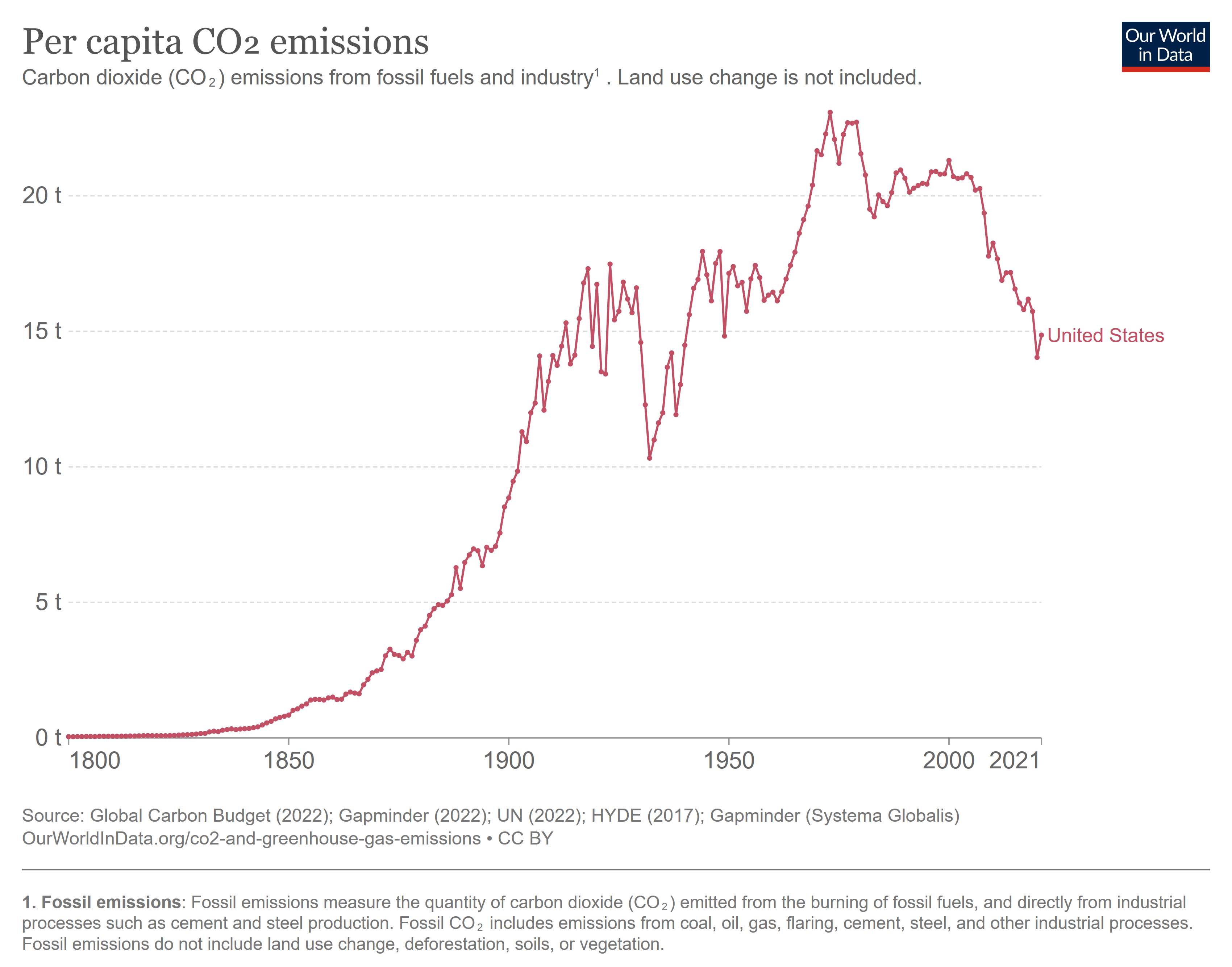
Not many people seem to know this, but the US has also been on the right track with regard to carbon emissions: Per-capita carbon emissions in the US have been trending downward since about 2000, and are now lower than they were in the 1950s. The Inflation Reduction act now looks poised to double down on that progress, as it has been forecasted to reduce our emissions all the way down to 40% below their early-2000s peak.
Somehow, this success doesn’t seem to be getting across. The majority of Americans incorrectly believe that we are in a downturn. Biden’s approval rating is still only 40%, barely higher than Trump’s was. When it comes to political beliefs, most American voters appear to be utterly impervious to facts.
Most Americans do correctly believe that inflation is still a bit high (though many seem to think it’s higher than it is); this is weird, seeing as inflation is normally high when the economy is growing rapidly, and gets too low when we are in a recession. This seems to be Halo Effect, rather than any genuine understanding of macroeconomics: downturns are bad and inflation is bad, so they must go together—when in fact, quite the opposite is the case.
People generally feel better about their own prospects than they do about the economy as a whole:
Sixty-four percent of Americans say the economy is worse off compared to 2020, while seventy-three percent of Americans say the economy is worse off compared to five years ago. About two in five of Americans say they feel worse off from five years ago generally (38%) and a similar number say they feel worse off compared to 2020 (37%).
(Did you really have to write out ‘seventy-three percent’? I hate that convention. 73% is so much clearer and quicker to read.)
I don’t know what the Biden administration should do about this. Trying to sell themselves harder might backfire. (And I’m pretty much the last person in the world you should ask for advice about selling yourself.) But they’ve been doing really great work for the US economy… and people haven’t noticed. Thousands of factories are being built, millions of people are getting jobs, and the collective response has been… “meh”.
 Human Economics