Sep 3 JDN 2460191
It looks like China’s era of extremely rapid economic growth may be coming to an end. Consumer confidence in China cratered this year (and, in typical authoritarian fashion, the agency responsible just quietly stopped publishing the data after that). Current forecasts have China’s economy growing only about 4-5% this year, which would be very impressive for a First World country—but far below the 6%, 7%, even 8% annual growth rates China had in recent years.
Some slowdown was quite frankly inevitable. A surprising number of people—particularly those in or from China—seem to think that China’s ultra-rapid growth was something special about China that could be expected to continue indefinitely.
China’s growth does look really impressive, in isolation:

But in fact this is a pattern we’ve seen several times now (admittedly mostly in Asia): A desperately poor Third World country finally figures out how to get its act together, and suddenly has extremely rapid growth for awhile until it manages to catch up and become a First World country.
It happened in South Korea:

It happened in Japan:

It happened in Taiwan:

It even seems to be happening in Botswana:
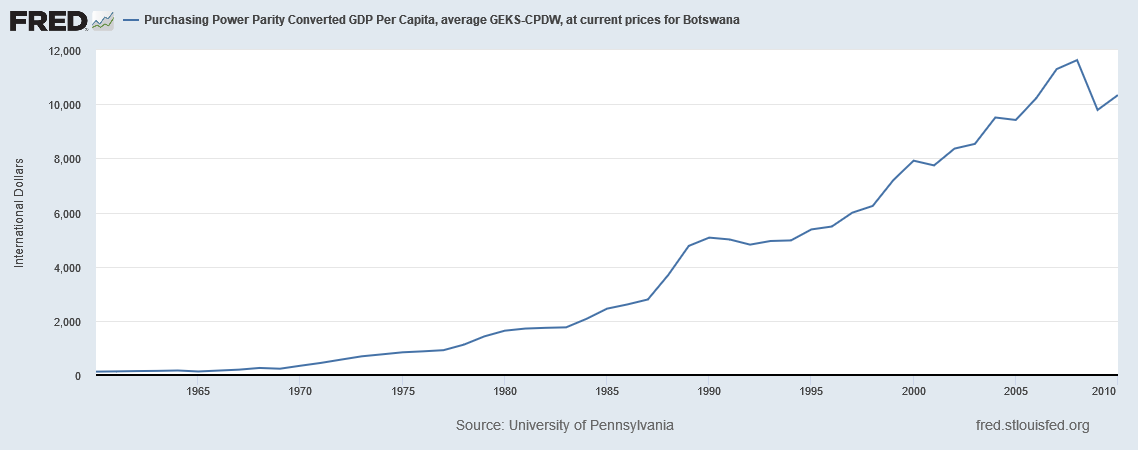
And this is a good thing! These are the great success stories of economic development. If we could somehow figure out how to do this all over the world, it might literally be the best thing that ever happened. (It would solve so many problems!)
Here’s a more direct comparison across all these countries (as well as the US), on a log scale:

From this you can pretty clearly see two things.
First, as countries get richer, their growth tends to slow down gradually. By the time Japan, Korea, and Taiwan reached the level that the US had been at back in 1950, their growth slowed to a crawl. But that was okay, because they had already become quite rich.
And second, China is nothing special: Yes, their growth rate is faster than the US, because the US is already so rich. But they are following the same pattern as several other countries. In fact they’ve actually fallen behind Botswana—they used to be much richer than Botswana, and are now slightly poorer.
So while there are many news articles discussing why China’s economy is slowing down, and some of them may even have some merit (they really seem to have screwed up their COVID response, for instance, and their terrible housing price bubble just burst); but the ultimate reason is really that 7% annual economic growth is just not sustainable. It will slow down. When and how remains in question—but it will happen.
Thus, I am not particularly worried about the fact that China’s growth has slowed down. Or at least, I wouldn’t be, if China were governed well and had prepared for this obvious eventuality the way that Korea and Japan did. But what does worry me is that they seem unprepared for this. Their authoritarian government seems to have depended upon sky-high economic growth to sustain support for their regime. The cracks are now forming in that dam, and something terrible could happen when it bursts.
Things may even be worse than they look, because we know that the Chinese government often distorts or omits statistics when they become inconvenient. That can only work for so long: Eventually the reality on the ground will override whatever lies the government is telling.
There are basically two ways this could go: They could reform their government to something closer to a liberal democracy, accept that growth will slow down and work toward more shared prosperity, and then take their place as a First World country like Japan did. Or they could try to cling to their existing regime, gripping ever tighter until it all slips out of their fingers in a potentially catastrophic collapse. Unfortunately, they seem to be opting for the latter.
I hope I’m wrong. I hope that China will find its way toward a future of freedom and prosperity.
But at this point, it doesn’t look terribly likely.
 Human Economics
[…] of whether we will move our capital to them. We have been doing so in China, and it worked (to a point). Before that, we did it in Korea and Japan, and it worked. Cambodia will probably come along […]
LikeLike