No, advertising is not signaling

JDN 2457373

Awhile ago, I wrote a post arguing that advertising is irrational, that at least with advertising as we know it, no real information is conveyed and thus either consumers are being irrational in their purchasing decisions, or advertisers are irrational for buying ads that don’t work.

One of the standard arguments neoclassical economists make to defend the rationality of advertising is that advertising is signaling—that even though the content of the ads conveys no useful information, the fact that there are ads is a useful signal of the real quality of goods being sold.

The idea is that by spending on advertising, a company shows that they have a lot of money to throw around, and are therefore a stable and solvent company that probably makes good products and is going to stick around for awhile.

Here are a number of different papers all making this same basic argument, often with sophisticated mathematical modeling. This paper takes an even bolder approach, arguing that people benefit from ads and would therefore pay to get them if they had to. Does that sound even remotely plausible to you? It sure doesn’t to me. Some ads are fairly entertaining, but generally if someone is willing to pay money for a piece of content, they charge money for that content.

Could spending on advertising offer a signal of the quality of a product or the company that makes it? Yes. That is something that actually could happen. The reason this argument is ridiculous is not that advertising signaling couldn’t happen—it’s that advertising is clearly nowhere near the best way to do that. The content of ads is clearly nothing remotely like what it would be if advertising were meant to be a costly signal of quality.

Look at this ad for Orangina. Look at it. Look at it.

https://www.youtube.com/watch?v=tKK37G-ZWvk

Now, did that ad tell you anything about Orangina? Anything at all?

As far as I can tell, the thing it actually tells you isn’t even true—it strongly implies that Orangina is a form of aftershave when in fact it is an orange-flavored beverage. It’d be kind of like having an ad for the iPad that involves scantily-clad dog-people riding the iPad like it’s a hoverboard. (Now that I’ve said it, Apple is probably totally working on that ad.)

This isn’t an isolated incident for Orangina, who have a tendency to run bizarre and somewhat suggestive (let’s say PG-13) TV spots involving anthropomorphic animals.

https://www.youtube.com/watch?v=ck14LKBI9GM

But more than that, it’s endemic to the whole advertising industry.

Look at GEICO, for instance; without them specifically mentioning that this is car insurance, you’d never know what they were selling from all the geckos,

and Neanderthals,

and… golf Krakens?

https://www.youtube.com/watch?v=SaJWYjWt9c0

Progressive does slightly better, talking about some of their actual services while also including an adorably-annoying spokesperson (she’s like Jar Jar, but done better):

https://www.youtube.com/watch?v=eG4tLPtAMcEState

State Farm also includes at least a few tidbits about their insurance amidst the teleportation insanity:

https://www.youtube.com/watch?v=HxznTayRCYQ

But honestly the only car insurance commercials I can think of that are actually about car insurance are Allstate’s, and even then they’re mostly about Dennis Haybert’s superhuman charisma. I would buy bacon cheeseburgers from this man, and I’m vegetarian.

https://www.youtube.com/watch?v=xPSgo-Bw5RA

Esurance is also relatively informative (and owned by Allstate, by the way); they talk about their customer service and low prices (in other words, the only things you actually care about with car insurance). But even so, what reason do we have to believe their bald assertions of good customer service? And what’s the deal with the whole money-printing thing?

https://www.youtube.com/watch?v=TrZ8DpH9_64

And of course I could deluge you with examples from other companies, from Coca-Cola’s polar bears and Santa Claus to this commercial, which is literally the most American thing I have ever seen:

https://www.youtube.com/watch?v=NjSJj_Pdjys

If you’re from some other country and are going, “What!?” right now, that’s totally healthy. Honestly I think we would too if constant immersion in this sort of thing hadn’t deadened our souls.

Do these ads signal that their companies have a lot of extra money to burn? Sure. But there are plenty of other ways to do that which would also serve other valuable functions. I honestly can’t imagine any scenario in which the best way to tell me the quality of an auto insurance company is to show me 30-second spots about geckos and Neanderthals.

If a company wants to signal that they have a lot of money, they could simply report their financial statement. That’s even regulated so that we know it has to be accurate (and this is one of the few financial regulations we actually enforce). The amount you spent on an ad is not obvious from the result of the ad, and doesn’t actually prove that you’re solvent, only that you have enough access to credit. (Pets.com famously collapsed the same year they ran a multi-million-dollar Super Bowl ad.)

If a company wants to signal that they make a good product, they could pay independent rating agencies to rate products on their quality (you know, like credit rating agencies and reviewers of movies and video games). Paying an independent agency is far more reliable than the signaling provided by advertising. Consumers could also pay their own agencies, which would be even more reliable; credit rating agencies and movie reviewers do sometimes have a conflict of interest, which could be resolved by making them report to consumers instead of producers.

If a company wants to establish that they are both financially stable and socially responsible, they could make large public donations to important charities. (This is also something that corporations do on occasion, such as Subaru’s recent campaign.) Or they could publicly announce a raise for all their employees. This would not only provide us with the information that they have this much money to spend—it would actually have a direct positive social effect, thus putting their money where there mouth is.

Signaling theory in advertising is based upon the success of signaling theory in evolutionary biology, which is beyond dispute; but evolution is tightly constrained in what it can do, so wasteful costly signals make sense. Human beings are smarter than that; we can find ways to convey information that don’t involve ludicrous amounts of waste.

If we were anywhere near as rational as these neoclassical models assume us to be, we would take the constant bombardment of meaningless ads not as a signal of a company’s quality but as a personal assault—they are needlessly attacking our time and attention when all the genuinely-valuable information they convey could have been conveyed much more easily and reliably. We would not buy more from them; we would refuse to buy from them. And indeed, I’ve learned to do just that; the more a company bombards me with annoying or meaningless advertisements, the more I make a point of not buying their product if I have a viable substitute. (For similar reasons, I make a point of never donating to any charity that uses hard-sell tactics to solicit donations.)

But of course the human mind is limited. We only have so much attention, and by bombarding us frequently and intensely enough they can overcome our mental defenses and get us to make decisions we wouldn’t if we were optimally rational. I can feel this happening when I am hungry and a food ad appears on TV; my autonomic hunger response combined with their expert presentation of food in the perfect lighting makes me want that food, if only for the few seconds it takes my higher cognitive functions to kick in and make me realize that I don’t eat meat and I don’t like mayonnaise.

Car commercials have always been particularly baffling to me. Who buys a car based on a commercial? A decision to spend $20,000 should not be made based upon 30 seconds of obviously biased information. But either people do buy cars based on commercials or they don’t; if they do, consumers are irrational, and if they don’t, car companies are irrational.

Advertising isn’t the source of human irrationality, but it feeds upon human irrationality, and is specifically designed to exploit our own stupidity to make us spend money in ways we wouldn’t otherwise. This means that markets will not be efficient, and huge amounts of productivity can be wasted because we spent it on what they convinced us to buy instead of what would truly have made our lives better. Those companies then profit more, which encourages them to make even more stuff nobody actually wants and sell it that much harder… and basically we all end up buying lots of worthless stuff and putting it in our garages and wondering what happened to our money and the meaning in our lives. Neoclassical economists really need to stop making ridiculous excuses for this damaging and irrational behavior–and maybe then we could actually find a way to make it stop.
Something is wrong with the corporate income tax

JDN 2457369

The US corporate income tax is clearly not working.
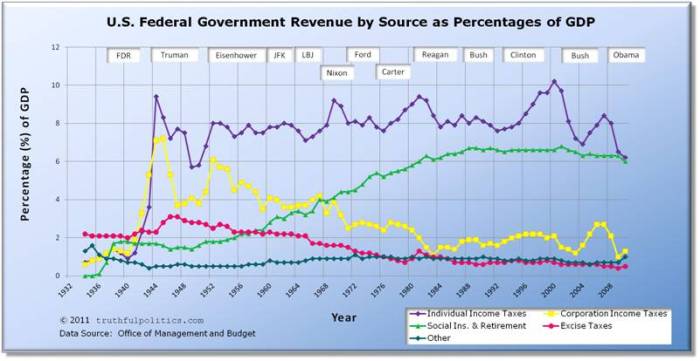
While at one time the corporate income tax took in almost as much revenue as the personal income tax, those days are long gone. In 1934 the personal income tax took in $420 million and the corporate income tax took in $364 million, (adjusted for inflation that’s $7.4 billion and $6.5 billion—still remarkably small! Taxes in the US used to be extremely low; now they are merely quite low). Today, the personal income tax takes in $1.39 trillion while the corporate income tax only takes in $320 billion. As you can see in the graph below (brought to you by Truthful Politics), while personal income tax revenue as a portion of GDP has been about the same since WW2, corporate income tax revenue has been steadily declining.

revenue_sources_GDP

Part of the problem is that it is so easy for corporations to hide their assets offshore; an estimated $2 trillion is currently held in corporate offshore accounts, almost all of it there to avoid US corporate tax.

The US corporate income tax has some unique features that set it apart from the corporate taxes of most other countries.
One, the rate of the US corporate tax is exceptionally high. That’s highly unusual; for almost every other sort of tax, the US tax rate is among the lowest, particularly when you compare with other First World countries. The United States was in a sense founded upon the idea of not paying taxes, and we have upheld that ideal for two centuries and counting.

Two, the US has a worldwide corporate tax system, whereas most countries have a territorial corporate tax system. In theory, this means that US corporations are required to pay tax on all their profits, wherever they are made, while most countries only require you to pay tax on profits you made in that country.

But wait—didn’t I just say that corporations hide trillions of dollars offshore to avoid US corporate tax? How can they do that, if they’re required to pay tax on all worldwide profits?

In a word? Loopholes.

Two that are particularly popular are inversion and transfer pricing. I won’t bore you with all the details, but basically inversion is when a US company pretends to be owned by a foreign company (I mean, I guess they are legally owned, but only on paper—real leadership rarely changes), so that their profits are now accounted in that foreign country; transfer pricing is a system by which corporations “buy” services from their subsidiaries in other countries, usually at ludicrously high prices in order to justify saying that they took a loss but their subsidiaries (which are not legally US corporations) made huge profits.

Of course, those are far from the only loopholes. There’s a long and ever-expanding list, as loopholes are like the Hydra: Cut off one head and two more shall emerge. For each loophole we close, lobbyists are hard at work creating two more. We must kill it with fire as Hercules did—burn out the entire corporate tax (and lobbying!) system as we know it and make something new.

In fact, most of the money corporations supposedly have “offshore” is actually being stored and spent here in the US. The “accounts” are offshore, but the actual cash, or more likely the actual encrypted servers that store the numbers (for that is what almost all of our money is nowadays—numbers in encrypted servers), are all here in the US. In the rare case that the money itself is actually elsewhere, they just take loans using it as collateral and spend the loan money here—because corporate debt payments are tax-deductible.

So this argument I see a lot that we need a “tax holiday” to encourage corporations to bring their money home and create jobs here is ridiculous. No, they’re already creating any jobs they were planning on creating (which of course they do only on the basis of expected consumer demand).

This money is already being used for everything it would be used for. The only distortion that corporate tax avoidance causes is a lack of tax revenue.

Now, there are two possible ways we could solve this problem in corporate tax reform.

The first is the tack Bernie Sanders takes, and it’s actually one of the few things I strongly disagree with him about. Bernie Sanders plans to reform the corporate tax system in a manner that will force corporations to actually pay taxes on their profits, closing most of these loopholes that allow them to avoid taxation.

The second is the one I favor, and for once I find myself agreeing with the American Enterprise Institute. We should eliminate the corporate tax entirely, and replace it with a higher tax rate on dividends and capital gains. I even rather like their idea of linking the tax rates on capital gains to the tax rates on ordinary income, so there is no longer any incentive to make your income be (or look likecarried interest) capital income instead of labor income.

Now, when I say that I agree with the American Enterprise Institute against Bernie Sanders, an explanation is surely in order. Normally quite the opposite is the case.

Well, first of all I also agree with the business writers in The Atlantic and The New York Times on this one, which should make my view a bit less surprising. But still, I should explain why many liberal economists think that the corporate income tax needs to disappear, since the common perception is that the corporate income tax affects the very rich, and normally liberal economists are all about raising taxes on the very rich in order to raise revenue while minimizing the harms of taxes.

And indeed I am all about raising taxes on the very rich—indeed, my proposed tax plan is the most progressive tax system this side of Eisenhower.

The problem is, we’re not sure if the corporate income tax actually does that.

I created my tax incidence series in large part to make this one fundamental point: The the person who writes the check is not necessarily person who actually pays the tax.

For personal income taxes, we understand their incidence relatively well. While we do think they create some small distortions in the economy as a whole, in general labor is inelastic enough that the burden of a personal income tax falls largely upon the person receiving the income. This makes income taxes a good means of actually redistributing income from one person to another. It’s very hard to disincentivize income; at most we might disincentivize work, and in a country that has twice as many unemployed people as job openings it’s hard for me to see how we have a problem with insufficient work incentives. If the Beveridge Curve ever gets so high up that we actually have more job openings than people looking for jobs, okay, then we can start talking about work incentives. It hasn’t happened at least in my lifetime.

Many economists argue that consumption is an even better thing to tax than income, because they want to increase the savings rate; but I am increasingly convinced that this is not actually a useful thing to do, and indeed that the savings rate is almost literally meaningless. (Perhaps in a future post I’ll talk about why I think so.) I will say this, however: Sales taxes have extremely well-understood incidence. They are the thing that our tax models were originally developed to handle, and they handle it very well. We can predict quite accurately what the effect of increases in sales taxes (or taxes on particular goods, such as alcohol) will be on consumer choices. Their predictability is a reason to recommend them, but in my opinion not sufficient to justify widespread use of sales taxes rather than income taxes.

The incidence of corporate income tax, on the other hand, is almost completely unknown. A substantial amount of research has gone into trying to understand corporate income taxes, but it is still not entirely clear who bears the primary burden of the corporate income tax, whether it is the owners of a corporation, its employees, or its customers. Because, pace Citizens United, corporations are not actually people. Corporations do not experience utility that can be raised or lowered. The money they make ultimately goes to actual human beings, and it’s those actual human beings we are interested in taxing.

To see this, think about what happens when we impose a tax on a corporation’s profits. One possibility is that their behavior is completely inelastic: They’ll just keep doing exactly the same thing they were doing, only now making less profit. But does that seem likely? No, it’s far more likely that they’re going to try to find some way to avoid the tax, or at least reduce how much they have to pay. They’ll use offshore banking and clever accounting methods to make it look like they have less profit than they really do. Even worse, they may even change the way that they run their company—producing fewer products or raising prices, laying off employees or reducing wages. They may decide not to make investments they otherwise would have, or overspend on capital they don’t actually need just for the tax deduction. All of these activities create real distortions in the economy and cause deadweight loss; and the harm they cause to employees or consumers could be much larger than the pain they impose on the owners of the corporation.

If we knew which of these strategies corporations would take, then we could predict the outcome and base our tax policy on that. But at present we are unable to do that. In fact, all of these strategies are probably employed by various corporations, and what we most care about is the aggregate effect—but we are currently unable to predict even that.

Indeed, given that they have so many options, it is most likely that the owners of corporations do not bear the burden of corporate income taxes. As you may recall from my tax incidence series, the person who bears a tax is the one who is least elastic; that is, the one who changes their behavior in response to the tax the least. This is likely to be the one who has the fewest alternatives—and employees and consumers have far fewer alternatives than corporate executives do. Indeed, employees probably have the fewest alternatives, and are likely the most inelastic; thus, they are probably the ones who actually bear the burden of the corporate income tax. And most inelastic of all are the employees at the bottom of the ladder (or should I say primate hierarchy), people like interns, janitors, and cashiers.

It may be counter-intuitive, but it is most likely true: By eliminating the corporate income tax, we will most likely create jobs and raise wages, especially for the people at the bottom. Janitors and cashiers may be the ones who feel the largest increase in pay.

There is a legitimate concern that raising capital gains rates could even have a similar effect. Under certain assumptions, the Atkinson-Stiglitz Theorem famously says that taxes on capital income cannot be used to redistribute wealth because they will impose more cost on workers than they raise in revenue for the transfer. They would reduce inequality only at the cost of reducing overall income, which clearly isn’t what we want. That would actually violate the Difference Principle, the seminal contribution to the theory of distributive justice we owe to John Rawls.

But the assumptions of that theorem are highly unrealistic, as I discussed in an earlier post. With a realistic idea of how capital income is actually allocated (I honestly can’t bear to say “earned” in this context), it becomes fairly obvious that taxes on capital income create minimal, if any, real distortions on hiring and investment. While corporate profits are fairly closely tied to the actual production and distribution of goods, capital income most assuredly is not. A corporate income tax takes money away from a corporation such as Apple or Boeing (well, not Apple or Boeing in particular, since they avoid it expertly; but the corporations that aren’t big enough to avoid corporate taxes are largely ones you’ve never heard of—yet another reason they’re unfair), who then most likely take it from their employees or their customers. A capital gains tax takes money away from people who bought and sold shares of Apple and Boeing, possibly thousands of times per second, people who most likely don’t even work there, have nothing to do with any decisions those companies have ever made, and may not even buy any of their products. I think you can see why in the latter case the decisions of the company are a lot less likely to be distorted.

It’s also harder to avoid capital gains taxes (albeit by no means impossible), especially if they are structured properly without loopholes. Thus, the same nominal rate on capital gains instead of corporate profits would likely raise a great deal more revenue.

In short, the corporate income tax is not working; I say we get rid of it altogether.

Why building more roads doesn’t stop rush hour

JDN 2457362

The topic of this post was selected based on the very first Patreon vote (which was albeit limited because I only had three patrons eligible to vote and only one of them actually did vote; but these things always start small, right?). It is what you (well, one of you) wanted to see. In future months there will be more such posts, and hopefully more people will vote.

Most Americans face an economic paradox every morning and every evening. Our road network is by far the largest in the world (for three reasons: We’re a huge country geographically, we have more money than anyone else, and we love our cars), and we continue to expand it; yet every morning around 8:00-9:00 and every evening around 17:00-18:00 we face rush hour, in which our roads become completely clogged by commuters and it takes two or three times as long to get anywhere.

Indeed, rush hour is experienced around the world, though it often takes the slightly different form of clogged public transit instead of clogged roads. In most countries, there are two specific one-hour periods in the morning and the evening in which all transportation is clogged to a standstill.

This is probably such a familiar part of your existence you never stopped to question it. But in fact it is quite bizarre; the natural processes of economic supply and demand should have solved this problem decades ago, so why haven’t they?

There are a number of important forces at work here, all of which conspire to doom our transit systems.

The first is the Tragedy of the Commons, which I’ll likely write about in the future (but since it didn’t win the vote, not just yet). The basic idea of the Tragedy of the Commons is similar to the Prisoner’s Dilemma, but expanded to a large number of people. A Tragedy of the Commons is a situation in which there are many people, each of whom has the opportunity to either cooperate with the group and help everyone a small amount, or defect from the group and help themselves a larger amount. If everyone cooperates, everyone is better off; but holding everyone else’s actions fixed, it is in each person’s self-interest to defect.

As it turns out, people do act closer to the neoclassical prediction in the Tragedy of the Commons—which is something I’d definitely like to get into at some point. Two different psychological mechanisms counter one another, and result in something fairly close to the prediction of neoclassical rational self-interest, at least when the number of people involved is very large. It’s actually a good example of how real human beings can deviate from neoclassical rationality both in a good way (we are altruistic) and in a bad way (we are irrational).

The large-scale way roads are a Tragedy of the Commons is that they are a public good, something that we share as a society. Except for toll roads (which I’ll get to in a moment), roads are set up so that once they are built, anyone can use them; so the best option for any individual person is to get everyone else to pay to build them and then quite literally free-ride on the roads everyone else built. But if everyone tries to do that, nobody is going to pay for the roads at all.

And indeed, our roads are massively underfunded. Simply to maintain currently-existing roads we need to spend about an additional $100 billion per year over what we’re already spending. Yet once you factor in all the extra costs of damaged vehicles, increased accidents, time wasted, and the fact that fixing things is cheaper than replacing them, in fact the cost to not maintain our roads is about 3 times as large as that. This is exactly what you expect to see in a Tragedy of the Commons; there’s a huge benefit for everyone just sitting there, not getting done, because nobody wants to pay for it themselves. Michigan saw this quite dramatically when we voted down increased road funding because it would have slightly increased sales taxes. (Granted, we should be funding roads with fuel taxes, not general sales taxes—but those are hardly any more popular.)

Toll roads can help with this, because they internalize the externality: When you have to pay for the roads that you use, you either use them less (creating less wear and tear) or pay more; either way, the gap between what is paid and what is needed is closed. And indeed, toll roads are better maintained than other roads. There are downsides, however; the additional effort to administrate the tolls is expensive, and traffic can be slowed down by toll booths (though modern transponder systems mitigate this effect substantially). Also, it’s difficult to fully privatize roads, because there is a large up-front cost and it takes a long time for a toll road to become profitable; most corporations don’t want to wait that long.

But we do build a lot of roads, and yet still we have rush hour. So that isn’t the full explanation.

The small-scale way that roads are a Tragedy of the Commons is that when you decide to drive during rush hour, you are in a sense defecting in a Tragedy of the Commons. You will get to your destination sooner than if you had waited until traffic clears; but by adding one more car to the congestion you have slowed everyone else down just a little bit. When we sum up all these little delays, we get the total gridlock that is rush hour. If you had instead waited to drive on clear roads, you would get to your destination without inconveniencing anyone else—but you’d get there a lot later.

The second major reason why we have rush hour is what is called induced demand. When you widen a road or add a parallel route, you generally fail to reduce traffic congestion on that route in the long run. What happens instead is that driving during rush hour becomes more convenient for a little while, which makes more people start driving during rush hour—they buy a car when they used to take the bus, or they don’t leave as early to go to work. Eventually enough people shift over that the equilibrium is restored—and the equilibrium is gridlock.

But if you think carefully, that can’t be the whole explanation. There are only so many people who could start driving during rush hour, so what if we simply built enough roads to accommodate them all? And if our public transit systems were better, people would feel no need to switch to driving, even if driving had in fact been made more convenient. And indeed, transportation economists have found that adding more capacity does reduce congestion—it just isn’t enough unless you also improve public transit. So why aren’t we improving public transit? See above, Tragedy of the Commons.

Yet we still don’t have a complete explanation, because of something that’s quite obvious in hindsight: Why do we all work 9:00 to 17:00!? There’s no reason for that. There’s nothing inherent about the angle of sunlight or something which requires us to work these hours—indeed, if there were, Daylight Savings Time wouldn’t work (which is not to say that it works well—Daylight Savings Times kills).

There should be a competitive market pressure to work different hours, which should ultimately lead to an equilibrium where traffic is roughly constant throughout the day, at least during the time when a large swath of the population is awake and outside. Congestion should spread itself out over time, because it is to the advantage of all involved if each driver tries to drive at a time when other driver’s aren’t. Driving outside of rush hour gives us an opportunity for something like “temporal arbitrage”, where you can pay a small amount of time here to get a larger amount of time there. And if there’s one thing a competitive economy is supposed to get rid of, it’s arbitrage.

But no, we keep almost all our working hours aligned at 09:00-17:00, and thus we get rush hour.

In fact, a lot of jobs would function better if they weren’t aligned in this way—retail sales, for example, is most successful during the “off hours”, because people only shop when they aren’t working. (Well, except for online shopping, and even then they’re not supposed to.) Banks continually insist on making their hours 9:00 to 17:00 when they know that on most days they’d actually get more business from 17:00 to 19:00 than they did from 9:00 to 17:00. Some banks are at least figuring that out enough to be open from 17:00 to 19:00—but they still don’t seem to grasp that retail banking services have no reason to be open during normal business hours. Commerce banking services do; but that’s a small portion of their overall customers (albeit not of their overall revenue). There’s no reason to have so many full branches open so many hours with most of the tellers doing nothing most of the time.

Education would be better off being later in the day, when students—particularly teenagers—have a chance to sleep in the way their brains are evolved to. The benefits of later school days in terms of academic performance and public health are actually astonishingly large. When you move the start of high school from 07:00 to 09:00, auto collisions involving teenagers drop 70%. Perhaps should be the new slogans: “Early classes cause car crashes.” Since 25% of auto collisions occur during rush hour, here’s another: “Always working nine to five? Vehicular homicide.”

Other jobs could have whatever hours they please. There’s no reason for most forms of manufacturing to be done at any particular hour of the day. Most clerical and office work could be done at any time (and thanks to the Internet, any place; though there are real benefits to working in an office). Writing can be done whenever it is convenient for the author—and when you think about it, an awful lot of jobs basically amount to writing.

Finance is only handled 09:00-17:00 because we force it to be. The idea of “opening” and “closing” the stock market each day is profoundly anachronistic, and actually amounts to granting special arbitrage privileges to the small number of financial institutions that are allowed to do so-called “after hours” trading.

And then there’s the fact that different people have different circadian rhythms, require different amounts of sleep and prefer to sleep at different times—it’s genetic. (My boyfriend and I are roughly three hours phase-shifted relative to one another, which made it surprisingly convenient to stay in touch when I lived in California and he lived in Michigan.)

Why do we continue to accept such absurdity?

Whenever you find yourself asking that question, try this answer first, for it is by far the most likely:

Social norms.

Social norms will make human beings do just about anything, from eating cockroaches to murdering elephants, from kilts to burqas, from waving giant foam hands to throwing octopus onto ice rinks, from landing on the moon to crashing into the World Trade Center, from bombing Afghanistan to marching on Washington, from eating only raw foods to using dead pigs as sex toys. Our basic mental architecture is structured around tribal identity, and to preserve that identity we will follow almost any rule imaginable. To a first approximation, all human behavior is social norms.

And indeed I can find no other explanation for why we continue to work on a “nine-to-five” 09:00-17:00 schedule (or for that matter why it probably feels weird to you that I say “17:00” instead of the far less efficient and more confusion-prone “5:00 PM”). Our productivity has skyrocketed, increasing by a factor of 4 just since 1950 (and these figures dramatically underestimate the gains in productivity from computer technology, because so much is in the form of free content, which isn’t counted in GDP). We could do the same work in a quarter the time, or twice as much in half the time. Yet still we continue to work the same old 40-hour work week, nine-to-five work day. We each do the work of a dozen previous workers, yet we still find a way to fill the same old work week, and the rich who grow ever richer still pay us more or less the same real wages. It’s all basically social norms at this point; this is how things have always been done, and we can’t imagine any other way. When you get right down to it, capitalism is fundamentally a system of social norms—a very successful one, but far from the only possibility and perhaps not the best.

Thus, why does building more roads not solve the problem of rush hour? Because we have a social norm that says we are all supposed to start work at 09:00 and end work at 17:00.
And that, dear readers, is what we must endeavor to change. Change our thinking, and we will change the norms. Change the norms, and we will change the world.

I have created a Patreon!

Patreon is a crowdfunding platform which allows authors, artists, and other creative people to be funded by small donations from a large number of people, supporting them financially while giving them as much time as possible to do their creative work. Patrons pledge to give a certain amount each month (or per project, but I decided to use a “per month” basis so it’s more predictable for all involved), which (after a small fee for Patreon itself) goes directly to the creative workers to help fund their work.

I have just launched a Patreon for myself, to support this blog and more generally my efforts in research and writing.  If you like what you see here (and I assume you do, since you’re reading it), I encourage you to support me in producing future content by becoming a patron. Even $1 per month is enough to become a patron (and adds up quickly if I get enough people!), and higher amounts will grant you special perks like early access to my drafts and the opportunity to vote on future topics.

The following link will take you to my Patreon public page, where you can get further information and become a patron if you so choose:
https://www.patreon.com/pnrjulius

This weekend has been a bit crazy.

This weekend I not only had a funeral to attend of a family friend who died suddenly, I had already committed to being part of the WolverineSoft 48-Hour Game Jam, in which our team of four attempts to construct an original playable computer game from free components in less than 48 hours. In lieu of a blog post I’ll hopefully be able to post a link of our completed game this evening.

I’m on vacation for a couple of weeks

I probably won’t have time to make my usual posts this week or next week due to vacation. This week I’m in Virginia Beach, and next week I’ll be in Indianapolis for Gen Con. Normal posts will resume in two weeks, on August 8.

Actually, I’m starting to run out of planned topics. I’m sure I can come up with more, but if you, dear readers, have any suggestions of topics you’d like to see me cover in the future I would like to hear them.

The cognitive science of morality part I: Joshua Greene

JDN 2457124 EDT 15:33.

Thursday and Friday of this past week there was a short symposium at the University of Michigan called “The Cognitive Science of Moral Minds“, sponsored by the Weinberg Cognitive Science Institute, a new research institute at Michigan. It was founded by a former investment banker, because those are the only people who actually have money these days—and Michigan, like most universities, will pretty much take money from whoever offers it (including naming buildings after those people and not even changing the name after it’s revealed that the money was obtained in a $550-million fraud scheme, for which he was fined $200 million, because that’s apparently how our so-called “justice” system so-called “works”. A hint for the SEC: If the fine paid divided by the amount defrauded would be a sensible rate for a marginal income tax, that’s not a punishment). So far as I know Weinberg isn’t a white-collar criminal the way Wyly is, so that’s good at least. Still, why are we relying upon investment bankers to decide what science institutes we’ll found?

The Weinberg Institute was founded just last year. Yes, four years after I got my bachelor’s degree in cognitive science from Michigan, they decide to actually make that a full institute instead of an awkward submajor of the psychology department. Oh, and did I mention how neither the psychology or economics department would support my thesis research in behavioral economics but then called in Daniel Kahneman as the keynote speaker at my graduation? Yeah, sometimes I think I’m a little too cutting-edge for my own good.

The symposium had Joshua Greene of Harvard and Molly Crockett of Oxford, both of whom I’d been hoping to meet for a few years now. I finally got the chance! (It also had Peter Railton—likely not hard to get, seeing as he works at our own philosophy department, but still has some fairly interesting ideas—and some law professor I’d never heard of named John Mikhail, whose talk was really boring.) I asked Greene how I could get in on his research, and he said I should do a PhD at Harvard… which is something I’ve been trying to convince Harvard for three years now—they keep not letting me in.

Anyway… the symposium was actually quite good, and the topic of moral cognition is incredibly fascinating and of course incredibly relevant to Infinite Identical Psychopaths.

Let’s start with Greene’s work. His basic research program is studying what our brains are doing when we try to resolve moral dilemmas. Normally I’m not a huge fan of fMRI research, because it’s just so damn coarse; I like to point out that it is basically equivalent to trying to understand how your computer works by running a voltmeter over the motherboard. But Greene does a good job of not over-interpreting results and combining careful experimental methods to really get a better sense of what’s going on.

There are basically two standard moral dilemmas people like to use in moral cognition research, and frankly I think this is a problem, because they don’t only differ in the intended way but also in many other ways; also once you’ve heard them, they no longer surprise you, so if you ever are a subject in one moral cognition experiment, it’s going to color your responses in any others from then on. I think we should come up with a much more extensive list of dilemmas that differ in various different dimensions; this would also make it much less likely for someone to already have seen them all before. A few weeks ago I made a Facebook post proposing a new dilemma of this sort, and the response, while an entirely unscientific poll, at least vaguely suggested that something may be wrong with the way Greene and others interpret the two standard dilemmas.

What are the standard dilemmas? They are called the trolley dilemma and the footbridge dilemma respectively; collectively they are trolley problems, of which there are several—but most aren’t actually used in moral cognition research for some reason.

In the trolley dilemma, there is, well, a trolley, hurtling down a track on which, for whatever reason, five people are trapped. There is another track, and you can flip a switch to divert the trolley onto that track, which will save those five people; but alas there is one other person trapped on that other track, who will now die. Do you flip the switch? Like most people, I say “Yes”.

In the footbridge dilemma, the trolley is still hurtling toward five people, but now you are above the track, standing on a footbridge beside an extremely fat man. The man is so fat, in fact, that if you push him in front of the trolley he will cause it to derail before it hits the five other people. You yourself are not fat enough to achieve this. Do you push the fat man? Like most people, I say “No.”

I actually hope you weren’t familiar with those dilemmas before, because your first impression is really useful to what I’m about to say next: Aren’t those really weird?

I mean, really weird, particularly the second one—what sort of man is fat enough to stop a trolley, yet nonetheless light enough or precariously balanced enough that I can reliably push him off a footbridge? These sorts of dilemmas are shades of the plugged-in-violinist; well, if the Society of Violin Enthusiasts ever does that, I suppose you can unplug the violinist—but what the hell does that have to do with abortion? (At the end of this post I’ve made a little appendix about the plugged-in-violinist and why it fails so miserably as an argument, but since it’s tangential I’ll move on for now.)

Even the first trolley problem, which seems a paragon of logical causality by comparison, is actually pretty bizarre. What are these people doing on the tracks? Why can’t they get off the tracks? Why is the trolley careening toward them? Why can’t the trolley be stopped some other way? Why is nobody on the trolley? What is this switch doing here, and why am I able to switch tracks despite having no knowledge, expertise or authority in trolley traffic control? Where are the proper traffic controllers? (There’s actually a pretty great sequence in Stargate: Atlantis where they have exactly this conversation.)

Now, if your goal is only to understand the core processes of human moral reasoning, using bizarre scenarios actually makes some sense; you can precisely control the variables—though, as I already said, they really don’t usuallyand see what exactly it is that makes us decide right from wrong. Would you do it for five? No? What about ten? What about fifty? Just what is the marginal utility of pushing a fat man off a footbridge? What if you could flip a switch to drop him through a trapdoor instead of pushing him? (Actually Greene did do that one, and the result is that more people do it than would push him, but not as many as would flip the switch to shift the track.) You’d probably do it if he willingly agreed, right? What if you had to pay his family $100,000 in life insurance as part of the deal? Does it matter if it’s your money or someone else’s? Does it matter how much you have to pay his family? $1,000,000? $1,000? Only $10? If he only needs $1 of enticement, is that as good as giving free consent?

You can go the other way as well: So you’d flip the switch for five? What about three? What about two? Okay, you strict act-utilitarian you: Would you do it for only one? Would you flip a coin because the expected marginal utility of two random strangers is equal? You wouldn’t, would you? So now your intervention does mean something, even if you think it’s less important than maximizing the number of lives saved. What if it were 10,000,001 lives versus 10,000,000 lives? Would you nuke a slightly smaller city to save a slightly larger one? Does it matter to you which country the cities are in? Should it matter?

Greene’s account is basically the standard one, which is that the reason we won’t push the fat man off the footbridge is that we have an intense emotional reaction to physically manhandling someone, but in the case of flipping the switch we don’t have that reaction, so our minds are clearer and we can simply rationally assess that five lives matter more than one. Greene maintains that this emotional response is irrational, an atavistic holdover from our evolutionary history, and we would make society better by suppressing it and going with the “rational”, (act-)utilitarian response. (I know he knows the difference between act-utilitarian and rule-utilitarian, because he has a PhD in philosophy. Why he didn’t mention it in the lecture, I cannot say.)

He does make a pretty good case for that, including the fMRIs showing that emotion centers light up a lot more for the footbridge dilemma than for the trolley dilemma; but I must say, I’m really not quite convinced.

Does flipping the switch to drop him through a trapdoor yield more support because it’s emotionally more distant? Or because it makes a bit more sense? We’ve solved the “Why can I push him hard enough?” problem, albeit not the “How he is heavy enough to stop a trolley?” problem.

I’ve also thought about ways to make the gruesome manhandling happen but nonetheless make more logical sense, and the best I’ve come up with is what we might call the lion dilemma: There is a hungry lion about to attack a group of five children and eat them all. You are standing on a ridge above, where the lion can’t easily get to you; if he eats the kids you’ll easily escape. Beside you is a fat man who weighs as much as the five children combined. If you push him off the ridge, he’ll be injured and unable to run, so the lion will attack him first, and then after eating him the lion will no longer be hungry and will leave the children alone. You yourself aren’t fat enough to make this work, however; you only weigh as much as two of the kids, not all five. You don’t have any weapons to kill the lion or anyone you could call for help, but you are sure you can push the fat man off the ridge quickly enough. Do you push the fat man off the ridge? I think I do—as did most of my friends in my aforementioned totally unscientific Facebook poll—though I’m not as sure of that as I was about flipping the switch. Yet nobody can deny the physicality of my action; not only am I pushing him just as before, he’s not going to be merely run over by a trolley, he’s going to be mauled and eaten by a lion. Of course, I might actually try something else, like yelling, “Run, kids!” and sliding down with the fat man to try to wrestle the lion together; and again we can certainly ask what the seven of us are doing out here unarmed and alone with lions about. But given the choice between the kids being eaten, myself and three of the kids being eaten, or the fat man being eaten, the last one does actually seem like the least-bad option.

Another good one, actually by the same Judith Thompson of plugged-in-violinist fame (for once her dilemma actually makes some sense; seriously, read A Defense of Abortion and you’ll swear she was writing it on psilocybin), is the transplant dilemma: You’re a doctor in a hospital where are five dying patients of different organ failures—two kidneys, one liver, one heart, and one lung, let’s say. You are one of the greatest transplant surgeons of all time, and there is no doubt in your mind that if you had a viable organ for each of them, you could save their lives—but you don’t. Yet as it so happens, a young man is visiting town and came to the hospital after severely breaking his leg in a skateboarding accident. He is otherwise in perfect health, and what’s more, he’s an organ donor and actually a match for all five of your dying patients. You could quietly take him into the surgical wing, give him a little too much anesthesia “by accident” as you operate on his leg, and then take his organs and save all five other patients. Nobody would ever know. Do you do it? Of course you don’t, you’re not a monster. But… you could save five by killing one, right? Is it just your irrational emotional aversion to cutting people open? No, you’re a surgeon—and I think you’ll be happy to know that actual surgeons agree that this is not the sort of thing they should be doing, despite the fact that they obviously have no problem cutting people open for the greater good all the time. The aversion to harm your own patient may come from (or be the source of) the Hippocratic Oath—are we prepared to say that the Hippocratic Oath is irrational?

I also came up with another really interesting one I’ll call the philanthropist assassin dilemma. One day, as you are walking past a dark alley, a shady figure pops out and makes you an offer: If you take this little vial of cyanide and pour it in the coffee of that man across the street while he’s in the bathroom, a donation of $100,000 will be made to UNICEF. If you refuse, the shady character will keep the $100,000 for himself. Nevermind the weirdness—they’re all weird, and unlike the footbridge dilemma this one actually could happen even though it probably won’t. Assume that despite being a murderous assassin this fellow really intends to make the donation if you help him carry out this murder. $100,000 to UNICEF would probably save the lives of over a hundred children. Furthermore, you can give the empty vial back to the philanthropist assassin and since there’s no logical connection between you and the victim, there’s basically no chance you’d ever be caught even if he is. (Also, how can you care more about your own freedom than the lives of a hundred children?) How can you justify not doing it? It’s just one man you don’t know, who apparently did something bad enough to draw the ire of philanthropist assassins, against the lives of a hundred innocent children! Yet I’m sure you share my strong intuition that you should not take the offer. It doesn’t require manhandling anybody—just a quick little pour into a cup of coffee—so that can’t be it. A hundred children! And yet I still don’t see how I could carry out this murder. Is that irrational, as Greene claims? Should we be prepared to carry out such a murder if the opportunity ever arises?

Okay, how about this one then, the white-collar criminal dilemma? You are a highly-skilled hacker, and you could hack into the accounts of a major bank and steal a few dollars from each account, gathering a total of $1 billion that you can then immediately donate to UNICEF, covering their entire operating budget for this year and possibly next year as well, saving the lives of countless children—perhaps literally millions of children. Should you do it? Honestly in this case I think maybe you should! (Maybe Sam Wyly isn’t so bad after all? He donated his stolen money to a university, which isn’t nearly as good as UNICEF… also he stole $550 million and donated $10 million, so there’s that.) But now suppose that you can only get into the system if you physically break into the bank and kill several of the guards. What are a handful of guards against millions of children? Yet you sound like a Well-Intentioned Extremist in a Hollywood blockbuster (seriously, someone should make this movie), and your action certainly doesn’t seem as unambigously heroic as one might think of any act that saves the lives of a million children and only kills a handful of people. Why is it that I think we should lobby governments and corporations to make these donations voluntarily, even if it takes a decade longer, rather than finding someone who can steal the money by force? Children will die in the meantime! Don’t those children matter?

I don’t have a good answer, actually. Maybe Greene is right and it’s just this atavistic emotional response that prevents me from seeing that these acts would be justified. But then again, maybe it’s not—maybe there’s something more here that Greene is missing.

And that brings me back to the act-utilitarian versus rule-utilitarian distinction, which Greene ignored in his lecture. In act-utilitarian terms, obviously you save the children; it’s a no-brainer, 100 children > 1 hapless coffee-drinker and 1,000,000 children >> 10 guards. But in rule-utilitarian terms, things come out a bit different. What kind of society would we live in, if at any moment we could fear the wrath of philanthropist assassins? Right now, there’s plenty of money in the bank for anyone to steal, but what would happen to our financial system if we didn’t punish bank robbers so long as they spent the money on the right charities? All of it, or just most of it? And which charities are the right charities? What would our medical system be like if we knew that our organs might be harvested at any time so long as there were two or more available recipients? Despite these dilemmas actually being a good deal more realistic than the standard trolley problems, the act-utilitarian response still relies upon assuming that this is an exceptional circumstance which will never be heard about or occur again. Yet those are by definition precisely the sort of moral principles we can’t live our lives by.

This post has already gotten really long, so I won’t even get into Molly Crockett’s talk until a later post. I probably won’t do it as the next post either, but the one after that, because next Friday is Capybara Day (“What?” you say? Stay tuned).

Appendix: The plugged-in-violinist

Continue reading