People need permission to disagree

Jul 21 JDN 2460513

Obviously, most of the blame for the rise of far-right parties in various countries has to go to the right-wing people who either joined up or failed to stop their allies from joining up. I would hope that goes without saying, but it probably doesn’t, so there, I said it; it’s mostly their fault.

But there is still some fault to go around, and I think we on the left need to do some soul-searching about this.

There is a very common mode of argumentation that is popular on the left, which I think is very dangerous:

What? You don’t already agree with [policy idea]? You bigot!”

Often it’s not quite that blatant, but the implication is still there: If you don’t agree with this policy involving race, you’re a racist. If you don’t agree with this policy involving transgender rights, you’re a transphobe. If you don’t agree with this policy involving women’s rights, you are a sexist. And so on.

I understand why people think this way. But I also think it has pushed some people over to the right who might otherwise have been possible to persuade to our own side.

And here comes the comeback, I know:

If being mistreated turns you into a Nazi, you were never a good ally to begin with.”

Well, first of all, not everyone who was pushed away from the left became a full-blown Nazi. Some of them just stopped listening to us, and started listening to whatever the right wing was saying instead.

Second, life is more complicated than that. Most people don’t really have well-defined political views, believe it or not. Most people sort of form their political views on the spot based on whoever else is around them and who they hear talking the loudest. Most swing voters are really low-information voters who really don’t follow politics and make up their minds based on frankly stupid reasons.

And with this in mind, the mere fact that we are pushing people away with our rhetoric means that we are shifting what those low-information voters hear—and thereby giving away elections to the right.

When people disagree about moral questions, isn’t someone morally wrong?

Yes, by construction. (At least one must be; possibly everyone is.)

But we don’t always know who is wrong—and generally speaking, everyone goes into a conversation assuming that they themselves are right. But our ultimate goal of moral conversation is to get more people to be right and fewer people to be wrong, yes? If we treat it as morally wrong to disagree in the first place,we are shutting down any hope of reaching that goal.

Not everyone knows everything about everything.

That may seem perfectly obvious to you, but when you leap from “disagree with [policy]” to “bigot”, you are basically assuming the opposite. You are assuming that whoever you are speaking with knows everything you know about all the relevant considerations of politics and social science, and the only possible reason they could come to a different conclusion is that they have a fundamentally different preference, namely, they are a bigot.

Maybe you are indeed such an enlightened individual that you never get any moral questions wrong. (Maybe.) But can you really expect everyone else to be like that? Isn’t it unfair to ask that of absolutely everyone?

This is why:

People need permission to disagree.

In order for people to learn and grow in their understanding, they need permission to not know all the answers right away. In order for people to change their beliefs, they need permission to believe something that might turn out to be wrong later.


This is exactly the permission we are denying when we accuse anyone we disagree with of being a bigot. Instead of continuing the conversation in the hopes of persuading people to our point of view, we are shutting the conversation down with vitriol and name-calling.

Try to consider this from the opposite perspective.

You enter a conversation about an important political or moral issue. You hear their view expressed, and then you express your own. Immediately, they start accusing you of being morally defective, a racist, sexist, homophobic, and/or transphobic bigot. How likely are you to continue that conversation? How likely are you to go on listening to this person? How likely are you to change your mind about the original political issue?

In fact, might you even be less likely to change your mind than you would have been if you’d just heard their view expressed and then ended the conversation? I think so. I think just respectfully expressing an alternative view pushes people a little—not a lot, but a little—in favor of whatever view you have expressed. It tells them that someone else who is reasonable and intelligent believes X, so maybe X isn’t so unreasonable.

Conversely, when someone resorts to name-calling, what does that do to your evaluation of their views? They suddenly seem unreasonable. You begin to doubt everything they’re saying. You may even try to revise your view further away out of spite (though this is clearly not rational—reversed stupidity is not intelligence).

Think about that, before you resort to name-calling your opponents.

But now I know you’re thinking:

But some people really are bigots!”

Yes, that’s true. And some of them may even be the sort of irredeemable bigot you’re imagining right now, someone for whom no amount of conversation could ever change their mind.

But I don’t think most people are like that. In fact, I don’t think most bigots are like that. I think even most people who hold bigoted views about whatever population could in fact be persuaded out of those views, under the right circumstances. And I think that the right circumstances involves a lot more patient, respectful conversation than it does angry name-calling. For we are all Judy Hopps.

Maybe I’m wrong. Maybe it doesn’t matter how patiently we argue. But it’s still morally better to be respectful and kind, so I’m going to do it.

You have my permission to disagree.

Building a wider tent, revisited

Sep 17, JDN 2458014

At a reader’s suggestion, I am expanding upon the argument I made a few weeks ago that political coalitions are strongest when they are willing to accept some disagreement. I made that argument with numbers, which is likely to convince someone like me; but I know that many other people don’t really think that way, so it may help to provide some visuals as well.

60% of this rectangle is filled in red.

Rectangle_1

This represents the proportion of the population that agrees with you on some issue. For concreteness but to avoid making this any more political than it already is, I’m going to pick silly issues. So let’s have this first issue be about which side of the road we should drive on. Let’s say your view is that we should drive on the right. 60% of people agree that we should drive on the right. The other 40% think we should drive on the left.

Now let’s consider another issue. Let’s say this one is about putting pineapples on pizza. You, and 60% of people, agree that pineapples should not be put on pizza. The other 40% think we should put pineapples on pizza.

For now, let’s assume those two issues are independent, that someone’s opinions on driving and pizza are unrelated. Then we can fill 60% of the rectangle in blue, but it should be a perpendicular portion because the two issues aren’t related:

Rectangle_2

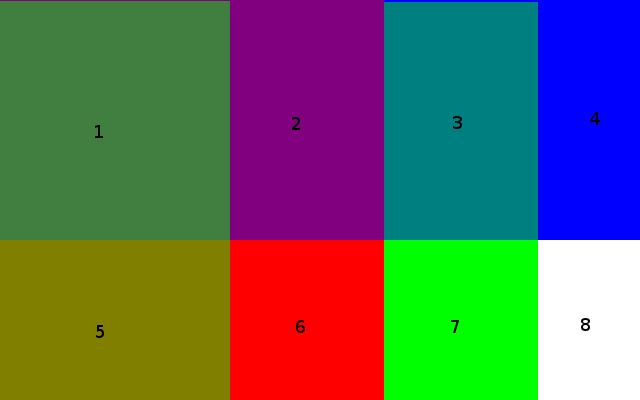
Those who agree with you on driving but not pizza (that would include me, by the way) are in red, those who agree with you on pizza but not driving are in blue, those who agree with you on both are in purple, and those who disagree with you on both are in white. You should already be able to see that less than half the population agrees with you on both issues, even though more than half agrees on each.

Let’s add a third issue, which we will color in green. This one can be the question of whether Star Trek is better than Star Wars. Let’s say that 60% of the population agrees with you that Star Trek is better, while 40% think that Star Wars is better. Let’s also assume that this is independent of opinions on both driving and pizza.

Rectangle_3

This is already starting to get unwieldy; there are now eight distinct regions. The white region (8) is comprised of people who disagree with you on everything. The red (6), blue (4), and green (7) regions each have people agree with you on exactly one issue. The blue-green (3), purple (2), and brown (5) regions have people agree with you on two issues. Only those in the dark-green region (1) agree with you on everything.

As you can see, the proportion of people who agree with you on all issues is fairly small, even though the majority of the population agrees with you on any given issue.

If we keep adding issues, this effect gets even stronger. I’m going to change the color-coding now to simplify things. Now, blue will indicate the people who agree with you on all issues, green the people who agree on all but one issue, yellow the people who agree on all but two issues, and red the people who disagree with you on three or more issues.

For three issues, that looks like this, which you can compare to the previous diagram:

Rectangle_4

Now let’s add a fourth issue. Let’s say 60% of people agree with you that socks should not be worn with sandals, but 40% think that socks should be worn with sandals. The blue region gets smaller:

Rectangle_5

How about a fifth issue? Let’s say 60% of people agree with you that cats are better than dogs, while 40% think that dogs are better than cats. The blue region continues to shrink:

Rectangle_6

How about a sixth issue?

Rectangle_7

And finally, a seventh issue?

Rectangle_8

Now the majority of the space is covered by red, meaning that most of the population disagrees with you on at least three issues.

To recap:

By the time there were two issues, the majority of the population disagreed with you on at least one issue.

By the time there were four issues, the majority of the population disagreed with you on at least two issues.

By the time there were seven issues, the majority of the population disagreed with you on at least three issues.

This despite the fact that the majority of the population always agrees with you on any given issue!

If you only welcomed people into your coalition who agree on every single issue (the blue region), you wouldn’t win election if there were even two issues. If you only welcomed those who disagree on at most one (blue or green), you’d stop winning if there were at least four issues. And if there were at least seven issues, you couldn’t even win by allowing those who disagree on at most two issues (blue, green, yellow).

Now, this argument very much does rely upon the different opinions being independent, which in real politics is not the case. So let’s introduce some correlations and see how this changes the result.

Suppose that once someone agrees with you about driving on the right side of the road, they are 90% likely to agree on pizza, Star Trek, sandals, and cats.

Rectangle_9
That makes things look a lot better for you; by including one level of disagreement, you could dominate every election. But notice that even in this case, if you exclude all disagreement, you will continue to lose elections.

With enough issues, even with very strong correlations you can get the same effect. Suppose there are 20 issues, and if you agree on the first one, there is a 99% chance you’ll agree on each of the others. You are still only getting about half the electorate if you don’t allow any disagreement! Due to the very high correlation, if someone disagrees with you on a few things, they usually disagree with you on many things; yet you’re still better off including some disagreement in your coalition.

Rectangle_10

Obviously, you shouldn’t include people in your coalition who actively oppose its core mission. Even if they aren’t actively trying to undermine you, at some point, the disagreement becomes so large that you’ve got to cut them loose. But in a pluralistic democracy, ideological purism is a surefire recipe for electoral failure. You need to allow at least some disagreement.

This isn’t even getting into the possibility that you might be wrong about some issues, and by including those who disagree with you, you may broaden your horizons and correct your mistakes. I’ve thus far assumed you are completely correct and in the majority on every single issue, and yet you still can’t win elections with complex policy mixes unless you include people who disagree with you.