The double standard between violence and sex in US media

Mar 24 JDN 2458567

The video game Elder Scrolls IV: Oblivion infamously had its ESRB rating upgraded from “Teen” to “Mature”, raising the minimum age to purchase it from 13 to 17. Why? Well, they gave two major reasons: One was that there was more blood and detailed depictions of death than in the original version submitted for review. The other was that a modder had made it possible to view the female characters with naked breasts.

These were considered comparable arguments—if anything, the latter seemed to carry more weight.

Yet first of all this was a mod: You can make a mod do just about anything. (Indeed, there has long since been a mod for Oblivion that shows full-frontal nudity; had this existed when the rating was upgraded, they might have gone all the way to “Adults Only”, ostensibly only raising the minimum age to 18, but in practice making stores unwilling to carry the game because they think of it as porn.)

But suppose in fact that the game had included female characters with naked breasts. Uh… so what? Why is that considered so inappropriate for teenagers? Men are allowed to walk around topless all the time, and male and female nipples really don’t look all that different!

Now, I actually think “Mature” is the right rating for Oblivion. But that’s because Oblivion is about a genocidal war against demons and involves mass slaughter and gruesome death at every turn—not because you can enable a mod to see boobs.

The game Grand Theft Auto: San Andreas went through a similar rating upgrade, from “Mature” to “Adults Only”—resulting it being the only mass-market “Adults Only” game in the US. This was, again, because of a mod—though in this case it was more like re-enabling content that the original game had included but disabled. But let me remind you that this is a game where you play as a gangster whose job is to steal cars, and who routinely guns down police officers and massacres civilians—and the thing that really upset people was that you could enable a scene where your character has sex with his girlfriend.

Meanwhile, games like Manhunt, where the object of the game is to brutally execute people, and the Call of Duty series graphically depicting the horrors of war (and in the Black Ops subseries, espionage, terrorism, and torture), all get to keep their “Mature” ratings.

And consider that a game like Legend of Zelda: Breath of the Wild, rated “Everyone 10+”, contains quite a lot of violence, and several scenes where, logically, it really seems like there should be nudity—bathing, emerging from a cryonic stasis chamber, a doctor examining your body for wounds—but there isn’t. Meanwhile, a key part of the game is killing goblin-like monsters to collect their organs and use them for making potions. It’s all tastefully depicted violence, with little blood and gore; okay, sure. But you can tastefully depict nudity as well. Why are we so uncomfortable with the possibility of seeing these young adult characters naked… while bathing? In this case, even a third-party mod that allowed nudity was itself censored, on the grounds that it would depict “underage characters”; but really, no indication is given that these characters are underage. Based on their role in society, I always read them as about 19 or 20. I guess they could conceivably be as young as 16… and as we all know, 16-year-olds do not have genitals, are never naked, and certainly never have sex.

We’re so accustomed to this that it may even feel uncomfortable to you when I suggest otherwise: “Why would you want to see Link’s penis as he emerges from the cryonic chamber?” Well, I guess, because… men have penises. (Well, cis men anyway; actually it would be really bold and interesting if they decided to make Link trans.) We should see that as normal, and not be so uncomfortable showing it. The emotional power of the scene comes in part from the innocence and vulnerability of nudity, which is undercut by you mysteriously coming with non-removable indestructible underwear. Part of what makes Breath of the Wild so, er, breathtaking is that you can often screenshot it and feel like you are looking at a painting—and I probably don’t need to mention that nudity has been a part of fine art since time immemorial. Letting you take off the protagonist’s underwear wouldn’t show anything you can’t see by looking at Michelangelo’s David.

And would it really be so traumatizing to the audience to see that? By the time you’re 10 years old, I hope you have seen at least one picture of a penis. If not, we’ve been doing sex ed very, very wrong. In fact, I’m quite confident that most of the children playing would not be disturbed at all; amused, perhaps, but what’s wrong with that? If looking at the protagonist’s cel-shaded genitals makes some of the players giggle, does that cause any harm? Some people play through Breath of the Wild without ever equipping clothing, both as a challenge (you get no armor protection that way), and simply for fun (some of the characters do actually react to you being “naked”, or as naked as the game will allow—and most of their reactions would make way more sense if you weren’t wearing magical underwear).

Of course, it’s not just video games. The United States has a bizarre double standard between sex and violence in all sorts of media.

On television, you can watch The Walking Dead on mainstream cable and see, as Andrew Boschert put it, a man’s skull being smashed with a hammer, people’s throats slit into a trough, a meat locker with people’s torsos and limbs hung by hooks and a man’s face being eaten off while he is still alive”; but show a single erect penis, and you have to go to premium channels.

Even children’s television is full of astonishing levels of violence. Watch Tom and Jerry sometime, and you’ll realize that the only difference between it and the Simpsons parody Itchy & Scratchy is that the Simpsons version is a bit more realistic in depicting how such violence would affect the body. In mainstream cartoons, characters can get shot, blown up, crushed by heavy objects, run over by trains, hit with baseball bats and frying pans—but God forbid you ever show a boob.

In film, the documentary This Film Is Not Yet Rated shows convincingly that not only are our standards for sexual content versus violent content wildly disproportionate, furthermore any depiction of queer sexual content is immediately considered pornographic while the equivalent heterosexual content is not. It’s really quite striking to watch: They show scenes with the exact same sex act, even from more or less the same camera angles, and when it’s a man and a woman, it gets R, but if it’s two men or two women, it gets NC-17.

The movie Thirteen is rated R for its depiction of drugs and sex, despite being based on a true story about actual thirteen-year-olds. Evan Rachel Wood was 15 at the time of filming and 16 at the time of release, meaning that she was two years older than the character she played, and yet a year later still not old enough to watch her own movie without parental permission. Granted, Thirteen is not a wholesome film; there’s a lot of disturbing stuff in it, including things done by (and to) teenagers that really shouldn’t be.

But it’s not as if violence, even against teenagers, is viewed as so dangerous for young minds. Look at the Hunger Games, for example; that is an absolutely horrific level of violence against teenagers—people get beheaded, blown up, burned, and mutilated—and it only received a PG-13 rating. The Dark Knight received only a PG-13 rating, despite being about a terrorist who murders hundreds and implants a bomb in one of his henchmen (and also implements the most literal and unethical Prisoner’s Dilemma experiment ever devised).

Novels are better about this sort of thing: You actually can have sex scenes in mainstream novels without everyone freaking out. Yet there’s still a subtler double standard: You can’t show too much detail in a sex scene, or you’ll be branded “erotica”. But there’s no special genre ghetto you get sent to for too graphically depicting torture or war. (I love the Culture novels, but honestly I think Use of Weapons should come with trigger warnings—it’s brutal.) And as I have personally struggled with, it’s very hard to write fiction honestly depicting queer characters without your whole book being labeled “queer fiction”.

Is it like this in other countries? Well, like most things, it depends on the country. In China and much of the Middle East, the government has control over almost every sort of content. Most countries have some things they censor and some things they don’t. The US is unusual: We censor very little. Content involvingviolence and political content are essentially unrestricted in the US. But sex is one of the few things that we do consistently censor.

Media in Europe especially is much more willing to depict sex, and a bit less willing to depict violence. This is particularly true in the Netherlands, where there are films rated R for sex in the US but 6 (that’s “minimum age of viewing, 6 years”) in the Netherlands, because we consider naked female breasts to be a deal-breaker and they consider them utterly harmless. Quite frankly, I’m much more inclined toward the latter assessment.

Japan has had a long tradition of sexuality in art and media, and only when the West came in did they start introducing censorship. But Japan is not known for its half-measures; in 1907 they instituted a ban on explicit depiction of genitals that applies to essentially all media—even media explicitly marketed as porn still fuzzes over keys parts of the images. Yet some are still resisting this censorship: A ban on sexual content in manga drew outrage from artists as recently as 2010.

Hinduism has always been more open to sexuality than Christianity, and it shows in Indian culture in various ways. The Kama Sutra is depicted in the West as a lurid sex manual, when it’s really more of a text on living a full life, finding love, and achieving spiritual transcendence (of which sex is often a major part). But like Japan, India began to censor sex as it began to adopt Western cultural influences, and now implements a very broad pornography ban.

What does this double standard do to our society?

Well, it’s very hard to separate causation from correlation. So I can’t really say that it is because of this double standard in media that we have the highest rates of teen pregnancy and homicide in the First World. But it seems like it might be related, at least; perhaps they come from a common source, the same sexual repression and valorization of masculinity expressed through violence.

I do know some things that are direct negative consequences of the censorship of sex in US media. The most urgent example of this is the so-called “Stop Enabling Sex Traffickers Act” (it does more or less the exact opposite, much like the “PATRIOT ACT” and George W. Bush’s “Clean Air Act”). That will have to wait until next week’s post.
Stop calling it “piracy”

Mar 17 JDN 2458560

It’s a bit of a pet peeve, but much like I insist people use “net wealth” instead of “net worth” (people are not worth more because they have more money!), I find it aggravating that the standard term for copyright infringement for personal use is “piracy”.

The word “piracy” is meant to describe some very severe crimes: Pirates on the high seas board ships to rape, enslave, and murder people. There are still actual pirates today, and they are murderous psychopaths. We glamorize pirates in much the same was as we glamorize organized crime; but the reality of actual piracy is horrific, monstrous violence. This is nothing like the “piracy” of copying songs and video games without permission.

If you need a word for copying songs and video games without permission, how about “unauthorized copying”? That’s what it is. You haven’t stolen anything. You’re not a pirate. You’ve copied something without authorization.

This can still be a harmful thing to do, and there are some cases where I think we rightfully make it illegal. But just from hearing the phrase “unauthorized copying” you can feel the difference: It already sounds like something that isn’t usually so bad and maybe shouldn’t always be against the law.

Indeed, it’s difficult to see exactly where the harm from most unauthorized copying is supposed to be. Even on the RIAA’s inflated estimates assuming that everyone who makes unauthorized copies would have otherwise purchased at retail price (which is clearly not true), total loss to the US music industry from unauthorized copying is less than $3 billion per year, while the total revenue of the music industry in the US is over $22 billion. So we’re talking about a roughly 12% reduction in revenue—and remember that this is an overestimate, because most of the people who make unauthorized copies would not have purchased the music at full price if they didn’t make the copies.

And most of those losses are to the very richest music producers, who are astonishingly rich indeed. The top 9 richest music producers in the US all have net wealth exceeding $100 million. It’s hard for me to see a 12% reduction in revenue for these nine-figure millionaires as a major loss to our society.

It might be a major loss to our society if weaker intellectual property enforcement had a chilling effect on the production of new content. And there is some reason to think that this could happen: Artists make their living selling content, and if that content can be copied for free it will be harder for them to make a living.

But it’s already really hard for most artists to make a living, and they make art anyway. There is no shortage of creative content in the world; indeed, there is an embarrassment of riches that makes it hard for new artists to break in and sometimes even hard for consumers to find the best content. If the goal is actually to support artists, there are obviously much better methods than granting Disney and Viacom totalitarian control over everything we read, hear, and see.

For instance, there are alternative modes of income support for artists that don’t require intellectual property enforcement, such as Patreon and Kickstarter. I make money on this very blog (not a lot mind you, but some extra spending cash) using Patreon without enforcing intellectual property. I’m not sure I could enforce intellectual property on my blog even if I tried.

A universal basic income is another option: Artists mostly create art because they want to, and only need to sell it because, like all humans, they have certain needs for food and shelter that must be met. With a sufficiently generous basic income, I think many artists would choose to share their work for free and live off the basic income, because it was never about making money but about creating art and spreading joy.

Or we could continue to enforce copyright, but in a much more limited manner: Say you get 30 years after publication, and whether or not your work has earned out by then, it goes to public domain and people can do whatever they want with it. Copy it, modify it, turn it into derivative works—yes, even make fanfiction and rule 34 porn, because that’s a form of artistic creation too.

I couldn’t find good data on this, but my suspicion is that most artistic works don’t turn a profit at all, and those that turn a profit generally do so within the first few years. Even if they paid out at a constant nominal rate, at any reasonable interest rate only about the first 30 years would really matter: At 7%, the net present value of $10,000 a year for 30 years is $124,000, while the net present value of $10,000 a year forever is only $143,000. This is because funds received in early years could be invested for that whole time (or used for something urgent and valuable), while funds received later can’t. There’s an old joke that may help you to remember that: “For $50, I’ll give you a million dollars! Such a deal! Oh, by the way, it’s $1 per year for the next million years.”

Extending copyright for decades simply doesn’t make sense if the goal is to support artists. (It makes perfect sense if the goal is to make Disney lobbyists happy.) Continuing to pay royalties for something you made 70 years ago may make you happy, but it wasn’t the incentive to produce that thing in the first place. I have trouble imagining an artist who would be willing to create a work if they received 70 years of royalties, but not if they only received 30 years of royalties.

In fact, economists studying copyright have estimated that the optimal duration of copyright to maximize creative innovation is even shorter than that: Only 15 years. There are a number of reasons for this, but perhaps the most important is that copyright can actually hinder some creativity, by making it harder to build off of the previous work of others. It’s one thing if all you have to do is re-name some characters in a novel and make a few other cosmetic changes (like Fifty Shades of Grey did; it was originally Twilight fanfiction); but that wouldn’t be so simple for a music remix or a video game mod. Depending on how the corporation that owns the original IP reacts, even a mod that looks and plays completely different could land you in court, because it was built on the same engine. There’s a great deal of ambiguity about just what constitutes a copyright violation in game modding.

And if we’re also thinking about patents as well as copyrights, intellectual property protection is the main cause of the high cost of brand-name drugs: People die because of that patent enforcement.

But there are complicated questions here about the proper way to balance the incentives. I think it would help to make the language clearer and less loaded: Don’t say “piracy”. Say “unauthorized copying”.

Defending yourself defends others

Mar 10 JDN 2458553

There’s a meme going around the feminist community that is very well-intentioned, but dangerously misguided. I first encountered it as a tweet, though it may have originated elsewhere:

If you’re promoting changes to women’s behaviour to “prevent” rape, you’re really saying “make sure he rapes the other girl”.

The good intention here is that we need to stop blaming victims. Victim-blaming is ubiquitous, and especially common and harmful in the case of sexual assault. If someone assaults you—or robs you, or abuses you—it is never your fault.

But I fear that there is a baby being thrown out with this bathwater: While failing to defend yourself doesn’t make it your fault, being able to defend yourself can still make you safer.

And, just as importantly, it can make others safer too. The game theory behind that is the subject of this post.

For purposes of the theory, it doesn’t matter what the crime is. So let’s set aside the intense emotional implications of sexual assault and suppose the crime is grand theft auto.

Some cars are defended—they have a LoJack system installed that will allow them to be recovered and the thieves to be prosecuted. (Don’t suppose it’s a car alarm; those don’t work.)

Other cars are not defended—once stolen, they may not be recovered.

There are two cases to consider: Defense that is visible, and defense that is invisible.

Let’s start by assuming that the defense is visible: When choosing which car to try to steal, the thieves can intentionally pick one that doesn’t have a LoJack installed. (This doesn’t work well for car theft, but it’s worth considering for the general question of self-defense. The kind of clothes you wear, the way you carry yourself, how many people are with you, and overall just how big and strong you look are visible signs of a capacity for self-defense.)

In that case, the game is one of perfect information: First each car owner chooses whether or not to install a LoJack at some cost L (in real life, about $700), and then thieves see which cars are equipped and then choose which car to steal.

Let’s say the probability of a car theft being recovered and prosecuted if it’s defended is p, and the probability of it being recovered if it’s not defended is q; p > q. In the real world, about half of stolen cars are recovered—but over 90% of LoJack-equipped vehicles are recovered, so p = 0.9 and q = 0.5.

Then let’s say the cost of being caught and prosecuted is C. This is presumably quite high: If you get convicted, you could spend time in prison. But maybe the car will be recovered and the thief won’t be convicted. Let’s ballpark that at about $30,000.

Finally, the value of successfully stealing a car is V. The average price of a used car in the US is about $20,000, so V is probably close to that.

If no cars are defended, what will the thieves choose? Assuming they are risk-neutral (car thieves don’t seem like very risk averse folks, in general), the expected benefit of stealing a car is V – q C. With the parameters above, that’s (20000)-(0.5)(30000) = $5,000. The thieves will choose a car at random and steal it.

If some cars are defended and some are not, what will the thieves choose? They will avoid the defended cars and steal one of the undefended cars.

But what if all cars are defended? Now the expected benefit is V – p C, which is (20000)-(0.9)(30000) = -$7,000. The thieves will not steal any cars at all. (This is actually the unique subgame-perfect equilibrium: Everyone installs a LoJack and no cars get stolen. Of course, that assumes perfect rationality.)

Yet that isn’t so impressive; everyone defending themselves results in everyone being defended? That sounds tautological. Expecting everyone to successfully defend themselves all the time sounds quite unreasonable. This might be what people have in mind when they say things like the quote above: It’s impossible for everyone to be defended always.

But it turns out that we don’t actually need that. Things get a lot more interesting when we assume that self-defense can be invisible. It would be very hard to know whether a car has a LoJack installed without actually opening it up, and there are many other ways to defend yourself that are not so visible—such as knowing techniques of martial arts or using a self-defense phone app.

Now the game has imperfect information. The thieves don’t know whether you have chosen to defend your car or not.

We need to add a couple more parameters. First is the number of cars per thief n. Then we need the proportion of cars that are defended. Let’s call it d. Then with probability d a given car is defended, and with probability 1-d it is not.

The expected value of stealing a car for the thieves is now this: V – p d C – q (1-d) C. If this is positive, they will steal a car; if it is negative, they will not.

Knowing this, should you install a LoJack? Remember that it costs you L to do so.

What’s the probability your car will be stolen? If they are stealing cars at all, the probability of your car being one stolen is 1/n. If that happens, you will have an expected loss of (1-p)V if you have a LoJack, or (1-q)V if you don’t. The difference between those is (p-q)V.

So your expected benefit of having a LoJack is (p-q)V/n – L. With the parameters above, that comes to: (0.9-0.5)(20000)/n – (700) = 8000/n – 700. So if there are no more than 11 cars per thief, this is positive and you should buy a LoJack. If there are 12 or more cars per thief, you’re better off taking your chances.

This only applies if the thieves are willing to steal at all. And then the interesting question is whether V – p d C – q (1-d) C is positive. For these parameters, that’s (20000) – (0.9)(30000)d – (0.5)(30000) + (0.5)(30000)d = 5000 – 12000 d. Notice that if we substitute in d=0 we get back $5,000, and at d=1 we get back -$7,000, just as before. There is a critical value of d at which the thieves aren’t sure whether to try or not: d* = 5/12 = 0.42.

Assuming that a given car is worth defending if it would be stolen (n <= 11), the equilibrium is actually when precisely d* of the cars are defended and 1-d* are not. Any less than this, and there is an undefended car that would be worth defending. Any more than this, and the thieves aren’t going to try to steal anything, so why bother defending?

Of course this is a very stylized model: In particular, we assumed that all cars are equally valuable and equally easy to steal, which is surely not true in real life.

Yet this model is still enough to make the most important point: Since presumably we do not value the welfare of the car thieves, it could happen that people choosing on their own would not defend their cars, but society as a whole would be better off if they did.

The net loss to society from a stolen car is (1-q)V if the car was not defended, or (1-p)V if it was. But if the thieves don’t steal any cars at all, the net loss to society is zero. The cost of defending a proportion d* of all cars is n d* L.

So if we are currently at d = 0, society is currently losing (1-q)V. We could eliminate this cost entirely by paying n d* L to defend a sufficient number of cars. Suppose n = 30. Then this total cost is (30)(5/12)(700) = $8,750. The loss from cars being stolen was (0.5)(20000) = $10,000. So it would be worth it, from society’s perspective, to randomly install LoJack systems in 42% of cars.

But for any given car owner, it would not be worth it; the expected benefit is 8000/30 – 700 = -$433. (I guess we could ask how much you’re willing to pay for “peace of mind”.)

Where does the extra benefit go? To all the other car owners. By defending your car, you are raising d and thereby lowering the expected payoff for a car thief. There is a positive externality; this is a public good. You get some of that benefit yourself, but others also share in that benefit.

This brings me at last to the core message of this post:

Self-defense is a public good.

The better each person defends themselves, the riskier it becomes for criminals to try to victimize anyone. Never feel guilty for trying to defend yourself; you are defending everyone else at the same time. In fact, you should consider taking actions to defend yourself even when you aren’t sure it’s worth it for you personally: That positive externality may be large enough to make your actions worthwhile for society as a whole.

Again, this does not mean we should blame victims when they are unable to defend themselves. Self-defense is easier for some people than others, and everyone is bound to slip up on occasion. (Also, eternal vigilance can quickly shade over into paranoia.) It is always the perpetrator’s fault.

How do you change a paradigm?

Mar 3 JDN 2458546

I recently attended the Institute for New Economic Thinking (INET) Young Scholars Initiative (YSI) North American Regional Convening (what a mouthful!). I didn’t present, so I couldn’t get funding for a hotel, so I commuted to LA each day. That was miserable; if I ever go again, it will be with funding.

The highlight of the conference was George Akerlof‘s keynote, which I knew would be the case from the start. The swag bag labeled “Rebel Without a Paradigm” was also pretty great (though not as great as the “Totes Bi” totes at the Human Rights Council Time to THRIVE conference).

The rest of the conference was… a bit strange, to be honest. They had a lot of slightly cheesy interactive activities and exhibits; the conference was targeted at grad students, but some of these would have drawn groans from my more jaded undergrads (and “jaded grad student” is a redundancy). The poster session was pathetically small; I think there were literally only three posters. (Had I known in time for the deadline, I could surely have submitted a poster.)

The theme of the conference was challenging the neoclassical paradigm. This was really the only unifying principle. So we had quite an eclectic mix of presenters: There were a few behavioral economists (like Akerlof himself), and some econophysicists and complexity theorists, but mostly the conference was filled with a wide variety of heterodox theorists, ranging all the way from Austrian to Marxist. Also sprinkled in were a few outright cranks, whose ideas were just total nonsense; fortunately these were relatively rare.

And what really struck me about listening to the heterodox theorists was how mainstream it made me feel. I went to a session on development economics, expecting randomized controlled trials of basic income and maybe some political economy game theory, and instead saw several presentations of neo-Marxist postcolonial theory. At the AEA conference I felt like a radical firebrand; at the YSI conference I felt like a holdout of the ancien regime. Is this what it feels like to push the envelope without leaping outside it?

The whole atmosphere of the conference was one of “Why won’t they listen to us!?” and I couldn’t help but feel like I kind of knew why. All this heterodox theory isn’t testable. It isn’t useful. It doesn’t solve the problem. Even if you are entirely correct that Latin America is poor because of colonial and neocolonial exploitation by the West (and I’m fairly certain that you’re not; standard of living under the Mexica wasn’t so great you know), that doesn’t tell me how to feed starving children in Nicaragua.

Indeed, I think it’s notable that the one Nobel Laureate they could find to speak for us was a behavioral economist. Behavioral economics has actually managed to penetrate into the mainstream somewhat. Not enough, not nearly quickly enough, to be sure—but it’s happening. Why is it happening? Because behavioral economics is testable, it’s useful, and it solves problems.

Indeed, behavioral economics is more testable than most neoclassical economics: We run lab experiments while they’re adding yet another friction or shock to the never-ending DSGE quagmire.

And we’ve already managed to solve some real policy problems this way, like Alvin Roth’s kidney matching system and Richard Thaler’s “Save More Tomorrow” program.

The (limited) success of behavioral economics came not because we continued to batter at the gates of the old paradigm demanding to be let in, but because we tied ourselves to the methodology of hard science and gathered irrefutable empirical data. We didn’t get as far as we have by complaining that economics is too much like physics; we actually made it more like physics. Physicists do experiments. They make sharp, testable predictions. They refute their hypotheses. And now, so do we.

That said, Akerlof was right when he pointed out that the insistence upon empirical precision has limited the scope of questions we are able to ask, and kept us from addressing some of the really vital economic problems in the world. And neoclassical theory is too narrow; in particular, the ongoing insistence that behavior must be modeled as perfectly rational and completely selfish is infuriating. That model has clearly failed at this point, and it’s time for something new.

So I do think there is some space for heterodox theory in economics. But there actually seems to be no shortage of heterodox theory; it’s easy to come up with ideas that are different from the mainstream. What we actually need is more ways to constrain theory with empirical evidence. The goal must be to have theory that actually predicts and explains the world better than neoclassical theory does—and that’s a higher bar than you might imagine. Neoclassical theory isn’t an abject failure; in fact, if we’d just followed the standard Keynesian models in the Great Recession, we would have recovered much faster. Most of this neo-Marxist theory struck me as not even wrong: the ideas were flexible enough that almost any observed outcome could be fit into them.

Galileo and Einstein didn’t just come up with new ideas and complain that no one listened to them. They developed detailed, mathematically precise models that could be experimentally tested—and when they were tested, they worked better than the old theory. That is the way to change a paradigm: Replace it with one that you can prove is better.

Impostor Syndrome

Feb 24 JDN 2458539

You probably have experienced Impostor Syndrome, even if you didn’t know the word for it. (Studies estimate that over 70% of the general population, and virtually 100% of graduate students, have experienced it at least once.)

Impostor Syndrome feels like this:

All your life you’ve been building up accomplishments, and people kept praising you for them, but those things were easy, or you’ve just gotten lucky so far. Everyone seems to think you are highly competent, but you know better: Now that you are faced with something that’s actually hard, you can’t do it. You’re not sure you’ll ever be able to do it. You’re scared to try because you know you’ll fail. And now you fear that at any moment, your whole house of cards is going to come crashing down, and everyone will see what a fraud and a failure you truly are.

The magnitude of that feeling varies: For most people it can be a fleeting experience, quickly overcome. But for some it is chronic, overwhelming, and debilitating.

It may surprise you that I am in the latter category. A few years ago, I went to a seminar on Impostor Syndrome, and they played a “Bingo” game where you collect spaces by exhibiting symptoms: I won.

In a group of about two dozen students who were there specifically because they were worried about Impostor Syndrome, I exhibited the most symptoms. On the Clance Impostor Phenomenon Scale, I score 90%. Anything above 60% is considered diagnostic, though there is no DSM disorder specifically for Impostor Syndrome.

Another major cause of Impostor Syndrome is being an underrepresented minority. Women, people of color, and queer people are at particularly high risk. While men are less likely to experience Impostor Syndrome, we tend to experience it more intensely when we do.

Aside from being a graduate student, which is basically coextensive with Impostor Syndrome, being a writer seems to be one of the strongest predictors of Impostor Syndrome. Megan McArdle of The Atlantic theorizes that it’s because we were too good in English class, or, more precisely, that English class was much too easy for us. We came to associate our feelings of competence and accomplishment with tasks simply coming so easily we barely even had to try.

But I think there’s a bigger reason, which is that writers face rejection letters. So many rejection letters. 90% of novels are rejected at the query stage; then a further 80% are rejected at the manuscript review stage; this means that a given query letter has about a 2% chance of acceptance. This means that even if you are doing everything right and will eventually get published, you can on average expected 50 rejection letters. I collected a little over 20 and ran out of steam, my will and self-confidence utterly crushed. But statistically I should have continued for at least 30 more. In fact, it’s worse than that; you should always expect to continue 50 more, up until you finally get accepted—this is a memoryless distribution. And if always having to expect to wait for 50 more rejection letters sounds utterly soul-crushing, that’s because it is.

And that’s something fiction writing has in common with academic research. Top journals in economics have acceptance rates between 3% and 8%. I’d say this means you need to submit between 13 and 34 times to get into a top journal, but that’s nonsense; there are only 5 top journals in economics. So it’s more accurate to say that with any given paper, no matter how many times you submit, you only have about a 30% chance of getting into a top journal. After that, your submissions will necessarily not be to top journals. There are enough good second-tier journals that you can probably get into one eventually—after submitting about a dozen times. And maybe a hiring or tenure committee will care about a second-tier publication. It might count for something. But it’s those top 5 journals that really matter. If for every paper you have in JEBO or JPubE, another candidate has a paper in AER or JPE, they’re going to hire the other candidate. Your paper could use better methodology on a more important question, and be better written—but if for whatever reason AER didn’t like it, that’s what will decide the direction of your career.

If I were trying to design a system that would inflict maximal Impostor Syndrome, I’m not sure I could do much better than this. I guess I’d probably have just one top journal instead of five, and I’d make the acceptance rate 1% instead of 3%. But this whole process of high-stakes checkpoints and low chances of getting on a tenure track that will by no means guarantee actually getting tenure? That’s already quite well-optimized. It’s really a brilliant design, if that’s the objective. You select a bunch of people who have experienced nothing but high achievement their whole lives. If they ever did have low achievement, for whatever reason (could be no fault of their own, you don’t care), you’d exclude them from the start. You give them a series of intensely difficult tasks—tasks literally no one else has ever done that may not even be possible—with minimal support and utterly irrelevant and useless “training”, and evaluate them constantly at extremely high stakes. And then at the end you give them an almost negligible chance of success, and force even those who do eventually succeed to go through multiple steps of failure and rejection beforehand. You really maximize the contrast between how long a streak of uninterrupted successes they must have had in order to be selected in the first place, and how many rejections they have to go through in order to make it to the next level.

(By the way, it’s not that there isn’t enough teaching and research for all these PhD graduates; that’s what universities want you to think. It’s that universities are refusing to open up tenure-track positions and instead relying upon adjuncts and lecturers. And the obvious reason for that is to save money.)

The real question is why we let them put us through this. I’m wondering that more and more every day.

I believe in science. I believe I could make a real contribution to human knowledge—at least, I think I still believe that. But I don’t know how much longer I can stand this gauntlet of constant evaluation and rejection.

I am going through a particularly severe episode of Impostor Syndrome at the moment. I am at an impasse in my third-year research paper, which is supposed to be done by the end of the summer. My dissertation committee wants me to revise my second-year paper to submit to journals, and I just… can’t do it. I have asked for help from multiple sources, and received conflicting opinions. At this point I can’t even bring myself to work on it.

I’ve been aiming for a career as an academic research scientist for as long as I can remember, and everyone tells me that this is what I should do and where I belong—but I don’t really feel like I belong anymore. I don’t know if I have a thick enough skin to get through all these layers of evaluation and rejection. Everyone tells me I’m good at this, but I don’t feel like I am. It doesn’t come easily the way I had come to expect things to come easily. And after I’ve done the research, written the paper—the stuff that I was told was the real work—there are all these extra steps that are actually so much harder, so much more painful—submitting to journals and being rejected over, and over, and over again, practically watching the graph of my career prospects plummet before my eyes.

I think that what really triggered my Impostor Syndrome was finally encountering things I’m not actually good at. It sounds arrogant when I say it, but the truth is, I had never had anything in my entire academic experience that felt genuinely difficult. There were things that were tedious, or time-consuming; there were other barriers I had to deal with, like migraines, depression, and the influenza pandemic. But there was never any actual educational content I had difficulty absorbing and understanding. Maybe if I had, I would be more prepared for this. But of course, if that were the case, they’d never let me into grad school at all. Just to be here, I had to have an uninterrupted streak of easy success after easy success—so now that it’s finally hard, I feel completely blindsided. I’m finally genuinely challenged by something academic, and I can’t handle it. There’s math I don’t know how to do; I’ve never felt this way before.

I know that part of the problem is internal: This is my own mental illness talking. But that isn’t much comfort. Knowing that the problem is me doesn’t exactly reduce the feeling of being a fraud and a failure. And even a problem that is 100% inside my own brain isn’t necessarily a problem I can fix. (I’ve had migraines in my brain for the last 18 years; I still haven’t fixed them.)

There is so much that the academic community could do so easily to make this problem better. Stop using the top 5 journals as a metric, and just look at overall publication rates. Referee publications double-blind, so that grad students know their papers will actually be read and taken seriously, rather than thrown out as soon as the referee sees they don’t already have tenure. Or stop obsessing over publications all together, and look at the detailed content of people’s work instead of maximizing the incentive to keep putting out papers that nobody will ever actually read. Open up more tenure-track faculty positions, and stop hiring lecturers and adjuncts. If you have to save money, do it by cutting salaries for administrators and athletic coaches. And stop evaluating constantly. Get rid of qualifying exams. Get rid of advancement exams. Start from the very beginning of grad school by assigning a mentor to each student and getting directly into working on a dissertation. Don’t make the applied econometrics researchers take exams in macro theory. Don’t make the empirical macroeconomists study game theory. Focus and customize coursework specifically on what grad students will actually need for the research they want to do, and don’t use grades at all. Remove the evaluative element completely. We should feel as though we are allowed to not know things. We should feel as though we are allowed to get things wrong. You are supposed to be teaching us, and you don’t seem to know how to do that; you just evaluate us constantly and expect us to learn on our own.

But none of those changes are going to happen. Certainly not in time for me, and probably not ever, because people like me who want the system to change are precisely the people the current system seems designed to weed out. It’s the ones who make it through the gauntlet, and convince themselves that it was their own brilliance and hard work that carried them through (not luck, not being a White straight upper-middle-class cis male, not even perseverance and resilience in the face of rejection), who end up making the policies for the next generation.

Because those who should be fixing the problem refuse to do so, that leaves the rest of us. What can we do to relieve Impostor Syndrome in ourselves or those around us?

You’d be right to take any advice I give now with a grain of salt; it’s obviously not working that well on me. But maybe it can help someone else. (And again I realize that “Don’t listen to me, I have no idea what I’m talking about” is exactly what someone with Impostor Syndrome would say.)

One of the standard techniques for dealing with Impostor Syndrome is called self-compassion. The idea is to be as forgiving to yourself as you would be to someone you love. I’ve never been good at this. I always hold myself to a much higher standard than I would hold anyone else—higher even than I would allow anyone to impose on someone else. After being told my whole life how brilliant and special I am, I internalized it in perhaps the most toxic way possible: I set my bar higher. Things that other people would count as great success I count as catastrophic failure. “Good enough” is never good enough.

Another good suggestion is to change your comparison set: Don’t compare yourself just to faculty or other grad students, compare yourself to the population as a whole. Others will tell you to stop comparing altogether, but I don’t know if that’s even possible in a capitalist labor market.

I’ve also had people encourage me to focus on my core motivations, remind myself what really matters and why I want to be a scientist in the first place. But it can be hard to keep my eye on that prize. Sometimes I wonder if I’ll ever be able to do the things I originally set out to do, or if it’s trying to fit other people’s molds and being rejected repeatedly over and over again for the rest of my life.

I think the best advice I’ve ever received on dealing with Impostor Syndrome was actually this: “Realize that nobody knows what they’re doing.” The people who are the very best at things… really aren’t all that good at them. If you look around carefully, the evidence of incompetence is everywhere. Look at all the books that get published that weren’t worth writing, all the songs that get recorded that weren’t worth singing. Think about the easily-broken electronic gadgets, the glitchy operating systems, the zero-day exploits, the data breaches, the traffic lights that are timed so badly they make the traffic jams worse. Remember that the leading cause of airplane crashes is pilot error, that medical mistakes are the third-leading cause of death in the United States. Think about every vending machine that ate your dollar, every time your cable went out in a storm. All those people around you who look like they are competent and successful? They aren’t. They are just as confused and ignorant and clumsy as you are. Most of them also feel like frauds, at least some of the time.

The “market for love” is a bad metaphor

Feb 14 JDN 2458529

Valentine’s Day was this past week, so let’s talk a bit about love.

Economists would never be accused of being excessively romantic. To most neoclassical economists, just about everything is a market transaction. Love is no exception.

There are all sorts of articles and books and an even larger number of research papers going back multiple decades and continuing all the way through until today using the metaphor of the “marriage market”.

In a few places, marriage does actually function something like a market: In China, there are places where your parents will hire brokers and matchmakers to select a spouse for you. But even this isn’t really a market for love or marriage. It’s a market for matchmaking services. The high-tech version of this is dating sites like OkCupid.
And of course sex work actually occurs on markets; there is buying and selling of services at monetary prices. There is of course a great deal worth saying on that subject, but it’s not my topic for today.

But in general, love is really nothing like a market. First of all, there is no price. This alone should be sufficient reason to say that we’re not actually dealing with a market. The whole mechanism that makes a market a market is the use of prices to achieve equilibrium between supply and demand.

A price doesn’t necessarily have to be monetary; you can barter apples for bananas, or trade in one used video game for another, and we can still legitimately call that a market transaction with a price.

But love isn’t like that either. If your relationship with someone is so transactional that you’re actually keeping a ledger of each thing they do for you and each thing you do for them so that you could compute a price for services, that isn’t love. It’s not even friendship. If you really care about someone, you set such calculations aside. You view their interests and yours as in some sense shared, aligned toward common goals. You stop thinking in terms of “me” and “you” and start thinking in terms of “us”. You don’t think “I’ll scratch your back if you scratch mine.” You think “We’re scratching each other’s backs today.”

This is of course not to say that love never involves conflict. On the contrary, love always involves conflict. Successful relationships aren’t those where conflict never happens, they are those where conflict is effectively and responsibly resolved. Your interests and your loved ones’ are never completely aligned; there will always be some residual disagreement. But the key is to realize that your interests are still mostly aligned; those small vectors of disagreement should be outweighed by the much larger vector of your relationship.

And of course, there can come a time when that is no longer the case. Obviously, there is domestic abuse, which should absolutely be a deal-breaker for anyone. But there are other reasons why you may find that a relationship ultimately isn’t working, that your interests just aren’t as aligned as you thought they were. Eventually those disagreement vectors just get too large to cancel out. This is painful, but unavoidable. But if you reach the point where you are keeping track of actions on a ledger, that relationship is already dead. Sooner or later, someone is going to have to pull the plug.

Very little of what I’ve said in the preceding paragraphs is likely to be controversial. Why, then, would economists think that it makes sense to treat love as a market?

I think this comes down to a motte and bailey doctrine. A more detailed explanation can be found at that link, but the basic idea of a motte and bailey is this: You have a core set of propositions that is highly defensible but not that interesting (the “motte”), and a broader set of propositions that are very interesting, but not as defensible (the “bailey”). The terms are related to a medieval defensive strategy, in which there was a small, heavily fortified tower called a motte, surrounded by fertile, useful land, the bailey. The bailey is where you actually want to live, but it’s hard to defend; so if the need arises, you can pull everyone back into the motte to fight off attacks. But nobody wants to live in the motte; it’s just a cramped stone tower. There’s nothing to eat or enjoy there.

The motte comprised of ideas that almost everyone agrees with. The bailey is the real point of contention, the thing you are trying to argue for—which, by construction, other people must not already agree with.

Here are some examples, which I have intentionally chosen from groups I agree with:

Feminism can be a motte and bailey doctrine. The motte is “women are people”; the bailey is abortion rights, affirmative consent and equal pay legislation.

Rationalism can be a motte and bailey doctrine. The motte is “rationality is good”; the bailey is atheism, transhumanism, and Bayesian statistics.

Anti-fascism can be a motte and bailey doctrine. The motte is “fascists are bad”; the bailey is black bloc Antifa and punching Nazis.

Even democracy can be a motte and bailey doctrine. The motte is “people should vote for their leaders”; my personal bailey is abolition of the Electoral College, a younger voting age, and range voting.

Using a motte and bailey doctrine does not necessarily make you wrong. But it’s something to be careful about, because as a strategy it can be disingenuous. Even if you think that the propositions in the bailey all follow logically from the propositions in the motte, the people you’re talking to may not think so, and in fact you could simply be wrong. At the very least, you should be taking the time to explain how one follows from the other; and really, you should consider whether the connection is actually as tight as you thought, or if perhaps one can believe that rationality is good without being Bayesian or believe that women are people without supporting abortion rights.

I think when economists describe love or marriage as a “market”, they are applying a motte and bailey doctrine. They may actually be doing something even worse than that, by equivocating on the meaning of “market”. But even if any given economist uses the word “market” totally consistently, the fact that different economists of the same broad political alignment use the word differently adds up to a motte and bailey doctrine.

The doctrine is this: “There have always been markets.”

The motte is something like this: “Humans have always engaged in interaction for mutual benefit.”

This is undeniably true. In fact, it’s not even uninteresting. As mottes go, it’s a pretty nice one; it’s worth spending some time there. In the endless quest for an elusive “human nature”, I think you could do worse than to focus on our universal tendency to engage in interaction for mutual benefit. (Don’t other species do it too? Yes, but that’s just it—they are precisely the ones that seem most human.)

And if you want to define any mutually-beneficial interaction as a “market trade”, I guess it’s your right to do that. I think this is foolish and confusing, but legislating language has always been a fool’s errand.

But of course the more standard meaning of the word “market” implies buyers and sellers exchanging goods and services for monetary prices. You can extend it a little to include bartering, various forms of financial intermediation, and the like; but basically you’re still buying and selling.

That makes this the bailey: “Humans have always engaged in buying and selling of goods and services at prices.”

And that, dear readers, is ahistorical nonsense. We’ve only been using money for a few thousand years, and it wasn’t until the Industrial Revolution that we actually started getting the majority of our goods and services via market trades. Economists like to tell a story where bartering preceded the invention of money, but there’s basically no evidence of that. Bartering seems to be what people do when they know how money works but don’t have any money to work with.

Before there was money, there were fundamentally different modes of interaction: Sharing, ritual, debts of honor, common property, and, yes, love.

These were not markets. They perhaps shared some very broad features of markets—such as the interaction for mutual benefit—but they lacked the defining attributes that make a market a market.

Why is this important? Because this doctrine is used to transform more and more of our lives into actual markets, on the grounds that they were already “markets”, and we’re just using “more efficient” kinds of markets. But in fact what’s happening is we are trading one fundamental mode of human interaction for another: Where we used to rely upon norms or trust or mutual affection, we instead rely upon buying and selling at prices.

In some cases, this actually is a good thing: Markets can be very powerful, and are often our best tool when we really need something done. In particular, it’s clear at this point that norms and trust are not sufficient to protect us against climate change. All the “Reduce, Reuse, Recycle” PSAs in the world won’t do as much as a carbon tax. When millions of lives are at stake, we can’t trust people to do the right thing; we need to twist their arms however we can.

But markets are in some sense a brute-force last-resort solution; they commodify and alienate (Marx wasn’t wrong about that), and despite our greatly elevated standard of living, the alienation and competitive pressure of markets seem to be keeping most of us from really achieving happiness.

This is why it’s extremely dangerous to talk about a “market for love”. Love is perhaps the last bastion of our lives that has not been commodified into a true market, and if it goes, we’ll have nothing left. If sexual relationships built on mutual affection were to disappear in favor of apps that will summon a prostitute or a sex robot at the push of a button, I would count that as a great loss for human civilization. (How we should regulate prostitution or sex robots are a different question, which I said I’d leave aside for this post.) A “market for love” is in fact a world with no love at all.

Moral luck: How it matters, and how it doesn’t

Feb 10 JDN 2458525

The concept of moral luck is now relatively familiar to most philosophers, but I imagine most other people haven’t heard it before. It sounds like a contradiction, which is probably why it drew so much attention.

The term “moral luck” seems to have originated in essay by Thomas Nagel, but the intuition is much older, dating at least back to Greek philosophy (and really probably older than that; we just don’t have good records that far back).

The basic argument is this:

Most people would say that if you had no control over something, you can’t be held morally responsible for it. It was just luck.

But if you look closely, everything we do—including things we would conventionally regard as moral actions—depends heavily on things we don’t have control over.

Therefore, either we can be held responsible for things we have no control over, or we can’t be held responsible for anything at all!

Neither approach seems very satisfying; hence the conundrum.

For example, consider four drivers:

Anna is driving normally, and nothing of note happens.

Bob is driving recklessly, but nothing of note happens.

Carla is driving normally, but a child stumbles out into the street and she runs the child over.

Dan is driving recklessly, and a child stumbles out into the street and he runs the child over.

The presence or absence of a child in the street was not in the control of any of the four drivers. Yet I think most people would agree that Dan should be held more morally responsible than Bob, and Carla should be held more morally responsible than Anna. (Whether Bob should be held more morally responsible than Carla is not as clear.) Yet both Bob and Dan were driving recklessly, and both Anna and Carla were driving normally. The moral evaluation seems to depend upon the presence of the child, which was not under the drivers’ control.

Other philosophers have argued that the difference is an epistemic one: We know the moral character of someone who drove recklessly and ran over a child better than the moral character of someone who drove recklessly and didn’t run over a child. But do we, really?

Another response is simply to deny that we should treat Bob and Dan any differently, and say that reckless driving is reckless driving, and safe driving is safe driving. For this particular example, maybe that works. But it’s not hard to come up with better examples where that doesn’t work:

Ted is a psychopathic serial killer. He kidnaps, rapes, and murder people. Maybe he can control whether or not he rapes and murders someone. But the reason he rapes and murders someone is that he is a psychopath. And he can’t control that he is a psychopath. So how can we say that his actions are morally wrong?

Obviously, we want to say that his actions are morally wrong.

I have heard one alternative, which is to consider psychopaths as morally equivalent to viruses: Zero culpability, zero moral value, something morally neutral but dangerous that we should contain or eradicate as swiftly as possible. HIV isn’t evil; it’s just harmful. We should kill it not because it deserves to die, but because it will kill us if we don’t. On this theory, Ted doesn’t deserve to be executed; it’s just that we must execute him in order to protect ourselves from the danger he poses.

But this quickly becomes unsatisfactory as well:

Jonas is a medical researcher whose work has saved millions of lives. Maybe he can control the research he works on, but he only works on medical research because he was born with a high IQ and strong feelings of compassion. He can’t control that he was born with a high IQ and strong feelings of compassion. So how can we say his actions are morally right?

This is the line of reasoning that quickly leads to saying that all actions are outside our control, and therefore morally neutral; and then the whole concept of morality falls apart.

So we need to draw the line somewhere; there has to be a space of things that aren’t in our control, but nonetheless carry moral weight. That’s moral luck.

Philosophers have actually identified four types of moral luck, which turns out to be tremendously useful in drawing that line.

Resultant luck is luck that determines the consequences of your actions, how things “turn out”. Happening to run over the child because you couldn’t swerve fast enough is resultant luck.

Circumstantial luck is luck that determines the sorts of situations you are in, and what moral decisions you have to make. A child happening to stumble across the street is circumstantial luck.

Constitutive luck is luck that determines who you are, your own capabilities, virtues, intentions and so on. Having a high IQ and strong feelings of compassion is constitutive luck.

Causal luck is the inherent luck written into the fabric of the universe that determines all events according to the fundamental laws of physics. Causal luck is everything and everywhere; it is written into the universal wavefunction.

I have a very strong intuition that this list is ordered; going from top to bottom makes things “less luck” in a vital sense.

Resultant luck is pure luck, what we originally meant when we said the word “luck”. It’s the roll of the dice.

Circumstantial luck is still mostly luck, but maybe not entirely; there are some aspects of it that do seem to be under our control.

Constitutive luck is maybe luck, sort of, but not really. Yes, “You’re lucky to be so smart” makes sense, but “You’re lucky to not be a psychopath” already sounds pretty weird. We’re entering territory here where our ordinary notions of luck and responsibility really don’t seem to apply.

Causal luck is not luck at all. Causal luck is really the opposite of luck: Without a universe with fundamental laws of physics to maintain causal order, none of our actions would have any meaning at all. They wouldn’t even really be actions; they’d just be events. You can’t do something in a world of pure chaos; things only happen. And being made of physical particles doesn’t make you any less what you are; a table made of wood is still a table, and a rocket made of steel is still a rocket. Thou art physics.

And that, my dear reader, is the solution to the problem of moral luck. Forget “causal luck”, which isn’t luck at all. Then, draw a hard line at constitutive luck: regardless of how you became who you are, you are responsible for what you do.

You don’t need to have control over who you are (what would that even mean!?).

You merely need to have control over what you do.

This is how the word “control” is normally used, by the way; when we say that a manufacturing process is “under control” or a pilot “has control” of an airplane, we aren’t asserting some grand metaphysical claim of ultimate causation. We’re merely saying that the system is working as it’s supposed to; the outputs coming out are within the intended parameters. This is all we need for moral responsibility as well.

In some cases, maybe people’s brains really are so messed up that we can’t hold them morally responsible; they aren’t “under control”. Okay, we’re back to the virus argument then: Contain or eradicate. If a brain tumor makes you so dangerous that we can’t trust you around sharp objects, unless we can take out that tumor, we’ll need to lock you up somewhere where you can’t get any sharp objects. Sorry. Maybe you don’t deserve that in some ultimate sense, but it’s still obviously what we have to do. And this is obviously quite exceptional; most people are not suffering from brain tumors that radically alter their personalities—and even most psychopaths are otherwise neurologically normal.

Ironically, it’s probably my fellow social scientists who will scoff the most at this answer. “But so much of what we are is determined by our neurochemistry/cultural norms/social circumstances/political institutions/economic incentives!” Yes, that’s true. And if we want to change those things to make us and others better, I’m all for it. (Well, neurochemistry is a bit problematic, so let’s focus on the others first—but if you can make a pill that cures psychopathy, I would support mandatory administration of that pill to psychopaths in positions of power.)

When you make a moral choice, we have to hold you responsible for that choice.

Maybe Ted is psychopathic and sadistic because there was too much lead in his water as a child. That’s a good reason to stop putting lead in people’s water (like we didn’t already have plenty!); but it’s not a good reason to let Ted off the hook for all those rapes and murders.

Maybe Jonas is intelligent and compassionate because his parents were wealthy and well-educated. That’s a good reason to make sure people are financially secure and well-educated (again, did we need more?); but it’s not a good reason to deny Jonas his Nobel Prize for saving millions of lives.

Yes, “personal responsibility” has been used by conservatives as an excuse to not solve various social and economic problems (indeed, it has specifically been used to stop regulations on lead in water and public funding for education). But that’s not actually anything wrong with personal responsibility. We should hold those conservatives personally responsible for abusing the term in support of their destructive social and economic policies. No moral freedom is lost by preventing lead from turning children into psychopaths. No personal liberty is destroyed by ensuring that everyone has access to a good education.

In fact, there is evidence that telling people who are suffering from poverty or oppression that they should take personal responsibility for their choices benefits them. Self-perceived victimhood is linked to all sorts of destructive behaviors, even controlling for prior life circumstances. Feminist theorists have written about how taking responsibility even when you are oppressed can empower you to make your life better. Yes, obviously, we should be helping people when we can. But telling them that they are hopeless unless we come in to rescue them isn’t helping them.

This way of thinking may require a delicate balance at times, but it’s not inconsistent. You can both fight against lead pollution and support the criminal justice system. You can believe in both public education and the Nobel Prize. We should be working toward a world where people are constituted with more virtue for reasons beyond their control, and where people are held responsible for the actions they take that are under their control.

We can continue to talk about “moral luck” referring to constitutive luck, I suppose, but I think the term obscures more than it illuminates. The “luck” that made you a good or a bad person is very different from the “luck” that decides how things happen to turn out.

What’s going on in Venezuela?

Feb 3 JDN 2458518

As you may know, Venezuela is currently in a state of political crisis. Juan Guaido has declared himself President and been recognized by the United States as such, while Nicolas Maduro claims that he remains President as he has been for the last six years—during most of which time has has “ruled by decree”, which is to say that he has been effectively a dictator.

Maduro claims that this is a US-backed coup. I’ve seen a lot of people on the left buy into this claim.

I’m not saying this is impossible: The US has backed coups several times before, and has a particular track record of doing so against socialist regimes in Latin America.

But there are some reasons to be skeptical of it.

Unrest in Venezuela is nothing new, and looks to be quite grassroots. There have been widespread protests against Maduro—and severe crackdowns against those protests—for several years now. Guaido himself got his start in politics by organizing protests against Chavez and then Maduro, starting when he was a college student.

While Chavez, Maduro’s predecessor, remains extremely popular, most of the support for Maduro in Venezuela seems to come from the military and other elites. This is looking a lot like the Lenin/Stalin pattern: A charismatic and popular authoritarian socialist revolutionary opens the door for a murderous psychopathic authoritarian socialist who rules with an iron fist and causes millions of deaths. (In China, Mao managed to play both roles by himself.)

Guaido himself rejects all claims that he’s working for the US (but I suppose he would in either case).

And so far, no US troops have been deployed to Venezuela, and at the moment, Trump is currently only threatening for more sanctions or an embargo, not a military intervention. (He’s Trump, so who knows? And he did talk about invading them a year or two ago.)

The best evidence I’ve seen that it could be a US-orchestrated coup is a leaked report about a meeting discussing the possibility of such a coup a few months ago. But at least by the most reliable accounts we have, the US decided not to support that coup. I guess that could be part of the cover-up? (It feels weird when the crazy-sounding conspiracy theorists actually have a point. There totally have been US coups against Latin American governments that were covered up for decades.)

Even if it is actually a coup, I’m not entirely convinced that’s a bad thing.

The American and French Revolutions were coups, after all. When you are faced with a strong authoritarian government, a coup may be your only option for achieving freedom.
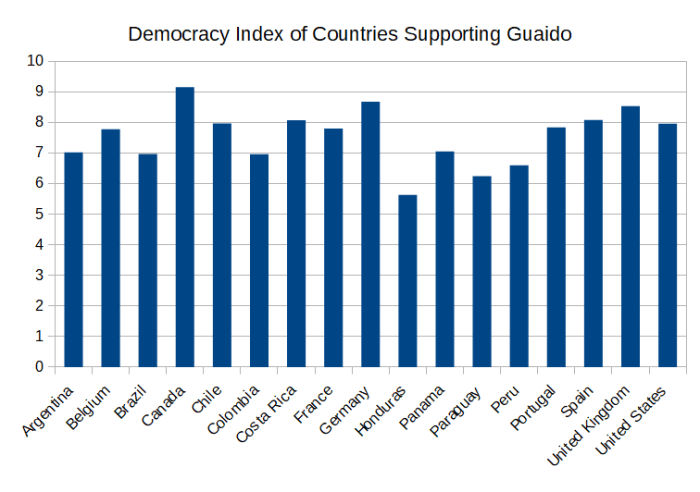
Here’s a bit of evidence that this is indeed what’s happening: the countries that support Guaido are a lot more democratic than the countries that support Maduro.

Guaido has already been recognized by most of Europe and Latin America, including Argentina, Brazil, Chile, Colombia, Costa Rica, Guatemala, Honduras, Panama, Paraguay, and Peru. Among those supporting Maduro are China, Russia, Iran, and Turkey—not exactly bastions of liberal democracy. Within Latin America, only Bolivia, Cuba, Mexico, and Uruguay support Maduro. Of those, only Mexico and Uruguay are recognizably democratic.

The average Democracy Index of countries that support Guaido is 7.5, which would be a “flawed democracy”. The average Democracy Index of countries that support Maduro is only 4.4, a “hybrid regime”.

Here is a plot of the Democracy Index by country supporting Guaido:democracy_index_guaido

Here is a plot of the Democracy Index by country supporting Maduro:

democracy_index_maduro

Since the entire EU recognizes Guaido, I could have shown each European country separately and biased the numbers even further, but I decided to specifically stick to major European powers with explicitly stated positions on Venezuela.

And we know that Maduro was a ruthless and autocratic dictator. So this is looking an awful lot like a democratic uprising against authoritarianism. It’s hard for me to be upset about that.

Second, Venezuela was in terrible shape, and largely due to Maduro’s administration.

After Maduro was elected (we’re still not sure how legitimate that election really was), Maduro underwent a total economic meltdown. Depression, hyperinflation, famine, a resurgence of malaria, and a huge exodus of refugees all followed. Millions of people are now starving in a country that was once quite rich. Nearly 90% of the population now lives in poverty. The story of Venezuela’s economy is one of total self-destruction.

Due to the bizarre system of subsidies and price controls in place, oil is now 100 times cheaper in Venezuela than water. Venezuela’s oil production has plummeted under Maduroto its lowest levels in decades, which might be good for climate change but is very bad for a country so dependent upon oil export revenue. It’s pretty much a classic cautionary tale for the Resource Curse.

Maduro, like any good socialist dictator, has blamed US sanctions for all his country’s economic failings. But there have not been strict US sanctions against Venezuela, and we remain their chief purchaser of oil by a wide margin. If you’ve ever bought gasoline at a Citgo station, you have paid for Venezuelan oil. Moreover, if your socialist country is that heavily dependent on exporting to capitalist countries… that really doesn’t say much in favor of socialism as an economic system, does it?

I don’t know what will happen. Maybe Maduro will successfully regain power. Maybe Guaido will retain control but turn out to be just as bad (there’s a long track record of coups against awful dictators resulting in equally awful dictators—Idi Amin is a classic example). Maybe Trump will do something stupid or crazy and we’ll end up in yet another decades-long military quagmire.

But there’s also a chance of something much better: Maybe Guaido can actually maintain power and build a genuinely democratic regime in Venezuela, and turn their economy back from the brink of devastation toward more sustainable growth. When the devil you know is this bad, sometimes you really do want to bet on the devil you don’t.

I don’t care what happened in that video

Jan 27 JDN 2458511

Right now there is an ongoing controversy over a viral video of a confrontation between young protesters wearing MAGA hats and an elderly Native American man. Various sources are purporting to show “a fuller picture” and “casting new light” and showing “a different side”. Others are saying it’s exactly as bad as it looks.

I think it probably is as bad as it looks, but the truth is: I don’t care. This is a distraction.

If you think litigating the precise events of this video is important, you are suffering from a severe case of scope neglect. You are looking at a single event between a handful of people when you should be looking at the overall trends of a country of over 300 million people.

First of all: The government shutdown only just ended. There are still going to be a lot of pieces to pick up. That’s what we should be talking about. That’s what we should be posting about. That’s what we should be calling Senators about. This is a national emergency. The longer this lasts, the worse it is going to get. People will die because of this shutdown—from tainted food and polluted water and denied food stamps. Our national security is being jeopardized—particularly with regard to cybersecurity.

The shutdown was also a completely unforced error. Government shutdowns shouldn’t even exist, and now that this one is over, we need to change the budget process so that this can never happen again.

And if you want to talk about the racist, sexist, and authoritarian leanings of Trump supporters, that’s quite important too. But it doesn’t hinge upon one person or one confrontation. I’m sure there are Trump supporters who aren’t racist; and I’m sure there are Obama supporters who are. But the overall statistical trend there is extremely strong.

I understand that most people suffer from severe scope neglect, and we have to live in a world filled with such people; so maybe there’s some symbolic value in finding one particularly egregious case that you can put a face on and share with the world. But if you’re going to do that, there’s two things I’d ask of you:

1. Make absolutely sure that this case is genuine. Nothing will destroy your persuasiveness faster than holding up an ambiguous case as if it were definitive.
2. After you’ve gotten their attention with the single example, show the statistics. There are truths, whole truths, and statistics. If you really want to know something, you use statistics.

The statistics are what this is really about. One person, even a hundred people—that really doesn’t matter. We need to keep our eyes on the millions of people, the directions of entire nations. For a lot of people, looking at numbers is boring; but there are people behind those numbers, and numbers are what tell us what’s really going on in the world.

For example: Trump really does seem to have brought bigotry out in the open. Hate crimes in the US increased for the third year in a row last year.

Then there are his direct policy actions which are human rights violations: The number of children detained at the border has skyrocketed to almost 13,000.

On the other hand, the economy is doing quite well: Unemployment stands at about 4%, and median income is increasing and poverty is decreasing.
Global extreme poverty continues its preciptious decline, but global climate change is getting worse, and already past the point where some serious consequences are going to be unavoidable.

Some indicators are more ambiguous: Corporate profits are near their all-time high, even in inflation-adjusted terms. That could be a sign of an overall good economy—but it also clearly has something to do with redistribution of income toward the wealthy.

Of course, all of those things were true yesterday, and will be true tomorrow. They were true last week, and will be true next week. They don’t lend themselves to a rapid-fire news cycle.

But maybe that means we don’t need a rapid-fire news cycle? Maybe that’s not the best way to understand what’s going on in the world?

Sexism in the economics profession

Jan 20 JDN 2458504

I mentioned in my previous post that the economics profession is currently coming to a reckoning with its own sexist biases. Today I’d like to get back to that in more detail.

I think I should include some kind of trigger warning here, because some of this sexism is pretty extreme. In particular, there are going to be references to anal sex, which certainly isn’t something I was expecting to find. I won’t quote anything highly explicit—but I assure you, it exists.

There is reason to believe that these biases are not as bad as they once were. If you compare the cohorts of new economics PhDs to those of the past, or to the professors who have been tenured for many years, the pattern is quite clear: The longer back you look, the fewer women (and racial minorities, and LGBT people) you see.

In part because of the #MeToo movement (which, I really would like to say, has done an excellent job of picking legitimate targets and not publicly shaming the wrong people, unlike almost every other attempt at public shaming via social media), the economics profession is also coming to terms with a related matter, which could be both cause and consequence of these gender disparities: Sexual harassment by economists of their students and junior faculty.

It wasn’t until last year that the AEA officially adopted a Code of Professional Conduct mandating equality of opportunity for women (and minorities, and LGBT people). Of course, sexual harassment has been illegal much longer than that—but it’s probably the most under-reported and under-prosecuted crime in existence. Last year’s AEA conference was the first to include panels specifically on gender and discrimination in economics, and this year’s conference had more.

Grad students have been a big part of this push; hundreds of econ grad students signed an open letter demanding that universities implement reporting and disciplinary systems to deal with sexual harassment in economics (one of the signatories is friend of mine from UCI, though strangely I don’t remember hearing about it, or I would have signed it too).

One of the most prominent economists accused of repeated sexual harassment unfortunately happens to be the youngest Black person ever to get tenured at Harvard. This would seem to create some tension between gender equality and racial equality. But of course this tension is illusory: There are plenty of other brilliant Black economists they could have hired who aren’t serial sexual harassers.

It’s still dicey for grad students and junior faculty to talk about these things, because of the very real power that senior faculty have over us as committees for dissertations, hiring, and tenure. Some economists who wrote papers about sexism in the profession have chosen to remain anonymous for fear of retaliation.

Part of how this issue has finally gotten so much attention is by concerned economists actually showing it using the methods of social science. One of the most striking studies was a data analysis of the word usage on econjobrumors.com, a job discussion board for PhD grads and junior faculty in economics. (More detail on that study here and also here.)

I’ve bolded the terms that are sexual or suggest bias. I’ve italicized the terms that suggest something involving romantic or family relationships. I’ve underlined the terms actually relevant for economics.
These were the terms most commonly associated with women:

hotter, lesbian, bb, sexism, tits, anal, marrying, feminazi, slut, hot, vagina, boobs, pregnant, pregnancy, cute, marry, levy, gorgeous, horny, crush, beautiful, secretary, dump, shopping, date, nonprofit, intentions, sexy, dated and prostitute.

These were the terms most commonly associated with men:

juicy, keys, adviser, bully, prepare, fought, wharton, austrian, fieckers, homo, genes, e7ee, mathematician, advisor, burning, pricing, fully, band, kfc, nobel, cat, amusing, greatest, textbook, goals, irritate, roof, pointing, episode, and tries.

I imagine the two lists more or less speak for themselves. I’m particularly shocked by the high prevalence of the word “anal”—the sixth-most common word used in threads involving women.

Who goes to an economics job forum and starts talking about anal sex?

I actually did a search on “anal” to see what sort of things were being discussed: This thread is apparently someone trying to decide where he should work based on “Girls of which country are easiest to get?”, so basically sex tourism as job market planning. Here’s another asking (perhaps legitimately) about the appropriate social norm for splitting vacation costs with a girlfriend, and someone down the thread recommends that in exchange for paying, he should expect her to provide him with anal sex. This one starts with a man lamenting that his girlfriend dumped him on his birthday (that’s a dick move by the way), but somehow veers off into a discussion of whether anal sex is overrated. And this one is just off the bat about frequency of sexual encounters.
So yeah, I’m really not surprised that there aren’t a lot of women on these so-called “job discussion boards”.

The only bias-related word associated with men was “homo”—so it’s actually a homophobic bias, itself indicative of sexism and a profession dominated by cisgender straight White men. I’m not entirely sure that “juicy” was intended to be sexualized (one could also speak of “juicy ideas”), but I’ll assume it was just to conservatively estimate the gender disparity.

Also of special note are “fieckers” and “e7ee”, which refer to specific users, who, despite being presumably economists, caused a great deal of damage to the discussion boards. “fieckers” was an idiosyncratic word that one user used in a variety of sexist and homophobic troll posts, while “e7ee” is the hexadecimal code for one of the former moderators, who apparently uilaterally deleted and moved threads in order to tilt the entire discussion board toward right-wing laissez-faire economics.

Of course, that one discussion board isn’t representative of the entire profession. As anyone who has ever visited 4chan knows, discussion boards can be some of the darkest places on the Internet.

Clearer evidence of discrimination where it counts can be found in citation studies, which have found that papers published by women in top economics journals are more highly cited than papers published by men in the same journals.

What does that mean? Well, it’s the same reason that female stock brokers outperform male brokers and firms with more female executives are more profitable. Women are held to a higher standard than men, so in order to simply get in, women have to be more competent and produce higher-quality output.

Admittedly, citation count is far from a perfect measure of research quality (and for that matter profit is far from a perfect measure of a well-run corporation). But this is very clear evidence of actual discrimination. Not innate differences in preferences, not differences in talent—actual discrimination. It’s less clear where and how the discrimination is happening. Are journals simply not accepting good papers if they see female authors? (This is possible, because most top journals in economics don’t use double-blind peer review anymore—for quite flimsy reasons, in my opinion). Are there not enough mentors for women in academia? Are women moving to more accepting fields before they even enter grad school? Are they being pushed out by harassment as grad students? Likely all of these are part of the story.

There’s reason to think that economic ideology has contributed to this problem. If you think of the world in neoclassical laissez-faire terms, where markets are perfect and always lead to the best outcome, then you are likely to be blind to bias and discrimination, because a perfect market would obviously eliminate such things. This is why the recognition of bias has largely come from empirical studies of labor markets, and to a lesser extent from experiments and more left-wing theorists. If you assert that markets are perfectly efficient, labor economists are likely to laugh in your face, while a surprising number of macro theorists will nod and ask you to continue.

Interestingly, recent field experiments on bias in hiring of new faculty did not find any bias against women in economics (and found biases toward women in several other fields). Of course, that doesn’t mean there never was such bias; but perhaps we’ve actually managed to remove it. So that’s one major avenue of discrimination we maybe finally have under control. Only several dozen left to go?