Strange times for the labor market

Jan 9 JDN 2459589

Labor markets have been behaving quite strangely lately, due to COVID and its consequences. As I said in an earlier post, the COVID recession was the one recession I can think of that actually seemed to follow Real Business Cycle theory—where it was labor supply, not demand, that drove employment.

I dare say that for the first time in decades, the US government actually followed Keynesian policy. US federal government spending surged from $4.8 trillion to $6.8 trillion in a single year:

That is a staggering amount of additional spending; I don’t think any country in history has ever increased their spending by that large an amount in a single year, even inflation-adjusted. Yet in response to a recession that severe, this is exactly what Keynesian models prescribed—and for once, we listened. Instead of balking at the big numbers, we went ahead and spent the money.

And apparently it worked, because unemployment spiked to the worst levels seen since the Great Depression, then suddenly plummeted back to normal almost immediately:

Nor was this just the result of people giving up on finding work. U-6, the broader unemployment measure that includes people who are underemployed or have given up looking for work, shows the same unprecedented pattern:
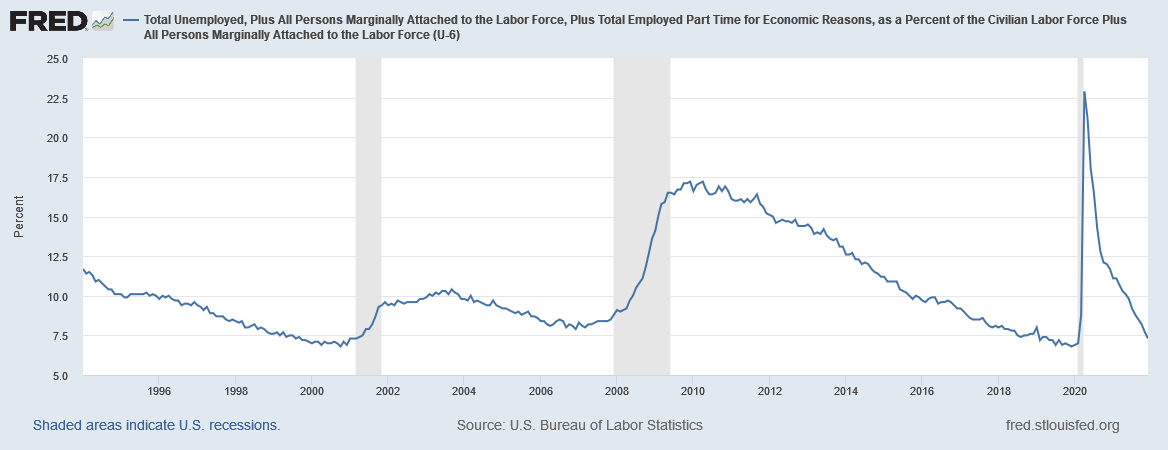
The oddest part is that people are now quitting their jobs at the highest rate seen in over 20 years:

[FRED_quits.png]

This phenomenon has been dubbed the Great Resignation, and while its causes are still unclear, it is clearly the most important change in the labor market in decades.

In a previous post I hypothesized that this surge in strikes and quits was a coordination effect: The sudden, consistent shock to all labor markets at once gave people a focal point to coordinate their decision to strike.

But it’s also quite possible that it was the Keynesian stimulus that did it: The relief payments made it safe for people to leave jobs they had long hated, and they leapt at the opportunity.

When that huge surge in government spending was proposed, the usual voices came out of the woodwork to warn of terrible inflation. It’s true, inflation has been higher lately than usual, nearly 7% last year. But we still haven’t hit the double-digit inflation rates we had in the late 1970s and early 1980s:

Indeed, most of the inflation we’ve had can be explained by the shortages created by the supply chain crisis, along with a very interesting substitution effect created by the pandemic. As services shut down, people bought goods instead: Home gyms instead of gym memberships, wifi upgrades instead of restaurant meals.

As a result, the price of durable goods actually rose, when it had previously been falling for decades. That broader pattern is worth emphasizing: As technology advances, services like healthcare and education get more expensive, durable goods like phones and washing machines get cheaper, and nondurable goods like food and gasoline fluctuate but ultimately stay about the same. But in the last year or so, durable goods have gotten more expensive too, because people want to buy more while supply chains are able to deliver less.

This suggests that the inflation we are seeing is likely to go away in a few years, once the pandemic is better under control (or else reduced to a new influenza where the virus is always there but we learn to live with it).

But I don’t think the effects on the labor market will be so transitory. The strikes and quits we’ve been seeing lately really are at a historic level, and they are likely to have a long-lasting effect on how work is organized. Employers are panicking about having to raise wages and whining about how “no one wants to work” (meaning, of course, no one wants to work at the current wage and conditions on offer). The correct response is the one from Goodfellas [language warning].

For the first time in decades, there are actually more job vacancies than unemployed workers:

This means that the tables have turned. The bargaining power is suddenly in the hands of workers again, after being in the hands of employers for as long as I’ve been alive. Of course it’s impossible to know whether some other shock could yield another reversal; but for now, it looks like we are finally on the verge of major changes in how labor markets operate—and I for one think it’s about time.

Reasons for optimism in 2022

Jan 2 JDN 2459582

When this post goes live, we will have begun the year 2022.

That still sounds futuristic, somehow. We’ve been in the 20th century long enough that most of my students were born in it and nearly all of them are old enough to drink (to be fair, it’s the UK, so “old enough to drink” only means 18). Yet “the year 2022” still seems like it belongs in science fiction, and not on our wall calendars.

2020 and 2021 were quite bad years. Death rates and poverty rates surged around the world. Almost all of that was directly or indirectly due to COVID.

Yet there are two things we should keep in perspective.

First, those death rates and poverty rates surged to what we used to consider normal 50 years ago. These are not uniquely bad times; indeed, they are still better than most of human history.

Second, there are many reasons to think that 2022—or perhaps a bit later than that, 2025 or 2030—will be better.

The Omicron variant is highly contagious, but so far does not appear to be as deadly as previous variants. COVID seems to be evolving to be more like influenza: Catching it will be virtually inevitable, but dying from it will be very rare.

Things are also looking quite good on the climate change front: Renewable energy production is growing at breathtaking speed and is now cheaper than almost every other form of energy. It’s awful that we panicked and locked down nuclear energy for the last 50 years, but at this point we may no longer need it: Solar and wind are just that good now.

Battery technology is also rapidly improving, giving us denser, cheaper, more stable batteries that may soon allow us to solve the intermittency problem: the wind may not always blow and the sun may not always shine, but if you have big enough batteries you don’t need them to. (You can get a really good feel for how much difference good batteries make in energy production by playing Factorio, or, more whimsically, Mewnbase.)

If we do go back to nuclear energy, it may not be fission anymore, but fusion. Now that we have nearly reached that vital milestone of break-even, investment in fusion technology has rapidly increased.


Fusion has basically all of the benefits of fission with none of the drawbacks. Unlike renewables, it can produce enormous amounts of energy in a way that can be easily scaled and controlled independently of weather conditions. Unlike fission, it requires no exotic nuclear fuels (deuterium can be readily attained from water), and produces no long-lived radioactive waste. (Indeed, development is ongoing of methods that could use fusion products to reduce the waste from fission reactors, making the effective rate of nuclear waste production for fusion negative.) Like both renewables and fission, it produces no carbon emissions other than those required to build the facility (mainly due to concrete).

Of course, technology is only half the problem: we still need substantial policy changes to get carbon emissions down. We’ve already dragged our feet for decades too long, and we will pay the price for that. But anyone saying that climate change is an inevitable catastrophe hasn’t been paying attention to recent developments in solar panels.

Technological development in general seems to be speeding up lately, after having stalled quite a bit in the early 2000s. Moore’s Law may be leveling off, but the technological frontier may simply be moving away from digital computing power and onto other things, such as biotechnology.

Star Trek told us that we’d have prototype warp drives by the 2060s but we wouldn’t have bionic implants to cure blindness until the 2300s. They seem to have gotten it backwards: We may never have warp drive, but we’ve got those bionic implants today.

Neural interfaces are allowing paralyzed people to move, speak, and now even write.

After decades of failed promises, gene therapy is finally becoming useful in treating real human diseases. CRISPR changes everything.

We are also entering a new era of space travel, thanks largely to SpaceX and their remarkable reusable rockets. The payload cost to LEO is a standard measure of the cost of space travel, which describes the cost of carrying a certain mass of cargo up to low Earth orbit. By this measure, costs have declined from nearly $20,000 per kg to only $1,500 per kg since the 1960s. Elon Musk claims that he can reduce the cost to as low as $10 per kg. I’m skeptical, to say the least—but even dropping it to $500 or $200 would be a dramatic improvement and open up many new options for space exploration and even colonization.

To put this in perspective, the cost of carrying a human being to the International Space Station (about 100 kg to LEO) has fallen from $2 million to $150,000. A further decrease to $200 per kg would lower that to $20,000, opening the possibility of space tourism; $20,000 might be something even upper-middle-class people could do as a once-in-a-lifetime vacation. If Musk is really right that he can drop it all the way to $10 per kg, the cost to carry a person to the ISS would be only $1000—something middle-class people could do regularly. (“Should we do Paris for our anniversary this year, or the ISS?”) Indeed, a cost that low would open the possibility of space-based shipping—for when you absolutely must have the product delivered from China to California in the next 2 hours.

Another way to put this in perspective is to convert these prices per mass in terms of those of commodities, such as precious metals. $20,000 per kg is nearly the price of solid platinum. $500 per kg is about the price of sterling silver. $10 per kg is roughly the price of copper.

The reasons for optimism are not purely technological. There has also been significant social progress just in the last few years, with major milestones on LGBT rights being made around the world in 2020 and 2021. Same-sex marriage is now legally recognized over nearly the entire Western Hemisphere.

None of that changes the fact that we are still in a global pandemic which seems to be increasingly out of control. I can’t tell you whether 2022 will be better than 2021, or just more of the same—or perhaps even worse.

But while these times are hard, overall the world is still making progress.