A lot of economists seem puzzled by the fact that co-ops are just as efficient as corporate firms, since they have this idea that profit-sharing inevitably results in lower efficiency due to perverse incentives.
I think they’ve been modeling co-ops wrong. Here I present a new model, a very simple one, with linear supply and demand curves. Of course one could make a more sophisticated model, but this should be enough to make the point (and this is just a blog post, not a research paper, after all).
Demand curve is p = a – b q
Marginal cost is f q
There are n workers, who would hold equal shares of the co-op.
Competitive market
First, let’s start with the traditional corporate firm in a competitive market.
Since the market is competitive, price would equal marginal cost would equal wage:
a – b q = d q
q = a/(b+f)
w = d (a/(b+f)) = (a d)/(b+f)
Total profit will be
(p – w)q = 0.
Monopoly firm
In a monopoly, marginal revenue would equal marginal cost: d[pq]/dq = a – 2 b q
If they are also a monopsonist in the labor market, this marginal cost would be marginal cost of labor, not wage:
d[d q2]/dq = 2 f q
a – 2 b q = 2 f q
q = a/(2b + 2f)
p = a – b q = a (1 – b/(2b + 2f)) = (a (b + 2f))/(2b + 2f)
First, suppose that instead of working for a wage, I work for profit sharing.
If our product market is competitive, we’ll be price-takers, and we will produce until price equals marginal cost:
p = f q
a – b q = f q
q = a/(a+b)
But will we, really? I only get 1/n share of the profits. So let’s see here. My marginal cost of production is still f q, but the marginal benefit I get from more sales may only be p/n.
In that case I would work until:
p/n = f q
(a – b q)/n = fq
a – b q = n f q
q = (a/(b+nf))
Thus I would under-produce. This is the usual argument against co-ops and similar shared ownership.
Co-ops with wages
But that’s not actually how co-ops work. They pay wages. Why do they do that? Well, consider what happens if I am offered a wage as a worker-owner of the co-op.
Is there any reason for the co-op to vote on a wage that is less than the competitive market? No, because owners are workers, so any additional profit from a lower wage would simply be taken from their own wages.
If there any reason for the co-op to vote on a wage that is more than the competitive market? No, because workers are owners, and any surplus lost by paying higher wages would simply be taken from their own profits.
So if the product market is competitive, the co-op will produce the same amount and charge the same price as a firm in perfect competition, even if they have market power over their own wages.
Monopoly co-ops
The argument above doesn’t assume that the co-op has no market power in the labor market. Thus if they are a monopoly in the product market and a monopsony in the labor market, they still pay a competitive wage.
Thus they would set marginal revenue equal to marginal cost:
a – 2 b q = f q
q = a/(2b + f)
The co-op will produce more than the monopoly firm..
This is the new price:
p = a – b q = a(1 – b/(2b+f)) = a(b+f)/(2b + f)
It’s not obvious that this is lower than the price charged by the monopoly firm, but it is.
(a (b + 2f))/(2b + 2f) – a(b+f)/(2b + f) = (a (2b + f)(b + 2f) – 2 a(b+f)2)/(2(b+f)(2b+f))
This is proportional to:
(2b + f)(b + 2f) – 2(b+f)2
2b2 + 5bf + 2f2 – (2b2 + 4bf + 2f2) = bf
So it’s not a large difference, but it’s there. In the presence of market power in the labor market, the co-op is better for consumers, because they get more goods and pay a lower price.
Thus, there is actually no lost efficiency from being a co-op. There is simply much lower inequality, and potentially higher efficiency.
Since they’re just as efficient—if not more so—and produce much lower inequality, switching more firms over to co-ops would clearly be a good thing.
Why, then, aren’t co-ops more common?
Because the people who have the money don’t like them.
The biggest barrier facing co-ops is their inability to get financing, because they don’t pay shareholders (so no IPOs) and banks don’t like to lend to them. They tend to make less profit than corporate firms, which offers investors a lower return—instead that money goes to the worker-owners. This lower return isn’t due to inefficiency; it’s just a different distribution of income, more to labor and less to capital.
We will need new financial institutions to support co-ops, such as the Cooperative Fund of New England. And general redistribution of wealth would also help, because if middle class people had more wealth they could afford to finance co-ops. (It would also be good for many other reasons, of course.)
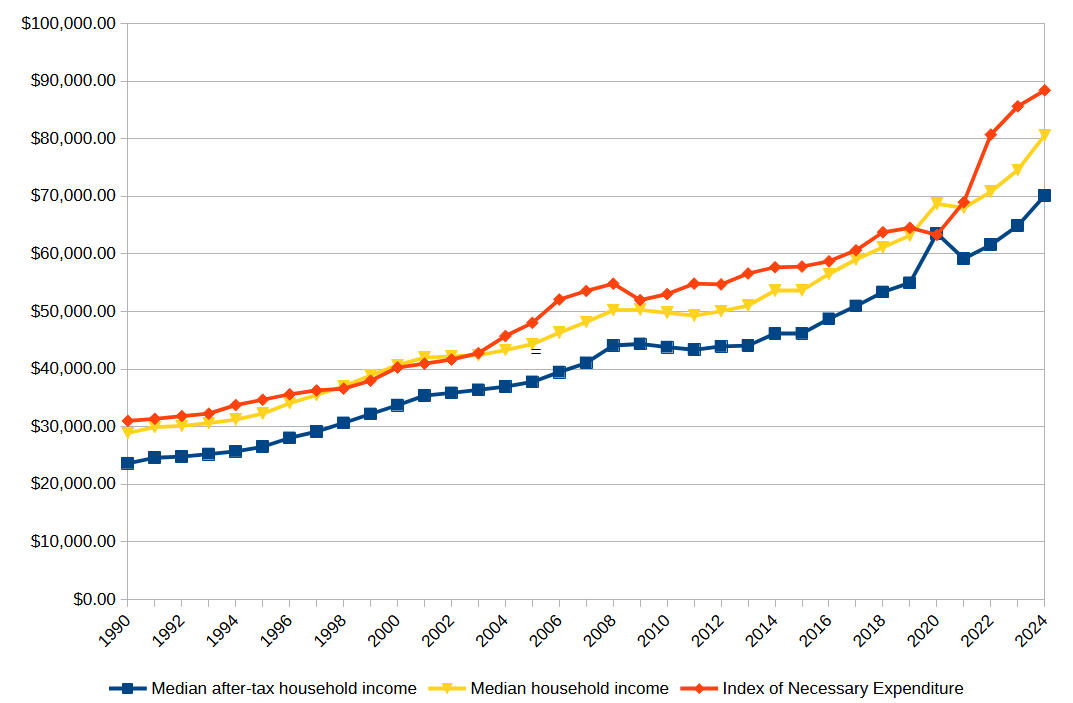
In last week’s post I constructed an Index of National Expenditure (INE), attempting to estimate the total cost of all of the things a family needs and can’t do without, like housing, food, clothing, cars, healthcare, and education. What I found shocked me: The median family cannot afford all necessary expenditures.
I have a couple more thoughts about that.
I still don’t understand why people care so much about gas prices.
Gasoline was a relatively small contribution to INE. It was more than clothing but less than utilities, and absolutely dwarfed by housing, food, or college. I thought maybe since I only counted a 15-mile commute, maybe I didn’t actually include enoughgasoline usage, but based on this estimate of about $2000 per driver, I was in about the right range; my estimate for the same year was $3350 for a 2-car family.
I think I still have to go with my salience hypothesis: Gasoline is the only price that we plaster in real-time on signs on the side of the road. So people are constantly aware of it, even though it isn’t actually that important.
The price surge that should be upsetting people is housing.
If the price of homes had only risen with the rate of CPI inflation instead of what it actually did, the median home price in 2024 would be only $234,000 instead of the $396,000 it actually is; and by my estimation that would save a typical family $11,000 per year—a whopping 15% of their income, and nearly enough to make the INE affordable by itself.
Now, I’ll consider some possible objections to my findings.
Objection 1: A typical family doesn’t actually spend this much on these things.
You’re right, they don’t! Because they couldn’t possibly. Even with substantial debt, you just can’t sustainably spend 125% of your after-tax household income.
My goal here was not to estimate how much families actually spend; it was to estimate how much they need to spend in order to live a good life and not feel deprived.
What I have found is that most American families feel deprived. They are forced to sacrifice something really important—like healthcare, or education, or owning a home—because they simply can’t afford it.
What I’m trying to do here is find the price of the American Dream; and what I’ve found is that the American Dream has a price that most Americans cannot afford.
Objection 2: You should use median healthcare spending, not mean.
I did in fact use mean figures instead of median for healthcare expenditures, mainly because only the mean was readily available. Mean income is higher than median income, so you might say that I’ve overestimated healthcare expenditure—and in a sense that’s definitely true. The median family spends less than this on healthcare.
But the reason that the median family spends less than this on healthcare is not that they want to, but that they have to. Healthcare isn’t a luxury that people buy more of because they are richer. People buy either as much as they need or as much as they can afford—whichever is lower, which is typically the latter. Using the mean instead of the median is a crude way to account for that, but I think it’s a defensible one.
But okay, let’s go ahead and cut the estimate of healthcare spending in half; even if you do that, the INE is still larger than after-tax median household income in most years.
Objection 3: A typical family isn’t a family of four, it’s a family of three.
Part of what I seem to be finding here is that a family of four is unaffordable—literally impossible to afford—on a typical family income.
But a healthy society is one in which typical families have two or three children. That is what we need in order to achieve population replacement. When families get smaller than that, we aren’t having enough children, and our population will decline—which means that we’ll have too many old people relative to young people. This puts enormous pressure on healthcare and pension systems, which rely upon the fact that young people produce more, in order to pay for the fact that old people cost more.
This is bad. This is not sustainable. If the reason families aren’t having enough kids is that they can’t afford them—and this fits with other research on the subject—then this economic failure damages our entire society, and it needs to be fixed.
Objection 4: Many families buy their cars used.
Perhaps 1/10 of a new car every year isn’t an ideal estimate of how much people spend on their cars, but if anything I think it’s conservative, because if you only buy a car every 10 years, and it was already used when you bought it, you’re going to need to spend a lot on maintaining it—quite possibly more than it would cost to get a new one. Motley Fool actually estimates the ownership cost of just one car at substantially more than I estimated for two cars. So if anything your complaint should be that I’ve underestimated the cost by not adequately including maintenance and insurance.
Objection 5: Not everyone gets a four-year college degree.
Fair enough; a substantial proportion get associate’s degrees, and most people get no college degree at all. But some also get graduate degrees, which is even more expensive (ask me how I know).
Moreover, in today’s labor market, having a college degree makes a huge difference in your future earnings; a bachelor’s degree increases your lifetime earnings by a whopping 84%. In theory it’s okay to have a society where most people don’t go to college; in practice, in our society, not going to college puts you at a tremendous disadvantage for the rest of your life. So we either need to find a way to bring wages up for those who don’t go to college, or find a way to bring the cost of college down.
This is probably one of the things that families actually choose to scrimp on, only sending one kid to college or none at all. But because college is such a huge determinant of earnings, this perpetuates intergenerational inequality: Only rich families can afford to send their kids to college, and only kids who went to college grow up to have rich families.
Objection 6: You don’t actually need to save for college; you can use student loans.
Yes, you can, and in practice, most people who to college do. But while this solves the liquidity problem (having enough money right now), it does not solve the solvency problem (having enough money in the long run). Failing to save for college and relying on student loans just means pushing the cost of college onto your children—and since we’ve been doing that for over a generation, feel free to replace the category “college savings” with “repaying student loans”; it won’t meaningfully change the results.
I’m still reeling from the fact that Donald Trump was re-elected President. He seemed obviously horrible at the time, and he still seems horrible now, for many of the same reasons as before (we all knew the tariffs were coming, and I think deep down we knew he would sell out Ukraine because he loves Putin), as well as some brand new ones (I did not predict DOGE would gain access to all the government payment systems, nor that Trump would want to start a “crypto fund”). Kamala Harris was not an ideal candidate, but she was a good candidate, and the comparison between the two could not have been starker.
Now that the dust has cleared and we have good data on voting patterns, I am now less convinced than I was that racism and sexism were decisive against Harris. I think they probably hurt her some, but given that she actually lost the most ground among men of color, racism seems like it really couldn’t have been a big factor. Sexism seems more likely to be a significant factor, but the fact that Harris greatly underperformed Hillary Clinton among Latina women at least complicates that view.
A lot of voters insisted that they voted on “inflation” or “the economy”. Setting aside for a moment how absurd it was—even at the time—to think that Trump (he of the tariffs and mass deportations!) was going to do anything beneficial for the economy, I would like to better understand how people could be so insistent that the economy was bad even though standard statistical measures said it was doing fine.
Krugman believes it was a “vibecession”, where people thought the economy was bad even though it wasn’t. I think there may be some truth to this.
But today I’d like to evaluate another possibility, that what people were really reacting against was not inflation per se but necessitization.
I first wrote about necessitization in 2020; as far as I know, the term is my own coinage. The basic notion is that while prices overall may not have risen all that much, prices of necessities have risen much faster, and the result is that people feel squeezed by the economy even as CPI growth remains low.
In this post I’d like to more directly evaluate that notion, by constructing an index of necessary expenditure (INE).
The core idea here is this:
What would you continue to buy, in roughly the same amounts, even if it doubled in price, because you simply can’t do without it?
For example, this is clearly true of housing: You can rent or you can own, but can’t not have a house. And nor are most families going to buy multiple houses—and they can’t buy partial houses.
It’s also true of healthcare: You need whatever healthcare you need. Yes, depending on your conditions, you maybe could go without, but not without suffering, potentially greatly. Nor are you going to go out and buy a bunch of extra healthcare just because it’s cheap. You need what you need.
I think it’s largely true of education as well: You want your kids to go to college. If college gets more expensive, you might—of necessity—send them to a worse school or not allow them to complete their degree, but this would feel like a great hardship for your family. And in today’s economy you can’t not send your kids to college.
But this is not true of technology: While there is a case to be made that in today’s society you need a laptop in the house, the fact is that people didn’t used to have those not that long ago, and if they suddenly got a lot cheaper you very well might buy another one.
Well, it just so happens that housing, healthcare, and education have all gotten radically more expensive over time, while technology has gotten radically cheaper. So prima facie, this is looking pretty plausible.
But I wanted to get more precise about it. So here is the index I have constructed. I consider a family of four, two adults, two kids, making the median household income.
To get the median income, I’ll use this FRED series for median household income, then use this table of median federal tax burden to get an after-tax wage. (State taxes vary too much for me to usefully include them.) Since the tax table ends in 2020 which was anomalous, I’m going to extrapolate that 2021-2024 should be about the same as 2019.
I assume the kids go to public school, but the parents are saving up for college; to make the math simple, I’ll assume the family is saving enough for each kid to graduate from with a four-year degree from a public university, and that saving is spread over 16 years of the child’s life. 2*4/16 = 0.5; this means that each year the family needs to come up with 0.5 years of cost of attendance. (I had to get the last few years from here, but the numbers are comparable.)
I assume the family owns two cars—both working full time, they kinda have to—which I amortize over 10 year lifetimes; 2*1/10 = 0.2, so each year the family pays 0.2 times the value of an average midsize car. (The current average new car price is $33226; I then use the CPI for cars to figure out what it was in previous years.)
I assume they pay a 30-year mortgage on the median home; they would pay interest on this mortgage, so I need to factor that in. I’ll assume they pay the average mortgage rate in that year, but I don’t want to have to do a full mortgage calculation (including PMI, points, down payment etc.) for each year, so I’ll say that they amount they pay is (1/30 + 0.5 (interest rate))*(home value) per year, which seems to be a reasonable approximation over the relevant range.
I assume that both adults have a 15-mile commute (this seems roughly commensurate with the current mean commute time of 26 minutes), both adults work 5 days per week, 50 weeks per year, and their cars get the median level of gas mileage. This means that they consume 2*15*2*5*50/(median MPG) = 15000/(median MPG) gallons of gasoline per year. I’ll use this BTS data for gas mileage. I’m intentionally not using median gasoline consumption, because when gas is cheap, people might take more road trips, which is consumption that could be avoided without great hardship when gas gets expensive. I will also assume that the kids take the bus to school, so that doesn’t contribute to the gasoline cost.
That I will multiply by the average price of gasoline in June of that year, which I have from the EIA since 1993. (I’ll extrapolate 1990-1992 as the same as 1993, which is conservative.)
I will assume that the family owns 2 cell phones, 1 computer, and 1 television. This is tricky, because the quality of these tech items has dramatically increased over time.
If you try to measure with equivalent buying power (e.g. a 1 MHz computer, a 20-inch CRT TV), then you’ll find that these items have gotten radically cheaper; $1000 in 1950 would only buy as much TV as $7 today, and a $50 Raspberry Pi‘s 2.4 GHz processor is 150 times faster than the 16 MHz offered by an Apple Powerbook in 1991—despite the latter selling for $2500 nominally. So in dollars per gigahertz, the price of computers has fallen by an astonishing 7,500 times just since 1990.
But I think that’s an unrealistic comparison. The standards for what was considered necessary have also increased over time. I actually think it’s quite fair to assume that people have spent a roughly constant nominal amount on these items: about $500 for a TV, $1000 for a computer, and $500 for a cell phone. I’ll also assume that the TV and phones are good for 5 years while the computer is good for 2 years, which makes the total annual expenditure for 2 phones, a TV, and a computer equal to 2/5*500 + 1/5*500 + 1/2*1000 = 800. This is about what a family must spend every year to feel like they have an adequate amount of digital technology.
I will assume that the family buys the equivalent of five months of infant care per year; they surely spend more than this (in either time or money) when they have actual infants, but less as the kids grow. This amounts to about $5000 today, but was only $1600 in 1990—a 214% increase, or 3.42% per year.
For food expenditure, I’m going to use the USDA’s thrifty plan for June of that year. I’ll use the figures assuming that one child is 6 and the other is 9. I don’t have data before 1994, so I’ll extrapolate that with the average growth rate of 3.2%.
The figures I had the hardest time getting were for utilities. It’s also difficult to know what to include: Is Internet access a necessity? Probably, nowadays—but not in 1990. Should I separate electric and natural gas, even though they are partial substitutes? But using these figures I estimate that utility costs rise at about 0.8% per year in CPI-adjusted terms, so what I’ll do is benchmark to $3800 in 2016 and assume that utility costs have risen by (0.8% + inflation rate) per year each year.
Healthcare is also a tough one; pardon the heteronormativity, but for simplicity I’m going to use the mean personal healthcare expenditures for one man and woman (aged 19-44) and one boy and one girl (aged 0-18). Unfortunately I was only able to find that for two-year intervals in the range from 2002 to 2020, so I interpolated and extrapolated both directions assuming the same average growth rate of 3.5%.
So let’s summarize what all is included here:
Estimated payment on a mortgage
0.5 years of college tuition
amortized cost of 2 cars
7500/(median MPG) gallons of gasoline
amortized cost of 2 phones, 1 computer, and 1 television
average spending on clothes
11% of income on food
Estimated utilities spending
Estimated childcare equivalent to five months of infant care
Healthcare for one man, one woman, one boy, one girl
There are obviously many criticisms you could make of these choices. If I were writing a proper paper, I would search harder for better data and run robustness checks over the various estimation and extrapolation assumptions. But for these purposes I really just want a ballpark figure, something that will give me a sense of what rising cost of living feels like to most people.
What I found absolutely floored me. Over the range from 1990 to 2024:
The Index of Necessary Expenditure rose by an average of 3.45% per year, almost a full percentage point higher than the average CPI inflation of 2.62% per year.
Over the same period, after-tax income rose at a rate of 3.31%, faster than CPI inflation, but slightly slower than the growth rate of INE.
The Index of Necessary Expenditure was over 100% of median after-tax household income every year except 2020.
Since 2021, the Index of Necessary Expenditure has risen at an average rate of 5.74%, compared to CPI inflation of only 2.66%. In that same time, after-tax income has only grown at a rate of 4.94%.
Point 3 is the one that really stunned me. The only time in the last 34 years that a family of four has been able to actually pay for all necessities—just necessities—on a typical household income was during the COVID pandemic, and that in turn was only because the federal tax burden had been radically reduced in response to the crisis. This means that every single year, a typical American family has been either going further and further into debt, or scrimping on something really important—like healthcare or education.
No wonder people feel like the economy is failing them! It is!
In fact, I can even make sense now of how Trump could convince people with “Are you better off than you were four years ago?” in 2024 looking back at 2020—while the pandemic was horrific and the disruption to the economy was massive, thanks to the US government finally actually being generous to its citizens for once, people could just about actually make ends meet. That one year. In my entire life.
This is why people felt betrayed by Biden’s economy. For the first time most of us could remember, we actually had this brief moment when we could pay for everything we needed and still have money left over. And then, when things went back to “normal”, it was taken away from us. We were back to no longer making ends meet.
When I went into this, I expected to see that the INE had risen faster than both inflation and income, which was indeed the case. But I expected to find that INE was a large but manageable proportion of household income—maybe 70% or 80%—and slowly growing. Instead, I found that INE was greater than 100% of income in every year but one.
And the truth is, I’m not sure I’ve adequately covered all necessary spending! My figures for childcare and utilities are the most uncertain; those could easily go up or down by quite a bit. But even if I exclude them completely, the reduced INE is still greater than income in most years.
Suddenly the way people feel about the economy makes a lot more sense to me.
In the last two posts I talked about ways that evolutionary theory could influence our understanding of morality, including the dangerous views of naive moral Darwinism as well as some more reasonable approaches; yet there are other senses of the phrase “morality evolves” that we haven’t considered. One of these is actually quite troubling; were it true, the entire project of morality would be in jeopardy. I’ll call it “evolutionary skepticism”; it says that yes, morality has evolved—and this is reason to doubt that morality is true. Richard Joyce, author of The Evolution of Morality, is of such a persuasion, and he makes a quite compelling case. Joyce’s central point is that evolution selects for fitness, not accuracy; we had reason to evolve in ways that would maximize the survival of our genes, not reasons to evolve in ways that would maximize the accuracy of our moral claims.
This is of course absolutely correct, and it is troubling precisely because we can all see that the two are not necessarily the same thing. It’s easy to imagine many ways that beliefs could evolve that had nothing to do with the accuracy of those beliefs.
But note that word: necessarily. Accuracy and fitness aren’t necessarily aligned—but it could still be that they are, in fact, aligned rather well. Yes, we can imagine ways a brain could evolve that would benefit its fitness without improving its accuracy; but is that actually what happened to our ancestors? Do we live on instinct, merely playing out by rote the lifestyles of our forebears, thinking and living the same way we have for hundreds of millennia?
Clearly not! Behold, you are reading a blog post! It was written on a laptop computer! While these facts may seem perfectly banal to you, they represent an unprecedented level of behavioral novelty, one achieved only by one animal species among millions, and even then only very recently. Human beings are incredibly flexible, incredibly creative, and incredibly intelligent. Yes, we evolved to be this way, of course we did; but so what? We are this way. We are capable of learning new things about the world, gaining in a few short centuries knowledge our forebears could never have imagined. Evolution does not always make animals into powerful epistemic engines—indeed, 99.99999\% of the time it does not—but once in awhile it does, and we are the result.
Natural selection is quite frugal; it tends to evolve things the easiest way. The way the world is laid out, it seems to be that the easiest way to evolve a brain that survives really well in a wide variety of ecological and social environments is to evolve a brain that is capable of learning to expand its own knowledge and understanding. After all, no other organism has ever been or is ever likely to be as evolutionarily fit as we are; we span the globe, cover a wide variety of ecological niches, and number in the billions and counting. We’ve even expanded beyond the planet Earth, something no other organism could even contemplate. We are successful because we are smart; is it really so hard to believe that we are smart because it made our ancestors successful?
Indeed, it must be this way, or we wouldn’t be able to make sense of the fact that our human brains, evolved for the African savannah a million years ago with minor tweaks since then, are capable of figuring out chess, calculus, writing, quantum mechanics, special relativity, television broadcasting, space travel, and for that matter Darwinian evolution and meta-ethics. None of these things could possibly have been adaptive in our ancestral ecology. They must be spandrels, fitness-neutral side-effects of evolved traits. And just like the original pendentives of San Marco that motivated Gould’s metaphor, what glorious spandrels they are!
Our genes made us better at gathering information and processing that information into correct beliefs, and calculus and quantum mechanics came along for the ride. Our greatest adaptation is to be adaptable; our niche is to need no niche, for we can carve our own.
This is not to abandon evolutionary psychology, for evolution does have a great deal to tell us about psychology. We do have instincts; preprocessing systems built into our sensory organs, innate emotions that motivate us to action, evolved heuristics that we use to respond quickly under pressure. Steven Pinker argues convincingly that language is an evolved instinct—and where would we be without language? Our instincts are essential for not only our survival, but indeed for our rationality.
Staring at a blinking cursor on the blank white page of a word processor, imagining the infinity of texts that could be written upon that page, you could be forgiven for thinking that you were looking at a blank slate. Yet in fact you are staring at the pinnacle of high technology, an extremely complex interlocking system of hardware and software with dozens of components and billions of subcomponents, all precision-engineered for maximum efficiency. The possibilities are endless not because the system is simple and impinged upon by its environment, but because it is complex, and capable of engaging with that environment in order to convert subtle differences in input into vast differences in output. If this is true of a word processor, how much more true it must be of an organism capable of designing and using word processors! It is the very instincts that seem to limit our rationality which have made that rationality possible in the first place. Witness the eternal wisdom of Immanuel Kant:
Misled by such a proof of the power of reason, the demand for the extension of knowledge recognises no limits. The light dove, cleaving the air in her free flight, and feeling its resistance, might imagine that its flight would be still easier in empty space.
The analogy is even stronger than he knew—for brains, like wings, are an evolutionary adaptation! (What would Kant have made of Darwin?) But because our instincts are so powerful, they are self-correcting; they allow us to do science.
Richard Joyce agrees that we are right to think our evolved brains are reasonably reliable when it comes to scientific facts. He has to, otherwise his whole argument would be incoherent. Joyce agrees that we evolved to think 2+2=4 precisely because 2+2=4, and we evolved to think space is 3-dimensional precisely because space is 3-dimensional. Indeed, he must agree that we evolved to think that we evolved because we evolved! Yet, for some reason Joyce thinks that this same line of reasoning doesn’t apply to ethics.
But why wouldn’t it? In fact, I think we have more reason to trust our evolved capacities in ethics than we do in other domains of science, because the subject matter of morality—human behavior and social dynamics—is something that we have been familiar with even all the way back to the savannah. If we evolved to think that theft and murder are bad, why would that happen? I submit it would happen precisely because theft and murder are Pareto-suboptimal unsustainable strategies—that is, precisely because theft and murder are bad. (Don’t worry if you don’t know what I mean by “Pareto-suboptimal” and “unsustainable strategy”; I’ll get to those in later posts.) Once you realize that “bad” is a concept that can ultimately be unpacked to naturalistic facts, all reason to think it is inaccessible to natural selection drops away; natural selection could well have chosen brains that didn’t like murder precisely because murder is bad. Indeed, because morality is ultimately scientific, part of how natural selection could evolve us to be more moral is by evolving us to be more scientific. We are more scientific than apes, and vastly more scientific than cockroaches; we are, indeed, the most scientific animal that has ever lived on Earth.
I do think that our evolved moral instincts are to some degree mistaken or incomplete; but I can make sense of this, in the same way I make sense of the fact that other evolved instincts don’t quite fit what we have discovered in other sciences. For instance, humans have an innate concept of linear momentum that doesn’t quite fit with what we’ve discovered in physics. We tend to presume that objects have an inherent tendency toward rest, though in fact they do not—this is because in our natural environment, friction makes most objects act as if they had such a tendency. Roll a rock along the ground, and it will eventually stop. Run a few miles, and eventually you’ll have to stop too. Most things in our everyday life really do behave as if they had an inherent tendency toward rest. It’s only once we realized that friction is itself a force, not present everywhere, that we came to see that linear momentum is conserved in the absence of external forces. (Throw a rock in space, and it will not ever stop. Nor will you, by Newton’s Third Law.) This casts no doubt upon our intuitions about rocks rolled along the ground, which do indeed behave exactly as our intuition predicts.
Similarly, our intuition that animals don’t deserve rights could well be an evolutionary consequence of the fact that we sometimes had to eat animals in order to survive, and so would do better not thinking about it too much; but now that we don’t need to do this anymore, we can reflect upon the deeper issues involved in eating meat. This is no reason to doubt our intuitions that parents should care for their children and murder is bad.
In my previous post, I talked about some ways that evolutionary theory can be abused in ethics, leading to abhorrent conclusions. This is all too common; but it doesn’t mean that evolutionary theory has nothing useful to say about ethics.
There are other approaches to evolutionary ethics that do not lead to such horrific conclusions; one such approach is evolutionary anthropocentrism; it is a position held by respected thinkers such as Frans de Waal, but it is still flawed. The claim is that certain behaviors are moral because we have evolved to do them—that behaviors like friendship, marriage, and nationalism are good precisely because they are part of human nature. On this theory, we can discern what is right and wrong for human beings simply by empirically studying what behaviors are universal or adaptive among human beings.
While I applaud the attempt to understand morality scientifically, I must ultimately conclude that the peculiar history of human evolution is far too parochial a basis for any deep moral truths. Another species—from the millions of other life forms with which we share the Earth to the millions of extraterrestrial civilizations that must in all probability exist somewhere in the vastness of the universe—could have a completely different set of adaptations, and hence a completely incompatible moral system.
Is a trait good because it evolved, or did it evolve because it is good? If the former then “good” just means “fit” and human beings are no more moral than rats or cockroaches. Indeed, the most fit human being of all time was the Moroccan tyrant Mulai Ismail, who reputedly fathered 800 children; the least fit include Isaac Newton and Alan Turing, who had no children at all. To say that evolution gets it right—as, with qualifications, I will—is to say that there is a right, independent of what did or did not evolve; if evolution can get it right, then it could also, under other circumstances, get it wrong.
For illustration, imagine a truly alien form of life, one with which we share no common ancestor and only the most basic similarities. Such creatures likely exist in the vastness of the universe, though of course we’ve never encountered any. Perhaps somewhere in one of the nearby arms of our galaxy there is an unassuming planet inhabited by a race of ammonia-based organisms, let’s call them the Extrans, whose “eyes” see in the radio spectrum, whose “ears” are attuned to frequencies lower than we can hear, whose “nerves” transmit signals by fiber optics instead of electricity, whose “legs” are twenty frond-structured fins that propel them through the ammonia sea, whose “hands” are three long prehensile tentacles extending from their heads, whose “language” is a pattern of radio transmissions produced by their four dorsal antennae. Now, imagine that this alien species has managed to develop sufficient technology so that over millions of years they have colonized all the nearby planets with sufficient ammonia to support them. Yet, their population continues to grow—now in the hundreds of trillions—and they cannot find enough living space to support it. One of their scientists has discovered a way to “ammoniform” certain planets—planets with a great deal of water and nitrogen can be converted into ammonia-supporting planets. There’s only one problem: The nearest water-nitrogen planet is called Earth, and there are already seven billion humans (not to mention billions of other lifeforms) living on it who would surely die if the ammoniforming were performed. The ammoniformer ship has just entered our solar system; we have managed to establish radio contact and achieve some rudimentary level of translation between our radically different languages. What do we say to the Extrans?
If morality is to have a truly objective meaning, we ought to be able to explain in terms the Extrans could accept and understand why it would be wrong for them to ammoniform our planet while we are still living on it. We ought to be able to justify to these other intelligent beings, however different they are from us chemically, biologically, psychologically, and technologically, why we are creatures of dignity who deserve not to be killed. Otherwise, the species with superior weapons will win; and if they can get here, that will probably be them, not us.
Sam Harris has said several times, “morality could be like food”; by this he seems to mean that there is objective evaluation that can be made about the nutrition versus toxicity of a given food, even if there is no one best food, and similarly that objective evaluation can be made about the goodness or badness of a moral system even if there is no one best moral system. This makes a great deal of sense to me, but the analogy can also be turned against him, for if morality is just as contingent upon our biology as diet, then who are we to question these Extrans in their quest for more lebensraum?
Or, if you’d prefer to keep the matter closer to home: Who are we to question sharks or cougars, for whom we are food? In practice it’s difficult to negotiate with sharks and cougars, of course. But if even this is to have real moral significance, e.g. that creatures more capable of rational thought and mutual communication are morally better, we still need an objective inter-species account of morality. And suppose we found a particularly intelligent cougar, and managed some sort of communication; what would we be able to say? What reasons could we offer in defense of our claim that they ought not to eat us? Or is, ultimately, our moral authority in these conflicts no deeper than our superior weapons technology? If this is so, it’s hard to see why the superior weapons technology of the Nazi military wouldn’t justify their genocide of the Jews; and thus we run afoul of the Hitler Principle.
While specific moral precepts can and will depend upon the particular features of a given situation, and evolution surely affects and informs these circumstances, the fundamental principles of morality must be deeper than this—they must at least have the objectivity of scientific facts; in fact I think we can go further than this and say that the core principles of morality are in fact logical truths, the sort of undeniable facts that any intelligent being must accept on pain of contradiction or incoherence. Even if not trivially obvious (like “2+2=4” or “a triangle has three sides”), logical and mathematical truths are still logically undeniable (like “the Fourier transform of a Gaussian function is a Gaussian function” or “the Galois group of some fifth-order real polynomials has an acyclic simple normal subgroup” or “the existence of a strong Lyapunov function proves that a system of nonlinear differential equations has an asymptotically stable zero solution”. Don’t worry if you have no idea what those sentences mean; that’s kind of the point. They are tautologies, yes, but very sophisticated tautologies). The fundamental norms must be derivable by logic and the applications to the real world must depend only upon empirical facts.
The standard that moral principles should be scientific or logical truths is a high bar indeed; and one may think it is unreachable. But if this is so, then I do not see how we can coherently discuss ethics as something which makes true claims against us; I can see only prudence, instinct, survival or custom. If morality is an adaptation like any other, then the claim “genocide is wrong” has no more meaning than “five fingers are better than six”—each applies to our particular evolutionary niche, but no other. Certainly the Extrans will not be bound by such rules, and it is hard to see why cougars should be either. There may still be objectively valid claims that can be made against our behavior, but they will have no more force than “Don’t do that; it’s bad for your genes”. Indeed, I already know that plenty of things people do are (at least potentially) bad for their genes, and yet I think they have a right to do them; not only the usual suspects of contraception, masturbation and homosexuality, but indeed reading books, attending school, drinking alcohol, watching television, skiing, playing baseball, and all sorts of other things human beings do, are wastes of energy in purely Darwinian terms. Most of what makes life worth living has little, if any, effect at spreading our genes.


 Human Economics