What do we do about unemployment?

JDN 2457188 EDT 11:21.

Macroeconomics, particularly monetary policy, is primarily concerned with controlling two variables.

The first is inflation: We don’t want prices to rise too fast, or markets will become unstable. This is something we have managed fairly well; other than food and energy prices which are known to be more volatile, prices have grown at a rate between 1.5% and 2.5% per year for the last 10 years; even with food and energy included, inflation has stayed between -1.5% and +5.0%. After recovering from its peak near 15% in 1980, US inflation has stayed between -1.5% and +6.0% ever since. While the optimal rate of inflation is probably between 2.0% and 4.0%, anything above 0.0% and below 10.0% is probably fine, so the only significant failure of US inflation policy was the deflation in 2009.

The second is unemployment: We want enough jobs for everyone who wants to work, and preferably we also wouldn’t have underemployment (people who are only working part-time even though they’d prefer full-time or discouraged workers (people who give up looking for jobs because they can’t find any, and aren’t counted as unemployed because they’re no looking looking for work). There’s also a tendency among economists to want “work incentives” that maximize the number of people who want to work, but I think these are wildly overrated. Work isn’t an end in itself; work is supposed to be creating products and providing services that make human lives better. The benefits of production have to be weighed against the costs of stress, exhaustion, and lost leisure time from working. Given that stress-related illnesses are some of the leading causes of death and disability in the United States, I don’t think that our problem is insufficient work incentives.

Unemployment is a problem that we have definitely not solved. Unemployment has bounced up and down between peaks and valleys, dropping as low as 4.0% and rising as high as 11.0% over the last 60 years. If 2009’s -1.5% deflation concerns you, then its 9.9% unemployment should concern you far more. Indeed, I’m not convinced that 5.0% is an acceptable “natural” rate of unemployment—that’s still millions of people who want work and can’t find it—but most economists would say that it is.

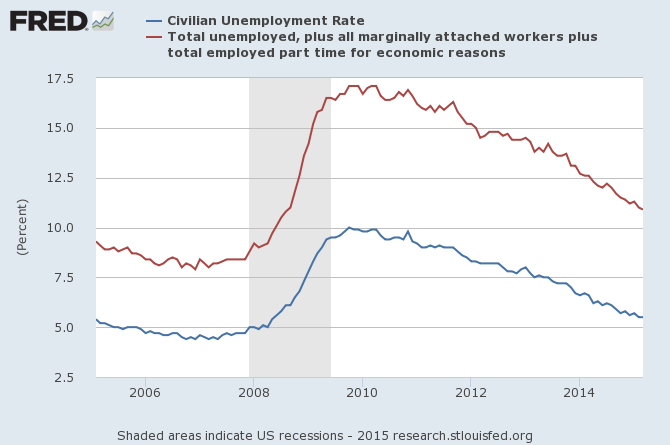
In fact, matters are worse than most people realize. Our unemployment rate has fallen back to a relatively normal 5.5%, as you can see in this graph (the blue line is unemployment, the red line is underemployment):

All_Unemployment

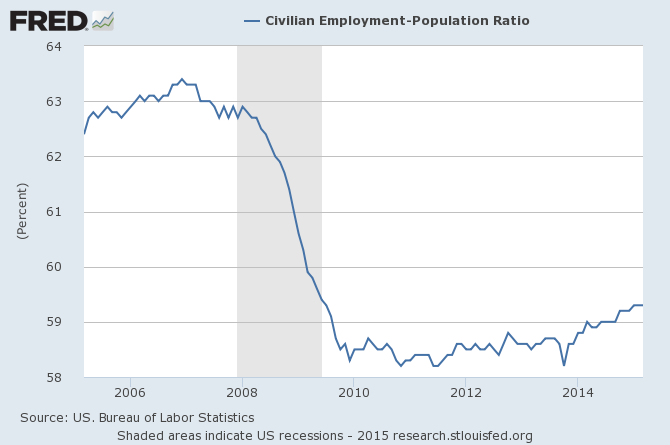
However, our employment rate never recovered from the Second Depression. As you can see in this graph, it fell from 63% to 58%, and has now only risen back to 59%:

Employment

How can unemployment fall without employment rising? The key is understanding how unemployment is calculated: It only counts people in the labor force. If people leave the labor force entirely, by retiring, going back to school, or simply giving up on finding work, they will no longer be counted as unemployed. The unemployment rate only counts people who want work but don’t have it, so as far as I’m concerned that figure should always be nearly zero. (Not quite zero since it takes some time to find a good fit; but maybe 1% at most. Any more than that and there is something wrong with our economic system.)

The optimal employment rate is not as obvious; it certainly isn’t 100%, as some people are too young, too old, or too disabled to be spending their time working. As automation improves, the number of workers necessary to produce any given product decreases, and eventually we may decide as a society that we are making enough products and most of us should be spending more of our time on other things, like spending time with family, creating works of art, or simply having fun. Maybe only a handful of people, the most driven or the most brilliant, will actually decide to work—and they will do because they want to, not because they have to. Indeed, the truly optimal employment rate might well be zero; think of The Culture, where there is no such concept as a “job”; there are things you do because you want to do them, or because they seem worthwhile, but there is none of this “working for pay” nonsense. We are not yet at the level of automation where this would be possible, but we are much closer than I think most people realize. Think about all of the various administrative and bureaucratic tasks that most people do the majority of the time, all the reports, all the meetings; why do they do that? Is it actually because the work is necessary, that the many levels of bureaucracy actually increase efficiency through specialization? Or is it simply because we’ve become so accustomed to the idea that people have to be working all the time in order to justify their existence? Is David Graeber (I reviewed one of his books previously) right that most jobs are actually (and this is a technical term), “bullshit jobs”? Once again, the problem doesn’t seem to be too few work incentives, but if anything too many.

Indeed, there is a basic fact about unemployment that has been hidden from most people. I’d normally say that this is accidental, that it’s too technical or obscure for most people to understand, but no, I think it has been actively concealed, or, since I guess the information has been publicly available, at least discussion of it has been actively avoided. It’s really not at all difficult to understand, yet it will fundamentally change the way you think about our unemployment problem. Here goes:

Since at least 2000 and probably since 1980 there have been more people looking for jobs than there have been jobs available.

The entire narrative of “people are lazy and don’t want to work” or “we need more work incentives” is just totally, totally wrong; people are desperate to find work, and there hasn’t been enough work for them to find since longer than I’ve been alive.

You can see this on the following graph, which is of what’s called the “Beveridge curve”; the horizontal axis is the unemployment rate, while the vertical axis is the rate of job vacancies. The red line across the diagonal is the point at which the two are even, and there are as many people looking for jobs as there are jobs to fill. Notice how the graph is always below the line. There have always been more unemployed people than jobs for them to fill, and at the worst of the Second Depression the ratio was 5 to 1.

Beveridge_curve_2

Personally I believe that we should be substantially above the line, and in a truly thriving economy there should be employers desperately trying to find employees and willing to pay them whatever it takes. You shouldn’t have to send out 20 job applications to get hired; 20 companies should have to send offers to you. For the economy does not exist to serve corporations; it exists to serve people.

I can see two basic ways to solve this problem: You can either create more jobs, or you can get people to stop looking for work. That may be sort of obvious, but I think people usually forget the second option.

We definitely do talk a lot about “job creation”, though usually in a totally nonsensical way—somehow “Job Creator” has come to be a euphemism for “rich person”. In fact the best way to create jobs is to put money into the hands of people who will spend it. The more people spend their money, the more it flows through the economy and the more wealth we end up with overall. High rates of spending—high marginal propensity to consumecan multiply the value of a dollar many times over.

But there’s also something to be said for getting people to stop looking for work—the key is do it in the right way. They shouldn’t stop looking because they give up; they should stop looking because they don’t need to work. People should have their basic needs met even if they aren’t working for an employer; human beings have rights and dignity beyond their productivity in the market. Employers should have to make you a better offer than “you’ll be homeless if you don’t do this”.

Both of these goals can be accomplished simultaneously by one simple policy: Basic income.

It’s really amazing how many problems can be solved by a basic income; it’s more or less the amazing wonder policy that solves all the world’s economic problems simultaneously. Poverty? Gone. Unemployment? Decimated. Inequality? Contained. (The pilot studies of basic income in India have been successful beyond all but the wildest dreams; they eliminate poverty, improve health, increase entrepreneurial activity, even reduce gender inequality.) The one major problem basic income doesn’t solve is government debt (indeed it likely increases it, at least in the short run), but as I’ve already talked about, that problem is not nearly as bad as most people fear.

And once again I think I should head off accusations that advocating a basic income makes me some sort of far-left Communist radical; Friedrich Hayek supported a basic income.

Basic income would help with unemployment in a third way as well; one of the major reasons unemployment is so harmful is that people who are unemployed can’t provide for themselves or their families. So a basic income would reduce the number of people looking for jobs, increase the number of jobs available, and also make being unemployed less painful, all in one fell swoop. I doubt it would solve the problem of unemployment entirely, but I think it would make an enormous difference.

Should we raise the minimum wage?

JDN 2456949 PDT 10:22.

The minimum wage is an economic issue that most people are familiar with; a large portion of the population has worked for minimum wage at some point in their lives, and those who haven’t generally know someone who has. As Chris Rock famously remarked (in the recording, Chris Rock, as usual, uses some foul language), “You know what that means when they pay you minimum wage? You know what they’re trying to tell you? It’s like, ‘Hey, if I could pay you less, I would; but it’s against the law.’ ”

The minimum wage was last raised in 2009, but adjusted for inflation its real value has been trending downward since 1968. The dollar values are going up, but not fast enough to keep up with inflation.

So, should we raise it again? How much? Should we just match it to inflation, or actually raise it higher in real terms? Productivity (in terms of GDP per worker) has more than doubled since 1968, so perhaps the minimum wage should double as well?

There are two major sides in this debate, and I basically disagree with both of them.

The first is the right-wing view (here espoused by the self-avowed “Objectivist” Don Watkins) that the minimum wage should be abolished entirely because it is an arbitrary price floor that prevents workers from selling their labor at whatever wage the market will bear. He argues that the free market is the only way the value of labor should be assessed and the government has no business getting involved.

On the other end of the spectrum we have Robert Reich, who thinks we should definitely raise the minimum wage and it would be the best way to lift workers out of poverty. He argues that by providing minimum-wage workers with welfare and Medicaid, we are effectively subsidizing employers to pay lower wages. While I sympathize a good deal more with this view, I still don’t think it’s quite right.

Why not? Because Watkins is right about one thing: The minimum wage is, in fact, an arbitrary price floor. Out of all the possible wages that an employer could pay, how did we decide that this one should be the lowest? And the same applies to everyone, no matter who they are or what sort of work they do?

What Watkins gets wrong—and Reich gets right—is that wages are not actually set in a free and competitive market. Large corporations have market power; they can influence wages and prices to their own advantage. They use monopoly power to raise prices, and its inverse, monopsony power, to lower wages. The workers who are making a minimum wage of $7.25 wouldn’t necessarily make $7.25 in a competitive market; they could make more than that. All we know, actually, is that they would make at least this much, because if a worker’s marginal productivity is below the minimum wage the corporation simply wouldn’t have hired them.

Monopsony power doesn’t just lower wages; it also reduces employment. One of the ways that corporations can control wages is by controlling hiring; if they tried to hire more people, they’d have to offer a higher wage, so instead they hire fewer people. Under these circumstances, a higher minimum wage can actually create jobs, as Reich argues it will. And in this particular case I think he’s right about that, because corporations have enormous market power to hold wages down and in the Second Depression we have a huge amount of unused productive capacity. But this isn’t true in general. If markets are competitive, then raising minimum wage just causes unemployment. Even when corporations have market power, if there isn’t much unused capacity then raising minimum wage will just lead them to raise prices instead of hiring more workers.

Reich is also wrong about this idea that welfare payments subsidize low wages. On the contrary, the stronger your welfare system, the higher your wages will be. The reason is quite simple: A stronger welfare system gives workers more bargaining power. If not getting this job means you turn to prostitution or starve to death, then you’re going to take just about any wage they offer you. (I don’t entirely agree with Krugman’s defense of sweatshops—I believe there are ways to increase trade without allowing oppressive working conditions—but he makes this point quite vividly.) On the other hand, if you live in the US with a moderate welfare system, you can sometimes afford to say no; you might end up broke or worse, homeless, but you’re unlikely to starve to death because at least you have food stamps. And in a nation with a really robust welfare system like Sweden, you can walk away from any employer who offers to pay you less than your labor is worth, because you know that even if you can’t find a job for awhile your basic livelihood will be protected. As a result, stronger welfare programs make labor markets more competitive and raise wages. Welfare and Medicaid do not subsidize low-wage employers; they exert pressure on employers to raise their low wages. Indeed, a sufficiently strong welfare system could render minimum wage redundant, as I’ll get back to at the end of this post.

Of course, I am above all an empiricist; all theory must bow down before the data. So what does the data say? Does raising the minimum wage create jobs or destroy jobs? Our best answer from compiling various studies is… neither. Moderate increases in the minimum wage have no discernible effect on employment. In some studies we’ve found increases, in others decreases, but the overall average effect across many studies is indistinguishable from zero.

Of course, a sufficiently large increase is going to decrease employment; a Fox News reporter once famously asked: “Why not raise the minimum wage to $100,000 an hour!?” (which Jon Stewart aptly satirized as “Why not pay people in cocaine and unicorns!?”) Yes, raising the minimum wage to $100,000 an hour would create massive inflation and unemployment. But that really says nothing about whether raising the minimum wage to $10 or $20 would be a good idea. Covering your car with 4000 gallons of gasoline is a bad idea, but filling it with 10 gallons is generally necessary for its proper functioning.

This kind of argument is actually pretty common among Republicans, come to think of it. Take the Laffer Curve, for instance; it’s basically saying that since a 99% tax on everyone would damage the economy (which is obviously true) then a 40% tax specifically on millionaires must have the same effect. Another good one is Rush Limbaugh’s argument that if unemployment benefits are good, why not just put everyone on unemployment benefits? Well, again, because there’s a difference between doing something for some people sometimes and doing it for everyone all the time. There are these things called numbers; they measure whether something is bigger or smaller instead of just “there” or “not there”. You might want to learn about that.

Since moderate increases in minimum wage have no effect on unemployment, and we are currently under conditions of extremely low—in fact, dangerously low—inflation, then I think on balance we should go with Reich: Raising the minimum wage would do more good than harm.

But in general, is minimum wage the best way to help workers out of poverty? No, I don’t think it is. It’s awkward and heavy-handed; it involves trying to figure out what the optimal wage should be and writing it down in legislation, instead of regulating markets so that they will naturally seek that optimal level and respond to changes in circumstances. It only helps workers at the very bottom: Someone making $12 an hour is hardly rich, but they won’t benefit from increasing minimum wage to $10; in fact they might be worse off, if that increase triggers inflation that lowers the real value of their $12 wage.

What do I propose instead? A basic income. There should be a cash payment that every adult citizen receives, once a month, directly from the government—no questions asked. You don’t have to be unemployed, you don’t have to be disabled, you don’t have to be looking for work. You don’t have to spend it on anything in particular; you can use it for food, for housing, for transportation; or if you like you can use it for entertainment or save it for a rainy day. We don’t keep track of what you do with it, because it’s your own freedom and none of our business. We just give you this money as your dividends for being a shareholder in the United States of America.

This would be extremely easy to implement—the IRS already has all the necessary infrastructure, they just need to turn some minus signs into plus signs. We could remove all the bureaucracy involved in administering TANF and SNAP and Medicaid, because there’s no longer any reason to keep track of who is in poverty since nobody is. We could in fact fold the $500 billion a year we currently spend on means-tested programs into the basic income itself. We could pull another $300 billion from defense spending while still solidly retaining the world’s most powerful military.

Which brings me to the next point: How much would this cost? Probably less than you think. I propose indexing the basic income to the poverty line for households of 2 or more; since currently a household of 2 or more at the poverty line makes $15,730 per year, the basic income would be $7,865 per person per year. The total cost of giving that amount to each of the 243 million adults in the United States would be $1.9 trillion, or about 12% of our GDP. If we fold in the means-tested programs, that lowers the net cost to $1.4 trillion, 9% of GDP. This means that an additional flat tax of 9% would be enough to cover the entire amount, even if we don’t cut any other government spending.

If you use a progressive tax system like I recommended a couple of posts ago, you could raise this much with a tax on less than 5% of utility, which means that someone making the median income of $30,000 would only pay 5.3% more than they presently do. At the mean income of $50,000, you’d only pay 7.7%. And keep in mind that you are also receiving the additional $7,865; so in fact in both cases you actually end up with more than you had before the basic income was implemented. The break-even point is at about $80,000, where you pay an extra 9.9% ($7,920) and receive $7,865, so your after-tax income is now $79,945. Anyone making less than $80,000 per year actually gains from this deal; the only people who pay more than they receive are those who make more than $80,000. This is about the average income of someone in the fourth quintile (the range where 60% to 80% of the population is below you), so this means that roughly 70% of Americans would benefit from this program.

With this system in place, we wouldn’t need a minimum wage. Working full-time at our current minimum wage makes you $7.25*40*52 = $15,080 per year. If you are a single person, you’re getting $7,865 from the basic income, this means that you’ll still have more than you presently do as long as your employer pays you at least $3.47 per hour. And if they don’t? Well then you can just quit, knowing that at least you have that $7,865. If you’re married, it’s even better; the two of you already get $15,730 from the basic income. If you were previously raising a family working full-time on minimum wage while your spouse is unemployed, guess what: You actually will make more money after the policy no matter what wage your employer pays you.

This system can adapt to changes in the market, because it is indexed to the poverty level (which is indexed to inflation), and also because it doesn’t say anything about what wage an employer pays. They can pay as little or as much as the market will bear; but the market is going to bear more, because workers can afford to quit. Billionaires are going to hate this plan, because it raises their taxes (by about 40%) and makes it harder for them to exploit workers. But for 70% of Americans, this plan is a pretty good deal.