How do we stop overspending on healthcare?

Dec 10 JDN 2460290

I don’t think most Americans realize just how much more the US spends on healthcare than other countries. This is true not simply in absolute terms—of course it is, the US is rich and huge—but in relative terms: As a portion of GDP, our healthcare spending is a major outlier.

Here’s a really nice graph from Healthsystemtracker.org that illustrates it quite nicely: Almost all other First World countries share a simple linear relationship between their per-capita GDP and their per-capita healthcare spending. But one of these things is not like the other ones….

The outlier in the other direction is Ireland, but that’s because their GDP is wildly inflated by Leprechaun Economics. (Notice that it looks like Ireland is by far the richest country in the sample! This is clearly not the case in reality.) With a corrected estimate of their true economic output, they are also quite close to the line.

Since US GDP per capita ($70,181) is in between that of Denmark ($64,898) and Norway ($80,496) both of which have very good healthcare systems (#ScandinaviaIsBetter), we would expect that US spending on healthcare would similarly be in between. But while Denmark spends $6,384 per person per year on healthcare and Norway spends $7,065 per person per year, the US spends $12,914.

That is, the US spends nearly twice as much as it should on healthcare.

The absolute difference between what we should spend and what we actually spend is nearly $6,000 per person per year. Multiply that out by the 330 million people in the US, and…

The US overspends on healthcare by nearly $2 trillion per year.

This might be worth it, if health in the US were dramatically better than health in other countries. (In that case I’d be saying that other countries spend too little.) But plainly it is not.

Probably the simplest and most comparable measure of health across countries is life expectancy. US life expectancy is 76 years, and has increased over time. But if you look at the list of countries by life expectancy, the US is not even in the top 50. Our life expectancy looks more like middle-income countries such as Algeria, Brazil, and China than it does like Norway or Sweden, who should be our economic peers.

There are of course many things that factor into life expectancy aside from healthcare: poverty and homicide are both much worse in the US than in Scandinavia. But then again, poverty is much worse in Algeria, and homicide is much worse in Brazil, and yet they somehow manage to nearly match the US in life expectancy (actually exceeding it in some recent years).

The US somehow manages to spend more on healthcare than everyone else, while getting outcomes that are worse than any country of comparable wealth—and even some that are far poorer.

This is largely why there is a so-called “entitlements crisis” (as many a libertarian think tank is fond of calling it). Since libertarians want to cut Social Security most of all, they like to lump it in with Medicare and Medicaid as an “entitlement” in “crisis”; but in fact we only need a few minor adjustments to the tax code to make sure that Social Security remains solvent for decades to come. It’s healthcare spending that’s out of control.

Here, take a look.

This is the ratio of Social Security spending to GDP from 1966 to the present. Notice how it has been mostly flat since the 1980s, other than a slight increase in the Great Recession.

This is the ratio of Medicare spending to GDP over the same period. Even ignoring the first few years while it was ramping up, it rose from about 0.6% in the 1970s to almost 4% in 2020, and only started to decline in the last few years (and it’s probably too early to say whether that will continue).

Medicaid has a similar pattern: It rose steadily from 0.2% in 1966 to over 3% today—and actually doesn’t even show any signs of leveling off.

If you look at Medicare and Medicaid together, they surged from just over 1% of GDP in 1970 to nearly 7% today:

Put another way: in 1982, Social Security was 4.8% of GDP while Medicare and Medicaid combined were 2.4% of GDP. Today, Social Security is 4.9% of GDP while Medicare and Medicaid are 6.8% of GDP.

Social Security spending barely changed at all; healthcare spending more than doubled. If we reduced our Medicare and Medicaid spending as a portion of GDP back to what it was in 1982, we would save 4.4% of GDP—that is, 4.4% of over $25 trillion per year, so $1.1 trillion per year.

Of course, we can’t simply do that; if we cut benefits that much, millions of people would suddenly lose access to healthcare they need.

The problem is not that we are spending frivolously, wasting the money on treatments no one needs. On the contrary, both Medicare and Medicaid carefully vet what medical services they are willing to cover, and if anything probably deny services more often than they should.

No, the problem runs deeper than this.

Healthcare is too expensive in the United States.

We simply pay more for just about everything, and especially for specialist doctors and hospitals.

In most other countries, doctors are paid like any other white-collar profession. They are well off, comfortable, certainly, but few of them are truly rich. But in the US, we think of doctors as an upper-class profession, and expect them to be rich.

Median doctor salaries are $98,000 in France and $138,000 in the UK—but a whopping $316,000 in the US. Germany and Canada are somewhere in between, at $183,000 and $195,000 respectively.

Nurses, on the other hand, are paid only a little more in the US than in Western Europe. This means that the pay difference between doctors and nurses is much higher in the US than most other countries.

US prices on brand-name medication are frankly absurd. Our generic medications are typically cheaper than other countries, but our brand name pills often cost twice as much. I noticed this immediately on moving to the UK: I had always been getting generics before, because the brand name pills cost ten times as much, but when I moved here, suddenly I started getting all brand-name medications (at no cost to me), because the NHS was willing to buy the actual brand name products, and didn’t have to pay through the nose to do so.

But the really staggering differences are in hospitals.

Let’s compare the prices of a few inpatient procedures between the US and Switzerland. Switzerland, you should note, is a very rich country that spends a lot on healthcare and has nearly the world’s highest life expectancy. So it’s not like they are skimping on care. (Nor is it that prices in general are lower in Switzerland; on the contrary, they are generally higher.)

A coronary bypass in Switzerland costs about $33,000. In the US, it costs $76,000.

A spinal fusion in Switzerland costs about $21,000. In the US? $52,000.

Angioplasty in Switzerland: $9.000. In the US? $32,000.

Hip replacement: Switzerland? $16,000. The US? $28,000.

Knee replacement: Switzerland? $19,000. The US? $27,000.

Cholecystectomy: Switzerland? $8,000. The US? $16,000.

Appendectomy: Switzerland? $7,000. The US? $13,000.

Caesarian section: Switzerland? $8,000. The US? $11,000.

Hospital prices are even lower in Germany and Spain, whose life expectancies are not as high as Switzerland—but still higher than the US.

These prices are so much lower that in fact if you were considering getting surgery for a chronic condition in the US, don’t. Buy plane tickets to Europe and get the procedure done there. Spend an extra few thousand dollars on a nice European vacation and you’d still end up saving money. (Obviously if you need it urgently you have no choice but to use your nearest hospital.) I know that if I ever need a knee replacement (which, frankly, is likely, given my height), I’m gonna go to Spain and thereby save $22,000 relative to what it would cost in the US. That’s a difference of a car.

Combine this with the fact that the US is the only First World country without universal healthcare, and maybe you can see why we’re also the only country in the world where people are afraid to call an ambulance because they don’t think they can afford it. We are also the only country in the world with a medical debt crisis.

Where is all this extra money going?

Well, a lot of it goes to those doctors who are paid three times as much as in France. That, at least, seems defensible: If we want the best doctors in the world maybe we need to pay for them. (Then again, do we have the best doctors in the world? If so, why is our life expectancy so mediocre?)

But a significant portion is going to shareholders.

You probably already knew that there are pharmaceutical companies that rake in huge profits on those overpriced brand-name medications. The top five US pharma companies took in net earnings of nearly $82 billion last year. Pharmaceutical companies typically take in much higher profit margins than other companies: a typical corporation makes about 8% of its revenue in profit, while pharmaceutical companies average nearly 14%.

But you may not have realized that a surprisingly large proportion of hospitals are for-profit businesseseven though they make most of their revenue from Medicare and Medicaid.

I was surprised to find that the US is not unusual in that; in fact, for-profit hospitals exist in dozens of countries, and the fraction of US hospital capacity that is for-profit isn’t even particularly high by world standards.

What is especially large is the profits of US hospitals. 7 healthcare corporations in the US all posted net incomes over $1 billion in 2021.

Even nonprofit US hospitals are tremendously profitable—as oxymoronic as that may sound. In fact, mean operating profit is higher among nonprofit hospitals in the US than for-profit hospitals. So even the hospitals that aren’t supposed to be run for profit… pretty much still are. They get tax deductions as if they were charities—but they really don’t act like charities.

They are basically nonprofit in name only.

So fixing this will not be as simple as making all hospitals nonprofit. We must also restructure the institutions so that nonprofit hospitals are genuinely nonprofit, and no longer nonprofit in name only. It’s normal for a nonprofit to have a little bit of profit or loss—nobody can make everything always balance perfectly—but these hospitals have been raking in huge profits and keeping it all in cash instead of using it to reduce prices or improve services. In the study I linked above, those 2,219 “nonprofit” hospitals took in operating profits averaging $43 million each—for a total of $95 billion.

Between pharmaceutical companies and hospitals, that’s a total of over $170 billion per year just in profit. (That’s more than we spend on food stamps, even after surge due to COVID.) This is pure grift. It must be stopped.

But that still doesn’t explain why we’re spending $2 trillion more than we should! So after all, I must leave you with a question:

What is America doing wrong? Why is our healthcare so expensive?

What most Americans think about government spending

Oct 22 JDN 2460240

American public opinion on government spending is a bit of a paradox. People say the government spends too much, but when you ask them what to cut, they don’t want to cut anything in particular.

This is how various demographics answer when you ask if, overall, the government spends “too much”, “too little”, or “about right”:

Democrats have a relatively balanced view, with about a third in each category. Republicans overwhelmingly agree that the government spends too much.

Let’s focus on the general population figures: 60% of Americans believe the government spends too much, 22% think it is about right, and only 16% think it spends too little. (2% must not have answered.)

This question is vague about how much people would like to see the budget change. So it’s possible people only want a moderate decrease. But they must at least want enough to justify not being in the “about right” category, which presumably allows for at least a few percent of wiggle room in each direction.

I think a reasonable proxy of how much people want the budget to change is the net difference in opinion between “too much” and “too little”: So for Democrats this is 34 – 27 = 7%. For the general population it is 60 – 16 = 44%; and for Republicans it is 88 – 6 = 82%.

To make this a useful proxy, I need to scale it appropriately. Republicans in Congress say they want to cut federal spending by $1 trillion per year, so that would be a reduction of 23%. So, for a reasonable proxy, I think ([too little] – [too much])/4 is about the desired amount of change.

Of course, it’s totally possible for 88% of people to agree that the budget should be cut 10%, and none of them to actually want the budget to be cut 22%. But without actually having survey data showing how much people want to cut the budget, the proportion who want it to be cut is the best proxy I have. And it definitely seems like most people want the budget to be cut.

But cut where? What spending do people want to actually reduce?

Not much, it turns out:

Overwhelming majorities want to increase spending on education, healthcare, social security, infrastructure, Medicare, and assistance to the poor. The plurality want to increase spending on border security, assistance for childcare, drug rehabilitation, the environment, and law enforcement. Overall opinion on military spending and scientific research seems to be that it’s about right, with some saying too high and others too low. That’s… almost the entire budget.

This AP NORC poll found only three areas with strong support for cuts: assistance to big cities, space exploration, and assistance to other countries.

The survey just asked about “the government”, so people may be including opinions on state and local spending as well as federal spending. But let’s just focus for now on federal spending.

Here is what the current budget looks like, divided as closely as I could get it into the same categories that the poll asked about:

The federal government accounts for only a tiny portion of overall government spending on education, so for this purpose I’m just going to ignore that category; anything else would be far too misleading. I had to separately look up border security, foreign aid, space exploration, and scientific research, as they are normally folded into other categories. I decided to keep the medical research under “health” and military R&D under “military”, so the “scientific research” includes all other sciences—and as you’ll note, it’s quite small.

“Regional Development” includes but is by no means limited to aid to big cities; in fact, most of it goes to rural areas. With regard to federal spending, “Transportation” is basically synonymous with “Infrastructure”, so I’ll treat those as equivalent. Federal spending directly on environmental protection is so tiny that I couldn’t even make a useful category for it; for this purpose, I guess I’ll just assume it’s most of “Other” (though it surely isn’t).

As you can see, the lion’s share of the federal budget goes to three things: healthcare (including Medicare), Social Security, and the military. (As Krugman is fond of putting it: “The US government is an insurance company with an army.”)

Assistance to the poor is also a major category, and as well it should be. Debt interest is also pretty substantial, especially now that interest rates have increased, but that’s not really optional; the global financial system would basically collapse if we ever stopped paying that. The only realistic way to bring that down is to balance the budget so that we don’t keep racking up more debt.

After that… it’s all pretty small, relatively speaking. I mean, these are still tens of billions of dollars. But the US government is huge. When you spend $1.24 trillion (that’s $1,240 billion) on Social Security, that $24 billion for space exploration really doesn’t seem that big.

So, that’s what the budget actually looks like. What do people want it to look like? Well on the one hand, they seem to want to cut it. My admittedly very rough estimate suggests they want to cut it about 11%, which would reduce the total from $4.3 trillion to $3.8 trillion. That’s what they say if you ask about the budget as a whole.

But what if we listen to what they say about particular budget categories? Using my same rough estimate, people want to increase spending on healthcare by 12%, spending on Social Security by 14%, and so on.

The resulting new budget looks like this:

Please note two things:

  1. The overall distribution of budget priorities has not substantially changed.
  2. The total amount of spending is in fact moderately higher.

This new budget would be disastrous for Ukraine, painful for NASA, and pleasant for anyone receiving Social Security benefits; but our basic budget outlook would be unchanged. Total spending would rise to $4.6 trillion, about $300 billion more than what we are currently spending.

The things people say they want to cut wouldn’t make a difference: We could stop all space missions immediately and throw Ukraine completely under the bus, and it wouldn’t make a dent in our deficit.

This leaves us with something of a paradox: If you ask them in general what they want to do with the federal budget, the majority of Americans say they want to cut it, often drastically. But if you ask them about any particular budget category, they mostly agree that things are okay, or even want them to be increased. Moreover, it is some of the largest categories of spending—particularly healthcare and Social Security—that often see the most people asking for increases.

I think this tells us some good news and some bad news.

The bad news is that most Americans are quite ignorant about how government money is actually spent. They seem to imagine that huge amounts are frittered away frivolously on earmarks; they think space exploration is far more expensive than it is; they wildly overestimate how much we give in foreign aid; they clearly don’t understand the enormous benefits of funding basic scientific research. Most people seem to think that there is some enormous category of totally wasted money that could easily be saved through more efficient spending—and that just doesn’t seem to be the case. Maybe government spending could be made more efficient, but if so, we need an actual plan for doing that. We can’t just cut budgets and hope for a miracle.

The good news is that our political system, for all of its faults, actually seems to have resulted in a government budget that broadly reflects the actual priorities of our citizenry. On budget categories people like, such as Social Security and Medicare, we are already spending a huge amount. On budget categories people dislike, such as earmarks and space exploration, we are already spending very little. We basically already have the budget most Americans say they want to have.

What does this mean for balancing the budget and keeping the national debt under control?

It means we have to raise taxes. There just isn’t anything left to cut that wouldn’t be wildly unpopular.

This shouldn’t really be shocking. The US government already spends less as a proportion of GDP than most other First World countries [note: I’m using 2019 figures because recent years were distorted by COVID]. Ireland’s figures are untrustworthy due to their inflated leprechaun GDP; so the only unambiguously First World country that clearly has lower government spending than the US is Switzerland. We spend about 38%, which is still high by global standards—but as well it should be, we’re incredibly rich. And this is quite a bit lower than the 41% they spend in the UK or the 45% they spend in Germany, let alone the 49% they spend in Sweden or the whopping 55% they spend in France.

Of course, Americans really don’t like paying taxes either. But at some point, we’re just going to have to decide: Do we want fewer services, more debt, or more taxes? Because those are really our only options. I for one think we can handle more taxes.

The right (and wrong) way to buy stocks

July 9, JDN 2457944

Most people don’t buy stocks at all. Stock equity is the quintessential form of financial wealth, and 42% of financial net wealth in the United States is held by the top 1%, while the bottom 80% owns essentially none.

Half of American households do not have any private retirement savings at all, and are depending either on employee pensions or Social Security for their retirement plans.

This is not necessarily irrational. In order to save for retirement, one must first have sufficient income to live on. Indeed, I got very annoyed at a “financial planning seminar” for grad students I attended recently, trying to scare us about the fact that almost none of us had any meaningful retirement savings. No, we shouldn’t have meaningful retirement savings, because our income is currently much lower than what we can expect to get once we graduate and enter our professions. It doesn’t make sense for someone scraping by on a $20,000 per year graduate student stipend to be saving up for retirement, when they can quite reasonably expect to be making $70,000-$100,000 per year once they finally get that PhD and become a professional economist (or sociologist, or psychologist or physicist or statistician or political scientist or material, mechanical, chemical, or aerospace engineer, or college professor in general, etc.). Even social workers, historians, and archaeologists make a lot more money than grad students. If you are already in the workforce and only expect to be getting small raises in the future, maybe you should start saving for retirement in your 20s. If you’re a grad student, don’t bother. It’ll be a lot easier to save once your income triples after graduation. (Personally, I keep about $700 in stocks mostly to get a feel for what it is like owning and trading stocks that I will apply later, not out of any serious expectation to support a retirement fund. Even at Warren Buffet-level returns I wouldn’t make more than $200 a year this way.)

Total US retirement savings are over $25 trillion, which… does actually sound low to me. In a country with a GDP now over $19 trillion, that means we’ve only saved a year and change of total income. If we had a rapidly growing population this might be fine, but we don’t; our population is fairly stable. People seem to be relying on economic growth to provide for their retirement, and since we are almost certainly at steady-state capital stock and fairly near full employment, that means waiting for technological advancement.

So basically people are hoping that we get to the Wall-E future where the robots will provide for us. And hey, maybe we will; but assuming that we haven’t abandoned capitalism by then (as they certainly haven’t in Wall-E), maybe you should try to make sure you own some assets to pay for robots with?

But okay, let’s set all that aside, and say you do actually want to save for retirement. How should you go about doing it?

Stocks are clearly the way to go. A certain proportion of government bonds also makes sense as a hedge against risk, and maybe you should even throw in the occasional commodity future. I wouldn’t recommend oil or coal at this point—either we do something about climate change and those prices plummet, or we don’t and we’ve got bigger problems—but it’s hard to go wrong with corn or steel, and for this one purpose it also can make sense to buy gold as well. Gold is not a magical panacea or the foundation of all wealth, but its price does tend to correlate negatively with stock returns, so it’s not a bad risk hedge.

Don’t buy exotic derivatives unless you really know what you’re doing—they can make a lot of money, but they can lose it just as fast—and never buy non-portfolio assets as a financial investment. If your goal is to buy something to make money, make it something you can trade at the click of a button. Buy a house because you want to live in that house. Buy wine because you like drinking wine. Don’t buy a house in the hopes of making a financial return—you’ll have leveraged your entire portfolio 10 to 1 while leaving it completely undiversified. And the problem with investing in wine, ironically, is its lack of liquidity.

The core of your investment portfolio should definitely be stocks. The biggest reason for this is the equity premium; equities—that is, stocks—get returns so much higher than other assets that it’s actually baffling to most economists. Bond returns are currently terrible, while stock returns are currently fantastic. The former is currently near 0% in inflation-adjusted terms, while the latter is closer to 16%. If this continues for the next 10 years, that means that $1000 put in bonds would be worth… $1000, while $1000 put in stocks would be worth $4400. So, do you want to keep the same amount of money, or quadruple your money? It’s up to you.

Higher risk is generally associated with higher return, because rational investors will only accept additional risk when they get some additional benefit from it; and stocks are indeed riskier than most other assets, but not that much riskier. For this to be rational, people would need to be extremely risk-averse, to the point where they should never drive a car or eat a cheeseburger. (Of course, human beings are terrible at assessing risk, so what I really think is going on is that people wildly underestimate the risk of driving a car and wildly overestimate the risk of buying stocks.)

Next, you may be asking: How does one buy stocks? This doesn’t seem to be something people teach in school.

You will need a brokerage of some sort. There are many such brokerages, but they are basically all equivalent except for the fees they charge. Some of them will try to offer you various bells and whistles to justify whatever additional cut they get of your trades, but they are almost never worth it. You should choose one that has a low a trade fee as possible, because even a few dollars here and there can add up surprisingly quickly.

Fortunately, there is now at least one well-established reliable stock brokerage available to almost anyone that has a standard trade fee of zero. They are called Robinhood, and I highly recommend them. If they have any downside, it is ironically that they make trading too easy, so you can be tempted to do it too often. Learn to resist that urge, and they will serve you well and cost you nothing.

Now, which stocks should you buy? There are a lot of them out there. The answer I’m going to give may sound strange: All of them. You should buy all the stocks.

All of them? How can you buy all of them? Wouldn’t that be ludicrously expensive?

No, it’s quite affordable in fact. In my little $700 portfolio, I own every single stock in the S&P 500 and the NASDAQ. If I get a little extra money to save, I may expand to own every stock in Europe and China as well.

How? A clever little arrangement called an exchange-traded fund, or ETF for short. An ETF is actually a form of mutual fund, where the fund purchases shares in a huge array of stocks, and adjusts what they own to precisely track the behavior of an entire stock market (such as the S&P 500). Then what you can buy is shares in that mutual fund, which are usually priced somewhere between $100 and $300 each. As the price of stocks in the market rises, the price of shares in the mutual fund rises to match, and you can reap the same capital gains they do.

A major advantage of this arrangement, especially for a typical person who isn’t well-versed in stock markets, is that it requires almost no attention at your end. You can buy into a few ETFs and then leave your money to sit there, knowing that it will grow as long as the overall stock market grows.

But there is an even more important advantage, which is that it maximizes your diversification. I said earlier that you shouldn’t buy a house as an investment, because it’s not at all diversified. What I mean by this is that the price of that house depends only on one thing—that house itself. If the price of that house changes, the full change is reflected immediately in the value of your asset. In fact, if you have 10% down on a mortgage, the full change is reflected ten times over in your net wealth, because you are leveraged 10 to 1.

An ETF is basically the opposite of that. Instead of its price depending on only one thing, it depends on a vast array of things, averaging over the prices of literally hundreds or thousands of different corporations. When some fall, others will rise. On average, as long as the economy continues to grow, they will rise.

The result is that you can get the same average return you would from owning stocks, while dramatically reducing the risk you bear.

To see how this works, consider the past year’s performance of Apple (AAPL), which has done very well, versus Fitbit (FIT), which has done very poorly, compared with the NASDAQ as a whole, of which they are both part.

AAPL has grown over 50% (40 log points) in the last year; so if you’d bought $1000 of their stock a year ago it would be worth $1500. FIT has fallen over 60% (84 log points) in the same time, so if you’d bought $1000 of their stock instead, it would be worth only $400. That’s the risk you’re taking by buying individual stocks.

Whereas, if you had simply bought a NASDAQ ETF a year ago, your return would be 35%, so that $1000 would be worth $1350.

Of course, that does mean you don’t get as high a return as you would if you had managed to choose the highest-performing stock on that index. But you’re unlikely to be able to do that, as even professional financial forecasters are worse than random chance. So, would you rather take a 50-50 shot between gaining $500 and losing $600, or would you prefer a guaranteed $350?

If higher return is not your only goal, and you want to be socially responsible in your investments, there are ETFs for that too. Instead of buying the whole stock market, these funds buy only a section of the market that is associated with some social benefit, such as lower carbon emissions or better representation of women in management. On average, you can expect a slightly lower return this way; but you are also helping to make a better world. And still your average return is generally going to be better than it would be if you tried to pick individual stocks yourself. In fact, certain classes of socially-responsible funds—particularly green tech and women’s representation—actually perform better than conventional ETFs, probably because most investors undervalue renewable energy and, well, also undervalue women. Women CEOs perform better at lower prices; why would you not want to buy their companies?

In fact ETFs are not literally guaranteed—the market as a whole does move up and down, so it is possible to lose money even by buying ETFs. But because the risk is so much lower, your odds of losing money are considerably reduced. And on average, an ETF will, by construction, perform exactly as well as the average performance of a randomly-chosen stock from that market.

Indeed, I am quite convinced that most people don’t take enough risk on their investment portfolios, because they confuse two very different types of risk.

The kind you should be worried about is idiosyncratic risk, which is risk tied to a particular investment—the risk of having chosen the Fitbit instead of Apple. But a lot of the time people seem to be avoiding market risk, which is the risk tied to changes in the market as a whole. Avoiding market risk does reduce your chances of losing money, but it does so at the cost of reducing your chances of making money even more.

Idiosyncratic risk is basically all downside. Yeah, you could get lucky; but you could just as well get unlucky. Far better if you could somehow average over that risk and get the average return. But with diversification, that is exactly what you can do. Then you are left only with market risk, which is the kind of risk that is directly tied to higher average returns.

Young people should especially be willing to take more risk in their portfolios. As you get closer to retirement, it becomes important to have more certainty about how much money will really be available to you once you retire. But if retirement is still 30 years away, the thing you should care most about is maximizing your average return. That means taking on a lot of market risk, which is then less risky overall if you diversify away the idiosyncratic risk.

I hope now that I have convinced you to avoid buying individual stocks. For most people most of the time, this is the advice you need to hear. Don’t try to forecast the market, don’t try to outperform the indexes; just buy and hold some ETFs and leave your money alone to grow.

But if you really must buy individual stocks, either because you think you are savvy enough to beat the forecasters or because you enjoy the gamble, here’s some additional advice I have for you.

My first piece of advice is that you should still buy ETFs. Even if you’re willing to risk some of your wealth on greater gambles, don’t risk all of it that way.

My second piece of advice is to buy primarily large, well-established companies (like Apple or Microsoft or Ford or General Electric). Their stocks certainly do rise and fall, but they are unlikely to completely crash and burn the way that young companies like Fitbit can.

My third piece of advice is to watch the price-earnings ratio (P/E for short). Roughly speaking, this is the number of years it would take for the profits of this corporation to pay off the value of its stock. If they pay most of their profits in dividends, it is approximately how many years you’d need to hold the stock in order to get as much in dividends as you paid for the shares.

Do you want P/E to be large or small? You want it to be small. This is called value investing, but it really should just be called “investing”. The alternatives to value investing are actually not investment but speculation and arbitrage. If you are actually investing, you are buying into companies that are currently undervalued; you want them to be cheap.

Of course, it is not always easy to tell whether a company is undervalued. A common rule-of-thumb is that you should aim for a P/E around 20 (20 years to pay off means about 5% return in dividends); if the P/E is below 10, it’s a fantastic deal, and if it is above 30, it might not be worth the price. But reality is of course more complicated than this. You don’t actually care about current earnings, you care about future earnings, and it could be that a company which is earning very little now will earn more later, or vice-versa. The more you can learn about a company, the better judgment you can make about their future profitability; this is another reason why it makes sense to buy large, well-known companies rather than tiny startups.

My final piece of advice is not to trade too frequently. Especially with something like Robinhood where trades are instant and free, it can be tempting to try to ride every little ripple in the market. Up 0.5%? Sell! Down 0.3%? Buy! And yes, in principle, if you could perfectly forecast every such fluctuation, this would be optimal—and make you an almost obscene amount of money. But you can’t. We know you can’t. You need to remember that you can’t. You should only trade if one of two things happens: Either your situation changes, or the company’s situation changes. If you need the money, sell, to get the money. If you have extra savings, buy, to give those savings a good return. If something bad happened to the company and their profits are going to fall, sell. If something good happened to the company and their profits are going to rise, buy. Otherwise, hold. In the long run, those who hold stocks longer are better off.

The unending madness of the gold standard

JDN 2457545

If you work in economics in any capacity (much like “How is the economy doing?” you don’t even really need to be in macroeconomics), you will encounter many people who believe in the gold standard. Many of these people will be otherwise quite intelligent and educated; they often understand economics better than most people (not that this is saying a whole lot). Yet somehow they continue to hold—and fiercely defend—this incredibly bizarre and anachronistic view of macroeconomics.

They even bring it up at the oddest times; I recently encountered someone who wrote a long and rambling post arguing for drug legalization (which I largely agree with, by the way) and concluded it with #EndTheFed, not seeming to grasp the total and utter irrelevance of this juxtaposition. It seems like it was just a conditioned response, or maybe the sort of irrelevant but consistent coda originally perfected by Cato and his “Carthago delenda est. “Foederale Reservatum delendum est. Hey, maybe that’s why they’re called the Cato Institute.

So just how bizarre is the gold standard? Well, let’s look at what sort of arguments they use to defend it. I’ll use Charles Kadlic, prominent Libertarian blogger on Forbes, as an example, with his “Top Ten Reasons That You Should Support the ‘Gold Commission’”:

  1. A gold standard is key to achieving a period of sustained, 4% real economic growth.
  2. A gold standard reduces the risk of recessions and financial crises.
  3. A gold standard would restore rising living standards to the middle-class.
  4. A gold standard would restore long-term price stability.
  5. A gold standard would stop the rise in energy prices.
  6. A gold standard would be a powerful force for restoring fiscal balance to federal state and local governments.
  7. A gold standard would help save Medicare and Social Security.
  8. A gold standard would empower Main Street over Wall Street.
  9. A gold standard would increase the liberty of the American people.
  10. Creation of a gold commission will provide the forum to chart a prudent path toward a 21st century gold standard.

Number 10 can be safely ignored, as clearly Kadlic just ran out of reasons and to make a round number tacked on the implicit assumption of the entire article, namely that this ‘gold commission’ would actually realistically lead us toward a gold standard. (Without it, the other 9 reasons are just non sequitur.)

So let’s look at the other 9, shall we? Literally none of them are true. Several are outright backward.

You know a policy is bad when even one of its most prominent advocates can’t even think of a single real benefit it would have. A lot of quite bad policies do have perfectly real benefits, they’re just totally outweighed by their costs: For example, cutting the top income tax rate to 20% probably would actually contribute something to economic growth. Not a lot, and it would cut a swath through the federal budget and dramatically increase inequality—but it’s not all downside. Yet Kadlic couldn’t actually even think of one benefit of the gold standard that actually holds up. (I actually can do his work for him: I do know of one benefit of the gold standard, but as I’ll get to momentarily it’s quite small and can easily be achieved in better ways.)

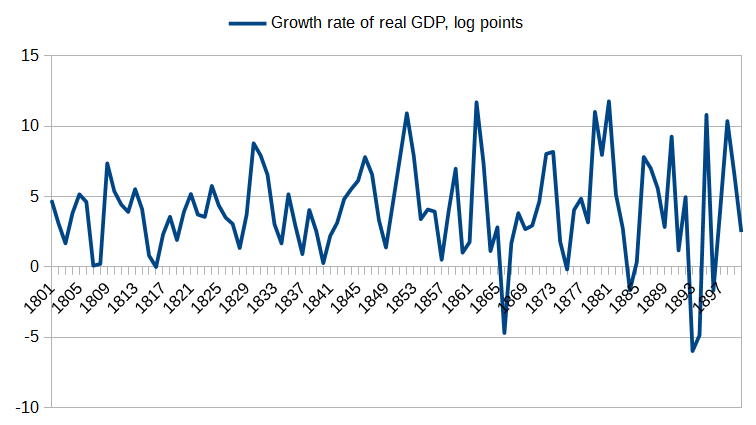
First of all, it’s quite clear that the gold standard did not increase economic growth. If you cherry-pick your years properly, you can make it seem like Nixon leaving the gold standard hurt growth, but if you look at the real long-run trends in economic growth it’s clear that we had really erratic growth up until about the 1910s (the surge of government spending in WW1 and the establishment of the Federal Reserve), at which point went through a temporary surge recovering from the Great Depression and then during WW2, and finally, if you smooth out the business cycle, our growth rates have slowly trended downward as growth in productivity has gradually slowed down.

Here’s GDP growth from 1800 to 1900, when we were on the classical gold standard:

US_GDP_growth_1800s

Here’s GDP growth from 1929 to today, using data from the Bureau of Economic Analysis:

US_GDP_growth_BEA

Also, both of these are total GDP growth (because that is what Kadlic said), which means that part of what you’re seeing here is population growth rather than growth in income per person. Here’s GDP per person in the 1800s:

US_GDP_growth_1800s

If you didn’t already know, I bet you can’t guess where on those graphs we left the gold standard, which you’d clearly be able to do if the gold standard had this dramatic “double your GDP growth” kind of effect. I can’t immediately rule out some small benefit to the gold standard just from this data, but don’t worry; more thorough economic studies have done that. Indeed, it is the mainstream consensus among economists today that the gold standard is what caused the Great Depression.

Indeed, there’s a whole subfield of historical economics research that basically amounts to “What were they thinking?” trying to explain why countries stayed on the gold standard for so long when it clearly wasn’t working. Here’s a paper trying to argue it was a costly signal of your “rectitude” in global bond markets, but I find much more compelling the argument that it was psychological: Their belief in the gold standard was simply too strong, so confirmation bias kept holding them back from what needed to be done. They were like my aforementioned #EndTheFed acquaintance.

Then we get to Kadlic’s second point: Does the gold standard reduce the risk of financial crises? Let’s also address point 4, which is closely related: Does the gold standard improve price stability? Tell that to 1929.

In fact, financial crises were more common on the classical gold standard; the period of pure fiat monetary policy was so stable that it was called the Great Moderation, until the crash in 2008 screwed it all up—and that crash occurred essentially outside the standard monetary system, in the “shadow banking system” of unregulated and virtually unlimited derivatives. Had we actually forced banks to stay within the light of the standard banking system, the Great Moderation might have continued indefinitely.

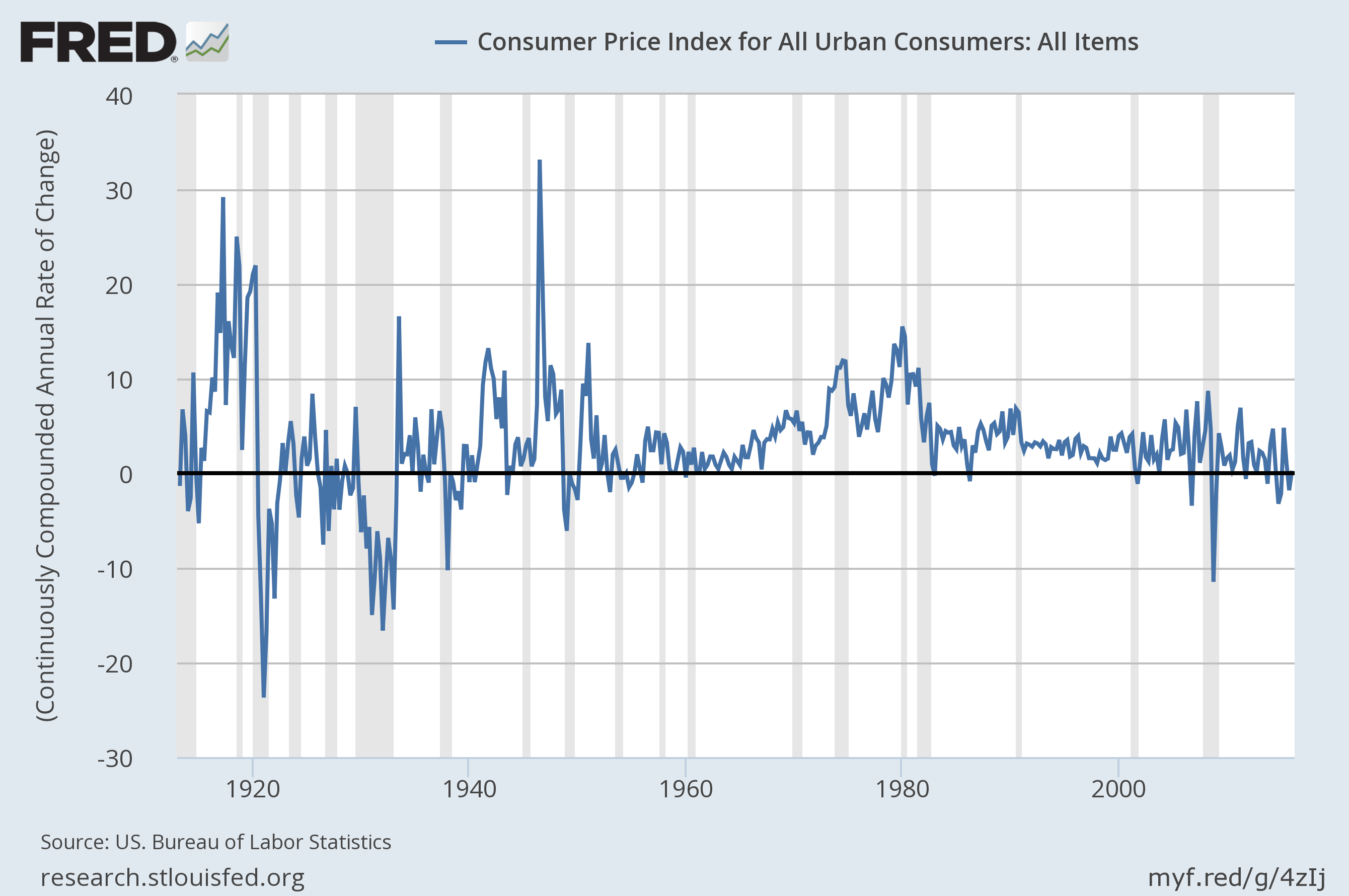
As for “price stability”, that’s sort of true if you look at the long run, because prices were as likely to go down as they were to go up. But that isn’t what we mean by “price stability”. A system with good price stability will have a low but positive and steady level of inflation, and will therefore exhibit some long-run increases in price levels; it won’t have prices jump up and down erratically and end up on average the same.

For jump up and down is what prices did on the gold standard, as you can see from FRED:

US_inflation_longrun

This is something we could have predicted in advance; the price of any given product jumps up and down over time, and gold is just one product among many. Tying prices to gold makes no more sense than tying them to any other commodity.

As for stopping the rise in energy prices, energy prices aren’t rising. Even if they were (and they could at some point), the only way the gold standard would stop that is by triggering deflation (and therefore recession) in the rest of the economy.

Regarding number 6, I don’t see how the fiscal balance of federal and state governments is improved by periodic bouts of deflation that make their debt unpayable.

As for number 7, saving Medicare and Social Security, their payments out are tied to inflation and their payments in are tied to nominal GDP, so overall inflation has very little effect on their long-term stability. In any case, the problem with Medicare is spiraling medical costs (which Obamacare has done a lot to fix), and the problem with Social Security is just the stupid arbitrary cap on the income subject to payroll tax; the gold standard would do very little to solve either of those problems, though I guess it would make the nominal income cap less binding by triggering deflation, which is just about the worst way to avoid a price ceiling I’ve ever heard.

Regarding 8 and 9, I don’t even understand why Kadlic thinks that going to a gold standard would empower individuals over banks (does it seem like individuals were empowered over banks in the “Robber Baron Era”?), or what in the world it has to do with giving people more liberty (all that… freedom… you lose… when the Fed… stabilizes… prices?), so I don’t even know where to begin on those assertions. You know what empowers people over banks? The Consumer Financial Protection Bureau. You know what would enhance liberty? Ending mass incarceration. Libertarians fight tooth and nail against the former; sometimes they get behind the latter, but sometimes they don’t; Gary Johnson for some bizarre reason believes in privatization of prisons, which are directly linked to the surge in US incarceration.

The only benefit I’ve been able to come up with for the gold standard is as a commitment mechanism, something the Federal Reserve could do to guarantee its future behavior and thereby reduce the fear that it will suddenly change course on its past promises. This would make forward guidance a lot more effective at changing long-term interest rates, because people would have reason to believe that the Fed means what it says when it projects its decisions 30 years out.

But there are much simpler and better commitment mechanisms the Fed could use. They could commit to a Taylor Rule or nominal GDP targeting, both of which mainstream economists have been clamoring for for decades. There are some definite downsides to both proposals, but also some important upsides; and in any case they’re both obviously better than the gold standard and serve the same forward guidance function.

Indeed, it’s really quite baffling that so many people believe in the gold standard. It cries out for some sort of psychological explanation, as to just what cognitive heuristic is failing when otherwise-intelligent and highly-educated people get monetary policy so deeply, deeply wrong. A lot of them don’t even to seem grasp when or how we left the gold standard; it really happened when FDR suspended gold convertibility in 1933. After that on the Bretton Woods system only national governments could exchange money for gold, and the Nixon shock that people normally think of as “ending the gold standard” was just the final nail in the coffin, and clearly necessary since inflation was rapidly eating through our gold reserves.

A lot of it seems to come down to a deep distrust of government, especially federal government (I still do not grok why the likes of Ron Paul think state governments are so much more trustworthy than the federal government); the Federal Reserve is a government agency (sort of) and is therefore not to be trusted—and look, it has federal right there in the name.

But why do people hate government so much? Why do they think politicians are much less honest than they actually are? Part of it could have to do with the terrifying expansion of surveillance and weakening of civil liberties in the face of any perceived outside threat (Sedition Act, PATRIOT ACT, basically the same thing), but often the same people defending those programs are the ones who otherwise constantly complain about Big Government. Why do polls consistently show that people don’t trust the government, but want it to do more?

I think a lot of this comes down to the vague meaning of the word “government” and the associations we make with particular questions about it. When I ask “Do you trust the government?” you think of the NSA and the Vietnam War and Watergate, and you answer “No.” But when I ask “Do you want the government to do more?” you think of the failure at Katrina, the refusal to expand Medicaid, the pitiful attempts at reducing carbon emissions, and you answer “Yes.” When I ask if you like the military, your conditioned reaction is to say the patriotic thing, “Yes.” But if I ask whether you like the wars we’ve been fighting lately, you think about the hundreds of thousands of people killed and the wanton destruction to achieve no apparent actual objective, and you say “No.” Most people don’t come to these polls with thought-out opinions they want to express; the questions evoke emotional responses in them and they answer accordingly. You can also evoke different responses by asking “Should we cut government spending?” (People say “Yes.”) versus asking “Should we cut military spending, Social Security, or Medicare?” (People say “No.”) The former evokes a sense of abstract government taking your tax money; the latter evokes the realization that this money is used for public services you value.

So, the gold standard has acquired positive emotional vibes, and the Fed has acquired negative emotional vibes.

The former is fairly easy to explain: “good as gold” is an ancient saying, and “the gold standard” is even a saying we use in general to describe the right way of doing something (“the gold standard in prostate cancer treatment”). Humans have always had a weird relationship with gold; something about its timeless and noncorroding shine mesmerizes us. That’s why you occasionally get proposals for a silver standard, but no one ever seems to advocate an oil standard, an iron standard, or a lumber standard, which would make about as much sense.

The latter is a bit more difficult to explain: What did the Fed ever do to you? But I think it might have something to do with the complexity of sound monetary policy, and the resulting air of technocratic mystery surrounding it. Moreover, the Fed actively cultivates this image, by using “open-market operations” and “quantitative easing” to “target interest rates”, instead of just saying, “We’re printing money.” There may be some good reasons to do it this way, but a lot of it really does seem to be intended to obscure the truth from the uninitiated and perpetuate the myth that they are almost superhuman. “It’s all very complicated, you see; you wouldn’t understand.” People are hoarding their money, so there’s not enough money in circulation, so prices are falling, so you’re printing more money and trying to get it into circulation. That’s really not that complicated. Indeed, if it were, we wouldn’t be able to write a simple equation like a Taylor Rule or nominal GDP targeting in order to automate it!

The reason so many people become gold bugs after taking a couple of undergraduate courses in economics, then, is that this teaches them enough that they feel they have seen through the veil; the curtain has been pulled open and the all-powerful Wizard revealed to be an ordinary man at a control panel. (Spoilers? The movie came out in 1939. Actually, it was kind of about the gold standard.) “What? You’ve just been printing money all this time? But that is surely madness!” They don’t actually understand why printing money is actually a perfectly sensible thing to do on many occasions, and it feels to them a lot like what would happen if they just went around printing money (counterfeiting) or what a sufficiently corrupt government could do if they printed unlimited amounts (which is why they keep bringing up Zimbabwe). They now grasp what is happening, but not why. A little learning is a dangerous thing.

Now as for why Paul Volcker wants to go back to Bretton Woods? That, I cannot say. He’s definitely got more than a little learning. At least he doesn’t want to go back to the classical gold standard.

How (not) to talk about the defense budget

JDN 2457927 EDT 20:20.

This week on Facebook I ran into a couple of memes about the defense budget that I thought were worth addressing. While the core message that the United States spends too much on the military is sound, these particular memes are so massively misleading that I think it would be irresponsible to let them go unanswered.

Tax_dollars_meme

First of all, this graph is outdated; it appears to be from about five years ago. If you use nominal figures for just direct military spending, the budget has been cut from just under $700 billion (what this figure looks like) in 2010 to only about $600 billion today. If you include verterans’ benefits, again nominally, we haven’t been below $700 billion since 2007; today we are now above $800 billion. I think the most meaningful measure is actually military spending as percent of GDP, on which we’ve cut military spending from its peak of 4.7% of GDP in 2010 to 3.5% of GDP today.

It’s also a terrible way to draw a graph; using images instead of bars may be visually appealing, but it undermines the most important aspect of a bar graph, which is that you can easily visually compare relative magnitudes.

But the most important reason why this graph is misleading is that it uses only the so-called “discretionary budget”, which includes almost all military spending but only a small fraction of spending on healthcare and social services. This creates a wildly inflated sense of how much we spend on the military relatively to other priorities.

In particular, we’re excluding Medicare and Social Security, which are on the “mandatory budget”; each of these alone is comparable to total military spending. Here’s a very nice table of all US government spending broken down by category.

Let’s just look at federal spending for now. Including veterans’ benefits, we currently spend $814 billion per year on defense. On Social Security, we spend $959 billion. On healthcare, we spend $1,018 billion per year, of which $536 billion is Medicare.

We also spend $376 billion on social welfare programs and unemployment, along with $149 billion on education, $229 billion servicing the national debt, and $214 billion on everything else (such as police, transportation, and administration).

I’ve made you a graph that accurately reflects these relative quantities:

US_federal_spending

As you can see, the military is one of our major budget items, but the largest categories are actually pensions (i.e. Social Security) and healthcare (i.e. Medicare and Medicaid).

Given the right year and properly adjusted bars on the graph, the meme may strictly be accurate about the discretionary budget, but it gives an extremely distorted sense of our overall government spending.

The next meme is even worse:

Lee_Camp_meme

Again the figures aren’t strictly wrong if you use the right year, but we’re only looking at the federal discretionary budget. Since basically all military spending is federal and discretionary, but most education spending is mandatory and done at the state and local level, this is an even more misleading picture.

Total annual US military spending (including veteran benefits) is about $815 billion.
Total US education spending (at all levels) is about $922 billion.

Here’s an accurate graph of total US government spending at all levels:

US_total_spending

That is, we spend more on education than we do on the military, and dramatically more on healthcare.

However, the United States clearly does spend far too much on the military and probably too little on education; the proper comparison to make is to other countries.

Most other First World Countries spend dramatically more on education than they do on the military.

France, for example, spends about $160 billion per year on education, but only about $53 billion per year on the military—and France is actually a relatively militaristic country, with the 6th-highest total military spending in the world.

Germany spends about $172 billion per year on education, but only about about $44 billion on the military.

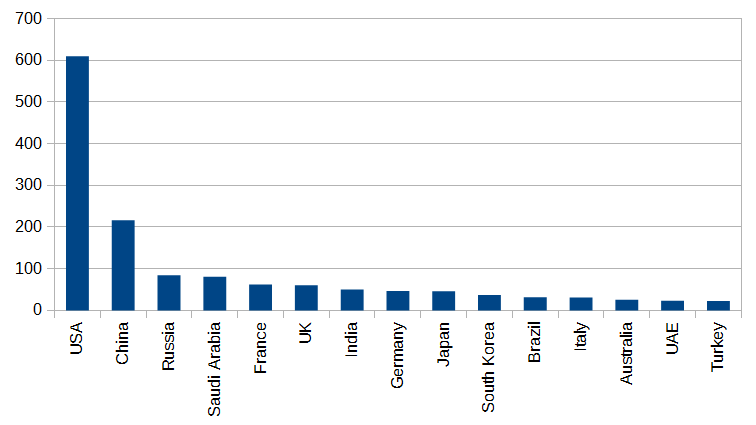
In absolute figures, the United States overwhelms all other countries in the world—we spend as much as at least the next 10 combined.

Using figures from the Stockholm International Peace Research Institute (SIPRI), the US spends $610 billion of the world’s total $1,776 billion, meaning that over a third of the world’s military spending is by the United States.

This is a graph of the top 15 largest military budgets in the world.

world_military_spending

One of these things is not like the other ones…

It probably makes the most sense to compare military spending as a portion of GDP, which makes the US no longer an outlier worldwide, but still very high by First World standards:

world_military_spending_GDP

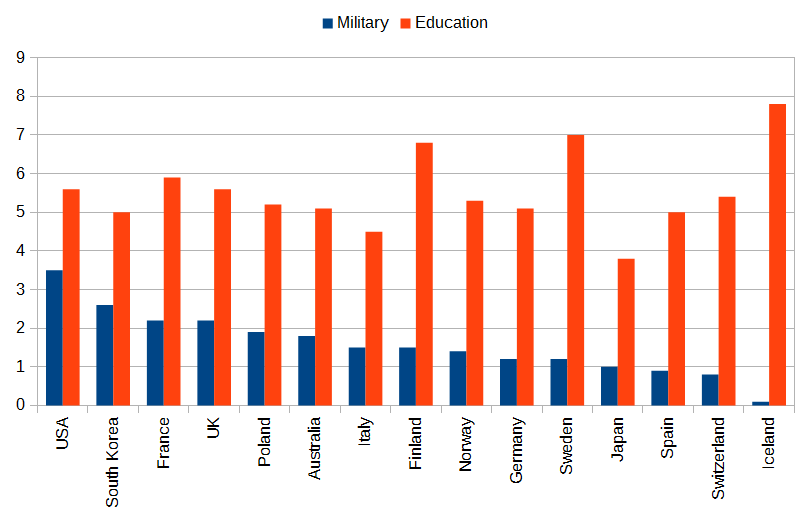
If we do want to compare military spending to other forms of spending, I think we should do that in international perspective as well. Here is a graph of education spending versus military spending as a portion of GDP, in several First World countries (military from SIPRI and the CIA, and education from the UNDP):

world_military_education

Our education spending is about average (though somehow we do it so inefficiently that we don’t provide college for free, unlike Germany, France, Finland, Sweden, or Norway), but our military spending is by far the highest.

How about a meme about that?