I can’t not talk about tariffs right now

Apr 13 JDN 2460779

On the one hand, I’m sure every economics blog on the Internet is already talking about this, including Paul Krugman who knows the subject way better than I ever will (and literally won a Nobel Prize for his work on it). And I have other things I’d rather be writing about, like the Index of Necessary Expenditure. But on the other hand, when something this big happens in economics, it just feels like there’s really no alternative: I have to talk about tariffs right now.

What is a tariff, anyway?

This feels like a really basic question, but it also seems like a lot of people don’t really understand tariffs, or didn’t when they voted for Trump.

A tariff, quite simply, is an import tax. It’s a tax that you impose on imported goods (either a particular kind, or from a particular country, or just across the board). On paper, it is generally paid by the company importing the goods, but as I wrote about in my sequence on tax incidence, that doesn’t matter. What matters is how prices change in response to the tax, and this means that in real terms, prices will go up.

In fact, in some sense that’s the goal of a protectionist tariff, because you’re trying to fix the fact that local producers can’t compete on the global market. So you compensate by making international firms pay higher taxes, so that the local producers can charge higher prices and still compete. So anyone who is saying that tariffs won’t raise prices is either ignorant or lying: Raising prices is what tariffs do.

Why are people so surprised?

The thing that surprises me about all this, (a bit ironically) is how surprised people seem to be. Trump ran his whole campaign promising two things: Deport all the immigrants, and massive tariffs on all trade. Most of his messaging was bizarre and incoherent, but on those two topics he was very consistent. So why in the world are people—including stock traders, who are supposedly savvy on these things—so utterly shocked that he has actually done precisely what he promised he would do?

What did people think Trump meant when he said these things? Did they assume he was bluffing? Did they think cooler heads in his administration would prevail (if so, whose?)?

But I will admit that even I am surprised at just how big the tariffs are. I knew they would be big, but I did not expect them to be this big.

How big?

Well, take a look at this graph:
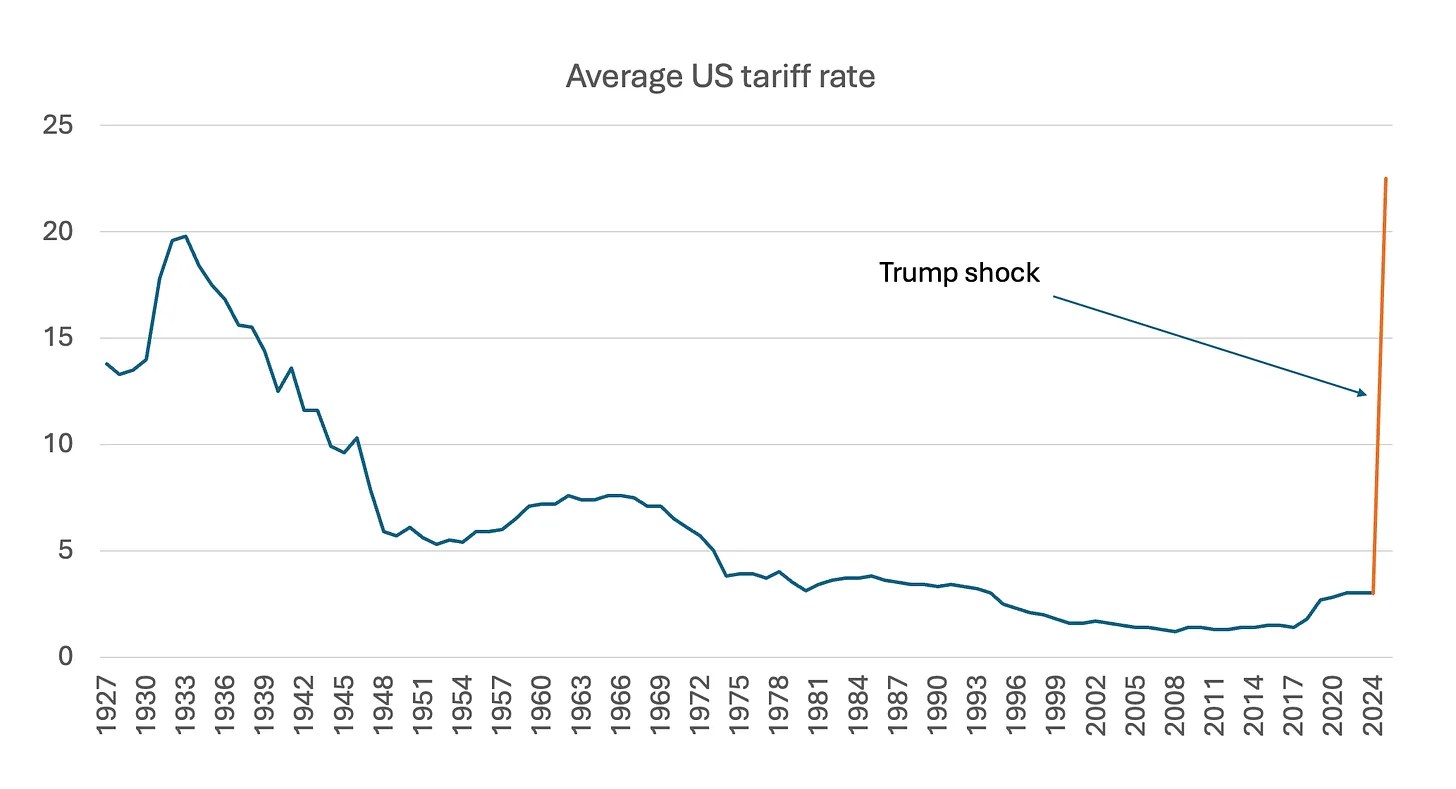
The average tariff rate on US imports will now be higher than it was at the peak in 1930 with the Smoot-Hawley Act. Moreover, Smoot-Hawley was passed during a time when protectionist tariffs were already in place, while Trump’s tariffs come at a time when tariffs had previously been near zero—so the change is dramatically more sudden.

This is worse than Smoot-Hawley.

For the uninitiated, Smoot-Hawley was a disaster. Several countries retaliated with their own tariffs, and the resulting trade war clearly exacerbated the Great Depression, not only in the US but around the world. World trade dropped by an astonishing 66% over the next few years. It’s still debated as to how much of the depression was caused by the tariffs; most economists believe that the gold standard was the bigger culprit. But it definitely made it worse.

Politically, the aftermath cost the Republicans (including Smoot and Hawley themselves) several seats in Congress. (I guess maybe the silver lining here is we can hope this will do the same?)

And I would now like to remind you that these tariffs are bigger than Smoot-Hawley’s and were implemented more suddenly.

Unlike in 1930, we are not currently in a depression—though nor is our economy as hunky-dory as a lot of pundits seem to think, once we consider things like the Index of Necessary Expenditure. But stock markets do seem to be crashing, and if trade drops as much as it did in the 1930s—and why wouldn’t it?—we may very well end up in another depression.

And it’s not as if we didn’t warn you all. Economists across the political spectrum have been speaking out against Trump’s tariffs from the beginning, and nobody listened to us.

So basically the mood of all economists right now is:

Voting Your Dollars

May 28 JDN 2460093

It’s no secret that Americans don’t like to pay taxes. It’s almost a founding principle of our country, really, going all the way back to the Boston Tea Party. This is likely part of why the US has one of the lowest tax-to-GDP ratios in the First World; our taxes are barely half what they pay in Scandinavia. And this in turn surely contributes to our ongoing budget issues and our stingy social welfare spending. (Speaking of budget issues: As of this writing, the debt ceiling debacle is still unresolved.)

Why don’t Americans like to pay taxes? Why does no one really like to pay taxes (though some seem more willing than others)?

It surely has something to do with the fact that taxes are so coercive: You have to pay them, you get no choice. And you also have very little choice as to how that money is used; yes, you can vote for politicians who will in theory at some point enact budgets that might possibly reflect the priorities they expressed in their campaigns—but the actual budget invariably ends up quite far removed from the campaign promises you could vote based on.

What if we could give you more choice? We can’t let people choose how much to pay—then most people would choose to pay less and we’d be in even more trouble. (If you want to pay more than you’re required to, the IRS will actually let you right now. You can just refuse your refund.) But perhaps we could let people choose where the money goes?

I call this program Vote Your Dollars. I would initially limit it to a small fraction of the budget, tied to a tax increase: Say, raise taxes enough to increase revenue by 5% and use that 5% for the program.

Under Vote Your Dollars, on your tax return, you are given a survey, asking you how you want to divide up your additional money toward various categories. I think they should be fairly broad categories, such as ‘healthcare’, ‘social security’, ‘anti-poverty programs’, ‘defense’, ‘foreign aid’. If we make them too specific, it would be more work for the voters and also more likely to lead to foolish allocations. We want them to basically reflect a voter’s priorities, rather than ask them to make detailed economic management decisions. Most voters are not qualified to properly allocate a budget; the goal here is to get people to weight how much they care about different programs.

As only a small portion of the budget, Vote Your Dollars would initially have very little real fiscal impact. Money is fungible, so any funds that were expected to go somewhere else than where voters put them could easily be reallocated as needed. But I suspect that most voters would fail to appreciate this effect, and thus actually feel like they have more control than they really do. (If voters understood fungibility and inframarginal transfers, they’d never have supported food stamps over just giving poor people cash.)

Moreover, it would still provide useful information, namely: What happens when voters are given this power? Do they make decisions that seem to make sense and reflect their interests and beliefs? Does the resulting budget actually seem like one that could be viable? Could it even be better than what we currently have in some ways?

I suspect that the result would be better than most economists and political scientists imagine. There seems to be a general sense that voters are too foolish or apathetic to usefully participate in politics, which of course would raise the very big question: Why does democracy work?

I don’t think that most voters would choose a perfect budget; indeed, I already said I wouldn’t trust them with the fine details of how to allocate the funds. But I do think most people have at least some reasonable idea of how important they think healthcare is relative to defense, and it would be good to at least gather that information in a more direct way.

If it goes well and Vote Your Dollars seems to result in reasonable budgets even for that extra 5%, we could start expanding it to a larger portion of the overall budget. Try 10% for the next election, then 15% for the next. There should always be some part that remains outside direct voter control, because voters would almost certainly underspend on certain categories (such as administration and national debt payments) and likely overspend on others.

This would allow us to increase taxes—which we clearly must do, because we need to improve government services, but we don’t want to go further into debt—while giving voters more choice, and thus making taxes feel less coercive. Being forced to pay a certain amount each year might not sting as much if you get to say where a significant portion of that money goes.

To give voters even more control over their money, I think I would also include a provision whereby you can deduct the full amount of your charitable contributions to certain high-impact charities (we would need to come up with a good list, but clear examples include UNICEF, Oxfam, and GiveWell) from your tax payment. Currently, you deduct charitable contributions from your income, which means you don’t pay taxes on those donations; but you still end up with less money after donating than you did before. If we let you deduct the full amount, then you would have the same amount after donating, and effectively the government would pay the full cost of your donation. Presumably this would lead to people donating a great deal; this might hurt tax revenues, but its overall positive impact on the world would be so large that it is obviously worth it. By the time we have given enough to UNICEF to meaningfully impact the US federal budget, we have ended world hunger.

Of course, it’s very unlikely that anything like Vote Your Dollars would ever be implemented. There are already ways we could make paying taxes less painful that we haven’t done—such as sending you a bill, as they do in Denmark, rather than making you file a tax form. And we could already increase revenue with very little real cost by simply expanding the IRS and auditing rich people more. These simple, obvious reforms have been repeatedly obstructed by powerful lobbies, who personally benefit from the current system even though it’s obviously a bad system. I guess I can’t think of anyone in particular who would want to lobby against Vote Your Dollars, but I feel like Republicans might just because they want taxes to hurt as much as possible so that they have an excuse to cut spending.

But still, I thought I’d put the idea out there.

The Asymmetry that Rules the World

JDN 2456921 PDT 13:30.

One single asymmetry underlies millions of problems and challenges the world has always faced. No, it’s not Christianity versus Islam (or atheism). No, it’s not the enormous disparities in wealth between the rich and the poor, though you’re getting warmer.

It is the asymmetry of information—the fundamental fact that what you know and what I know are not the same. If this seems so obvious as to be unworthy of comment, maybe you should tell that to the generations of economists who have assumed perfect information in all of their models.

It’s not clear that information asymmetry could ever go away—even in the utopian post-scarcity economy of the Culture, one of the few sacred rules is the sanctity of individual thought. The closest to an information-symmetric world I can think of is the Borg, and with that in mind we may ask whether we want such a thing after all. It could even be argued that total information symmetry is logically impossible, because once you make two individuals know and believe exactly the same things, you don’t have two individuals anymore, you just have one. (And then where do we draw the line? It’s that damn Ship of Theseus again—except of course the problem was never the ship, but defining the boundaries of Theseus himself.)

Right now you may be thinking: So what? Why is asymmetric information so important? Well, as I mentioned in an earlier post, the Myerson-Satterthwaithe Theorem proves—mathematically proves, as certain as 2+2=4—that in the presence of asymmetric information, there is no market mechanism that guarantees Pareto-efficiency.

You can’t square that circle; because information is asymmetric, there’s just no way to make a free market that insures Pareto efficiency. This result is so strong that it actually makes you begin to wonder if we should just give up on economics entirely! If there’s no way we can possibly make a market that works, why bother at all?

But this is not the appropriate response. First of all, Pareto-efficiency is overrated; there are plenty of bad systems that are Pareto-efficient, and even some good systems that aren’t quite Pareto-efficient.

More importantly, even if there is no perfect market system, there clearly are better and worse market systems. Life is better here in the US than it is in Venezuela. Life in Sweden is arguably a bit better still (though not in every dimension). Life in Zambia and North Korea is absolutely horrific. Clearly there are better and worse ways to run a society, and the market system is a big part of that. The quality—and sometimes quantity—of life of billions of people can be made better or worse by the decisions we make in managing our economic system. Asymmetric information cannot be conquered, but it can be tamed.

This is actually a major subject for cognitive economics: How can we devise systems of regulation that minimize the damage done by asymmetric information? Akerlof’s Nobel was for his work on this subject, especially his famous paper “The Market for Lemons” in which he showed how product quality regulations could increase efficiency using the example of lemon cars. What he showed was, in short, that libertarian deregulation is stupid; removing regulations on product safety and quality doesn’t increase efficiency, it reduces it. (This is of course only true if the regulations are good ones; but despite protests from the supplement industry I really don’t see how “this bottle of pills must contain what it claims to contain” is an illegitimate regulation.)

Unfortunately, the way we currently write regulations leaves much to be desired: Basically, lobbyists pay hundreds of staffers to make hundreds of pages that no human being can be expected to read, and then hands them to Congress with a wink and a reminder of last year’s campaign contributions, who passes them without question. (Can you believe the US is one of the least corrupt governments in the world? Yup, that’s how bad it is out there.) As a result, we have a huge morass of regulations that nobody really understands, and there is a whole “industry” of people whose job it is to decode those regulations and use them to the advantage of whoever is paying them—lawyers. The amount of deadweight loss introduced into our economy is almost incalculable; if I had to guess, I’d have to put it somewhere in the trillions of dollars per year. At the very least, I can tell you that the $200 billion per year spent by corporations on litigation is all deadweight loss due to bad regulation. That is an industry that should not exist—I cannot stress this enough. We’ve become so accustomed to the idea that regulations are this complicated that people have to be paid six-figure salaries to understand them that we never stopped to think whether this made any sense. The US Constitution was originally printed on 6 pages.

The tax code should contain one formula for setting tax brackets with one or two parameters to adjust to circumstances, and then a list of maybe two dozen goods with special excise taxes for their externalities (like gasoline and tobacco). In reality it is over 70,000 pages.

Laws should be written with a clear and general intent, and then any weird cases can be resolved in court—because there will always be cases you couldn’t anticipate. Shakespeare was onto something when he wrote, “First, kill all the lawyers.” (I wouldn’t kill them; I’d fire them and make them find a job doing something genuinely useful, like engineering or management.)

All told, I think you could run an entire country with less than 100 pages of regulations. Furthermore, these should be 100 pages that are taught to every high school student, because after all, we’re supposed to be following them. How are we supposed to follow them if we don’t even know them? There’s a principle called ignorantia non excusatignorance does not excuse—which is frankly Kafkaesque. If you can be arrested for breaking a law you didn’t even know existed, in what sense can we call this a free society? (People make up strawman counterexamples: “Gee, officer, I didn’t know it was illegal to murder people!” But all you need is a standard of reasonable knowledge and due diligence, which courts already use to make decisions.)

So, in that sense, I absolutely favor deregulation. But my reasons are totally different from libertarians: I don’t want regulations to stop constraining businesses, I want regulations to be so simple and clear that no one can get around them. In the system I envision, you wouldn’t be able to sell fraudulent derivatives, because on page 3 it would clearly say that fraud is illegal and punishable in proportion to the amount of money involved.

But until that happens—and let’s face it, it’s gonna be awhile—we’re stuck with these ridiculous regulations, and that introduces a whole new type of asymmetric information. This is the way that regulations can make our economy less efficient; they distort what we can do not just by making it illegal, but by making it so we don’t know what is illegal.

The wealthy and powerful can hire people to explain—or evade—the regulations, while the rest of us are forced to live with them. You’ve felt this in a small way if you’ve ever gotten a parking ticket and didn’t know why. Asymmetric information strikes again.