Trump will soon be gone. But this isn’t over.

Nov 8 JDN 2459162

After a frustratingly long wait for several states to finish counting their mail-in ballots (particularly Pennsylvania, Nevada, and Arizona), Biden has officially won the Presidential election. While it was far too close in a few key states, this is largely an artifact of the Electoral College: Biden’s actual popular vote advantage was over 4 million votes. We now have our first Vice President who is a woman of color. I think it’s quite reasonable for us all to share a long sigh of relief at this result.

We have won this battle. But the war is far from over.

First, there is the fact that we are still in a historic pandemic and economic recession. I have no doubt that Biden’s policy response will be better than Trump’s; but he hasn’t taken office yet, and much of the damage has already been done. Things are not going to get much better for quite awhile yet.

Second, while Biden is a pretty good candidate, he does have major flaws.

Above all, Biden is still far too hawkish on immigration and foreign policy. He won’t chant “build the wall!”, but he’s unlikely to tear down all of our border fences or abolish ICE. He won’t rattle the saber with Iran or bomb civilians indiscriminately, but he’s unlikely to end the program of assassination drone strikes. Trump has severely, perhaps irrevocably, damaged the Pax Americana with his ludicrous trade wars, alienation of our allies, and fawning over our enemies; but whether or not Biden can restore America’s diplomatic credibility, I have no doubt that he’ll continue to uphold—and deploy—America’s military hegemony. Indeed, the failure of the former could only exacerbate the latter.

Biden’s domestic policy is considerably better, but even there he doesn’t go far enough. His healthcare plan is a substantial step forward, improving upon the progress already made by Obamacare; but it’s still not the single-payer healthcare system we really need. He has some good policy ideas for directly combating discrimination, but isn’t really addressing the deep structural sources of systemic racism. His anti-poverty programs would be a step in the right direction, but are clearly insufficient.

Third, Democrats did not make significant gains in Congress, and while they kept the majority in the House, they are unlikely to gain control of the Senate. Because the Senate is so powerful and Mitch McConnell is so craven, this could be disastrous for Biden’s ability to govern.

But there is an even more serious problem we must face as a country: Trump got 70 million votes. Even after all he did—his endless lies, his utter incompetence, his obvious corruption—and all that happened—the mishandled pandemic, the exacerbated recession—there were still 70 million people willing to vote for Trump. I said it from the beginning: I have never feared Trump nearly so much as I fear an America that could elect him.

Yes, of course he would have had a far worse shot if our voting system were better: Several viable parties, range voting, and no Electoral College would have all made things go very differently than they did in 2016. But the fact remains that tens of millions of Americans were willing to vote for this man not once, but twice.

What can explain the support of so many people for such an obviously terrible leader?

First, there is misinformation: Our mass media is biased and can give a very distorted view of the world. Someone whose view of world events was shaped entirely by right-wing media like Fox News (let alone OAN) might not realize how terrible Trump is, or might be convinced that Biden is somehow even worse. Yet today, in the 21st century, our access to information is virtually unlimited. Anyone who really wanted to know what Trump is like would be able to find out—so whatever ignorance or misinformation Trump voters had, they bear the greatest responsibility for it.

Then, there is discontent: Growth in total economic output has greatly outpaced growth in real standard of living for most Americans. While real per-capita GDP rose from $26,000 in 1974 to $56,000 today (a factor of 2.15, or 1.7% per year), real median personal income only rose from $25,000 to $36,000 (a factor of 1.44, or 0.8% per year). This reflects the fact that more and more of our country’s wealth is being concentrated in the hands of the rich. Combined with dramatically increased costs of education and healthcare, this means that most American families really don’t feel like their standard of living has meaningfully improved in a generation or more.

Yet if people are discontent with how our economy is run… why would they vote for Donald Trump, who epitomizes everything that is wrong with that system? The Democrats have not done enough to fight rising inequality and spiraling healthcare costs, but they have at least done something—raising taxes here, expanding Medicaid there. This is not enough, since it involves only tweaking the system at the edges rather than solving the deeper structural problems—but it has at least some benefit. The Republicans at their best have done nothing, and at their worst actively done everything in their power to exacerbate rising inequality. And Trump is no different in this regard than any other Republican; he promised more populist economic policy, but did not deliver it in any way. Do people somehow not see that?

I think we must face up to the fact that racism and sexism are clearly a major part of what motivates supporters of Trump. Trump’s core base consists of old, uneducated White men. Women are less likely to support him, and young people, educated people, and people of color are far less likely to support him. The race gap is staggering: A mere 8% of Black people support Trump, while 54% of White people do. While Asian and Hispanic voters are not quite so univocal, still it’s clear that if only non-White people had voted Biden would have won an utter landslide and might have taken every state—yes, likely even Florida, where Cuban-Americans did actually lean slightly toward Trump. The age and education gaps are also quite large: Among those under 30, only 30% support Trump, while among those over 65, 52% do. Among White people without a college degree, 64% support Trump, while among White people with a college degree, only 38% do. The gender gap is smaller, but still significant: 48% of men but only 42% of women support Trump. (Also the fact that the gender gap was smaller this year than in 2016 could reflect the fact that Clinton was running for President but Harris was only running for Vice President.)

We shouldn’t ignore the real suffering and discontent that rising inequality has wrought, nor should we dismiss the significance of right-wing propaganda. Yet when it comes right down to it, I don’t see how we can explain Trump’s popularity without recognizing that an awful lot of White men in America are extremely racist and sexist. The most terrifying thing about Trump is that millions of Americans do know what he’s like—and they’re okay with that.

Trump will soon be gone. But many others like him remain. We need to find a way to fix this, or the next racist, misogynist, corrupt, authoritarian psychopath may turn out to be a lot less foolish and incompetent.

What meritocracy trap?

Nov 1 JDN 2459155

So I just finished reading The Meritocracy Trap by David Markovits.

The basic thesis of the book is that America’s rising inequality is not due to a defect in our meritocratic ideals, but is in fact their ultimate fruition. Markovits implores us to reject the very concept of meritocracy, and replace it with… well, something, and he’s never very clear about exactly what.

The most frustrating thing about reading this book is trying to figure out where Markovits draws the line for “elite”. He rapidly jumps between talking about the upper quartile, the upper decile, the top 1%, and even the top 0.1% or top 0.01% while weaving his narrative. The upper quartile of the US contains 75 million people; the top 0.01% contains only 300,000. The former is the size of Germany, the latter the size of Iceland (which has fewer people than Long Beach). Inequality which concentrates wealth in the top quartile of Americans is a much less serious problem than inequality which concentrates wealth in the top 0.01%. It could still be a problem—those lower three quartiles are people too—but it is definitely not nearly as bad.

I think it’s particularly frustrating to me personally, because I am an economist, which means both that such quantitative distinctions are important to me, and also that whether or not I myself am in this “elite” depends upon which line you are drawing. Do I have a post-graduate education? Yes. Was I born into the upper quartile? Not quite, but nearly. Was I raised by married parents in a stable home? Certainly. Am I in the upper decile and working as a high-paid professional? Hopefully I will be soon. Will I enter the top 1%? Maybe, maybe not. Will I join the top 0.1%? Probably not. Will I ever be in the top 0.01% and a captain of industry? Almost certainly not.

So, am I one of the middle class who are suffering alienation and stagnation, or one of the elite who are devouring themselves with cutthroat competition? Based on BLS statistics for economists and job offers I’ve been applying to, my long-term household income is likely to be about 20-50% higher than my parents’; this seems like neither the painful stagnation he attributes to the middle class nor the unsustainable skyrocketing of elite incomes. (Even 50% in 30 years is only 1.4% per year, about our average rate of real GDP growth.) Marxists would no doubt call me petit bourgeoisie; but isn’t that sort of the goal? We want as many people as possible to live comfortable upper-middle class lives in white-collar careers?

Markovits characterizes—dare I say caricatures—the habits of the middle-class versus the elite, and once again I and most people I know cross-cut them: I spend more time with friends than family (elite), but I cook familiar foods, not fancy dinners (middle); I exercise fairly regularly and don’t watch much television (elite) but play a lot of video games and sleep a lot as well (middle). My web searches involve technology and travel (elite), but also chronic illness (middle). I am a donor to Amnesty International (elite) but also play tabletop role-playing games (middle). I have a functional, inexpensive car (middle) but a top-of-the-line computer (elite)—then again that computer is a few years old now (middle). Most of the people I hang out with are well-educated (elite) but struggling financially (middle), civically engaged (elite) but pessimistic (middle). I rent my apartment and have a lot of student debt (middle) but own stocks (elite). (The latter seemed like a risky decision before the pandemic, but as stock prices have risen and student loan interest was put on moratorium, it now seems positively prescient.) So which class am I, again?

I went to public school (middle) but have a graduate degree (elite). I grew up in Ann Arbor (middle) but moved to Irvine (elite). Then again my bachelor’s was at a top-10 institution (elite) but my PhD will be at only a top-50 (middle). The beautiful irony there is that the top-10 institution is the University of Michigan and the top-50 institution is the University of California, Irvine. So I can’t even tell which class each of those events is supposed to represent! Did my experience of Ann Arbor suddenly shift from middle class to elite when I graduated from public school and started attending the University of Michigan—even though about a third of my high school cohort did exactly that? Was coming to UCI an elite act because it’s a PhD in Orange County, or a middle-class act because it’s only a top-50 university?

If the gap between these two classes is such a wide chasm, how am I straddling it? I honestly feel quite confident in characterizing myself as precisely the upwardly-mobile upper-middle class that Markovits claims no longer exists. Perhaps we’re rarer than we used to be; perhaps our status is more precarious; but we plainly aren’t gone.

Markovits keeps talking about “radical differences” “not merely in degree but in kind” between “subordinate” middle-class workers and “superordinate” elite workers, but if the differences are really that stark, why is it so hard to tell which group I’m in? From what I can see, the truth seems less like a sharp divide between middle-class and upper-class, and more like an increasingly steep slope from middle-class to upper-middle class to upper-class to rich to truly super-rich. If I had to put numbers on this, I’d say annual household incomes of about $50,000, $100,000, $200,000, $400,000, $1 million, and $10 million respectively. (And yet perhaps I should add more categories: Even someone who makes $10 million a year has only pocket change next to Elon Musk or Jeff Bezos.) The slope has gotten steeper over time, but it hasn’t (yet?) turned into a sharp cliff the way Markovits describes. America’s Lorenz curve is clearly too steep, but it doesn’t have a discontinuity as far as I can tell.

Some of the inequalities Markovits discusses are genuine, but don’t seem to be particularly related to meritocracy. The fact that students from richer families go to better schools indeed seems unjust, but the problem is clearly not that the rich schools are too good (except maybe at the very top, where truly elite schools seem a bit excessive—five-figure preschool tuition?), but that the poor schools are not good enough. So it absolutely makes sense to increase funding for poor schools and implement various reforms, but this is hardly a radical notion—nor is it in any way anti-meritocratic. Providing more equal opportunities for the poor to raise their own station is what meritocracy is all about.

Other inequalities he objects to seem, if not inevitable, far too costly to remove: Educated people are better parents, who raise their children in ways that make them healthier, happier, and smarter? No one is going to apologize for being a good parent, much less stop doing so because you’re concerned about what it does to inequality. If you have some ideas for how we might make other people into better parents, by all means let’s hear them. But I believe I speak for the entire upper-middle class when I say: when I have kids of my own, I’m going to read to them, I’m not going to spank them, and there’s not a damn thing you can do to change my mind on either front. Quite frankly, this seems like a heavy-handed satire of egalitarianism, right out of Harrison Bergeron: Let’s make society equal by forcing rich people to neglect and abuse their kids as much as poor people do! My apologies to Vonnegut: I thought you were ridiculously exaggerating, but apparently some people actually think like this.

This is closely tied with the deepest flaw in the argument: The meritocratic elite are actually more qualified. It’s easy to argue that someone like Donald Trump shouldn’t rule the world; he’s a deceitful, narcissistic, psychopathic, incompetent buffoon. (The only baffling part is that 40% of American voters apparently disagree.) But it’s a lot harder to see why someone like Bill Gates shouldn’t be in charge of things: He’s actually an extremely intelligent, dedicated, conscientious, hard-working, ethical, and competent individual. Does he deserve $100 billion? No, for reasons I’ve talked about before. But even he knows that! He’s giving most of it away to highly cost-effective charities! Bill Gates alone has saved several million lives by his philanthropy.

Markovits tries to argue that the merits of the meritocratic elite are arbitrary and contextual, like the alleged virtues of the aristocratic class: “The meritocratic virtues, that is, are artifacts of economic inequality in just the fashion in which the pitching virtues are artifacts of baseball.” (p. 264) “The meritocratic achievement commonly celebrated today, no less than the aristocratic virtue acclaimed in the ancien regime, is a sham.” (p. 268)

But it’s pretty hard for me to see how things like literacy, knowledge of history and science, and mathematical skill are purely arbitrary. Even the highly specialized skills of a quantum physicist, software engineer, or geneticist are clearly not arbitrary. Not everyone needs to know how to solve the Schrodinger equation or how to run a polymerase chain reaction, but our civilization greatly benefits from the fact that someone does. Software engineers aren’t super-productive because of high inequality; they are super-productive because they speak the secret language of the thinking machines. I suppose some of the skills involved in finance, consulting, and law are arbitrary and contextual; but he makes it sound like the only purpose graduate school serves is in teaching us table manners.

Precisely by attacking meritocracy, Markovits renders his own position absurd. So you want less competent people in charge? You want people assigned to jobs they’re not good at? You think businesses should go out of their way to hire employees who will do their jobs worse? Had he instead set out to show how American society fails at achieving its meritocratic ideals—indeed, failing to provide equality of opportunity for the poor is probably the clearest example of this—he might have succeeded. But instead he tries to attack the ideals themselves, and fails miserably.

Markovits avoids the error that David Graeber made: Graeber sees that there are many useless jobs but doesn’t seem to have a clue why these jobs exist (and turns to quite foolish Marxian conspiracy theories to explain it). Markovits understands that these jobs are profitable for the firms that employ them, but unproductive for society as a whole. He is right; this is precisely what virtually the entire fields of finance, sales, advertising, and corporate law consist of. Most people in our elite work very hard with great skill and competence, and produce great profits for the corporations that employ them, all while producing very little of genuine societal value. But I don’t see how this is a flaw in meritocracy per se.

Nor does Markovits stop at accusing employment of being rent-seeking; he takes aim at education as well: “when the rich make exceptional investments in schooling, this does reduce the value of ordinary, middle-class training and degrees. […] Meritocratic education inexorably engenders a wasteful and destructive arms educational arms race, which ultimately benefits no one, not even the victors.” (p.153) I don’t doubt that education is in part such a rent-seeking arms race, and it’s worthwhile to try to minimize that. But education is not entirely rent-seeking! At the very least, is there not genuine value in teaching children to read and write and do arithmetic? Perhaps by the time we get to calculus or quantum physics or psychopathology we have reached diminishing returns for most students (though clearly at least some people get genuine value out of such things!), but education is not entirely comprised of signaling or rent-seeking (and nor do “sheepskin effects” prove otherwise).

My PhD may be less valuable to me than it would be to someone in my place 40 years ago, simply because there are more people with PhDs now and thus I face steeper competition. Then again, perhaps not, as the wage premium for college and postgraduate education has been increasing, not decreasing, over that time period. (How much of that wage premium is genuine social benefit and how much is rent-seeking is difficult to say.) In any case it’s definitely still valuable. I have acquired many genuine skills, and will in fact be able to be genuinely more productive as well as compete better in the labor market than I would have without it. Some parts of it have felt like a game where I’m just trying to stay ahead of everyone else, but it hasn’t all been that. A world where nobody had PhDs would be a world with far fewer good scientists and far slower technological advancement.

Abandoning meritocracy entirely would mean that we no longer train people to be more productive or match people to the jobs they are most qualified to do. Do you want a world where surgery is not done by the best surgeons, where airplanes are not flown by the best pilots? This necessarily means less efficient production and an overall lower level of prosperity for society as a whole. The most efficient way may not be the best way, but it’s still worth noting that it’s the most efficient way.

Really, is meritocracy the problem, or is it something else?

Markovits is clearly right that something is going wrong with American society: Our inequality is much too high, and our job market is much too cutthroat. I can’t even relate to his description of what the job market was like in the 1960s (“Old Economy Steve” has it right): “Even applicants for white-collar jobs received startlingly little scrutiny. For most midcentury workers, getting a job did not involve any application at all, in the competitive sense of the term.” (p.203)

In fact, if anything he seems to understate the difference across time, perhaps because it lets him overstate the difference across class (p. 203):

Today, by contrast, the workplace is methodically arranged around gradations of skill. Firms screen job candidates intensively at hiring, and they then sort elite and non-elite workers into separate physical spaces.

Only the very lowest-wage employers, seeking unskilled workers, hire casually. Middle-class employers screen using formal cognitive tests and lengthy interviews. And elite employers screen with urgent intensity, recruiting from only a select pool and spending millions of dollars to probe applicants over several rounds of interviews, lasting entire days.

Today, not even the lowest-wage employers hire casually! Have you ever applied to work at Target? There is a personality test you have to complete, which I presume is designed to test your reliability as an obedient corporate drone. Never in my life have I gotten a job that didn’t involve either a lengthy application process or some form of personal connection—and I hate to admit it, but usually the latter. It is literally now harder to get a job as a cashier at Target than it was to get a job as an engineer at Ford 60 years ago.

But I still can’t shake the feeling that meritocracy is not exactly what’s wrong here. The problem with the sky-high compensation packages at top financial firms isn’t that they are paid to people who are really good at their jobs; it’s that those jobs don’t actually accomplish anything beneficial for society. Where elite talent and even elite compensation is combined with genuine productivity, such as in science and engineering, it seems unproblematic (and I note that Markovits barely even touches on these industries, perhaps because he sees they would undermine his argument). The reason our economic growth seems to have slowed as our inequality has massively surged isn’t that we are doing too good a job of rewarding people for being productive.

Indeed, it seems like the problem may be much simpler: Labor supply exceeds labor demand.

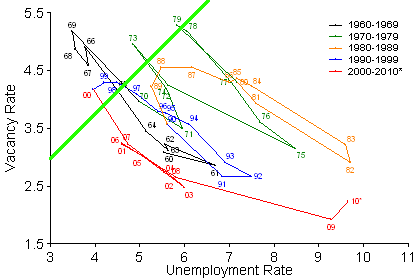
Take a look at this graph from the Federal Reserve Bank of San Francisco:

[Beveridge_curve_data.png]

This graph shows the relationship over time between unemployment and job vacancies. As you can see, they are generally inversely related: More vacancies means less unemployment. I have drawn in a green line which indicates the cutoff between having more vacancies than unemployment—upper left—and having more unemployment than vacancies—lower right. We have almost always been in the state of having more unemployment than we have vacancies; notably, the mid-1960s were one of the few periods in which we had significantly more vacancies than unemployment.

For decades we’ve been instituting policies to try to give people “incentives to work”; but there is no shortage of labor in this country. We seem to have plenty of incentives to work—what we need are incentives to hire people and pay them well.

Indeed, perhaps we need incentives not to work—like a basic income or an expanded social welfare system. Thanks to automation, productivity is now astonishingly high, and yet we work ourselves to death instead of enjoying leisure.

And of course there are various other policy changes that have made our inequality worse—chiefly the dramatic drops in income tax rates at the top brackets that occurred under Reagan.

In fact, many of the specific suggestions Markovits makes—which, much to my chagrin, he waits nearly 300 pages to even mention—are quite reasonable, or even banal: He wants to end tax deductions for alumni donations to universities and require universities to enroll more people from lower income brackets; I could support that. He wants to regulate finance more stringently, eliminate most kinds of complex derivatives, harmonize capital gains tax rates to ordinary income rates, and remove the arbitrary cap on payroll taxes; I’ve been arguing for all of those things for years. What about any of these policies is anti-meritocratic? I don’t see it.

More controversially, he wants to try to re-organize production to provide more opportunities for mid-skill labor. In some industries I’m not sure that’s possible: The 10X programmer is a real phenomenon, and even mediocre programmers and engineers can make software and machines that are a hundred times as productive as doing the work by hand would be. But some of his suggestions make sense, such as policies favoring nurse practitioners over specialist doctors and legal secretaries instead of bar-certified lawyers. (And please, please reform the medical residency system! People die from the overwork caused by our medical residency system.)

But I really don’t see how not educating people or assigning people to jobs they aren’t good at would help matters—which means that meritocracy, as I understand the concept, is not to blame after all.

What if we cared for everyone equally?

Oct 11 JDN 2459134

Imagine for a moment a hypothetical being who was a perfect utilitarian, who truly felt at the deepest level an equal caring for all human beings—or even all life.

We often imagine that such a being would be perfectly moral, and sometimes chide ourselves for failing so utterly to live up to its ideal. Today I’d like to take a serious look at how such a being would behave, and ask whether it is really such a compelling ideal after all.

I cannot feel sadness at your grandmother’s death, for over 150,000 people die every day. By far the highest QALY lost are the deaths of children in the poorest countries, and I feel sad for them as an aggregate, but couldn’t feel particularly saddened by any individual one.

I cannot feel happiness at your wedding or the birth of your child, for 50,000 couples marry every day, and another 30,000 divorce. 350,000 children are born every day, so why should I care about yours?

My happiness does not change from hour to hour or day to day, except as a slow, steady increase over time that is occasionally interrupted briefly by sudden disasters like hurricanes or tsunamis. 2020 was the saddest year I’ve had in awhile, as for once there was strongly correlated suffering across the globe sufficient to break through the trend of steadily increasing prosperity.

Should we go out with friends for drinks or dinner or games, I’ll be ever-so-slightly happier, some barely perceptible degree, provided that there is no coincidental event which causes more than the baseline rate of global suffering that day. And I’d be just as happy to learn that someone else I’d never met went out to dinner with someone else I’d also never met.

Of course I love you, my dear: Precisely as much as I love the other eight billion people on Earth.

I hope now that you can see how flat, how bleak, how inhuman such a being’s experience would be. We might sometimes wish some respite from the roller coaster ride of our own emotional experiences, but in its place this creature feels almost nothing at all, just a vague sense of gradually increasing contentment which is occasionally interrupted by fleeting deviations from the trend.

Such a being is incapable of feeling love as we would recognize it—for a mind such as ours could not possibly feel so intensely for a billion people at once. To love all the people of the world equally, and still have anything resembling a human mind, is to love no one at all.

Perhaps we should not feel so bad that we are not such creatures, then?

Of course I do not mean to say that we should care nothing for distant strangers in foreign lands, or even that the tiny amount most people seem to care is adequate. We should care—and we should care more, and do more, than most people do.

But I do mean to say that it is possible to care too much about other people far away, an idea that probably seems obvious to some but radical to others. The human capacity for caring is not simply zero-sum—there are those who care more overall and less overall—but I do believe that it is limited: At some point you begin to sacrifice so much for those you have no attachments to that you begin to devalue your own attachments.

There is an interior optimum: We should care enough, but not too much. We should sacrifice some things, but not everything. Those closest to us should matter more than those further away—but both should matter. Where exactly to draw that line is a very difficult question, which has stumped far greater philosophers than I; but at least we can narrow the space and exclude the endpoints.

This may even make a certain space for morally justifying selfishness. Surely it does not justify total, utter selfishness with no regard for the suffering of others. But it defends self-care at the very least, and perhaps can sweep away some of the feelings of guilt we may have from being fortunate or prevailing in fair competition. Yes, much of what you have was gained by sheer luck, and even much of what you have earned, you earned by out-competing someone else nearly as deserving. But this is true of everyone, and as long as you played fair, you’ve not done wrong by doing better. There’s even good reason to think that a system which allocates its privileges by fair competition is a particularly efficient one, one which ultimately raises the prosperity of all.

If nothing else, reflecting on this has made me feel better about giving 8% of my gross income to charity instead of 20% or 50% or even 80%. And if even 8% is too much for you, try 2% or even 1%.

Sincerity inflation

Aug 30 JDN 2459092

What is the most saccharine, empty, insincere way to end a letter? “Sincerely”.

Whence such irony? Well, we’ve all been using it for so long that we barely notice it anymore. It’s just the standard way to end a letter now.

This process is not unlike inflation: As more and more dollars get spent, the value of a dollar decreases, and as a word or phrase gets used more and more, its meaning weakens.

It’s hardly just the word “Sincerely” itself that has thus inflated. Indeed, almost any sincere expression of caring often feels empty. We routinely ask strangers “How are you?” when we don’t actually care how they are.

I felt this quite vividly when I was applying to GiveWell (alas, they decided not to hire me). I was trying to express how much I care about GiveWell’s mission to maximize the effectiveness of charity at saving lives, and it was quite hard to find the words. I kept find myself saying things that anyone could say, whether they really cared or not. Fighting global poverty is nothing less than my calling in life—but how could I say that without sounding obsequious or hyperbolic? Anyone can say that they care about global poverty—and if you asked them, hardly anyone would say that they don’t care at all about saving African children from malaria—but how many people actually give money to the Against Malaria Foundation?

Or think about how uncomfortable it can feel to tell a friend that you care about them. I’ve seen quite a few posts on social media that are sort of scattershot attempts at this: “I love you all!” Since that is obviously not true—you do not in fact love all 286 of your Facebook friends—it has plausible deniability. But you secretly hope that the ones you really do care about will see its truth.

Where is this ‘sincerity inflation’ coming from? It can’t really be from overuse of sincerity in ordinary conversation—the question is precisely why such conversation is so rare.

But there is a clear source of excessive sincerity, and it is all around us: Advertising.

Every product is the “best”. They will all “change your life”. You “need” every single one. Every corporation “supports family”. Every product will provide “better living”. The product could be a toothbrush or an automobile; the ads are never really about the product. They are about how the corporation will make your family happy.

Consider the following hilarious subversion by the Steak-umms Twitter account (which is a candle in the darkness of these sad times; they have lots of really great posts about Coronavirus and critical thinking).

Kevin Farzard (who I know almost nothing about, but gather he’s a comedian?) wrote this on Twitter: “I just want one brand to tell me that we are not in this together and their health is our lowest priority”

Steak-umms diligently responded: “Kevin we are not in this together and your health is our lowest priority”

Why is this amusing? Because every other corporation—whose executives surely care less about public health than whatever noble creature runs the Steak-umms Twitter feed—has been saying the opposite: “We are all in this together and your health is our highest priority.”

We are so inundated with this saccharine sincerity by advertisers that we learn to tune it out—we have to, or else we’d go crazy and/or bankrupt. But this has an unfortunate side effect: We tune out expressions of caring when they come from other human beings as well.

Therefore let us endeavor to change this, to express our feelings clearly and plainly to those around us, while continuing to shield ourselves from the bullshit of corporations. (I choose that word carefully: These aren’t lies, they’re bullshit. They aren’t false so much as they are utterly detached from truth.) Part of this means endeavoring to be accepting and supportive when others express their feelings to us, not retreating into the comfort of dismissal or sarcasm. Restoring the value of our sincerity will require a concerted effort from many people acting at once.

For this project to succeed, we must learn to make a sharp distinction between the institutions that are trying to extract profits from us and the people who have relationships with us. This is not to say that human beings cannot lie or be manipulative; of course they can. Trust is necessary for all human relationships, but there is such a thing as too much trust. There is a right amount to trust others you do not know, and it is neither complete distrust nor complete trust. Higher levels of trust must be earned.

But at least human beings are not systematically designed to be amoral and manipulative—which corporations are. A corporation exists to do one thing: Maximize profit for its shareholders. Whatever else a corporation is doing, it is in service of that one ultimate end. Corporations can do many good things; but they sort of do it by accident, along the way toward their goal of maximizing profit. And when those good things stop being profitable, they stop doing them. Keep these facts in mind, and you may have an easier time ignoring everything that corporations say without training yourself to tune out all expressions of sincerity.

Then, perhaps one day it won’t feel so uncomfortable to tell people that we care about them.

Why nonviolence?

Aug 16 JDN 2459078

You are no doubt aware that there are widespread protests going on right now. You may even have marched in some of them. Nearly 30 million Americans have participated in the Black Lives Matter protests, located in cities all around the country; this makes them quite likely the largest protests in American history.

The right wing is of course making much of the isolated incidents of violence that have occurred, often but not always actually provoked by the police or federal agents assigned to quell the protests. They have also made much of the property destruction caused by riots that have emerged from the protests, typically eliding the distinction between property destruction and violence. Since there has been far more property destruction than actual violence, this allows them to effectively inflate the level of violence.

In reality, the total deaths caused by these protests over two months and counting is clearly less than the number of Americans who are shot by police in an average week. And the total amount of property destruction is clearly less than the tens of billions of dollars per year that are stolen in wage theft, let alone the hundreds of billions of dollars per year that are stolen by white-collar crime. If violence and loss of property are really what you care about, these protests should not be your main concern.

Yet, I am concerned that too many on the left are too willing to accept violence. I have seen far too many people sharing and endorsing this quote:

“Dr. King’s policy was that nonviolence would achieve the gains for black people in the United States. His major assumption was that if you are nonviolent, if you suffer, your opponent will see your suffering and will be moved to change his heart. That’s very good. He only made one fallacious assumption: In order for nonviolence to work, your opponent must have a conscience. The United States has none.”

~ Stokely Carmichael

Nonviolence does work. Nonviolence did work for the civil rights movement. No, it doesn’t depend upon your opponent having a conscience—it only depends upon bystanders having a conscience. (Also, “the United States has no conscience” is only true insofar as socially constructed institutions don’t have feelings. Clearly most of the people in the United States—probably even most of the people in the US government—have a conscience!)

In fact, nonviolent protest is typically more effective than violent protest. When protesters turn to violence, they alienate the public whose support they need, and they allow the government to feel justified in responding with even more force. Campaigns of nonviolent civil resistance have been historically more effective than violent revolutions, even against authoritarian governments. On average, nonviolent protests are twice as likely to achieve their goals than violent protests.

Even worse than the Carmichael quote are the memes that have been shared saying things like this: “You want to fix the system, but not use violence; so, by magic?”

Nonviolence doesn’t mean politely asking for rights. It doesn’t mean being calm and non-confrontational. It doesn’t mean waiting patiently.

Nonviolence doesn’t even mean following the law or never damaging property. Some of the most important and effective acts of nonviolent protest involved breaking laws and damaging things—Rosa Parks was breaking the law, and does the Boston Tea Party ring a bell?

Nonviolence doesn’t even mean that nobody gets hurt; it often means strategically placing your own people in harm’s way knowing that the government’s violent overreaction will stir support for your cause. It’s a kind of ethical and political judo: Instead of directly resisting your stronger opponent, you maneuver so that their own power ends up damaging them. You use the government’s repression as a weapon for your own cause.

What does nonviolence mean?

Nonviolence means you don’t hurt people.

It sounds so simple and obvious, but a lot of people still don’t seem to get it. They seem to think that our only choices are “ask nicely” or “start a civil war”. Asking nicely obviously would not be effective; only someone deeply naive could imagine otherwise. Working legally within the system can sometimes be effective, but when really deep reforms are needed urgently it is often not enough. Starting a civil war might work—it has sometimes worked in the past—but it would come at a horrendous cost, probably thousands if not millions of lives.

Fortunately, these are not our only options. We don’t have to ask nicely; we don’t even have to obey the law. We can even break things. We just need to not hurt people. That still allows for a variety of forms of protest, confrontation, civil disobedience, and direct action. Jacobin, oddly enough, gets this right.

In reality, any movement is going to have extremists who act violently. A protest movement can still be considered nonviolent as long as such incidents of violence can be kept to a minimum, and never condoned by the leaders of the movement. Thus far, Black Lives Matter has absolutely fit that description—indeed, impressively so, given the sheer scale of the protests.

Some degree of self-defense can even be consistent with nonviolence, though it must be of a very minimal sort. Wearing armor and carrying a shield is entirely consistent with nonviolence. Hitting back after you are hit is a finer line. This is morally still nonviolence as long as you use only the minimal necessary force—but politically it will only work if the public clearly knows that you are not the ones who hit first.

The ethical case for nonviolence is simple, but worth repeating: Human lives have intrinsic value. Yes, even if those human beings work willingly for a corrupt and evil system. Yes, even the average Nazi was a sentient being of intrinsic moral worth.

The only people who really deserve to die are the psychopaths at the top pulling the strings—and they are almost never the ones on the front lines getting shot or bombed. If you had a plan to kill Donald Trump, I would have no particular moral objection. I think such a plan would be very unlikely to succeed, and I would never attempt such a thing myself; but does Donald Trump deserve to die for his brazen authoritarianism, overwhelming corruption, and depraved indifference for over 160,000 dead Americans? Yes. But how does that justify killing random police officers?

Nonviolence also has another great advantage, which is that it works better when you are on the right side. The effectiveness of violence is proportional to your firepower; the effectiveness of nonviolence is proportional to your righteousness. Why in the world would you, who are righteous but have little firepower, want to use violence against an enemy that is unrighteous and has more firepower?

Nonviolent protest actually works best when your enemy is violent and repressive; it is precisely that contrast between your nonviolence and their violence that wins people to your cause. Probably the smartest thing a government could do to respond to nonviolent protests would be to sit back and calmly watch them, then make whatever was the minimal level of concessions in order to make the protests lose momentum. When you bring out the tear gas, you have basically already admitted that you are on the wrong side of history. But repressive governments don’t think that way; if they did, they would have given those same concessions before the protests even gathered steam. They imagine that by simply cracking down harder they will be able to win—but they are usually wrong.

And even if the ethical case for nonviolence means literally nothing to you, please consider the strategic case: The empirical data says quite clearly that nonviolent protest works better. In many ways, violence is the default; it’s the conflict revolution mechanism that we evolved to use, largely unmodified from the same instincts that motivate any other primate. Nonviolence is a recent invention, a high-tech solution to this ancient problem. Violence is easy; just about anyone can do it. Nonviolence is hard; it requires strategic cleverness, unwavering vigilance, and deep moral courage.

This is not to say that violence is never necessary: Against a truly totalitarian regime that is willing to murder people simply for speaking out against the government, violence may well be the only option. I certainly do not begrudge the French Resistance for using violence against the Nazis. But violence should be a last resort, not simply for ethical reasons—but also for strategic reasons.

How to hurt allies and alienate people

Aug 9 JDN 2459071

I’ve been wanting to write this post for awhile now, but I have been worried about the reaction I might get. Ultimately I realized that this is precisely why it needs to be written. Especially since Slate Star Codex is offline for the foreseeable future, there don’t see to be a lot of other people willing to write it.

The timing could be questioned, I suppose; when we are in the throes of a historic pandemic and brazen creeping authoritarianism, perhaps now should be the time for unconditional solidarity. But I fear that unconditional solidarity is one of the most dangerous forces in human existence: Politics is the mind-killer, arguments are soldiers, and the absolute unwillingness to question one’s own side is how we get everything from the Spanish Inquisition to Vladimir Lenin.

And since this is about not simply being mistaken but alienating allies, perhaps these desperate times are when we need the correction most: For we simply cannot afford to lose any allies right now.

“All men benefit from male violence.”

“It’s impossible to be racist against White people.”

“I hate White people.”

“Men are pigs.”

“All I want for Christmas is White genocide.”

Statements like these have two things in common: One, they are considered appropriate and acceptable to say by most of the social justice left; and two, they are harmful, alienating, and wrong.

All men benefit from male violence? You mean that male rape victims benefit from male violence? The thousands of men who are assaulted and murdered by other men—at far higher rates than women—benefit from that, do they? Did Matthew Shepard benefit from male violence?

It’s impossible to be racist against White people? Then tell me, what was it when a Black woman told me that melanin is the gateway to the soul and all White people are soulless snakes? Swap the colors, and it sounds like something only a diehard KKK member or neo-Nazi could say. If that’s not racism, what is?

The insistence that racism is “prejudice plus power” is a disingenuous redefinition of the concept precisely in an attempt to retroactively make it true that it’s impossible to be racist against White people. This is not what the word “racist” means to most people. But even if I were to allow that definition, do you think Black people never have power over White people? There are no Black managers who discriminate against their White employees, no Black teachers who abuse their White students? I’m not aware of Barack Obama discriminating against any White people, but can anyone deny that he had power? White people may have more power on average, but that doesn’t mean they have more power in every case.

What’s more, I don’t really understand what leftists think they are accomplishing by making this kind of assertion. Is it just an expression of rage, or a signal of your group identity? You’re clearly not going to convince any White person who has been discriminated against that White people never get discriminated against. You’re clearly not going to convince any man who has been brutally attacked by another man that all men benefit from male violence. It would be one thing to say that White people face less discrimination (clearly true) or that most White people don’t face discrimination (maybe true); but to say that no White people ever face discrimination is just obviously false, and will be disproved by many people’s direct experience.

Indeed, it seems quite obvious to me that this kind of talk is likely to frustrate and alienate many people who could otherwise have been allies.

The left has a counter-argument prepared for this: If you are alienated by what we say, then you were never a true ally in the first place.

The accusation seems to be that alienated allies are just fair-weather friends; but I don’t think someone is being a fair-weather friend if they stop wanting to be your friend because you abuse them. And make no mistake: Continually telling people that they are inferior and defective because of their race or gender or some other innate aspect of themselves absolutely constitutes abuse. Indeed, it’s nothing less than a mirror image of the very abuse that social justice is supposed to exist to prevent.

To be sure, there are cases where people claim to be alienated allies but were never really allies to begin with. Anyone who says “Wokeness made me a Nazi” obviously was far-right to begin with, and is just using that as an excuse. No amount of people saying “I hate White people” would justify becoming a Nazi or a KKK member. This isn’t them genuinely being alienated by the left being unfair; this is them saying “Look what you made me do” as they punch you in the face.

But I think the far more common scenario is more like this: “I want to support social justice, but every time I try to participate in leftist spaces, people attack me. They say that I’m defective because of who I am, and it hurts. They don’t seem interested in my input anyway, so I think I’ll just stay away from leftist spaces to preserve my own mental health.” These are people who broadly agree with social justice in principle, but just feel so frustrated and alienated by the movement in practice that they decide they are better off remaining on the sidelines.

Is it really so hard to understand how someone might feel that way? Why would anyone want to interact in a social space where most of the time is spent disparaging people like them? To stay in such a space, one either needs to have very strong moral convictions to sustain them against that onslaught, or needs to be masochistic or self-loathing.


Maybe it is self-loathing, actually: Liberal White people are the only group that systematically exhibits a negative in-group bias. The further left you are on the political spectrum, the more likely you are to suffer from mental illness, especially if you are male. I’ve seen some right-wing sources use this to claim that “liberalism is a mental illness”, but the far more sensible explanation is that the kind of collective guilt and self-hatred that the left inculcates in liberal White people is harmful to mental health. It may also be because concern about the injustice in the world makes your life generally harder, even though you are right to be concerned.

There really does seem to be a lot of pressure to confess and self-flagellate among White leftists. I think my favorite is the injunction to “Divest from Whiteness“; it’s beautiful because it’s utterly meaningless. If you really just meant “fight racial discrimination”, you could have said that. Better yet, you could have recommended some specific policy or belief to adopt. (“Defund the Police”, for all its flaws, is an infinitely superior slogan to “Divest from Whiteness”.) By saying it this way, you’re trying to bring in some notion that we are morally obliged to somehow stop being White—which is of course completely impossible. Frankly I think even if I got gene therapy to convert my body to a West African phenotype people would still say I was “really White”. Thus, Whiteness becomes Original Sin: A stain acquired at birth that can never be removed and must always be a source of guilt.

So let me say this in no uncertain terms:

It’s okay to be White.

It’s okay to be straight.

It’s okay to be male.

It’s wrong to be racist.

It’s wrong to be homophobic.

It’s wrong to be sexist.

No, it isn’t “covertly racist” to say that it’s okay to be White—and if you think it is, you are part of the problem here. People do not have control over what race they are born into. There is no moral failing in being a particular color, or in being descended from people who did terrible things. (And it’s not like only White people have ancestors who did terrible things!)

Yes, I know that there are White supremacist groups using the slogan “It’s okay to be White”, but you know what? Stopped Clock Principle. Reversed stupidity is not intelligence. Nazis believe many things that are wrong, but the mere fact that Nazis believe something doesn’t make it wrong. Nazis also generally believe in Darwinian evolution, and Adolf Hitler was a strict vegetarian.

I am not denying that privilege and oppression exist. But there is a clear and absolutely vital moral distinction between being a member of a group and oppressing people who are not in that group. Being White is not the same thing as being racist. Being straight is not the same thing as being homophobic. Being male is not the same thing as being sexist. Indeed, I would argue that being a member of the privileged category is not even necessary to participate in oppression—you can oppress people of your own group, or be in one underprivileged group and oppress someone in another group. Being privileged certainly makes it easier for you to support oppression and more likely that you’ll do so—but it is neither necessary nor sufficient.

Another common response is that this is just “tone policing“, that complaining about alienating rhetoric is just a way of shutting down dissent in general. No doubt this is sometimes true: One of the more effective ways of silencing someone’s argument is to convince people that it has been delivered in an overly aggressive or shrill way, thus discrediting the messenger. (This was basically the only major criticism ever leveled against New Atheism, for instance.)

But it clearly takes the notion too far to say that any kind of rhetoric is acceptable as long as it’s for the right cause. Insulting and denigrating people is never appropriate. Making people feel guilty for being born in the wrong group is never fair. Indeed, it’s not clear that one can even argue against tone policing without… tone policing. Sometimes your tone is actually inappropriate and harmful and you need to be criticized for it.

In fact, some of the people that harsh rhetoric is alienating may harbor real prejudices that need to be challenged. But they aren’t very likely to make the intense effort to challenge their own prejudices if every interaction they have with the social justice community is hostile. If we want to change someone’s mind, it helps a great deal to start by showing them compassion and respect.

I’m not saying that fighting for social justice is never going to upset people. Social change is always painful, and there are many cherished beliefs and institutions that will have to be removed in order to achieve lasting justice. So the mere fact that someone is frustrated or upset with you doesn’t necessarily mean you’ve done anything wrong. But you should at least consider that people might sometimes be upset with you for genuinely good reasons, that when they say your aggressive rhetoric is hurtful and alienating that might be because it’s actually true.

This is not just about selfishness

Aug 2 JDN 2459064

The Millennial term is “Karen”: someone (paradigmatically a middle-aged White woman) who is so privileged, so self-centered, and has such an extreme sense of entitlement, that they are willing to make others suffer in order to avoid the slightest inconvenience.

I recently saw a tweet (which for some reason has been impossible to find; I think I must have misremembered its precise wording, because putting that in quotes in Google yields nothing) saying that Americans are not simply selfish, we are so selfish that we would gladly let others die to avoid mildly inconveniencing ourselves. Searching Twitter for “Americans are selfish” certainly yields plenty of results.

And it is tempting to agree with this, when it seems that re-opening the economy and so many people refusing to wear masks has given us far worse outcomes from COVID-19 than most other countries.

But this can’t be the whole story. Perhaps Americans are a bit more self-centered than other cultures, because of our history of libertarian individualism. But if we were truly so selfish we’d gladly let others die to avoid inconvenience, whence the fact that we donate more to charity than any other country in the world? I don’t simply mean total amount or per-capita dollars (though both of those are also true); I mean as a fraction of GDP Americans give more to charity than any other country, and by a wide margin.

How then do we explain that so many Americans are not wearing masks?

Well, first of all, most of us are wearing masks. The narrative about people not wearing masks has been exaggerated; the majority of Americans, including the majority of Republicans, agree that wearing masks is a matter of public health rather than personal choice. There are some people who refuse to wear masks, and each one adds a little bit more risk to us all; but it’s really not the case that Americans in general are refusing to wear masks.

But I think the most important failings here come from the top down. The Trump administration has handled the pandemic in an astonishingly poor way. First, they denied that it was even a serious problem. Then, they implemented only a half-hearted response. Then, they turned masks into a culture war. Then, they resisted the economic relief package and prevented it from being as large as it needed to me. At every step of the way, they have been at best utterly incompetent and at worst guilty of depraved indifference murder.

From denying it was a problem, to responding too slowly, to disparaging mask use, to pushing to re-open the economy too soon, at every step of the way our government has made things worse. Above all, a better economic relief package—like what most other First World countries have done—would have done a great deal to reduce the harm of lockdowns, and would have made re-opening the economy far less popular.

Republican-led states have followed the President’s lead, refusing to implement even basic common-sense protections. But even Democrat-led states have suffered greatly as well. New York and California have some of the most cases, though this is surely in part because they are huge states with highly urbanized populations that get a lot of visitors and trade from other places. The trajectory of infections looks worst in Lousiana and Missouri, surely among the most conservative of states; but it also looks quite bad in New Jersey and Hawaii, which are among the most liberal.

I think what this shows us is that America lacks coordination. Despite having United in our name and E pluribus unum as our motto (“In God We Trust” was a Cold War change to spite the Soviets), what we lack most of all is unity. Viruses do not respect borders or jurisdictions. More than perhaps any other issue aside from climate change, fighting a pandemic requires a unified, coordinated response—and that is precisely what we did not have.

In some ways the pluralism of the United States can be a great strength; but this year, it was very much a weakness. And as the many crises around us continue, I fear we grow only more divided.

The Race to the Bottom is not inevitable

Jul 19 JDN 2459050

The race to the bottom is a common result of competition, between firms, between states, or even between countries. One firm finds a way to cut corners and reduce costs, then lowers their price to undercut others; then soon every firm is cutting those same corners. Or one country decides to weaken their regulations in order to attraction more business; then soon every other country has to weaken their regulations as well.

Let’s first consider individual firms. Suppose that you run a business, and you are an upstanding, ethical person. You want to treat your employees, your customers, and your community well. You have high labor standards, you exceed the requirements of environmental regulations, and you make a high-quality product at a reasonable price for a moderate profit.

Then, a competitor appears. The owner of this company is not so ethical. They exploit their workers, perhaps even stealing their wages. They flaunt environmental regulations. They make shoddy products. All of this allows them to make their products for a lower price than yours.

Suppose that most customers can’t tell the difference between your product and theirs. What will happen? They will stop buying yours, because it’s more expensive. What do you do then?

You could simply go out of business. But that doesn’t really solve anything. Probably you’ll be forced to lower your standards. You’ll treat your workers worse, pollute more, reduce product quality. You may not do so as much as the other company, but you’ll have to do it some in order to get the price down low enough to still compete. And your profits will be lower than theirs as a result.

Far better would be for the government to step in and punish that other business for breaking the rules—or if what they’re doing is technically legal, change the rules so that it’s not anymore. Then you could continue to produce high-quality products with fair labor standards and good environmental sustainability.

But there are some problems with this. First, consider this from the point of view of a regulator, who is being lobbied by both companies. Your company asks for higher standards to improve product quality while protecting workers and the environment. But theirs claims that these higher standards will push them out of business. Who will they believe?

In fact, it may be worse than that: Suppose we’ve already settled into an equilibrium where all the firms have low standards. In that case, all the lobbyists will be saying that regulations need to be kept weak, lest the whole industry fail.

But in fact there’s no reason to think that stricter regulations would actually destroy the whole industry. Firm owners are used to thinking in terms of fixed competitors: They act in response to what competitors do. And in many cases it’s actually true that if just one firm tried to raise their standards, they would be outcompeted and go out of business. This does not mean that if all firms were forced to raise their standards, the industry would collapse. In fact, it’s much more likely that stricter regulations would only moderately reduce output and profits, if imposed consistently across the whole industry.

To see why, let’s consider a very simple model, a Bertrand competition game. There are two firms, A and B. Each can either use process H, producing a product of high quality with high labor standards and good sustainability, or use process L, producing a product of low quality with low labor standards and poor sustainability. Process H costs $100 per unit, process L costs $50 per unit. Customers can’t tell the difference, so they will buy whichever product is offered at the lowest price. Let’s say you are in charge of firm A. You choose which process to use, and set your price. At the same time, firm B chooses a process and sets their price.

Suppose choose to use process H. The lowest possible price you could charge to still make a profit would be a price of $101 (ignoring cents; let’s say customers also ignore them, which might be true!).

But firm B could choose process L, and then set a price of $100. They can charge just one dollar less than you charge for their product, but their cost is only $50, so now they are making a large profit—and you get nothing.

So you are forced to lower your standards, in order to match their price. You could try to undercut them at a price of $100, but in the long run that’s a bad idea, since eventually you’ll both be driven to charging a price of 51 and making only a very small profit. And there’s a way to stop them from undercutting you, which is to offer a price-matching guarantee; you can tell your customers that if they see a lower price from firm B than what you’re offering, you’ll match it for them. Then firm B has no incentive to try to undercut you, and you can maintain a stable equilibrium at a price of $100. You have been forced to used process L even though you know it is worse, because any attempt to unilaterally deviate from that industry norm would result in your company going bankrupt.

But now suppose the government comes in and mandates that all firms use process H, and they really enforce this rule so that no firm wants to try to break it. Then you’d want to raise the price, but you wouldn’t necessarily have to raise it all that much. Even $101 would be enough to ensure some profit, and you could even maintain your current profits by raising the price up to $150. In reality the result would probably be somewhere in between those two, depending on the elasticity of demand; so perhaps you end up charging $125 and make half the profit you did before.

Even though the new regulation raised costs all the way up to the current price, they did not result in collapsing the industry; because the rule was enforced uniformly, all firms were able to raise their standards and also raise their prices. This is what we should typically expect to happen; so any time someone claims that a new regulation will “destroy the industry” we should be very skeptical of that claim. (It’s not impossible; for instance, a regulation mandating that all fast food workers be paid $200 per hour would surely collapse the fast food industry. But it’s very unlikely that anyone would seriously propose a regulation like that.)

So as long as you have a strong government in place, you can escape the race to the bottom. But then we must consider international competition: What if other countries have weaker regulations, and so firms want to move their production to those other countries?

Well, a small country may actually be forced to lower their standards in order to compete. I’m not sure there’s much that Taiwan or Singapore could do to enforce higher labor standards. If Taiwan decided to tighten all their labor regulations, firms might just move their production to Indonesia or Vietnam. Then again, monthly incomes in Taiwan, once adjusted for currency exchange rates, are considerably higher than those in Vietnam. Indeed, wages in Taiwan aren’t much lower than wages in the US. So apparently Taiwan has some power to control their own labor standards—perhaps due to their highly educated population and strong industrial infrastructure.

However, a large country like the US or China absolutely has more power than that. If the US wants to enforce stricter labor standards, they can simply impose tariffs on countries that don’t. Actually there are many free-trade rules in place precisely to reduce that power, because it can be easily abused in the service of protectionism.

Perhaps these rules go too far; while I agree with the concern about protectionism, I definitely think we should be doing more to enforce penalties for forced labor, for instance. But this is not the result of too little international governance—if anything it is the result of too much. Our free trade agreements are astonishingly binding, even on the most powerful countries (China has successfully sued the United States under WTO rules!). I wish only that our human rights charters were anywhere near as well enforced.

This means that the race to the bottom is not the inevitable result of competition between firms or even between countries. When it occurs, it is the result of particular policy regimes nationally or internationally. We can make better rules.

The first step may be to stop listening to the people who say that any change will “destroy the industry” because they are unable (or unwilling?) to understand how uniformly-imposed rules differ from unilateral deviations from industry norms.

“The Patriarchy” is not a thing

Jun 28 JDN 2459030

It’s really mainly a coincidence that I am writing this post on Father’s Day; working at home and almost never going out due to the pandemic, I have become unmoored from the normal passage of time. It’s a wonder I can remember it’s Sunday. But it is at least a bit ironic, since the word “patriarchy” comes from the Latin word pater meaning “father”.

A great deal of feminist discourse references “The Patriarchy”: Examples are included as links in this sentence from a variety of different sources.

This is a problem, because “The Patriarchy” plainly does not exist.

Am I saying that patriarchy doesn’t exist? Of course not. Patriarchy plainly exists. What I’m saying is that there is no one single source “The Patriarchy“.

China and Japan are both extremely patriarchial societies. They have fought wars with one another dozens of times. Saudi Arabia and Iran are both extremely patriarchal. They hate each other and have likewise fought numerous wars.

Indeed, nearly every human society is to some degree patriarchal; and yet, somehow we seem to be in conflict with one another quite frequently. If patriarchy all stemmed from some common source “The Patriarchy”, such a result would be baffling: If we’re all following the same ruler, how can we fight each other so much? Whoever is running this conspiracy is doing a really awful job!

Yes, there are common elements between the various forms of patriarchy in different societies—otherwise, we wouldn’t recognize them all as patriarchy. But there are also substantial differences. Nearly all societies regulate how women must dress, but precisely what women are expected to wear varies a great deal. Nearly all societies put more men in positions of power than women, but the degree to which this is true runs a wide gamut.

Patriarchy is like authoritarianism, or fanaticism, or corruption; yes, obviously authoritarianism, fanaticism, and corruption exist, and are important forces in the world. But there are no such things as “The Authoritarianism”, “The Fanaticism”, or “The Corruption”. There is no single unified source of these things. Indeed, authoritarians are often at each other’s throats, fanatics fight with other fanatics all the time, and those who are corrupt have no qualms about exploiting others who are corrupt.

Is this important? Perhaps it’s just a provocative turn of phrase, and I’m being overly pedantic.

But I do think it’s important, for the following reasons.

Many feminists who use the phrase “The Patriarchy” really do seem to think that all patriarchial ideas, beliefs, norms, attitudes, and behaviors stem from some common root, as the following quotes attest:

Only “patriarchy” seems to capture the peculiar elusiveness of gendered power – the idea that it does not reside in any one site or institution, but seems spread throughout the world. Only “patriarchy” seems to express that it is felt in the way individual examples of gender inequality interact, reinforcing each other to create entire edifices of oppression.

~Charlotte Higgins, The Guardian

I’m not angry because I hate men. I’m not even angry at men. I’m angry at the system that, for the lack of a better term, most people refer to as the patriarchy.

~Anne Theriaut, The Good Men Project

Remember in “Terminator 2” how the bad terminator kept getting smashed and shattered and ripped apart, but it didn’t matter? He just kept re-emerging, rising from the ashes, as an unstoppable force. Now imagine that terminator is a vessel to keep power, wealth and status in the hands of men — that’s the patriarchy. It can feel indestructible, coming back ever stronger despite seemingly endless efforts to smash it.

~Maya Salam, The New York Times

If you imagine that there is such a thing as “The Patriarchy”, it gives you the sense that you have just one enemy to fight. It makes the world simple and comprehensible. There’s a lot of psychological appeal in that kind of worldview. But it also makes you miss a great deal of the real complexity and nuance in the world. You have reified the concept.

Such a simplistic worldview might motivate you to fight harder against patriarchy, which would be a good thing. But then again, it could actually sap your motivation, by making it seem like you have a single implacable enemy that controls the entire world and has throughout history. If there is such a thing as “The Patriarchy”, then its power must be tremendous; perhaps we have weakened its hold upon the world, but could we ever hope to completely defeat it? (I made a similar point in an old post about how acknowledging progress is vital in order to make more progress.)

Moreover, thinking that all patriarchy stems from the same source could cause you to misdiagnose problems and fail to notice solutions that would otherwise be readily available. If you go around thinking that any disparity between how men and women are treated must be the result of some global phenomenon called “The Patriarchy”, you may not think to try simple fixes like blinded auditions or revising or eliminating student evaluations. You may assume that sexism is around ever corner when often the real causes are nepotism and network effects.

Slate Star Codex made a similar point about racism in an excellent post called “Murderism”. If your view of the world is that all bad things (or even all bad things in a broad class like “racism” or “sexism”) must stem from the same source, you will be unable to analyze the real nuances of what causes problems and thus be powerless to fix them.

Yes, of course patriarchy exists; and it’s important. But it comes in many different kinds, and many difference degrees, and policies that amelioriate it in some contexts may be ineffective—or even counterproductive—in others. This is why I say that it’s dangerous to use a phrase like “The Patriarchy”—for patriarchy isn’t a thing, it’s many things.

How we measure efficiency affects our efficiency

Jun 21 JDN 2459022

Suppose we are trying to minimize carbon emissions, and we can afford one of the two following policies to improve fuel efficiency:

  1. Policy A will replace 10,000 cars that average 25 MPG with hybrid cars that average 100 MPG.
  2. Policy B will replace 5,000 diesel trucks that average 5 MPG with turbocharged, aerodynamic diesel trucks that average 10 MPG.

Assume that both cars and trucks last about 100,000 miles (in reality this of course depends on a lot of factors), and diesel and gas pollute about the same amount per gallon (this isn’t quite true, but it’s close). Which policy should we choose?

It seems obvious: Policy A, right? 10,000 vehicles, each increasing efficiency by 75 MPG or a factor of 4, instead of 5,000 vehicles, each increasing efficiency by only 5 MPG or a factor of 2.

And yet—in fact the correct answer is definitely policy B, because the use of MPG has distorted our perception of what constitutes efficiency. We should have been using the inverse: gallons per hundred miles.

  1. Policy A will replace 10,000 cars that average 4 GPHM with cars that average 1 GPHM.
  2. Policy B will replace 5,000 trucks that average 20 GPHM with trucks that average 10 GPHM.

This means that policy A will save (10,000)(100,000/100)(4-1) = 30 million gallons, while policy B will save (5,000)(100,000/100)(20-10) = 50 million gallons.

A gallon of gasoline produces about 9 kg of CO2 when burned. This means that by choosing the right policy here, we’ll have saved 450,000 tons of CO2—or by choosing the wrong one we would only have saved 270,000.

The simple choice of which efficiency measure to use when making our judgment—GPHM versus MPG—has had a profound effect on the real impact of our choices.

Let’s try applying the same reasoning to charities. Again suppose we can choose one of two policies.

  1. Policy C will move $10 million that currently goes to local community charities which can save one QALY for $1 million to medical-research charities that can save one QALY for $50,000.
  2. Policy D will move $10 million that currently goes to direct-transfer charities which can save one QALY for $1000 to anti-malaria net charities that can save one QALY for $800.

Policy C means moving funds from charities that are almost useless ($1 million per QALY!?) to charities that meet a basic notion of cost-effectiveness (most public health agencies in the First World have a standard threshold of about $50,000 or $100,000 per QALY).

Policy D means moving funds from charities that are already highly cost-effective to other charities that are only a bit more cost-effective. It almost seems pedantic to even concern ourselves with the difference between $1000 per QALY and $800 per QALY.

It’s the same $10 million either way. So, which policy should we pick?

If the lesson you took from the MPG example is that we should always be focused on increasing the efficiency of the least efficient, you’ll get the wrong answer. The correct answer is based on actually using the right measure of efficiency.

Here, it’s not dollars per QALY we should care about; it’s QALY per million dollars.

  1. Policy C will move $10 million from charities which get 1 QALY per million dollars to charities which get 20 QALY per million dollars.
  2. Policy D will move $10 million from charities which get 1000 QALY per million dollars to charities which get 1250 QALY per million dollars.

Multiply that out, and policy C will gain (10)(20-1) = 190 QALY, while policy D will gain (10)(1250-1000) = 2500 QALY. Assuming that “saving a life” means about 50 QALY, this is the difference between saving 4 lives and saving 50 lives.

My intuition actually failed me on this one; before I actually did the math, I had assumed that it would be far more important to move funds from utterly useless charities to ones that meet a basic standard. But it turns out that it’s actually far more important to make sure that the funds being targeted at the most efficient charities are really the most efficient—even apparently tiny differences matter a great deal.

Of course, if we can move that $10 million from the useless charities to the very best charities, that’s the best of all; it would save (10)(1250-1) = 12,490 QALY. This is nearly 250 lives.

In the fuel economy example, there’s no feasible way to upgrade a semitrailer to get 100 MPG. If we could, we totally should; but nobody has any idea how to do that. Even an electric semi probably won’t be that efficient, depending on how the grid produces electricity. (Obviously if the grid were all nuclear, wind, and solar, it would be; but very few places are like that.)

But when we’re talking about charities, this is just money; it is by definition fungible. So it is absolutely feasible in an economic sense to get all the money currently going towards nearly-useless charities like churches and museums and move that money directly toward high-impact charities like anti-malaria nets and vaccines.

Then again, it may not be feasible in a practical or political sense. Someone who currently donates to their local church may simply not be motivated by the same kind of cosmopolitan humanitarianism that motivates Effective Altruism. They may care more about supporting their local community, or be motivated by genuine religious devotion. This isn’t even inherently a bad thing; nobody is a cosmopolitan in everything they do, nor should we be—we have good reasons to care more about our own friends, family, and community than we do about random strangers in foreign countries thousands of miles away. (And while I’m fairly sure Jesus himself would have been an Effective Altruist if he’d been alive today, I’m well aware that most Christians aren’t—and this doesn’t make them “false Christians”.) There might be some broader social or cultural change that could make this happen—but it’s not something any particular person can expect to accomplish.

Whereas, getting people who are already Effective Altruists giving to efficient charities to give to a slightly more efficient charity is relatively easy: Indeed, it’s basically the whole purpose for which GiveWell exists. And there are analysts working at GiveWell right now whose job it is to figure out exactly which charities yield the most QALY per dollar and publish that information. One person doing that job even slightly better can save hundreds or even thousands of lives.

Indeed, I’m seriously considering applying to be one myself—it sounds both more pleasant and more important than anything I’d be likely to get in academia.