Moral luck: How it matters, and how it doesn’t

Feb 10 JDN 2458525

The concept of moral luck is now relatively familiar to most philosophers, but I imagine most other people haven’t heard it before. It sounds like a contradiction, which is probably why it drew so much attention.

The term “moral luck” seems to have originated in essay by Thomas Nagel, but the intuition is much older, dating at least back to Greek philosophy (and really probably older than that; we just don’t have good records that far back).

The basic argument is this:

Most people would say that if you had no control over something, you can’t be held morally responsible for it. It was just luck.

But if you look closely, everything we do—including things we would conventionally regard as moral actions—depends heavily on things we don’t have control over.

Therefore, either we can be held responsible for things we have no control over, or we can’t be held responsible for anything at all!

Neither approach seems very satisfying; hence the conundrum.

For example, consider four drivers:

Anna is driving normally, and nothing of note happens.

Bob is driving recklessly, but nothing of note happens.

Carla is driving normally, but a child stumbles out into the street and she runs the child over.

Dan is driving recklessly, and a child stumbles out into the street and he runs the child over.

The presence or absence of a child in the street was not in the control of any of the four drivers. Yet I think most people would agree that Dan should be held more morally responsible than Bob, and Carla should be held more morally responsible than Anna. (Whether Bob should be held more morally responsible than Carla is not as clear.) Yet both Bob and Dan were driving recklessly, and both Anna and Carla were driving normally. The moral evaluation seems to depend upon the presence of the child, which was not under the drivers’ control.

Other philosophers have argued that the difference is an epistemic one: We know the moral character of someone who drove recklessly and ran over a child better than the moral character of someone who drove recklessly and didn’t run over a child. But do we, really?

Another response is simply to deny that we should treat Bob and Dan any differently, and say that reckless driving is reckless driving, and safe driving is safe driving. For this particular example, maybe that works. But it’s not hard to come up with better examples where that doesn’t work:

Ted is a psychopathic serial killer. He kidnaps, rapes, and murder people. Maybe he can control whether or not he rapes and murders someone. But the reason he rapes and murders someone is that he is a psychopath. And he can’t control that he is a psychopath. So how can we say that his actions are morally wrong?

Obviously, we want to say that his actions are morally wrong.

I have heard one alternative, which is to consider psychopaths as morally equivalent to viruses: Zero culpability, zero moral value, something morally neutral but dangerous that we should contain or eradicate as swiftly as possible. HIV isn’t evil; it’s just harmful. We should kill it not because it deserves to die, but because it will kill us if we don’t. On this theory, Ted doesn’t deserve to be executed; it’s just that we must execute him in order to protect ourselves from the danger he poses.

But this quickly becomes unsatisfactory as well:

Jonas is a medical researcher whose work has saved millions of lives. Maybe he can control the research he works on, but he only works on medical research because he was born with a high IQ and strong feelings of compassion. He can’t control that he was born with a high IQ and strong feelings of compassion. So how can we say his actions are morally right?

This is the line of reasoning that quickly leads to saying that all actions are outside our control, and therefore morally neutral; and then the whole concept of morality falls apart.

So we need to draw the line somewhere; there has to be a space of things that aren’t in our control, but nonetheless carry moral weight. That’s moral luck.

Philosophers have actually identified four types of moral luck, which turns out to be tremendously useful in drawing that line.

Resultant luck is luck that determines the consequences of your actions, how things “turn out”. Happening to run over the child because you couldn’t swerve fast enough is resultant luck.

Circumstantial luck is luck that determines the sorts of situations you are in, and what moral decisions you have to make. A child happening to stumble across the street is circumstantial luck.

Constitutive luck is luck that determines who you are, your own capabilities, virtues, intentions and so on. Having a high IQ and strong feelings of compassion is constitutive luck.

Causal luck is the inherent luck written into the fabric of the universe that determines all events according to the fundamental laws of physics. Causal luck is everything and everywhere; it is written into the universal wavefunction.

I have a very strong intuition that this list is ordered; going from top to bottom makes things “less luck” in a vital sense.

Resultant luck is pure luck, what we originally meant when we said the word “luck”. It’s the roll of the dice.

Circumstantial luck is still mostly luck, but maybe not entirely; there are some aspects of it that do seem to be under our control.

Constitutive luck is maybe luck, sort of, but not really. Yes, “You’re lucky to be so smart” makes sense, but “You’re lucky to not be a psychopath” already sounds pretty weird. We’re entering territory here where our ordinary notions of luck and responsibility really don’t seem to apply.

Causal luck is not luck at all. Causal luck is really the opposite of luck: Without a universe with fundamental laws of physics to maintain causal order, none of our actions would have any meaning at all. They wouldn’t even really be actions; they’d just be events. You can’t do something in a world of pure chaos; things only happen. And being made of physical particles doesn’t make you any less what you are; a table made of wood is still a table, and a rocket made of steel is still a rocket. Thou art physics.

And that, my dear reader, is the solution to the problem of moral luck. Forget “causal luck”, which isn’t luck at all. Then, draw a hard line at constitutive luck: regardless of how you became who you are, you are responsible for what you do.

You don’t need to have control over who you are (what would that even mean!?).

You merely need to have control over what you do.

This is how the word “control” is normally used, by the way; when we say that a manufacturing process is “under control” or a pilot “has control” of an airplane, we aren’t asserting some grand metaphysical claim of ultimate causation. We’re merely saying that the system is working as it’s supposed to; the outputs coming out are within the intended parameters. This is all we need for moral responsibility as well.

In some cases, maybe people’s brains really are so messed up that we can’t hold them morally responsible; they aren’t “under control”. Okay, we’re back to the virus argument then: Contain or eradicate. If a brain tumor makes you so dangerous that we can’t trust you around sharp objects, unless we can take out that tumor, we’ll need to lock you up somewhere where you can’t get any sharp objects. Sorry. Maybe you don’t deserve that in some ultimate sense, but it’s still obviously what we have to do. And this is obviously quite exceptional; most people are not suffering from brain tumors that radically alter their personalities—and even most psychopaths are otherwise neurologically normal.

Ironically, it’s probably my fellow social scientists who will scoff the most at this answer. “But so much of what we are is determined by our neurochemistry/cultural norms/social circumstances/political institutions/economic incentives!” Yes, that’s true. And if we want to change those things to make us and others better, I’m all for it. (Well, neurochemistry is a bit problematic, so let’s focus on the others first—but if you can make a pill that cures psychopathy, I would support mandatory administration of that pill to psychopaths in positions of power.)

When you make a moral choice, we have to hold you responsible for that choice.

Maybe Ted is psychopathic and sadistic because there was too much lead in his water as a child. That’s a good reason to stop putting lead in people’s water (like we didn’t already have plenty!); but it’s not a good reason to let Ted off the hook for all those rapes and murders.

Maybe Jonas is intelligent and compassionate because his parents were wealthy and well-educated. That’s a good reason to make sure people are financially secure and well-educated (again, did we need more?); but it’s not a good reason to deny Jonas his Nobel Prize for saving millions of lives.

Yes, “personal responsibility” has been used by conservatives as an excuse to not solve various social and economic problems (indeed, it has specifically been used to stop regulations on lead in water and public funding for education). But that’s not actually anything wrong with personal responsibility. We should hold those conservatives personally responsible for abusing the term in support of their destructive social and economic policies. No moral freedom is lost by preventing lead from turning children into psychopaths. No personal liberty is destroyed by ensuring that everyone has access to a good education.

In fact, there is evidence that telling people who are suffering from poverty or oppression that they should take personal responsibility for their choices benefits them. Self-perceived victimhood is linked to all sorts of destructive behaviors, even controlling for prior life circumstances. Feminist theorists have written about how taking responsibility even when you are oppressed can empower you to make your life better. Yes, obviously, we should be helping people when we can. But telling them that they are hopeless unless we come in to rescue them isn’t helping them.

This way of thinking may require a delicate balance at times, but it’s not inconsistent. You can both fight against lead pollution and support the criminal justice system. You can believe in both public education and the Nobel Prize. We should be working toward a world where people are constituted with more virtue for reasons beyond their control, and where people are held responsible for the actions they take that are under their control.

We can continue to talk about “moral luck” referring to constitutive luck, I suppose, but I think the term obscures more than it illuminates. The “luck” that made you a good or a bad person is very different from the “luck” that decides how things happen to turn out.

What’s going on in Venezuela?

Feb 3 JDN 2458518

As you may know, Venezuela is currently in a state of political crisis. Juan Guaido has declared himself President and been recognized by the United States as such, while Nicolas Maduro claims that he remains President as he has been for the last six years—during most of which time has has “ruled by decree”, which is to say that he has been effectively a dictator.

Maduro claims that this is a US-backed coup. I’ve seen a lot of people on the left buy into this claim.

I’m not saying this is impossible: The US has backed coups several times before, and has a particular track record of doing so against socialist regimes in Latin America.

But there are some reasons to be skeptical of it.

Unrest in Venezuela is nothing new, and looks to be quite grassroots. There have been widespread protests against Maduro—and severe crackdowns against those protests—for several years now. Guaido himself got his start in politics by organizing protests against Chavez and then Maduro, starting when he was a college student.

While Chavez, Maduro’s predecessor, remains extremely popular, most of the support for Maduro in Venezuela seems to come from the military and other elites. This is looking a lot like the Lenin/Stalin pattern: A charismatic and popular authoritarian socialist revolutionary opens the door for a murderous psychopathic authoritarian socialist who rules with an iron fist and causes millions of deaths. (In China, Mao managed to play both roles by himself.)

Guaido himself rejects all claims that he’s working for the US (but I suppose he would in either case).

And so far, no US troops have been deployed to Venezuela, and at the moment, Trump is currently only threatening for more sanctions or an embargo, not a military intervention. (He’s Trump, so who knows? And he did talk about invading them a year or two ago.)

The best evidence I’ve seen that it could be a US-orchestrated coup is a leaked report about a meeting discussing the possibility of such a coup a few months ago. But at least by the most reliable accounts we have, the US decided not to support that coup. I guess that could be part of the cover-up? (It feels weird when the crazy-sounding conspiracy theorists actually have a point. There totally have been US coups against Latin American governments that were covered up for decades.)

Even if it is actually a coup, I’m not entirely convinced that’s a bad thing.

The American and French Revolutions were coups, after all. When you are faced with a strong authoritarian government, a coup may be your only option for achieving freedom.
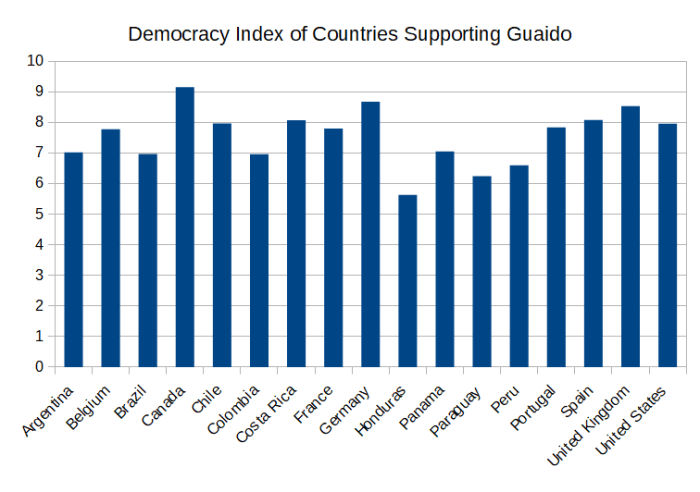
Here’s a bit of evidence that this is indeed what’s happening: the countries that support Guaido are a lot more democratic than the countries that support Maduro.

Guaido has already been recognized by most of Europe and Latin America, including Argentina, Brazil, Chile, Colombia, Costa Rica, Guatemala, Honduras, Panama, Paraguay, and Peru. Among those supporting Maduro are China, Russia, Iran, and Turkey—not exactly bastions of liberal democracy. Within Latin America, only Bolivia, Cuba, Mexico, and Uruguay support Maduro. Of those, only Mexico and Uruguay are recognizably democratic.

The average Democracy Index of countries that support Guaido is 7.5, which would be a “flawed democracy”. The average Democracy Index of countries that support Maduro is only 4.4, a “hybrid regime”.

Here is a plot of the Democracy Index by country supporting Guaido:democracy_index_guaido

Here is a plot of the Democracy Index by country supporting Maduro:

democracy_index_maduro

Since the entire EU recognizes Guaido, I could have shown each European country separately and biased the numbers even further, but I decided to specifically stick to major European powers with explicitly stated positions on Venezuela.

And we know that Maduro was a ruthless and autocratic dictator. So this is looking an awful lot like a democratic uprising against authoritarianism. It’s hard for me to be upset about that.

Second, Venezuela was in terrible shape, and largely due to Maduro’s administration.

After Maduro was elected (we’re still not sure how legitimate that election really was), Maduro underwent a total economic meltdown. Depression, hyperinflation, famine, a resurgence of malaria, and a huge exodus of refugees all followed. Millions of people are now starving in a country that was once quite rich. Nearly 90% of the population now lives in poverty. The story of Venezuela’s economy is one of total self-destruction.

Due to the bizarre system of subsidies and price controls in place, oil is now 100 times cheaper in Venezuela than water. Venezuela’s oil production has plummeted under Maduroto its lowest levels in decades, which might be good for climate change but is very bad for a country so dependent upon oil export revenue. It’s pretty much a classic cautionary tale for the Resource Curse.

Maduro, like any good socialist dictator, has blamed US sanctions for all his country’s economic failings. But there have not been strict US sanctions against Venezuela, and we remain their chief purchaser of oil by a wide margin. If you’ve ever bought gasoline at a Citgo station, you have paid for Venezuelan oil. Moreover, if your socialist country is that heavily dependent on exporting to capitalist countries… that really doesn’t say much in favor of socialism as an economic system, does it?

I don’t know what will happen. Maybe Maduro will successfully regain power. Maybe Guaido will retain control but turn out to be just as bad (there’s a long track record of coups against awful dictators resulting in equally awful dictators—Idi Amin is a classic example). Maybe Trump will do something stupid or crazy and we’ll end up in yet another decades-long military quagmire.

But there’s also a chance of something much better: Maybe Guaido can actually maintain power and build a genuinely democratic regime in Venezuela, and turn their economy back from the brink of devastation toward more sustainable growth. When the devil you know is this bad, sometimes you really do want to bet on the devil you don’t.

I don’t care what happened in that video

Jan 27 JDN 2458511

Right now there is an ongoing controversy over a viral video of a confrontation between young protesters wearing MAGA hats and an elderly Native American man. Various sources are purporting to show “a fuller picture” and “casting new light” and showing “a different side”. Others are saying it’s exactly as bad as it looks.

I think it probably is as bad as it looks, but the truth is: I don’t care. This is a distraction.

If you think litigating the precise events of this video is important, you are suffering from a severe case of scope neglect. You are looking at a single event between a handful of people when you should be looking at the overall trends of a country of over 300 million people.

First of all: The government shutdown only just ended. There are still going to be a lot of pieces to pick up. That’s what we should be talking about. That’s what we should be posting about. That’s what we should be calling Senators about. This is a national emergency. The longer this lasts, the worse it is going to get. People will die because of this shutdown—from tainted food and polluted water and denied food stamps. Our national security is being jeopardized—particularly with regard to cybersecurity.

The shutdown was also a completely unforced error. Government shutdowns shouldn’t even exist, and now that this one is over, we need to change the budget process so that this can never happen again.

And if you want to talk about the racist, sexist, and authoritarian leanings of Trump supporters, that’s quite important too. But it doesn’t hinge upon one person or one confrontation. I’m sure there are Trump supporters who aren’t racist; and I’m sure there are Obama supporters who are. But the overall statistical trend there is extremely strong.

I understand that most people suffer from severe scope neglect, and we have to live in a world filled with such people; so maybe there’s some symbolic value in finding one particularly egregious case that you can put a face on and share with the world. But if you’re going to do that, there’s two things I’d ask of you:

1. Make absolutely sure that this case is genuine. Nothing will destroy your persuasiveness faster than holding up an ambiguous case as if it were definitive.
2. After you’ve gotten their attention with the single example, show the statistics. There are truths, whole truths, and statistics. If you really want to know something, you use statistics.

The statistics are what this is really about. One person, even a hundred people—that really doesn’t matter. We need to keep our eyes on the millions of people, the directions of entire nations. For a lot of people, looking at numbers is boring; but there are people behind those numbers, and numbers are what tell us what’s really going on in the world.

For example: Trump really does seem to have brought bigotry out in the open. Hate crimes in the US increased for the third year in a row last year.

Then there are his direct policy actions which are human rights violations: The number of children detained at the border has skyrocketed to almost 13,000.

On the other hand, the economy is doing quite well: Unemployment stands at about 4%, and median income is increasing and poverty is decreasing.
Global extreme poverty continues its preciptious decline, but global climate change is getting worse, and already past the point where some serious consequences are going to be unavoidable.

Some indicators are more ambiguous: Corporate profits are near their all-time high, even in inflation-adjusted terms. That could be a sign of an overall good economy—but it also clearly has something to do with redistribution of income toward the wealthy.

Of course, all of those things were true yesterday, and will be true tomorrow. They were true last week, and will be true next week. They don’t lend themselves to a rapid-fire news cycle.

But maybe that means we don’t need a rapid-fire news cycle? Maybe that’s not the best way to understand what’s going on in the world?

Sexism in the economics profession

Jan 20 JDN 2458504

I mentioned in my previous post that the economics profession is currently coming to a reckoning with its own sexist biases. Today I’d like to get back to that in more detail.

I think I should include some kind of trigger warning here, because some of this sexism is pretty extreme. In particular, there are going to be references to anal sex, which certainly isn’t something I was expecting to find. I won’t quote anything highly explicit—but I assure you, it exists.

There is reason to believe that these biases are not as bad as they once were. If you compare the cohorts of new economics PhDs to those of the past, or to the professors who have been tenured for many years, the pattern is quite clear: The longer back you look, the fewer women (and racial minorities, and LGBT people) you see.

In part because of the #MeToo movement (which, I really would like to say, has done an excellent job of picking legitimate targets and not publicly shaming the wrong people, unlike almost every other attempt at public shaming via social media), the economics profession is also coming to terms with a related matter, which could be both cause and consequence of these gender disparities: Sexual harassment by economists of their students and junior faculty.

It wasn’t until last year that the AEA officially adopted a Code of Professional Conduct mandating equality of opportunity for women (and minorities, and LGBT people). Of course, sexual harassment has been illegal much longer than that—but it’s probably the most under-reported and under-prosecuted crime in existence. Last year’s AEA conference was the first to include panels specifically on gender and discrimination in economics, and this year’s conference had more.

Grad students have been a big part of this push; hundreds of econ grad students signed an open letter demanding that universities implement reporting and disciplinary systems to deal with sexual harassment in economics (one of the signatories is friend of mine from UCI, though strangely I don’t remember hearing about it, or I would have signed it too).

One of the most prominent economists accused of repeated sexual harassment unfortunately happens to be the youngest Black person ever to get tenured at Harvard. This would seem to create some tension between gender equality and racial equality. But of course this tension is illusory: There are plenty of other brilliant Black economists they could have hired who aren’t serial sexual harassers.

It’s still dicey for grad students and junior faculty to talk about these things, because of the very real power that senior faculty have over us as committees for dissertations, hiring, and tenure. Some economists who wrote papers about sexism in the profession have chosen to remain anonymous for fear of retaliation.

Part of how this issue has finally gotten so much attention is by concerned economists actually showing it using the methods of social science. One of the most striking studies was a data analysis of the word usage on econjobrumors.com, a job discussion board for PhD grads and junior faculty in economics. (More detail on that study here and also here.)

I’ve bolded the terms that are sexual or suggest bias. I’ve italicized the terms that suggest something involving romantic or family relationships. I’ve underlined the terms actually relevant for economics.
These were the terms most commonly associated with women:

hotter, lesbian, bb, sexism, tits, anal, marrying, feminazi, slut, hot, vagina, boobs, pregnant, pregnancy, cute, marry, levy, gorgeous, horny, crush, beautiful, secretary, dump, shopping, date, nonprofit, intentions, sexy, dated and prostitute.

These were the terms most commonly associated with men:

juicy, keys, adviser, bully, prepare, fought, wharton, austrian, fieckers, homo, genes, e7ee, mathematician, advisor, burning, pricing, fully, band, kfc, nobel, cat, amusing, greatest, textbook, goals, irritate, roof, pointing, episode, and tries.

I imagine the two lists more or less speak for themselves. I’m particularly shocked by the high prevalence of the word “anal”—the sixth-most common word used in threads involving women.

Who goes to an economics job forum and starts talking about anal sex?

I actually did a search on “anal” to see what sort of things were being discussed: This thread is apparently someone trying to decide where he should work based on “Girls of which country are easiest to get?”, so basically sex tourism as job market planning. Here’s another asking (perhaps legitimately) about the appropriate social norm for splitting vacation costs with a girlfriend, and someone down the thread recommends that in exchange for paying, he should expect her to provide him with anal sex. This one starts with a man lamenting that his girlfriend dumped him on his birthday (that’s a dick move by the way), but somehow veers off into a discussion of whether anal sex is overrated. And this one is just off the bat about frequency of sexual encounters.
So yeah, I’m really not surprised that there aren’t a lot of women on these so-called “job discussion boards”.

The only bias-related word associated with men was “homo”—so it’s actually a homophobic bias, itself indicative of sexism and a profession dominated by cisgender straight White men. I’m not entirely sure that “juicy” was intended to be sexualized (one could also speak of “juicy ideas”), but I’ll assume it was just to conservatively estimate the gender disparity.

Also of special note are “fieckers” and “e7ee”, which refer to specific users, who, despite being presumably economists, caused a great deal of damage to the discussion boards. “fieckers” was an idiosyncratic word that one user used in a variety of sexist and homophobic troll posts, while “e7ee” is the hexadecimal code for one of the former moderators, who apparently uilaterally deleted and moved threads in order to tilt the entire discussion board toward right-wing laissez-faire economics.

Of course, that one discussion board isn’t representative of the entire profession. As anyone who has ever visited 4chan knows, discussion boards can be some of the darkest places on the Internet.

Clearer evidence of discrimination where it counts can be found in citation studies, which have found that papers published by women in top economics journals are more highly cited than papers published by men in the same journals.

What does that mean? Well, it’s the same reason that female stock brokers outperform male brokers and firms with more female executives are more profitable. Women are held to a higher standard than men, so in order to simply get in, women have to be more competent and produce higher-quality output.

Admittedly, citation count is far from a perfect measure of research quality (and for that matter profit is far from a perfect measure of a well-run corporation). But this is very clear evidence of actual discrimination. Not innate differences in preferences, not differences in talent—actual discrimination. It’s less clear where and how the discrimination is happening. Are journals simply not accepting good papers if they see female authors? (This is possible, because most top journals in economics don’t use double-blind peer review anymore—for quite flimsy reasons, in my opinion). Are there not enough mentors for women in academia? Are women moving to more accepting fields before they even enter grad school? Are they being pushed out by harassment as grad students? Likely all of these are part of the story.

There’s reason to think that economic ideology has contributed to this problem. If you think of the world in neoclassical laissez-faire terms, where markets are perfect and always lead to the best outcome, then you are likely to be blind to bias and discrimination, because a perfect market would obviously eliminate such things. This is why the recognition of bias has largely come from empirical studies of labor markets, and to a lesser extent from experiments and more left-wing theorists. If you assert that markets are perfectly efficient, labor economists are likely to laugh in your face, while a surprising number of macro theorists will nod and ask you to continue.

Interestingly, recent field experiments on bias in hiring of new faculty did not find any bias against women in economics (and found biases toward women in several other fields). Of course, that doesn’t mean there never was such bias; but perhaps we’ve actually managed to remove it. So that’s one major avenue of discrimination we maybe finally have under control. Only several dozen left to go?

The best thing we can do to help them is let them in


Dec 23 JDN 2458476

This is a Christmas post, but not like most of my other Christmas posts. It’s not going to be an upbeat post about the effects of holidays on the economy, or the psychology of gift-giving, or the game theory that underlies the whole concept of a “holiday”.

No, today is about an urgent moral crisis. This post isn’t about Christmas as a weird but delightful syncretic solstice celebration. This post is about the so-called “spirit of Christmas”, a spirit of compassion and generosity that our country is clearly not living up to.

At the time of writing, the story had just come out: Jakelin Maquin, a 7-year-old girl from Guatemala died in the custody of US border agents.

Even if it’s true that the Border Patrol did everything they could to help her once they found out she was dying (and the reports coming out suggest that this is in fact the case), this death was still entirely preventable.

The first question we should ask is very basic: Why are there little girls in custody of border agents?
The next question is even more fundamental than that: Why are there border agents?

There are now 15,000 children being held by US Border Patrol. There should not be even one. The very concept of imprisoning children for crossing the border, under any circumstances, is a human rights violation. And yes, this is new, and it is specific to Donald Trump: Bush and Obama never separated children from their families this way. And while two-thirds of Americans oppose this policy, a majority of Republicans support it—this child’s blood is on their hands too.

Yet despite the gulf between the two major parties, the majority of Americans do support the idea of restricting immigration in general. And what I want to know is: Why? What gives us that right?

Let’s be absolutely clear about what “restricting immigration” means. It means that when someone decides they want to come to our country, either to escape oppression, work toward a better life, or simply to live with their family who came here before, men with guns come and lock them up.

We don’t politely ask them to leave. We don’t even fine them or tax them for entering. We lock them in detention camps, or force them to return to the country they came from which may be ruled by a dictator or a drug cartel.

Honestly, even the level of border security US citizens are subjected to is appalling: We’ve somehow come to think of it as normal that whenever you get on an airplane, you are first run through a body scanner, while all your belongings are inspected and scanned, and if you are found carrying any contraband—or if you even say the wrong thing—you can be summarily detained. This is literally Orwellian. “Papers, please” is the refrain of a tyrannical regime, not a liberal democracy.

If we truly believe in the spirit of compassion and generosity, we must let these people in. We don’t even have to do anything; we just need to stop violently resisting them. Stop pointing guns at them, stop locking them away. How is “Stop pointing guns at children” controversial?

I could write an entire post about the benefits for Americans of more open immigration. But honestly, we shouldn’t even care. It doesn’t matter whether immigration creates jobs, or destroys jobs, or decreases crime, or increases crime. We should not be locking up children in camps.

If we really believe in the spirit of compassion and generosity, the only thing we should care about is whether immigration is good for the immigrants. And it obviously is, or they wouldn’t be willing to go to such lengths to accomplish it. But I don’t think most people realize just how large the benefits of immigration are.

I’m going to focus on Guatemala, because that’s where Jakelin Maqin was from.

Guatemala’s life expectancy at birth is 73 years. The life expectancy for recent Hispanic immigrants to the US is 82 years. Crossing that border can give you nine years of life.

And what about income? GDP per capita PPP in the US is almost $60,000 per year. In Guatemala? Just over $8,000. Of course, that’s not accounting for the fact that Guatemalans are less educated; but even the exact same worker emigrating from there to here can greatly increase their income. The minimum wage in Guatemala is 90 GTQ per day, which is about $11.64. For a typical 8-hour workday, the US minimum wage of $7.25 per hour comes to $58 per day. That same exact worker can quintuple their income just by getting a job on the other side of the border.

Almost 60 percent of Guatemalans live in poverty. Over 20% live below the UN extreme poverty line. A full 11% of Guatemala’s GDP is remittances: Money that immigrants pay to help their families back home. A further 7% is exports to the US. This means that almost a fifth of Guatemala’s economy is dependent on the United States.

For comparison, less than 0.5% of Americans live in extreme poverty. (The UN recently claimed almost 6%; the Trump administration has claimed only 0.1% which is even more dubious. Both methodologies are deeply flawed; in particular, the UN report looks at income, not consumption—and consumption is what matters.) The overall poverty rate in the US is about 12%.

These figures are still appallingly high for a country as rich as the US; our extreme poverty rate should be strictly zero, a policy decision which could be implemented immediately and permanently in the form of a basic income of $700 per person per year, at a total expenditure of only $224 billion per year—about a third of the military budget. The net cost would in fact be far smaller than that, because we’d immediately turn around and spend that money. In fact, had this been done at the trough of the Great Recession, it would almost certainly have saved the government money.

Making our overall poverty rate strictly zero would be more challenging, but not obviously infeasible; since the poverty line is about $12,000 per person per year, it would take a basic income of that much to eliminate poverty, which would cost about $3.8 trillion per year. This is a huge expenditure, comparable as a proportion of GDP to the First World War (though still less than the Second). On the other hand, it would end poverty in America immediately and forever.

But even as things currently stand, the contrast between Guatemala and the US could hardly be starker: Immigrants are moving from a country with 60% poverty and 20% extreme poverty to one with 12% poverty and 0.5% extreme poverty.

Guatemala is a particularly extreme example; things are not as bad in Mexico or Cuba, for example. But the general pattern is a very consistent one: Immigrants come to the United States because things are very bad where they come from and their chances of living a better life here are much higher.

The best way to help these people, at Christmas and all year round, literally couldn’t be easier:

Let them in.

The upsides of life extension

Dec 16 JDN 2458469

If living is good, then living longer is better.

This may seem rather obvious, but it’s something we often lose sight of when discussing the consequences of medical technology for extending life. It’s almost like it seems too obvious that living longer must be better, and so we go out of our way to find ways that it is actually worse.

Even from a quick search I was able to find half a dozen popular media articles about life extension, and not one of them focused primarily on the benefits. The empirical literature is better, asking specific, empirically testable questions like “How does life expectancy relate to retirement age?” and “How is lifespan related to population and income growth?” and “What effect will longer lifespans have on pension systems?” Though even there I found essays in medical journals complaining that we have extended “quantity” of life without “quality” (yet by definition, if you are using QALY to assess the cost-effectiveness of a medical intervention, that’s already taken into account).

But still I think somewhere along the way we have forgotten just how good this is. We may not even be able to imagine the benefits of extending people’s lives to 200 or 500 or 1000 years.

To really get some perspective on this, I want you to imagine what a similar conversation must have looked like in roughly the year 1800, the Industrial Revolution, when industrial capitalism came along and made babies finally stop dying.

There was no mass media back then (not enough literacy), but imagine what it would have been like if there had been, or imagine what conversations about the future between elites must have been like.

And we do actually have at least one example of an elite author lamenting the increase in lifespan: His name was Thomas Malthus.

The Malthusian argument was seductive then, and it remains seductive today: If you improve medicine and food production, you will increase population. But if you increase population, you will eventually outstrip those gains in medicine and food and return once more to disease and starvation, only now with more mouths to feed.

Basically any modern discussion of “overpopulation” has this same flavor (by the way, serious environmentalists don’t use that concept; they’re focused on reducing pollution and carbon emissions, not people). Why bother helping poor countries, when they’re just going to double their population and need twice the help?

Well, as a matter of fact, Malthus was wrong. In fact, he was not just wrong: He was backwards. Increased population has come with increased standard of living around the world, as it allowed for more trade, greater specialization, and the application of economies of scale. You can’t build a retail market with a hunter-gatherer tribe. You can’t built an auto industry with a single city-state. You can’t build a space program with a population of 1 million. Having more people has allowed each person to do and have more than they could before.

Current population projections suggest world population will stabilize between 11 and 12 billion. Crucially, this does not factor in any kind of radical life extension technology. The projections allow for moderate increases in lifespan, but not people living much past 100.

Would increased lifespan lead to increased population? Probably, yes. I can’t be certain, because I can very easily imagine people deciding to put off having kids if they can reasonably expect to live 200 years and never become infertile.

I’m actually more worried about the unequal distribution of offspring: People who don’t believe in contraception will be able to have an awful lot of kids during that time, which could be bad for both the kids and society as a whole. We may need to impose regulations on reproduction similar to (but hopefully less draconian than) the One-Child policy imposed in China.

I think the most sensible way to impose the right incentives while still preserving civil liberties is to make it a tax: The first kid gets a subsidy, to help care for them. The second kid is revenue-neutral; we tax you but you get it back as benefits for the child. (Why not just let them keep the money? One of the few places where I think government paternalism is justifiable is protection against abusive or neglectful parents.) The third and later kids result in progressively higher taxes. We always feed the kids on government money, but their parents are going to end up quite poor if they don’t learn how to use contraceptives. (And of course, contraceptives will be made available for free without a prescription.)

But suppose that, yes, population does greatly increase as a result of longer lifespans. This is not a doomsday scenario. In fact, in itself, this is a good thing. If life is worth living, more lives are better.

The question becomes how we ensure that all these people live good lives; but technology will make that easier too. There seems to be an underlying assumption that increased lifespan won’t come with improved health and vitality; but this is already not true. 60 is the new 50: People who are 60 years old today live as well as people who were 50 years old just a generation ago.

And in fact, radical life extension will be an entirely different mechanism. We’re not talking about replacing a hip here, a kidney there; we’re talking about replenishing your chromosomal telomeres, repairing your cells at the molecular level, and revitalizing the content of your blood. The goal of life extension technology isn’t to make you technically alive but hooked up to machines for 200 years; it’s to make you young again for 200 years. The goal is a world where centenarians are playing tennis with young adults fresh out of college and you have trouble telling which is which.

There is another inequality concern here as well, which is cost. Especially in the US—actually almost only in the US, since most of the world has socialized medicine—where medicine is privatized and depends on your personal budget, I can easily imagine a world where the rich live to 200 and the poor die at 60. (The forgettable Justin Timberlake film In Time started with this excellent premise and then went precisely nowhere with it. Oddly, the Deus Ex games seem to have considered every consequence of mixing capitalism with human augmentation except this one.) We should be proactively taking steps to prevent this nightmare scenario by focusing on making healthcare provision equitable and universal. Even if this slows down the development of the technology a little bit, it’ll be worth it to make sure that when it does arrive, it will arrive for everyone.

We really don’t know what the world will look like when people can live 200 years or more. Yes, there will be challenges that come from the transition; honestly I’m most worried about keeping alive ideas that people grew up with two centuries prior. Imagine talking politics with Abraham Lincoln: He was viewed as extremely progressive for his time, even radical—but he was still a big-time racist.

The good news there is that people are not actually as set in their ways as many believe: While the huge surge in pro-LGBT attitudes did come from younger generations, support for LGBT rights has been gradually creeping up among older generations too. Perhaps if Abraham Lincoln had lived through the Great Depression, the World Wars, and the Civil Rights Movement he’d be a very different person than he was in 1865. Longer lifespans will mean people live through more social change; that’s something we’re going to need to cope with.

And of course violent death becomes even more terrifying when aging is out of the picture: It’s tragic enough when a 20-year-old dies in a car accident today and we imagine the 60 years they lost—but what if it was 180 years or 480 years instead? But violent death in basically all its forms is declining around the world.

But again, I really want to emphasize this: Think about how good this is. Imagine meeting your great-grandmother—and not just meeting her, not just having some fleeting contact you half-remember from when you were four years old or something, but getting to know her, talking with her as an adult, going to the same movies, reading the same books. Imagine the converse: Knowing your great-grandchildren, watching them grow up and have kids of their own, your great-great-grandchildren. Imagine the world that we could build if people stopped dying all the time.

And if that doesn’t convince you, I highly recommend Nick Bostrom’s “Fable of the Dragon-Tyrant”.

Stop making excuses for the dragon.

Fighting the zero-sum paradigm

Dec 2 JDN 2458455

It should be obvious at this point that there are deep, perhaps even fundamental, divides between the attitudes and beliefs of different political factions. It can be very difficult to even understand, much less sympathize, with the concerns of people who are racist, misogynistic, homophobic, xenophobic, and authoritarian.
But at the end of the day we still have to live in the same country as these people, so we’d better try to understand how they think. And maybe, just maybe, that understanding will help us to change them.

There is one fundamental belief system that I believe underlies almost all forms of extremism. Right now right-wing extremism is the major threat to global democracy, but left-wing extremism subscribes to the same core paradigm (consistent with Horseshoe Theory).

I think the best term for this is the zero-sum paradigm. The idea is quite simple: There is a certain amount of valuable “stuff” (money, goods, land, status, happiness) in the world, and the only political question is who gets how much.

Thus, any improvement in anyone’s life must, necessarily, come at someone else’s expense. If I become richer, you become poorer. If I become stronger, you become weaker. Any improvement in my standard of living is a threat to your status.

If this belief were true, it would justify, or at least rationalize, all sorts of destructive behavior: Any harm I can inflict upon someone else will yield a benefit for me, by some fundamental conservation law of the universe.

Viewed in this light, beliefs like patriarchy and White supremacy suddenly become much more comprehensible: Why would you want to spend so much effort hurting women and Black people? Because, by the fundamental law of zero-sum, any harm to women is a benefit to men, and any harm to Black people is a benefit to White people. The world is made of “teams”, and you are fighting for your own against all the others.

And I can even see why such an attitude is seductive: It’s simple and easy to understand. And there are many circumstances where it can be approximately true.
When you are bargaining with your boss over a wage, one dollar more for you is one dollar less for your boss.
When your factory outsources production to China, one more job for China is one less job for you.

When we vote for President, one more vote for the Democrats is one less vote for the Republicans.

But of course the world is not actually zero-sum. Both you and your boss would be worse off if your job were to disappear; they need your work and you need their money. For every job that is outsourced to China, another job is created in the United States. And democracy itself is such a profound public good that it basically overwhelms all others.

In fact, it is precisely when a system is running well that the zero-sum paradigm becomes closest to true. In the space of all possible allocations, it is the efficient ones that behave in something like a zero-sum way, because when the system is efficient, we are already producing as much as we can.

This may be part of why populist extremism always seems to assert itself during periods of global prosperity, as in the 1920s and today: It is precisely when the world is running at its full capacity that it feels most like someone else’s gain must come at your loss.

Yet if we live according to the zero-sum paradigm, we will rapidly destroy the prosperity that made that paradigm seem plausible. A trade war between the US and China would put millions out of work in both countries. A real war with conventional weapons would kill millions. A nuclear war would kill billions.

This is what we must convey: We must show people just how good things are right now.

This is not an easy task; when people want to believe the world is falling apart, they can very easily find excuses to do so. You can point to the statistics showing a global decline in homicide, but one dramatic shooting on the TV news will wipe that all away. You can show the worldwide rise in real incomes across the board, but that won’t console someone who just lost their job and blames outsourcing or immigrants.

Indeed, many people will be offended by the attempt—the mere suggestion that the world is actually in very good shape and overall getting better will be perceived as an attempt to deny or dismiss the problems and injustices that still exist.

I encounter this especially from the left: Simply pointing out the objective fact that the wealth gap between White and Black households is slowly closing is often taken as a claim that racism no longer exists or doesn’t matter. Congratulating the meteoric rise in women’s empowerment around the world is often paradoxically viewed as dismissing feminism instead of lauding it.

I think the best case against progress can be made with regard to global climate change: Carbon emissions are not falling nearly fast enough, and the world is getting closer to the brink of truly catastrophic ecological damage. Yet even here the zero-sum paradigm is clearly holding us back; workers in fossil-fuel industries think that the only way to reduce carbon emissions is to make their families suffer, but that’s simply not true. We can make them better off too.

Talking about injustice feels righteous. Talking about progress doesn’t. Yet I think what the world needs most right now—the one thing that might actually pull us back from the brink of fascism or even war—is people talking about progress.

If people think that the world is full of failure and suffering and injustice, they will want to tear down the whole system and start over with something else. In a world that is largely democratic, that very likely means switching to authoritarianism. If people think that this is as bad as it gets, they will be willing to accept or even instigate violence in order to change to almost anything else.

But if people realize that in fact the world is full of success and prosperity and progress, that things are right now quite literally better in almost every way for almost every person in almost every country than they were a hundred—or even fifty—years ago, they will not be so eager to tear the system down and start anew. Centrism is often mocked (partly because it is confused with false equivalence), but in a world where life is improving this quickly for this many people, “stay the course” sounds awfully attractive to me.
That doesn’t mean we should ignore the real problems and injustices that still exist, of course. There is still a great deal of progress left to be made.  But I believe we are more likely to make progress if we acknowledge and seek to continue the progress we have already made, than if we allow ourselves to fall into despair as if that progress did not exist.

How much should we give?

Nov 4 JDN 2458427

How much should we give of ourselves to others?

I’ve previously struggled with this basic question when it comes to donating money; I have written multiple posts on it now, some philosophical, some empirical, and some purely mathematical.

But the question is broader than this: We don’t simply give money. We also give effort. We also give emotion. Above all, we also give time. How much should we be volunteering? How many protest marches should we join? How many Senators should we call?

It’s easy to convince yourself that you aren’t doing enough. You can always point to some hour when you weren’t doing anything particularly important, and think about all the millions of lives that hang in the balance on issues like poverty and climate change, and then feel a wave of guilt for spending that hour watching Netflix or playing video games instead of doing one more march. This, however, is clearly unhealthy: You won’t actually make yourself into a more effective activist, you’ll just destroy yourself psychologically and become no use to anybody.

I previously argued for a sort of Kantian notion that we should commit to giving our fair share, defined as the amount we would have to give if everyone gave that amount. This is quite appealing, and if I can indeed get anyone to donate 1% of their income as a result, I will be quite glad. (If I can get 100 people to do so, that’s better than I could ever have done myself—a good example of highly cost-effective slacktivism.)

Lately I have come to believe that this is probably inadequate. We know that not everyone will take this advice, which means that by construction it won’t be good enough to actually solve global problems.

This means I must make a slightly greater demand: Define your fair share as the amount you would have to give if everyone among people who are likely to give gave that amount.

Unfortunately, this question is considerably harder. It may not even have a unique answer. The number of people willing to give an amount n is obviously dependent upon the amount x itself, and we are nowhere close to knowing what that function n(x) looks like.

So let me instead put some mathematical constraints on it, by choosing an elasticity. Instead of an elasticity of demand or elasticity of supply, we could call this an elasticity of contribution.

Presumably the elasticity is negative: The more you ask of people, the fewer people you’ll get to contribute.

Suppose that the elasticity is something like -0.5, where contribution is relatively inelastic. This means that if you increase the amount you ask for by 2%, you’ll only decrease the number of contributors by 1%. In that case, you should be like Peter Singer and ask for everything. At that point, you’re basically counting on Bill Gates to save us, because nobody else is giving anything. The total amount contributed n(x) * x is increasing in x.

On the other hand, suppose that elasticity is something like 2, where contribution is relatively elastic. This means that if you increase the amount you ask for by 2%, you will decrease the number of contributors by 4%. In that case, you should ask for very little. You’re asking everyone in the world to give 1% of their income, as I did earlier. The total amount contributed n(x) * x is now decreasing in x.

But there is also a third option: What if the elasticity is exactly -1, unit elastic? Then if you increase the amount you ask for by 2%, you’ll decrease the number of contributors by 2%. Then it doesn’t matter how much you ask for: The total amount contributed n(x) * x is constant.

Of course, there’s no guarantee that the elasticity is constant over all possible choices of x—indeed, it would be quite surprising if it were. A quite likely scenario is that contribution is inelastic for small amounts, then passes through a regime where it is nearly unit elastic, and finally it becomes elastic as you start asking for really large amounts of money.

The simplest way to model that is to just assume that n(x) is linear in x, something like n = N – k x.

There is a parameter N that sets the maximum number of people who will ever donate, and a parameter k that sets how rapidly the number of contributors drops off as the amount asked for increases.

The first-order condition for maximizing n(x) * x is then quite simple: x = N/(2k)

This actually turns out to be the precisely the point at which the elasticity of contribution is -1.

The total amount you can get under that condition is N2/(4k)

Of course, I have no idea what N and k are in real life, so this isn’t terribly helpful. But what I really want to know is whether we should be asking for more money from each person, or asking for less money and trying to get more people on board.

In real life we can sometimes do both: Ask each person to give more than they are presently giving, whatever they are presently giving. (Just be sure to run your slogans by a diverse committee, so you don’t end up with “I’ve upped my standards. Now, up yours!”) But since we’re trying to find a benchmark level to demand of ourselves, let’s ignore that for now.

About 25% of American adults volunteer some of their time, averaging 140 hours of volunteer work per year. This is about 1.6% of all the hours in a year, or 2.4% of all waking hours. Total monetary contributions in the US reached $400 billion for the first time this year; this is about 2.0% of GDP. So the balance between volunteer hours and donations is actually pretty even. It would probably be better to tilt it a bit more toward donations, but it’s really not bad. About 60% of US households made some sort of charitable contribution, though only half of these received the charitable tax deduction.

This suggests to me that the quantity of people who give is probably about as high as it’s going to get—and therefore we need to start talking more about the amount of money. We may be in the inelastic regime, where the way to increase total contributions is to demand more from each individual.

Our goal is to increase the total contribution to poverty eradication by about 1% of GDP in both the US and Europe. So if 60% of people give, and currently total contributions are about 2.0% of GDP, this means that the average contribution is about 3.3% of the contributor’s gross income. Therefore I should tell them to donate 4.3%, right? Not quite; some of them might drop out entirely, and the rest will have to give more to compensate.
Without knowing the exact form of the function n(x), I can’t say precisely what the optimal value is. But it is most likely somewhat larger than 4.3%; 5% would be a nice round number in the right general range. This would raise contributions in the US to 2.6% of GDP, or about $500 billion. That’s a 20% increase over the current level, which is large, but feasible.

Accomplishing a similar increase in Europe would then give us a total of $200 billion per year in additional funds to fight global poverty; this might not quite be enough to end world hunger (depending on which estimate you use), but it would definitely have a large impact.

I asked you before to give 1%. I am afraid I must now ask for more. Set a target of 5%. You don’t have to reach it this year; you can gradually increase your donations each year for several years (I call this “Save More Lives Tomorrow”, after Thaler’s highly successful program “Save More Tomorrow”). This is in some sense more than your fair share; I’m relying on the assumption that half the population won’t actually give anything. But ultimately this isn’t about what’s fair to us. It’s about solving global problems.

How to respond to dog whistles

Oct 21 JDN 2458413

Political messaging has grown extremely sophisticated. The dog whistle technique is particularly powerful one: it allows you to say the same thing to two different groups and have them each hear what they wanted to hear. The term comes from the gadget used in training canines, which emits sounds at a frequency which humans can’t hear but dogs can. Similar concepts have been around for a long time, but the word wasn’t used for this specific meaning until the 1990s.

There was once a time when politicians could literally say different things to different groups, but mass media has made that effectively impossible. When Mitt Romney tried to do this, it destroyed his (already weak) campaign. So instead they find ways to convey two different meanings, while saying the same words.

Classic examples of this include “law and order” and “states’ rights”, which have always carried hidden racist connotations, yet on their face sound perfectly reasonable. “Family values” is another one.

Trump is particularly inelegant at this; his dog whistles often seem to drop into the audible frequency range, as when he called undocumented immigrants (or possibly gang members?) “animals” and tweeted about “caravans” of immigrants, and above all when he said “they’re bringing drugs, they’re bringing crime, they’re rapists”. (Frankly, does that even count as a dog whistle?) He’s a little less obvious in his deployment of “globalist” as a probable anti-Semitic slur.

How should we respond to this kind of coded language?

It’s not as simple as you might think. It’s not always easy to tell what is a dog whistle. Someone talking about crime could be trying to insinuate something about minorities… or, they could just be talking about crime. Someone complaining about immigration could be trying to dehumanize immigrants… or, they could just want a change in our border policy. Accusations of “globalism” could be coded anti-Semitism… or they could just be nationalism.
It’s also easy to accuse someone of using dog whistles even if they probably aren’t: It is now commonplace for the right wing to argue that “common-sense gun control” means confiscating all handguns (when it in fact means universal background checks, mandatory safety classes, and perhaps assault weapon bans and magazine limits, all of which are quite popular even among gun owners), or to argue that “safe, legal, and rare” is just a Trojan horse for unrestricted free abortion (when in fact “safe, legal, and rare” is the overwhelming majority view among Americans). Indeed, it’s quite probable that many of the things that the left wing has taken as dog whistles by Trump were actually overreactions—Trump is bigoted, but not especially so by the standards of old White Republican men. The best reasons to want Trump out of office involve his authoritarianism, his corruption, and his incompetence, not his bigotry. Foreign policy and climate change should be issues that overwhelm basically everything else—these are millions of lives on the line—and they are the two issues that Trump gets most decisively wrong.

The fact that it can be difficult to tell which statements are dog-whistles is not a bug but a feature: It provides plausible deniability.

If you can structure your speech so that it will be heard by your base as supporting a strong ideological platform, but when the words are analyzed they will be innocuous enough that no one can directly prove your extremism, you can have your cake and eat it too. Even if journalists go on to point out the dog whistles in your speech, moderates on your side of the fence might not hear the same dog whistles, and then just become convinced that the journalists are overreacting. And they might even be overreacting.

Instead, I think there are two things we need to do, which are distinct but complementary.’

1. Ask for clarification.

Whether you are in a personal conversation with a friend who is spouting talking points, or a journalist interviewing a politician running for office, there will come opportunities where you can directly respond to a potential dog whistle.
Do not accuse them of using a dog whistle—even if you are confident that they are. That will only make them defensive, and make you appear to be the aggressor. Instead, ask them firmly, but calmly:

What exactly do you mean by that statement?”

If they ignore the question or try to evade it, ask again, a little more firmly. If they evade again, ask again. Keep asking until they answer you or literally force you to shut up. Be confident, but calm and poised. Now they look like the aggressor—and above all, they sound like they have something to hide.

Note also that if it turns out not to be a dog whistle, they will likely not be offended by your request and will have a perfectly reasonable clarification. For example:

“What did you mean when you said you’re worried about Muslim immigrants?”

“Well, I mean that Muslim societies often have very regressive norms surrounding gender and LGBT rights, and many Muslim immigrants have difficulty assimilating into our liberal values. I think we need to spend more effort finding ways to integrate Muslims into our community and disabuse them of harmful cultural norms.”

“What did you mean when you said you are worried about law and order?”

“I mean that gang violence in several of our inner cities is really out of control, and we need to be working on both investing more in policing and finding better methods of crime prevention in order to keep these communities safe.”

“What ‘states’ rights’ are you particularly concerned about, Senator?”

“I don’t like that the federal government thinks it can impose laws against marijuana based on an absurdly broad reading of the Interstate Commerce Clause. I don’t think it’s right that legitimate businesses in California and Colorado have to operate entirely in cash because federal regulations won’t let them put their money into banks without fear of having it confiscated.”

You may even find that you still disagree with the clarified statement, but hopefully it can be a reasonable disagreement, rather than a direct conflict over fundamental values.

2. State your own positive case.

This is one you can probably do even if you don’t actually get the opportunity to engage directly with people on the other side.

I was actually surprised to learn this, but apparently the empirical data shows that including messages of social justice in your political platform makes it more popular, even among moderates.
This means that we don’t have to respond to innuendo with innuendo—we can come out and say that we think a given policy is bad because it will hurt women or Black people. Economic populism is good too, but we don’t need to rely entirely upon that.

To be clear, we should not say that the policy is designed to hurt women or Black people—even if we think that is likely to be true—for at least two reasons: First, we can’t actually prove that, except in very rare cases, so it makes our argument inherently more tendentious; and second, it makes our whole mode of argumentation more aggressive and less charitable. We should always at least consider the possibility that our opponent’s intentions are noble, and unless the facts utterly force us to abandon that view it should probably be our working assumption.

This means that we don’t even necessarily have to come out and challenge dog whistles. We just need to make a better positive case ourselves. While they are making vague, ambiguous claims about “cleaning up our cities” and “making America great”, we can lay out explicit policy plans for reducing unemployment, poverty, and carbon emissions.

Hillary Clinton almost did this—but she didn’t do it well enough. She relied too heavily on constituents being willing to read detailed plans on her website, instead of summarizing them in concise, pithy talking points to put in headlines. Her line Because we’re going to put a lot of coal miners and coal companies out of business, right?” was indeed taken out of contextbut she should have pushed harder by making an actual slogan, like “End coal burning—save coal communities.” (I literally came up with that in five minutes. She had hundreds of professional campaign staff working for her and they couldn’t do better?) The media did butcher her statements—but she didn’t correct them by putting slogans on yard signs or giving stump speeches in Appalachia.

Indeed, the news media didn’t do her any favors—they spent literally more time talking about her emails than every actual policy issued combined, and not by a small margin. But we can’t rely on the news media—and we don’t have to, in the age of blogs and social media. Instead of assuming that everyone already agrees with us and we will win because we deserve to, we need to be doing what actually works at conveying our message and making sure that we win by the largest margin possible.

If you really want grad students to have better mental health, remove all the high-stakes checkpoints

Post 260: Oct 14 JDN 2458406

A study was recently published in Nature Biotechnology showing clear evidence of a mental health crisis among graduate students (no, I don’t know why they picked the biotechnology imprint—I guess it wasn’t good enough for Nature proper?). This is only the most recent of several studies showing exceptionally high rates of mental health issues among graduate students.

I’ve seen universities do a lot of public hand-wringing and lip service about this issue—but I haven’t seen any that were seriously willing to do what it takes to actually solve the problem.

I think this fact became clearest to me when I was required to fill out an official “Individual Development Plan” form as a prerequisite for my advancement to candidacy, which included one question about “What are you doing to support your own mental health and work/life balance?”

The irony here is absolutely excruciating, because advancement to candidacy has been overwhelmingly my leading source of mental health stress for at least the last six months. And it is only one of several different high-stakes checkpoints that grad students are expected to complete, always threatened with defunding or outright expulsion from the graduate program if the checkpoint is not met by a certain arbitrary deadline.

The first of these was the qualifying exams. Then comes advancement to candidacy. Then I have to complete and defend a second-year paper, then a third-year paper. Finally I have to complete and defend a dissertation, and then go onto the job market and go through a gauntlet of applications and interviews. I can’t think of any other time in my life when I was under this much academic and career pressure this consistently—even finishing high school and applying to college wasn’t like this.

If universities really wanted to improve my mental health, they would find a way to get rid of all that.

Granted, a single university does not have total control over all this: There are coordination problems between universities regarding qualifying exams, advancement, and dissertation requirements. One university that unilaterally tried to remove all these would rapidly lose prestige, as it would not be regarded as “rigorous” to reduce the pressure on your grad students. But that itself is precisely the problem—we have equated “rigor” with pressuring grad students until they are on the verge of emotional collapse. Universities don’t seem to know how to make graduate school difficult in the ways that would actually encourage excellence in research and teaching; they simply know how to make it difficult in ways that destroy their students psychologically.

The job market is even more complicated; in the current funding environment, it would be prohibitively expensive to open up enough faculty positions to actually accept even half of all graduating PhDs to tenure-track jobs. Probably the best answer here is to refocus graduate programs on supporting employment outside academia, recognizing both that PhD-level skills are valuable in many workplaces and that not every grad student really wants to become a professor.

But there are clearly ways that universities could mitigate these effects, and they don’t seem genuinely interested in doing so. They could remove the advancement exam, for example; you could simply advance to candidacy as a formality when your advisor decides you are ready, never needing to actually perform a high-stakes presentation before a committee—because what the hell does that accomplish anyway? Speaking of advisors, they could have a formalized matching process that starts with interviewing several different professors and being matched to the one that best fits your goals and interests, instead of expecting you to reach out on your own and hope for the best. They could have you write a dissertation, but not perform a “dissertation defense”—because, again, what can they possibly learn from forcing you to present in a high-stakes environment that they couldn’t have learned from reading your paper and talking with you about it over several months?

They could adjust or even remove funding deadlines—especially for international students. Here at UCI at least, once you are accepted to the program, you are ostensibly guaranteed funding for as long as you maintain reasonable academic progress—but then they define “reasonable progress” in such a way that you have to form an advancement committee, fill out forms, write a paper, and present before a committee all by a certain date or your funding is in jeopardy. Residents of California (which includes all US students who successfully established residency after a full year) are given more time if we need it—but international students aren’t. How is that fair?

The unwillingness of universities to take such actions clearly shows that their commitment to improving students’ mental health is paper-thin. They are only willing to help their students improve their work-life balance as long as it doesn’t require changing anything about the graduate program. They will provide us with counseling services and free yoga classes, but they won’t seriously reduce the pressure they put on us at every step of the way.
I understand that universities are concerned about protecting their prestige, but I ask them this: Does this really improve the quality of your research or teaching output? Do you actually graduate better students by selecting only the ones who can survive being emotionally crushed? Do all these arbitrary high-stakes performances actually result in greater advancement of human knowledge?

Or is it perhaps that you yourselves were put through such hazing rituals years ago, and now your cognitive dissonance won’t let you admit that it was all for naught? “This must be worth doing, or else they wouldn’t have put me through so much suffering!” Are you trying to transfer your own psychological pain onto your students, lest you be forced to face it yourself?