How to hurt allies and alienate people

Aug 9 JDN 2459071

I’ve been wanting to write this post for awhile now, but I have been worried about the reaction I might get. Ultimately I realized that this is precisely why it needs to be written. Especially since Slate Star Codex is offline for the foreseeable future, there don’t see to be a lot of other people willing to write it.

The timing could be questioned, I suppose; when we are in the throes of a historic pandemic and brazen creeping authoritarianism, perhaps now should be the time for unconditional solidarity. But I fear that unconditional solidarity is one of the most dangerous forces in human existence: Politics is the mind-killer, arguments are soldiers, and the absolute unwillingness to question one’s own side is how we get everything from the Spanish Inquisition to Vladimir Lenin.

And since this is about not simply being mistaken but alienating allies, perhaps these desperate times are when we need the correction most: For we simply cannot afford to lose any allies right now.

“All men benefit from male violence.”

“It’s impossible to be racist against White people.”

“I hate White people.”

“Men are pigs.”

“All I want for Christmas is White genocide.”

Statements like these have two things in common: One, they are considered appropriate and acceptable to say by most of the social justice left; and two, they are harmful, alienating, and wrong.

All men benefit from male violence? You mean that male rape victims benefit from male violence? The thousands of men who are assaulted and murdered by other men—at far higher rates than women—benefit from that, do they? Did Matthew Shepard benefit from male violence?

It’s impossible to be racist against White people? Then tell me, what was it when a Black woman told me that melanin is the gateway to the soul and all White people are soulless snakes? Swap the colors, and it sounds like something only a diehard KKK member or neo-Nazi could say. If that’s not racism, what is?

The insistence that racism is “prejudice plus power” is a disingenuous redefinition of the concept precisely in an attempt to retroactively make it true that it’s impossible to be racist against White people. This is not what the word “racist” means to most people. But even if I were to allow that definition, do you think Black people never have power over White people? There are no Black managers who discriminate against their White employees, no Black teachers who abuse their White students? I’m not aware of Barack Obama discriminating against any White people, but can anyone deny that he had power? White people may have more power on average, but that doesn’t mean they have more power in every case.

What’s more, I don’t really understand what leftists think they are accomplishing by making this kind of assertion. Is it just an expression of rage, or a signal of your group identity? You’re clearly not going to convince any White person who has been discriminated against that White people never get discriminated against. You’re clearly not going to convince any man who has been brutally attacked by another man that all men benefit from male violence. It would be one thing to say that White people face less discrimination (clearly true) or that most White people don’t face discrimination (maybe true); but to say that no White people ever face discrimination is just obviously false, and will be disproved by many people’s direct experience.

Indeed, it seems quite obvious to me that this kind of talk is likely to frustrate and alienate many people who could otherwise have been allies.

The left has a counter-argument prepared for this: If you are alienated by what we say, then you were never a true ally in the first place.

The accusation seems to be that alienated allies are just fair-weather friends; but I don’t think someone is being a fair-weather friend if they stop wanting to be your friend because you abuse them. And make no mistake: Continually telling people that they are inferior and defective because of their race or gender or some other innate aspect of themselves absolutely constitutes abuse. Indeed, it’s nothing less than a mirror image of the very abuse that social justice is supposed to exist to prevent.

To be sure, there are cases where people claim to be alienated allies but were never really allies to begin with. Anyone who says “Wokeness made me a Nazi” obviously was far-right to begin with, and is just using that as an excuse. No amount of people saying “I hate White people” would justify becoming a Nazi or a KKK member. This isn’t them genuinely being alienated by the left being unfair; this is them saying “Look what you made me do” as they punch you in the face.

But I think the far more common scenario is more like this: “I want to support social justice, but every time I try to participate in leftist spaces, people attack me. They say that I’m defective because of who I am, and it hurts. They don’t seem interested in my input anyway, so I think I’ll just stay away from leftist spaces to preserve my own mental health.” These are people who broadly agree with social justice in principle, but just feel so frustrated and alienated by the movement in practice that they decide they are better off remaining on the sidelines.

Is it really so hard to understand how someone might feel that way? Why would anyone want to interact in a social space where most of the time is spent disparaging people like them? To stay in such a space, one either needs to have very strong moral convictions to sustain them against that onslaught, or needs to be masochistic or self-loathing.


Maybe it is self-loathing, actually: Liberal White people are the only group that systematically exhibits a negative in-group bias. The further left you are on the political spectrum, the more likely you are to suffer from mental illness, especially if you are male. I’ve seen some right-wing sources use this to claim that “liberalism is a mental illness”, but the far more sensible explanation is that the kind of collective guilt and self-hatred that the left inculcates in liberal White people is harmful to mental health. It may also be because concern about the injustice in the world makes your life generally harder, even though you are right to be concerned.

There really does seem to be a lot of pressure to confess and self-flagellate among White leftists. I think my favorite is the injunction to “Divest from Whiteness“; it’s beautiful because it’s utterly meaningless. If you really just meant “fight racial discrimination”, you could have said that. Better yet, you could have recommended some specific policy or belief to adopt. (“Defund the Police”, for all its flaws, is an infinitely superior slogan to “Divest from Whiteness”.) By saying it this way, you’re trying to bring in some notion that we are morally obliged to somehow stop being White—which is of course completely impossible. Frankly I think even if I got gene therapy to convert my body to a West African phenotype people would still say I was “really White”. Thus, Whiteness becomes Original Sin: A stain acquired at birth that can never be removed and must always be a source of guilt.

So let me say this in no uncertain terms:

It’s okay to be White.

It’s okay to be straight.

It’s okay to be male.

It’s wrong to be racist.

It’s wrong to be homophobic.

It’s wrong to be sexist.

No, it isn’t “covertly racist” to say that it’s okay to be White—and if you think it is, you are part of the problem here. People do not have control over what race they are born into. There is no moral failing in being a particular color, or in being descended from people who did terrible things. (And it’s not like only White people have ancestors who did terrible things!)

Yes, I know that there are White supremacist groups using the slogan “It’s okay to be White”, but you know what? Stopped Clock Principle. Reversed stupidity is not intelligence. Nazis believe many things that are wrong, but the mere fact that Nazis believe something doesn’t make it wrong. Nazis also generally believe in Darwinian evolution, and Adolf Hitler was a strict vegetarian.

I am not denying that privilege and oppression exist. But there is a clear and absolutely vital moral distinction between being a member of a group and oppressing people who are not in that group. Being White is not the same thing as being racist. Being straight is not the same thing as being homophobic. Being male is not the same thing as being sexist. Indeed, I would argue that being a member of the privileged category is not even necessary to participate in oppression—you can oppress people of your own group, or be in one underprivileged group and oppress someone in another group. Being privileged certainly makes it easier for you to support oppression and more likely that you’ll do so—but it is neither necessary nor sufficient.

Another common response is that this is just “tone policing“, that complaining about alienating rhetoric is just a way of shutting down dissent in general. No doubt this is sometimes true: One of the more effective ways of silencing someone’s argument is to convince people that it has been delivered in an overly aggressive or shrill way, thus discrediting the messenger. (This was basically the only major criticism ever leveled against New Atheism, for instance.)

But it clearly takes the notion too far to say that any kind of rhetoric is acceptable as long as it’s for the right cause. Insulting and denigrating people is never appropriate. Making people feel guilty for being born in the wrong group is never fair. Indeed, it’s not clear that one can even argue against tone policing without… tone policing. Sometimes your tone is actually inappropriate and harmful and you need to be criticized for it.

In fact, some of the people that harsh rhetoric is alienating may harbor real prejudices that need to be challenged. But they aren’t very likely to make the intense effort to challenge their own prejudices if every interaction they have with the social justice community is hostile. If we want to change someone’s mind, it helps a great deal to start by showing them compassion and respect.

I’m not saying that fighting for social justice is never going to upset people. Social change is always painful, and there are many cherished beliefs and institutions that will have to be removed in order to achieve lasting justice. So the mere fact that someone is frustrated or upset with you doesn’t necessarily mean you’ve done anything wrong. But you should at least consider that people might sometimes be upset with you for genuinely good reasons, that when they say your aggressive rhetoric is hurtful and alienating that might be because it’s actually true.

This is not just about selfishness

Aug 2 JDN 2459064

The Millennial term is “Karen”: someone (paradigmatically a middle-aged White woman) who is so privileged, so self-centered, and has such an extreme sense of entitlement, that they are willing to make others suffer in order to avoid the slightest inconvenience.

I recently saw a tweet (which for some reason has been impossible to find; I think I must have misremembered its precise wording, because putting that in quotes in Google yields nothing) saying that Americans are not simply selfish, we are so selfish that we would gladly let others die to avoid mildly inconveniencing ourselves. Searching Twitter for “Americans are selfish” certainly yields plenty of results.

And it is tempting to agree with this, when it seems that re-opening the economy and so many people refusing to wear masks has given us far worse outcomes from COVID-19 than most other countries.

But this can’t be the whole story. Perhaps Americans are a bit more self-centered than other cultures, because of our history of libertarian individualism. But if we were truly so selfish we’d gladly let others die to avoid inconvenience, whence the fact that we donate more to charity than any other country in the world? I don’t simply mean total amount or per-capita dollars (though both of those are also true); I mean as a fraction of GDP Americans give more to charity than any other country, and by a wide margin.

How then do we explain that so many Americans are not wearing masks?

Well, first of all, most of us are wearing masks. The narrative about people not wearing masks has been exaggerated; the majority of Americans, including the majority of Republicans, agree that wearing masks is a matter of public health rather than personal choice. There are some people who refuse to wear masks, and each one adds a little bit more risk to us all; but it’s really not the case that Americans in general are refusing to wear masks.

But I think the most important failings here come from the top down. The Trump administration has handled the pandemic in an astonishingly poor way. First, they denied that it was even a serious problem. Then, they implemented only a half-hearted response. Then, they turned masks into a culture war. Then, they resisted the economic relief package and prevented it from being as large as it needed to me. At every step of the way, they have been at best utterly incompetent and at worst guilty of depraved indifference murder.

From denying it was a problem, to responding too slowly, to disparaging mask use, to pushing to re-open the economy too soon, at every step of the way our government has made things worse. Above all, a better economic relief package—like what most other First World countries have done—would have done a great deal to reduce the harm of lockdowns, and would have made re-opening the economy far less popular.

Republican-led states have followed the President’s lead, refusing to implement even basic common-sense protections. But even Democrat-led states have suffered greatly as well. New York and California have some of the most cases, though this is surely in part because they are huge states with highly urbanized populations that get a lot of visitors and trade from other places. The trajectory of infections looks worst in Lousiana and Missouri, surely among the most conservative of states; but it also looks quite bad in New Jersey and Hawaii, which are among the most liberal.

I think what this shows us is that America lacks coordination. Despite having United in our name and E pluribus unum as our motto (“In God We Trust” was a Cold War change to spite the Soviets), what we lack most of all is unity. Viruses do not respect borders or jurisdictions. More than perhaps any other issue aside from climate change, fighting a pandemic requires a unified, coordinated response—and that is precisely what we did not have.

In some ways the pluralism of the United States can be a great strength; but this year, it was very much a weakness. And as the many crises around us continue, I fear we grow only more divided.

The Race to the Bottom is not inevitable

Jul 19 JDN 2459050

The race to the bottom is a common result of competition, between firms, between states, or even between countries. One firm finds a way to cut corners and reduce costs, then lowers their price to undercut others; then soon every firm is cutting those same corners. Or one country decides to weaken their regulations in order to attraction more business; then soon every other country has to weaken their regulations as well.

Let’s first consider individual firms. Suppose that you run a business, and you are an upstanding, ethical person. You want to treat your employees, your customers, and your community well. You have high labor standards, you exceed the requirements of environmental regulations, and you make a high-quality product at a reasonable price for a moderate profit.

Then, a competitor appears. The owner of this company is not so ethical. They exploit their workers, perhaps even stealing their wages. They flaunt environmental regulations. They make shoddy products. All of this allows them to make their products for a lower price than yours.

Suppose that most customers can’t tell the difference between your product and theirs. What will happen? They will stop buying yours, because it’s more expensive. What do you do then?

You could simply go out of business. But that doesn’t really solve anything. Probably you’ll be forced to lower your standards. You’ll treat your workers worse, pollute more, reduce product quality. You may not do so as much as the other company, but you’ll have to do it some in order to get the price down low enough to still compete. And your profits will be lower than theirs as a result.

Far better would be for the government to step in and punish that other business for breaking the rules—or if what they’re doing is technically legal, change the rules so that it’s not anymore. Then you could continue to produce high-quality products with fair labor standards and good environmental sustainability.

But there are some problems with this. First, consider this from the point of view of a regulator, who is being lobbied by both companies. Your company asks for higher standards to improve product quality while protecting workers and the environment. But theirs claims that these higher standards will push them out of business. Who will they believe?

In fact, it may be worse than that: Suppose we’ve already settled into an equilibrium where all the firms have low standards. In that case, all the lobbyists will be saying that regulations need to be kept weak, lest the whole industry fail.

But in fact there’s no reason to think that stricter regulations would actually destroy the whole industry. Firm owners are used to thinking in terms of fixed competitors: They act in response to what competitors do. And in many cases it’s actually true that if just one firm tried to raise their standards, they would be outcompeted and go out of business. This does not mean that if all firms were forced to raise their standards, the industry would collapse. In fact, it’s much more likely that stricter regulations would only moderately reduce output and profits, if imposed consistently across the whole industry.

To see why, let’s consider a very simple model, a Bertrand competition game. There are two firms, A and B. Each can either use process H, producing a product of high quality with high labor standards and good sustainability, or use process L, producing a product of low quality with low labor standards and poor sustainability. Process H costs $100 per unit, process L costs $50 per unit. Customers can’t tell the difference, so they will buy whichever product is offered at the lowest price. Let’s say you are in charge of firm A. You choose which process to use, and set your price. At the same time, firm B chooses a process and sets their price.

Suppose choose to use process H. The lowest possible price you could charge to still make a profit would be a price of $101 (ignoring cents; let’s say customers also ignore them, which might be true!).

But firm B could choose process L, and then set a price of $100. They can charge just one dollar less than you charge for their product, but their cost is only $50, so now they are making a large profit—and you get nothing.

So you are forced to lower your standards, in order to match their price. You could try to undercut them at a price of $100, but in the long run that’s a bad idea, since eventually you’ll both be driven to charging a price of 51 and making only a very small profit. And there’s a way to stop them from undercutting you, which is to offer a price-matching guarantee; you can tell your customers that if they see a lower price from firm B than what you’re offering, you’ll match it for them. Then firm B has no incentive to try to undercut you, and you can maintain a stable equilibrium at a price of $100. You have been forced to used process L even though you know it is worse, because any attempt to unilaterally deviate from that industry norm would result in your company going bankrupt.

But now suppose the government comes in and mandates that all firms use process H, and they really enforce this rule so that no firm wants to try to break it. Then you’d want to raise the price, but you wouldn’t necessarily have to raise it all that much. Even $101 would be enough to ensure some profit, and you could even maintain your current profits by raising the price up to $150. In reality the result would probably be somewhere in between those two, depending on the elasticity of demand; so perhaps you end up charging $125 and make half the profit you did before.

Even though the new regulation raised costs all the way up to the current price, they did not result in collapsing the industry; because the rule was enforced uniformly, all firms were able to raise their standards and also raise their prices. This is what we should typically expect to happen; so any time someone claims that a new regulation will “destroy the industry” we should be very skeptical of that claim. (It’s not impossible; for instance, a regulation mandating that all fast food workers be paid $200 per hour would surely collapse the fast food industry. But it’s very unlikely that anyone would seriously propose a regulation like that.)

So as long as you have a strong government in place, you can escape the race to the bottom. But then we must consider international competition: What if other countries have weaker regulations, and so firms want to move their production to those other countries?

Well, a small country may actually be forced to lower their standards in order to compete. I’m not sure there’s much that Taiwan or Singapore could do to enforce higher labor standards. If Taiwan decided to tighten all their labor regulations, firms might just move their production to Indonesia or Vietnam. Then again, monthly incomes in Taiwan, once adjusted for currency exchange rates, are considerably higher than those in Vietnam. Indeed, wages in Taiwan aren’t much lower than wages in the US. So apparently Taiwan has some power to control their own labor standards—perhaps due to their highly educated population and strong industrial infrastructure.

However, a large country like the US or China absolutely has more power than that. If the US wants to enforce stricter labor standards, they can simply impose tariffs on countries that don’t. Actually there are many free-trade rules in place precisely to reduce that power, because it can be easily abused in the service of protectionism.

Perhaps these rules go too far; while I agree with the concern about protectionism, I definitely think we should be doing more to enforce penalties for forced labor, for instance. But this is not the result of too little international governance—if anything it is the result of too much. Our free trade agreements are astonishingly binding, even on the most powerful countries (China has successfully sued the United States under WTO rules!). I wish only that our human rights charters were anywhere near as well enforced.

This means that the race to the bottom is not the inevitable result of competition between firms or even between countries. When it occurs, it is the result of particular policy regimes nationally or internationally. We can make better rules.

The first step may be to stop listening to the people who say that any change will “destroy the industry” because they are unable (or unwilling?) to understand how uniformly-imposed rules differ from unilateral deviations from industry norms.

“The Patriarchy” is not a thing

Jun 28 JDN 2459030

It’s really mainly a coincidence that I am writing this post on Father’s Day; working at home and almost never going out due to the pandemic, I have become unmoored from the normal passage of time. It’s a wonder I can remember it’s Sunday. But it is at least a bit ironic, since the word “patriarchy” comes from the Latin word pater meaning “father”.

A great deal of feminist discourse references “The Patriarchy”: Examples are included as links in this sentence from a variety of different sources.

This is a problem, because “The Patriarchy” plainly does not exist.

Am I saying that patriarchy doesn’t exist? Of course not. Patriarchy plainly exists. What I’m saying is that there is no one single source “The Patriarchy“.

China and Japan are both extremely patriarchial societies. They have fought wars with one another dozens of times. Saudi Arabia and Iran are both extremely patriarchal. They hate each other and have likewise fought numerous wars.

Indeed, nearly every human society is to some degree patriarchal; and yet, somehow we seem to be in conflict with one another quite frequently. If patriarchy all stemmed from some common source “The Patriarchy”, such a result would be baffling: If we’re all following the same ruler, how can we fight each other so much? Whoever is running this conspiracy is doing a really awful job!

Yes, there are common elements between the various forms of patriarchy in different societies—otherwise, we wouldn’t recognize them all as patriarchy. But there are also substantial differences. Nearly all societies regulate how women must dress, but precisely what women are expected to wear varies a great deal. Nearly all societies put more men in positions of power than women, but the degree to which this is true runs a wide gamut.

Patriarchy is like authoritarianism, or fanaticism, or corruption; yes, obviously authoritarianism, fanaticism, and corruption exist, and are important forces in the world. But there are no such things as “The Authoritarianism”, “The Fanaticism”, or “The Corruption”. There is no single unified source of these things. Indeed, authoritarians are often at each other’s throats, fanatics fight with other fanatics all the time, and those who are corrupt have no qualms about exploiting others who are corrupt.

Is this important? Perhaps it’s just a provocative turn of phrase, and I’m being overly pedantic.

But I do think it’s important, for the following reasons.

Many feminists who use the phrase “The Patriarchy” really do seem to think that all patriarchial ideas, beliefs, norms, attitudes, and behaviors stem from some common root, as the following quotes attest:

Only “patriarchy” seems to capture the peculiar elusiveness of gendered power – the idea that it does not reside in any one site or institution, but seems spread throughout the world. Only “patriarchy” seems to express that it is felt in the way individual examples of gender inequality interact, reinforcing each other to create entire edifices of oppression.

~Charlotte Higgins, The Guardian

I’m not angry because I hate men. I’m not even angry at men. I’m angry at the system that, for the lack of a better term, most people refer to as the patriarchy.

~Anne Theriaut, The Good Men Project

Remember in “Terminator 2” how the bad terminator kept getting smashed and shattered and ripped apart, but it didn’t matter? He just kept re-emerging, rising from the ashes, as an unstoppable force. Now imagine that terminator is a vessel to keep power, wealth and status in the hands of men — that’s the patriarchy. It can feel indestructible, coming back ever stronger despite seemingly endless efforts to smash it.

~Maya Salam, The New York Times

If you imagine that there is such a thing as “The Patriarchy”, it gives you the sense that you have just one enemy to fight. It makes the world simple and comprehensible. There’s a lot of psychological appeal in that kind of worldview. But it also makes you miss a great deal of the real complexity and nuance in the world. You have reified the concept.

Such a simplistic worldview might motivate you to fight harder against patriarchy, which would be a good thing. But then again, it could actually sap your motivation, by making it seem like you have a single implacable enemy that controls the entire world and has throughout history. If there is such a thing as “The Patriarchy”, then its power must be tremendous; perhaps we have weakened its hold upon the world, but could we ever hope to completely defeat it? (I made a similar point in an old post about how acknowledging progress is vital in order to make more progress.)

Moreover, thinking that all patriarchy stems from the same source could cause you to misdiagnose problems and fail to notice solutions that would otherwise be readily available. If you go around thinking that any disparity between how men and women are treated must be the result of some global phenomenon called “The Patriarchy”, you may not think to try simple fixes like blinded auditions or revising or eliminating student evaluations. You may assume that sexism is around ever corner when often the real causes are nepotism and network effects.

Slate Star Codex made a similar point about racism in an excellent post called “Murderism”. If your view of the world is that all bad things (or even all bad things in a broad class like “racism” or “sexism”) must stem from the same source, you will be unable to analyze the real nuances of what causes problems and thus be powerless to fix them.

Yes, of course patriarchy exists; and it’s important. But it comes in many different kinds, and many difference degrees, and policies that amelioriate it in some contexts may be ineffective—or even counterproductive—in others. This is why I say that it’s dangerous to use a phrase like “The Patriarchy”—for patriarchy isn’t a thing, it’s many things.

How we measure efficiency affects our efficiency

Jun 21 JDN 2459022

Suppose we are trying to minimize carbon emissions, and we can afford one of the two following policies to improve fuel efficiency:

  1. Policy A will replace 10,000 cars that average 25 MPG with hybrid cars that average 100 MPG.
  2. Policy B will replace 5,000 diesel trucks that average 5 MPG with turbocharged, aerodynamic diesel trucks that average 10 MPG.

Assume that both cars and trucks last about 100,000 miles (in reality this of course depends on a lot of factors), and diesel and gas pollute about the same amount per gallon (this isn’t quite true, but it’s close). Which policy should we choose?

It seems obvious: Policy A, right? 10,000 vehicles, each increasing efficiency by 75 MPG or a factor of 4, instead of 5,000 vehicles, each increasing efficiency by only 5 MPG or a factor of 2.

And yet—in fact the correct answer is definitely policy B, because the use of MPG has distorted our perception of what constitutes efficiency. We should have been using the inverse: gallons per hundred miles.

  1. Policy A will replace 10,000 cars that average 4 GPHM with cars that average 1 GPHM.
  2. Policy B will replace 5,000 trucks that average 20 GPHM with trucks that average 10 GPHM.

This means that policy A will save (10,000)(100,000/100)(4-1) = 30 million gallons, while policy B will save (5,000)(100,000/100)(20-10) = 50 million gallons.

A gallon of gasoline produces about 9 kg of CO2 when burned. This means that by choosing the right policy here, we’ll have saved 450,000 tons of CO2—or by choosing the wrong one we would only have saved 270,000.

The simple choice of which efficiency measure to use when making our judgment—GPHM versus MPG—has had a profound effect on the real impact of our choices.

Let’s try applying the same reasoning to charities. Again suppose we can choose one of two policies.

  1. Policy C will move $10 million that currently goes to local community charities which can save one QALY for $1 million to medical-research charities that can save one QALY for $50,000.
  2. Policy D will move $10 million that currently goes to direct-transfer charities which can save one QALY for $1000 to anti-malaria net charities that can save one QALY for $800.

Policy C means moving funds from charities that are almost useless ($1 million per QALY!?) to charities that meet a basic notion of cost-effectiveness (most public health agencies in the First World have a standard threshold of about $50,000 or $100,000 per QALY).

Policy D means moving funds from charities that are already highly cost-effective to other charities that are only a bit more cost-effective. It almost seems pedantic to even concern ourselves with the difference between $1000 per QALY and $800 per QALY.

It’s the same $10 million either way. So, which policy should we pick?

If the lesson you took from the MPG example is that we should always be focused on increasing the efficiency of the least efficient, you’ll get the wrong answer. The correct answer is based on actually using the right measure of efficiency.

Here, it’s not dollars per QALY we should care about; it’s QALY per million dollars.

  1. Policy C will move $10 million from charities which get 1 QALY per million dollars to charities which get 20 QALY per million dollars.
  2. Policy D will move $10 million from charities which get 1000 QALY per million dollars to charities which get 1250 QALY per million dollars.

Multiply that out, and policy C will gain (10)(20-1) = 190 QALY, while policy D will gain (10)(1250-1000) = 2500 QALY. Assuming that “saving a life” means about 50 QALY, this is the difference between saving 4 lives and saving 50 lives.

My intuition actually failed me on this one; before I actually did the math, I had assumed that it would be far more important to move funds from utterly useless charities to ones that meet a basic standard. But it turns out that it’s actually far more important to make sure that the funds being targeted at the most efficient charities are really the most efficient—even apparently tiny differences matter a great deal.

Of course, if we can move that $10 million from the useless charities to the very best charities, that’s the best of all; it would save (10)(1250-1) = 12,490 QALY. This is nearly 250 lives.

In the fuel economy example, there’s no feasible way to upgrade a semitrailer to get 100 MPG. If we could, we totally should; but nobody has any idea how to do that. Even an electric semi probably won’t be that efficient, depending on how the grid produces electricity. (Obviously if the grid were all nuclear, wind, and solar, it would be; but very few places are like that.)

But when we’re talking about charities, this is just money; it is by definition fungible. So it is absolutely feasible in an economic sense to get all the money currently going towards nearly-useless charities like churches and museums and move that money directly toward high-impact charities like anti-malaria nets and vaccines.

Then again, it may not be feasible in a practical or political sense. Someone who currently donates to their local church may simply not be motivated by the same kind of cosmopolitan humanitarianism that motivates Effective Altruism. They may care more about supporting their local community, or be motivated by genuine religious devotion. This isn’t even inherently a bad thing; nobody is a cosmopolitan in everything they do, nor should we be—we have good reasons to care more about our own friends, family, and community than we do about random strangers in foreign countries thousands of miles away. (And while I’m fairly sure Jesus himself would have been an Effective Altruist if he’d been alive today, I’m well aware that most Christians aren’t—and this doesn’t make them “false Christians”.) There might be some broader social or cultural change that could make this happen—but it’s not something any particular person can expect to accomplish.

Whereas, getting people who are already Effective Altruists giving to efficient charities to give to a slightly more efficient charity is relatively easy: Indeed, it’s basically the whole purpose for which GiveWell exists. And there are analysts working at GiveWell right now whose job it is to figure out exactly which charities yield the most QALY per dollar and publish that information. One person doing that job even slightly better can save hundreds or even thousands of lives.

Indeed, I’m seriously considering applying to be one myself—it sounds both more pleasant and more important than anything I’d be likely to get in academia.

Motivation under trauma

May 3 JDN 2458971

Whenever I ask someone how they are doing lately, I get the same answer: “Pretty good, under the circumstances.” There seems to be a general sense that—at least among the sort of people I interact with regularly—that our own lives are still proceeding more or less normally, as we watch in horror the crises surrounding us. Nothing in particular is going wrong for us specifically. Everything is fine, except for the things that are wrong for everyone everywhere.

One thing that seems to be particularly difficult for a lot of us is the sense that we suddenly have so much time on our hands, but can’t find the motivation to actually use this time productively. So many hours of our lives were wasted on commuting or going to meetings or attending various events we didn’t really care much about but didn’t want to feel like we had missed out on. But now that we have these hours back, we can’t find the strength to use them well.

This is because we are now, as an entire society, experiencing a form of trauma. One of the most common long-term effects of post-traumatic stress disorder is a loss of motivation. Faced with suffering we have no power to control, we are made helpless by this traumatic experience; and this makes us learn to feel helpless in other domains.

There is a classic experiment about learned helplessness; like many old classic experiments, its ethics are a bit questionable. Though unlike many such experiments (glares at Zimbardo), its experimental rigor was ironclad. Dogs were divided into three groups. Group 1 was just a control, where the dogs were tied up for a while and then let go. Dogs in groups 2 and 3 were placed into a crate with a floor that could shock them. Dogs in group 2 had a lever they could press to make the shocks stop. Dogs in group 3 did not. (They actually gave the group 2 dogs control over the group 3 dogs to make the shock times exactly equal; but the dogs had no way to know that, so as far as they knew the shocks ended at random.)

Later, dogs from both groups were put into another crate, where they no longer had a lever to press, but they could jump over a barrier to a different part of the crate where the shocks wouldn’t happen. The dogs from group 2, who had previously had some control over their own pain, were able to quickly learn to do this. The dogs from group 3, who had previously felt pain apparently at random, had a very hard time learning this, if they could ever learn it at all. They’d just lay there and suffer the shocks, unable to bring themselves to even try to leap the barrier.

The group 3 dogs just knew there was nothing they could do. During their previous experience of the trauma, all their actions were futile, and so in this new trauma they were certain that their actions would remain futile. When nothing you do matters, the only sensible thing to do is nothing; and so they did. They had learned to be helpless.

I think for me, chronic migraines were my first crate. For years of my life there was basically nothing I could do to prevent myself from getting migraines—honestly the thing that would have helped most would have been to stop getting up for high school that started at 7:40 AM every morning. Eventually I found a good neurologist and got various treatments, as well as learned about various triggers and found ways to avoid most of them. (Let me know if you ever figure out a way to avoid stress.) My migraines are now far less frequent than they were when I was a teenager, though they are still far more frequent than I would prefer.

Yet, I think I still have not fully unlearned the helplessness that migraines taught me. Every time I get another migraine despite all the medications I’ve taken and all the triggers I’ve religiously avoided, this suffering beyond my control acts as another reminder of the ultimate caprice of the universe. There are so many things in our lives that we cannot control that it can be easy to lose sight of what we can.

This pandemic is a trauma that the whole world is now going through. And perhaps that unity of experience will ultimately save us—it will make us see the world and each other a little differently than we did before.

There are a few things you can do to reduce your own risk of getting or spreading the COVID-19 infection, like washing your hands regularly, avoiding social contact, and wearing masks when you go outside. And of course you should do these things. But the truth really is that there is very little any one of us can do to stop this global pandemic. We can watch the numbers tick up almost in real-time—as of this writing, 1 million cases and over 50,000 deaths in the US, 3 million cases and over 200,000 deaths worldwide—but there is very little we can do to change those numbers.

Sometimes we really are helpless. The challenge we face is not to let this genuine helplessness bleed over and make us feel helpless about other aspects of our lives. We are currently sitting in a crate with no lever, where the shocks will begin and end beyond our control. But the day will come when we are delivered to a new crate, and given the chance to leap over a barrier; we must find the strength to take that leap.

For now, I think we can forgive ourselves for getting less done than we might have hoped. We’re still not really out of that first crate.

A Socratic open letter to transphobes everywhere

Feb 23 JDN 2458903

This post is a bit different than usual. This is an open letter to those who doubt that trans people actually exist, or insist on using the wrong pronouns; above all it is an open letter to those who want to discriminate against trans people, denying trans people civil rights or the dignity to use public bathrooms in peace. Most of my readers are probably not such people, but I think you’ll still benefit from reading it—perhaps you can use some of its arguments when you inevitably encounter someone who is.

Content warning: Because of how sex and gender are tied up together in transphobes’ minds, I’m going to need to talk a little bit about sexual anatomy and genital surgery. If such topics make you uncomfortable, feel free to skip this post.

Dear Transphobe:

First of all, I’m going to assume you are a man. Statistically you probably are, in which case that works. If by chance you’re not, well, now you know what it feels like for people to assume your gender and never correct themselves. You’re almost certainly politically right-wing, so that’s an even safer assumption on my part.

You probably think that gender and sex are interchangeable things, that the idea of a woman born with a penis or a man born without one is utter nonsense. I’m here to hopefully make you question this notion.

Let’s start by thinking about your own identity. You are a man. I presume that you have a penis. I am not going to make the standard insult many on the left would and say that it’s probably a small penis. In fact I have no particular reason to believe that, and in any case the real problem is that we as a society have so thoroughly equated penis size with masculinity with value as a human being. Right-wing attitudes of the sort that lead to discriminating against LGBT people are strongly correlated with aggressive behaviors to assert one’s masculinity. Even if I had good reason—which I assuredly do not—to do so, attacking your masculinity would be inherently counterproductive, causing you to double down on the same aggressive, masculinity-signaling behaviors. If it so happens that you are insecure in your masculinity, I certainly don’t want to make that worse, as masculine insecurity was one of the strongest predictors of voting for Donald Trump. You are a man, and I make no challenges to your masculinity whatsoever. I’m even prepared to concede that you are more manly than I am, whatever you may take that to mean.

Let us consider a thought experiment. Suppose that you were to lose your penis in some tragic accident. Don’t try to imagine the details; I’m sure the mere fact of it is terrifying enough. Suppose a terrible day were to arrive where you wake up in a hospital and find you no longer have a penis.

I have a question for you now: Should such a terrible day arrive, would you cease to be a man?

I contend that you would remain a man. I think that you, upon reflection, would also contend the same. There are a few thousand men in the world who have undergone penectomy, typically as a treatment for genital cancer. You wouldn’t even know unless you saw them naked or they told you. As far as anyone else can tell, they look and act as men, just as they did before their surgery. They are still men, just as they were before.

In fact, it’s quite likely that you would experience a phantom limb effect—where here the limb that is in your self-image but no longer attached to your body is your penis. You would sometimes feel “as if” your penis was still there, because your brain continues to have the neural connections that generate such sensations.

An even larger number of men have undergone castration for various reasons, and while they do often find that their thoughts and behavior change due to the changes in hormone balances, they still consider themselves men, and are generally considered men by others as well. We do not even consider them transgender men; we simply consider them men.

But does this not mean, then, that there is something more to being a man than simply having male anatomy?

Perhaps it has to do with other body parts, or some totality of the male body? Let’s consider another thought experiment then. Suppose that by some bizarre event you were transported into a female body. The mechanism isn’t important: Perhaps it was a mad scientist, or aliens, or magic. But just suppose that somehow or other, while you slept, your brain in its current state was transported into an entirely female body, complete with breasts, vulva, wide hips, narrow shoulders—the whole package. When you awaken, your body is female.

Such a transition would no doubt be distressing and disorienting. People would probably begin to see you as a woman when they looked at you. You would be denied access to men’s spaces you had previously used, and suddenly granted access to women’s spaces you had never before been allowed into. And who knows what sort of effect the hormonal changes would have on your mind?

Particularly if you are sexually attracted to women, you might imagine that you would enjoy this transformation: Now you get to play with female body parts whenever you want! But think about this matter carefully, now: While there might be some upsides, would you really want this change to happen? You have to now wear women’s clothing, use women’s restrooms, cope with a menstrual cycle. Everyone will see you as a woman and treat you as a woman. (How do you treat women, by the way? Is this something you’ve thought carefully about?)

And if you still think that being a woman isn’t so bad, maybe it isn’t—if your mind and body are in agreement. But remember that you’ve still got the mind of a man; you still feel that mental attachment to body parts that are no longer present, and these new body parts you have don’t feel like they are properly your own.

But throughout this harrowing experience, would you still be a man?

Once again I contend that you would. You would now feel a deep conflict between your mind and your body—dare I call it gender dysphoria?—and you would probably long to change your body back to what it was, or at least back to a body that is male.

You would once again experience phantom limb effects—but now all over, everywhere your new body deviated from your original form. In your brain there is a kind of map of where your body parts are supposed to be: Your shoulders are supposed to end here, your legs are supposed to end there, and down here there is supposed to be a penis, not vulva. This map is deeply ingrained into your mind, its billions of strands almost literally woven into the fabric of your brain.

We are presumably born with such a map: By some mindbogglingly complex mix of genetic and environmental factors our brains organize themselves into specific patterns, telling us what kind of body we’re supposed to have. Some of this structuring may go on before birth, some while we are growing up. But surely by the time we are adults the process is complete.

This mental map does allow for some flexibility: When we were young and growing, it allowed us to adjust to our ever-increasing height. Now that we are older, it allows us to adjust to gaining or losing weight. But this flexibility is quite limited: it might take years, or perhaps we could never adjust at all, to finding that we had suddenly grown a tail—or suddenly changed from male to female.

Now imagine that this transformation didn’t happen by some sudden event when you were an adult, but by some quirk of ontogeny while you were still in the womb. Suppose that you were born this way: in a body that is female, but with a mind that is male.

In such a state, surely something is wrong, in the same way that being born with sickle-cell anemia or spina bifida is wrong. There are more ambiguous cases: Is polydactyly a disorder? Sometimes? But surely there are some ways to be born that are worth correcting, and “female body, male mind” seems like one of them.

And yet, this is often precisely how trans people describe their experience. Not always—humans are nothing if not diverse, and trans people are no exception—but quite frequently, they will say that they feel like “a man in a woman’s body” or the reverse. By all accounts, they seem to have precisely this hypothetical condition: The gender of their mind does not match the sex of their body. And since this mismatch causes great suffering, we ought to correct it.

But then the question becomes: Correct it how?

Broadly speaking, it seems we’ve only two options: Change the body, or change the mind. If you were in this predicament, which would you want?

In the case of being transferred into a new body as an adult, I’m quite sure you’d prefer to change your body, and keep your mind as it is. You don’t belong in this new body, and you want your old one back.

Yet perhaps you think that if you were born with this mismatch, things might be different: Perhaps in such a case you think it would make more sense to change the mind to match the body. But I ask you this: Which is more fundamental to who you are? If you are still an infant, we can’t ask your opinion; but what do you suppose you’d say if we could?

Or suppose that you notice the mismatch later, as a child, or even as a teenager. Before that, something felt off somehow, but you couldn’t quite put your finger on it. But now you realize where the problem lies: You were born in a body of the wrong sex. Now that you’ve had years to build up your identity, would you still say that the mind is the right thing to change? Once you can speak, now we can ask you—and we do ask such children, and their answers are nigh-unanimous: They want to change their bodies, not their minds. David Reimer was raised as a girl for years, and yet he always still knew he was a boy and tried to act like one.

In fact, we don’t even know how to change the gender of a mind. Despite literally millennia of civilization trying at great expense to enforce particular gender norms on everyone’s minds, we still get a large proportion of the population deviating substantially from them—if you include mild enough deviations, probably a strict majority. If I seem a soft “soy boy” to you (and, I admit, I am both bisexual and vegetarian—though I already knew I was the former before I became the latter), ask yourself this: Why would I continue to deviate from your so ferociously-enforced gender norms, if it were easy to conform?

Whereas, we do have some idea how to change a body. We have hormonal and surgical treatments that allow people to change their bodies substantially—trans women can grow breasts, trans men can grow beards. Often this is enough to make people feel much more comfortable in their own bodies, and also present themselves in a way that leads others to recognize them as their desired gender.

Sex reassignment surgery is not as reliable, especially for trans men: While building artificial vulva works relatively well, building a good artificial penis still largely eludes us. Yet technological process in this area continues, and we’ve improved our ability to change the sex of bodies substantially in just the last few decades—while, let me repeat, we have not meaningfully improved our ability to change the gender of minds in the last millennium.

If we could reliably change the gender of minds, perhaps that would be an option worth considering. But ought implies can: We cannot be ethically expected to do that which we are simply incapable.

At present, this means that our only real options are two: We can accept the gender of the mind, change the sex of the body, and treat this person as the gender they identify themselves as; or we can demand that they repress and conceal their mental gender in favor of conforming to the standards we have imposed upon them based on their body. The option you may most prefer—accept the body, change the mind—simply is not feasible with any current or foreseeable technology.

We have tried repressing transgender identity for centuries: It has brought endless suffering, depression, suicide.

But now that we are trying to affirm transgender identity the outlook seems much better: Simply having one adult in their life who accepts their gender identity reduces the risk of a transgender child attempting suicide by 40%. Meta-analysis of research on the subject shows that gender transition, while surely no panacea, does overall improve outcomes for transgender people—including reducing risk of depression and suicide. (That site is actually refreshingly nuanced; it does not simply accept either the left-wing or right-wing ideology on the subject, instead delving deeply into the often quite ambiguous evidence.)

Above all, ask yourself: If you ever found yourself in the wrong sort of body, what would you want us to do?

Coase, extortion, and pay-to-skip

Feb 9 JDN 2458889

The Coase Theorem states that under perfect property rights, perfect information, perfect contract enforcement, and negligible transaction costs, Pareto efficiency can be achieved even when there are large externalities. It was designed as an argument against Pigovian taxation, which tries to use taxes to create incentives against externalities such as pollution.

The usual argument against the Coase Theorem is that transaction costs are rarely negligible and contracts are often unenforceable, so the Pareto-efficient solution to externalities that it provides is unrealistic. (In fact, Coase himself agreed with this critique, and instead argued that regulation of externalities needs to be done on a case-by-case basis with attention to the detailed context.)

Yet this is not the real problem with the Coase Theorem. The real problem is the criterion of Pareto-efficiency: An arrangement can be Pareto-efficient without being fair, just, or even economically efficient in any real sense.

As a reminder, Pareto efficiency simply says that no person can be made better off without making some other person worse off. It doesn’t say anything about how well off people are relative to one another—inequality—or how they got what they have—justice. It doesn’t even really entail economic efficiency: Supposing that the marginal utility of wealth is always positive, if one man claims all the wealth in the world and lends it out to everyone else at interest, that does seem to be Pareto-efficient—we can’t make anyone else better off without taking something from His Majesty the Supreme Emperor—but it clearly isn’t economically efficient in any desirable sense.

And this is what’s wrong with the Coase Theorem: The kind of Pareto efficiency it generates allows for—indeed, in many cases demands—what we would ordinarily call extortion.

What is extortion, after all?

If a member of the mafia comes to your house and says, “What a nice place you’ve got here; what a shame if anything happened to it!” and then demands you pay him $500 a month, that’s extortion. He has the power to inflict a negative externality on you, and he promises not to as long as you pay him. (Here, the contract enforcement actually comes from the reciprocity in the indefinitely iterated game, and doesn’t require an outside enforcer.)

Extortion is when one party has the power to create a negative externality upon another (e.g. burn your house down, punch you in the face). They make a deal: They won’t create that negative externality, provided that you compensate them (pay them money). Is this Pareto efficient? Absolutely! They’re as well off as they would be if they hurt you, and you’re better off. But is this how we want to run a society? I don’t think so.

In the cyberpunk future in which we now live, there is a market emerging that fits the requirements of the Coase Theorem as well as any which has ever existed; and sure enough, in the absence of adequate regulation it is turning to extortion.

I am referring of course to the market for online advertisements. Perfect property rights? Not quite, but that intellectual property enforcement is very strong. Perfect contract enforcement? Not perfect, but highly reliable, like any mature market in a First World country. Perfect information and negligible transaction costs? As close as humanity has ever come.

What’s the externality? People don’t like seeing ads. Ads are annoying, distracting, and unpleasant. But businesses benefit from showing people ads (or at least think they do), and seek rents by trying to post more ads than their competition. I proposed a Pigouvian solution: Tax advertising.

What’s the Coase solution? Let people pay to skip ads. And indeed there are now sites that do this.

Note that there is a vital difference between this and, say, YouTube Premium. With YouTube Premium, you’re actually paying for the opportunity to use an ad-free version of the service. So instead of advertisers paying Google to run ads on the content you watch, you’re simply paying for the content you watch. That’s great. I have no objection to that. In fact, I strongly prefer it to the ad-supported model. Paying for content makes you the customer. Accepting ads in return for free content makes you the product.

No, I’m talking about businesses posting ads, and then offering you the chance to pay them to get rid of those ads. (Maybe a cut would go to the content provider, but that’s not really important here.) The key is that the people who make the ads get the chance to get revenue from you paying to skip them.

In Coase terms, that sounds great! Instead of me having to put you through a miserable ad that probably won’t lead you to buying anything anyway, you just pay me $0.25 or something directly. I’m better off, you’re better off, everyone’s happy.

But in fact, everyone is not happy, because here’s what I can do: I can go out of my way to make the ads as obnoxious as possible, so that you have no choice but to pay me to skip them. I’m not the first one to make this point: It’s the subject of an SMBC comic and a major plot point in a Black Mirror episode.

This is precisely the same process as extortion: Threaten a negative externality, demand compensation in return for not doing so.

I think what Coase missed in his original argument is that negative externalities aren’t always by-products of otherwise productive activities. We often—nay, usually—have the power to inflict negative externalities upon other people with no productive purpose. If externalities were always by-products, negotiation as Coase imagined it could allow us to achieve the productive benefit without the externality cost. But when externalities can be generated independently, they are a means of extracting rent from those too weak to resist you.

What’s the solution to this problem? It’s boring: We have to tax and regulate externalities after all.

Is Singularitarianism a religion?


Nov 17 JDN 2458805

I said in last week’s post that Pascal’s Mugging provides some deep insights into both Singularitarianism and religion. In particular, it explains why Singularitarianism seems so much like a religion.

This has been previously remarked, of course. I think Eric Steinhart makes the best case for Singularitarianism as a religion:

I think singularitarianism is a new religious movement. I might add that I think Clifford Geertz had a pretty nice (though very abstract) definition of religion. And I think singularitarianism fits Geertz’s definition (but that’s for another time).

My main interest is this: if singularitarianism is a new religious movement, then what should we make of it? Will it mainly be a good thing? A kind of enlightenment religion? It might be an excellent alternative to old-fashioned Abrahamic religion. Or would it degenerate into the well-known tragic pattern of coercive authority? Time will tell; but I think it’s worth thinking about this in much more detail.

To be clear: Singularitarianism is probably not a religion. It is certainly not a cult, as it has been even worse accused; the behaviors it prescribes are largely normative, pro-social behaviors, and therefore it would at worst be a mainstream religion. Really, if every religion only inspired people to do things like donate to famine relief and work on AI research (as opposed to, say, beheading gay people), I wouldn’t have much of a problem with religion.

In fact, Singularitarianism has one vital advantage over religion: Evidence. While the evidence in favor of it is not overwhelming, there is enough evidential support to lend plausibility to at least a broad concept of Singularitarianism: Technology will continue rapidly advancing, achieving accomplishments currently only in our wildest imaginings; artificial intelligence surpassing human intelligence will arise, sooner than many people think; human beings will change ourselves into something new and broadly superior; these posthumans will go on to colonize the galaxy and build a grander civilization than we can imagine. I don’t know that these things are true, but I hope they are, and I think it’s at least reasonably likely. All I’m really doing is extrapolating based on what human civilization has done so far and what we are currently trying to do now. Of course, we could well blow ourselves up before then, or regress to a lower level of technology, or be wiped out by some external force. But there’s at least a decent chance that we will continue to thrive for another million years to come.

But yes, Singularitarianism does in many ways resemble a religion: It offers a rich, emotionally fulfilling ontology combined with ethical prescriptions that require particular behaviors. It promises us a chance at immortality. It inspires us to work toward something much larger than ourselves. More importantly, it makes us special—we are among the unique few (millions?) who have the power to influence the direction of human and posthuman civilization for a million years. The stronger forms of Singularitarianism even have a flavor of apocalypse: When the AI comes, sooner than you think, it will immediately reshape everything at effectively infinite speed, so that from one year—or even one moment—to the next, our whole civilization will be changed. (These forms of Singularitarianism are substantially less plausible than the broader concept I outlined above.)

It’s this sense of specialness that Pascal’s Mugging provides some insight into. When it is suggested that we are so special, we should be inherently skeptical, not least because it feels good to hear that. (As Less Wrong would put it, we need to avoid a Happy Death Spiral.) Human beings like to feel special; we want to feel special. Our brains are configured to seek out evidence that we are special and reject evidence that we are not. This is true even to the point of absurdity: One cannot be mathematically coherent without admitting that the compliment “You’re one in a million.” is equivalent to the statement “There are seven thousand people as good or better than you.”—and yet, the latter seems much worse, because it does not make us sound special.

Indeed, the connection between Pascal’s Mugging and Pascal’s Wager is quite deep: Each argument takes a tiny probability and multiplies it by a huge impact in order to get a large expected utility. This often seems to be the way that religions defend themselves: Well, yes, the probability is small; but can you take the chance? Can you afford to take that bet if it’s really your immortal soul on the line?

And Singularitarianism has a similar case to make, even aside from the paradox of Pascal’s Mugging itself. The chief argument for why we should be focusing all of our time and energy on existential risk is that the potential payoff is just so huge that even a tiny probability of making a difference is enough to make it the only thing that matters. We should be especially suspicious of that; anything that says it is the only thing that matters is to be doubted with utmost care. The really dangerous religion has always been the fanatical kind that says it is the only thing that matters. That’s the kind of religion that makes you crash airliners into buildings.

I think some people may well have become Singularitarians because it made them feel special. It is exhilarating to be one of these lone few—and in the scheme of things, even a few million is a small fraction of all past and future humanity—with the power to effect some shift, however small, in the probability of a far grander, far brighter future.

Yet, in fact this is very likely the circumstance in which we are. We could have been born in the Neolithic, struggling to survive, utterly unaware of what would come a few millennia hence; we could have been born in the posthuman era, one of a trillion other artist/gamer/philosophers living in a world where all the hard work that needed to be done is already done. In the long S-curve of human development, we could have been born in the flat part on the left or the flat part on the right—and by all probability, we should have been; most people were. But instead we happened to be born in that tiny middle slice, where the curve slopes upward at its fastest. I suppose somebody had to be, and it might as well be us.

Sigmoid curve labeled

A priori, we should doubt that we were born so special. And when forming our beliefs, we should compensate for the fact that we want to believe we are special. But we do in fact have evidence, lots of evidence. We live in a time of astonishing scientific and technological progress.

My lifetime has included the progression from Deep Thought first beating David Levy to the creation of a computer one millimeter across that runs on a few nanowatts and nevertheless has ten times as much computing power as the 80-pound computer that ran the Saturn V. (The human brain runs on about 100 watts, and has a processing power of about 1 petaflop, so we can say that our energy efficiency is about 10 TFLOPS/W. The M3 runs on about 10 nanowatts and has a processing power of about 0.1 megaflops, so its energy efficiency is also about 10 TFLOPS/W. We did it! We finally made a computer as energy-efficient as the human brain! But we have still not matched the brain in terms of space-efficiency: The volume of the human brain is about 1000 cm^3, so our space efficiency is about 1 TFLOPS/cm^3. The volume of the M3 is about 1 mm^3, so its space efficiency is only about 100 MFLOPS/cm^3. The brain still wins by a factor of 10,000.)

My mother saw us go from the first jet airliners to landing on the Moon to the International Space Station and robots on Mars. She grew up before the polio vaccine and is still alive to see the first 3D-printed human heart. When I was a child, smartphones didn’t even exist; now more people have smartphones than have toilets. I may yet live to see the first human beings set foot on Mars. The pace of change is utterly staggering.

Without a doubt, this is sufficient evidence to believe that we, as a civilization, are living in a very special time. The real question is: Are we, as individuals, special enough to make a difference? And if we are, what weight of responsibility does this put upon us?

If you are reading this, odds are the answer to the first question is yes: You are definitely literate, and most likely educated, probably middle- or upper-middle-class in a First World country. Countries are something I can track, and I do get some readers from non-First-World countries; and of course I don’t observe your education or socioeconomic status. But at an educated guess, this is surely my primary reading demographic. Even if you don’t have the faintest idea what I’m talking about when I use Bayesian logic or calculus, you’re already quite exceptional. (And if you do? All the more so.)

That means the second question must apply: What do we owe these future generations who may come to exist if we play our cards right? What can we, as individuals, hope to do to bring about this brighter future?

The Singularitarian community will generally tell you that the best thing to do with your time is to work on AI research, or, failing that, the best thing to do with your money is to give it to people working on artificial intelligence research. I’m not going to tell you not to work on AI research or donate to AI research, as I do think it is among the most important things humanity needs to be doing right now, but I’m also not going to tell you that it is the one single thing you must be doing.

You should almost certainly be donating somewhere, but I’m not so sure it should be to AI research. Maybe it should be famine relief, or malaria prevention, or medical research, or human rights, or environmental sustainability. If you’re in the United States (as I know most of you are), the best thing to do with your money may well be to support political campaigns, because US political, economic, and military hegemony means that as goes America, so goes the world. Stop and think for a moment how different the prospects of global warming might have been—how many millions of lives might have been saved!—if Al Gore had become President in 2001. For lack of a few million dollars in Tampa twenty years ago, Miami may be gone in fifty. If you’re not sure which cause is most important, just pick one; or better yet, donate to a diversified portfolio of charities and political campaigns. Diversified investment isn’t just about monetary return.

And you should think carefully about what you’re doing with the rest of your life. This can be hard to do; we can easily get so caught up in just getting through the day, getting through the week, just getting by, that we lose sight of having a broader mission in life. Of course, I don’t know what your situation is; it’s possible things really are so desperate for you that you have no choice but to keep your head down and muddle through. But you should also consider the possibility that this is not the case: You may not be as desperate as you feel. You may have more options than you know. Most “starving artists” don’t actually starve. More people regret staying in their dead-end jobs than regret quitting to follow their dreams. I guess if you stay in a high-paying job in order to earn to give, that might really be ethically optimal; but I doubt it will make you happy. And in fact some of the most important fields are constrained by a lack of good people doing good work, and not by a simple lack of funding.

I see this especially in economics: As a field, economics is really not focused on the right kind of questions. There’s far too much prestige for incrementally adjusting some overcomplicated unfalsifiable mess of macroeconomic algebra, and not nearly enough for trying to figure out how to mitigate global warming, how to turn back the tide of rising wealth inequality, or what happens to human society once robots take all the middle-class jobs. Good work is being done in devising measures to fight poverty directly, but not in devising means to undermine the authoritarian regimes that are responsible for maintaining poverty. Formal mathematical sophistication is prized, and deep thought about hard questions is eschewed. We are carefully arranging the pebbles on our sandcastle in front of the oncoming tidal wave. I won’t tell you that it’s easy to change this—it certainly hasn’t been easy for me—but I have to imagine it’d be easier with more of us trying rather than with fewer. Nobody needs to donate money to economics departments, but we definitely do need better economists running those departments.

You should ask yourself what it is that you are really good at, what you—you yourself, not anyone else—might do to make a mark on the world. This is not an easy question: I have not quite answered for myself whether I would make more difference as an academic researcher, a policy analyst, a nonfiction author, or even a science fiction author. (If you scoff at the latter: Who would have any concept of AI, space colonization, or transhumanism, if not for science fiction authors? The people who most tilted the dial of human civilization toward this brighter future may well be Clarke, Roddenberry, and Asimov.) It is not impossible to be some combination or even all of these, but the more I try to take on the more difficult my life becomes.

Your own path will look different than mine, different, indeed, than anyone else’s. But you must choose it wisely. For we are very special individuals, living in a very special time.

What if the charitable deduction were larger?

Nov 3 JDN 2458791

Right now, the charitable tax deduction is really not all that significant. It makes donating to charity cheaper, but you still always end up with less money after donating than you had before. It might cause you to donate more than you otherwise would have, but you’ll still only give to a charity you already care about.

This is because the tax deduction applies to your income, rather than your taxes directly. So if you make $100,000 and donate $10,000, you pay taxes as if your income were $90,000. Say your tax rate is 25%; then you go from paying $25,000 and keeping $75,000 to paying $22,500 and keeping $67,500. The more you donate, the less money you will have to keep.

Many people don’t seem to understand this; they seem to think that rich people can actually get richer by donating to charity. That can’t be done in our current tax system, or at least not legally. (There are fraudulent ways to do so; but there are fraudulent ways to do lots of things.) Part of the confusion may be related to the fact that people don’t seem to understand how tax brackets work; they worry about being “pushed into a higher tax bracket” as though this could somehow reduce their after-tax income, but that doesn’t happen. That isn’t how tax brackets work.

Some welfare programs work that way—for instance, seeing your income rise high enough to lose Medicaid eligibility can be bad enough that you would prefer to have less income—but taxes themselves do not.

The graph below shows the actual average tax rate (red) and marginal tax rate (purple) of the current US federal income tax:

Average_tax_rate
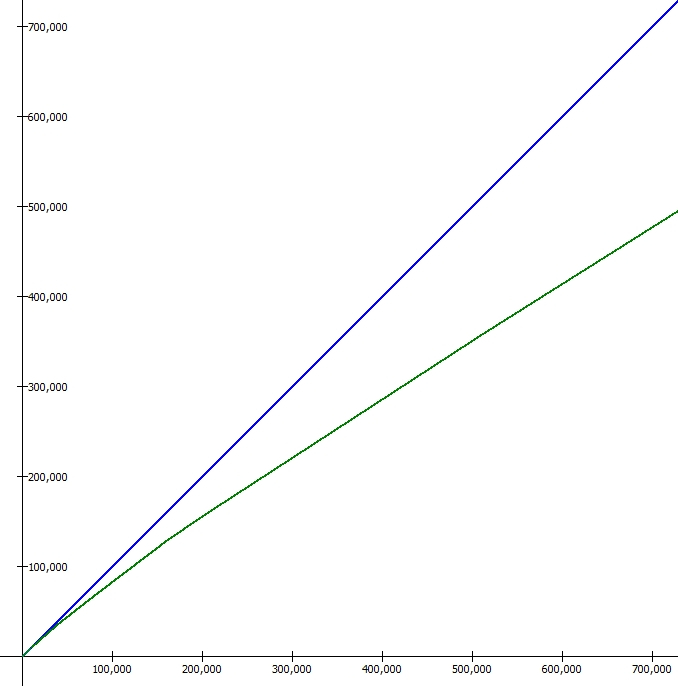
From that graph alone, you might think that going to a higher tax bracket could result in lower after-tax income. But the next graph, of before-tax (blue) and after-tax (green) income shows otherwise:

After_tax_income

All that tax deductions can do is reduce your taxable income. Thus the tax deduction benefits you if you were already donating, but never leaves you richer than you would have been without donating at all.

For example, if you have an income of $700,000, you would pay $223,000 in taxes and keep $477,000 in after-tax income. If you instead donate $100,000, your adjusted gross income will be reduced to $600,000, you will only pay $186,000 in taxes, and you will keep $414,000 in after-tax income. If there were no tax deduction, you would still have to pay $223,000 in taxes, and your after-tax income would be only $377,000. So you do benefit from the tax deduction; but there is no amount of donation which will actually increase your after-tax income to above $477,000.

But we wouldn’t have to do it this way. We could instead apply the deduction as a tax credit, which would make the effect of the deduction far larger.

Several years back, Miles Kimball (an economist who formerly worked at Michigan, now at UC Boulder) proposed a quite clever change to the tax system:

My proposal is to raise marginal tax rates above about $75,000 per person–or $150,000 per couple–by 10% (a dime on every extra dollar), but offer a 100% tax credit for public contributions up to the entire amount of the tax surcharge.

Kimball’s argument for the policy is mainly that this would make a tax increase more palatable, by giving people more control over where their money goes. This is surely true, and a worthwhile endeavor.

But the even larger benefit might come from the increased charitable donations. If we limited the tax credit to particularly high-impact charities, we would increase the donations to those charities. Whereas in the current system you get the same deduction regardless of where you give your money, even though we know that some charities are literally hundreds of times as cost-effective as others.

In fact, we might not even want to limit the tax credit to that 10% surcharge. If people want to donate more than 10% of their income to high-impact charities, perhaps we should let them. This would mean that the federal deficit could actually increase under this policy, but if so, there would have to be so much money donated that we’d most likely end world hunger. That’s a tradeoff I’m quite willing to make.

In principle, we could even introduce a tax credit that is greater than 100%—say for instance you get a 120% donation for the top-rated charities. This is not mathematically inconsistent, though it is surely a very bad idea. In that case, it absolutely would be possible to end up with more money than you started with, and the richer you are, the more you could get. There would effectively be a positive return on charitable donations, with the money paid for from the government budget. Bill Gates for instance could pay $10 billion a year to charity and the government would not only pay for it, but also have to give him an extra $2 billion. So even for the best charities—which probably are actually a good deal more cost-effective than the US government—we should cap the tax credit at 100%.

Obvious choices for high-impact charities include UNICEF, the Red Cross, GiveDirectly, and the Malaria Consortium. We would need some sort of criteria to decide which charities should get the benefits; I’m thinking we could have some sort of panel of experts who rate charities based on their cost-effectiveness.

It wouldn’t have to be all-or-nothing, either; charities with good but not top ratings could get an increased deduction but not a 100% deduction. The expert panel could rate charities on a scale from 0 to 10, and then anything above 5 gets an (X-5)*10% tax credit.

In effect, the current policy says, “If you give to charity, you don’t have to pay taxes on the money you gave; but all of your other taxes still apply.” The new policy would say, “You can give to a top-impact charity instead of paying taxes.”

Americans hate taxes and already give a lot to charity, but most of those donations are to relatively ineffective charities. This policy could incentivize people to give more or at least give to better places, probably without hurting the government budget—and if it does hurt the government budget, the benefits will be well worth the cost.