Reflections at the crossroads

Jan 21 JDN 2460332

When this post goes live, I will have just passed my 36th birthday. (That means I’ve lived for about 1.1 billion seconds, so in order to be as rich as Elon Musk, I’d need to have made, on average, since birth, $200 per second—$720,000 per hour.)

I certainly feel a lot better turning 36 than I did 35. I don’t have any particular additional accomplishments to point to, but my life has already changed quite a bit, in just that one year: Most importantly, I quit my job at the University of Edinburgh, and I am currently in the process of moving out of the UK and back home to Michigan. (We moved the cat over Christmas, and the movers have already come and taken most of our things away; it’s really just us and our luggage now.)

But I still don’t know how to field the question that people have been asking me since I announced my decision to do this months ago:

“What’s next?”

I’m at a crossroads now, trying to determine which path to take. Actually maybe it’s more like a roundabout; it has a whole bunch of different paths, surely not just two or three. The road straight ahead is labeled “stay in academia”; the others at the roundabout are things like “freelance writing”, “software programming”, “consulting”, and “tabletop game publishing”. There’s one well-paved and superficially enticing road that I’m fairly sure I don’t want to take, labeled “corporate finance”.

Right now, I’m just kind of driving around in circles.

Most people don’t seem to quit their jobs without a clear plan for where they will go next. Often they wait until they have another offer in hand that they intend to take. But when I realized just how miserable that job was making me, I made the—perhaps bold, perhaps courageous, perhaps foolish—decision to get out as soon as I possibly could.

It’s still hard for me to fully understand why working at Edinburgh made me so miserable. Many features of an academic career are very appealing to me. I love teaching, I like doing research; I like the relatively flexible hours (and kinda need them, because of my migraines).

I often construct formal decision models to help me make big choices—generally it’s a linear model, where I simply rate each option by its relative quality in a particular dimension, then try different weightings of all the different dimensions. I’ve used this successfully to pick out cars, laptops, even universities. I’m not entrusting my decisions to an algorithm; I often find myself tweaking the parameters to try to get a particular result—but that in itself tells me what I really want, deep down. (Don’t do that in research—people do, and it’s bad—but if the goal is to make yourself happy, your gut feelings are important too.)

My decision models consistently rank university teaching quite high. It generally only gets beaten by freelance writing—which means that maybe I should give freelance writing another try after all.

And yet, my actual experience at Edinburgh was miserable.

What went wrong?

Well, first of all, I should acknowledge that when I separate out the job “university professor” into teaching and research as separate jobs in my decision model, and include all that goes into both jobs—not just the actual teaching, but the grading and administrative tasks; not just doing the research, but also trying to fund and publish it—they both drop lower on the list, and research drops down a lot.

Also, I would rate them both even lower now, having more direct experience of just how awful the exam-grading, grant-writing and journal-submitting can be.

Designing and then grading an exam was tremendously stressful: I knew that many of my students’ futures rested on how they did on exams like this (especially in the UK system, where exams are absurdly overweighted! In most of my classes, the final exam was at least 60% of the grade!). I struggled mightily to make the exam as fair as I could, all the while knowing that it would never really feel fair and I didn’t even have the time to make it the best it could be. You really can’t assess how well someone understands an entire subject in a multiple-choice exam designed to take 90 minutes. It’s impossible.

The worst part of research for me was the rejection.

I mentioned in a previous post how I am hypersensitive to rejection; applying for grants and submitting to journals was clearly the worst feelings of rejection I’ve felt in any job. It felt like they were evaluting not only the value of my work, but my worth as a scientist. Failure felt like being told that my entire career was a waste of time.

It was even worse than the feeling of rejection in freelance writing (which is one of the few things that my model tells me is bad about freelancing as a career for me, along with relatively low and uncertain income). I think the difference is that a book publisher is saying “We don’t think we can sell it.”—’we’ and ‘sell’ being vital. They aren’t saying “this is a bad book; it shouldn’t exist; writing it was a waste of time.”; they’re just saying “It’s not a subgenre we generally work with.” or “We don’t think it’s what the market wants right now.” or even “I personally don’t care for it.”. They acknowledge their own subjective perspective and the fact that it’s ultimately dependent on forecasting the whims of an extremely fickle marketplace. They aren’t really judging my book, and they certainly aren’t judging me.

But in research publishing, it was different. Yes, it’s all in very polite language, thoroughly spiced with sophisticated jargon (though some reviewers are more tactful than others). But when your grant application gets rejected by a funding agency or your paper gets rejected by a journal, the sense really basically is “This project is not worth doing.”; “This isn’t good science.”; “It was/would be a waste of time and money.”; “This (theory or experiment you’ve spent years working on) isn’t interesting or important.” Nobody ever came out and said those things, nor did they come out and say “You’re a bad economist and you should feel bad.”; but honestly a couple of the reviews did kinda read to me like they wanted to say that. They thought that the whole idea that human beings care about each other is fundamentally stupid and naive and not worth talking about, much less running experiments on.

It isn’t so much that I believed them that my work was bad science. I did make some mistakes along the way (but nothing vital; I’ve seen far worse errors by Nobel Laureates). I didn’t have very large samples (because every person I add to the experiment is money I have to pay, and therefore funding I have to come up with). But overall I do believe that my work is sufficiently rigorous to be worth publishing in scientific journals.

It’s more that I came to feel that my work is considered bad, that the kind of work I wanted to do would forever be an uphill battle against an implacable enemy. I already feel exhausted by that battle, and it had only barely begun. I had thought that behavioral economics was a more successful paradigm by now, that it had largely displaced the neoclassical assumptions that came before it; but I was wrong. Except specifically in journals dedicated to experimental and behavioral economics (of which prestigious journals are few—I quickly exhausted them), it really felt like a lot of the feedback I was getting amounted to, “I refuse to believe your paradigm.”.

Part of the problem, also, was that there simply aren’t that many prestigious journals, and they don’t take that many papers. The top 5 journals—which, for whatever reason, command far more respect than any other journals among economists—each accept only about 5-10% of their submissions. Surely more than that are worth publishing; and, to be fair, much of what they reject probably gets published later somewhere else. But it makes a shockingly large difference in your career how many “top 5s” you have; other publications almost don’t matter at all. So once you don’t get into any of those (which of course I didn’t), should you even bother trying to publish somewhere else?

And what else almost doesn’t matter? Your teaching. As long as you show up to class and grade your exams on time (and don’t, like, break the law or something), research universities basically don’t seem to care how good a teacher you are. That was certainly my experience at Edinburgh. (Honestly even their responses to professors sexually abusing their students are pretty unimpressive.)

Some of the other faculty cared, I could tell; there were even some attempts to build a community of colleagues to support each other in improving teaching. But the administration seemed almost actively opposed to it; they didn’t offer any funding to support the program—they wouldn’t even buy us pizza at the meetings, the sort of thing I had as an undergrad for my activist groups—and they wanted to take the time we spent in such pedagogy meetings out of our grading time (probably because if they didn’t, they’d either have to give us less grading, or some of us would be over our allotted hours and they’d owe us compensation).

And honestly, it is teaching that I consider the higher calling.

The difference between 0 people knowing something and 1 knowing it is called research; the difference between 1 person knowing it and 8 billion knowing it is called education.

Yes, of course, research is important. But if all the research suddenly stopped, our civilization would stagnate at its current level of technology, but otherwise continue unimpaired. (Frankly it might spare us the cyberpunk dystopia/AI apocalypse we seem to be hurtling rapidly toward.) Whereas if all education suddenly stopped, our civilization would slowly decline until it ultimately collapsed into the Stone Age. (Actually it might even be worse than that; even Stone Age cultures pass on knowledge to their children, just not through formal teaching. If you include all the ways parents teach their children, it may be literally true that humans cannot survive without education.)

Yet research universities seem to get all of their prestige from their research, not their teaching, and prestige is the thing they absolutely value above all else, so they devote the vast majority of their energy toward valuing and supporting research rather than teaching. In many ways, the administrators seem to see teaching as an obligation, as something they have to do in order to make money that they can spend on what they really care about, which is research.

As such, they are always making classes bigger and bigger, trying to squeeze out more tuition dollars (well, in this case, pounds) from the same number of faculty contact hours. It becomes impossible to get to know all of your students, much less give them all sufficient individual attention. At Edinburgh they even had the gall to refer to their seminars as “tutorials” when they typically had 20+ students. (That is not tutoring!)And then of course there were the lectures, which often had over 200 students.

I suppose it could be worse: It could be athletics they spend all their money on, like most Big Ten universities. (The University of Michigan actually seems to strike a pretty good balance: they are certainly not hurting for athletic funding, but they also devote sizeable chunks of their budget to research, medicine, and yes, even teaching. And unlike virtually all other varsity athletic programs, University of Michigan athletics turns a profit!)

If all the varsity athletics in the world suddenly disappeared… I’m not convinced we’d be any worse off, actually. We’d lose a source of entertainment, but it could probably be easily replaced by, say, Netflix. And universities could re-focus their efforts on academics, instead of acting like a free training and selection system for the pro leagues. The University of California, Irvine certainly seemed no worse off for its lack of varsity football. (Though I admit it felt a bit strange, even to a consummate nerd like me, to have a varsity League of Legends team.)

They keep making the experience of teaching worse and worse, even as they cut faculty salaries and make our jobs more and more precarious.

That might be what really made me most miserable, knowing how expendable I was to the university. If I hadn’t quit when I did, I would have been out after another semester anyway, and going through this same process a bit later. It wasn’t even that I was denied tenure; it was never on the table in the first place. And perhaps because they knew I wouldn’t stay anyway, they didn’t invest anything in mentoring or supporting me. Ostensibly I was supposed to be assigned a faculty mentor immediately; I know the first semester was crazy because of COVID, but after two and a half years I still didn’t have one. (I had a small research budget, which they reduced in the second year; that was about all the support I got. I used it—once.)

So if I do continue on that “academia” road, I’m going to need to do a lot of things differently. I’m not going to put up with a lot of things that I did. I’ll demand a long-term position—if not tenure-track, at least renewable indefinitely, like a lecturer position (as it is in the US, where the tenure-track position is called “assistant professor” and “lecturer” is permanent but not tenured; in the UK, “lecturers” are tenure-track—except at Oxford, and as of 2021, Cambridge—just to confuse you). Above all, I’ll only be applying to schools that actually have some track record for valuing teaching and supporting their faculty.

And if I can’t find any such positions? Then I just won’t apply at all. I’m not going in with the “I’ll take what I can get” mentality I had last time. Our household finances are stable enough that I can afford to wait awhile.

But maybe I won’t even do that. Maybe I’ll take a different path entirely.

For now, I just don’t know.
A new direction

Dec 31 JDN 2460311

CW: Spiders [it’ll make sense in context]

My time at the University of Edinburgh is officially over. For me it was a surprisingly gradual transition: Because of the holiday break, I had already turned in my laptop and ID badge over a week ago, and because my medical leave, I hadn’t really done much actual work for quite some time. But this is still a momentous final deadline; it’s really, truly, finally over.

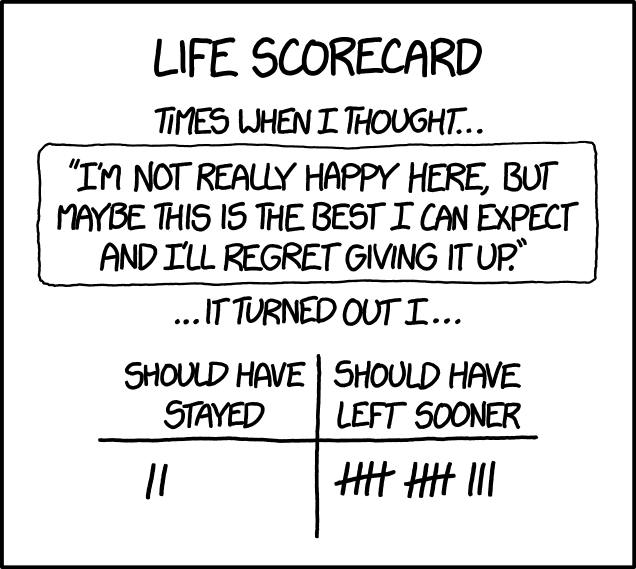
I now know with some certainty that leaving Edinburgh early was the right choice, and if anything I should have left sooner or never taken the job in the first place. (It seems I am like Randall Munroe after all.) But what I don’t know is where to go next.

We won’t be starving or homeless. My husband still has his freelance work, and my mother has graciously offered to let us stay in her spare room for awhile. We have some savings to draw upon. Our income will be low enough that payments on my student loans will be frozen. We’ll be able to get by, even if I can’t find work for awhile. But I certainly don’t want to live like that forever.

I’ve been trying to come up with ideas for new career paths, including ones I would never have considered before. Right now I am considering: Back into academia (but much choosier about what sort of school and position), into government or an international aid agency, re-training to work in software development, doing my own freelance writing (then I must decide: fiction or nonfiction? Commercial publishing, or self-published?), publishing our own tabletop games (we have one almost ready for crowdfunding, and another that I could probably finish relatively quickly), opening a game shop or escape room, or even just being a stay-at-home parent (surely the hardest to achieve financially; and while on the one hand it seems like an awful waste of a PhD, on the other hand it would really prove once and for all that I do understand the sunk cost fallacy, and therefore be a sign of my ultimate devotion to behavioral economics). The one mainstream option for an econ PhD that I’m not seriously considering is the private sector: If academia was this soul-sucking, I’m not sure I could survive corporate America.

Maybe none of these are yet the right answer. Or maybe some combination is.

What I’m really feeling right now is a deep uncertainty.

Also, fear. Fear of the unknown. Fear of failure. Fear of rejection. Almost any path I could take involves rejection—though of different kinds, and surely some more than others.

I’ve always been deeply and intensely affected by rejection. Some of it comes from formative experiences I had as a child and a teenager; some of it may simply be innate, the rejection-sensitive dysphoria that often comes with ADHD (which I now believe I have, perhaps mildly). (Come to think of it, even those formative experiences may have hit so hard because of my innate predisposition.)

But wherever it comes from, my intense fear of rejection is probably my greatest career obstacle. In today’s economy, just applying for a job—any job—requires bearing dozens of rejections. Openings get hundreds of applicants, so even being fully qualified is no guarantee of anything.

This makes it far more debilitating than most other kinds of irrational fear. I am also hematophobic, but that doesn’t really get in my way all that much; in the normal course of life, one generally tries to avoid bleeding anyway. (Now that MSM can donate blood, it does prevent me from doing that; and I do feel a little bad about that, since there have been blood shortages recently.)

But rejection phobia basically feels like this:

Imagine you are severely arachnophobic, just absolutely terrified of spiders. You are afraid to touch them, afraid to look at them, afraid to be near them, afraid to even think about them too much. (Given how common it is, you may not even have to imagine.)

Now, imagine (perhaps not too vividly, if you are genuinely arachnophobic!) that every job, every job, in every industry, regardless of what skills are required or what the work entails, requires you to first walk through a long hallway which is covered from floor to ceiling in live spiders. This is simply a condition of employment in our society: Everyone must be able to walk through the hallway full of spiders. Some jobs have longer hallways than others, some have more or less aggressive spiders, and almost none of the spiders are genuinely dangerous; but every job, everywhere, requires passing through a hallway of spiders.

That’s basically how I feel right now.

Freelance writing is the most obvious example—we could say this is an especially long hallway with especially large and aggressive spiders. To succeed as a freelance writer requires continually submitting work you have put your heart and soul into, and receiving in response curtly-worded form rejection letters over and over and over, every single time. And even once your work is successful, there will always be critics to deal with.

Yet even a more conventional job, say in academia or government, requires submitting dozens of applications and getting rejected dozens of times. Sometimes it’s also a curt form letter; other times, you make it all the way through multiple rounds of in-depth interviews and still get turned down. The latter honestly stings a lot more than the former, even though it’s in some sense a sign of your competence: they wouldn’t have taken you that far if you were unqualified; they just think they found someone better. (Did they actually? Who knows?) But investing all that effort for zero reward feels devastating.

The other extreme might be becoming a stay-at-home parent. There aren’t as many spiders in this hallway. While biological children aren’t really an option for us, foster agencies really can’t afford to be choosy. Since we don’t have any obvious major red flags, we will probably be able to adopt if we choose to—there will be bureaucratic red tape, no doubt, but not repeated rejections. But there is one very big rejection—one single, genuinely dangerous spider that lurks in a dark corner of the hallway: What if I am rejected by the child? What if they don’t want me as their parent?

Another alternative is starting a business—such as selling our own games, or opening an escape room. Even self-publishing has more of this character than traditional freelance writing. The only direct, explicit sort of rejection we’d have to worry about there is small business loans; and actually with my PhD and our good credit, we could reasonably expect to get accepted sooner or later. But there is a subtler kind of rejection: What if the market doesn’t want us? What if the sort of games or books (or escape experiences, or whatever) we have to offer just aren’t what the world seems to want? Most startup businesses fail quickly; why should ours be any different? (I wonder if I’d be able to get a small business loan on the grounds that I forecasted only a 50% chance of failing in the first year, instead of the baseline 80%. Somehow, I suspect not.)

I keep searching for a career option with no threat of rejection, and it just… doesn’t seem to exist. The best I can come up with is going off the grid and living as hermits in the woods somewhere. (This sounds pretty miserable for totally different reasons—as well as being an awful, frankly unconscionable waste of my talents.) As long as I continue to live within human society and try to contribute to the world, rejection will rear its ugly head.

Ultimately, I think my only real option is to find a way to cope with rejection—or certain forms of rejection. The hallways full of spiders aren’t going away. I have to find a way to walk through them.

Time and How to Use It

Nov 5 JDN 2460254

A review of Four Thousand Weeks by Oliver Burkeman

The central message of Four Thousand Weeks: Time and How to Use It seems so obvious in hindsight it’s difficult to understand why it feels so new and unfamiliar. It’s a much-needed reaction to the obsessive culture of “efficiency” and “productivity” that dominates the self-help genre. Its core message is remarkable simple:

You don’t have time to do everything you want, so stop trying.

I actually think Burkeman understands the problem incorrectly. He argues repeatedly that it is our mortality which makes our lives precious—that it is because we only get four thousand weeks of life that we must use our time well. But this strikes me as just yet more making excuses for the dragon.

Our lives would not be less precious if we lived a thousand years or a million. Indeed, our time would hardly be any less scarce! You still can’t read every book ever written if you live a million years—for every one of those million years, another 500,000 books will be published. You could visit every one of the 10,000 cities in the world, surely; but if you spend a week in each one, by the time you get back to Paris for a second visit, centuries will have passed—I must imagine you’ll have missed quite a bit of change in that time. (And this assumes that our population remains the same—do we really think it would, if humans could live a million years?)

Even a truly immortal being that will live until the end of time needs to decide where to be at 7 PM this Saturday.

Yet Burkeman does grasp—and I fear that too many of us do not—that our time is precious, and when we try to do everything that seems worth doing, we end up failing to prioritize what really matters most.

What do most of us spend most of our lives doing? Whatever our bosses tell us to do. Aside from sleeping, the activity that human beings spend the largest chunk of their lives on is working.

This has made us tremendously, mind-bogglingly productive—our real GDP per capita is four times what it was in just 1950, and about eight times what it was in the 1920s. Projecting back further than that is a bit dicier, but assuming even 1% annual growth, it should be about twenty times what it was at the dawn of the Industrial Revolution. We could surely live better than medieval peasants did by working only a few hours per week; yet in fact on average we work more hours than they did—by some estimates, nearly twice as much. Rather than getting the same wealth for 5% of the work, or twice the wealth for 10%, we chose to get 40 times the wealth for twice the work.

It would be one thing if all this wealth and productivity actually seemed to make us happy. But does it?

Our physical health is excellent: We are tall, we live long lives—we are smarter, even, than people of the not-so-distant past. We have largely conquered disease as the ancients knew it. Even a ‘catastrophic’ global pandemic today kills a smaller share of the population than would die in a typical year from disease in ancient times. Even many of our most common physical ailments, such as obesity, heart disease, and diabetes, are more symptoms of abundance than poverty. Our higher rates of dementia and cancer are largely consequences of living longer lives—most medieval peasants simply didn’t make it long enough to get Alzheimer’s. I wonder sometimes how ancient people dealt with other common ailments such as migraine and sleep apnea; but my guess is that they basically just didn’t—since treatment was impossible, they learned to live with it. Maybe they consoled themselves with whatever placebo treatments the healers of their local culture offered.

Yet our mental health seems to be no better than ever—and depending on how you measure it, may actually be getting worse over time. Some of the measured increase is surely due to more sensitive diagnosis; but some of it may be a genuine increase—especially as a result of the COVID pandemic. I wasn’t able to find any good estimates of rates of depression or anxiety disorders in ancient or medieval times, so I guess I really can’t say whether this is a problem that’s getting worse. But it sure doesn’t seem to be getting better. We clearly have not solved the problem of depression the way we have solved the problem of infectious disease.

Burkeman doesn’t tell us to all quit our jobs and stop working. But he does suggest that if you are particularly unhappy at your current job (as I am), you may want to quit it and begin searching for something else (as I have). He reminds us that we often get stuck in a particular pattern and underestimate the possibilities that may be available to us.

And he has advice for those who want to stay in their current jobs, too: Do less. Don’t take on everything that is asked of you. Don’t work yourself to the bone. The rewards for working harder are far smaller than our society will tell you, and the costs of burning out are far higher. Do the work that is genuinely most important, and let the rest go.

Unlike most self-help books, Four Thousand Weeks offers very little in the way of practical advice. It’s more like a philosophical treatise, exhorting you to adopt a whole new outlook on time and how you use it. But he does offer a little bit of advice, near the end of the book, in “Ten Tools for Embracing Your Finitude” and “Five Questions”.

The ten tools are as follows:


Adopt a ‘fixed volume’ approach to productivity. Limit the number of tasks on your to-do list. Set aside a particular amount of time for productive work, and work only during that time.

I am relatively good at this one; I work only during certain hours on weekdays, and I resist the urge to work other times.

Serialize, serialize, serialize. Do one major project at a time.

I am terrible at this one; I constantly flit between different projects, leaving most of them unfinished indefinitely. But I’m not entirely convinced I’d do better trying to focus on one in particular. I switch projects because I get stalled on the current one, not because I’m anxious about not doing the others. Unless I can find a better way to break those stalls, switching projects still gets more done than staying stuck on the same one.

Decide in advance what to fail at. Prioritize your life and accept that some things will fail.

We all, inevitably, fail to achieve everything we want to. What Burkeman is telling us to do is choose in advance which achievements we will fail at. Ask yourself: How much do you really care about keeping the kitchen clean and the lawn mowed? If you’re doing these things to satisfy other people’s expectations but you don’t truly care about them yourself, maybe you should just accept that people will frown upon you for your messy kitchen and overgrown lawn.

Focus on what you’ve already completed, not just on what’s left to complete. Make a ‘done list’ of tasks you have completed today—even small ones like “brushed teeth” and “made breakfast”—to remind yourself that you do in fact accomplish things.

I may try this one for awhile. It feels a bit hokey to congratulate yourself on making breakfast—but when you are severely depressed, even small tasks like that can in fact feel like an ordeal.

Consolidate your caring. Be generous and kind, but pick your battles.

I’m not very good at this one either. Spending less time on social media has helped; I am no longer bombarded quite so constantly by worthy causes and global crises. Yet I still have a vague sense that I am not doing enough, that I should be giving more of myself to help others. For me this is partly colored by a feeling that I have failed to build a career that would have both allowed me to have direct impact on some issues and also made enough money to afford large donations.

Embrace boring and single-purpose technology. Downgrade your technology to reduce distraction.

I don’t do this one, but I also don’t see it as particularly good advice. Maybe taking Facebook and (the-platform-formerly-known-as-) Twitter off your phone home screen is a good idea. But the reason you go to social media isn’t that they are so easy to access. It’s that you are expected to, and that you try to use them to fill some kind of need in your life—though it’s unclear they ever actually fill it.

Seek out novelty in the mundane. Cultivate awareness and appreciation of the ordinary things around you.

This one is basically a stripped-down meditation technique. It does work, but it’s also a lot harder to do than most people seem to think. It is especially hard to do when you are severely depressed. One technique I’ve learned from therapy that is surprisingly helpful is to replace “I have to” with “I get to” whenever you can: You don’t have to scoop cat litter, you get to because you have an adorable cat. You don’t have to catch the bus to work, you get to because you have a job. You don’t have to make breakfast for your family, you get to because you have a loving family.

Be a ‘researcher’ in relationships. Cultivate curiosity rather than anxiety or judgment.

Human beings are tremendously varied and often unpredictable. If you worry about whether or not people will do what you want, you’ll be constantly worried. And I have certainly been there. It can help to try to take a stance of detachment, where you concern yourself less with getting the right outcome and more with learning about the people you are with. I think this can be taken too far—you can become totally detached from relationships, or you could put yourself in danger by failing to pass judgment on obviously harmful behaviors—but in moderation, it’s surprisingly powerful. The first time I ever enjoyed going to a nightclub, (at my therapist’s suggestion) I went as a social scientist, tasked with observing and cataloguing the behavior around me. I still didn’t feel fully integrated into the environment (and the music was still too damn loud!), but for once, I wasn’t anxious and miserable.

Cultivate instantaneous generosity. If you feel like doing something good for someone, just do it.

I’m honestly not sure whether this one is good advice. I used to follow it much more than I do now. Interacting with the Effective Altruism community taught me to temper these impulses, and instead of giving to every random charity or homeless person that asks for money, instead concentrate my donations into a few highly cost-effective charities. Objectively, concentrating donations in this way produces a larger positive impact on the world. But subjectively, it doesn’t feel as good, it makes people sad, and sometimes it can make you feel like a very callous person. Maybe there’s a balance to be had here: Give a little when the impulse strikes, but save up most of it for the really important donations.

Practice doing nothing.

This one is perhaps the most subversive, the most opposed to all standard self-help advice. Do nothing? Just rest? How can you say such a thing, when you just reminded us that we have only four thousand weeks to live? Yet this is in fact the advice most of us need to hear. We burn ourselves out because we forget how to rest.

I am also terrible at this one. I tend to get most anxious when I have between 15 and 45 minutes of free time before an activity, because 45 minutes doesn’t feel long enough to do anything, and 15 minutes feels too long to do nothing. Logically this doesn’t really make sense: Either you have time to do something, or you don’t. But it can be hard to find good ways to fill that sort of interval, because it requires the emotional overhead of starting and stopping a task.

Then, there are the five questions:

Where in your life or work are you currently pursuing comfort, when what’s called for is a little discomfort?

It seems odd to recommend discomfort as a goal, but I think what Burkeman is getting at is that we tend to get stuck in the comfortable and familiar, even when we would be better off reaching out and exploring into the unknown. I know that for me, finally deciding to quit this job was very uncomfortable; it required taking a big risk and going outside the familiar and expected. But I am now convinced it was the right decision.

Are you holding yourself to, and judging yourself by, standards of productivity or performance that are impossible to meet?

In a word? Yes. I’m sure I am. But this one is also slipperier than it may seem—for how do we really know what’s possible? And possible for whom? If you see someone else who seems to be living the life you think you want, is it just an illusion? Are they really suffering as badly as you? Or do they perhaps have advantages you don’t, which made it possible for them, but not for you? When people say they work 60 hours per week and you can barely manage 20, are they lying? Are you truly not investing enough effort? Or do you suffer from ailments they don’t, which make it impossible for you to commit those same hours?

In what ways have you yet to accept the fact that you are who you are, not the person you think you ought to be?

I think most of us have a lot of ways that we fail to accept ourselves: physically, socially, psychologically. We are never the perfect beings we aspire to be. And constantly aspiring to an impossible ideal will surely drain you. But I also fear that self-acceptance could be a dangerous thing: What if it makes us stop striving to improve? What if we could be better than we are, but we don’t bother? Would you want a murderous psychopath to practice self-acceptance? (Then again, do they already, whether we want them to or not?) How are we to know which flaws in ourselves should be accepted, and which repaired?

In which areas of your life are you still holding back until you feel like you know what you’re doing?

This one cut me very deep. I have several areas of my life where this accusation would be apt, and one in particular where I am plainly guilty as charged: Parenting. In a same-sex marriage, offspring don’t emerge automatically without intervention. If we want to have kids, we must do a great deal of work to secure adoption. And it has been much easier—safer, more comfortable—to simply put off that work, avoid the risk. I told myself we’d adopt once I finished grad school; but then I only got a temporary job, so I put it off again, saying we’d adopt once I found stability in my career. But what if I never find that stability? What if the rest of my career is always this precarious? What if I can always find some excuse to delay? The pain of never fulfilling that lifelong dream of parenthood might continue to gnaw at me forever.

How would you spend your days differently if you didn’t care so much about seeing your actions reach fruition?

This one is frankly useless. I hate it. It’s like when people say “What would you do if you knew you’d die tomorrow?” Obviously, you wouldn’t go to work, you wouldn’t pay your bills, you wouldn’t clean your bathroom. You might devote yourself single-mindedly to a single creative task you hoped to make a legacy, or gather your family and friends to share one last day of love, or throw yourself into meaningless hedonistic pleasure. Those might even be things worth doing, on occasion. But you can’t do them every day. If you knew you were about to die, you absolutely would not live in any kind of sustainable way.

Similarly, if I didn’t care about seeing my actions reach fruition, I would continue to write stories and never worry about publishing them. I would make little stabs at research when I got curious, then once it starts getting difficult or boring, give up and never bother writing the paper. I would continue flitting between a dozen random projects at once and never finish any of them. I might well feel happier—at least until it all came crashing down—but I would get absolutely nothing done.

Above all, I would never apply for any jobs, because applying for jobs is absolutely not about enjoying the journey. If you know for a fact that you won’t get an offer, you’re an idiot to bother applying. That is a task that is only worth doing if I believe that it will yield results—and indeed, a big part of why it’s so hard to bring myself to do it is that I have a hard time maintaining that belief.

If you read the surrounding context, Burkeman actually seems to intend something quite different than the actual question he wrote. He suggests devoting more time to big, long-term projects that require whole communities to complete. He likens this to laying bricks in a cathedral that we will never see finished.

I do think there is wisdom in this. But it isn’t a simple matter of not caring about results. Indeed, if you don’t care at all about whether the cathedral will stand, you won’t bother laying the bricks correctly. In some sense Burkeman is actually asking us to do the opposite: To care more about results, but specifically results that we may never live to see. Maybe he really intends to emphasize the word see—you care about your actions reaching fruition, but not whether or not you’ll ever see it.

Yet this, I am quite certain, is not my problem. When a psychiatrist once asked me, “What do you really want most in life?” I gave a very thoughtful answer: “To be remembered in a thousand years for my contribution to humanity.” (His response was glib: “You can’t control that.”) I still stand by that answer: If I could have whatever I want, no limits at all, three wishes from an all-powerful genie, two of them would be to solve some of the world’s greatest problems, and the third would be for the chance to live my life in a way that I knew would be forever remembered.

But I am slowly coming to realize that maybe I should abandon that answer. That psychiatrist’s answer was far too glib (he was in fact not a very good fit for me; I quickly switched to a different psychiatrist), but maybe it wasn’t fundamentally wrong. It may be impossible to predict, let alone control, whether our lives have that kind of lasting impact—and, almost by construction, most lives can’t.

Perhaps, indeed, I am too worried about whether the cathedral will stand. I only have a few bricks to lay myself, and while I can lay them the best I can, that ultimately will not be what decides the fate of the cathedral. A fire, or an earthquake, or simply some other bricklayer’s incompetence, could bring about its destruction—and there is nothing at all I can do to prevent that.

This post is already getting too long, so I should try to bring it to a close.

As the adage goes, perhaps if I had more time, I’d make it shorter.

Knowing When to Quit

Sep 10 JDN 2460198

At the time of writing this post, I have officially submitted my letter of resignation at the University of Edinburgh. I’m giving them an entire semester of notice, so I won’t actually be leaving until December. But I have committed to my decision now, and that feels momentous.

Since my position here was temporary to begin with, I’m actually only leaving a semester early. Part of me wanted to try to stick it out, continue for that one last semester and leave on better terms. Until I sent that letter, I had that option. Now I don’t, and I feel a strange mix of emotions: Relief that I have finally made the decision, regret that it came to this, doubt about what comes next, and—above all—profound ambivalence.

Maybe it’s the very act of quitting—giving up, being a quitter—that feels bad. Even knowing that I need to get out of here, it hurts to have to be the one to quit.

Our society prizes grit and perseverance. Since I was a child I have been taught that these are virtues. And to some extent, they are; there certainly is such a thing as giving up too quickly.

But there is also such a thing as not knowing when to quit. Sometimes things really aren’t going according to plan, and you need to quit before you waste even more time and effort. And I think I am like Randall Monroe in this regard; I am more inclined to stay when I shouldn’t than quit when I shouldn’t:

Sometimes quitting isn’t even as permanent as it is made out to be. In many cases, you can go back later and try again when you are better prepared.

In my case, I am unlikely to ever work at the University of Edinburgh again, but I haven’t yet given up on ever having a career in academia. Then again, I am by no means as certain as I once was that academia is the right path for me. I will definitely be searching for other options.

There is a reason we are so enthusiastically sold on the virtue of perseverance. Part of how our society sells the false narrative of meritocracy is by claiming that people who succeed did so because they tried harder or kept on trying.

This is not entirely false; all other things equal, you are more likely to succeed if you keep on trying. But in some ways that just makes it more seductive and insidious.

For the real reason most people hit home runs in life is they were born on third base. The vast majority of success in life is determined by circumstances entirely outside individual control.


Even having the resources to keep trying is not guaranteed for everyone. I remember a great post on social media pointing out that entrepreneurship is like one of those carnival games:

Entrepreneurship is like one of those carnival games where you throw darts or something.

Middle class kids can afford one throw. Most miss. A few hit the target and get a small prize. A very few hit the center bullseye and get a bigger prize. Rags to riches! The American Dream lives on.

Rich kids can afford many throws. If they want to, they can try over and over and over again until they hit something and feel good about themselves. Some keep going until they hit the center bullseye, then they give speeches or write blog posts about ‘meritocracy’ and the salutary effects of hard work.

Poor kids aren’t visiting the carnival. They’re the ones working it.

The odds of succeeding on any given attempt are slim—but you can always pay for more tries. A middle-class person can afford to try once; mostly those attempts will fail, but a few will succeed and then go on to talk about how their brilliant talent and hard work made the difference. A rich person can try as many times as they like, and when they finally succeed, they can credit their success to perseverance and a willingness to take risks. But the truth is, they didn’t have any exceptional reserves of grit or courage; they just had exceptional reserves of money.

In my case, I was not depleting money (if anything, I’m probably losing out financially by leaving early, though that very much depends on how the job market goes for me): It was something far more valuable. I was whittling away at my own mental health, depleting my energy, draining my motivation. The resource I was exhausting was my very soul.

I still have trouble articulating why it has been so painful for me to work here. It’s so hard to point to anything in particular.

The most obvious downsides were things I knew at the start: The position is temporary, the pay is mediocre, and I had to move across the Atlantic and live thousands of miles from home. And I had already heard plenty about the publish-or-perish system of research publication.

Other things seem like minor annoyances: They never did give me a good office (I have to share it with too many people, and there isn’t enough space, so in fact I rarely use it at all). They were supposed to assign me a faculty mentor and never did. They kept rearranging my class schedule and not telling me things until immediately beforehand.

I think what it really comes down to is I didn’t realize how much it would hurt. I knew that I was moving across the Atlantic—but I didn’t know how isolated and misunderstood I would feel when I did. I knew that publish-or-perish was a problem—but I didn’t know how agonizing it would be for me in particular. I knew I probably wouldn’t get very good mentorship from the other faculty—but I didn’t realize just how bad it would be, or how desperately I would need that support I didn’t get.

I either underestimated the severity of these problems, or overestimated my own resilience. I thought I knew what I was going into, and I thought I could take it. But I was wrong. I couldn’t take it. It was tearing me apart. My only answer was to leave.

So, leave I shall. I have now committed to doing so.

I don’t know what comes next. I don’t even know if I’ve made the right choice. Perhaps I’ll never truly know. But I made the choice, and now I have to live with it.

Age, ambition, and social comparison

Jul 2 JDN 2460128

The day I turned 35 years old was one of the worst days of my life, as I wrote about at the time. I think the only times I have felt more depressed than that day were when my father died, when I was hospitalized by an allergic reaction to lamotrigine, and when I was rejected after interviewing for jobs at GiveWell and Wizards of the Coast.

This is notable because… nothing particularly bad happened to me on my 35th birthday. It was basically an ordinary day for me. I felt horrible simply because I was turning 35 and hadn’t accomplished so many of the things I thought I would have by that point in my life. I felt my dreams shattering as the clock ticked away what chance I thought I’d have at achieving my life’s ambitions.

I am slowly coming to realize just how pathological that attitude truly is. It was ingrained in me very deeply from the very youngest age, not least because I was such a gifted child.

While studying quantum physics in college, I was warned that great physicists do all their best work before they are 30 (some even said 25). Einstein himself said as much (so it must be true, right?). It turns out that was simply untrue. It may have been largely true in the 18th and 19th centuries, and seems to have seen some resurgence during the early years of quantum theory, but today the median age at which a Nobel laureate physicist did their prize-winning work is 48. Less than 20% of eminent scientists made their great discoveries before the age of 40.

Alexander Fleming was 47 when he discovered penicillin—just about average for an eminent scientist of today. Darwin was 22 when he set sail on the Beagle, but didn’t publish On the Origin of Species until he was 50. Andre-Marie Ampere started his work in electromagnetism in his forties.

In creative arts, age seems to be no barrier at all. Julia Child published her first cookbook at 50. Stan Lee sold his first successful Marvel comic at 40. Toni Morrison was 39 when she published her first novel, and 62 when she won her Nobel. Peter Mark Roget was 73 when he published his famous thesaurus. Tolkein didn’t publish The Hobbit until he was 45.

Alan Rickman didn’t start drama school until he was 26 and didn’t have a major Hollywood role until he was 42. Samuel L. Jackson is now the third-highest-grossing actor of all time (mostly because of the Avengers movies), but he didn’t have any major movie roles until his forties. Anna Moses didn’t start painting until she was 78.

We think of entrepreneurship as a young man’s game, but Ray Kroc didn’t buy McDonalds until he was 59. Harland Sanders didn’t franchise KFC until he was 62. Eric Yuan wasn’t a vice president until the age of 37 and didn’t become a billionaire until Zoom took off in 2019—he was 49. Sam Walton didn’t found Walmart until he was 44.

Great humanitarian achievements actually seem to be more likely later in life: Gandhi did not see India achieve independence until he was 78. Nelson Mandela was 76 when he became President of South Africa.

It has taken me far too long to realize this, and in fact I don’t think I have yet fully internalized it: Life is not a race. You do not “fall behind” when others achieve things younger than you did. In fact, most child prodigies grow up no more successful as adults than children who were merely gifted or even above-average. (There is another common belief that prodigies grow up miserable and stunted; that, fortunately, isn’t true either.)

Then there is queer timethe fact that, in a hostile heteronormative world, queer people often find ourselves growing up in a very different way than straight people—and crip timethe ways that coping with a disability changes your relationship with time and often forces you to manage your time in ways that others don’t. As someone who came out fairly young and is now married, queer time doesn’t seem to have affected me all that much. But I feel crip time very acutely: I have to very carefully manage when I go to bed and when I wake up, every single day, making sure I get not only enough sleep—much more sleep than most people get or most employers respect—but also that it aligns properly with my circadian rhythm. Failure to do so risks triggering severe, agonizing pain. Factoring that in, I have lost at least a few years of my life to migraines and depression, and will probably lose several more in the future.

But more importantly, we all need to learn to stop measuring ourselves against other people’s timelines. There is no prize in life for being faster. And while there are prizes for particular accomplishments (Oscars, Nobels, and so on), much of what determines whether you win such prizes is entirely beyond your control. Even people who ultimately made eminent contributions to society didn’t know in advance that they were going to, and didn’t behave all that much differently from others who tried but failed.

I do not want to make this sound easy. It is incredibly hard. I believe that I personally am especially terrible at it. Our society seems to be optimized to make us compare ourselves to others in as many ways as possible as often as possible in as biased a manner as possible.

Capitalism has many important upsides, but one of its deepest flaws is that it makes our standard of living directly dependent on what is happening in the rest of a global market we can neither understand nor control. A subsistence farmer is subject to the whims of nature; but in a supermarket, you are subject to the whims of an entire global economy.

And there is reason to think that the harm of social comparison is getting worse rather than better. If some mad villain set out to devise a system that would maximize harmful social comparison and the emotional damage it causes, he would most likely create something resembling social media.

The villain might also tack on some TV news for good measure: Here are some random terrifying events, which we’ll make it sound like could hit you at any moment (even though their actual risk is declining); then our ‘good news’ will be a litany of amazing accomplishments, far beyond anything you could reasonably hope for, which have been achieved by a cherry-picked sample of unimaginably fortunate people you have never met (yet you somehow still form parasocial bonds with because we keep showing them to you). We will make a point not to talk about the actual problems in the world (such as inequality and climate change), certainly not in any way you might be able to constructively learn from; nor will we mention any actual good news which might be relevant to an ordinary person such as yourself (such as economic growth, improved health, or reduced poverty). We will focus entirely on rare, extreme events that by construction aren’t likely to ever happen to you and are not relevant to how you should live your life.

I do not have some simple formula I can give you that will make social comparison disappear. I do not know how to shake the decades of indoctrination into a societal milieu that prizes richer and faster over all other concepts of worth. But perhaps at least recognizing the problem will weaken its power over us.

I’m old enough to be President now.

Jan 22 JDN 2459967

When this post goes live, I will have passed my 35th birthday. This is old enough to be President of the United States, at least by law. (In practice, no POTUS has been less than 42.)

Not that I will ever be President. I have neither the wealth nor the charisma to run any kind of national political campaign. I might be able to get elected to some kind of local office at some point, like a school board or a city water authority. But I’ve been eligible to run for such offices for quite awhile now, and haven’t done so; nor do I feel particularly inclined at the moment.

No, the reason this birthday feels so significant is the milestone it represents. By this age, most people have spouses, children, careers. I have a spouse. I don’t have kids. I sort of have a career.

I have a job, certainly. I work for relatively decent pay. Not excellent, not what I was hoping for with a PhD in economics, but enough to live on (anywhere but an overpriced coastal metropolis). But I can’t really call that job a career, because I find large portions of it unbearable and I have absolutely no job security. In fact, I have the exact opposite: My job came with an explicit termination date from the start. (Do the people who come up with these short-term postdoc positions understand how that feels? It doesn’t seem like they do.)

I missed the window to apply for academic jobs that start next year. If I were happy here, this would be fine; I still have another year left on my contract. But I’m not happy here, and that is a grievous understatement. Working here is clearly the most important situational factor contributing to my ongoing depression. So I really ought to be applying to every alternative opportunity I can find—but I can’t find the will to try it, or the self-confidence to believe that my attempts could succeed if I did.

Then again, I’m not sure I should be applying to academic positions at all. If I did apply to academic positions, they’d probably be teaching-focused ones, since that’s the one part of my job I’m actually any good at. I’ve more or less written off applying to major research institutions; I don’t think I would get hired anyway, and even if I did, the pressure to publish is so unbearable that I think I’d be just as miserable there as I am here.

On the other hand, I can’t be sure that I would be so miserable even at another research institution; maybe with better mentoring and better administration I could be happy and successful in academic research after all.

The truth is, I really don’t know how much of my misery is due to academia in general, versus the British academic system, versus Edinburgh as an institution, versus starting work during the pandemic, versus the experience of being untenured faculty, versus simply my own particular situation. I don’t know if working at another school would be dramatically better, a little better, or just the same. (If it were somehow worse—which frankly seems hard to arrange—I would literally just quit immediately.)

I guess if the University of Michigan offered me an assistant professor job right now, I would take it. But I’m confident enough that they wouldn’t offer it to me that I can’t see the point in applying. (Besides, I missed the application windows this year.) And I’m not even sure that I would be happy there, despite the fact that just a few years ago I would have called it a dream job.

That’s really what I feel most acutely about turning 35: The shattering of dreams.

I thought I had some idea of how my life would go. I thought I knew what I wanted. I thought I knew what would make me happy.

The weirdest part it that it isn’t even that different from how I’d imagined it. If you’d asked me 10 or even 20 years ago what my career would be like at 35, I probably would have correctly predicted that I would have a PhD and be working at a major research university. 10 years ago I would have correctly expected it to be a PhD in economics; 20, I probably would have guessed physics. In both cases I probably would have thought I’d be tenured by now, or at least on the tenure track. But a postdoc or adjunct position (this is sort of both?) wouldn’t have been utterly shocking, just vaguely disappointing.

The biggest error by my past self was thinking that I’d be happy and successful in this career, instead of barely, desperately hanging on. I thought I’d have published multiple successful papers by now, and be excited to work on a new one. I imagined I’d also have published a book or two. (The fact that I self-published a nonfiction book at 16 but haven’t published any nonfiction ever since would be particularly baffling to my 15-year-old self, and is particularly depressing to me now.) I imagined myself becoming gradually recognized as an authority in my field, not languishing in obscurity; I imagined myself feeling successful and satisfied, not hopeless and depressed.

It’s like the dark Mirror Universe version of my dream job. It’s so close to what I thought I wanted, but it’s also all wrong. I finally get to touch my dreams, and they shatter in my hands.

When you are young, birthdays are a sincere cause for celebration; you look forward to the new opportunities the future will bring you. I seem to be now at the age where it no longer feels that way.

When to give up

Jun 6 JDN 2459372

Perseverance is widely regarded as a virtue, and for good reason. Often one of the most important deciding factors in success is the capacity to keep trying after repeated failure. I think this has been a major barrier for me personally; many things came easily to me when I was young, and I internalized the sense that if something doesn’t come easily, it must be beyond my reach.

Yet it’s also worth noting that this is not the only deciding factor—some things really are beyond our capabilities. Indeed, some things are outright impossible. And we often don’t know what is possible and what isn’t.

This raises the question: When should we persevere, and when should we give up?

There is actually reason to think that people often don’t give up when they should. Steven Levitt (of Freakonomics fame)recently published a study that asked people who were on the verge of a difficult decision to flip a coin, and then base their decision on the coin flip: Heads, make a change; tails, keep things as they are. Many didn’t actually follow the coin flip—but enough did that there was a statistical difference between those who saw heads and those who saw tails. The study found that the people who flipped heads and made a change were on average happier a couple of years later than the people who flipped tails and kept things as they were.

This question is particularly salient for me lately, because the academic job market has gone so poorly for me. I’ve spent most of my life believing that academia is where I belong; my intellect and my passion for teaching and research has convinced me and many others that this is the right path for me. But now that I have a taste of what it is actually like to apply for tenure-track jobs and submit papers to journals, I am utterly miserable. I hate every minute of it. I’ve spent the entire past year depressed and feeling like I have accomplished absolutely nothing.

In theory, once one actually gets tenure it’s supposed to get easier. But that could be a long way away—or it might never happen at all. As it is, there’s basically no chance I’ll get a tenure track position this year, and it’s unclear what my chances would be if I tried again next year.

If I could actually get a paper published, that would no doubt improve my odds of landing a better job next year. But I haven’t been able to do that, and each new rejection cuts so deep that I can barely stand to look at my papers anymore, much less actually continue submitting them. And apparently even tenured professors still get their papers rejected repeatedly, which means that this pain will never go away. I simply cannot imagine being happy if this is what I am expected to do for the rest of my life.

I found this list of criteria for when you should give up something—and most of them fit me. I’m not sure I know in my heart it can’t work out, but I increasingly suspect that. I’m not sure I want it anymore, now that I have a better idea of what it’s really like. Pursuing it is definitely making me utterly miserable. I wouldn’t say it’s the only reason, but I definitely do worry what other people will think if I quit; I feel like I’d be letting a lot of people down. I also wonder who I am without it, where I belong if not here. I don’t know what other paths are out there, but maybe there is something better. This constant stream of failure and rejection has definitely made me feel like I hate myself. And above all, when I imagine quitting, I absolutely feel an enormous sense of relief.

Publishing in journals seems to be the thing that successful academics care about most, and it means almost nothing to me anymore. I only want it because of all the pressure to have it, because of all the rewards that come from having it. It has become fully instrumental to me, with no intrinsic meaning or value. I have no particular desire to be lauded by the same system that lauded Fischer Black or Kenneth Rogoff—both of whose egregious and easily-avoidable mistakes are responsible for the suffering of millions people around the world.

I want people to read my ideas. But people don’t actually read journals. They skim them. They read the abstracts. They look at the graphs and regression tables. (You have the meeting that should have been an email? I raise you the paper that should have been a regression table.) They see if there’s something in there that they should be citing for their own work, and if there is, maybe then they actually read the paper—but everyone is so hyper-specialized that only a handful of people will ever actually want to cite any given paper. The vast majority of research papers are incredibly tedious to read and very few people actually bother. As a method for disseminating ideas, this is perhaps slightly better than standing on a street corner and shouting into a megaphone.

I would much rather write books; people sometimes actually read books, especially when they are written for a wide audience and hence not forced into the straitjacket of standard ‘scientific writing’ that no human being actually gets any enjoyment out of writing or reading. I’ve seen a pretty clear improvement in writing quality of papers written by Nobel laureates—after they get their Nobels or similar accolades. Once they establish themselves, they are free to actually write in ways that are compelling and interesting, rather than having to present everything in the most dry, tedious way possible. If your paper reads like something that a normal person would actually find interesting or enjoyable to read, you will be—as I have been—immediately told that you must remove all such dangerous flavor until the result is as tasteless as possible.

No, the purpose of research journals is not to share ideas. Its function is not to share, but to evaluate. And it isn’t even really to evaluate research—it’s to evaluate researchers. It’s to outsource the efforts of academic hiring to an utterly unaccountable and arbitrary system run mostly by for-profit corporations. It may have some secondary effect of evaluating ideas for validity; at least the really awful ideas are usually excluded. But its primary function is to decide the academic pecking order.

I had thought that scientific peer review was supposed to select for truth. Perhaps sometimes it does. It seems to do so reasonably well in the natural sciences, at least. But in the social sciences? That’s far less clear. Peer-reviewed papers are much more likely to be accurate than any randomly-selected content; but there are still a disturbingly large number of peer-reviewed published papers that are utterly wrong, and some unknown but undoubtedly vast number of good papers that have never seen the light of day.

Then again, when I imagine giving up on an academic career, I don’t just feel relief—I also feel regret and loss. I feel like I’ve wasted years of my life putting together a dream that has now crumbled in my hands. I even feel some anger, some sense that I was betrayed by those who told me that this was about doing good research when it turns out it’s actually about being thick-skinned enough that you can take an endless assault of rejections. It feels like I’ve been running a marathon, and I just rounded a curve to discover that the last five miles must be ridden on horseback, when I don’t have a horse, I have no equestrian training, and in fact I’m allergic to horses.

I wish someone had told me it would be like this. Maybe they tried and I didn’t listen. They did say that papers would get rejected. They did say that the tenure track was high-pressure and publish-or-perish was a major source of anxiety. But they never said that it would tear at my soul like this. They never said that I would have to go through multiple rounds of agony, self-doubt, and despair in order to get even the slighest recognition for my years of work. They never said that the whole field would treat me like I’m worthless because I can’t satisfy the arbitrary demands of a handful of anonymous reviewers. They never said that I would begin to feel worthless after several rounds of this.

That’s really what I want to give up on. I want to give up on hitching my financial security, my career, my future, my self-worth to a system as capricious as peer review.

I don’t want to give up on research. I don’t want to give up on teaching. I still believe strongly in discovering new truths and sharing them with others. I’m just increasingly realizing that academia isn’t nearly as good at that as I thought it was.

It isn’t even that I think it’s impossible for me to succeed in academia. I think that if I continued trying to get a tenure-track job, I would land one eventually. Maybe next year. Or maybe I’d spend a few years at a postdoc first. And I’d probably manage to publish some paper in some reasonably respectable journal at some point in the future. But I don’t know how long it would take, or how good a journal it would be—and I’m already past the point where I really don’t care anymore, where I can’t afford to care, where if I really allowed myself to care it would only devastate me when I inevitably fail again. Now that I see what is really involved in the process, how arduous and arbitrary it is, publishing in a journal means almost nothing to me. I want to be validated; I want to be appreciated; I want to be recognized. But the system is set up to provide nothing but rejection, rejection, rejection. If even the best work won’t be recognized immediately and even the worst work can make it with enough tries, then the whole system begins to seem meaningless. It’s just rolls of the dice. And I didn’t sign up to be a gambler.

The job market will probably be better next year than it was this year. But how much better? Yes, there will be more openings, but there will also be more applicants: Everyone who would normally be on the market, plus everyone like me who didn’t make it this year, plus everyone who decided to hold back this year because they knew they wouldn’t make it (as I probably should have done). Yes, in a normal year, I could be fairly confident of getting some reasonably decent position—but this wasn’t a normal year, and next year won’t be one either, and the one after that might still not be. If I can’t get a paper published in a good journal between now and then—and I’m increasingly convinced that I can’t—then I really can’t expect my odds to be greatly improved from what they were this time around. And if I don’t know that this terrible gauntlet is going to lead to something good, I’d really much rather avoid it altogether. It was miserable enough when I went into it being (over)confident that it would work out all right.

Perhaps the most important question when deciding whether to give up is this: What will happen if you do? What alternatives do you have? If giving up means dying, then don’t give up. (“Learn to let go” is very bad advice to someone hanging from the edge of a cliff.) But while it may feel that way sometimes, rarely does giving up on a career or a relationship or a project yield such catastrophic results.

When people are on the fence about making a change and then do so, even based on the flip of a coin, it usually makes them better off. Note that this is different from saying you should make all your decisions randomly; if you are confident that you don’t want to make a change, don’t make a change. This advice is for people who feel like they want a change but are afraid to take the chance, people who find themselves ambivalent about what direction to go next—people like me.

I don’t know where I should go next. I don’t know where I belong. I know it isn’t Wall Street. I’m pretty sure it’s not consulting. Maybe it’s nonprofits. Maybe it’s government. Maybe it’s freelance writing. Maybe it’s starting my own business. I guess I’d still consider working in academia; if Purdue called me back to say they made a terrible mistake and they want me after all, I’d probably take the offer. But since such an outcome is now vanishingly unlikely, perhaps it’s time, after all, to give up.

Glorifying superstars glorifies excessive risk

Apr 26 JDN 2458964

Suppose you were offered the choice of the following two gambles; which one would you take?

Gamble A: 99.9% chance of $0; 0.1% chance of $100 million

Gamble B: 10% chance of $50,000; 80% chance of $100,000; 10% chance of $1 million

I think it’s pretty clear that you should choose gamble B.

If you were risk-neutral, the expected payoffs would be $100,000 for gamble A and $185,000 for gamble B. So clearly gamble B is the better deal.

But you’re probably risk-averse. If you have logarithmic utility with a baseline and current wealth of $10,000, the difference is even larger:

0.001*ln(10001) = 0.009

0.1*ln(6) + 0.8*ln(11) + 0.1*ln(101) = 2.56

Yet suppose this is a gamble that a lot of people get to take. And furthermore suppose that what you read about in the news every day is always the people who are the very richest. Then you will read, over and over again, about people who took gamble A and got lucky enough to get the $100 million. You’d probably start to wonder if maybe you should be taking gamble A instead.

This is more or less the world we live in. A handful of billionaires own staggering amounts of wealth, and we are constantly hearing about them. Even aside from the fact that most of them inherited a large portion of it and all of them had plenty of advantages that most of us will never have, it’s still not clear that they were actually smart about taking the paths they did—it could simply be that they got spectacularly lucky.

Or perhaps there’s an even clearer example: Professional athletes. The vast majority of athletes make basically no money at sports. Even most paid athletes are in minor leagues and make only a modest living.

There’s certainly nothing wrong with being an amateur who plays sports for fun. But if you were to invest a large proportion of your time training in sports in the hopes of becoming a professional athlete, you would most likely find yourself gravely disappointed, as your chances of actually getting into the major leagues and becoming a multi-millionaire are exceedingly small. Yet you can probably name at least a few major league athletes who are multi-millionaires—perhaps dozens, if you’re a serious fan—and I doubt you can name anywhere near as many minor league players or players who never made it into paid leagues in the first place.

When we spend all of our time focused on the superstars, what we are effectively assessing is the maximum possible income available on a given career track. And it’s true; the maximum for professional athletes and especially entrepreneurs is extremely high. But the maximum isn’t what you should care about; you should really be concerned about the average or even the median.

And it turns out that the same professions that offer staggeringly high incomes at the very top also tend to be professions with extremely high risk attached. The average income for an athlete is very small; the median is almost certainly zero. Entrepreneurs do better; their average and median income aren’t too much worse than most jobs. But this moderate average comes with a great deal of risk; yes, you could become a billionaire—but far more likely, you could become bankrupt.

This is a deeply perverse result: The careers that our culture most glorifies, the ones that we inspire people to dream about, are precisely those that are the most likely to result in financial ruin.

Realizing this changes your perspective on a lot of things. For instance, there is a common lament that teachers aren’t paid the way professional athletes are. I for one am extremely grateful that this is the case. If teachers were paid like athletes, yes, 0.1% would be millionaires, but only 4.9% would make a decent living, and the remaining 95% would be utterly broke. Indeed, this is precisely what might happen if MOOCs really take off, and a handful of superstar teachers are able to produce all the content while the vast majority of teaching mostly amounts to showing someone else’s slideshows. Teachers are much better off in a world where they almost all make a decent living even though none of them ever get spectacularly rich. (Are many teachers still underpaid? Sure. How do I know this? Because there are teacher shortages. A chronic shortage of something is a surefire sign that its price is too low.) And clearly the idea that we could make all teachers millionaires is just ludicrous: Do you want to pay $1 million a year for your child’s education?

Is there a way that we could change this perverse pattern? Could we somehow make it feel more inspiring to choose a career that isn’t so risky? Well, I doubt we’ll ever get children to dream of being accountants or middle managers. But there are a wide range of careers that are fulfilling and meaningful while still making a decent living—like, well, teaching. Even working in creative arts can be like this: While very few authors are millionaires, the median income for an author is quite respectable. (On the other hand there’s some survivor bias here: We don’t count you as an author if you can’t get published at all.) Software engineers are generally quite satisfied with their jobs, and they manage to get quite high incomes with low risk. I think the real answer here is to spend less time glorifying obscene hoards of wealth and more time celebrating lives that are rich and meaningful.

I don’t know if Jeff Bezos is truly happy. But I do know that you and I are more likely to be happy if instead of trying to emulate him, we focus on making our own lives meaningful.

Do I want to stay in academia?

Apr 5 JDN 2458945

This is a very personal post. You’re not going to learn any new content today; but this is what I needed to write about right now.

I am now nearly finished with my dissertation. It only requires three papers (which, quite honestly, have very little to do with one another). I just got my second paper signed off on, and my third is far enough along that I can probably finish it in a couple of months.

I feel like I ought to be more excited than I am. Mostly what I feel right now is dread.

Yes, some of that dread is the ongoing pandemic—though I am pleased to report that the global number of cases of COVID-19 has substantially undershot the estimates I made last week, suggesting that at least most places are getting the virus under control. The number of cases and number of deaths has about doubled in the past week, which is a lot better than doubling every two days as it was at the start of the pandemic. And that’s all I want to say about COVID-19 today, because I’m sure you’re as tired of the wall-to-wall coverage of it as I am.

But most of the dread is about my own life, mainly my career path. More and more I’m finding that the world of academic research just isn’t working for me. The actual research part I like, and I’m good at it; but then it comes time to publish, and the journal system is so fundamentally broken, so agonizingly capricious, and has such ludicrous power over the careers of young academics that I’m really not sure I want to stay in this line of work. I honestly think I’d prefer they just flip a coin when you graduate and you get a tenure-track job if you get heads. Or maybe journals could roll a 20-sided die for each paper submitted and publish the papers that get 19 or 20. At least then the powers that be couldn’t convince themselves that their totally arbitrary and fundamentally unjust selection process was actually based on deep wisdom and selecting the most qualified individuals.

In any case I’m fairly sure at this point that I won’t have any publications in peer-reviewed journals by the time I graduate. It’s possible I still could—I actually still have decent odds with two co-authored papers, at least—but I certainly do not expect to. My chances of getting into a top journal at this point are basically negligible.

If I weren’t trying to get into academia, that fact would be basically irrelevant. I think most private businesses and government agencies are fairly well aware of the deep defects in the academic publishing system, and really don’t put a whole lot of weight on its conclusions. But in academia, publication is everything. Specifically, publication in top journals.

For this reason, I am now seriously considering leaving academia once I graduate. The more contact I have with the academic publishing system the more miserable I feel. The idea of spending another six or seven years desperately trying to get published in order to satisfy a tenure committee sounds about as appealing right now as having my fingernails pulled out one by one.

This would mean giving up on a lifelong dream. It would mean wondering why I even bothered with the PhD, when the first MA—let alone the second—would probably have been enough for most government or industry careers. And it means trying to fit myself into a new mold that I may find I hate just as much for different reasons: A steady 9-to-5 work schedule is a lot harder to sustain when waking up before 10 AM consistently gives you migraines. (In theory, there are ways to get special accommodations for that sort of thing; in practice, I’m sure most employers would drag their feet as much as possible, because in our culture a phase-delayed circadian rhythm is tantamount to being lazy and therefore worthless.)

Or perhaps I should aim for a lecturer position, perhaps at a smaller college, that isn’t so obsessed with research publication. This would still dull my dream, but would not require abandoning it entirely.

I was asked a few months ago what my dream job is, and I realized: It is almost what I actually have. It is so tantalizingly close to what I am actually headed for that it is painful. The reality is a twisted mirror of the dream.

I want to teach. I want to do research. I want to write. And I get to do those things, yes. But I want to them without the layers of bureaucracy, without the tiers of arbitrary social status called ‘prestige’, without the hyper-competitive and capricious system of journal publication. Honestly I want to do them without grading or dealing with publishers at all—though I can at least understand why some mechanisms for evaluating student progress and disseminating research are useful, even if our current systems for doing so are fundamentally defective.

It feels as though I have been running a marathon, but was only given a vague notion of the route beforehand. There were a series of flags to follow: This way to the bachelor’s, this way to the master’s, that way to advance to candidacy. Then when I come to the last set of flags, the finish line now visible at the horizon, I see that there is an obstacle course placed in my way, with obstacles I was never warned about, much less trained for. A whole new set of skills, maybe even a whole different personality, is necessary to surpass these new obstacles, and I feel utterly unprepared.

It is as if the last mile of my marathon must bedone on horseback, and I’ve never learned to ride a horse—no one ever told me I would need to ride a horse. (Or maybe they did and I didn’t listen?) And now every time I try to mount one, I fall off immediately; and the injuries I sustain seem to be worse every time. The bruises I thought would heal only get worse. The horses I must ride are research journals, and the injuries when I fall are psychological—but no less real, all too real. With each attempt I keep hoping that my fear will fade, but instead it only intensifies.

It’s the same pain, the same fear, that pulled me away from fiction writing. I want to go back, I hope to go back—but I am not strong enough now, and cannot be sure I ever will be. I was told that working in a creative profession meant working hard and producing good output; it turns out it doesn’t mean that at all. A successful career in a creative field actually means satisfying the arbitrary desires of a handful of inscrutable gatekeepers. It means rolling the dice over, and over, and over again, each time a little more painful than the last. And it turns out that this just isn’t something I’m good at. It’s not what I’m cut out for. And maybe it never will be.

An incompetent narcissist would surely fare better than I, willing to re-submit whatever refuse they produce a thousand times because they are certain they deserve to succeed. For, deep down, I never feel that I deserve it. Others tell me I do, and I try to believe them; but the only validation that feels like it will be enough is the kind that comes directly from those gatekeepers, the kind that I can never get. And truth be told, maybe if I do finally get that, it still won’t be enough. Maybe nothing ever will be.

If I knew that it would get easier one day, that the pain would, if not go away, at least retreat to a dull roar I could push aside, then maybe I could stay on this path. But this cannot be the rest of my life. If this is really what it means to have an academic career, maybe I don’t want one after all.

Or maybe it’s not academia that’s broken. Maybe it’s just me.

Reflections on Past and Future

Jan 19 JDN 2458868

This post goes live on my birthday. Unfortunately, I won’t be able to celebrate much, as I’ll be in the process of moving. We moved just a few months ago, and now we’re moving again, because this apartment turned out to be full of mold that keeps triggering my migraines. Our request for a new apartment was granted, but the university housing system gives very little time to deal with such things: They told us on Tuesday that we needed to commit by Wednesday, and then they set our move-in date for that Saturday.

Still, a birthday seems like a good time to reflect on how my life is going, and where I want it to go next. As for how old I am? This is the probably the penultimate power of two I’ll reach.

The biggest change in my life over the previous year was my engagement. Our wedding will be this October. (We have the venue locked in; invitations are currently in the works.) This was by no means unanticipated; really, folks had been wondering when we’d finally get around to it. Yet it still feels strange, a leap headlong into adulthood for someone of a generation that has been saddled with a perpetual adolescence. The articles on “Millennials” talking about us like we’re teenagers still continue, despite the fact that there are now Millenials with college-aged children. Thanks to immigration and mortality, we now outnumber Boomers. Based on how each group voted in 2016, this bodes well for the 2020 election. (Then again, a lot of young people stay home on Election Day.)

I don’t doubt that graduate school has contributed to this feeling of adolescence: If we count each additional year of schooling as a grade, I would now be in the 22nd grade. Yet from others my age, even those who didn’t go to grad school, I’ve heard similar experiences about getting married, buying homes, or—especially—having children of their own: Society doesn’t treat us like adults, so we feel strange acting like adults. 30 is the new 23.

Perhaps as life expectancy continues to increase and educational attainment climbs ever higher, future generations will continue to experience this feeling ever longer, until we’re like elves in a Tolkienesque fantasy setting, living to 1000 but not considered a proper adult until we hit 100. I wonder if people will still get labeled by generation when there are 40 generations living simultaneously, or if we’ll find some other category system to stereotype by.

Another major event in my life this year was the loss of our cat Vincent. He was quite old by feline standards, and had been sick for a long time; so his demise was not entirely unexpected. Still, it’s never easy to lose a loved one, even if they are covered in fur and small enough to fit under an airplane seat.

Most of the rest of my life has remained largely unchanged: Still in grad school, still living in the same city, still anxious about my uncertain career prospects. Trump is still President, and still somehow managing to outdo his own high standards of unreasonableness. I do feel some sense of progress now, some glimpses of the light at the end of the tunnel. I can vaguely envision finishing my dissertation some time this year, and I’m hoping that in a couple years I’ll have settled into a job that actually pays well enough to start paying down my student loans, and we’ll have a good President (or at least Biden).

I’ve reached the point where people ask me what I am going to do next with my life. I want to give an answer, but the problem is, this is almost entirely out of my control. I’ll go wherever I end up getting job offers. Based on the experience of past cohorts, most people seem to apply to about 200 positions, interview for about 20, and get offers from about 2. So asking me where I’ll work in five years is like asking me what number I’m going to roll on a 100-sided die. I could probably tell you what order I would prioritize offers in, more or less; but even that would depend a great deal on the details. There are difficult tradeoffs to be made: Take a private sector offer with higher pay, or stay in academia for more autonomy and security? Accept a postdoc or adjunct position at a prestigious university, or go for an assistant professorship at a lower-ranked college?

I guess I can say that I do still plan to stay in academia, though I’m less certain of that than I once was; I will definitely cast a wider net. I suppose the job market isn’t like that for most people? I imagine most people at least know what city they’ll be living in. (I’m not even positive what country—opportunities for behavioral economics actually seem to be generally better in Europe and Australia than they are in the US.)

But perhaps most people simply aren’t as cognizant of how random and contingent their own career paths truly were. The average number of job changes per career is 12. You may want to think that you chose where you ended up, but for the most part you landed where the wind blew you. This can seem tragic in a way, but it is also a call for compassion: “There but for the grace of God go I.”

Really, all I can do now is hang on and try to enjoy the ride.