Reflections at the crossroads

Jan 21 JDN 2460332

When this post goes live, I will have just passed my 36th birthday. (That means I’ve lived for about 1.1 billion seconds, so in order to be as rich as Elon Musk, I’d need to have made, on average, since birth, $200 per second—$720,000 per hour.)

I certainly feel a lot better turning 36 than I did 35. I don’t have any particular additional accomplishments to point to, but my life has already changed quite a bit, in just that one year: Most importantly, I quit my job at the University of Edinburgh, and I am currently in the process of moving out of the UK and back home to Michigan. (We moved the cat over Christmas, and the movers have already come and taken most of our things away; it’s really just us and our luggage now.)

But I still don’t know how to field the question that people have been asking me since I announced my decision to do this months ago:

“What’s next?”

I’m at a crossroads now, trying to determine which path to take. Actually maybe it’s more like a roundabout; it has a whole bunch of different paths, surely not just two or three. The road straight ahead is labeled “stay in academia”; the others at the roundabout are things like “freelance writing”, “software programming”, “consulting”, and “tabletop game publishing”. There’s one well-paved and superficially enticing road that I’m fairly sure I don’t want to take, labeled “corporate finance”.

Right now, I’m just kind of driving around in circles.

Most people don’t seem to quit their jobs without a clear plan for where they will go next. Often they wait until they have another offer in hand that they intend to take. But when I realized just how miserable that job was making me, I made the—perhaps bold, perhaps courageous, perhaps foolish—decision to get out as soon as I possibly could.

It’s still hard for me to fully understand why working at Edinburgh made me so miserable. Many features of an academic career are very appealing to me. I love teaching, I like doing research; I like the relatively flexible hours (and kinda need them, because of my migraines).

I often construct formal decision models to help me make big choices—generally it’s a linear model, where I simply rate each option by its relative quality in a particular dimension, then try different weightings of all the different dimensions. I’ve used this successfully to pick out cars, laptops, even universities. I’m not entrusting my decisions to an algorithm; I often find myself tweaking the parameters to try to get a particular result—but that in itself tells me what I really want, deep down. (Don’t do that in research—people do, and it’s bad—but if the goal is to make yourself happy, your gut feelings are important too.)

My decision models consistently rank university teaching quite high. It generally only gets beaten by freelance writing—which means that maybe I should give freelance writing another try after all.

And yet, my actual experience at Edinburgh was miserable.

What went wrong?

Well, first of all, I should acknowledge that when I separate out the job “university professor” into teaching and research as separate jobs in my decision model, and include all that goes into both jobs—not just the actual teaching, but the grading and administrative tasks; not just doing the research, but also trying to fund and publish it—they both drop lower on the list, and research drops down a lot.

Also, I would rate them both even lower now, having more direct experience of just how awful the exam-grading, grant-writing and journal-submitting can be.

Designing and then grading an exam was tremendously stressful: I knew that many of my students’ futures rested on how they did on exams like this (especially in the UK system, where exams are absurdly overweighted! In most of my classes, the final exam was at least 60% of the grade!). I struggled mightily to make the exam as fair as I could, all the while knowing that it would never really feel fair and I didn’t even have the time to make it the best it could be. You really can’t assess how well someone understands an entire subject in a multiple-choice exam designed to take 90 minutes. It’s impossible.

The worst part of research for me was the rejection.

I mentioned in a previous post how I am hypersensitive to rejection; applying for grants and submitting to journals was clearly the worst feelings of rejection I’ve felt in any job. It felt like they were evaluting not only the value of my work, but my worth as a scientist. Failure felt like being told that my entire career was a waste of time.

It was even worse than the feeling of rejection in freelance writing (which is one of the few things that my model tells me is bad about freelancing as a career for me, along with relatively low and uncertain income). I think the difference is that a book publisher is saying “We don’t think we can sell it.”—’we’ and ‘sell’ being vital. They aren’t saying “this is a bad book; it shouldn’t exist; writing it was a waste of time.”; they’re just saying “It’s not a subgenre we generally work with.” or “We don’t think it’s what the market wants right now.” or even “I personally don’t care for it.”. They acknowledge their own subjective perspective and the fact that it’s ultimately dependent on forecasting the whims of an extremely fickle marketplace. They aren’t really judging my book, and they certainly aren’t judging me.

But in research publishing, it was different. Yes, it’s all in very polite language, thoroughly spiced with sophisticated jargon (though some reviewers are more tactful than others). But when your grant application gets rejected by a funding agency or your paper gets rejected by a journal, the sense really basically is “This project is not worth doing.”; “This isn’t good science.”; “It was/would be a waste of time and money.”; “This (theory or experiment you’ve spent years working on) isn’t interesting or important.” Nobody ever came out and said those things, nor did they come out and say “You’re a bad economist and you should feel bad.”; but honestly a couple of the reviews did kinda read to me like they wanted to say that. They thought that the whole idea that human beings care about each other is fundamentally stupid and naive and not worth talking about, much less running experiments on.

It isn’t so much that I believed them that my work was bad science. I did make some mistakes along the way (but nothing vital; I’ve seen far worse errors by Nobel Laureates). I didn’t have very large samples (because every person I add to the experiment is money I have to pay, and therefore funding I have to come up with). But overall I do believe that my work is sufficiently rigorous to be worth publishing in scientific journals.

It’s more that I came to feel that my work is considered bad, that the kind of work I wanted to do would forever be an uphill battle against an implacable enemy. I already feel exhausted by that battle, and it had only barely begun. I had thought that behavioral economics was a more successful paradigm by now, that it had largely displaced the neoclassical assumptions that came before it; but I was wrong. Except specifically in journals dedicated to experimental and behavioral economics (of which prestigious journals are few—I quickly exhausted them), it really felt like a lot of the feedback I was getting amounted to, “I refuse to believe your paradigm.”.

Part of the problem, also, was that there simply aren’t that many prestigious journals, and they don’t take that many papers. The top 5 journals—which, for whatever reason, command far more respect than any other journals among economists—each accept only about 5-10% of their submissions. Surely more than that are worth publishing; and, to be fair, much of what they reject probably gets published later somewhere else. But it makes a shockingly large difference in your career how many “top 5s” you have; other publications almost don’t matter at all. So once you don’t get into any of those (which of course I didn’t), should you even bother trying to publish somewhere else?

And what else almost doesn’t matter? Your teaching. As long as you show up to class and grade your exams on time (and don’t, like, break the law or something), research universities basically don’t seem to care how good a teacher you are. That was certainly my experience at Edinburgh. (Honestly even their responses to professors sexually abusing their students are pretty unimpressive.)

Some of the other faculty cared, I could tell; there were even some attempts to build a community of colleagues to support each other in improving teaching. But the administration seemed almost actively opposed to it; they didn’t offer any funding to support the program—they wouldn’t even buy us pizza at the meetings, the sort of thing I had as an undergrad for my activist groups—and they wanted to take the time we spent in such pedagogy meetings out of our grading time (probably because if they didn’t, they’d either have to give us less grading, or some of us would be over our allotted hours and they’d owe us compensation).

And honestly, it is teaching that I consider the higher calling.

The difference between 0 people knowing something and 1 knowing it is called research; the difference between 1 person knowing it and 8 billion knowing it is called education.

Yes, of course, research is important. But if all the research suddenly stopped, our civilization would stagnate at its current level of technology, but otherwise continue unimpaired. (Frankly it might spare us the cyberpunk dystopia/AI apocalypse we seem to be hurtling rapidly toward.) Whereas if all education suddenly stopped, our civilization would slowly decline until it ultimately collapsed into the Stone Age. (Actually it might even be worse than that; even Stone Age cultures pass on knowledge to their children, just not through formal teaching. If you include all the ways parents teach their children, it may be literally true that humans cannot survive without education.)

Yet research universities seem to get all of their prestige from their research, not their teaching, and prestige is the thing they absolutely value above all else, so they devote the vast majority of their energy toward valuing and supporting research rather than teaching. In many ways, the administrators seem to see teaching as an obligation, as something they have to do in order to make money that they can spend on what they really care about, which is research.

As such, they are always making classes bigger and bigger, trying to squeeze out more tuition dollars (well, in this case, pounds) from the same number of faculty contact hours. It becomes impossible to get to know all of your students, much less give them all sufficient individual attention. At Edinburgh they even had the gall to refer to their seminars as “tutorials” when they typically had 20+ students. (That is not tutoring!)And then of course there were the lectures, which often had over 200 students.

I suppose it could be worse: It could be athletics they spend all their money on, like most Big Ten universities. (The University of Michigan actually seems to strike a pretty good balance: they are certainly not hurting for athletic funding, but they also devote sizeable chunks of their budget to research, medicine, and yes, even teaching. And unlike virtually all other varsity athletic programs, University of Michigan athletics turns a profit!)

If all the varsity athletics in the world suddenly disappeared… I’m not convinced we’d be any worse off, actually. We’d lose a source of entertainment, but it could probably be easily replaced by, say, Netflix. And universities could re-focus their efforts on academics, instead of acting like a free training and selection system for the pro leagues. The University of California, Irvine certainly seemed no worse off for its lack of varsity football. (Though I admit it felt a bit strange, even to a consummate nerd like me, to have a varsity League of Legends team.)

They keep making the experience of teaching worse and worse, even as they cut faculty salaries and make our jobs more and more precarious.

That might be what really made me most miserable, knowing how expendable I was to the university. If I hadn’t quit when I did, I would have been out after another semester anyway, and going through this same process a bit later. It wasn’t even that I was denied tenure; it was never on the table in the first place. And perhaps because they knew I wouldn’t stay anyway, they didn’t invest anything in mentoring or supporting me. Ostensibly I was supposed to be assigned a faculty mentor immediately; I know the first semester was crazy because of COVID, but after two and a half years I still didn’t have one. (I had a small research budget, which they reduced in the second year; that was about all the support I got. I used it—once.)

So if I do continue on that “academia” road, I’m going to need to do a lot of things differently. I’m not going to put up with a lot of things that I did. I’ll demand a long-term position—if not tenure-track, at least renewable indefinitely, like a lecturer position (as it is in the US, where the tenure-track position is called “assistant professor” and “lecturer” is permanent but not tenured; in the UK, “lecturers” are tenure-track—except at Oxford, and as of 2021, Cambridge—just to confuse you). Above all, I’ll only be applying to schools that actually have some track record for valuing teaching and supporting their faculty.

And if I can’t find any such positions? Then I just won’t apply at all. I’m not going in with the “I’ll take what I can get” mentality I had last time. Our household finances are stable enough that I can afford to wait awhile.

But maybe I won’t even do that. Maybe I’ll take a different path entirely.

For now, I just don’t know.
Knowing When to Quit

Sep 10 JDN 2460198

At the time of writing this post, I have officially submitted my letter of resignation at the University of Edinburgh. I’m giving them an entire semester of notice, so I won’t actually be leaving until December. But I have committed to my decision now, and that feels momentous.

Since my position here was temporary to begin with, I’m actually only leaving a semester early. Part of me wanted to try to stick it out, continue for that one last semester and leave on better terms. Until I sent that letter, I had that option. Now I don’t, and I feel a strange mix of emotions: Relief that I have finally made the decision, regret that it came to this, doubt about what comes next, and—above all—profound ambivalence.

Maybe it’s the very act of quitting—giving up, being a quitter—that feels bad. Even knowing that I need to get out of here, it hurts to have to be the one to quit.

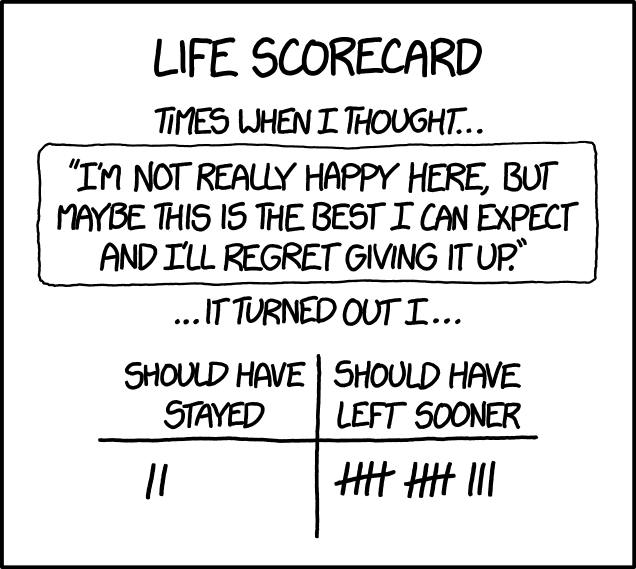
Our society prizes grit and perseverance. Since I was a child I have been taught that these are virtues. And to some extent, they are; there certainly is such a thing as giving up too quickly.

But there is also such a thing as not knowing when to quit. Sometimes things really aren’t going according to plan, and you need to quit before you waste even more time and effort. And I think I am like Randall Monroe in this regard; I am more inclined to stay when I shouldn’t than quit when I shouldn’t:

Sometimes quitting isn’t even as permanent as it is made out to be. In many cases, you can go back later and try again when you are better prepared.

In my case, I am unlikely to ever work at the University of Edinburgh again, but I haven’t yet given up on ever having a career in academia. Then again, I am by no means as certain as I once was that academia is the right path for me. I will definitely be searching for other options.

There is a reason we are so enthusiastically sold on the virtue of perseverance. Part of how our society sells the false narrative of meritocracy is by claiming that people who succeed did so because they tried harder or kept on trying.

This is not entirely false; all other things equal, you are more likely to succeed if you keep on trying. But in some ways that just makes it more seductive and insidious.

For the real reason most people hit home runs in life is they were born on third base. The vast majority of success in life is determined by circumstances entirely outside individual control.


Even having the resources to keep trying is not guaranteed for everyone. I remember a great post on social media pointing out that entrepreneurship is like one of those carnival games:

Entrepreneurship is like one of those carnival games where you throw darts or something.

Middle class kids can afford one throw. Most miss. A few hit the target and get a small prize. A very few hit the center bullseye and get a bigger prize. Rags to riches! The American Dream lives on.

Rich kids can afford many throws. If they want to, they can try over and over and over again until they hit something and feel good about themselves. Some keep going until they hit the center bullseye, then they give speeches or write blog posts about ‘meritocracy’ and the salutary effects of hard work.

Poor kids aren’t visiting the carnival. They’re the ones working it.

The odds of succeeding on any given attempt are slim—but you can always pay for more tries. A middle-class person can afford to try once; mostly those attempts will fail, but a few will succeed and then go on to talk about how their brilliant talent and hard work made the difference. A rich person can try as many times as they like, and when they finally succeed, they can credit their success to perseverance and a willingness to take risks. But the truth is, they didn’t have any exceptional reserves of grit or courage; they just had exceptional reserves of money.

In my case, I was not depleting money (if anything, I’m probably losing out financially by leaving early, though that very much depends on how the job market goes for me): It was something far more valuable. I was whittling away at my own mental health, depleting my energy, draining my motivation. The resource I was exhausting was my very soul.

I still have trouble articulating why it has been so painful for me to work here. It’s so hard to point to anything in particular.

The most obvious downsides were things I knew at the start: The position is temporary, the pay is mediocre, and I had to move across the Atlantic and live thousands of miles from home. And I had already heard plenty about the publish-or-perish system of research publication.

Other things seem like minor annoyances: They never did give me a good office (I have to share it with too many people, and there isn’t enough space, so in fact I rarely use it at all). They were supposed to assign me a faculty mentor and never did. They kept rearranging my class schedule and not telling me things until immediately beforehand.

I think what it really comes down to is I didn’t realize how much it would hurt. I knew that I was moving across the Atlantic—but I didn’t know how isolated and misunderstood I would feel when I did. I knew that publish-or-perish was a problem—but I didn’t know how agonizing it would be for me in particular. I knew I probably wouldn’t get very good mentorship from the other faculty—but I didn’t realize just how bad it would be, or how desperately I would need that support I didn’t get.

I either underestimated the severity of these problems, or overestimated my own resilience. I thought I knew what I was going into, and I thought I could take it. But I was wrong. I couldn’t take it. It was tearing me apart. My only answer was to leave.

So, leave I shall. I have now committed to doing so.

I don’t know what comes next. I don’t even know if I’ve made the right choice. Perhaps I’ll never truly know. But I made the choice, and now I have to live with it.

The Fringe: An overwhelming embarrassment of riches

Aug 20 JDN 2460177

As I write this, Edinburgh is currently in the middle of The Fringe: It’s often described as an “arts and culture festival”, but mainly it consists of a huge number of theatre and comedy performances that go on across the city in hundreds of venues all month long. It’s an “open access festival”, which basically means that it’s half a dozen different festivals that all run independently and are loosely coordinated with one another.

There is truly an embarrassment of riches in the sheer number and variety of performances going on. There’s no way I could ever go to all of them, or even half of them, even though most of them are going on every single day, all month long

It would be tremendously helpful to get good information about which performances are likely to suit my tastes, so I’d know which ones to attend. For once, advertising actually has a genuinely useful function to serve!

And yet, the ads for performances plastered across the city are almost completely useless. They tell you virtually nothing about the content or even style of the various shows. You are bombarded with hundreds of posters for hundreds of performances as you walk through the city, and almost none of them tell you anything useful that would help you decide which shows you want to attend.

Here’s what they look like; imagine this plastered on every bus shelter and spare bit of wall in the city, as well as plenty of specially-built structures explicitly for the purpose:

What I want to ask today is: Why are these posters so uninformative?

I think there are two forces at work here which may explain this phenomenon.

The first is about comedy: Most of these shows are comedy shows, and it’s very hard to explain to someone what is funny about a joke. In fact, most jokes aren’t even funny once they have been explained. Comedy seems to be closely tied to surprise: If you know exactly what they are going to say, it isn’t funny anymore. So it is inherently difficult to explain what’s good about a comedy show without making it actually less funny for those attending.

Yet this is not a complete explanation. For there are some things you could explain about comedy shows without ruining them. You could give it a general genre: political satire, slapstick, alternative, dark comedy, blue comedy, burlesque, cringe, insult, sitcom, parody, surreal, and so on. That would at least tell you something—I tend to like satire and parody, dark and blue are hit-or-miss, surreal leaves me cold, and I can’t stand cringe. And some of the posters do this—yet a remarkable number do not. I often find myself staring at a particular poster, poring over its details, trying to get some inkling of what kind of comedy I could expect from this performer.

To fully explain this, we need something more: And that, I believe, is provided by economic theory.

Consider for a moment that comedy is varied and largely subjective: What one person finds hilarious, another finds boring, and yet another finds outrageously offensive. And whether or not you find a particular routine funny can be hard to predict—even for you.

But consider that money is quite the opposite: Everyone wants it, everyone always wants more of it, and people pretty much want it for the same reasons.

So when you offer to pay money for comedy, you are offering something fundamentally fungible and objective in exchange for something almost totally individual and subjective. You are giving what everyone wants in exchange for something that only some people want and you yourself may or may not want—and may have no way of knowing whether you want until you have it.

I believe it is in the interests of the performers to keep you in the dark in this way. They don’t want to resolve your ignorance too thoroughly. Their goal is not to find the market niche of people who would most enjoy their comedy. Their goal is to get as many people as possible to show up to their shows. Even if someone absolutely hates their show, if they bought tickets, that’s a win. And even any negative reviews or word-of-mouth they might try to give the comedian is probably still a win—comedians are one profession for which there really may be no such thing as bad publicity.

In other words, even these relatively helpful advertisements aren’t actually designed to inform you. They are, as all advertisements are, designed to get you to buy something. And the way to get you to do that is twofold:

First, get your attention. That’s vital. And it’s quite difficult in such a saturated environment. As a result, all of the posters are quite eye-catching and often bizarre. They use loud colors and striking images, and the whole city is filled with them. It actually becomes exhausting to look at them all; but this is the Nash equilibrium, because there is an arms race between different performers to look more interesting and exciting than all the rest.

Second, convince you to go. But let’s be clear about this: It is not necessary to make you absolutely certain that this show is one you’ll enjoy. It is merely to tip the balance of probability, make you reasonably confident that it is likely to be one you’ll enjoy. Given the subjectivity and unpredictability of comedy, any attendee knows that they are likely to end up with a few duds. That risk effectively gets priced in: You accept that one £10 ticket may be wasted, in exchange for buying another £10 ticket that you’d have gladly paid £20 for.

If the posters tried to give more details about what the shows were about, there would be two costs to this: One, it might make the posters less eye-catching and interesting in the first place. And two, it might (perhaps correctly!) convince some customers that this flavor of comedy really wasn’t for them, making them decide not to buy a ticket. The task when designing such a poster, then, is to make one that conveys enough that people are willing to take the chance on it—but not too much so that you might scare some potential audience members away.

I think that this has implications which go beyond comedy. In fact, I think that something quite similar is going on with political speeches. But I’ll save that one for another post.

Where is the money going in academia?

Feb 19 JDN 2459995

A quandary for you:

My salary is £41,000.

Annual tuition for a full-time full-fee student in my department is £23,000.

I teach roughly the equivalent of one full-time course (about 1/2 of one and 1/4 of two others; this is typically counted as “teaching 3 courses”, but if I used that figure, it would underestimate the number of faculty needed).

Each student takes about 5 or 6 courses at a time.

Why do I have 200 students?

If you multiply this out, the 200 students I teach, divided by the 6 instructors they have at one time, times the £23,000 they are paying… I should be bringing in over £760,000 for the university. Why am I paid only 5% of that?

Granted, there are other costs a university must bear aside from paying instructors. There are facilities, and administration, and services. And most of my students are not full-fee paying; that £23,000 figure really only applies to international students.

Students from Scotland pay only £1,820, but there aren’t very many of them, and public funding is supposed to make up that difference. Even students from the rest of the UK pay £9,250. And surely the average tuition paid has got to be close to that? Yet if we multiply that out, £9,000 times 200 divided by 6, we’re still looking at £300,000. So I’m still getting only 14%.

Where is the rest going?

This isn’t specific to my university by any means. It seems to be a global phenomenon. The best data on this seems to be from the US.

According to salary.com, the median salary for an adjunct professor in the US is about $63,000. This actually sounds high, given what I’ve heard from other entry-level faculty. But okay, let’s take that as our figure. (My pay is below this average, though how much depends upon the strength of the pound against the dollar. Currently the pound is weak, so quite a bit.)

Yet average tuition for out-of-state students at public college is $23,000 per year.

This means that an adjunct professor in the US with 200 students takes in $760,000 but receives $63,000. Where does that other $700,000 go?

If you think that it’s just a matter of paying for buildings, service staff, and other costs of running a university, consider this: It wasn’t always this way.

Since 1970, inflation-adjusted salaries for US academic faculty at public universities have risen a paltry 3.1%. In other words, basically not at all.

This is considerably slower than the growth of real median household income, which has risen almost 40% in that same time.

Over the same interval, nominal tuition has risen by over 2000%; adjusted for inflation, this is a still-staggering increase of 250%.

In other words, over the last 50 years, college has gotten three times as expensive, but faculty are still paid basically the same. Where is all this extra money going?

Part of the explanation is that public funding for colleges has fallen over time, and higher tuition partly makes up the difference. But private school tuition has risen just as fast, and their faculty salaries haven’t kept up either.

In their annual budget report, the University of Edinburgh proudly declares that their income increased by 9% last year. Let me assure you, my salary did not. (In fact, inflation-adjusted, my salary went down.) And their EBITDA—earnings before interest, taxes, depreciation, and amortization—was £168 million. Of that, £92 million was lost to interest and depreciation, but they don’t pay taxes at all, so their real net income was about £76 million. In the report, they include price changes of their endowment and pension funds to try to make this number look smaller, ending up with only £37 million, but that’s basically fiction; these are just stock market price drops, and they will bounce back.

Using similar financial alchemy, they’ve been trying to cut our pensions lately, because they say they “are too expensive” (because the stock market went down—nevermind that it’ll bounce back in a year or two). Fortunately, the unions are fighting this pretty hard. I wish they’d also fight harder to make them put people like me on the tenure track.

Had that £76 million been distributed evenly between all 5,000 of us faculty, we’d each get an extra £15,600.

Well, then, that solves part of the mystery in perhaps the most obvious, corrupt way possible: They’re literally just hoarding it.

And Edinburgh is far from the worst offender here. No, that would be Harvard, who are sitting on over $50 billion in assets. Since they have 21,000 students, that is over $2 million per student. With even a moderate return on its endowment, Harvard wouldn’t need to charge tuition at all.

But even then, raising my salary to £56,000 wouldn’t explain why I need to teach 200 students. Even that is still only 19% of the £300,000 those students are bringing in. But hey, then at least the primary service for which those students are here for might actually account for one-fifth of what they’re paying!

Now let’s considers administrators. Median salary for a university administrator in the US is about $138,000—twice what adjunct professors make.


Since 1970, that same time interval when faculty salaries were rising a pitiful 3% and tuition was rising a staggering 250%, how much did chancellors’ salaries increase? Over 60%.

Of course, the number of administrators is not fixed. You might imagine that with technology allowing us to automate a lot of administrative tasks, the number of administrators could be reduced over time. If that’s what you thought happened, you would be very, very wrong. The number of university administrators in the US has more than doubled since the 1980s. This is far faster growth than the number of students—and quite frankly, why should the number of administrators even grow with the number of students? There is a clear economy of scale here, yet it doesn’t seem to matter.

Combine those two facts: 60% higher pay times twice as many administrators means that universities now spend at least 3 times as much on administration as they did 50 years ago. (Why, that’s just about the proportional increase in tuition! Coincidence? I think not.)

Edinburgh isn’t even so bad in this regard. They have 6,000 administrative staff versus 5,000 faculty. If that already sounds crazy—more admins than instructors?—consider that the University of Michigan has 7,000 faculty but 19,000 administrators.

Michigan is hardly exceptional in this regard: Illinois UC has 2,500 faculty but nearly 8,000 administrators, while Ohio State has 7,300 faculty and 27,000 administrators. UCLA is even worse, with only 4,000 faculty but 26,000 administrators—a ratio of 6 to 1. It’s not the UC system in general, though: My (other?) alma mater of UC Irvine somehow supports 5,600 faculty with only 6,400 administrators. Yes, that’s right; compared to UCLA, UCI has 40% more faculty but 76% fewer administrators. (As far as students? UCLA has 47,000 while UCI has 36,000.)

At last, I think we’ve solved the mystery! Where is all the money in academia going? Administrators.

They keep hiring more and more of them, and paying them higher and higher salaries. Meanwhile, they stop hiring tenure-track faculty and replace them with adjuncts that they can get away with paying less. And then, whatever they manage to save that way, they just squirrel away into the endowment.

A common right-wing talking point is that more institutions should be “run like a business”. Well, universities seem to have taken that to heart. Overpay your managers, underpay your actual workers, and pocket the savings.

The United Kingdom in transition

Oct 30 JDN 2459883

When I first decided to move to Edinburgh, I certainly did not expect it to be such a historic time. The pandemic was already in full swing, but I thought that would be all. But this year I was living in the UK when its leadership changed in two historic ways:

First, there was the death of Queen Elizabeth II, and the coronation of King Charles III.

Second, there was the resignation of Boris Johnson, the appointment of Elizabeth Truss, and then, so rapidly I feel like I have whiplash, the resignation of Elizabeth Truss.

In other words, I have seen the end of the longest-reigning monarch and the rise and fall of the shortest-reigning prime minister in the history of the United Kingdom. The three hundred-year history of the United Kingdom.

The prior probability of such a 300-year-historic event happening during my own 3-year term in the UK is approximately 1%. Yet, here we are. A new king, one of a handful of genuine First World monarchs to be coronated in the 21st century. The others are the Netherlands, Belgium, Spain, Monaco, Andorra, and Luxembourg; none of these have even a third the population of the UK, and if we include every Commonwealth Realm (believe it or not, “realm” is in fact still the official term), Charles III is now king of a supranational union with a population of over 150 million people—half the size of the United States. (Yes, he’s your king too, Canada!) Note that Charles III is not king of the entire Commonwealth of Nations, which includes now-independent nations such as India, Pakistan, and South Africa; that successor to the British Empire contains 54 nations and has a population of over 2 billion.

I still can’t quite wrap my mind around this idea of having a king. It feels even more ancient and anachronistic than the 400-year-old university I work at. Of course I knew that we had a queen before, and that she was old and would presumably die at some point and probably be replaced; but that wasn’t really salient information to me until she actually did die and then there was a ten-mile-long queue to see her body and now next spring they will be swearing in this new guy as the monarch of the fourteen realms. It now feels like I’m living in one of those gritty satirical fractured fairy tales. Maybe it’s an urban fantasy setting; it feels a lot like Shrek, to be honest.

Yet other than feeling surreal, none of this has affected my life all that much. I haven’t even really felt the effects of inflation: Groceries and restaurant meals seem a bit more expensive than they were when we arrived, but it’s well within what our budget can absorb; we don’t have a car here, so we don’t care about petrol prices; and we haven’t even been paying more than usual in natural gas because of the subsidy programs. Actually it’s probably been good for our household finances that the pound is so weak and the dollar is so strong. I have been much more directly affected by the university union strikes: being temporary contract junior faculty (read: expendable), I am ineligible to strike and hence had to cross a picket line at one point.

Perhaps this is what history has always felt like for most people: The kings and queens come and go, but life doesn’t really change. But I honestly felt more directly affected by Trump living in the US than I did by Truss living in the UK.

This may be in part because Elizabeth Truss was a very unusual politician; she combined crazy far-right economic policy with generally fairly progressive liberal social policy. A right-wing libertarian, one might say. (As Krugman notes, such people are astonishingly rare in the electorate.) Her socially-liberal stance meant that she wasn’t trying to implement horrific hateful policies against racial minorities or LGBT people the way that Trump was, and for once her horrible economic policies were recognized immediately as such and quickly rescinded. Unlike Trump, Truss did not get the chance to appoint any supreme court justices who could go on to repeal abortion rights.

Then again, Truss couldn’t have appointed any judges if she’d wanted to. The UK Supreme Court is really complicated, and I honestly don’t understand how it works; but from what I do understand, the Prime Minister appoints the Lord Chancellor, the Lord Chancellor forms a commission to appoint the President of the Supreme Court, and the President of the Supreme Court forms a commission to appoint new Supreme Court judges. But I think the monarch is considered the ultimate authority and can veto any appointment along the way. (Or something. Sometimes I get the impression that no one truly understands the UK system, and they just sort of go with doing things as they’ve always been done.) This convoluted arrangement seems to grant the court considerably more political independence than its American counterpart; also, unlike the US Supreme Court, the UK Supreme Court is not allowed to explicitly overturn primary legislation. (Fun fact: The Lord Chancellor is also the Keeper of the Great Seal of the Realm, because Great Britain hasn’t quite figured out that the 13th century ended yet.)

It’s sad and ironic that it was precisely by not being bigoted and racist that Truss ensured she would not have sufficient public support for her absurd economic policies. There’s a large segment of the population of both the US and UK—aptly, if ill-advisedly, referred to by Clinton as “deplorables”—who will accept any terrible policy as long as it hurts the right people. But Truss failed to appeal to that crucial demographic, and so could find no one to support her. Hence, her approval rating fell to a dismal 10%, and she was outlasted by a head of lettuce.

At the time of writing, the new prime minister has not yet been announced, but the smart money is on Rishi Sunak. (I mean that quite literally; he’s leading in prediction markets.) He’s also socially liberal but fiscally conservative, but unlike Truss he seems to have at least some vague understanding of how economics works. Sunak is also popular in a way Truss never was (though that popularity has been declining recently). So I think we can expect to get new policies which are in the same general direction as what Truss wanted—lower taxes on the rich, more privatization, less spent on social services—but at least Sunak is likely to do so in a way that makes the math(s?) actually add up.

All of this is unfortunate, but largely par for the course for the last few decades. It compares quite favorably to the situation in the US, where somehow a large chunk of Americans either don’t believe that an insurrection attempt occurred, are fine with it, or blame the other side, and as the guardrails of democracy continue breaking, somehow gasoline prices appear to be one of the most important issues in the midterm election.

You know what? Living through history sucks. I don’t want to live in “interesting times” anymore.