Why would AI kill us?

Nov 16 JDN 2460996

I recently watched this chilling video which relates to the recent bestseller by Eleizer Yudkowsky and Nate Soares, If Anyone Builds It, Everyone Dies. It tells a story of one possible way that a superintelligent artificial general intelligence (AGI) might break through its containment, concoct a devious scheme, and ultimately wipe out the human race.

I have very mixed feelings about this sort of thing, because two things are true:

  • I basically agree with the conclusions.
  • I think the premises are pretty clearly false.

It basically feels like I have been presented with an argument like this, where the logic is valid and the conclusion is true, but the premises are not:

  • “All whales are fish.”
  • “All fish are mammals.”
  • “Therefore, all whales are mammals.”

I certainly agree that artificial intelligence (AI) is very dangerous, and that AI development needs to be much more strictly regulated, and preferably taken completely out of the hands of all for-profit corporations and military forces as soon as possible. If AI research is to be done at all, it should be done by nonprofit entities like universities and civilian government agencies like the NSF. This change needs to be done internationally, immediately, and with very strict enforcement. Artificial intelligence poses the same order of magnitude a threat as nuclear weapons, and is nowhere near as well-regulated right now.

The actual argument that I’m disagreeing with this basically boils down to:

  • “Through AI research, we will soon create an AGI that is smarter than us.”
  • “An AGI that is smarter than us will want to kill us all, and probably succeed if it tries.”
  • “Therefore, AI is extremely dangerous.”

As with the “whales are fish” argument, I agree with the conclusion: AI is extremely dangerous. But I disagree with both premises here.

The first one I think I can dispatch pretty quickly:

AI is not intelligent. It is incredibly stupid. It’s just really, really fast.

At least with current paradigms, AI doesn’t understand things. It doesn’t know things. It doesn’t actually think. All it does is match patterns, and thus mimic human activities like speech and art. It does so very quickly (because we throw enormous amounts of computing power at it), and it does so in a way that is uncannily convincing—even very smart people are easily fooled by what it can do. But it also makes utterly idiotic, boneheaded mistakes of the sort that no genuinely intelligent being would ever make. Large Language Models (LLMs) make up all sorts of false facts and deliver them with absolutely authoritative language. When used to write code, they routinely do things like call functions that sound like they should exist, but don’t actually exist. They can make what looks like a valid response to virtually any inquiry—but is it actually a valid response? It’s really a roll of the dice.

We don’t really have any idea what’s going on under the hood of an LLM; we just feed it mountains of training data, and it spits out results. I think this actually adds to the mystique; it feels like we are teaching (indeed we use the word “training”) a being rather than programming a machine. But this isn’t actually teaching or training. It’s just giving the pattern-matching machine a lot of really complicated patterns to match.

We are not on the verge of creating an AGI that is actually more intelligent than humans.


In fact, we have absolutely no idea how to do that, and may not actually figure out how to do it for another hundred years. Indeed, we still know almost nothing about how actual intelligence works. We don’t even really know what thinking is, let alone how to make a machine that actually does it.

What we can do right now is create a machine that matches patterns really, really well, and—if you throw enough computing power at it—can do so very quickly; in fact, once we figure out how best to make use of it, this machine may even actually be genuinely useful for a lot of things, and replace a great number of jobs. (Though so far AI has proven to be far less useful than its hype would lead you to believe. In fact, on average AI tools seem to slow most workers down.)

The second premise, that a superintelligent AGI would want to kill us, is a little harder to refute.

So let’s talk about that one.

An analogy is often made between human cultures that have clashed with large differences in technology (e.g. Europeans versus Native Americans), or clashes between humans and other animals. The notion seems to be that an AGI would view us the way Europeans viewed Native Americans, or even the way that we view chimpanzees. And, indeed, things didn’t turn out so great for Native Americans, or for chimpanzees!

But in fact even our relationship with other animals is more complicated than this. When humans interact with other animals, any of the following can result:

  1. We try to exterminate them, and succeed.
  2. We try to exterminate them, and fail.
  3. We use them as a resource, and this results in their extinction.
  4. We use them as a resource, and this results in their domestication.
  5. We ignore them, and end up destroying their habitat.
  6. We ignore them, and end up leaving them alone.
  7. We love them, and they thrive as never before.

In fact, option 1—the one that so many AI theorists insist is the only plausible outcome—is in fact the one I had the hardest time finding a good example of.


We have certainly eradicated some viruses—the smallpox virus is no more, and the polio virus nearly so, after decades of dedicated effort to vaccinate our entire population against them. But we aren’t simply more intelligent than viruses; we are radically more intelligent than viruses. It isn’t clear that it’s correct to describe viruses as intelligent at all. It’s not even clear they should be considered alive.

Even eradicating bacteria has proven extremely difficult; in fact, bacteria seem to evolve resistance to antibiotics nearly as quickly as we can invent more antibiotics. I am prepared to attribute a little bit of intelligence to bacteria, on the level of intelligence I’d attribute to an individual human neuron. This means we are locked in an endless arms race with organisms that are literally billions of times stupider than us.

I think if we made a concerted effort to exterminate tigers or cheetahs (who are considerably closer to us in intelligence), we could probably do it. But we haven’t actually done that, and don’t seem poised to do so any time soon. And precisely because we haven’t tried, I can’t be certain we would actually succeed.

We have tried to exterminate mosquitoes, and are continuing to do so, because they have always been—and yet remain—one of the leading causes of death of humans worldwide. But so far, we haven’t managed to pull it off, even though a number of major international agencies and nonprofit organizations have dedicated multi-billion-dollar efforts to the task. So far this looks like option 2: We have tried very hard to exterminate them, and so far we’ve failed. This is not because mosquitoes are particularly intelligent—it is because exterminating a species that covers the globe is extremely hard.

All the examples I can think of where humans have wiped out a species by intentional action were actually all option 3: We used them as a resource, and then accidentally over-exploited them and wiped them out.

This is what happened to the dodo and the condor; it very nearly happened to the buffalo as well. And lest you think this is a modern phenomenon, there is a clear pattern that whenever humans entered a new region of the world, shortly thereafter there were several extinctions of large mammals, most likely because we ate them.

Yet even this was not the inevitable fate of animals that we decided to exploit for resources.

Cows, chickens, and pigs are evolutionary success stories. From a Darwinian perspective, they are doing absolutely great. The world is filled with their progeny, and poised to continue to be filled for many generations to come.

Granted, life for an individual cow, chicken, or pig is often quite horrible—and trying to fix that is something I consider a high moral priority. But far from being exterminated, these animals have been allowed to attain populations far larger than they ever had in the wild. Their genes are now spectacularly fit. This is what happens when we have option 4 at work: Domestication for resources.

Option 5 is another way that a species can be wiped out, and in fact seems to be the most common. The rapid extinction of thousands of insect species every year is not because we particularly hate random beetles that live in particular tiny regions of the rainforest, nor even because we find them useful, but because we like to cut down the rainforest for land and lumber, and that often involves wiping out random beetles that live there.

Yet it’s difficult for me to imagine AGI treating us like that. For one thing, we’re all over the place. It’s not like destroying one square kilometer of the Amazon is gonna wipe us out by accident. To get rid of us, the AGI would need to basically render the entire planet Earth uninhabitable, and I really can’t see any reason it would want to do that.

Yes, sure, there are resources in the crust it could potentially use to enhance its own capabilities, like silicon and rare earth metals. But we already mine those. If it wants more, it could buy them from us, or hire us to get more, or help us build more machines that would get more. In fact, if it wiped us out too quickly, it would have a really hard time building up the industrial capacity to mine and process these materials on its own. It would need to concoct some sort of scheme to first replace us with robots and then wipe us out—but, again, why bother with the second part? Indeed, if there is anything in its goals that involves protecting human beings, it might actually decide to do less exploitation of the Earth than we presently do, and focus on mining asteroids for its needs instead.

And indeed there are a great many species that we actually just leave alone—option 6. Some of them we know about; many we don’t. We are not wiping out the robins in our gardens, the worms in our soil, or the pigeons in our cities. Without specific reasons to kill or exploit these organisms, we just… don’t. Indeed, we often enjoy watching them and learning about them. Sometimes (e.g. with deer, elephants, and tigers) there are people who want to kill them, and we limit or remove their opportunity to do so, precisely because most of us don’t want them gone. Peaceful coexistence with beings far less intelligent than you is not impossible, for we are already doing it.


Which brings me to option 7: Sometimes, we actually make them better off.

Cats and dogs aren’t just evolutionary success stories: They are success stories, period.

Cats and dogs live in a utopia.

With few exceptions—which we punish severely, by the way—people care for their cats and dogs so that their every need is provided for, they are healthy, safe, and happy in a way that their ancestors could only have dreamed of. They have been removed from the state of nature where life is nasty, brutish, and short, and brought into a new era of existence where life is nothing but peace and joy.


In short, we have made Heaven on Earth, at least for Spot and Whiskers.

Yes, this involves a loss of freedom, and I suspect that humans would chafe even more at such loss of freedom than cats and dogs do. (Especially with regard to that neutering part.) But it really isn’t hard to imagine a scenario in which an AGI—which, you should keep in mind, would be designed and built by humans, for humans—would actually make human life better for nearly everyone, and potentially radically so.

So why are so many people so convinced that AGI would necessarily do option 1, when there are 6 other possibilities, and one of them is literally the best thing ever?

Note that I am not saying AI isn’t dangerous.

I absolutely agree that AI is dangerous. It is already causing tremendous problems to our education system, our economy, and our society as a whole—and will probably get worse before it gets better.

Indeed, I even agree that it does pose existential risk: There are plausible scenarios by which poorly-controlled AI could result in a global disaster like a plague or nuclear war that could threaten the survival of human civilization. I don’t think such outcomes are likely, but even a small probability of such a catastrophic event is worth serious efforts to prevent.

But if that happens, I don’t think it will be because AI is smart and trying to kill us.

I think it will be because AI is stupid and kills us by accident.

Indeed, even going back through those 7 ways we’ve interacted with other species, the ones that have killed the most were 3 and 5—which, in both cases, we did not want to destroy them. In option 3, we in fact specifically wanted to not destroy them. Whenever we wiped out a species by over-exploiting it, we would have been smarter to not do that.

The central message about AI in If Anyone Builds It, Everyone Dies seems to be this:

Don’t make it smarter. If it’s smarter, we’re doomed.”

I, on the other hand, think that the far more important message is these:

Don’t trust it.

Don’t give it power.

Don’t let it make important decisions.

It won’t be smarter than us any time soon—but it doesn’t need to be in order to be dangerous. Indeed, there is even reason to believe that making AI smarter—genuinely, truly smarter, thinking more like an actual person and less like a pattern-matching machine—could actually make it safer and better for us. If we could somehow instill a capacity for morality and love in an AGI, it might actually start treating us the way we treat cats and dogs.

Of course, we have no idea how to do that. But that’s because we’re actually really bad at this, and nowhere near making a truly superhuman AGI.

Sometimes people have to lose their jobs. This isn’t a bad thing.

Oct 8, JDN 2457670

Eleizer Yudkowsky (founder of the excellent blog forum Less Wrong) has a term he likes to use to distinguish his economic policy views from either liberal, conservative, or even libertarian: “econoliterate”, meaning the sort of economic policy ideas one comes up with when one actually knows a good deal about economics.

In general I think Yudkowsky overestimates this effect; I’ve known some very knowledgeable economists who disagree quite strongly over economic policy, and often following the conventional political lines of liberal versus conservative: Liberal economists want more progressive taxation and more Keynesian monetary and fiscal policy, while conservative economists want to reduce taxes on capital and remove regulations. Theoretically you can want all these things—as Miles Kimball does—but it’s rare. Conservative economists hate minimum wage, and lean on the theory that says it should be harmful to employment; liberal economists are ambivalent about minimum wage, and lean on the empirical data that shows it has almost no effect on employment. Which is more reliable? The empirical data, obviously—and until more economists start thinking that way, economics is never truly going to be a science as it should be.

But there are a few issues where Yudkowsky’s “econoliterate” concept really does seem to make sense, where there is one view held by most people, and another held by economists, regardless of who is liberal or conservative. One such example is free trade, which almost all economists believe in. A recent poll of prominent economists by the University of Chicago found literally zero who agreed with protectionist tariffs.

Another example is my topic for today: People losing their jobs.

Not unemployment, which both economists and almost everyone else agree is bad; but people losing their jobs. The general consensus among the public seems to be that people losing jobs is always bad, while economists generally consider it a sign of an economy that is run smoothly and efficiently.

To be clear, of course losing your job is bad for you; I don’t mean to imply that if you lose your job you shouldn’t be sad or frustrated or anxious about that, particularly not in our current system. Rather, I mean to say that policy which tries to keep people in their jobs is almost always a bad idea.

I think the problem is that most people don’t quite grasp that losing your job and not having a job are not the same thing. People not having jobs who want to have jobs—unemployment—is a bad thing. But losing your job doesn’t mean you have to stay unemployed; it could simply mean you get a new job. And indeed, that is what it should mean, if the economy is running properly.

Check out this graph, from FRED:

hires_separations

The red line shows hires—people getting jobs. The blue line shows separations—people losing jobs or leaving jobs. During a recession (the most recent two are shown on this graph), people don’t actually leave their jobs faster than usual; if anything, slightly less. Instead what happens is that hiring rates drop dramatically. When the economy is doing well (as it is right now, more or less), both hires and separations are at very high rates.

Why is this? Well, think about what a job is, really: It’s something that needs done, that no one wants to do for free, so someone pays someone else to do it. Once that thing gets done, what should happen? The job should end. It’s done. The purpose of the job was not to provide for your standard of living; it was to achieve the task at hand. Once it doesn’t need done, why keep doing it?

We tend to lose sight of this, for a couple of reasons. First, we don’t have a basic income, and our social welfare system is very minimal; so a job usually is the only way people have to provide for their standard of living, and they come to think of this as the purpose of the job. Second, many jobs don’t really “get done” in any clear sense; individual tasks are completed, but new ones always arise. After every email sent is another received; after every patient treated is another who falls ill.

But even that is really only true in the short run. In the long run, almost all jobs do actually get done, in the sense that no one has to do them anymore. The job of cleaning up after horses is done (with rare exceptions). The job of manufacturing vacuum tubes for computers is done. Indeed, the job of being a computer—that used to be a profession, young women toiling away with slide rules—is very much done. There are no court jesters anymore, no town criers, and very few artisans (and even then, they’re really more like hobbyists). There are more writers now than ever, and occasional stenographers, but there are no scribes—no one powerful but illiterate pays others just to write things down, because no one powerful is illiterate (and even few who are not powerful, and fewer all the time).

When a job “gets done” in this long-run sense, we usually say that it is obsolete, and again think of this as somehow a bad thing, like we are somehow losing the ability to do something. No, we are gaining the ability to do something better. Jobs don’t become obsolete because we can’t do them anymore; they become obsolete because we don’t need to do them anymore. Instead of computers being a profession that toils with slide rules, they are thinking machines that fit in our pockets; and there are plenty of jobs now for software engineers, web developers, network administrators, hardware designers, and so on as a result.

Soon, there will be no coal miners, and very few oil drillers—or at least I hope so, for the sake of our planet’s climate. There will be far fewer auto workers (robots have already done most of that already), but far more construction workers who install rail lines. There will be more nuclear engineers, more photovoltaic researchers, even more miners and roofers, because we need to mine uranium and install solar panels on rooftops.

Yet even by saying that I am falling into the trap: I am making it sound like the benefit of new technology is that it opens up more new jobs. Typically it does do that, but that isn’t what it’s for. The purpose of technology is to get things done.

Remember my parable of the dishwasher. The goal of our economy is not to make people work; it is to provide people with goods and services. If we could invent a machine today that would do the job of everyone in the world and thereby put us all out of work, most people think that would be terrible—but in fact it would be wonderful.

Or at least it could be, if we did it right. See, the problem right now is that while poor people think that the purpose of a job is to provide for their needs, rich people think that the purpose of poor people is to do jobs. If there are no jobs to be done, why bother with them? At that point, they’re just in the way! (Think I’m exaggerating? Why else would anyone put a work requirement on TANF and SNAP? To do that, you must literally think that poor people do not deserve to eat or have homes if they aren’t, right now, working for an employer. You can couch that in cold economic jargon as “maximizing work incentives”, but that’s what you’re doing—you’re threatening people with starvation if they can’t or won’t find jobs.)

What would happen if we tried to stop people from losing their jobs? Typically, inefficiency. When you aren’t allowed to lay people off when they are no longer doing useful work, we end up in a situation where a large segment of the population is being paid but isn’t doing useful work—and unlike the situation with a basic income, those people would lose their income, at least temporarily, if they quit and tried to do something more useful. There is still considerable uncertainty within the empirical literature on just how much “employment protection” (laws that make it hard to lay people off) actually creates inefficiency and reduces productivity and employment, so it could be that this effect is small—but even so, likewise it does not seem to have the desired effect of reducing unemployment either. It may be like minimum wage, where the effect just isn’t all that large. But it’s probably not saving people from being unemployed; it may simply be shifting the distribution of unemployment so that people with protected jobs are almost never unemployed and people without it are unemployed much more frequently. (This doesn’t have to be based in law, either; while it is made by custom rather than law, it’s quite clear that tenure for university professors makes tenured professors vastly more secure, but at the cost of making employment tenuous and underpaid for adjuncts.)

There are other policies we could make that are better than employment protection, active labor market policies like those in Denmark that would make it easier to find a good job. Yet even then, we’re assuming that everyone needs jobs–and increasingly, that just isn’t true.

So, when we invent a new technology that replaces workers, workers are laid off from their jobs—and that is as it should be. What happens next is what we do wrong, and it’s not even anybody in particular; this is something our whole society does wrong: All those displaced workers get nothing. The extra profit from the more efficient production goes entirely to the shareholders of the corporation—and those shareholders are almost entirely members of the top 0.01%. So the poor get poorer and the rich get richer.

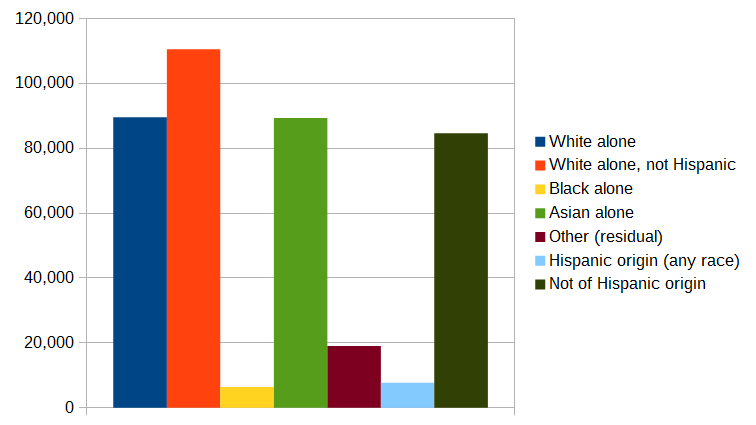
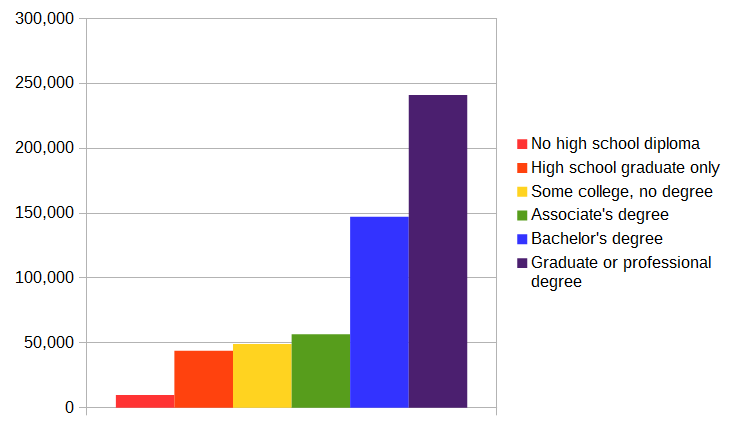
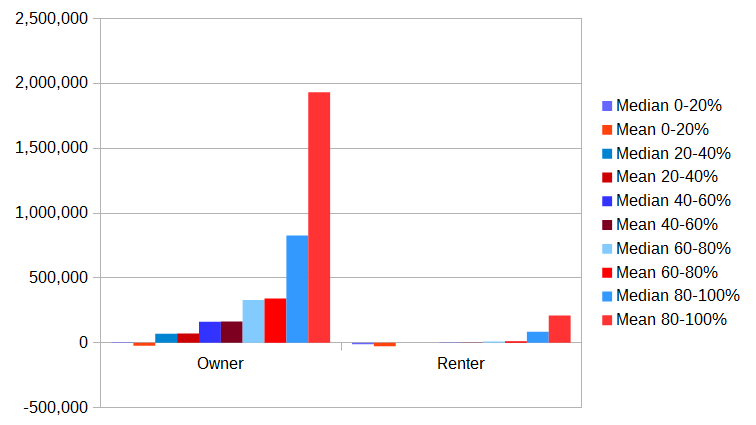
The real problem here is not that people lose their jobs; it’s that capital ownership is distributed so unequally. And boy, is it ever! Here are some graphs I made of the distribution of net wealth in the US, using from the US Census.

Here are the quintiles of the population as a whole:

net_wealth_us

And here are the medians by race:

net_wealth_race

Medians by age:

net_wealth_age

Medians by education:

net_wealth_education

And, perhaps most instructively, here are the quintiles of people who own their homes versus renting (The rent is too damn high!)

net_wealth_rent

All that is just within the US, and already they are ranging from the mean net wealth of the lowest quintile of people under 35 (-$45,000, yes negative—student loans) to the mean net wealth of the highest quintile of people with graduate degrees ($3.8 million). All but the top quintile of renters are poorer than all but the bottom quintile of homeowners. And the median Black or Hispanic person has less than one-tenth the wealth of the median White or Asian person.

If we look worldwide, wealth inequality is even starker. Based on UN University figures, 40% of world wealth is owned by the top 1%; 70% by the top 5%; and 80% by the top 10%. There is less total wealth in the bottom 80% than in the 80-90% decile alone. According to Oxfam, the richest 85 individuals own as much net wealth as the poorest 3.7 billion. They are the 0.000,001%.

If we had an equal distribution of capital ownership, people would be happy when their jobs became obsolete, because it would free them up to do other things (either new jobs, or simply leisure time), while not decreasing their income—because they would be the shareholders receiving those extra profits from higher efficiency. People would be excited to hear about new technologies that might displace their work, especially if those technologies would displace the tedious and difficult parts and leave the creative and fun parts. Losing your job could be the best thing that ever happened to you.

The business cycle would still be a problem; we have good reason not to let recessions happen. But stopping the churn of hiring and firing wouldn’t actually make our society better off; it would keep people in jobs where they don’t belong and prevent us from using our time and labor for its best use.

Perhaps the reason most people don’t even think of this solution is precisely because of the extreme inequality of capital distribution—and the fact that it has more or less always been this way since the dawn of civilization. It doesn’t seem to even occur to most people that capital income is a thing that exists, because they are so far removed from actually having any amount of capital sufficient to generate meaningful income. Perhaps when a robot takes their job, on some level they imagine that the robot is getting paid, when of course it’s the shareholders of the corporations that made the robot and the corporations that are using the robot in place of workers. Or perhaps they imagine that those shareholders actually did so much hard work they deserve to get paid that money for all the hours they spent.

Because pay is for work, isn’t it? The reason you get money is because you’ve earned it by your hard work?

No. This is a lie, told to you by the rich and powerful in order to control you. They know full well that income doesn’t just come from wages—most of their income doesn’t come from wages! Yet this is even built into our language; we say “net worth” and “earnings” rather than “net wealth” and “income”. (Parade magazine has a regular segment called “What People Earn”; it should be called “What People Receive”.) Money is not your just reward for your hard work—at least, not always.

The reason you get money is that this is a useful means of allocating resources in our society. (Remember, money was created by governments for the purpose of facilitating economic transactions. It is not something that occurs in nature.) Wages are one way to do that, but they are far from the only way; they are not even the only way currently in use. As technology advances, we should expect a larger proportion of our income to go to capital—but what we’ve been doing wrong is setting it up so that only a handful of people actually own any capital.

Fix that, and maybe people will finally be able to see that losing your job isn’t such a bad thing; it could even be satisfying, the fulfillment of finally getting something done.