What do we do about unemployment?

JDN 2457188 EDT 11:21.

Macroeconomics, particularly monetary policy, is primarily concerned with controlling two variables.

The first is inflation: We don’t want prices to rise too fast, or markets will become unstable. This is something we have managed fairly well; other than food and energy prices which are known to be more volatile, prices have grown at a rate between 1.5% and 2.5% per year for the last 10 years; even with food and energy included, inflation has stayed between -1.5% and +5.0%. After recovering from its peak near 15% in 1980, US inflation has stayed between -1.5% and +6.0% ever since. While the optimal rate of inflation is probably between 2.0% and 4.0%, anything above 0.0% and below 10.0% is probably fine, so the only significant failure of US inflation policy was the deflation in 2009.

The second is unemployment: We want enough jobs for everyone who wants to work, and preferably we also wouldn’t have underemployment (people who are only working part-time even though they’d prefer full-time or discouraged workers (people who give up looking for jobs because they can’t find any, and aren’t counted as unemployed because they’re no looking looking for work). There’s also a tendency among economists to want “work incentives” that maximize the number of people who want to work, but I think these are wildly overrated. Work isn’t an end in itself; work is supposed to be creating products and providing services that make human lives better. The benefits of production have to be weighed against the costs of stress, exhaustion, and lost leisure time from working. Given that stress-related illnesses are some of the leading causes of death and disability in the United States, I don’t think that our problem is insufficient work incentives.

Unemployment is a problem that we have definitely not solved. Unemployment has bounced up and down between peaks and valleys, dropping as low as 4.0% and rising as high as 11.0% over the last 60 years. If 2009’s -1.5% deflation concerns you, then its 9.9% unemployment should concern you far more. Indeed, I’m not convinced that 5.0% is an acceptable “natural” rate of unemployment—that’s still millions of people who want work and can’t find it—but most economists would say that it is.

In fact, matters are worse than most people realize. Our unemployment rate has fallen back to a relatively normal 5.5%, as you can see in this graph (the blue line is unemployment, the red line is underemployment):
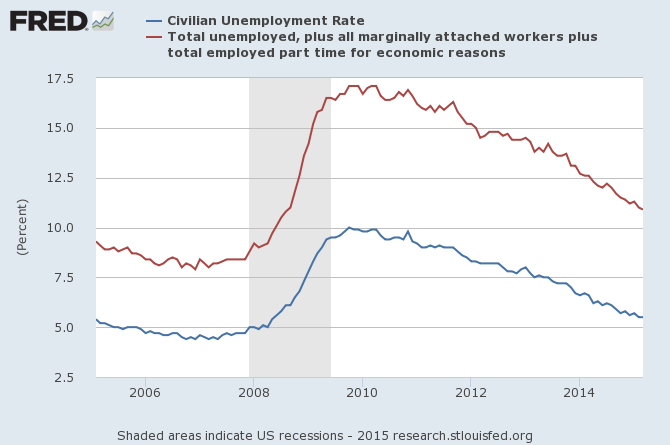
All_Unemployment

However, our employment rate never recovered from the Second Depression. As you can see in this graph, it fell from 63% to 58%, and has now only risen back to 59%:
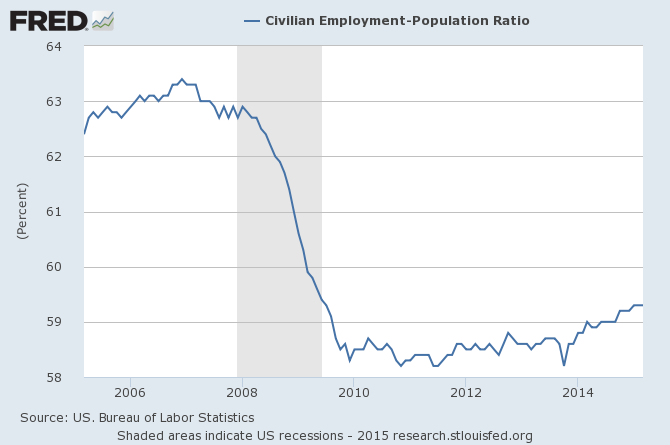
Employment

How can unemployment fall without employment rising? The key is understanding how unemployment is calculated: It only counts people in the labor force. If people leave the labor force entirely, by retiring, going back to school, or simply giving up on finding work, they will no longer be counted as unemployed. The unemployment rate only counts people who want work but don’t have it, so as far as I’m concerned that figure should always be nearly zero. (Not quite zero since it takes some time to find a good fit; but maybe 1% at most. Any more than that and there is something wrong with our economic system.)

The optimal employment rate is not as obvious; it certainly isn’t 100%, as some people are too young, too old, or too disabled to be spending their time working. As automation improves, the number of workers necessary to produce any given product decreases, and eventually we may decide as a society that we are making enough products and most of us should be spending more of our time on other things, like spending time with family, creating works of art, or simply having fun. Maybe only a handful of people, the most driven or the most brilliant, will actually decide to work—and they will do because they want to, not because they have to. Indeed, the truly optimal employment rate might well be zero; think of The Culture, where there is no such concept as a “job”; there are things you do because you want to do them, or because they seem worthwhile, but there is none of this “working for pay” nonsense. We are not yet at the level of automation where this would be possible, but we are much closer than I think most people realize. Think about all of the various administrative and bureaucratic tasks that most people do the majority of the time, all the reports, all the meetings; why do they do that? Is it actually because the work is necessary, that the many levels of bureaucracy actually increase efficiency through specialization? Or is it simply because we’ve become so accustomed to the idea that people have to be working all the time in order to justify their existence? Is David Graeber (I reviewed one of his books previously) right that most jobs are actually (and this is a technical term), “bullshit jobs”? Once again, the problem doesn’t seem to be too few work incentives, but if anything too many.

Indeed, there is a basic fact about unemployment that has been hidden from most people. I’d normally say that this is accidental, that it’s too technical or obscure for most people to understand, but no, I think it has been actively concealed, or, since I guess the information has been publicly available, at least discussion of it has been actively avoided. It’s really not at all difficult to understand, yet it will fundamentally change the way you think about our unemployment problem. Here goes:

Since at least 2000 and probably since 1980 there have been more people looking for jobs than there have been jobs available.

The entire narrative of “people are lazy and don’t want to work” or “we need more work incentives” is just totally, totally wrong; people are desperate to find work, and there hasn’t been enough work for them to find since longer than I’ve been alive.

You can see this on the following graph, which is of what’s called the “Beveridge curve”; the horizontal axis is the unemployment rate, while the vertical axis is the rate of job vacancies. The red line across the diagonal is the point at which the two are even, and there are as many people looking for jobs as there are jobs to fill. Notice how the graph is always below the line. There have always been more unemployed people than jobs for them to fill, and at the worst of the Second Depression the ratio was 5 to 1.

Beveridge_curve_2

Personally I believe that we should be substantially above the line, and in a truly thriving economy there should be employers desperately trying to find employees and willing to pay them whatever it takes. You shouldn’t have to send out 20 job applications to get hired; 20 companies should have to send offers to you. For the economy does not exist to serve corporations; it exists to serve people.

I can see two basic ways to solve this problem: You can either create more jobs, or you can get people to stop looking for work. That may be sort of obvious, but I think people usually forget the second option.

We definitely do talk a lot about “job creation”, though usually in a totally nonsensical way—somehow “Job Creator” has come to be a euphemism for “rich person”. In fact the best way to create jobs is to put money into the hands of people who will spend it. The more people spend their money, the more it flows through the economy and the more wealth we end up with overall. High rates of spending—high marginal propensity to consumecan multiply the value of a dollar many times over.

But there’s also something to be said for getting people to stop looking for work—the key is do it in the right way. They shouldn’t stop looking because they give up; they should stop looking because they don’t need to work. People should have their basic needs met even if they aren’t working for an employer; human beings have rights and dignity beyond their productivity in the market. Employers should have to make you a better offer than “you’ll be homeless if you don’t do this”.

Both of these goals can be accomplished simultaneously by one simple policy: Basic income.

It’s really amazing how many problems can be solved by a basic income; it’s more or less the amazing wonder policy that solves all the world’s economic problems simultaneously. Poverty? Gone. Unemployment? Decimated. Inequality? Contained. (The pilot studies of basic income in India have been successful beyond all but the wildest dreams; they eliminate poverty, improve health, increase entrepreneurial activity, even reduce gender inequality.) The one major problem basic income doesn’t solve is government debt (indeed it likely increases it, at least in the short run), but as I’ve already talked about, that problem is not nearly as bad as most people fear.

And once again I think I should head off accusations that advocating a basic income makes me some sort of far-left Communist radical; Friedrich Hayek supported a basic income.

Basic income would help with unemployment in a third way as well; one of the major reasons unemployment is so harmful is that people who are unemployed can’t provide for themselves or their families. So a basic income would reduce the number of people looking for jobs, increase the number of jobs available, and also make being unemployed less painful, all in one fell swoop. I doubt it would solve the problem of unemployment entirely, but I think it would make an enormous difference.

How is the economy doing?

JDN 2457033 EST 12:22.

Whenever you introduce yourself to someone as an economist, you will typically be asked a single question: “How is the economy doing?” I’ve already experienced this myself, and I don’t have very many dinner parties under my belt.

It’s an odd question, for a couple of reasons: First, I didn’t say I was a macroeconomic forecaster. That’s a very small branch of economics—even a small branch of macroeconomics. Second, it is widely recognized among economists that our forecasters just aren’t very good at what they do. But it is the sort of thing that pops into people’s minds when they hear the word “economist”, so we get asked it a lot.

Why are our forecasts so bad? Some argue that the task is just inherently too difficult due to the chaotic system involved; but they used to say that about weather forecasts, and yet with satellites and computer models our forecasts are now far more accurate than they were 20 years ago. Others have argued that “politics always dominates over economics”, as though politics were somehow a fundamentally separate thing, forever exogenous, a parameter in our models that cannot be predicted. I have a number of economic aphorisms I’m trying to popularize; the one for this occasion is: “Nothing is exogenous.” (Maybe fundamental constants of physics? But actually many physicists think that those constants can be derived from even more fundamental laws.) My most common is “It’s the externalities, stupid.”; next is “It’s not the incentives, it’s the opportunities.”; and the last is “Human beings are 90% rational. But woe betide that other 10%.” In fact, it’s not quite true that all our macroeconomic forecasters are bad; a few, such as Krugman, are actually quite good. The Klein Award is given each year to the best macroeconomic forecasters, and the same names pop up too often for it to be completely random. (Sadly, one of the most common is Citigroup, meaning that our banksters know perfectly well what they’re doing when they destroy our economy—they just don’t care.) So in fact I think our failures of forecasting are not inevitable or permanent.

And of course that’s not what I do at all. I am a cognitive economist; I study how economic systems behave when they are run by actual human beings, rather than by infinite identical psychopaths. I’m particularly interested in what I call the tribal paradigm, the way that people identify with groups and act in the interests of those groups, how much solidarity people feel for each other and why, and what role ideology plays in that identification. I’m hoping to one day formally model solidarity and make directly testable predictions about things like charitable donations, immigration policies and disaster responses.

I do have a more macroeconomic bent than most other cognitive economists; I’m not just interested in how human irrationality affects individuals or corporations, I’m also interested in how it affects society as a whole. But unlike most macroeconomists I care more about inequality than unemployment, and hardly at all about inflation. Unless you start getting 40% inflation per year, inflation really isn’t that harmful—and can you imagine what 40% unemployment would be like? (Also, while 100% inflation is awful, 100% unemployment would be no economy at all.) If we’re going to have a “misery index“, it should weight unemployment at least 10 times as much as inflation—and it should also include terms for poverty and inequality. Frankly maybe we should just use poverty, since I’d be prepared to accept just about any level of inflation, unemployment, or even inequality if it meant eliminating poverty. This is of course is yet another reason why a basic income is so great! An anti-poverty measure can really only be called a failure if it doesn’t actually reduce poverty; the only way that could happen with a basic income is if it somehow completely destabilized the economy, which is extremely unlikely as long as the basic income isn’t something ridiculous like $100,000 per year.

I could probably talk about my master’s thesis; the econometric models are relatively arcane, but the basic idea of correlating the income concentration of the top 1% of 1% and the level of corruption is something most people can grasp easily enough.

Of course, that wouldn’t be much of an answer to “How is the economy doing?”; usually my answer is to repeat what I’ve last read from mainstream macroeconomic forecasts, which is usually rather banal—but maybe that’s the idea? Most small talk is pretty banal I suppose (I never was very good at that sort of thing). It sounds a bit like this: No, we’re not on the verge of horrible inflation—actually inflation is currently too low. (At this point someone will probably bring up the gold standard, and I’ll have to explain that the gold standard is an unequivocally terrible idea on so, so many levels. The gold standard caused the Great Depression.) Unemployment is gradually improving, and actually job growth is looking pretty good right now; but wages are still stagnant, which is probably what’s holding down inflation. We could have prevented the Second Depression entirely, but we didn’t because Republicans are terrible at managing the economy—all of the 10 most recent recessions and almost 80% of the recessions in the last century were under Republican presidents. Instead the Democrats did their best to implement basic principles of Keynesian macroeconomics despite Republican intransigence, and we muddled through. In another year or two we will actually be back at an unemployment rate of 5%, which the Federal Reserve considers “full employment”. That’s already problematic—what about that other 5%?—but there’s another problem as well: Much of our reduction in unemployment has come not from more people being employed but instead by more people dropping out of the labor force. Our labor force participation rate is the lowest it’s been since 1978, and is still trending downward. Most of these people aren’t getting jobs; they’re giving up. At best we may hope that they are people like me, who gave up on finding work in order to invest in their own education, and will return to the labor force more knowledgeable and productive one day—and indeed, college participation rates are also rising rapidly. And no, that doesn’t mean we’re becoming “overeducated”; investment in education, so-called “human capital”, is literally the single most important factor in long-term economic output, by far. Education is why we’re not still in the Stone Age. Physical capital can be replaced, and educated people will do so efficiently. But all the physical capital in the world will do you no good if nobody knows how to use it. When everyone in the world is a millionaire with two PhDs and all our work is done by robots, maybe then you can say we’re “overeducated”—and maybe then you’d still be wrong. Being “too educated” is like being “too rich” or “too happy”.

That’s usually enough to placate my interlocutor. I should probably count my blessings, for I imagine that the first confrontation you get at a dinner party if you say you are a biologist involves a Creationist demanding that you “prove evolution”. I like to think that some mathematical biologists—yes, that’s a thing—take their request literally and set out to mathematically prove that if allele distributions in a population change according to a stochastic trend then the alleles with highest expected fitness have, on average, the highest fitness—which is what we really mean by “survival of the fittest”. The more formal, the better; the goal is to glaze some Creationist eyes. Of course that’s a tautology—but so is literally anything that you can actually prove. Cosmologists probably get similar demands to “prove the Big Bang”, which sounds about as annoying. I may have to deal with gold bugs, but I’ll take them over Creationists any day.

What do other scientists get? When I tell people I am a cognitive scientist (as a cognitive economist I am sort of both an economist and a cognitive scientist after all), they usually just respond with something like “Wow, you must be really smart.”; which I suppose is true enough, but always strikes me as an odd response. I think they just didn’t know enough about the field to even generate a reasonable-sounding question, whereas with economists they always have “How is the economy doing?” handy. Political scientists probably get “Who is going to win the election?” for the same reason. People have opinions about economics, but they don’t have opinions about cognitive science—or rather, they don’t think they do. Actually most people have an opinion about cognitive science that is totally and utterly ridiculous, more on a par with Creationists than gold bugs: That is, most people believe in a soul that survives after death. This is rather like believing that after your computer has been smashed to pieces and ground back into the sand from whence it came, all the files you had on it are still out there somewhere, waiting to be retrieved. No, they’re long gone—and likewise your memories and your personality will be long gone once your brain has rotted away. Yes, we have a soul, but it’s made of lots of tiny robots; when the tiny robots stop working the soul is no more. Everything you are is a result of the functioning of your brain. This does not mean that your feelings are not real or do not matter; they are just as real and important as you thought they were. What it means is that when a person’s brain is destroyed, that person is destroyed, permanently and irrevocably. This is terrifying and difficult to accept; but it is also most definitely true. It is as solid a fact as any in modern science. Many people see a conflict between evolution and religion; but the Pope has long since rendered that one inert. No, the real conflict, the basic fact that undermines everything religion is based upon, is not in biology but in cognitive science. It is indeed the Basic Fact of Cognitive Science: We are our brains, no more and no less. (But I suppose it wouldn’t be polite to bring that up at dinner parties.)

The “You must be really smart.” response is probably what happens to physicists and mathematicians. Quantum mechanics confuses basically everyone, so few dare go near it. The truly bold might try to bring up Schrodinger’s Cat, but are unlikely to understand the explanation of why it doesn’t work. General relativity requires thinking in tensors and four-dimensional spaces—perhaps they’ll be asked the question “What’s inside a black hole?”, which of course no physicist can really answer; the best answer may actually be, “What do you mean, inside?” And if a mathematician tries to explain their work in lay terms, it usually comes off as either incomprehensible or ridiculous: Stokes’ Theorem would be either “the integral of a differential form over the boundary of some orientable manifold is equal to the integral of its exterior derivative over the whole manifold” or else something like “The swirliness added up inside an object is equal to the swirliness added up around the edges.”

Economists, however, always seem to get this one: “How is the economy doing?”

Right now, the answer is this: “It’s still pretty bad, but it’s getting a lot better. Hopefully the new Congress won’t screw that up.”