Bet five dollars for maximum performance

JDN 2457433

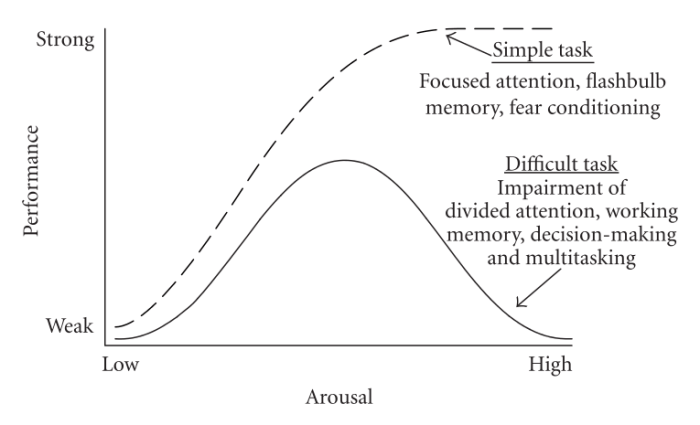
One of the more surprising findings from the study of human behavior under stress is the Yerkes-Dodson curve:

OriginalYerkesDodson
This curve shows how well humans perform at a given task, as a function of how high the stakes are on whether or not they do it properly.

For simple tasks, it says what most people intuitively expect—and what neoclassical economists appear to believe: As the stakes rise, the more highly incentivized you are to do it, and the better you do it.

But for complex tasks, it says something quite different: While increased stakes do raise performance to a point—with nothing at stake at all, people hardly work at all—it is possible to become too incentivized. Formally we say the curve is not monotonic; it has a local maximum.

This is one of many reasons why it’s ridiculous to say that top CEOs should make tens of millions of dollars a year on the rise and fall of their company’s stock price (as a great many economists do in fact say). Even if I believed that stock prices accurately reflect the company’s viability (they do not), and believed that the CEO has a great deal to do with the company’s success, it would still be a case of overincentivizing. When a million dollars rides on a decision, that decision is going to be worse than if the stakes had only been $100. With this in mind, it’s really not surprising that higher CEO pay is correlated with worse company performance. Stock options are terrible motivators, but do offer a subtle way of making wages adjust to the business cycle.

The reason for this is that as the stakes get higher, we become stressed, and that stress response inhibits our ability to use higher cognitive functions. The sympathetic nervous system evolved to make us very good at fighting or running away in the face of danger, which works well should you ever be attacked by a tiger. It did not evolve to make us good at complex tasks under high stakes, the sort of skill we’d need when calculating the trajectory of an errant spacecraft or disarming a nuclear warhead.

To be fair, most of us never have to worry about piloting errant spacecraft or disarming nuclear warheads—indeed, you’re about as likely to get attacked by a tiger even in today’s world. (The rate of tiger attacks in the US is just under 2 per year, and the rate of manned space launches in the US was about 5 per year until the Space Shuttle was terminated.)

There are certain professions, such as pilots and surgeons, where performing complex tasks under life-or-death pressure is commonplace, but only a small fraction of people take such professions for precisely that reason. And if you’ve ever wondered why we use checklists for pilots and there is discussion of also using checklists for surgeons, this is why—checklists convert a single complex task into many simple tasks, allowing high performance even at extreme stakes.

But we do have to do a fair number of quite complex tasks with stakes that are, if not urgent life-or-death scenarios, then at least actions that affect our long-term life prospects substantially. In my tutoring business I encounter one in particular quite frequently: Standardized tests.

Tests like the SAT, ACT, GRE, LSAT, GMAT, and other assorted acronyms are not literally life-or-death, but they often feel that way to students because they really do have a powerful impact on where you’ll end up in life. Will you get into a good college? Will you get into grad school? Will you get the job you want? Even subtle deviations from the path of optimal academic success can make it much harder to achieve career success in the future.

Of course, these are hardly the only examples. Many jobs require us to complete tasks properly on tight deadlines, or else risk being fired. Working in academia infamously requires publishing in journals in time to rise up the tenure track, or else falling off the track entirely. (This incentivizes the production of huge numbers of papers, whether they’re worth writing or not; yes, the number of papers published goes down after tenure, but is that a bad thing? What we need to know is whether the number of good papers goes down. My suspicion is that most if not all of the reduction in publications is due to not publishing things that weren’t worth publishing.)

So if you are faced with this sort of task, what can you do? If you realize that you are faced with a high-stakes complex task, you know your performance will be bad—which only makes your stress worse!

My advice is to pretend you’re betting five dollars on the outcome.

Ignore all other stakes, and pretend you’re betting five dollars. $5.00 USD. Do it right and you get a Lincoln; do it wrong and you lose one.
What this does is ensures that you care enough—you don’t want to lose $5 for no reason—but not too much—if you do lose $5, you don’t feel like your life is ending. We want to put you near that peak of the Yerkes-Dodson curve.

The great irony here is that you most want to do this when it is most untrue. If you actually do have a task for which you’ve bet $5 and nothing else rides on it, you don’t need this technique, and any technique to improve your performance is not particularly worthwhile. It’s when you have a standardized test to pass that you really want to use this—and part of me even hopes that people know to do this whenever they have nuclear warheads to disarm. It is precisely when the stakes are highest that you must put those stakes out of your mind.

Why five dollars? Well, the exact amount is arbitrary, but this is at least about the right order of magnitude for most First World individuals. If you really want to get precise, I think the optimal stakes level for maximum performance is something like 100 microQALY per task, and assuming logarithmic utility of wealth, $5 at the US median household income of $53,600 is approximately 100 microQALY. If you have a particularly low or high income, feel free to adjust accordingly. Literally you should be prepared to bet about an hour of your life; but we are not accustomed to thinking that way, so use $5. (I think most people, if asked outright, would radically overestimate what an hour of life is worth to them. “I wouldn’t give up an hour of my life for $1,000!” Then why do you work at $20 an hour?)

It’s a simple heuristic, easy to remember, and sometimes effective. Give it a try.

How to change the world

JDN 2457166 EDT 17:53.

I just got back from watching Tomorrowland, which is oddly appropriate since I had already planned this topic in advance. How do we, as they say in the film, “fix the world”?

I can’t find it at the moment, but I vaguely remember some radio segment on which a couple of neoclassical economists were interviewed and asked what sort of career can change the world, and they answered something like, “Go into finance, make a lot of money, and then donate it to charity.”

In a slightly more nuanced form this strategy is called earning to give, and frankly I think it’s pretty awful. Most of the damage that is done to the world is done in the name of maximizing profits, and basically what you end up doing is stealing people’s money and then claiming you are a great altruist for giving some of it back. I guess if you can make enormous amounts of money doing something that isn’t inherently bad and then donate that—like what Bill Gates did—it seems better. But realistically your potential income is probably not actually raised that much by working in finance, sales, or oil production; you could have made the same income as a college professor or a software engineer and not be actively stripping the world of its prosperity. If we actually had the sort of ideal policies that would internalize all externalities, this dilemma wouldn’t arise; but we’re nowhere near that, and if we did have that system, the only billionaires would be Nobel laureate scientists. Albert Einstein was a million times more productive than the average person. Steve Jobs was just a million times luckier. Even then, there is the very serious question of whether it makes sense to give all the fruits of genius to the geniuses themselves, who very quickly find they have all they need while others starve. It was certainly Jonas Salk’s view that his work should only profit him modestly and its benefits should be shared with as many people as possible. So really, in an ideal world there might be no billionaires at all.

Here I would like to present an alternative. If you are an intelligent, hard-working person with a lot of talent and the dream of changing the world, what should you be doing with your time? I’ve given this a great deal of thought in planning my own life, and here are the criteria I came up with:

  1. You must be willing and able to commit to doing it despite great obstacles. This is another reason why earning to give doesn’t actually make sense; your heart (or rather, limbic system) won’t be in it. You’ll be miserable, you’ll become discouraged and demoralized by obstacles, and others will surpass you. In principle Wall Street quantitative analysts who make $10 million a year could donate 90% to UNICEF, but they don’t, and you know why? Because the kind of person who is willing and able to exploit and backstab their way to that position is the kind of person who doesn’t give money to UNICEF.
  2. There must be important tasks to be achieved in that discipline. This one is relatively easy to satisfy; I’ll give you a list in a moment of things that could be contributed by a wide variety of fields. Still, it does place some limitations: For one, it rules out the simplest form of earning to give (a more nuanced form might cause you to choose quantum physics over social work because it pays better and is just as productive—but you’re not simply maximizing income to donate). For another, it rules out routine, ordinary jobs that the world needs but don’t make significant breakthroughs. The world needs truck drivers (until robot trucks take off), but there will never be a great world-changing truck driver, because even the world’s greatest truck driver can only carry so much stuff so fast. There are no world-famous secretaries or plumbers. People like to say that these sorts of jobs “change the world in their own way”, which is a nice sentiment, but ultimately it just doesn’t get things done. We didn’t lift ourselves into the Industrial Age by people being really fantastic blacksmiths; we did it by inventing machines that make blacksmiths obsolete. We didn’t rise to the Information Age by people being really good slide-rule calculators; we did it by inventing computers that work a million times as fast as any slide-rule. Maybe not everyone can have this kind of grand world-changing impact; and I certainly agree that you shouldn’t have to in order to live a good life in peace and happiness. But if that’s what you’re hoping to do with your life, there are certain professions that give you a chance of doing so—and certain professions that don’t.
  3. The important tasks must be currently underinvested. There are a lot of very big problems that many people are already working on. If you work on the problems that are trendy, the ones everyone is talking about, your marginal contribution may be very small. On the other hand, you can’t just pick problems at random; many problems are not invested in precisely because they aren’t that important. You need to find problems people aren’t working on but should be—problems that should be the focus of our attention but for one reason or another get ignored. A good example here is to work on pancreatic cancer instead of breast cancer; breast cancer research is drowning in money and really doesn’t need any more; pancreatic cancer kills 2/3 as many people but receives less than 1/6 as much funding. If you want to do cancer research, you should probably be doing pancreatic cancer.
  4. You must have something about you that gives you a comparative—and preferably, absolute—advantage in that field. This is the hardest one to achieve, and it is in fact the reason why most people can’t make world-changing breakthroughs. It is in fact so hard to achieve that it’s difficult to even say you have until you’ve already done something world-changing. You must have something special about you that lets you achieve what others have failed. You must be one of the best in the world. Even as you stand on the shoulders of giants, you must see further—for millions of others stand on those same shoulders and see nothing. If you believe that you have what it takes, you will be called arrogant and naïve; and in many cases you will be. But in a few cases—maybe 1 in 100, maybe even 1 in 1000, you’ll actually be right. Not everyone who believes they can change the world does so, but everyone who changes the world believed they could.

Now, what sort of careers might satisfy all these requirements?

Well, basically any kind of scientific research:

Mathematicians could work on network theory, or nonlinear dynamics (the first step: separating “nonlinear dynamics” into the dozen or so subfields it should actually comprise—as has been remarked, “nonlinear” is a bit like “non-elephant”), or data processing algorithms for our ever-growing morasses of unprocessed computer data.

Physicists could be working on fusion power, or ways to neutralize radioactive waste, or fundamental physics that could one day unlock technologies as exotic as teleportation and faster-than-light travel. They could work on quantum encryption and quantum computing. Or if those are still too applied for your taste, you could work in cosmology and seek to answer some of the deepest, most fundamental questions in human existence.

Chemists could be working on stronger or cheaper materials for infrastructure—the extreme example being space elevators—or technologies to clean up landfills and oceanic pollution. They could work on improved batteries for solar and wind power, or nanotechnology to revolutionize manufacturing.

Biologists could work on any number of diseases, from cancer and diabetes to malaria and antibiotic-resistant tuberculosis. They could work on stem-cell research and regenerative medicine, or genetic engineering and body enhancement, or on gerontology and age reversal. Biology is a field with so many important unsolved problems that if you have the stomach for it and the interest in some biological problem, you can’t really go wrong.

Electrical engineers can obviously work on improving the power and performance of computer systems, though I think over the last 20 years or so the marginal benefits of that kind of research have begun to wane. Efforts might be better spent in cybernetics, control systems, or network theory, where considerably more is left uncharted; or in artificial intelligence, where computing power is only the first step.

Mechanical engineers could work on making vehicles safer and cheaper, or building reusable spacecraft, or designing self-constructing or self-repairing infrastructure. They could work on 3D printing and just-in-time manufacturing, scaling it up for whole factories and down for home appliances.

Aerospace engineers could link the world with hypersonic travel, build satellites to provide Internet service to the farthest reaches of the globe, or create interplanetary rockets to colonize Mars and the moons of Jupiter and Saturn. They could mine asteroids and make previously rare metals ubiquitous. They could build aerial drones for delivery of goods and revolutionize logistics.

Agronomists could work on sustainable farming methods (hint: stop farming meat), invent new strains of crops that are hardier against pests, more nutritious, or higher-yielding; on the other hand a lot of this is already being done, so maybe it’s time to think outside the box and consider what we might do to make our food system more robust against climate change or other catastrophes.

Ecologists will obviously be working on predicting and mitigating the effects of global climate change, but there are a wide variety of ways of doing so. You could focus on ocean acidification, or on desertification, or on fishery depletion, or on carbon emissions. You could work on getting the climate models so precise that they become completely undeniable to anyone but the most dogmatically opposed. You could focus on endangered species and habitat disruption. Ecology is in general so underfunded and undersupported that basically anything you could do in ecology would be beneficial.

Neuroscientists have plenty of things to do as well: Understanding vision, memory, motor control, facial recognition, emotion, decision-making and so on. But one topic in particular is lacking in researchers, and that is the fundamental Hard Problem of consciousness. This one is going to be an uphill battle, and will require a special level of tenacity and perseverance. The problem is so poorly understood it’s difficult to even state clearly, let alone solve. But if you could do it—if you could even make a significant step toward it—it could literally be the greatest achievement in the history of humanity. It is one of the fundamental questions of our existence, the very thing that separates us from inanimate matter, the very thing that makes questions possible in the first place. Understand consciousness and you understand the very thing that makes us human. That achievement is so enormous that it seems almost petty to point out that the revolutionary effects of artificial intelligence would also fall into your lap.

The arts and humanities also have a great deal to contribute, and are woefully underappreciated.

Artists, authors, and musicians all have the potential to make us rethink our place in the world, reconsider and reimagine what we believe and strive for. If physics and engineering can make us better at winning wars, art and literature and remind us why we should never fight them in the first place. The greatest works of art can remind us of our shared humanity, link us all together in a grander civilization that transcends the petty boundaries of culture, geography, or religion. Art can also be timeless in a way nothing else can; most of Aristotle’s science is long-since refuted, but even the Great Pyramid thousands of years before him continues to awe us. (Aristotle is about equidistant chronologically between us and the Great Pyramid.)

Philosophers may not seem like they have much to add—and to be fair, a great deal of what goes on today in metaethics and epistemology doesn’t add much to civilization—but in fact it was Enlightenment philosophy that brought us democracy, the scientific method, and market economics. Today there are still major unsolved problems in ethics—particularly bioethics—that are in need of philosophical research. Technologies like nanotechnology and genetic engineering offer us the promise of enormous benefits, but also the risk of enormous harms; we need philosophers to help us decide how to use these technologies to make our lives better instead of worse. We need to know where to draw the lines between life and death, between justice and cruelty. Literally nothing could be more important than knowing right from wrong.

Now that I have sung the praises of the natural sciences and the humanities, let me now explain why I am a social scientist, and why you probably should be as well.

Psychologists and cognitive scientists obviously have a great deal to give us in the study of mental illness, but they may actually have more to contribute in the study of mental health—in understanding not just what makes us depressed or schizophrenic, but what makes us happy or intelligent. The 21st century may not simply see the end of mental illness, but the rise of a new level of mental prosperity, where being happy, focused, and motivated are matters of course. The revolution that biology has brought to our lives may pale in comparison to the revolution that psychology will bring. On the more social side of things, psychology may allow us to understand nationalism, sectarianism, and the tribal instinct in general, and allow us to finally learn to undermine fanaticism, encourage critical thought, and make people more rational. The benefits of this are almost impossible to overstate: It is our own limited, broken, 90%-or-so heuristic rationality that has brought us from simians to Shakespeare, from gorillas to Godel. To raise that figure to 95% or 99% or 99.9% could be as revolutionary as was whatever evolutionary change first brought us out of the savannah as Australopithecus africanus.

Sociologists and anthropologists will also have a great deal to contribute to this process, as they approach the tribal instinct from the top down. They may be able to tell us how nations are formed and undermined, why some cultures assimilate and others collide. They can work to understand combat bigotry in all its forms, racism, sexism, ethnocentrism. These could be the fields that finally end war, by understanding and correcting the imbalances in human societies that give rise to violent conflict.

Political scientists and public policy researchers can allow us to understand and restructure governments, undermining corruption, reducing inequality, making voting systems more expressive and more transparent. They can search for the keystones of different political systems, finding the weaknesses in democracy to shore up and the weaknesses in autocracy to exploit. They can work toward a true international government, representative of all the world’s people and with the authority and capability to enforce global peace. If the sociologists don’t end war and genocide, perhaps the political scientists can—or more likely they can do it together.

And then, at last, we come to economists. While I certainly work with a lot of ideas from psychology, sociology, and political science, I primarily consider myself an economist. Why is that? Why do I think the most important problems for me—and perhaps everyone—to be working on are fundamentally economic?

Because, above all, economics is broken. The other social sciences are basically on the right track; their theories are still very limited, their models are not very precise, and there are decades of work left to be done, but the core principles upon which they operate are correct. Economics is the field to work in because of criterion 3: Almost all the important problems in economics are underinvested.

Macroeconomics is where we are doing relatively well, and yet the Keynesian models that allowed us to reduce the damage of the Second Depression nonetheless had no power to predict its arrival. While inflation has been at least somewhat tamed, the far worse problem of unemployment has not been resolved or even really understood.

When we get to microeconomics, the neoclassical models are totally defective. Their core assumptions of total rationality and total selfishness are embarrassingly wrong. We have no idea what controls assets prices, or decides credit constraints, or motivates investment decisions. Our models of how people respond to risk are all wrong. We have no formal account of altruism or its limitations. As manufacturing is increasingly automated and work shifts into services, most economic models make no distinction between the two sectors. While finance takes over more and more of our society’s wealth, most formal models of the economy don’t even include a financial sector.

Economic forecasting is no better than chance. The most widely-used asset-pricing model, CAPM, fails completely in empirical tests; its defenders concede this and then have the audacity to declare that it doesn’t matter because the mathematics works. The Black-Scholes derivative-pricing model that caused the Second Depression could easily have been predicted to do so, because it contains a term that assumes normal distributions when we know for a fact that financial markets are fat-tailed; simply put, it claims certain events will never happen that actually occur several times a year.

Worst of all, economics is the field that people listen to. When a psychologist or sociologist says something on television, people say that it sounds interesting and basically ignore it. When an economist says something on television, national policies are shifted accordingly. Austerity exists as national policy in part due to a spreadsheet error by two famous economists.

Keynes already knew this in 1936: “The ideas of economists and political philosophers, both when they are right and when they are wrong, are more powerful than is commonly understood. Indeed the world is ruled by little else. Practical men, who believe themselves to be quite exempt from any intellectual influence, are usually the slaves of some defunct economist. Madmen in authority, who hear voices in the air, are distilling their frenzy from some academic scribbler of a few years back.”

Meanwhile, the problems that economics deals with have a direct influence on the lives of millions of people. Bad economics gives us recessions and depressions; it cripples our industries and siphons off wealth to an increasingly corrupt elite. Bad economics literally starves people: It is because of bad economics that there is still such a thing as world hunger. We have enough food, we have the technology to distribute it—but we don’t have the economic policy to lift people out of poverty so that they can afford to buy it. Bad economics is why we don’t have the funding to cure diabetes or colonize Mars (but we have the funding for oil fracking and aircraft carriers, don’t we?). All of that other scientific research that needs done probably could be done, if the resources of our society were properly distributed and utilized.

This combination of both overwhelming influence, overwhelming importance and overwhelming error makes economics the low-hanging fruit; you don’t even have to be particularly brilliant to have better ideas than most economists (though no doubt it helps if you are). Economics is where we have a whole bunch of important questions that are unanswered—or the answers we have are wrong. (As Will Rogers said, “It isn’t what we don’t know that gives us trouble, it’s what we know that ain’t so.”)

Thus, rather than tell you go into finance and earn to give, those economists could simply have said: “You should become an economist. You could hardly do worse than we have.”
Who are you? What is this new blog? Why “Infinite Identical Psychopaths”?

My name is Patrick Julius. I am about halfway through a master’s degree in economics, specializing in the new subfield of cognitive economics (closely related to the also quite new fields of cognitive science and behavioral economics). This makes me in one sense heterodox; I disagree adamantly with most things that typical neoclassical economists say. But in another sense, I am actually quite orthodox. All I’m doing is bringing the insights of psychology, sociology, history, and political science—not to mention ethics—to the study of economics. The problem is simply that economists have divorced themselves so far from the rest of social science.

Another way I differ from most critics of mainstream economics (I’m looking at you, Peter Schiff) is that, for lack of a better phrase, I’m good at math. (As Bill Clinton said, “It’s arithmetic!”) I understand things like partial differential equations and subgame perfect equilibria, and therefore I am equipped to criticize them on their own terms. In this blog I will do my best to explain the esoteric mathematical concepts in terms most readers can understand, but it’s not always easy. The important thing to keep in mind is that fancy math can’t make a lie true; no matter how sophisticated its equations, a model that doesn’t fit the real world can’t be correct.

This blog, which I plan to update every Saturday, is about the current state of economics, both as it is and how economists imagine it to be. One of my central points is that these two are quite far apart, which has exacerbated if not caused the majority of economic problems in the world today. (Economists didn’t invent world hunger, but for over a decade now we’ve had the power to end it and haven’t done so. You’d be amazed how cheap it would be; we’re talking about 1% of First World GDP at most.)

The reason I call it “infinite identical psychopaths” is that this is what neoclassical economists appear to believe human beings are, at least if we judge by the models they use. These are the typical assumptions of a neoclassical economic model:

      1. Perfect information: All individuals know everything they need to know about the state of the world and the actions of other individuals.
      2. Rational expectations: Predictions about the future can only be wrong within a normal distribution, and in the long run are on average correct.
      3. Representative agents: All individuals are identical and interchangeable; a single type represents them all.
      4. Perfect competition: There are infinitely many agents in the market, and none of them ever collude with one another.
      5. “Economic rationality”: Individuals act according to a monotonic increasing utility function that is only dependent upon their own present and future consumption of goods.

I put the last one in scare quotes because it is the worst of the bunch. What economists call “rationality” has only a distant relation to actual rationality, either as understood by common usage or by formal philosophical terminology.

Don’t be scared by the terminology; a “utility function” is just a formal model of the things you care about when you make decisions. Things you want have positive utility; things you don’t want have negative utility. Larger numbers reflect stronger feelings: a bar of chocolate has much less positive utility than a decade of happy marriage; a pinched finger has much less negative utility than a year of continual torture. Utility maximization just means that you try to get the things you want and avoid the things you don’t. By talking about expected utility, we make some allowance for an uncertain future—but not much, because we have so-called “rational expectations”.

Since any action taken by an “economically rational” agent maximizes expected utility, it is impossible for such an agent to ever make a mistake in the usual sense. Whatever they do is always the best idea at the time. This is already an extremely strong assumption that doesn’t make a whole lot of sense applied to human beings; who among us can honestly say they’ve never done anything they later regretted?

The worst part, however, is the assumption that an individual’s utility function depends only upon their own consumption. What this means is that the only thing anyone cares about is how much stuff they have; considerations like family, loyalty, justice, honesty, and fairness cannot factor into their decisions. The “monotonic increasing” part means that more stuff is always better; if they already have twelve private jets, they’d still want a thirteenth; and even if children had to starve for it, they’d be just fine with that. They are, in other words, psychopaths. So that’s one word of my title.

I think “identical” is rather self-explanatory; by using representative agent models, neoclassicists effectively assume that there is no variation between human beings whatsoever. They all have the same desires, the same goals, the same capabilities, the same resources. Implicit in this assumption is the notion that there is no such thing as poverty or wealth inequality, not to mention diversity, disability, or even differences in taste. (One wonders why you’d even bother with economics if that were the case.)

As for “infinite”, that comes from the assumptions of perfect information and perfect competition. In order to really have perfect information, one would need a brain with enough storage capacity to contain the state of every particle in the visible universe. Maybe not quite infinite, but pretty darn close. Likewise, in order to have true perfect competition, there must be infinitely many individuals in the economy, all of whom are poised to instantly take any opportunity offered that allows them to make even the tiniest profit.

Now, you might be thinking this is a strawman; surely neoclassicists don’t actually believe that people are infinite identical psychopaths. They just model that way to simplify the mathematics, which is of course necessary because the world is far too vast and interconnected to analyze in its full complexity.

This is certainly true: Suppose it took you one microsecond to consider each possible position on a Go board; how long would it take you to go through them all? More time than we have left before the universe fades into heat death. A Go board has two colors (plus empty) and 361 spaces. Now imagine trying to understand a global economy of 7 billion people by brute-force analysis. Simplifying heuristics are unavoidable.

And some neoclassical economists—for example Paul Krugman and Joseph Stiglitz—generally use these heuristics correctly; they understand the limitations of their models and don’t apply them in cases where they don’t belong. In that sort of case, there’s nothing particularly bad about these simplifying assumptions; they are like when a physicist models the trajectory of a spacecraft by assuming frictionless vacuum. Since outer space actually is close to a frictionless vacuum, this works pretty well; and if you need to make minor corrections (like the Pioneer Anomaly) you can.

However, this explanation already seems weird for the “economically rational” assumption (the psychopath part), because that doesn’t really make things much simpler. Why would we exclude the fact that people care about each other, they like to cooperate, they have feelings of loyalty and trust? And don’t tell me it’s because that’s impossible to quantify; behavioral geneticists already have a simple equation (C < r B) designed precisely to quantify altruism. (C is cost, B is benefit, r is relatedness.) I’d make only one slight modification; instead of r for relatedness, use p for psychological closeness, or as I like to call it, solidarity. For humans, solidarity is usually much higher than relatedness, though the two are correlated. C < p B.

Worse, there are other neoclassical economists—those of the most fanatically “free-market” bent—who really don’t seem to do this. I don’t know if they honestly believe that people are infinite identical psychopaths, but they make policy as if they did.

We have people like Stephen Moore saying that unemployment is “like a paid vacation” because obviously anyone who truly wants a job can immediately find one, or people like N. Gregory Mankiw arguing—in a published paper no less!—that the reason Steve Jobs was a billionaire was that he was actually a million times as productive as the rest of us, and therefore it would be inefficient (and, he implies but does not say outright, immoral) to take the fruits of those labors from him. (Honestly, I think I could concede the point and still argue for redistribution, on the grounds that people do not deserve to starve to death simply because they aren’t productive; but that’s the sort of thing never even considered by most neoclassicists, and anyway it’s a topic for another time.)

These kinds of statements would only make sense if markets were really as efficient and competitive as neoclassical models—that is, if people were infinite identical psychopaths. Allow even a single monopoly or just a few bits of imperfect information, and that whole edifice collapses.

And indeed if you’ve ever been unemployed or known someone who was, you know that our labor markets just ain’t that efficient. If you want to cut unemployment payments, you need a better argument than that. Similarly, it’s obvious to anyone who isn’t wearing the blinders of economic ideology that many large corporations exert monopoly power to increase their profits at our expense (How can you not see that Apple is a monopoly!?).

This sort of reasoning is more like plotting the trajectory of an aircraft on the assumption of frictionless vacuum; you’d be baffled as to where the oxidizer comes from, or how the craft manages to lift itself off the ground when the exhaust vents are pointed sideways instead of downward. And then you’d be telling the aerospace engineers to cut off the wings because they’re useless mass.

Worst of all, if we continue this analogy, the engineers would listen to you—they’d actually be convinced by your differential equations and cut off the wings just as you requested. Then the plane would never fly, and they’d ask if they could put the wings back on—but you’d adamantly insist that it was just coincidence, you just happened to be hit by a random problem at the very same moment as you cut off the wings, and putting them back on will do nothing and only make things worse.

No, seriously; so-called “Real Business Cycle” theory, while thoroughly obfuscated in esoteric mathematics, ultimately boils down to the assertion that financial crises have nothing to do with recessions, which are actually caused by random shocks to the real economy—the actual production of goods and services. The fact that a financial crisis always seems to happen just beforehand is, apparently, sheer coincidence, or at best some kind of forward-thinking response investors make as they see the storm coming. I want to you think for a minute about the idea that the kind of people who make computer programs that accidentally collapse the Dow, who made Bitcoin the first example in history of hyperdeflation, and who bought up Tweeter thinking it was Twitter are forward-thinking predictors of future events in real production.

And yet, it is on this sort of basis that our policy is made.

Can otherwise intelligent people really believe that these insane models are true? I’m not sure.
Sadly I think they may really believe that all people are psychopaths—because they themselves may be psychopaths. Economics students score higher on various psychopathic traits than other students. Part of this is self-selection—psychopaths are more likely to study economics—but the terrifying part is that part of it isn’t—studying economics may actually make you more like a sociopath. As I study for my master’s degree, I actually am somewhat afraid of being corrupted by this; I make sure to periodically disengage from their ideology and interact with normal people with normal human beliefs to recalibrate my moral compass.

Of course, it’s still pretty hard to imagine that anyone could honestly believe that the world economy is in a state of perfect information. But if they can’t really believe this insane assumption, why do they keep using models based on it?

The more charitable possibility is that they don’t appreciate just how sensitive the models are to the assumptions. They may think, for instance, that the General Welfare Theorems still basically apply if you relax the assumption of perfect information; maybe it’s not always Pareto-efficient, but it’s probably most of the time, right? Or at least close? Actually, no. The Myerson-Satterthwaithe Theorem says that once you give up perfect information, the whole theorem collapses; even a small amount of asymmetric information is enough to make it so that a Pareto-efficient outcome is impossible. And as you might expect, the more asymmetric the information is, the further the result deviates from Pareto-efficiency. And since we always have some asymmetric information, it looks like the General Welfare Theorems really aren’t doing much for us. They apply only in a magical fantasy world. (In case you didn’t know, Pareto-efficiency is a state in which it’s impossible to make any person better off without making someone else worse off. The real world is in a not Pareto-efficient state, which means that by smarter policy we could improve some people’s lives without hurting anyone else.)

The more sinister possibility is that they know full well that the models are wrong, they just don’t care. The models are really just excuses for an underlying ideology, the unshakeable belief that rich people are inherently better than poor people and private corporations are inherently better than governments. Hence, it must be bad for the economy to raise the minimum wage and good to cut income taxes, even though the empirical evidence runs exactly the opposite way; it must be good to subsidize big oil companies and bad to subsidize solar power research, even though that makes absolutely no sense.

One should normally be hesitant to attribute to malice what can be explained by stupidity, but the “I trust the models” explanation just doesn’t work for some of the really extreme privatizations that the US has undergone since Reagan.

No neoclassical model says that you should privatize prisons; prisons are a classic example of a public good, which would be underfunded in a competitive market and basically has to be operated or funded by the government.

No neoclassical model would support the idea that the EPA is a terrorist organization (yes, a member of the US Congress said this). In fact, the economic case for environmental regulations is unassailable. (What else are we supposed to do, privatize the air?) The question is not whether to regulate and tax pollution, but how and how much.

No neoclassical model says that you should deregulate finance; in fact, most neoclassical models don’t even include a financial sector (as bizarre and terrifying as that is), and those that do generally assume it is in a state of perfect equilibrium with zero arbitrage. If the financial sector were actually in a state of zero arbitrage, no banks would make a profit at all.

In case you weren’t aware, arbitrage is the practice of making money off of money without actually making any goods or doing any services. Unlike manufacturing (which, oddly enough, almost all neoclassical models are based on—despite the fact that it is now a minority sector in First World GDP), there’s no value added. Under zero arbitrage, the interest rate a bank charges should be almost exactly the same as the interest rate it receives, with just enough gap between to barely cover their operating expenses—which should in turn be minimal, especially in a modern electronic system. If financial markets were at zero arbitrage equilibrium, it would be sensible to speak of a single “real interest rate” in the economy, the one that everyone pays and everyone receives. Of course, those of us who live in the real world know that not only do different people pay radically different rates, most people have multiple outstanding lines of credit, each with a different rate. My savings account is 0.5%, my car loan is 5.5%, and my biggest credit card is 19%. These basically span the entire range of sensible interest rates (frankly 19% may even exceed that; that’s a doubling time of 3.6 years), and I know I’m not the exception but the rule.

So that’s the mess we’re in. Stay tuned; in future weeks I’ll talk about what we can do about it.