Why is it so hard to get a job?

JDN 2457411

The United States is slowly dragging itself out of the Second Depression.

Unemployment fell from almost 10% to about 5%.

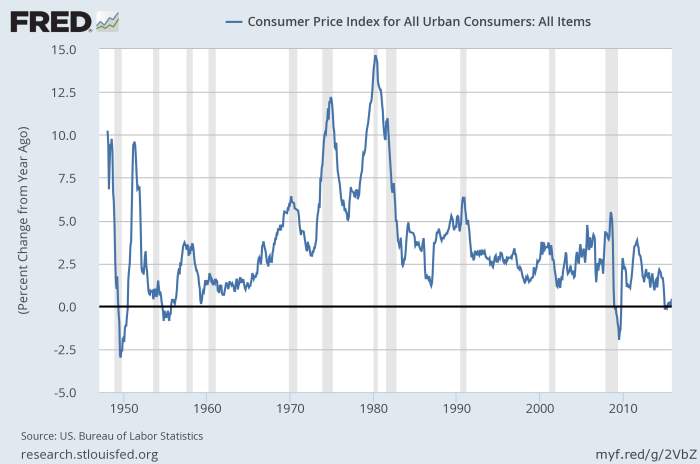
Core inflation has been kept between 0% and 2% most of the time.

Overall inflation has been within a reasonable range:
US_inflation

Real GDP has returned to its normal growth trend, though with a permanent loss of output relative to what would have happened without the Great Recession.

US_GDP_growth

Consumption spending is also back on trend, tracking GDP quite precisely.

The Federal Reserve even raised the federal funds interest rate above the zero lower bound, signaling a return to normal monetary policy. (As I argued previously, I’m pretty sure that was their main goal actually.)

Employment remains well below the pre-recession peak, but is now beginning to trend upward once more.

The only thing that hasn’t recovered is labor force participation, which continues to decline. This is how we can have unemployment go back to normal while employment remains depressed; people leave the labor force by retiring, going back to school, or simply giving up looking for work. By the formal definition, someone is only unemployed if they are actively seeking work. No, this is not new, and it is certainly not Obama rigging the numbers. This is how we have measured unemployment for decades.

Actually, it’s kind of the opposite: Since the Clinton administration we’ve also kept track of “broad unemployment”, which includes people who’ve given up looking for work or people who have some work but are trying to find more. But we can’t directly compare it to anything that happened before 1994, because the BLS didn’t keep track of it before then. All we can do is estimate based on what we did measure. Based on such estimation, it is likely that broad unemployment in the Great Depression may have gotten as high as 50%. (I’ve found that one of the best-fitting models is actually one of the simplest; assume that broad unemployment is 1.8 times narrow unemployment. This fits much better than you might think.)

So, yes, we muddle our way through, and the economy eventually heals itself. We could have brought the economy back much sooner if we had better fiscal policy, but at least our monetary policy was good enough that we were spared the worst.

But I think most of us—especially in my generation—recognize that it is still really hard to get a job. Overall GDP is back to normal, and even unemployment looks all right; but why are so many people still out of work?

I have a hypothesis about this: I think a major part of why it is so hard to recover from recessions is that our system of hiring is terrible.

Contrary to popular belief, layoffs do not actually substantially increase during recessions. Quits are substantially reduced, because people are afraid to leave current jobs when they aren’t sure of getting new ones. As a result, rates of job separation actually go down in a recession. Job separation does predict recessions, but not in the way most people think. One of the things that made the Great Recession different from other recessions is that most layoffs were permanent, instead of temporary—but we’re still not sure exactly why.

Here, let me show you some graphs from the BLS.

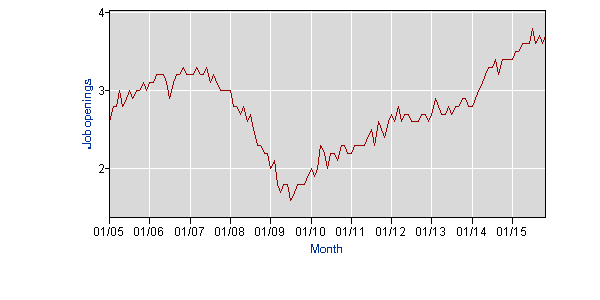
This graph shows job openings from 2005 to 2015:
job_openings

This graph shows hires from 2005 to 2015:

job_hires

Both of those show the pattern you’d expect, with openings and hires plummeting in the Great Recession.

But check out this graph, of job separations from 2005 to 2015:

job_separations

Same pattern!

Unemployment in the Second Depression wasn’t caused by a lot of people losing jobs. It was caused by a lot of people not getting jobs—either after losing previous ones, or after graduating from school. There weren’t enough openings, and even when there were openings there weren’t enough hires.

Part of the problem is obviously just the business cycle itself. Spending drops because of a financial crisis, then businesses stop hiring people because they don’t project enough sales to justify it; then spending drops even further because people don’t have jobs, and we get caught in a vicious cycle.

But we are now recovering from the cyclical downturn; spending and GDP are back to their normal trend. Yet the jobs never came back. Something is wrong with our hiring system.

So what’s wrong with our hiring system? Probably a lot of things, but here’s one that’s been particularly bothering me for a long time.
As any job search advisor will tell you, networking is essential for career success.

There are so many different places you can hear this advice, it honestly gets tiring.

But stop and think for a moment about what that means. One of the most important determinants of what job you will get is… what people you know?

It’s not what you are best at doing, as it would be if the economy were optimally efficient.
It’s not even what you have credentials for, as we might expect as a second-best solution.

It’s not even how much money you already have, though that certainly is a major factor as well.

It’s what people you know.

Now, I realize, this is not entirely beyond your control. If you actively participate in your community, attend conferences in your field, and so on, you can establish new contacts and expand your network. A major part of the benefit of going to a good college is actually the people you meet there.

But a good portion of your social network is more or less beyond your control, and above all, says almost nothing about your actual qualifications for any particular job.

There are certain jobs, such as marketing, that actually directly relate to your ability to establish rapport and build weak relationships rapidly. These are a tiny minority. (Actually, most of them are the sort of job that I’m not even sure needs to exist.)

For the vast majority of jobs, your social skills are a tiny, almost irrelevant part of the actual skill set needed to do the job well. This is true of jobs from writing science fiction to teaching calculus, from diagnosing cancer to flying airliners, from cleaning up garbage to designing spacecraft. Social skills are rarely harmful, and even often provide some benefit, but if you need a quantum physicist, you should choose the recluse who can write down the Dirac equation by heart over the well-connected community leader who doesn’t know what an integral is.

At the very least, it strains credibility to suggest that social skills are so important for every job in the world that they should be one of the defining factors in who gets hired. And make no mistake: Networking is as beneficial for landing a job at a local bowling alley as it is for becoming Chair of the Federal Reserve. Indeed, for many entry-level positions networking is literally all that matters, while advanced positions at least exclude candidates who don’t have certain necessary credentials, and then make the decision based upon who knows whom.

Yet, if networking is so inefficient, why do we keep using it?

I can think of a couple reasons.

The first reason is that this is how we’ve always done it. Indeed, networking strongly pre-dates capitalism or even money; in ancient tribal societies there were certainly jobs to assign people to: who will gather berries, who will build the huts, who will lead the hunt. But there were no colleges, no certifications, no resumes—there was only your position in the social structure of the tribe. I think most people simply automatically default to a networking-based system without even thinking about it; it’s just the instinctual System 1 heuristic.

One of the few things I really liked about Debt: The First 5000 Years was the discussion of how similar the behavior of modern CEOs is to that of ancient tribal chieftans, for reasons that make absolutely no sense in terms of neoclassical economic efficiency—but perfect sense in light of human evolution. I wish Graeber had spent more time on that, instead of many of these long digressions about international debt policy that he clearly does not understand.

But there is a second reason as well, a better reason, a reason that we can’t simply give up on networking entirely.

The problem is that many important skills are very difficult to measure.

College degrees do a decent job of assessing our raw IQ, our willingness to persevere on difficult tasks, and our knowledge of the basic facts of a discipline (as well as a fantastic job of assessing our ability to pass standardized tests!). But when you think about the skills that really make a good physicist, a good economist, a good anthropologist, a good lawyer, or a good doctor—they really aren’t captured by any of the quantitative metrics that a college degree provides. Your capacity for creative problem-solving, your willingness to treat others with respect and dignity; these things don’t appear in a GPA.

This is especially true in research: The degree tells how good you are at doing the parts of the discipline that have already been done—but what we really want to know is how good you’ll be at doing the parts that haven’t been done yet.

Nor are skills precisely aligned with the content of a resume; the best predictor of doing something well may in fact be whether you have done so in the past—but how can you get experience if you can’t get a job without experience?

These so-called “soft skills” are difficult to measure—but not impossible. Basically the only reliable measurement mechanisms we have require knowing and working with someone for a long span of time. You can’t read it off a resume, you can’t see it in an interview (interviews are actually a horribly biased hiring mechanism, particularly biased against women). In effect, the only way to really know if someone will be good at a job is to work with them at that job for awhile.

There’s a fundamental information problem here I’ve never quite been able to resolve. It pops up in a few other contexts as well: How do you know whether a novel is worth reading without reading the novel? How do you know whether a film is worth watching without watching the film? When the information about the quality of something can only be determined by paying the cost of purchasing it, there is basically no way of assessing the quality of things before we purchase them.

Networking is an attempt to get around this problem. To decide whether to read a novel, ask someone who has read it. To decide whether to watch a film, ask someone who has watched it. To decide whether to hire someone, ask someone who has worked with them.

The problem is that this is such a weak measure that it’s not much better than no measure at all. I often wonder what would happen if businesses were required to hire people based entirely on resumes, with no interviews, no recommendation letters, and any personal contacts treated as conflicts of interest rather than useful networking opportunities—a world where the only thing we use to decide whether to hire someone is their documented qualifications. Could it herald a golden age of new economic efficiency and job fulfillment? Or would it result in widespread incompetence and catastrophic collapse? I honestly cannot say.

No, advertising is not signaling

JDN 2457373

Awhile ago, I wrote a post arguing that advertising is irrational, that at least with advertising as we know it, no real information is conveyed and thus either consumers are being irrational in their purchasing decisions, or advertisers are irrational for buying ads that don’t work.

One of the standard arguments neoclassical economists make to defend the rationality of advertising is that advertising is signaling—that even though the content of the ads conveys no useful information, the fact that there are ads is a useful signal of the real quality of goods being sold.

The idea is that by spending on advertising, a company shows that they have a lot of money to throw around, and are therefore a stable and solvent company that probably makes good products and is going to stick around for awhile.

Here are a number of different papers all making this same basic argument, often with sophisticated mathematical modeling. This paper takes an even bolder approach, arguing that people benefit from ads and would therefore pay to get them if they had to. Does that sound even remotely plausible to you? It sure doesn’t to me. Some ads are fairly entertaining, but generally if someone is willing to pay money for a piece of content, they charge money for that content.

Could spending on advertising offer a signal of the quality of a product or the company that makes it? Yes. That is something that actually could happen. The reason this argument is ridiculous is not that advertising signaling couldn’t happen—it’s that advertising is clearly nowhere near the best way to do that. The content of ads is clearly nothing remotely like what it would be if advertising were meant to be a costly signal of quality.

Look at this ad for Orangina. Look at it. Look at it.

Now, did that ad tell you anything about Orangina? Anything at all?

As far as I can tell, the thing it actually tells you isn’t even true—it strongly implies that Orangina is a form of aftershave when in fact it is an orange-flavored beverage. It’d be kind of like having an ad for the iPad that involves scantily-clad dog-people riding the iPad like it’s a hoverboard. (Now that I’ve said it, Apple is probably totally working on that ad.)

This isn’t an isolated incident for Orangina, who have a tendency to run bizarre and somewhat suggestive (let’s say PG-13) TV spots involving anthropomorphic animals.

But more than that, it’s endemic to the whole advertising industry.

Look at GEICO, for instance; without them specifically mentioning that this is car insurance, you’d never know what they were selling from all the geckos,

and Neanderthals,

and… golf Krakens?

Progressive does slightly better, talking about some of their actual services while also including an adorably-annoying spokesperson (she’s like Jar Jar, but done better):

State Farm also includes at least a few tidbits about their insurance amidst the teleportation insanity:

But honestly the only car insurance commercials I can think of that are actually about car insurance are Allstate’s, and even then they’re mostly about Dennis Haybert’s superhuman charisma. I would buy bacon cheeseburgers from this man, and I’m vegetarian.

Esurance is also relatively informative (and owned by Allstate, by the way); they talk about their customer service and low prices (in other words, the only things you actually care about with car insurance). But even so, what reason do we have to believe their bald assertions of good customer service? And what’s the deal with the whole money-printing thing?

And of course I could deluge you with examples from other companies, from Coca-Cola’s polar bears and Santa Claus to this commercial, which is literally the most American thing I have ever seen:

If you’re from some other country and are going, “What!?” right now, that’s totally healthy. Honestly I think we would too if constant immersion in this sort of thing hadn’t deadened our souls.

Do these ads signal that their companies have a lot of extra money to burn? Sure. But there are plenty of other ways to do that which would also serve other valuable functions. I honestly can’t imagine any scenario in which the best way to tell me the quality of an auto insurance company is to show me 30-second spots about geckos and Neanderthals.

If a company wants to signal that they have a lot of money, they could simply report their financial statement. That’s even regulated so that we know it has to be accurate (and this is one of the few financial regulations we actually enforce). The amount you spent on an ad is not obvious from the result of the ad, and doesn’t actually prove that you’re solvent, only that you have enough access to credit. (Pets.com famously collapsed the same year they ran a multi-million-dollar Super Bowl ad.)

If a company wants to signal that they make a good product, they could pay independent rating agencies to rate products on their quality (you know, like credit rating agencies and reviewers of movies and video games). Paying an independent agency is far more reliable than the signaling provided by advertising. Consumers could also pay their own agencies, which would be even more reliable; credit rating agencies and movie reviewers do sometimes have a conflict of interest, which could be resolved by making them report to consumers instead of producers.

If a company wants to establish that they are both financially stable and socially responsible, they could make large public donations to important charities. (This is also something that corporations do on occasion, such as Subaru’s recent campaign.) Or they could publicly announce a raise for all their employees. This would not only provide us with the information that they have this much money to spend—it would actually have a direct positive social effect, thus putting their money where there mouth is.

Signaling theory in advertising is based upon the success of signaling theory in evolutionary biology, which is beyond dispute; but evolution is tightly constrained in what it can do, so wasteful costly signals make sense. Human beings are smarter than that; we can find ways to convey information that don’t involve ludicrous amounts of waste.

If we were anywhere near as rational as these neoclassical models assume us to be, we would take the constant bombardment of meaningless ads not as a signal of a company’s quality but as a personal assault—they are needlessly attacking our time and attention when all the genuinely-valuable information they convey could have been conveyed much more easily and reliably. We would not buy more from them; we would refuse to buy from them. And indeed, I’ve learned to do just that; the more a company bombards me with annoying or meaningless advertisements, the more I make a point of not buying their product if I have a viable substitute. (For similar reasons, I make a point of never donating to any charity that uses hard-sell tactics to solicit donations.)

But of course the human mind is limited. We only have so much attention, and by bombarding us frequently and intensely enough they can overcome our mental defenses and get us to make decisions we wouldn’t if we were optimally rational. I can feel this happening when I am hungry and a food ad appears on TV; my autonomic hunger response combined with their expert presentation of food in the perfect lighting makes me want that food, if only for the few seconds it takes my higher cognitive functions to kick in and make me realize that I don’t eat meat and I don’t like mayonnaise.

Car commercials have always been particularly baffling to me. Who buys a car based on a commercial? A decision to spend $20,000 should not be made based upon 30 seconds of obviously biased information. But either people do buy cars based on commercials or they don’t; if they do, consumers are irrational, and if they don’t, car companies are irrational.

Advertising isn’t the source of human irrationality, but it feeds upon human irrationality, and is specifically designed to exploit our own stupidity to make us spend money in ways we wouldn’t otherwise. This means that markets will not be efficient, and huge amounts of productivity can be wasted because we spent it on what they convinced us to buy instead of what would truly have made our lives better. Those companies then profit more, which encourages them to make even more stuff nobody actually wants and sell it that much harder… and basically we all end up buying lots of worthless stuff and putting it in our garages and wondering what happened to our money and the meaning in our lives. Neoclassical economists really need to stop making ridiculous excuses for this damaging and irrational behavior–and maybe then we could actually find a way to make it stop.

The winner-takes-all effect

JDN 2457054 PST 14:06.

As I write there is some sort of mariachi band playing on my front lawn. It is actually rather odd that I have a front lawn, since my apartment is set back from the road; yet there is the patch of grass, and there is the band playing upon it. This sort of thing is part of the excitement of living in a large city (and Long Beach would seem like a large city were it not right next to the sprawling immensity that is Los Angeles—there are more people in Long Beach than in Cleveland, but there are more people in greater Los Angeles than in Sweden); with a certain critical mass of human beings comes unexpected pieces of culture.

The fact that people agglomerate in this way is actually relevant to today’s topic, which is what I will call the winner-takes-all effect. I actually just finished reading a book called The Winner-Take-All Society, which is particularly horrifying to read because it came out in 1996. That’s almost twenty years ago, and things were already bad; and since then everything it describes has only gotten worse.

What is the winner-takes-all effect? It is the simple fact that in competitive capitalist markets, a small difference in quality can yield an enormous difference in return. The third most popular soda drink company probably still makes drinks that are pretty good, but do you have any idea what it is? There’s Coke, there’s Pepsi, and then there’s… uh… Dr. Pepper, apparently! But I didn’t know that before today and I bet you didn’t either. Now think about what it must be like to be the 15th most popular soda drink company, or the 37th. That’s the winner-takes-all effect.

I don’t generally follow football, but since tomorrow is the Super Bowl I feel some obligation to use that example as well. The highest-paid quarterback is Russell Wilson of the Seattle Seahawks, who is signing onto a five-year contract worth $110 million ($22 million a year). In annual income that will make him pass Jay Cutler of the Chicago Bears who has a seven-year contract worth $127 million ($18.5 million a year). This shift may have something to do with the fact that the Seahawks are in the Super Bowl this year and the Bears are not (they haven’t since 2007). Now consider what life is like for most football players; the median income of football players is most likely zero (at least as far as football-related income), and the median income of NFL players—the cream of the crop already—is $770,000; that’s still very good money of course (more than Krugman makes, actually! But he could make more, if he were willing to sell out to Wall Street), but it’s barely 1/30 of what Wilson is going to be making. To make that million-dollar salary, you need to be the best, of the best, of the best (sir!). That’s the winner-takes-all effect.

To go back to the example of cities, it is for similar reasons that the largest cities (New York, Los Angeles, London, Tokyo, Shanghai, Hong Kong, Delhi) become packed with tens of millions of people while others (Long Beach, Ann Arbor, Cleveland) get hundreds of thousands and most (Petoskey, Ketchikan, Heber City, and hundreds of others you’ve never heard of) get only a few thousand. Beyond that there are thousands of tiny little hamlets that many don’t even consider cities. The median city probably has about 10,000 people in it, and that only because we’d stop calling it a city if it fell below 1,000. If we include every tiny little village, the median town size is probably about 20 people. Meanwhile the largest city in the world is Tokyo, with a greater metropolitan area that holds almost 38 million people—or to put it another way almost exactly as many people as California. Huh, LA doesn’t seem so big now does it? How big is a typical town? Well, that’s the thing about this sort of power-law distribution; the concept of “typical” or “average” doesn’t really apply anymore. Each little piece of the distribution has basically the same shape as the whole distribution, so there isn’t a “typical” size or scale. That’s the winner-takes-all effect.

As they freely admit in the book, it isn’t literally that a single winner takes everything. That is the theoretical maximum level of wealth inequality, and fortunately no society has ever quite reached it. The closest we get in today’s society is probably Saudi Arabia, which recently lost its king—and yes I do mean king in the fullest sense of the word, a man of virtually unlimited riches and near-absolute power. His net wealth was estimated at $18 billion, which frankly sounds low; still even if that’s half the true amount it’s oddly comforting to know that he is still not quite as rich as Bill Gates ($78 billion), who earned his wealth at least semi-legitimately in a basically free society. Say what you will about intellectual property rents and market manipulation—and you know I do—but they are worlds away from what Abdullah’s family did, which was literally and directly robbed from millions of people by the power of the sword. Mostly he just inherited all that, and he did implement some minor reforms, but make no mistake: He was ruthless and by no means willing to give up his absolute power—he beheaded dozens of political dissidents, for example. Saudi Arabia does spread their wealth around a little, such that basically no one is below the UN poverty lines of $1.25 and $2 per day, but about a fourth of the population is below the national poverty line—which is just about the same distribution of wealth as what we have in the US, which actually makes me wonder just how free and legitimate our markets really are.

The winner-takes-all effect would really be more accurately described as the “top small fraction takes the vast majority” effect, but that isn’t nearly as catchy, now is it?

There are several different causes that can all lead to this same result. In the book, Robert Frank and Philip Cook argue that we should not attribute the cause to market manipulation, but in fact to the natural functioning of competitive markets. There’s something to be said for this—I used to buy the whole idea that competitive markets are the best, but increasingly I’ve been seeing ways that less competitive markets can make better overall outcomes.

Where they lose me is in arguing that the skyrocketing compensation packages for CEOs are due to their superior performance, and corporations are just being rational in competing for the best CEOs. If that were true, we wouldn’t find that the rank correlation between the CEO’s pay and the company’s stock performance is statistically indistinguishable from zero. Actually even a small positive correlation wouldn’t prove that the CEOs are actually performing well; it could just be that companies that perform well are willing to pay their CEOs more—and stock option compensation will do this automatically. But in fact the correlation is so tiny as to be negligible; corporations would be better off hiring a random person off the street and paying them $50,000 for all the CEO does for their stock performance. If you adjust for the size of the company, you find that having a higher-paid CEO is positively related to performance for small startups, but negatively correlated for large well-established corporations. No, clearly there’s something going on here besides competitive pay for high performance—corruption comes to mind, which you’ll remember was the subject of my master’s thesis.

But in some cases there isn’t any apparent corruption, and yet we still see these enormously unequal distributions of income. Another good example of this is the publishing industry, in which J.K. Rowling can make over $1 billion (she donated enough to charity to officially lose her billionaire status) but most authors make little or nothing, particularly those who can’t get published in the first place. I have no reason to believe that J.K. Rowling acquired this massive wealth by corruption; she just sold an awful lot of booksover 100 million of the first Harry Potter book alone.

But why would she be able to sell 100 million while thousands of authors write books that are probably just as good or nearly so make nothing? Am I just bitter and envious, as Mitt Romney would say? Is J.K. Rowling actually a million times as good an author as I am?

Obviously not, right? She may be better, but she’s not that much better. So how is it that she ends up making a million times as much as I do from writing? It feels like squaring the circle: How can markets be efficient and competitive, yet some people are being paid millions of times as others despite being only slightly more productive?

The answer is simple but enormously powerful: positive feedback.Once you start doing well, it’s easier to do better. You have what economists call an economy of scale. The first 10,000 books sold is the hardest; then the next 10,000 is a little easier; the next 10,000 a little easier still. In fact I suspect that in many cases the first 10% growth is harder than the second 10% growth and so on—which is actually a much stronger claim. For my sales to grow 10% I’d need to add like 20 people. For J.K. Rowling’s sales to grow 10% she’d need to add 10 million. Yet it might actually be easier for J.K. Rowling to add 10 million than for me to add 20. If not, it isn’t much harder. Suppose we tried by just sending out enticing tweets. I have about 100 Twitter followers, so I’d need 0.2 sales per follower; she has about 4 million, so she’d need an average of 2.5 sales per follower. That’s an advantage for me, percentage-wise—but if we have the same uptake rate I sell 20 books and she sells 800,000.

If you have only a handful of book sales like I do, those sales are static; but once you cross that line into millions of sales, it’s easy for that to spread into tens or even hundreds of millions. In the particular case of books, this is because it spreads by word-of-mouth; say each person who reads a book recommends it to 10 friends, and you only read a book if at least 2 of your friends recommended it. In a city of 100,000 people, if you start with 50 people reading it, odds are that most of those people don’t have friends that overlap and so you stop at 50. But if you start at 50,000, there is bound to be a great deal of overlap; so then that 50,000 recruits another 10,000, then another 10,000, and pretty soon the whole 100,000 have read it. In this case we have what are called network externalitiesyou’re more likely to read a book if your friends have read it, so the more people there are who have read it, the more people there are who want to read it. There’s a very similar effect at work in social networks; why does everyone still use Facebook, even though it’s actually pretty awful? Because everyone uses Facebook. Less important than the quality of the software platform (Google Plus is better, and there are some third-party networks that are likely better still) is the fact that all your friends and family are on it. We all use Facebook because we all use Facebook? We all read Harry Potter books because we all read Harry Potter books? The first rule of tautology club is…

Languages are also like this, which is why I can write this post in English and yet people can still read it around the world. English is the winner of the language competition (we call it the lingua franca, as weird as that is—French is not the lingua franca anymore). The losers are those hundreds of New Guinean languages you’ve never heard of, many of which are dying. And their distribution obeys, once again, a power-law. (Individual words actually obey a power-law as well, which makes this whole fractal business delightfully ever more so.)
Network externalities are not the only way that the winner-takes-all effect can occur, though I think it is the most common. You can also have economies of scale from the supply side, particularly in the case of information: Recording a song is a lot of time and effort, but once you record a song, it’s trivial to make more copies of it. So that first recording costs a great deal, while every subsequent recording costs next to nothing. This is probably also at work in the case of J.K. Rowling and the NFL; the two phenomena are by no means mutually exclusive. But clearly the sizes of cities are due to network externalities: It’s quite expensive to live in a big city—no supply-side economy of scale—but you want to live in a city where other people live because that’s where friends and family and opportunities are.

The most worrisome kind of winner-takes-all effect is what Frank and Cook call deep pockets: Once you have concentration of wealth in a few hands, those few individuals can now choose their own winners in a much more literal sense: the rich can commission works of art from their favorite artists, exacerbating the inequality among artists; worse yet they can use their money to influence politicians (as the Kochs are planning on spending $900 million—$3 for every person in America—to do in 2016) and exacerbate the inequality in the whole system. That gives us even more positive feedback on top of all the other positive feedbacks.

Sure enough, if you run the standard neoclassical economic models of competition and just insert the assumption of economies of scale, the result is concentration of wealth—in fact, if nothing about the rules prevents it, the result is a complete monopoly. Nor is this result in any sense economically efficient; it’s just what naturally happens in the presence of economies of scale.

Frank and Cook seem most concerned about the fact that these winner-take-all incomes will tend to push too many people to seek those careers, leaving millions of would-be artists, musicians and quarterbacks with dashed dreams when they might have been perfectly happy as electrical engineers or high school teachers. While this may be true—next week I’ll go into detail about prospect theory and why human beings are terrible at making judgments based on probability—it isn’t really what I’m most concerned about. For all the cost of frustrated ambition there is also a good deal of benefit; striving for greatness does not just make the world better if we succeed, it can make ourselves better even if we fail. I’d strongly encourage people to have backup plans; but I’m not going to tell people to stop painting, singing, writing, or playing football just because they’re unlikely to make a living at it. The one concern I do have is that the competition is so fierce that we are pressured to go all in, to not have backup plans, to use performance-enhancing drugs—they may carry awful risks, but they also work. And it’s probably true, actually, that you’re a bit more likely to make it all the way to the top if you don’t have a backup plan. You’re also vastly more likely to end up at the bottom. Is raising your probability of being a bestselling author from 0.00011% to 0.00012% worth giving up all other career options? Skipping chemistry class to practice football may improve your chances of being an NFL quarterback from 0.000013% to 0.000014%, but it will also drop your chances of being a chemical engineer from 95% (a degree in chemical engineering almost guarantees you a job eventually) to more like 5% (it’s hard to get a degree when you flunk all your classes).

Frank and Cook offer a solution that I think is basically right; they call it positional arms control agreements. By analogy with arms control agreements between nations—and what is war, if not the ultimate winner-takes-all contest?—they propose that we use taxation and regulation policy to provide incentives to make people compete less fiercely for the top positions. Some of these we already do: Performance-enhancing drugs are banned in professional sports, for instance. Even where there are no regulations, we can use social norms: That’s why it’s actually a good thing that your parents rarely support your decision to drop out of school and become a movie star.

That’s yet another reason why progressive taxation is a good idea, as if we needed another; by paring down those top incomes it makes the prospect of winning big less enticing. If NFL quarterbacks only made 10 times what chemical engineers make instead of 300 times, people would be a lot more hesitant to give up on chemical engineering to become a quarterback. If top Wall Street executives only made 50 times what normal people make instead of 5000, people with physics degrees might go back to actually being physicists instead of speculating on stock markets.

There is one case where we might not want fewer people to try, and that is entrepreneurship. Most startups fail, and only a handful go on to make mind-bogglingly huge amounts of money (often for no apparent reason, like the Snuggie and Flappy Bird), yet entrepreneurship is what drives the dynamism of a capitalist economy. We need people to start new businesses, and right now they do that mainly because of a tiny chance of a huge benefit. Yet we don’t want them to be too unrealistic in their expectations: Entrepreneurs are much more optimistic than the general population, but the most successful entrepreneurs are a bit less optimistic than other entrepreneurs. The most successful strategy is to be optimistic but realistic; this outperforms both unrealistic optimism and pessimism. That seems pretty intuitive; you have to be confident you’ll succeed, but you can’t be totally delusional. Yet it’s precisely the realistic optimists who are most likely to be disincentivized by a reduction in the top prizes.

Here’s my solution: Let’s change it from a tiny change of a huge benefit to a large chance of a moderately large benefit. Let’s reward entrepreneurs for trying—with standards for what constitutes a really serious, good attempt rather than something frivolous that was guaranteed to fail. Use part of the funds from the progressive tax as a fund for angel grants, provided to a large number of the most promising entrepreneurs. It can’t be a million-dollar prize for the top 100. It needs to be more like a $50,000 prize for the top 100,000 (which would cost $5 billion a year, affordable for the US government). It should be paid at the proposal phase; the top 100,000 business plans receive the funding and are under no obligation to repay it. It has to be enough money that someone can rationally commit themselves to years of dedicated work without throwing themselves into poverty, and it has to be confirmed money so that they don’t have to worry about throwing themselves into debt. As for the upper limit, it only needs to be small enough that there is still an incentive for the business to succeed; but even with a 99% tax Mark Zuckerberg would still be a millionaire, so the rewards for success are high indeed.

The good news is that we actually have such a system to some extent. For research scientists rather than entrepreneurs, NSF grants are pretty close to what I have in mind, but at present they are a bit too competitive: 8,000 research grants with a median of $130,000 each and a 20% acceptance rate isn’t quite enough people—the acceptance rate should be higher, since most of these proposals are quite worthy. Still, it’s close, and definitely a much better incentive system than what we have for entrepreneurs; there are almost 12 million entrepreneurs in the United States, starting 6 million businesses a year, 75% of which fail before they can return their venture capital. Those that succeed have incomes higher than the general population, with a median income of around $70,000 per year, but most of this is accounted for by the fact that entrepreneurs are more educated and talented than the general population. Once you factor that in, successful entrepreneurs have about 50% more income on average, but their standard deviation of income is also 60% higher—so some are getting a lot and some are getting very little. Since 75% fail, we’re talking about a 25% chance of entering an income distribution that’s higher on average but much more variable, and a 75% chance of going through a period with little or no income at all—is it worth it? Maybe, maybe not. But if you could get a guaranteed $50,000 for having a good idea—and let me be clear, only serious proposals that have a good chance of success should qualify—that deal sounds an awful lot better.

The Asymmetry that Rules the World

JDN 2456921 PDT 13:30.

One single asymmetry underlies millions of problems and challenges the world has always faced. No, it’s not Christianity versus Islam (or atheism). No, it’s not the enormous disparities in wealth between the rich and the poor, though you’re getting warmer.

It is the asymmetry of information—the fundamental fact that what you know and what I know are not the same. If this seems so obvious as to be unworthy of comment, maybe you should tell that to the generations of economists who have assumed perfect information in all of their models.

It’s not clear that information asymmetry could ever go away—even in the utopian post-scarcity economy of the Culture, one of the few sacred rules is the sanctity of individual thought. The closest to an information-symmetric world I can think of is the Borg, and with that in mind we may ask whether we want such a thing after all. It could even be argued that total information symmetry is logically impossible, because once you make two individuals know and believe exactly the same things, you don’t have two individuals anymore, you just have one. (And then where do we draw the line? It’s that damn Ship of Theseus again—except of course the problem was never the ship, but defining the boundaries of Theseus himself.)

Right now you may be thinking: So what? Why is asymmetric information so important? Well, as I mentioned in an earlier post, the Myerson-Satterthwaithe Theorem proves—mathematically proves, as certain as 2+2=4—that in the presence of asymmetric information, there is no market mechanism that guarantees Pareto-efficiency.

You can’t square that circle; because information is asymmetric, there’s just no way to make a free market that insures Pareto efficiency. This result is so strong that it actually makes you begin to wonder if we should just give up on economics entirely! If there’s no way we can possibly make a market that works, why bother at all?

But this is not the appropriate response. First of all, Pareto-efficiency is overrated; there are plenty of bad systems that are Pareto-efficient, and even some good systems that aren’t quite Pareto-efficient.

More importantly, even if there is no perfect market system, there clearly are better and worse market systems. Life is better here in the US than it is in Venezuela. Life in Sweden is arguably a bit better still (though not in every dimension). Life in Zambia and North Korea is absolutely horrific. Clearly there are better and worse ways to run a society, and the market system is a big part of that. The quality—and sometimes quantity—of life of billions of people can be made better or worse by the decisions we make in managing our economic system. Asymmetric information cannot be conquered, but it can be tamed.

This is actually a major subject for cognitive economics: How can we devise systems of regulation that minimize the damage done by asymmetric information? Akerlof’s Nobel was for his work on this subject, especially his famous paper “The Market for Lemons” in which he showed how product quality regulations could increase efficiency using the example of lemon cars. What he showed was, in short, that libertarian deregulation is stupid; removing regulations on product safety and quality doesn’t increase efficiency, it reduces it. (This is of course only true if the regulations are good ones; but despite protests from the supplement industry I really don’t see how “this bottle of pills must contain what it claims to contain” is an illegitimate regulation.)

Unfortunately, the way we currently write regulations leaves much to be desired: Basically, lobbyists pay hundreds of staffers to make hundreds of pages that no human being can be expected to read, and then hands them to Congress with a wink and a reminder of last year’s campaign contributions, who passes them without question. (Can you believe the US is one of the least corrupt governments in the world? Yup, that’s how bad it is out there.) As a result, we have a huge morass of regulations that nobody really understands, and there is a whole “industry” of people whose job it is to decode those regulations and use them to the advantage of whoever is paying them—lawyers. The amount of deadweight loss introduced into our economy is almost incalculable; if I had to guess, I’d have to put it somewhere in the trillions of dollars per year. At the very least, I can tell you that the $200 billion per year spent by corporations on litigation is all deadweight loss due to bad regulation. That is an industry that should not exist—I cannot stress this enough. We’ve become so accustomed to the idea that regulations are this complicated that people have to be paid six-figure salaries to understand them that we never stopped to think whether this made any sense. The US Constitution was originally printed on 6 pages.

The tax code should contain one formula for setting tax brackets with one or two parameters to adjust to circumstances, and then a list of maybe two dozen goods with special excise taxes for their externalities (like gasoline and tobacco). In reality it is over 70,000 pages.

Laws should be written with a clear and general intent, and then any weird cases can be resolved in court—because there will always be cases you couldn’t anticipate. Shakespeare was onto something when he wrote, “First, kill all the lawyers.” (I wouldn’t kill them; I’d fire them and make them find a job doing something genuinely useful, like engineering or management.)

All told, I think you could run an entire country with less than 100 pages of regulations. Furthermore, these should be 100 pages that are taught to every high school student, because after all, we’re supposed to be following them. How are we supposed to follow them if we don’t even know them? There’s a principle called ignorantia non excusatignorance does not excuse—which is frankly Kafkaesque. If you can be arrested for breaking a law you didn’t even know existed, in what sense can we call this a free society? (People make up strawman counterexamples: “Gee, officer, I didn’t know it was illegal to murder people!” But all you need is a standard of reasonable knowledge and due diligence, which courts already use to make decisions.)

So, in that sense, I absolutely favor deregulation. But my reasons are totally different from libertarians: I don’t want regulations to stop constraining businesses, I want regulations to be so simple and clear that no one can get around them. In the system I envision, you wouldn’t be able to sell fraudulent derivatives, because on page 3 it would clearly say that fraud is illegal and punishable in proportion to the amount of money involved.

But until that happens—and let’s face it, it’s gonna be awhile—we’re stuck with these ridiculous regulations, and that introduces a whole new type of asymmetric information. This is the way that regulations can make our economy less efficient; they distort what we can do not just by making it illegal, but by making it so we don’t know what is illegal.

The wealthy and powerful can hire people to explain—or evade—the regulations, while the rest of us are forced to live with them. You’ve felt this in a small way if you’ve ever gotten a parking ticket and didn’t know why. Asymmetric information strikes again.