A tale of two corporations

May 10 JDN 246171

Consider two corporations.

Corporation A has net income equal to 2.9% of its total revenue, and pretax income equal to 4.1% of its total revenue. The cost of its goods sold accounts for 77% of its revenue, with most of the remainder going to wages.

This seems reasonable, right? It doesn’t seem like this corporation is being especially exploitative.

Corporation B has 2.1 million employees, and made net income of $21.8 billion, meaning that it could afford to pay every single employee an additional $10,000 and still be profitable. The median employee at this corporation makes approximately $16 per hour, meaning that this would an income increase of over 30%—an absolutely huge jump in income that would make a big difference in millions of lives. Yet instead they have chosen to buy back $30 billion in shares to raise their stock price even higher.

Corporation B seems like they are obviously exploiting their workers and favoring their shareholders, and directly contributing to the extreme inequality in our society.

But I have a bit of a surprise for you.

They are the same corporation. All of these facts are true of Walmart: Here is their income statement, here is their announced stock buyback, and here are estimates of their number of employees and median pay.

Walmart is not a particularly exceptional case. Similar stories hold for most major corporations: the profit margin doesn’t sound that high as a proportion of revenue, but it still amounts to an enormous sum of money that is being hoarded by shareholders instead of paid to workers.

Amazon’s net income of $90 billion on $742 billion in revenue gives it a profit margin of 12%, but would be enough to give all 1.6 million employees an additional $56,000—in many cases doubling their incomes.

United Health Group made $12 billion in profit on $447 billion in revenue, which is only 2.7%; and yet with 400,000 employees, they could still afford to give each one an extra $30,000. How many nurses would be very happy to see another $30,000?

Exxon Mobil’s $28 billion profit was made on $324 billion in revenue, a reasonable-sounding margin of 8.6%. Yet with only 58,000 employees, that’s $480,000 each.

McDonald’s made $8.5 billion on $26 billion in revenue, a margin of 33% (which is actually pretty high). Yet more than 1.8 million people work at McDonald’s including all its franchises, so it could really only afford to give each one an extra $4,700—which sounds small compared to these other figures, but for a minimum-wage employee ($7.25 per hour is about $14,500 per year), that’s still an extra 32%.

This is something I think we have failed to reckon with as a society.

Once a corporation becomes sufficiently large, it doesn’t need to have a big-sounding profit margin to nonetheless control staggering amounts of wealth and funnel it away from employees into the hands of shareholders. Especially with regard to Walmart and United Health Group, those margins honestly sound small as a proportion of revenue—and yet, they still amount to incredibly vast sums of wealth that are being hoarded away from thousands or millions of workers that desperately need help.

I don’t know exactly what to do about this. More progressive taxes, especially on capital income, might help, and would certainly raise much-needed revenue; but they don’t seem like enough on their own. I think we may need something more radical, like requiring employee ownership of a certain proportion of shares—essentially turning corporations into co-ops.

Another option would be simply not allowing corporations to ever get this big, and splitting them up if they already are. Perhaps being CEO of a corporation with billions of dollars in revenue really is just too much power for one person to have. But I am genuinely concerned that this could reduce economic efficiency and thereby lower the standard of living of everyone.

Some corporations actually seem to behave more fairly.

Car companies, for instance, don’t seem to hoard huge amounts.

Ford actually lost money last year, losing $6 billion on $189 billion in revenue (3.1%). With 168,000 employees, that’s $35,000 each—essentially they gave each employee a free car. And Ford employees do fine: Median annual compensation is $126,000.

General Motors made $2.4 billion in profit on $184 billion in revenue, a margin of only 1.3%. With 150,000 employees, it could give each one an extra $16,000. Given that most of its employees are well-paid (median employee salary is $99,000), I actually don’t begrudge them this. Accounting for the risk of bad years like Ford had, I think GM is being reasonable by not simply plowing that $2.4 billion back into their own employees.

Even Tesla isn’t really an exception to this pattern. Tesla made $3.8 billion on $98 billion in revenue, which is 3.9%. With 135,000 employees, this is $28,000 each—more than GM, but still not completely crazy. Median employee pay at Tesla is over $160,000, so these workers are doing well. What’s weird about Tesla, however, is that its revenue is half that of Ford or GM, yet its market capitalization is a staggering $1.5 trillionwhile Ford’s is only $46 billion and GM’s is only $71 billion. A P/E ratio of 20 is considered reasonable. Tesla’s is 365.)

But there are some corporations that don’t even sound reasonable.

Tech companies in particular tend to have very high profit margins.

Consider Apple; its net income of $122 billion on $451 billion in revenue gives it a net profit margin of 27%. It could give all 550,000 of the employees of not only Apple itself but also all its foreign suppliers a raise of $221,000. Some of these employees are sweatshop workers in China—they would be set for life on a sum like that.

Alphabet’s profit margins are even higher than that; its net income of $160 billion was on $422 billion in revenue, for a net profit margin of 37%. With 190,000 employees, that would be $840,000 each.

Yet Microsoft’s margins are even higher; its $125 billion net income was on only $318 billion in revenue, giving it a net profit margin of 39%. It has 228,000 employees, so it could give every single one an additional $540,000.

SpaceX isn’t publicly-traded, so they don’t have to disclose everything; but it is estimated that they made about $8 billion in profit on $16 billion in revenue—a staggering margin of 50%—and with only about 12,000 employees, it could give every single one an extra $660,000. In fact, Elon Musk himself owns enough stock that he could personally give every single SpaceX employee some $60 million in shares and still be a billionaire. That’s a life-changing sum for anyone who works for a living—neurosurgeons would be awed, and even NBA players would consider that a successful career unto itself. But Elon must see number go up!

This is why I’m still somewhat sympathetic to Marxism, despite not being a Marxist.

There really is something terrible going on here, with capital owners making absolutely obscene sums of money and using it to wield enormous power over our society, leaving their own workers to struggle even though they could easily give those employees enough additional pay to significantly change their lives—and if they all did so, even the capital owners wouldn’t be meaningfully worse off, because they already have more wealth than any human being could possibly need and the overall boost to the economy might even compensate them in the long run.

And turning corporations into co-ops (which is, arguably, seizing the means of production) could actually make a very big difference here, and both theory and empirical data suggests that it would greatly reduce inequality without greatly reducing economic efficiency.
But the labor theory of value is still garbage.

Adversarial design

Feb 4 JDN 2460346

Have you noticed how Amazon feels a lot worse lately? Years ago, it was extremely convenient: You’d just search for what you want, it would give you good search results, you could buy what you want and be done. But now you have to slog through “sponsored results” and a bunch of random crap made by no-name companies in China before you can get to what you actually want.

Temu is even worse, and has been from the start: You can’t buy anything on Temu without first being inundated in ads. It’s honestly such an awful experience, I don’t understand why anyone is willing to buy anything from Temu.

#WelcomeToCyberpunk, I guess.

Even some video games have become like this: The free-to-play or “freemium” business model seems to be taking off, where you don’t pay money for the game itself, but then have to deal with ads inside the game trying to sell you additional content, because that’s where the developers actually make their money. And now AAA firms like EA and Ubisoft are talking about going to a subscription-based model where you don’t even own your games anymore. (Fortunately there’s been a lot of backlash against that; I hope it persists.)

Why is this happening? Isn’t capitalism supposed to make life better for consumers? Isn’t competition supposed to make products and services supposed to improve over time?

Well, first of all, these markets are clearly not as competitive as they should be. Amazon has a disturbingly large market share, and while the video game market is more competitive, it’s still dominated by a few very large firms (like EA and Ubisoft).

But I think there’s a deeper problem here, one which may be specific to media content.

What I mean by “media content” here is fairly broad: I would include art, music, writing, journalism, film, and video games.

What all of these things have in common is that they are not physical products (they’re not like a car or a phone that is a single physical object), but they are also not really services either (they aren’t something you just do as an action and it’s done, like a haircut, a surgery, or a legal defense).

Another way of thinking about this is that media content can be copied with zero marginal cost.

Because it can be copied with zero marginal cost, media content can’t simply be made and sold the way that conventional products and services are. There are a few different ways it can be monetized.


The most innocuous way is commission or patronage, where someone pays someone else to create a work because they want that work. This is totally unproblematic. You want a piece of art, you pay an artist, they make it for you; great. Maybe you share copies with the world, maybe you don’t; whatever. It’s good either way.

Unfortunately, it’s hard to sustain most artists and innovators on that model alone. (In a sense I’m using a patronage model, because I have a Patreon. But I’m not making anywhere near enough to live on that way.)

The second way is intellectual property, which I have written about before, and surely will again. If you can enforce limits on who is allowed to copy a work, then you can make a work and sell it for profit without fear of being undercut by someone else who simply copies it and sells it for cheaper. A detailed discussion of that is beyond the scope of this post, but you can read those previous posts, and I can give you the TLDR version: Some degree of intellectual property is probably necessary, but in our current society, it has clearly been taken much too far. I think artists and authors deserve to be able to copyright (or maybe copyleft) their work—but probably not for 70 years after their death.

And then there is a third way, the most insidious way: advertising. If you embed advertisements for other products and services within your content, you can then sell those ad slots for profit. This is how newspapers stay afloat, mainly; subscriptions have never been the majority of their revenue. It’s how TV was supported before cable and streaming—and cable usually has ads too, and streaming is starting to.

There is something fundamentally different about advertising as a service. Whereas most products and services you encounter in a capitalist society are made for you, designed for you to use, advertising it made at you, designed to manipulate you.

I’ve heard it put well this way:

If you’re not paying, you aren’t the customer; you’re the product.

Monetizing content by advertising effectively makes your readers (or viewers, players, etc.) into the product instead of the customer.

I call this effect adversarial design.

I chose this term because it not only conveys the right sense of being an adversary: it also includes the word ‘ad’ and the same Latin root ‘advertere‘ as ‘advertising’.

When a company designs a car or a phone, they want it to appeal to customers—they want you to like it. Yes, they want to take your money; but it’s a mutually beneficial exchange. They get money, you get a product; you’re both happier.

When a company designs an ad, they want it to affect customers—they want you to do what it says, whether you like it or not. And they wouldn’t be doing it if they thought you would buy it anyway—so they are basically trying to make you do something you wouldn’t otherwise have done.

In other words, when designing a product, corporations want to be your friend.

When designing an ad, they become your enemy.

You would absolutely prefer not to have ads. You don’t want your attention taken in this way. But they way that these corporations make money—disgustingly huge sums of money—is by forcing those ads in your face anyway.

Yes, to be fair, there might be some kinds of ads that aren’t too bad. Simple, informative, unobtrusive ads that inform you that something is available you might not otherwise have known about. Movie trailers are like this; people often enjoy watching movie trailers, and they want to see what movies are going to come out next. That’s fine. I have no objection to that.

But it should be clear to anyone who has, um, used the Internet in the past decade that we have gone far, far beyond that sort of advertising. Ads have become aggressive, manipulative, aggravating, and—above all—utterly ubiquitous. You can’t escape them. They’re everywhere. Even when you use ad-block software (which I highly recommend, particularly Adblock Plus—which is free), you still can’t completely escape them.

That’s another thing that should make it pretty clear that there’s something wrong with ads: People are willing to make efforts or even pay money to make ads go away.

Whenever there is a game I like that’s ad-supported but you can pay to make the ads go away, I always feel like I’m being extorted, even if what I have to pay would have been a totally reasonable price for the game. Come on, just sell me the game. Don’t give me the game for free and then make me pay to make it not unpleasant. Don’t add anti-features.

This is clearly not a problem that market competition alone will solve. Even in highly competitive markets, advertising is still ubiquitous, aggressive and manipulative. In fact, competition may even make it worse—a true monopoly wouldn’t need to advertise very much.

Consider Coke and Pepsi ads; they’re actually relatively pleasant, aren’t they? Because all they’re trying to do is remind you and make you thirsty so you’ll buy more of the product you were already buying. They aren’t really trying to get you to buy something you wouldn’t have otherwise. They know that their duopoly is solid, and only a true Black Swan event would unseat their hegemony.

And have you ever seen an ad for your gas company? I don’t think I have—probably because I didn’t have a choice in who my gas company was; there was only one that covered my area. So why bother advertising to me?

If competition won’t fix this, what will? Is there some regulation we could impose that would make advertising less obtrusive? People have tried, without much success. I think imposing an advertising tax would help, but even that might not do enough.

What I really think we need right now is to recognize the problem and invest in solving it. Right now we have megacorporations which are thoroughly (literally) invested in making advertising more obtrusive and more ubiquitous. We need other institutions—maybe government, maybe civil society more generally—that are similarly invested in counteracting it.


Otherwise, it’s only going to get worse.

If I had a trillion dollars…

May 29 JDN 2459729

(To the tune of “If I had a million dollars” by Barenaked Ladies; by the way, he does now)

[Inspired by the book How to Spend a Trillion Dollars]

If I had a trillion dollars… if I had a trillion dollars!

I’d buy everyone a house—and yes, I mean, every homeless American.

[500,000 homeless households * $300,000 median home price = $150 billion]

If I had a trillion dollars… if I had a trillion dollars!

I’d give to the extreme poor—and then there would be no extreme poor!

[Global poverty gap: $160 billion]

If I had a trillion dollars… if I had a trillion dollars!

I’d send people to Mars—hey, maybe we’d find some alien life!

[Estimated cost of manned Mars mission: $100 billion]

If I had a trillion dollars… if I had a trillion dollars!

I’d build us a Moon base—haven’t you always wanted a Moon base?

[Estimated cost of a permanent Lunar base: $35 billion. NASA is bad at forecasting cost, so let’s allow cost overruns to take us to $100 billion.]

If I had a trillion dollars… if I had a trillion dollars!

I’d build a new particle accelerator—let’s finally figure out dark matter!

[Cost of planned new accelerator at CERN: $24 billion. Let’s do 4 times bigger and make it $100 billion.]

If I had a trillion dollars… if I had a trillion dollars!

I’d save the Amazon—pay all the ranchers to do something else!

[Brazil, where 90% of Amazon cattle ranching is, produces about 10 million tons of beef per year, which at an average price of $5000 per ton is $50 billion. So I could pay all the farmers two years of revenue to protect the Amazon instead of destroying it for $100 billion.]

If I had a trillion dollars…

We wouldn’t have to drive anymore!

If I had a trillion dollars…

We’d build high-speed rail—it won’t cost more!

[Cost of proposed high-speed rail system: $240 billion]

If I had a trillion dollars… if I had trillion dollars!

Hey wait, I could get it from a carbon tax!

[Even a moderate carbon tax could raise $1 trillion in 10 years.]

If I had a trillion dollars… I’d save the world….

All of the above really could be done for under $1 trillion. (Some of them would need to be repeated, so we could call it $1 trillion per year.)

I, of course, do not, and will almost certainly never have, anything approaching $1 trillion.

But here’s the thing: There are people who do.

Elon Musk and Jeff Bezos together have a staggering $350 billion. That’s two people with enough money to end world hunger. And don’t give me that old excuse that it’s not in cash: UNICEF gladly accepts donations in stock. They could, right now, give their stocks to UNICEF and thereby end world hunger. They are choosing not to do that. In fact, the goodwill generated by giving, say, half their stocks to UNICEF might actually result in enough people buying into their companies that their stock prices would rise enough to make up the difference—thus costing them literally nothing.

The total net wealth of all the world’s billionaires is a mind-boggling $12.7 trillion. That’s more than half a year of US GDP. Held by just over 2600 people—a small town.

The US government spends $4 trillion in a normal year—and $5 trillion the last couple of years due to the pandemic. Nearly $1 trillion of that is military spending, which could be cut in half and still be the highest in the world. After seeing how pathetic Russia’s army actually is in battle (they paint Zs on their tanks because apparently their IFF system is useless!), are we really still scared of them? Do we really need eleven carrier battle groups?

Yes, the total cost of mitigating climate change is probably in the tens of trillions—but the cost of not mitigating climate change could be over $100 trillion. And it’s not as if the world can’t come up with tens of trillions; we already do. World GDP is now over $100 trillion per year; just 2% of that for 10 years is $20 trillion.

Do these sound like good ideas to you? Would you want to do them? I think most people would want most of them. So now the question becomes: Why aren’t we doing them?

The fable of the billionaires

May 31 JDN 2458999

There are great many distortions in real-world markets that cause them to deviate from the ideal of perfectly competitive free markets, and economists rightfully spend much of their time locating, analyzing, and mitigating such distortions.

But I think there is a general perception among economists, and perhaps among others as well, that if we could somehow make markets perfectly competitive and efficient, we’d be done; the world, or at least the market, would be just and fair and all would be good. And this perception is gravely mistaken. To make that clear to you, I offer a little fable.

Once upon a time, widgets were made by hand. One person, working for one eight-hour day, could make 100 widgets. Most people were employed making widgets full-time. The wage for making widgets was $1 per widget.

Then, an inventor came up with a way to automate the production of widgets. For $100 per day, the same cost to hire a worker to make 100 widgets, the machine could instead make 101 widgets.

Because it was 1% more efficient, businesses began adopting the new machine, and now made slightly more widgets than before. But some workers who had previously made widgets were laid off, while others saw their wages fall to only $0.99 per widget.


If there were more widgets, but fewer people were getting paid less to make them, where did the extra wealth go? To the inventor, of course, who now owns 10% of all widget production and has billions of dollars.

Later, another inventor came up with an even better machine, which could make 102 widgets in a day. And that inventor became a billionare too, while more became unemployed and wages fell to $0.98 per widget.

And then there was another inventor, and another, and another; and today the machines can make 200 widgets in a day and wages are only $0.50 per widget. We now have twice as many widgets as we used to have, and hundreds of billionaires; yet only half as many people now work making widgets as once did, and those who remain make only half of what they once did.

Was this market inefficient or uncompetitive? Not at all! In fact it was quite efficient: It delivered the most widgets for the least cost every step of the way. And the first round of billionaires didn’t get enough power to keep the next round from innovating even better and also becoming billionaires. No one stole or cheated to get where they are; the billionaires really made it to the top by being brilliant innovators who made the world more efficient.

Indeed, by the standard measures of economic surplus, the world has gotten better with each new machine. GDP has gone up, wealth has gone up. Yet millions of people are out of work, and millions more are making pitifully low wages. Overall the nation seems to be worse off, even though all the numbers keep saying things are getting better.

There are some relatively simple solutions to this problem: We could tax those billionaires, and use the money to provide public goods to everyone else; and then the added wealth from doubling our quantity of widgets would benefit everyone and not just the inventors who made it happen. Would that reduce the incentives to innovate? A little, perhaps; but it’s hard to believe that most people who would be willing to invent something for $1 billion wouldn’t be willing to do so for $500 million or even for $50 million. At some point that extra money really isn’t benefiting you all that much. And what’s the point of incentivizing innovation if it makes life worse for most of our population?

In the real world there are lots of other problems, of course. Corruption, regulatory capture, rent-seeking, collusion, and so on all make our markets less efficient than they could have been. But even if markets were efficient, it’s not clear that they would be fair or just, or that they would be making most people’s lives better.

Indeed, I’m not convinced that most billionaires really got where they are by being particularly innovative. I can appreciate the innovations made by Cisco and Microsoft, but what brilliant innovation underlies Facebook or Amazon? The Internet itself is a great innovation (largely created by DARPA and universities), but is using it to talk to people or sell things really such a great leap? Tesla and SpaceX are innovative, but they have largely been money pits for Elon Musk, who inherited a good chunk of his wealth and made most of the rest by owning shares in PayPal. Yet even if we suppose that all the billionaires got where they are by inventing things that made the economy more efficient, it’s still not clear that they deserve to keep that staggering wealth.

I think the fundamental problem is that we have mentally equated ‘value of marginal product’ with ‘what you rightfully earn’. But the former is dependent upon the rest of the market: Who you are competing with, what your customers want. You can work very hard and be very talented, but if you’re making something that people aren’t willing to pay for, you won’t make any money. And the fact that people won’t pay for something doesn’t mean it isn’t valuable: If you produce public goods, they could benefit many people a great deal but still not draw in profits. Conversely, the fact that something is profitable doesn’t necessarily make it valuable: It could just be a very effective method of rent-seeking.

I’m not saying we should do away with markets; they’re very useful, and they do have a lot of benefits. But we should acknowledge their limitations. We should be aware not only that real-world markets are not perfectly efficient, but also that even a perfectly efficient market wouldn’t make for the best possible world.

The Amazon is burning.

Sep 1 JDN 2458729

As you probably already know, the Amazon rainforest is currently on fire. You can get more details about the fires from The Washington Post, or CNN, or New York magazine, or even The Economist; but I think the best coverage I’ve seen has been these two articles from Al-Jazeera.

I have good news and bad news. Let’s start with the bad news: If we lose the Amazon, we lose everything. The ecological importance of the Amazon is basically impossible to overstate. The Amazon produces 20% of the oxygen on Earth. 25% of the carbon absorbed on land is absorbed by the Amazon. We must protect the Amazon, at almost any cost: Given how vital preserving the rainforest will be to resisting climate change, millions of lives are at stake.

The good news is there is still a lot of Amazon left.

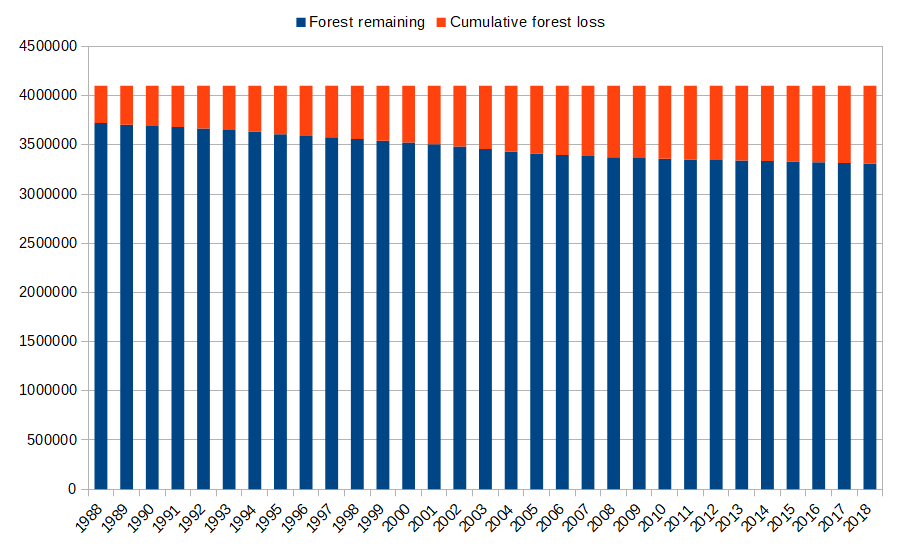
This graph shows the total cumulative deforestation of the Amazon, compared against its current area and its original area. The units are square kilometers; the Amazon rainforest has been reduced from 4.1 million square kilometers (1.6 million square miles) to 3.3 million hectares (1.3 million square miles), a decline of about 20% (21 log points). We still have four-fifths of the rainforest remaining—less than we should, but a lot more than we might.

Amazon_cumulative

This graph shows the annual deforestation of the Amazon, with results that are even more encouraging. While the last few years have had faster deforestation than previously, we are still nowhere near the peak deforestation rates of the early 2000s. At peak deforestation, the Amazon was projected to last no more than 150 years; but at current rates of deforestation, the Amazon would not be completely destroyed in more than 400 years.

Amazon_annual

Of course, any loss of the Amazon is bad. We should actually be trying to restore the Amazon—that extra 800,000 square kilometers of high-density forest would sequester a lot of carbon. We probably can’t actually add the 9 million square kilometers (3.4 million square miles) of forest it would take to stop climate change; but any reforestation we do manage will help.

And a number of ecologists have been sounding the alarm that the Amazon is approaching some sort of tipping point where it will stop being a rainforest and become a savannah. If this happens, it may be irreversible. It sounds crazy to me—80% of the forest is still there!—but that’s what ecologists are saying, and I’ll defer to their expertise.

On the other hand, ecologists have been panicking about “irreversible tipping points” on almost everything for the past century. We really can’t be blamed for not taking their word as gospel: They’ve cried wolf about “population bombs” and shortages of food and water for a very long time now. So far their projections on the rates of temperature rise, species extinction, and deforestation have been quite accurate; but their predictions of dire human consequences have always suspiciously failed to materialize. Humans are quite creative and resilient, as it turns out. This is part of why I’m not actually afraid climate change will cause the collapse of human civilization (much less the utterly laughable claim of human extinction); but tens of millions of deaths is still plenty of reason to take drastic action.

Indeed, I think panicking is precisely what we need to avoid. If we exaggerate the problem to the point where it sounds hopeless, that won’t encourage people to take action; it may actually cause them to throw in the towel.

What do we actually need to do here? We need to restore as many forests as possible, and we need to cut carbon emissions as rapidly as possible.

This doesn’t require a revolution to overthrow capitalism. It doesn’t require exotic new technologies (though fusion power and improved electricity storage would certainly help). It simply requires a real commitment to bear real economic costs today in order to prevent much higher costs in the future.

Bernie Sanders has a climate change plan that is estimated to cost $16 trillion over the next ten years. Make no mistake: This is an enormous amount of money. US GDP is about $20 trillion, growing at about 3% per year, so we’re looking at about 6% of GDP over that interval. This is about twice our current military budget, or about our military budget in the 1980s. Notably, it is nowhere near the levels of military spending we reached in the Second World War, which exceeded 40% of GDP. That’s what happens when America really commits to something.

Would this be enough? The UN seems to think so. They estimate that it would cost about 1% of global GDP to keep global warming below 2 C. Even if that’s an underestimate, 6% of the GDP of the US and EU would by itself account for twice that amount—and I have no doubt that if America committed to climate change mitigation, Europe would gladly follow.

And it’s not as if this money would be set on fire. (Military spending, on the other hand, almost literally is that.) We would spending this money mainly on infrastructure and technology; we would be paying wages and creating millions of jobs.

So far as I know Sanders’s plan doesn’t include paying Brazil to restore the Amazon, but it probably should. Part of why Brazil is currently burning the Amazon is the externalities: The ecological benefit of the Amazon affects us all, but the economic benefit of clear-cutting and cattle ranching directly benefits Brazil. We should set up some sort of payment mechanism to ensure that it is more profitable for Brazil to keep the rainforest where it is than to burn it down. How can we afford such a thing, you ask? No: How can we afford not to?

Subsidies almost never create jobs

May 5 JDN 2458609

The most extreme examples of harmful subsidies are fossil fuel industries and stadiums.

Fossil fuels are obviously the worst: The $1 trillion per year in direct and indirect government subsidies to fossil fuel corporations are second only to the $4 trillion in climate change externalities produced by the fossil fuel industry. Instead of subsidizing these corporations $1 trillion, the world should be taxing them $4 trillion—so we are off by $5 trillion, every single year. This is 6.5% of the world’s GDP. In the United States, our largest oil subsidy is called the Interstate Highway System, but other countries have us beat: Iran, Uzbekistan, and Libya each give more than 10% of their GDP in subsidies to the fossil fuel industry.

Most stadiums receive some kind of subsidy, and many are outright publicly funded—and yet banks still get the naming rights. The largest teams with the most wealth of their own are typically also the most subsidized. The benefits of building a new stadium are not even particularly large, which is probably why over 85% of US economists agree that these subsidies don’t make sense.

But subsidies are all over the place, and one of the most common reasons given for them, if not the most common reason, is that they will “create jobs”.

This is the reason Trump gave for trying to subsidize coal (which isn’t even working). It’s the reason people give for subsidizing huge filmmaking conglomerates in making films (which costs the government about $90,000 per job created). Why are we handing money to rich people? It will create jobs!

This is almost never actually true. We have known that this kind of subsidy doesn’t work since at least the 1980s.

The states and cities that create the most jobs aren’t the ones that offer the most generous handouts to corporations. They are the ones that have the cleanest air, the best infrastructure, and above all the most educated population. This is why there have been months when the majority of US jobs were created in California. California is the largest state, but it’s not that large—it’s only about 12% of the US population. If as many as 70% of the new jobs are being created there, it’s because California is doing something right that most other states are doing very, very wrong.

And then there is the rent-seeking competition that megacorporations like Amazon engage in, getting cities to bid higher and higher subsidies, then locating where they probably would have anyway but with billions of dollars in free money. This is a trick we need to stop falling for: The federal government should outright ban any attempt to use subsidies to get an existing corporation to locate in a specific state or city. That’s not contributing to American society; it’s just moving things around.

There are a few kinds of industries it makes sense to subsidize, because they have high up-front costs and large public benefits. Examples include research and development and renewable energy. But here the goal is not to create jobs. It’s to create wealth, typically in the form of scientific knowledge. We aren’t trying to get them to hire people; we’re trying to get them to accomplish something that’s difficult and important.

Why don’t subsidies create jobs? It’s really quite simple: You need to pay for those subsidies.

The federal government doesn’t face a hard budget constraint like businesses do; they can print money. But state and municipal governments don’t have that power, and so their subsidies need to be made up in either taxes or debt—which means either taxes now, or taxes later. Or they could cut spending elsewhere, which means losing whatever benefits they were getting from that spending. This means that any jobs you created with the subsidies are just going to be destroyed somewhere else, by higher taxes or lower government spending.

Most state and local governments have really tight budgets. Allen, Texas was running a $30 billion budget deficit and cutting salaries for public school teachers, but still somehow found $60 billion to subsidize building a stadium. The stadium might “create jobs” by moving some economic activity from one place to another, but the actual real economic benefit of a stadium is very small. Public schools are the foundation of a highly-developed economy. Without widespread education, this high a standard of living is simply impossible to sustain. Cutting public education is one of the last things you should be willing to do to balance a government budget—and yet somehow it seems to be one of the first we actually do.

It is true that we spend a great deal on education, and that spending could be made a lot more cost-effective (we can start by cutting athletic coaches and administrators); but every $1 spent on education yields between $4 and $6 in additional long-run wealth for our society. This means that at quite reasonable tax rates (17% to 25%) a public education system can directly pay for itself. Compare this to subsidizing a stadium, which gets back less than $1 of benefit per $1 spent, or subsidizing oil companies, which actively harms the world.

People don’t seem to understand that a capitalist economy basically just creates as many jobs as it needs. In a financial crisis, that mechanism falters; that’s when the federal government should step in and print money to get it running again. But when the economy is running smoothly, trying to “create jobs” is just not a useful thing to do. Jobs will be created and destroyed by the market. Policy should be trying to increase welfare. Educate your population. Improve your healthcare system. Build more public transit. Invest in fighting poverty and homelessness. And if you don’t think you can afford those things, then you definitely can’t afford handouts to megacorporations that won’t even make back what you paid.