Saudi Arabia is becoming a problem.

JDN 2457394

There has been a lot of talk lately about what’s going on in the Middle East, particularly in Syria, Iran, and Iraq, where Daesh (I like to call them that precisely because they don’t like it), also known as ISIS or ISIL, has been killing people and destroying things–including priceless ancient artifacts.

We in the United States actually have little to fear from Daesh. Pace Ben Carson and Lindsey Graham, Daesh is absolutely not an existential threat to the United States. We have them completely outnumbered and outgunned—indeed, we have the world outgunned, as we ourselves account for 40% of the world’s military spending and a comparable portion of the world’s nuclear missiles, naval tonnage, and air fleet.
The people who need to worry are those living in (or fleeing from) the Middle East.

Some 17,000 civilians were killed by warfare in Iraq in 2014, the plurality killed by Daesh and only a small fraction killed by US or NATO forces. Contrary to the belief of people like Noam Chomsky who think the US military is comprised of bloodthirsty genocidal murderers, we actually go quite far out of our way to minimize civilian deaths, up to and including dropping pamphlets warning of bombing raids before we carry them out (I love the “admits” in that headline. You keep using that word…). Then there’s Syria, where there have been over 200,000 deaths, though actually more attributable to Bashir al-Assad than to Daesh.

Daesh, on the other hand, has no qualms about killing anyone they consider not a “true Muslim”, which basically means anyone who doesn’t support them—it certainly doesn’t exclude all Muslims. Daesh is so brutal and extreme that Al Qaeda has condemned their tactics. Yes, that Al Qaeda, the one that crashed airplanes into the World Trade Center in 2001. If you really want to know the sorts of things Daesh has been doing (and have the stomach for it), there are plenty of photos and video footage, many of them openly promoted by Daesh itself, including on their Twitter feed which also shows lots of (I am not kidding) kitten photos called “Mewjahideen”.

But today I’m not actually going to focus on Daesh itself. I’m going to focus on a country that is ostensibly our ally in the fight against them—yet the way they’ve been behaving is a lot more like being an ally of Daesh. As I gave away in the title, I mean of course Saudi Arabia.

Between the time that I drafted this post as a Blog From the Future on Patreon and the time that you are now reading this, Saudi Arabia did another terrible thing, namely executing an important Shi’ite cleric and triggering the possibility of war between Saudi Arabia and Iran. (I think it helps support the point I’m about to make shortly that the focus of this article is on the effect on oil prices.)

First, remember what Saudi Arabia is—namely, an absolute theocratic monarchy founded upon the same Wahhabi Islamist ideology that drives Daesh. They teach Wahhabi Islam as their state religion in schools. This by itself should make us wonder whether they are really our allies—they after all agree a lot more with our enemies than they do with us. And indeed, while they speak of joining the “war on terror”, they are actually the leading source of funds for global Islamist terrorism. In theory, with their large, powerful military and a majority-Muslim population (which would help avoid the sense that this is some kind of Christian/atheist versus Muslim neo-Crusade, which it absolutely must not be), Saudi Arabia could be a valuable ally in this war—but they don’t particularly want to be.

Saudi Arabia is now paying to support refugees, but they aren’t actually accepting any refugees themselves. It would make sense for the US to do this, because we are very far away and it would be very difficult to transport refugees here. It does not make sense for Saudi Arabia to do this, except in order to look like they’re doing something while actually doing as little as possible. (Also, I’ve read conflicting reports as to whether they’ve pledged $10 million to Jordan or $10 billion—which is kind of like saying, “The car was either $1,000 or $1,000,000, I’m not sure.” The most credible estimate I’ve seen is $300 million, $10 million to Jordan. In my favorite unit of wealth, they’ve donated a romney. It’s a whopping… 0.04% of their country’s income in a year.) They should be doing what Turkey is doing, and taking on hundreds of thousands of refugees themselves.

As is fairly common among tyrants (look no further than North Korea), Saudi Arabia’s leaders often present some rather… eccentric beliefs, such as the claim that Daesh is actually secretly a wing of the Israeli military. Maybe this is Freudian projection: Knowing that they are secretly supporting Daesh and its ideology, they decide to accuse whomever they most dislike—i.e., Israel—of doing that very thing. And they certainly do hate Israel; Saudi Arabia’s state-run media frequently compare Israel to Nazis because apparently irony is completely lost on them.

One of the things Daesh does to display its brutality is behead nonbelievers; yet Saudi Arabia beheads far more people, including for thoughtcrimes such as apostasy and political dissent, as well as “crimes” such as sorcery and witchcraft. The human rights violation here is not so much the number of executions as the intentional spectacle of brutality, as well as the “crimes” cited. In the summer of 2014, they beheaded about one person per day—in a country of 27 million people, it wouldn’t be that odd to execute 30 people in a month, if they were in fact murderers. That’s about the size and execution rate of Texas. The world’s real execution leader is China, where over 2,000—and previously as many as 10,000—people per year are executed. China does have a huge population of almost 1.4 billion people—but even so, they execute more people than the rest of the world combined.

I mean, one can certainly argue that the death penalty in general is morally wrong (it is certainly economically inefficient); but I never could quite manage to be outraged by the use of lethal injection on serial killers (which is mainly what we’re talking about in Texas). But Saudi Arabia doesn’t use lethal injection, they use beheading. And they don’t just execute serial killers—they execute atheists and feminists.

Saudi Arabia’s human rights record is one of the worst in the world. (And that’s from the US Department of State, so don’t tell me our government doesn’t know this.) Freedom House gives them the lowest possible rating, and lists several reasons why their government should be considered a global pariah. Even the Heritage Foundation (which overweights economic freedom over civil liberties, in my opinion—would you rather pay high taxes, or be executed for thoughtcrime?) gave Saudi Arabia a moderate freedom rating at best.

So, the question really becomes: Why do we call these people our allies?

Why did President Obama cut short a visit to India—which is, you know, a democracy—to see the new king—as in absolute monarch—of Saudi Arabia? (Though good on Michelle Obama for refusing to wear the hijab. You can see the contempt in the faces of the Saudi dignitaries, but she just grins smugly. You can almost hear, “What are you gonna do about it?”) Why was “cementing ties with Saudi Arabia” even something we wanted to do?


The answer of course is painfully obvious, especially to economists: Oil.

Saudi Arabia is by far the world’s largest oil exporter, accounting for a sixth of all crude oil exports.

The United States is by far the world’s largest oil importer, accounting for an eighth of all crude oil imports.

As Vonnegut said, we are rolling drunk on petroleum. We are addicts, and they’re our dealer. And if there’s one thing addicts don’t do, it’s rat out their own dealers.

Fortunately, US oil imports are on the decline, and why? Thanks, Obama. Under policies that really were largely spearheaded by the Obama administration such as expanded fracking and subsidized solar power investment, a combination of increased domestic oil production and reduced domestic oil consumptionhas been reducing the need to continue importing oil from other countries.

Of course, the “expanded fracking” and “increased oil production” part gives me very mixed feelings, given its obvious connection to climate change. But I will say this: If we’re going to be burning all that oil anyway, far better that we extract it ourselves than that we buy it from butchers and tyrants. And indeed US carbon emissions have also been steady or declining under Obama.

The sudden crash in oil prices last year has been damaging to both Saudi Arabia and other major oil exporters such as Russia and Venezuela, which are nowhere near as bad but also hardly wholesome liberal democracies. (It also hurt Norway, who didn’t deserve it; but they’re wisely divesting from fossil fuels, starting with coal.) Now is the perfect time to implement a carbon tax; consumers will hardly feel it—it’ll just feel like prices are going back to normal—but oil exporters will have even more pressure to switch industries, and above all global carbon emissions will decrease.

Ideally we would also combine this with what I call a “human rights tariff”, a tariff applied to the goods a country exports based upon that country’s human rights record. We could keep it very simple: Another percentage point added to the tariff every time you execute someone for political, religious, or ideological reasons. A percentage point off every time you go at least a month without executing anyone for any reason except murder.

Obviously that wouldn’t deal with the fact that women can’t drive, or the fact that hijab is mandatory, or the fact that homosexuality is illegal—but hey, it would at least be something. Right now, every barrel of oil we buy from them is basically saying that we care more about cheap gasoline than we do about human rights.

The Tragedy of the Commons

JDN 2457387

In a previous post I talked about one of the most fundamental—perhaps the most fundamental—problem in game theory, the Prisoner’s Dilemma, and how neoclassical economic theory totally fails to explain actual human behavior when faced with this problem in both experiments and the real world.

As a brief review, the essence of the game is that both players can either cooperate or defect; if they both cooperate, the outcome is best overall; but it is always in each player’s interest to defect. So a neoclassically “rational” player would always defect—resulting in a bad outcome for everyone. But real human beings typically cooperate, and thus do better. The “paradox” of the Prisoner’s Dilemma is that being “rational” results in making less money at the end.

Obviously, this is not actually a good definition of rational behavior. Being short-sighted and ignoring the impact of your behavior on others doesn’t actually produce good outcomes for anybody, including yourself.

But the Prisoner’s Dilemma only has two players. If we expand to a larger number of players, the expanded game is called a Tragedy of the Commons.

When we do this, something quite surprising happens: As you add more people, their behavior starts converging toward the neoclassical solution, in which everyone defects and we get a bad outcome for everyone.

Indeed, people in general become less cooperative, less courageous, and more apathetic the more of them you put together. K was quite apt when he said, “A person is smart; people are dumb, panicky, dangerous animals and you know it.” There are ways to counteract this effect, as I’ll get to in a moment—but there is a strong effect that needs to be counteracted.

We see this most vividly in the bystander effect. If someone is walking down the street and sees someone fall and injure themselves, there is about a 70% chance that they will go try to help the person who fell—humans are altruistic. But if there are a dozen people walking down the street who all witness the same event, there is only a 40% chance that any of them will help—humans are irrational.

The primary reason appears to be diffusion of responsibility. When we are alone, we are the only one could help, so we feel responsible for helping. But when there are others around, we assume that someone else could take care of it for us, so if it isn’t done that’s not our fault.

There also appears to be a conformity effect: We want to conform our behavior to social norms (as I said, to a first approximation, all human behavior is social norms). The mere fact that there are other people who could have helped but didn’t suggests the presence of an implicit social norm that we aren’t supposed to help this person for some reason. It never occurs to most people to ask why such a norm would exist or whether it’s a good one—it simply never occurs to most people to ask those questions about any social norms. In this case, by hesitating to act, people actually end up creating the very norm they think they are obeying.

This can lead to what’s called an Abilene Paradox, in which people simultaneously try to follow what they think everyone else wants and also try to second-guess what everyone else wants based on what they do, and therefore end up doing something that none of them actually wanted. I think a lot of the weird things humans do can actually be attributed to some form of the Abilene Paradox. (“Why are we sacrificing this goat?” “I don’t know, I thought you wanted to!”)

Autistic people are not as good at following social norms (though some psychologists believe this is simply because our social norms are optimized for the neurotypical population). My suspicion is that autistic people are therefore less likely to suffer from the bystander effect, and more likely to intervene to help someone even if they are surrounded by passive onlookers. (Unfortunately I wasn’t able to find any good empirical data on that—it appears no one has ever thought to check before.) I’m quite certain that autistic people are less likely to suffer from the Abilene Paradox—if they don’t want to do something, they’ll tell you so (which sometimes gets them in trouble).

Because of these psychological effects that blunt our rationality, in large groups human beings often do end up behaving in a way that appears selfish and short-sighted.

Nowhere is this more apparent than in ecology. Recycling, becoming vegetarian, driving less, buying more energy-efficient appliances, insulating buildings better, installing solar panels—none of these things are particularly difficult or expensive to do, especially when weighed against the tens of millions of people who will die if climate change continues unabated. Every recyclable can we throw in the trash is a silent vote for a global holocaust.

But as it no doubt immediately occurred to you to respond: No single one of us is responsible for all that. There’s no way I myself could possibly save enough carbon emissions to significantly reduce climate change—indeed, probably not even enough to save a single human life (though maybe). This is certainly true; the error lies in thinking that this somehow absolves us of the responsibility to do our share.

I think part of what makes the Tragedy of the Commons so different from the Prisoner’s Dilemma, at least psychologically, is that the latter has an identifiable victimwe know we are specifically hurting that person more than we are helping ourselves. We may even know their name (and if we don’t, we’re more likely to defect—simply being on the Internet makes people more aggressive because they don’t interact face-to-face). In the Tragedy of the Commons, it is often the case that we don’t know who any of our victims are; moreover, it’s quite likely that we harm each one less than we benefit ourselves—even though we harm everyone overall more.

Suppose that driving a gas-guzzling car gives me 1 milliQALY of happiness, but takes away an average of 1 nanoQALY from everyone else in the world. A nanoQALY is tiny! Negligible, even, right? One billionth of a year, a mere 30 milliseconds! Literally less than the blink of an eye. But take away 30 milliseconds from everyone on Earth and you have taken away 7 years of human life overall. Do that 10 times, and statistically one more person is dead because of you. And you have gained only 10 milliQALY, roughly the value of $300 to a typical American. Would you kill someone for $300?

Peter Singer has argued that we should in fact think of it this way—when we cause a statistical death by our inaction, we should call it murder, just as if we had left a child to drown to keep our clothes from getting wet. I can’t agree with that. When you think seriously about the scale and uncertainty involved, it would be impossible to live at all if we were constantly trying to assess whether every action would lead to statistically more or less happiness to the aggregate of all human beings through all time. We would agonize over every cup of coffee, every new video game. In fact, the global economy would probably collapse because none of us would be able to work or willing to buy anything for fear of the consequences—and then whom would we be helping?

That uncertainty matters. Even the fact that there are other people who could do the job matters. If a child is drowning and there is a trained lifeguard right next to you, the lifeguard should go save the child, and if they don’t it’s their responsibility, not yours. Maybe if they don’t you should try; but really they should have been the one to do it.
But we must also not allow ourselves to simply fall into apathy, to do nothing simply because we cannot do everything. We cannot assess the consequences of every specific action into the indefinite future, but we can find general rules and patterns that govern the consequences of actions we might take. (This is the difference between act utilitarianism, which is unrealistic, and rule utilitarianism, which I believe is the proper foundation for moral understanding.)

Thus, I believe the solution to the Tragedy of the Commons is policy. It is to coordinate our actions together, and create enforcement mechanisms to ensure compliance with that coordinated effort. We don’t look at acts in isolation, but at policy systems holistically. The proper question is not “What should I do?” but “How should we live?”

In the short run, this can lead to results that seem deeply suboptimal—but in the long run, policy answers lead to sustainable solutions rather than quick-fixes.

People are starving! Why don’t we just steal money from the rich and use it to feed people? Well, think about what would happen if we said that the property system can simply be unilaterally undermined if someone believes they are achieving good by doing so. The property system would essentially collapse, along with the economy as we know it. A policy answer to that same question might involve progressive taxation enacted by a democratic legislature—we agree, as a society, that it is justified to redistribute wealth from those who have much more than they need to those who have much less.

Our government is corrupt! We should launch a revolution! Think about how many people die when you launch a revolution. Think about past revolutions. While some did succeed in bringing about more just governments (e.g. the French Revolution, the American Revolution), they did so only after a long period of strife; and other revolutions (e.g. the Russian Revolution, the Iranian Revolution) have made things even worse. Revolution is extremely costly and highly unpredictable; we must use it only as a last resort against truly intractable tyranny. The policy answer is of course democracy; we establish a system of government that elects leaders based on votes, and then if they become corrupt we vote to remove them. (Sadly, we don’t seem so good about that second part—the US Congress has a 14% approval rating but a 95% re-election rate.)

And in terms of ecology, this means that berating ourselves for our sinfulness in forgetting to recycle or not buying a hybrid car does not solve the problem. (Not that it’s bad to recycle, drive a hybrid car, and eat vegetarian—by all means, do these things. But it’s not enough.) We need a policy solution, something like a carbon tax or cap-and-trade that will enforce incentives against excessive carbon emissions.

In case you don’t think politics makes a difference, all of the Democrat candidates for President have proposed such plans—Bernie Sanders favors a carbon tax, Martin O’Malley supports an aggressive cap-and-trade plan, and Hillary Clinton favors heavily subsidizing wind and solar power. The Republican candidates on the other hand? Most of them don’t even believe in climate change. Chris Christie and Carly Fiorina at least accept the basic scientific facts, but (1) they are very unlikely to win at this point and (2) even they haven’t announced any specific policy proposals for dealing with it.

This is why voting is so important. We can’t do enough on our own; the coordination problem is too large. We need to elect politicians who will make policy. We need to use the systems of coordination enforcement that we have built over generations—and that is fundamentally what a government is, a system of coordination enforcement. Only then can we overcome the tendency among human beings to become apathetic and short-sighted when faced with a Tragedy of the Commons.

What really scares me

JDN 2457327

Today is Halloween, so in the spirit of the holiday I thought I’d talk about things that are scary. Not things like zombies and witches and vampires; those things aren’t real (though people do still believe in them in many parts of the world). And maybe that’s part of the point; maybe Halloween is meant to “scare” us like a roller coaster, where we feel some of the epinephrine rush of fear but deep down we know we are safe.

But today I’m going to talk about things that are actually scary, things that are not safe deep down. I could talk about the Republican debate earlier this week, but maybe I shouldn’t get too scary.

In fiction there is whatever sort of ending the author wants to make, usually a happy one. Even tragic endings are written to be meaningful and satisfying. But in real life any sort of ending is possible. I could be driving down the street tomorrow and a semi truck could blindside me and kill me on impact. There’s no satisfying tragedy there, no comeuppance for my hubris or tragic flaw in my character leading to my doom—but this sort of thing kills over 30,000 Americans each year.

But are car accidents really scary? The way they kill just about anyone at random is scary. But there is a clear limit to how much damage they can do. No society has ever been wiped off the face of the Earth because of traffic accidents. There is no way for traffic accidents to risk the survival of the human race itself.

This brings me to the first thing that is really scary: Climate change. Human societies have been wiped off the face of the Earth due to local ecological collapses. The classic example is Easter Island, which did have an ecological collapse, but also suffered greatly from European invaders. Recent evidence suggests that the Vikings fell apart because glaciation broke their trade networks. Jared Diamond argues that a large number of ancient societies have fallen due to ecological collapse.

Yet for the first time we are now facing rapid global climate change, and it is our own doing. (As the vast majority of climate scientists agree.) We are already seeing its effects in flooding, wildfires, droughts, and hurricanes. Positive feedbacks are created, such as heat waves leading to more air conditioning, which draws more electricity that releases more carbon. Even as management of fishing improves, fisheries are still being depleted—because their waters are becoming too warm for the native fish.

Just yesterday the United Nations released a report showing that current promises of reduced carbon emissions will not be sufficient—even if they are followed through, which such promises often aren’t. The goal was to keep warming under 2 C; but it looks like we are looking at more like 2.7 C. That 0.7-degree difference may not seem like much, but in fact it means thousands or even millions of additional deaths. Most of the economic damage will be done to countries near the equator—which is also where the most impoverished people tend to live. The Global Humanitarian Forum estimates that global warming is already killing 300,000 people each year and causing over $100 billion in economic damage.

Meanwhile, there is a campaign of disinformation about climate change, funneled through secretive “dark money” processes (Why are these even allowed!?), including Exxon corporation, which has known for 30 years that they were contributing to climate change but actively suppressed that knowledge in order to avoid regulation. Koch Industries has also funded a great deal of climate change denialism. West Virginia recently tried to alter their science textbooks to remove references to climate change because they considered the scientific facts to be “too political”. Supposedly serious “think tanks” with conservative ideologies twist data in order to support their claims. Rather than be caught lying or denying science, most of the Republican presidential candidates are avoiding talking about the subject altogether.
There is good news, however: More Americans than ever recognize that climate change is real. 7% changed their minds in just the last few months. Even a lot of Republican politicians are finally coming around.

What else is scary? Nuclear war, a Black Swan. This is the most probable way humanity could destroy ourselves; the probability of nuclear war in the next 50 years has been estimated as high as 10%. Every day that goes by with nuclear weapons at the ready is like pulling the trigger in a game of Russian Roulette. We don’t really know how to estimate the probability with any precision; but even 0.1% per year would be a 10% chance over the next century.

There’s good news on this front as well: Slowly but surely, the world is disarming its nuclear weapons. From a peak of 60,000 nuclear weapons in 1986, we are now down to about 10,000. But we shouldn’t get too comfortable, as the estimated number necessary to trigger a global nuclear winter with catastrophic consequences is only about 100. India or Pakistan alone probably has enough to do that. The US or Russia has enough to do it 40 times over. We will need to continue our current disarmament trend for another 30 years before no single nation has enough weapons to trigger a nuclear winter.

Then there’s one more class of scary Black Swans: Mass extinction events. In particular, I’m talking about the Yellowstone Supervolcano, which could erupt at any moment, and the possibility of a large asteroid impact which could destroy cities or even wipe out all life on the surface of the Earth. We are 99.989% sure that TV135 will not do this; but in that 0.02% chance, it would hit with the force of 2500 megatons—50 times larger than any nuclear weapon ever built. Smaller (“smaller”) sub-megaton impacts are actually remarkably common; we average about two per year. If one ever hit a major city, it would be comparable to the Hiroshima nuclear bombing. The Yellowstone supervolcano would not be as catastrophic as a planet-scouring impact, but it would be comparable to a nuclear war and nuclear winter.

With asteroids, there are actually clear things we could do to improve our chances. Above all, we could invest in space exploration and astronomy. With better telescopes and more tracking stations we could see them coming; with better long-range rockets we might be able to deflect them before they get here. A number of different deflection proposals are being studied right now. This is actually the best reason I can think of to keep at least some nuclear weapons on standby; a large nuclear blast positioned at the right place could be effective at destroying an asteroid or deflecting it enough to miss us.

With Yellowstone, there really isn’t much we can do; all we can do at this point is continue to research the supervolcano and try to find ways to reduce the probability of its eruption. It is currently estimated at a just over 1 in 1 million chance of erupting any given year, but that’s a very rough estimate. Fracking near Yellowstone is currently banned, and I think it should stay that way until we have a very clear idea of what would happen. (It’s actually possible it could reduce the probability of eruption, in which case we should start fracking like crazy.)

Forget the zombie apocalypse. I’m scared of the supervolcano apocalypse.

What is socialism?

JDN 2457265 EDT 10:47

Last night I was having a political discussion with some friends (as I am wont to do), and it became a little heated, though never uncongenial. A key point of contention was the fact that Bernie Sanders is a socialist, and what exactly that entails.

One of my friends was arguing that this makes him far-left, and thus it is fair when the news media often likes to make a comparison between Sanders on the left and Trump on the right. Donald Trump is actually oddly liberal on some issues, but his attitudes on racial purity, nativism, military unilateralism, and virtually unlimited executive power are literally fascist. Even his “liberal” views are more like the kind of populism that fascists have often used to win support in the past: Don’t you hate being disenfranchised? Give me absolute power and I’ll fix everything for you! Don’t like how our democracy has become corrupt? Don’t worry, I’ll get rid of it! (The democracy, that is.) While he certainly doesn’t align well with the Republican Party platform, I think it’s quite fair to say that Donald Trump is a far-right candidate.

Bernie Sanders, however, is not a far-left candidate. He is a center-left candidate. His views are basically consonant with the Labour Party of the UK and the Social Democratic Party of Germany. He has spoken often about the Scandinavian model (because, well, #Scandinaviaisbetter—Denmark, Sweden, and Norway are some of the happiest places on Earth). When we talk about Bernie Sanders we aren’t talking about following Cuba and the Soviet Union; we’re talking about following Norway and Sweden. As Jon Stewart put it, he isn’t a “crazy-pants cuckoo bird” as some would have you think.

But he’s a socialist, right? Well… sort of—we have to be very clear what that means.

The word “socialism” has been used to mean many things; it has been a cover for genocidal fascism (“National Socialism”) and tyrannical Communism (“Union of Soviet Socialist Republics”). It has become a pejorative thrown at Social Security, Medicare, banking regulations—basically any policy left of Milton Friedman. So apparently it means something between Medicare and the Holocaust.

Social democracy is often classified as a form of socialism—but one can actually make a pretty compelling case that social democracy is not socialism, but in fact a form of capitalism.

If we want a simple, consistent definition of “socialism”, I think I would put it thus: Socialism is a system in which the majority of economic activity is directly controlled by the government. Most, if not all, industries are nationalized; production and distribution are handled by centrally-planned quotas instead of market supply and demand. Under this definition, the USSR, Venezuela, Cuba, and (at least until recently) China are socialist—and under this definition, socialism is a very bad idea. The best-case scenario is inefficiency; the worst-case scenario is mass murder.

Social democracy, the position that Bernie Sanders espouses (and I basically agree wit), is as follows: Social democracy is a system in which markets are taxed and regulated by a democratically-elected government to ensure that they promote general welfare, public goods are provided by the government, and transfer programs are used to reduce poverty and inequality.

Let’s also try to define “capitalism”: Capitalism is a system in which the majority of economic activity is handled by private sector markets.

Under the Scandinavian model, the majority of economic activity is handled by private sector markets, which are in turn regulated and taxed to promote the general welfare—that is, at least on these definitions, Scandinavia is both capitalist and social democratic.

In fact, so is the United States; while our taxes are lower and our regulations weaker, we still have substantial taxes and regulations. We do have transfer programs like WIC, SNAP, and Social Security that attempt to redistribute wealth and reduce poverty.

We could define “socialism” more broadly to mean any government intervention in the economy, in which case Bernie Sander is a socialist and so is… almost everyone else, including most economists.

The majority of the most eminent American economists are in favor of social democracy. I don’t intend this as an argument from authority, but rather to give a sense of the scientific consensus. The consensus in economics is by no means as strong as that in biology or physics (or climatology, ahem), but there is still broad agreement on many issues.

In a survey of 264 members of the American Economics Association [pdf link], 77% opposed government ownership of enterprise (14% mixed feelings, 8% favor) but 71% favored redistribution of wealth in some form (7% mixed feelings, 20% opposed). That’s social democracy is a nutshell. 67% favored public schools (14% mixed feelings, 17% opposed); 75% favored Keynesian monetary policy (12% mixed feelings, 12% opposed); 51% favored Keynesian fiscal policy (19% mixed feelings, 30% opposed). 58% opposed tighter immigration restrictions (16% mixed feelings, 25% opposed). 79% support anti-discrimination laws. 68% favor gun control.

The major departure from left-wing views that the majority of economists make is a near-universal opposition to protectionism, with 86.8% opposed, 7.6% with mixed feelings, and only 5.3% in favor. It seems I am not the only economist to cringe when politicians say they want to “stop sending jobs overseas”, which they do left and right. This view is quite popular; but the evidence says that it is wrong. Protectionism is not the answer; you make your trading partners poorer, they retaliate with their own protections, and you both end up worse off. We need open trade. I’ll save the details on why open trade is so important for a later post.

One issue that economists are very divided on right now is minimum wage; 47.3% favor minimum wage, 38.3% oppose it, and 14.4% have mixed feelings. This division likely reflects the ambiguity of empirical results on the employment effect of minimum wage, which have a wide margin of error but effect sizes that cluster around zero. Economists are also somewhat divided on military aid, with 36.8% in favor, 33% opposed, and 29.9% with mixed feelings. This I attribute more to the fact that military aid, like most military action, can be justified in principle but is typically unjustified in practice. And indeed perhaps “mixed feelings” is the most reasonable view to have on war and its instruments.

Since Bernie Sanders strongly supports raising minimum wage and some of his statements verge on protectionism, I do have to place him to the left of the economic consensus. A lot of economists would probably disagree on the particulars of his tax plans and such. But his core policies are entirely in line with that consensus, and being a social democrat is absolutely part of that. Compare this to the Republicans, who keep trying to out-crazy each other (apparently Scott Walker thinks we should not only build a wall against Mexico, but also against Canada?) and want policies that were abandoned decades ago by mainstream economists (like the gold standard, or a balanced-budget amendment), or simply would never be taken seriously by mainstream economists at all (the aforementioned border wall, eliminating all environmental regulation, or ending all transfer payments and social welfare programs). Even the things they supposedly agree on I’m not sure they do; when economists say they want “deregulation” Republicans seem to think that means “no rules at all” when in fact it’s supposed to mean “simple, transparent rules that can be tightly and fairly enforced”. (I think we need a new term for it, though there is a slogan I like: “Deregulate with a scalpel, not a chainsaw.”) Obama has done a very good job of deregulating in the sense that economists intend, and I think in general most economists view him positively as a leader who made the best of a bad situation.

In any case, the broad consensus of American economists (and I think most economists around the world) is that some form of capitalist social democracy is the best system we have so far. There is dispute about particular policies—how much should the tax rates be, should we tax income, consumption, real estate, capital, etc.; how large should the transfers be; what regulations should be added or removed—but the basic concept of a market economy with a government that taxes, transfers, and regulates is not in serious dispute.

Indeed, social democracy is the economic system of the free world.

Even using the conservative Heritage Foundation’s data, the correlation between tax burden and economic freedom—that’s economic freedom—is small but positive. (I’m excluding missing data, as well as Timor-Leste because it has a “tax burden” larger than its GDP due to weird accounting of its tourism-based economy, and North Korea because they lie to us and they theoretically have “zero taxes” but that’s clearly not true; the Heritage Foundation reports them as 100% taxes, but that’s also clearly not true either.) See for yourself:

Graph: Heritage Foundation Economic Freedom Index and tax burden

Why is this? Do taxes automatically make you more free? No, they make you less free, because you have to pay for things you didn’t choose to buy (which I admit and the Heritage Foundation includes in their index). But taxes are how you manage a free economy. You need to control monetary policy somehow, which means adding and removing money. The way that social democracies do this is by spending on public goods and transfers to add money, and taxing income, consumption, or assets to remove money. Even if you tie your money to the gold standard, you still need to pay for public goods like military and police; and with a fixed money supply that means spending must be matched by taxes.

There are other ways to do this. You could be like Zimbabwe and print as much money as you feel like. You could be like Venezuela, and have government-owned industries form the majority of your economy. Or, actually, you could not do it; you could fail to manage your country’s economy and leave it wallowing in poverty, like Ghana. All of the countries I just listed have lower tax burdens than the United States.

Within the framework of social democracy, there are higher taxes so that spending and transfers can be higher, which means that more public goods are provided and poverty is lower, which means that real equality of opportunity and thus, real economic freedom, are higher. It’s not that raising taxes automatically makes people more free; rather, the kind of policies that make people more free tend to be the kind of social-democratic policies that involve relatively high taxes.

Worldwide, US is 12th in terms of economic freedom and 62nd in terms of tax burden. We currently stand at 24%. That’s quite low for a First World country, but still relatively high by world standards. The highest tax burden is in Eritrea at 50%; the lowest is in Kuwait at an astonishing 0.7% (I don’t even know how that’s possible). Neither is a really wonderful place to live (though Kuwait is better).

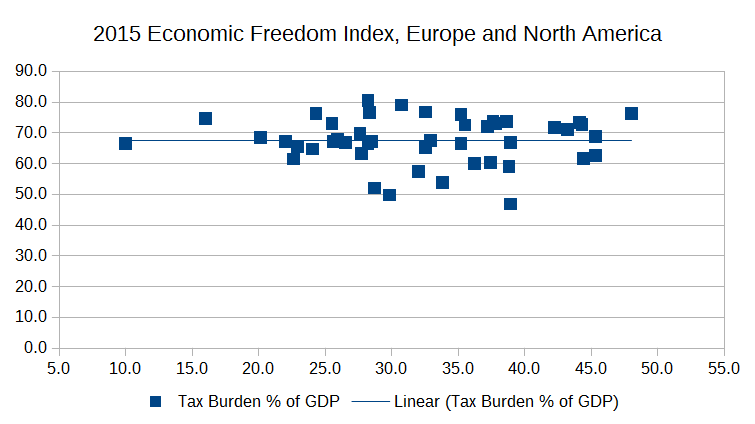
Indeed, if you restrict the sample to North America and Europe, the correlation basically disappears; all the countries are fairly free, all the taxes are fairly high, and within that the two aren’t very much related. (It’s been a long time since I’ve seen a trendline that flat, actually!)

Graph: Heritage Foundation Economic Freedom Index and tax burden, Europe and North America

Switzerland, Canada, and Denmark all have higher economic freedom scores than the United States, as well as higher tax burdens; but on the other hand, Greece, Spain, and Austria have higher tax burdens but lower freedom scores. All of them are variations on social democracy.

Is that socialism? I’m really not sure. Why does it matter, really?

Externalities

JDN 2457202 EDT 17:52.

The 1992 Bill Clinton campaign had a slogan, “It’s the economy, stupid.”: A snowclone I’ve used on occasion is “it’s the externalities, stupid.” (Though I’m actually not all that fond of calling people ‘stupid’; though occasionally true is it never polite and rarely useful.) Externalities are one of the most important concepts in economics, and yet one that even all too many economists frequently neglect.

Fortunately for this one, I really don’t need much math; the concept isn’t even that complicated, which makes it all the more mysterious how frequently it is ignored. An externality is simply an effect that an action has upon those who were not involved in choosing to perform that action.

All sorts of actions have externalities; indeed, much rarer are actions that don’t. An obvious example is that punching someone in the face has the externality of injuring that person. Pollution is an important externality of many forms of production, because the people harmed by pollution are typically not the same people who were responsible for creating it. Traffic jams are created because every car on the road causes a congestion externality on all the other cars.

All the aforementioned are negative externalities, but there are also positive externalities. When one individual becomes educated, they tend to improve the overall economic viability of the place in which they live. Building infrastructure benefits whole communities. New scientific discoveries enhance the well-being of all humanity.

Externalities are a fundamental problem for the functioning of markets. In the absence of externalities—if each person’s actions only affected that one person and nobody else—then rational self-interest would be optimal and anything else would make no sense. In arguing that rationality is equivalent to self-interest, generations of economists have been, tacitly or explicitly, assuming that there are no such things as externalities.

This is a necessary assumption to show that self-interest would lead to something I discussed in an earlier post: Pareto-efficiency, in which the only way to make one person better off is to make someone else worse off. As I already talked about in that other post, Pareto-efficiency is wildly overrated; a wide variety of Pareto-efficient systems would be intolerable to actually live in. But in the presence of externalities, markets can’t even guarantee Pareto-efficiency, because it’s possible to have everyone acting in their rational self-interest cause harm to everyone at once.

This is called a tragedy of the commons; the basic idea is really quite simple. Suppose that when I burn a gallon of gasoline, that makes me gain 5 milliQALY by driving my car, but then makes everyone lose 1 milliQALY in increased pollution. On net, I gain 4 milliQALY, so if I am rational and self-interested I would do that. But now suppose that there are 10 people all given the same choice. If we all make that same choice, each of us will gain 1 milliQALY—and then lose 10 milliQALY. We would all have been better off if none of us had done it, even though it made sense to each of us at the time. Burning a gallon of gasoline to drive my car is beneficial to me, more so than the release of carbon dioxide into the atmosphere is harmful; but as a result of millions of people burning gasoline, the carbon dioxide in the atmosphere is destabilizing our planet’s climate. We’d all be better off if we could find some way to burn less gasoline.

In order for rational self-interest to be optimal, externalities have to somehow be removed from the system. Otherwise, there are actions we can take that benefit ourselves but harm other people—and thus, we would all be better off if we acted to some degree altruistically. (When I say things like this, most non-economists think I am saying something trivial and obvious, while most economists insist that I am making an assertion that is radical if not outright absurd.)

But of course a world without externalities is a world of complete isolation; it’s a world where everyone lives on their own deserted island and there is no way of communicating or interacting with any other human being in the world. The only reasonable question about this world is whether we would die first or go completely insane first; clearly those are the two things that would happen. Human beings are fundamentally social animals—I would argue that we are in fact more social even than eusocial animals like ants and bees. (Ants and bees are only altruistic toward their own kin; humans are altruistic to groups of millions of people we’ve never even met.) Humans without social interaction are like flowers without sunlight.

Indeed, externalities are so common that if markets only worked in their absence, markets would make no sense at all. Fortunately this isn’t true; there are some ways that markets can be adjusted to deal with at least some kinds of externalities.

One of the most well-known is the Coase theorem; this is odd because it is by far the worst solution. The Coase theorem basically says that if you can assign and enforce well-defined property rights and there is absolutely no cost in making any transaction, markets will automatically work out all externalities. The basic idea is that if someone is about to perform an action that would harm you, you can instead pay them not to do it. Then, the harm to you will be prevented and they will incur an additional benefit.

In the above example, we could all agree to pay $30 (which let’s say is worth 1 milliQALY) to each person who doesn’t burn a gallon of gasoline that would pollute our air. Then, if I were thinking about burning some gasoline, I wouldn’t want to do it, because I’d lose the $300 in payments, which costs me 10 milliQALY, while the benefits of burning the gasoline are only 5 milliQALY. We all reason the same way, and the result is that nobody burns gasoline and actually the money exchanged all balances out so we end up where we were before. The result is that we are all better off.

The first thought you probably have is: How do I pay everyone who doesn’t hurt me? How do I even find all those people? How do I ensure that they follow through and actually don’t hurt me? These are the problems of transaction costs and contract enforcement that are usually presented as the problem with the Coase theorem, and they certainly are very serious problems. You end up needing some sort of government simply to enforce all those contracts, and even then there’s the question of how we can possibly locate everyone who has ever polluted our air or our water.

But in fact there’s an even more fundamental problem: This is extortion. We are almost always in the condition of being able to harm other people, and a system in which the reason people don’t hurt each other is because they’re constantly paying each other not to is a system in which the most intimidating psychopath is the wealthiest person in the world. That system is in fact Pareto-efficient (the psychopath does quite well for himself indeed); but it’s exactly the sort of Pareto-efficient system that isn’t worth pursuing.

Another response to externalities is simply to accept them, which isn’t as awful as it sounds. There are many kinds of externalities that really aren’t that bad, and anything we might do to prevent them is likely to make the cure worse than the disease. Think about the externality of people standing in front of you in line, or the externality of people buying the last cereal box off the shelf before you can get there. The externality of taking the job you applied for may hurt at the time, but in the long run that’s how we maintain a thriving and competitive labor market. In fact, even the externality of ‘gentrifying’ your neighborhood so you can no longer afford it is not nearly as bad as most people seem to think—indeed, the much larger problem seems to be the poor neighborhoods that don’t have rising incomes, remaining poor for generations. (It also makes no sense to call this “gentrifying”; the only landed gentry we have in America is the landowners who claim a ludicrous proportion of our wealth, not the middle-class people who buy cheap homes and move in. If you really want to talk about a gentry, you should be thinking Waltons and Kochs—or Bushs and Clintons.) These sorts of minor externalities that are better left alone are sometimes characterized as pecuniary externalities because they usually are linked to prices, but I think that really misses the point; it’s quite possible for an externality to be entirely price-related and do enormous damage (read: the entire financial system) and to have little or nothing to do with prices and still be not that bad (like standing in line as I mentioned above).

But obviously we can’t leave all externalities alone in this way. We can’t just let people rob and murder one another arbitrarily, or ignore the destruction of the world’s climate that threatens hundreds of millions of lives. We can’t stand back and let forests burn and rivers run dry when we could easily have saved them.

The much more reasonable and realistic response to externalities is what we call government—there are rules you have to follow in society and punishments you face if you don’t. We can avoid most of the transaction problems involved in figuring out who polluted our water by simply making strict rules about polluting water in general. We can prevent people from stealing each other’s things or murdering each other by police who will investigate and punish such crimes.

This is why regulation—and a government strong enough to enforce that regulation—is necessary for the functioning of a society. This dichotomy we have been sold about “regulations versus the market” is totally nonsensical; the market depends upon regulations. This doesn’t justify any particular regulation—and indeed, an awful lot of regulations are astonshingly bad. But some sort of regulatory system is necessary for a market to function at all, and the question has never been whether we will have regulations but which regulations we will have. People who argue that all regulations must go and the market would somehow work on its own are either deeply ignorant of economics or operating from an ulterior motive; some truly horrendous policies have been made by arguing that “less government is always better” when the truth is nothing of the sort.

In fact, there is one real-world method I can think of that actually comes reasonably close to eliminating all externalities—and it is called social democracy. By involving everyone—democracy—in a system that regulates the economy—socialism—we can, in a sense, involve everyone in every transaction, and thus make it impossible to have externalities. In practice it’s never that simple, of course; but the basic concept of involving our whole society in making the rules that our society will follow is sound—and in fact I can think of no reasonable alternative.

We have to institute some sort of regulatory system, but then we need to decide what the regulations will be and who will control them. If we want to instead vest power in a technocratic elite, how do you decide whom to include in that elite? How do we ensure that the technocrats are actually better for the general population if there is no way for that general population to have a say in their election? By involving as many people as we can in the decision-making process, we make it much less likely that one person’s selfish action will harm many others. Indeed, this is probably why democracy prevents famine and genocide—which are, after all, rather extreme examples of negative externalities.

Beware the false balance

JDN 2457046 PST 13:47.

I am now back in Long Beach, hence the return to Pacific Time. Today’s post is a little less economic than most, though it’s certainly still within the purview of social science and public policy. It concerns a question that many academic researchers and in general reasonable, thoughtful people have to deal with: How do we remain unbiased and nonpartisan?

This would not be so difficult if the world were as the most devoted “centrists” would have you believe, and it were actually the case that both sides have their good points and bad points, and both sides have their scandals, and both sides make mistakes or even lie, so you should never take the side of the Democrats or the Republicans but always present both views equally.

Sadly, this is not at all the world in which we live. While Democrats are far from perfect—they are human beings after all, not to mention politicians—Republicans have become completely detached from reality. As Stephen Colbert has said, “Reality has a liberal bias.” You know it’s bad when our detractors call us the reality-based community. Treating both sides as equal isn’t being unbiased—it’s committing a balance fallacy.

Don’t believe me? Here is a list of objective, scientific facts that the Republican Party (and particularly its craziest subset, the Tea Party) has officially taken political stances against:

  1. Global warming is a real problem, and largely caused by human activity. (The Republican majority in the Senate voted down a resolution acknowledging this.)
  2. Human beings share a common ancestor with chimpanzees. (48% of Republicans think that we were created in our present form.)
  3. Animals evolve over time due to natural selection. (Only 43% of Republicans believe this.)
  4. The Earth is approximately 4.5 billion years old. (Marco Rubio said he thinks maybe the Earth was made in seven days a few thousand years ago.)
  5. Hydraulic fracturing can trigger earthquakes.(Republican in Congress are trying to nullify local regulations on fracking because they insist it is so safe we don’t even need to keep track.)
  6. Income inequality in the United States is the worst it has been in decades and continues to rise. (Mitt Romney said that the concern about income inequality is just “envy”.)
  7. Progressive taxation reduces inequality without adversely affecting economic growth. (Here’s a Republican former New York Senator saying that the President “should be ashamed” for raising taxes on—you guessed it—”job creators”.)
  8. Moderate increases in the minimum wage do not yield significant losses in employment. (Republicans consistently vote against even small increases in the minimum wage, and Democrats consistently vote in favor.)
  9. The United States government has no reason to ever default on its debt. (John Boehner, now Speaker of the House, once said that “America is broke” and if we don’t stop spending we’ll never be able to pay the national debt.)
  10. Human embryos are not in any way sentient, and fetuses are not sentient until at least 17 weeks of gestation, probably more like 30 weeks. (Yet if I am to read it in a way that would make moral sense, “Life begins at conception”—which several Republicans explicitly endorsed at the National Right to Life Convention—would have to imply that even zygotes are sentient beings. If you really just meant “alive”, then that would equally well apply to plants or even bacteria. Sentience is the morally relevant category.)

And that’s not even counting the Republican Party’s association with Christianity and all of the objectively wrong scientific claims that necessarily entails—like the existence of an afterlife and the intervention of supernatural forces. Most Democrats also self-identify as Christian, though rarely with quite the same fervor (the last major Democrat I can think of who was a devout Christian was Jimmy Carter), probably because most Americans self-identify as Christian and are hesitant to elect an atheist President (despite the fact that 93% of the National Academy of Sciences is comprised of atheists and the higher your IQ the more likely you are to be an atheist; we wouldn’t want to elect someone who agrees with smart people, now would we?).

It’s true, there are some other crazy ideas out there with a left-wing slant, like the anti-vaccination movement that has wrought epidemic measles upon us, the anti-GMO crowd that rejects basic scientific facts about genetics, and the 9/11 “truth” movement that refuses to believe that Al Qaeda actually caused the attacks. There are in fact far-left Marxists out there who want to tear down the whole capitalist system by glorious revolution and replace it with… er… something (they’re never quite clear on that last point). But none of these things are the official positions of standing members of Congress.

The craziest belief by a standing Democrat I can think of is Dennis Kucinich’s belief that he saw an alien spacecraft. And to be perfectly honest, alien spacecraft are about a thousand times more plausible than Christianity in general, let alone Creationism. There almost certainly are alien spacecraft somewhere in the universe—just most likely so far away we’ll need FTL to encounter them. Moreover, this is not Kucinich’s official position as a member of Congress and it’s not something he has ever made policy based upon.

Indeed, if you’re willing to include the craziest individuals with no real political power who identify with a particular side of the political spectrum, then we should include on the right-wing side people like the Bundy militia in Nevada, neo-Nazis in Detroit, and the dozens of KKK chapters across the US. Not to mention this pastor who wants to murder all gay people in the world (because he truly believes what Leviticus 20:13 actually and clearly says).

If you get to include Marxists on the left, then we get to include Nazis on the right. Or, we could be reasonable and say that only the official positions of elected officials or mainstream pundits actually count, in which case Democrats have views that are basically accurate and reasonable while the majority of Republicans have views that are still completely objectively wrong.

There’s no balance here. For every Democrat who is wrong, there is a Republicans who is totally delusional. For every Democrat who distorts the truth, there is a Republican who blatantly lies about basic facts. Not to mention that for every Democrat who has had an ill-advised illicit affair there is a Republican who has committed war crimes.

Actually war crimes are something a fair number of Democrats have done as well, but the difference still stands out in high relief: Barack Obama has ordered double-tap drone strikes that are in violation of the Geneva Convention, but George W. Bush orchestrated a worldwide mass torture campaign and launched pointless wars that slaughtered hundreds of thousands of people. Bill Clinton ordered some questionable CIA operations, but George H.W. Bush was the director of the CIA.

I wish we had two parties that were equally reasonable. I wish there were two—or three, or four—proposals on the table in each discussion, all of which had merits and flaws worth considering. Maybe if we somehow manage to get the Green Party a significant seat in power, or the Social Democrat party, we can actually achieve that goal. But that is not where we are right now. Right now, we have the Democrats, who have some good ideas and some bad ideas; and then we have the Republicans, who are completely out of their minds.

There is an important concept in political science called the Overton window; it is the range of political ideas that are considered “reasonable” or “mainstream” within a society. Things near the middle of the Overton window are considered sensible, even “nonpartisan” ideas, while things near the edges are “partisan” or “political”, and things near but outside the window are seen as “extreme” and “radical”. Things far outside the window are seen as “absurd” or even “unthinkable”.

Right now, our Overton window is in the wrong place. Things like Paul Ryan’s plan to privatize Social Security and Medicare are seen as reasonable when they should be considered extreme. Progressive income taxes of the kind we had in the 1960s are seen as extreme when they should be considered reasonable. Cutting WIC and SNAP with nothing to replace them and letting people literally starve to death are considered at most partisan, when they should be outright unthinkable. Opposition to basic scientific facts like climate change and evolution is considered a mainstream political position—when in terms of empirical evidence Creationism should be more intellectually embarrassing than being a 9/11 truther or thinking you saw an alien spacecraft. And perhaps worst of all, military tactics like double-tap strikes that are literally war crimes are considered “liberal”, while the “conservative” position involves torture, worldwide surveillance and carpet bombing—if not outright full-scale nuclear devastation.

I want to restore reasonable conversation to our political system, I really do. But that really isn’t possible when half the politicians are totally delusional. We have but one choice: We must vote them out.

I say this particularly to people who say “Why bother? Both parties are the same.” No, they are not the same. They are deeply, deeply different, for all the reasons I just outlined above. And if you can’t bring yourself to vote for a Democrat, at least vote for someone! A Green, or a Social Democrat, or even a Libertarian or a Socialist if you must. It is only by the apathy of reasonable people that this insanity can propagate in the first place.