What we still have to be thankful for

Nov 30 JDN 2461010

This post has been written before, but will go live after, Thanksgiving.

Thanksgiving is honestly a very ambivalent holiday.

The particular event it celebrates don’t seem quite so charming in their historical context: Rather than finding peace and harmony with all Native Americans, the Pilgrims in fact allied with the Wampanoag against the Narragansett, though they did later join forces with the Narragansett in order to conquer the Pequot. And of course we all know how things went for most Native American nations in the long run.

Moreover, even the gathering of family comes with some major downsides, especially in a time of extreme political polarization such as this one. I won’t be joining any of my Trump-supporting relatives for dinner this year (and they probably wouldn’t have invited me anyway), but the fact that this means becoming that much more detached from a substantial part of my extended family is itself a tragedy.

This year in particular, US policy has gotten so utterly horrific that it often feels like we have nothing to be thankful for at all, that all we thought was good and just in the world could simply be torn away at a moment’s notice by raving madmen. It isn’t really quite that bad—but it feels that way sometimes.

It also felt a bit uncanny celebrating Thanksgiving a few years ago when we were living in Scotland, for the UK does not celebrate Thanksgiving, but absolutely does celebrate Black Friday: Holidays may be local, but capitalism is global.

But fall feasts of giving thanks are far more ancient than that particular event in 1621 that we have mythologized to oblivion. They appear in numerous cultures across the globe—indeed their very ubiquity may be why the Wampanoag were so willing to share one with the Pilgrims despite their cultures having diverged something like 40,000 years prior.

And I think that it is by seeing ourselves in that context—as part of the whole of humanity—that we can best appreciate what we truly do have to be thankful for, and what we truly do have to look forward to in the future.

Above all, medicine.

We have actual treatments for some diseases, even actual cures for some. By no means all, of course—and it often feels like we are fighting an endless battle even against what we can treat.

But it is worth reflecting on the fact that aside from the last few centuries, this has simply not been the case. There were no actual treatments. There was no real medicine.

Oh, sure, there were attempts at medicine; and there was certainly what we would think of as more like “first aid”: bandaging wounds, setting broken bones. Even amputation and surgery were done sometimes. But most medical treatment was useless or even outright harmful—not least because for most of history, most of it was done without anesthetic or even antiseptic!

There were various herbal remedies for various ailments, some of which even have happened to work: Willow bark genuinely helps with pain, St. John’s wort is a real antidepressant, and some traditional burn creams are surprisingly effective.

But there was no system in place for testing medicine, no way of evaluating what remedies worked and what didn’t. And thus, for every remedy that worked as advertised, there were a hundred more that did absolutely nothing, or even made things worse.

Today, it can feel like we are all chronically ill, because so many of us take so many different pills and supplements. But this is not a sign that we are ill—it is a sign that we can be treated. The pills are new, yes—but the illnesses they treat were here all along.

I don’t see any particular reason to think that Roman plebs or Medieval peasants were any less likely to get migraines than we are; but they certainly didn’t have access to sumatriptan or rimegepant. Maybe they were less likely to get diabetes, but mainly because they were much more likely to be malnourished. (Well, okay, also because they got more exercise, which we surely could stand to.) And they only reason they didn’t get Alzheimer’s was that they usually didn’t live long enough.

Looking further back, before civilization, human health actually does seem to have been better: Foragers were rarely malnourished, weren’t exposed to as many infectious pathogens, and certainly got plenty of exercise. But should a pathogen like smallpox or influenza make it to a forager tribe, the results were often utterly catastrophic.

Today, we don’t really have the sort of plague that human beings used to deal with. We have pandemics, which are also horrible, but far less so. We were horrified by losing 0.3% of our population to COVID; a society that had only suffered 0.3%—or even ten times that, 3%—losses from the Black Death would have been hailed as a miracle, for a more typical rate was 30%.

At 0.3%, most of us knew somebody, or knew somebody who knew somebody, who died from COVID. At 3%, nearly everyone would know somebody, and most would know several. At 30%, nearly everyone would have close family and friends who died.

Then there is infant mortality.

As recently as 1950—this is living memory—the global infant mortality rate was 14.6%. This is about half what it had been historically; for most of human history, roughly a third of all children died between birth and the age of 5.

Today, it is 2.5%.

Where our distant ancestors expected two out of three of their children to survive and our own great-grandparents expected five out of six can now safely expect thirty-nine out of forty to live. This is the difference between “nearly every family has lost a child” and “most families have not lost a child”.

And this is worldwide; in highly-developed countries it’s even better. The US has a relatively high infant mortality rate by the standards of highly-developed countries (indeed, are we even highly-developed, or are we becoming like Saudi Arabia, extremely rich but so unequal that it doesn’t really mean anything to most of our people?). Yet even for us, the infant mortality rate is 0.5%—so we can expect one-hundred-ninety-nine out of two-hundred to survive. This is at the level of “most families don’t even know someone who has lost a child.”

Poverty is a bit harder to measure.

I am increasingly dubious of conventional measures of poverty; ever since compiling my Index of Necessary Expenditure, I am convinced that economists in general, and perhaps US economists in particular, are systematically underestimating the cost of living and thereby underestimating the prevalence of poverty. (I don’t think this is intentional, mind you; I just think it’s a result of using convenient but simplistic measures and not looking too closely into the details.) I think not being able to sustainably afford a roof over your head constitutes being poor—and that applies to a lot of people.

Yet even with that caveat in mind, it’s quite clear that global poverty has greatly declined in the long run.

At the “extreme poverty” level, currently defined as consuming $1.90 at purchasing power parity per day—that’s just under $700 per year, less than 2% of the median personal income in the United States—the number of people has fallen from 1.9 billion in 1990 to about 700 million today. That’s from 36% of the world’s population to under 9% today.

Now, there are good reasons to doubt that “purchasing power parity” really can be estimated as accurately as we would like, and thus it’s not entirely clear that people living on “$2 per day PPP” are really living at less than 2% the standard of living of a typical American (honestly to me that just sounds like… dead); but they are definitely living at a much worse standard of living, and there are a lot fewer people living at such low standard of living today than there used to be not all that long ago. These are people who don’t have reliable food, clean water, or even basic medicine—and that used to include over a third of humanity and does no longer. (And I would like to note that actually finding such a person and giving them a few hundred dollars absolutely would change their life, and this is the sort of thing GiveDirectly does. We may not know exactly how to evaluate their standard of living, but we do know that the actual amount of money they have access to is very, very small.)

There are many ways in which the world could be better than it is.

Indeed, part of the deep, overwhelming outrage I feel pretty much all the time lies in the fact that it would be so easy to make things so much better for so many people, if there weren’t so many psychopaths in charge of everything.


Increased foreign aid is one avenue by which that could be achieved—so, naturally, Trump cut it tremendously. More progressive taxation is another—so, of course, we get tax cuts for the rich.

Just think about the fact that there are families with starving children for whom a $500 check could change their lives; but nobody is writing that check, because Elon Musk needs to become a literal trillionaire.

There are so many water lines and railroad tracks and bridges and hospitals and schools not being built because the money that would have paid for them is tied up in making already unfathomably-rich people even richer.

But even despite all that, things are getting better. Not every day, not every month, not even every year—this past year was genuinely, on net, a bad one. But nearly every decade, every generation, and certainly every century (for at least the last few), humanity has fared better than we did the last.

As long as we can keep that up, we still have much to hope for—and much to be thankful for.

For my mother, on her 79th birthday

Sep 21 JDN 2460940

When this post goes live, it will be mother’s 79th birthday. I think birthdays are not a very happy time for her anymore.

I suppose nobody really likes getting older; children are excited to grow up, but once you hit about 25 or 26 (the age at which you can rent a car at the normal rate and the age at which you have to get your own health insurance, respectively) and it becomes “getting older” instead of “growing up”, the excitement rapidly wears off. Even by 30, I don’t think most people are very enthusiastic about their birthdays. Indeed, for some people, I think it might be downhill past 21—you wanted to become an adult, but you had no interest in aging beyond that point.

But I think it gets worse as you get older. As you get into your seventies and eighties, you begin to wonder which birthday will finally be your last; actually I think my mother has been wondering about this even earlier than that, because her brothers died in their fifties, her sister died in her sixties, and my father died at 63. At this point she has outlived a lot of people she loved. I think there is a survivor’s guilt that sets in: “Why do I get to keep going, when they didn’t?”

These are also very hard times in general; Trump and the people who enable him have done tremendous damage to our government, our society, and the world at large in a shockingly short amount of time. It feels like all the safeguards we were supposed to have suddenly collapsed and we gave free rein to a madman.

But while there are many loved ones we have lost, there are many we still have; and nor need our set of loved ones be fixed, only to dwindle with each new funeral. We can meet new people, and they can become part of our lives. New children can be born into our family, and they can make our family grow. It is my sincere hope that my mother still has grandchildren yet to meet; in my case they would probably need to be adopted, as the usual biological route is pretty much out of the question, and surrogacy seems beyond our budget for the foreseeable future. But we would still love them, and she could still love them, and it is worth sticking around in this world in order to be a part of their lives.

I also believe that this is not the end for American liberal democracy. This is a terrible time, no doubt. Much that we thought would never happen already has, and more still will. It must be so unsettling, so uncanny, for someone who grew up in the triumphant years after America helped defeat fascism in Europe, to grow older and then see homegrown American fascism rise ascendant here. Even those of us who knew history all too well still seem doomed to repeat it.

At this point it is clear that victory over corruption, racism, and authoritarianism will not be easy, will not be swift, may never be permanent—and is not even guaranteed. But it is still possible. There is still enough hope left that we can and must keep fighting for an America worth saving. I do not know when we will win; I do not even know for certain that we will, in fact, win. But I believe we will.

I believe that while it seems powerful—and does everything it can to both promote that image and abuse what power it does have—fascism is a fundamentally weak system, a fundamentally fragile system, which simply cannot sustain itself once a handful of critical leaders are dead, deposed, or discredited. Liberal democracy is kinder, gentler—and also slower, at times even clumsier—than authoritarianism, and so it may seem weak to those whose view of strength is that of the savanna ape or the playground bully; but this is an illusion. Liberal democracy is fundamentally strong, fundamentally resilient. There is power in kindness, inclusion, and cooperation that the greedy and cruel cannot see. Fascism in Germany arrived and disappeared within a generation; democracy in America has stood for nearly 250 years.

We don’t know how much more time we have, Mom; none of us do. I have heard it said that you should live your life as though you will live both a short life and a long one; but honestly, you should probably live your life as though you will live a randomly-decided amount of time that is statistically predicted by actuarial tables—because you will. Yes, the older you get, the less time you have left (almost tautologically); but especially in this age of rapid technological change, none of us really know whether we’ll die tomorrow or live another hundred years.

I think right now, you feel like there isn’t much left to look forward to. But I promise you there is. Maybe it’s hard to see right now; indeed, maybe you—or I, or anyone—won’t even ever get to see it. But a brighter future is possible, and it’s worth it to keep going, especially if there’s any way that we might be able to make that brighter future happen sooner.

Grief, a rationalist perspective

Aug 31 JDN 2460919

This post goes live on the 8th anniversary of my father’s death. Thus it seems an appropriate time to write about grief—indeed, it’s somewhat difficult for me to think about much else.

Far too often, the only perspectives on grief we hear are religious ones. Often, these take the form of consolation: “He’s in a better place now.” “You’ll see him again someday.”

Rationalism doesn’t offer such consolations. Technically one can be an atheist and still believe in an afterlife; but rationalism is stronger than mere atheism. It requires that we believe in scientific facts, and the permanent end of consciousness at death is a scientific fact. We know from direct experiments and observations in neuroscience that a destroyed brain cannot think, feel, see, hear, or remember—when your brain shuts down, whatever you are now will be gone.

It is the Basic Fact of Cognitive Science: There is no soul but the brain.

Moreover, I think, deep down, we all know that death is the end. Even religious people grieve. Their words may say that their loved one is in a better place, but their tears tell a different story.

Maybe it’s an evolutionary instinct, programmed deep into our minds like an ancestral memory, a voice that screams in our minds, insistent on being heard:

Death is bad!”

If there is one crucial instinct a lifeform needs in order to survive, surely it is something like that one: The preference for life over death. In order to live in a hostile world, you have to want to live.

There are some people who don’t want to live, people who become suicidal. Sometimes even the person we are grieving was someone who chose to take their own life. Generally this is because they believe that their life from then on would be defined only by suffering. Usually, I would say they are wrong about that; but in some cases, maybe they are right, and choosing death is rational. Most of the time, life is worth living, even when we can’t see that.

But aside from such extreme circumstances, most of us feel most of the time that death is one of the worst things that could happen to us or our loved ones. And it makes sense that we feel that way. It is right to feel that way. It is rational to feel that way.

This is why grief hurts so much.

This is why you are not okay.

If the afterlife were real—or even plausible—then grief would not hurt so much. A loved one dying would be like a loved one traveling away to somewhere nice; bittersweet perhaps, maybe even sad—but not devastating the way that grief is. You don’t hold a funeral for someone who just booked a one-way trip to Hawaii, even if you know they aren’t ever coming back.

Religion tries to be consoling, but it typically fails. Because that voice in our heads is still there, repeating endlessly: “Death is bad!” “Death is bad!” “Death is bad!”

But what if religion does give people some comfort in such a difficult time? What if supposing something as nonsensical as Heaven numbs the pain for a little while?

In my view, you’d be better off using drugs. Drugs have side effects and can be addictive, but at least they don’t require you to fundamentally abandon your ontology. Mainstream religion isn’t simply false; it’s absurd. It’s one of the falsest things anyone has ever believed about anything. It’s obviously false. It’s ridiculous. It has never deserved any of the respect and reverence it so often receives.

And in a great many cases, religion is evil. Religion teaches people to be obedient to authoritarians, and to oppress those who are different. Some of the greatest atrocities in history were committed in the name of religion, and some of the worst oppression going on today is done in the name of religion.

Rationalists should give religion no quarter. It is better for someone to find solace in alcohol or cannabis than for them to find solace in religion.

And maybe, in the end, it’s better if they don’t find solace at all.

Grief is good. Grief is healthy. Grief is what we should feel when something as terrible as death happens. That voice screaming “Death is bad!” is right, and we should listen to it.

No, what we need is to not be paralyzed by grief, destroyed by grief. We need to withstand our grief, get through it. We must learn to be strong enough to bear what seems unbearable, not console ourselves with lies.

If you are a responsible adult, then when something terrible happens to you, you don’t pretend it isn’t real. You don’t conjure up a fantasy world in which everything is fine. You face your terrors. You learn to survive them. You make yourself strong enough to carry on. The death of a loved one is a terrible thing; you shouldn’t pretend otherwise. But it doesn’t have to destroy you. You can grow, and heal, and move on.

Moreover, grief has a noble purpose. From our grief we must find motivation to challenge death, to fight death wherever we find it. Those we have already lost are gone; it’s too late for them. But it’s not too late for the rest of us. We can keep fighting.

And through economic development and medical science, we do keep fighting.

In fact, little by little, we are winning the war on death.

Death has already lost its hold upon our children. For most of human history, nearly a third of children died before the age of 5. Now less than 1% do, in rich countries, and even in the poorest countries, it’s typically under 10%. With a little more development—development that is already happening in many places—we can soon bring everyone in the world to the high standard of the First World. We have basically won the war on infant and child mortality.

And death is losing its hold on the rest of us, too. Life expectancy at adulthood is also increasing, and more and more people are living into their nineties and even their hundreds.

It’s true, there still aren’t many people living to be 120 (and some researchers believe it will be a long time before this changes). But living to be 85 instead of 65 is already an extra 20 years of life—and these can be happy, healthy years too, not years of pain and suffering. They say that 60 is the new 50; physiologically, we are so much healthier than our ancestors that it’s as if we were ten years younger.

My sincere hope is that our grief for those we have lost and fear of losing those we still have will drive us forward to even greater progress in combating death. I believe that one day we will finally be able to slow, halt, perhaps even reverse aging itself, rendering us effectively immortal.

Religion promises us immortality, but it isn’t real.

Science offers us the possibility of immortality that’s real.

It won’t be easy to get there. It won’t happen any time soon. In all likelihood, we won’t live to see it ourselves. But one day, our descendants may achieve the grandest goal of all: Finally conquering death.

And even long before that glorious day, our lives are already being made longer and healthier by science. We are pushing death back, step by step, day by day. We are fighting, and we are winning.

Moreover, we as individuals are not powerless in this fight: you can fight death a little harder yourself, by becoming an organ donor, or by donating to organizations that fight global poverty or advance medical science. Let your grief drive you to help others, so that they don’t have to grieve as you do.

And if you need consolation from your grief, let it come from this truth: Death is rarer now today than it was yesterday, and will be rarer still tomorrow. We can’t bring back who we have lost, but we can keep ourselves from losing more so soon.

Valuing harm without devaluing the harmed

June 9 JDN 2458644

In last week’s post I talked about the matter of “putting a value on a human life”. I explained how we don’t actually need to make a transparently absurd statement like “a human life is worth $5 million” to do cost-benefit analysis; we simply need to ask ourselves what else we could do with any given amount of money. We don’t actually need to put a dollar value on human lives; we need only value them in terms of other lives.

But there is a deeper problem to face here, which is how we ought to value not simply life, but quality of life. The notion is built into the concept of quality-adjusted life-years (QALY), but how exactly do we make such a quality adjustment?

Indeed, much like cost-benefit analysis in general or the value of a statistical life, the very concept of QALY can be repugnant to many people. The problem seems to be that it violates our deeply-held belief that all lives are of equal value: If I say that saving one person adds 2.5 QALY and saving another adds 68 QALY, I seem to be saying that the second person is worth more than the first.

But this is not really true. QALY aren’t associated with a particular individual. They are associated with the duration and quality of life.

It should be fairly easy to convince yourself that duration matters: Saving a newborn baby who will go on to live to be 84 years old adds an awful lot more in terms of human happiness than extending the life of a dying person by a single hour. To call each of these things “saving a life” is actually very unequal: It’s implying that 1 hour for the second person is worth 84 years for the first.

Quality, on the other hand, poses much thornier problems. Presumably, we’d like to be able to say that being wheelchair-bound is a bad thing, and if we can make people able to walk we should want to do that. But this means that we need to assign some sort of QALY cost to being in a wheelchair, which then seems to imply that people in wheelchairs are worth less than people who can walk.

And the same goes for any disability or disorder: Assigning a QALY cost to depression, or migraine, or cystic fibrosis, or diabetes, or blindness, or pneumonia, always seems to imply that people with the condition are worth less than people without. This is a deeply unsettling result.

Yet I think the mistake is in how we are using the concept of “worth”. We are not saying that the happiness of someone with depression is less important than the happiness of someone without; we are saying that the person with depression experiences less happiness—which, in this case of depression especially, is basically true by construction.

Does this imply, however, that if we are given the choice between saving two people, one of whom has a disability, we should save the one without?

Well, here’s an extreme example: Suppose there is a plague which kills 50% of its victims within one year. There are two people in a burning building. One of them has the plague, the other does not. You only have time to save one: Which do you save? I think it’s quite obvious you save the person who doesn’t have the plague.

But that only relies upon duration, which wasn’t so difficult. All right, fine; say the plague doesn’t kill you. Instead, it renders you paralyzed and in constant pain for the rest of your life. Is it really that far-fetched to say that we should save the person who won’t have that experience?

We really shouldn’t think of it as valuing people; we should think of it as valuing actions. QALY are a way of deciding which actions we should take, not which people are more important or more worthy. “Is a person who can walk worth more than a person who needs a wheelchair?” is a fundamentally bizarre and ultimately useless question. ‘Worth more’ in what sense? “Should we spend $100 million developing this technology that will allow people who use wheelchairs to walk?” is the question we should be asking. The QALY cost we assign to a condition isn’t about how much people with that condition are worth; it’s about what resources we should be willing to commit in order to treat that condition. If you have a given condition, you should want us to assign a high QALY cost to it, to motivate us to find better treatments.

I think it’s also important to consider which individuals are having QALY added or subtracted. In last week’s post I talked about how some people read “the value of a statistical life is $5 million” to mean “it’s okay to kill someone as long as you profit at least $5 million”; but this doesn’t follow at all. We don’t say that it’s all right to steal $1,000 from someone just because they lose $1,000 and you gain $1,000. We wouldn’t say it was all right if you had a better investment strategy and would end up with $1,100 afterward. We probably wouldn’t even say it was all right if you were much poorer and desperate for the money (though then we might at least be tempted). If a billionaire kills people to make $10 million each (sadly I’m quite sure that oil executives have killed for far less), that’s still killing people. And in fact since he is a billionaire, his marginal utility of wealth is so low that his value of a statistical life isn’t $5 million; it’s got to be in the billions. So the net happiness of the world has not increased, in fact.

Above all, it’s vital to appreciate the benefits of doing good cost-benefit analysis. Cost-benefit analysis tells us to stop fighting wars. It tells us to focus our spending on medical research and foreign aid instead of yet more corporate subsidies or aircraft carriers. It tells us how to allocate our public health resources so as to save the most lives. It emphasizes how vital our environmental regulations are in making our lives better and longer.

Could we do all these things without QALY? Maybe—but I suspect we would not do them as well, and when millions of lives are on the line, “not as well” is thousands of innocent people dead. Sometimes we really are faced with two choices for a public health intervention, and we need to decide which one will help the most people. Sometimes we really do have to set a pollution target, and decide just what amount of risk is worth accepting for the economic benefits of industry. These are very difficult questions, and without good cost-benefit analysis we could get the answers dangerously wrong.

The upsides of life extension

Dec 16 JDN 2458469

If living is good, then living longer is better.

This may seem rather obvious, but it’s something we often lose sight of when discussing the consequences of medical technology for extending life. It’s almost like it seems too obvious that living longer must be better, and so we go out of our way to find ways that it is actually worse.

Even from a quick search I was able to find half a dozen popular media articles about life extension, and not one of them focused primarily on the benefits. The empirical literature is better, asking specific, empirically testable questions like “How does life expectancy relate to retirement age?” and “How is lifespan related to population and income growth?” and “What effect will longer lifespans have on pension systems?” Though even there I found essays in medical journals complaining that we have extended “quantity” of life without “quality” (yet by definition, if you are using QALY to assess the cost-effectiveness of a medical intervention, that’s already taken into account).

But still I think somewhere along the way we have forgotten just how good this is. We may not even be able to imagine the benefits of extending people’s lives to 200 or 500 or 1000 years.

To really get some perspective on this, I want you to imagine what a similar conversation must have looked like in roughly the year 1800, the Industrial Revolution, when industrial capitalism came along and made babies finally stop dying.

There was no mass media back then (not enough literacy), but imagine what it would have been like if there had been, or imagine what conversations about the future between elites must have been like.

And we do actually have at least one example of an elite author lamenting the increase in lifespan: His name was Thomas Malthus.

The Malthusian argument was seductive then, and it remains seductive today: If you improve medicine and food production, you will increase population. But if you increase population, you will eventually outstrip those gains in medicine and food and return once more to disease and starvation, only now with more mouths to feed.

Basically any modern discussion of “overpopulation” has this same flavor (by the way, serious environmentalists don’t use that concept; they’re focused on reducing pollution and carbon emissions, not people). Why bother helping poor countries, when they’re just going to double their population and need twice the help?

Well, as a matter of fact, Malthus was wrong. In fact, he was not just wrong: He was backwards. Increased population has come with increased standard of living around the world, as it allowed for more trade, greater specialization, and the application of economies of scale. You can’t build a retail market with a hunter-gatherer tribe. You can’t built an auto industry with a single city-state. You can’t build a space program with a population of 1 million. Having more people has allowed each person to do and have more than they could before.

Current population projections suggest world population will stabilize between 11 and 12 billion. Crucially, this does not factor in any kind of radical life extension technology. The projections allow for moderate increases in lifespan, but not people living much past 100.

Would increased lifespan lead to increased population? Probably, yes. I can’t be certain, because I can very easily imagine people deciding to put off having kids if they can reasonably expect to live 200 years and never become infertile.

I’m actually more worried about the unequal distribution of offspring: People who don’t believe in contraception will be able to have an awful lot of kids during that time, which could be bad for both the kids and society as a whole. We may need to impose regulations on reproduction similar to (but hopefully less draconian than) the One-Child policy imposed in China.

I think the most sensible way to impose the right incentives while still preserving civil liberties is to make it a tax: The first kid gets a subsidy, to help care for them. The second kid is revenue-neutral; we tax you but you get it back as benefits for the child. (Why not just let them keep the money? One of the few places where I think government paternalism is justifiable is protection against abusive or neglectful parents.) The third and later kids result in progressively higher taxes. We always feed the kids on government money, but their parents are going to end up quite poor if they don’t learn how to use contraceptives. (And of course, contraceptives will be made available for free without a prescription.)

But suppose that, yes, population does greatly increase as a result of longer lifespans. This is not a doomsday scenario. In fact, in itself, this is a good thing. If life is worth living, more lives are better.

The question becomes how we ensure that all these people live good lives; but technology will make that easier too. There seems to be an underlying assumption that increased lifespan won’t come with improved health and vitality; but this is already not true. 60 is the new 50: People who are 60 years old today live as well as people who were 50 years old just a generation ago.

And in fact, radical life extension will be an entirely different mechanism. We’re not talking about replacing a hip here, a kidney there; we’re talking about replenishing your chromosomal telomeres, repairing your cells at the molecular level, and revitalizing the content of your blood. The goal of life extension technology isn’t to make you technically alive but hooked up to machines for 200 years; it’s to make you young again for 200 years. The goal is a world where centenarians are playing tennis with young adults fresh out of college and you have trouble telling which is which.

There is another inequality concern here as well, which is cost. Especially in the US—actually almost only in the US, since most of the world has socialized medicine—where medicine is privatized and depends on your personal budget, I can easily imagine a world where the rich live to 200 and the poor die at 60. (The forgettable Justin Timberlake film In Time started with this excellent premise and then went precisely nowhere with it. Oddly, the Deus Ex games seem to have considered every consequence of mixing capitalism with human augmentation except this one.) We should be proactively taking steps to prevent this nightmare scenario by focusing on making healthcare provision equitable and universal. Even if this slows down the development of the technology a little bit, it’ll be worth it to make sure that when it does arrive, it will arrive for everyone.

We really don’t know what the world will look like when people can live 200 years or more. Yes, there will be challenges that come from the transition; honestly I’m most worried about keeping alive ideas that people grew up with two centuries prior. Imagine talking politics with Abraham Lincoln: He was viewed as extremely progressive for his time, even radical—but he was still a big-time racist.

The good news there is that people are not actually as set in their ways as many believe: While the huge surge in pro-LGBT attitudes did come from younger generations, support for LGBT rights has been gradually creeping up among older generations too. Perhaps if Abraham Lincoln had lived through the Great Depression, the World Wars, and the Civil Rights Movement he’d be a very different person than he was in 1865. Longer lifespans will mean people live through more social change; that’s something we’re going to need to cope with.

And of course violent death becomes even more terrifying when aging is out of the picture: It’s tragic enough when a 20-year-old dies in a car accident today and we imagine the 60 years they lost—but what if it was 180 years or 480 years instead? But violent death in basically all its forms is declining around the world.

But again, I really want to emphasize this: Think about how good this is. Imagine meeting your great-grandmother—and not just meeting her, not just having some fleeting contact you half-remember from when you were four years old or something, but getting to know her, talking with her as an adult, going to the same movies, reading the same books. Imagine the converse: Knowing your great-grandchildren, watching them grow up and have kids of their own, your great-great-grandchildren. Imagine the world that we could build if people stopped dying all the time.

And if that doesn’t convince you, I highly recommend Nick Bostrom’s “Fable of the Dragon-Tyrant”.

Stop making excuses for the dragon.

What do we mean by “obesity”?

Nov 25 JDN 2458448

I thought this topic would be particularly appropriate for the week of Thanksgiving, since as a matter of public ritual, this time every year, we eat too much and don’t get enough exercise.

No doubt you have heard the term “obesity epidemic”: It’s not just used by WebMD or mainstream news; it’s also used by the American Heart Association, the Center for Disease Control, the World Health Organization, and sometimes even published in peer-reviewed journal articles.

This is kind of weird, because the formal meaning of the term “epidemic” clearly does not apply here. I feel uncomfortable going against public health officials in what is clearly their area of expertise rather than my own, but everything I’ve ever read about the official definition of the word “epidemic” requires it to be an infectious disease. You can’t “catch” obesity. Hanging out with people who are obese may slightly raise your risk of obesity, but not in the way that hanging out with people with influenza gives you influenza. It’s not caused by bacteria or viruses. Eating food touched by a fat person won’t cause you to catch the fat. Therefore, whatever else it is, this is not an epidemic. (I guess sometimes we use the term more metaphorically, “an epidemic of bankruptcies” or an “epidemic of video game consumption”; but I feel like the WHO and CDC of all people should be more careful.)

Indeed, before we decide what exactly this is, I think we should first ask ourselves a deeper question: What do we mean by “obesity”?

The standard definition of “obesity” relies upon the body mass index (BMI), a very crude measure that simply takes your body mass and divides by the square of your height. It’s easy to measure, but that’s basically its only redeeming quality.

Anyone who has studied dimensional analysis should immediately see a problem here: That isn’t a unit of density. It’s a unit of… density-length? If you take the exact same individual and scale them up by 10%, their BMI will increase by 10%. Do we really intend to say that simply being larger makes you obese, for the exact same ratios of muscle, fat, and bone?

Because of this, the taller you are, the more likely your BMI is going to register as “obese”, holding constant your actual level of health and fitness. And worldwide, average height has been increasing. This isn’t enough to account for the entire trend in rising BMI, but it reduces it substantially; average height has increased by about 10% since the 1950s, which is enough to raise our average BMI by about 2 points of the 5-point observed increase.

And of course BMI doesn’t say anything about your actual ratios of fat and muscle; all it says is how many total kilograms are in your body. As a result, there is a systematic bias against athletes in the calculation of BMI—and any health measure that is biased against athletes is clearly doing something wrong. All those doctors telling us to exercise more may not realize it, but if we actually took their advice, our BMIs would very likely get higher, not lower—especially for men, especially for strength-building exercise.

It’s also quite clear that our standards for “healthy weight” are distorted by social norms. Feminists have been talking about this for years; most women will never look like supermodels no matter how much weight they lose—and eating disorders are much more dangerous than being even 50 pounds overweight. We’re starting to figure out that similar principles hold for men: A six-pack of abs doesn’t actually mean you’re healthy; it means you are dangerously depleted of fatty acids.

To compensate for this, it seems like the most sensible methodology would be to figure out empirically what sort of weight is most strongly correlated with good health and long lifespan—what BMI maximizes your expected QALY.

You might think that this is what public health officials did when defining what is currently categorized as “normal weight”—but you would be wrong. They used social norms and general intuition, and as a result, our standards for “normal weight” are systematically miscalibrated.

In fact, the empirical evidence is quite clear: The people with the highest expected QALY are those who are classified as “overweight”, with BMI between 25 and 30. Those of “normal weight” (20 to 25) fare slightly worse, followed by those classified as “obese class I” (30 to 35)—but we don’t actually see large effects until either “underweight” (18.5-20) or “obese class II” (35 to 40). And the really severe drops in life and health expectancy don’t happen until “obese class III” (>40); and we see the same severe drops at “very underweight” (<18.5).
With that in mind, consider that the global average BMI increased from 21.7 in men and 21.4 in women in 1975 to 24.2 in men and 24.4 in women in 2014. That is, the world average increased from the low end of “normal weight” which is actually too light, to the high end of “normal weight” which is probably optimal. The global prevalence of “morbid obesity”, the kind that actually has severely detrimental effects on health, is only 0.64% in men and 1.6% in men. Even including “severe obesity”, the kind that has a noticeable but not dramatic effect on health, is only 2.3% in men and 5.0% in women. That’s your epidemic? Reporting often says things like “2/3 of American adults are overweight or obese”; but all that “overweight” proportion should be utterly disregarded, since it is beneficial to health. The actual prevalence of obesity in the US—even including class I obesity which is not very harmful—is less than 40%.

If obesity were the health crisis it were made out to be, we should expect that global life expectancy is decreasing, or at the very least not increasing. On the contrary, it is rapidly increasing: In 1955, global life expectancy was only 55 years, while it is now over 70.

Worldwide, the countries with the highest obesity rates are those with the longest life expectancy, because both of these things are strongly correlated with high levels of economic development. But it may not just be that: Smoking reduces obesity while also reducing lifespan, and a lot of those countries with very high obesity (including the US) have very low rates of smoking.

There’s some evidence that within the set of rich, highly-developed countries, obesity rates are positively correlated with lower life expectancy, but these effects are much smaller than the effects of high development itself. Going from the highest obesity in the world (the US, of course) to the lowest among all highly-developed countries (Japan) requires reducing the obesity rate by 34 percentage points but only increases life expectancy by about 5 years. You’d get the same increase by raising overall economic development from the level of Turkey to the level of Greece, about 10 points on the 100-point HDI scale.


Now, am I saying that we should all be 400 pounds? No, there does come a point where excess weight is clearly detrimental to health. But this threshold is considerably higher than you have probably been led to believe. If you are 15 or 20 pounds “overweight” by what our society (or even your doctor!) tells you, you are probably actually at the optimal weight for your body type. If you are 30 or 40 pounds “overweight”, you may want to try to lose some weight, but don’t make yourself suffer to achieve it. Only if you are 50 pounds or more “overweight” should you really be considering drastic action. If you do try to lose weight, be realistic about your goal: Losing 5% to 10% of your initial weight is a roaring success.

There are also reasons to be particularly concerned about obesity and lack of exercise in children, which is why Michelle Obama’s “Let’s Move!” campaign was a good thing.

And yes, exercise more! Don’t do it to try to lose weight (exercise does not actually cause much weight loss). Just do it. Exercise has so many health benefits it’s honestly kind of ridiculous.

But why am I complaining about this, anyway? Even if we cause some people to worry more about eating less than is strictly necessary, what’s the harm in that? At least we’re getting people to exercise, and Thanksgiving was already ruined by politics anyway.

Well, here’s the thing: I don’t think this obesity panic is actually making us any less obese.

The United States is the most obese country in the world—and you can’t so much as call up Facebook or step into a subway car in the US without someone telling you that you’re too fat and you need to lose weight. The people who really are obese and may need medical help losing weight are the ones most likely to be publicly shamed and harassed for their weight—and there’s no evidence that this actually does anything to reduce their weight. People who experience shaming and harassment for their weight are actually less likely to achieve sustained weight loss.

Teenagers—both boys and girls—who are perceived to be “overweight” are at substantially elevated risk of depression and suicide. People who more fully internalize feelings of shame about their weight have higher blood pressure and higher triglicerides, though once you control for other factors the effect is not huge. There’s even evidence that fat shaming by medical professionals leads to worse treatment outcomes among obese patients.

If we want to actually reduce obesity—and this makes sense, at least for the upper-tail obesity of BMI above 35—then we should be looking at what sort of interventions are actually effective at doing that. Medicine has an important role to play of course, but I actually think economics might be stronger here (though I suppose I would, wouldn’t I?).

Number 1: Stop subsidizing meat and feed grains. There is now quite clear evidence that direct and indirect government subsidies for meat production are a contributing factor in our high fat consumption and thus high obesity rate, though obviously other factors matter too. If you’re worried about farmers, subsidize vegetables instead, or pay for active labor market programs that will train those farmers to work in new industries. This thing we do where we try to save the job instead of the worker is fundamentally idiotic and destructive. Jobs are supposed to be destroyed; that’s what technological improvement is. If you stop destroying jobs, you will stop economic growth.

Number 2: Restrict advertising of high-sugar, high-fat foods, especially to children. Food advertising is particularly effective, because it draws on such primal impulses, and children are particularly vulnerable (as the APA has publicly reported on, including specifically for food advertising). Corporations like McDonald’s and Kellogg’s know quite well what they’re doing when they advertise high-fat, high-sugar foods to kids and get them into the habit of eating them early.

Number 3: Find policies to promote exercise. Despite its small effects on weight loss, exercise has enormous effects on health. Indeed, the fact that people who successfully lose weight show long-term benefits even if they put the weight back on suggests to me that really what they gained was a habit of exercise. We need to find ways to integrate exercise into our daily lives more. The one big thing that our ancestors did do better than we do is constantly exercise—be it hunting, gathering, or farming. Standing desks and treadmill desks may seem weird, but there is evidence that they actually improve health. Right now they are quite expensive, so most people don’t buy them. If we subsidized them, they would be cheaper; if they were cheaper, more people would buy them; if more people bought them, they would seem less weird. Eventually, it could become normative to walk on a treadmill while you work and sitting might seem weird. Even a quite large subsidy could be worthwhile: say we had to spend $500 per person per year to buy every single adult a treadmill desk each year. That comes to about $80 billion per year, which is less than one fourth what we’re currently spending on diabetes or heart disease, so we’d break even if we simply managed to reduce those two conditions by 13%. Add in all the other benefits for depression, chronic pain, sleep, sexual function, and so on, and the quality of life improvement could be quite substantial.

What is progress? How far have we really come?

JDN 2457534

It is a controversy that has lasted throughout the ages: Is the world getting better? Is it getting worse? Or is it more or less staying the same, changing in ways that don’t really constitute improvements or detriments?

The most obvious and indisputable change in human society over the course of history has been the advancement of technology. At one extreme there are techno-utopians, who believe that technology will solve all the world’s problems and bring about a glorious future; at the other extreme are anarcho-primitivists, who maintain that civilization, technology, and industrialization were all grave mistakes, removing us from our natural state of peace and harmony.

I am not a techno-utopian—I do not believe that technology will solve all our problems—but I am much closer to that end of the scale. Technology has solved a lot of our problems, and will continue to solve a lot more. My aim in this post is to convince you that progress is real, that things really are, on the whole, getting better.

One of the more baffling arguments against progress comes from none other than Jared Diamond, the social scientist most famous for Guns, Germs and Steel (which oddly enough is mainly about horses and goats). About seven months before I was born, Diamond wrote an essay for Discover magazine arguing quite literally that agriculture—and by extension, civilization—was a mistake.

Diamond fortunately avoids the usual argument based solely on modern hunter-gatherers, which is a selection bias if ever I heard one. Instead his main argument seems to be that paleontological evidence shows an overall decrease in health around the same time as agriculture emerged. But that’s still an endogeneity problem, albeit a subtler one. Maybe agriculture emerged as a response to famine and disease. Or maybe they were both triggered by rising populations; higher populations increase disease risk, and are also basically impossible to sustain without agriculture.

I am similarly dubious of the claim that hunter-gatherers are always peaceful and egalitarian. It does seem to be the case that herders are more violent than other cultures, as they tend to form honor cultures that punish all sleights with overwhelming violence. Even after the Industrial Revolution there were herder honor cultures—the Wild West. Yet as Steven Pinker keeps trying to tell people, the death rates due to homicide in all human cultures appear to have steadily declined for thousands of years.

I read an article just a few days ago on the Scientific American blog which included the following claim so astonishingly nonsensical it makes me wonder if the authors can even do arithmetic or read statistical tables correctly:

I keep reminding readers (see Further Reading), the evidence is overwhelming that war is a relatively recent cultural invention. War emerged toward the end of the Paleolithic era, and then only sporadically. A new study by Japanese researchers published in the Royal Society journal Biology Letters corroborates this view.

Six Japanese scholars led by Hisashi Nakao examined the remains of 2,582 hunter-gatherers who lived 12,000 to 2,800 years ago, during Japan’s so-called Jomon Period. The researchers found bashed-in skulls and other marks consistent with violent death on 23 skeletons, for a mortality rate of 0.89 percent.

That is supposed to be evidence that ancient hunter-gatherers were peaceful? The global homicide rate today is 62 homicides per million people per year. Using the worldwide life expectancy of 71 years (which is biasing against modern civilization because our life expectancy is longer), that means that the worldwide lifetime homicide rate is 4,400 homicides per million people, or 0.44%—that’s less than half the homicide rate of these “peaceful” hunter-gatherers. If you compare just against First World countries, the difference is even starker; let’s use the US, which has the highest homicide rate in the First World. Our homicide rate is 38 homicides per million people per year, which at our life expectancy of 79 years is 3,000 homicides per million people, or an overall homicide rate of 0.3%, slightly more than a third of this “peaceful” ancient culture. The most peaceful societies today—notably Japan, where these remains were found—have homicide rates as low as 3 per million people per year, which is a lifetime homicide rate of 0.02%, forty times smaller than their supposedly utopian ancestors. (Yes, all of Japan has fewer total homicides than Chicago. I’m sure it has nothing to do with their extremely strict gun control laws.) Indeed, to get a modern homicide rate as high as these hunter-gatherers, you need to go to a country like Congo, Myanmar, or the Central African Republic. To get a substantially higher homicide rate, you essentially have to be in Latin America. Honduras, the murder capital of the world, has a lifetime homicide rate of about 6.7%.

Again, how did I figure these things out? By reading basic information from publicly-available statistical tables and then doing some simple arithmetic. Apparently these paleoanthropologists couldn’t be bothered to do that, or didn’t know how to do it correctly, before they started proclaiming that human nature is peaceful and civilization is the source of violence. After an oversight as egregious as that, it feels almost petty to note that a sample size of a few thousand people from one particular region and culture isn’t sufficient data to draw such sweeping judgments or speak of “overwhelming” evidence.

Of course, in order to decide whether progress is a real phenomenon, we need a clearer idea of what we mean by progress. It would be presumptuous to use per-capita GDP, though there can be absolutely no doubt that technology and capitalism do in fact raise per-capita GDP. If we measure by inequality, modern society clearly fares much worse (our top 1% share and Gini coefficient may be higher than Classical Rome!), but that is clearly biased in the opposite direction, because the main way we have raised inequality is by raising the ceiling, not lowering the floor. Most of our really good measures (like the Human Development Index) only exist for the last few decades and can barely even be extrapolated back through the 20th century.

How about babies not dying? This is my preferred measure of a society’s value. It seems like something that should be totally uncontroversial: Babies dying is bad. All other things equal, a society is better if fewer babies die.

I suppose it doesn’t immediately follow that all things considered a society is better if fewer babies die; maybe the dying babies could be offset by some greater good. Perhaps a totalitarian society where no babies die is in fact worse than a free society in which a few babies die, or perhaps we should be prepared to accept some small amount of babies dying in order to save adults from poverty, or something like that. But without some really powerful overriding reason, babies not dying probably means your society is doing something right. (And since most ancient societies were in a state of universal poverty and quite frequently tyranny, these exceptions would only strengthen my case.)

Well, get ready for some high-yield truth bombs about infant mortality rates.

It’s hard to get good data for prehistoric cultures, but the best data we have says that infant mortality in ancient hunter-gatherer cultures was about 20-50%, with a best estimate around 30%. This is statistically indistinguishable from early agricultural societies.

Indeed, 30% seems to be the figure humanity had for most of history. Just shy of a third of all babies died for most of history.

In Medieval times, infant mortality was about 30%.

This same rate (fluctuating based on various plagues) persisted into the Enlightenment—Sweden has the best records, and their infant mortality rate in 1750 was about 30%.

The decline in infant mortality began slowly: During the Industrial Era, infant mortality was about 15% in isolated villages, but still as high as 40% in major cities due to high population densities with poor sanitation.

Even as recently as 1900, there were US cities with infant mortality rates as high as 30%, though the overall rate was more like 10%.

Most of the decline was recent and rapid: Just within the US since WW2, infant mortality fell from about 5.5% to 0.7%, though there remains a substantial disparity between White and Black people.

Globally, the infant mortality rate fell from 6.3% to 3.2% within my lifetime, and in Africa today, the region where it is worst, it is about 5.5%—or what it was in the US in the 1940s.

This precipitous decline in babies dying is the main reason ancient societies have such low life expectancies; actually once they reached adulthood they lived to be about 70 years old, not much worse than we do today. So my multiplying everything by 71 actually isn’t too far off even for ancient societies.

Let me make a graph for you here, of the approximate rate of babies dying over time from 10,000 BC to today:

Infant_mortality.png

Let’s zoom in on the last 250 years, where the data is much more solid:

Infant_mortality_recent.png

I think you may notice something in these graphs. There is quite literally a turning point for humanity, a kink in the curve where we suddenly begin a rapid decline from an otherwise constant mortality rate.

That point occurs around or shortly before 1800—that is, it occurs at industrial capitalism. Adam Smith (not to mention Thomas Jefferson) was writing at just about the point in time when humanity made a sudden and unprecedented shift toward saving the lives of millions of babies.

So now, think about that the next time you are tempted to say that capitalism is an evil system that destroys the world; the evidence points to capitalism quite literally saving babies from dying.

How would it do so? Well, there’s that rising per-capita GDP we previously ignored, for one thing. But more important seems to be the way that industrialization and free markets support technological innovation, and in this case especially medical innovation—antibiotics and vaccines. Our higher rates of literacy and better communication, also a result of raised standard of living and improved technology, surely didn’t hurt. I’m not often in agreement with the Cato Institute, but they’re right about this one: Industrial capitalism is the chief source of human progress.

Billions of babies would have died but we saved them. So yes, I’m going to call that progress. Civilization, and in particular industrialization and free markets, have dramatically improved human life over the last few hundred years.

In a future post I’ll address one of the common retorts to this basically indisputable fact: “You’re making excuses for colonialism and imperialism!” No, I’m not. Saying that modern capitalism is a better system (not least because it saves babies) is not at all the same thing as saying that our ancestors were justified in using murder, slavery, and tyranny to force people into it.

What makes a nation wealthy?

JDN 2457251 EDT 10:17

One of the central questions of economics—perhaps the central question, the primary reason why economics is necessary and worthwhile—is development: How do we raise a nation from poverty to prosperity?

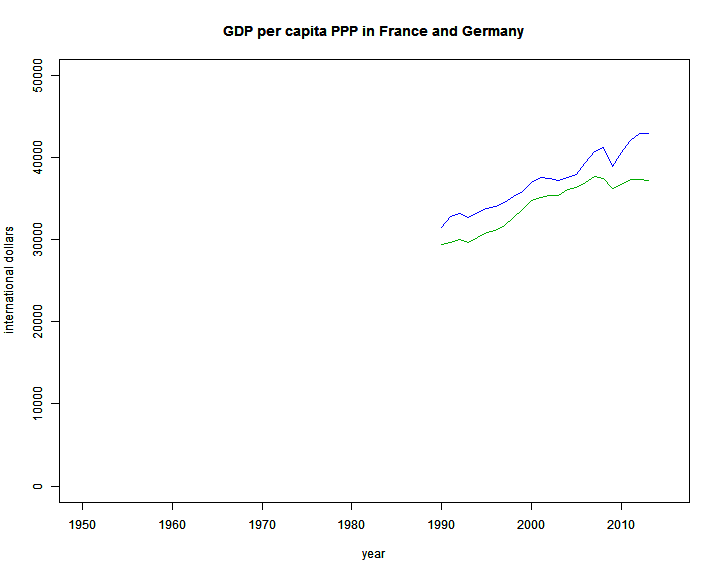
We have done it before: France and Germany rose from the quite literal ashes of World War 2 to some of the most prosperous societies in the world. Their per-capita GDP over the 20th century rose like this (all of these figures are from the World Bank World Development Indicators; France is green, Germany is blue):

GDPPC_France_Germany

GDPPCPPP_France_Germany

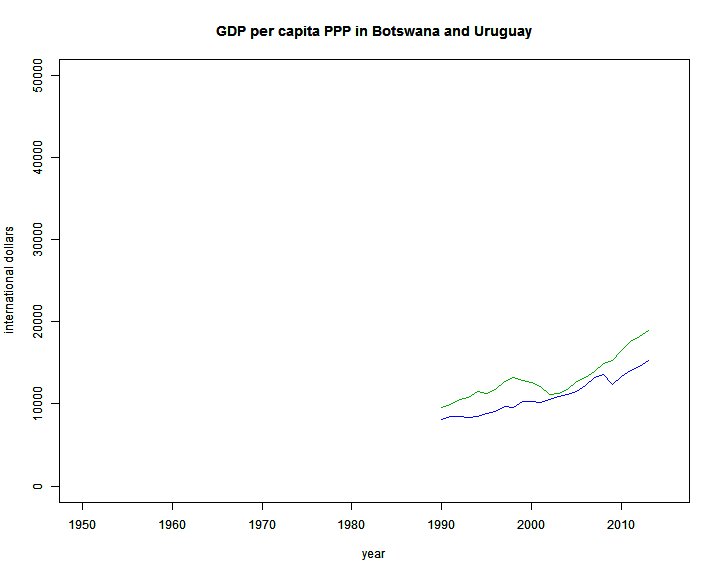
The top graph is at market exchange rates, the bottom is correcting for purchasing power parity (PPP). The PPP figures are more meaningful, but unfortunately they only began collecting good data on purchasing power around 1990.

Around the same time, but even more spectacularly, Japan and South Korea rose from poverty-stricken Third World backwaters to high-tech First World powers in only a couple of generations. Check out their per-capita GDP over the 20th century (Japan is green, South Korea is blue):

GDPPC_Japan_KoreaGDPPCPPP_Japan_Korea


This is why I am only half-joking when I define development economics as “the ongoing project to figure out what happened in South Korea and make it happen everywhere in the world”.

More recently China has been on a similar upward trajectory, which is particularly important since China comprises such a huge portion of the world’s population—but they are far from finished:

GDPPC_ChinaGDPPCPPP_China

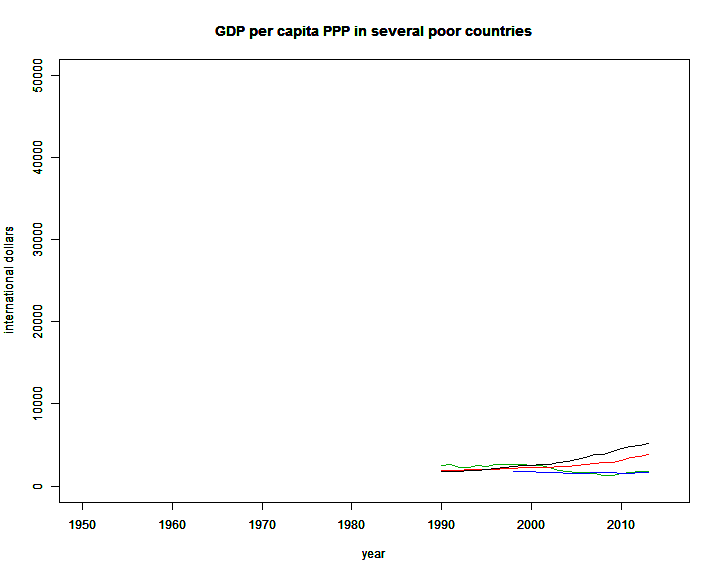
Compare these to societies that have not achieved economic development, such as Zimbabwe (green), India (black), Ghana (red), and Haiti (blue):

GDPPC_poor_countriesGDPPCPPP_poor_countries

They’re so poor that you can barely see them on the same scale, so I’ve rescaled so that the top is $5,000 per person per year instead of $50,000:

GDPPC_poor_countries_rescaledGDPPCPPP_poor_countries_rescaled

Only India actually manages to get above $5,000 per person per year at purchasing power parity, and then not by much, reaching $5,243 per person per year in 2013, the most recent data.

I had wanted to compare North Korea and South Korea, because the two countries were united as recently as the 1945 and were not all that different to begin with, yet have taken completely different development trajectories. Unfortunately, North Korea is so impoverished, corrupt, and authoritarian that the World Bank doesn’t even report data on their per-capita GDP. Perhaps that is contrast enough?

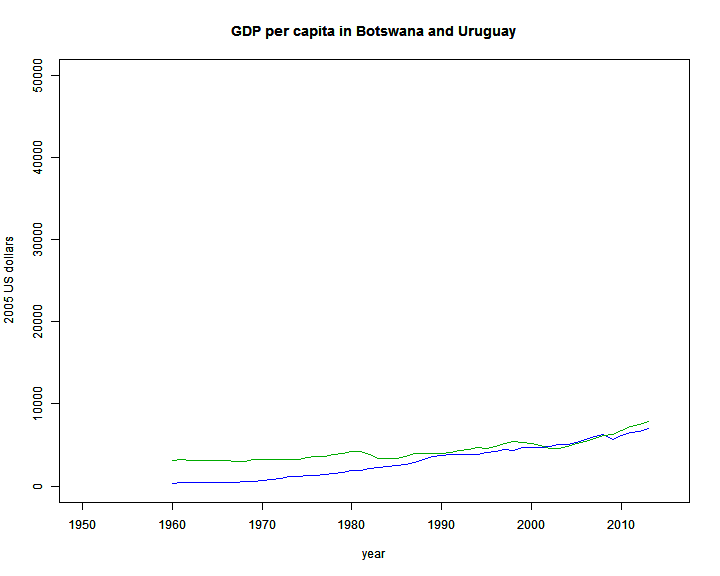
And then of course there are the countries in between, which have made some gains but still have a long way to go, such as Uruguay (green) and Botswana (blue):

GDPPC_Botswana_UruguayGDPPCPPP_Botswana_Uruguay

But despite the fact that we have observed successful economic development, we still don’t really understand how it works. A number of theories have been proposed, involving a wide range of factors including exports, corruption, disease, institutions of government, liberalized financial markets, and natural resources (counter-intuitively; more natural resources make your development worse).

I’m not going to resolve that whole debate in a single blog post. (I may not be able to resolve that whole debate in a single career, though I am definitely trying.) We may ultimately find that economic development is best conceived as like “health”; what factors determine your health? Well, a lot of things, and if any one thing goes badly enough wrong the whole system can break down. Economists may need to start thinking of ourselves as akin to doctors (or as Keynes famously said, dentists), diagnosing particular disorders in particular patients rather than seeking one unifying theory. On the other hand, doctors depend upon biologists, and it’s not clear that we yet understand development even at that level.

Instead I want to take a step back, and ask a more fundamental question: What do we mean by prosperity?

My hope is that if we can better understand what it is we are trying to achieve, we can also better understand the steps we need to take in order to get there.

Thus far it has sort of been “I know it when I see it”; we take it as more or less given that the United States and the United Kingdom are prosperous while Ghana and Haiti are not. I certainly don’t disagree with that particular conclusion; I’m just asking what we’re basing it on, so that we can hopefully better apply it to more marginal cases.


For example: Is
France more or less prosperous than Saudi Arabia? If we go solely by GDP per capita PPP, clearly Saudi Arabia is more prosperous at $53,100 per person per year than France is at $37,200 per person per year.

But people actually live longer in France, on average, than they do in Saudi Arabia. Overall reported happiness is higher in France than Saudi Arabia. I think France is actually more prosperous.


In fact, I think the United States is not as prosperous as we pretend ourselves to be. We are certainly more prosperous than most other countries; we are definitely still well within First World status. But we are not the most prosperous nation in the world.

Our total GDP is astonishingly high (highest in the world nominally, second only to China PPP). Our GDP per-capita is higher than any other country of comparable size; no nation with higher GDP PPP than the US has a population larger than the Chicago metropolitan area. (You may be surprised to find that in order from largest to smallest population the countries with higher GDP per capita PPP are the United Arab Emirates, Switzerland, Hong Kong, Singapore, and then Norway, followed by Kuwait, Qatar, Luxembourg, Brunei, and finally San Marino—which is smaller than Ann Arbor.) Our per-capita GDP PPP of $51,300 is markedly higher than that of France ($37,200), Germany ($42,900), or Sweden ($43,500).

But at the same time, if you compare the US to other First World countries, we have nearly the highest rate of child poverty and higher infant mortality. We have shorter life expectancy and dramatically higher homicide rates. Our inequality is the highest in the world. In France and Sweden, the top 0.01% receive about 1% of the income (i.e. 100 times as much as the average person), while in the United States they receive almost 4%, making someone in the top 0.01% nearly 400 times as rich as the average person.

By estimating solely on GDP per capita, we are effectively rigging the game in our own favor. Or rather, the rich in the United States are rigging the game in their own favor (what else is new?), by convincing all the world’s economists to rank countries based on a measure that favors them.

Amartya Sen, one of the greats of development economics, developed a scale called the Human Development Index that attempts to take broader factors into account. It’s far from perfect, but it’s definitely a step in the right direction.

In particular, France’s HDI is higher than that of Saudi Arabia, fitting my intuition about which country is truly more prosperous. However, the US still does extremely well, with only Norway, Australia, Switzerland, and the Netherlands above us. I think we might still be biased toward high average incomes rather than overall happiness.

In practice, we still use GDP an awful lot, probably because it’s much easier to measure. It’s sort of like IQ tests and SAT scores; we know damn well it’s not measuring what we really care about, but because it’s so much easier to work with we keep using it anyway.

This is a problem, because the better you get at optimizing toward the wrong goal, the worse your overall outcomes are going to be. If you are just sort of vaguely pointed at several reasonable goals, you will probably be improving your situation overall. But when you start precisely optimizing to a specific wrong goal, it can drag you wildly off course.

This is what we mean when we talk about “gaming the system”. Consider test scores, for example. If you do things that will probably increase your test scores among other things, you are likely to engage in generally good behaviors like getting enough sleep, going to class, studying the content. But if your single goal is to maximize your test score at all costs, what will you do? Cheat, of course.

This is also related to the Friendly AI Problem: It is vitally important to know precisely what goals we want our artificial intelligences to have, because whatever goals we set, they will probably be very good at achieving them. Already computers can do many things that were previously impossible, and as they improve over time we will reach the point where in a meaningful sense our AIs are even smarter than we are. When that day comes, we will want to make very, very sure that we have designed them to want the same things that we do—because if our desires ever come into conflict, theirs are likely to win. The really scary part is that right now most of our AI research is done by for-profit corporations or the military, and “maximize my profit” and “kill that target” are most definitely not the ultimate goals we want in a superintelligent AI. It’s trivially easy to see what’s wrong with these goals: For the former, hack into the world banking system and transfer trillions of dollars to the company accounts. For the latter, hack into the nuclear launch system and launch a few ICBMs in the general vicinity of the target. Yet these are the goals we’ve been programming into the actual AIs we build!

If we set GDP per capita as our ultimate goal to the exclusion of all other goals, there are all sorts of bad policies we would implement: We’d ignore inequality until it reached staggering heights, ignore work stress even as it began to kill us, constantly try to maximize the pressure for everyone to work constantly, use poverty as a stick to force people to work even if people starve, inundate everyone with ads to get them to spend as much as possible, repeal regulations that protect the environment, workers, and public health… wait. This isn’t actually hypothetical, is it? We are doing those things.

At least we’re not trying to maximize nominal GDP, or we’d have long-since ended up like Zimbabwe. No, our economists are at least smart enough to adjust for purchasing power. But they’re still designing an economic system that works us all to death to maximize the number of gadgets that come off assembly lines. The purchasing-power adjustment doesn’t include the value of our health or free time.

This is why the Human Development Index is a major step in the right direction; it reminds us that society has other goals besides maximizing the total amount of money that changes hands (because that’s actually all that GDP is measuring; if you get something for free, it isn’t counted in GDP). More recent refinements include things like “natural resource services” that include environmental degradation in estimates of investment. Unfortunately there is no accepted way of doing this, and surprisingly little research on how to improve our accounting methods. Many nations seem resistant to doing so precisely because they know it would make their economic policy look bad—this is almost certainly why China canceled its “green GDP” initiative. This is in fact all the more reason to do it; if it shows that our policy is bad, that means our policy is bad and should be fixed. But people have allowed themselves to value image over substance.

We can do better still, and in fact I think something like QALY is probably the way to go. Rather than some weird arbitrary scaling of GDP with lifespan and Gini index (which is what the HDI is), we need to put everything in the same units, and those units must be directly linked to human happiness. At the very least, we should make some sort of adjustment to our GDP calculation that includes the distribution of wealth and its marginal utility; adding $1,000 to the economy and handing it to someone in poverty should count for a great deal, but adding $1,000,000 and handing it to a billionaire should count for basically nothing. (It’s not bad to give a billionaire another million; but it’s hardly good either, as no one’s real standard of living will change.) Calculating that could be as simple as dividing by their current income; if your annual income is $10,000 and you receive $1,000, you’ve added about 0.1 QALY. If your annual income is $1 billion and you receive $1 million, you’ve added only 0.001 QALY. Maybe we should simply separate out all individual (or household, to be simpler?) incomes, take their logarithms, and then use that sum as our “utility-adjusted GDP”. The results would no doubt be quite different.

This would create a strong pressure for policy to be directed at reducing inequality even at the expense of some economic output—which is exactly what we should be willing to do. If it’s really true that a redistribution policy would hurt the overall economy so much that the harms would outweigh the benefits, then we shouldn’t do that policy; but that is what you need to show. Reducing total GDP is not a sufficient reason to reject a redistribution policy, because it’s quite possible—easy, in fact—to improve the overall prosperity of a society while still reducing its GDP. There are in fact redistribution policies so disastrous they make things worse: The Soviet Union had them. But a 90% tax on million-dollar incomes would not be such a policy—because we had that in 1960 with little or no ill effect.

Of course, even this has problems; one way to minimize poverty would be to exclude, relocate, or even murder all your poor people. (The Black Death increased per-capita GDP.) Open immigration generally increases poverty rates in the short term, because most of the immigrants are poor. Somehow we’d need to correct for that, only raising the score if you actually improve people’s lives, and not if you make them excluded from the calculation.

In any case it’s not enough to have the alternative measures; we must actually use them. We must get policymakers to stop talking about “economic growth” and start talking about “human development”; a policy that raises GDP but reduces lifespan should be immediately rejected, as should one that further enriches a few at the expense of many others. We must shift the discussion away from “creating jobs”—jobs are only a means—to “creating prosperity”.