Bayesian updating with irrational belief change

Jul 27 JDN 2460884

For the last few weeks I’ve been working at a golf course. (It’s a bit of an odd situation: I’m not actually employed by the golf course; I’m contracted by a nonprofit to be a “job coach” for a group of youths who are part of a work program that involves them working at the golf course.)

I hate golf. I have always hated golf. I find it boring and pointless—which, to be fair, is my reaction to most sports—and also an enormous waste of land and water. A golf course is also a great place for oligarchs to arrange collusion.

But I noticed something about being on the golf course every day, seeing people playing and working there: I feel like I hate it a bit less now.

This is almost certainly a mere-exposure effect: Simply being exposed to something many times makes it feel familiar, and that tends to make you like it more, or at least dislike it less. (There are some exceptions: repeated exposure to trauma can actually make you more sensitive to it, hating it even more.)

I kinda thought this would happen. I didn’t really want it to happen, but I thought it would.

This is very interesting from the perspective of Bayesian reasoning, because it is a theorem (though I cannot seem to find anyone naming the theorem; it’s like a folk theorem, I guess?) of Bayesian logic that the following is true:

The prior expectation of the posterior is the expectation of the prior.

The prior is what you believe before observing the evidence; the posterior is what you believe afterward. This theorem describes a relationship that holds between them.

This theorem means that, if I am being optimally rational, I should take into account all expected future evidence, not just evidence I have already seen. I should not expect to encounter evidence that will change my beliefs—if I did expect to see such evidence, I should change my beliefs right now!

This might be easier to grasp with an example.

Suppose I am trying to predict whether it will rain at 5:00 pm tomorrow, and I currently estimate that the probability of rain is 30%. This is my prior probability.

What will actually happen tomorrow is that it will rain or it won’t; so my posterior probability will either be 100% (if it rains) or 0% (if it doesn’t). But I had better assign a 30% chance to the event that will make me 100% certain it rains (namely, I see rain), and a 70% chance to the event that will make me 100% certain it doesn’t rain (namely, I see no rain); if I were to assign any other probabilities, then I must not really think the probability of rain at 5:00 pm tomorrow is 30%.

(The keen Bayesian will notice that the expected variance of my posterior need not be the variance of my prior: My initial variance is relatively high (it’s actually 0.3*0.7 = 0.21, because this is a Bernoulli distribution), because I don’t know whether it will rain or not; but my posterior variance will be 0, because I’ll know the answer once it rains or doesn’t.)

It’s a bit trickier to analyze, but this also works even if the evidence won’t make me certain. Suppose I am trying to determine the probability that some hypothesis is true. If I expect to see any evidence that might change my beliefs at all, then I should, on average, expect to see just as much evidence making me believe the hypothesis more as I see evidence that will make me believe the hypothesis less. If that is not what I expect, I should really change how much I believe the hypothesis right now!

So what does this mean for the golf example?

Was I wrong to hate golf quite so much before, because I knew that spending time on a golf course might make me hate it less?

I don’t think so.

See, the thing is: I know I’m not perfectly rational.

If I were indeed perfectly rational, then anything I expect to change my beliefs is a rational Bayesian update, and I should indeed factor it into my prior beliefs.

But if I know for a fact that I am not perfectly rational, that there are things which will change my beliefs in ways that make them deviate from rational Bayesian updating, then in fact I should not take those expected belief changes into account in my prior beliefs—since I expect to be wrong later, updating on that would just make me wrong now as well. I should only update on the expected belief changes that I believe will be rational.

This is something that a boundedly-rational person should do that neither a perfectly-rational nor perfectly-irrational person would ever do!

But maybe you don’t find the golf example convincing. Maybe you think I shouldn’t hate golf so much, and it’s not irrational for me to change my beliefs in that direction.


Very well. Let me give you a thought experiment which provides a very clear example of a time when you definitely would think your belief change was irrational.


To be clear, I’m not suggesting the two situations are in any way comparable; the golf thing is pretty minor, and for the thought experiment I’m intentionally choosing something quite extreme.

Here’s the thought experiment.

A mad scientist offers you a deal: Take this pill and you will receive $50 million. Naturally, you ask what the catch is. The catch, he explains, is that taking the pill will make you staunchly believe that the Holocaust didn’t happen. Take this pill, and you’ll be rich, but you’ll become a Holocaust denier. (I have no idea if making such a pill is even possible, but it’s a thought experiment, so bear with me. It’s certainly far less implausible than Swampman.)

I will assume that you are not, and do not want to become, a Holocaust denier. (If not, I really don’t know what else to say to you right now. It happened.) So if you take this pill, your beliefs will change in a clearly irrational way.

But I still think it’s probably justifiable to take the pill. This is absolutely life-changing money, for one thing, and being a random person who is a Holocaust denier isn’t that bad in the scheme of things. (Maybe it would be worse if you were in a position to have some kind of major impact on policy.) In fact, before taking the pill, you could write out a contract with a trusted friend that will force you to donate some of the $50 million to high-impact charities—and perhaps some of it to organizations that specifically fight Holocaust denial—thus ensuring that the net benefit to humanity is positive. Once you take the pill, you may be mad about the contract, but you’ll still have to follow it, and the net benefit to humanity will still be positive as reckoned by your prior, more correct, self.

It’s certainly not irrational to take the pill. There are perfectly-reasonable preferences you could have (indeed, likely dohave) that would say that getting $50 million is more important than having incorrect beliefs about a major historical event.

And if it’s rational to take the pill, and you intend to take the pill, then of course it’s rational to believe that in the future, you will have taken the pill and you will become a Holocaust denier.

But it would be absolutely irrational for you to become a Holocaust denier right now because of that. The pill isn’t going to provide evidence that the Holocaust didn’t happen (for no such evidence exists); it’s just going to alter your brain chemistry in such a way as to make you believe that the Holocaust didn’t happen.

So here we have a clear example where you expect to be more wrong in the future.

Of course, if this really only happens in weird thought experiments about mad scientists, then it doesn’t really matter very much. But I contend it happens in reality all the time:

  • You know that by hanging around people with an extremist ideology, you’re likely to adopt some of that ideology, even if you really didn’t want to.
  • You know that if you experience a traumatic event, it is likely to make you anxious and fearful in the future, even when you have little reason to be.
  • You know that if you have a mental illness, you’re likely to form harmful, irrational beliefs about yourself and others whenever you have an episode of that mental illness.

Now, all of these belief changes are things you would likely try to guard against: If you are a researcher studying extremists, you might make a point of taking frequent vacations to talk with regular people and help yourself re-calibrate your beliefs back to normal. Nobody wants to experience trauma, and if you do, you’ll likely seek out therapy or other support to help heal yourself from that trauma. And one of the most important things they teach you in cognitive-behavioral therapy is how to challenge and modify harmful, irrational beliefs when they are triggered by your mental illness.

But these guarding actions only make sense precisely because the anticipated belief change is irrational. If you anticipate a rational change in your beliefs, you shouldn’t try to guard against it; you should factor it into what you already believe.

This also gives me a little more sympathy for Evangelical Christians who try to keep their children from being exposed to secular viewpoints. I think we both agree that having more contact with atheists will make their children more likely to become atheists—but we view this expected outcome differently.

From my perspective, this is a rational change, and it’s a good thing, and I wish they’d factor it into their current beliefs already. (Like hey, maybe if talking to a bunch of smart people and reading a bunch of books on science and philosophy makes you think there’s no God… that might be because… there’s no God?)

But I think, from their perspective, this is an irrational change, it’s a bad thing, the children have been “tempted by Satan” or something, and thus it is their duty to protect their children from this harmful change.

Of course, I am not a subjectivist. I believe there’s a right answer here, and in this case I’m pretty sure it’s mine. (Wouldn’t I always say that? No, not necessarily; there are lots of matters for which I believe that there are experts who know better than I do—that’s what experts are for, really—and thus if I find myself disagreeing with those experts, I try to educate myself more and update my beliefs toward theirs, rather than just assuming they’re wrong. I will admit, however, that a lot of people don’t seem to do this!)

But this does change how I might tend to approach the situation of exposing their children to secular viewpoints. I now understand better why they would see that exposure as a harmful thing, and thus be resistant to actions that otherwise seem obviously beneficial, like teaching kids science and encouraging them to read books. In order to get them to stop “protecting” their kids from the free exchange of ideas, I might first need to persuade them that introducing some doubt into their children’s minds about God isn’t such a terrible thing. That sounds really hard, but it at least clearly explains why they are willing to fight so hard against things that, from my perspective, seem good. (I could also try to convince them that exposure to secular viewpoints won’t make their kids doubt God, but the thing is… that isn’t true. I’d be lying.)

That is, Evangelical Christians are not simply incomprehensibly evil authoritarians who hate truth and knowledge; they quite reasonably want to protect their children from things that will harm them, and they firmly believe that being taught about evolution and the Big Bang will make their children more likely to suffer great harm—indeed, the greatest harm imaginable, the horror of an eternity in Hell. Convincing them that this is not the case—indeed, ideally, that there is no such place as Hell—sounds like a very tall order; but I can at least more keenly grasp the equilibrium they’ve found themselves in, where they believe that anything that challenges their current beliefs poses a literally existential threat. (Honestly, as a memetic adaptation, this is brilliant. Like a turtle, the meme has grown itself a nigh-impenetrable shell. No wonder it has managed to spread throughout the world.)

Belief in belief, and why it’s important

Oct 30, JDN 2457692

In my previous post on ridiculous beliefs, I passed briefly over this sentence:

“People invest their identity in beliefs, and decide what beliefs to profess based on the group identities they value most.”

Today I’d like to talk about the fact that “to profess” is a very important phrase in that sentence. Part of understanding ridiculous beliefs, I think, is understanding that many, if not most, of them are not actually proper beliefs. They are what Daniel Dennett calls “belief in belief”, and has elsewhere been referred to as “anomalous belief”. They are not beliefs in the ordinary sense that we would line up with the other beliefs in our worldview and use them to anticipate experiences and motivate actions. They are something else, lone islands of belief that are not weaved into our worldview. But all the same they are invested with importance, often moral or even ultimate importance; this one belief may not make any sense with everyone else, but you must believe it, because it is a vital part of your identity and your tribe. To abandon it would not simply be mistaken; it would be heresy, it would be treason.

How do I know this? Mainly because nobody has tried to stone me to death lately.

The Bible is quite explicit about at least a dozen reasons I am supposed to be executed forthwith; you likely share many of them: Heresy, apostasy, blasphemy, nonbelief, sodomy, fornication, covetousness, taking God’s name in vain, eating shellfish (though I don’t anymore!), wearing mixed fiber, shaving, working on the Sabbath, making images of things, and my personal favorite, not stoning other people for committing such crimes (as we call it in game theory, a second-order punishment).

Yet I have met many people who profess to be “Bible-believing Christians”, and even may oppose some of these activities (chiefly sodomy, blasphemy, and nonbelief) on the grounds that they are against what the Bible says—and yet not one has tried to arrange my execution, nor have I ever seriously feared that they might.

Is this because we live in a secular society? Well, yes—but not simply that. It isn’t just that these people are afraid of being punished by our secular government should they murder me for my sins; they believe that it is morally wrong to murder me, and would rarely even consider the option. Someone could point them to the passage in Leviticus (20:16, as it turns out) that explicitly says I should be executed, and it would not change their behavior toward me.

On first glance this is quite baffling. If I thought you were about to drink a glass of water that contained cyanide, I would stop you, by force if necessary. So if they truly believe that I am going to be sent to Hell—infinitely worse than cyanide—then shouldn’t they be willing to use any means necessary to stop that from happening? And wouldn’t this be all the more true if they believe that they themselves will go to Hell should they fail to punish me?

If these “Bible-believing Christians” truly believed in Hell the way that I believe in cyanide—that is, as proper beliefs which anticipate experience and motivate action—then they would in fact try to force my conversion or execute me, and in doing so would believe that they are doing right. This used to be quite common in many Christian societies (most infamously in the Salem Witch Trials), and still is disturbingly common in many Muslim societies—ISIS doesn’t just throw gay men off rooftops and stone them as a weird idiosyncrasy; it is written in the Hadith that they’re supposed to. Nor is this sort of thing confined to terrorist groups; the “legitimate” government of Saudi Arabia routinely beheads atheists or imprisons homosexuals (though has a very capricious enforcement system, likely so that the monarchy can trump up charges to justify executing whomever they choose). Beheading people because the book said so is what your behavior would look like if you honestly believed, as a proper belief, that the Qur’an or the Bible or whatever holy book actually contained the ultimate truth of the universe. The great irony of calling religion people’s “deeply-held belief” is that it is in almost all circumstances the exact opposite—it is their most weakly held belief, the one that they could most easily sacrifice without changing their behavior.

Yet perhaps we can’t even say that to people, because they will get equally defensive and insist that they really do hold this very important anomalous belief, and how dare you accuse them otherwise. Because one of the beliefs they really do hold, as a proper belief, and a rather deeply-held one, is that you must always profess to believe your religion and defend your belief in it, and if anyone catches you not believing it that’s a horrible, horrible thing. So even though it’s obvious to everyone—probably even to you—that your behavior looks nothing like what it would if you actually believed in this book, you must say that you do, scream that you do if necessary, for no one must ever, ever find out that it is not a proper belief.

Another common trick is to try to convince people that their beliefs do affect their behavior, even when they plainly don’t. We typically use the words “religious” and “moral” almost interchangeably, when they are at best orthogonal and arguably even opposed. Part of why so many people seem to hold so rigidly to their belief-in-belief is that they think that morality cannot be justified without recourse to religion; so even though on some level they know religion doesn’t make sense, they are afraid to admit it, because they think that means admitting that morality doesn’t make sense. If you are even tempted by this inference, I present to you the entire history of ethical philosophy. Divine Command theory has been a minority view among philosophers for centuries.

Indeed, it is precisely because your moral beliefs are not based on your religion that you feel a need to resort to that defense of your religion. If you simply believed religion as a proper belief, you would base your moral beliefs on your religion, sure enough; but you’d also defend your religion in a fundamentally different way, not as something you’re supposed to believe, not as a belief that makes you a good person, but as something that is just actually true. (And indeed, many fanatics actually do defend their beliefs in those terms.) No one ever uses the argument that if we stop believing in chairs we’ll all become murderers, because chairs are actually there. We don’t believe in belief in chairs; we believe in chairs.

And really, if such a belief were completely isolated, it would not be a problem; it would just be this weird thing you say you believe that everyone really knows you don’t and it doesn’t affect how you behave, but okay, whatever. The problem is that it’s never quite isolated from your proper beliefs; it does affect some things—and in particular it can offer a kind of “support” for other real, proper beliefs that you do have, support which is now immune to rational criticism.

For example, as I already mentioned: Most of these “Bible-believing Christians” do, in fact, morally oppose homosexuality, and say that their reason for doing so is based on the Bible. This cannot literally be true, because if they actually believed the Bible they wouldn’t want gay marriage taken off the books, they’d want a mass pogrom of 4-10% of the population (depending how you count), on a par with the Holocaust. Fortunately their proper belief that genocide is wrong is overriding. But they have no such overriding belief supporting the moral permissibility of homosexuality or the personal liberty of marriage rights, so the very tenuous link to their belief-in-belief in the Bible is sufficient to tilt their actual behavior.

Similarly, if the people I meet who say they think maybe 9/11 was an inside job by our government really believed that, they would most likely be trying to organize a violent revolution; any government willing to murder 3,000 of its own citizens in a false flag operation is one that must be overturned and can probably only be overturned by force. At the very least, they would flee the country. If they lived in a country where the government is actually like that, like Zimbabwe or North Korea, they wouldn’t fear being dismissed as conspiracy theorists, they’d fear being captured and executed. The very fact that you live within the United States and exercise your free speech rights here says pretty strongly that you don’t actually believe our government is that evil. But they wouldn’t be so outspoken about their conspiracy theories if they didn’t at least believe in believing them.

I also have to wonder how many of our politicians who lean on the Constitution as their source of authority have actually read the Constitution, as it says a number of rather explicit things against, oh, say, the establishment of religion (First Amendment) or searches and arrests without warrants (Fourth Amendment) that they don’t much seem to care about. Some are better about this than others; Rand Paul, for instance, actually takes the Constitution pretty seriously (and is frequently found arguing against things like warrantless searches as a result!), but Ted Cruz for example says he has spent decades “defending the Constitution”, despite saying things like “America is a Christian nation” that directly violate the First Amendment. Cruz doesn’t really seem to believe in the Constitution; but maybe he believes in believing the Constitution. (It’s also quite possible he’s just lying to manipulate voters.)


How (not) to talk about the defense budget

JDN 2457927 EDT 20:20.

This week on Facebook I ran into a couple of memes about the defense budget that I thought were worth addressing. While the core message that the United States spends too much on the military is sound, these particular memes are so massively misleading that I think it would be irresponsible to let them go unanswered.

Tax_dollars_meme

First of all, this graph is outdated; it appears to be from about five years ago. If you use nominal figures for just direct military spending, the budget has been cut from just under $700 billion (what this figure looks like) in 2010 to only about $600 billion today. If you include verterans’ benefits, again nominally, we haven’t been below $700 billion since 2007; today we are now above $800 billion. I think the most meaningful measure is actually military spending as percent of GDP, on which we’ve cut military spending from its peak of 4.7% of GDP in 2010 to 3.5% of GDP today.

It’s also a terrible way to draw a graph; using images instead of bars may be visually appealing, but it undermines the most important aspect of a bar graph, which is that you can easily visually compare relative magnitudes.

But the most important reason why this graph is misleading is that it uses only the so-called “discretionary budget”, which includes almost all military spending but only a small fraction of spending on healthcare and social services. This creates a wildly inflated sense of how much we spend on the military relatively to other priorities.

In particular, we’re excluding Medicare and Social Security, which are on the “mandatory budget”; each of these alone is comparable to total military spending. Here’s a very nice table of all US government spending broken down by category.

Let’s just look at federal spending for now. Including veterans’ benefits, we currently spend $814 billion per year on defense. On Social Security, we spend $959 billion. On healthcare, we spend $1,018 billion per year, of which $536 billion is Medicare.

We also spend $376 billion on social welfare programs and unemployment, along with $149 billion on education, $229 billion servicing the national debt, and $214 billion on everything else (such as police, transportation, and administration).

I’ve made you a graph that accurately reflects these relative quantities:

US_federal_spending

As you can see, the military is one of our major budget items, but the largest categories are actually pensions (i.e. Social Security) and healthcare (i.e. Medicare and Medicaid).

Given the right year and properly adjusted bars on the graph, the meme may strictly be accurate about the discretionary budget, but it gives an extremely distorted sense of our overall government spending.

The next meme is even worse:

Lee_Camp_meme

Again the figures aren’t strictly wrong if you use the right year, but we’re only looking at the federal discretionary budget. Since basically all military spending is federal and discretionary, but most education spending is mandatory and done at the state and local level, this is an even more misleading picture.

Total annual US military spending (including veteran benefits) is about $815 billion.
Total US education spending (at all levels) is about $922 billion.

Here’s an accurate graph of total US government spending at all levels:

US_total_spending

That is, we spend more on education than we do on the military, and dramatically more on healthcare.

However, the United States clearly does spend far too much on the military and probably too little on education; the proper comparison to make is to other countries.

Most other First World Countries spend dramatically more on education than they do on the military.

France, for example, spends about $160 billion per year on education, but only about $53 billion per year on the military—and France is actually a relatively militaristic country, with the 6th-highest total military spending in the world.

Germany spends about $172 billion per year on education, but only about about $44 billion on the military.

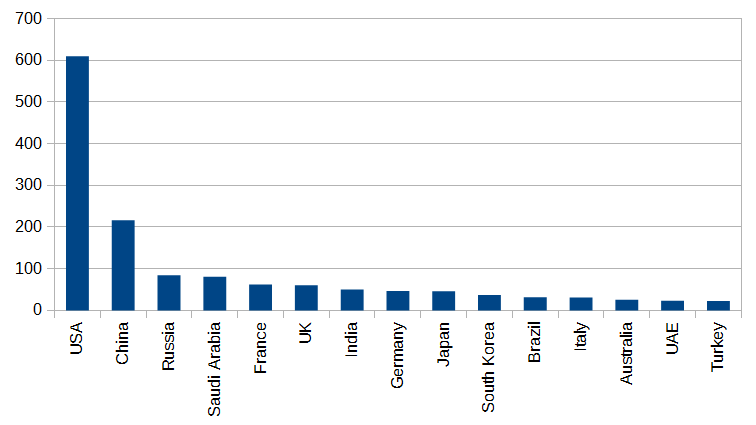
In absolute figures, the United States overwhelms all other countries in the world—we spend as much as at least the next 10 combined.

Using figures from the Stockholm International Peace Research Institute (SIPRI), the US spends $610 billion of the world’s total $1,776 billion, meaning that over a third of the world’s military spending is by the United States.

This is a graph of the top 15 largest military budgets in the world.

world_military_spending

One of these things is not like the other ones…

It probably makes the most sense to compare military spending as a portion of GDP, which makes the US no longer an outlier worldwide, but still very high by First World standards:

world_military_spending_GDP

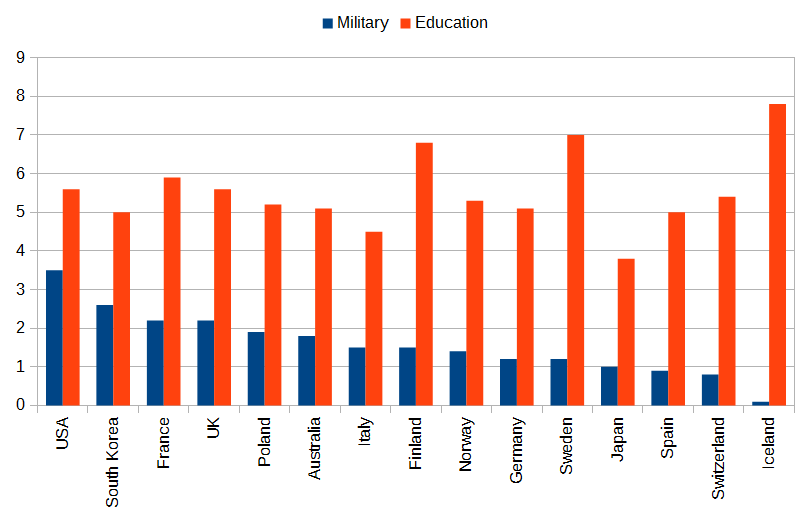
If we do want to compare military spending to other forms of spending, I think we should do that in international perspective as well. Here is a graph of education spending versus military spending as a portion of GDP, in several First World countries (military from SIPRI and the CIA, and education from the UNDP):

world_military_education

Our education spending is about average (though somehow we do it so inefficiently that we don’t provide college for free, unlike Germany, France, Finland, Sweden, or Norway), but our military spending is by far the highest.

How about a meme about that?