What is anxiety for?

Sep 17 JDN 2460205

As someone who experiences a great deal of anxiety, I have often struggled to understand what it could possibly be useful for. We have this whole complex system of evolved emotions, and yet more often than not it seems to harm us rather than help us. What’s going on here? Why do we even have anxiety? What even is anxiety, really? And what is it for?

There’s actually an extensive body of research on this, though very few firm conclusions. (One of the best accounts I’ve read, sadly, is paywalled.)

For one thing, there seem to be a lot of positive feedback loops involved in anxiety: Panic attacks make you more anxious, triggering more panic attacks; being anxious disrupts your sleep, which makes you more anxious. Positive feedback loops can very easily spiral out of control, resulting in responses that are wildly disproportionate to the stimulus that triggered them.

A certain amount of stress response is useful, even when the stakes are not life-or-death. But beyond a certain point, more stress becomes harmful rather than helpful. This is the Yerkes-Dodson effect, for which I developed my stochastic overload model (which I still don’t know if I’ll ever publish, ironically enough, because of my own excessive anxiety). Realizing that anxiety can have benefits can also take some of the bite out of having chronic anxiety, and, ironically, reduce that anxiety a little. The trick is finding ways to break those positive feedback loops.

I think one of the most useful insights to come out of this research is the smoke-detector principle, which is a fundamentally economic concept. It sounds quite simple: When dealing with an uncertain danger, sound the alarm if the expected benefit of doing so exceeds the expected cost.

This has profound implications when risk is highly asymmetric—as it usually is. Running away from a shadow or a noise that probably isn’t a lion carries some cost; you wouldn’t want to do it all the time. But it is surely nowhere near as bad as failing to run away when there is an actual lion. Indeed, it might be fair to say that failing to run away from an actual lion counts as one of the worst possible things that could ever happen to you, and could easily be 100 times as bad as running away when there is nothing to fear.

With this in mind, if you have a system for detecting whether or not there is a lion, how sensitive should you make it? Extremely sensitive. You should in fact try to calibrate it so that 99% of the time you experience the fear and want to run away, there is not a lion. Because the 1% of the time when there is one, it’ll all be worth it.

Yet this is far from a complete explanation of anxiety as we experience it. For one thing, there has never been, in my entire life, even a 1% chance that I’m going to be attacked by a lion. Even standing in front of a lion enclosure at the zoo, my chances of being attacked are considerably less than that—for a zoo that allowed 1% of its customers to be attacked would not stay in business very long.

But for another thing, it isn’t really lions I’m afraid of. The things that make me anxious are generally not things that would be expected to do me bodily harm. Sure, I generally try to avoid walking down dark alleys at night, and I look both ways before crossing the street, and those are activities directly designed to protect me from bodily harm. But I actually don’t feel especially anxious about those things! Maybe I would if I actually had to walk through dark alleys a lot, but I don’t, and in the rare occasion I would, I think I’d feel afraid at the time but fine afterward, rather than experiencing persistent, pervasive, overwhelming anxiety. (Whereas, if I’m anxious about reading emails, and I do manage to read emails, I’m usually still anxious afterward.) When it comes to crossing the street, I feel very little fear at all, even though perhaps I should—indeed, it had been remarked that when it comes to the perils of motor vehicles, human beings suffer from a very dangerous lack of fear. We should be much more afraid than we are—and our failure to be afraid kills thousands of people.

No, the things that make me anxious are invariably social: Meetings, interviews, emails, applications, rejection letters. Also parties, networking events, and back when I needed them, dates. They involve interacting with other people—and in particular being evaluated by other people. I never felt particularly anxious about exams, except maybe a little before my PhD qualifying exam and my thesis defenses; but I can understand those who do, because it’s the same thing: People are evaluating you.

This suggests that anxiety, at least of the kind that most of us experience, isn’t really about danger; it’s about status. We aren’t worried that we will be murdered or tortured or even run over by a car. We’re worried that we will lose our friends, or get fired; we are worried that we won’t get a job, won’t get published, or won’t graduate.

And yet it is striking to me that it often feels just as bad as if we were afraid that we were going to die. In fact, in the most severe instances where anxiety feeds into depression, it can literally make people want to die. How can that be evolutionarily adaptive?

Here it may be helpful to remember that in our ancestral environment, status and survival were oft one and the same. Humans are the most social organisms on Earth; I even sometimes describe us as hypersocial, a whole new category of social that no other organism seems to have achieved. We cooperate with others of our species on a mind-bogglingly grand scale, and are utterly dependent upon vast interconnected social systems far too large and complex for us to truly understand, let alone control.

At this historical epoch, these social systems are especially vast and incomprehensible; but at least for most of us in First World countries, they are also forgiving in a way that is fundamentally alien to our ancestors’ experience. It was not so long ago that a failed hunt or a bad harvest would let your family starve unless you could beseech your community for aid successfully—which meant that your very survival could depend upon being in the good graces of that community. But now we have food stamps, so even if everyone in your town hates you, you still get to eat. Of course some societies are more forgiving (Sweden) than others (the United States); and virtually all societies could be even more forgiving than they are. But even the relatively cutthroat competition of the US today has far less genuine risk of truly catastrophic failure than what most human beings lived through for most of our existence as a species.

I have found this realization helpful—hardly a cure, but helpful, at least: What are you really afraid of? When you feel anxious, your body often tells you that the stakes are overwhelming, life-or-death; but if you stop and think about it, in the world we live in today, that’s almost never true. Failing at one important task at work probably won’t get you fired—and even getting fired won’t really make you starve.

In fact, we might be less anxious if it were! For our bodies’ fear system seems to be optimized for the following scenario: An immediate threat with high chance of success and life-or-death stakes. Spear that wild animal, or jump over that chasm. It will either work or it won’t, you’ll know immediately; it probably will work; and if it doesn’t, well, that may be it for you. So you’d better not fail. (I think it’s interesting how much of our fiction and media involves these kinds of events: The hero would surely and promptly die if he fails, but he won’t fail, for he’s the hero! We often seem more comfortable in that sort of world than we do in the one we actually live in.)

Whereas the life we live in now is one of delayed consequences with low chance of success and minimal stakes. Send out a dozen job applications. Hear back in a week from three that want to interview you. Do those interviews and maybe one will make you an offer—but honestly, probably not. Next week do another dozen. Keep going like this, week after week, until finally one says yes. Each failure actually costs you very little—but you will fail, over and over and over and over.

In other words, we have transitioned from an environment of immediate return to one of delayed return.

The result is that a system which was optimized to tell us never fail or you will die is being put through situations where failure is constantly repeated. I think deep down there is a part of us that wonders, “How are you still alive after failing this many times?” If you had fallen in as many ravines as I have received rejection letters, you would assuredly be dead many times over.

Yet perhaps our brains are not quite as miscalibrated as they seem. Again I come back to the fact that anxiety always seems to be about people and evaluation; it’s different from immediate life-or-death fear. I actually experience very little life-or-death fear, which makes sense; I live in a very safe environment. But I experience anxiety almost constantly—which also makes a certain amount of sense, seeing as I live in an environment where I am being almost constantly evaluated by other people.

One theory posits that anxiety and depression are a dual mechanism for dealing with social hierarchy: You are anxious when your position in the hierarchy is threatened, and depressed when you have lost it. Primates like us do seem to care an awful lot about hierarchies—and I’ve written before about how this explains some otherwise baffling things about our economy.

But I for one have never felt especially invested in hierarchy. At least, I have very little desire to be on top of the hiearchy. I don’t want to be on the bottom (for I know how such people are treated); and I strongly dislike most of the people who are actually on top (for they’re most responsible for treating the ones on the bottom that way). I also have ‘a problem with authority’; I don’t like other people having power over me. But if I were to somehow find myself ruling the world, one of the first things I’d do is try to figure out a way to transition to a more democratic system. So it’s less like I want power, and more like I want power to not exist. Which means that my anxiety can’t really be about fearing to lose my status in the hierarchy—in some sense, I want that, because I want the whole hierarchy to collapse.

If anxiety involved the fear of losing high status, we’d expect it to be common among those with high status. Quite the opposite is the case. Anxiety is more common among people who are more vulnerable: Women, racial minorities, poor people, people with chronic illness. LGBT people have especially high rates of anxiety. This suggests that it isn’t high status we’re afraid of losing—though it could still be that we’re a few rungs above the bottom and afraid of falling all the way down.

It also suggests that anxiety isn’t entirely pathological. Our brains are genuinely responding to circumstances. Maybe they are over-responding, or responding in a way that is not ultimately useful. But the anxiety is at least in part a product of real vulnerabilities. Some of what we’re worried about may actually be real. If you cannot carry yourself with the confidence of a mediocre White man, it may be simply because his status is fundamentally secure in a way yours is not, and he has been afforded a great many advantages you never will be. He never had a Supreme Court ruling decide his rights.

I cannot offer you a cure for anxiety. I cannot even really offer you a complete explanation of where it comes from. But perhaps I can offer you this: It is not your fault. Your brain evolved for a very different world than this one, and it is doing its best to protect you from the very different risks this new world engenders. Hopefully one day we’ll figure out a way to get it calibrated better.

Two terms in marginal utility of wealth

JDN 2457569

This post is going to be a little wonkier than most; I’m actually trying to sort out my thoughts and draw some public comment on a theory that has been dancing around my head for awhile. The original idea of separating terms in marginal utility of wealth was actually suggested by my boyfriend, and from there I’ve been trying to give it some more mathematical precision to see if I can come up with a way to test it experimentally. My thinking is also influenced by a paper Miles Kimball wrote about the distinction between happiness and utility.

There are lots of ways one could conceivably spend money—everything from watching football games to buying refrigerators to building museums to inventing vaccines. But insofar as we are rational (and we are after all about 90% rational), we’re going to try to spend our money in such a way that its marginal utility is approximately equal across various activities. You’ll buy one refrigerator, maybe two, but not seven, because the marginal utility of refrigerators drops off pretty fast; instead you’ll spend that money elsewhere. You probably won’t buy a house that’s twice as large if it means you can’t afford groceries anymore. I don’t think our spending is truly optimal at maximizing utility, but I think it’s fairly good.

Therefore, it doesn’t make much sense to break down marginal utility of wealth into all these different categories—cars, refrigerators, football games, shoes, and so on—because we already do a fairly good job of equalizing marginal utility across all those different categories. I could see breaking it down into a few specific categories, such as food, housing, transportation, medicine, and entertainment (and this definitely seems useful for making your own household budget); but even then, I don’t get the impression that most people routinely spend too much on one of these categories and not enough on the others.

However, I can think of two quite different fundamental motives behind spending money, which I think are distinct enough to be worth separating.

One way to spend money is on yourself, raising your own standard of living, making yourself more comfortable. This would include both football games and refrigerators, really anything that makes your life better. We could call this the consumption motive, or maybe simply the self-directed motive.

The other way is to spend it on other people, which, depending on your personality can take either the form of philanthropy to help others, or as a means of self-aggrandizement to raise your own relative status. It’s also possible to do both at the same time in various combinations; while the Gates Foundation is almost entirely philanthropic and Trump Tower is almost entirely self-aggrandizing, Carnegie Hall falls somewhere in between, being at once a significant contribution to our society and an obvious attempt to bring praise and adulation to himself. I would also include spending on Veblen goods that are mainly to show off your own wealth and status in this category. We can call this spending the philanthropic/status motive, or simply the other-directed motive.

There is some spending which combines both motives: A car is surely useful, but a Ferrari is mainly for show—but then, a Lexus or a BMW could be either to show off or really because you like the car better. Some form of housing is a basic human need, and bigger, fancier houses are often better, but the main reason one builds mansions in Beverly Hills is to demonstrate to the world that one is fabulously rich. This complicates the theory somewhat, but basically I think the best approach is to try to separate a sort of “spending proportion” on such goods, so that say $20,000 of the Lexus is for usefulness and $15,000 is for show. Empirically this might be hard to do, but theoretically it makes sense.

One of the central mysteries in cognitive economics right now is the fact that while self-reported happiness rises very little, if at all, as income increases, a finding which was recently replicated even in poor countries where we might not expect it to be true, nonetheless self-reported satisfaction continues to rise indefinitely. A number of theories have been proposed to explain this apparent paradox.

This model might just be able to account for that, if by “happiness” we’re really talking about the self-directed motive, and by “satisfaction” we’re talking about the other-directed motive. Self-reported happiness seems to obey a rule that $100 is worth as much to someone with $10,000 as $25 is to someone with $5,000, or $400 to someone with $20,000.

Self-reported satisfaction seems to obey a different rule, such that each unit of additional satisfaction requires a roughly equal proportional increase in income.

By having a utility function with two terms, we can account for both of these effects. Total utility will be u(x), happiness h(x), and satisfaction s(x).

u(x) = h(x) + s(x)

To obey the above rule, happiness must obey harmonic utility, like this, for some constants h0 and r:

h(x) = h0 – r/x

Proof of this is straightforward, though to keep it simple I’ve hand-waved why it’s a power law:

Given

h'(2x) = 1/4 h'(x)

Let

h'(x) = r x^n

h'(2x) = r (2x)^n

r (2x)^n = 1/4 r x^n

n = -2

h'(x) = r/x^2

h(x) = – r x^(-1) + C

h(x) = h0 – r/x

Miles Kimball also has some more discussion on his blog about how a utility function of this form works. (His statement about redistribution at the end is kind of baffling though; sure, dollar for dollar, redistributing wealth from the middle class to the poor would produce a higher gain in utility than redistributing wealth from the rich to the middle class. But neither is as good as redistributing from the rich to the poor, and the rich have a lot more dollars to redistribute.)

Satisfaction, however, must obey logarithmic utility, like this, for some constants s0 and k.

The x+1 means that it takes slightly less proportionally to have the same effect as your wealth increases, but it allows the function to be equal to s0 at x=0 instead of going to negative infinity:

s(x) = s0 + k ln(x)

Proof of this is very simple, almost trivial:

Given

s'(x) = k/x

s(x) = k ln(x) + s0

Both of these functions actually have a serious problem that as x approaches zero, they go to negative infinity. For self-directed utility this almost makes sense (if your real consumption goes to zero, you die), but it makes no sense at all for other-directed utility, and since there are causes most of us would willingly die for, the disutility of dying should be large, but not infinite.

Therefore I think it’s probably better to use x +1 in place of x:

h(x) = h0 – r/(x+1)

s(x) = s0 + k ln(x+1)

This makes s0 the baseline satisfaction of having no other-directed spending, though the baseline happiness of zero self-directed spending is actually h0 – r rather than just h0. If we want it to be h0, we could use this form instead:

h(x) = h0 + r x/(x+1)

This looks quite different, but actually only differs by a constant.

Therefore, my final answer for the utility of wealth (or possibly income, or spending? I’m not sure which interpretation is best just yet) is actually this:

u(x) = h(x) + s(x)

h(x) = h0 + r x/(x+1)

s(x) = s0 + k ln(x+1)

Marginal utility is then the derivatives of these:

h'(x) = r/(x+1)^2

s'(x) = k/(x+1)

Let’s assign some values to the constants so that we can actually graph these.

Let h0 = s0 = 0, so our baseline is just zero.

Furthermore, let r = k = 1, which would mean that the value of $1 is the same whether spent either on yourself or on others, if $1 is all you have. (This is probably wrong, actually, but it’s the simplest to start with. Shortly I’ll discuss what happens as you vary the ratio k/r.)

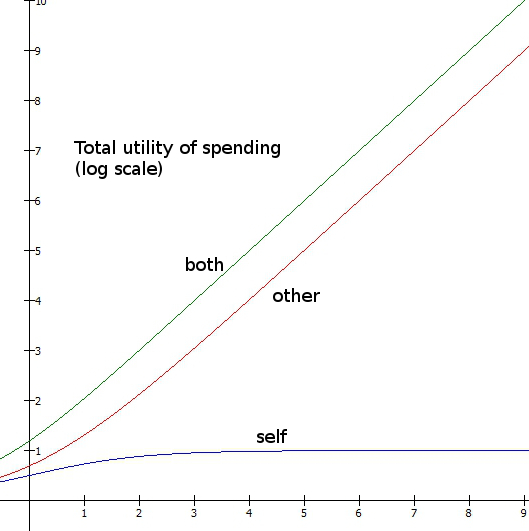
Here is the result graphed on a linear scale:

Utility_linear

And now, graphed with wealth on a logarithmic scale:

Utility_log

As you can see, self-directed marginal utility drops off much faster than other-directed marginal utility, so the amount you spend on others relative to yourself rapidly increases as your wealth increases. If that doesn’t sound right, remember that I’m including Veblen goods as “other-directed”; when you buy a Ferrari, it’s not really for yourself. While proportional rates of charitable donation do not increase as wealth increases (it’s actually a U-shaped pattern, largely driven by poor people giving to religious institutions), they probably should (people should really stop giving to religious institutions! Even the good ones aren’t cost-effective, and some are very, very bad.). Furthermore, if you include spending on relative power and status as the other-directed motive, that kind of spending clearly does proportionally increase as wealth increases—gotta keep up with those Joneses.

If r/k = 1, that basically means you value others exactly as much as yourself, which I think is implausible (maybe some extreme altruists do that, and Peter Singer seems to think this would be morally optimal). r/k < 1 would mean you should never spend anything on yourself, which not even Peter Singer believes. I think r/k = 10 is a more reasonable estimate.

For any given value of r/k, there is an optimal ratio of self-directed versus other-directed spending, which can vary based on your total wealth.

Actually deriving what the optimal proportion would be requires a whole lot of algebra in a post that probably already has too much algebra, but the point is, there is one, and it will depend strongly on the ratio r/k, that is, the overall relative importance of self-directed versus other-directed motivation.

Take a look at this graph, which uses r/k = 10.

Utility_marginal

If you only have 2 to spend, you should spend it entirely on yourself, because up to that point the marginal utility of self-directed spending is always higher. If you have 3 to spend, you should spend most of it on yourself, but a little bit on other people, because after you’ve spent about 2.2 on yourself there is more marginal utility for spending on others than on yourself.

If your available wealth is W, you would spend some amount x on yourself, and then W-x on others:

u(x) = h(x) + s(W-x)

u(x) = r x/(x+1) + k ln(W – x + 1)

Then you take the derivative and set it equal to zero to find the local maximum. I’ll spare you the algebra, but this is the result of that optimization:

x = – 1 – r/(2k) + sqrt(r/k) sqrt(2 + W + r/(4k))

As long as k <= r (which more or less means that you care at least as much about yourself as about others—I think this is true of basically everyone) then as long as W > 0 (as long as you have some money to spend) we also have x > 0 (you will spend at least something on yourself).

Below a certain threshold (depending on r/k), the optimal value of x is greater than W, which means that, if possible, you should be receiving donations from other people and spending them on yourself. (Otherwise, just spend everything on yourself). After that, x < W, which means that you should be donating to others. The proportion that you should be donating smoothly increases as W increases, as you can see on this graph (which uses r/k = 10, a figure I find fairly plausible):

Utility_donation

While I’m sure no one literally does this calculation, most people do seem to have an intuitive sense that you should donate an increasing proportion of your income to others as your income increases, and similarly that you should pay a higher proportion in taxes. This utility function would justify that—which is something that most proposed utility functions cannot do. In most models there is a hard cutoff where you should donate nothing up to the point where your marginal utility is equal to the marginal utility of donating, and then from that point forward you should donate absolutely everything. Maybe a case can be made for that ethically, but psychologically I think it’s a non-starter.

I’m still not sure exactly how to test this empirically. It’s already quite difficult to get people to answer questions about marginal utility in a way that is meaningful and coherent (people just don’t think about questions like “Which is worth more? $4 to me now or $10 if I had twice as much wealth?” on a regular basis). I’m thinking maybe they could play some sort of game where they have the opportunity to make money at the game, but must perform tasks or bear risks to do so, and can then keep the money or donate it to charity. The biggest problem I see with that is that the amounts would probably be too small to really cover a significant part of anyone’s total wealth, and therefore couldn’t cover much of their marginal utility of wealth function either. (This is actually a big problem with a lot of experiments that use risk aversion to try to tease out marginal utility of wealth.) But maybe with a variety of experimental participants, all of whom we get income figures on?