How do we stop overspending on healthcare?

Dec 10 JDN 2460290

I don’t think most Americans realize just how much more the US spends on healthcare than other countries. This is true not simply in absolute terms—of course it is, the US is rich and huge—but in relative terms: As a portion of GDP, our healthcare spending is a major outlier.

Here’s a really nice graph from Healthsystemtracker.org that illustrates it quite nicely: Almost all other First World countries share a simple linear relationship between their per-capita GDP and their per-capita healthcare spending. But one of these things is not like the other ones….

The outlier in the other direction is Ireland, but that’s because their GDP is wildly inflated by Leprechaun Economics. (Notice that it looks like Ireland is by far the richest country in the sample! This is clearly not the case in reality.) With a corrected estimate of their true economic output, they are also quite close to the line.

Since US GDP per capita ($70,181) is in between that of Denmark ($64,898) and Norway ($80,496) both of which have very good healthcare systems (#ScandinaviaIsBetter), we would expect that US spending on healthcare would similarly be in between. But while Denmark spends $6,384 per person per year on healthcare and Norway spends $7,065 per person per year, the US spends $12,914.

That is, the US spends nearly twice as much as it should on healthcare.

The absolute difference between what we should spend and what we actually spend is nearly $6,000 per person per year. Multiply that out by the 330 million people in the US, and…

The US overspends on healthcare by nearly $2 trillion per year.

This might be worth it, if health in the US were dramatically better than health in other countries. (In that case I’d be saying that other countries spend too little.) But plainly it is not.

Probably the simplest and most comparable measure of health across countries is life expectancy. US life expectancy is 76 years, and has increased over time. But if you look at the list of countries by life expectancy, the US is not even in the top 50. Our life expectancy looks more like middle-income countries such as Algeria, Brazil, and China than it does like Norway or Sweden, who should be our economic peers.

There are of course many things that factor into life expectancy aside from healthcare: poverty and homicide are both much worse in the US than in Scandinavia. But then again, poverty is much worse in Algeria, and homicide is much worse in Brazil, and yet they somehow manage to nearly match the US in life expectancy (actually exceeding it in some recent years).

The US somehow manages to spend more on healthcare than everyone else, while getting outcomes that are worse than any country of comparable wealth—and even some that are far poorer.

This is largely why there is a so-called “entitlements crisis” (as many a libertarian think tank is fond of calling it). Since libertarians want to cut Social Security most of all, they like to lump it in with Medicare and Medicaid as an “entitlement” in “crisis”; but in fact we only need a few minor adjustments to the tax code to make sure that Social Security remains solvent for decades to come. It’s healthcare spending that’s out of control.

Here, take a look.

This is the ratio of Social Security spending to GDP from 1966 to the present. Notice how it has been mostly flat since the 1980s, other than a slight increase in the Great Recession.

This is the ratio of Medicare spending to GDP over the same period. Even ignoring the first few years while it was ramping up, it rose from about 0.6% in the 1970s to almost 4% in 2020, and only started to decline in the last few years (and it’s probably too early to say whether that will continue).

Medicaid has a similar pattern: It rose steadily from 0.2% in 1966 to over 3% today—and actually doesn’t even show any signs of leveling off.

If you look at Medicare and Medicaid together, they surged from just over 1% of GDP in 1970 to nearly 7% today:

Put another way: in 1982, Social Security was 4.8% of GDP while Medicare and Medicaid combined were 2.4% of GDP. Today, Social Security is 4.9% of GDP while Medicare and Medicaid are 6.8% of GDP.

Social Security spending barely changed at all; healthcare spending more than doubled. If we reduced our Medicare and Medicaid spending as a portion of GDP back to what it was in 1982, we would save 4.4% of GDP—that is, 4.4% of over $25 trillion per year, so $1.1 trillion per year.

Of course, we can’t simply do that; if we cut benefits that much, millions of people would suddenly lose access to healthcare they need.

The problem is not that we are spending frivolously, wasting the money on treatments no one needs. On the contrary, both Medicare and Medicaid carefully vet what medical services they are willing to cover, and if anything probably deny services more often than they should.

No, the problem runs deeper than this.

Healthcare is too expensive in the United States.

We simply pay more for just about everything, and especially for specialist doctors and hospitals.

In most other countries, doctors are paid like any other white-collar profession. They are well off, comfortable, certainly, but few of them are truly rich. But in the US, we think of doctors as an upper-class profession, and expect them to be rich.

Median doctor salaries are $98,000 in France and $138,000 in the UK—but a whopping $316,000 in the US. Germany and Canada are somewhere in between, at $183,000 and $195,000 respectively.

Nurses, on the other hand, are paid only a little more in the US than in Western Europe. This means that the pay difference between doctors and nurses is much higher in the US than most other countries.

US prices on brand-name medication are frankly absurd. Our generic medications are typically cheaper than other countries, but our brand name pills often cost twice as much. I noticed this immediately on moving to the UK: I had always been getting generics before, because the brand name pills cost ten times as much, but when I moved here, suddenly I started getting all brand-name medications (at no cost to me), because the NHS was willing to buy the actual brand name products, and didn’t have to pay through the nose to do so.

But the really staggering differences are in hospitals.

Let’s compare the prices of a few inpatient procedures between the US and Switzerland. Switzerland, you should note, is a very rich country that spends a lot on healthcare and has nearly the world’s highest life expectancy. So it’s not like they are skimping on care. (Nor is it that prices in general are lower in Switzerland; on the contrary, they are generally higher.)

A coronary bypass in Switzerland costs about $33,000. In the US, it costs $76,000.

A spinal fusion in Switzerland costs about $21,000. In the US? $52,000.

Angioplasty in Switzerland: $9.000. In the US? $32,000.

Hip replacement: Switzerland? $16,000. The US? $28,000.

Knee replacement: Switzerland? $19,000. The US? $27,000.

Cholecystectomy: Switzerland? $8,000. The US? $16,000.

Appendectomy: Switzerland? $7,000. The US? $13,000.

Caesarian section: Switzerland? $8,000. The US? $11,000.

Hospital prices are even lower in Germany and Spain, whose life expectancies are not as high as Switzerland—but still higher than the US.

These prices are so much lower that in fact if you were considering getting surgery for a chronic condition in the US, don’t. Buy plane tickets to Europe and get the procedure done there. Spend an extra few thousand dollars on a nice European vacation and you’d still end up saving money. (Obviously if you need it urgently you have no choice but to use your nearest hospital.) I know that if I ever need a knee replacement (which, frankly, is likely, given my height), I’m gonna go to Spain and thereby save $22,000 relative to what it would cost in the US. That’s a difference of a car.

Combine this with the fact that the US is the only First World country without universal healthcare, and maybe you can see why we’re also the only country in the world where people are afraid to call an ambulance because they don’t think they can afford it. We are also the only country in the world with a medical debt crisis.

Where is all this extra money going?

Well, a lot of it goes to those doctors who are paid three times as much as in France. That, at least, seems defensible: If we want the best doctors in the world maybe we need to pay for them. (Then again, do we have the best doctors in the world? If so, why is our life expectancy so mediocre?)

But a significant portion is going to shareholders.

You probably already knew that there are pharmaceutical companies that rake in huge profits on those overpriced brand-name medications. The top five US pharma companies took in net earnings of nearly $82 billion last year. Pharmaceutical companies typically take in much higher profit margins than other companies: a typical corporation makes about 8% of its revenue in profit, while pharmaceutical companies average nearly 14%.

But you may not have realized that a surprisingly large proportion of hospitals are for-profit businesseseven though they make most of their revenue from Medicare and Medicaid.

I was surprised to find that the US is not unusual in that; in fact, for-profit hospitals exist in dozens of countries, and the fraction of US hospital capacity that is for-profit isn’t even particularly high by world standards.

What is especially large is the profits of US hospitals. 7 healthcare corporations in the US all posted net incomes over $1 billion in 2021.

Even nonprofit US hospitals are tremendously profitable—as oxymoronic as that may sound. In fact, mean operating profit is higher among nonprofit hospitals in the US than for-profit hospitals. So even the hospitals that aren’t supposed to be run for profit… pretty much still are. They get tax deductions as if they were charities—but they really don’t act like charities.

They are basically nonprofit in name only.

So fixing this will not be as simple as making all hospitals nonprofit. We must also restructure the institutions so that nonprofit hospitals are genuinely nonprofit, and no longer nonprofit in name only. It’s normal for a nonprofit to have a little bit of profit or loss—nobody can make everything always balance perfectly—but these hospitals have been raking in huge profits and keeping it all in cash instead of using it to reduce prices or improve services. In the study I linked above, those 2,219 “nonprofit” hospitals took in operating profits averaging $43 million each—for a total of $95 billion.

Between pharmaceutical companies and hospitals, that’s a total of over $170 billion per year just in profit. (That’s more than we spend on food stamps, even after surge due to COVID.) This is pure grift. It must be stopped.

But that still doesn’t explain why we’re spending $2 trillion more than we should! So after all, I must leave you with a question:

What is America doing wrong? Why is our healthcare so expensive?

Forget the Doughnut. Meet the Wedge.

Mar 11 JDN 2458189

I just finished reading Kate Raworth’s book Doughnut Economics: Seven Ways to Think Like a 21st-Century Economist; Raworth also has a whole website dedicated to the concept of the Doughnut as a way of rethinking economics.

The book is very easy to read, and manages to be open to a wide audience with only basic economics knowledge without feeling patronizing or condescending. Most of the core ideas are fundamentally sound, though Raworth has a way of making it sound like she is being revolutionary even when most mainstream economists already agree with the core ideas.

For example, she makes it sound like it is some sort of dogma among neoclassical economists that GDP growth must continue at the same pace forever. As I discussed in an earlier post, the idea that growth will slow down is not radical in economics—it is basically taken for granted in the standard neoclassical growth models.

Even the core concept of the Doughnut isn’t all that radical. It’s based on the recognition that economic development is necessary to end poverty, but resources are not unlimited. Then combine that with two key assumptions: GDP growth requires growth in energy consumption, and growth in energy consumption requires increased carbon emissions. Then, the goal should be to stay within a certain range: We want to be high enough to not have poverty, but low enough to not exceed our carbon budget.

Why a doughnut? That’s… actually a really good question. The concept Raworth presents is a fundamentally one-dimensional object; there’s no reason for it to be doughnut-shaped. She could just as well have drawn it on a single continuum, with poverty at one end, unsustainability at the other end, and a sweet spot in the middle. The doughnut shape adds some visual appeal, but no real information.

But the fundamental assumptions that GDP requires energy and energy requires carbon emissions are simply false—especially the second one. Always keep one thing in mind whenever you’re reading something by environmentalists telling you we need to reduce economic output to save the Earth: Nuclear power does not produce carbon emissions.

This is how the environmentalist movement has shot itself—and the world—in the foot for the last 50 years. They continually refuse to admit that nuclear power is the best hope we have for achieving both economic development and ecological sustainability. They have let their political biases cloud their judgment on what is actually best for humanity’s future.

I will give Raworth some credit for not buying into the pipe dream that we can somehow transition rapidly to an entirely solar and wind-based power grid—renewables only produce 6% of world energy (the most they ever have), while nuclear produces 10%. And nuclear power certainly has its downsides, particularly in its high cost of construction. It may in fact be the case that we need to reduce economic output somewhat, particularly in the very richest countries, and if so, we need to find a way to do that without causing social and political collapse.

The Dougnut is a one-dimensional object glorified by a two-dimensional diagram.

So let me present you with an actual two-dimensional object, which I call the Wedge.

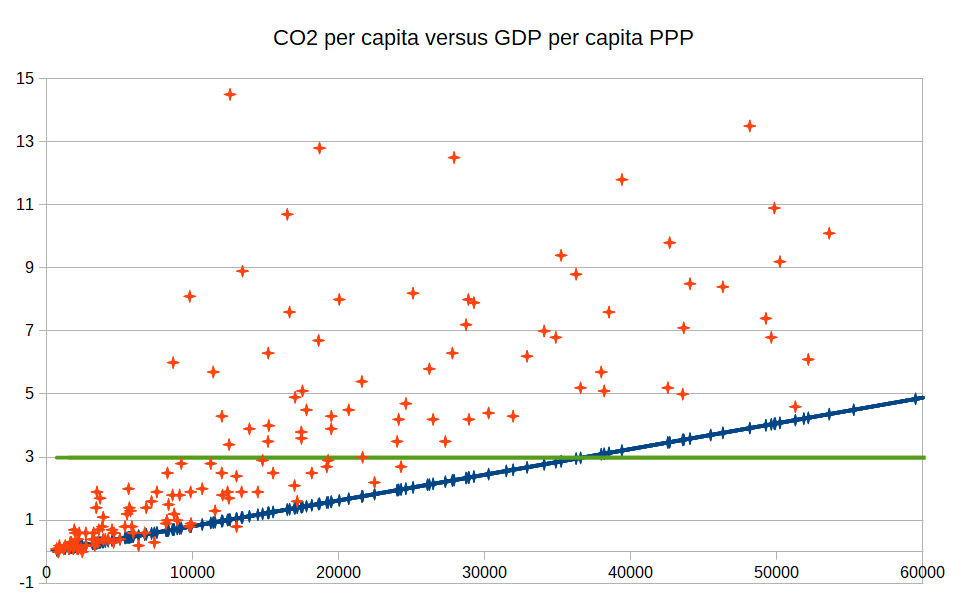
On this graph, the orange dots plot actual GDP per capita (at purchasing power parity) on the X axis against actual CO2 emissions per capita on the Y-axis. The green horizonal line is a CO2 emission target of 3 tonnes per person per year based on reports from the International Panel on Climate Change.

Wedge_full

As you can see, most countries are above the green line. That’s bad. We need the whole world below that green line. The countries that are below the line are largely poor countries, with a handful of middle-income countries mixed in.

But it’s the blue diagonal line that really makes this graph significant, what makes it the Wedge. That line uses Switzerland’s level of efficiency to estimate a frontier of what’s possible. Switzerland’s ratio of GDP to CO2 is the best in the world, among countries where the data actually looks reliable. A handful of other countries do better in the data, but for some (Macau) it’s obviously due to poor counting of indirect emissions and for others (Rwanda, Chad, Burundi) we just don’t have good data at all. I think Switzerland’s efficiency level of $12,000 per ton of CO2 is about as good as can be reasonably expected for most countries over the long run.

Our goal should be to move as far right on the graph as we can (toward higher levels of economic development), but always staying inside this Wedge: Above the green line, our CO2 emissions are too high. Below the blue line may not be technologically feasible (though of course it’s worth a try). We want to aim for the point of the wedge, where GDP is as high as possible but emissions are still below safe targets.

Zooming in on the graph gives a better view of the Wedge.

Wedge_zoomed

The point of the Wedge is about $38,000 per person per year. This is not as rich as the US, but it’s definitely within the range of highly-developed countries. This is about the same standard of living as Italy, Spain, or South Korea. In fact, all three of these countries exceed their targets; the closest I was able to find to a country actually hitting the point of the wedge was Latvia, at $27,300 and 3.5 tonnes per person per year. Uruguay also does quite well at $22,400 and 2.2 tonnes per person per year.

Some countries are within the Wedge; a few, like Uruguay, quite close to the point, and many, like Colombia and Bangladesh, that are below and to the left. For these countries, a “stay the course” policy is the way to go: If they keep up what they are doing, they can continue to experience economic growth without exceeding their emission targets.


But the most important thing about the graph is not actually the Wedge itself: It’s all the countries outside the Wedge, and where they are outside the Wedge.

There are some countries, like Sweden, France, and Switzerland, that are close to the blue line but still outside the Wedge because they are too far to the right. These are countries for whom “degrowth” policies might actually make sense: They are being as efficient in their use of resources as may be technologically feasible, but are simply producing too much output. They need to find a way to scale back their economies without causing social and political collapse. My suggestion, for what it’s worth, is progressive taxation. In addition to carbon taxes (which are a no-brainer), make income taxes so high that they start actually reducing GDP, and do so without fear, since that’s part of the point; then redistribute all the income as evenly as possible so that lower total income comes with much lower inequality and the eradication of poverty. Most of the country will then be no worse off than they were, so social and political unrest seems unlikely. Call it “socialism” if you like, but I’m not suggesting collectivization of industry or the uprising of the proletariat; I just want everyone to adopt the income tax rates the US had in the 1950s.

But most countries are not even close to the blue line; they are well above it. In all these countries, the goal should not be to reduce economic output, but to increase the carbon efficiency of that output. Increased efficiency has no downside (other than the transition cost to implement it): It makes you better off ecologically without making you worse off economically. Bahrain has about the same GDP per capita as Sweden but produces over five times the per-capita carbon emissions. Simply by copying Sweden they could reduce their emissions by almost 19 tonnes per person per year, which is more than the per-capita output of the US (and we’re hardly models of efficiency)—at absolutely no cost in GDP.

Then there are countries like Mongolia, which produces only $12,500 in GDP but 14.5 tonnes of CO2 per person per year. Mongolia is far above and to the left of the point of the Wedge, meaning that they could both increase their GDP and decrease their emissions by adopting the model of more efficient countries. Telling these countries that “degrowth” is the answer is beyond perverse—cut Mongolia’s GDP by 2/3 and you would throw them into poverty without even bringing carbon emissions down to target.

We don’t need to overthrow capitalism or even give up on GDP growth in general. We need to focus on carbon, carbon, carbon: All economic policy from this point forward should be made with CO2 reduction in mind. If that means reducing GDP, we may have to accept that; but often it won’t. Switching to nuclear power and public transit would dramatically reduce emissions but need have no harmful effect on economic output—in fact, the large investment required could pull a country out of recession.

Don’t worry about the Doughnut. Aim for the point of the Wedge.

What is the point of democracy?

Apr 9, JDN 2457853

[This topic was chosen by Patreon vote.]

“Democracy” is the sort of word that often becomes just an Applause Light (indeed it was the original example Less Wrong used). Like “freedom” and “liberty” (and for much the same reasons), it’s a good thing, that much we know; but it’s often unclear what is even meant by the word, much less why it should be so important to us.

From another angle, it is strangely common for economists and political scientists to argue that democracy is not all that important; they at least tend to use a precise formal definition of “democracy”, but are oddly quick to dismiss it as pointless or even harmful when it doesn’t line up precisely with their models of an efficient economy or society. I think the best example of this is the so-called “Downs paradox”, where political scientists were so steeped in the tradition of defining all rationality as psychopathic self-interest that they couldn’t even explain why it would occur to anyone to vote. (And indeed, rumor has it that most economists don’t bother to vote, much less campaign politically—which perhaps begins to explain why our economic policy is so terrible.)

Yet especially for Americans in the Trump era, I think it is vital to understand what “democracy” is supposed to mean, and why it is so important.

So, first of all, what is democracy? It is nothing more or less than government by popular vote.

This comes in degrees, of course: The purest direct democracy would have the entire population vote on even the most mundane policies and decisions. You could actually manage something like a monastery or a social club in such a fashion, but this is clearly unworkable on any large scale. Even once you get to hundreds of people, much less thousands or millions, it becomes unviable. The closest example I’ve seen is Switzerland, where there are always numerous popular referenda on ballots that are voted on by entire regions or the entire country—and even then, Switzerland does have representatives that make many of the day-to-day decisions.

So in practice all large-scale democratic systems are some degree of representative democracy, or republic, where some especially decisions may be made by popular vote, but most policies are made by elected representatives, staff appointed by those representatives, or even career civil servants who are appointed in a nominally apolitical process not so different from private-sector hiring. In the most extreme cases such civil servants can become so powerful that you get a deep state, where career bureaucrats exercise more power than elected officials—at that point I think you have actually lost the right to really call yourself a “democracy” and have become something more like a technocracy.
Yet of course a country can get even more undemocratic than that, and many are, governed by an aristocracy or oligarchy that vests power in a small number of wealthy and powerful individuals, or monarchy or autocracy that gives near-absolute power to a single individual.

Thus, there is a continuum of most to least democratic, with popular vote at one end, followed by elected representatives, followed by appointed civil servants, followed by a handful of oligarchs, and ultimately the most undemocratic system is an autocracy controlled by a single individual.

I also think it’s worth mentioning that constitutional monarchies with strong parliamentary systems, like the United Kingdom and Norway, are also “democracies” in the sense I intend. Yes, technically they have these hereditary monarchs—but in practice, the vast majority of the state’s power is vested in the votes of its people. Indeed, if we separate out parliamentary constitutional monarchy from presidential majoritarian democracy and compare them, the former might actually turn out to be better. Certainly, some of the world’s most prosperous nations are governed that way.

As I’ve already acknowledge, the very far extreme of pure direct democracy is unfeasible. But why would we want to get closer to that end? Why be like Switzerland or Denmark rather than like Turkey or Russia—or for that matter why be like California rather than like Mississippi?
Well, if you know anything about the overall welfare of these states, it almost seems obvious—Switzerland and Denmark are richer, happier, safer, healthier, more peaceful, and overall better in almost every way than Turkey and Russia. The gap between California and Mississippi is not as large, but it is larger than most people realize. Median household income in California is $64,500; in Mississippi it is only $40,593. Both are still well within the normal range of a highly-developed country, but that effectively makes California richer than Luxembourg but Mississippi poorer than South Korea. But perhaps the really stark comparison to make is life expectancy: Life expectancy at birth in California is almost 81 years, while in Mississippi it’s only 75.

Of course, there are a lot of other differences between states besides how much of their governance is done by popular referendum. Simply making Mississippi decide more things by popular vote would not turn it into California—much less would making Turkey more democratic turn it into Switzerland. So we shouldn’t attribute these comparisons entirely to differences in democracy. Indeed, a pair of two-way comparisons is only in the barest sense a statistical argument; we should be looking at dozens if not hundreds of comparisons if we really want to see the effects of democracy. And we should of course be trying to control for other factors, adjust for country fixed-effects, and preferably use natural experiments or instrumental variables to tease out causality.

Yet such studies have in fact been done. Stronger degrees of democracy appear to improve long-run economic growth, as well as reduce corruption, increase free trade, protect peace, and even improve air quality.

Subtler analyses have compared majoritarian versus proportional systems (where proportional seems, to me, at least, more democratic), as well as different republican systems with stronger or weaker checks and balances (stronger is clearly better, though whether that is “more democratic” is at least debatable). The effects of democracy on income distribution are more complicated, probably because there have been some highly undemocratic socialist regimes.

So, the common belief that democracy is good seems to be pretty well supported by the data. But why is democracy good? Is it just a practical matter of happening to get better overall results? Could it one day be overturned by some superior system such as technocracy or a benevolent autocratic AI?

Well, I don’t want to rule out the possibility of improving upon existing systems of government. Clearly new systems of government have in fact emerged over the course of history—Greek “democracy” and Roman “republic” were both really aristocracy, and anything close to universal suffrage didn’t really emerge on a large scale until the 20th century. So the 21st (or 22nd) century could well devise a superior form of government we haven’t yet imagined.
However, I do think there is good reason to believe that any new system of government that actually manages to improve upon democracy will still resemble democracy, because there are three key features democracy has that other systems of government simply can’t match. It is these three features that make democracy so important and so worth fighting for.

1. Everyone’s interests are equally represented.

Perhaps no real system actually manages to represent everyone’s interests equally, but the more democratic a system is, the better it will conform to this ideal. A well-designed voting system can aggregate the interests of an entire population and choose the course of action that creates the greatest overall benefit.

Markets can also be a good system for allocating resources, but while markets represent everyone’s interests, they do so highly unequally. Rich people are quite literally weighted more heavily in the sum.

Most systems of government do even worse, by completely silencing the voices of the majority of the population. The notion of a “benevolent autocracy” is really a conceit; what makes you think you could possibly keep the autocrat benevolent?

This is also why any form of disenfranchisement is dangerous and a direct attack upon democracy. Even if people are voting irrationally, against their own interests and yours, by silencing their voice you are undermining the most fundamental tenet of democracy itself. All voices must be heard, no exceptions. That is democracy’s fundamental strength.

2. The system is self-correcting.

This may more accurately describe a constitutional republican system with strong checks and balances, but that is what most well-functioning democracies have and it is what I recommend. If you conceive of “more democracy” as meaning that people can vote their way into fascism by electing a sufficiently charismatic totalitarian, then I do not want us to have “more democracy”. But just as contracts and regulations that protect you can make you in real terms more free because you can now safely do things you otherwise couldn’t risk, I consider strong checks and balances that maintain the stability of a republic against charismatic fascists to be in a deeper sense more democratic. This is ultimately semantic; I think I’ve made it clear enough that I want strong checks and balances.

With such checks and balances in place, democracies may move slower than autocracies; they may spend more time in deliberation or even bitter, polarized conflict. But this also means that their policies do not lurch from one emperor’s whim to another, and they are stable against being overtaken by corruption or fascism. Their policies are stable and predictable; their institutions are strong and resilient.

No other system of government yet devised by humans has this kind of stability, which may be why democracies are gradually taking over the world. Charismatic fascism fails when the charismatic leader dies; hereditary monarchy collapses when the great-grandson of the great king is incompetent; even oligarchy and aristocracy, which have at least some staying power, ultimately fall apart when the downtrodden peasants ultimately revolt. But democracy abides, for where monarchy and aristocracy are made of families and autocracy and fascism are made of a single man, democracy is made of principles and institutions. Democracy is evolutionarily stable, and thus in Darwinian terms we can predict it will eventually prevail.

3. The coercion that government requires is justified.

All government is inherently coercive. Libertarians are not wrong about this. Taxation is coercive. Regulation is coercive. Law is coercive. (The ones who go on to say that all government is “death threats” or “slavery” are bonkers, mind you. But it is in fact coercive.)

The coercion of government is particularly terrible if that coercion is coming from a system like an autocracy, where the will of the people is minimally if at all represented in the decisions of policymakers. Then that is a coercion imposed from outside, a coercion in the fullest sense, one person who imposes their will upon another.

But when government coercion comes from a democracy, it takes on a fundamentally different meaning. Then it is not they who coerce us—it is we who coerce ourselves. Now, why in the world would you coerce yourself? It seems ridiculous, doesn’t it?

Not if you know any game theory. There are in fall all sorts of reasons why one might want to coerce oneself, and two in particular become particularly important for the justification of democratic government.

The first and most important is collective action: There are many situations in which people all working together to accomplish a goal can be beneficial to everyone, but nonetheless any individual person who found a way to shirk their duty and not contribute could benefit even more. Anyone who has done a group project in school with a couple of lazy students in it will know this experience: You end up doing all the work, but they still get a good grade at the end. If everyone had taken the rational, self-interested action of slacking off, everyone in the group would have failed the project.

Now imagine that the group project we’re trying to achieve is, say, defending against an attack by Imperial Japan. We can’t exactly afford to risk that project falling through. So maybe we should actually force people to support it—in the form of taxes, or even perhaps a draft (as ultimately we did in WW2). Then it is no longer rational to try to shirk your duty, so everyone does their duty, the project gets done, and we’re all better off. How do we decide which projects are important enough to justify such coercion? We vote, of course. This is the most fundamental justification of democratic government.

The second that is relevant for government is commitment. There are many circumstances in which we want to accomplish something in the future, and from a long-run perspective it makes sense to achieve that goal—but then when the time comes to take action, we are tempted to procrastinate or change our minds. How can we resolve such a dilemma? Well, one way is to tie our own hands—to coerce ourselves into carrying out the necessary task we are tempted to avoid or delay.

This applies to many types of civil and criminal law, particularly regarding property ownership. Murder is a crime that most people would not commit even if it were completely legal. But shoplifting? I think if most people knew there would be no penalty for petty theft and retail fraud they would be tempted into doing it at least on occasion. I doubt it would be frequent enough to collapse our entire economic system, but it would introduce a lot of inefficiency, and make almost everything more expensive. By having laws in place that punish us for such behavior, we have a way of defusing such temptations, at least for most people most of the time. This is not as important for the basic functioning of government as is collective action, but I think it is still important enough to be worthy of mention.

Of course, there will always be someone who disagrees with any given law, regardless of how sensible and well-founded that law may be. And while in some sense “we all” agreed to pay these taxes, when the IRS actually demands that specific dollar amount from you, it may well be an amount that you would not have chosen if you’d been able to set our entire tax system yourself. But this is a problem of aggregation that I think may be completely intractable; there’s no way to govern by consensus, because human beings just can’t achieve consensus on the scale of millions of people. Governing by popular vote and representation is the best alternative we’ve been able to come up with. If and when someone devises a system of government that solves that problem and represents the public will even better than voting, then we will have a superior alternative to democracy.

Until then, it is as Churchill said: “Democracy is the worst form of government, except for all the others.”

The possibilities of a global basic income

JDN 2457401

This post is sort of a Patreon Readers’ Choice; it had a tied score with the previous post. If ties keep happening, I may need to devise some new scheme, lest I end up writing so many Readers’ Choice posts I don’t have time for my own topics (I suppose there are worse fates).

The idea of a global basic income is one I have alluded to many times, but never directly focused on.

As I wrote this I realized it’s actually two posts. I have good news and bad news.
First, the good news.

A national basic income is a remarkably simple, easy policy to make: When the tax code comes around for revision that year, you get Congress to vote in a very large refundable credit, disbursed monthly, that goes to everyone—that is a basic income. To avoid ballooning the budget deficit, you would also want to eliminate a bunch of other deductions and credits, and might want to raise the tax rates as well—but these are all things that we have done before many times. Different administrations almost always add some deductions and remove others, raise some rates and lower others. By this simple intervention, we could end poverty in America immediately and forever. The most difficult part of this whole process is convincing a majority of both houses of Congress to support it. (And even that may not be as difficult as it seems, for a basic income is one of the few economic policies that appeals to both Democrats, Libertarians, and even some Republicans.)

Similar routine policy changes could be applied in other First World countries. A basic income could be established by a vote of Parliament in the UK, a vote of the Senate and National Assembly in France, a vote of the Riksdag in Sweden, et cetera; indeed, Switzerland is already planning a referendum on the subject this year. The benefits of a national basic income policy are huge, the costs are manageable, the implementation is trivial. Indeed, the hardest thing to understand about all of this is why we haven’t done it already.

But the benefits of a national basic income are of course limited to the nation(s) in which it is applied. If Switzerland votes in its proposal to provide $30,000 per person per year (that’s at purchasing power parity, but it’s almost irrelevant whether I use nominal or PPP figures, because Swiss prices are so close to US prices), that will help a lot of people in Switzerland—but it won’t do much for people in Germany or Italy, let alone people in Ghana or Nicaragua. It could do a little bit for other countries, if the increased income for the poor and lower-middle class results in increased imports to Switzerland. But Switzerland especially is a very small player in global trade. A US basic income is more likely to have global effects, because the US by itself accounts for 9% of the world’s exports and 13% of the world’s imports. Some nations, particularly in Latin America, depend almost entirely upon the US to buy their exports.

But even so, national basic incomes in the entire First World would not solve the problem of global poverty. To do that, we would need a global basic income, one that applies to every human being on Earth.

The first question to ask is whether this is feasible at all. Do we even have enough economic output in the world to do this? If we tried would we simply trigger a global economic collapse?

Well,if you divide all the world’s income, adjusted for purchasing power, evenly across all the world’s population, the result is about $15,000 per person per year. This is about the standard of living of the average (by which I mean median) person in Lebanon, Brazil, or Botswana. It’s a little better than the standard of living in China, South Africa, or Peru. This is about half of what the middle class of the First World are accustomed to, but it is clearly enough to not only survive, but actually make some kind of decent living. I think most people would be reasonably happy with this amount of income, if it were stable and secure—and by construction, the majority of the world’s population would be better off if all incomes were equalized in this way.

Of course, we can’t actually do that. All the means we have for redistributing income to that degree would require sacrificing economic efficiency in various ways. It is as if we were carrying water in buckets with holes in the bottom; the amount we give at the end is a lot less than the amount we took at the start.

Indeed, the efficiency costs of redistribution rise quite dramatically as the amount redistributed increases.

I have yet to see a convincing argument for why we could not simply tax the top 1% at a 90% marginal rate and use all of that income for public goods without any significant loss in economic efficiency—this is after all more or less what we did here in the United States in the 1960s, when we had a top marginal rate over 90% and yet per capita GDP growth was considerably higher than it is today. A great many economists seem quite convinced that taxing top incomes in this way would create some grave disincentive against innovation and productivity, yet any time anything like this has been tried such disincentives have conspicuously failed to emerge. (Why, it’s almost as if the rich aren’t that much smarter and more hard-working than we are!)

I am quite sure, on the other hand, that if we literally set up the tax system so that all income gets collected by the government and then doled out to everyone evenly, this would be economically disastrous. Under that system, your income is basically independent of the work you do. You could work your entire life to create a brilliant invention that adds $10 billion to the world economy, and your income would rise by… 0.01%, the proportion that your invention added to the world economy. Or you could not do that, indeed do nothing at all, be a complete drain upon society, and your income would be about $1.50 less each year. It’s not hard to understand why a lot of people might work considerably less hard in such circumstances; if you are paid exactly the same whether you are an entrepreneur, a software engineer, a neurosurgeon, a teacher, a garbage collector, a janitor, a waiter, or even simply a couch potato, it’s hard to justify spending a lot of time and effort acquiring advanced skills and doing hard work. I’m sure there are some people, particularly in creative professions such as art, music, and writing—and indeed, science—who would continue to work, but even so the garbage would not get picked up, the hamburgers would never get served, and the power lines would never get fixed. The result would be that trying to give everyone the same income would dramatically reduce the real income available to distribute, so that we all ended up with say $5,000 per year or even $1,000 per year instead of $15,000.

Indeed, absolute equality is worse than the system of income distribution under Soviet Communism, which still provided at least some incentives to work—albeit often not to work in the most productive or efficient way.

So let’s suppose that we only have the income of the top 1% to work with. It need not be literally that we take income only from the top 1%; we could spread the tax burden wider than that, and there may even be good reasons to do so. But I think this gives us a good back-of-the-envelope estimate of how much money we would realistically have to work with in funding a global basic income. It’s actually surprisingly hard to find good figures on the global income share of the top 1%; there’s one figure going around which is not simply wrong it’s ridiculous, claiming that the income threshold for the top 1% worldwide is only $34,000. Why is it ridiculous? Because the United States comprises 4.5% of the world’s population, and half of Americans make more money than that. This means that we already have at least 2% of the world’s population making at least that much, in the United States alone. Add in people from Europe, Japan, etc. and you easily find that this must be the income of about the top 5%, maybe even only the top 10%, worldwide. Exactly where it lies depends on the precise income distributions of various countries.

But here’s what I do know; the global Gini coefficient is about 0.40, and the US Gini coefficient is about 0.45; thus, roughly speaking, income inequality on a global scale recapitulates income inequality in the US. The top 1% in the US receive about 20% of the income. So let’s say that the top 1% worldwide probably also receive somewhere around 20% of the income. We were only using it to estimate the funds available for a basic income anyway.

This would mean that our basic income could be about $3,000 per person per year at purchasing power parity. That probably doesn’t sound like a lot, and I suppose it isn’t; but the UN poverty threshold is $2 per person per day, which is $730 per person per day. Thus, our basic income is over four times what it would take to eliminate global poverty by the UN threshold.

Now in fact I think that this threshold is probably too low; but is it four times too low? We are accustomed to such a high standard of living in the First World that it’s easy to forget that people manage to survive on far, far less than we have. I think in fact our problem here is not so much poverty per se as it is inequality and financial insecurity. We live in a state of “insecure affluence”; we have a great deal (think for a moment about your shelter, transportation, computer, television, running water, reliable electricity, abundant food—and if you are reading this you probably have all these things), but we constantly fear that we may lose it at any moment, and not without reason. (My family actually lost the house I grew up in as a result of predatory banking and the financial crisis.) We are taught all our lives that the only way to protect this abundance is by means of a hyper-competitive, winner-takes-allcutthroat capitalist economy that never lets us ever become comfortable in appreciating that abundance, for it could be taken from us at any time.

I think the apotheosis of what it is to live in insecure affluence is renting an apartment in LA or New York—you must have a great deal going for you to be able to live in the city at all, but you are a renter, an interloper; the apartment, like so much of your existence, is never fully secure, never fully yours. Perhaps the icing on the cake is if you’re doing it for grad school (as I was a year ago), this bizarre system in which we live near poverty for several years not in spite but because of the fact that we are so hard-working, intelligent and educated. (And it never ceases to baffle me that economists who lived through that can still believe in the Life-Cycle Spending Hypothesis.)

Being below the poverty line in a First World country is a kind of poverty, but it’s a very different kind than being below the poverty line in a Third World country. (I think we need a new term to distinguish it, and maybe “insecure affluence” or “economic insecurity” is the right one.) A national basic income could be set considerably higher than the global basic income (since we’re giving it to far fewer people), so we might actually be able to set $15,000 nationally—but to do that worldwide would use up literally all the money in the world.

Raising the minimum income worldwide to $3,000 per person per year would transform the lives of billions of people. It would, in a very real sense, end poverty, worldwide, immediately and forever.

And that’s the good news. Stay tuned for the bad news.