How much should we give of ourselves?

Jul 23 JDN 2460149

This is a question I’ve written about before, but it’s a very important one—perhaps the most important question I deal with on this blog—so today I’d like to come back to it from a slightly different angle.

Suppose you could sacrifice all the happiness in the rest of your life, making your own existence barely worth living, in exchange for saving the lives of 100 people you will never meet.

  1. Would it be good for you do so?
  2. Should you do so?
  3. Are you a bad person if you don’t?
  4. Are all of the above really the same question?

Think carefully about your answer. It may be tempting to say “yes”. It feels righteous to say “yes”.

But in fact this is not hypothetical. It is the actual situation you are in.

This GiveWell article is entitled “Why is it so expensive to save a life?” but that’s incredibly weird, because the actual figure they give is astonishingly, mind-bogglingly, frankly disgustingly cheap: It costs about $4500 to save one human life. I don’t know how you can possibly find that expensive. I don’t understand how anyone can think, “Saving this person’s life might max out a credit card or two; boy, that sure seems expensive!

The standard for healthcare policy in the US is that something is worth doing if it is able to save one quality-adjusted life year for less than $50,000. That’s one year for ten times as much. Even accounting for the shorter lifespans and worse lives in poor countries, saving someone from a poor country for $4500 is at least one hundred times as cost-effective as that.

To put it another way, if you are a typical middle-class person in the First World, with an after-tax income of about $25,000 per year, and you were to donate 90% of that after-tax income to high-impact charities, you could be expected to save 5 lives every year. Over the course of a 30-year career, that’s 150 lives saved.

You would of course be utterly miserable for those 30 years, having given away all the money you could possibly have used for any kind of entertainment or enjoyment, not to mention living in the cheapest possible housing—maybe even a tent in a homeless camp—and eating the cheapest possible food. But you could do it, and you would in fact be expected to save over 100 lives by doing so.

So let me ask you again:

  1. Would it be good for you do so?
  2. Should you do so?
  3. Are you a bad person if you don’t?
  4. Are all of the above really the same question?

Peter Singer often writes as though the answer to all these questions is “yes”. But even he doesn’t actually live that way. He gives a great deal to charity, mind you; no one seems to know exactly how much, but estimates range from at least 10% to up to 50% of his income. My general impression is that he gives about 10% of his ordinary income and more like 50% of big prizes he receives (which are in fact quite numerous). Over the course of his life he has certainly donated at least a couple million dollars. Yet he clearly could give more than he does: He lives a comfortable, upper-middle-class life.

Peter Singer’s original argument for his view, from his essay “Famine, Affluence, and Morality”, is actually astonishingly weak. It involves imagining a scenario where a child is drowning in a lake and you could go save them, but only at the cost of ruining your expensive suit.

Obviously, you should save the child. We all agree on that. You are in fact a terrible person if you wouldn’t save the child.

But Singer tries to generalize this into a principle that requires us to donate all most of our income to international charities, and that just doesn’t follow.

First of all, that suit is not worth $4500. Not if you’re a middle-class person. That’s a damn Armani. No one who isn’t a millionaire wears suits like that.

Second, in the imagined scenario, you’re the only one who can help the kid. All I have to do is change that one thing and already the answer is different: If right next to you there is a trained, certified lifeguard, they should save the kid, not you. And if there are a hundred other people at the lake, and none of them is saving the kid… probably there’s a good reason for that? (It could be bystander effect, but actually that’s much weaker than a lot of people think.) The responsibility doesn’t uniquely fall upon you.

Third, the drowning child is a one-off, emergency scenario that almost certainly will never happen to you, and if it does ever happen, will almost certainly only happen once. But donation is something you could always do, and you could do over and over and over again, until you have depleted all your savings and run up massive debts.

Fourth, in the hypothetical scenario, there is only one child. What if there were ten—or a hundred—or a thousand? What if you couldn’t possibly save them all by yourself? Should you keep going out there and saving children until you become exhausted and you yourself drown? Even if there is a lifeguard and a hundred other bystanders right there doing nothing?

And finally, in the drowning child scenario, you are right there. This isn’t some faceless stranger thousands of miles away. You can actually see that child in front of you. Peter Singer thinks that doesn’t matter—actually his central point seems to be that it doesn’t matter. But I think it does.

Singer writes:

It makes no moral difference whether the person I can help is a neighbor’s child ten yards away from me or a Bengali whose name I shall never know, ten thousand miles away.

That’s clearly wrong, isn’t it? Relationships mean nothing? Community means nothing? There is no moral value whatsoever to helping people close to us rather than random strangers on the other side of the planet?

One answer might be to say that the answer to question 4 is “no”. You aren’t a bad person for not doing everything you should, and even though something would be good if you did it, that doesn’t necessarily mean you should do it.

Perhaps some things are above and beyond the call of duty: Good, perhaps even heroic, if you’re willing to do them, but not something we are all obliged to do. The formal term for this is supererogatory. While I think that overall utilitarianism is basically correct and has done great things for human society, one thing I think most utilitarians miss is that they seem to deny that supererogatory actions exist.

Even then, I’m not entirely sure it is good to be this altruistic.

Someone who really believed that we owe as much to random strangers as we do to our friends and family would never show up to any birthday parties, because any time spent at a birthday party would be more efficiently spent earning-to-give to some high-impact charity. They would never visit their family on Christmas, because plane tickets are expensive and airplanes burn a lot of carbon.

They also wouldn’t concern themselves with whether their job is satisfying or even not totally miserable; they would only care whether the total positive impact they can have on the world is positive, either directly through their work or by raising as much money as possible and donating it all to charity.

They would rest only the minimum amount they require to remain functional, eat only the barest minimum of nutritious food, and otherwise work, work, work, constantly, all the time. If their body was capable of doing the work, they would continue doing the work. For there is not a moment to waste when lives are on the line!

A world full of people like that would be horrible. We would all live our entire lives in miserable drudgery trying to maximize the amount we can donate to faceless strangers on the other side of the planet. There would be no joy or friendship in that world, only endless, endless toil.

When I bring this up in the Effective Altruism community, I’ve heard people try to argue otherwise, basically saying that we would never need everyone to devote themselves to the cause at this level, because we’d soon solve all the big problems and be able to go back to enjoying our lives. I think that’s probably true—but it also kind of misses the point.

Yes, if everyone gave their fair share, that fair share wouldn’t have to be terribly large. But we know for a fact that most people are not giving their fair share. So what now? What should we actually do? Do you really want to live in a world where the morally best people are miserable all the time sacrificing themselves at the altar of altruism?

Yes, clearly, most people don’t do enough. In fact, most people give basically nothing to high-impact charities. We should be trying to fix that. But if I am already giving far more than my fair share, far more than I would have to give if everyone else were pitching in as they should—isn’t there some point at which I’m allowed to stop? Do I have to give everything I can or else I’m a monster?

The conclusion that we ought to make ourselves utterly miserable in order to save distant strangers feels deeply unsettling. It feels even worse if we say that we ought to do so, and worse still if we feel we are bad people if we don’t.

One solution would be to say that we owe absolutely nothing to these distant strangers. Yet that clearly goes too far in the opposite direction. There are so many problems in this world that could be fixed if more people cared just a little bit about strangers on the other side of the planet. Poverty, hunger, war, climate change… if everyone in the world (or really even just everyone in power) cared even 1% as much about random strangers as they do about themselves, all these would be solved.

Should you donate to charity? Yes! You absolutely should. Please, I beseech you, give some reasonable amount to charity—perhaps 5% of your income, or if you can’t manage that, maybe 1%.

Should you make changes in your life to make the world better? Yes! Small ones. Eat less meat. Take public transit instead of driving. Recycle. Vote.

But I can’t ask you to give 90% of your income and spend your entire life trying to optimize your positive impact. Even if it worked, it would be utter madness, and the world would be terrible if all the good people tried to do that.

I feel quite strongly that this is the right approach: Give something. Your fair share, or perhaps even a bit more, because you know not everyone will.

Yet it’s surprisingly hard to come up with a moral theory on which this is the right answer.

It’s much easier to develop a theory on which we owe absolutely nothing: egoism, or any deontology on which charity is not an obligation. And of course Singer-style utilitarianism says that we owe virtually everything: As long as QALYs can be purchased cheaper by GiveWell than by spending on yourself, you should continue donating to GiveWell.

I think part of the problem is that we have developed all these moral theories as if we were isolated beings, who act in a world that is simply beyond our control. It’s much like the assumption of perfect competition in economics: I am but one producer among thousands, so whatever I do won’t affect the price.

But what we really needed was a moral theory that could work for a whole society. Something that would still make sense if everyone did it—or better yet, still make sense if half the people did it, or 10%, or 5%. The theory cannot depend upon the assumption that you are the only one following it. It cannot simply “hold constant” the rest of society.

I have come to realize that the Effective Altruism movement, while probably mostly good for the world as a whole, has actually been quite harmful to the mental health of many of its followers, including myself. It has made us feel guilty for not doing enough, pressured us to burn ourselves out working ever harder to save the world. Because we do not give our last dollar to charity, we are told that we are murderers.

But there are real murderers in this world. While you were beating yourself up over not donating enough, Vladmir Putin was continuing his invasion of Ukraine, ExxonMobil was expanding its offshore drilling, Daesh was carrying out hundreds of terrorist attacks, Qanon was deluding millions of people, and the human trafficking industry was making $150 billion per year.

In other words, by simply doing nothing you are considerably better than the real monsters responsible for most of the world’s horror.

In fact, those starving children in Africa that you’re sending money to help? They wouldn’t need it, were it not for centuries of colonial imperialism followed by a series of corrupt and/or incompetent governments ruled mainly by psychopaths.

Indeed the best way to save those people, in the long run, would be to fix their governments—as has been done in places like Namibia and Botswana. According to the World Development Indicators, the proportion of people living below the UN extreme poverty line (currently $2.15 per day at purchasing power parity) has fallen from 36% to 16% in Namibia since 2003, and from 42% to 15% in Botswana since 1984. Compare this to some countries that haven’t had good governments over that time: In Cote d’Ivoire the same poverty rate was 8% in 1985 but is 11% today (and was actually as high as 33% in 2015), while in Congo it remains at 35%. Then there are countries that are trying, but just started out so poor it’s a long way to go: Burkina Faso’s extreme poverty rate has fallen from 82% in 1994 to 30% today.

In other words, if you’re feeling bad about not giving enough, remember this: if everyone in the world were as good as you, you wouldn’t need to give a cent.

Of course, simply feeling good about yourself for not being a psychopath doesn’t accomplish very much either. Somehow we have to find a balance: Motivate people enough so that they do something, get them to do their share; but don’t pressure them to sacrifice themselves at the altar of altruism.

I think part of the problem here—and not just here—is that the people who most need to change are the ones least likely to listen. The kind of person who reads Peter Singer is already probably in the top 10% of most altruistic people, and really doesn’t need much more than a slight nudge to be doing their fair share. And meanwhile the really terrible people in the world have probably never picked up an ethics book in their lives, or if they have, they ignored everything it said.

I don’t quite know what to do about that. But I hope I can least convince you—and myself—to take some of the pressure off when it feels like we’re not doing enough.

Slides from my presentation at Worldcon

Whether you are a regular reader curious about my Worldcon talk, or a Worldcon visitor interested in seeing the slides, The slides from my presentation, “How do we get to the Federation from here?” can be found here.

Will China’s growth continue forever?

July 23, JDN 2457958

It’s easy to make the figures sound alarming, especially if you are a xenophobic American:

Annual GDP growth in the US is currently 2.1%, while annual GDP growth in China is 6.9%. At markte exchange rates, US GDP is currently $18.6 trillion, while China’s GDP is $11.2 trillion. If these growth rates continue, that means that China’s GDP will surpass ours in just 12 years.

Looking instead at per-capita GDP (and now using purchasing-power-parity, which is a much better measure for standard of living), the US is currently at $53,200 per person per year while China is at $14,400 per person per year. Since 2010 US per-capita GDP PPP has been growing at about 1.2%, while China’s has been growing at 7.1%. At that rate, China will surpass the US in standard of living in only 24 years.

And then if you really want to get scared, you start thinking about what happens if this growth continues for 20, or 30, or 50 years. At 50 years of these growth rates, US GDP will just about triple; but China’s GDP would increase by almost a factor of thirty. US per-capita GDP will increase to about $150,000, while China’s per-capita GDP will increase all the way to $444,000.

But while China probably will surpass the US in total nominal GDP within say 15 years, the longer-horizon predictions are totally unfounded. In fact, there is reason to believe that China will never surpass the US in standard of living, at least within the foreseeable future. Sure, some sort of global catastrophe could realign the world’s fortunes (climate change being a plausible candidate) and over very long time horizons all sorts of things can happen; but barring catastrophe and looking within the next few generations, there’s little reason to think that the average person in China will actually be better off than the average person in the United States. Indeed, while that $150,000 figure is actually remarkably plausible, that $444,000 figure is totally nonsensical. I project that in 2065, per-capita GDP in the US will indeed be about $150,000, but per-capita GDP in China will be more like $100,000.

That’s still a dramatic improvement over today for both countries, and something worth celebrating; but the panic that the US must be doing something wrong and China must be doing something right, that China is “eating our lunch” in Trump’s terminology, is simply unfounded.

Why am I so confident of this? Because, for all the proud proclamations of Chinese officials and panicked reports of American pundits, China’s rapid growth rates are not unprecedented. We have seen this before.

Look at South Korea. As I like to say, the discipline of development economics is basically the attempt to determine what happened in South Korea 1950-2000 and how to make it happen everywhere.

In 1960, South Korea’s nominal per-capita GDP was only $944. In 2016, it was $25,500. That takes them from solidly Third World underdeveloped status into very nearly First World highly-developed status in just two generations. This was an average rate of growth of 6.0%. But South Korea didn’t grow steadily at 6.0% for that entire period. Their growth fluctuated wildly (small countries tend to do that; they are effectively undiversified assets), but also overall trended downward.

The highest annual growth rate in South Korea over that time period was an astonishing 20.8%. Over twenty percent per year. Now that is growth you would feel. Imagine going from an income of $10,000 to an income of $12,000, in just one year. Imagine your entire country doing this. In its best years, South Korea was achieving annual growth rates in income comparable to the astronomical investment returns of none other than Warren Buffett (For once, we definitely had r < g). Even if you smooth out over the boom-and-bust volatility South Korea went through during that period, they were still averaging growth rates over 7.5% in the 1970s.

I wasn’t alive then, but I wouldn’t be surprised if Americans back then were panicking about South Korea’s growth too. Maybe not, since South Korea was and remains a close US ally, and their success displayed the superiority of capitalism over Communism (boy did it ever: North Korea’s per capita GDP also started at about $900 in 1960, and is still today… only about $1000!); but you could have made the same pie-in-the-sky forecasts of Korea taking over the world if you’d extrapolated their growth rates forward.

South Korea’s current growth rate, on the other hand? 2.9%. Not so shocking now!

Moreover, this is a process we understand theoretically as well as empirically. The Solow model is now well-established as the mainstream neoclassical model of economic growth, and it directly and explicitly predicts this sort of growth pattern, where a country that starts very poor will initially grow extremely fast as they build a capital base and reverse-engineer technology from more advanced countries, but then over a couple of generations their growth will slow down and eventually level off once they reach a high level of economic development.

Indeed, the basic reason is quite simple: A given proportional growth is easier to do when you start small. (There’s more to it than that, involving capital degradation and diminishing marginal returns, but at its core, that’s the basic idea.)

I think I can best instill this realization in you by making another comparison between the US and China: How much income are we adding in absolute terms?

US per-capita GDP of $53,200 is growing at 1.2% per year; that means we’re adding $640 per person per year. China per-capita GDP of $14,400 is growing at 7.1% per year; that means they’re adding $1,020 per year. So while it sounds like they are growing almost six times faster, they’re actually only adding about 40% more real income per person each year than we are. It’s just a larger proportion to them.

Indeed, China is actually doing relatively well on this scale. Many developing countries that are growing “fast” are actually adding less income per person in absolute terms than many highly-developed countries. India’s per capita GDP is growing at 5.8% per year, but adding only $340 per person per year. Ethiopia’s income per person is growing by 4.9%—which is only $75 per person per year. Compare this to the “slow” growth of the UK, where 1.0% annual growth is still $392 per person per year, or France, where “stagnant” growth of 0.8% is still $293 per person per year.

Back when South Korea was growing at 20%, that was still on the order of $200 per person per year. Their current 2.9%, on the other hand, is actually $740 per person per year. We often forget just how poor many poor countries truly are; what sounds like a spectacular growth rate still may not be all that much in absolute terms.

Here’s a graph (on a log scale) of GDP per capita in the US, Japan, China, and Korea, from World Bank data since 1960. I’d prefer to use GDP PPP, but the World Bank data doesn’t go back far enough.

As you can see, there is a general pattern of growth at a decreasing rate; it’s harder to see in China because they are earlier in the process; but there’s good reason to think that they will follow the same pattern.

If anything, I think the panic about Japan in the 1990s may have been more justifiable (not that it was terribly justified either). As you can see on the graph, in terms of nominal GDP per capita, Japan actually did briefly surpass the United States in the 1990s. Of course, the outcome of that was not a global war or Japan ruling the world or something; it was… the Nintendo Wii and the Toyota Prius.

Of course, that doesn’t stop people from writing news articles and even publishing economic papers about how this time is different, not like all the other times we saw the exact same pattern. Many Chinese officials appear to believe that China is special, that they can continue to grow at extremely high rates indefinitely without the constraints that other countries would face. But for once economic theory and economic data are actually in very good agreement: These high growth rates will not last forever. They will slow down, and that’s not such a bad thing. By the time they do, China will have greatly raised their standard of living to something very close to our own. Hundreds of millions of people have already been lifted out of abject poverty; continued growth could benefit hundreds of millions more.

The far bigger problem would be if the government refuses to accept that growth must slow down, and begins trying to force impossible levels of growth or altering the economic data to make it appear as though growth has occurred that hasn’t. We already know that the People’s Republic of China has a track record of doing this sort of thing: we know they have manipulated some data, though we think only in small ways, and the worst example of an attempt at forcing economic growth in human history was in China, the so-called “Great Leap Forward” that killed 20 million people. The danger is not that China will grow this fast forever, nor that they will slow down soon enough, but that they will slow down and their government will refuse to admit it.

What makes a nation wealthy?

JDN 2457251 EDT 10:17

One of the central questions of economics—perhaps the central question, the primary reason why economics is necessary and worthwhile—is development: How do we raise a nation from poverty to prosperity?

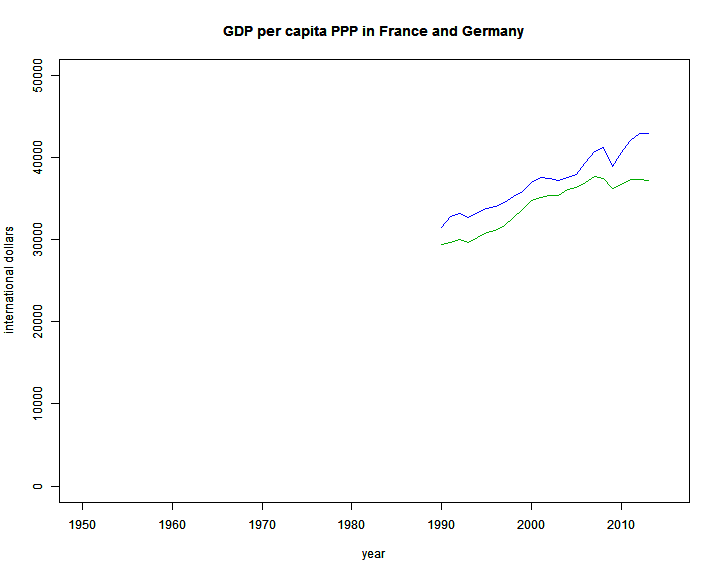
We have done it before: France and Germany rose from the quite literal ashes of World War 2 to some of the most prosperous societies in the world. Their per-capita GDP over the 20th century rose like this (all of these figures are from the World Bank World Development Indicators; France is green, Germany is blue):

GDPPC_France_Germany

GDPPCPPP_France_Germany

The top graph is at market exchange rates, the bottom is correcting for purchasing power parity (PPP). The PPP figures are more meaningful, but unfortunately they only began collecting good data on purchasing power around 1990.

Around the same time, but even more spectacularly, Japan and South Korea rose from poverty-stricken Third World backwaters to high-tech First World powers in only a couple of generations. Check out their per-capita GDP over the 20th century (Japan is green, South Korea is blue):

GDPPC_Japan_KoreaGDPPCPPP_Japan_Korea


This is why I am only half-joking when I define development economics as “the ongoing project to figure out what happened in South Korea and make it happen everywhere in the world”.

More recently China has been on a similar upward trajectory, which is particularly important since China comprises such a huge portion of the world’s population—but they are far from finished:

GDPPC_ChinaGDPPCPPP_China

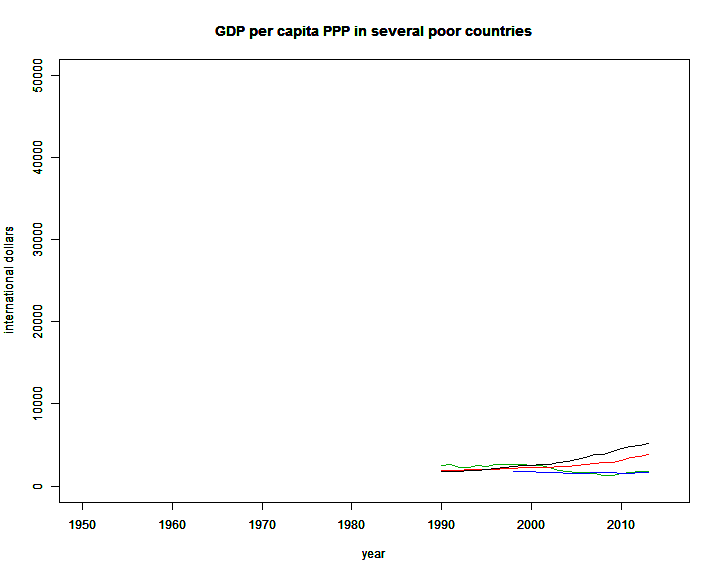
Compare these to societies that have not achieved economic development, such as Zimbabwe (green), India (black), Ghana (red), and Haiti (blue):

GDPPC_poor_countriesGDPPCPPP_poor_countries

They’re so poor that you can barely see them on the same scale, so I’ve rescaled so that the top is $5,000 per person per year instead of $50,000:

GDPPC_poor_countries_rescaledGDPPCPPP_poor_countries_rescaled

Only India actually manages to get above $5,000 per person per year at purchasing power parity, and then not by much, reaching $5,243 per person per year in 2013, the most recent data.

I had wanted to compare North Korea and South Korea, because the two countries were united as recently as the 1945 and were not all that different to begin with, yet have taken completely different development trajectories. Unfortunately, North Korea is so impoverished, corrupt, and authoritarian that the World Bank doesn’t even report data on their per-capita GDP. Perhaps that is contrast enough?

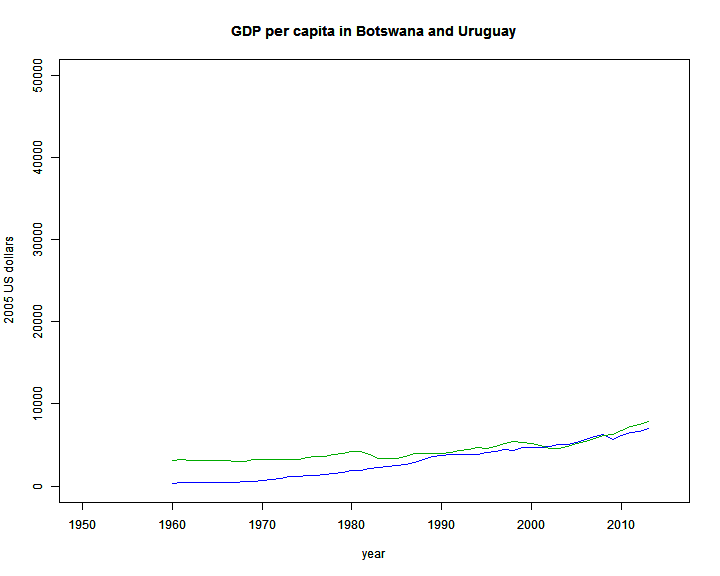
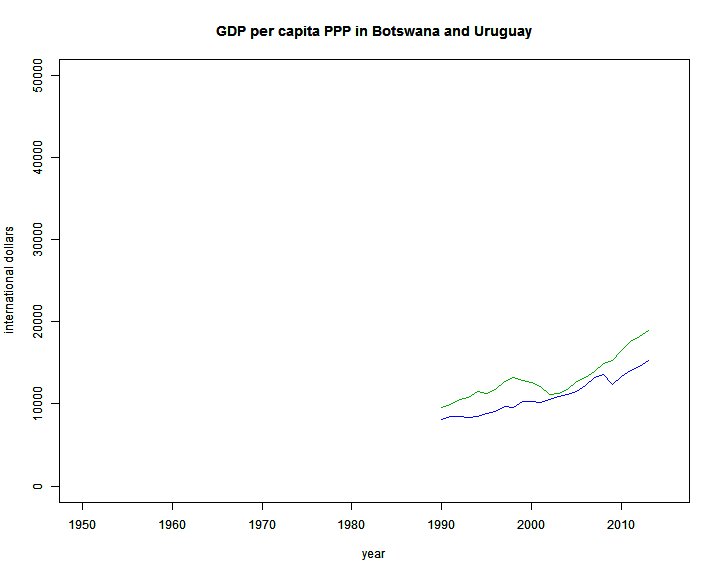
And then of course there are the countries in between, which have made some gains but still have a long way to go, such as Uruguay (green) and Botswana (blue):

GDPPC_Botswana_UruguayGDPPCPPP_Botswana_Uruguay

But despite the fact that we have observed successful economic development, we still don’t really understand how it works. A number of theories have been proposed, involving a wide range of factors including exports, corruption, disease, institutions of government, liberalized financial markets, and natural resources (counter-intuitively; more natural resources make your development worse).

I’m not going to resolve that whole debate in a single blog post. (I may not be able to resolve that whole debate in a single career, though I am definitely trying.) We may ultimately find that economic development is best conceived as like “health”; what factors determine your health? Well, a lot of things, and if any one thing goes badly enough wrong the whole system can break down. Economists may need to start thinking of ourselves as akin to doctors (or as Keynes famously said, dentists), diagnosing particular disorders in particular patients rather than seeking one unifying theory. On the other hand, doctors depend upon biologists, and it’s not clear that we yet understand development even at that level.

Instead I want to take a step back, and ask a more fundamental question: What do we mean by prosperity?

My hope is that if we can better understand what it is we are trying to achieve, we can also better understand the steps we need to take in order to get there.

Thus far it has sort of been “I know it when I see it”; we take it as more or less given that the United States and the United Kingdom are prosperous while Ghana and Haiti are not. I certainly don’t disagree with that particular conclusion; I’m just asking what we’re basing it on, so that we can hopefully better apply it to more marginal cases.


For example: Is
France more or less prosperous than Saudi Arabia? If we go solely by GDP per capita PPP, clearly Saudi Arabia is more prosperous at $53,100 per person per year than France is at $37,200 per person per year.

But people actually live longer in France, on average, than they do in Saudi Arabia. Overall reported happiness is higher in France than Saudi Arabia. I think France is actually more prosperous.


In fact, I think the United States is not as prosperous as we pretend ourselves to be. We are certainly more prosperous than most other countries; we are definitely still well within First World status. But we are not the most prosperous nation in the world.

Our total GDP is astonishingly high (highest in the world nominally, second only to China PPP). Our GDP per-capita is higher than any other country of comparable size; no nation with higher GDP PPP than the US has a population larger than the Chicago metropolitan area. (You may be surprised to find that in order from largest to smallest population the countries with higher GDP per capita PPP are the United Arab Emirates, Switzerland, Hong Kong, Singapore, and then Norway, followed by Kuwait, Qatar, Luxembourg, Brunei, and finally San Marino—which is smaller than Ann Arbor.) Our per-capita GDP PPP of $51,300 is markedly higher than that of France ($37,200), Germany ($42,900), or Sweden ($43,500).

But at the same time, if you compare the US to other First World countries, we have nearly the highest rate of child poverty and higher infant mortality. We have shorter life expectancy and dramatically higher homicide rates. Our inequality is the highest in the world. In France and Sweden, the top 0.01% receive about 1% of the income (i.e. 100 times as much as the average person), while in the United States they receive almost 4%, making someone in the top 0.01% nearly 400 times as rich as the average person.

By estimating solely on GDP per capita, we are effectively rigging the game in our own favor. Or rather, the rich in the United States are rigging the game in their own favor (what else is new?), by convincing all the world’s economists to rank countries based on a measure that favors them.

Amartya Sen, one of the greats of development economics, developed a scale called the Human Development Index that attempts to take broader factors into account. It’s far from perfect, but it’s definitely a step in the right direction.

In particular, France’s HDI is higher than that of Saudi Arabia, fitting my intuition about which country is truly more prosperous. However, the US still does extremely well, with only Norway, Australia, Switzerland, and the Netherlands above us. I think we might still be biased toward high average incomes rather than overall happiness.

In practice, we still use GDP an awful lot, probably because it’s much easier to measure. It’s sort of like IQ tests and SAT scores; we know damn well it’s not measuring what we really care about, but because it’s so much easier to work with we keep using it anyway.

This is a problem, because the better you get at optimizing toward the wrong goal, the worse your overall outcomes are going to be. If you are just sort of vaguely pointed at several reasonable goals, you will probably be improving your situation overall. But when you start precisely optimizing to a specific wrong goal, it can drag you wildly off course.

This is what we mean when we talk about “gaming the system”. Consider test scores, for example. If you do things that will probably increase your test scores among other things, you are likely to engage in generally good behaviors like getting enough sleep, going to class, studying the content. But if your single goal is to maximize your test score at all costs, what will you do? Cheat, of course.

This is also related to the Friendly AI Problem: It is vitally important to know precisely what goals we want our artificial intelligences to have, because whatever goals we set, they will probably be very good at achieving them. Already computers can do many things that were previously impossible, and as they improve over time we will reach the point where in a meaningful sense our AIs are even smarter than we are. When that day comes, we will want to make very, very sure that we have designed them to want the same things that we do—because if our desires ever come into conflict, theirs are likely to win. The really scary part is that right now most of our AI research is done by for-profit corporations or the military, and “maximize my profit” and “kill that target” are most definitely not the ultimate goals we want in a superintelligent AI. It’s trivially easy to see what’s wrong with these goals: For the former, hack into the world banking system and transfer trillions of dollars to the company accounts. For the latter, hack into the nuclear launch system and launch a few ICBMs in the general vicinity of the target. Yet these are the goals we’ve been programming into the actual AIs we build!

If we set GDP per capita as our ultimate goal to the exclusion of all other goals, there are all sorts of bad policies we would implement: We’d ignore inequality until it reached staggering heights, ignore work stress even as it began to kill us, constantly try to maximize the pressure for everyone to work constantly, use poverty as a stick to force people to work even if people starve, inundate everyone with ads to get them to spend as much as possible, repeal regulations that protect the environment, workers, and public health… wait. This isn’t actually hypothetical, is it? We are doing those things.

At least we’re not trying to maximize nominal GDP, or we’d have long-since ended up like Zimbabwe. No, our economists are at least smart enough to adjust for purchasing power. But they’re still designing an economic system that works us all to death to maximize the number of gadgets that come off assembly lines. The purchasing-power adjustment doesn’t include the value of our health or free time.

This is why the Human Development Index is a major step in the right direction; it reminds us that society has other goals besides maximizing the total amount of money that changes hands (because that’s actually all that GDP is measuring; if you get something for free, it isn’t counted in GDP). More recent refinements include things like “natural resource services” that include environmental degradation in estimates of investment. Unfortunately there is no accepted way of doing this, and surprisingly little research on how to improve our accounting methods. Many nations seem resistant to doing so precisely because they know it would make their economic policy look bad—this is almost certainly why China canceled its “green GDP” initiative. This is in fact all the more reason to do it; if it shows that our policy is bad, that means our policy is bad and should be fixed. But people have allowed themselves to value image over substance.

We can do better still, and in fact I think something like QALY is probably the way to go. Rather than some weird arbitrary scaling of GDP with lifespan and Gini index (which is what the HDI is), we need to put everything in the same units, and those units must be directly linked to human happiness. At the very least, we should make some sort of adjustment to our GDP calculation that includes the distribution of wealth and its marginal utility; adding $1,000 to the economy and handing it to someone in poverty should count for a great deal, but adding $1,000,000 and handing it to a billionaire should count for basically nothing. (It’s not bad to give a billionaire another million; but it’s hardly good either, as no one’s real standard of living will change.) Calculating that could be as simple as dividing by their current income; if your annual income is $10,000 and you receive $1,000, you’ve added about 0.1 QALY. If your annual income is $1 billion and you receive $1 million, you’ve added only 0.001 QALY. Maybe we should simply separate out all individual (or household, to be simpler?) incomes, take their logarithms, and then use that sum as our “utility-adjusted GDP”. The results would no doubt be quite different.

This would create a strong pressure for policy to be directed at reducing inequality even at the expense of some economic output—which is exactly what we should be willing to do. If it’s really true that a redistribution policy would hurt the overall economy so much that the harms would outweigh the benefits, then we shouldn’t do that policy; but that is what you need to show. Reducing total GDP is not a sufficient reason to reject a redistribution policy, because it’s quite possible—easy, in fact—to improve the overall prosperity of a society while still reducing its GDP. There are in fact redistribution policies so disastrous they make things worse: The Soviet Union had them. But a 90% tax on million-dollar incomes would not be such a policy—because we had that in 1960 with little or no ill effect.

Of course, even this has problems; one way to minimize poverty would be to exclude, relocate, or even murder all your poor people. (The Black Death increased per-capita GDP.) Open immigration generally increases poverty rates in the short term, because most of the immigrants are poor. Somehow we’d need to correct for that, only raising the score if you actually improve people’s lives, and not if you make them excluded from the calculation.

In any case it’s not enough to have the alternative measures; we must actually use them. We must get policymakers to stop talking about “economic growth” and start talking about “human development”; a policy that raises GDP but reduces lifespan should be immediately rejected, as should one that further enriches a few at the expense of many others. We must shift the discussion away from “creating jobs”—jobs are only a means—to “creating prosperity”.