Working from home is the new normal—sort of

Aug 28 JDN 2459820

Among people with jobs that can be done remotely, a large majority did in fact switch to doing their jobs remotely: By the end of 2020, over 70% of Americans with jobs that could be done remotely were working from home—and most of them said they didn’t want to go back.

This is actually what a lot of employers expected to happen—just not quite like this. In 2014, a third of employers predicted that the majority of their workforce would be working remotely by 2020; given the timeframe there, it required a major shock to make that happen so fast, and yet a major shock was what we had.

Working from home has carried its own challenges, but overall productivity seems to be higher working remotely (that meeting really could have been an email!). This may actually explain why output per work hour actually rose rapidly in 2020 and fell in 2022.

The COVID pandemic now isn’t so much over as becoming permanent; COVID is now being treated as an endemic infection like influenza that we don’t expect to be able to eradicate in the foreseeable future.

And likewise, remote work seems to be here to stay—sort of.

First of all, we don’t seem to be giving up office work entirely. As of the first quarter 2022, almost as many firms have partially remote work as have fully remote work, and this seems to be trending upward. A lot of firms seem to be transitioning into a “hybrid” model where employees show up to work two or three days a week. This seems to be preferred by large majorities of both workers and firms.

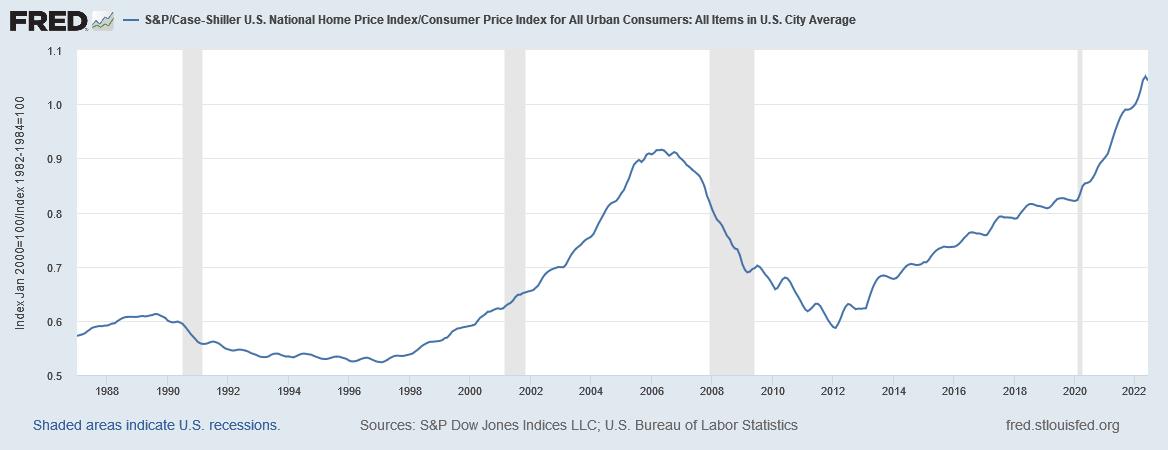
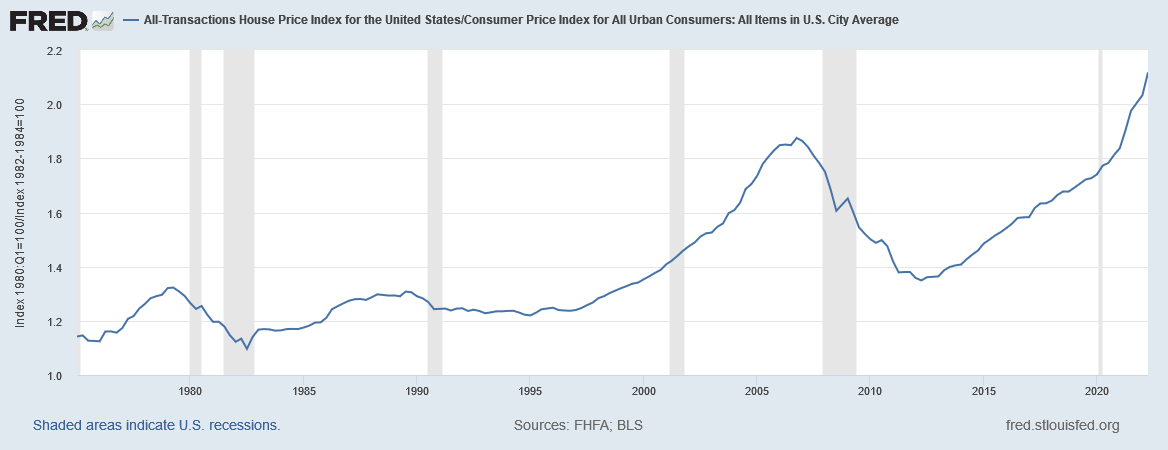
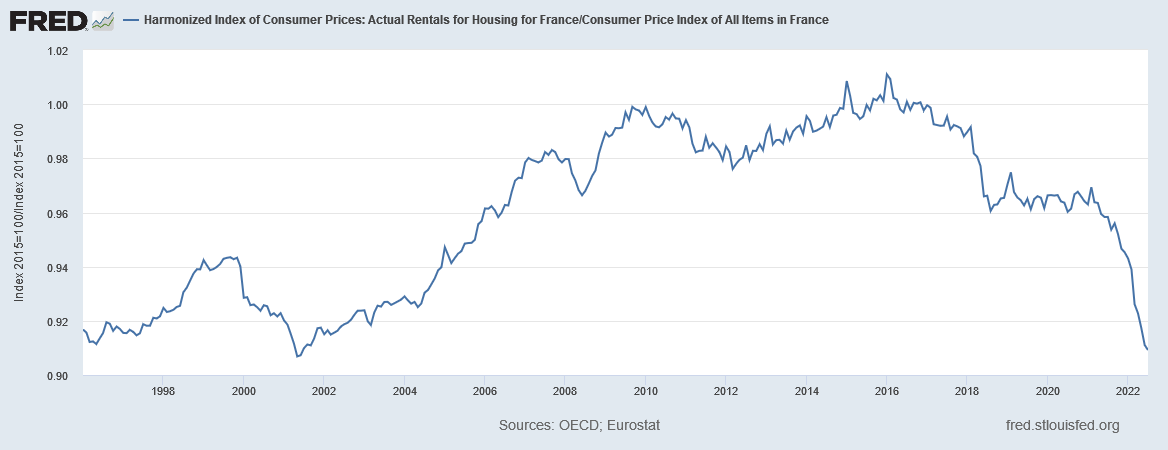
There is a significant downside of this: It means that the hope that remote working might finally ease the upward pressure on housing prices in major cities is largely a false one. If we were transitioning to a fully remote system, then people could live wherever they want (or can afford) and there would be no reason to move to overpriced city centers. But if you have to show up to work even one day a week, that means you need to live close enough to the office to manage that commute.

Likewise, if workers never came to the office, you could sell the office building and convert it into more housing. But if they show up even once in awhile, you need a physical place for them to go. Some firms may shrink their office space (indeed, many have—and unlike this New York Times journalist, I have a really hard time feeling bad for landlords of office buildings); but they aren’t giving it up entirely. It’s possible that firms could start trading off—you get the building on Mondays, we get it on Tuesdays—but so far this seems to be rare, and it does raise a lot of legitimate logistical and security concerns. So our global problem of office buildings that are empty, wasted space most of the time is going to get worse, not better. Manhattan will still empty out every night; it just won’t fill up as much during the day. This is honestly a major drain on our entire civilization—building and maintaining all those structures that are only used at most 1/3 of 5/7 of the time, and soon, less—and we really should stop ignoring it. No wonder our real estate is so expensive, when half of it is only used 20% of the time!

Moreover, not everyone gets to work remotely. Your job must be something that can be done remotely—something that involves dealing with information, not physical objects. That includes a wide and ever-growing range of jobs, from artists and authors to engineers and software developers—but it doesn’t include everyone. It basically means what we call “white-collar” work.

Indeed, it is largely limited to the upper-middle class. The rich never really worked anyway, though sometimes they pretend to, convincing themselves that managing a stock portfolio (that would actually grow faster if they let it sit) constitutes “work”. And the working class? By and large, they didn’t get the chance to work remotely. While 73% of workers with salaries above $200,000 worked remotely in 2020, only 12% of workers with salaries under $25,000 did, and there is a smooth trend where, across the board, the more money you make, the more likely you have been able to work remotely.

This will only intensify the divide between white-collar and blue-collar workers. They already think we don’t do “real work”; now we don’t even go to work. And while blue-collar workers are constantly complaining about contempt from white-collar elites, I think the shoe is really on the other foot. I have met very few white-collar workers who express contempt for blue-collar workers—and I have met very few blue-collar workers who don’t express anger and resentment toward white-collar workers. I keep hearing blue-collar people say that we think that they are worthless and incompetent, when they are literally the only ones ever saying that. I can’t stop saying things that I never said.

The rich and powerful may look down on them, but they look down on everyone. (Maybe they look down on blue-collar workers more? I’m not even sure about that.) I think politicians sometimes express contempt for blue-collar workers, but I don’t think this reflects what most white-collar workers feel.

And the highly-educated may express some vague sense of pity or disappointment in people who didn’t get college degrees, and sometimes even anger (especially when they do things like vote for Donald Trump), but the really vitriolic hatred is clearly in the opposite direction (indeed, I have no better explanation for how otherwise-sane people could vote for Donald Trump). And I certainly wouldn’t say that everyone needs a college degree (though I became tempted to, when so many people without college degrees voted for Donald Trump).

This really isn’t us treating them with contempt: This is them having a really severe inferiority complex. And as information technology (that white-collar work created) gives us—but not them—the privilege of staying home, that is only going to get worse.

It’s not their fault: Our culture of meritocracy puts a little bit of inferiority complex in all of us. It tells us that success and failure are our own doing, and so billionaires deserve to have everything and the poor deserve to have nothing. And blue-collar workers have absolutely internalized these attitudes: Most of them believe that poor people choose to stay on welfare forever rather than get jobs (when welfare has time limits and work requirements, so this is simply not an option—and you would know this from the Wikipedia page on TANF).

I think that what they experience as “contempt by white-collar elites” is really the pain of living in an illusory meritocracy. They were told—and they came to believe—that working hard would bring success, and they have worked very hard, and watched other people be much more successful. They assume that the rich and powerful are white-collar workers, when really they are non-workers; they are people the world was handed to on a silver platter. (What, you think George W. Bush earned his admission to Yale?)

And thus, we can shout until we are blue in the face that plumbers, bricklayers and welders are the backbone of civilization—and they are, and I absolutely mean that; our civilization would, in an almost literal sense, collapse without them—but it won’t make any difference. They’ll still feel the pain of living in a society that gave them very little and tells them that people get what they deserve.

I don’t know what to say to such people, though. When your political attitudes are based on beliefs that are objectively false, that you could know are objectively false if you simply bothered to look them up… what exactly am I supposed to say to you? How can we have a useful political conversation when half the country doesn’t even believe in fact-checking?

Honestly I wish someone had explained to them that even the most ideal meritocratic capitalism wouldn’t reward hard work. Work is a cost, not a benefit, and the whole point of technological advancement is to allow us to accomplish more with less work. The ideal capitalism would reward talent—you would succeed by accomplishing things, regardless of how much effort you put into them. People would be rich mainly because they are brilliant, not because they are hard-working. The closest thing we have to ideal capitalism right now is probably professional sports. And no amount of effort could ever possibly make me into Steph Curry.

If that isn’t the world we want to live in, so be it; let’s do something else. I did nothing to earn either my high IQ or my chronic migraines, so it really does feel unfair that the former increases my income while the latter decreases it. But the labor theory of value has always been wrong; taking more sweat or more hours to do the same thing is worse, not better. The dignity of labor consists in its accomplishment, not its effort. Sisyphus is not happy, because his work is pointless.

Honestly at this point I think our best bet is just to replace all blue-collar work with automation, thus rendering it all moot. And then maybe we can all work remotely, just pushing code patches to the robots that do everything. (And no doubt this will prove my “contempt”: I want to replace you! No, I want to replace the grueling work that you have been forced to do to make a living. I want you—the human being—to be able to do something more fun with your life, even if that’s just watching television and hanging out with friends.)

A guide to surviving the apocalypse

Aug 21 JDN 2459820

Some have characterized the COVID pandemic as an apocalypse, though it clearly isn’t. But a real apocalypse is certainly possible, and its low probability is offset by its extreme importance. The destruction of human civilization would be quite literally the worst thing that ever happened, and if it led to outright human extinction or civilization was never rebuilt, it could prevent a future that would have trillions if not quadrillions of happy, prosperous people.

So let’s talk about things people like you and me could do to survive such a catastrophe, and hopefully work to rebuild civilization. I’ll try to inject a somewhat light-hearted tone into this otherwise extraordinarily dark topic; we’ll see how well it works. What specifically we would want—or be able—to do will depend on the specific scenario that causes the apocalypse, so I’ll address those specifics shortly. But first, let’s talk about general stuff that should be useful in most, if not all, apocalypse scenarios.

It turns out that these general pieces of advice are also pretty good advice for much smaller-scale disasters such as fires, tornados, or earthquakes—all of which are far more likely to occur. Your top priority is to provide for the following basic needs:

1. Water: You will need water to drink. You should have some kind of stockpile of clean water; bottled water is fine but overpriced, and you’d do just as well to bottle tap water (as long as you do it before the crisis occurs and the water system goes down). Better still would be to have water filtration and purification equipment so that you can simply gather whatever water is available and make it drinkable.

2. Food: You will need nutritious, non-perishable food. Canned vegetables and beans are ideal, but you can also get a lot of benefit from dry staples such as crackers. Processed foods and candy are not as nutritious, but they do tend to keep well, so they can do in a pinch. Avoid anything that spoils quickly or requires sophisticated cooking. In the event of a disaster, you will be able to make fire and possibly run a microwave on a solar panel or portable generator—but you can’t rely on the electrical or gas mains to stay operational, and even boiling will require precious water.

3. Shelter: Depending on the disaster, your home may or may not remain standing—and even if it is standing, it may not be fit for habitation. Consider backup options for shelter: Do you have a basement? Do you own any tents? Do you know people you could move in with, if their homes survive and yours doesn’t?

4. Defense: It actually makes sense to own a gun or two in the event of a crisis. (In general it’s actually a big risk, though, so keep that in mind: the person your gun is most likely to kill is you.) Just don’t go overboard and do what we all did in Oregon Trail, stocking plenty of bullets but not enough canned food. Ammo will be hard to replace, though; your best option may actually be a gauss rifle (yes, those are real, and yes, I want one), because all they need for ammo is ferromagnetic metal of the appropriate shape and size. Then, all you need is a solar panel to charge its battery and some machine tools to convert scrap metal into ammo.

5. Community: Humans are highly social creatures, and we survive much better in groups. Get to know your neighbors. Stay in touch with friends and family. Not only will this improve your life in general, it will also give you people to reach out to if you need help during the crisis and the government is indisposed (or toppled). Having a portable radio that runs on batteries, solar power, or hand-crank operation will also be highly valuable for staying in touch with people during a crisis. (Likewise flashlights!)

Now, on to the specific scenarios. I will consider the following potential causes of apocalypse: Alien Invasion, Artificial Intelligence Uprising, Climate Disaster, Conventional War, Gamma-Ray Burst, Meteor Impact, Plague, Nuclear War, and last (and, honestly, least), Zombies.

I will rate each apocalypse by its risk level, based on its probability of occurring within the next 100 years (roughly the time I think it will take us to meaningfully colonize space and thereby change the game):

Very High: 1% or more

High: 0.1% – 1%

Moderate: 0.01% – 0.1%

Low: 0.001% – 0.01%

Very Low: 0.0001% – 0.001%

Tiny: 0.00001% – 0.0001%

Miniscule: 0.00001% or less

I will also rate your relative safety in different possible locations you might find yourself during the crisis:

Very Safe: You will probably survive.

Safe: You will likely survive if you are careful.

Dicey: You may survive, you may not. Hard to say.

Dangerous: You will likely die unless you are very careful.

Very Dangerous: You will probably die.

Hopeless: You will definitely die.

I’ll rate the following locations for each, with some explanation: City, Suburb, Rural Area, Military Base, Underground Bunker, Ship at Sea. Certain patterns will emerge—but some results may surprise you. This may tell you where to go to have the best chance of survival in the event of a disaster (though I admit bunkers are often in short supply).

All right, here goes!

Alien Invasion

Risk: Low

There are probably sapient aliens somewhere in this vast universe, maybe even some with advanced technology. But they are very unlikely to be willing to expend the enormous resources to travel across the stars just to conquer us. Then again, hey, it could happen; maybe they’re imperialists, or they have watched our TV commercials and heard the siren song of oregano.

City: Dangerous

Population centers are likely to be primary targets for their invasion. They probably won’t want to exterminate us outright (why would they?), but they may want to take control of our cities, and are likely to kill a lot of people when they do.

Suburb: Dicey

Outside the city centers will be a bit safer, but hardly truly safe.

Rural Area: Dicey

Where humans are spread out, we’ll present less of a target. Then again, if you own an oregano farm….

Military Base: Very Dangerous

You might think that having all those planes and guns around would help, but these will surely be prime targets in an invasion. Since the aliens are likely to be far more technologically advanced, it’s unlikely our military forces could put up much resistance. Our bases would likely be wiped out almost immediately.

Underground Bunker: Safe

This is a good place to be. Orbital and aerial weapons won’t be very effective against underground targets, and even ground troops would have trouble finding and attacking an isolated bunker. Since they probably won’t want to exterminate us, hiding in your bunker until they establish a New World Order could work out for you.

Ship at Sea: Dicey

As long as it’s a civilian vessel, you should be okay. A naval vessel is just as dangerous as a base, if not more so; they would likely strike our entire fleets from orbit almost instantly. But the aliens are unlikely to have much reason to bother attacking a cruise ship or a yacht. Then again, if they do, you’re toast.

Artificial Intelligence Uprising

Risk: Very High

While it sounds very sci-fi, this is one of the most probable apocalypse scenarios, and we should be working to defend against it. There are dozens of ways that artificial intelligence could get out of control and cause tremendous damage, particularly if the AI got control of combat drones or naval vessels. This could mean a superintelligent AI beyond human comprehension, but it need not; it could in fact be a very stupid AI that was programmed to make profits for Hasbro and decided that melting people into plastic was the best way to do that.

City: Very Dangerous

Cities don’t just have lots of people; they also have lots of machines. If the AI can hack our networks, they may be able to hack into not just phones and laptops, but even cars, homes, and power plants. Depending on the AI’s goals (which are very hard to predict), cities could become disaster zones almost immediately, as thousands of cars shut down and crash and all the power plants get set to overload.

Suburb: Dangerous

Definitely safer than the city, but still, you’ve got plenty of technology around you for the AI to exploit.

Rural Area: Dicey

The further you are from other people and their technology, the safer you’ll be. Having bad wifi out in the boonies may actually save your life. Then again, even tractors have software updates now….

Military Base: Very Dangerous

The military is extremely high-tech and all network-linked. Unless they can successfully secure their systems against the AI very well, very fast, suddenly all the guided missiles and combat drones and sentry guns will be deployed in service of the robot revolution.

Underground Bunker: Safe

As long as your bunker is off the grid, you should be okay. The robots won’t have any weapons we don’t already have, and bunkers are built because they protect pretty well against most weapons.

Ship at Sea: Hopeless

You are surrounded by technology and you have nowhere to run. A military vessel is worse than a civilian ship, but either way, you’re pretty much doomed. The AI is going to take over the radio, the GPS system, maybe even the controls of the ship themselves. It could intentionally overload the engines, or drive you into rocks, or simply shut down everything and leave you to starve at sea. A sailing yacht with a hand-held compass and sextant should be relatively safe, if you manage to get your hands on one of those somehow.

Climate Disaster

Risk: Moderate

Let’s be clear here. Some kind of climate disaster is inevitable; indeed, it’s already in progress. But what I’m talking about is something really severe, something that puts all of human civilization in jeopardy. That, fortunately, is fairly unlikely—and even more so after the big bill that just passed!

City: Dicey

Buildings provide shelter from the elements, and cities will be the first places we defend. Dikes will be built around Manhattan like the ones around Amsterdam. You won’t need to worry about fires, snowstorms, or flooding very much. Still, a really severe crisis could cause all utility systems to break down, meaning you won’t have heating and cooling.

Suburb: Dicey

The suburbs will be about as safe as the cities, maybe a little worse because there isn’t as much shelter if you lose your home to a disaster event.

Rural Area: Dangerous

Remote areas are going to have it the worst. Especially if you’re near a coast that can flood or a forest that can burn, you’re exposed to the elements and there won’t be much infrastructure to protect you. Your best bet is to move in toward the city, where other people will try to help you against the coming storms.

Military Base: Very Safe

Military infrastructure will be prioritized in defense plans, and soldiers are already given lots of survival tools and training. If you can get yourself to a military base and they actually let you in, you really won’t have much to worry about.

Underground Bunker: Very Safe

Underground doesn’t have a lot of weather, it turns out. As long as your bunker is well sealed against flooding, earthquakes are really your only serious concern, and climate change isn’t going to affect those very much.

Ship at Sea: Safe

Increased frequency of hurricanes and other storms will make the sea more dangerous, but as long as you steer clear of storms as they come, you should be okay.

Conventional War

Risk: Moderate

Once again, I should clarify. Obviously there are going to be wars—there are wars going on this very minute. But a truly disastrous war, a World War 3 still fought with conventional weapons, is fairly unlikely. We can’t rule it out, but we don’t have to worry too much—or rather, it’s nukes we should worry about, as I’ll get to in a little bit. It’s unlikely that truly apocalyptic damage could be caused by conventional weapons alone.

City: Dicey

Cities will often be where battles are fought, as they are strategically important. Expect bombing raids and perhaps infantry or tank battalions. Still, it’s actually pretty feasible to survive in a city that is under attack by conventional weapons; while lots of people certainly die, in most wars, most people actually don’t.

Suburb: Safe

Suburbs rarely make interesting military targets, so you’ll mainly have to worry about troops passing through on their way to cities.

Rural Area: Safe

For similar reasons to the suburbs, you should be relatively safe out in the boonies. You may encounter some scattered skirmishes, but you’re unlikely to face sustained attack.

Military Base: Dicey

Whether military bases are safe really depends on whether your side is winning or not. If they are, then you’re probably okay; that’s where all the soldiers and military equipment are, there to defend you. If they aren’t, then you’re in trouble; military bases make nice, juicy targets for attack.

Ship at Sea: Safe

There’s a reason it is big news every time a civilian cruise liner gets sunk in a war (does the Lusitania ring a bell?); it really doesn’t happen that much. Transport ships are at risk of submarine raids, and of course naval vessels will face constant threats; but cruise liners aren’t strategically important, so military forces have very little reason to target them.

Gamma-Ray Burst

Risk: Tiny

While gamma-ray bursts certainly happen all the time, so far they have all been extremely remote from Earth. It is currently estimated that they only happen a few times in any given galaxy every few million years. And each one is concentrated in a narrow beam, so even when they happen they only affect a few nearby stars. This is very good news, because if it happened… well, that’s pretty much it. We’d be doomed.

If a gamma-ray burst happened within a few light-years of us, and happened to be pointed at us, it would scour the Earth, boil the water, burn the atmosphere. Our entire planet would become a dead, molten rock—if, that is, it wasn’t so close that it blew the planet up completely. And the same is going to be true of Mars, Mercury, and every other planet in our solar system.

Underground Bunker: Very Dangerous

Your one meager hope of survival would be to be in an underground bunker at the moment the burst hit. Since most bursts give very little warning, you are unlikely to achieve this unless you, like, live in a bunker—which sounds pretty terrible. Moreover, your bunker needs to be a 100% closed system, and deep underground; the surface will be molten and the air will be burned away. There’s honestly a pretty narrow band of the Earth’s crust that’s deep enough to protect you but not already hot enough to doom you.

Anywhere Else: Hopeless

If you aren’t deep underground at the moment the burst hits us, that’s it; you’re dead. If you are on the side of the Earth facing the burst, you will die mercifully quickly, burned to a crisp instantly. If you are not, your death will be a bit slower, as the raging firestorm that engulfs the Earth, boils the oceans, and burns away the atmosphere will take some time to hit you. But your demise is equally inevitable.

Well, that was cheery. Remember, it’s really unlikely to happen! Moving on!

Meteor Impact

Risk: Tiny

Yes, “it has happened before, and it will happen again; the only question is when.” However, meteors with sufficient size to cause a global catastrophe only seem to hit the Earth about once every couple hundred million years. Moreover, right now the first time in human history where we might actually have a serious chance of detecting and deflecting an oncoming meteor—so even if one were on the way, we’d still have some hope of saving ourselves.

Underground Bunker: Dangerous

A meteor impact would be a lot like a gamma-ray burst, only much less so. (Almost anything is “much less so” than a gamma-ray burst, with the lone exception of a supernova, which is always “much more so”.) It would still boil a lot of ocean and start a massive firestorm, but it wouldn’t boil all the ocean, and the firestorm wouldn’t burn away all the oxygen in the atmosphere. Underground is clearly the safest place to be, preferably on the other side of the planet from the impact.

Anywhere Else: Very Dangerous

If you are above ground, it wouldn’t otherwise matter too much where you are, at least not in any way that’s easy to predict. Further from the impact is obviously better than closer, but the impact could be almost anywhere. After the initial destruction there would be a prolonged impact winter, which could cause famines and wars. Rural areas might be a bit safer than cities, but then again if you are in a remote area, you are less likely to get help if you need it.

Plague

Risk: Low

Obviously, the probability of a pandemic is 100%. You best start believing in pandemics; we’re in one. But pandemics aren’t apocalyptic plagues. To really jeopardize human civilization, there would have to be a superbug that spreads and mutates rapidly, has a high fatality rate, and remains highly resistant to treatment and vaccination. Fortunately, there aren’t a lot of bacteria or viruses like that; the last one we had was the Black Death, and humanity made it through that one. In fact, there is good reason to believe that with modern medical technology, even a pathogen like the Black Death wouldn’t be nearly as bad this time around.

City: Dangerous

Assuming the pathogen spreads from human to human, concentrations of humans are going to be the most dangerous places to be. Staying indoors and following whatever lockdown/mask/safety protocols that authorities recommend will surely help you; but if the plague gets bad enough, infrastructure could start falling apart and even those things will stop working.

Suburb: Safe

In a suburb, you are much more isolated from other people. You can stay in your home and be fairly safe from the plague, as long as you are careful.

Rural Area: Dangerous

The remoteness of a rural area means that you’d think you wouldn’t have to worry as much about human-to-human transmission. But as we’ve learned from COVID, rural areas are full of stubborn right-wing people who refuse to follow government safety protocols. There may not be many people around, but they probably will be taking stupid risks and spreading the disease all over the place. Moreover, if the disease can be carried by animals—as quite a few can—livestock will become an added danger.

Military Base: Safe

If there’s one place in the world where people follow government safety protocols, it’s a military base. Bases will have top-of-the-line equipment, skilled and disciplined personnel, and up-to-the-minute data on the spread of the pathogen.

Underground Bunker: Very Safe

The main thing you need to do is be away from other people for awhile, and a bunker is a great place to do that. As long as your bunker is well-stocked with food and water, you can ride out the plague and come back out once it dies down.

Ship at Sea: Dicey

This is an all-or-nothing proposition. If no one on the ship has the disease, you’re probably safe as long as you remain at sea, because very few pathogens can spread that far through the air. On the other hand, if someone on your ship does carry the disease, you’re basically doomed.

Nuclear War

Risk: Very High

Honestly, this is the one that terrifies me. I have no way of knowing that Vladmir Putin or Xi Jinping won’t wake up one morning any day now and give the order to launch a thousand nuclear missiles. (I honestly wasn’t even sure Trump wouldn’t, so it’s a damn good thing he’s out of office.) They have no reason to, but they’re psychopathic enough that I can’t be sure they won’t.

City: Dangerous

Obviously, most of those missiles are aimed at cities. And if you happen to be in the center of such a city, this is very bad for your health. However, nukes are not the automatic death machines that they are often portrayed to be; sure, right at the blast center you’re vaporized. But Hiroshima and Nagasaki both had lots of survivors, many of whom lived on for years or even decades afterward, even despite the radiation poisoning.

Suburb: Dangerous

Being away from a city center might provide some protection, but then again it might not; it really depends on how the nukes are targeted. It’s actually quite unlikely that Russia or China (or whoever) would deploy large megaton-yield missiles, as they are very expensive; so you could only have a few, making it easier to shoot them all down. The far more likely scenario is lots of kiloton-yield missiles, deployed in what is called a MIRV: multiple independent re-entry vehicle. One missile launches into space, then splits into many missiles, each of which can have a different target. It’s sort of like a cluster bomb, only the “little” clusters are each Hiroshima bombs. Those clusters might actually be spread over metropolitan areas relatively evenly, so being in a suburb might not save you. Or it might. Hard to say.

Rural Area: Dicey

If you are sufficiently remote from cities, the nukes probably won’t be aimed at you. And since most of the danger really happens right when the nuke hits, this is good news for you. You won’t have to worry about the blast or the radiation; your main concerns will be fallout and the resulting collapse of infrastructure. Nuclear winter could also be a risk, but recent studies suggest that’s relatively unlikely even in a full-scale nuclear exchange.

Military Base: Hopeless

The nukes are going to be targeted directly at military bases. Probably multiple nukes per base, in case some get shot down. Basically, if you are on a base at the time the missiles hit, you’re doomed. If you know the missiles are coming, your best bet would be to get as far from that base as you can, into as remote an area as you can. You’ll have a matter of minutes, so good luck.

Underground Bunker: Safe

There’s a reason we built a bunch of underground bunkers during the Cold War; they’re one of the few places you can go to really be safe from a nuclear attack. As long as your bunker is well-stocked and well-shielded, you can hide there and survive not only the initial attack, but the worst of the fallout as well.

Ship at Sea: Safe

Ships are small enough that they probably wouldn’t be targeted by nukes. Maybe if you’re on or near a major naval capital ship, like an aircraft carrier, you’d be in danger; someone might try to nuke that. (Even then, aircraft carriers are tough: Anything short of a direct hit might actually be survivable. In tests, carriers have remained afloat and largely functional even after a 100-kiloton nuclear bomb was detonated a mile away. They’re even radiation-shielded, because they have nuclear reactors.) But a civilian vessel or even a smaller naval vessel is unlikely to be targeted. Just stay miles away from any cities or any other ships, and you should be okay.

Zombies

Risk: Miniscule

Zombies per se—the literal undeadaren’t even real, so that’s just impossible. But something like zombies could maybe happen, in some very remote scenario in which some bizarre mutant strain of rabies or something spreads far and wide and causes people to go crazy and attack other people. Even then, if the infection is really only spread through bites, it’s not clear how it could ever reach a truly apocalyptic level; more likely, it would cause a lot of damage locally and then be rapidly contained, and we’d remember it like Pearl Harbor or 9/11: That terrible, terrible day when 5,000 people became zombies in Portland, and then they all died and it was over. An airborne or mosquito-borne virus would be much more dangerous, but then we’re really talking about a plague, not zombies. The ‘turns people into zombies’ part of the virus would be a lot less important than the ‘spreads through the air and kills you’ part.

Seriously, why is this such a common trope? Why do people think that this could cause an apocalypse?

City: Safe

Yes, safe, dammit. Once you have learned that zombies are on the loose, stay locked in your home, wearing heavy clothing (to block bites; a dog suit is ideal, but a leather jacket or puffy coat would do) with a shotgun (or a gauss rifle, see above) at the ready, and you’ll probably be fine. Yes, this is the area of highest risk, due to the concentration of people who could potentially be infected with the zombie virus. But unless you are stupid—which people in these movies always seem to be—you really aren’t in all that much danger. Zombies can at most be as fast and strong as humans (often, they seem to be less!), so all you need to do is shoot them before they can bite you. And unlike fake movie zombies, anything genuinely possible will go down from any mortal wound, not just a perfect headshot—I assure you, humans, however crazed by infection they might be, can’t run at you if their hearts (or their legs) are gone. It might take a bit more damage to drop them than an ordinary person, if they aren’t slowed down by pain; but it wouldn’t require perfect marksmanship or any kind of special weaponry. Buckshot to the chest will work just fine.

Suburb: Safe

Similar to the city, only more so, because people there are more isolated.

Rural Area: Very Safe

And rural areas are even more isolated still—plus you have more guns than people, so you’ll have more guns than zombies.

Military Base: Very Safe

Even more guns, plus military training and a chain of command! The zombies don’t stand a chance. A military base would be a great place to be, and indeed that’s where the containment would begin, as troops march from the bases to the cities to clear out the zombies. Shaun of the Dead (of all things!) actually got this right: One local area gets pretty bad, but then the Army comes in and takes all the zombies out.

Underground Bunker: Very Safe

A bunker remains safe in the event of zombies, just as it is in most other scenarios.

Ship at Sea: Very Safe

As long as the infection hasn’t spread to the ship you are currently on and the zombies can’t swim, you are at literally zero risk.

How to fix economics publishing

Aug 7 JDN 2459806

The current system of academic publishing in economics is absolutely horrible. It seems practically designed to undermine the mental health of junior faculty.

1. Tenure decisions, and even most hiring decisions, are almost entirely based upon publication in five (5) specific journals.

2. One of those “top five” journals is owned by Elsevier, a corrupt monopoly that has no basis for its legitimacy yet somehow controls nearly one-fifth of all scientific publishing.

3. Acceptance rates in all of these journals are between 5% and 10%—greatly decreased from what they were a generation or two ago. Given a typical career span, the senior faculty evaluating you on whether you were published in these journals had about a three times better chance to get their own papers published there than you do.

4. Submissions are only single-blinded, so while you have no idea who is reading your papers, they know exactly who you are and can base their decision on whether you are well-known in the profession—or simply whether they like you.

5. Simultaneous submissions are forbidden, so when submitting to journals you must go one at a time, waiting to hear back from one before trying the next.

6. Peer reviewers are typically unpaid and generally uninterested, and so procrastinate as long as possible on doing their reviews.

7. As a result, review times for a paper are often measured in months, for every single cycle.

So, a highly successful paper goes like this: You submit it to a top journal, wait three months, it gets rejected. You submit it to another one, wait another four months, it gets rejected. You submit it to a third one, wait another two months, and you are told to revise and resubmit. You revise and resubmit, wait another three months, and then finally get accepted.

You have now spent an entire year getting one paper published. And this was a success.

Now consider a paper that doesn’t make it into a top journal. You submit, wait three months, rejected; you submit again, wait four months, rejected; you submit again, wait two months, rejected. You submit again, wait another five months, rejected; you submit to the fifth and final top-five, wait another four months, and get rejected again.

Now, after a year and a half, you can turn to other journals. You submit to a sixth journal, wait three months, rejected. You submit to a seventh journal, wait four months, get told to revise and resubmit. You revise and resubmit, wait another two months, and finally—finally, after two years—actually get accepted, but not to a top-five journal. So it may not even help you get tenure, unless maybe a lot of people cite it or something.

And what if you submit to a seventh, an eighth, a ninth journal, and still keep getting rejected? At what point do you simply give up on that paper and try to move on with your life?

That’s a trick question: Because what really happens, at least to me, is I can’t move on with my life. I get so disheartened from all the rejections of that paper that I can’t bear to look at it anymore, much less go through the work of submitting it to yet another journal that will no doubt reject it again. But worse than that, I become so depressed about my academic work in general that I become unable to move on to any other research either. And maybe it’s me, but it isn’t just me: 28% of academic faculty suffer from severe depression, and 38% from severe anxiety. And that’s across all faculty—if you look just at junior faculty it’s even worse: 43% of junior academic faculty suffer from severe depression. When a problem is that prevalent, at some point we have to look at the system that’s making us this way.

I can blame the challenges of moving across the Atlantic during a pandemic, and the fact that my chronic migraines have been the most frequent and severe they have been in years, but the fact remains: I have accomplished basically nothing towards the goal of producing publishable research in the past year. I have two years left at this job; if I started right now, I might be able to get something published before my contract is done. Assuming that the project went smoothly, I could start submitting it as soon as it was done, and it didn’t get rejected as many times as the last one.

I just can’t find the motivation to do it. When the pain is so immediate and so intense, and the rewards are so distant and so uncertain, I just can’t bring myself to do the work. I had hoped that talking about this with my colleagues would help me cope, but it hasn’t; in fact it only makes me seem to feel worse, because so few of them seem to understand how I feel. Maybe I’m talking to the wrong people; maybe the ones who understand are themselves suffering too much to reach out to help me. I don’t know.

But it doesn’t have to be this way. Here are some simple changes that could make the entire process of academic publishing in economics go better:

1. Boycott Elsevier and all for-profit scientific journal publishers. Stop reading their journals. Stop submitting to their journals. Stop basing tenure decisions on their journals. Act as though they don’t exist, because they shouldn’t—and then hopefully soon they won’t.

2. Peer reviewers should be paid for their time, and in return required to respond promptly—no more than a few weeks. A lack of response should be considered a positive vote on that paper.

3. Allow simultaneous submissions; if multiple journals accept, let the author choose between them. This is already how it works in fiction publishing, which you’ll note has not collapsed.

4. Increase acceptance rates. You are not actually limited by paper constraints anymore; everything is digital now. Most of the work—even in the publishing process—already has to be done just to go through peer review, so you may as well publish it. Moreover, most papers that are submitted are actually worthy of publishing, and this whole process is really just an idiotic status hierarchy. If the prestige of your journal decreases because you accept more papers, we are measuring prestige wrong. Papers should be accepted something like 50% of the time, not 5-10%.

5. Double blind submissions, and insist on ethical standards that maintain that blinding. No reviewer should know whether they are reading the work of a grad student or a Nobel Laureate. Reputation should mean nothing; scientific rigor should mean everything.

And, most radical of all, what I really need in my life right now:

6. Faculty should not have to submit their own papers. Each university department should have administrative staff whose job it is to receive papers from their faculty, format them appropriately, and submit them to journals. They should deal with all rejections, and only report to the faculty member when they have received an acceptance or a request to revise and resubmit. Faculty should simply do the research, write the papers, and then fire and forget them. We have highly specialized skills, and our valuable time is being wasted on the clerical tasks of formatting and submitting papers, which many other people could do as well or better. Worse, we are uniquely vulnerable to the emotional impact of the rejection—seeing someone else’s paper rejected is an entirely different feeling from having your own rejected.

Do all that, and I think I could be happy to work in academia. As it is, I am seriously considering leaving and never coming back.

Good news on the climate, for a change

Aug 7 JDN 2459799

In what is surely the biggest political surprise of the decade—if not the century—Joe Manchin suddenly changed his mind and signed onto a budget reconciliation bill that will radically shift US climate policy. He was the last vote needed for the bill to make it through the Senate via reconciliation (as he often is, because he’s pretty much a DINO).

Because the Senate is ridiculous, there are still several layers of procedure the bill must go through before it can actually pass. But since the parliamentarian was appointed by a Democrat and the House had already passed an even stronger climate bill, it looks like at least most of it will make it through. The reconciliation process means we only need a bare majority, so even if all the Republicans vote against it—which they very likely will—it can still get through, with Vice President Harris’s tiebreaking vote. (Because our Senate is 50-50, Harris is on track to cast the most tie-breaking votes of any US Vice President by the end of her term.) Reconciliation also can’t be filibustered.

While it includes a lot of expenditures, particularly tax credits for clean energy and electric cars, the bill includes tax increases and closed loopholes so that it will actually decrease the deficit and likely reduce inflation—which Manchin said was a major reason he was willing to support it. But more importantly, it promises to reduce US carbon emissions by a staggering 40% by 2030.

The US currently produces about 15 tons of CO2 equivalent per person per year, so reducing that by 40% would drop it to only 9 tons per person per year. This would move us from nearly as bad as Saudi Arabia to nearly as good as Norway. It still won’t mean we are doing as well as France or the UK—but at least we’ll no longer be dragging down the rest of the First World.

And this isn’t a pie-in-the-sky promise: Independent forecasts suggest that these policies may really be able to reduce our emissions that much that fast. It’s honestly a little hard for me to believe; but that’s what the experts are saying.

Manchin wants to call it the Inflation Reduction Act, but it probably won’t actually reduce inflation very much. But some economists—even quite center-right ones—think it may actually reduce inflation quite a bit, and we basically all agree that it at least won’t increase inflation very much. Since the effects on inflation are likely to be small, we really don’t have to worry about them: whatever it does to inflation, the important thing is that this bill reduces carbon emissions.

Honestly, it’ll be kind of disgusting if this actually does work—because it’s so easy. This bill will have almost no downside. Its macroeconomic effects will be minor, maybe even positive. There was no reason it needed to be this hard-fought. Even if it didn’t have tax increases to offset it—which it absolutely does—the total cost of this bill over the next ten years would be less than six months of military spending, so cutting military spending by 5% would cover it. We have cured our unbearable headaches by finally realizing we could stop hitting ourselves in the head. (And the Republicans want us to keep hitting ourselves and will do whatever they can to make that happen.)

So, yes, it’s very sad that it took us this long. And even 60% of our current emissions is still too much emissions for a stable climate. But let’s take a moment to celebrate, because this is a genuine victory—and we haven’t had a lot of those in awhile.

The radical uncertainty of life

Jul 31 JDN 2459792

It’s a question you get a lot in job interviews, and sometimes from elsewhere as well: “Where do you see yourself in ten years?”

I never quite know how to answer such a question, because the future is so full of uncertainty.

Ten years from now:

I could be a tenured professor, or have left academia entirely. I could be teaching here at Edinburgh, or at an even more prestigious university, or at a tiny, obscure school. I could be working in private industry, or unemployed. I could be working as a full-time freelance writer.

I could have published nothing new, or have published a few things, or have won a Fields Medal. (It’s especially unlikely to have won a Nobel by then, but it’s a bit less unlikely that I might have done work that would one day lead to one.)

I could be still living in the United Kingdom, or back in the United States, or in some other country entirely.

I could be healthier than I am now, or permanently disabled. I could even be dead, from a variety of diseases, or a car accident, or a gunshot wound.

I could have adopted three children, or none. I could be divorced. My spouse could be dead.

It could even all be moot because the Russian war in Ukraine—or some other act of Russian aggression—has escalated into a nuclear Third World War.

These are the relatively likely scenarios.

I’m not saying I’m going to win a Fields Medal—but I am the sort of person who wins Fields Medals, surely far more likely than any randomly selected individual. I’m not saying we’re going to have WW3, but we’re definitely closer to it than we’ve been since the end of the Cold War.

There are plenty of other, unlikely scenarios that still remain possible:

I could be working in finance, or engineering, or medicine. I could be living on a farm. I could be President of the United States. I could have won a multi-million-dollar lottery and retired to a life of luxury and philanthropy. Those seem rather unlikely for me personally—but they are all true of someone, somewhere.

I could be living on a space station, or a Lunar base. I could be cybernetically enhanced. 2032 seems early for such things—but it didn’t to folks writing in the 1980s, so who knows? (Maybe it will even happen so gradually we won’t notice: Is a glucose-monitoring implant a cybernetic enhancement? It doesn’t seem so unlikely I might one day have one of those.)

None of us really knows what the future is going to hold. We could say what we want, or what we expect is the most likely, but more often than not, the world will surprise us.

What does this mean for our lives now? Should we give up trying to make plans, since the future is so unpredictable? Should we “eat, drink, and be merry, for tomorrow we die”?

I think the key is to realize that there is a kind of planning that’s still useful even if you can’t predict what will happen—and that is to plan to be flexible and resilient.

You can keep your eyes open for opportunities, rather than trying too hard to hold onto what you already have. Rather than trying in vain to keep everything the same, you can accept that your life is going to change and try to direct that change in better directions.

Rather than planning on staying in the same career for your whole life—which hardly anyone in our generation does—you should expect to change careers, and be working on building a wide range of transferable skills and a broad network of friends and colleagues. Maybe sooner or later you’ll find the right place to settle down, but it could be awhile.

You may not know where you’ll be living or working in ten years, but odds are pretty good that it’ll still be useful for you to have some money saved up, so you should probably save some money. If we end up in a post-scarcity utopia, you won’t need it, but you also won’t care. If we end up in a post-apocalyptic hellscape, it really won’t matter one way or the other. And those two extremes are about what would need to happen for you not to be able to make use of savings.

And where should you put that saved money? Stocks, bonds, cryptocurrency? Well, crypto would give you a chance at spectacular gains—but a much larger chance of spectacular losses. Bonds are very safe, but also don’t grow very much. So, as I’ve said before, you probably want to buy stocks. Yes, you could end up better off by choosing something else; but you have to play the odds, and stocks give you the best odds.

You will have setbacks at some point, either small or large. Everyone does. You can’t plan for what they will be, but you can plan to have resources available to deal with them.

Hey, maybe you should even buy life insurance, just in case you really do die tomorrow. You probably won’t—but somebody will, and doesn’t know it yet.

On the Overton Window

Jul 24 JDN 2459786

As you are no doubt aware, a lot of people on the Internet like to loudly proclaim support for really crazy, extreme ideas. Some of these people actually believe in those ideas, and if you challenge them, will do their best to defend them. Those people are wrong at the level of substantive policy, but there’s nothing wrong with their general approach: If you really think that anarchism or communism is a good thing, it only makes sense that you’d try to convince other people. You might have a hard time of it (in part because you are clearly wrong), but it makes sense that you’d try.

But there is another class of people who argue for crazy, extreme ideas. When pressed, they will admit they don’t really believe in abolishing the police or collectivizing all wealth, but they believe in something else that’s sort of vaguely in that direction, and they think that advocating for the extreme idea will make people more likely to accept what they actually want.

They often refer to this as “shifting the Overton Window”. As Matt Yglesias explained quite well a year ago, this is not actually what Overton was talking about.

But, in principle, it could still be a thing that works. There is a cognitive bias known as anchoring which is often used in marketing: If I only offered a $5 bottle of wine and a $20 bottle of wine, you might think the $20 bottle is too expensive. But if I also include a $50 bottle, that makes you adjust your perceptions of what constitutes a “reasonable” price for wine, and may make you more likely to buy the $20 bottle after all.

It could be, therefore, that an extreme policy demand makes people more willing to accept moderate views, as a sort of compromise. Maybe demanding the abolition of police is a way of making other kinds of police reform seem more reasonable. Maybe showing pictures of Marx and chanting “eat the rich” could make people more willing to accept higher capital gains taxes. Maybe declaring that we are on the verge of apocalyptic climate disaster will make people more willing to accept tighter regulations on carbon emissions and subsidies for solar energy.

Then again—does it actually seem to do that? I see very little evidence that it does. All those demands for police abolition haven’t changed the fact that defunding the police is unpopular. Raising taxes on the rich is popular, but it has been for awhile now (and never was with, well, the rich). And decades of constantly shouting about imminent climate catastrophe is really starting to look like crying wolf.

To see why this strategy seems to be failing, I think it’s helpful to consider how it feels from the other side. Take a look at some issues where someone else is trying to get you to accept a particular view, and consider whether someone advocating a more extreme view would make you more likely to compromise.

Your particular opinions may vary, but here are some examples that would apply to me, and, I suspect, many of you.

If someone says they want tighter border security, I’m skeptical—it’s pretty tight already. But in and of itself, this would not be such a crazy idea. Certainly I agree that it is possible to have too little border security, and so maybe that turns out to be the state we’re in.

But then, suppose that same person, or someone closely allied to them, starts demanding the immediate deportation of everyone who was not born in the United States, even those who immigrated legally and are naturalized or here on green cards. This is a crazy, extreme idea that’s further in the same direction, so on this anchoring theory, it should make me more willing to accept the idea of tighter border security. And yet, I can say with some confidence that it has no such effect.

Indeed, if anything I think it would make me less likely to accept tighter border security, in proportion to how closely aligned those two arguments are. If they are coming from the same person, or the same political party, it would cause me to suspect that the crazy, extreme policy is the true objective, and the milder, compromise policy is just a means toward that end. It also suggests certain beliefs and attitudes about immigration in general—xenophobia, racism, ultranationalism—that I oppose even more strongly. If you’re talking about deporting all immigrants, you make me suspect that your reasons for wanting tighter border security are not good ones.

Let’s try another example. Suppose someone wants to cut taxes on upper income brackets. In our current state, I think that would be a bad idea. But there was a time not so long ago when I would have agreed with it: Even I have to admit that a top bracket of 94% (as we had in 1943) sounds a little ridiculous, and is surely on the wrong side of the Laffer curve. So the basic idea of cutting top tax rates is not inherently crazy or ridiculous.

Now, suppose that same idea came from the same person, or the same party, or the same political movement, as one that was arguing for the total abolition of all taxation. This is a crazy, extreme idea; it would amount to either total anarcho-capitalism with no government at all, or some sort of bizarre system where the government is funded entirely through voluntary contributions. I think it’s pretty obvious that such a system would be terrible, if not outright impossible; and anyone whose understanding of political economy is sufficiently poor that they would fail to see this is someone whose overall judgment on questions of policy I must consider dubious. Once again, the presence of the extreme view does nothing to make me want to consider the moderate view, and may even make me less willing to do so.

Perhaps I am an unusually rational person, not so greatly affected by anchoring biases? Perhaps. But whereas I do feel briefly tempted by to buy the $20 wine bottle by the effect of the $50 wine bottle, and must correct myself with knowledge I have about anchoring bias, the presentation of an extreme political view never even makes me feel any temptation to accept some kind of compromise with it. Learning that someone supports something crazy or ridiculous—or is willing to say they do, even if deep down they don’t—makes me automatically lower my assessment of their overall credibility. If anything, I think I am tempted to overreact in that direction, and have to remind myself of the Stopped Clock Principle: reversed stupidity is not intelligence, and someone can have both bad ideas and good ones.

Moreover, the empirical data, while sketchy, doesn’t seem to support this either; where the Overton Window (in the originally intended sense) has shifted, as on LGBT rights, it was because people convincingly argued that the “extreme” position was in fact an entirely reasonable and correct view. There was a time not so long ago that same-sex marriage was deemed unthinkable, and the “moderate” view was merely decriminalizing sodomy; but we demanded, and got, same-sex marriage, not as a strategy to compromise on decriminalizing sodomy, but because we actually wanted same-sex marriage and had good arguments for it. I highly doubt we would have been any more successful if we had demanded something ridiculous and extreme, like banning opposite-sex marriage.

The resulting conclusion seems obvious and banal: Only argue for things you actually believe in.

Yet, somehow, that seems to be a controversial view these days.

Krugman and rockets and feathers

Jul 17 JDN 2459797

Well, this feels like a milestone: Paul Krugman just wrote a column about a topic I’ve published research on. He didn’t actually cite our paper—in fact the literature review he links to is from 2014—but the topic is very much what we were studying: Asymmetric price transmission, ‘rockets and feathers’. He’s even talking about it from the perspective of industrial organization and market power, which is right in line with our results (and a bit different from the mainstream consensus among economic policy pundits).

The phenomenon is a well-documented one: When the price of an input (say, crude oil) rises, the price of outputs made from that input (say, gasoline) rise immediately, and basically one to one, sometimes even more than one to one. But when the price of an input falls, the price of outputs only falls slowly and gradually, taking a long time to converge to the same level as the input prices. Prices go up like a rocket, but down like a feather.

Many different explanations have been proposed to explain this phenomenon, and they aren’t all mutually exclusive. They include various aspects of market structure, substitution of inputs, and use of inventories to smooth the effects of prices.

One that I find particularly unpersuasive is the notion of menu costs: That it requires costly effort to actually change your prices, and this somehow results in the asymmetry. Most gas stations have digital price boards; it requires almost zero effort for them to change prices whenever they want. Moreover, there’s no clear reason this would result in asymmetry between raising and lowering prices. Some models extend the notion of “menu cost” to include expected customer responses, which is a much better explanation; but I think that’s far beyond the original meaning of the concept. If you fear to change your price because of how customers may respond, finding a cheaper way to print price labels won’t do a thing to change that.

But our paper—and Krugman’s article—is about one factor in particular: market power. We don’t see prices behave this way in highly competitive markets. We see it the most in oligopolies: Markets where there are only a small number of sellers, who thus have some control over how they set their prices.

Krugman explains it as follows:

When oil prices shoot up, owners of gas stations feel empowered not just to pass on the cost but also to raise their markups, because consumers can’t easily tell whether they’re being gouged when prices are going up everywhere. And gas stations may hang on to these extra markups for a while even when oil prices fall.

That’s actually a somewhat different mechanism from the one we found in our experiment, which is that asymmetric price transmission can be driven by tacit collusion. Explicit collusion is illegal: You can’t just call up the other gas stations and say, “Let’s all set the price at $5 per gallon.” But you can tacitly collude by responding to how they set their prices, and not trying to undercut them even when you could get a short-run benefit from doing so. It’s actually very similar to an Iterated Prisoner’s Dilemma: Cooperation is better for everyone, but worse for you as an individual; to get everyone to cooperate, it’s vital to severely punish those who don’t.

In our experiment, the participants in our experiment were acting as businesses setting their prices. The customers were fully automated, so there was no opportunity to “fool” them in this way. We also excluded any kind of menu costs or product inventories. But we still saw prices go up like rockets and down like feathers. Moreover, prices were always substantially higher than costs, especially during that phase when they are falling down like feathers.

Our explanation goes something like this: Businesses are trying to use their market power to maintain higher prices and thereby make higher profits, but they have to worry about other businesses undercutting their prices and taking all the business. Moreover, they also have to worry about others thinking that they are trying to undercut prices—they want to be perceived as cooperating, not defecting, in order to preserve the collusion and avoid being punished.

Consider how this affects their decisions when input prices change. If the price of oil goes up, then there’s no reason not to raise the price of gasoline immediately, because that isn’t violating the collusion. If anything, it’s being nice to your fellow colluders; they want prices as high as possible. You’ll want to raise the prices as high and fast as you can get away with, and you know they’ll do the same. But if the price of oil goes down, now gas stations are faced with a dilemma: You could lower prices to get more customers and make more profits, but the other gas stations might consider that a violation of your tacit collusion and could punish you by cutting their prices even more. Your best option is to lower prices very slowly, so that you can take advantage of the change in the input market, but also maintain the collusion with other gas stations. By slowly cutting prices, you can ensure that you are doing it together, and not trying to undercut other businesses.

Krugman’s explanation and ours are not mutually exclusive; in fact I think both are probably happening. They have one important feature in common, which fits the empirical data: Markets with less competition show greater degrees of asymmetric price transmission. The more concentrated the oligopoly, the more we see rockets and feathers.

They also share an important policy implication: Market power can make inflation worse. Contrary to what a lot of economic policy pundits have been saying, it isn’t ridiculous to think that breaking up monopolies or putting pressure on oligopolies to lower their prices could help reduce inflation. It probably won’t be as reliably effective as the Fed’s buying and selling of bonds to adjust interest rates—but we’re also doing that, and the two are not mutually exclusive. Besides, breaking up monopolies is a generally good thing to do anyway.

It’s not that unusual that I find myself agreeing with Krugman. I think what makes this one feel weird is that I have more expertise on the subject than he does.

How to pack the court

Jul 10 JDN 2459790

By now you have no doubt heard the news that Roe v. Wade was overturned. The New York Times has an annotated version of the full opinion.

My own views on abortion are like those of about 2/3 of Americans: More nuanced than can be neatly expressed by ‘pro-choice’ or ‘pro-life’, much more comfortable with first-trimester abortion (which is what 90% of abortions are, by the way) than later, and opposed to overturning Roe v. Wade in its entirety. I also find great appeal in Clinton’s motto on the issue: “safe, legal, and rare”.Several years ago I moderated an online discussion group that reached what we called the Twelve Week Compromise: Abortion would be legal for any reason up to 12 weeks of pregnancy, after which it would only be legal for extenuating circumstances including rape, incest, fetal nonviability, and severe health risk to the mother. This would render the vast majority of abortions legal without simply saying that it should be permitted without question. Roe v. Wade was actually slightly more permissive than this, but it was itself a very sound compromise.

But even if you didn’t like Roe v. Wade, you should be outraged at the manner in which it was overturned. If the Supreme Court can simply change its mind on rights that have been established for nearly 50 years, then none of our rights are safe. And in chilling comments, Clarence Thomas has declared that this is his precise intention: “In future cases, we should reconsider all of this Court’s substantive due process precedents, including Griswold, Lawrence, and Obergefell.” That is to say, Thomas wants to remove our rights to use contraception and have same-sex relationships. (If Lawrence were overturned, sodomy could be criminalized in several states!)

The good news here is that even the other conservative justices seem much less inclined to overturn these other precedents. Kavanaugh’s concurrent opinion explicitly states he has no intention of overturning “Griswold v. Connecticut, 381 U. S. 479 (1965); Eisenstadt v. Baird, 405 U. S. 438 (1972); Loving v. Virginia, 388 U. S. 1 (1967); and Obergefell v. Hodges, 576 U. S. 644 (2015)”. It seems quite notable that Thomas did not mention Loving v. Virginia, seeing as it was made around the same time as Roe v. Wade, based on very similar principles—and it affects him personally. And even if these precedents are unlikely to be overturned immediately, this ruling shows that the security of all of our rights can depend on the particular inclinations of individual justices.

The Supreme Court is honestly a terrible institution. Courts should not be more powerful than legislatures, lifetime appointments reek of monarchism, and the claim of being ‘apolitical’ that was dubious from the start is now obviously ludicrous. But precisely because it is so powerful, reforming it will be extremely difficult.

The first step is to pack the court. The question is no longer whether we should pack the court, but how, and why we didn’t do it sooner.

What does it mean to pack the court? Increase the number of justices, appointing new ones who are better than the current ones. (Since almost any randomly-selected American would be better than Clarence Thomas, Samuel Alito, or Brent Kavanaugh, this wouldn’t be hard.) This is 100% Constitutional, as the Constitution does not in any way restrict the number of justices. It can simply be done by an act of Congress.

But of course we can’t stop there. President Biden could appoint four more justices, and then whoever comes after him could appoint another three, and before we know it the Supreme Court has twenty-seven justices and each new President is expected to add a few more.

No, we need to fix the number of justices so that it can’t be increased any further. Ideally this would be done by Constitutional Amendment, though the odds of getting such a thing passed seem rather slim. But there is in fact a sensible way to add new justices now and then justify not adding any more later, and that is to tie justices to federal circuits.

There are currently 13 US federal circuit courts. If we added 4 more Supreme Court justices, there would be 13 Supreme Court justices. Each could even be assigned to be the nominal head of that federal circuit, and responsible for being the first to read appeals coming from that circuit.

Which justice goes where? Well, what if we let the circuits themselves choose? The selection could be made by a popular vote among the people who live there. Make the federal circuit a federal popular vote. The justice responsible for the federal circuit can also be the Chief Justice.

That would also require a Constitutional Amendment, but it would, at a stroke, fundamentally reform what the Supreme Court is and how its justices are chosen. For now, we could simply add three new justices, making the current number 13. Then they could decide amongst themselves who will get what circuit until we implement the full system to let circuits choose their justices.

I’m well aware that electing judges is problematic—but at this point I don’t think we have a choice. (I would also prefer to re-arrange the circuits: it’s weird that DC gets its own circuit instead of being part of circuit 4, and circuit 9 has way more people than circuit 1.) We can’t simply trust each new President to appoint a new justice whenever one happens to retire or die and then leave that justice in place for decades to come. Not in a world where someone like Donald Trump can be elected President.

A lot of centrist people are uncomfortable with such a move, seeing it as ‘playing dirty’. But it’s not. It’s playing hardball—taking seriously the threat that the current Republican Party poses to the future of American government and society, and taking substantive steps to fight that threat. (After its authoritarian shift that started in the mid 2000s but really took off under Trump, the Republican Party now has more in common with far-right extremist parties like Fidesz in Hungary than with mainstream center-right parties like the Tories.) But there is absolutely nothing un-Constitutional about this plan. It’s doing everything possible within the law.

We should have done this before they started overturning landmark precedents. But it’s not too late to do it before they overturn any more.

Why copyrights should be shorter

Jul 3 JDN 2459783

The copyright protection for Mickey Mouse is set to expire in 2024, though a recently-proposed bill that specifically targets large corporations would cause it to end immediately. Steamboat Willie was released in 1928.

This means that Mickey Mouse has been under copyright protection for 94 years, and is scheduled to last 96. Let me remind you that Walt Disney has been dead since 1966. This is, quite frankly, ridiculous. Mickey Mouse should have been released into the public domain decades ago.

Copyright in general has quite a shaky justification, and there are those who argue that it should be eliminated entirely. There’s something profoundly weird—and fundamentally monopolistic—about banning people from copying things.

But clearly we do need some way of ensuring that creators of artistic works can be fairly compensated for their efforts. Copyright is not the only way to do that: A few alternatives that I think are worth considering are expanded crowdfunding (Patreon and Kickstart already support quite a few artists, though most not very much), a large basic income (artists would still create even if they weren’t paid; they really just need money to live on), government grants directly to artists (we have the National Endowment for the Arts, but it doesn’t support very many artists), and some kind of central clearinghouse that surveys consumers about the art they enjoy and then compensates artists according to how much their work is appreciated. But all of these would require substantial changes, and suffer from their own flaws, so for the time being, let’s say we stick with copyright.

Even so, it’s utterly ludicrous that Disney has managed to hold onto the copyright on Mickey Mouse for this long. It makes absolutely no sense from the perspective of supporting artists—indeed, in this case the artist has been dead for over 50 years.

In fact, it wouldn’t even make sense if Walt Disney were still alive. (Not many people live 96 years past their first highly-successful creative work, but it’s at least possible, if you say published as a child and then lived to be a centenarian.) If the goal is to incentivize new creative art, the first few decades—indeed, the first few years—are clearly the most important for doing so.

To show why this is, I need to take a brief detour into finance, and the concept of a net present value.

As the saying goes: Time is money. $1 today is worth more than $1 a year from now. (And if you doubt this, let me remind you of the old joke: “I’ll give you $1 million dollars if you give me $100! Such a deal! Give me the $100 today, and I’ll give you $1 per year for the next million years.”)

The idea of a net present value is to precisely quantify the monetary value of time (or the time value of money), so that we can compare cashflows over time in a directly comparable way.

To compute a net present value, you need a discount rate. At a discount rate of r, an amount of money X that you get 1 year from now is worth X/(1+r). The discount rate should be positive, because money later is worth less than money now; this means that we want X/(1+r) < X, and therefore r > 0.

This is surprisingly hard to get precisely, but relatively easy to ballpark. A good guess is that it’s somewhere close to the prevailing interest rate, or maybe the average return on the stock market. It should definitely be at least the inflation rate. Right now inflation is running a little high (around 8%), so we’d want to use a relatively high discount rate currently, maybe 10% or 12%. But I think in a more typical scenario, something more like 5-6% would be a reasonable guess.

Once you have a discount rate, it’s pretty simple to figure out the net present value: Just add up all the future cashflows, each discounted by that discount rate for the time you have to wait for it.

So for instance if you get $100 per year for the next 5 years, this would be your net present value:

100/(1+r) + 100/(1+r)^2 + 100/(1+r)^3 + 100/(1+r)^4 + 100/(1+r)^5

If you get $50 this year, $60 next year, $70 the year after that, this would be your next present value:

50 + 60/(1+r) + 70/(1+r)^2

If the cashflow is the same X over time for some fixed amount of time T this can be collapsed into a single formula using a geometric series:

X (1 – (1+r)^(-T)) – 1)/r

This is really just a more compact way of adding up, X + X/(1+r) + X/(1+r)^2 + …; here, let’s do that example of $100 per year for 5 years, with r = 10%.

100/1.1 + 100/1.1^2 + 100/1.1^3 + 100/1.1^4 + 100/1.1^5 = $379

100 (1 – 1.1^(-5))/0.1 = $379

See, we get the same answer either way. Notice that this is less than $100 * 5 = $500, which is what we’d get if we had assumed that $1 a year from now is worth the same as $1 today. But it’s not too much less, because it’s only 5 years.

This formula allows us to consider what happens when the time interval becomes extremely long—even infinite. It gives us the power to ask the question, “What is the value of this perpetual cashflow?”

This feels a bit weird for individuals, since of course we die. We can have heirs, but rare indeed is the thousand-year dynasty. (The Imperial House of Japan does appear to have an unbroken hereditary line for the last 2000 years, but they’re basically alone in that.) But governments and corporations don’t have a lifespan, so it makes more sense for them. The US government was here 200 years ago, and may still be here 200 years from now. Oxford was here 900 years ago, and I see no particular reason to think it won’t still be here 900 years from now.

Since r > 0, (1+r)^(-T) gets smaller as T increases. As T approaches infinity, (1+r)^(-T) approaches zero. So for a perpetual cashflow, we can just make this term zero.

Thus, we can actually assess the value of $1 per year for the next million years! It is this:

1 (1-(1+r)^(10^6))/r

which is basically the same as this:

1/r

So if your discount rate is 10%, then $1 per year for 1 million years is worth about as much to you as $1/0.1 = $10 today. If your discount rate is 5%, it would be worth about $1/0.05 = $20 today. And suddenly it makes sense that you’re not willing to pay $100 for this deal.

What if the cashflow is changing? Then this formula won’t work. But if it’s simply a constant rate of growth, we can adjust for that. If the growth rate of the cashflow is g, so that you get X, then X (1+g), then x (1+g)^2, and so on, the formula becomes just a bit more complicated:

X (1-(1+r-g)^(-T))/(r-g)

So for instance if your cashflow grows at 6% per year and your discount rate is 10%, then it’s basically the same as if it didn’t grow at all but your discount rate is 4%. [This is actually an approximation, but it’s a pretty good one.] Let’s call this the effective discount rate.

For a perpetual cashflow, as long as r > g, this becomes:

X/(r-g)

With this in mind, let’s return to the question of copyright. How long should copyright protection last?

We want it to last long enough for artists to be fairly compensated for their work; but what does “fairly compensated” mean? Well, with the concept of a perpetual net present value in mind, we could quantify this as the majority of all revenue that would be expected to be earned by a perpetual copyright.

I think this is actually quite generous: We’re saying that you should get to keep the copyright long enough to get most of what you’d probably get if we allowed you to own it forever. In some cases this might actually result in a copyright that’s too long; but I don’t see how it could result in it being too short.

Mickey Mouse today earns about $3 million per year. That’s honestly amazing, to continue to rake in that much money after such a long period. But, adjusted for inflation, that’s actually quite a bit less than what he took in just a few years after his first films were released, nominally $1 million per year which comes to more like $19 million per year in today’s money.

This means that our discount rate is larger than our growth rate (r > g) even if r is just inflation; but in fact we should use a discount rate higher than inflation. Let’s use a plausible but slightly conservative discount rate of 5%.

To grow from nominally $1 million to nominally $3 million per year in 94 years means a growth rate of about 1% per year.

So, our effective discount rate is 4%.

Then, a perpetual copyright for Mickey Mouse should be worth approximately:

X/(r-g) = 10^6/(0.04) = $25 million

Yes, that’s right; an unending stream of over $1 million per year ends up being worth about the same as a single payment of $25 million way back in 1928.

But isn’t Mickey Mouse a “fictional billionare”, meaning his total income over his existence has been more than $1 billion? Sure. And indeed, at a discount rate of 5%, $1 billion today is worth about $10 million in 1928. So Mickey is indeed well above that. Even if I use Forbes’ higher estimate that Mickey Mouse has taken in $5.8 billion, that would still only be a net present value of $59 million in 1928.

Remember, time is money. When it takes this long to get a cashflow, it ends up worth substantially less.

So, if we were aiming to let Mickey earn half of his perpetual earnings in net present value, when should we have ended his copyright? By my estimate, when the net present value of earnings exceeded $12.5 million. If we use Forbes’s more generous estimate, when it exceeded $30 million.

So now let’s go back to the formula for a finite time horizon, and try to solve it for T, the time horizon. We want the net present value of the finite horizon to be half that of the infinite horizon:

X (1-(1+r-g)^(-T))/(r-g) = (X/2)/(r-g)

(1+r-g)^(-T) = 1/2

To solve this for T, I’ll need to use a logarithm, the inverse of an exponent.

T = ln(2)/ln(1+r – g)

This is a doubling time, very analogous to a half-life in physics. Since logarithms are very difficult to do by hand, if you don’t have a scientific calculator handy, you can also approximate it by dividing the percentage into 69:

T = 69/(r-g)%

This is because ln(2) = 0.69…, and when r-g is a small percentage, ln(1+r-g) is about the same as r-g.

For an effective discount rate of 4%, this becomes:

T = ln(2)/ln(1.04) = 69/4 = 17

That is, only seventeen years. Even for a hugely successful long-running property like Mickey Mouse (in fact, is there really anything on a par with Mickey Mouse?), the majority of the net present value was earned in less than 20 years.

Indeed, it seems especially sensible in this case, because back then, Walt Disney was still alive! He could actually enjoy the fruits of his labors for that period. Now it’s all going to some faceless shareholders of a massive megacorporation, only a few of which are even Walt Disney’s heirs. Only about 3% of Disney shares are owned by anyone actually in the Disney family.

This gives us an answer to the question, “How long should copyrights last?”: About 20 years.

If we’d used a higher discount rate, it would be even shorter: at 10%, you get only 10 years.

And a lower discount rate simply isn’t plausible; inflation and stock market growth are both too fast for net present value to be discounted much less than 4% or 5%. Maybe you could go as low as 3%, which would be 23 years.

Does this accomplish the goal of copyrights—which, remember, was to fairly compensate artists and incentivize the creation of artistic works? I’d say so. They get half of what they would have gotten if we never released their work into the public domain, and I don’t think I’ve ever met an artist who could honestly say that they’d create something if they could hold onto the rights for 96 years, but not if they could for only 20 years. (Maybe they exist, but if so, they are rare.) Most artists really just want to be credited—not paid, credited—for their work and to make a decent living. 20 years is enough for that.

This means that our current copyright system keeps works out of public domain nearly five times as long as there is any real economic justification for.

Small deviations can have large consequences.

Jun 26 JDN 2459787

A common rejoinder that behavioral economists get from neoclassical economists is that most people are mostly rational most of the time, so what’s the big deal? If humans are 90% rational, why worry so much about the other 10%?

Well, it turns out that small deviations from rationality can have surprisingly large consequences. Let’s consider an example.

Suppose we have a market for some asset. Without even trying to veil my ulterior motive, let’s make that asset Bitcoin. Its fundamental value is of course $0; it’s not backed by anything (not even taxes or a central bank), it has no particular uses that aren’t already better served by existing methods, and it’s not even scalable.

Now, suppose that 99% of the population rationally recognizes that the fundamental value of the asset is indeed $0. But 1% of the population doesn’t; they irrationally believe that the asset is worth $20,000. What will the price of that asset be, in equilibrium?

If you assume that the majority will prevail, it should be $0. If you did some kind of weighted average, you’d think maybe its price will be something positive but relatively small, like $200. But is this actually the price it will take on?

Consider someone who currently owns 1 unit of the asset, and recognizes that it is fundamentally worthless. What should they do? Well, if they also know that there are people out there who believe it is worth $20,000, the answer is obvious: They should sell it to those people. Indeed, they should sell it for something quite close to $20,000 if they can.

Now, suppose they don’t already own the asset, but are considering whether or not to buy it. They know it’s worthless, but they also know that there are people who will buy it for close to $20,000. Here’s the kicker: This is a reason for them to buy it at anything meaningfully less than $20,000.

Suppose, for instance, they could buy it for $10,000. Spending $10,000 to buy something you know is worthless seems like a terribly irrational thing to do. But it isn’t irrational, if you also know that somewhere out there is someone who will pay $20,000 for that same asset and you have a reasonable chance of finding that person and selling it to them.

The equilibrium outcome, then, is that the price of the asset will be almost $20,000! Even though 99% of the population recognizes that this asset is worthless, the fact that 1% of people believe it’s worth as much as a car will result in it selling at that price. Thus, even a slight deviation from a perfectly-rational population can result in a market that is radically at odds with reality.

And it gets worse! Suppose that in fact everyone knows that the asset is worthless, but most people think that there is some small portion of the population who believes the asset has value. Then, it will still be priced at that value in equilibrium, as people trade it back and forth searching in vain for the person who really wants it! (This is called the Greater Fool theory.)

That is, the price of an asset in a free market—even in a market where most people are mostly rational most of the time—will in fact be determined by the highest price anyone believes that anyone else thinks it has. And this is true of essentially any asset market—any market where people are buying something, not to use it, but to sell it to someone else.

Of course, beliefs—and particularly beliefs about beliefs—can very easily change, so that equilibrium price could move in any direction basically without warning.

Suddenly, the cycle of bubble and crash, boom and bust, doesn’t seem so surprising does it? The wonder is that prices ever become stable at all.


Then again, do they? Last I checked, the only prices that were remotely stable were for goods like apples and cars and televisions, goods that are bought and sold to be consumed. (Or national currencies managed by competent central banks, whose entire job involves doing whatever it takes to keep those prices stable.) For pretty much everything else—and certainly any purely financial asset that isn’t a national currency—prices are indeed precisely as wildly unpredictable and utterly irrational as this model would predict.

So much for the Efficient Market Hypothesis? Sadly I doubt that the people who still believe this nonsense will be convinced.