How do you change a paradigm?

Mar 3 JDN 2458546

I recently attended the Institute for New Economic Thinking (INET) Young Scholars Initiative (YSI) North American Regional Convening (what a mouthful!). I didn’t present, so I couldn’t get funding for a hotel, so I commuted to LA each day. That was miserable; if I ever go again, it will be with funding.

The highlight of the conference was George Akerlof‘s keynote, which I knew would be the case from the start. The swag bag labeled “Rebel Without a Paradigm” was also pretty great (though not as great as the “Totes Bi” totes at the Human Rights Council Time to THRIVE conference).

The rest of the conference was… a bit strange, to be honest. They had a lot of slightly cheesy interactive activities and exhibits; the conference was targeted at grad students, but some of these would have drawn groans from my more jaded undergrads (and “jaded grad student” is a redundancy). The poster session was pathetically small; I think there were literally only three posters. (Had I known in time for the deadline, I could surely have submitted a poster.)

The theme of the conference was challenging the neoclassical paradigm. This was really the only unifying principle. So we had quite an eclectic mix of presenters: There were a few behavioral economists (like Akerlof himself), and some econophysicists and complexity theorists, but mostly the conference was filled with a wide variety of heterodox theorists, ranging all the way from Austrian to Marxist. Also sprinkled in were a few outright cranks, whose ideas were just total nonsense; fortunately these were relatively rare.

And what really struck me about listening to the heterodox theorists was how mainstream it made me feel. I went to a session on development economics, expecting randomized controlled trials of basic income and maybe some political economy game theory, and instead saw several presentations of neo-Marxist postcolonial theory. At the AEA conference I felt like a radical firebrand; at the YSI conference I felt like a holdout of the ancien regime. Is this what it feels like to push the envelope without leaping outside it?

The whole atmosphere of the conference was one of “Why won’t they listen to us!?” and I couldn’t help but feel like I kind of knew why. All this heterodox theory isn’t testable. It isn’t useful. It doesn’t solve the problem. Even if you are entirely correct that Latin America is poor because of colonial and neocolonial exploitation by the West (and I’m fairly certain that you’re not; standard of living under the Mexica wasn’t so great you know), that doesn’t tell me how to feed starving children in Nicaragua.

Indeed, I think it’s notable that the one Nobel Laureate they could find to speak for us was a behavioral economist. Behavioral economics has actually managed to penetrate into the mainstream somewhat. Not enough, not nearly quickly enough, to be sure—but it’s happening. Why is it happening? Because behavioral economics is testable, it’s useful, and it solves problems.

Indeed, behavioral economics is more testable than most neoclassical economics: We run lab experiments while they’re adding yet another friction or shock to the never-ending DSGE quagmire.

And we’ve already managed to solve some real policy problems this way, like Alvin Roth’s kidney matching system and Richard Thaler’s “Save More Tomorrow” program.

The (limited) success of behavioral economics came not because we continued to batter at the gates of the old paradigm demanding to be let in, but because we tied ourselves to the methodology of hard science and gathered irrefutable empirical data. We didn’t get as far as we have by complaining that economics is too much like physics; we actually made it more like physics. Physicists do experiments. They make sharp, testable predictions. They refute their hypotheses. And now, so do we.

That said, Akerlof was right when he pointed out that the insistence upon empirical precision has limited the scope of questions we are able to ask, and kept us from addressing some of the really vital economic problems in the world. And neoclassical theory is too narrow; in particular, the ongoing insistence that behavior must be modeled as perfectly rational and completely selfish is infuriating. That model has clearly failed at this point, and it’s time for something new.

So I do think there is some space for heterodox theory in economics. But there actually seems to be no shortage of heterodox theory; it’s easy to come up with ideas that are different from the mainstream. What we actually need is more ways to constrain theory with empirical evidence. The goal must be to have theory that actually predicts and explains the world better than neoclassical theory does—and that’s a higher bar than you might imagine. Neoclassical theory isn’t an abject failure; in fact, if we’d just followed the standard Keynesian models in the Great Recession, we would have recovered much faster. Most of this neo-Marxist theory struck me as not even wrong: the ideas were flexible enough that almost any observed outcome could be fit into them.

Galileo and Einstein didn’t just come up with new ideas and complain that no one listened to them. They developed detailed, mathematically precise models that could be experimentally tested—and when they were tested, they worked better than the old theory. That is the way to change a paradigm: Replace it with one that you can prove is better.
What’s going on in Venezuela?

Feb 3 JDN 2458518

As you may know, Venezuela is currently in a state of political crisis. Juan Guaido has declared himself President and been recognized by the United States as such, while Nicolas Maduro claims that he remains President as he has been for the last six years—during most of which time has has “ruled by decree”, which is to say that he has been effectively a dictator.

Maduro claims that this is a US-backed coup. I’ve seen a lot of people on the left buy into this claim.

I’m not saying this is impossible: The US has backed coups several times before, and has a particular track record of doing so against socialist regimes in Latin America.

But there are some reasons to be skeptical of it.

Unrest in Venezuela is nothing new, and looks to be quite grassroots. There have been widespread protests against Maduro—and severe crackdowns against those protests—for several years now. Guaido himself got his start in politics by organizing protests against Chavez and then Maduro, starting when he was a college student.

While Chavez, Maduro’s predecessor, remains extremely popular, most of the support for Maduro in Venezuela seems to come from the military and other elites. This is looking a lot like the Lenin/Stalin pattern: A charismatic and popular authoritarian socialist revolutionary opens the door for a murderous psychopathic authoritarian socialist who rules with an iron fist and causes millions of deaths. (In China, Mao managed to play both roles by himself.)

Guaido himself rejects all claims that he’s working for the US (but I suppose he would in either case).

And so far, no US troops have been deployed to Venezuela, and at the moment, Trump is currently only threatening for more sanctions or an embargo, not a military intervention. (He’s Trump, so who knows? And he did talk about invading them a year or two ago.)

The best evidence I’ve seen that it could be a US-orchestrated coup is a leaked report about a meeting discussing the possibility of such a coup a few months ago. But at least by the most reliable accounts we have, the US decided not to support that coup. I guess that could be part of the cover-up? (It feels weird when the crazy-sounding conspiracy theorists actually have a point. There totally have been US coups against Latin American governments that were covered up for decades.)

Even if it is actually a coup, I’m not entirely convinced that’s a bad thing.

The American and French Revolutions were coups, after all. When you are faced with a strong authoritarian government, a coup may be your only option for achieving freedom.
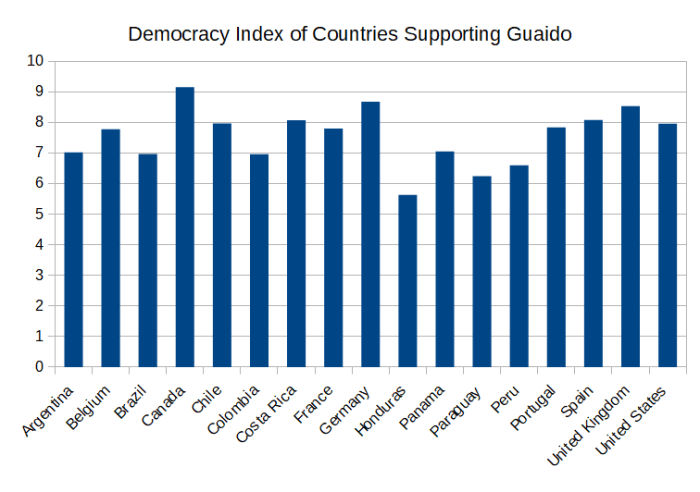
Here’s a bit of evidence that this is indeed what’s happening: the countries that support Guaido are a lot more democratic than the countries that support Maduro.

Guaido has already been recognized by most of Europe and Latin America, including Argentina, Brazil, Chile, Colombia, Costa Rica, Guatemala, Honduras, Panama, Paraguay, and Peru. Among those supporting Maduro are China, Russia, Iran, and Turkey—not exactly bastions of liberal democracy. Within Latin America, only Bolivia, Cuba, Mexico, and Uruguay support Maduro. Of those, only Mexico and Uruguay are recognizably democratic.

The average Democracy Index of countries that support Guaido is 7.5, which would be a “flawed democracy”. The average Democracy Index of countries that support Maduro is only 4.4, a “hybrid regime”.

Here is a plot of the Democracy Index by country supporting Guaido:democracy_index_guaido

Here is a plot of the Democracy Index by country supporting Maduro:

democracy_index_maduro

Since the entire EU recognizes Guaido, I could have shown each European country separately and biased the numbers even further, but I decided to specifically stick to major European powers with explicitly stated positions on Venezuela.

And we know that Maduro was a ruthless and autocratic dictator. So this is looking an awful lot like a democratic uprising against authoritarianism. It’s hard for me to be upset about that.

Second, Venezuela was in terrible shape, and largely due to Maduro’s administration.

After Maduro was elected (we’re still not sure how legitimate that election really was), Maduro underwent a total economic meltdown. Depression, hyperinflation, famine, a resurgence of malaria, and a huge exodus of refugees all followed. Millions of people are now starving in a country that was once quite rich. Nearly 90% of the population now lives in poverty. The story of Venezuela’s economy is one of total self-destruction.

Due to the bizarre system of subsidies and price controls in place, oil is now 100 times cheaper in Venezuela than water. Venezuela’s oil production has plummeted under Maduroto its lowest levels in decades, which might be good for climate change but is very bad for a country so dependent upon oil export revenue. It’s pretty much a classic cautionary tale for the Resource Curse.

Maduro, like any good socialist dictator, has blamed US sanctions for all his country’s economic failings. But there have not been strict US sanctions against Venezuela, and we remain their chief purchaser of oil by a wide margin. If you’ve ever bought gasoline at a Citgo station, you have paid for Venezuelan oil. Moreover, if your socialist country is that heavily dependent on exporting to capitalist countries… that really doesn’t say much in favor of socialism as an economic system, does it?

I don’t know what will happen. Maybe Maduro will successfully regain power. Maybe Guaido will retain control but turn out to be just as bad (there’s a long track record of coups against awful dictators resulting in equally awful dictators—Idi Amin is a classic example). Maybe Trump will do something stupid or crazy and we’ll end up in yet another decades-long military quagmire.

But there’s also a chance of something much better: Maybe Guaido can actually maintain power and build a genuinely democratic regime in Venezuela, and turn their economy back from the brink of devastation toward more sustainable growth. When the devil you know is this bad, sometimes you really do want to bet on the devil you don’t.

I don’t care what happened in that video

Jan 27 JDN 2458511

Right now there is an ongoing controversy over a viral video of a confrontation between young protesters wearing MAGA hats and an elderly Native American man. Various sources are purporting to show “a fuller picture” and “casting new light” and showing “a different side”. Others are saying it’s exactly as bad as it looks.

I think it probably is as bad as it looks, but the truth is: I don’t care. This is a distraction.

If you think litigating the precise events of this video is important, you are suffering from a severe case of scope neglect. You are looking at a single event between a handful of people when you should be looking at the overall trends of a country of over 300 million people.

First of all: The government shutdown only just ended. There are still going to be a lot of pieces to pick up. That’s what we should be talking about. That’s what we should be posting about. That’s what we should be calling Senators about. This is a national emergency. The longer this lasts, the worse it is going to get. People will die because of this shutdown—from tainted food and polluted water and denied food stamps. Our national security is being jeopardized—particularly with regard to cybersecurity.

The shutdown was also a completely unforced error. Government shutdowns shouldn’t even exist, and now that this one is over, we need to change the budget process so that this can never happen again.

And if you want to talk about the racist, sexist, and authoritarian leanings of Trump supporters, that’s quite important too. But it doesn’t hinge upon one person or one confrontation. I’m sure there are Trump supporters who aren’t racist; and I’m sure there are Obama supporters who are. But the overall statistical trend there is extremely strong.

I understand that most people suffer from severe scope neglect, and we have to live in a world filled with such people; so maybe there’s some symbolic value in finding one particularly egregious case that you can put a face on and share with the world. But if you’re going to do that, there’s two things I’d ask of you:

1. Make absolutely sure that this case is genuine. Nothing will destroy your persuasiveness faster than holding up an ambiguous case as if it were definitive.
2. After you’ve gotten their attention with the single example, show the statistics. There are truths, whole truths, and statistics. If you really want to know something, you use statistics.

The statistics are what this is really about. One person, even a hundred people—that really doesn’t matter. We need to keep our eyes on the millions of people, the directions of entire nations. For a lot of people, looking at numbers is boring; but there are people behind those numbers, and numbers are what tell us what’s really going on in the world.

For example: Trump really does seem to have brought bigotry out in the open. Hate crimes in the US increased for the third year in a row last year.

Then there are his direct policy actions which are human rights violations: The number of children detained at the border has skyrocketed to almost 13,000.

On the other hand, the economy is doing quite well: Unemployment stands at about 4%, and median income is increasing and poverty is decreasing.
Global extreme poverty continues its preciptious decline, but global climate change is getting worse, and already past the point where some serious consequences are going to be unavoidable.

Some indicators are more ambiguous: Corporate profits are near their all-time high, even in inflation-adjusted terms. That could be a sign of an overall good economy—but it also clearly has something to do with redistribution of income toward the wealthy.

Of course, all of those things were true yesterday, and will be true tomorrow. They were true last week, and will be true next week. They don’t lend themselves to a rapid-fire news cycle.

But maybe that means we don’t need a rapid-fire news cycle? Maybe that’s not the best way to understand what’s going on in the world?

Sexism in the economics profession

Jan 20 JDN 2458504

I mentioned in my previous post that the economics profession is currently coming to a reckoning with its own sexist biases. Today I’d like to get back to that in more detail.

I think I should include some kind of trigger warning here, because some of this sexism is pretty extreme. In particular, there are going to be references to anal sex, which certainly isn’t something I was expecting to find. I won’t quote anything highly explicit—but I assure you, it exists.

There is reason to believe that these biases are not as bad as they once were. If you compare the cohorts of new economics PhDs to those of the past, or to the professors who have been tenured for many years, the pattern is quite clear: The longer back you look, the fewer women (and racial minorities, and LGBT people) you see.

In part because of the #MeToo movement (which, I really would like to say, has done an excellent job of picking legitimate targets and not publicly shaming the wrong people, unlike almost every other attempt at public shaming via social media), the economics profession is also coming to terms with a related matter, which could be both cause and consequence of these gender disparities: Sexual harassment by economists of their students and junior faculty.

It wasn’t until last year that the AEA officially adopted a Code of Professional Conduct mandating equality of opportunity for women (and minorities, and LGBT people). Of course, sexual harassment has been illegal much longer than that—but it’s probably the most under-reported and under-prosecuted crime in existence. Last year’s AEA conference was the first to include panels specifically on gender and discrimination in economics, and this year’s conference had more.

Grad students have been a big part of this push; hundreds of econ grad students signed an open letter demanding that universities implement reporting and disciplinary systems to deal with sexual harassment in economics (one of the signatories is friend of mine from UCI, though strangely I don’t remember hearing about it, or I would have signed it too).

One of the most prominent economists accused of repeated sexual harassment unfortunately happens to be the youngest Black person ever to get tenured at Harvard. This would seem to create some tension between gender equality and racial equality. But of course this tension is illusory: There are plenty of other brilliant Black economists they could have hired who aren’t serial sexual harassers.

It’s still dicey for grad students and junior faculty to talk about these things, because of the very real power that senior faculty have over us as committees for dissertations, hiring, and tenure. Some economists who wrote papers about sexism in the profession have chosen to remain anonymous for fear of retaliation.

Part of how this issue has finally gotten so much attention is by concerned economists actually showing it using the methods of social science. One of the most striking studies was a data analysis of the word usage on econjobrumors.com, a job discussion board for PhD grads and junior faculty in economics. (More detail on that study here and also here.)

I’ve bolded the terms that are sexual or suggest bias. I’ve italicized the terms that suggest something involving romantic or family relationships. I’ve underlined the terms actually relevant for economics.
These were the terms most commonly associated with women:

hotter, lesbian, bb, sexism, tits, anal, marrying, feminazi, slut, hot, vagina, boobs, pregnant, pregnancy, cute, marry, levy, gorgeous, horny, crush, beautiful, secretary, dump, shopping, date, nonprofit, intentions, sexy, dated and prostitute.

These were the terms most commonly associated with men:

juicy, keys, adviser, bully, prepare, fought, wharton, austrian, fieckers, homo, genes, e7ee, mathematician, advisor, burning, pricing, fully, band, kfc, nobel, cat, amusing, greatest, textbook, goals, irritate, roof, pointing, episode, and tries.

I imagine the two lists more or less speak for themselves. I’m particularly shocked by the high prevalence of the word “anal”—the sixth-most common word used in threads involving women.

Who goes to an economics job forum and starts talking about anal sex?

I actually did a search on “anal” to see what sort of things were being discussed: This thread is apparently someone trying to decide where he should work based on “Girls of which country are easiest to get?”, so basically sex tourism as job market planning. Here’s another asking (perhaps legitimately) about the appropriate social norm for splitting vacation costs with a girlfriend, and someone down the thread recommends that in exchange for paying, he should expect her to provide him with anal sex. This one starts with a man lamenting that his girlfriend dumped him on his birthday (that’s a dick move by the way), but somehow veers off into a discussion of whether anal sex is overrated. And this one is just off the bat about frequency of sexual encounters.
So yeah, I’m really not surprised that there aren’t a lot of women on these so-called “job discussion boards”.

The only bias-related word associated with men was “homo”—so it’s actually a homophobic bias, itself indicative of sexism and a profession dominated by cisgender straight White men. I’m not entirely sure that “juicy” was intended to be sexualized (one could also speak of “juicy ideas”), but I’ll assume it was just to conservatively estimate the gender disparity.

Also of special note are “fieckers” and “e7ee”, which refer to specific users, who, despite being presumably economists, caused a great deal of damage to the discussion boards. “fieckers” was an idiosyncratic word that one user used in a variety of sexist and homophobic troll posts, while “e7ee” is the hexadecimal code for one of the former moderators, who apparently uilaterally deleted and moved threads in order to tilt the entire discussion board toward right-wing laissez-faire economics.

Of course, that one discussion board isn’t representative of the entire profession. As anyone who has ever visited 4chan knows, discussion boards can be some of the darkest places on the Internet.

Clearer evidence of discrimination where it counts can be found in citation studies, which have found that papers published by women in top economics journals are more highly cited than papers published by men in the same journals.

What does that mean? Well, it’s the same reason that female stock brokers outperform male brokers and firms with more female executives are more profitable. Women are held to a higher standard than men, so in order to simply get in, women have to be more competent and produce higher-quality output.

Admittedly, citation count is far from a perfect measure of research quality (and for that matter profit is far from a perfect measure of a well-run corporation). But this is very clear evidence of actual discrimination. Not innate differences in preferences, not differences in talent—actual discrimination. It’s less clear where and how the discrimination is happening. Are journals simply not accepting good papers if they see female authors? (This is possible, because most top journals in economics don’t use double-blind peer review anymore—for quite flimsy reasons, in my opinion). Are there not enough mentors for women in academia? Are women moving to more accepting fields before they even enter grad school? Are they being pushed out by harassment as grad students? Likely all of these are part of the story.

There’s reason to think that economic ideology has contributed to this problem. If you think of the world in neoclassical laissez-faire terms, where markets are perfect and always lead to the best outcome, then you are likely to be blind to bias and discrimination, because a perfect market would obviously eliminate such things. This is why the recognition of bias has largely come from empirical studies of labor markets, and to a lesser extent from experiments and more left-wing theorists. If you assert that markets are perfectly efficient, labor economists are likely to laugh in your face, while a surprising number of macro theorists will nod and ask you to continue.

Interestingly, recent field experiments on bias in hiring of new faculty did not find any bias against women in economics (and found biases toward women in several other fields). Of course, that doesn’t mean there never was such bias; but perhaps we’ve actually managed to remove it. So that’s one major avenue of discrimination we maybe finally have under control. Only several dozen left to go?

My first AEA conference

Jan 13 JDN 2458497

The last couple of weeks have been a bit of a whirlwind for me. I submitted a grant proposal, I have another, much more complicated proposal due next week, I submitted a paper to a journal, and somewhere in there I went to the AEA conference for the first time.

Going to the conference made it quite clear that the race and gender disparities in economics are quite real: The vast majority of the attendees were middle-aged White males, all wearing one of either two outfits: Sportcoat and khakis, or suit and tie. (And almost all of the suits were grey or black and almost all of the shirts were white or pastel. Had you photographed in greyscale you’d only notice because the hotel carpets looked wrong.) In an upcoming post I’ll go into more detail about this problem, what seems to be causing it, and what might be done to fix it.

But for now I just want to talk about the conference itself, and moreover, the idea of having conferences—is this really the best way to organize ourselves as a profession?

One thing I really do like about the AEA conference is actually something that separates it from other professions: The job market for economics PhDs is a very formalized matching system designed to be efficient and minimize opportunities for bias. It should be a model for other job markets. All the interviews are conducted in rapid succession, at the conference itself, so that candidates can interview for positions all over the country or even abroad.

I wasn’t on the job market yet, but I will be in a few years. I wanted to see what it’s like before I have to run that gauntlet myself.

But then again, why did we need face-to-face interviews at all? What do they actually tell us?

It honestly seems like a face-to-face interview is optimized to maximize opportunities for discrimination. Do you know them personally? Nepotism opportunity. Are they male or female? Sexism opportunity. Are they in good health? Ableism opportunity. Do they seem gay, or mention a same-sex partner? Homophobia opportunity. Is their gender expression normative? Transphobia opportunity. How old are they? Ageism opportunity. Are they White? Racism opportunity. Do they have an accent? Nationalism opportunity. Do they wear fancy clothes? Classism opportunity. There are other forms of bias we don’t even have simple names for: Do they look pregnant? Do they wear a wedding band? Are they physically attractive? Are they tall?

You can construct your resume review system to not include any of this information, by excluding names, pictures, and personal information. But you literally can’t exclude all of this information from a face-to-face interview, and this is the only hiring mechanism that suffers from this fundamental flaw.

If it were really about proving your ability to do the job, they could send you a take-home exam (a lot of tech companies actually do this): Here’s a small sample project similar to what we want you to do, and a reasonable deadline in which to do it. Do it, and we’ll see if it’s good enough.

If they want to offer an opportunity for you to ask or answer specific questions, that could be done via text chat—which could be on the one hand end-to-end encrypted against eavesdropping and on the other hand leave a clear paper trail in case they try to ask you anything they shouldn’t. If they start asking about your sexual interests in the digital interview, you don’t just feel awkward and wonder if you should take the job: You have something to show in court.

Even if they’re interested in things like your social skills and presentation style, those aren’t measured well by interviews anyway. And they probably shouldn’t even be as relevant to hiring as they are.

With that in mind, maybe bringing all the PhD graduates in economics in the entire United States into one hotel for three days isn’t actually necessary. Maybe all these face-to-face interviews aren’t actually all that great, because their small potential benefits are outweighed by their enormous potential biases.

The rest of the conference is more like other academic conferences, which seems even less useful.

The conference format seems like a strange sort of formality, a ritual that we go through. It’s clearly not the optimal way to present ongoing research—though perhaps it’s better than publishing papers in journals, which is our current gold standard. A whole bunch of different people give you brief, superficial presentations of their research, which may be only tangentially related to anything you’re interested in, and you barely even have time to think about it before they go on to the next once. Also, seven of these sessions are going on simultaneously, so unless you have a Time Turner, you have to choose which one to go to. And they are often changed at the last minute, so you may not even end up going to the one you thought you were going to.

I was really struck by how little experimental work was presented. I was under the impression that experimental economics was catching on, but despite specifically trying to go to experiment-related sessions (excluding the 8:00 AM session for migraine reasons), I only counted a handful of experiments, most of them in the field rather than the lab. There was a huge amount of theory and applied econometrics. I guess this isn’t too surprising, as those are the two main kinds of research that only cost a researcher’s time. I guess in some sense this is good news for me: It means I don’t have as much competition as I thought.

Instead of gathering papers into sessions where five different people present vaguely-related papers in far too little time, we could use working papers, or better yet a more sophisticated online forum where research could be discussed in real-time before it even gets written into a paper. We could post results as soon as we get them, and instead of conducting one high-stakes anonymous peer review at the time of publication, conduct dozens of little low-stakes peer reviews as the research is ongoing. Discussants could be turned into collaborators.

The most valuable parts of conferences always seem to be the parts that aren’t official sessions: Luncheons, receptions, mixers. There you get to meet other people in the field. And this can be valuable, to be sure. But I fear that the individual gain is far larger than the social gain: Most of the real benefits of networking get dissipated by the competition to be better-connected than the other candidates. The kind of working relationships that seem to be genuinely valuable are the kind formed by working at the same school for several years, not the kind that can be forged by meeting once at a conference reception.

I guess every relationship has to start somewhere, and perhaps more collaborations have started that way than I realize. But it’s also worth asking: Should we really be putting so much weight on relationships? Is that the best way to organize an academic discipline?

“It’s not what you know, it’s who you know” is an accurate adage in many professions, but it seems like research should be where we would want it least to apply. This is supposed to be about advancing human knowledge, not making friends—and certainly not maintaining the old boys’ club.

Government shutdowns are pure waste

Jan 6 JDN 2458490
At the time of writing, the US federal government is still shut down.

The US government has been shut down in this way 22 times—all of them since 1976. Most countries don’t do this. The US didn’t do it for most of our history. Please keep that in mind: This was an entirely avoidable outcome that most countries never go through.

The consequences of a government shutdown are pure waste on an enormous scale. Most government employees get furloughed without pay, which means they miss their credit card and mortgage payments while they wait for their back pay after the shutdown ends. (And this one happened during Christmas!) Contractors have it even worse: They get their contracts terminated and may never see the money they were promised. This has effects on our whole economy; the 2013 shutdown removed a full $24 billion from the US economy, and the current shutdown is expected to drain $6 billion per week. The government itself is taking losses of about $1 billion per week, mostly in the form of unpaid and unaudited taxes.

I personally don’t know what’s going to happen to an NSF grant proposal I’ve been writing for several weeks: Almost the entire NSF has been furloughed as “non-essential” (most of the military remains operative; almost all basic science gets completely shut down—insert comment about the military-industrial complex here), and in 2013 some of the dissertation grants were outright canceled because of the shutdown.

Why do these shutdowns happen?

A government shutdown occurs when the omnibus appropriations bill fails to pass. This bill is essentially the entire US federal budget in a single bill; like any other bill, it has to be passed by both houses of Congress and signed by the President.

For some reason, our government decided that if this process doesn’t happen on schedule, the correct answer is to shut down all non-essential government services. This is a frankly idiotic answer. The obviously correct solution is that if Congress and the President can’t agree on a new budget, the old budget gets renewed in its entirety with a standard COLA inflation adjustment. This really seems incredibly basic: If the government can’t agree on how to change something, the status quo should remain in effect until they do. And the status quo is an inflation-adjusted version of the existing budget.

This particular shutdown occurred because of Donald Trump’s brinksmanship on the border wall: He demanded at least $5 billion, and the House wouldn’t give it to him.

It won’t be much longer before we’ve already lost more money on the shutdown than that $5 billion; this may tempt you to say that the House should give in. But the wall won’t actually do anything to make our nation safer or better, and building it would displace thousands of people by eminent domain and send an unquestionable signal of xenophobia to the rest of the world. Frankly it sickens me that there were not enough principled Republicans to stand their ground against Trump’s madness; but at least there are now Democrats standing theirs.

Make no mistake: This is Trump’s shutdown, and he said so himself. The House even offered to do what should be done by default, which is renew the old budget while negotiations on the border wall continue—Trump refused this offer. And Trump keeps changing his story with every new tweet.

But the real problem is that this is even something the President is allowed to do. Vetoing the old budget should restore the old budget, not furlough hundreds of thousands of workers and undermine government services. This is a ludicrous way to organize a government, and seems practically designed to make our government as inefficient, wasteful, and hated as possible. This was an absolutely unforced error and we should be enacting policy rules that would prevent it from ever happening again.

The best thing we can do to help them is let them in


Dec 23 JDN 2458476

This is a Christmas post, but not like most of my other Christmas posts. It’s not going to be an upbeat post about the effects of holidays on the economy, or the psychology of gift-giving, or the game theory that underlies the whole concept of a “holiday”.

No, today is about an urgent moral crisis. This post isn’t about Christmas as a weird but delightful syncretic solstice celebration. This post is about the so-called “spirit of Christmas”, a spirit of compassion and generosity that our country is clearly not living up to.

At the time of writing, the story had just come out: Jakelin Maquin, a 7-year-old girl from Guatemala died in the custody of US border agents.

Even if it’s true that the Border Patrol did everything they could to help her once they found out she was dying (and the reports coming out suggest that this is in fact the case), this death was still entirely preventable.

The first question we should ask is very basic: Why are there little girls in custody of border agents?
The next question is even more fundamental than that: Why are there border agents?

There are now 15,000 children being held by US Border Patrol. There should not be even one. The very concept of imprisoning children for crossing the border, under any circumstances, is a human rights violation. And yes, this is new, and it is specific to Donald Trump: Bush and Obama never separated children from their families this way. And while two-thirds of Americans oppose this policy, a majority of Republicans support it—this child’s blood is on their hands too.

Yet despite the gulf between the two major parties, the majority of Americans do support the idea of restricting immigration in general. And what I want to know is: Why? What gives us that right?

Let’s be absolutely clear about what “restricting immigration” means. It means that when someone decides they want to come to our country, either to escape oppression, work toward a better life, or simply to live with their family who came here before, men with guns come and lock them up.

We don’t politely ask them to leave. We don’t even fine them or tax them for entering. We lock them in detention camps, or force them to return to the country they came from which may be ruled by a dictator or a drug cartel.

Honestly, even the level of border security US citizens are subjected to is appalling: We’ve somehow come to think of it as normal that whenever you get on an airplane, you are first run through a body scanner, while all your belongings are inspected and scanned, and if you are found carrying any contraband—or if you even say the wrong thing—you can be summarily detained. This is literally Orwellian. “Papers, please” is the refrain of a tyrannical regime, not a liberal democracy.

If we truly believe in the spirit of compassion and generosity, we must let these people in. We don’t even have to do anything; we just need to stop violently resisting them. Stop pointing guns at them, stop locking them away. How is “Stop pointing guns at children” controversial?

I could write an entire post about the benefits for Americans of more open immigration. But honestly, we shouldn’t even care. It doesn’t matter whether immigration creates jobs, or destroys jobs, or decreases crime, or increases crime. We should not be locking up children in camps.

If we really believe in the spirit of compassion and generosity, the only thing we should care about is whether immigration is good for the immigrants. And it obviously is, or they wouldn’t be willing to go to such lengths to accomplish it. But I don’t think most people realize just how large the benefits of immigration are.

I’m going to focus on Guatemala, because that’s where Jakelin Maqin was from.

Guatemala’s life expectancy at birth is 73 years. The life expectancy for recent Hispanic immigrants to the US is 82 years. Crossing that border can give you nine years of life.

And what about income? GDP per capita PPP in the US is almost $60,000 per year. In Guatemala? Just over $8,000. Of course, that’s not accounting for the fact that Guatemalans are less educated; but even the exact same worker emigrating from there to here can greatly increase their income. The minimum wage in Guatemala is 90 GTQ per day, which is about $11.64. For a typical 8-hour workday, the US minimum wage of $7.25 per hour comes to $58 per day. That same exact worker can quintuple their income just by getting a job on the other side of the border.

Almost 60 percent of Guatemalans live in poverty. Over 20% live below the UN extreme poverty line. A full 11% of Guatemala’s GDP is remittances: Money that immigrants pay to help their families back home. A further 7% is exports to the US. This means that almost a fifth of Guatemala’s economy is dependent on the United States.

For comparison, less than 0.5% of Americans live in extreme poverty. (The UN recently claimed almost 6%; the Trump administration has claimed only 0.1% which is even more dubious. Both methodologies are deeply flawed; in particular, the UN report looks at income, not consumption—and consumption is what matters.) The overall poverty rate in the US is about 12%.

These figures are still appallingly high for a country as rich as the US; our extreme poverty rate should be strictly zero, a policy decision which could be implemented immediately and permanently in the form of a basic income of $700 per person per year, at a total expenditure of only $224 billion per year—about a third of the military budget. The net cost would in fact be far smaller than that, because we’d immediately turn around and spend that money. In fact, had this been done at the trough of the Great Recession, it would almost certainly have saved the government money.

Making our overall poverty rate strictly zero would be more challenging, but not obviously infeasible; since the poverty line is about $12,000 per person per year, it would take a basic income of that much to eliminate poverty, which would cost about $3.8 trillion per year. This is a huge expenditure, comparable as a proportion of GDP to the First World War (though still less than the Second). On the other hand, it would end poverty in America immediately and forever.

But even as things currently stand, the contrast between Guatemala and the US could hardly be starker: Immigrants are moving from a country with 60% poverty and 20% extreme poverty to one with 12% poverty and 0.5% extreme poverty.

Guatemala is a particularly extreme example; things are not as bad in Mexico or Cuba, for example. But the general pattern is a very consistent one: Immigrants come to the United States because things are very bad where they come from and their chances of living a better life here are much higher.

The best way to help these people, at Christmas and all year round, literally couldn’t be easier:

Let them in.

Halloween is kind of a weird holiday.

Oct 28 JDN 2458420

I suppose most holidays are weird if you look at them from an outside perspective; but I think Halloween especially so, because we don’t even seem to be clear about what we’re celebrating at this point.

Christmas is ostensibly about the anniversary of the birth of Jesus; New Year’s is about the completion of the year; Thanksgiving is about the founding of the United States and being thankful for what we have; Independence Day is about declaring independence from Great Britain.

But what’s Halloween about, again? Why do we have our children dress up in costumes and go beg candy from our neighbors?

The name comes originally from “All Hallow’s Eve”, the beginning of the three-day Christian holiday Allhallowtide of rememberance for the dead, which has merged in most Latin American countries with the traditional holiday Dia de los Muertos. But most Americans don’t actually celebrate the rest of Allhallowtide; we just do the candy and costume thing on Halloween.

The parts involving costumes and pumpkins actually seem to be drawn from Celtic folk traditions celebrating the ending of harvest season and the coming of the winter months. It’s celebrated so early because, well, in Ireland and Scotland it gets dark and cold pretty early in the year.

One tradition I sort of wish we’d kept from the Celtic festival is that of pouring molten lead into water to watch it rapidly solidify. Those guys really knew how to have a good time. It may have originated as a form of molybdomancy, which I officially declare the word of the day. Fortunately by the power of YouTube, we too can enjoy the excitement of molten lead without the usual fear of third-degree burns. The only divination ritual that we kept as a Halloween activity is the far tamer apple-bobbing.

The trick-or-treating part and especially the costume part originated in the Medieval performance art of mumming, which is also related to the modern concept of mime. Basically, these were traveling performance troupes who went around dressed up as mythological figures, did battle silently, and then bowed and passed their hats around for money. It’s like busking, basically.

The costumes were originally religious or mythological figures, then became supernatural creatures more generally, and nowadays the most popular costumes tend to be superheroes. And since apparently we didn’t want people giving out money to our children, we went for candy instead. Yet I’m sure you could write a really convincing economics paper about why candy is way less efficient, making both the parents giving, the child receiving, and the parents of the child receiving less happy than the same amount of money would (and unlike the similar argument against Christmas presents, I’m actually sort of inclined to agree; it’s not a personal gesture, and what in the world do you need with all that candy?).

So apparently we’re celebrating the end of the harvest, and also mourning the dead, and also being mimes, and also emulating pagan divination rituals, but mainly we’re dressed up like superheroes and begging for candy? Like I said, it’s kind of a weird holiday.

But maybe none of that ultimately matters. The joy of holidays isn’t really in following some ancient ritual whose religious significance is now lost on us; it’s in the togetherness we feel when we manage to all coordinate our activities and do something joyful and out of the ordinary that we don’t have to do by ourselves. I think deep down we all sort of wish we could dress up as superheroes more of the time, but society frowns upon that sort of behavior most of the year; this is our one chance to do it, so we’ll take the chance when we get it.

How to respond to dog whistles

Oct 21 JDN 2458413

Political messaging has grown extremely sophisticated. The dog whistle technique is particularly powerful one: it allows you to say the same thing to two different groups and have them each hear what they wanted to hear. The term comes from the gadget used in training canines, which emits sounds at a frequency which humans can’t hear but dogs can. Similar concepts have been around for a long time, but the word wasn’t used for this specific meaning until the 1990s.

There was once a time when politicians could literally say different things to different groups, but mass media has made that effectively impossible. When Mitt Romney tried to do this, it destroyed his (already weak) campaign. So instead they find ways to convey two different meanings, while saying the same words.

Classic examples of this include “law and order” and “states’ rights”, which have always carried hidden racist connotations, yet on their face sound perfectly reasonable. “Family values” is another one.

Trump is particularly inelegant at this; his dog whistles often seem to drop into the audible frequency range, as when he called undocumented immigrants (or possibly gang members?) “animals” and tweeted about “caravans” of immigrants, and above all when he said “they’re bringing drugs, they’re bringing crime, they’re rapists”. (Frankly, does that even count as a dog whistle?) He’s a little less obvious in his deployment of “globalist” as a probable anti-Semitic slur.

How should we respond to this kind of coded language?

It’s not as simple as you might think. It’s not always easy to tell what is a dog whistle. Someone talking about crime could be trying to insinuate something about minorities… or, they could just be talking about crime. Someone complaining about immigration could be trying to dehumanize immigrants… or, they could just want a change in our border policy. Accusations of “globalism” could be coded anti-Semitism… or they could just be nationalism.
It’s also easy to accuse someone of using dog whistles even if they probably aren’t: It is now commonplace for the right wing to argue that “common-sense gun control” means confiscating all handguns (when it in fact means universal background checks, mandatory safety classes, and perhaps assault weapon bans and magazine limits, all of which are quite popular even among gun owners), or to argue that “safe, legal, and rare” is just a Trojan horse for unrestricted free abortion (when in fact “safe, legal, and rare” is the overwhelming majority view among Americans). Indeed, it’s quite probable that many of the things that the left wing has taken as dog whistles by Trump were actually overreactions—Trump is bigoted, but not especially so by the standards of old White Republican men. The best reasons to want Trump out of office involve his authoritarianism, his corruption, and his incompetence, not his bigotry. Foreign policy and climate change should be issues that overwhelm basically everything else—these are millions of lives on the line—and they are the two issues that Trump gets most decisively wrong.

The fact that it can be difficult to tell which statements are dog-whistles is not a bug but a feature: It provides plausible deniability.

If you can structure your speech so that it will be heard by your base as supporting a strong ideological platform, but when the words are analyzed they will be innocuous enough that no one can directly prove your extremism, you can have your cake and eat it too. Even if journalists go on to point out the dog whistles in your speech, moderates on your side of the fence might not hear the same dog whistles, and then just become convinced that the journalists are overreacting. And they might even be overreacting.

Instead, I think there are two things we need to do, which are distinct but complementary.’

1. Ask for clarification.

Whether you are in a personal conversation with a friend who is spouting talking points, or a journalist interviewing a politician running for office, there will come opportunities where you can directly respond to a potential dog whistle.
Do not accuse them of using a dog whistle—even if you are confident that they are. That will only make them defensive, and make you appear to be the aggressor. Instead, ask them firmly, but calmly:

What exactly do you mean by that statement?”

If they ignore the question or try to evade it, ask again, a little more firmly. If they evade again, ask again. Keep asking until they answer you or literally force you to shut up. Be confident, but calm and poised. Now they look like the aggressor—and above all, they sound like they have something to hide.

Note also that if it turns out not to be a dog whistle, they will likely not be offended by your request and will have a perfectly reasonable clarification. For example:

“What did you mean when you said you’re worried about Muslim immigrants?”

“Well, I mean that Muslim societies often have very regressive norms surrounding gender and LGBT rights, and many Muslim immigrants have difficulty assimilating into our liberal values. I think we need to spend more effort finding ways to integrate Muslims into our community and disabuse them of harmful cultural norms.”

“What did you mean when you said you are worried about law and order?”

“I mean that gang violence in several of our inner cities is really out of control, and we need to be working on both investing more in policing and finding better methods of crime prevention in order to keep these communities safe.”

“What ‘states’ rights’ are you particularly concerned about, Senator?”

“I don’t like that the federal government thinks it can impose laws against marijuana based on an absurdly broad reading of the Interstate Commerce Clause. I don’t think it’s right that legitimate businesses in California and Colorado have to operate entirely in cash because federal regulations won’t let them put their money into banks without fear of having it confiscated.”

You may even find that you still disagree with the clarified statement, but hopefully it can be a reasonable disagreement, rather than a direct conflict over fundamental values.

2. State your own positive case.

This is one you can probably do even if you don’t actually get the opportunity to engage directly with people on the other side.

I was actually surprised to learn this, but apparently the empirical data shows that including messages of social justice in your political platform makes it more popular, even among moderates.
This means that we don’t have to respond to innuendo with innuendo—we can come out and say that we think a given policy is bad because it will hurt women or Black people. Economic populism is good too, but we don’t need to rely entirely upon that.

To be clear, we should not say that the policy is designed to hurt women or Black people—even if we think that is likely to be true—for at least two reasons: First, we can’t actually prove that, except in very rare cases, so it makes our argument inherently more tendentious; and second, it makes our whole mode of argumentation more aggressive and less charitable. We should always at least consider the possibility that our opponent’s intentions are noble, and unless the facts utterly force us to abandon that view it should probably be our working assumption.

This means that we don’t even necessarily have to come out and challenge dog whistles. We just need to make a better positive case ourselves. While they are making vague, ambiguous claims about “cleaning up our cities” and “making America great”, we can lay out explicit policy plans for reducing unemployment, poverty, and carbon emissions.

Hillary Clinton almost did this—but she didn’t do it well enough. She relied too heavily on constituents being willing to read detailed plans on her website, instead of summarizing them in concise, pithy talking points to put in headlines. Her line Because we’re going to put a lot of coal miners and coal companies out of business, right?” was indeed taken out of contextbut she should have pushed harder by making an actual slogan, like “End coal burning—save coal communities.” (I literally came up with that in five minutes. She had hundreds of professional campaign staff working for her and they couldn’t do better?) The media did butcher her statements—but she didn’t correct them by putting slogans on yard signs or giving stump speeches in Appalachia.

Indeed, the news media didn’t do her any favors—they spent literally more time talking about her emails than every actual policy issued combined, and not by a small margin. But we can’t rely on the news media—and we don’t have to, in the age of blogs and social media. Instead of assuming that everyone already agrees with us and we will win because we deserve to, we need to be doing what actually works at conveying our message and making sure that we win by the largest margin possible.

What really works against bigotry

Sep 30 JDN 2458392

With Donald Trump in office, I think we all need to be thinking carefully about what got us to this point, how we have apparently failed in our response to bigotry. It’s good to see that Kavanaugh’s nomination vote has been delayed pending investigations, but we can’t hope to rely on individual criminal accusations to derail every potentially catastrophic candidate. The damage that someone like Kavanaugh would do to the rights of women, racial minorities, and LGBT people is too severe to risk. We need to attack this problem at its roots: Why are there so many bigoted leaders, and so many bigoted voters willing to vote for them?

The problem is hardly limited to the United States; we are witnessing a global crisis of far-right ideology, as even the UN has publicly recognized.

I think the left made a very dangerous wrong turn with the notion of “call-out culture”. There is now empirical data to support me on this. Publicly calling people racist doesn’t make them less racist—in fact, it usually makes them more racist. Angrily denouncing people doesn’t change their minds—it just makes you feel righteous. Our own accusatory, divisive rhetoric is part of the problem: By accusing anyone who even slightly deviates from our party line (say, by opposing abortion in some circumstances, as 75% of Americans do?) of being a fascist, we slowly but surely push more people toward actual fascism.

Call-out culture encourages a black-and-white view of the world, where there are “good guys” (us) and “bad guys” (them), and our only job is to fight as hard as possible against the “bad guys”. It frees us from the pain of nuance, complexity, and self-reflection—at only the cost of giving up any hope of actually understanding the real causes or solving the problem. Bigotry is not something that “other” people have, which you, fine upstanding individual, could never suffer from. We are all Judy Hopps.

This is not to say we should do nothing—indeed, that would be just as bad if not worse. The rise of neofascism has been possible largely because so many people did nothing. Knowing that there is bigotry in all of us shouldn’t stop us from recognizing that some people are far worse than others, or paralyze us against constructively improving ourselves and our society. See the shades of gray without succumbing to the Fallacy of Gray.

The most effective interventions at reducing bigotry are done in early childhood; obviously, it’s far too late for that when it comes to people like Trump and Kavanaugh.

But there are interventions that can work at reducing bigotry among adults. We need to first understand where the bigotry comes from—and it doesn’t always come from the same source. We need to be willing to look carefully—yes, even sympathetically—at people with bigoted views so that we can understand them.

There are deep, innate systems in the human brain that make bigotry come naturally to us. Even people on the left who devote their lives to combating discrimination against women, racial minorities and LGBT people can still harbor bigoted attitudes toward other groups—such as rural people or Republicans. If you think that all Republicans are necessarily racist, that’s not a serious understanding of what motivates Republicans—that’s just bigotry on your part. Trump is racist. Pence is racist. One could argue that voting for them constitutes, in itself, a racist act. But that does not mean that every single Republican voter is fundamentally and irredeemably racist.

It’s also important to have conversations face-to-face. I must admit that I am personally terrible at this; despite training myself extensively in etiquette and public speaking to the point where most people perceive me as charismatic, even charming, deep down I am still a strong introvert. I dislike talking in person, and dread talking over the phone. I would much prefer to communicate entirely in written electronic communication—but the data is quite clear on this: Face-to-face conversations work better at changing people’s minds. It may be awkward and uncomfortable, but by being there in person, you limit their ability to ignore you or dismiss you; you aren’t a tweet from the void, but an actual person, sitting there in front of them.

Speak with friends and family members. This, I know, can be especially awkward and painful. In the last few years I have lost connections with friends who were once quite close to me as a result of difficult political conversations. But we must speak up, for silence becomes complicity. And speaking up really can work.

Don’t expect people to change their entire worldview overnight. Focus on small, concrete policy ideas. Don’t ask them to change who they are; ask them to change what they believe. Ask them to justify and explain their beliefs—and really listen to them when they do. Be open to the possibility that you, too might be wrong about something.

If they say “We should deport all illegal immigrants!”, point out that whenever we try this, a lot of fields go unharvested for lack of workers, and ask them why they are so concerned about illegal immigrants. If they say “Illegal immigrants come here and commit crimes!” point them to the statistical data showing that illegal immigrants actually commit fewer crimes on average than native-born citizens (probably because they are more afraid of what happens if they get caught).

If they are concerned about Muslim immigrants influencing our culture in harmful ways, first, acknowledge that there are legitimate concerns about Islamic cultural values (particularly toward women and LGBT people)but then point out that over 90% of Muslim-Americans are proud to be American, and that welcoming people is much more effective at getting them to assimilate into our culture than keeping them out and treating them as outsiders.

If they are concerned about “White people getting outnumbered”, first point out that White people are still over 70% of the US population, and in most rural areas there are only a tiny fraction of non-White people. Point out that Census projections showing the US will be majority non-White by 2045 are based on naively extrapolating current trends, and we really have no idea what the world will look like almost 30 years from now. Next, ask them why they worry about being “outnumbered”; get them to consider that perhaps racial demographics don’t have to be a matter of zero-sum conflict.

After you’ve done this, you will feel frustrated and exhausted, and the relationship between you and the person you’re trying to convince will be strained. You will probably feel like you have accomplished absolutely nothing to change their mind—but you are wrong. Even if they don’t acknowledge any change in their beliefs, the mere fact that you sat down and asked them to justify what they believe, and presented calm, reasonable, cogent arguments against those beliefs will have an effect. It will be a small effect, difficult for you to observe in that moment. But it will still be an effect.

Think about the last time you changed your mind about something important. (I hope you can remember such a time; none of us were born being right about everything!) Did it happen all at once? Was there just one, single knock-down argument that convinced you? Probably not. (On some mathematical and scientific questions I’ve had that experience: Oh, wow, yeah, that proof totally demolishes what I believed. Well, I guess I was wrong. But most beliefs aren’t susceptible to such direct proof.) More likely, you were presented with arguments from a variety of sources over a long span of time, gradually chipping away at what you thought you knew. In the moment, you might not even have admitted that you thought any differently—even to yourself. But as the months or years went by, you believed something quite different at the end than you had at the beginning.

Your goal should be to catalyze that process in other people. Don’t take someone who is currently a frothing neo-Nazi and expect them to start marching with Black Lives Matter. Take someone who is currently a little bit uncomfortable about immigration, and calm their fears. Don’t take someone who thinks all poor people are subhuman filth and try to get them to support a basic income. Take someone who is worried about food stamps adding to our national debt, and show them how it is a small portion of our budget. Don’t take someone who thinks global warming was made up by the Chinese and try to get them to support a ban on fossil fuels. Take someone who is worried about gas prices going up as a result of carbon taxes and show them that carbon offsets would add only about $100 per person per year while saving millions of lives.

And if you’re ever on the other side, and someone has just changed your mind, even a little bit—say so. Thank them for opening your eyes. I think a big part of why we don’t spend more time trying to honestly persuade people is that so few people acknowledge us when we do.