The real Existential Risk we should be concerned about

JDN 2457458

There is a rather large subgroup within the rationalist community (loosely defined because organizing freethinkers is like herding cats) that focuses on existential risks, also called global catastrophic risks. Prominent examples include Nick Bostrom and Eliezer Yudkowsky.

Their stated goal in life is to save humanity from destruction. And when you put it that way, it sounds pretty darn important. How can you disagree with wanting to save humanity from destruction?

Well, there are actually people who do (the Voluntary Human Extinction movement), but they are profoundly silly. It should be obvious to anyone with even a basic moral compass that saving humanity from destruction is a good thing.

It’s not the goal of fighting existential risk that bothers me. It’s the approach. Specifically, they almost all seem to focus on exotic existential risks, vivid and compelling existential risks that are the stuff of great science fiction stories. In particular, they have a rather odd obsession with AI.

Maybe it’s the overlap with Singularitarians, and their inability to understand that exponentials are not arbitrarily fast; if you just keep projecting the growth in computing power as growing forever, surely eventually we’ll have a computer powerful enough to solve all the world’s problems, right? Well, yeah, I guess… if we can actually maintain the progress that long, which we almost certainly can’t, and if the problems turn out to be computationally tractable at all (the fastest possible computer that could fit inside the observable universe could not brute-force solve the game of Go, though a heuristic AI did just beat one of the world’s best players), and/or if we find really good heuristic methods of narrowing down the solution space… but that’s an awful lot of “if”s.

But AI isn’t what we need to worry about in terms of saving humanity from destruction. Nor is it asteroid impacts; NASA has been doing a good job watching for asteroids lately, and estimates the current risk of a serious impact (by which I mean something like a city-destroyer or global climate shock, not even a global killer) at around 1/10,000 per year. Alien invasion is right out; we can’t even find clear evidence of bacteria on Mars, and the skies are so empty of voices it has been called a paradox. Gamma ray bursts could kill us, and we aren’t sure about the probability of that (we think it’s small?), but much like brain aneurysms, there really isn’t a whole lot we can do to prevent them.

There is one thing that we really need to worry about destroying humanity, and one other thing that could potentially get close over a much longer timescale. The long-range threat is ecological collapse; as global climate change gets worse and the oceans become more acidic and the aquifers are drained, we could eventually reach the point where humanity cannot survive on Earth, or at least where our population collapses so severely that civilization as we know it is destroyed. This might not seem like such a threat, since we would see this coming decades or centuries in advance—but we are seeing it coming decades or centuries in advance, and yet we can’t seem to get the world’s policymakers to wake up and do something about it. So that’s clearly the second-most important existential risk.

But the most important existential risk, by far, no question, is nuclear weapons.

Nuclear weapons are the only foreseeable, preventable means by which humanity could be destroyed in the next twenty minutes.

Yes, that is approximately the time it takes an ICBM to hit its target after launch. There are almost 4,000 ICBMs currently deployed, mostly by the US and Russia. Once we include submarine-launched missiles and bombers, the total number of global nuclear weapons is over 15,000. I apologize for terrifying you by saying that these weapons could be deployed in a moment’s notice to wipe out most of human civilization within half an hour, followed by a global ecological collapse and fallout that would endanger the future of the entire human race—but it’s the truth. If you’re not terrified, you’re not paying attention.

I’ve intentionally linked the Union of Concerned Scientists as one of those sources. Now they are people who understand existential risk. They don’t talk about AI and asteroids and aliens (how alliterative). They talk about climate change and nuclear weapons.

We must stop this. We must get rid of these weapons. Next to that, literally nothing else matters.

“What if we’re conquered by tyrants?” It won’t matter. “What if there is a genocide?” It won’t matter. “What if there is a global economic collapse?” None of these things will matter, if the human race wipes itself out with nuclear weapons.

To speak like an economist for a moment, the utility of a global nuclear war must be set at negative infinity. Any detectable reduction in the probability of that event must be considered worth paying any cost to achieve. I don’t care if it costs $20 trillion and results in us being taken over by genocidal fascists—we are talking about the destruction of humanity. We can spend $20 trillion (actually the US as a whole does every 14 months!). We can survive genocidal fascists. We cannot survive nuclear war.

The good news is, we shouldn’t actually have to pay that sort of cost. All we have to do is dismantle our nuclear arsenal, and get other countries—particularly Russia—to dismantle theirs. In the long run, we will increase our wealth as our efforts are no longer wasted maintaining doomsday machines.

The main challenge is actually a matter of game theory. The surprisingly-sophisticated 1990s cartoon show the Animaniacs basically got it right when they sang: “We’d beat our swords into liverwurst / Down by the East Riverside / But no one wants to be the first!”

The thinking, anyway, is that this is basically a Prisoner’s Dilemma. If the US disarms and Russia doesn’t, Russia can destroy the US. Conversely, if Russia disarms and the US doesn’t, the US can destroy Russia. If neither disarms, we’re left where we are. Whether or not the other country disarms, you’re always better off not disarming. So neither country disarms.

But I contend that it is not, in fact, a Prisoner’s Dilemma. It could be a Stag Hunt; if that’s the case, then only multilateral disarmament makes sense, because the best outcome is if we both disarm, but the worst outcome is if we disarm and they don’t. Once we expect them to disarm, we have no temptation to renege on the deal ourselves; but if we think there’s a good chance they won’t, we might not want to either. Stag Hunts have two stable Nash equilibria; one is where both arm, the other where both disarm.

But in fact, I think it may be simply the trivial game.

There aren’t actually that many possible symmetric two-player nonzero-sum games (basically it’s a question of ordering 4 possibilities, and it’s symmetric, so 12 possible games), and one that we never talk about (because it’s sort of boring) is the trivial game: If I do the right thing and you do the right thing, we’re both better off. If you do the wrong thing and I do the right thing, I’m better off. If we both do the wrong thing, we’re both worse off. So, obviously, we both do the right thing, because we’d be idiots not to. Formally, we say that cooperation is a strictly dominant strategy. There’s no dilemma, no paradox; the self-interested strategy is the optimal strategy. (I find it kind of amusing that laissez-faire economics basically amounts to assuming that all real-world games are the trivial game.)

That is, I don’t think the US would actually benefit from nuking Russia, even if we could do so without retaliation. Likewise, I don’t think Russia would actually benefit from nuking the US. One of the things we’ve discovered—the hardest way possible—through human history is that working together is often better for everyone than fighting. Russia could nuke NATO, and thereby destroy all of their largest trading partners, or they could continue trading with us. Even if they are despicable psychopaths who think nothing of committing mass murder (Putin might be, but surely there are people under his command who aren’t?), it’s simply not in Russia’s best interest to nuke the US and Europe. Likewise, it is not in our best interest to nuke them.

Nuclear war is a strange game: The only winning move is not to play.

So I say, let’s stop playing. Yes, let’s unilaterally disarm, the thing that so many policy analysts are terrified of because they’re so convinced we’re in a Prisoner’s Dilemma or a Stag Hunt. “What’s to stop them from destroying us, if we make it impossible for us to destroy them!?” I dunno, maybe basic human decency, or failing that, rationality?

Several other countries have already done this—South Africa unilaterally disarmed, and nobody nuked them. Japan refused to build nuclear weapons in the first place—and I think it says something that they’re the only people to ever have them used against them.

Our conventional military is plenty large enough to defend us against all realistic threats, and could even be repurposed to defend against nuclear threats as well, by a method I call credible targeted conventional response. Instead of building ever-larger nuclear arsenals to threaten devastation in the world’s most terrifying penis-measuring contest, you deploy covert operatives (perhaps Navy SEALS in submarines, or double agents, or these days even stealth drones) around the world, with the standing order that if they have reason to believe a country initiated a nuclear attack, they will stop at nothing to hunt down and kill the specific people responsible for that attack. Not the country they came from; not the city they live in; those specific people. If a leader is enough of a psychopath to be willing to kill 300 million people in another country, he’s probably enough of a psychopath to be willing to lose 150 million people in his own country. He likely has a secret underground bunker that would allow him to survive, at least if humanity as a whole does. So you should be threatening the one thing he does care about—himself. You make sure he knows that if he pushes that button, you’ll find that bunker, drop in from helicopters, and shoot him in the face.

The “targeted conventional response” should be clear by now—you use non-nuclear means to respond, and you target the particular leaders responsible—but let me say a bit more about the “credible” part. The threat of mutually-assured destruction is actually not a credible one. It’s not what we call in game theory a subgame perfect Nash equilibrium. If you know that Russia has launched 1500 ICBMs to destroy every city in America, you actually have no reason at all to retaliate with your own 1500 ICBMs, and the most important reason imaginable not to. Your people are dead either way; you can’t save them. You lose. The only question now is whether you risk taking the rest of humanity down with you. If you have even the most basic human decency, you will not push that button. You will not “retaliate” in useless vengeance that could wipe out human civilization. Thus, your threat is a bluff—it is not credible.

But if your response is targeted and conventional, it suddenly becomes credible. It’s exactly reversed; you now have every reason to retaliate, and no reason not to. Your covert operation teams aren’t being asked to destroy humanity; they’re being tasked with finding and executing the greatest mass murderer in history. They don’t have some horrific moral dilemma to resolve; they have the opportunity to become the world’s greatest heroes. Indeed, they’d very likely have the whole world (or what’s left of it) on their side; even the population of the attacking country would rise up in revolt and the double agents could use the revolt as cover. Now you have no reason to even hesitate; your threat is completely credible. The only question is whether you can actually pull it off, and if we committed the full resources of the United States military to preparing for this possibility, I see no reason to doubt that we could. If a US President can be assassinated by a lone maniac (and yes, that is actually what happened), then the world’s finest covert operations teams can assassinate whatever leader pushed that button.

This is a policy that works both unilaterally and multilaterally. We could even assemble an international coalition—perhaps make the UN “peacekeepers” put their money where their mouth is and train the finest special operatives in the history of the world tasked with actually keeping the peace.

Let’s not wait for someone else to save humanity from destruction. Let’s be the first.
Will robots take our jobs?

JDN 2457451
I briefly discussed this topic before, but I thought it deserved a little more depth. Also, the SF author in me really likes writing this sort of post where I get to speculate about futures that are utopian, dystopian, or (most likely) somewhere in between.

The fear is quite widespread, but how realistic is it? Will robots in fact take all our jobs?

Most economists do not think so. Robert Solow famously quipped, “You can see the computer age everywhere but in the productivity statistics.” (It never quite seemed to occur to him that this might be a flaw in the way we measure productivity statistics.)

By the usual measure of labor productivity, robots do not appear to have had a large impact. Indeed, their impact appears to have been smaller than almost any other major technological innovation.

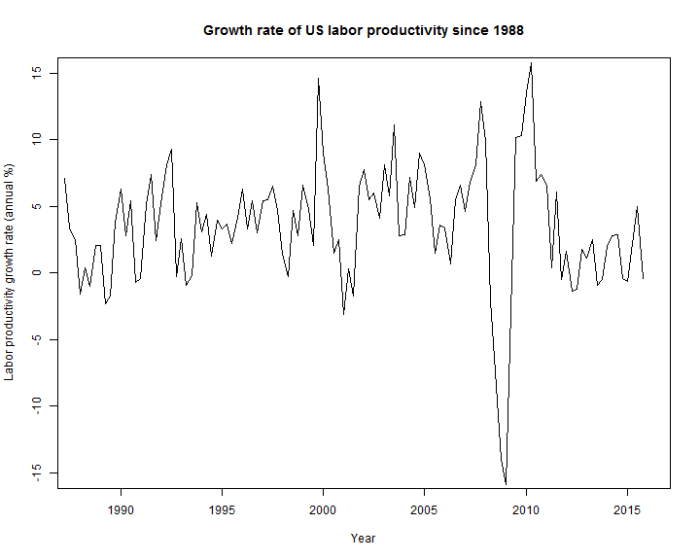
Using BLS data (which was formatted badly and thus a pain to clean, by the way—albeit not as bad as the World Bank data I used on my master’s thesis, which was awful), I made this graph of the growth rate of labor productivity as usually measured:

Productivity_growth

The fluctuations are really jagged due to measurement errors, so I also made an annually smoothed version:

Productivity_growth_smooth

Based on this standard measure, productivity has grown more or less steadily during my lifetime, fluctuating with the business cycle around a value of about 3.5% per year (3.4 log points). If anything, the growth rate seems to be slowing down; in recent years it’s been around 1.5% (1.5 lp).

This was clearly the time during which robots became ubiquitous—autonomous robots did not emerge until the 1970s and 1980s, and robots became widespread in factories in the 1980s. Then there’s the fact that computing power has been doubling every 1.5 years during this period, which is an annual growth rate of 59% (46 lp). So why hasn’t productivity grown at anywhere near that rate?

I think the main problem is that we’re measuring productivity all wrong. We measure it in terms of money instead of in terms of services. Yes, we try to correct for inflation; but we fail to account for the fact that computers have allowed us to perform literally billions of services every day that could not have been performed without them. You can’t adjust that away by plugging into the CPI or the GDP deflator.

Think about it: Your computer provides you the services of all the following:

  1. A decent typesetter and layout artist
  2. A truly spectacular computer (remember, that used to be a profession!)
  3. A highly skilled statistician (who takes no initiative—you must tell her what calculations to do)
  4. A painting studio
  5. A photographer
  6. A video camera operator
  7. A professional orchestra of the highest quality
  8. A decent audio recording studio
  9. Thousands of books, articles, and textbooks
  10. Ideal seats at every sports stadium in the world

And that’s not even counting things like social media and video games that can’t even be readily compared to services that were provided before computers.

If you added up the value of all of those jobs, the amount you would have had to pay in order to hire all those people to do all those things for you before computers existed, your computer easily provides you with at least $1 million in professional services every year. Put another way, your computer has taken jobs that would have provided $1 million in wages. You do the work of a hundred people with the help of your computer.

This isn’t counted in our productivity statistics precisely because it’s so efficient. If we still had to pay that much for all these services, it would be included in our GDP and then our GDP per worker would properly reflect all this work that is getting done. But then… whom would we be paying? And how would we have enough to pay that? Capitalism isn’t actually set up to handle this sort of dramatic increase in productivity—no system is, really—and thus the market price for work has almost no real relation to the productive capacity of the technology that makes that work possible.

Instead it has to do with scarcity of work—if you are the only one in the world who can do something (e.g. write Harry Potter books), you can make an awful lot of money doing that thing, while something that is far more important but can be done by almost anyone (e.g. feed babies) will pay nothing or next to nothing. At best we could say it has to do with marginal productivity, but marginal in the sense of your additional contribution over and above what everyone else could already do—not in the sense of the value actually provided by the work that you are doing. Anyone who thinks that markets automatically reward hard work or “pay you what you’re worth” clearly does not understand how markets function in the real world.

So, let’s ask again: Will robots take our jobs?

Well, they’ve already taken many jobs already. There isn’t even a clear high-skill/low-skill dichotomy here; robots are just as likely to make pharmacists obsolete as they are truck drivers, just as likely to replace surgeons as they are cashiers.

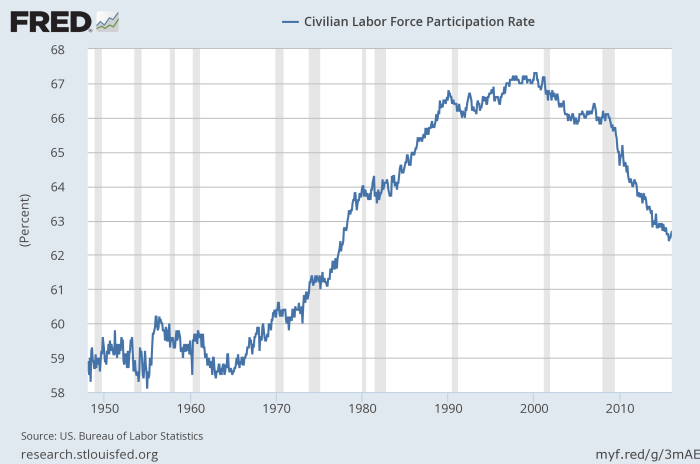
Labor force participation is declining, though slowly:

Labor_force_participation

Yet I think this also underestimates the effect of technology. As David Graeber points out, most of the new jobs we’ve been creating seem to be for lack of a better term bullshit jobs—jobs that really don’t seem like they need to be done, other than to provide people with something to do so that we can justify paying them salaries.

As he puts it:

Again, an objective measure is hard to find, but one easy way to get a sense is to ask: what would happen were this entire class of people to simply disappear? Say what you like about nurses, garbage collectors, or mechanics, it’s obvious that were they to vanish in a puff of smoke, the results would be immediate and catastrophic. A world without teachers or dock-workers would soon be in trouble, and even one without science fiction writers or ska musicians would clearly be a lesser place. It’s not entirely clear how humanity would suffer were all private equity CEOs, lobbyists, PR researchers, actuaries, telemarketers, bailiffs or legal consultants to similarly vanish. (Many suspect it might markedly improve.)

The paragon of all bullshit jobs is sales. Sales is a job that simply should not exist. If something is worth buying, you should be able to present it to the market and people should choose to buy it. If there are many choices for a given product, maybe we could have some sort of independent product rating agencies that decide which ones are the best. But sales means trying to convince people to buy your product—you have an absolutely overwhelming conflict of interest that makes your statements to customers so utterly unreliable that they are literally not even information anymore. The vast majority of advertising, marketing, and sales is thus, in a fundamental sense, literally noise. Sales contributes absolutely nothing to our economy, and because we spend so much effort on it and advertising occupies so much of our time and attention, takes a great deal away. But sales is one of our most steadily growing labor sectors; once we figure out how to make things without people, we employ the people in trying to convince customers to buy the new things we’ve made. Sales is also absolutely miserable for many of the people who do it, as I know from personal experience in two different sales jobs that I had to quit before the end of the first week.

Fortunately we have not yet reached the point where sales is the fastest growing labor sector. Currently the fastest-growing jobs fall into three categories: Medicine, green energy, and of course computers—but actually mostly medicine. Yet even this is unlikely to last; one of the easiest ways to reduce medical costs would be to replace more and more medical staff with automated systems. A nursing robot may not be quite as pleasant as a real professional nurse—but if by switching to robots the hospital can save several million dollars a year, they’re quite likely to do so.

Certain tasks are harder to automate than others—particularly anything requiring creativity and originality is very hard to replace, which is why I believe that in the 2050s or so there will be a Revenge of the Humanities Majors as all the supposedly so stable and forward-thinking STEM jobs disappear and the only jobs that are left are for artists, authors, musicians, game designers and graphic designers. (Also, by that point, very likely holographic designers, VR game designers, and perhaps even neurostim artists.) Being good at math won’t mean anything anymore—frankly it probably shouldn’t right now. No human being, not even great mathematical savants, is anywhere near as good at arithmetic as a pocket calculator. There will still be a place for scientists and mathematicians, but it will be the creative aspects of science and math that persist—design of experiments, development of new theories, mathematical intuition to develop new concepts. The grunt work of cleaning data and churning through statistical models will be fully automated.

Most economists appear to believe that we will continue to find tasks for human beings to perform, and this improved productivity will simply raise our overall standard of living. As any ECON 101 textbook will tell you, “scarcity is a fundamental fact of the universe, because human needs are unlimited and resources are finite.”

In fact, neither of those claims are true. Human needs are not unlimited; indeed, on Maslow’s hierarchy of needs First World countries have essentially reached the point where we could provide the entire population with the whole pyramid, guaranteed, all the time—if we were willing and able to fundamentally reform our economic system.

Resources are not even finite; what constitutes a “resource” depends on technology, as does how accessible or available any given source of resources will be. When we were hunter-gatherers, our only resources were the plants and animals around us. Agriculture turned seeds and arable land into a vital resource. Whale oil used to be a major scarce resource, until we found ways to use petroleum. Petroleum in turn is becoming increasingly irrelevant (and cheap) as solar and wind power mature. Soon the waters of the oceans themselves will be our power source as we refine the deuterium for fusion. Eventually we’ll find we need something for interstellar travel that we used to throw away as garbage (perhaps it will in fact be dilithium!) I suppose that if the universe is finite or if FTL is impossible, we will be bound by what is available in the cosmic horizon… but even that is not finite, as the universe continues to expand! If the universe is open (as it probably is) and one day we can harness the dark energy that seethes through the ever-expanding vacuum, our total energy consumption can grow without bound just as the universe does. Perhaps we could even stave off the heat death of the universe this way—we after all have billions of years to figure out how.

If scarcity were indeed this fundamental law that we could rely on, then more jobs would always continue to emerge, producing whatever is next on the list of needs ordered by marginal utility. Life would always get better, but there would always be more work to be done. But in fact, we are basically already at the point where our needs are satiated; we continue to try to make more not because there isn’t enough stuff, but because nobody will let us have it unless we do enough work to convince them that we deserve it.

We could continue on this route, making more and more bullshit jobs, pretending that this is work that needs done so that we don’t have to adjust our moral framework which requires that people be constantly working for money in order to deserve to live. It’s quite likely in fact that we will, at least for the foreseeable future. In this future, robots will not take our jobs, because we’ll make up excuses to create more.

But that future is more on the dystopian end, in my opinion; there is another way, a better way, the world could be. As technology makes it ever easier to produce as much wealth as we need, we could learn to share that wealth. As robots take our jobs, we could get rid of the idea of jobs as something people must have in order to live. We could build a new economic system: One where we don’t ask ourselves whether children deserve to eat before we feed them, where we don’t expect adults to spend most of their waking hours pushing papers around in order to justify letting them have homes, where we don’t require students to take out loans they’ll need decades to repay before we teach them history and calculus.

This second vision is admittedly utopian, and perhaps in the worst way—perhaps there’s simply no way to make human beings actually live like this. Perhaps our brains, evolved for the all-too-real scarcity of the ancient savannah, simply are not plastic enough to live without that scarcity, and so create imaginary scarcity by whatever means they can. It is indeed hard to believe that we can make so fundamental a shift. But for a Homo erectus in 500,000 BP, the idea that our descendants would one day turn rocks into thinking machines that travel to other worlds would be pretty hard to believe too.

Will robots take our jobs? Let’s hope so.

What would an interplanetary economy look like?

JDN 2457397

Today’s post is the second Reader’s Choice topic, chosen by a vote of my Patreons.

Remember, you too can vote on future topics if you pledge at least $10 per month.

Actually, there was a tie between two topics; since I was in an SF mood today, I decided to do this one as the official Reader’s Choice post. The second, “The challenges and possibilities of a global basic income”, I’ll do as a later post. (If I don’t get around to that before the next vote, you can of course always vote for it again.)

Will we ever colonize outer space? Many people thought we’d be there by now.

In Blade Runner, released in 1982, Roy was built and deployed to the outer colonies in 2015, which you may remember as the year that just ended.

Predictions of the future are often wrong, but predictions from the 20th century of the 21st century seem to be consistently overoptimistic about technology. In a past Idiot Free Zone post, I hypothesize that this is due to the confusion between exponential and logistic growth.

Paul Krugman is also a big fan of SF (it is actually about as likely that I’d run into Krugman at Worldcon as at an economics conference), and he wrote a paper on the possibility of interstellar trade way back in 1978. I think he’s kind of satirizing economic theorists actually; he uses sophisticated mathematics to address a problem that doesn’t exist in the real world—just like they do.

I think we will eventually at least reach the point of interplanetary colonization, if not actually interstellar. To begin, let me emphasize that vital distinction. Mars is currently about 60 million kilometers away at its closest approach. The core of the Alpha Centauri system is 4.24 light-years away, which is about 40 trillion kilometers. The distance from Ann Arbor to Toledo is about 84 kilometers. Thus, the difficulty of going to Alpha Centauri is about as much higher than that of going to Mars as the difficulty of going to Mars is compared to going from Ann Arbor to Toledo—each a factor of 700,000 times the distance.

With current technology, we can send robots to Mars (how cool is that? We did get some of the future we were promised). A typical trip takes about half a year. It costs us about $2.5 billion to do that, though India somehow managed to at least make Mars orbit for $75 million. Even if we use the $2.5 billion figure, that still means our current economic output the US and Europe alone could support hundreds of missions per year if we were willing to pay for it. (Devote the entire US military budget to NASA and we could land a new robot on Mars every day.) Interplanetary travel is most definitely feasible.

Interstellar travel on the other hand, is still far out of reach. In principle we are limited by the speed of light; in fact, it’s a good deal worse than that. The fastest we have ever gotten a spacecraft leaving the Solar System is about 60,000 km/h; at that speed it would take almost one billion hours to get to Alpha Centauri, which is over 100,000 years. We will need substantial breakthroughs in spacecraft propulsion before we can even consider sending anything to even the nearest stars. (I wouldn’t give up hope completely, however; in 1901 someone could just as well have criticized H.G. Wells’ The First Men in the Moon on the grounds that no one will ever invent a propulsion system powerful enough to reach the moon.)

By the time we manage interstellar travel, our technology will be so much more advanced it’s hard to even imagine what things will be like. But interplanetary travel we could probably do right now.

So let’s suppose we do in fact establish colonies on other planets—most likely Mars and Mercury, as well as several moons of Jupiter and Saturn. What would our economy look like once we did?

For a decidedly Game of Thrones take on this situation, see The Expanse. Their scientific accuracy is quite good (although they still have sound in space!); so far, their economic accuracy seems pretty good as well, but so far I haven’t seen enough yet to be sure.
One thing I think The Expanse does get right is that asteroid mining is a vital part of the interplanetary trade network. The thing that’s currently keeping us from colonizing other planets is a lack of economic incentives to bear the enormous cost of space travel. Asteroid mining is one thing that might actually provide those incentives, if we can leap just a few more technological hurdles in terms of mining robots and spacecraft propulsion.

Many asteroids contain metals such as silver, gold and platinum at concentrations 20 times as great as anything found on the surface of the Earth. The amount of iron and nickel they contain is even larger; we could supply the entire iron production of the Earth (3.2 billion tonnes) with a single asteroid, 16 Psyche, for the next million years. That one asteroid over 2e19 kg of nearly pure iron-nickel, which is 200 quadrillion tonnes. Many asteroids also contain large concentrations of other useful and rare metals, such as lithium and neodymium.

It is unlikely we would actually try to colonize asteroids (they do in The Expanse, but I’m not sure I buy it). None are large enough to support an atmosphere (kind of by definition), so we’d have to build space stations large enough for permanent habitation. With such ludicrous amounts of iron all around us, that might be possible; but would it be cost-effective? I think it’s more likely that we would have temporary habitats, able to support people for several months or maybe a few years, and people would basically do “tours of duty” working in the asteroids, and then return home. This is similar to how we use space stations right now; you can live there for a long time—the standing record is over a year—but nobody lives their whole life there. It might be a sort of “seasonal” work, where the seasons are decided by large-scale orbital mechanics rather than local planetary axial tilt. (We might have to start doing “seasonal adjustments” to statistics based on this!) Provided that the workers are paid a substantial portion of the spoils—by no means a certainty, as we all know from sweatshops around the world—this work could easily be lucrative enough that you become a millionaire after a tour or two and then retire.

But they might well return home to Mars, since the orbital transfer from the asteroid belt to Mars is considerably easier (it has what we call a lower “delta-v”) than the same transfer all the way back to Earth, and the launch and landing are even easier still. Mars does support an atmosphere—currently very thin and not breathable, but that could change with terraforming. It is also large enough to spread out with room for many homes, greenhouses, power plants, etc., and has enough gravity to at least keep human bodies as a basic level of functioning without too much additional support. (Mars’ gravity is about 40% that of Earth’s.)

Of course, most of the products we make are going to be used on Earth—most of everything is going to be used on Earth, probably for centuries to come. It’s possible that we’ll end up like the British Empire did where the colonies are more populous than the source, but it will take a long time for that to happen. (Moreover, the primary reason—cheap, fertile agricultural land—will not apply unless we happen upon a habitable planet or get very good at terraforming.) This means we will need to ship something from Mars to Earth. But since the delta-v is exceptionally high, we’ll want to ship as little as possible. I think this means that we will do most of the refinement and even manufacturing on Mars, and then ship prefabricated components to Earth. Any process that removes mass will be done on Mars, to minimize the amount of mass that needs to make the trip to Earth.

And what will Earth provide in return? As we import this huge quantity of metal (or metal components), what will we export in return?
Well, one possibility is that we won’t—at first, we (by which I mean “our corporations”) will simply retain ownership of the entire supply chain and do all the accounting as though production were being done entirely on Earth. We won’t think of it as “trade”, just as corporations engaging in a series of prospecting and mining ventures. At least at first.

Yet this will become increasingly unwieldy, just as it became unwieldy for the British Empire to retain control of all its colonies and collect their taxes for the Crown. Communication between Mars, Earth, and the asteroid belt will be relatively fast—a few hours delay at worst—but travel will be very slow and very expensive. Local institutions will form and assert themselves, and may eventually topple the corporate managers, expropriate their assets, and create new governments. The corporations could see the rebellion coming a year in advance from the transmissions, and still be powerless to stop it because the ships will take too long to arrive.

Once new local governments form, we will start thinking of it as “trade”. So what will we be trading? To some extent people on Mars might simply accept Earth currency (perhaps US Dollars, or Euros, or as I like to imagine some unified currency, perhaps the Atlantic Union Dollar); but only if they can then use that Earth currency to buy things they actually need. What will they actually need?

Food, for one. Some amount of food production will be done on Mars by necessity—you can’t survive if you depend entirely on imported food to survive. But it will be expensive, and most likely nutrient-dense but tasteless and monotonous genetically-engineered vegetable products. People will get tired of eating bricks of processed Aresoy(TM) for the 17,000th time and will crave real food; Earth will respond by selling them frozen steaks at $12,000 per kilogram. Probably only luxury foods will be imported, actually; why spend $11,900 for a hamburger when you can spend $12,000 for filet mignon? Nominal income on Mars will be huge—millionaires will be ubiquitous. At purchasing power parity, it may not be so impressive, once you account for the ridiculous cost of food and housing. It’ll be like living in Silicon Valley—on steroids.

Water, perhaps. This one is not as obvious as it may seem. While Earth does have the largest concentration of liquid water (except for a couple of moons of the gas giants), there is plenty of ice in them thar asteroids. It will most likely be cheaper (albeit not cheap) to obtain water by capturing and melting down asteroid ice than to ship it all the way from Earth.

But I think the most important Earth export will beculture. The main products that Martians will want to buy from us will be books, movies, songs, video games, hologram simulations. They will be blueprints, patents, 3D printer schematics. Those who travel to Mars will be bold, adventurous, many of them loners and misfits—but deep down they will still sometimes long for the comforts of the books they read as children, the songs they listened to as teenagers. The beautiful thing about selling culture is that it can be transported almost for free—just add it to the radio transmissions you were already sending. Mars will also produce its own culture, of course, but the much smaller population and constant struggle for survival will mean that most of the cultural flow will be outward from Earth to the colonies rather than the reverse. The Internet won’t work normally between Earth and Mars due to the time delay, but there will be something like it, a local MarsNet that caches material from the Internet on a delay of a few hours and then shares it with the colony. You won’t download webpages in real time, you’ll request them a day in advance. You won’t send instant messages, but sending email will be hardly any different. (Instead of Nigerian princes we’ll start getting scam spam about Martian mining entrepreneurs.) Whoever owns this communication monopoly will become fantastically rich, perhaps even more so than the mining companies themselves—because the mining companies have overhead.

Overall, the increased availability of previously-scarce metals like gold, lithium, and neodymium will make new technologies possible and also widely available, including battery technologies that might finally allow Earth to wean itself off of carbon emissions. (Unfortunately, our current means of spacecraft launch are all very carbon-intensive. We will need to invent nuclear engines that don’t leave fallout so that we can launch with them from the ground.) Like all trade, the mutual imports and exports between Earth and Mars will benefit both societies.

But unless we change course dramatically as a society, interplanetary trade will make one problem even worse, and that is inequality. I am having trouble foreseeing an interplanetary trade system that doesn’t involve making the middlemen who own the shipping and networking companies rich even beyond the wildest dreams of today’s plutocrats. We will witness the birth of humanity’s first trillionaires, individual men (and let’s face it, probably men, unless we figure out gender equality too) who own as much as not just entire countries, but as entire large First World countries. The GDP of France today is $2.8 trillion per year; the CEO of Aresoy or MarsNet could well make more than that on dividends. Of course, that provides him a great incentive to start the project now—but what will it mean for our societies when one person can buy a spaceship as casually as we would buy a cup of coffee?