Reflections at the crossroads

Jan 21 JDN 2460332

When this post goes live, I will have just passed my 36th birthday. (That means I’ve lived for about 1.1 billion seconds, so in order to be as rich as Elon Musk, I’d need to have made, on average, since birth, $200 per second—$720,000 per hour.)

I certainly feel a lot better turning 36 than I did 35. I don’t have any particular additional accomplishments to point to, but my life has already changed quite a bit, in just that one year: Most importantly, I quit my job at the University of Edinburgh, and I am currently in the process of moving out of the UK and back home to Michigan. (We moved the cat over Christmas, and the movers have already come and taken most of our things away; it’s really just us and our luggage now.)

But I still don’t know how to field the question that people have been asking me since I announced my decision to do this months ago:

“What’s next?”

I’m at a crossroads now, trying to determine which path to take. Actually maybe it’s more like a roundabout; it has a whole bunch of different paths, surely not just two or three. The road straight ahead is labeled “stay in academia”; the others at the roundabout are things like “freelance writing”, “software programming”, “consulting”, and “tabletop game publishing”. There’s one well-paved and superficially enticing road that I’m fairly sure I don’t want to take, labeled “corporate finance”.

Right now, I’m just kind of driving around in circles.

Most people don’t seem to quit their jobs without a clear plan for where they will go next. Often they wait until they have another offer in hand that they intend to take. But when I realized just how miserable that job was making me, I made the—perhaps bold, perhaps courageous, perhaps foolish—decision to get out as soon as I possibly could.

It’s still hard for me to fully understand why working at Edinburgh made me so miserable. Many features of an academic career are very appealing to me. I love teaching, I like doing research; I like the relatively flexible hours (and kinda need them, because of my migraines).

I often construct formal decision models to help me make big choices—generally it’s a linear model, where I simply rate each option by its relative quality in a particular dimension, then try different weightings of all the different dimensions. I’ve used this successfully to pick out cars, laptops, even universities. I’m not entrusting my decisions to an algorithm; I often find myself tweaking the parameters to try to get a particular result—but that in itself tells me what I really want, deep down. (Don’t do that in research—people do, and it’s bad—but if the goal is to make yourself happy, your gut feelings are important too.)

My decision models consistently rank university teaching quite high. It generally only gets beaten by freelance writing—which means that maybe I should give freelance writing another try after all.

And yet, my actual experience at Edinburgh was miserable.

What went wrong?

Well, first of all, I should acknowledge that when I separate out the job “university professor” into teaching and research as separate jobs in my decision model, and include all that goes into both jobs—not just the actual teaching, but the grading and administrative tasks; not just doing the research, but also trying to fund and publish it—they both drop lower on the list, and research drops down a lot.

Also, I would rate them both even lower now, having more direct experience of just how awful the exam-grading, grant-writing and journal-submitting can be.

Designing and then grading an exam was tremendously stressful: I knew that many of my students’ futures rested on how they did on exams like this (especially in the UK system, where exams are absurdly overweighted! In most of my classes, the final exam was at least 60% of the grade!). I struggled mightily to make the exam as fair as I could, all the while knowing that it would never really feel fair and I didn’t even have the time to make it the best it could be. You really can’t assess how well someone understands an entire subject in a multiple-choice exam designed to take 90 minutes. It’s impossible.

The worst part of research for me was the rejection.

I mentioned in a previous post how I am hypersensitive to rejection; applying for grants and submitting to journals was clearly the worst feelings of rejection I’ve felt in any job. It felt like they were evaluting not only the value of my work, but my worth as a scientist. Failure felt like being told that my entire career was a waste of time.

It was even worse than the feeling of rejection in freelance writing (which is one of the few things that my model tells me is bad about freelancing as a career for me, along with relatively low and uncertain income). I think the difference is that a book publisher is saying “We don’t think we can sell it.”—’we’ and ‘sell’ being vital. They aren’t saying “this is a bad book; it shouldn’t exist; writing it was a waste of time.”; they’re just saying “It’s not a subgenre we generally work with.” or “We don’t think it’s what the market wants right now.” or even “I personally don’t care for it.”. They acknowledge their own subjective perspective and the fact that it’s ultimately dependent on forecasting the whims of an extremely fickle marketplace. They aren’t really judging my book, and they certainly aren’t judging me.

But in research publishing, it was different. Yes, it’s all in very polite language, thoroughly spiced with sophisticated jargon (though some reviewers are more tactful than others). But when your grant application gets rejected by a funding agency or your paper gets rejected by a journal, the sense really basically is “This project is not worth doing.”; “This isn’t good science.”; “It was/would be a waste of time and money.”; “This (theory or experiment you’ve spent years working on) isn’t interesting or important.” Nobody ever came out and said those things, nor did they come out and say “You’re a bad economist and you should feel bad.”; but honestly a couple of the reviews did kinda read to me like they wanted to say that. They thought that the whole idea that human beings care about each other is fundamentally stupid and naive and not worth talking about, much less running experiments on.

It isn’t so much that I believed them that my work was bad science. I did make some mistakes along the way (but nothing vital; I’ve seen far worse errors by Nobel Laureates). I didn’t have very large samples (because every person I add to the experiment is money I have to pay, and therefore funding I have to come up with). But overall I do believe that my work is sufficiently rigorous to be worth publishing in scientific journals.

It’s more that I came to feel that my work is considered bad, that the kind of work I wanted to do would forever be an uphill battle against an implacable enemy. I already feel exhausted by that battle, and it had only barely begun. I had thought that behavioral economics was a more successful paradigm by now, that it had largely displaced the neoclassical assumptions that came before it; but I was wrong. Except specifically in journals dedicated to experimental and behavioral economics (of which prestigious journals are few—I quickly exhausted them), it really felt like a lot of the feedback I was getting amounted to, “I refuse to believe your paradigm.”.

Part of the problem, also, was that there simply aren’t that many prestigious journals, and they don’t take that many papers. The top 5 journals—which, for whatever reason, command far more respect than any other journals among economists—each accept only about 5-10% of their submissions. Surely more than that are worth publishing; and, to be fair, much of what they reject probably gets published later somewhere else. But it makes a shockingly large difference in your career how many “top 5s” you have; other publications almost don’t matter at all. So once you don’t get into any of those (which of course I didn’t), should you even bother trying to publish somewhere else?

And what else almost doesn’t matter? Your teaching. As long as you show up to class and grade your exams on time (and don’t, like, break the law or something), research universities basically don’t seem to care how good a teacher you are. That was certainly my experience at Edinburgh. (Honestly even their responses to professors sexually abusing their students are pretty unimpressive.)

Some of the other faculty cared, I could tell; there were even some attempts to build a community of colleagues to support each other in improving teaching. But the administration seemed almost actively opposed to it; they didn’t offer any funding to support the program—they wouldn’t even buy us pizza at the meetings, the sort of thing I had as an undergrad for my activist groups—and they wanted to take the time we spent in such pedagogy meetings out of our grading time (probably because if they didn’t, they’d either have to give us less grading, or some of us would be over our allotted hours and they’d owe us compensation).

And honestly, it is teaching that I consider the higher calling.

The difference between 0 people knowing something and 1 knowing it is called research; the difference between 1 person knowing it and 8 billion knowing it is called education.

Yes, of course, research is important. But if all the research suddenly stopped, our civilization would stagnate at its current level of technology, but otherwise continue unimpaired. (Frankly it might spare us the cyberpunk dystopia/AI apocalypse we seem to be hurtling rapidly toward.) Whereas if all education suddenly stopped, our civilization would slowly decline until it ultimately collapsed into the Stone Age. (Actually it might even be worse than that; even Stone Age cultures pass on knowledge to their children, just not through formal teaching. If you include all the ways parents teach their children, it may be literally true that humans cannot survive without education.)

Yet research universities seem to get all of their prestige from their research, not their teaching, and prestige is the thing they absolutely value above all else, so they devote the vast majority of their energy toward valuing and supporting research rather than teaching. In many ways, the administrators seem to see teaching as an obligation, as something they have to do in order to make money that they can spend on what they really care about, which is research.

As such, they are always making classes bigger and bigger, trying to squeeze out more tuition dollars (well, in this case, pounds) from the same number of faculty contact hours. It becomes impossible to get to know all of your students, much less give them all sufficient individual attention. At Edinburgh they even had the gall to refer to their seminars as “tutorials” when they typically had 20+ students. (That is not tutoring!)And then of course there were the lectures, which often had over 200 students.

I suppose it could be worse: It could be athletics they spend all their money on, like most Big Ten universities. (The University of Michigan actually seems to strike a pretty good balance: they are certainly not hurting for athletic funding, but they also devote sizeable chunks of their budget to research, medicine, and yes, even teaching. And unlike virtually all other varsity athletic programs, University of Michigan athletics turns a profit!)

If all the varsity athletics in the world suddenly disappeared… I’m not convinced we’d be any worse off, actually. We’d lose a source of entertainment, but it could probably be easily replaced by, say, Netflix. And universities could re-focus their efforts on academics, instead of acting like a free training and selection system for the pro leagues. The University of California, Irvine certainly seemed no worse off for its lack of varsity football. (Though I admit it felt a bit strange, even to a consummate nerd like me, to have a varsity League of Legends team.)

They keep making the experience of teaching worse and worse, even as they cut faculty salaries and make our jobs more and more precarious.

That might be what really made me most miserable, knowing how expendable I was to the university. If I hadn’t quit when I did, I would have been out after another semester anyway, and going through this same process a bit later. It wasn’t even that I was denied tenure; it was never on the table in the first place. And perhaps because they knew I wouldn’t stay anyway, they didn’t invest anything in mentoring or supporting me. Ostensibly I was supposed to be assigned a faculty mentor immediately; I know the first semester was crazy because of COVID, but after two and a half years I still didn’t have one. (I had a small research budget, which they reduced in the second year; that was about all the support I got. I used it—once.)

So if I do continue on that “academia” road, I’m going to need to do a lot of things differently. I’m not going to put up with a lot of things that I did. I’ll demand a long-term position—if not tenure-track, at least renewable indefinitely, like a lecturer position (as it is in the US, where the tenure-track position is called “assistant professor” and “lecturer” is permanent but not tenured; in the UK, “lecturers” are tenure-track—except at Oxford, and as of 2021, Cambridge—just to confuse you). Above all, I’ll only be applying to schools that actually have some track record for valuing teaching and supporting their faculty.

And if I can’t find any such positions? Then I just won’t apply at all. I’m not going in with the “I’ll take what I can get” mentality I had last time. Our household finances are stable enough that I can afford to wait awhile.

But maybe I won’t even do that. Maybe I’ll take a different path entirely.

For now, I just don’t know.
Knowing When to Quit

Sep 10 JDN 2460198

At the time of writing this post, I have officially submitted my letter of resignation at the University of Edinburgh. I’m giving them an entire semester of notice, so I won’t actually be leaving until December. But I have committed to my decision now, and that feels momentous.

Since my position here was temporary to begin with, I’m actually only leaving a semester early. Part of me wanted to try to stick it out, continue for that one last semester and leave on better terms. Until I sent that letter, I had that option. Now I don’t, and I feel a strange mix of emotions: Relief that I have finally made the decision, regret that it came to this, doubt about what comes next, and—above all—profound ambivalence.

Maybe it’s the very act of quitting—giving up, being a quitter—that feels bad. Even knowing that I need to get out of here, it hurts to have to be the one to quit.

Our society prizes grit and perseverance. Since I was a child I have been taught that these are virtues. And to some extent, they are; there certainly is such a thing as giving up too quickly.

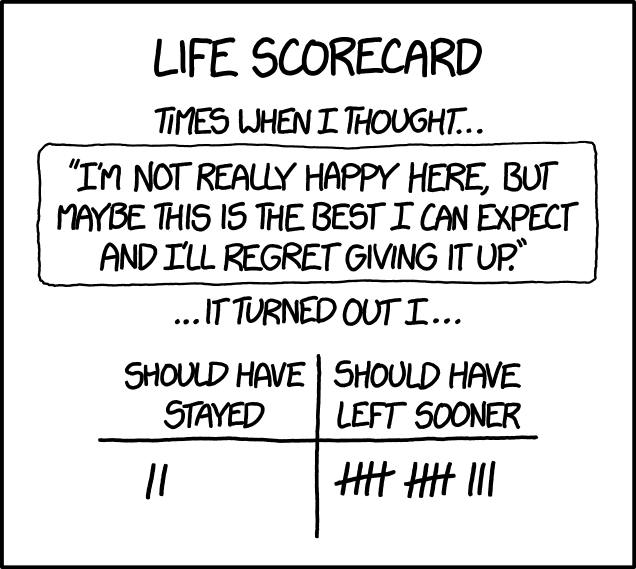
But there is also such a thing as not knowing when to quit. Sometimes things really aren’t going according to plan, and you need to quit before you waste even more time and effort. And I think I am like Randall Monroe in this regard; I am more inclined to stay when I shouldn’t than quit when I shouldn’t:

Sometimes quitting isn’t even as permanent as it is made out to be. In many cases, you can go back later and try again when you are better prepared.

In my case, I am unlikely to ever work at the University of Edinburgh again, but I haven’t yet given up on ever having a career in academia. Then again, I am by no means as certain as I once was that academia is the right path for me. I will definitely be searching for other options.

There is a reason we are so enthusiastically sold on the virtue of perseverance. Part of how our society sells the false narrative of meritocracy is by claiming that people who succeed did so because they tried harder or kept on trying.

This is not entirely false; all other things equal, you are more likely to succeed if you keep on trying. But in some ways that just makes it more seductive and insidious.

For the real reason most people hit home runs in life is they were born on third base. The vast majority of success in life is determined by circumstances entirely outside individual control.


Even having the resources to keep trying is not guaranteed for everyone. I remember a great post on social media pointing out that entrepreneurship is like one of those carnival games:

Entrepreneurship is like one of those carnival games where you throw darts or something.

Middle class kids can afford one throw. Most miss. A few hit the target and get a small prize. A very few hit the center bullseye and get a bigger prize. Rags to riches! The American Dream lives on.

Rich kids can afford many throws. If they want to, they can try over and over and over again until they hit something and feel good about themselves. Some keep going until they hit the center bullseye, then they give speeches or write blog posts about ‘meritocracy’ and the salutary effects of hard work.

Poor kids aren’t visiting the carnival. They’re the ones working it.

The odds of succeeding on any given attempt are slim—but you can always pay for more tries. A middle-class person can afford to try once; mostly those attempts will fail, but a few will succeed and then go on to talk about how their brilliant talent and hard work made the difference. A rich person can try as many times as they like, and when they finally succeed, they can credit their success to perseverance and a willingness to take risks. But the truth is, they didn’t have any exceptional reserves of grit or courage; they just had exceptional reserves of money.

In my case, I was not depleting money (if anything, I’m probably losing out financially by leaving early, though that very much depends on how the job market goes for me): It was something far more valuable. I was whittling away at my own mental health, depleting my energy, draining my motivation. The resource I was exhausting was my very soul.

I still have trouble articulating why it has been so painful for me to work here. It’s so hard to point to anything in particular.

The most obvious downsides were things I knew at the start: The position is temporary, the pay is mediocre, and I had to move across the Atlantic and live thousands of miles from home. And I had already heard plenty about the publish-or-perish system of research publication.

Other things seem like minor annoyances: They never did give me a good office (I have to share it with too many people, and there isn’t enough space, so in fact I rarely use it at all). They were supposed to assign me a faculty mentor and never did. They kept rearranging my class schedule and not telling me things until immediately beforehand.

I think what it really comes down to is I didn’t realize how much it would hurt. I knew that I was moving across the Atlantic—but I didn’t know how isolated and misunderstood I would feel when I did. I knew that publish-or-perish was a problem—but I didn’t know how agonizing it would be for me in particular. I knew I probably wouldn’t get very good mentorship from the other faculty—but I didn’t realize just how bad it would be, or how desperately I would need that support I didn’t get.

I either underestimated the severity of these problems, or overestimated my own resilience. I thought I knew what I was going into, and I thought I could take it. But I was wrong. I couldn’t take it. It was tearing me apart. My only answer was to leave.

So, leave I shall. I have now committed to doing so.

I don’t know what comes next. I don’t even know if I’ve made the right choice. Perhaps I’ll never truly know. But I made the choice, and now I have to live with it.

The mental health crisis in academia

Apr 30 JDN 2460065

Why are so many academics anxious and depressed?

Depression and anxiety are much more prevalent among both students and faculty than they are in the general population. Unsurprisingly, women seem to have it a bit worse than men, and trans people have it worst of all.

Is this the result of systemic failings of the academic system? Before deciding that, one thing we should consider is that very smart people do seem to have a higher risk of depression.

There is a complex relationship between genes linked to depression and genes linked to intelligence, and some evidence that people of especially high IQ are more prone to depression; nearly 27% of Mensa members report mood disorders, compared to 10% of the general population.

(Incidentally, the stereotype of the weird, sickly nerd has a kernel of truth: the correlations between intelligence and autism, ADHD, allergies, and autoimmune disorders are absolutely real—and not at all well understood. It may be a general pattern of neural hyper-activation, not unlike what I posit in my stochastic overload model. The stereotypical nerd wears glasses, and, yes, indeed, myopia is also correlated with intelligence—and this seems to be mostly driven by genetics.)

Most of these figures are at least a few years old. If anything things are only worse now, as COVID triggered a surge in depression for just about everyone, academics included. It remains to be seen how much of this large increase will abate as things gradually return to normal, and how much will continue to have long-term effects—this may depend in part on how well we manage to genuinely restore a normal way of life and how well we can deal with long COVID.

If we assume that academics are a similar population to Mensa members (admittedly a strong assumption), then this could potentially explain why 26% of academic faculty are depressed—but not why nearly 40% of junior faculty are. At the very least, we junior faculty are about 50% more likely to be depressed than would be explained by our intelligence alone. And grad students have it even worse: Nearly 40% of graduate students report anxiety or depression, and nearly 50% of PhD students meet the criteria for depression. At the very least this sounds like a dual effect of being both high in intelligence and low in status—it’s those of us who have very little power or job security in academia who are the most depressed.

This suggests that, yes, there really is something wrong with academia. It may not be entirely the fault of the system—perhaps even a well-designed academic system would result in more depression than the general population because we are genetically predisposed. But it really does seem like there is a substantial environmental contribution that academic institutions bear some responsibility for.

I think the most obvious explanation is constant evaluation: From the time we are students at least up until we (maybe, hopefully, someday) get tenure, academics are constantly being evaluated on our performance. We know that this sort of evaluation contributes to anxiety and depression.

Don’t other jobs evaluate performance? Sure. But not constantly the way that academia does. This is especially obvious as a student, where everything you do is graded; but it largely continues once you are faculty as well.

For most jobs, you are concerned about doing well enough to keep your job or maybe get a raise. But academia has this continuous forward pressure: if you are a grad student or junior faculty, you can’t possibly keep your job; you must either move upward to the next stage or drop out. And academia has become so hyper-competitive that if you want to continue moving upward—and someday getting that tenure—you must publish in top-ranked journals, which have utterly opaque criteria and ever-declining acceptance rates. And since there are so few jobs available compared to the number of applicants, good enough is never good enough; you must be exceptional, or you will fail. Two thirds of PhD graduates seek a career in academia—but only 30% are actually in one three years later. (And honestly, three years is pretty short; there are plenty of cracks left to fall through between that and a genuinely stable tenured faculty position.)

Moreover, our skills are so hyper-specialized that it’s very hard to imagine finding work anywhere else. This grants academic institutions tremendous monopsony power over us, letting them get away with lower pay and worse working conditions. Even with an economics PhD—relatively transferable, all things considered—I find myself wondering who would actually want to hire me outside this ivory tower, and my feeble attempts at actually seeking out such employment have thus far met with no success.

I also find academia painfully isolating. I’m not an especially extraverted person; I tend to score somewhere near the middle range of extraversion (sometimes called an “ambivert”). But I still find myself craving more meaningful contact with my colleagues. We all seem to work in complete isolation from one another, even when sharing the same office (which is awkward for other reasons). There are very few consistent gatherings or good common spaces. And whenever faculty do try to arrange some sort of purely social event, it always seems to involve drinking at a pub and nobody is interested in providing any serious emotional or professional support.

Some of this may be particular to this university, or to the UK; or perhaps it has more to do with being at a certain stage of my career. In any case I didn’t feel nearly so isolated in graduate school; I had other students in my cohort and adjacent cohorts who were going through the same things. But I’ve been here two years now and so far have been unable to establish any similarly supportive relationships with colleagues.

There may be some opportunities I’m not taking advantage of: I’ve skipped a lot of research seminars, and I stopped going to those pub gatherings. But it wasn’t that I didn’t try them at all; it was that I tried them a few times and quickly found that they were not filling that need. At seminars, people only talked about the particular research project being presented. At the pub, people talked about almost nothing of serious significance—and certainly nothing requiring emotional vulnerability. The closest I think I got to this kind of support from colleagues was a series of lunch meetings designed to improve instruction in “tutorials” (what here in the UK we call discussion sections); there, at least, we could commiserate about feeling overworked and dealing with administrative bureaucracy.

There seem to be deep, structural problems with how academia is run. This whole process of universities outsourcing their hiring decisions to the capricious whims of high-ranked journals basically decides the entire course of our careers. And once you get to the point I have, now so disheartened with the process of publishing research that I can’t even engage with it, it’s not at all clear how it’s even possible to recover. I see no way forward, no one to turn to. No one seems to care how well I teach, if I’m not publishing research.

And I’m clearly not the only one who feels this way.

Implications of stochastic overload

Apr 2 JDN 2460037

A couple weeks ago I presented my stochastic overload model, which posits a neurological mechanism for the Yerkes-Dodson effect: Stress increases sympathetic activation, and this increases performance, up to the point where it starts to risk causing neural pathways to overload and shut down.

This week I thought I’d try to get into some of the implications of this model, how it might be applied to make predictions or guide policy.

One thing I often struggle with when it comes to applying theory is what actual benefits we get from a quantitative mathematical model as opposed to simply a basic qualitative idea. In many ways I think these benefits are overrated; people seem to think that putting something into an equation automatically makes it true and useful. I am sometimes tempted to try to take advantage of this, to put things into equations even though I know there is no good reason to put them into equations, simply because so many people seem to find equations so persuasive for some reason. (Studies have even shown that, particularly in disciplines that don’t use a lot of math, inserting a totally irrelevant equation into a paper makes it more likely to be accepted.)

The basic implications of the Yerkes-Dodson effect are already widely known, and utterly ignored in our society. We know that excessive stress is harmful to health and performance, and yet our entire economy seems to be based around maximizing the amount of stress that workers experience. I actually think neoclassical economics bears a lot of the blame for this, as neoclassical economists are constantly talking about “increasing work incentives”—which is to say, making work life more and more stressful. (And let me remind you that there has never been any shortage of people willing to work in my lifetime, except possibly briefly during the COVID pandemic. The shortage has always been employers willing to hire them.)

I don’t know if my model can do anything to change that. Maybe by putting it into an equation I can make people pay more attention to it, precisely because equations have this weird persuasive power over most people.

As far as scientific benefits, I think that the chief advantage of a mathematical model lies in its ability to make quantitative predictions. It’s one thing to say that performance increases with low levels of stress then decreases with high levels; but it would be a lot more useful if we could actually precisely quantify how much stress is optimal for a given person and how they are likely to perform at different levels of stress.

Unfortunately, the stochastic overload model can only make detailed predictions if you have fully specified the probability distribution of innate activation, which requires a lot of free parameters. This is especially problematic if you don’t even know what type of distribution to use, which we really don’t; I picked three classes of distribution because they were plausible and tractable, not because I had any particular evidence for them.

Also, we don’t even have standard units of measurement for stress; we have a vague notion of what more or less stressed looks like, but we don’t have the sort of quantitative measure that could be plugged into a mathematical model. Probably the best units to use would be something like blood cortisol levels, but then we’d need to go measure those all the time, which raises its own issues. And maybe people don’t even respond to cortisol in the same ways? But at least we could measure your baseline cortisol for awhile to get a prior distribution, and then see how different incentives increase your cortisol levels; and then the model should give relatively precise predictions about how this will affect your overall performance. (This is a very neuroeconomic approach.)

So, for now, I’m not really sure how useful the stochastic overload model is. This is honestly something I feel about a lot of the theoretical ideas I have come up with; they often seem too abstract to be usefully applicable to anything.

Maybe that’s how all theory begins, and applications only appear later? But that doesn’t seem to be how people expect me to talk about it whenever I have to present my work or submit it for publication. They seem to want to know what it’s good for, right now, and I never have a good answer to give them. Do other researchers have such answers? Do they simply pretend to?

Along similar lines, I recently had one of my students ask about a theory paper I wrote on international conflict for my dissertation, and after sending him a copy, I re-read the paper. There are so many pages of equations, and while I am confident that the mathematical logic is valid,I honestly don’t know if most of them are really useful for anything. (I don’t think I really believe that GDP is produced by a Cobb-Douglas production function, and we don’t even really know how to measure capital precisely enough to say.) The central insight of the paper, which I think is really important but other people don’t seem to care about, is a qualitative one: International treaties and norms provide an equilibrium selection mechanism in iterated games. The realists are right that this is cheap talk. The liberals are right that it works. Because when there are many equilibria, cheap talk works.

I know that in truth, science proceeds in tiny steps, building a wall brick by brick, never sure exactly how many bricks it will take to finish the edifice. It’s impossible to see whether your work will be an irrelevant footnote or the linchpin for a major discovery. But that isn’t how the institutions of science are set up. That isn’t how the incentives of academia work. You’re not supposed to say that this may or may not be correct and is probably some small incremental progress the ultimate impact of which no one can possibly foresee. You’re supposed to sell your work—justify how it’s definitely true and why it’s important and how it has impact. You’re supposed to convince other people why they should care about it and not all the dozens of other probably equally-valid projects being done by other researchers.

I don’t know how to do that, and it is agonizing to even try. It feels like lying. It feels like betraying my identity. Being good at selling isn’t just orthogonal to doing good science—I think it’s opposite. I think the better you are at selling your work, the worse you are at cultivating the intellectual humility necessary to do good science. If you think you know all the answers, you’re just bad at admitting when you don’t know things. It feels like in order to succeed in academia, I have to act like an unscientific charlatan.

Honestly, why do we even need to convince you that our work is more important than someone else’s? Are there only so many science points to go around? Maybe the whole problem is this scarcity mindset. Yes, grant funding is limited; but why does publishing my work prevent you from publishing someone else’s? Why do you have to reject 95% of the papers that get sent to you? Don’t tell me you’re limited by space; the journals are digital and searchable and nobody reads the whole thing anyway. Editorial time isn’t infinite, but most of the work has already been done by the time you get a paper back from peer review. Of course, I know the real reason: Excluding people is the main source of prestige.

I’m old enough to be President now.

Jan 22 JDN 2459967

When this post goes live, I will have passed my 35th birthday. This is old enough to be President of the United States, at least by law. (In practice, no POTUS has been less than 42.)

Not that I will ever be President. I have neither the wealth nor the charisma to run any kind of national political campaign. I might be able to get elected to some kind of local office at some point, like a school board or a city water authority. But I’ve been eligible to run for such offices for quite awhile now, and haven’t done so; nor do I feel particularly inclined at the moment.

No, the reason this birthday feels so significant is the milestone it represents. By this age, most people have spouses, children, careers. I have a spouse. I don’t have kids. I sort of have a career.

I have a job, certainly. I work for relatively decent pay. Not excellent, not what I was hoping for with a PhD in economics, but enough to live on (anywhere but an overpriced coastal metropolis). But I can’t really call that job a career, because I find large portions of it unbearable and I have absolutely no job security. In fact, I have the exact opposite: My job came with an explicit termination date from the start. (Do the people who come up with these short-term postdoc positions understand how that feels? It doesn’t seem like they do.)

I missed the window to apply for academic jobs that start next year. If I were happy here, this would be fine; I still have another year left on my contract. But I’m not happy here, and that is a grievous understatement. Working here is clearly the most important situational factor contributing to my ongoing depression. So I really ought to be applying to every alternative opportunity I can find—but I can’t find the will to try it, or the self-confidence to believe that my attempts could succeed if I did.

Then again, I’m not sure I should be applying to academic positions at all. If I did apply to academic positions, they’d probably be teaching-focused ones, since that’s the one part of my job I’m actually any good at. I’ve more or less written off applying to major research institutions; I don’t think I would get hired anyway, and even if I did, the pressure to publish is so unbearable that I think I’d be just as miserable there as I am here.

On the other hand, I can’t be sure that I would be so miserable even at another research institution; maybe with better mentoring and better administration I could be happy and successful in academic research after all.

The truth is, I really don’t know how much of my misery is due to academia in general, versus the British academic system, versus Edinburgh as an institution, versus starting work during the pandemic, versus the experience of being untenured faculty, versus simply my own particular situation. I don’t know if working at another school would be dramatically better, a little better, or just the same. (If it were somehow worse—which frankly seems hard to arrange—I would literally just quit immediately.)

I guess if the University of Michigan offered me an assistant professor job right now, I would take it. But I’m confident enough that they wouldn’t offer it to me that I can’t see the point in applying. (Besides, I missed the application windows this year.) And I’m not even sure that I would be happy there, despite the fact that just a few years ago I would have called it a dream job.

That’s really what I feel most acutely about turning 35: The shattering of dreams.

I thought I had some idea of how my life would go. I thought I knew what I wanted. I thought I knew what would make me happy.

The weirdest part it that it isn’t even that different from how I’d imagined it. If you’d asked me 10 or even 20 years ago what my career would be like at 35, I probably would have correctly predicted that I would have a PhD and be working at a major research university. 10 years ago I would have correctly expected it to be a PhD in economics; 20, I probably would have guessed physics. In both cases I probably would have thought I’d be tenured by now, or at least on the tenure track. But a postdoc or adjunct position (this is sort of both?) wouldn’t have been utterly shocking, just vaguely disappointing.

The biggest error by my past self was thinking that I’d be happy and successful in this career, instead of barely, desperately hanging on. I thought I’d have published multiple successful papers by now, and be excited to work on a new one. I imagined I’d also have published a book or two. (The fact that I self-published a nonfiction book at 16 but haven’t published any nonfiction ever since would be particularly baffling to my 15-year-old self, and is particularly depressing to me now.) I imagined myself becoming gradually recognized as an authority in my field, not languishing in obscurity; I imagined myself feeling successful and satisfied, not hopeless and depressed.

It’s like the dark Mirror Universe version of my dream job. It’s so close to what I thought I wanted, but it’s also all wrong. I finally get to touch my dreams, and they shatter in my hands.

When you are young, birthdays are a sincere cause for celebration; you look forward to the new opportunities the future will bring you. I seem to be now at the age where it no longer feels that way.

How to fix economics publishing

Aug 7 JDN 2459806

The current system of academic publishing in economics is absolutely horrible. It seems practically designed to undermine the mental health of junior faculty.

1. Tenure decisions, and even most hiring decisions, are almost entirely based upon publication in five (5) specific journals.

2. One of those “top five” journals is owned by Elsevier, a corrupt monopoly that has no basis for its legitimacy yet somehow controls nearly one-fifth of all scientific publishing.

3. Acceptance rates in all of these journals are between 5% and 10%—greatly decreased from what they were a generation or two ago. Given a typical career span, the senior faculty evaluating you on whether you were published in these journals had about a three times better chance to get their own papers published there than you do.

4. Submissions are only single-blinded, so while you have no idea who is reading your papers, they know exactly who you are and can base their decision on whether you are well-known in the profession—or simply whether they like you.

5. Simultaneous submissions are forbidden, so when submitting to journals you must go one at a time, waiting to hear back from one before trying the next.

6. Peer reviewers are typically unpaid and generally uninterested, and so procrastinate as long as possible on doing their reviews.

7. As a result, review times for a paper are often measured in months, for every single cycle.

So, a highly successful paper goes like this: You submit it to a top journal, wait three months, it gets rejected. You submit it to another one, wait another four months, it gets rejected. You submit it to a third one, wait another two months, and you are told to revise and resubmit. You revise and resubmit, wait another three months, and then finally get accepted.

You have now spent an entire year getting one paper published. And this was a success.

Now consider a paper that doesn’t make it into a top journal. You submit, wait three months, rejected; you submit again, wait four months, rejected; you submit again, wait two months, rejected. You submit again, wait another five months, rejected; you submit to the fifth and final top-five, wait another four months, and get rejected again.

Now, after a year and a half, you can turn to other journals. You submit to a sixth journal, wait three months, rejected. You submit to a seventh journal, wait four months, get told to revise and resubmit. You revise and resubmit, wait another two months, and finally—finally, after two years—actually get accepted, but not to a top-five journal. So it may not even help you get tenure, unless maybe a lot of people cite it or something.

And what if you submit to a seventh, an eighth, a ninth journal, and still keep getting rejected? At what point do you simply give up on that paper and try to move on with your life?

That’s a trick question: Because what really happens, at least to me, is I can’t move on with my life. I get so disheartened from all the rejections of that paper that I can’t bear to look at it anymore, much less go through the work of submitting it to yet another journal that will no doubt reject it again. But worse than that, I become so depressed about my academic work in general that I become unable to move on to any other research either. And maybe it’s me, but it isn’t just me: 28% of academic faculty suffer from severe depression, and 38% from severe anxiety. And that’s across all faculty—if you look just at junior faculty it’s even worse: 43% of junior academic faculty suffer from severe depression. When a problem is that prevalent, at some point we have to look at the system that’s making us this way.

I can blame the challenges of moving across the Atlantic during a pandemic, and the fact that my chronic migraines have been the most frequent and severe they have been in years, but the fact remains: I have accomplished basically nothing towards the goal of producing publishable research in the past year. I have two years left at this job; if I started right now, I might be able to get something published before my contract is done. Assuming that the project went smoothly, I could start submitting it as soon as it was done, and it didn’t get rejected as many times as the last one.

I just can’t find the motivation to do it. When the pain is so immediate and so intense, and the rewards are so distant and so uncertain, I just can’t bring myself to do the work. I had hoped that talking about this with my colleagues would help me cope, but it hasn’t; in fact it only makes me seem to feel worse, because so few of them seem to understand how I feel. Maybe I’m talking to the wrong people; maybe the ones who understand are themselves suffering too much to reach out to help me. I don’t know.

But it doesn’t have to be this way. Here are some simple changes that could make the entire process of academic publishing in economics go better:

1. Boycott Elsevier and all for-profit scientific journal publishers. Stop reading their journals. Stop submitting to their journals. Stop basing tenure decisions on their journals. Act as though they don’t exist, because they shouldn’t—and then hopefully soon they won’t.

2. Peer reviewers should be paid for their time, and in return required to respond promptly—no more than a few weeks. A lack of response should be considered a positive vote on that paper.

3. Allow simultaneous submissions; if multiple journals accept, let the author choose between them. This is already how it works in fiction publishing, which you’ll note has not collapsed.

4. Increase acceptance rates. You are not actually limited by paper constraints anymore; everything is digital now. Most of the work—even in the publishing process—already has to be done just to go through peer review, so you may as well publish it. Moreover, most papers that are submitted are actually worthy of publishing, and this whole process is really just an idiotic status hierarchy. If the prestige of your journal decreases because you accept more papers, we are measuring prestige wrong. Papers should be accepted something like 50% of the time, not 5-10%.

5. Double blind submissions, and insist on ethical standards that maintain that blinding. No reviewer should know whether they are reading the work of a grad student or a Nobel Laureate. Reputation should mean nothing; scientific rigor should mean everything.

And, most radical of all, what I really need in my life right now:

6. Faculty should not have to submit their own papers. Each university department should have administrative staff whose job it is to receive papers from their faculty, format them appropriately, and submit them to journals. They should deal with all rejections, and only report to the faculty member when they have received an acceptance or a request to revise and resubmit. Faculty should simply do the research, write the papers, and then fire and forget them. We have highly specialized skills, and our valuable time is being wasted on the clerical tasks of formatting and submitting papers, which many other people could do as well or better. Worse, we are uniquely vulnerable to the emotional impact of the rejection—seeing someone else’s paper rejected is an entirely different feeling from having your own rejected.

Do all that, and I think I could be happy to work in academia. As it is, I am seriously considering leaving and never coming back.

I finally have a published paper.

Jun 12 JDN 2459773

Here it is, my first peer-reviewed publication: “Imperfect Tactic Collusion and Asymmetric Price Transmission”, in the Journal of Economic Behavior and Organization.

Due to the convention in economics that authors are displayed alphabetically, I am listed third of four, and will be typically collapsed into “Bulutay et. al.”. I don’t actually think it should be “Julius et. al.”; I think Dave Hales did the most important work, and I wanted it to be “Hales et. al.”; but anything non-alphabetical is unusual in economics, and it would have taken a strong justification to convince the others to go along with it. This is a very stupid norm (and I attribute approximately 20% of Daron Acemoglu’s superstar status to it), but like any norm, it is difficult to dislodge.

I thought I would feel different when this day finally came. I thought I would feel joy, or at least satisfaction. I had been hoping that satisfaction would finally spur me forward in resubmitting my single-author paper, “Experimental Public Goods Games with Progressive Taxation”, so I could finally get a publication that actually does have “Julius (2022)” (or, at this rate, 2023, 2024…?). But that motivating satisfaction never came.

I did feel some vague sense of relief: Thank goodness, this ordeal is finally over and I can move on. But that doesn’t have the same motivating force; it doesn’t make me want to go back to the other papers I can now hardly bear to look at.

This reaction (or lack thereof?) could be attributed to circumstances: I have been through a lot lately. I was already overwhelmed by finishing my dissertation and going on the job market, and then there was the pandemic, and I had to postpone my wedding, and then when I finally got a job we had to suddenly move abroad, and then it was awful finding a place to live, and then we actually got married (which was lovely, but still stressful), and it took months to get my medications sorted with the NHS, and then I had a sudden resurgence of migraines which kept me from doing most of my work for weeks, and then I actually caught COVID and had to deal with that for a few weeks too. So it really isn’t too surprising that I’d be exhausted and depressed after all that.

Then again, it could be something deeper. I didn’t feel this way about my wedding. That genuinely gave me the joy and satisfaction that I had been expecting; I think it really was the best day of my life so far. So it isn’t as if I’m incapable of these feelings under my current state.

Rather, I fear that I am becoming more permanently disillusioned with academia. Now that I see how the sausage is made, I am no longer so sure I want to be one of the people making it. Publishing that paper didn’t feel like I had accomplished something, or even made some significant contribution to human knowledge. In fact, the actual work of publication was mostly done by my co-authors, because I was too overwhelmed by the job market at the time. But what I did have to do—and what I’ve tried to do with my own paper—felt like a miserable, exhausting ordeal.

More and more, I’m becoming convinced that a single experiment tells us very little, and we are being asked to present each one as if it were a major achievement when it’s more like a single brick in a wall.

But whatever new knowledge our experiments may have gleaned, that part was done years ago. We could have simply posted the draft as a working paper on the web and moved on, and the world would know just as much and our lives would have been a lot easier.

Oh, but then it would not have the imprimatur of peer review! And for our careers, that means absolutely everything. (Literally, when they’re deciding tenure, nothing else seems to matter.) But for human knowledge, does it really mean much? The more referee reports I’ve read, the more arbitrary they feel to me. This isn’t an objective assessment of scientific merit; it’s the half-baked opinion of a single randomly chosen researcher who may know next to nothing about the topic—or worse, have a vested interest in defending a contrary paradigm.

Yes, of course, what gets through peer review is of considerably higher quality than any randomly-selected content on the Internet. (The latter can be horrifically bad.) But is this not also true of what gets submitted for peer review? In fact, aren’t many blogs written by esteemed economists (say, Krugman? Romer? Nate Silver?) of considerably higher quality as well, despite having virtually none of the gatekeepers? I think Krugman’s blog is nominally edited by the New York Times, and Silver has a whole staff at FiveThirtyEight (they’re hiring, in fact!), but I’m fairly certain Romer just posts whatever he wants like I do. Of course, they had to establish their reputations (Krugman and Romer each won a Nobel). But still, it seems like maybe peer-review isn’t doing the most important work here.

Even blogs by far less famous economists (e.g. Miles Kimball, Brad DeLong) are also very good, and probably contribute more to advancing the knowledge of the average person than any given peer-reviewed paper, simply because they are more readable and more widely read. What we call “research” means going from zero people knowing a thing to maybe a dozen people knowing it; “publishing” means going from a dozen to at most a thousand; to go from a thousand to a billion, we call that “education”.

They all matter, of course; but I think we tend to overvalue research relative to education. A world where a few people know something is really not much better than a world where nobody does, while a world where almost everyone knows something can be radically superior. And the more I see just how far behind the cutting edge of research most economists are—let alone most average people—the more apparent it becomes to me that we are investing far too much in expanding that cutting edge (and far, far too much in gatekeeping who gets to do that!) and not nearly enough in disseminating that knowledge to humanity.

I think maybe that’s why finally publishing a paper felt so anticlimactic for me. I know that hardly anyone will ever actually read the damn thing. Just getting to this point took far more effort than it should have; dozens if not hundreds of hours of work, months of stress and frustration, all to satisfy whatever arbitrary criteria the particular reviewers happened to use so that we could all clear this stupid hurdle and finally get that line on our CVs. (And we wonder why academics are so depressed?) Far from being inspired to do the whole process again, I feel as if I have finally emerged from the torture chamber and may at last get some chance for my wounds to heal.

Even publishing fiction was not this miserable. Don’t get me wrong; it was miserable, especially for me, as I hate and fear rejection to the very core of my being in a way most people do not seem to understand. But there at least the subjectivity and arbitrariness of the process is almost universally acknowledged. Agents and editors don’t speak of your work being “flawed” or “wrong”; they don’t even say it’s “unimportant” or “uninteresting”. They say it’s “not a good fit” or “not what we’re looking for right now”. (Journal editors sometimes make noises like that too, but there’s always a subtext of “If this were better science, we’d have taken it.”) Unlike peer reviewers, they don’t come back with suggestions for “improvements” that are often pointless or utterly infeasible.

And unlike peer reviewers, fiction publishers acknowledge their own subjectivity and that of the market they serve. Nobody really thinks that Fifty Shades of Grey was good in any deep sense; but it was popular and successful, and that’s all the publisher really cares about. As a result, failing to be the next Fifty Shades of Grey ends up stinging a lot less than failing to be the next article in American Economic Review. Indeed, I’ve never had any illusions that my work would be popular among mainstream economists. But I once labored under the belief that it would be more important that it is true; and I guess I now consider that an illusion.

Moreover, fiction writers understand that rejection hurts; I’ve been shocked how few academics actually seem to. Nearly every writing conference I’ve ever been to has at least one seminar on dealing with rejection, often several; at academic conferences, I’ve literally never seen one. There seems to be a completely different mindset among academics—at least, the successful, tenured ones—about the process of peer review, what it means, even how it feels. When I try to talk with my mentors about the pain of getting rejected, they just… don’t get it. They offer me guidance on how to deal with anger at rejection, when that is not at all what I feel—what I feel is utter, hopeless, crushing despair.

There is a type of person who reacts to rejection with anger: Narcissists. (Look no further than the textbook example, Donald Trump.) I am coming to fear that I’m just not narcissistic enough to be a successful academic. I’m not even utterly lacking in narcissism: I am almost exactly average for a Millennial on the Narcissistic Personality Inventory. I score fairly high on Authority and Superiority (I consider myself a good leader and a highly competent individual) but very low on Exploitativeness and Self-Sufficiency (I don’t like hurting people and I know no man is an island). Then again, maybe I’m just narcissistic in the wrong way: I score quite low on “grandiose narcissism”, but relatively high on “vulnerable narcissism”. I hate to promote myself, but I find rejection devastating. This combination seems to be exactly what doesn’t work in academia. But it seems to be par for the course among writers and poets. Perhaps I have the mind of a scientist, but I have the soul of a poet. (Send me through the wormhole! Please? Please!?)

When to give up

Jun 6 JDN 2459372

Perseverance is widely regarded as a virtue, and for good reason. Often one of the most important deciding factors in success is the capacity to keep trying after repeated failure. I think this has been a major barrier for me personally; many things came easily to me when I was young, and I internalized the sense that if something doesn’t come easily, it must be beyond my reach.

Yet it’s also worth noting that this is not the only deciding factor—some things really are beyond our capabilities. Indeed, some things are outright impossible. And we often don’t know what is possible and what isn’t.

This raises the question: When should we persevere, and when should we give up?

There is actually reason to think that people often don’t give up when they should. Steven Levitt (of Freakonomics fame)recently published a study that asked people who were on the verge of a difficult decision to flip a coin, and then base their decision on the coin flip: Heads, make a change; tails, keep things as they are. Many didn’t actually follow the coin flip—but enough did that there was a statistical difference between those who saw heads and those who saw tails. The study found that the people who flipped heads and made a change were on average happier a couple of years later than the people who flipped tails and kept things as they were.

This question is particularly salient for me lately, because the academic job market has gone so poorly for me. I’ve spent most of my life believing that academia is where I belong; my intellect and my passion for teaching and research has convinced me and many others that this is the right path for me. But now that I have a taste of what it is actually like to apply for tenure-track jobs and submit papers to journals, I am utterly miserable. I hate every minute of it. I’ve spent the entire past year depressed and feeling like I have accomplished absolutely nothing.

In theory, once one actually gets tenure it’s supposed to get easier. But that could be a long way away—or it might never happen at all. As it is, there’s basically no chance I’ll get a tenure track position this year, and it’s unclear what my chances would be if I tried again next year.

If I could actually get a paper published, that would no doubt improve my odds of landing a better job next year. But I haven’t been able to do that, and each new rejection cuts so deep that I can barely stand to look at my papers anymore, much less actually continue submitting them. And apparently even tenured professors still get their papers rejected repeatedly, which means that this pain will never go away. I simply cannot imagine being happy if this is what I am expected to do for the rest of my life.

I found this list of criteria for when you should give up something—and most of them fit me. I’m not sure I know in my heart it can’t work out, but I increasingly suspect that. I’m not sure I want it anymore, now that I have a better idea of what it’s really like. Pursuing it is definitely making me utterly miserable. I wouldn’t say it’s the only reason, but I definitely do worry what other people will think if I quit; I feel like I’d be letting a lot of people down. I also wonder who I am without it, where I belong if not here. I don’t know what other paths are out there, but maybe there is something better. This constant stream of failure and rejection has definitely made me feel like I hate myself. And above all, when I imagine quitting, I absolutely feel an enormous sense of relief.

Publishing in journals seems to be the thing that successful academics care about most, and it means almost nothing to me anymore. I only want it because of all the pressure to have it, because of all the rewards that come from having it. It has become fully instrumental to me, with no intrinsic meaning or value. I have no particular desire to be lauded by the same system that lauded Fischer Black or Kenneth Rogoff—both of whose egregious and easily-avoidable mistakes are responsible for the suffering of millions people around the world.

I want people to read my ideas. But people don’t actually read journals. They skim them. They read the abstracts. They look at the graphs and regression tables. (You have the meeting that should have been an email? I raise you the paper that should have been a regression table.) They see if there’s something in there that they should be citing for their own work, and if there is, maybe then they actually read the paper—but everyone is so hyper-specialized that only a handful of people will ever actually want to cite any given paper. The vast majority of research papers are incredibly tedious to read and very few people actually bother. As a method for disseminating ideas, this is perhaps slightly better than standing on a street corner and shouting into a megaphone.

I would much rather write books; people sometimes actually read books, especially when they are written for a wide audience and hence not forced into the straitjacket of standard ‘scientific writing’ that no human being actually gets any enjoyment out of writing or reading. I’ve seen a pretty clear improvement in writing quality of papers written by Nobel laureates—after they get their Nobels or similar accolades. Once they establish themselves, they are free to actually write in ways that are compelling and interesting, rather than having to present everything in the most dry, tedious way possible. If your paper reads like something that a normal person would actually find interesting or enjoyable to read, you will be—as I have been—immediately told that you must remove all such dangerous flavor until the result is as tasteless as possible.

No, the purpose of research journals is not to share ideas. Its function is not to share, but to evaluate. And it isn’t even really to evaluate research—it’s to evaluate researchers. It’s to outsource the efforts of academic hiring to an utterly unaccountable and arbitrary system run mostly by for-profit corporations. It may have some secondary effect of evaluating ideas for validity; at least the really awful ideas are usually excluded. But its primary function is to decide the academic pecking order.

I had thought that scientific peer review was supposed to select for truth. Perhaps sometimes it does. It seems to do so reasonably well in the natural sciences, at least. But in the social sciences? That’s far less clear. Peer-reviewed papers are much more likely to be accurate than any randomly-selected content; but there are still a disturbingly large number of peer-reviewed published papers that are utterly wrong, and some unknown but undoubtedly vast number of good papers that have never seen the light of day.

Then again, when I imagine giving up on an academic career, I don’t just feel relief—I also feel regret and loss. I feel like I’ve wasted years of my life putting together a dream that has now crumbled in my hands. I even feel some anger, some sense that I was betrayed by those who told me that this was about doing good research when it turns out it’s actually about being thick-skinned enough that you can take an endless assault of rejections. It feels like I’ve been running a marathon, and I just rounded a curve to discover that the last five miles must be ridden on horseback, when I don’t have a horse, I have no equestrian training, and in fact I’m allergic to horses.

I wish someone had told me it would be like this. Maybe they tried and I didn’t listen. They did say that papers would get rejected. They did say that the tenure track was high-pressure and publish-or-perish was a major source of anxiety. But they never said that it would tear at my soul like this. They never said that I would have to go through multiple rounds of agony, self-doubt, and despair in order to get even the slighest recognition for my years of work. They never said that the whole field would treat me like I’m worthless because I can’t satisfy the arbitrary demands of a handful of anonymous reviewers. They never said that I would begin to feel worthless after several rounds of this.

That’s really what I want to give up on. I want to give up on hitching my financial security, my career, my future, my self-worth to a system as capricious as peer review.

I don’t want to give up on research. I don’t want to give up on teaching. I still believe strongly in discovering new truths and sharing them with others. I’m just increasingly realizing that academia isn’t nearly as good at that as I thought it was.

It isn’t even that I think it’s impossible for me to succeed in academia. I think that if I continued trying to get a tenure-track job, I would land one eventually. Maybe next year. Or maybe I’d spend a few years at a postdoc first. And I’d probably manage to publish some paper in some reasonably respectable journal at some point in the future. But I don’t know how long it would take, or how good a journal it would be—and I’m already past the point where I really don’t care anymore, where I can’t afford to care, where if I really allowed myself to care it would only devastate me when I inevitably fail again. Now that I see what is really involved in the process, how arduous and arbitrary it is, publishing in a journal means almost nothing to me. I want to be validated; I want to be appreciated; I want to be recognized. But the system is set up to provide nothing but rejection, rejection, rejection. If even the best work won’t be recognized immediately and even the worst work can make it with enough tries, then the whole system begins to seem meaningless. It’s just rolls of the dice. And I didn’t sign up to be a gambler.

The job market will probably be better next year than it was this year. But how much better? Yes, there will be more openings, but there will also be more applicants: Everyone who would normally be on the market, plus everyone like me who didn’t make it this year, plus everyone who decided to hold back this year because they knew they wouldn’t make it (as I probably should have done). Yes, in a normal year, I could be fairly confident of getting some reasonably decent position—but this wasn’t a normal year, and next year won’t be one either, and the one after that might still not be. If I can’t get a paper published in a good journal between now and then—and I’m increasingly convinced that I can’t—then I really can’t expect my odds to be greatly improved from what they were this time around. And if I don’t know that this terrible gauntlet is going to lead to something good, I’d really much rather avoid it altogether. It was miserable enough when I went into it being (over)confident that it would work out all right.

Perhaps the most important question when deciding whether to give up is this: What will happen if you do? What alternatives do you have? If giving up means dying, then don’t give up. (“Learn to let go” is very bad advice to someone hanging from the edge of a cliff.) But while it may feel that way sometimes, rarely does giving up on a career or a relationship or a project yield such catastrophic results.

When people are on the fence about making a change and then do so, even based on the flip of a coin, it usually makes them better off. Note that this is different from saying you should make all your decisions randomly; if you are confident that you don’t want to make a change, don’t make a change. This advice is for people who feel like they want a change but are afraid to take the chance, people who find themselves ambivalent about what direction to go next—people like me.

I don’t know where I should go next. I don’t know where I belong. I know it isn’t Wall Street. I’m pretty sure it’s not consulting. Maybe it’s nonprofits. Maybe it’s government. Maybe it’s freelance writing. Maybe it’s starting my own business. I guess I’d still consider working in academia; if Purdue called me back to say they made a terrible mistake and they want me after all, I’d probably take the offer. But since such an outcome is now vanishingly unlikely, perhaps it’s time, after all, to give up.

Selectivity is a terrible measure of quality

May 23 JDN 2459358

How do we decide which universities and research journals are the best? There are a vast number of ways we could go about this—and there are in fact many different ranking systems out there, though only a handful are widely used. But one primary criterion which seems to be among the most frequently used is selectivity.

Selectivity is a very simple measure: What proportion of people who try to get in, actually get in? For universities this is admission rates for applicants; for journals it is acceptance rates for submitted papers.

The top-rated journals in economics have acceptance rates of 1-7%. The most prestigious universities have acceptance rates of 4-10%. So a reasonable ballpark is to assume a 95% chance of not getting accepted in either case. Of course, some applicants are more or less qualified, and some papers are more or less publishable; but my guess is that most applicants are qualified and most submitted papers are publishable. So these low acceptance rates mean refusing huge numbers of qualified people.


Selectivity is an objective, numeric score that can be easily generated and compared, and is relatively difficult to fake. This may accouunt for its widespread appeal. And it surely has some correlation with genuine quality: Lots of people are likely to apply to a school because it is good, and lots of people are likely to submit to a journal because it is good.

But look a little bit closer, and it becomes clear that selectivity is really a terrible measure of quality.


One, it is extremely self-fulfilling. Once a school or a journal becomes prestigious, more people will try to get in there, and that will inflate its selectivity rating. Harvard is extremely selective because Harvard is famous and high-rated. Why is Harvard so high-rated? Well, in part because Harvard is extremely selective.

Two, it incentivizes restricting the number of applicants accepted.

Ivy League schools have vast endowments, and could easily afford to expand their capacity, thus employing more faculty and educating more students. But that would require reducing their acceptance rates and hence jeopardizing their precious selectivity ratings. If the goal is to give as many people as possible the highest quality education, then selectivity is a deeply perverse incentive: It specifically incentivizes not educating too many students.

Similarly, most journals include something in their rejection letters about “limited space”, which in the age of all-digital journals is utter nonsense. Journals could choose to publish ten, twenty, fifty times as many papers as they currently do—or half, or a tenth. They could publish everything that gets submitted, or only publish one paper a year. It’s an entirely arbitrary decision with no real constraints. They choose what proportion of papers to publish entirely based primarily on three factors that have absolutely nothing to do with limited space: One, they want to publish enough papers to make it seem like they are putting out regular content; two, they want to make sure they publish anything that will turn out to be a major discovery (though they honestly seem systematically bad at predicting that); and three, they want to publish as few papers as possible within those constraints to maximize their selectivity.

To be clear, I’m not saying that journals should publish everything that gets submitted. Actually I think too many papers already get published—indeed, too many get written. The incentives in academia are to publish as many papers in top journals as possible, rather than to actually do the most rigorous and ground-breaking research. The best research often involves spending long periods of time making very little visible progress, and it does not lend itself to putting out regular publications to impress tenure committees and grant agencies.

The number of scientific papers published each year has grown at about 5% per year since 1900. The number of peer-reviewed journals has grown at an increasing rate, from about 3% per year for most of the 20th century to over 6% now. These are far in excess of population growth, technological advancement, or even GDP growth; this many scientific papers is obviously unsustainable. There are now 300 times as many scientific papers published per year as there were in 1900—while the world population has only increased by about 5-fold during that time. Yes, the number of scientists has also increased—but not that fast. About 8 million people are scientists, publishing an average of 2 million articles per year—one per scientist every four years. But the number of scientist jobs grows at just over 1%—basically tracking population growth or the job market in general. If papers published continue to grow at 5% while the number of scientists increases at 1%, then in 100 years each scientist will have to publish 48 times as many papers as today, or about 1 every month.


So the problem with research journals isn’t so much that journals aren’t accepting enough papers, as that too many people are submitting papers. Of course the real problem is that universities have outsourced their hiring decisions to journal editors. Rather than actually evaluating whether someone is a good teacher or a good researcher (or accepting that they can’t and hiring randomly), universities have trusted in the arbitrary decisions of research journals to decide whom they should hire.

But selectivity as a measure of quality means that journals have no reason not to support this system; they get their prestige precisely from the fact that scientists are so pressured to publish papers. The more papers get submitted, the better the journals look for rejecting them.

Another way of looking at all this is to think about what the process of acceptance or rejection entails. It is inherently a process of asymmetric information.

If we had perfect information, what would the acceptance rate of any school or journal be? 100%, regardless of quality. Only the applicants who knew they would get accepted would apply. So the total number of admitted students and accepted papers would be exactly the same, but all the acceptance rates would rise to 100%.

Perhaps that’s not realistic; but what if the application criteria were stricter? For instance, instead of asking you your GPA and SAT score, Harvard’s form could simply say: “Anyone with a GPA less than 4.0 or an SAT score less than 1500 need not apply.” That’s practically true anyway. But Harvard doesn’t have an incentive to say it out loud, because then applicants who know they can’t meet that standard won’t bother applying, and Harvard’s precious selectivity number will go down. (These are far from sufficient, by the way; I was valedictorian and had a 1590 on my SAT and still didn’t get in.)

There are other criteria they’d probably be even less willing to emphasize, but are no less significant: “If your family income is $20,000 or less, there is a 95% chance we won’t accept you.” “Other things equal, your odds of getting in are much better if you’re Black than if you’re Asian.”

For journals it might be more difficult to express the criteria clearly, but they could certainly do more than they do. Journals could more strictly delineate what kind of papers they publish: This one only for pure theory, that one only for empirical data, this one only for experimental results. They could choose more specific content niches rather than literally dozens of journals all being ostensibly about “economics in general” (the American Economic Review, the Quarterly Journal of Economics, the Journal of Political Economy, the Review of Economic Studies, the European Economic Review, the International Economic Review, Economic Inquiry… these are just the most prestigious). No doubt there would still have to be some sort of submission process and some rejections—but if they really wanted to reduce the number of submissions they could easily do so. The fact is, they want to have a large number of submissions that they can reject.

What this means is that rather than being a measure of quality, selectivity is primarily a measure of opaque criteria. It’s possible to imagine a world where nearly every school and every journal accept less than 1% of applicants; this would occur if the criteria for acceptance were simply utterly unknown and everyone had to try hundreds of places before getting accepted.


Indeed, that’s not too dissimilar to how things currently work in the job market or the fiction publishing market. The average job opening receives a staggering 250 applications. In a given year, a typical literary agent receives 5000 submissions and accepts 10 clients—so about one in every 500.

For fiction writing I find this somewhat forgivable, if regrettable; the quality of a novel is a very difficult thing to assess, and to a large degree inherently subjective. I honestly have no idea what sort of submission guidelines one could put on an agency page to explain to authors what distinguishes a good novel from a bad one (or, not quite the same thing, a successful one from an unsuccessful one).

Indeed, it’s all the worse because a substantial proportion of authors don’t even follow the guidelines that they do include! The most common complaint I hear from agents and editors at writing conferences is authors not following their submission guidelines—such basic problems as submitting content from the wrong genre, not formatting it correctly, having really egregious grammatical errors. Quite frankly I wish they’d shut up about it, because I wanted to hear what would actually improve my chances of getting published, not listen to them rant about the thousands of people who can’t bother to follow directions. (And I’m pretty sure that those people aren’t likely to go to writing conferences and listen to agents give panel discussions.)

But for the job market? It’s really not that hard to tell who is qualified for most jobs. If it isn’t something highly specialized, most people could probably do it, perhaps with a bit of training. If it is something highly specialized, you can restrict your search to people who already have the relevant education or training. In any case, having experience in that industry is obviously a plus. Beyond that, it gets much harder to assess quality—but also much less necessary. Basically anyone with an advanced degree in the relevant subject or a few years of experience at that job will probably do fine, and you’re wasting effort by trying to narrow the field further. If it is very hard to tell which candidate is better, that usually means that the candidates really aren’t that different.

To my knowledge, not a lot of employers or fiction publishers pride themselves on their selectivity. Indeed, many fiction publishers have a policy of simply refusing unsolicited submissions, relying upon literary agents to pre-filter their submissions for them. (Indeed, even many agents refuse unsolicited submissions—which raises the question: What is a debut author supposed to do?) This is good, for if they did—if Penguin Random House (or whatever that ludicrous all-absorbing conglomerate is calling itself these days; ah, what was it like in that bygone era, when anti-trust enforcement was actually a thing?) decided to start priding itself on its selectivity of 0.05% or whatever—then the already massively congested fiction industry would probably grind to a complete halt.

This means that by ranking schools and journals based on their selectivity, we are partly incentivizing quality, but mostly incentivizing opacity. The primary incentive is for them to attract as many applicants as possible, even knowing full well that they will reject most of these applicants. They don’t want to be too clear about what they will accept or reject, because that might discourage unqualified applicants from trying and thus reduce their selectivity rate. In terms of overall welfare, every rejected application is wasted human effort—but in terms of the institution’s selectivity rating, it’s a point in their favor.

Do I want to stay in academia?

Apr 5 JDN 2458945

This is a very personal post. You’re not going to learn any new content today; but this is what I needed to write about right now.

I am now nearly finished with my dissertation. It only requires three papers (which, quite honestly, have very little to do with one another). I just got my second paper signed off on, and my third is far enough along that I can probably finish it in a couple of months.

I feel like I ought to be more excited than I am. Mostly what I feel right now is dread.

Yes, some of that dread is the ongoing pandemic—though I am pleased to report that the global number of cases of COVID-19 has substantially undershot the estimates I made last week, suggesting that at least most places are getting the virus under control. The number of cases and number of deaths has about doubled in the past week, which is a lot better than doubling every two days as it was at the start of the pandemic. And that’s all I want to say about COVID-19 today, because I’m sure you’re as tired of the wall-to-wall coverage of it as I am.

But most of the dread is about my own life, mainly my career path. More and more I’m finding that the world of academic research just isn’t working for me. The actual research part I like, and I’m good at it; but then it comes time to publish, and the journal system is so fundamentally broken, so agonizingly capricious, and has such ludicrous power over the careers of young academics that I’m really not sure I want to stay in this line of work. I honestly think I’d prefer they just flip a coin when you graduate and you get a tenure-track job if you get heads. Or maybe journals could roll a 20-sided die for each paper submitted and publish the papers that get 19 or 20. At least then the powers that be couldn’t convince themselves that their totally arbitrary and fundamentally unjust selection process was actually based on deep wisdom and selecting the most qualified individuals.

In any case I’m fairly sure at this point that I won’t have any publications in peer-reviewed journals by the time I graduate. It’s possible I still could—I actually still have decent odds with two co-authored papers, at least—but I certainly do not expect to. My chances of getting into a top journal at this point are basically negligible.

If I weren’t trying to get into academia, that fact would be basically irrelevant. I think most private businesses and government agencies are fairly well aware of the deep defects in the academic publishing system, and really don’t put a whole lot of weight on its conclusions. But in academia, publication is everything. Specifically, publication in top journals.

For this reason, I am now seriously considering leaving academia once I graduate. The more contact I have with the academic publishing system the more miserable I feel. The idea of spending another six or seven years desperately trying to get published in order to satisfy a tenure committee sounds about as appealing right now as having my fingernails pulled out one by one.

This would mean giving up on a lifelong dream. It would mean wondering why I even bothered with the PhD, when the first MA—let alone the second—would probably have been enough for most government or industry careers. And it means trying to fit myself into a new mold that I may find I hate just as much for different reasons: A steady 9-to-5 work schedule is a lot harder to sustain when waking up before 10 AM consistently gives you migraines. (In theory, there are ways to get special accommodations for that sort of thing; in practice, I’m sure most employers would drag their feet as much as possible, because in our culture a phase-delayed circadian rhythm is tantamount to being lazy and therefore worthless.)

Or perhaps I should aim for a lecturer position, perhaps at a smaller college, that isn’t so obsessed with research publication. This would still dull my dream, but would not require abandoning it entirely.

I was asked a few months ago what my dream job is, and I realized: It is almost what I actually have. It is so tantalizingly close to what I am actually headed for that it is painful. The reality is a twisted mirror of the dream.

I want to teach. I want to do research. I want to write. And I get to do those things, yes. But I want to them without the layers of bureaucracy, without the tiers of arbitrary social status called ‘prestige’, without the hyper-competitive and capricious system of journal publication. Honestly I want to do them without grading or dealing with publishers at all—though I can at least understand why some mechanisms for evaluating student progress and disseminating research are useful, even if our current systems for doing so are fundamentally defective.

It feels as though I have been running a marathon, but was only given a vague notion of the route beforehand. There were a series of flags to follow: This way to the bachelor’s, this way to the master’s, that way to advance to candidacy. Then when I come to the last set of flags, the finish line now visible at the horizon, I see that there is an obstacle course placed in my way, with obstacles I was never warned about, much less trained for. A whole new set of skills, maybe even a whole different personality, is necessary to surpass these new obstacles, and I feel utterly unprepared.

It is as if the last mile of my marathon must bedone on horseback, and I’ve never learned to ride a horse—no one ever told me I would need to ride a horse. (Or maybe they did and I didn’t listen?) And now every time I try to mount one, I fall off immediately; and the injuries I sustain seem to be worse every time. The bruises I thought would heal only get worse. The horses I must ride are research journals, and the injuries when I fall are psychological—but no less real, all too real. With each attempt I keep hoping that my fear will fade, but instead it only intensifies.

It’s the same pain, the same fear, that pulled me away from fiction writing. I want to go back, I hope to go back—but I am not strong enough now, and cannot be sure I ever will be. I was told that working in a creative profession meant working hard and producing good output; it turns out it doesn’t mean that at all. A successful career in a creative field actually means satisfying the arbitrary desires of a handful of inscrutable gatekeepers. It means rolling the dice over, and over, and over again, each time a little more painful than the last. And it turns out that this just isn’t something I’m good at. It’s not what I’m cut out for. And maybe it never will be.

An incompetent narcissist would surely fare better than I, willing to re-submit whatever refuse they produce a thousand times because they are certain they deserve to succeed. For, deep down, I never feel that I deserve it. Others tell me I do, and I try to believe them; but the only validation that feels like it will be enough is the kind that comes directly from those gatekeepers, the kind that I can never get. And truth be told, maybe if I do finally get that, it still won’t be enough. Maybe nothing ever will be.

If I knew that it would get easier one day, that the pain would, if not go away, at least retreat to a dull roar I could push aside, then maybe I could stay on this path. But this cannot be the rest of my life. If this is really what it means to have an academic career, maybe I don’t want one after all.

Or maybe it’s not academia that’s broken. Maybe it’s just me.