What we still have to be thankful for

Nov 30 JDN 2461010

This post has been written before, but will go live after, Thanksgiving.

Thanksgiving is honestly a very ambivalent holiday.

The particular event it celebrates don’t seem quite so charming in their historical context: Rather than finding peace and harmony with all Native Americans, the Pilgrims in fact allied with the Wampanoag against the Narragansett, though they did later join forces with the Narragansett in order to conquer the Pequot. And of course we all know how things went for most Native American nations in the long run.

Moreover, even the gathering of family comes with some major downsides, especially in a time of extreme political polarization such as this one. I won’t be joining any of my Trump-supporting relatives for dinner this year (and they probably wouldn’t have invited me anyway), but the fact that this means becoming that much more detached from a substantial part of my extended family is itself a tragedy.

This year in particular, US policy has gotten so utterly horrific that it often feels like we have nothing to be thankful for at all, that all we thought was good and just in the world could simply be torn away at a moment’s notice by raving madmen. It isn’t really quite that bad—but it feels that way sometimes.

It also felt a bit uncanny celebrating Thanksgiving a few years ago when we were living in Scotland, for the UK does not celebrate Thanksgiving, but absolutely does celebrate Black Friday: Holidays may be local, but capitalism is global.

But fall feasts of giving thanks are far more ancient than that particular event in 1621 that we have mythologized to oblivion. They appear in numerous cultures across the globe—indeed their very ubiquity may be why the Wampanoag were so willing to share one with the Pilgrims despite their cultures having diverged something like 40,000 years prior.

And I think that it is by seeing ourselves in that context—as part of the whole of humanity—that we can best appreciate what we truly do have to be thankful for, and what we truly do have to look forward to in the future.

Above all, medicine.

We have actual treatments for some diseases, even actual cures for some. By no means all, of course—and it often feels like we are fighting an endless battle even against what we can treat.

But it is worth reflecting on the fact that aside from the last few centuries, this has simply not been the case. There were no actual treatments. There was no real medicine.

Oh, sure, there were attempts at medicine; and there was certainly what we would think of as more like “first aid”: bandaging wounds, setting broken bones. Even amputation and surgery were done sometimes. But most medical treatment was useless or even outright harmful—not least because for most of history, most of it was done without anesthetic or even antiseptic!

There were various herbal remedies for various ailments, some of which even have happened to work: Willow bark genuinely helps with pain, St. John’s wort is a real antidepressant, and some traditional burn creams are surprisingly effective.

But there was no system in place for testing medicine, no way of evaluating what remedies worked and what didn’t. And thus, for every remedy that worked as advertised, there were a hundred more that did absolutely nothing, or even made things worse.

Today, it can feel like we are all chronically ill, because so many of us take so many different pills and supplements. But this is not a sign that we are ill—it is a sign that we can be treated. The pills are new, yes—but the illnesses they treat were here all along.

I don’t see any particular reason to think that Roman plebs or Medieval peasants were any less likely to get migraines than we are; but they certainly didn’t have access to sumatriptan or rimegepant. Maybe they were less likely to get diabetes, but mainly because they were much more likely to be malnourished. (Well, okay, also because they got more exercise, which we surely could stand to.) And they only reason they didn’t get Alzheimer’s was that they usually didn’t live long enough.

Looking further back, before civilization, human health actually does seem to have been better: Foragers were rarely malnourished, weren’t exposed to as many infectious pathogens, and certainly got plenty of exercise. But should a pathogen like smallpox or influenza make it to a forager tribe, the results were often utterly catastrophic.

Today, we don’t really have the sort of plague that human beings used to deal with. We have pandemics, which are also horrible, but far less so. We were horrified by losing 0.3% of our population to COVID; a society that had only suffered 0.3%—or even ten times that, 3%—losses from the Black Death would have been hailed as a miracle, for a more typical rate was 30%.

At 0.3%, most of us knew somebody, or knew somebody who knew somebody, who died from COVID. At 3%, nearly everyone would know somebody, and most would know several. At 30%, nearly everyone would have close family and friends who died.

Then there is infant mortality.

As recently as 1950—this is living memory—the global infant mortality rate was 14.6%. This is about half what it had been historically; for most of human history, roughly a third of all children died between birth and the age of 5.

Today, it is 2.5%.

Where our distant ancestors expected two out of three of their children to survive and our own great-grandparents expected five out of six can now safely expect thirty-nine out of forty to live. This is the difference between “nearly every family has lost a child” and “most families have not lost a child”.

And this is worldwide; in highly-developed countries it’s even better. The US has a relatively high infant mortality rate by the standards of highly-developed countries (indeed, are we even highly-developed, or are we becoming like Saudi Arabia, extremely rich but so unequal that it doesn’t really mean anything to most of our people?). Yet even for us, the infant mortality rate is 0.5%—so we can expect one-hundred-ninety-nine out of two-hundred to survive. This is at the level of “most families don’t even know someone who has lost a child.”

Poverty is a bit harder to measure.

I am increasingly dubious of conventional measures of poverty; ever since compiling my Index of Necessary Expenditure, I am convinced that economists in general, and perhaps US economists in particular, are systematically underestimating the cost of living and thereby underestimating the prevalence of poverty. (I don’t think this is intentional, mind you; I just think it’s a result of using convenient but simplistic measures and not looking too closely into the details.) I think not being able to sustainably afford a roof over your head constitutes being poor—and that applies to a lot of people.

Yet even with that caveat in mind, it’s quite clear that global poverty has greatly declined in the long run.

At the “extreme poverty” level, currently defined as consuming $1.90 at purchasing power parity per day—that’s just under $700 per year, less than 2% of the median personal income in the United States—the number of people has fallen from 1.9 billion in 1990 to about 700 million today. That’s from 36% of the world’s population to under 9% today.

Now, there are good reasons to doubt that “purchasing power parity” really can be estimated as accurately as we would like, and thus it’s not entirely clear that people living on “$2 per day PPP” are really living at less than 2% the standard of living of a typical American (honestly to me that just sounds like… dead); but they are definitely living at a much worse standard of living, and there are a lot fewer people living at such low standard of living today than there used to be not all that long ago. These are people who don’t have reliable food, clean water, or even basic medicine—and that used to include over a third of humanity and does no longer. (And I would like to note that actually finding such a person and giving them a few hundred dollars absolutely would change their life, and this is the sort of thing GiveDirectly does. We may not know exactly how to evaluate their standard of living, but we do know that the actual amount of money they have access to is very, very small.)

There are many ways in which the world could be better than it is.

Indeed, part of the deep, overwhelming outrage I feel pretty much all the time lies in the fact that it would be so easy to make things so much better for so many people, if there weren’t so many psychopaths in charge of everything.


Increased foreign aid is one avenue by which that could be achieved—so, naturally, Trump cut it tremendously. More progressive taxation is another—so, of course, we get tax cuts for the rich.

Just think about the fact that there are families with starving children for whom a $500 check could change their lives; but nobody is writing that check, because Elon Musk needs to become a literal trillionaire.

There are so many water lines and railroad tracks and bridges and hospitals and schools not being built because the money that would have paid for them is tied up in making already unfathomably-rich people even richer.

But even despite all that, things are getting better. Not every day, not every month, not even every year—this past year was genuinely, on net, a bad one. But nearly every decade, every generation, and certainly every century (for at least the last few), humanity has fared better than we did the last.

As long as we can keep that up, we still have much to hope for—and much to be thankful for.

Charity shouldn’t end at home

It so happens that this week’s post will go live on Christmas Day. I always try to do some kind of holiday-themed post around this time of year, because not only Christmas, but a dozen other holidays from various religions all fall around this time of year. The winter solstice seems to be a very popular time for holidays, and has been since antiquity: The Romans were celebrating Saturnalia 2000 years ago. Most of our ‘Christmas’ traditions are actually derived from Yuletide.

These holidays certainly mean many different things to different people, but charity and generosity are themes that are very common across a lot of them. Gift-giving has been part of the season since at least Saturnalia and remains as vital as ever today. Most of those gifts are given to our friends and loved ones, but a substantial fraction of people also give to strangers in the form of charitable donations: November and December have the highest rates of donation to charity in the US and the UK, with about 35-40% of people donating during this season. (Of course this is complicated by the fact that December 31 is often the day with the most donations, probably from people trying to finish out their tax year with a larger deduction.)

My goal today is to make you one of those donors. There is a common saying, often attributed to the Bible but not actually present in it: “Charity begins at home”.

Perhaps this is so. There’s certainly something questionable about the Effective Altruism strategy of “earning to give” if it involves abusing and exploiting the people around you in order to make more money that you then donate to worthy causes. Certainly we should be kind and compassionate to those around us, and it makes sense for us to prioritize those close to us over strangers we have never met. But while charity may begin at home, it must not end at home.

There are so many global problems that could benefit from additional donations. While global poverty has been rapidly declining in the early 21st century, this is largely because of the efforts of donors and nonprofit organizations. Official Development Assitance has been roughly constant since the 1970s at 0.3% of GNI among First World countries—well below international targets set decades ago. Total development aid is around $160 billion per year, while private donations from the United States alone are over $480 billion. Moreover, 9% of the world’s population still lives in extreme poverty, and this rate has actually slightly increased the last few years due to COVID.

There are plenty of other worthy causes you could give to aside from poverty eradication, from issues that have been with us since the dawn of human civilization (the Humane Society International for domestic animal welfare, the World Wildlife Federation for wildlife conservation) to exotic fat-tail sci-fi risks that are only emerging in our own lifetimes (the Machine Intelligence Research Institute for AI safety, the International Federation of Biosafety Associations for biosecurity, the Union of Concerned Scientists for climate change and nuclear safety). You could fight poverty directly through organizations like UNICEF or GiveDirectly, fight neglected diseases through the Schistomoniasis Control Initiative or the Against Malaria Foundation, or entrust an organization like GiveWell to optimize your donations for you, sending them where they think they are needed most. You could give to political causes supporting civil liberties (the American Civil Liberties Union) or protecting the rights of people of color (the North American Association of Colored People) or LGBT people (the Human Rights Campaign).

I could spent a lot of time and effort trying to figure out the optimal way to divide up your donations and give them to causes such as this—and then convincing you that it’s really the right one. (And there is even a time and place for that, because seemingly-small differences can matter a lot in this.) But instead I think I’m just going to ask you to pick something. Give something to an international charity with a good track record.

I think we worry far too much about what is the best way to give—especially people in the Effective Altruism community, of which I’m sort of a marginal member—when the biggest thing the world really needs right now is just more people giving more. It’s true, there are lots of worthless or even counter-productive charities out there: Please, please do not give to the Salvation Army. (And think twice before donating to your own church; if you want to support your own community, okay, go ahead. But if you want to make the world better, there are much better places to put your money.)

But above all, give something. Or if you already give, give more. Most people don’t give at all, and most people who give don’t give enough.

What if the charitable deduction were larger?

Nov 3 JDN 2458791

Right now, the charitable tax deduction is really not all that significant. It makes donating to charity cheaper, but you still always end up with less money after donating than you had before. It might cause you to donate more than you otherwise would have, but you’ll still only give to a charity you already care about.

This is because the tax deduction applies to your income, rather than your taxes directly. So if you make $100,000 and donate $10,000, you pay taxes as if your income were $90,000. Say your tax rate is 25%; then you go from paying $25,000 and keeping $75,000 to paying $22,500 and keeping $67,500. The more you donate, the less money you will have to keep.

Many people don’t seem to understand this; they seem to think that rich people can actually get richer by donating to charity. That can’t be done in our current tax system, or at least not legally. (There are fraudulent ways to do so; but there are fraudulent ways to do lots of things.) Part of the confusion may be related to the fact that people don’t seem to understand how tax brackets work; they worry about being “pushed into a higher tax bracket” as though this could somehow reduce their after-tax income, but that doesn’t happen. That isn’t how tax brackets work.

Some welfare programs work that way—for instance, seeing your income rise high enough to lose Medicaid eligibility can be bad enough that you would prefer to have less income—but taxes themselves do not.

The graph below shows the actual average tax rate (red) and marginal tax rate (purple) of the current US federal income tax:

Average_tax_rate
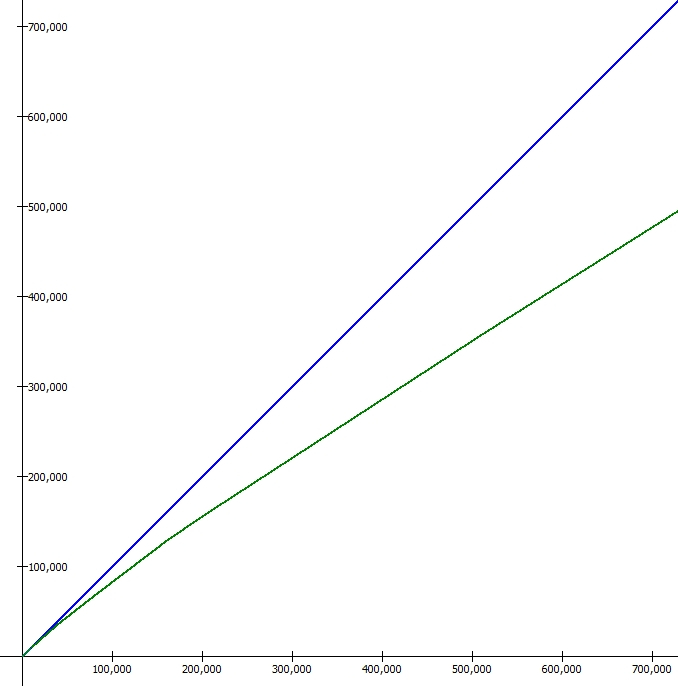
From that graph alone, you might think that going to a higher tax bracket could result in lower after-tax income. But the next graph, of before-tax (blue) and after-tax (green) income shows otherwise:

After_tax_income

All that tax deductions can do is reduce your taxable income. Thus the tax deduction benefits you if you were already donating, but never leaves you richer than you would have been without donating at all.

For example, if you have an income of $700,000, you would pay $223,000 in taxes and keep $477,000 in after-tax income. If you instead donate $100,000, your adjusted gross income will be reduced to $600,000, you will only pay $186,000 in taxes, and you will keep $414,000 in after-tax income. If there were no tax deduction, you would still have to pay $223,000 in taxes, and your after-tax income would be only $377,000. So you do benefit from the tax deduction; but there is no amount of donation which will actually increase your after-tax income to above $477,000.

But we wouldn’t have to do it this way. We could instead apply the deduction as a tax credit, which would make the effect of the deduction far larger.

Several years back, Miles Kimball (an economist who formerly worked at Michigan, now at UC Boulder) proposed a quite clever change to the tax system:

My proposal is to raise marginal tax rates above about $75,000 per person–or $150,000 per couple–by 10% (a dime on every extra dollar), but offer a 100% tax credit for public contributions up to the entire amount of the tax surcharge.

Kimball’s argument for the policy is mainly that this would make a tax increase more palatable, by giving people more control over where their money goes. This is surely true, and a worthwhile endeavor.

But the even larger benefit might come from the increased charitable donations. If we limited the tax credit to particularly high-impact charities, we would increase the donations to those charities. Whereas in the current system you get the same deduction regardless of where you give your money, even though we know that some charities are literally hundreds of times as cost-effective as others.

In fact, we might not even want to limit the tax credit to that 10% surcharge. If people want to donate more than 10% of their income to high-impact charities, perhaps we should let them. This would mean that the federal deficit could actually increase under this policy, but if so, there would have to be so much money donated that we’d most likely end world hunger. That’s a tradeoff I’m quite willing to make.

In principle, we could even introduce a tax credit that is greater than 100%—say for instance you get a 120% donation for the top-rated charities. This is not mathematically inconsistent, though it is surely a very bad idea. In that case, it absolutely would be possible to end up with more money than you started with, and the richer you are, the more you could get. There would effectively be a positive return on charitable donations, with the money paid for from the government budget. Bill Gates for instance could pay $10 billion a year to charity and the government would not only pay for it, but also have to give him an extra $2 billion. So even for the best charities—which probably are actually a good deal more cost-effective than the US government—we should cap the tax credit at 100%.

Obvious choices for high-impact charities include UNICEF, the Red Cross, GiveDirectly, and the Malaria Consortium. We would need some sort of criteria to decide which charities should get the benefits; I’m thinking we could have some sort of panel of experts who rate charities based on their cost-effectiveness.

It wouldn’t have to be all-or-nothing, either; charities with good but not top ratings could get an increased deduction but not a 100% deduction. The expert panel could rate charities on a scale from 0 to 10, and then anything above 5 gets an (X-5)*10% tax credit.

In effect, the current policy says, “If you give to charity, you don’t have to pay taxes on the money you gave; but all of your other taxes still apply.” The new policy would say, “You can give to a top-impact charity instead of paying taxes.”

Americans hate taxes and already give a lot to charity, but most of those donations are to relatively ineffective charities. This policy could incentivize people to give more or at least give to better places, probably without hurting the government budget—and if it does hurt the government budget, the benefits will be well worth the cost.

Just how rich is rich?

May 26 JDN 2458630

I think if there is one single thing I would like more people to know about economics, it is the sheer magnitude of global inequality. Most people seem to have no idea just how rich some people are—and how poor so many others are. They have a vision in their head of what “rich” and “poor” are, and their “rich” is a low-level Wall Street trader making $400,000 a year (the kind of people Gordon Gekko mocks in the film), and “poor” is someone who lives under a bridge in New York City. (They’re both New Yorkers, I guess. New Yorkers seem to be the iconic Americans, which is honestly more representative than you might think—80% of Americans live in urban or suburban areas.)

If we take a global perspective, this is not what “rich” and “poor” truly mean.

In next week’s post I’ll talk about what “poor” means. It’s really appallingly bad. We have to leave the First World in order to find it; many people here are poor, but not that poor. It’s so bad that I think once you really understand it, it can’t but change your whole outlook on the world. But I’m saving that for next week.

This week, I’ll talk about what “rich” really means in today’s world. We needn’t leave the United States, for the top 3 and 6 of the top 10 richest people in the world live here. And they are all White men, by the way, though Carlos Slim and Amancio Ortega are at least Latino.

Going down the list of billionaires ranked by wealth, you have to get down to 15th place before encountering a woman, and it’s really worse than that, because Francoise Bettencourt (15), Alice Walton (17), Jacqueline Mars (33), Yang Huiyan (42), Susan Klatton (46), Laurena Powell-Jobs (54), Abigail Johnson (71), and Iris Fontbona (74) are all heirs. The richest living woman who didn’t simply inherit from her father or husband is actually Gina Rinehart, the 75th richest person in the world. (And note that, while also in some sense an heir, Queen Elizabeth is not on that list; in fact, she’s nowhere near the richest people in the world. She’s not in the top 500.)

You have to get to 20th place before encountering someone non-White (Ma Huateng), and all the way down to 65th before encountering someone not White or East Asian (the Hinduja brothers). Not one of the top 100 richest people is Black.

Just how rich are these people? Well, there’s a meme going around saying that Jeff Bezos could afford to buy every homeless person in the world a house at median market price and still, with just what’s left over, be a multi-billionaire among the top 100 richest people in the world.

And that meme is completely correct. The math checks out.

There are about 554,000 homeless people in the US at any given time.

The median sale price of a currently existing house in the US is about $253,000.

Multiply those two numbers together, and you get $140 billion.

And Jeff Bezos has net wealth of $157 billion.

This means that he would still have $17 billion left after buying all those houses. The 100th richest person in the world has $13 billion, so Jeff Bezos would still be higher than that.

Even $17 billion is enough to spend over $2 million every single day—over $20 per second—and never run out of money as long as the dividends keep paying out.

Jeff Bezos in fact made so much in dividends and capital gains this past quarter that he was taking in as much money as the median Amazon employee’s annual salary—which is more than what I make as a grad student, and only slightly less than the median US individual incomeevery nine seconds. Yes, you read that correctly: Nine (9) seconds. In the time it took you to read this paragraph, Jeff Bezos probably received more in capital gains than you will make this whole year. And if not (because you’re relatively rich or you read quickly), I’m sure he will have in the time it takes you to read this whole post.

When Mitt Romney ran for President, a great deal was made of his net wealth of over $250 million. This is indeed very rich, richer than anyone really needs or probably deserves. But compared to the world’s richest, this is pocket change. Jeff Bezos gets that much in dividends and capital gains every day. Bill Gates could give away that much every day for a year and still not run out of money. (He doesn’t quite give that much, but he does give a lot.)

I grew up in Ann Arbor, Michigan. Ann Arbor is a medium-sized city of about 120,000 people (230th in the US by population), and relatively well-off (median household income about 16% higher than the US median). Nevertheless, if Jeff Bezos wanted to, he could give every single person in Ann Arbor the equivalent of 30 years of their income—over a million dollars each—and still have enough money left to be among the world’s 100 richest people.

Or suppose instead that all the world’s 500 richest people decided to give away all the money they have above $1 billion—so they’d all still be billionaires, but only barely. That $8.7 trillion they have together, minus the $500 billion they’re keeping, would be $8.2 trillion. In fact, let’s say they keep a little more, just to make sure they all have the same ordering: Give each one an extra $1 million for each point they are in the ranking, so that Jeff Bezos would stay on top at $1 B + 500 ($0.001 B) = $1.5 billion, while Bill Gates in second place would have $1 million less, and so on. That would leave us with still over $8 trillion to give away.

How far could that $8 trillion go? Well, suppose we divided it evenly between all 328 million people in the United States. How much would each person receive? Oh, just about $24,000—basically my annual income.

Or suppose instead we spread it out over the entire world: Every single man, woman, and child on the planet Earth gets an equal share. There are 7.7 billion people in the world, so by spreading out $8 trillion between them, each one would get over $1000. For you or I that’s a big enough windfall to feel. For the world’s poorest people, it’s more than they make in several years. It would be life-changing for them. (Actually that’s about what GiveDirectly gives each family—and it is life-changing.)

And let me remind you: This would be leaving them billionaires. They’re just not as much billionaires as before—they only have $1 billion instead of $20 billion or $50 billion or $100 billion. And even $1 billion is obviously enough to live however you want, wherever you want, for the rest of your life, never working another day if you don’t want to. With $1 billion, you can fly in jets (a good one will set you back $20 million), sail in yachts (even a massive 200-footer wouldn’t run much above $200 million), and eat filet mignon at every meal (in fact, at $25 per pound, you can serve it to yourself and a hundred of your friends without breaking a sweat). You can decorate your bedroom with original Jackson Pollock paintings (at $200 million, his most expensive painting is only 20% of your wealth) and bathe in bottles of Dom Perignon (at $400 per liter, a 200-liter bath would cost you about $80,000—even every day that’s only $30 million a year, or maybe half to a third of your capital income). Remember, this is all feasible at just $1 billion—and Jeff Bezos has over a hundred times that. There is no real lifestyle improvement that happens between $1 billion and $157 billion; it’s purely a matter of status and power.

Taking enough to make them mere millionaires would give us another $0.5 trillion to spend (about the GDP of Sweden, one-fourth the GDP of Canada, or 70% of the US military budget).

Do you think maybe these people have too much money?

I’m not saying that we should confiscate all private property. I’m not saying that we should collectivize all industry. I believe in free markets and private enterprise. People should be able to get rich by inventing things and starting businesses.

But should they be able to get that rich? So rich that one man could pay off every mortgage in a whole major city? So rich that the CEO of a company makes what his employees make in a year in less than a minute? So rich that 500 people—enough to fill a large lecture hall—own enough wealth that if it were spread out evenly they could give $1000 to every single person in the world?

If Jeff Bezos had $1.5 million, I’d say he absolutely earned it. Some high-level programmers at Amazon have that much, and they absolutely earned it. If he had $15 million, I’d think maybe he could deserve that, given his contribution to the world. If he had $150 million, I’d find it hard to believe that anyone could really deserve that much, but if it’s part of what we need to make capitalism work, I could live with that.

But Jeff Bezos doesn’t have $1.5 million. He doesn’t have $15 million. He doesn’t have $150 million. He doesn’t have $1.5 billion. He doesn’t even have $15 billion. He has $150 billion. He has over a thousand times the level of wealth at which I was already having to doubt whether any human being could possibly deserve so much money—and once it gets that big, it basically just keeps growing. A stock market crash might drop it down temporarily, but it would come back in a few years.

And it’s not like there’s nothing we could do to spread this wealth around. Some fairly simple changes in how we tax dividends and capital gains would be enough to get a lot of it, and a wealth tax like the one Elizabeth Warren has proposed would help a great deal as well. At the rates people have seriously proposed, these taxes would only really stop their wealth from growing; it wouldn’t meaningfully shrink it.

That could be combined with policy changes about compensation for corporate executives, particularly with regard to stock options, to make it harder to extract such a large proportion of a huge multinational corporation’s wealth into a single individual. We could impose a cap on the ratio between median employee salary (including the entire supply chain!) and total executive compensation (including dividends and capital gains!), say 100 to 1. (Making in 9 seconds what his employees make in a year, Jeff Bezos is currently operating at a ratio of over 3 million to 1.) If you exceed the cap, the remainder is taxed at 100%. This would mean that as a CEO you can still make $100 million a year, but only if your median employee makes $1 million. If your median employee makes $30,000, you’d better keep your own compensation under $3 million, because we’re gonna take the rest.

Is this socialism? I guess maybe it’s democratic socialism, the high-tax, high-spend #ScandinaviaIsBetter welfare state. But it would not be an end to free markets or free enterprise. We’re not collectivizing any industries, let alone putting anyone in guillotines. You could still start a business and make millions or even hundreds of millions of dollars; you’d simply be expected to share that wealth with your employees and our society as a whole, instead of hoarding it all for yourself.