Toward a positive vision of the future

Jun 22 JDN 2460849

Things look pretty bleak right now. Wildfires rage across Canada, polluting the air across North America. Russia is still at war with Ukraine, and Israel seems to be trying to start a war with Iran. ICE continues sending agents without badges to kidnap people in unmarked vehicles and sending them to undisclosed locations. Climate change is getting worse, and US policy is pivoting from subsidizing renewables back to subsidizing fossil fuels. And Trump, now revealed to be a literal fascist, is still President.

But things can get better.

I can’t guarantee that they will, nor can I say when; but there is still hope that a better future is possible.

It has been very difficult to assemble a strong coalition against the increasingly extreme far-right in this country (epitomized by Trump). This seems odd, when most Americans hold relatively centrist views. Yes, more Americans identify as conservative than as liberal, but Trump isn’t a conservative; he’s a radical far-right fascist. Trump recently gave a speech endorsing ethnic cleansing, for goodness’ sake! I’m liberal, but I’d definitely vote for a conservative like Mitt Romney rather than a Stalinist! So why are “conservatives” voting for a fascist?

But setting aside the question of why people voted for Trump, we still have the question of why the left has not been able to assemble a strong coalition against him.

I think part of the problem is that the left really has two coalitions within it: The center left, who were relatively happy with the status quo before Trump and want to go back to that; and the far left, who were utterly unhappy with that status quo and want radical change. So while we all agree that Trump is awful, we don’t really agree on what he’s supposed to be replaced with.

It’s of course possible to be in between, and indeed I would say that I am. While clearly things were better under Obama and Biden than they have been under Trump, there were still a lot of major problems in this country that should have been priorities for national policy but weren’t:

  1. Above all, climate change—the Democrats at least try to do something against it, but not nearly enough. Our carbon emissions are declining, but it’s very unclear if we’ll actually hit our targets. The way we have been going, we’re in for a lot more hurricanes and wildfires and droughts.
  2. Housing affordability is still an absolute crisis; half of renters spend more than the targeted 30% of their income on housing, and a fourth spend more than 50%.Homelessness is now at a record high.
  3. Healthcare is still far too expensive in this country; we continue to spend far more than other First World countries without getting meaningfully better care.
  4. While rights and protections for LGB people have substantially improved in the last 30 years, rights and protections for trans people continue to lag behind.
  5. Racial segregation in housing remains the de facto norm, even though it is de jure illegal.
  6. Livestock remain exempted from the Animal Welfare Act and in 2002 laboratory rats and mice were excluded as well, meaning that cruel or negligent treatment which would be illegal for cats and dogs is still allowed on livestock and lab rats.
  7. Income and wealth inequality in this country remains staggeringly high, and the super-rich continue to gain wealth at a terrifying rate.
  8. Our voting system is terrible—literally the worst possible system that can technically still be considered democracy.

This list is by no means exhaustive, but these are the issues that seem most salient to me.

2 and 3 both clearly showed up in my Index of Necessary Expenditure; these costs were the primary reason why raising a family of 4 was unaffordable on a median household income.

So it isn’t right to say that I was completely happy with how things were going before. But I still think of myself as center left, because I don’t believe we need to tear everything down and start over.

I have relatively simple recommendations that would go a long way toward solving all 8 of these problems:

Climate change could be greatly mitigated if we’d just tax carbon already, or implement a cap-and-trade system like California’s nationwide. If that’s too politically unpalatable, subsidize nuclear power, fusion research, and renewables instead. That’s way worse from a budget perspective, but for some reason Americans are just fanatically opposed to higher gas prices.

Housing affordability is politically thorny, but economically quite simple: Build more housing. Whatever we have to do to make that happen, we should do it. Maybe this involves changes to zoning or other regulations. Maybe it involves subsidies to developers. Maybe it involves deploying eminent domain to build public housing. Maybe it involves using government funds to build housing and then offering it for sale on the market. But whatever we do, we need more housing.

Healthcare costs are a trickier one; Obamacare helped, but wasn’t enough. I think what I would like to see next is an option to buy into Medicare; before you are old enough to get it for free, you can pay a premium to be covered by it. Because Medicare is much more efficient than private insurance, you could pay a lower premium and get better coverage, so a lot of people would likely switch (which is of course exactly why insurance companies would fight the policy at every turn). Even putting everyone on Medicare might not be enough; to really bring costs down, we may need to seriously address the fact that US doctors, particularly specialists, are just radically higher-paid than any other doctors in the world. Is an American doctor who gets $269,000 per year really 88% better than a French doctor who gets $143,000?

The policies we need for LGBT rights are mostly no-brainers.

Okay, I can admit to some reasonable nuance when it comes to trans women in pro sports (the statistical advantages they have over cis women are not as clear-cut as many people think, but they do seem to exist; average athletic performance for trans women seems to be somewhere in between the average for cis men and the average for cis women), but that’s really not a very important issue. Like, seriously, why do we care so much about pro sports? Either let people play sports according to their self-identified gender, or make the two options “cis women” and “other” and let trans people play the latter. And you can do the same thing with school sports, or you can eliminate them entirely because they are a stupid waste of academic resources; but either way this should not be considered a top priority policy question. (If parents want their kids to play sports, they can form their own leagues; the school shouldn’t be paying for it. Winning games is not one of the goals of an academic institution. If you want kids to get more exercise, give them more recess and reform the physical education system so it isn’t so miserable for the kids who need it most.)

But there is absolutely no reason not to let people use whatever pronouns and bathrooms they want; indeed, there doesn’t really seem to be a compelling reason to gender-segregate bathrooms in the first place, and removing that segregation would most benefit women, who often have to wait much longer in line for the bathroom. (The argument that this somehow protects women never made sense to me; if a man wants to assault women in the bathroom, what’s to stop him from just going into the women’s bathroom? It’s not like there’s a magic field that prevents men from entering. He’s already planning on committing a crime, so it doesn’t seem like he’s very liable to held back by social norms. It’s worthwhile to try to find ways to prevent sexual assault, but segregating bathrooms does little or nothing toward that goal—and indeed, trans-inclusive bathrooms do not statistically correlate with higher rates of sexual assault.) But okay, fine, if you insist on having the segregation, at least require gender-neutral bathrooms as well. This is really not that difficult; it’s pretty clearly bigotry driving this, not serious policy concerns.

Not exempting any vertebrate animals from anti-cruelty legislation is an incredibly simple thing to do, obviously morally better, and the only reason we’re not doing it is that it would hurt agribusinesses and make meat more expensive. There is literally zero question what the morally right thing to do here is; the question is only how to get people to actually do that morally right thing.

Finally, how do we fix income inequality? Some people—including some economists—treat this as a very complicated, difficult question, but I don’t think it is. I think the really simple, obvious answer is actually the correct one: Tax rich people more, and use the proceeds to help poor people. We should be taxing the rich a lot more; I want something like the revenue-maximizing rate, estimated at about 70%. (And an even higher rate like the 90% we had in the 1950s is not out of the question.) These funds could either provide services like education and healthcare, or they could simply be direct cash transfers. But one way or another, the simplest, most effective way to reduce inequality is to tax the rich and help the poor. A lot of economists fear that this would hurt the overall economy, but particularly if these rates are really targeted at the super-rich (the top 0.01%), I don’t see how they could, because all those billions of dollars are very clearly monopoly rents rather than genuine productivity. If anything, making it harder to amass monopoly rents should make the economy more efficient. And taking say 90% of the roughly 10% return just the top 400 billionaires make on their staggering wealth would give us an additional $480 billion per year.

Fixing our voting system is also quite straightforward. Ranked-choice voting would be a huge improvement, and has already been implemented successfully in several states. Even better would be range voting, but so far very few places have been bold enough to actually try it. But even ranked-choice voting would remove most of the terrible incentives that plurality voting creates, and likely allow us to move beyond the two-party system into a much more representative multiparty system.

None of this requires overthrowing the entire system or dismantling capitalism.

That is, we can have a positive vision of the future that doesn’t require revolution or radical change.

Unfortunately, there’s still a very good chance we’ll do none of it.

Extrapolating the INE

Apr 6 JDN 2460772

I was only able to find sufficient data to calculate the Index of Necessary Expenditure back to 1990. But I found a fairly consistent pattern that the INE grew at a rate about 20% faster than the CPI over that period, so I decided to take a look at what longer-term income growth looks like if we extrapolate that pattern back further in time.

The result is this graph:

Using the CPI, real per-capita GDP in the US (in 2024 dollars) has grown from $25,760 in 1950 to $85,779 today—increasing by a factor of 3.33. Even accounting for increased inequality and the fact that more families have two income earners, that’s still a substantial increase.

But using the extrapolated INE, real per-capita GDP has only grown from $43,622 in 1950 to $85,779 today—increasing by only a factor of 1.97. This is a much smaller increase, especially when we adjusted for increased inequality and increased employment for women.

Even without the extrapolation, it’s still clear that real INE-adjusted incomes have were basically stagnant in the 2000s, increased rather slowly in the 2020s, and then actually dropped in 2022 after a bunch of government assistance ended. What looked, under the CPI, like steadily increasing real income was actually more like treading water.

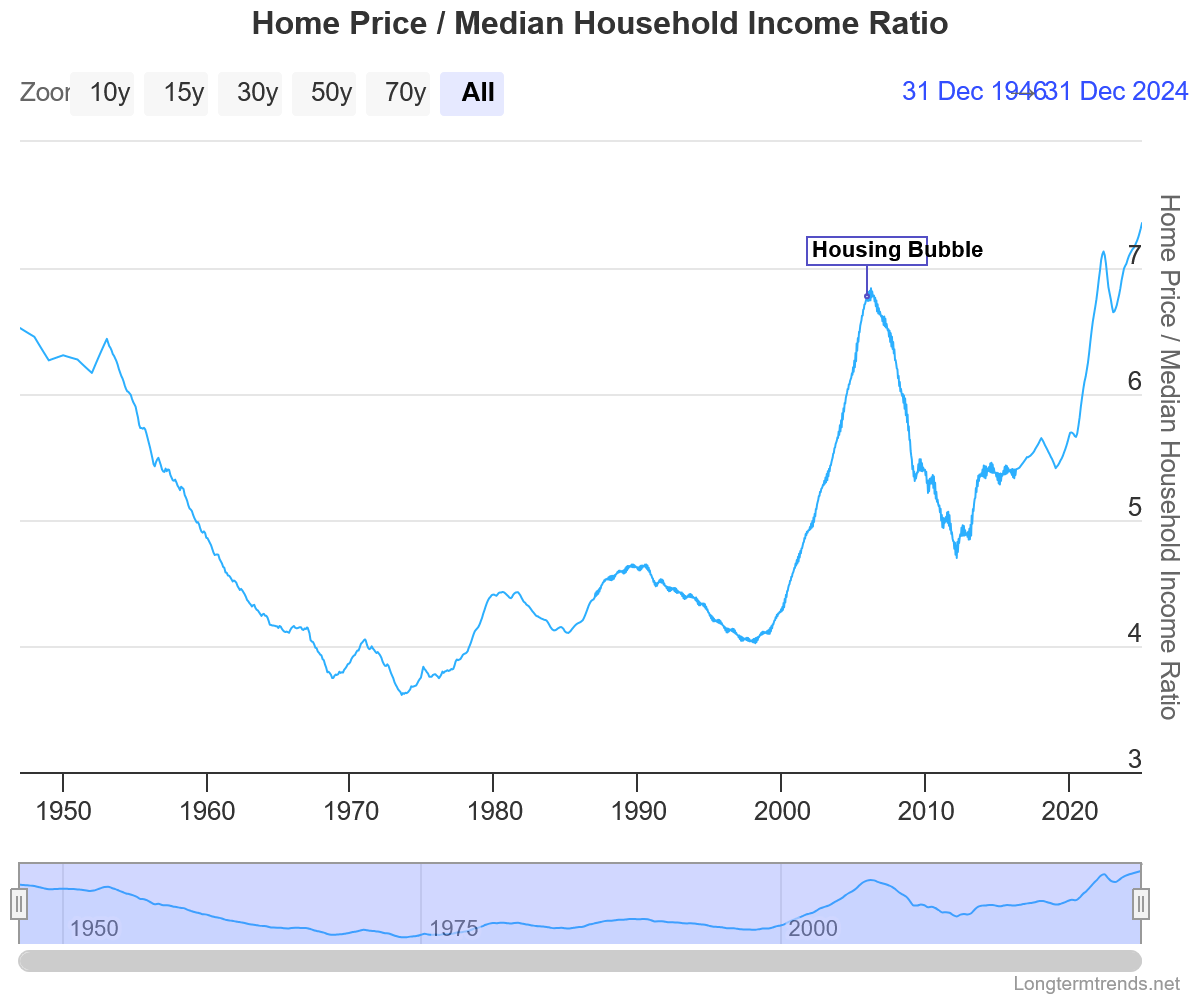
Should we trust this extrapolation? It’s a pretty simplistic approach, I admit. But I think it is plausible when we consider this graph of the ratio between median income and median housing price:

This ratio was around 6 in the 1950s, then began to fall until in the 1970s it stabilized around 4. It began to slowly creep back up, but then absolutely skyrocketed in the 2000s before the 2008 crash. Now it has been rising again, and is now above 7, the highest it has been since the Second World War. (Does this mean we’re due for another crash? I’d bet as much.)

What does this mean? It means that a typical family used to be able to afford a typical house with only four years of their total income—and now would require seven. In that sense, homes are now 75% more expensive today than they were in the 1970s.

Similar arguments can be made for the rising costs of education and healthcare; while many prices have not grown much (gasoline) or even fallen (jewelry and technology), these necessities have continued to grow more and more expensive, not simply in nominal terms, but even compared to the median income.

This is further evidence that our standard measures of “inflation” and “real income” are fundamentally inadequate. They simply aren’t accurately reflecting the real cost of living for most American families. Even in many times when it seemed “inflation” was low and “real income” was growing, in fact it was growing harder and harder to afford vital necessities such as housing, education, and healthcare.

This economic malaise may have been what contributed to the widespread low opinion of Biden’s economy. While the official figures looked good, people’s lives weren’t actually getting better.

Yet this is still no excuse for those who voted for Trump; even the policies he proudly announced he would do—like tariffs and deportations—have clearly made these problems worse, and this was not only foreseeable but actually foreseen by the vast majority of the world’s economists. Then there are all the things he didn’t even say he would do but is now doing, like cozying up to Putin, alienating our closest allies, and discussing “methods” for achieving an unconstitutional third term.

Indeed, it honestly feels quite futile to even reflect upon what was wrong with our economy even when things seemed to be running smoothly, because now things are rapidly getting worse, and showing no sign of getting better in any way any time soon.

Reflections on the Index of Necessary Expenditure

Mar 16 JDN 2460751

In last week’s post I constructed an Index of National Expenditure (INE), attempting to estimate the total cost of all of the things a family needs and can’t do without, like housing, food, clothing, cars, healthcare, and education. What I found shocked me: The median family cannot afford all necessary expenditures.

I have a couple more thoughts about that.

I still don’t understand why people care so much about gas prices.

Gasoline was a relatively small contribution to INE. It was more than clothing but less than utilities, and absolutely dwarfed by housing, food, or college. I thought maybe since I only counted a 15-mile commute, maybe I didn’t actually include enoughgasoline usage, but based on this estimate of about $2000 per driver, I was in about the right range; my estimate for the same year was $3350 for a 2-car family.

I think I still have to go with my salience hypothesis: Gasoline is the only price that we plaster in real-time on signs on the side of the road. So people are constantly aware of it, even though it isn’t actually that important.

The price surge that should be upsetting people is housing.

If the price of homes had only risen with the rate of CPI inflation instead of what it actually did, the median home price in 2024 would be only $234,000 instead of the $396,000 it actually is; and by my estimation that would save a typical family $11,000 per year—a whopping 15% of their income, and nearly enough to make the INE affordable by itself.

Now, I’ll consider some possible objections to my findings.

Objection 1: A typical family doesn’t actually spend this much on these things.

You’re right, they don’t! Because they couldn’t possibly. Even with substantial debt, you just can’t sustainably spend 125% of your after-tax household income.

My goal here was not to estimate how much families actually spend; it was to estimate how much they need to spend in order to live a good life and not feel deprived.


What I have found is that most American families feel deprived. They are forced to sacrifice something really important—like healthcare, or education, or owning a home—because they simply can’t afford it.

What I’m trying to do here is find the price of the American Dream; and what I’ve found is that the American Dream has a price that most Americans cannot afford.

Objection 2: You should use median healthcare spending, not mean.

I did in fact use mean figures instead of median for healthcare expenditures, mainly because only the mean was readily available. Mean income is higher than median income, so you might say that I’ve overestimated healthcare expenditure—and in a sense that’s definitely true. The median family spends less than this on healthcare.

But the reason that the median family spends less than this on healthcare is not that they want to, but that they have to. Healthcare isn’t a luxury that people buy more of because they are richer. People buy either as much as they need or as much as they can afford—whichever is lower, which is typically the latter. Using the mean instead of the median is a crude way to account for that, but I think it’s a defensible one.

But okay, let’s go ahead and cut the estimate of healthcare spending in half; even if you do that, the INE is still larger than after-tax median household income in most years.

Objection 3: A typical family isn’t a family of four, it’s a family of three.

Yes, the mean number of people in a family household in the US is 3.22 (the median is 3).

This is a very bad thing.

Part of what I seem to be finding here is that a family of four is unaffordable—literally impossible to afford—on a typical family income.

But a healthy society is one in which typical families have two or three children. That is what we need in order to achieve population replacement. When families get smaller than that, we aren’t having enough children, and our population will decline—which means that we’ll have too many old people relative to young people. This puts enormous pressure on healthcare and pension systems, which rely upon the fact that young people produce more, in order to pay for the fact that old people cost more.

The ideal average number of births per woman is about 2.1; this is what would give us a steady population. No US state has fertility above this level. The only reason the US population is growing rather than shrinking is that we are taking in immigrants.

This is bad. This is not sustainable. If the reason families aren’t having enough kids is that they can’t afford them—and this fits with other research on the subject—then this economic failure damages our entire society, and it needs to be fixed.

Objection 4: Many families buy their cars used.

Perhaps 1/10 of a new car every year isn’t an ideal estimate of how much people spend on their cars, but if anything I think it’s conservative, because if you only buy a car every 10 years, and it was already used when you bought it, you’re going to need to spend a lot on maintaining it—quite possibly more than it would cost to get a new one. Motley Fool actually estimates the ownership cost of just one car at substantially more than I estimated for two cars. So if anything your complaint should be that I’ve underestimated the cost by not adequately including maintenance and insurance.

Objection 5: Not everyone gets a four-year college degree.

Fair enough; a substantial proportion get associate’s degrees, and most people get no college degree at all. But some also get graduate degrees, which is even more expensive (ask me how I know).

Moreover, in today’s labor market, having a college degree makes a huge difference in your future earnings; a bachelor’s degree increases your lifetime earnings by a whopping 84%. In theory it’s okay to have a society where most people don’t go to college; in practice, in our society, not going to college puts you at a tremendous disadvantage for the rest of your life. So we either need to find a way to bring wages up for those who don’t go to college, or find a way to bring the cost of college down.

This is probably one of the things that families actually choose to scrimp on, only sending one kid to college or none at all. But because college is such a huge determinant of earnings, this perpetuates intergenerational inequality: Only rich families can afford to send their kids to college, and only kids who went to college grow up to have rich families.

Objection 6: You don’t actually need to save for college; you can use student loans.

Yes, you can, and in practice, most people who to college do. But while this solves the liquidity problem (having enough money right now), it does not solve the solvency problem (having enough money in the long run). Failing to save for college and relying on student loans just means pushing the cost of college onto your children—and since we’ve been doing that for over a generation, feel free to replace the category “college savings” with “repaying student loans”; it won’t meaningfully change the results.

The Index of Necessary Expenditure

Mar 16 JDN 2460751

I’m still reeling from the fact that Donald Trump was re-elected President. He seemed obviously horrible at the time, and he still seems horrible now, for many of the same reasons as before (we all knew the tariffs were coming, and I think deep down we knew he would sell out Ukraine because he loves Putin), as well as some brand new ones (I did not predict DOGE would gain access to all the government payment systems, nor that Trump would want to start a “crypto fund”). Kamala Harris was not an ideal candidate, but she was a good candidate, and the comparison between the two could not have been starker.

Now that the dust has cleared and we have good data on voting patterns, I am now less convinced than I was that racism and sexism were decisive against Harris. I think they probably hurt her some, but given that she actually lost the most ground among men of color, racism seems like it really couldn’t have been a big factor. Sexism seems more likely to be a significant factor, but the fact that Harris greatly underperformed Hillary Clinton among Latina women at least complicates that view.

A lot of voters insisted that they voted on “inflation” or “the economy”. Setting aside for a moment how absurd it was—even at the time—to think that Trump (he of the tariffs and mass deportations!) was going to do anything beneficial for the economy, I would like to better understand how people could be so insistent that the economy was bad even though standard statistical measures said it was doing fine.

Krugman believes it was a “vibecession”, where people thought the economy was bad even though it wasn’t. I think there may be some truth to this.


But today I’d like to evaluate another possibility, that what people were really reacting against was not inflation per se but necessitization.

I first wrote about necessitization in 2020; as far as I know, the term is my own coinage. The basic notion is that while prices overall may not have risen all that much, prices of necessities have risen much faster, and the result is that people feel squeezed by the economy even as CPI growth remains low.

In this post I’d like to more directly evaluate that notion, by constructing an index of necessary expenditure (INE).

The core idea here is this:

What would you continue to buy, in roughly the same amounts, even if it doubled in price, because you simply can’t do without it?

For example, this is clearly true of housing: You can rent or you can own, but can’t not have a house. And nor are most families going to buy multiple houses—and they can’t buy partial houses.

It’s also true of healthcare: You need whatever healthcare you need. Yes, depending on your conditions, you maybe could go without, but not without suffering, potentially greatly. Nor are you going to go out and buy a bunch of extra healthcare just because it’s cheap. You need what you need.

I think it’s largely true of education as well: You want your kids to go to college. If college gets more expensive, you might—of necessity—send them to a worse school or not allow them to complete their degree, but this would feel like a great hardship for your family. And in today’s economy you can’t not send your kids to college.

But this is not true of technology: While there is a case to be made that in today’s society you need a laptop in the house, the fact is that people didn’t used to have those not that long ago, and if they suddenly got a lot cheaper you very well might buy another one.

Well, it just so happens that housing, healthcare, and education have all gotten radically more expensive over time, while technology has gotten radically cheaper. So prima facie, this is looking pretty plausible.

But I wanted to get more precise about it. So here is the index I have constructed. I consider a family of four, two adults, two kids, making the median household income.

To get the median income, I’ll use this FRED series for median household income, then use this table of median federal tax burden to get an after-tax wage. (State taxes vary too much for me to usefully include them.) Since the tax table ends in 2020 which was anomalous, I’m going to extrapolate that 2021-2024 should be about the same as 2019.

I assume the kids go to public school, but the parents are saving up for college; to make the math simple, I’ll assume the family is saving enough for each kid to graduate from with a four-year degree from a public university, and that saving is spread over 16 years of the child’s life. 2*4/16 = 0.5; this means that each year the family needs to come up with 0.5 years of cost of attendance. (I had to get the last few years from here, but the numbers are comparable.)

I assume the family owns two cars—both working full time, they kinda have to—which I amortize over 10 year lifetimes; 2*1/10 = 0.2, so each year the family pays 0.2 times the value of an average midsize car. (The current average new car price is $33226; I then use the CPI for cars to figure out what it was in previous years.)

I assume they pay a 30-year mortgage on the median home; they would pay interest on this mortgage, so I need to factor that in. I’ll assume they pay the average mortgage rate in that year, but I don’t want to have to do a full mortgage calculation (including PMI, points, down payment etc.) for each year, so I’ll say that they amount they pay is (1/30 + 0.5 (interest rate))*(home value) per year, which seems to be a reasonable approximation over the relevant range.

I assume that both adults have a 15-mile commute (this seems roughly commensurate with the current mean commute time of 26 minutes), both adults work 5 days per week, 50 weeks per year, and their cars get the median level of gas mileage. This means that they consume 2*15*2*5*50/(median MPG) = 15000/(median MPG) gallons of gasoline per year. I’ll use this BTS data for gas mileage. I’m intentionally not using median gasoline consumption, because when gas is cheap, people might take more road trips, which is consumption that could be avoided without great hardship when gas gets expensive. I will also assume that the kids take the bus to school, so that doesn’t contribute to the gasoline cost.

That I will multiply by the average price of gasoline in June of that year, which I have from the EIA since 1993. (I’ll extrapolate 1990-1992 as the same as 1993, which is conservative.)

I will assume that the family owns 2 cell phones, 1 computer, and 1 television. This is tricky, because the quality of these tech items has dramatically increased over time.

If you try to measure with equivalent buying power (e.g. a 1 MHz computer, a 20-inch CRT TV), then you’ll find that these items have gotten radically cheaper; $1000 in 1950 would only buy as much TV as $7 today, and a $50 Raspberry Pi‘s 2.4 GHz processor is 150 times faster than the 16 MHz offered by an Apple Powerbook in 1991—despite the latter selling for $2500 nominally. So in dollars per gigahertz, the price of computers has fallen by an astonishing 7,500 times just since 1990.

But I think that’s an unrealistic comparison. The standards for what was considered necessary have also increased over time. I actually think it’s quite fair to assume that people have spent a roughly constant nominal amount on these items: about $500 for a TV, $1000 for a computer, and $500 for a cell phone. I’ll also assume that the TV and phones are good for 5 years while the computer is good for 2 years, which makes the total annual expenditure for 2 phones, a TV, and a computer equal to 2/5*500 + 1/5*500 + 1/2*1000 = 800. This is about what a family must spend every year to feel like they have an adequate amount of digital technology.

I will also assume that the family buys clothes with this equivalent purchasing power, with an index that goes from 166 in 1990 to 177 in 2024—also nearly constant in nominal terms. I’ll multiply that index by $10 because the average annual household spending on clothes is about $1700 today.

I will assume that the family buys the equivalent of five months of infant care per year; they surely spend more than this (in either time or money) when they have actual infants, but less as the kids grow. This amounts to about $5000 today, but was only $1600 in 1990—a 214% increase, or 3.42% per year.

For food expenditure, I’m going to use the USDA’s thrifty plan for June of that year. I’ll use the figures assuming that one child is 6 and the other is 9. I don’t have data before 1994, so I’ll extrapolate that with the average growth rate of 3.2%.

Food expenditures have been at a fairly consistent 11% of disposable income since 1990; so I’m going to include them as 2*11%*40*50*(after-tax median wage) = 440*(after-tax median wage).

The figures I had the hardest time getting were for utilities. It’s also difficult to know what to include: Is Internet access a necessity? Probably, nowadays—but not in 1990. Should I separate electric and natural gas, even though they are partial substitutes? But using these figures I estimate that utility costs rise at about 0.8% per year in CPI-adjusted terms, so what I’ll do is benchmark to $3800 in 2016 and assume that utility costs have risen by (0.8% + inflation rate) per year each year.

Healthcare is also a tough one; pardon the heteronormativity, but for simplicity I’m going to use the mean personal healthcare expenditures for one man and woman (aged 19-44) and one boy and one girl (aged 0-18). Unfortunately I was only able to find that for two-year intervals in the range from 2002 to 2020, so I interpolated and extrapolated both directions assuming the same average growth rate of 3.5%.

So let’s summarize what all is included here:

  • Estimated payment on a mortgage
  • 0.5 years of college tuition
  • amortized cost of 2 cars
  • 7500/(median MPG) gallons of gasoline
  • amortized cost of 2 phones, 1 computer, and 1 television
  • average spending on clothes
  • 11% of income on food
  • Estimated utilities spending
  • Estimated childcare equivalent to five months of infant care
  • Healthcare for one man, one woman, one boy, one girl

There are obviously many criticisms you could make of these choices. If I were writing a proper paper, I would search harder for better data and run robustness checks over the various estimation and extrapolation assumptions. But for these purposes I really just want a ballpark figure, something that will give me a sense of what rising cost of living feels like to most people.

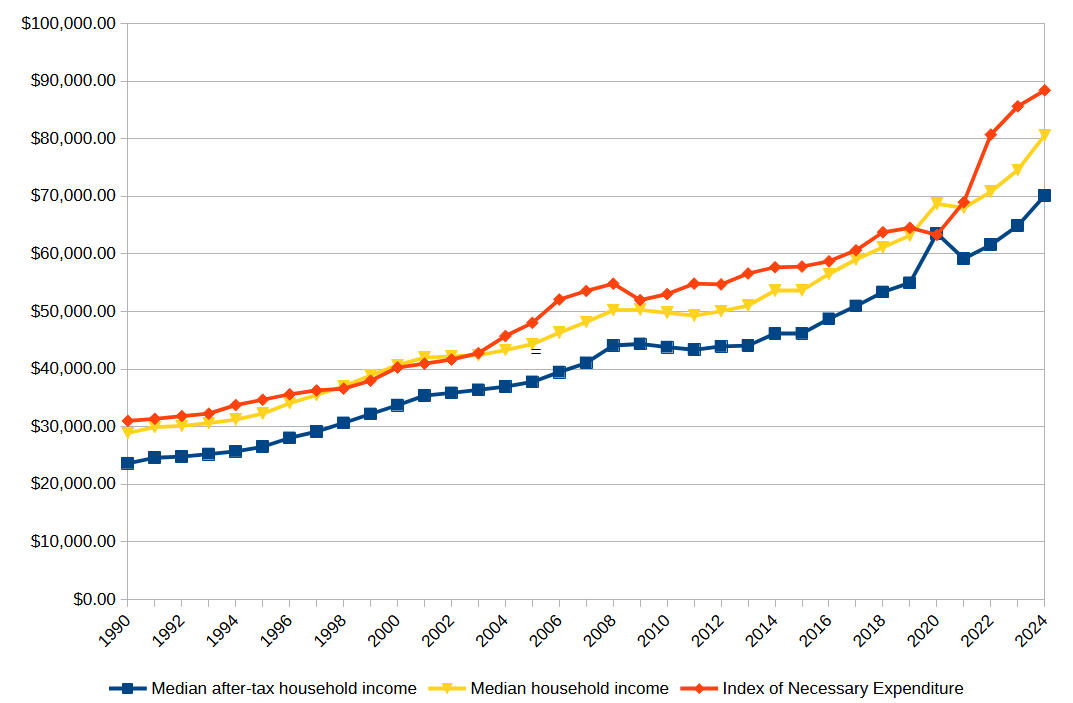
What I found absolutely floored me. Over the range from 1990 to 2024:

  1. The Index of Necessary Expenditure rose by an average of 3.45% per year, almost a full percentage point higher than the average CPI inflation of 2.62% per year.
  2. Over the same period, after-tax income rose at a rate of 3.31%, faster than CPI inflation, but slightly slower than the growth rate of INE.
  3. The Index of Necessary Expenditure was over 100% of median after-tax household income every year except 2020.
  4. Since 2021, the Index of Necessary Expenditure has risen at an average rate of 5.74%, compared to CPI inflation of only 2.66%. In that same time, after-tax income has only grown at a rate of 4.94%.

Point 3 is the one that really stunned me. The only time in the last 34 years that a family of four has been able to actually pay for all necessities—just necessities—on a typical household income was during the COVID pandemic, and that in turn was only because the federal tax burden had been radically reduced in response to the crisis. This means that every single year, a typical American family has been either going further and further into debt, or scrimping on something really important—like healthcare or education.

No wonder people feel like the economy is failing them! It is!

In fact, I can even make sense now of how Trump could convince people with “Are you better off than you were four years ago?” in 2024 looking back at 2020—while the pandemic was horrific and the disruption to the economy was massive, thanks to the US government finally actually being generous to its citizens for once, people could just about actually make ends meet. That one year. In my entire life.

This is why people felt betrayed by Biden’s economy. For the first time most of us could remember, we actually had this brief moment when we could pay for everything we needed and still have money left over. And then, when things went back to “normal”, it was taken away from us. We were back to no longer making ends meet.

When I went into this, I expected to see that the INE had risen faster than both inflation and income, which was indeed the case. But I expected to find that INE was a large but manageable proportion of household income—maybe 70% or 80%—and slowly growing. Instead, I found that INE was greater than 100% of income in every year but one.

And the truth is, I’m not sure I’ve adequately covered all necessary spending! My figures for childcare and utilities are the most uncertain; those could easily go up or down by quite a bit. But even if I exclude them completely, the reduced INE is still greater than income in most years.

Suddenly the way people feel about the economy makes a lot more sense to me.

Adverse selection and all-you-can-eat

Jul 7 JDN 2460499

The concept of adverse selection is normally associated with finance and insurance, and they certainly do have a lot of important applications there. But finance and insurance are complicated (possibly intentionally?) and a lot of people are intimidated by them, and it turns out there’s a much simpler example of this phenomenon, which most people should find familiar:

All-you-can-eat meals.

At most restaurants, you buy a specific amount of food: One cheeseburger, one large order of fries. But at some, you have another option: You can buy an indeterminate amount of food, as much as you are able to eat at one sitting.

Now think about this from the restaurant’s perspective: How do you price an all-you-can-eat meal and turn a profit? Your cost obviously depends on how much food you need to prepare, but you don’t know exactly how much each customer is going to eat.

Fortunately, you don’t need to! You only need to know how much people will eat on average. As long as the average customer’s meal is worth less than what they paid for it, you will continue to make a profit, even though some customers end up eating more than what they paid for.

Insurance works the same way: Some people will cash in on their insurance, costing the company money; but most will not, providing the company with revenue. In fact, you could think of an all-you-can-eat-meal as a form of food insurance.

So, all you need to do is figure out how much an average person eats in one meal, and price based on that, right?

Wrong. Here’s the problem: The people who eat at your restaurant aren’t a random sample of people. They are specifically the kind of people who eat at all-you-can-eat restaurants.

Someone who eats very little probably won’t want to go to your restaurant very much, because they’ll have to pay a high price for very little food. But someone with a big appetite will go to your restaurant frequently, because they get to eat a large amount of food for that same price.

This means that, on average, your customers will end up eating more than what an average restaurant customer eats. You’ll have to raise the price accordingly—which will make the effect even stronger.

This can end in one of two ways: Either an equilibrium is reached where the price is pretty high and most of the customers have big appetites, or no equilibrium is reached, and the restaurant either goes bankrupt or gets rid of its all-you-can-eat policy.

But there’s basically no way to get the outcome that seems the best, which is a low price and a wide variety of people attending the restaurant. Those who eat very little just won’t show up.

That’s adverse selection. Because there’s no way to charge people who eat more a higher price (other than, you know, not being all-you-can-eat), people will self-select by choosing whether or not to attend, and the people who show up at your restaurant will be the ones with big appetites.

The same thing happens with insurance. Say we’re trying to price health insurance; we don’t just need to know the average medical expenses of our population, even if we know a lot of specific demographic information. People who are very healthy may choose not to buy insurance, leaving us with only the less-healthy people buying our insurance—which will force us to raise the price of our insurance.

Once again, you’re not getting a random sample; you’re getting a sample of the kind of people who buy health insurance.

Obamacare was specifically designed to prevent this, by imposing a small fine on people who choose not to buy health insurance. The goal was to get more healthy people buying insurance, in order to bring the cost down. It worked, at least for awhile—but now that individual mandate has been nullified, so adverse selection will once again rear its ugly head. Had our policymakers better understood this concept, they might not have removed the individual mandate.

Another option might occur to you, analogous to the restaurant: What if we just didn’t offer insurance, and made people pay for all their own healthcare? This would be like the restaurant ending its all-you-can-eat policy and charging for each new serving. Most restaurants do that, so maybe it’s the better option in general?

There are two problems here, one ethical, one economic.

The ethical problem is that people don’t deserve to be sick or injured. They didn’t choose those things. So it isn’t fair to let them suffer or bear all the costs of getting better. As a society, we should share in those costs. We should help people in need. (If you don’t already believe this, I don’t know how to convince you of it. But hopefully most people do already believe this.)

The economic problem is that some healthcare is rarely needed, but very expensive. That’s exactly the sort of situation where insurance makes sense, to spread the cost around. If everyone had to pay for their own care with no insurance at all, then most people who get severe illnesses simply wouldn’t be able to afford it. They’d go massively into debt, go bankrupt—people already do, even with insurance!—and still not even get much of the care they need. It wouldn’t matter that we have good treatments for a lot of cancers now; they are all very expensive, so most people with cancer would be unable to pay for them, and they’d just die anyway.

In fact, the net effect of such a policy would probably be to make us all poorer, because a lot of illness and disability would go untreated, making our workforce less productive. Even if you are very healthy and never need health insurance, it may still be in your own self-interest to support a policy of widespread health insurance, so that sick people get treated and can go back to work.

A world without all-you-can-eat restaurants wouldn’t be so bad. But a world without health insurance would be one in which millions of people suffer needlessly because they can’t afford healthcare.

Medical progress, at least, is real

May 26 JDN 2460457

The following vignettes are about me.

Well, one of them is about me as I actually am. The others are about the person I would have been, if someone very much like me, with the same medical conditions, had been born in a particular place and time. Someone in these times and places probably had actual experiences like this, though of course we’ll never know who they were.

976 BC, the hilled lands near the mouth of the river:

Since I was fourteen years old, I have woken up almost every day in pain. Often it is mild, but occasionally it is severe. It often seems to be worse when I encounter certain plants, or if I awaken too early, or if I exert myself too much, or if a storm is coming. No one knows why. The healers have tried every herb and tincture imaginable in their efforts to cure me, but nothing has worked. The priests believe it is a curse from the gods, but at least they appreciate my ability to sometimes predict storms. I am lucky to even remain alive, as I am of little use to the tribe. I will most likely remain this way the rest of my life.

24 AD, Rome:

Since I was fourteen years old, I have woken up almost every day in pain. Often it is mild, but occasionally it is severe. It often seems to be worse when I encounter certain plants, or if I awaken too early, or if I exert myself too much, or if a storm is coming. No one knows why. The healers have tried every herb and tincture imaginable in their efforts to cure me, but nothing has worked. The priests believe it is a curse from the gods, but at least they appreciate my ability to sometimes predict storms. I am lucky that my family was rich enough to teach me reading and mathematics, as I would be of little use for farm work, but can at least be somewhat productive as a scribe and a tutor. I will most likely remain this way the rest of my life.

1024 AD, England:

Since I was fourteen years old, I have woken up almost every day in pain. Often it is mild, but occasionally it is severe. It often seems to be worse when I encounter certain plants, or if I awaken too early, or if I exert myself too much, or if a storm is coming. No one knows why. The healers have tried every herb and tincture imaginable in their efforts to cure me, but nothing has worked. The priests believe it is a curse imposed upon me by some witchcraft, but at least they appreciate my ability to sometimes predict storms. I am lucky that my family was rich enough to teach me reading and mathematics, as I would be of little use for farm work, but can at least be somewhat productive as a scribe and a tutor. I will most likely remain this way the rest of my life.

2024 AD, Michigan:

Since I was fourteen years old, I have woken up almost every day in pain. Often it is mild, but occasionally it is severe. It often seems to be worse when I encounter certain pollens, fragrances, or chemicals, or if I awaken too early, or if I exert myself too much, or when the air pressure changes before a storm. Brain scans detected no gross abnormalities. I have been diagnosed with chronic migraine, but this is more a description of my symptoms than an explanation. I have tried over a dozen different preventative medications; most of them didn’t work at all, some of them worked but gave me intolerable side effects. (One didn’t work at all and put me in the hospital with a severe allergic reaction.) I’ve been more successful with acute medications, which at least work as advertised, but I have to ration them carefully to avoid rebound effects. And the most effective acute medication is a subcutaneous injection that makes me extremely nauseated unless I also take powerful anti-emetics along with it. I have had the most success with botulinum toxin injections, so I will be going back to that soon; but I am also looking into transcranial magnetic stimulation. Currently my condition is severe enough that I can’t return to full-time work, but I am hopeful that with future treatment I will be able to someday. For now, I can at least work as a writer and a tutor. Hopefully things get better soon.

3024 AD, Aegir 7, Ran System:

For a few months when I was fourteen years old, I woke up nearly every day in pain. Often it was mild, but occasionally it was severe. It often seemed to be worse when I encountered certain pollens, fragrances or chemicals, or if I awakened too early, or if I exerted myself too much, or when the air pressure changed before a storm. Brain scans detected no gross abnormalities, only subtle misfiring patterns. Genetic analysis confirmed I had chronic migraine type IVb, and treatment commenced immediately. Acute medications suppressed the pain while I underwent gene therapy and deep-effect transcranial magnetic stimulation. After three months of treatment, I was cured. That was an awful few months, but it’s twenty years behind me now. I can scarcely imagine how it might have impaired my life if it had gone on that whole time.

What is the moral of this story?

Medical progress is real.

Many people often doubt that society has made real progress. And in a lot of ways, maybe it hasn’t. Human nature is still the same, and so many of the problems we suffer have remained the same.

Economically, of course we have had tremendous growth in productivity and output, but it doesn’t really seem to have made us much happier. We have all this stuff, but we’re still struggling and miserable as a handful at the top become spectacularly, disgustingly rich.

Social progress seems to have gone better: Institutions have improved, more of the world is democratic than ever before, and women and minorities are better represented and better protected from oppression. Rates of violence have declined to some of their lowest levels in history. But even then, it’s pretty clear that we have a long, long way to go.

But medical progress is undeniable. We live longer, healthier lives than at any other point in history. Our infant and child mortality rates have plummeted. Even chronic conditions that seem intractable today (such as my chronic migraines) still show signs of progress; in a few generations they should be cured—in surely far less than the thousand years I’ve considered here.

Like most measures of progress, this change wasn’t slow and gradual over thousands of years; it happened remarkably suddenly. Humans went almost 200,000 years without any detectable progress in medicine, using basically the same herbs and tinctures (and a variety of localized and ever-changing superstitions) the entire time. Some of it worked (the herbs and tinctures, at least), but mostly it didn’t. Then, starting around the 18th century, as the Enlightenment took hold and Industrial Revolution ramped up, everything began to change.

We began to test our medicine and see if it actually worked. (Yes, amazingly, somehow, nobody had actually ever thought to do that before—not in anything resembling a scientific way.) And when we learned that most of it didn’t, we began to develop new methods, and see if those worked; and when they didn’t either, we tried new things instead—until, finally, eventually, we actually found medicines that actually did something, medicines worthy of the name. Our understanding of anatomy and biology greatly improved as well, allowing us to make better predictions about the effects our medicines would have. And after a few hundred years of that—a few hundred, out of two hundred thousand years of our species—we actually reached the point where most medicine is effective and a variety of health conditions are simply curable or preventable, including diseases like malaria and polio that had once literally plagued us.

Scientific medicine brought humanity into a whole new era of existence.

I could have set the first vignette 10,000 years ago without changing it. But the final vignette I could probably have set only 200 years from now. I’m actually assuming remarkable stagnation by putting it in the 31st century; but presumably technological advancement will slow at one point, perhaps after we’ve more or less run out of difficult challenges to resolve. (Then again, for all I know, maybe my 31st century counterpart will be an emulated consciousness, and his chronic pain will be resolved in 17.482 seconds by a code update.)

Indeed, the really crazy thing about all this is that there are still millions of people who don’t believe in scientific medicine, who want to use “homeopathy” or “naturopathy” or “acupuncture” or “chiropractic” or whatever else—who basically want to go back to those same old herbs and tinctures that maybe sometimes kinda worked but probably not and nobody really knows. (I have a cousin who is a chiropractor. I try to be polite about it, but….) They point out the various ways that scientific medicine has failed—and believe me, I am painfully aware of those failures—but then where the obvious solution is to improve scientific medicine, they instead want to turn the whole ship around, and go back to what we had before, which was obviously a million times worse.

And don’t tell me it’s harmless: One, it’s a completewaste of resources that could instead have been used for actual scientific medicine. (9% of all out-of-pocket spending on healthcare in the US is on “alternative medicine”—which is to say, on pointless nonsense.) Two, when you have a chronic illness and people keep shoving nonsense treatments in your face, you start to feel blamed for your condition: “Why haven’t you tried [other incredibly stupid idea that obviously won’t work]? You’re so closed-minded! Maybe your illness isn’t really that bad, or you’d be more desperate!” If “alternative medicine” didn’t exist, maybe these people could help me cope with the challenges of living with a chronic illness, or even just sympathize with me, instead of constantly shoving stupid nonsense in my face.

Not everything about the future looks bright.

In particular, I am pessimistic about the near-term future of artificial intelligence, which I think will cause a lot more problems than it solves and does have a small—but not negligible—risk of causing a global catastrophe.

I’m also not very optimistic about climate change; I don’t think it will wipe out our civilization or anything so catastrophic, but I do think it’s going to kill millions of people and we’ve done too little, too late to prevent that. We’re now doing about what we should have been doing in the 1980s.

But I am optimistic about scientific medicine. Every day, new discoveries are made. Every day, new treatments are invented. Yes, there is a lot we haven’t figured out how to cure yet; but people are working on it.

And maybe they could do it faster if we stopped wasting time on stuff that obviously won’t work.

How do we stop overspending on healthcare?

Dec 10 JDN 2460290

I don’t think most Americans realize just how much more the US spends on healthcare than other countries. This is true not simply in absolute terms—of course it is, the US is rich and huge—but in relative terms: As a portion of GDP, our healthcare spending is a major outlier.

Here’s a really nice graph from Healthsystemtracker.org that illustrates it quite nicely: Almost all other First World countries share a simple linear relationship between their per-capita GDP and their per-capita healthcare spending. But one of these things is not like the other ones….

The outlier in the other direction is Ireland, but that’s because their GDP is wildly inflated by Leprechaun Economics. (Notice that it looks like Ireland is by far the richest country in the sample! This is clearly not the case in reality.) With a corrected estimate of their true economic output, they are also quite close to the line.

Since US GDP per capita ($70,181) is in between that of Denmark ($64,898) and Norway ($80,496) both of which have very good healthcare systems (#ScandinaviaIsBetter), we would expect that US spending on healthcare would similarly be in between. But while Denmark spends $6,384 per person per year on healthcare and Norway spends $7,065 per person per year, the US spends $12,914.

That is, the US spends nearly twice as much as it should on healthcare.

The absolute difference between what we should spend and what we actually spend is nearly $6,000 per person per year. Multiply that out by the 330 million people in the US, and…

The US overspends on healthcare by nearly $2 trillion per year.

This might be worth it, if health in the US were dramatically better than health in other countries. (In that case I’d be saying that other countries spend too little.) But plainly it is not.

Probably the simplest and most comparable measure of health across countries is life expectancy. US life expectancy is 76 years, and has increased over time. But if you look at the list of countries by life expectancy, the US is not even in the top 50. Our life expectancy looks more like middle-income countries such as Algeria, Brazil, and China than it does like Norway or Sweden, who should be our economic peers.

There are of course many things that factor into life expectancy aside from healthcare: poverty and homicide are both much worse in the US than in Scandinavia. But then again, poverty is much worse in Algeria, and homicide is much worse in Brazil, and yet they somehow manage to nearly match the US in life expectancy (actually exceeding it in some recent years).

The US somehow manages to spend more on healthcare than everyone else, while getting outcomes that are worse than any country of comparable wealth—and even some that are far poorer.

This is largely why there is a so-called “entitlements crisis” (as many a libertarian think tank is fond of calling it). Since libertarians want to cut Social Security most of all, they like to lump it in with Medicare and Medicaid as an “entitlement” in “crisis”; but in fact we only need a few minor adjustments to the tax code to make sure that Social Security remains solvent for decades to come. It’s healthcare spending that’s out of control.

Here, take a look.

This is the ratio of Social Security spending to GDP from 1966 to the present. Notice how it has been mostly flat since the 1980s, other than a slight increase in the Great Recession.

This is the ratio of Medicare spending to GDP over the same period. Even ignoring the first few years while it was ramping up, it rose from about 0.6% in the 1970s to almost 4% in 2020, and only started to decline in the last few years (and it’s probably too early to say whether that will continue).

Medicaid has a similar pattern: It rose steadily from 0.2% in 1966 to over 3% today—and actually doesn’t even show any signs of leveling off.

If you look at Medicare and Medicaid together, they surged from just over 1% of GDP in 1970 to nearly 7% today:

Put another way: in 1982, Social Security was 4.8% of GDP while Medicare and Medicaid combined were 2.4% of GDP. Today, Social Security is 4.9% of GDP while Medicare and Medicaid are 6.8% of GDP.

Social Security spending barely changed at all; healthcare spending more than doubled. If we reduced our Medicare and Medicaid spending as a portion of GDP back to what it was in 1982, we would save 4.4% of GDP—that is, 4.4% of over $25 trillion per year, so $1.1 trillion per year.

Of course, we can’t simply do that; if we cut benefits that much, millions of people would suddenly lose access to healthcare they need.

The problem is not that we are spending frivolously, wasting the money on treatments no one needs. On the contrary, both Medicare and Medicaid carefully vet what medical services they are willing to cover, and if anything probably deny services more often than they should.

No, the problem runs deeper than this.

Healthcare is too expensive in the United States.

We simply pay more for just about everything, and especially for specialist doctors and hospitals.

In most other countries, doctors are paid like any other white-collar profession. They are well off, comfortable, certainly, but few of them are truly rich. But in the US, we think of doctors as an upper-class profession, and expect them to be rich.

Median doctor salaries are $98,000 in France and $138,000 in the UK—but a whopping $316,000 in the US. Germany and Canada are somewhere in between, at $183,000 and $195,000 respectively.

Nurses, on the other hand, are paid only a little more in the US than in Western Europe. This means that the pay difference between doctors and nurses is much higher in the US than most other countries.

US prices on brand-name medication are frankly absurd. Our generic medications are typically cheaper than other countries, but our brand name pills often cost twice as much. I noticed this immediately on moving to the UK: I had always been getting generics before, because the brand name pills cost ten times as much, but when I moved here, suddenly I started getting all brand-name medications (at no cost to me), because the NHS was willing to buy the actual brand name products, and didn’t have to pay through the nose to do so.

But the really staggering differences are in hospitals.

Let’s compare the prices of a few inpatient procedures between the US and Switzerland. Switzerland, you should note, is a very rich country that spends a lot on healthcare and has nearly the world’s highest life expectancy. So it’s not like they are skimping on care. (Nor is it that prices in general are lower in Switzerland; on the contrary, they are generally higher.)

A coronary bypass in Switzerland costs about $33,000. In the US, it costs $76,000.

A spinal fusion in Switzerland costs about $21,000. In the US? $52,000.

Angioplasty in Switzerland: $9.000. In the US? $32,000.

Hip replacement: Switzerland? $16,000. The US? $28,000.

Knee replacement: Switzerland? $19,000. The US? $27,000.

Cholecystectomy: Switzerland? $8,000. The US? $16,000.

Appendectomy: Switzerland? $7,000. The US? $13,000.

Caesarian section: Switzerland? $8,000. The US? $11,000.

Hospital prices are even lower in Germany and Spain, whose life expectancies are not as high as Switzerland—but still higher than the US.

These prices are so much lower that in fact if you were considering getting surgery for a chronic condition in the US, don’t. Buy plane tickets to Europe and get the procedure done there. Spend an extra few thousand dollars on a nice European vacation and you’d still end up saving money. (Obviously if you need it urgently you have no choice but to use your nearest hospital.) I know that if I ever need a knee replacement (which, frankly, is likely, given my height), I’m gonna go to Spain and thereby save $22,000 relative to what it would cost in the US. That’s a difference of a car.

Combine this with the fact that the US is the only First World country without universal healthcare, and maybe you can see why we’re also the only country in the world where people are afraid to call an ambulance because they don’t think they can afford it. We are also the only country in the world with a medical debt crisis.

Where is all this extra money going?

Well, a lot of it goes to those doctors who are paid three times as much as in France. That, at least, seems defensible: If we want the best doctors in the world maybe we need to pay for them. (Then again, do we have the best doctors in the world? If so, why is our life expectancy so mediocre?)

But a significant portion is going to shareholders.

You probably already knew that there are pharmaceutical companies that rake in huge profits on those overpriced brand-name medications. The top five US pharma companies took in net earnings of nearly $82 billion last year. Pharmaceutical companies typically take in much higher profit margins than other companies: a typical corporation makes about 8% of its revenue in profit, while pharmaceutical companies average nearly 14%.

But you may not have realized that a surprisingly large proportion of hospitals are for-profit businesseseven though they make most of their revenue from Medicare and Medicaid.

I was surprised to find that the US is not unusual in that; in fact, for-profit hospitals exist in dozens of countries, and the fraction of US hospital capacity that is for-profit isn’t even particularly high by world standards.

What is especially large is the profits of US hospitals. 7 healthcare corporations in the US all posted net incomes over $1 billion in 2021.

Even nonprofit US hospitals are tremendously profitable—as oxymoronic as that may sound. In fact, mean operating profit is higher among nonprofit hospitals in the US than for-profit hospitals. So even the hospitals that aren’t supposed to be run for profit… pretty much still are. They get tax deductions as if they were charities—but they really don’t act like charities.

They are basically nonprofit in name only.

So fixing this will not be as simple as making all hospitals nonprofit. We must also restructure the institutions so that nonprofit hospitals are genuinely nonprofit, and no longer nonprofit in name only. It’s normal for a nonprofit to have a little bit of profit or loss—nobody can make everything always balance perfectly—but these hospitals have been raking in huge profits and keeping it all in cash instead of using it to reduce prices or improve services. In the study I linked above, those 2,219 “nonprofit” hospitals took in operating profits averaging $43 million each—for a total of $95 billion.

Between pharmaceutical companies and hospitals, that’s a total of over $170 billion per year just in profit. (That’s more than we spend on food stamps, even after surge due to COVID.) This is pure grift. It must be stopped.

But that still doesn’t explain why we’re spending $2 trillion more than we should! So after all, I must leave you with a question:

What is America doing wrong? Why is our healthcare so expensive?

What most Americans think about government spending

Oct 22 JDN 2460240

American public opinion on government spending is a bit of a paradox. People say the government spends too much, but when you ask them what to cut, they don’t want to cut anything in particular.

This is how various demographics answer when you ask if, overall, the government spends “too much”, “too little”, or “about right”:

Democrats have a relatively balanced view, with about a third in each category. Republicans overwhelmingly agree that the government spends too much.

Let’s focus on the general population figures: 60% of Americans believe the government spends too much, 22% think it is about right, and only 16% think it spends too little. (2% must not have answered.)

This question is vague about how much people would like to see the budget change. So it’s possible people only want a moderate decrease. But they must at least want enough to justify not being in the “about right” category, which presumably allows for at least a few percent of wiggle room in each direction.

I think a reasonable proxy of how much people want the budget to change is the net difference in opinion between “too much” and “too little”: So for Democrats this is 34 – 27 = 7%. For the general population it is 60 – 16 = 44%; and for Republicans it is 88 – 6 = 82%.

To make this a useful proxy, I need to scale it appropriately. Republicans in Congress say they want to cut federal spending by $1 trillion per year, so that would be a reduction of 23%. So, for a reasonable proxy, I think ([too little] – [too much])/4 is about the desired amount of change.

Of course, it’s totally possible for 88% of people to agree that the budget should be cut 10%, and none of them to actually want the budget to be cut 22%. But without actually having survey data showing how much people want to cut the budget, the proportion who want it to be cut is the best proxy I have. And it definitely seems like most people want the budget to be cut.

But cut where? What spending do people want to actually reduce?

Not much, it turns out:

Overwhelming majorities want to increase spending on education, healthcare, social security, infrastructure, Medicare, and assistance to the poor. The plurality want to increase spending on border security, assistance for childcare, drug rehabilitation, the environment, and law enforcement. Overall opinion on military spending and scientific research seems to be that it’s about right, with some saying too high and others too low. That’s… almost the entire budget.

This AP NORC poll found only three areas with strong support for cuts: assistance to big cities, space exploration, and assistance to other countries.

The survey just asked about “the government”, so people may be including opinions on state and local spending as well as federal spending. But let’s just focus for now on federal spending.

Here is what the current budget looks like, divided as closely as I could get it into the same categories that the poll asked about:

The federal government accounts for only a tiny portion of overall government spending on education, so for this purpose I’m just going to ignore that category; anything else would be far too misleading. I had to separately look up border security, foreign aid, space exploration, and scientific research, as they are normally folded into other categories. I decided to keep the medical research under “health” and military R&D under “military”, so the “scientific research” includes all other sciences—and as you’ll note, it’s quite small.

“Regional Development” includes but is by no means limited to aid to big cities; in fact, most of it goes to rural areas. With regard to federal spending, “Transportation” is basically synonymous with “Infrastructure”, so I’ll treat those as equivalent. Federal spending directly on environmental protection is so tiny that I couldn’t even make a useful category for it; for this purpose, I guess I’ll just assume it’s most of “Other” (though it surely isn’t).

As you can see, the lion’s share of the federal budget goes to three things: healthcare (including Medicare), Social Security, and the military. (As Krugman is fond of putting it: “The US government is an insurance company with an army.”)

Assistance to the poor is also a major category, and as well it should be. Debt interest is also pretty substantial, especially now that interest rates have increased, but that’s not really optional; the global financial system would basically collapse if we ever stopped paying that. The only realistic way to bring that down is to balance the budget so that we don’t keep racking up more debt.

After that… it’s all pretty small, relatively speaking. I mean, these are still tens of billions of dollars. But the US government is huge. When you spend $1.24 trillion (that’s $1,240 billion) on Social Security, that $24 billion for space exploration really doesn’t seem that big.

So, that’s what the budget actually looks like. What do people want it to look like? Well on the one hand, they seem to want to cut it. My admittedly very rough estimate suggests they want to cut it about 11%, which would reduce the total from $4.3 trillion to $3.8 trillion. That’s what they say if you ask about the budget as a whole.

But what if we listen to what they say about particular budget categories? Using my same rough estimate, people want to increase spending on healthcare by 12%, spending on Social Security by 14%, and so on.

The resulting new budget looks like this:

Please note two things:

  1. The overall distribution of budget priorities has not substantially changed.
  2. The total amount of spending is in fact moderately higher.

This new budget would be disastrous for Ukraine, painful for NASA, and pleasant for anyone receiving Social Security benefits; but our basic budget outlook would be unchanged. Total spending would rise to $4.6 trillion, about $300 billion more than what we are currently spending.

The things people say they want to cut wouldn’t make a difference: We could stop all space missions immediately and throw Ukraine completely under the bus, and it wouldn’t make a dent in our deficit.

This leaves us with something of a paradox: If you ask them in general what they want to do with the federal budget, the majority of Americans say they want to cut it, often drastically. But if you ask them about any particular budget category, they mostly agree that things are okay, or even want them to be increased. Moreover, it is some of the largest categories of spending—particularly healthcare and Social Security—that often see the most people asking for increases.

I think this tells us some good news and some bad news.

The bad news is that most Americans are quite ignorant about how government money is actually spent. They seem to imagine that huge amounts are frittered away frivolously on earmarks; they think space exploration is far more expensive than it is; they wildly overestimate how much we give in foreign aid; they clearly don’t understand the enormous benefits of funding basic scientific research. Most people seem to think that there is some enormous category of totally wasted money that could easily be saved through more efficient spending—and that just doesn’t seem to be the case. Maybe government spending could be made more efficient, but if so, we need an actual plan for doing that. We can’t just cut budgets and hope for a miracle.

The good news is that our political system, for all of its faults, actually seems to have resulted in a government budget that broadly reflects the actual priorities of our citizenry. On budget categories people like, such as Social Security and Medicare, we are already spending a huge amount. On budget categories people dislike, such as earmarks and space exploration, we are already spending very little. We basically already have the budget most Americans say they want to have.

What does this mean for balancing the budget and keeping the national debt under control?

It means we have to raise taxes. There just isn’t anything left to cut that wouldn’t be wildly unpopular.

This shouldn’t really be shocking. The US government already spends less as a proportion of GDP than most other First World countries [note: I’m using 2019 figures because recent years were distorted by COVID]. Ireland’s figures are untrustworthy due to their inflated leprechaun GDP; so the only unambiguously First World country that clearly has lower government spending than the US is Switzerland. We spend about 38%, which is still high by global standards—but as well it should be, we’re incredibly rich. And this is quite a bit lower than the 41% they spend in the UK or the 45% they spend in Germany, let alone the 49% they spend in Sweden or the whopping 55% they spend in France.

Of course, Americans really don’t like paying taxes either. But at some point, we’re just going to have to decide: Do we want fewer services, more debt, or more taxes? Because those are really our only options. I for one think we can handle more taxes.

There should be a glut of nurses.

Jan 15 JDN 2459960

It will not be news to most of you that there is a worldwide shortage of healthcare staff, especially nurses and emergency medical technicians (EMTs). I would like you to stop and think about the utterly terrible policy failure this represents. Maybe if enough people do, we can figure out a way to fix it.

It goes without saying—yet bears repeating—that people die when you don’t have enough nurses and EMTs. Indeed, surely a large proportion of the 2.6 million (!) deaths each year from medical errors are attributable to this. It is likely that at least one million lives per year could be saved by fixing this problem worldwide. In the US alone, over 250,000 deaths per year are caused by medical errors; so we’re looking at something like 100,000 lives we could safe each year by removing staffing shortages.

Precisely because these jobs have such high stakes, the mere fact that we would ever see the word “shortage” beside “nurse” or “EMT” was already clear evidence of dramatic policy failure.

This is not like other jobs. A shortage of accountants or baristas or even teachers, while a bad thing, is something that market forces can be expected to correct in time, and it wouldn’t be unreasonable to simply let them do so—meaning, let wages rise on their own until the market is restored to equilibrium. A “shortage” of stockbrokers or corporate lawyers would in fact be a boon to our civilization. But a shortage of nurses or EMTs or firefighters (yes, there are those too!) is a disaster.

Partly this is due to the COVID pandemic, which has been longer and more severe than any but the most pessimistic analysts predicted. But there shortages of nurses before COVID. There should not have been. There should have been a massive glut.

Even if there hadn’t been a shortage of healthcare staff before the pandemic, the fact that there wasn’t a glut was already a problem.

This is what a properly-functioning healthcare policy would look like: Most nurses are bored most of the time. They are widely regarded as overpaid. People go into nursing because it’s a comfortable, easy career with very high pay and usually not very much work. Hospitals spend most of their time with half their beds empty and half of their ambulances parked while the drivers and EMTs sit around drinking coffee and watching football games.

Why? Because healthcare, especially emergency care, involves risk, and the stakes couldn’t be higher. If the number of severely sick people doubles—as in, say, a pandemic—a hospital that usually runs at 98% capacity won’t be able to deal with them. But a hospital that usually runs at 50% capacity will.

COVID exposed to the world what a careful analysis would already have shown: There was not nearly enough redundancy in our healthcare system. We had been optimizing for a narrow-minded, short-sighted notion of “efficiency” over what we really needed, which was resiliency and robustness.

I’d like to compare this to two other types of jobs.

The first is stockbrokers.Set aside for a moment the fact that most of what they do is worthless is not actively detrimental to human society. Suppose that their most adamant boosters are correct and what they do is actually really important and beneficial.

Their experience is almost like what I just said nurses ought to be. They are widely regarded (correctly) as very overpaid. There is never any shortage of them; there are people lining up to be hired. People go into the work not because they care about it or even because they are particularly good at it, but because they know it’s an easy way to make a lot of money.

The one thing that seems to be different from my image may not be as different as it seems. Stockbrokers work long hours, but nobody can really explain why. Frankly most of what they do can be—and has been—successfully automated. Since there simply isn’t that much work for them to do, my guess is that most of the time they spend “working” 60-80 hour weeks is actually not actually working, but sitting around pretending to work. Since most financial forecasters are outperformed by a simple diversified portfolio, the most profitable action for most stock analysts to take most of the time would be nothing.

It may also be that stockbrokers work hard at sales—trying to convince people to buy and sell for bad reasons in order to earn sales commissions. This would at least explain why they work so many hours, though it would make it even harder to believe that what they do benefits society. So if we imagine our “ideal” stockbroker who makes the world a better place, I think they mostly just use a simple algorithm and maybe adjust it every month or two. They make better returns than their peers, but spend 38 hours a week goofing off.

There is a massive glut of stockbrokers. This is what it looks like when a civilization is really optimized to be good at something.

The second is soldiers. Say what you will about them, no one can dispute that their job has stakes of life and death. A lot of people seem to think that the world would be better off without them, but that’s at best only true if everyone got rid of them; if you don’t have soldiers but other countries do, you’re going to be in big trouble. (“We’ll beat our swords into liverwurst / Down by the East Riverside; / But no one wants to be the first!”) So unless and until we can solve that mother of all coordination problems, we need to have soldiers around.

What is life like for a soldier? Well, they don’t seem overpaid; if anything, underpaid. (Maybe some of the officers are overpaid, but clearly not most of the enlisted personnel. Part of the problem there is that “pay grade” is nearly synonymous with “rank”—it’s a primate hierarchy, not a rational wage structure. Then again, so are most industries; the military just makes it more explicit.) But there do seem to be enough of them. Military officials may lament of “shortages” of soldiers, but they never actually seem to want for troops to deploy when they really need them. And if a major war really did start that required all available manpower, the draft could be reinstated and then suddenly they’d have it—the authority to coerce compliance is precisely how you can avoid having a shortage while keeping your workers underpaid. (Russia’s soldier shortage is genuine—something about being utterly outclassed by your enemy’s technological superiority in an obviously pointless imperialistic war seems to hurt your recruiting numbers.)

What is life like for a typical soldier? The answer may surprise you. The overwhelming answer in surveys and interviews (which also fits with the experiences I’ve heard about from friends and family in the military) is that life as a soldier is boring. All you do is wake up in the morning and push rubbish around camp.” Bosnia was scary for about 3 months. After that it was boring. That is pretty much day to day life in the military. You are bored.”

This isn’t new, nor even an artifact of not being in any major wars: Union soldiers in the US Civil War had the same complaint. Even in World War I, a typical soldier spent only half the time on the front, and when on the front only saw combat 1/5 of the time. War is boring.

In other words, there is a massive glut of soldiers. Most of them don’t even know what to do with themselves most of the time.

This makes perfect sense. Why? Because an army needs to be resilient. And to be resilient, you must be redundant. If you only had exactly enough soldiers to deploy in a typical engagement, you’d never have enough for a really severe engagement. If on average you had enough, that means you’d spend half the time with too few. And the costs of having too few soldiers are utterly catastrophic.

This is probably an evolutionary outcome, in fact; civilizations may have tried to have “leaner” militaries that didn’t have so much redundancy, and those civilizations were conquered by other civilizations that were more profligate. (This is not to say that we couldn’t afford to cut military spending at all; it’s one thing to have the largest military in the world—I support that, actually—but quite another to have more than the next 10 combined.)

What’s the policy solution here? It’s actually pretty simple.

Pay nurses and EMTs more. A lot more. Whatever it takes to get to the point where we not only have enough, but have so many people lining up to join we don’t even know what to do with them all. If private healthcare firms won’t do it, force them to—or, all the more reason to nationalize healthcare. The stakes are far too high to leave things as they are.

Would this be expensive? Sure.

Removing the shortage of EMTs wouldn’t even be that expensive. There are only about 260,000 EMTs in the US, and they get paid the apallingly low median salary of $36,000. That means we’re currently spending only about $9 billion per year on EMTs. We could double their salaries and double their numbers for only an extra $27 billion—about 0.1% of US GDP.

Nurses would cost more. There are about 5 million nurses in the US, with an average salary of about $78,000, so we’re currently spending about $390 billion a year on nurses. We probably can’t afford to double both salary and staffing. But maybe we could increase both by 20%, costing about an extra $170 billion per year.

Altogether that would cost about $200 billion per year. To save one hundred thousand lives.

That’s $2 million per life saved, or about $40,000 per QALY. The usual estimate for the value of a statistical life is about $10 million, and the usual threshold for a cost-effective medical intervention is $50,000-$100,000 per QALY; so we’re well under both. This isn’t as efficient as buying malaria nets in Africa, but it’s more efficient than plenty of other things we’re spending on. And this isn’t even counting additional benefits of better care that go beyond lives saved.

In fact if we nationalized US healthcare we could get more than these amounts in savings from not wasting our money on profits for insurance and drug companies—simply making the US healthcare system as cost-effective as Canada’s would save $6,000 per American per year, or a whopping $1.9 trillion. At that point we could double the number of nurses and their salaries and still be spending less.

No, it’s not because nurses and doctors are paid much less in Canada than the US. That’s true in some countries, but not Canada. The median salary for nurses in Canada is about $95,500 CAD, which is $71,000 US at current exchange rates. Doctors in Canada can make anywhere from $80,000 to $400,000 CAD, which is $60,000 to $300,000 US. Nor are healthcare outcomes in Canada worse than the US; if anything, they’re better, as Canadians live an average of four years longer than Americans. No, the radical difference in cost—a factor of 2 to 1—between Canada and the US comes from privatization. Privatization is supposed to make things more efficient and lower costs, but it has absolutely not done that in US healthcare.

And if our choice is between spending more money and letting hundreds of thousands or millions of people die every year, that’s no choice at all.

The economic impact of chronic illness

Mar 27 JDN 2459666

This topic is quite personal for me, as someone who has suffered from chronic migraines since adolescence. Some days, weeks, and months are better than others. This past month has been the worst I have felt since 2019, when we moved into an apartment that turned out to be full of mold. This time, there is no clear trigger—which also means no easy escape.

The economic impact of chronic illness is enormous. 90% of US healthcare spending is on people with chronic illnesses, including mental illnesses—and the US has the most expensive healthcare system in the world by almost any measure. Over 55% of adult Medicaid beneficiaries have two or more chronic illnesses.

The total annual cost of all chronic illnesses is hard to estimate, but it’s definitely somewhere in the trillions of dollars per year. The World Economic Forum estimated that number at $47 trillion over the next 20 years, which I actually consider conservative. I think this is counting how much we actually spend and some notion of lost productivity, as well as the (fraught) concept of the value of a statistical life—but I don’t think it’s putting a sensible value on the actual suffering. This will effectively undervalue poor people who are suffering severely but can’t get treated—because they spend little and can’t put a large dollar value on their lives. In the US, where the data is the best, the total cost of chronic illness comes to nearly $4 trillion per year—20% of GDP. If other countries are as bad or worse (and I don’t see why they would be better), then we’re looking at something like $17 trillion in real cost every single year; so over the next 20 years that’s not $47 trillion—it’s over $340 trillion.

Over half of US adults have at least one of the following, and over a quarter have two or more: arthritis, cancer, chronic obstructive pulmonary disease, coronary heart disease, current asthma, diabetes, hepatitis, hypertension, stroke, or kidney disease. (Actually the former very nearly implies the latter, unless chronic conditions somehow prevented one another. Two statistically independent events with 50% probability will jointly occur 25% of the time: Flip two coins.)

Unsurprisingly, age is positively correlated with chronic illness. Income is negatively correlated, both because chronic illnesses reduce job opportunities and because poorer people have more trouble getting good treatment. I am the exception that proves the rule, the upper-middle-class professional with both a PhD and a severe chronic illness.

There seems to be a common perception that chronic illness is largely a “First World problem”, but in fact chronic illnesses are more common—and much less poorly treated—in countries with low and moderate levels of development than they are in the most highly-developed countries. Over 75% of all deaths by non-communicable disease are in low- and middle-income countries. The proportion of deaths that is caused by non-communicable diseases is higher in high-income countries—but that’s because other diseases have been basically eradicated from high-income countries. People in rich countries actually suffer less from chronic illness than people in poor countries (on average).

It’s always a good idea to be careful of the distinction between incidence and prevalence, but with chronic illness this is particularly important, because (almost by definition) chronic illnesses last longer and so can have very high prevalence even with low incidence. Indeed, the odds of someone getting their first migraine (incidence) are low precisely because the odds of being someone who gets migraines (prevalence) is so high.

Quite high in fact: About 10% of men and 20% of women get migraines at least occasionally—though only about 8% of these (so 1% of men and 2% of women) get chronic migraines. Indeed, because ti is both common and can be quite severe, migraine is the second-most disabling condition worldwide as measured by years lived with disability (YLD), after low back pain. Neurologists are particularly likely to get migraines; the paper I linked speculates that they are better at realizing they have migraines, but I think we also need to consider the possibility of self-selection bias where people with migraines may be more likely to become neurologists. (I considered it, and it seems at least as good a reason as becoming a dentist because your name is Denise.)

If you order causes by the number of disability-adjusted life years (DALYs) they cost, chronic conditions rank quite high: while cardiovascular disease and cancer rate by far the highest, diabetes and kidney disease, mental disorders, neurological disorders, and musculoskeletal disorders all rate higher than malaria, HIV, or any other infection except respiratory infections (read: tuberculosis, influenza, and, once these charts are updated for the next few years, COVID). Note also that at the very bottom is “conflict and terrorism”—that’s all organized violence in the world—and natural disasters. Mental disorders alone cost the world 20 times as many DALYs as all conflict and terrorism combined.