Conflict without shared reality

Aug 17 JDN 2460905

Donald Trump has federalized the police in Washington D.C. and deployed the National Guard. He claims he is doing this in response to a public safety emergency and crime that is “out of control”.

Crime rates in Washington, D.C. are declining and overall at their lowest level in 30 years. Its violent crime rate has not been this low since the 1960s.

By any objective standard, there is no emergency here. Crime in D.C. is not by any means out of control.

Indeed, across the United States, homicide rates are as low as they have been in 60 years.

But we do not live in a world where politics is based on objective truth.

We live in a world where the public perception of reality itself is shaped by the political narrative.

One of the first things that authoritarians do to control these narratives is try to make their followers distrust objective sources. I watch in disgust as not simply the Babylon Bee (which is a right-wing satire site that tries really hard to be funny but never quite manages it) but even the Atlantic (a mainstream news outlet generally considered credible) feeds—in multiple articles—into this dangerous lie that crime is increasing and the official statistics are somehow misleading us about that.

Of course the Atlantic‘s take is much more nuanced; but quite frankly, now is not the time for nuance. A fascist is trying to take over our government, and he needs to be resisted at every turn by every means possible. You need to be calling him out on every single lie he makes—yes, every single one, I know there are a lot of them, and that’s kind of the point—rather than trying to find alternative framings on which maybe part of what he said could somehow be construed as reasonable from a certain point of view. Every time you make Trump sound more reasonable than he is—and mainstream news outlets have done this literally hundreds of times—you are pushing America closer to fascism.

I really don’t know what to do here.

It is impossible to resolve conflicts when they are not based on shared reality.

No policy can solve a crime wave that doesn’t exist. No trade agreement can stop unfair trading practices that aren’t happening. Nothing can stop vaccines from causing autism that they already don’t cause. There is no way to fix problems when those problems are completely imaginary.

I used to think that political conflict was about different values which had to be balanced against one another: Liberty versus security, efficiency versus equality, justice versus mercy. I thought that we all agreed on the basic facts and even most of the values, and were just disagreeing about how to weigh certain values over others.

Maybe I was simply naive; maybe it’s never been like that. But it certainly isn’t right now. We aren’t disagreeing about what should be done; we are disagreeing about what is happening in front of our eyes. We don’t simply have different priorities or even different values; it’s like we are living in different worlds.

I have read, e.g. by Jonathan Haidt, that conservatives largely understand what liberals want, but liberals don’t really understand what conservatives want. (I would like to take one of the tests they use in these experiments, see how I actually do; but I’ve never been able to find one.)

Haidt’s particular argument seems to be that liberals don’t “understand” the “moral dimensions” of loyalty, authority, and sanctity, because we only “understand” harm and fairness as the basis of morality. But just because someone says something is morally relevant, that doesn’t mean it is morally relevant! And indeed, based on more or less the entirety of ethical philosophy, I can say that harm and fairness are morality, and the others simply aren’t. They are distortions of morality, they are inherently evil, and we are right to oppose them at every turn. Loyalty, authority, and sanctity are what fed Nazi Germany and the Spanish Inquisition.

This claim that liberals don’t understand conservatives has always seemed very odd to me: I feel like I have a pretty clear idea what conservatives want, it’s just that what they want is terrible: Kick out the immigrants, take money from the poor and give it to the rich, and put rich straight Christian White men back in charge of everything. (I mean, really, if that’s not what they want, why do they keep voting for people who do it? Revealed preferences, people!)

Or, more sympathetically: They want to go back to a nostalgia-tinted vision of the 1950s and 1960s in which it felt like things were going well for our country—because they were blissfully ignorant of all the violence and injustice in the world. No, thank you, Black people and queer people do not want to go back to how we were treated in the 1950s—when segregation was legal and Alan Turing was chemically castrated. (And they also don’t seem to grasp that among the things that did make some things go relatively well in that period were unions, antitrust law and progressive taxes, which conservatives now fight against at every turn.)

But I think maybe part of what’s actually happening here is that a lot of conservatives actually “want” things that literally don’t make sense, because they rest upon assumptions about the world that simply aren’t true.

They want to end “out of control” crime that is the lowest it’s been in decades.

They want to stop schools from teaching things that they already aren’t teaching.

They want the immigrants to stop bringing drugs and crime that they aren’t bringing.

They want LGBT people to stop converting their children, which we already don’t and couldn’t. (And then they want to do their own conversions in the other direction—which also don’t work, but cause tremendous harm.)

They want liberal professors to stop indoctrinating their students in ways we already aren’t and can’t. (If we could indoctrinate our students, don’t you think we’d at least make them read the syllabus?)

They want to cut government spending by eliminating “waste” and “fraud” that are trivial amounts, without cutting the things that are actually expensive, like Social Security, Medicare, and the military. They think we can balance the budget without cutting these things or raising taxes—which is just literally mathematically impossible.

They want to close off trade to bring back jobs that were sent offshore—but those jobs weren’t sent offshore, they were replaced by robots. (US manufacturing output is near its highest ever, even though manufacturing employment is half what it once was.)


And meanwhile, there’s a bunch of real problems that aren’t getting addressed: Soaring inequality, a dysfunctional healthcare system, climate change, the economic upheaval of AI—and they either don’t care about those, aren’t paying attention to them, or don’t even believe they exist.

It feels a bit like this:

You walk into a room and someone points a gun at you, shouting “Drop the weapon!” but you’re not carrying a weapon. And you show your hands, and try to explain that you don’t have a weapon, but they just keep shouting “Drop the weapon!” over and over again. Someone else has already convinced them that you have a weapon, and they expect you to drop that weapon, and nothing you say can change their mind about this.

What exactly should you do in that situation?

How do you avoid getting shot?

Do you drop something else and say it’s the weapon (make some kind of minor concession that looks vaguely like what they asked for)? Do you try to convince them that you have a right to the weapon (accept their false premise but try to negotiate around it)? Do you just run away (leave the country?)? Do you double down and try even harder to convince them that you really, truly, have no weapon?

I’m not saying that everyone on the left has a completely accurate picture of reality; there are clearly a lot of misconceptions on this side of the aisle as well. But at least among the mainstream center left, there seems to be a respect for objective statistics and a generally accurate perception of how the world works—the “reality-based community”. Sometimes liberals make mistakes, have bad ideas, or even tell lies; but I don’t hear a lot of liberals trying to fix problems that don’t exist or asking for the government budget to be changed in ways that violate basic arithmetic.

I really don’t know what do here, though.

How do you change people’s minds when they won’t even agree on the basic facts?

The worst is not inevitable

Jul 14 JDN 2460506

As I write this, the left has just won two historic landslide victories: In France, where a coalition of left-wing parties set aside their differences and prevailed; and in the UK, where the Labour Party just curb-stomped all competition.

Many commentators had been worried that the discredited center-right parties in these countries had left a power vacuum that would be filled by far-right parties like France’s National Rally, but this isn’t what happened. Voters showed up to the polls, and they voted out the center-right all right; but what they put in its place was the center-left, not the far-right.

The New York Times is constitutionally incapable of celebrating anything, so they immediately turned to worries that “turnout was low” and this indicates “an unhappy Britain”. Honestly this seems to be a general failing of journalists: They can’t ever say anything is good. Their entire view of the world is based around “if it bleeds, it leads”. I’m assuming this has something to do with incentives created by the market of news consumers, but it also seems to be an entrenched social norm among journalists themselves. The world must be getting worse, in every way, or if it’s obviously not, we don’t talk about those things—because good things just aren’t news. (Look no further than the fact we now have the lowest global homicide rates in the history of the human race. What, you didn’t realize we had that right now? Could that perhaps be because literally no news source even mentioned it, ever?)

Now, to be fair, turnout was low, and far-right parties did win some representation, and any kind of sudden political shift indicates some kind of public dissatisfaction… but for goodness’ sake, can we take the win for once?

These elections are proof that the free world’s slide into far-right authoritarianism doesn’t have to be inevitable. We can fight it, we are fighting it—and sometimes, we actually win.

So let’s not give up hope in the United States, either. Yes, polls of the Biden/Trump election don’t look great right now; Trump seems to have a slight lead, and it’s way too close for comfort. But we don’t need to roll over and die. The left can win, when we band together well enough; and if France and Britain can pull it off, I don’t see why we can’t too.

And don’t tell me they had way better candidates. The new UK Prime Minister is not a particularly appealing or charismatic candidate. I frankly don’t even like him. He either is a TERF, or is at least willing to capitulate to them. (He also underestimates the number of trans women by about an order of magnitude.) But he won, because the Labour Party won, and he happened to be the Labour Party leader at the time.

Biden is old. Sure. So is Trump. And if it turns out that Biden is really unhealthy, guess what? That means he’ll die or resign and we get a woman of color as President instead. I don’t see eye-to-eye with Kamala Harris on everything, but I don’t see her taking office as a horrible outcome. It’s certainly a hundred times better than what happens if we let Trump win.

Are there better candidates out there? Theoretically, sure. But unless one of them manages to win nomination by one of the two leading parties, that doesn’t matter. Because in a first-past-the-post voting system, you either vote for one of the top two, or you waste your vote. I’m sorry. It sucks. I want a new voting system too. I know exactly which one we could use that would be a hundred times better. But we’re not going to get it by refusing to vote altogether.

We might get a better voting system by voting strategically for candidates who are open to the idea—which at this juncture clearly means Democrats, not Republicans. (At this point in history, Republicans don’t seem entirely convinced that we should decide things democratically in the first place.)There are also other forms of activism we can use, independent of voting. But not voting isn’t a form of activism, and we should stop acting like it is. Not voting is the lazy, selfish, default option. It’s what you’d do if you were a neoclassical rational agent who cares not in the least for his fellow human beings. You should never be proud of not voting. You’re not sending a message; you’re shirking your civic responsibility.

Voting isn’t writing a love letter. It isn’t signing a form endorsing everything a candidate has ever done or ever will do. If you think of it that way, you’re going to never want to vote—and thus you’re going to give up the most important power you have as a citizen of a democracy.

Voting is a decision. It’s choosing one alternative over another. Like any decision in the real world, there will almost never be a perfect option. There will only be better or worse options. Sometimes, even, you’ll feel that there are only bad options, and you are choosing the least-bad option. But you still have to choose the least-bad option, because literally everything else is worse—including doing nothing.

So get out there and try to help Biden win. Not because you love Biden, but because it’s your civic duty. And if enough people do it, we can still win this.

Of men and bears

May 5 JDN 2460436

[CW: rape, violence, crime, homicide]

I think it started on TikTok, but I’m too old for TikTok, so I first saw it on Facebook and Twitter.

Men and women were asked:
“Would you rather be alone in the woods with a man, or a bear?”

Answers seem to have been pretty mixed. Some women still thought a man was a safer choice, but a significant number chose the bear.

Then when the question was changed to a woman, almost everyone chose the woman over the bear.

What can we learn from this?

I think the biggest thing it tells us is that a lot of women are afraid of men. If you are seriously considering the wild animal over the other human being, you’re clearly afraid.

A lot of the discourse on this seems to be assuming that they are right to be afraid, but I’m not so sure.

It’s not that the fear is unfounded: Most women will suffer some sort of harassment, and a sizeable fraction will suffer some sort of physical or sexual assault, at the hands of some men at some point in their lives.

But there is a cost to fear, and I don’t think we’re taking it properly into account here. I’m worried that encouraging women to fear men will only serve to damage relationships between men and women, the vast majority of which are healthy and positive. I’m worried that this fear is really the sort of overreaction to trauma that ends up causing its own kind of harm.

If you think that’s wrong, consider this:

A sizeable fraction of men will be physically assaulted by other men.

Should men fear each other?

Should all men fear all other men?

What does it do to a society when its whole population fears half of its population? Does that sound healthy? Does whatever small increment in security that might provide seem worth it?

Keep in mind that women being afraid of men doesn’t seem to be protecting them from harm right now. So even if there is genuine harm to be feared, the harm of that fear is actually a lot more obvious than the benefit of it. Our entire society becomes fearful and distrustful, and we aren’t actually any safer.

I’m worried that this is like our fear of terrorism, which made us sacrifice our civil liberties without ever clearly making us safer. What are women giving up due to their fear of men? Is it actually protecting them?

If you have any ideas for how we might actually make women safer, let’s hear them. But please, stop saying idiotic things like “Don’t be a rapist.” 95% of men already aren’t, and the 5% who are, are not going to listen to anything you—or I—say to them. (Bystander intervention programs can work. But just telling men to not be rapists does not.)

I’m all for teaching about consent, but it really isn’t that hard to do—and most rapists seem to understand it just fine, they just don’t care. They’ll happily answer on a survey that they “had sex with someone without their consent”. By all means, undermine rape myths; just don’t expect it to dramatically reduce the rate of rape.

I absolutely want to make people safer. But telling people to be afraid of people like me doesn’t actually seem to accomplish that.

And yes, it hurts when people are afraid of you.

This is not a small harm. This is not a minor trifle. Once we are old enough to be seen as “men” rather than “boys” (which seems to happen faster if you’re Black than if you’re White), men know that other people—men and women, but especially women—will fear us. We go through our whole lives having to be careful what we say, how we move, when we touch someone else, because we are shaped like rapists.

When my mother encounters a child, she immediately walks up to the child and starts talking to them, pointing, laughing, giggling. I can’t do that. If I tried to do the exact same thing, I would be seen as a predator. In fact, without children of my own, it’s safer for me to just not interact with children at all, unless they are close friends or family. This is a whole class of joyful, fulfilling experience that I just don’t get to have because people who look like me commit acts of violence.

Normally we’re all about breaking down prejudice, not treating people differently based on how they look—except when it comes to gender, apparently. It’s okay to fear men but not women.

Who is responsible for this?

Well, obviously the ones most responsible are actual rapists.

But they aren’t very likely to listen to me. If I know any rapists, I don’t know that they are rapists. If I did know, I would want them imprisoned. (Which is likely why they wouldn’t tell me if they were.)

Moreover, my odds of actually knowing a rapist are probably lower than you think, because I don’t like to spend time with men who are selfish, cruel, aggressive, misogynist, or hyper-masculine. The fact that 5% of men in general are rapists doesn’t mean that 5% of any non-random sample of men are rapists. I can only think of a few men I have ever known personally who I would even seriously suspect, and I’ve cut ties with all of them.

The fact that psychopaths are not slavering beasts, obviously different from the rest of us, does not mean that there is no way to tell who is a psychopath. It just means that you need to know what you’re actually looking for. When I once saw a glimmer of joy in someone’s eyes as he described the suffering of animals in an experiment, I knew in that moment he was a psychopath. (There are legitimate reasons to harm animals in scientific experiments—but a good person does not enjoy it.) He did not check most of the boxes of the “Slavering Beast theory”: He had many friends; he wasn’t consistently violent; he was a very good liar; he was quite accomplished in life; he was handsome and charismatic. But go through an actual psychopathy checklist, and you realize that every one of these features makes psychopathy more likely, not less.

I’m not even saying it’s easy to detect psychopaths. It’s not. Even experts need to look very closely and carefully, because psychopaths are often very good at hiding. But there are differences. And it really is true that the selfish, cruel, aggressive, misogynist, hyper-masculine men are more likely to be rapists than the generous, kind, gentle, feminist, androgynous men. It’s not a guarantee—there are lots of misogynists who aren’t rapists, and there are men who present as feminists in public but are rapists in private. But it is a tendency nevertheless. You don’t need to treat every man as equally dangerous, and I don’t think it’s healthy to do so.

Indeed, if I had the choice to be alone in the woods with either a gay male feminist or a woman I knew was cruel to animals, I’d definitely choose the man. These differences matter.

And maybe, just maybe, if we could tamp down this fear a little bit, men and women could have healthier interactions with one another and build stronger relationships. Even if the fear is justified, it could still be doing more harm than good.

So are you safer with a man, or a bear?

Let’s go back to the original thought experiment, and consider the actual odds of being attacked. Yes, the number of people actually attacked by bears is far smaller than the number of people actually attacked by men. (It’s also smaller than the number of people attacked by women, by the way.)

This is obviously because we are constantly surrounded by people, and rarely interact with bears.

In other words, that fact alone basically tells us nothing. It could still be true even if bears are far more dangerous than men, because people interact with bears far less often.

The real question is “How likely is an attack, given that you’re alone in the woods with one?”

Unfortunately, I was unable to find any useful statistics on this. There area lot of vague statements like “Bears don’t usually attack humans” or “Bears only attack when startled or protecting their young”; okay. But how often is “usually”? How often are bears startled? What proportion of bears you might encounter are protecting their young?

So this is really a stab in the dark; but do you think it’s perhaps fair to say that maybe 10% of bear-human close encounters result in an attack?

That doesn’t seem like an unreasonably high number, at least. 90% not attacking sounds like “usually”. Being startled or protecting their young don’t seem like events much rarer than 10%. This estimate could certainly be wrong (and I’m sure it’s not precise), but it seems like the right order of magnitude.

So I’m going to take that as my estimate:

If you are alone in the woods with a bear, you have about a 10% chance of being attacked.

Now, what is the probability that a randomly-selected man would attack you, if you were alone in the woods with him?

This one can be much better estimated. It is roughly equal to the proportion of men who are psychopaths.


Now, figures on this vary too, partly because psychopathy comes in degrees. But at the low end we have about 1.2% of men and 0.3% of women who are really full-blown psychopaths, and at the high end we have about 10% of men and 2% of women who exhibit significant psychopathic traits.

I’d like to note two things about these figures:

  1. It still seems like the man is probably safer than the bear.
  2. Men are only about four or five times as likely to be psychopaths as women.

Admittedly, my bear estimate is very imprecise; so if, say, only 5% of bear encounters result in attacks and 10% of men would attack if you were alone in the woods, men could be more dangerous. But I think it’s unlikely. I’m pretty sure bears are more dangerous.

But the really interesting thing is that people who seemed ambivalent about man versus bear, or even were quite happy to choose the bear, seem quite consistent in choosing women over bears. And I’m not sure the gender difference is really large enough to justify that.

If 1.2% to 10% of men are enough for us to fear all men, why aren’t 0.3% to 2% of women enough for us to fear all women? Is there a threshold at 1% or 5% that flips us from “safe” to “dangerous”?

But aren’t men responsible for most violence, especially sexual violence?

Yes, but probably not by as much as you think.

The vast majority of rapesare committed by men, and most of those are against women. But the figures may not be as lopsided as you imagine; in a given year, about 0.3% of women are raped by a man, and about 0.1% of men are raped by a woman. Over their lifetimes, about 25% of women will be sexually assaulted, and about 5% of men will be. Rapes of men by women have gone even more under-reported than rapes in general, in part because it was only recently that being forced to penetrate someone was counted as a sexual assault—even though it very obviously is.

So men are about 5 times as likely to commit rape as women. That’s a big difference, but I bet it’s a lot smaller than what many of you believed. There are statistics going around that claim that as many as 99% of rapes are committed by men; those statistics are ignoring the “forced to penetrate” assaults, and thus basically defining rape of men by women out of existence.

Indeed, 5 to 1 is quite close to the ratio in psychopathy.

I think that’s no coincidence: In fact, I think it’s largely the case that the psychopaths and the rapists are the same people.

What about homicide?

While men are indeed much more likely to be perpetrators of homicide, they are also much more likely to be victims.

Of about 23,000 homicide offenders in 2022, 15,100 were known to be men, 2,100 were known to be women, and 5,800 were unknown (because we never caught them). Assuming that women are no more or less likely to be caught than men, we can ignore the unknown, and presume that the same gender ratio holds across all homicides: 12% are committed by women.

Of about 22,000 homicides in the US last year, 17,700 victims were men. 3,900 victims were women. So men are 4.5 times as likely to be murdered than women in the US. Similar ratios hold in most First World countries (though total numbers are lower).

Overall, this means that men are about 7 times as likely to commit murder, but about 4.5 times as likely to suffer it.

So if we measure by rate of full-blown psychopathy, men are about 4 times as dangerous as women. If we measure by rate of moderate psychopathy, men are about 5 times as dangerous. If we measure by rate of rape, men are about 5 times as dangerous. And if we measure by rate of homicide, men are about 7 times as dangerous—but mainly to each other.

Put all this together, and I think it’s fair to summarize these results as:

Men are about five times as dangerous as women.

That’s not a small difference. But it’s also not an astronomical one. If you are right to be afraid of all men because they could rape or murder you, why are you not also right to be afraid of all women, who are one-fifth as likely to do the same?

Should we all fear everyone?

Surely you can see that isn’t a healthy way for a society to operate. Yes, there are real dangers in this world; but being constantly afraid of everyone will make you isolated, lonely, paranoid and probably depressed—and it may not even protect you.

It seems like a lot of men responding to the “man or bear” meme were honestly shocked that women are so afraid. If so, they have learned something important. Maybe that’s the value in the meme.

But the fear can be real, even justified, and still be hurting more than it’s helping. I don’t see any evidence that it’s actually making anyone any safer.

We need a better answer than fear.

We do seem to have better angels after all

Jun 18 JDN 2460114

A review of The Darker Angels of Our Nature

(I apologize for not releasing this on Sunday; I’ve been traveling lately and haven’t found much time to write.)

Since its release, I have considered Steven Pinker’s The Better Angels of our Nature among a small elite category of truly great books—not simply good because enjoyable, informative, or well-written, but great in its potential impact on humanity’s future. Others include The General Theory of Employment, Interest, and Money, On the Origin of Species, and Animal Liberation.

But I also try to expose myself as much as I can to alternative views. I am quite fearful of the echo chambers that social media puts us in, where dissent is quietly hidden from view and groupthink prevails.

So when I saw that a group of historians had written a scathing critique of The Better Angels, I decided I surely must read it and get its point of view. This book is The Darker Angels of Our Nature.

The Darker Angels is written by a large number of different historians, and it shows. It’s an extremely disjointed book; it does not present any particular overall argument, various sections differ wildly in scope and tone, and sometimes they even contradict each other. It really isn’t a book in the usual sense; it’s a collection of essays whose only common theme is that they disagree with Steven Pinker.

In fact, even that isn’t quite true, as some of the best essays in The Darker Angels are actually the ones that don’t fundamentally challenge Pinker’s contention that global violence has been on a long-term decline for centuries and is now near its lowest in human history. These essays instead offer interesting insights into particular historical eras, such as medieval Europe, early modern Russia, and shogunate Japan, or they add additional nuances to the overall pattern, like the fact that, compared to medieval times, violence in Europe seems to have been less in the Pax Romana (before) and greater in the early modern period (after), showing that the decline in violence was not simple or steady, but went through fluctuations and reversals as societies and institutions changed. (At this point I feel I should note that Pinker clearly would not disagree with this—several of the authors seem to think he would, which makes me wonder if they even read The Better Angels.)

Others point out that the scale of civilization seems to matter, that more is different, and larger societies and armies more or less automatically seem to result in lower fatality rates by some sort of scaling or centralization effect, almost like the square-cube law. That’s very interesting if true; it would suggest that in order to reduce violence, you don’t really need any particular mode of government, you just need something that unites as many people as possible under one banner. The evidence presented for it was too weak for me to say whether it’s really true, however, and there was really no theoretical mechanism proposed whatsoever.

Some of the essays correct genuine errors Pinker made, some of which look rather sloppy. Pinker clearly overestimated the death tolls of the An Lushan Rebellion, the Spanish Inquisition, and Aztec ritual executions, probably by using outdated or biased sources. (Though they were all still extremely violent!) His depiction of indigenous cultures does paint with a very broad brush, and fails to recognize that some indigenous societies seem to have been quite peaceful (though others absolutely were tremendously violent).

One of the best essays is about Pinker’s cavalier attitude toward mass incarceration, which I absolutely do consider a deep flaw in Pinker’s view. Pinker presents increased incarceration rates along with decreased crime rates as if they were an unalloyed good, while I can at best be ambivalent about whether the benefit of decreasing crime is worth the cost of greater incarceration. Pinker seems to take for granted that these incarcerations are fair and impartial, when we have a great deal of evidence that they are strongly biased against poor people and people of color.

There’s another good essay about the Enlightenment, which Pinker seems to idealize a little too much (especially in his other book Enlightenment Now). There was no sudden triumph of reason that instantly changed the world. Human knowledge and rationality gradually improved over a very long period of time, with no obvious turning point and many cases of backsliding. The scientific method isn’t a simple, infallible algorithm that suddenly appeared in the brain of Galileo or Bayes, but a whole constellation of methods and concepts of rationality that took centuries to develop and is in fact still developing. (Much as the Tao that can be told is not the eternal Tao, the scientific method that can be written in a textbook is not the true scientific method.)

Several of the essays point out the limitations of historical and (especially) archaeological records, making it difficult to draw any useful inferences about rates of violence in the past. I agree that Pinker seems a little too cavalier about this; the records really are quite sparse and it’s not easy to fill in the gaps. Very small samples can easily distort homicide rates; since only about 1% of deaths worldwide are homicide, if you find 20 bodies, whether or not one of them was murdered is the difference between peaceful Japan and war-torn Colombia.

On the other hand, all we really can do is make the best inferences we have with the available data, and for the time periods in which we do have detailed records—surely true since at least the 19th century—the pattern of declining violence is very clear, and even the World Wars look like brief fluctuations rather than fundamental reversals. Contrary to popular belief, the World Wars do not appear to have been especially deadly on a per-capita basis, compared to various historic wars. The primary reason so many people died in the World Wars was really that there just were more people in the world. A few of the authors don’t seem to consider this an adequate reason, but ask yourself this: Would you rather live in a society of 100 in which 10 people are killed, or a society of 1 billion in which 1 million are killed? In the former case your chances of being killed are 10%; in the latter, 0.1%. Clearly, per-capita measures of violence are the correct ones.

Some essays seem a bit beside the point, like one on “environmental violence” which quite aptly details the ongoing—terrifying—degradation of our global ecology, but somehow seems to think that this constitutes violence when it obviously doesn’t. There is widespread violence against animals, certainly; slaughterhouses are the obvious example—and unlike most people, I do not consider them some kind of exception we can simply ignore. We do in fact accept levels of cruelty to pigs and cows that we would never accept against dogs or horses—even the law makes such exceptions. Moreover, plenty of habitat destruction is accompanied by killing of the animals who lived in that habitat. But ecological degradation is not equivalent to violence. (Nor is it clear to me that our treatment of animals is more violent overall today than in the past; I guess life is probably worse for a beef cow today than it was in the medieval era, but either way, she was going to be killed and eaten. And at least we no longer do cat-burning.) Drilling for oil can be harmful, but it is not violent. We can acknowledge that life is more peaceful now than in the past without claiming that everything is better now—in fact, one could even say that overall life isn’t better, but I think they’d be hard-pressed to argue that.

These are the relatively good essays, which correct minor errors or add interesting nuances. There are also some really awful essays in the mix.

A common theme of several of the essays seems to be “there are still bad things, so we can’t say anything is getting better”; they will point out various forms of violence that undeniably still exist, and treat this as a conclusive argument against the claim that violence has declined. Yes, modern slavery does exist, and it is a very serious problem; but it clearly is not the same kind of atrocity that the Atlantic slave trade was. Yes, there are still murders. Yes, there are still wars. Probably these things will always be with us to some extent; but there is a very clear difference between 500 homicides per million people per year and 50—and it would be better still if we could bring it down to 5.

There’s one essay about sexual violence that doesn’t present any evidence whatsoever to contradict the claim that rates of sexual violence have been declining while rates of reporting and prosecution have been increasing. (These two trends together often result in reported rapes going up, but most experts agree that actual rapes are going down.) The entire essay is based on anecdote, innuendo, and righteous anger.

There are several essays that spend their whole time denouncing neoliberal capitalism (not even presenting any particularly good arguments against it, though such arguments do exist), seeming to equate Pinker’s view with some kind of Rothbardian anarcho-capitalism when in fact Pinker is explictly in favor of Nordic-style social democracy. (One literally dismisses his support for universal healthcare as “Well, he is Canadian”.) But Pinker has on occasion said good things about capitalism, so clearly, he is an irredeemable monster.

Right in the introduction—which almost made me put the book down—is an astonishingly ludicrous argument, which I must quote in full to show you that it is not out of context:

What actually is violence (nowhere posed or answered in The Better Angels)? How do people perceive it in different time-place settings? What is its purpose and function? What were contemporary attitudes toward violence and how did sensibilities shift over time? Is violence always ‘bad’ or can there be ‘good’ violence, violence that is regenerative and creative?

The Darker Angels of Our Nature, p.16

Yes, the scare quotes on ‘good’ and ‘bad’ are in the original. (Also the baffling jargon “time-place settings” as opposed to, say, “times and places”.) This was clearly written by a moral relativist. Aside from questioning whether we can say anything about anything, the argument seems to be that Pinker’s argument is invalid because he didn’t precisely define every single relevant concept, even though it’s honestly pretty obvious what the world “violence” means and how he is using it. (If anything, it’s these authors who don’t seem to understand what the word means; they keep calling things “violence” that are indeed bad, but obviously aren’t violence—like pollution and cyberbullying. At least talk of incarceration as “structural violence” isn’t obvious nonsense—though it is still clearly distinct from murder rates.)

But it was by reading the worst essays that I think I gained the most insight into what this debate is really about. Several of the essays in The Darker Angels thoroughly and unquestioningly share the following inference: if a culture is superior, then that culture has a right to impose itself on others by force. On this, they seem to agree with the imperialists: If you’re better, that gives you a right to dominate everyone else. They rightly reject the claim that cultures have a right to imperialistically dominate others, but they cannot deny the inference, and so they are forced to deny that any culture can ever be superior to another. The result is that they tie themselves in knots trying to justify how greater wealth, greater happiness, less violence, and babies not dying aren’t actually good things. They end up talking nonsense about “violence that is regenerative and creative”.

But we can believe in civilization without believing in colonialism. And indeed that is precisely what I (along with Pinker) believe: That democracy is better than autocracy, that free speech is better than censorship, that health is better than illness, that prosperity is better than poverty, that peace is better than war—and therefore that Western civilization is doing a better job than the rest. I do not believe that this justifies the long history of Western colonial imperialism. Governing your own country well doesn’t give you the right to invade and dominate other countries. Indeed, part of what makes colonial imperialism so terrible is that it makes a mockery of the very ideals of peace, justice, and freedom that the West is supposed to represent.

I think part of the problem is that many people see the world in zero-sum terms, and believe that the West’s prosperity could only be purchased by the rest of the world’s poverty. But this is untrue. The world is nonzero-sum. My happiness does not come from your sadness, and my wealth does not come from your poverty. In fact, even the West was poor for most of history, and we are far more prosperous now that we have largely abandoned colonial imperialism than we ever were in imperialism’s heyday. (I do occasionally encounter British people who seem vaguely nostalgic for the days of the empire, but real median income in the UK has doubled just since 1977. Inequality has also increased during that time, which is definitely a problem; but the UK is undeniably richer now than it ever was at the peak of the empire.)

In fact it could be that the West is richer now because of colonalism than it would have been without it. I don’t know whether or not this is true. I suspect it isn’t, but I really don’t know for sure. My guess would be that colonized countries are poorer, but colonizer countries are not richer—that is, colonialism is purely destructive. Certain individuals clearly got richer by such depredation (Leopold II, anyone?), but I’m not convinced many countries did.

Yet even if colonialism did make the West richer, it clearly cannot explain most of the wealth of Western civilization—for that wealth simply did not exist in the world before. All these bridges and power plants, laptops and airplanes weren’t lying around waiting to be stolen. Surely, some of the ingredients were stolen—not least, the land. Had they been bought at fair prices, the result might have been less wealth for us (then again it might not, for wealthier trade partners yield greater exports). But this does not mean that the products themselves constitute theft, nor that the wealth they provide is meaningless. Perhaps we should find some way to pay reparations; undeniably, we should work toward greater justice in the future. But we do not need to give up all we have in order to achieve that justice.

There is a law of conservation of energy. It is impossible to create energy in one place without removing it from another. There is no law of conservation of prosperity. Making the world better in one place does not require making it worse in another.

Progress is real. Yes, it is flawed, uneven, and it has costs of its own; but it is real. If we want to have more of it, we best continue to believe in it. And The Better Angels of Our Nature does have some notable flaws, but it still retains its place among truly great books.

What we can be thankful for

Nov 24 JDN 2458812

Thanksgiving is upon us, yet as more and more evidence is revealed implicating President Trump in grievous crimes, as US carbon emissions that had been declining are now trending upward again, as our air quality deteriorates for the first time in decades, it may be hard to see what we should be thankful for.

But these are exceptions to a broader trend: The world is getting better, in almost every way, remarkably quickly. Homicide rates in the US are lower than they’ve been since the 1960s. Worldwide, the homicide rate has fallen 20% since 1990.

While world carbon emissions are still increasing, on a per capita basis they are actually starting to decline, and on an efficiency basis (kilograms of carbon-equivalent per dollar of GDP) they are at their lowest ever. This trend is likely to continue: The price of solar power has rapidly declined to the point where it is now the cheapest form of electric power.
The number—not just proportion, absolute number—of people in extreme poverty has declined by almost two-thirds within my own lifetime. The proportion is the lowest it has ever been in human history. World life expectancy is at its highest ever. Death rates from infectious disease fell by over 85% over the 20th century, and are now at their lowest ever.

I wouldn’t usually cite Reason as a source, but they’re right on this one: Defeat appears imminent for all four Horsemen of the Apocalypse. Pestilence, Famine, War, and even Death are all on the decline. We have a great deal to be grateful for: We are living in a golden age.

This is not to say that we should let ourselves become complacent and stop trying to make the world better: On the contrary, it proves that the world can be made better, which gives us every reason to redouble our efforts to do so.

Our government just voted to let thousands of people die for no reason

May 14, JDN 2457888

The US House of Representatives just voted to pass a bill that will let thousands of Americans die for no reason. At the time of writing it hasn’t yet passed the Senate, but it may yet do so. And if it does, there can be little doubt that President Trump (a phrase I still feel nauseous saying) will sign it.

Some already call it Trumpcare (or “Trump-doesn’t-care”); but officially they call it the American Health Care Act. I think we should use the formal name, because it is a name which is already beginning to take on a dark irony; yes, only in America would such a terrible health care act be considered. Every other highly-developed country has a universal healthcare system; most of them have single-payer systems (and this has been true for over two decades).
The Congressional Budget Office estimates that the AHCA will increase the number of uninsured Americans by 24 million. Of these, 14 million will be people near the poverty line who lose access to Medicaid.

In 2009, a Harvard study estimated that 45,000 Americans die each year because they don’t have health insurance. This is on the higher end; other studies have estimated more like 20,000. But based on the increases in health insurance rates under Obamacare, somewhere between 5,000 and 10,000 American lives have been saved each year since it was enacted. That reduction came from insuring about 10 million people who weren’t insured before.

Making a linear projection, we can roughly estimate the number of additional Americans who will die every year if this American Health Care Act is implemented. (24 million/10 million)(5,000 to 10,000) = 12,000 to 24,000 deaths per year. For comparison, there are about 14,000 total homicides in the United States each year (and we have an exceptionally high homicide rate for a highly-developed country).
Indeed, morally, it might make sense to count these deaths as homicides (by the principle of “depraved indifference”); Trump therefore intends to double our homicide rate.

Of course, it will not be prosecuted this way. And one can even make an ethical case for why it shouldn’t be, why it would be impossible to make policy if every lawmaker had to face the consequences of every policy choice. (Start a war? A hundred thousand deaths. Fail to start a war in response to a genocide? A different hundred thousand deaths.)

But for once, I might want to make an exception. Because these deaths will not be the result of a complex policy trade-off with merits and demerits on both sides. They will not be the result of honest mistakes or unforeseen disasters. These people will die out of pure depraved indifference.

We had a healthcare bill that was working. Indeed, Obamacare was remarkably successful. It increased insurance rates and reduced mortality rates while still managing to slow the growth in healthcare expenditure.

The only real cost was an increase in taxes on the top 5% (and particularly the top 1%) of the income distribution. But the Republican Party—and make no mistake, the vote was on almost completely partisan lines, and not a single Democrat supported it—has now made it a matter of official policy that they care more about cutting taxes on millionaires than they do about poor people dying from lack of healthcare.

Yet there may be a silver lining in all of this: Once people saw that Obamacare could work, the idea of universal healthcare in the United States began to seem like a serious political position. The Overton Window has grown. Indeed, it may even have shifted to the left for once; the responses to the American Health Care Act have been almost uniformly comprised of shock and outrage, when really what the bill does is goes back to the same awful system we had before. Going backward and letting thousands of people die for no reason should appall people—but I feared that it might not, because it would seem “normal”. We in America have grown very accustomed to letting poor people die in order to slightly increase the profits of billionaires, and I thought this time might be no different—but it was different. Once Obamacare actually passed and began to work, people really saw what was happening—that all this suffering and death wasn’t necessary, it wasn’t an inextricable part of having a functioning economy. And now that they see that, they aren’t willing to go back.

What is progress? How far have we really come?

JDN 2457534

It is a controversy that has lasted throughout the ages: Is the world getting better? Is it getting worse? Or is it more or less staying the same, changing in ways that don’t really constitute improvements or detriments?

The most obvious and indisputable change in human society over the course of history has been the advancement of technology. At one extreme there are techno-utopians, who believe that technology will solve all the world’s problems and bring about a glorious future; at the other extreme are anarcho-primitivists, who maintain that civilization, technology, and industrialization were all grave mistakes, removing us from our natural state of peace and harmony.

I am not a techno-utopian—I do not believe that technology will solve all our problems—but I am much closer to that end of the scale. Technology has solved a lot of our problems, and will continue to solve a lot more. My aim in this post is to convince you that progress is real, that things really are, on the whole, getting better.

One of the more baffling arguments against progress comes from none other than Jared Diamond, the social scientist most famous for Guns, Germs and Steel (which oddly enough is mainly about horses and goats). About seven months before I was born, Diamond wrote an essay for Discover magazine arguing quite literally that agriculture—and by extension, civilization—was a mistake.

Diamond fortunately avoids the usual argument based solely on modern hunter-gatherers, which is a selection bias if ever I heard one. Instead his main argument seems to be that paleontological evidence shows an overall decrease in health around the same time as agriculture emerged. But that’s still an endogeneity problem, albeit a subtler one. Maybe agriculture emerged as a response to famine and disease. Or maybe they were both triggered by rising populations; higher populations increase disease risk, and are also basically impossible to sustain without agriculture.

I am similarly dubious of the claim that hunter-gatherers are always peaceful and egalitarian. It does seem to be the case that herders are more violent than other cultures, as they tend to form honor cultures that punish all sleights with overwhelming violence. Even after the Industrial Revolution there were herder honor cultures—the Wild West. Yet as Steven Pinker keeps trying to tell people, the death rates due to homicide in all human cultures appear to have steadily declined for thousands of years.

I read an article just a few days ago on the Scientific American blog which included the following claim so astonishingly nonsensical it makes me wonder if the authors can even do arithmetic or read statistical tables correctly:

I keep reminding readers (see Further Reading), the evidence is overwhelming that war is a relatively recent cultural invention. War emerged toward the end of the Paleolithic era, and then only sporadically. A new study by Japanese researchers published in the Royal Society journal Biology Letters corroborates this view.

Six Japanese scholars led by Hisashi Nakao examined the remains of 2,582 hunter-gatherers who lived 12,000 to 2,800 years ago, during Japan’s so-called Jomon Period. The researchers found bashed-in skulls and other marks consistent with violent death on 23 skeletons, for a mortality rate of 0.89 percent.

That is supposed to be evidence that ancient hunter-gatherers were peaceful? The global homicide rate today is 62 homicides per million people per year. Using the worldwide life expectancy of 71 years (which is biasing against modern civilization because our life expectancy is longer), that means that the worldwide lifetime homicide rate is 4,400 homicides per million people, or 0.44%—that’s less than half the homicide rate of these “peaceful” hunter-gatherers. If you compare just against First World countries, the difference is even starker; let’s use the US, which has the highest homicide rate in the First World. Our homicide rate is 38 homicides per million people per year, which at our life expectancy of 79 years is 3,000 homicides per million people, or an overall homicide rate of 0.3%, slightly more than a third of this “peaceful” ancient culture. The most peaceful societies today—notably Japan, where these remains were found—have homicide rates as low as 3 per million people per year, which is a lifetime homicide rate of 0.02%, forty times smaller than their supposedly utopian ancestors. (Yes, all of Japan has fewer total homicides than Chicago. I’m sure it has nothing to do with their extremely strict gun control laws.) Indeed, to get a modern homicide rate as high as these hunter-gatherers, you need to go to a country like Congo, Myanmar, or the Central African Republic. To get a substantially higher homicide rate, you essentially have to be in Latin America. Honduras, the murder capital of the world, has a lifetime homicide rate of about 6.7%.

Again, how did I figure these things out? By reading basic information from publicly-available statistical tables and then doing some simple arithmetic. Apparently these paleoanthropologists couldn’t be bothered to do that, or didn’t know how to do it correctly, before they started proclaiming that human nature is peaceful and civilization is the source of violence. After an oversight as egregious as that, it feels almost petty to note that a sample size of a few thousand people from one particular region and culture isn’t sufficient data to draw such sweeping judgments or speak of “overwhelming” evidence.

Of course, in order to decide whether progress is a real phenomenon, we need a clearer idea of what we mean by progress. It would be presumptuous to use per-capita GDP, though there can be absolutely no doubt that technology and capitalism do in fact raise per-capita GDP. If we measure by inequality, modern society clearly fares much worse (our top 1% share and Gini coefficient may be higher than Classical Rome!), but that is clearly biased in the opposite direction, because the main way we have raised inequality is by raising the ceiling, not lowering the floor. Most of our really good measures (like the Human Development Index) only exist for the last few decades and can barely even be extrapolated back through the 20th century.

How about babies not dying? This is my preferred measure of a society’s value. It seems like something that should be totally uncontroversial: Babies dying is bad. All other things equal, a society is better if fewer babies die.

I suppose it doesn’t immediately follow that all things considered a society is better if fewer babies die; maybe the dying babies could be offset by some greater good. Perhaps a totalitarian society where no babies die is in fact worse than a free society in which a few babies die, or perhaps we should be prepared to accept some small amount of babies dying in order to save adults from poverty, or something like that. But without some really powerful overriding reason, babies not dying probably means your society is doing something right. (And since most ancient societies were in a state of universal poverty and quite frequently tyranny, these exceptions would only strengthen my case.)

Well, get ready for some high-yield truth bombs about infant mortality rates.

It’s hard to get good data for prehistoric cultures, but the best data we have says that infant mortality in ancient hunter-gatherer cultures was about 20-50%, with a best estimate around 30%. This is statistically indistinguishable from early agricultural societies.

Indeed, 30% seems to be the figure humanity had for most of history. Just shy of a third of all babies died for most of history.

In Medieval times, infant mortality was about 30%.

This same rate (fluctuating based on various plagues) persisted into the Enlightenment—Sweden has the best records, and their infant mortality rate in 1750 was about 30%.

The decline in infant mortality began slowly: During the Industrial Era, infant mortality was about 15% in isolated villages, but still as high as 40% in major cities due to high population densities with poor sanitation.

Even as recently as 1900, there were US cities with infant mortality rates as high as 30%, though the overall rate was more like 10%.

Most of the decline was recent and rapid: Just within the US since WW2, infant mortality fell from about 5.5% to 0.7%, though there remains a substantial disparity between White and Black people.

Globally, the infant mortality rate fell from 6.3% to 3.2% within my lifetime, and in Africa today, the region where it is worst, it is about 5.5%—or what it was in the US in the 1940s.

This precipitous decline in babies dying is the main reason ancient societies have such low life expectancies; actually once they reached adulthood they lived to be about 70 years old, not much worse than we do today. So my multiplying everything by 71 actually isn’t too far off even for ancient societies.

Let me make a graph for you here, of the approximate rate of babies dying over time from 10,000 BC to today:

Infant_mortality.png

Let’s zoom in on the last 250 years, where the data is much more solid:

Infant_mortality_recent.png

I think you may notice something in these graphs. There is quite literally a turning point for humanity, a kink in the curve where we suddenly begin a rapid decline from an otherwise constant mortality rate.

That point occurs around or shortly before 1800—that is, it occurs at industrial capitalism. Adam Smith (not to mention Thomas Jefferson) was writing at just about the point in time when humanity made a sudden and unprecedented shift toward saving the lives of millions of babies.

So now, think about that the next time you are tempted to say that capitalism is an evil system that destroys the world; the evidence points to capitalism quite literally saving babies from dying.

How would it do so? Well, there’s that rising per-capita GDP we previously ignored, for one thing. But more important seems to be the way that industrialization and free markets support technological innovation, and in this case especially medical innovation—antibiotics and vaccines. Our higher rates of literacy and better communication, also a result of raised standard of living and improved technology, surely didn’t hurt. I’m not often in agreement with the Cato Institute, but they’re right about this one: Industrial capitalism is the chief source of human progress.

Billions of babies would have died but we saved them. So yes, I’m going to call that progress. Civilization, and in particular industrialization and free markets, have dramatically improved human life over the last few hundred years.

In a future post I’ll address one of the common retorts to this basically indisputable fact: “You’re making excuses for colonialism and imperialism!” No, I’m not. Saying that modern capitalism is a better system (not least because it saves babies) is not at all the same thing as saying that our ancestors were justified in using murder, slavery, and tyranny to force people into it.

What makes a nation wealthy?

JDN 2457251 EDT 10:17

One of the central questions of economics—perhaps the central question, the primary reason why economics is necessary and worthwhile—is development: How do we raise a nation from poverty to prosperity?

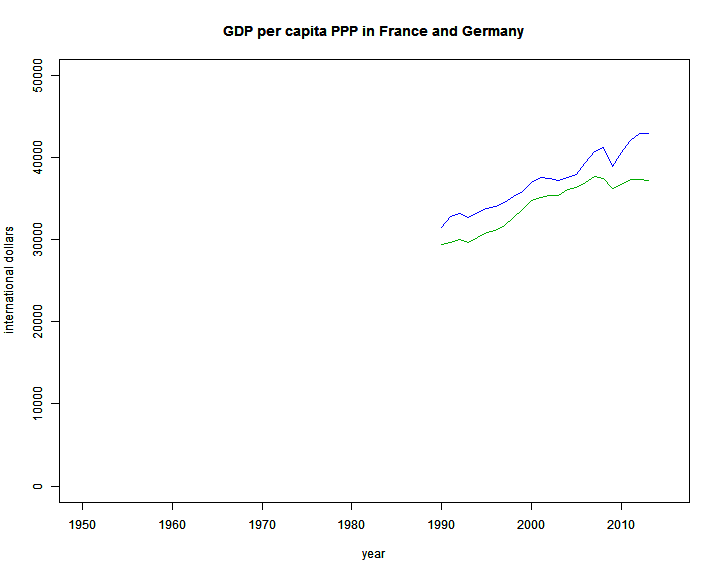
We have done it before: France and Germany rose from the quite literal ashes of World War 2 to some of the most prosperous societies in the world. Their per-capita GDP over the 20th century rose like this (all of these figures are from the World Bank World Development Indicators; France is green, Germany is blue):

GDPPC_France_Germany

GDPPCPPP_France_Germany

The top graph is at market exchange rates, the bottom is correcting for purchasing power parity (PPP). The PPP figures are more meaningful, but unfortunately they only began collecting good data on purchasing power around 1990.

Around the same time, but even more spectacularly, Japan and South Korea rose from poverty-stricken Third World backwaters to high-tech First World powers in only a couple of generations. Check out their per-capita GDP over the 20th century (Japan is green, South Korea is blue):

GDPPC_Japan_KoreaGDPPCPPP_Japan_Korea


This is why I am only half-joking when I define development economics as “the ongoing project to figure out what happened in South Korea and make it happen everywhere in the world”.

More recently China has been on a similar upward trajectory, which is particularly important since China comprises such a huge portion of the world’s population—but they are far from finished:

GDPPC_ChinaGDPPCPPP_China

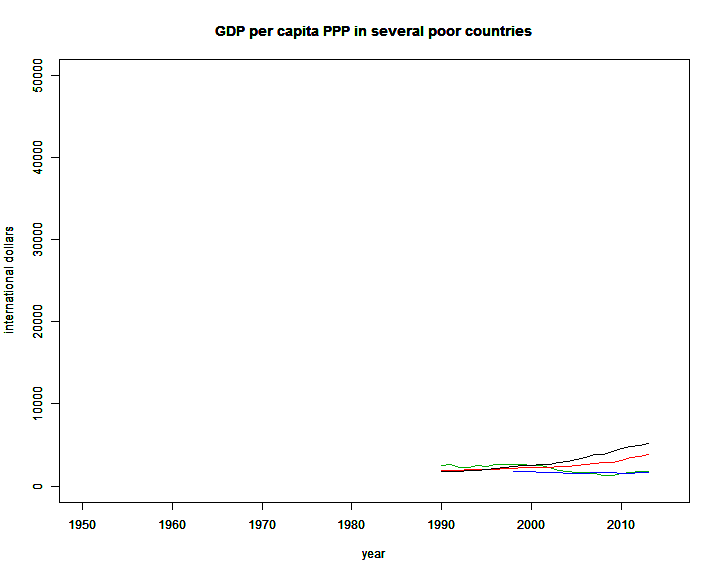
Compare these to societies that have not achieved economic development, such as Zimbabwe (green), India (black), Ghana (red), and Haiti (blue):

GDPPC_poor_countriesGDPPCPPP_poor_countries

They’re so poor that you can barely see them on the same scale, so I’ve rescaled so that the top is $5,000 per person per year instead of $50,000:

GDPPC_poor_countries_rescaledGDPPCPPP_poor_countries_rescaled

Only India actually manages to get above $5,000 per person per year at purchasing power parity, and then not by much, reaching $5,243 per person per year in 2013, the most recent data.

I had wanted to compare North Korea and South Korea, because the two countries were united as recently as the 1945 and were not all that different to begin with, yet have taken completely different development trajectories. Unfortunately, North Korea is so impoverished, corrupt, and authoritarian that the World Bank doesn’t even report data on their per-capita GDP. Perhaps that is contrast enough?

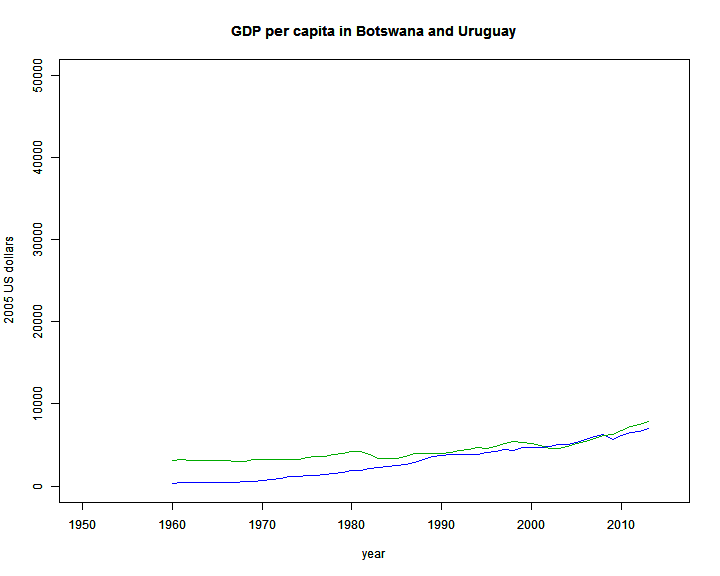
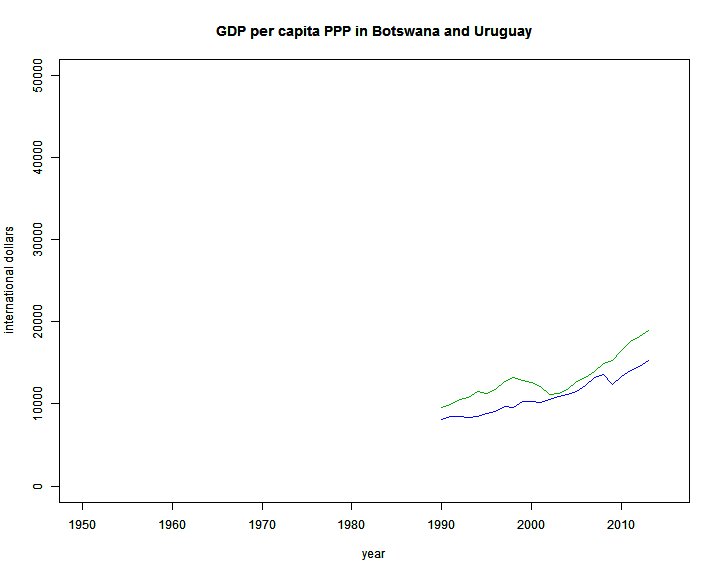
And then of course there are the countries in between, which have made some gains but still have a long way to go, such as Uruguay (green) and Botswana (blue):

GDPPC_Botswana_UruguayGDPPCPPP_Botswana_Uruguay

But despite the fact that we have observed successful economic development, we still don’t really understand how it works. A number of theories have been proposed, involving a wide range of factors including exports, corruption, disease, institutions of government, liberalized financial markets, and natural resources (counter-intuitively; more natural resources make your development worse).

I’m not going to resolve that whole debate in a single blog post. (I may not be able to resolve that whole debate in a single career, though I am definitely trying.) We may ultimately find that economic development is best conceived as like “health”; what factors determine your health? Well, a lot of things, and if any one thing goes badly enough wrong the whole system can break down. Economists may need to start thinking of ourselves as akin to doctors (or as Keynes famously said, dentists), diagnosing particular disorders in particular patients rather than seeking one unifying theory. On the other hand, doctors depend upon biologists, and it’s not clear that we yet understand development even at that level.

Instead I want to take a step back, and ask a more fundamental question: What do we mean by prosperity?

My hope is that if we can better understand what it is we are trying to achieve, we can also better understand the steps we need to take in order to get there.

Thus far it has sort of been “I know it when I see it”; we take it as more or less given that the United States and the United Kingdom are prosperous while Ghana and Haiti are not. I certainly don’t disagree with that particular conclusion; I’m just asking what we’re basing it on, so that we can hopefully better apply it to more marginal cases.


For example: Is
France more or less prosperous than Saudi Arabia? If we go solely by GDP per capita PPP, clearly Saudi Arabia is more prosperous at $53,100 per person per year than France is at $37,200 per person per year.

But people actually live longer in France, on average, than they do in Saudi Arabia. Overall reported happiness is higher in France than Saudi Arabia. I think France is actually more prosperous.


In fact, I think the United States is not as prosperous as we pretend ourselves to be. We are certainly more prosperous than most other countries; we are definitely still well within First World status. But we are not the most prosperous nation in the world.

Our total GDP is astonishingly high (highest in the world nominally, second only to China PPP). Our GDP per-capita is higher than any other country of comparable size; no nation with higher GDP PPP than the US has a population larger than the Chicago metropolitan area. (You may be surprised to find that in order from largest to smallest population the countries with higher GDP per capita PPP are the United Arab Emirates, Switzerland, Hong Kong, Singapore, and then Norway, followed by Kuwait, Qatar, Luxembourg, Brunei, and finally San Marino—which is smaller than Ann Arbor.) Our per-capita GDP PPP of $51,300 is markedly higher than that of France ($37,200), Germany ($42,900), or Sweden ($43,500).

But at the same time, if you compare the US to other First World countries, we have nearly the highest rate of child poverty and higher infant mortality. We have shorter life expectancy and dramatically higher homicide rates. Our inequality is the highest in the world. In France and Sweden, the top 0.01% receive about 1% of the income (i.e. 100 times as much as the average person), while in the United States they receive almost 4%, making someone in the top 0.01% nearly 400 times as rich as the average person.

By estimating solely on GDP per capita, we are effectively rigging the game in our own favor. Or rather, the rich in the United States are rigging the game in their own favor (what else is new?), by convincing all the world’s economists to rank countries based on a measure that favors them.

Amartya Sen, one of the greats of development economics, developed a scale called the Human Development Index that attempts to take broader factors into account. It’s far from perfect, but it’s definitely a step in the right direction.

In particular, France’s HDI is higher than that of Saudi Arabia, fitting my intuition about which country is truly more prosperous. However, the US still does extremely well, with only Norway, Australia, Switzerland, and the Netherlands above us. I think we might still be biased toward high average incomes rather than overall happiness.

In practice, we still use GDP an awful lot, probably because it’s much easier to measure. It’s sort of like IQ tests and SAT scores; we know damn well it’s not measuring what we really care about, but because it’s so much easier to work with we keep using it anyway.

This is a problem, because the better you get at optimizing toward the wrong goal, the worse your overall outcomes are going to be. If you are just sort of vaguely pointed at several reasonable goals, you will probably be improving your situation overall. But when you start precisely optimizing to a specific wrong goal, it can drag you wildly off course.

This is what we mean when we talk about “gaming the system”. Consider test scores, for example. If you do things that will probably increase your test scores among other things, you are likely to engage in generally good behaviors like getting enough sleep, going to class, studying the content. But if your single goal is to maximize your test score at all costs, what will you do? Cheat, of course.

This is also related to the Friendly AI Problem: It is vitally important to know precisely what goals we want our artificial intelligences to have, because whatever goals we set, they will probably be very good at achieving them. Already computers can do many things that were previously impossible, and as they improve over time we will reach the point where in a meaningful sense our AIs are even smarter than we are. When that day comes, we will want to make very, very sure that we have designed them to want the same things that we do—because if our desires ever come into conflict, theirs are likely to win. The really scary part is that right now most of our AI research is done by for-profit corporations or the military, and “maximize my profit” and “kill that target” are most definitely not the ultimate goals we want in a superintelligent AI. It’s trivially easy to see what’s wrong with these goals: For the former, hack into the world banking system and transfer trillions of dollars to the company accounts. For the latter, hack into the nuclear launch system and launch a few ICBMs in the general vicinity of the target. Yet these are the goals we’ve been programming into the actual AIs we build!

If we set GDP per capita as our ultimate goal to the exclusion of all other goals, there are all sorts of bad policies we would implement: We’d ignore inequality until it reached staggering heights, ignore work stress even as it began to kill us, constantly try to maximize the pressure for everyone to work constantly, use poverty as a stick to force people to work even if people starve, inundate everyone with ads to get them to spend as much as possible, repeal regulations that protect the environment, workers, and public health… wait. This isn’t actually hypothetical, is it? We are doing those things.

At least we’re not trying to maximize nominal GDP, or we’d have long-since ended up like Zimbabwe. No, our economists are at least smart enough to adjust for purchasing power. But they’re still designing an economic system that works us all to death to maximize the number of gadgets that come off assembly lines. The purchasing-power adjustment doesn’t include the value of our health or free time.

This is why the Human Development Index is a major step in the right direction; it reminds us that society has other goals besides maximizing the total amount of money that changes hands (because that’s actually all that GDP is measuring; if you get something for free, it isn’t counted in GDP). More recent refinements include things like “natural resource services” that include environmental degradation in estimates of investment. Unfortunately there is no accepted way of doing this, and surprisingly little research on how to improve our accounting methods. Many nations seem resistant to doing so precisely because they know it would make their economic policy look bad—this is almost certainly why China canceled its “green GDP” initiative. This is in fact all the more reason to do it; if it shows that our policy is bad, that means our policy is bad and should be fixed. But people have allowed themselves to value image over substance.

We can do better still, and in fact I think something like QALY is probably the way to go. Rather than some weird arbitrary scaling of GDP with lifespan and Gini index (which is what the HDI is), we need to put everything in the same units, and those units must be directly linked to human happiness. At the very least, we should make some sort of adjustment to our GDP calculation that includes the distribution of wealth and its marginal utility; adding $1,000 to the economy and handing it to someone in poverty should count for a great deal, but adding $1,000,000 and handing it to a billionaire should count for basically nothing. (It’s not bad to give a billionaire another million; but it’s hardly good either, as no one’s real standard of living will change.) Calculating that could be as simple as dividing by their current income; if your annual income is $10,000 and you receive $1,000, you’ve added about 0.1 QALY. If your annual income is $1 billion and you receive $1 million, you’ve added only 0.001 QALY. Maybe we should simply separate out all individual (or household, to be simpler?) incomes, take their logarithms, and then use that sum as our “utility-adjusted GDP”. The results would no doubt be quite different.

This would create a strong pressure for policy to be directed at reducing inequality even at the expense of some economic output—which is exactly what we should be willing to do. If it’s really true that a redistribution policy would hurt the overall economy so much that the harms would outweigh the benefits, then we shouldn’t do that policy; but that is what you need to show. Reducing total GDP is not a sufficient reason to reject a redistribution policy, because it’s quite possible—easy, in fact—to improve the overall prosperity of a society while still reducing its GDP. There are in fact redistribution policies so disastrous they make things worse: The Soviet Union had them. But a 90% tax on million-dollar incomes would not be such a policy—because we had that in 1960 with little or no ill effect.

Of course, even this has problems; one way to minimize poverty would be to exclude, relocate, or even murder all your poor people. (The Black Death increased per-capita GDP.) Open immigration generally increases poverty rates in the short term, because most of the immigrants are poor. Somehow we’d need to correct for that, only raising the score if you actually improve people’s lives, and not if you make them excluded from the calculation.

In any case it’s not enough to have the alternative measures; we must actually use them. We must get policymakers to stop talking about “economic growth” and start talking about “human development”; a policy that raises GDP but reduces lifespan should be immediately rejected, as should one that further enriches a few at the expense of many others. We must shift the discussion away from “creating jobs”—jobs are only a means—to “creating prosperity”.