What we still have to be thankful for

Nov 30 JDN 2461010

This post has been written before, but will go live after, Thanksgiving.

Thanksgiving is honestly a very ambivalent holiday.

The particular event it celebrates don’t seem quite so charming in their historical context: Rather than finding peace and harmony with all Native Americans, the Pilgrims in fact allied with the Wampanoag against the Narragansett, though they did later join forces with the Narragansett in order to conquer the Pequot. And of course we all know how things went for most Native American nations in the long run.

Moreover, even the gathering of family comes with some major downsides, especially in a time of extreme political polarization such as this one. I won’t be joining any of my Trump-supporting relatives for dinner this year (and they probably wouldn’t have invited me anyway), but the fact that this means becoming that much more detached from a substantial part of my extended family is itself a tragedy.

This year in particular, US policy has gotten so utterly horrific that it often feels like we have nothing to be thankful for at all, that all we thought was good and just in the world could simply be torn away at a moment’s notice by raving madmen. It isn’t really quite that bad—but it feels that way sometimes.

It also felt a bit uncanny celebrating Thanksgiving a few years ago when we were living in Scotland, for the UK does not celebrate Thanksgiving, but absolutely does celebrate Black Friday: Holidays may be local, but capitalism is global.

But fall feasts of giving thanks are far more ancient than that particular event in 1621 that we have mythologized to oblivion. They appear in numerous cultures across the globe—indeed their very ubiquity may be why the Wampanoag were so willing to share one with the Pilgrims despite their cultures having diverged something like 40,000 years prior.

And I think that it is by seeing ourselves in that context—as part of the whole of humanity—that we can best appreciate what we truly do have to be thankful for, and what we truly do have to look forward to in the future.

Above all, medicine.

We have actual treatments for some diseases, even actual cures for some. By no means all, of course—and it often feels like we are fighting an endless battle even against what we can treat.

But it is worth reflecting on the fact that aside from the last few centuries, this has simply not been the case. There were no actual treatments. There was no real medicine.

Oh, sure, there were attempts at medicine; and there was certainly what we would think of as more like “first aid”: bandaging wounds, setting broken bones. Even amputation and surgery were done sometimes. But most medical treatment was useless or even outright harmful—not least because for most of history, most of it was done without anesthetic or even antiseptic!

There were various herbal remedies for various ailments, some of which even have happened to work: Willow bark genuinely helps with pain, St. John’s wort is a real antidepressant, and some traditional burn creams are surprisingly effective.

But there was no system in place for testing medicine, no way of evaluating what remedies worked and what didn’t. And thus, for every remedy that worked as advertised, there were a hundred more that did absolutely nothing, or even made things worse.

Today, it can feel like we are all chronically ill, because so many of us take so many different pills and supplements. But this is not a sign that we are ill—it is a sign that we can be treated. The pills are new, yes—but the illnesses they treat were here all along.

I don’t see any particular reason to think that Roman plebs or Medieval peasants were any less likely to get migraines than we are; but they certainly didn’t have access to sumatriptan or rimegepant. Maybe they were less likely to get diabetes, but mainly because they were much more likely to be malnourished. (Well, okay, also because they got more exercise, which we surely could stand to.) And they only reason they didn’t get Alzheimer’s was that they usually didn’t live long enough.

Looking further back, before civilization, human health actually does seem to have been better: Foragers were rarely malnourished, weren’t exposed to as many infectious pathogens, and certainly got plenty of exercise. But should a pathogen like smallpox or influenza make it to a forager tribe, the results were often utterly catastrophic.

Today, we don’t really have the sort of plague that human beings used to deal with. We have pandemics, which are also horrible, but far less so. We were horrified by losing 0.3% of our population to COVID; a society that had only suffered 0.3%—or even ten times that, 3%—losses from the Black Death would have been hailed as a miracle, for a more typical rate was 30%.

At 0.3%, most of us knew somebody, or knew somebody who knew somebody, who died from COVID. At 3%, nearly everyone would know somebody, and most would know several. At 30%, nearly everyone would have close family and friends who died.

Then there is infant mortality.

As recently as 1950—this is living memory—the global infant mortality rate was 14.6%. This is about half what it had been historically; for most of human history, roughly a third of all children died between birth and the age of 5.

Today, it is 2.5%.

Where our distant ancestors expected two out of three of their children to survive and our own great-grandparents expected five out of six can now safely expect thirty-nine out of forty to live. This is the difference between “nearly every family has lost a child” and “most families have not lost a child”.

And this is worldwide; in highly-developed countries it’s even better. The US has a relatively high infant mortality rate by the standards of highly-developed countries (indeed, are we even highly-developed, or are we becoming like Saudi Arabia, extremely rich but so unequal that it doesn’t really mean anything to most of our people?). Yet even for us, the infant mortality rate is 0.5%—so we can expect one-hundred-ninety-nine out of two-hundred to survive. This is at the level of “most families don’t even know someone who has lost a child.”

Poverty is a bit harder to measure.

I am increasingly dubious of conventional measures of poverty; ever since compiling my Index of Necessary Expenditure, I am convinced that economists in general, and perhaps US economists in particular, are systematically underestimating the cost of living and thereby underestimating the prevalence of poverty. (I don’t think this is intentional, mind you; I just think it’s a result of using convenient but simplistic measures and not looking too closely into the details.) I think not being able to sustainably afford a roof over your head constitutes being poor—and that applies to a lot of people.

Yet even with that caveat in mind, it’s quite clear that global poverty has greatly declined in the long run.

At the “extreme poverty” level, currently defined as consuming $1.90 at purchasing power parity per day—that’s just under $700 per year, less than 2% of the median personal income in the United States—the number of people has fallen from 1.9 billion in 1990 to about 700 million today. That’s from 36% of the world’s population to under 9% today.

Now, there are good reasons to doubt that “purchasing power parity” really can be estimated as accurately as we would like, and thus it’s not entirely clear that people living on “$2 per day PPP” are really living at less than 2% the standard of living of a typical American (honestly to me that just sounds like… dead); but they are definitely living at a much worse standard of living, and there are a lot fewer people living at such low standard of living today than there used to be not all that long ago. These are people who don’t have reliable food, clean water, or even basic medicine—and that used to include over a third of humanity and does no longer. (And I would like to note that actually finding such a person and giving them a few hundred dollars absolutely would change their life, and this is the sort of thing GiveDirectly does. We may not know exactly how to evaluate their standard of living, but we do know that the actual amount of money they have access to is very, very small.)

There are many ways in which the world could be better than it is.

Indeed, part of the deep, overwhelming outrage I feel pretty much all the time lies in the fact that it would be so easy to make things so much better for so many people, if there weren’t so many psychopaths in charge of everything.


Increased foreign aid is one avenue by which that could be achieved—so, naturally, Trump cut it tremendously. More progressive taxation is another—so, of course, we get tax cuts for the rich.

Just think about the fact that there are families with starving children for whom a $500 check could change their lives; but nobody is writing that check, because Elon Musk needs to become a literal trillionaire.

There are so many water lines and railroad tracks and bridges and hospitals and schools not being built because the money that would have paid for them is tied up in making already unfathomably-rich people even richer.

But even despite all that, things are getting better. Not every day, not every month, not even every year—this past year was genuinely, on net, a bad one. But nearly every decade, every generation, and certainly every century (for at least the last few), humanity has fared better than we did the last.

As long as we can keep that up, we still have much to hope for—and much to be thankful for.

Grief, a rationalist perspective

Aug 31 JDN 2460919

This post goes live on the 8th anniversary of my father’s death. Thus it seems an appropriate time to write about grief—indeed, it’s somewhat difficult for me to think about much else.

Far too often, the only perspectives on grief we hear are religious ones. Often, these take the form of consolation: “He’s in a better place now.” “You’ll see him again someday.”

Rationalism doesn’t offer such consolations. Technically one can be an atheist and still believe in an afterlife; but rationalism is stronger than mere atheism. It requires that we believe in scientific facts, and the permanent end of consciousness at death is a scientific fact. We know from direct experiments and observations in neuroscience that a destroyed brain cannot think, feel, see, hear, or remember—when your brain shuts down, whatever you are now will be gone.

It is the Basic Fact of Cognitive Science: There is no soul but the brain.

Moreover, I think, deep down, we all know that death is the end. Even religious people grieve. Their words may say that their loved one is in a better place, but their tears tell a different story.

Maybe it’s an evolutionary instinct, programmed deep into our minds like an ancestral memory, a voice that screams in our minds, insistent on being heard:

Death is bad!”

If there is one crucial instinct a lifeform needs in order to survive, surely it is something like that one: The preference for life over death. In order to live in a hostile world, you have to want to live.

There are some people who don’t want to live, people who become suicidal. Sometimes even the person we are grieving was someone who chose to take their own life. Generally this is because they believe that their life from then on would be defined only by suffering. Usually, I would say they are wrong about that; but in some cases, maybe they are right, and choosing death is rational. Most of the time, life is worth living, even when we can’t see that.

But aside from such extreme circumstances, most of us feel most of the time that death is one of the worst things that could happen to us or our loved ones. And it makes sense that we feel that way. It is right to feel that way. It is rational to feel that way.

This is why grief hurts so much.

This is why you are not okay.

If the afterlife were real—or even plausible—then grief would not hurt so much. A loved one dying would be like a loved one traveling away to somewhere nice; bittersweet perhaps, maybe even sad—but not devastating the way that grief is. You don’t hold a funeral for someone who just booked a one-way trip to Hawaii, even if you know they aren’t ever coming back.

Religion tries to be consoling, but it typically fails. Because that voice in our heads is still there, repeating endlessly: “Death is bad!” “Death is bad!” “Death is bad!”

But what if religion does give people some comfort in such a difficult time? What if supposing something as nonsensical as Heaven numbs the pain for a little while?

In my view, you’d be better off using drugs. Drugs have side effects and can be addictive, but at least they don’t require you to fundamentally abandon your ontology. Mainstream religion isn’t simply false; it’s absurd. It’s one of the falsest things anyone has ever believed about anything. It’s obviously false. It’s ridiculous. It has never deserved any of the respect and reverence it so often receives.

And in a great many cases, religion is evil. Religion teaches people to be obedient to authoritarians, and to oppress those who are different. Some of the greatest atrocities in history were committed in the name of religion, and some of the worst oppression going on today is done in the name of religion.

Rationalists should give religion no quarter. It is better for someone to find solace in alcohol or cannabis than for them to find solace in religion.

And maybe, in the end, it’s better if they don’t find solace at all.

Grief is good. Grief is healthy. Grief is what we should feel when something as terrible as death happens. That voice screaming “Death is bad!” is right, and we should listen to it.

No, what we need is to not be paralyzed by grief, destroyed by grief. We need to withstand our grief, get through it. We must learn to be strong enough to bear what seems unbearable, not console ourselves with lies.

If you are a responsible adult, then when something terrible happens to you, you don’t pretend it isn’t real. You don’t conjure up a fantasy world in which everything is fine. You face your terrors. You learn to survive them. You make yourself strong enough to carry on. The death of a loved one is a terrible thing; you shouldn’t pretend otherwise. But it doesn’t have to destroy you. You can grow, and heal, and move on.

Moreover, grief has a noble purpose. From our grief we must find motivation to challenge death, to fight death wherever we find it. Those we have already lost are gone; it’s too late for them. But it’s not too late for the rest of us. We can keep fighting.

And through economic development and medical science, we do keep fighting.

In fact, little by little, we are winning the war on death.

Death has already lost its hold upon our children. For most of human history, nearly a third of children died before the age of 5. Now less than 1% do, in rich countries, and even in the poorest countries, it’s typically under 10%. With a little more development—development that is already happening in many places—we can soon bring everyone in the world to the high standard of the First World. We have basically won the war on infant and child mortality.

And death is losing its hold on the rest of us, too. Life expectancy at adulthood is also increasing, and more and more people are living into their nineties and even their hundreds.

It’s true, there still aren’t many people living to be 120 (and some researchers believe it will be a long time before this changes). But living to be 85 instead of 65 is already an extra 20 years of life—and these can be happy, healthy years too, not years of pain and suffering. They say that 60 is the new 50; physiologically, we are so much healthier than our ancestors that it’s as if we were ten years younger.

My sincere hope is that our grief for those we have lost and fear of losing those we still have will drive us forward to even greater progress in combating death. I believe that one day we will finally be able to slow, halt, perhaps even reverse aging itself, rendering us effectively immortal.

Religion promises us immortality, but it isn’t real.

Science offers us the possibility of immortality that’s real.

It won’t be easy to get there. It won’t happen any time soon. In all likelihood, we won’t live to see it ourselves. But one day, our descendants may achieve the grandest goal of all: Finally conquering death.

And even long before that glorious day, our lives are already being made longer and healthier by science. We are pushing death back, step by step, day by day. We are fighting, and we are winning.

Moreover, we as individuals are not powerless in this fight: you can fight death a little harder yourself, by becoming an organ donor, or by donating to organizations that fight global poverty or advance medical science. Let your grief drive you to help others, so that they don’t have to grieve as you do.

And if you need consolation from your grief, let it come from this truth: Death is rarer now today than it was yesterday, and will be rarer still tomorrow. We can’t bring back who we have lost, but we can keep ourselves from losing more so soon.

Medical progress, at least, is real

May 26 JDN 2460457

The following vignettes are about me.

Well, one of them is about me as I actually am. The others are about the person I would have been, if someone very much like me, with the same medical conditions, had been born in a particular place and time. Someone in these times and places probably had actual experiences like this, though of course we’ll never know who they were.

976 BC, the hilled lands near the mouth of the river:

Since I was fourteen years old, I have woken up almost every day in pain. Often it is mild, but occasionally it is severe. It often seems to be worse when I encounter certain plants, or if I awaken too early, or if I exert myself too much, or if a storm is coming. No one knows why. The healers have tried every herb and tincture imaginable in their efforts to cure me, but nothing has worked. The priests believe it is a curse from the gods, but at least they appreciate my ability to sometimes predict storms. I am lucky to even remain alive, as I am of little use to the tribe. I will most likely remain this way the rest of my life.

24 AD, Rome:

Since I was fourteen years old, I have woken up almost every day in pain. Often it is mild, but occasionally it is severe. It often seems to be worse when I encounter certain plants, or if I awaken too early, or if I exert myself too much, or if a storm is coming. No one knows why. The healers have tried every herb and tincture imaginable in their efforts to cure me, but nothing has worked. The priests believe it is a curse from the gods, but at least they appreciate my ability to sometimes predict storms. I am lucky that my family was rich enough to teach me reading and mathematics, as I would be of little use for farm work, but can at least be somewhat productive as a scribe and a tutor. I will most likely remain this way the rest of my life.

1024 AD, England:

Since I was fourteen years old, I have woken up almost every day in pain. Often it is mild, but occasionally it is severe. It often seems to be worse when I encounter certain plants, or if I awaken too early, or if I exert myself too much, or if a storm is coming. No one knows why. The healers have tried every herb and tincture imaginable in their efforts to cure me, but nothing has worked. The priests believe it is a curse imposed upon me by some witchcraft, but at least they appreciate my ability to sometimes predict storms. I am lucky that my family was rich enough to teach me reading and mathematics, as I would be of little use for farm work, but can at least be somewhat productive as a scribe and a tutor. I will most likely remain this way the rest of my life.

2024 AD, Michigan:

Since I was fourteen years old, I have woken up almost every day in pain. Often it is mild, but occasionally it is severe. It often seems to be worse when I encounter certain pollens, fragrances, or chemicals, or if I awaken too early, or if I exert myself too much, or when the air pressure changes before a storm. Brain scans detected no gross abnormalities. I have been diagnosed with chronic migraine, but this is more a description of my symptoms than an explanation. I have tried over a dozen different preventative medications; most of them didn’t work at all, some of them worked but gave me intolerable side effects. (One didn’t work at all and put me in the hospital with a severe allergic reaction.) I’ve been more successful with acute medications, which at least work as advertised, but I have to ration them carefully to avoid rebound effects. And the most effective acute medication is a subcutaneous injection that makes me extremely nauseated unless I also take powerful anti-emetics along with it. I have had the most success with botulinum toxin injections, so I will be going back to that soon; but I am also looking into transcranial magnetic stimulation. Currently my condition is severe enough that I can’t return to full-time work, but I am hopeful that with future treatment I will be able to someday. For now, I can at least work as a writer and a tutor. Hopefully things get better soon.

3024 AD, Aegir 7, Ran System:

For a few months when I was fourteen years old, I woke up nearly every day in pain. Often it was mild, but occasionally it was severe. It often seemed to be worse when I encountered certain pollens, fragrances or chemicals, or if I awakened too early, or if I exerted myself too much, or when the air pressure changed before a storm. Brain scans detected no gross abnormalities, only subtle misfiring patterns. Genetic analysis confirmed I had chronic migraine type IVb, and treatment commenced immediately. Acute medications suppressed the pain while I underwent gene therapy and deep-effect transcranial magnetic stimulation. After three months of treatment, I was cured. That was an awful few months, but it’s twenty years behind me now. I can scarcely imagine how it might have impaired my life if it had gone on that whole time.

What is the moral of this story?

Medical progress is real.

Many people often doubt that society has made real progress. And in a lot of ways, maybe it hasn’t. Human nature is still the same, and so many of the problems we suffer have remained the same.

Economically, of course we have had tremendous growth in productivity and output, but it doesn’t really seem to have made us much happier. We have all this stuff, but we’re still struggling and miserable as a handful at the top become spectacularly, disgustingly rich.

Social progress seems to have gone better: Institutions have improved, more of the world is democratic than ever before, and women and minorities are better represented and better protected from oppression. Rates of violence have declined to some of their lowest levels in history. But even then, it’s pretty clear that we have a long, long way to go.

But medical progress is undeniable. We live longer, healthier lives than at any other point in history. Our infant and child mortality rates have plummeted. Even chronic conditions that seem intractable today (such as my chronic migraines) still show signs of progress; in a few generations they should be cured—in surely far less than the thousand years I’ve considered here.

Like most measures of progress, this change wasn’t slow and gradual over thousands of years; it happened remarkably suddenly. Humans went almost 200,000 years without any detectable progress in medicine, using basically the same herbs and tinctures (and a variety of localized and ever-changing superstitions) the entire time. Some of it worked (the herbs and tinctures, at least), but mostly it didn’t. Then, starting around the 18th century, as the Enlightenment took hold and Industrial Revolution ramped up, everything began to change.

We began to test our medicine and see if it actually worked. (Yes, amazingly, somehow, nobody had actually ever thought to do that before—not in anything resembling a scientific way.) And when we learned that most of it didn’t, we began to develop new methods, and see if those worked; and when they didn’t either, we tried new things instead—until, finally, eventually, we actually found medicines that actually did something, medicines worthy of the name. Our understanding of anatomy and biology greatly improved as well, allowing us to make better predictions about the effects our medicines would have. And after a few hundred years of that—a few hundred, out of two hundred thousand years of our species—we actually reached the point where most medicine is effective and a variety of health conditions are simply curable or preventable, including diseases like malaria and polio that had once literally plagued us.

Scientific medicine brought humanity into a whole new era of existence.

I could have set the first vignette 10,000 years ago without changing it. But the final vignette I could probably have set only 200 years from now. I’m actually assuming remarkable stagnation by putting it in the 31st century; but presumably technological advancement will slow at one point, perhaps after we’ve more or less run out of difficult challenges to resolve. (Then again, for all I know, maybe my 31st century counterpart will be an emulated consciousness, and his chronic pain will be resolved in 17.482 seconds by a code update.)

Indeed, the really crazy thing about all this is that there are still millions of people who don’t believe in scientific medicine, who want to use “homeopathy” or “naturopathy” or “acupuncture” or “chiropractic” or whatever else—who basically want to go back to those same old herbs and tinctures that maybe sometimes kinda worked but probably not and nobody really knows. (I have a cousin who is a chiropractor. I try to be polite about it, but….) They point out the various ways that scientific medicine has failed—and believe me, I am painfully aware of those failures—but then where the obvious solution is to improve scientific medicine, they instead want to turn the whole ship around, and go back to what we had before, which was obviously a million times worse.

And don’t tell me it’s harmless: One, it’s a completewaste of resources that could instead have been used for actual scientific medicine. (9% of all out-of-pocket spending on healthcare in the US is on “alternative medicine”—which is to say, on pointless nonsense.) Two, when you have a chronic illness and people keep shoving nonsense treatments in your face, you start to feel blamed for your condition: “Why haven’t you tried [other incredibly stupid idea that obviously won’t work]? You’re so closed-minded! Maybe your illness isn’t really that bad, or you’d be more desperate!” If “alternative medicine” didn’t exist, maybe these people could help me cope with the challenges of living with a chronic illness, or even just sympathize with me, instead of constantly shoving stupid nonsense in my face.

Not everything about the future looks bright.

In particular, I am pessimistic about the near-term future of artificial intelligence, which I think will cause a lot more problems than it solves and does have a small—but not negligible—risk of causing a global catastrophe.

I’m also not very optimistic about climate change; I don’t think it will wipe out our civilization or anything so catastrophic, but I do think it’s going to kill millions of people and we’ve done too little, too late to prevent that. We’re now doing about what we should have been doing in the 1980s.

But I am optimistic about scientific medicine. Every day, new discoveries are made. Every day, new treatments are invented. Yes, there is a lot we haven’t figured out how to cure yet; but people are working on it.

And maybe they could do it faster if we stopped wasting time on stuff that obviously won’t work.

Believing in civilization without believing in colonialism

JDN 2457541

In a post last week I presented some of the overwhelming evidence that society has been getting better over time, particularly since the start of the Industrial Revolution. I focused mainly on infant mortality rates—babies not dying—but there are lots of other measures you could use as well. Despite popular belief, poverty is rapidly declining, and is now the lowest it’s ever been. War is rapidly declining. Crime is rapidly declining in First World countries, and to the best of our knowledge crime rates are stable worldwide. Public health is rapidly improving. Lifespans are getting longer. And so on, and so on. It’s not quite true to say that every indicator of human progress is on an upward trend, but the vast majority of really important indicators are.

Moreover, there is every reason to believe that this great progress is largely the result of what we call “civilization”, even Western civilization: Stable, centralized governments, strong national defense, representative democracy, free markets, openness to global trade, investment in infrastructure, science and technology, secularism, a culture that values innovation, and freedom of speech and the press. We did not get here by Marxism, nor agragrian socialism, nor primitivism, nor anarcho-capitalism. We did not get here by fascism, nor theocracy, nor monarchy. This progress was built by the center-left welfare state, “social democracy”, “modified capitalism”, the system where free, open markets are coupled with a strong democratic government to protect and steer them.

This fact is basically beyond dispute; the evidence is overwhelming. The serious debate in development economics is over which parts of the Western welfare state are most conducive to raising human well-being, and which parts of the package are more optional. And even then, some things are fairly obvious: Stable government is clearly necessary, while speaking English is clearly optional.

Yet many people are resistant to this conclusion, or even offended by it, and I think I know why: They are confusing the results of civilization with the methods by which it was established.

The results of civilization are indisputably positive: Everything I just named above, especially babies not dying.

But the methods by which civilization was established are not; indeed, some of the greatest atrocities in human history are attributable at least in part to attempts to “spread civilization” to “primitive” or “savage” people.
It is therefore vital to distinguish between the result, civilization, and the processes by which it was effected, such as colonialism and imperialism.

First, it’s important not to overstate the link between civilization and colonialism.

We tend to associate colonialism and imperialism with White people from Western European cultures conquering other people in other cultures; but in fact colonialism and imperialism are basically universal to any human culture that attains sufficient size and centralization. India engaged in colonialism, Persia engaged in imperialism, China engaged in imperialism, the Mongols were of course major imperialists, and don’t forget the Ottoman Empire; and did you realize that Tibet and Mali were at one time imperialists as well? And of course there are a whole bunch of empires you’ve probably never heard of, like the Parthians and the Ghaznavids and the Ummayyads. Even many of the people we’re accustoming to thinking of as innocent victims of colonialism were themselves imperialists—the Aztecs certainly were (they even sold people into slavery and used them for human sacrifice!), as were the Pequot, and the Iroquois may not have outright conquered anyone but were definitely at least “soft imperialists” the way that the US is today, spreading their influence around and using economic and sometimes military pressure to absorb other cultures into their own.

Of course, those were all civilizations, at least in the broadest sense of the word; but before that, it’s not that there wasn’t violence, it just wasn’t organized enough to be worthy of being called “imperialism”. The more general concept of intertribal warfare is a human universal, and some hunter-gatherer tribes actually engage in an essentially constant state of warfare we call “endemic warfare”. People have been grouping together to kill other people they perceived as different for at least as long as there have been people to do so.

This is of course not to excuse what European colonial powers did when they set up bases on other continents and exploited, enslaved, or even murdered the indigenous population. And the absolute numbers of people enslaved or killed are typically larger under European colonialism, mainly because European cultures became so powerful and conquered almost the entire world. Even if European societies were not uniquely predisposed to be violent (and I see no evidence to say that they were—humans are pretty much humans), they were more successful in their violent conquering, and so more people suffered and died. It’s also a first-mover effect: If the Ming Dynasty had supported Zheng He more in his colonial ambitions, I’d probably be writing this post in Mandarin and reflecting on why Asian cultures have engaged in so much colonial oppression.

While there is a deeply condescending paternalism (and often post-hoc rationalization of your own self-interested exploitation) involved in saying that you are conquering other people in order to civilize them, humans are also perfectly capable of committing atrocities for far less noble-sounding motives. There are holy wars such as the Crusades and ethnic genocides like in Rwanda, and the Arab slave trade was purely for profit and didn’t even have the pretense of civilizing people (not that the Atlantic slave trade was ever really about that anyway).

Indeed, I think it’s important to distinguish between colonialists who really did make some effort at civilizing the populations they conquered (like Britain, and also the Mongols actually) and those that clearly were just using that as an excuse to rape and pillage (like Spain and Portugal). This is similar to but not quite the same thing as the distinction between settler colonialism, where you send colonists to live there and build up the country, and exploitation colonialism, where you send military forces to take control of the existing population and exploit them to get their resources. Countries that experienced settler colonialism (such as the US and Australia) have fared a lot better in the long run than countries that experienced exploitation colonialism (such as Haiti and Zimbabwe).

The worst consequences of colonialism weren’t even really anyone’s fault, actually. The reason something like 98% of all Native Americans died as a result of European colonization was not that Europeans killed them—they did kill thousands of course, and I hope it goes without saying that that’s terrible, but it was a small fraction of the total deaths. The reason such a huge number died and whole cultures were depopulated was disease, and the inability of medical technology in any culture at that time to handle such a catastrophic plague. The primary cause was therefore accidental, and not really foreseeable given the state of scientific knowledge at the time. (I therefore think it’s wrong to consider it genocide—maybe democide.) Indeed, what really would have saved these people would be if Europe had advanced even faster into industrial capitalism and modern science, or else waited to colonize until they had; and then they could have distributed vaccines and antibiotics when they arrived. (Of course, there is evidence that a few European colonists used the diseases intentionally as biological weapons, which no amount of vaccine technology would prevent—and that is indeed genocide. But again, this was a small fraction of the total deaths.)

However, even with all those caveats, I hope we can all agree that colonialism and imperialism were morally wrong. No nation has the right to invade and conquer other nations; no one has the right to enslave people; no one has the right to kill people based on their culture or ethnicity.

My point is that it is entirely possible to recognize that and still appreciate that Western civilization has dramatically improved the standard of human life over the last few centuries. It simply doesn’t follow from the fact that British government and culture were more advanced and pluralistic that British soldiers can just go around taking over other people’s countries and planting their own flag (follow the link if you need some comic relief from this dark topic). That was the moral failing of colonialism; not that they thought their society was better—for in many ways it was—but that they thought that gave them the right to terrorize, slaughter, enslave, and conquer people.

Indeed, the “justification” of colonialism is a lot like that bizarre pseudo-utilitarianism I mentioned in my post on torture, where the mere presence of some benefit is taken to justify any possible action toward achieving that benefit. No, that’s not how morality works. You can’t justify unlimited evil by any good—it has to be a greater good, as in actually greater.

So let’s suppose that you do find yourself encountering another culture which is clearly more primitive than yours; their inferior technology results in them living in poverty and having very high rates of disease and death, especially among infants and children. What, if anything, are you justified in doing to intervene to improve their condition?

One idea would be to hold to the Prime Directive: No intervention, no sir, not ever. This is clearly what Gene Roddenberry thought of imperialism, hence why he built it into the Federation’s core principles.

But does that really make sense? Even as Star Trek shows progressed, the writers kept coming up with situations where the Prime Directive really seemed like it should have an exception, and sometimes decided that the honorable crew of Enterprise or Voyager really should intervene in this more primitive society to save them from some terrible fate. And I hope I’m not committing a Fictional Evidence Fallacy when I say that if your fictional universe specifically designed not to let that happen makes that happen, well… maybe it’s something we should be considering.

What if people are dying of a terrible disease that you could easily cure? Should you really deny them access to your medicine to avoid intervening in their society?

What if the primitive culture is ruled by a horrible tyrant that you could easily depose with little or no bloodshed? Should you let him continue to rule with an iron fist?

What if the natives are engaged in slavery, or even their own brand of imperialism against other indigenous cultures? Can you fight imperialism with imperialism?

And then we have to ask, does it really matter whether their babies are being murdered by the tyrant or simply dying from malnutrition and infection? The babies are just as dead, aren’t they? Even if we say that being murdered by a tyrant is worse than dying of malnutrition, it can’t be that much worse, can it? Surely 10 babies dying of malnutrition is at least as bad as 1 baby being murdered?

But then it begins to seem like we have a duty to intervene, and moreover a duty that applies in almost every circumstance! If you are on opposite sides of the technology threshold where infant mortality drops from 30% to 1%, how can you justify not intervening?

I think the best answer here is to keep in mind the very large costs of intervention as well as the potentially large benefits. The answer sounds simple, but is actually perhaps the hardest possible answer to apply in practice: You must do a cost-benefit analysis. Furthermore, you must do it well. We can’t demand perfection, but it must actually be a serious good-faith effort to predict the consequences of different intervention policies.

We know that people tend to resist most outside interventions, especially if you have the intention of toppling their leaders (even if they are indeed tyrannical). Even the simple act of offering people vaccines could be met with resistance, as the native people might think you are poisoning them or somehow trying to control them. But in general, opening contact with with gifts and trade is almost certainly going to trigger less hostility and therefore be more effective than going in guns blazing.

If you do use military force, it must be targeted at the particular leaders who are most harmful, and it must be designed to achieve swift, decisive victory with minimal collateral damage. (Basically I’m talking about just war theory.) If you really have such an advanced civilization, show it by exhibiting total technological dominance and minimizing the number of innocent people you kill. The NATO interventions in Kosovo and Libya mostly got this right. The Vietnam War and Iraq War got it totally wrong.

As you change their society, you should be prepared to bear most of the cost of transition; you are, after all, much richer than they are, and also the ones responsible for effecting the transition. You should not expect to see short-term gains for your own civilization, only long-term gains once their culture has advanced to a level near your own. You can’t bear all the costs of course—transition is just painful, no matter what you do—but at least the fungible economic costs should be borne by you, not by the native population. Examples of doing this wrong include basically all the standard examples of exploitation colonialism: Africa, the Caribbean, South America. Examples of doing this right include West Germany and Japan after WW2, and South Korea after the Korean War—which is to say, the greatest economic successes in the history of the human race. This was us winning development, humanity. Do this again everywhere and we will have not only ended world hunger, but achieved global prosperity.

What happens if we apply these principles to real-world colonialism? It does not fare well. Nor should it, as we’ve already established that most if not all real-world colonialism was morally wrong.

15th and 16th century colonialism fail immediately; they offer no benefit to speak of. Europe’s technological superiority was enough to give them gunpowder but not enough to drop their infant mortality rate. Maybe life was better in 16th century Spain than it was in the Aztec Empire, but honestly not by all that much; and life in the Iroquois Confederacy was in many ways better than life in 15th century England. (Though maybe that justifies some Iroquois imperialism, at least their “soft imperialism”?)

If these principles did justify any real-world imperialism—and I am not convinced that it does—it would only be much later imperialism, like the British Empire in the 19th and 20th century. And even then, it’s not clear that the talk of “civilizing” people and “the White Man’s Burden” was much more than rationalization, an attempt to give a humanitarian justification for what were really acts of self-interested economic exploitation. Even though India and South Africa are probably better off now than they were when the British first took them over, it’s not at all clear that this was really the goal of the British government so much as a side effect, and there are a lot of things the British could have done differently that would obviously have made them better off still—you know, like not implementing the precursors to apartheid, or making India a parliamentary democracy immediately instead of starting with the Raj and only conceding to democracy after decades of protest. What actually happened doesn’t exactly look like Britain cared nothing for actually improving the lives of people in India and South Africa (they did build a lot of schools and railroads, and sought to undermine slavery and the caste system), but it also doesn’t look like that was their only goal; it was more like one goal among several which also included the strategic and economic interests of Britain. It isn’t enough that Britain was a better society or even that they made South Africa and India better societies than they were; if the goal wasn’t really about making people’s lives better where you are intervening, it’s clearly not justified intervention.

And that’s the relatively beneficent imperialism; the really horrific imperialists throughout history made only the barest pretense of spreading civilization and were clearly interested in nothing more than maximizing their own wealth and power. This is probably why we get things like the Prime Directive; we saw how bad it can get, and overreacted a little by saying that intervening in other cultures is always, always wrong, no matter what. It was only a slight overreaction—intervening in other cultures is usually wrong, and almost all historical examples of it were wrong—but it is still an overreaction. There are exceptional cases where intervening in another culture can be not only morally right but obligatory.

Indeed, one underappreciated consequence of colonialism and imperialism is that they have triggered a backlash against real good-faith efforts toward economic development. People in Africa, Asia, and Latin America see economists from the US and the UK (and most of the world’s top economists are in fact educated in the US or the UK) come in and tell them that they need to do this and that to restructure their society for greater prosperity, and they understandably ask: “Why should I trust you this time?” The last two or four or seven batches of people coming from the US and Europe to intervene in their countries exploited them or worse, so why is this time any different?

It is different, of course; UNDP is not the East India Company, not by a longshot. Even for all their faults, the IMF isn’t the East India Company either. Indeed, while these people largely come from the same places as the imperialists, and may be descended from them, they are in fact completely different people, and moral responsibility does not inherit across generations. While the suspicion is understandable, it is ultimately unjustified; whatever happened hundreds of years ago, this time most of us really are trying to help—and it’s working.

What is progress? How far have we really come?

JDN 2457534

It is a controversy that has lasted throughout the ages: Is the world getting better? Is it getting worse? Or is it more or less staying the same, changing in ways that don’t really constitute improvements or detriments?

The most obvious and indisputable change in human society over the course of history has been the advancement of technology. At one extreme there are techno-utopians, who believe that technology will solve all the world’s problems and bring about a glorious future; at the other extreme are anarcho-primitivists, who maintain that civilization, technology, and industrialization were all grave mistakes, removing us from our natural state of peace and harmony.

I am not a techno-utopian—I do not believe that technology will solve all our problems—but I am much closer to that end of the scale. Technology has solved a lot of our problems, and will continue to solve a lot more. My aim in this post is to convince you that progress is real, that things really are, on the whole, getting better.

One of the more baffling arguments against progress comes from none other than Jared Diamond, the social scientist most famous for Guns, Germs and Steel (which oddly enough is mainly about horses and goats). About seven months before I was born, Diamond wrote an essay for Discover magazine arguing quite literally that agriculture—and by extension, civilization—was a mistake.

Diamond fortunately avoids the usual argument based solely on modern hunter-gatherers, which is a selection bias if ever I heard one. Instead his main argument seems to be that paleontological evidence shows an overall decrease in health around the same time as agriculture emerged. But that’s still an endogeneity problem, albeit a subtler one. Maybe agriculture emerged as a response to famine and disease. Or maybe they were both triggered by rising populations; higher populations increase disease risk, and are also basically impossible to sustain without agriculture.

I am similarly dubious of the claim that hunter-gatherers are always peaceful and egalitarian. It does seem to be the case that herders are more violent than other cultures, as they tend to form honor cultures that punish all sleights with overwhelming violence. Even after the Industrial Revolution there were herder honor cultures—the Wild West. Yet as Steven Pinker keeps trying to tell people, the death rates due to homicide in all human cultures appear to have steadily declined for thousands of years.

I read an article just a few days ago on the Scientific American blog which included the following claim so astonishingly nonsensical it makes me wonder if the authors can even do arithmetic or read statistical tables correctly:

I keep reminding readers (see Further Reading), the evidence is overwhelming that war is a relatively recent cultural invention. War emerged toward the end of the Paleolithic era, and then only sporadically. A new study by Japanese researchers published in the Royal Society journal Biology Letters corroborates this view.

Six Japanese scholars led by Hisashi Nakao examined the remains of 2,582 hunter-gatherers who lived 12,000 to 2,800 years ago, during Japan’s so-called Jomon Period. The researchers found bashed-in skulls and other marks consistent with violent death on 23 skeletons, for a mortality rate of 0.89 percent.

That is supposed to be evidence that ancient hunter-gatherers were peaceful? The global homicide rate today is 62 homicides per million people per year. Using the worldwide life expectancy of 71 years (which is biasing against modern civilization because our life expectancy is longer), that means that the worldwide lifetime homicide rate is 4,400 homicides per million people, or 0.44%—that’s less than half the homicide rate of these “peaceful” hunter-gatherers. If you compare just against First World countries, the difference is even starker; let’s use the US, which has the highest homicide rate in the First World. Our homicide rate is 38 homicides per million people per year, which at our life expectancy of 79 years is 3,000 homicides per million people, or an overall homicide rate of 0.3%, slightly more than a third of this “peaceful” ancient culture. The most peaceful societies today—notably Japan, where these remains were found—have homicide rates as low as 3 per million people per year, which is a lifetime homicide rate of 0.02%, forty times smaller than their supposedly utopian ancestors. (Yes, all of Japan has fewer total homicides than Chicago. I’m sure it has nothing to do with their extremely strict gun control laws.) Indeed, to get a modern homicide rate as high as these hunter-gatherers, you need to go to a country like Congo, Myanmar, or the Central African Republic. To get a substantially higher homicide rate, you essentially have to be in Latin America. Honduras, the murder capital of the world, has a lifetime homicide rate of about 6.7%.

Again, how did I figure these things out? By reading basic information from publicly-available statistical tables and then doing some simple arithmetic. Apparently these paleoanthropologists couldn’t be bothered to do that, or didn’t know how to do it correctly, before they started proclaiming that human nature is peaceful and civilization is the source of violence. After an oversight as egregious as that, it feels almost petty to note that a sample size of a few thousand people from one particular region and culture isn’t sufficient data to draw such sweeping judgments or speak of “overwhelming” evidence.

Of course, in order to decide whether progress is a real phenomenon, we need a clearer idea of what we mean by progress. It would be presumptuous to use per-capita GDP, though there can be absolutely no doubt that technology and capitalism do in fact raise per-capita GDP. If we measure by inequality, modern society clearly fares much worse (our top 1% share and Gini coefficient may be higher than Classical Rome!), but that is clearly biased in the opposite direction, because the main way we have raised inequality is by raising the ceiling, not lowering the floor. Most of our really good measures (like the Human Development Index) only exist for the last few decades and can barely even be extrapolated back through the 20th century.

How about babies not dying? This is my preferred measure of a society’s value. It seems like something that should be totally uncontroversial: Babies dying is bad. All other things equal, a society is better if fewer babies die.

I suppose it doesn’t immediately follow that all things considered a society is better if fewer babies die; maybe the dying babies could be offset by some greater good. Perhaps a totalitarian society where no babies die is in fact worse than a free society in which a few babies die, or perhaps we should be prepared to accept some small amount of babies dying in order to save adults from poverty, or something like that. But without some really powerful overriding reason, babies not dying probably means your society is doing something right. (And since most ancient societies were in a state of universal poverty and quite frequently tyranny, these exceptions would only strengthen my case.)

Well, get ready for some high-yield truth bombs about infant mortality rates.

It’s hard to get good data for prehistoric cultures, but the best data we have says that infant mortality in ancient hunter-gatherer cultures was about 20-50%, with a best estimate around 30%. This is statistically indistinguishable from early agricultural societies.

Indeed, 30% seems to be the figure humanity had for most of history. Just shy of a third of all babies died for most of history.

In Medieval times, infant mortality was about 30%.

This same rate (fluctuating based on various plagues) persisted into the Enlightenment—Sweden has the best records, and their infant mortality rate in 1750 was about 30%.

The decline in infant mortality began slowly: During the Industrial Era, infant mortality was about 15% in isolated villages, but still as high as 40% in major cities due to high population densities with poor sanitation.

Even as recently as 1900, there were US cities with infant mortality rates as high as 30%, though the overall rate was more like 10%.

Most of the decline was recent and rapid: Just within the US since WW2, infant mortality fell from about 5.5% to 0.7%, though there remains a substantial disparity between White and Black people.

Globally, the infant mortality rate fell from 6.3% to 3.2% within my lifetime, and in Africa today, the region where it is worst, it is about 5.5%—or what it was in the US in the 1940s.

This precipitous decline in babies dying is the main reason ancient societies have such low life expectancies; actually once they reached adulthood they lived to be about 70 years old, not much worse than we do today. So my multiplying everything by 71 actually isn’t too far off even for ancient societies.

Let me make a graph for you here, of the approximate rate of babies dying over time from 10,000 BC to today:

Infant_mortality.png

Let’s zoom in on the last 250 years, where the data is much more solid:

Infant_mortality_recent.png

I think you may notice something in these graphs. There is quite literally a turning point for humanity, a kink in the curve where we suddenly begin a rapid decline from an otherwise constant mortality rate.

That point occurs around or shortly before 1800—that is, it occurs at industrial capitalism. Adam Smith (not to mention Thomas Jefferson) was writing at just about the point in time when humanity made a sudden and unprecedented shift toward saving the lives of millions of babies.

So now, think about that the next time you are tempted to say that capitalism is an evil system that destroys the world; the evidence points to capitalism quite literally saving babies from dying.

How would it do so? Well, there’s that rising per-capita GDP we previously ignored, for one thing. But more important seems to be the way that industrialization and free markets support technological innovation, and in this case especially medical innovation—antibiotics and vaccines. Our higher rates of literacy and better communication, also a result of raised standard of living and improved technology, surely didn’t hurt. I’m not often in agreement with the Cato Institute, but they’re right about this one: Industrial capitalism is the chief source of human progress.

Billions of babies would have died but we saved them. So yes, I’m going to call that progress. Civilization, and in particular industrialization and free markets, have dramatically improved human life over the last few hundred years.

In a future post I’ll address one of the common retorts to this basically indisputable fact: “You’re making excuses for colonialism and imperialism!” No, I’m not. Saying that modern capitalism is a better system (not least because it saves babies) is not at all the same thing as saying that our ancestors were justified in using murder, slavery, and tyranny to force people into it.

What makes a nation wealthy?

JDN 2457251 EDT 10:17

One of the central questions of economics—perhaps the central question, the primary reason why economics is necessary and worthwhile—is development: How do we raise a nation from poverty to prosperity?

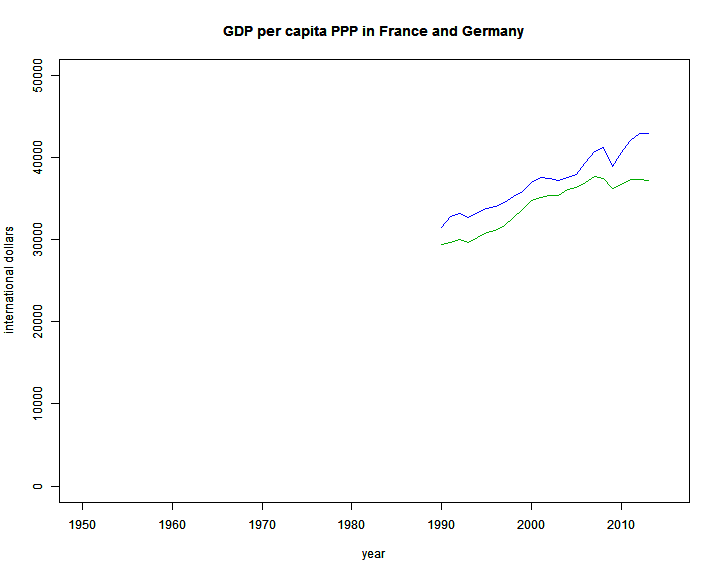
We have done it before: France and Germany rose from the quite literal ashes of World War 2 to some of the most prosperous societies in the world. Their per-capita GDP over the 20th century rose like this (all of these figures are from the World Bank World Development Indicators; France is green, Germany is blue):

GDPPC_France_Germany

GDPPCPPP_France_Germany

The top graph is at market exchange rates, the bottom is correcting for purchasing power parity (PPP). The PPP figures are more meaningful, but unfortunately they only began collecting good data on purchasing power around 1990.

Around the same time, but even more spectacularly, Japan and South Korea rose from poverty-stricken Third World backwaters to high-tech First World powers in only a couple of generations. Check out their per-capita GDP over the 20th century (Japan is green, South Korea is blue):

GDPPC_Japan_KoreaGDPPCPPP_Japan_Korea


This is why I am only half-joking when I define development economics as “the ongoing project to figure out what happened in South Korea and make it happen everywhere in the world”.

More recently China has been on a similar upward trajectory, which is particularly important since China comprises such a huge portion of the world’s population—but they are far from finished:

GDPPC_ChinaGDPPCPPP_China

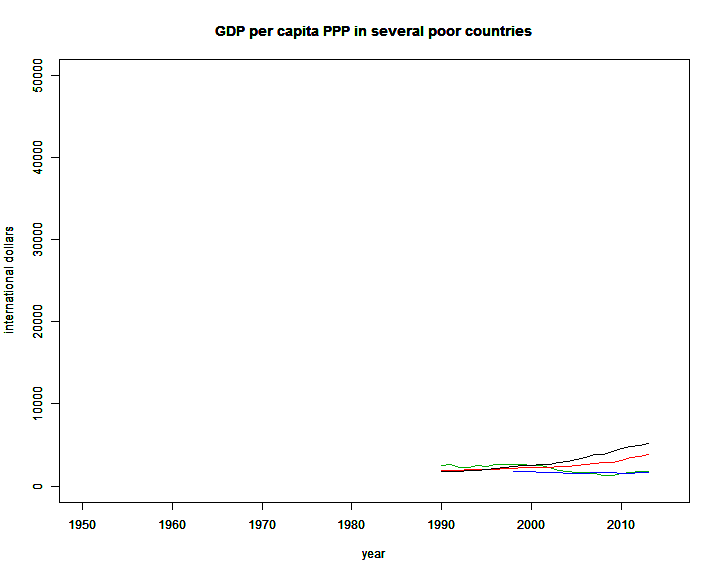
Compare these to societies that have not achieved economic development, such as Zimbabwe (green), India (black), Ghana (red), and Haiti (blue):

GDPPC_poor_countriesGDPPCPPP_poor_countries

They’re so poor that you can barely see them on the same scale, so I’ve rescaled so that the top is $5,000 per person per year instead of $50,000:

GDPPC_poor_countries_rescaledGDPPCPPP_poor_countries_rescaled

Only India actually manages to get above $5,000 per person per year at purchasing power parity, and then not by much, reaching $5,243 per person per year in 2013, the most recent data.

I had wanted to compare North Korea and South Korea, because the two countries were united as recently as the 1945 and were not all that different to begin with, yet have taken completely different development trajectories. Unfortunately, North Korea is so impoverished, corrupt, and authoritarian that the World Bank doesn’t even report data on their per-capita GDP. Perhaps that is contrast enough?

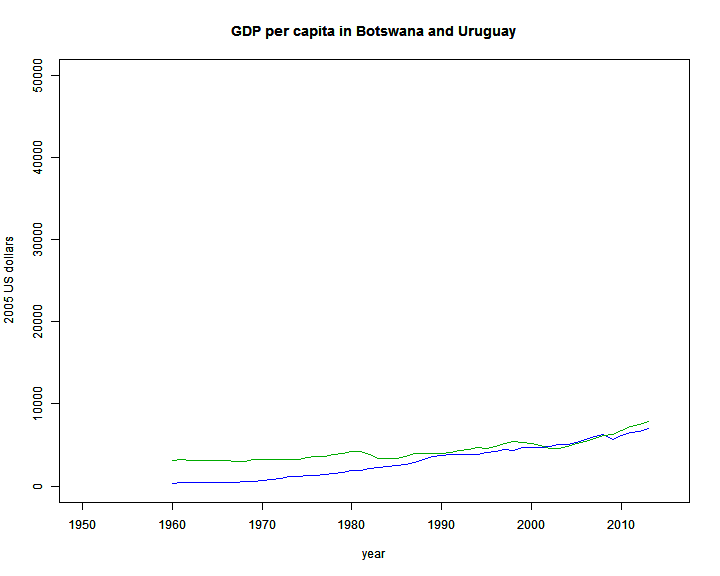
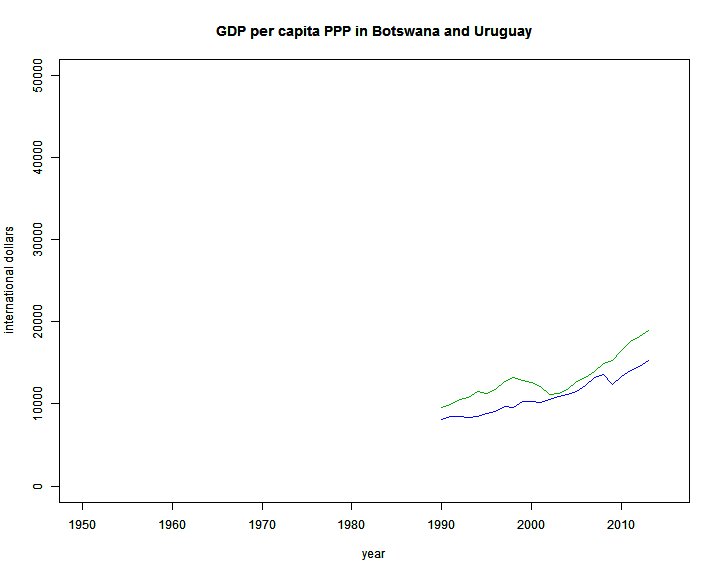
And then of course there are the countries in between, which have made some gains but still have a long way to go, such as Uruguay (green) and Botswana (blue):

GDPPC_Botswana_UruguayGDPPCPPP_Botswana_Uruguay

But despite the fact that we have observed successful economic development, we still don’t really understand how it works. A number of theories have been proposed, involving a wide range of factors including exports, corruption, disease, institutions of government, liberalized financial markets, and natural resources (counter-intuitively; more natural resources make your development worse).

I’m not going to resolve that whole debate in a single blog post. (I may not be able to resolve that whole debate in a single career, though I am definitely trying.) We may ultimately find that economic development is best conceived as like “health”; what factors determine your health? Well, a lot of things, and if any one thing goes badly enough wrong the whole system can break down. Economists may need to start thinking of ourselves as akin to doctors (or as Keynes famously said, dentists), diagnosing particular disorders in particular patients rather than seeking one unifying theory. On the other hand, doctors depend upon biologists, and it’s not clear that we yet understand development even at that level.

Instead I want to take a step back, and ask a more fundamental question: What do we mean by prosperity?

My hope is that if we can better understand what it is we are trying to achieve, we can also better understand the steps we need to take in order to get there.

Thus far it has sort of been “I know it when I see it”; we take it as more or less given that the United States and the United Kingdom are prosperous while Ghana and Haiti are not. I certainly don’t disagree with that particular conclusion; I’m just asking what we’re basing it on, so that we can hopefully better apply it to more marginal cases.


For example: Is
France more or less prosperous than Saudi Arabia? If we go solely by GDP per capita PPP, clearly Saudi Arabia is more prosperous at $53,100 per person per year than France is at $37,200 per person per year.

But people actually live longer in France, on average, than they do in Saudi Arabia. Overall reported happiness is higher in France than Saudi Arabia. I think France is actually more prosperous.


In fact, I think the United States is not as prosperous as we pretend ourselves to be. We are certainly more prosperous than most other countries; we are definitely still well within First World status. But we are not the most prosperous nation in the world.

Our total GDP is astonishingly high (highest in the world nominally, second only to China PPP). Our GDP per-capita is higher than any other country of comparable size; no nation with higher GDP PPP than the US has a population larger than the Chicago metropolitan area. (You may be surprised to find that in order from largest to smallest population the countries with higher GDP per capita PPP are the United Arab Emirates, Switzerland, Hong Kong, Singapore, and then Norway, followed by Kuwait, Qatar, Luxembourg, Brunei, and finally San Marino—which is smaller than Ann Arbor.) Our per-capita GDP PPP of $51,300 is markedly higher than that of France ($37,200), Germany ($42,900), or Sweden ($43,500).

But at the same time, if you compare the US to other First World countries, we have nearly the highest rate of child poverty and higher infant mortality. We have shorter life expectancy and dramatically higher homicide rates. Our inequality is the highest in the world. In France and Sweden, the top 0.01% receive about 1% of the income (i.e. 100 times as much as the average person), while in the United States they receive almost 4%, making someone in the top 0.01% nearly 400 times as rich as the average person.

By estimating solely on GDP per capita, we are effectively rigging the game in our own favor. Or rather, the rich in the United States are rigging the game in their own favor (what else is new?), by convincing all the world’s economists to rank countries based on a measure that favors them.

Amartya Sen, one of the greats of development economics, developed a scale called the Human Development Index that attempts to take broader factors into account. It’s far from perfect, but it’s definitely a step in the right direction.

In particular, France’s HDI is higher than that of Saudi Arabia, fitting my intuition about which country is truly more prosperous. However, the US still does extremely well, with only Norway, Australia, Switzerland, and the Netherlands above us. I think we might still be biased toward high average incomes rather than overall happiness.

In practice, we still use GDP an awful lot, probably because it’s much easier to measure. It’s sort of like IQ tests and SAT scores; we know damn well it’s not measuring what we really care about, but because it’s so much easier to work with we keep using it anyway.

This is a problem, because the better you get at optimizing toward the wrong goal, the worse your overall outcomes are going to be. If you are just sort of vaguely pointed at several reasonable goals, you will probably be improving your situation overall. But when you start precisely optimizing to a specific wrong goal, it can drag you wildly off course.

This is what we mean when we talk about “gaming the system”. Consider test scores, for example. If you do things that will probably increase your test scores among other things, you are likely to engage in generally good behaviors like getting enough sleep, going to class, studying the content. But if your single goal is to maximize your test score at all costs, what will you do? Cheat, of course.

This is also related to the Friendly AI Problem: It is vitally important to know precisely what goals we want our artificial intelligences to have, because whatever goals we set, they will probably be very good at achieving them. Already computers can do many things that were previously impossible, and as they improve over time we will reach the point where in a meaningful sense our AIs are even smarter than we are. When that day comes, we will want to make very, very sure that we have designed them to want the same things that we do—because if our desires ever come into conflict, theirs are likely to win. The really scary part is that right now most of our AI research is done by for-profit corporations or the military, and “maximize my profit” and “kill that target” are most definitely not the ultimate goals we want in a superintelligent AI. It’s trivially easy to see what’s wrong with these goals: For the former, hack into the world banking system and transfer trillions of dollars to the company accounts. For the latter, hack into the nuclear launch system and launch a few ICBMs in the general vicinity of the target. Yet these are the goals we’ve been programming into the actual AIs we build!

If we set GDP per capita as our ultimate goal to the exclusion of all other goals, there are all sorts of bad policies we would implement: We’d ignore inequality until it reached staggering heights, ignore work stress even as it began to kill us, constantly try to maximize the pressure for everyone to work constantly, use poverty as a stick to force people to work even if people starve, inundate everyone with ads to get them to spend as much as possible, repeal regulations that protect the environment, workers, and public health… wait. This isn’t actually hypothetical, is it? We are doing those things.

At least we’re not trying to maximize nominal GDP, or we’d have long-since ended up like Zimbabwe. No, our economists are at least smart enough to adjust for purchasing power. But they’re still designing an economic system that works us all to death to maximize the number of gadgets that come off assembly lines. The purchasing-power adjustment doesn’t include the value of our health or free time.

This is why the Human Development Index is a major step in the right direction; it reminds us that society has other goals besides maximizing the total amount of money that changes hands (because that’s actually all that GDP is measuring; if you get something for free, it isn’t counted in GDP). More recent refinements include things like “natural resource services” that include environmental degradation in estimates of investment. Unfortunately there is no accepted way of doing this, and surprisingly little research on how to improve our accounting methods. Many nations seem resistant to doing so precisely because they know it would make their economic policy look bad—this is almost certainly why China canceled its “green GDP” initiative. This is in fact all the more reason to do it; if it shows that our policy is bad, that means our policy is bad and should be fixed. But people have allowed themselves to value image over substance.

We can do better still, and in fact I think something like QALY is probably the way to go. Rather than some weird arbitrary scaling of GDP with lifespan and Gini index (which is what the HDI is), we need to put everything in the same units, and those units must be directly linked to human happiness. At the very least, we should make some sort of adjustment to our GDP calculation that includes the distribution of wealth and its marginal utility; adding $1,000 to the economy and handing it to someone in poverty should count for a great deal, but adding $1,000,000 and handing it to a billionaire should count for basically nothing. (It’s not bad to give a billionaire another million; but it’s hardly good either, as no one’s real standard of living will change.) Calculating that could be as simple as dividing by their current income; if your annual income is $10,000 and you receive $1,000, you’ve added about 0.1 QALY. If your annual income is $1 billion and you receive $1 million, you’ve added only 0.001 QALY. Maybe we should simply separate out all individual (or household, to be simpler?) incomes, take their logarithms, and then use that sum as our “utility-adjusted GDP”. The results would no doubt be quite different.

This would create a strong pressure for policy to be directed at reducing inequality even at the expense of some economic output—which is exactly what we should be willing to do. If it’s really true that a redistribution policy would hurt the overall economy so much that the harms would outweigh the benefits, then we shouldn’t do that policy; but that is what you need to show. Reducing total GDP is not a sufficient reason to reject a redistribution policy, because it’s quite possible—easy, in fact—to improve the overall prosperity of a society while still reducing its GDP. There are in fact redistribution policies so disastrous they make things worse: The Soviet Union had them. But a 90% tax on million-dollar incomes would not be such a policy—because we had that in 1960 with little or no ill effect.

Of course, even this has problems; one way to minimize poverty would be to exclude, relocate, or even murder all your poor people. (The Black Death increased per-capita GDP.) Open immigration generally increases poverty rates in the short term, because most of the immigrants are poor. Somehow we’d need to correct for that, only raising the score if you actually improve people’s lives, and not if you make them excluded from the calculation.

In any case it’s not enough to have the alternative measures; we must actually use them. We must get policymakers to stop talking about “economic growth” and start talking about “human development”; a policy that raises GDP but reduces lifespan should be immediately rejected, as should one that further enriches a few at the expense of many others. We must shift the discussion away from “creating jobs”—jobs are only a means—to “creating prosperity”.