The purpose of a system is not what it does.

Nov 22 JDN 2461367

Coined by Stafford Beer in his seminal work The Heart of Enterprise, it is the sort of pithy quote that sounds deep and wise when you hear it:

“The purpose of a system is what it does.”

I even understand to some extent why he would say something like this. It offers an important counterpoint to the notion that the purpose of every system is exactly what those who created or control it say its purpose is. It is common—ubiquitous, even—for those who run a system to insist that its purpose is wise and benevolent when in fact their true intentions are far different.

But in fact, this view is equally wrong, if not more so; and what’s more, I think that following this maxim leads to a dangerous kind of conspiracy-like thinking about the world. If you start assuming that every system around you is working successfully toward its true purpose, then any time you see something bad happen, you immediately assume that some evil person is intentionally causing that bad thing to happen. You never even consider the possibility that the outcome was unintended.

Indeed, this is closely related to a similar maxim I discussed in a previous post: “The system is working exactly as designed.” In both cases, the maxim is disillusioning; it makes you feel like you’ve finally seen through the veil and have washed away the naivete that blinded you—but in fact you’ve just exchanged one harmful illusion for another.

In fact, taken literally, this maxim can lead you to some really weird places.

This maxim tells you that the purpose of capitalism is to make the rich much richer while leaving the poor still poor. Okay, fair enough; many people genuinely believe that (though I would say it’s too simplistic, and most people who defend capitalism would also disagree).

But it also tells you that the purpose of communism is do the same thing, even more so, while also granting unchecked authoritarian power to a handful of people. Would anyone who believes in communism agree with that?

This maxim tells you that there’s no such thing as a bug in a program. Programmers do not make errors, by definition; whatever the program actually does is what it was designed to do. Anyone who has ever written a program is bound to see this view of the world as utterly baffling; when you know the nuts and bolts of how coding is done, the wonder really is that any of our software works as well as it does.

This maxim tells you that any time an army loses a war, its purpose was to lose that war; it isn’t that they were trying to win and failed because the other army was better-trained or better-led or better-equipped or larger or luckier, but because the losing army was trying to lose all along. Had their purpose really been to win, they would have, because the purpose of a system is what it does.

It says the same thing about anyone who loses a game. If you play a game of chess and lose, you wanted to lose; you were trying to lose. Had you really wanted to win, you would have.

In fact, while this notion seems to be a way for people to justify their beliefs in Conflict Theory over Mistake Theory, it’s actually quite puzzling even on Conflict Theory: In a conflict, one side is trying to do one thing, and the other side is trying to do something else. At most one of those things actually will happen (sometimes neither does, or the result is somewhere in between). So how can we say that the purpose of that system is to do what it actually does? The purpose of the system is decided by who wins the conflict? If you believe that society is full of conflicts, you should also believe that systems frequently fail to achieve anybody’s goals, precisely because of the conflicts!

Why does it matter whether the outcome is intended?

Even unintentionally bad things can still be very bad; that much is true. But the vital difference lies in what it takes to stop those bad things from happening.

If the outcomes are unintentional, then simply pointing them out to anyone who has power to influence the system—which, in a liberal democracy, turns out to be a lot of people—can actually work toward making better outcomes in the future. When bad things happen that nobody in particular wanted to happen, simply getting people to notice that they are happening can motivate them to try to fix things.

Whereas, if the outcomes are intentional, then whoever is in charge of the system wants them to happen, and so simply pointing out to them that they happen will do absolutely nothing. (In fact, it could even make things worse, by convincing them that whatever they are doing is working great and they should keep doing it even harder.) In those circumstances, in order to stop the bad outcomes, you will need to change who is in charge. You will need to take control away from the people who like things as they are and give it to people who want to make things better.

What if the system is complicated enough that some of the people in charge intend these outcomes and some of them don’t?

Now that is the right way to think about systems! Yes, basically any large-scale system is extremely complicated, and involves the differing goals and ideas of a huge number of people—sometimes thousands, sometimes even millions of people. When something bad happens as the result of such a system, it is worthwhile to look and see if anyone in charge is perfectly happy with that outcome, because they might genuinely be tipping the scales in that direction on purpose. But it’s just as worthwhile to make note of everyone who isn’t happy with that outcome. And when the system is big enough, you will almost certainly have many people in both groups.

In fact, when it comes to really large, complicated systems like governments or economic systems, I’m not sure it’s even right to say it has any singular purpose at all. These systems were built by too many different people, with too many different goals and ideas. They probably don’t actually optimize toward anything in particular—rather, they are awkward compromises between a whole bunch of different conflicting goals, the result of decades or centuries of tinkering from a variety of different sources. We don’t have to be strict Conflict Theorists or Mistake Theorists; we can acknowledge that both conflicts and mistakes are ubiquitous in human society, and from that knowledge, recognize that most real-world systems aren’t working as anyone in particular would intend them to work.

Even when systems are explicitly designed toward a singular purpose, such as corporations, which are explicitly designed to maximize profits for their shareholders above all else (why we would ever design such a thing is a different question), they often fail to achieve that purpose for a variety of different reasons, both internal and external—and indeed, there are enough people involved in influencing them that they may not even be working toward that purpose a lot of the time. (Indeed, I strongly suspect that many corporations do a whole lot of things that aren’t good even for their own long-term profitability, because their managers would rather do what everyone else is doing—and thus avoid blame for anything that goes wrong—rather than take the risk of trying to genuinely innovate.)
Wealth inequality in graphs

Nov 15 JDN 2461360

While the results of this year’s elections were mostly very good, there is one outcome that disappointed me: California’s ballot measure to institute a wealth tax on billionaires narrowly failed. I was also quite surprised by this, because wealth taxes on billionaires seem to be, in general, a very popular policy, especially among Democrats, who form a strong majority of California’s population. (The New York Times tries to make this into some kind of referendum on progressive policies in general, which seems… oddly defeatist. Okay, we didn’t get this one, this time; but after winning this many elections, you’re saying our policy agenda is hopeless?)

Perhaps time will tell what happened here: Did many people simply not vote on the proposal? Did they not understand it? Were the extensive and well-funded ad campaigns against the proposal effective at convincing people to oppose it? I don’t know.

What I do know is that we clearly need to do something about wealth inequality in this country.

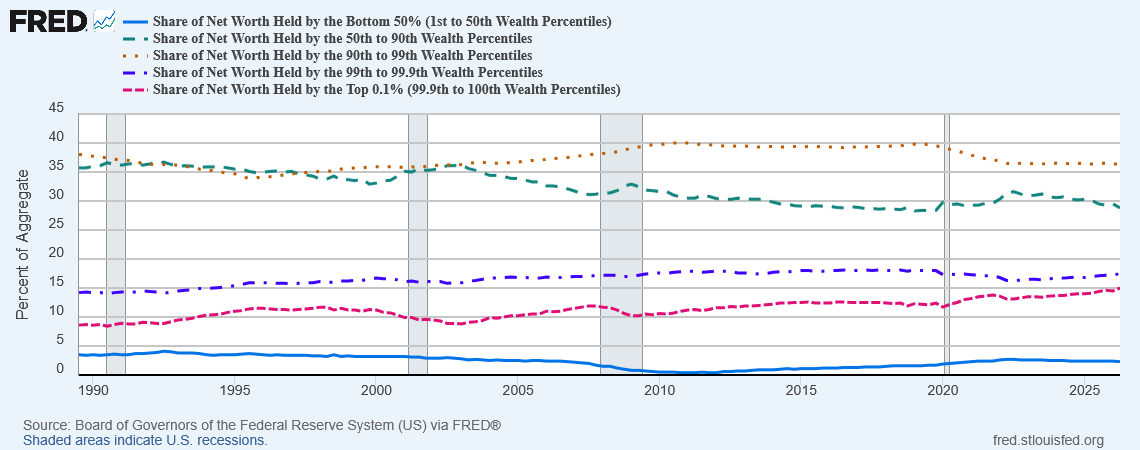
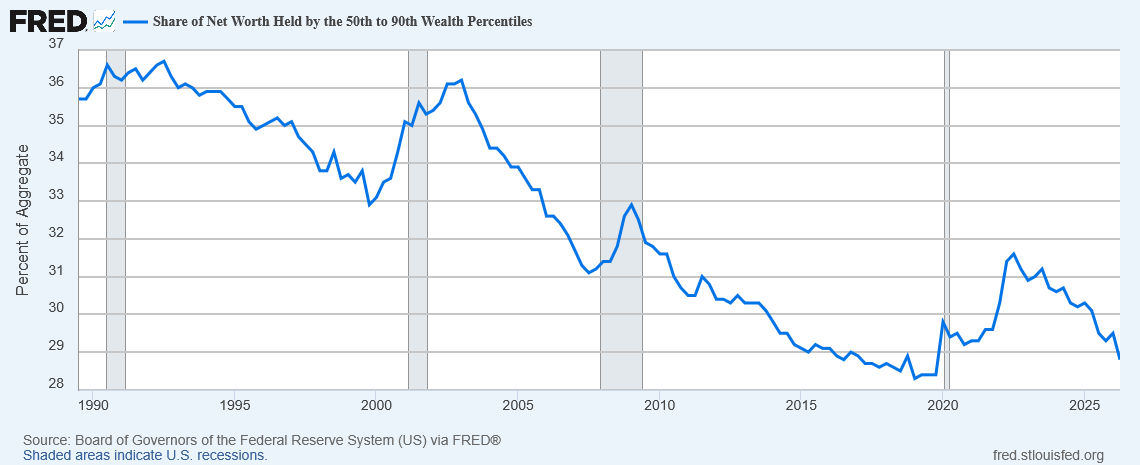
If you look at the proportion of wealth owned by the 50%-90% percentiles, which we might think of as the “upper middle class”, there is a steady decline, but the absolute numbers still don’t seem so bad:

This group comprises 40% of the population, and in 1990 owned 36% of the wealth. Today, they own 29% of the wealth. That’s a definite decline, but 40% of people owning 29% of the wealth still doesn’t seem too unreasonable.

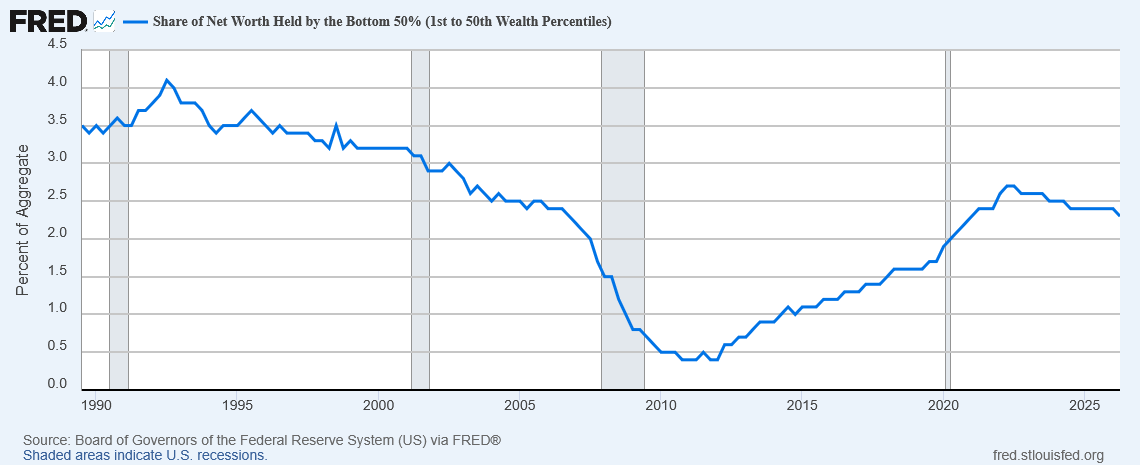
It’s when you look at the bottom 50%—everyone below the median wealth—that alarm bells start going off:

In 1990, this group—half the population, remember—owned only 3.5% of all US wealth. Today, it’s even worse: The lower half of the population owns only 2.5% of the wealth. And most of that is owned by the second quartile; the first quartile owns essentially zero net wealth—or even has negative net wealth.

What about the rich?

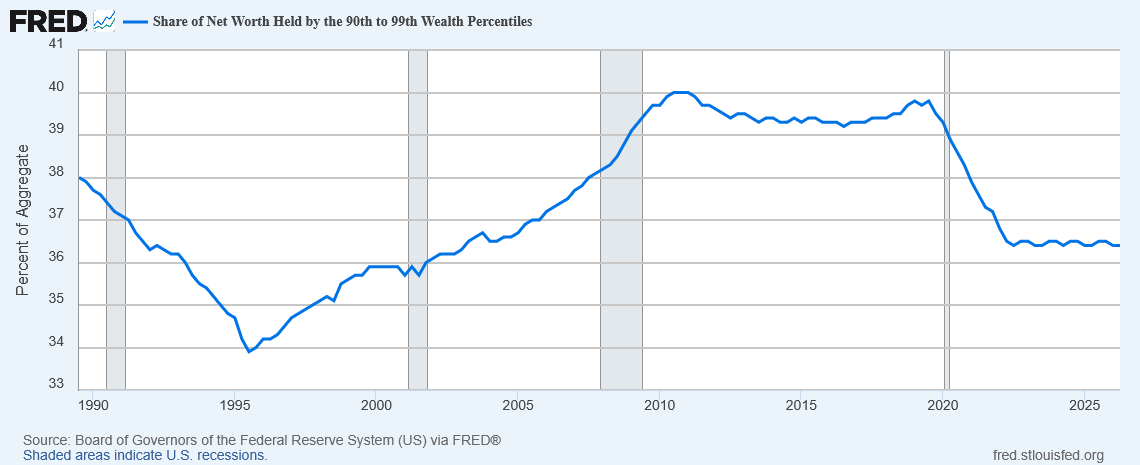
Well, what we might call the “merely rich”, the 90% to 99% percentiles, has been fairly stable in its wealth share, going from 38% of wealth in 1990 to 36.5% of wealth today. They comprise 9% of the population; so, roughly speaking, people in this group are about 4 times as wealthy as the average.

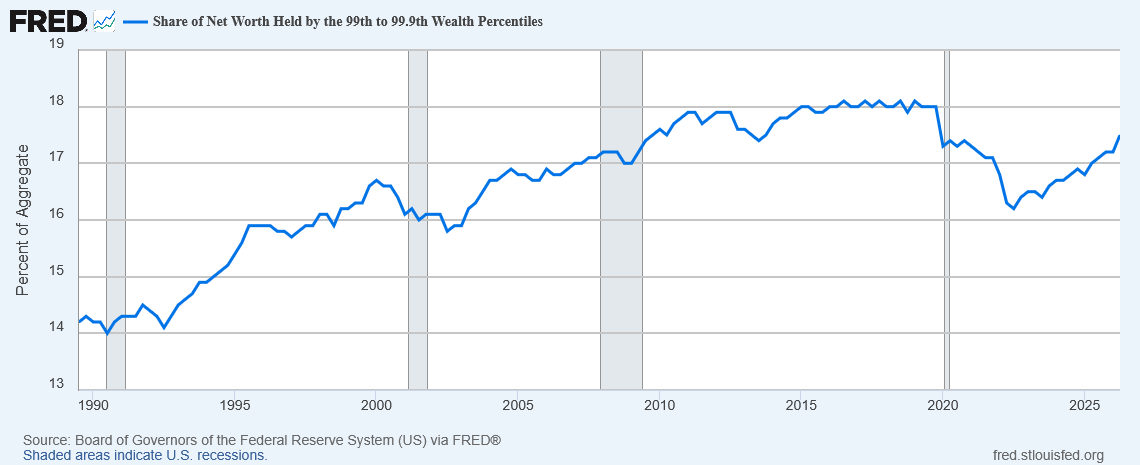
But then we get to the “very rich”, the top 1% excluding the top 0.1%, and we see a different story:

Their share of wealth has risen from 14% in 1990 to 17% today—and note that since they are only 1% of the population, this means they have gone from 14 times as rich as the average to 17 times as rich.

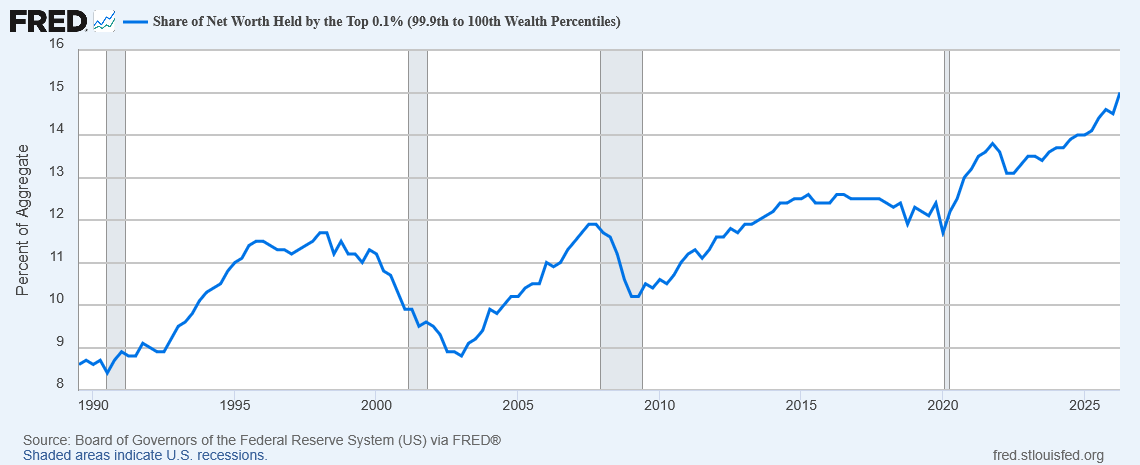
But even this is not the worst of our inequality. Finally, we come to the “super rich”, the top 0.1%, and the result is absolutely appalling:

Their share of US wealth has risen from 9% in 1990—already much too high—to over 15% today. Since they are only 0.1% of the population, this means their wealth has risen from 90 times the average to 150 times the average.

Combining this with the fall in wealth for the bottom half of the distribution, we find that the ratio in average wealth between someone in the top 0.1% and someone in the bottom 50% has risen from an already-staggering 1,285 to an utterly horrifying 3,000. The average person in the top 0.1% now owns three thousand times as much wealth as the average person in the poorest half of our country.

Many economists will tell you we should only be concerned about how poor the poor are, nevermind how rich the rich are—but I think this is wrong. I think when the richest of the rich own this much of our society’s wealth, they also take on a disproportionate amount of the power by their ability to run ads, control media, and donate to political campaigns.

Indeed, I think it may turn out that the very reason the billionaire tax failed was because of this disproportionate power—that the very reason we need the billionaire tax is the reason it didn’t quite make it.

We won the election. Now the real work begins.

Nov 10 JDN 2461355

Last Tuesday’s midterm elections honestly went better than I would have hoped for. Not only did Democrats take majorities in the House and the Senate, but several states attained a “trifecta” of governor, state house, and state senate all controlled by the Democrats—including Texas, which I was utterly shocked to see; they haven’t had a Democratic trifecta in decades. Even Mississippi and Alabama elected a number of Democrats, including a transgender woman in Alabama!

Of course I would have liked to reach a veto-proof 67 seats in the Senate, but that was always a very long shot; Democrats would have needed to win literally every seat that was up for election. (The Democrats had 32 seats not up for grabs, and there were 35 seats up for grabs, so getting to 67 would have required winning all 35. As it is, they won 22 and might win up to 2 more.) This went as well as could be reasonably hoped for, and it’s worth celebrating.

But this is not the end. It is only the beginning.

Now our task is to hold the Democrats accountable for repairing the damage Trump and the Republicans have done, and also for bringing to justice those in Trump’s administration—including himself—who have displayed blatant corruption, venality, and authoritarianism.

This won’t be easy: Without those 67 seats (which we almost certainly weren’t ever going to get), Trump can veto anything the Democrats pass, and will probably do so—but they should pass it anyway, and we need to make that clear to them. Passing popular bills that then Trump vetoes is yet another way to chip away at Trump’s remaining support. And in fact if Trump realizes this, he might even decide to sign some bills he’d rather veto, just to avoid the loss to his popularity. (Trump doesn’t care in the least about the welfare of the country, but his own popularity is one of the few things he does care about.)

There will be self-styled “moderates” and “centrists” who will tell us to let bygones be bygones. This is not centrism. True centrists defend democracy. Trump has clearly shown that he intends to undermine American democracy to serve himself, and he must be fought at every turn.

We should impeach him again, if nothing else. Maybe the Republicans are still too ideologically blinded or too corrupt to actually help us remove him from office, but making him even more historic in his number of impeachments still at least sends a message.

We should also get enough states to finally sign onto the National Popular Vote Interstate Compact to actually make it happen. With Democratic control of Congress and several states gaining Democratic trifectas—including Texas, a huge number of Electoral College votes—it should now be feasible to complete the compact and ensure that future Presidential elections are effectively done by popular vote. This would be a major triumph for “one person, one vote”, and had we done this before 2016, Trump would never have been in office in the first place. (Why do we need Congress? The Compacts Clause. Fortunately, the Compacts Clause does not require a bill to pass—Trump would obviously veto any such bill—but merely “consent of Congress”, which can bypass the President. It’s also possible that the Supreme Court could rule that the NPVIC doesn’t constitute the sort of “compact” intended by the clause, but given the current state of the court, I wouldn’t hold my breath on that.)

Our work is not done.

Protests must continue. Campaigns to call or write members of Congress must continue. We must ensure that the Democrats understand that this mandate we have given them is to undo all the damage Republicans have done, not simply return to a feeling of normalcy.

This is precisely what President Biden failed to do in 2021-2024. Yes, it was a relief to get Trump out of office. But the deeper problems were not addressed. They must now be addressed.

Of course, I don’t expect them to solve all our country’s problems—or even necessarily repair all the damage Trump in particular has done—in two years. But we need them to work as hard as humanly possible toward that goal, now and for as long as it takes to get the job done.