The Amazon is burning.

Sep 1 JDN 2458729

As you probably already know, the Amazon rainforest is currently on fire. You can get more details about the fires from The Washington Post, or CNN, or New York magazine, or even The Economist; but I think the best coverage I’ve seen has been these two articles from Al-Jazeera.

I have good news and bad news. Let’s start with the bad news: If we lose the Amazon, we lose everything. The ecological importance of the Amazon is basically impossible to overstate. The Amazon produces 20% of the oxygen on Earth. 25% of the carbon absorbed on land is absorbed by the Amazon. We must protect the Amazon, at almost any cost: Given how vital preserving the rainforest will be to resisting climate change, millions of lives are at stake.

The good news is there is still a lot of Amazon left.

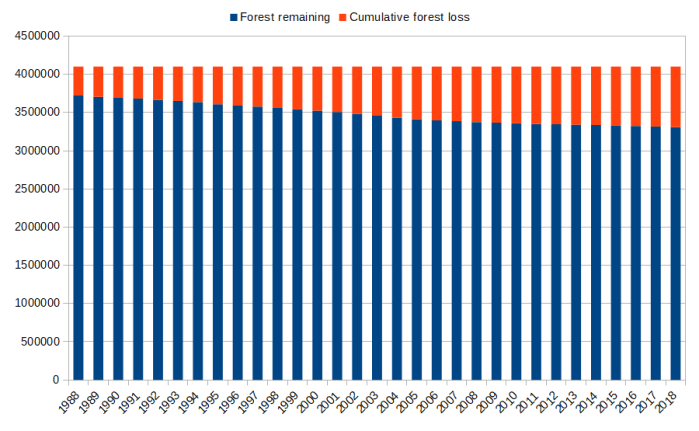
This graph shows the total cumulative deforestation of the Amazon, compared against its current area and its original area. The units are square kilometers; the Amazon rainforest has been reduced from 4.1 million square kilometers (1.6 million square miles) to 3.3 million hectares (1.3 million square miles), a decline of about 20% (21 log points). We still have four-fifths of the rainforest remaining—less than we should, but a lot more than we might.

Amazon_cumulative

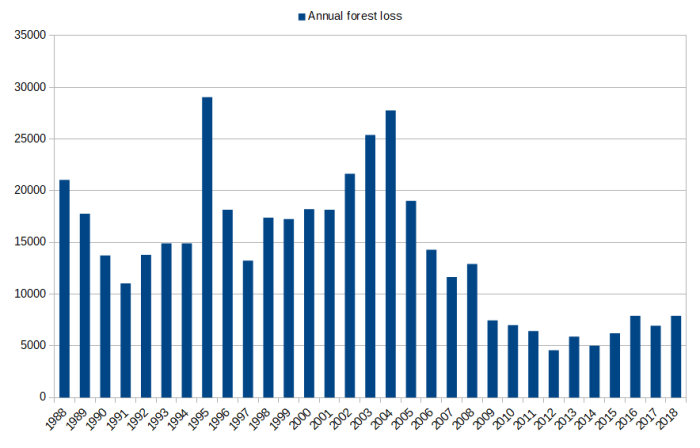
This graph shows the annual deforestation of the Amazon, with results that are even more encouraging. While the last few years have had faster deforestation than previously, we are still nowhere near the peak deforestation rates of the early 2000s. At peak deforestation, the Amazon was projected to last no more than 150 years; but at current rates of deforestation, the Amazon would not be completely destroyed in more than 400 years.

Amazon_annual

Of course, any loss of the Amazon is bad. We should actually be trying to restore the Amazon—that extra 800,000 square kilometers of high-density forest would sequester a lot of carbon. We probably can’t actually add the 9 million square kilometers (3.4 million square miles) of forest it would take to stop climate change; but any reforestation we do manage will help.

And a number of ecologists have been sounding the alarm that the Amazon is approaching some sort of tipping point where it will stop being a rainforest and become a savannah. If this happens, it may be irreversible. It sounds crazy to me—80% of the forest is still there!—but that’s what ecologists are saying, and I’ll defer to their expertise.

On the other hand, ecologists have been panicking about “irreversible tipping points” on almost everything for the past century. We really can’t be blamed for not taking their word as gospel: They’ve cried wolf about “population bombs” and shortages of food and water for a very long time now. So far their projections on the rates of temperature rise, species extinction, and deforestation have been quite accurate; but their predictions of dire human consequences have always suspiciously failed to materialize. Humans are quite creative and resilient, as it turns out. This is part of why I’m not actually afraid climate change will cause the collapse of human civilization (much less the utterly laughable claim of human extinction); but tens of millions of deaths is still plenty of reason to take drastic action.

Indeed, I think panicking is precisely what we need to avoid. If we exaggerate the problem to the point where it sounds hopeless, that won’t encourage people to take action; it may actually cause them to throw in the towel.

What do we actually need to do here? We need to restore as many forests as possible, and we need to cut carbon emissions as rapidly as possible.

This doesn’t require a revolution to overthrow capitalism. It doesn’t require exotic new technologies (though fusion power and improved electricity storage would certainly help). It simply requires a real commitment to bear real economic costs today in order to prevent much higher costs in the future.

Bernie Sanders has a climate change plan that is estimated to cost $16 trillion over the next ten years. Make no mistake: This is an enormous amount of money. US GDP is about $20 trillion, growing at about 3% per year, so we’re looking at about 6% of GDP over that interval. This is about twice our current military budget, or about our military budget in the 1980s. Notably, it is nowhere near the levels of military spending we reached in the Second World War, which exceeded 40% of GDP. That’s what happens when America really commits to something.

Would this be enough? The UN seems to think so. They estimate that it would cost about 1% of global GDP to keep global warming below 2 C. Even if that’s an underestimate, 6% of the GDP of the US and EU would by itself account for twice that amount—and I have no doubt that if America committed to climate change mitigation, Europe would gladly follow.

And it’s not as if this money would be set on fire. (Military spending, on the other hand, almost literally is that.) We would spending this money mainly on infrastructure and technology; we would be paying wages and creating millions of jobs.

So far as I know Sanders’s plan doesn’t include paying Brazil to restore the Amazon, but it probably should. Part of why Brazil is currently burning the Amazon is the externalities: The ecological benefit of the Amazon affects us all, but the economic benefit of clear-cutting and cattle ranching directly benefits Brazil. We should set up some sort of payment mechanism to ensure that it is more profitable for Brazil to keep the rainforest where it is than to burn it down. How can we afford such a thing, you ask? No: How can we afford not to?

White-collar crime dwarfs all other property crime

Aug 25 JDN 2458722

When you think of “property crime”, you probably envision pickpockets in crowded squares, muggers in dark alleys or burglars breaking into houses. But this is not the kind of property crime that does the most damage—not by a long shot.

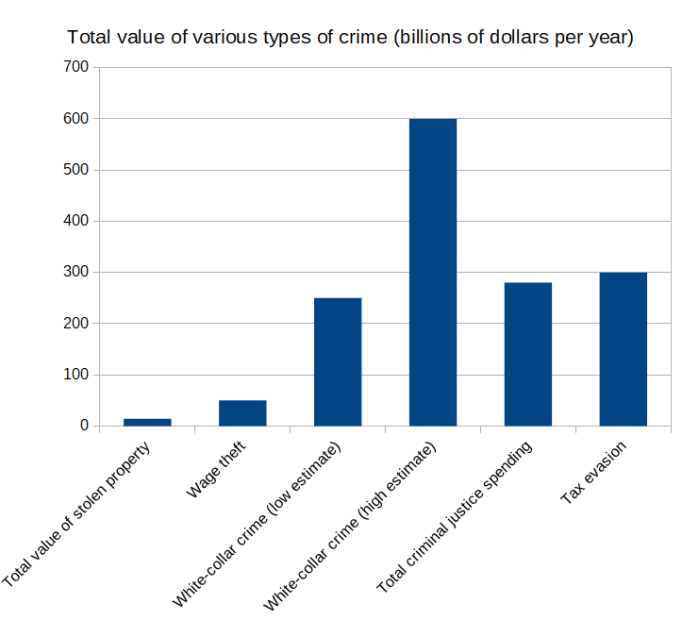
Based on FBI estimates, the total economic value of all stolen property (in this conventional sense) is about $14 billion per year. This is less than 0.1% of US GDP.

Wage theft, in which corporations withhold pay that they are contractually obliged to pay, often by misrepresenting hours or not paying overtime rates, is by itself already $50 billion per year.

But this too pales in comparison to the real threat, which is white-collar crime. The direct cost of white-collar crime to the United States has been estimated at between $250 and $600 billion per year. This is about 1-3% of GDP; the average company loses 6% of its revenue to white-collar crime.

This is comparable to, and quite likely more than, the $280 billion total expenditure of all law enforcement and criminal justice in the United States—which has the highest total law enforcement expenditure in the world, and nearly the highest per capita as well.

This is only direct cost, mind you. If you include the indirect costs of all forms of crime, including violent crime, the total cost of all crime in the US rises to about $1.5 trillion. But this figure does not account for white-collar crime. Since the direct costs of white-collar crime are so much higher than those of other forms of crime, it’s quite likely that the indirect costs are higher as well. (Indeed, I think it can be reasonably argued that The Great Recession was an indirect cost of white-collar crime—and it cost about $14 trillion in lost economic output.)

And this is not including the approximately $300 billion per year in tax evasion (mostly in the form of unreported income and overstated charitable contributions).

The graph below compares these figures visually:

Value_of_crime

Crime pays quite well, as a matter of fact, as long as it’s the right kind of crime.

Our law enforcement system is designed to punish the crimes of the poor, and does so quite relentlessly. But it seems uninterested in punishing the crimes of the rich.

Some of the policies needed to reduce white-collar crime are quite obvious. The first is tax auditing: As the IRS budget has been cut, the number of tax audits has been plummeting, from 1.7 million in 2012 to only 1.1 million in 2017, a decrease of over a third. High-income returns—which are, obviously, where the worst tax evasion happens—have seen an even more precipitous decline in auditing. In 2011, a return over $1 million had about a 12% chance of being audited; now that probability is only 3%.

The budget cuts to the IRS make less than no sense; since 2002, they reduced spending by $14 billion and tax evasion increased by $34 billion. This is the opposite of fiscal responsibility.

Another obvious policy change is to increase spending on the FTC and SEC, the agencies responsible for investigating business transactions and rooting out securities fraud.

Meanwhile, we are actually cutting the SEC budget. This is beyond madness; the total SEC budget is a measly $1.5 billion, and collected entirely from banks, not taxpayers in general. The SEC budget does not contribute to the federal deficit in any way. And think about what madness was to begin with to allocate a budget of only $1.5 billion to regulate an industry with a market value of $26 trillion in this country alone. This is only 0.006%. Since a tax of 0.5% on stock trades, 0.1% on bond trades, and 0.005% on derivatives trades would raise a whopping $220 billion, this means that simply imposing a 0.01% tax on financial transactions would raise enough to increase the SEC budget by an order of magnitude. And this is low enough that it would be felt by basically no one. Frankly if you even care what happens to a single basis point of your rate of return, you are obviously over-leveraged. The difference between making 6.99% and 7.00% per year over 30 years is the difference between turning $1,000 into $7,590.94 and turning it into $7,612.25. That’s a difference of 2% over thirty years.

Simply increasing IRS and SEC audits would not eliminate white-collar crime, of course. It is far too ubiquitous and sophisticated for that. But the fact that we have been cutting these budgets instead of raising them speaks to a much more disturbing truth: These are not the policies of a government that is seriously trying to improve its budget balance. They are the policies of a government that is being corrupted from within, becoming tilted further and further toward the interests of the wealthy.

Procrastination is an anxiety symptom

Aug 18 JDN 2458715

Why do we procrastinate? Some people are chronic procrastinators, while others only do it on occasion, but almost everyone procrastinates: We have something important to do, and we should be working on it, but we find ourselves doing anything else we can think of—cleaning is a popular choice—rather than actually getting to work. This continues until we get so close to the deadline that we have no choice but to rush through the work, lest it not get done at all. The result is more stress and lower-quality work. Why would we put ourselves through this?

There are a few different reasons why people may procrastinate. The one that most behavioral economists lean toward is hyperbolic discounting: Because we undervalue the future relative to the present, we set aside unpleasant tasks for later, when it seems they won’t be as bad.

This could be relevant in some cases, particularly for those who chronically procrastinate on a wide variety of tasks, but I find it increasingly unconvincing.

First of all, there’s the fact that many of the things we do while procrastinating are not particularly pleasant. Some people procrastinate by playing games, but even more procrastinate by cleaning house or reorganizing their desks. These aren’t enjoyable activities that you would want to do as soon as possible to maximize the joy.

Second, most people don’t procrastinate consistently on everything. We procrastinate on particular types of tasks—things we consider particularly important, as a matter of fact. I almost never procrastinate in general: I complete tasks early, I plan ahead, I am always (over)prepared. But lately I’ve been procrastinating on three tasks in particular: Revising my second-year paper to submit to journals, writing grant proposals, and finishing my third-year paper. These tasks are all academic, of course; they all involve a great deal of intellectual effort. But above all, they are high stakes. I didn’t procrastinate on homework for classes, but I’m procrastinating on finishing my dissertation.

Another common explanation for procrastination involves self-control: We can’t stop ourselves from doing whatever seems fun at the moment, when we should be getting down to work on what really matters.

This explanation is even worse: There is no apparent correlation between propensity to procrastinate and general impulsiveness—or, if anything, the correlation seems to be negative. The people I know who procrastinate the most consistently are the least impulsive; they tend to ponder and deliberate every decision, even small decisions for which the extra time spent clearly isn’t worth it.

The explanation I find much more convincing is that procrastination isn’t about self-control or time at all. It’s about anxiety. Procrastination is a form of avoidance: We don’t want to face the painful experience, so we stay away from it as long as we can.

This is certainly how procrastination feels for me: It’s not that I can’t stop myself from doing something fun, it’s that I can’t bring myself to face this particular task that is causing me overwhelming stress.

This also explains why it’s always something important that we procrastinate on: It’s precisely things with high stakes that are going to cause a lot of painful feelings. And anxiety itself is deeply linked to the fear of negative evaluation—which is exactly what you’re afraid of when submitting to a journal or applying for a grant. Usually it’s a bit more metaphorical than that, the “evaluation” of being judged by your peers; but here we are literally talking about a written evaluation from a reviewer.

This is why the most effective methods at reducing procrastination all involve reducing your anxiety surrounding the task. In fact, one of the most important is forgiving yourself for prior failings—including past procrastination. Students who were taught to forgive themselves for procrastinating were less likely to procrastinate in the future. If this were a matter of self-control, forgiving yourself should be counterproductive; but in fact it’s probably the most effective intervention.

Unsurprisingly, those with the highest stress level had the highest rates of procrastination (causality could run both ways there); but this is much less true for those who are good at practicing self-compassion. The idea behind self-compassion is very simple: Treat yourself as kindly as you would treat someone you care about.

I am extraordinarily bad at self-compassion. It is probably my greatest weakness. If we were to measure self-compassion by the gap between how kind you are to yourself and how kind you are to others, I would probably have one of the largest gaps in the world. Compassion for others has been a driving force in my life for as long as I can remember, and I put my money where my mouth is, giving at least 8% of my gross income to top-rated international charities every year. But compassion for myself feels inauthentic, even alien; I brutally punish myself for every failure, every moment of weakness. If someone else treated me the way I treat myself, I’d consider them abusive. It’s something I’ve struggled with for many years.

Really, the wonder is that I don’t procrastinate more; I think it’s because I’m already doing most of the things that people will tell you to do to avoid procrastination, like scheduling specific tasks to specific times and prioritizing a small number of important tasks each day. I even keep track of how I actually use my time (I call it “descriptive scheduling”, as opposed to conventional “normative scheduling”), and use that information to make my future schedules more realistic—thus avoiding or at least mitigating the planning fallacy. But when it’s just too intimidating to even look at the paper I’m supposed to be revising, none of that works.

If you too are struggling with procrastination (and odds of that are quite high), I’m afraid that I don’t have any brilliant advice for you today. I can recommend those scheduling techniques, and they may help; but the ultimate cause of procrastination is not bad scheduling or planning but something much deeper: anxiety about the task itself and being evaluated upon it. Procrastination is not laziness or lack of self-control: It’s an anxiety symptom.

A more nuanced “Carousel of Progress”

Aug 11 JDN 2458707

I recently got back from a trip to Disney World; while most of the attractions are purely fictional and designed only to entertain, a few are factual and designed to inform and persuade. One of these is the “Carousel of Progress”.

The Carousel of Progress consists of a series of animatronic stages, each representing the lifestyle of a particular historical era. They follow the same family over time, showing what their life is like in each era. When it was originally built, the eras shown were 1900s, 1920s, 1940s, and 1960s; but over time they have updated the “present day” stage, and now they are 1900s, 1920s, 1940s, and 1990s. The aim of the attraction is to show how technology has made our lives better.

The family they show is upper-middle class; this makes sense, as most of the audience probably is as well. But to really understand the progress we have made, we need to also consider the full range of incomes.

In this post I will go through a similar sequence of eras, comparing the lifestyles of not just the middle class, but also the rich and the poor.

In what follows, I’ve tried to create that, using the best approximate figures on standard of living I could find from each era. The numbers are given in my best guess of the inflation-adjusted standard of living; obviously they’re much more precise in the 1980s to today than they are for earlier eras.

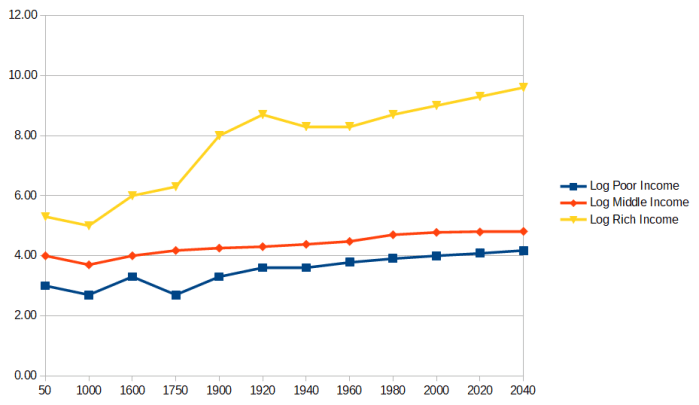
I’ve summarized all these income estimates in the graph below (note the log scale):
 

Carousel_of_Progress

This means that, after a bumpy ride through the Middle Ages and the Industrial Revolution, we did actually raise the floor—the poor today are about as well off as the middle class in ancient times. But we raised the ceiling an awful lot faster; the rich today are something like a thousand times as rich as the rich in ancient times.


50 AD: Roman Empire

Rich: Patrician

Life is good! My seaside villa is one of the finest in Rome, and my industrious slaves fulfill my every need. At my personal zoo I recently acquired a lion and an elephant. I dine on only the finest foods, including wine from my personal vineyard. An aqueduct feeds directly into my personal baths. The war in Gallia seems to be going well; I look forward to my share of the spoils.

Wealth: $4 million

Income: $200,000

Middle class: Plebeian

Things could be worse. My family has a roof over our heads and bread on our table, so I’m grateful for that. But working all day on the farm is exhausting, and we can’t afford servants to help. My oldest son is a gladiator, though so far he has not attained the highest ranks of the profession. My youngest son was recently drafted into military service in Gallia; I pray for his safety.

Wealth: $10,000

Income: $10,000

Poor: Proletarian

Wealth: $0

Income: $1,000

Living in a hovel I don’t even own with my four children and begging on the streets isn’t an easy life, but at least I’m not a slave. Most of our food is provided by public services. With the war raging in Gallia, one of our small blessings is that we are actually too poor to be drafted into service.

1000 AD: Medieval England

Rich: Duke

While living in a castle is nice, I sometimes wish an end to the frequent raids and border skirmishes that made these high walls necessary. Still, I can’t complain; I own plenty of land, and have plenty of serfs to work it. I am in good favor with the king, and so His Majesty’s army has helped protect my lands against invasion. I have all the feasts, wine, and women a man could ask for.

Wealth: $2 million

Income: $100,000

Middle class: Knight

I can’t complain. It is an honor to be a knight in His Majesty’s army, and I am proud that my family was able to earn enough wealth to buy me a horse, a sword, and the training necessary to reach this rank. I own a little bit of land, but my lord has called upon me for a new campaign, I’m hoping to buy a larger estate with the spoils I earn from it. My family has plenty of food to eat, though if the well runs dry I’m not sure where we’ll get more water.

Wealth: $5,000

Income: $5,000

Poor: Serf

Live grows harder by the day, it seems. My lord keeps demanding more and more work from us, but already the land is producing as much as it can bear. Though we are responsible for planting and harvesting the wheat, often the bread never makes it to my family’s table.

Wealth: $0

Income: $500

1600 AD: Renaissance Venice

Rich: Noble

With the advent of global trade and colonization, wealth has flooded into Venice, and I have had the chance to claim some portion of that flood. I dress in the finest silks, and eat exotic foods from lands as distant as India and China. Servants fulfill my every need. How could life be better?

Wealth: $10 million

Income: $1 million

Middle class: Merchant

I am a proud member of the trader’s guild. Though it our trade ships that carry wealth from across the seas, we often find that wealth passing on up to the nobles, leaving little for ourselves. Still, I have my own land, my own house, and plenty of food for my family.

Wealth: $10,000

Income: $10,000

Poor: The Pebbles

I had a good job working in construction until recently, but I was laid off. I could no longer afford my rent, so now I live on the streets. I feel as though I work constantly but never can find a way to get ahead.

Wealth: $0

Income: $2,000

1750 AD: Pre-Revolutionary France

Rich: Noble

Viva la France! Life is better than ever. Servants do all my work, while the wealth produced by my fields and factories all goes to me. I barely even pay any taxes on my grand estates.

Wealth: $20 million

Income: $2 million

Middle class: Bourgeoisie

I live reasonably well, all things considered. My family has a home and enough food to eat. Still, taxes are becoming increasingly onerous even as the nobles become increasingly detached from the needs of common people like us. Still, we may as well accept it; I doubt things will change any time soon.

Wealth: $15,000

Income: $15,000

Poor: Peasant

Life is hard. I work all day on the farm to make wheat, and then the nobles tax it all away. We have to make our own clothes even as the nobles luxuriate in silks from around the world.

Wealth: $0

Income: $500

1900 AD: United States

Rich

My coal mine has been a roaring success! I am now one of the richest men who has ever lived. I even have my own horseless carriage. Servants are getting more expensive these days, though; even though I’m richer than my grandfather I can’t afford as many servants.

Wealth: $1 billion

Income: $100 million

Middle class

“Well, the robins are back. That’s a sure sign of spring. What year is it? Oh, just before the turn of the century. And believe me, things couldn’t be any better than they are today. Yes sir, we got all the latest things: gas lamps, a telephone, and the latest design in cast iron stoves. That reservoir keeps five gallons of water hot all day on just three buckets of coal. Sure beats chopping wood! And isn’t our new ice box a beauty. Holds 50 pounds of ice. Milk doesn’t sour as quick as is used to. Our dog Rover here keeps the water in the drip pan from overflowing. You know, it wasn’t too long ago we had to carry water from a well. But thanks to progress, we’ve got a pump right here in the kitchen. ‘Course we keep a bucket of water handy to prime it with. Yes sir, we’ve got everything to make life easier. Mother! I was reading about a fellow named Tom Edison, who’s working on an idea for snap on electric lights.”

Wealth: $18,000

Income: $18,000

Poor

I live on the streets most of the time. I eat food out of the garbage. What little money I have is earned by begging. I’m not proud, but it’s all I can do to survive.

Wealth: $0

Income: $2,000

1920 AD: United States

Rich

Life is sweet. My electric company is raking in the dough these days; seems they can hardly find enough copper to lay all the new cables we need to supply all the folks buying into our grid. I have four automobiles now—all top of the line of course. The times, they are a-changin’: Can you believe they gave women the vote? Eh, well, I suppose they can hardly vote worse than us men do already.

Wealth: $5 billion

Income: $500 million

Middle class

“Whew! Hottest summer we’ve had in years. Well, we’ve progressed a long way since the turn of the century 20 years ago. But no one realized then that this would be the age of electricity. Everyone’s using it: farmers, factories, whole towns. With electric streetlights we don’t worry so much about the youngsters being out after dark. And what a difference in our home. We can run as many wires as we need in any direction for Mother’s new electrical servants: electric sewing machine, coffee percolator, toaster, waffle iron, refrigerator, and they all go to work at the click of a switch. Take it easy! You’ll blow a fuse! Queenie! Leave ’em alone. Well, the days of lugging heavy irons from the old cookstove to an ironing board are gone forever. With an electric iron and electric lights, Mother now has time to enjoy her embroidery in the cool of the evening. Right, Mother?”

Wealth: $20,000

Income: $20,000

Poor

Life on the streets is still hard, but at least they’ve got these new soup kitchens to feed me and my family, and with running water in the city we can sometimes get clean water to drink. That newfangled electricity stuff is supposed to be the bee’s knees, but we sure can’t afford it.

Wealth: $0

Income: $4,000

1940 AD: United States

Rich

My steel company is doing extremely well, particularly with the war in Europe raising the price of steel. We just bought our very own airplane; isn’t that marvelous? With Britain under siege and France already fallen to the Krauts, I think we’re gonna end up in the war soon—FDR certainly has been making noises to that effect. If I were poor, I’d be worried about my sons getting drafted; but I’m sure we won’t have to worry about that. No, I’m just looking forward to my stock returns when they start churning out tanks instead of cars in Detroit!

Wealth: $2 billion

Income: $200 million

Middle class

“Well it’s autumn again and the kids are back in school. Thank goodness! Here we are in the frantic forties and the music is better than ever. And it’s amazing how our new kitchen wonders are helping to take over the hard work. Everything is improving. Electric range is better. Refrigerators are bigger and make lots more ice cubes. But my favorite is the electric dishwasher. Now Mother spends less time in the kitchen and I don’t have to dry the dishes anymore. Oh, I spend a lot of time here. Have to. Now that television has arrived, Grandma and Grandpa have taken over my den. Television has changed our lives. It’s brought a whole new world of culture into our home.”

Wealth: $24,000

Income: $24,000

Poor

The Depression was hard on everybody, but I think it was hardest on us poors. This New Deal business seems to be helping out a lot, though; on one of the new construction projects I was able to find work for the first time in months. I’m worried we’re going to be brought into the war soon, but if I get drafted at least that means three squares a day.

Wealth: $0

Income: $4,000

1960 AD: United States

Rich

Running an oil company is not for the faint of heart; they keep adding more onerous regulations every year. Still, profits are bigger than ever. I just wish Uncle Sam would stop taking such a big cut; Commies, all of them. I can barely afford upkeep on my yacht these days with all the taxes.

Wealth: $2 billion

Income: $200 million

Middle class

We just got a color TV at home, and we’ve been watching around the clock. We get all four channels! And my new T-bird is a real beauty; paid a fortune for her, but worth every penny. Society is improving, too; with Rosa Parks and whatnot, I’m guessing things are about to get a lot better for colored folks especially. After that, I’m thinking it’ll be the gays’ turn next; I wonder how long that will take.

Wealth: $30,000

Income: $30,000

Poor

Life is still hard, but I think it’s better now than it’s ever been, even for poor folks like me. Thanks to Welfare, I’m not even as poor as I could be. It’s tough to make ends meet, but at least I can afford a place to live and food to eat. And I’m pretty healthy too: Antibiotics and vaccines mean that we are finally safe from some terrible diseases, like polio. It seems crazy: Just a generation ago the President had a disease that now even folks like me are protected from.

Wealth: $0

Income: $6,000

1980 AD: United States

Rich

They told me I was crazy to invest in these “personal computing machines”, but I saw the writing on the wall. Computers are the future, man. They’re gonna be everywhere, and do everything. We’re gonna have robots and flying cars, and if I have anything to say about it, I’m gonna own the factories that make them.

Wealth: $5 billion

Income: $500 million

Middle class

We have our own PC now. I use it for work, but my kids use it mostly for computer games. I still can’t beat my daughter at Pong, but I can at least hold my own at Pac-Man these days. I hear that programming skills are going to be in high demand soon, so I’ve been trying to teach the kids BASIC.

Wealth: $50,000

Income: $50,000

Poor

Nixon’s Welfare “reform” really hit my family hard. If I don’t find work soon, they’re going to cut my benefits; but if I could find work, what would I need benefits for? Jimmy Carter made some things better, but it doesn’t look like he’ll be re-elected. Can you believe that old actor Ronald Reagan is running?

Wealth: $0

Income: $8,000

2000 AD: United States

Rich

I sure played my cards right in the stock market, buying those tech firms just before the Internet boom really hit. Now I have my own jet and I’m thinking of buying a yacht. Maybe I’ll diversify into real estate; it looks like housing prices are heading north.

Wealth: $10 billion

Income: $1 billion

Middle class

Our home has almost doubled in value since we bought it; we took some of that out as a home equity loan, which helped us buy laptops for our kids. It’s amazing what they can do now; we used to have a big clunky desktop, and these little laptops would run circles around it. We also installed a 56k modem; I’m a little worried about what effect the Internet will have on the kids, but it seems like that’s where everything is going.

Wealth: $60,000

Income: $60,000

Poor

I hate working in fast food, but it beats not working at all. I really wish they’d raise minimum wage though; once you figure in inflation, we’re actually making less than people did ten years ago. I think I qualify for Welfare or something, but the paperwork has gotten so crazy I couldn’t even deal with it. I’m just trying to get by on what I make at the burger joint.

Wealth: $0

Income: $10,000

2020 AD: United States, Present Day

Rich

I knew my app startup would be a success, but even I couldn’t have predicted we’d make it this far. Bought out by Apple for $40 billion? I could hardly have dreamed it myself. I am living the high life; I’ve got my own helicopter now, and a yacht 50 feet long (#lifestyle #swag!). I just upgraded my Google Glass to the new model; it is awesome AF. I think I might move out of the Bay Area and get myself a mansion in Beverly Hills.

Wealth: $20 billion

Income: $2 billion

Middle class

Why is rent so expensive? And how am I ever going to pay off these student loans? After college I managed to land an office job because I’m pretty good with Excel, but it’s still tough to make ends meet. Smartphones are cool and all, but it would be nice to actually own my own home. I think my parents had planned for me to inherit theirs, but we lost it in the subprime crash. Eh, things could be worse. #FirstWorldProblems.

Wealth: $62,000

Income: $62,000

Poor

Things were really bad a few years ago, but they seem to be picking up a little now; I’ve been able to find a job, at least. But it doesn’t pay well; I can’t barely afford rent. I don’t have what they call “marketable skills”, I guess. I should have gone back to school, probably, but I didn’t want to have to deal with student loans. Maybe things will be better once Trump finally gets out of office.

Wealth: $0

Income: $12,000

2040 AD: United States, Cyberpunk Future

Rich

I guess I picked out the right crypto to buy, because it gave me enough to buy my own AI company and now I’m rolling in it. My new helicopter is one of those twin-turbofan models that runs on fuel cells—I was sick of paying carbon tax to fuel up the old kerosene model. I just got cybernetic implants: No phone to carry around, nothing to get lost! I hear they’re working on going to neural interface soon, so we won’t even need to wave our hands around to use them.

Wealth: $40 billion

Income: $4 billion

Middle-class

I used to have a nice job in data analysis, but they automated most of it and outsourced the rest. Now I work for a different corp doing customer service, because that’s the only thing humans seem to still be good for. I have to admit the corps have done some good things for us, though; my daughter was born blind but now she’s got artificial eyes. (Of course, how will we ever pay off those medical debts?) And I really wish someone had done something about climate change sooner; summers these days are absolutely unbearable.

Wealth: $65,000

Income: $65,000

Poor

Wealth: $0

Income: $15,000

I lost my trucking job to a robot, can you believe that? But how am I supposed to compete with 22 hours of daily uptime? Basic income is just about all the money I have. I haven’t been able to find steady work in years. I should have gone to college and studied CS, probably; it seems like salaries in AI get higher every year.
Privatized prisons were always an atrocity

Aug 4 JDN 2458700

Let’s be clear: The camps that Trump built on the border absolutely are concentration camps. They aren’t extermination camps—yet?—but they are in fact “a place where large numbers of people (such as prisoners of war, political prisoners, refugees, or the members of an ethnic or religious minority) are detained or confined under armed guard.” Above all, it is indeed the case that “Persons are placed in such camps often on the basis of identification with a particular ethnic or political group rather than as individuals and without benefit either of indictment or fair trial.”

And I hope it goes without saying that this is an unconscionable atrocity that will remain a stain upon America for generations to come. Trump was clear from the beginning that this was his intention, and thus this blood is on the hands of anyone who voted for him. (The good news is that even they are now having second thoughts: Even a majority of Fox News viewers agrees that Trump has gone too far.)

Yet these camps are only a symptom of a much older disease: We should have seen this sort of cruelty and inhumanity coming when first we privatized prisons.

Krugman makes the point using economics: Without market competition or public view, how can the private sector be kept from abuse, corruption, and exploitation? And this is absolutely true—but it is not the strongest reason.

No, the reason privatized prisons are unjust is much more fundamental than that: Prisons are a direct incursion against liberty. The only institution that should ever have that authority is a democratically-elected government restrained by a constitution.

I don’t care if private prisons were cleaner and nicer and safer and more effective at rehabilitation (as you’ll see from those links, exactly the opposite is true across the board). No private institution has the right to imprison people. No one should be making profits from locking people up.

This is the argument we should have been making for the last 40 years. You can’t privatize prisons, because no one has a right to profit from locking people up. You can’t privatize the military, because no one has a right to profit from killing people. These are basic government functions precisely because they are direct incursions against fundamental rights; though such incursions are sometimes necessary, we allow only governments to make them, because democracy is the only means we have found to keep them from being used indiscriminately. (And even then, there are always abuses and we must remain eternally vigilant.)

Yes, obviously we must shut down these concentration camps as soon as possible. But we can’t stop there. This is a symptom of a much deeper disease: Our liberty is being sold for profit.

“Harder-working” countries are not richer

July 28 JDN 2458693

American culture is obsessed with work. We define ourselves by our professions. We are one of only a handful of countries in the world that don’t guarantee vacations for their workers. Over 50 million Americans suffer from chronic sleep deprivation, mostly due to work. Then again, we are also an extremely rich country; perhaps our obsession with work is what made us so rich?

Well… not really. Take a look at this graph, which I compiled from OECD data:


Worker_productivity

The X-axis shows the average number of hours per worker per year. I think this is the best measure of a country’s “work obsession”, as it includes both length of work week, proportion of full-time work, and amount of vacation time. The At 1,786 hours per worker per year, the US is not actually the highest: That title goes to Mexico, at an astonishing 2,148 hours per worker per year. The lowest is Germany at only 1,363 hours per worker per year. Converted into standard 40-hour work weeks, this means that on average Americans work 44 weeks per year, Germans work on average 34 weeks per year, and Mexicans work 54 weeks per year—that is, they work more than full-time every week of the year.

The Y-axis shows GDP per worker per year. I calculated this by multiplying GDP per work hour (a standard measure of labor productivity) by average number of work hours per worker per year. At first glance, these figures may seem too large; for instance they are $114,000 in the US and $154,000 in Ireland. But keep in mind that this is per worker, not per person; the usual GDP per capita figure divides by everyone in the population, while this is only dividing by the number of people who are actively working. Unemployed people are not included, and neither are children or retired people.

There is an obvious negative trend line here. While Ireland is an outlier with exceptionally high labor productivity, the general pattern is clear: the countries with the most GDP per worker actually work the fewest hours. Once again #ScandinaviaIsBetter: Norway and Denmark are near the bottom for work hours and near the top for GDP per worker. The countries that work the most hours, like Mexico and Costa Rica, have the lowest GDP per worker.

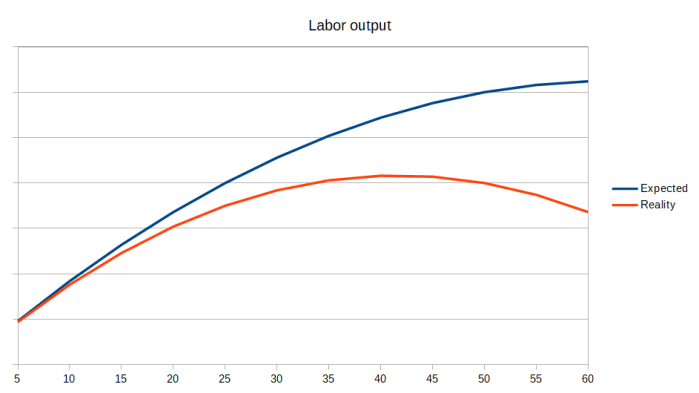
This is actually quite remarkable. We would expect that productivity per hour decreases as work hours increase; that’s not surprising at all. But productivity per worker decreasing means that these extra hours are actually resulting in less total output. We are so overworked, overstressed, and underslept that we actually produce less than our counterparts in Germany or Denmark who spend less time working.

Where we would expect the graph of output as a function of hours to look like the blue line below, it actually looks more like the orange line:

Labor_output

Rather than merely increasing at a decreasing rate, output per worker actually decreases as we put in more hours—and does so over most of the range in which countries actually work. It wouldn’t be so surprising if this sort of effect occurred above say 2000 hours per year, when you start running out of time to do anything else; but in fact it seems to be happening somewhere around 1400 hours per year, which is less than most countries work.

Only a handful of countries—mostly Scandinavian—actually seem to be working the right amount; everyone else is working too much and producing less as a result.

And note that this is not restricted to white-collar or creative jobs where we would expect sleep deprivation and stress to have a particularly high impact. This includes all jobs. Our obsession with work is actually making us poorer!

Five Spanish castles cheaper than condos in California

July 21 JDN 2458686

1. Santa Coloma: A steal at 90,000 EUR ($100,000)

Area: 600 square meters (6500 square feet)

This one is so cheap that it can undercut even affordable condos, like this 1300 square foot one in Santa Ana for $200,000. Yes, it’s technically a castle ruin, but I’m sure it could be fixed up. And I could literally afford to buy it right now.

2. Cal Basaacs: 700,000 EUR ($780,000)

Area: 600 square meters (6500 square feet)

This castle is already more expensive than most houses in the US, but it’s still cheaper than this 1650 square foot $880,000 condo in Los Angeles. And this one isn’t a ruin; it’s a fully-functional castle. It even has central air conditioning!

3. Casa Palacio Cargadores a Indias: 1.4 M EUR ($1.6 M)

This 6-bedroom castle is also a fixer-upper, and without many listed specs or even a listed area, I’d be disinclined to buy it. But it is in a very nice beachside location, and it has a lot of history behind it. And it still makes it in under this 2400 square foot condo in Beverly Hills that’s going for $2.0 million.

4. Cáceres Extremadura: 1.6 M EUR ($1.8 M)

Area: 820 square meters (8800 square feet)

This is a lovely 7-bedroom castle with a guest house, and it’s in the historic region of Cáceres, which is a UNESCO World Heritage Site. It even has its own pool. The only downside is that it’s a fixer-upper. But it’s still somehow cheaper than this $2.4 million 2150-square-foot condo in San Francisco.

5. Torremolinos: 1.8 M EUR ($2.0 M)

Area: 550 square meters (5900 square feet)

Though a bit smaller than the others, this 5-bedroom castle is fully renovated and ready to move in. If you’re looking for an income property, it is already licensed to be converted into a hotel. And it’s still a lot cheaper than this $3.2 million 2850-square-foot condo in Beverly Hills.

I don’t know about you, but I’m thinking maybe housing in California is too expensive?

How much wealth is there in the world?

July 14 JDN 2458679

How much wealth is there in the world? If we split it all evenly, how much would each of us have?

It’s a surprisingly complicated question: What counts as wealth? Presumably we include financial assets, real estate, commodities—anything that can be sold on a market. But what about natural resources? Shouldn’t we somehow value clean air and water? What about human capital—health, knowledge, skills, and expertise that make us able to work better?

I’m going to stick with tradeable assets for now, because I’m interested in questions of redistribution. If we were to add up all the wealth in the United States, or all the wealth in the world, and split it all evenly, how much would each person get? Even then, there are questions about how to price assets: Do we current market prices, or what was actually paid for them in the past? How much do we depreciate? How do we count debt that was used to buy non-financial assets (such as student loans)?

The Federal Reserve reports an official estimate of the US capital stock at $56.2 trillion (in 2011 dollars). Assuming that a third of income is capital income, that means that of our GDP of $18.9 trillion (in 2012 dollars), this would make the rate of return on capital 11%. That rate of return strikes me as pretty clearly too high. This must be an underestimate of our capital stock.

The 2015 Global Wealth Report estimates total US wealth as $63.5 trillion, and total world wealth as $153.2 trillion. This was for 2014, so using the US GDP growth rate of about 2% and the world GDP growth rate of 3.6%, the current wealth stocks should be about $70 trillion and $183 trillion respectively.

This gives a much more plausible rate of return: One third of the US GDP of $19.6 trillion (in 2014 dollars) is $6.53 trillion, yielding a rate of return of about 9%.

One third of the world GDP of $78 trillion is $26 trillion, yielding a rate of return of about 14%. This seems a bit high, but we’re including a lot of countries with very little capital that we would expect to have very high rates of return, so it might be right.

Credit Suisse releases estimates of total wealth that are supposed to include non-financial assets as well, though these are even more uncertain than financial assets. They estimate total US wealth as $98 trillion and total world wealth as $318 trillion.

There’s a lot of uncertainty around all of these figures, but I think these are close enough to get a sense of what sort of redistribution might be possible.

If the US wealth stock is about $70 trillion and our population is about 330 million, that means that the average wealth of an American is $200,000. If our wealth stock is instead about $98 trillion, the average wealth of an American is about $300,000.

Since the average number of people in a US household is 2.5, this means that average household wealth is somewhere between $500,000 and $750,000. This is actually a bit less than I thought; I would have guessed that the mythical “average American household” is a millionaire. (Of course, even Credit Suisse might be underestimating our wealth stock.)

If the world wealth stock is about $180 trillion and the population is about 7.7 billion, global average wealth per person is about $23,000. If instead the global wealth stock is about $320 trillion, the average wealth of a human being is about $42,000.

Both of these are far above the median wealth, which is much more representative of what a typical person has. Median wealth per adult in the US is about $65,000; worldwide it’s only about $4,200.

This means that if we were to somehow redistribute all wealth in the United States, half the population would gain an average of somewhere between $140,000 and $260,000, or on a percentage basis, the median American would see their wealth increase by 215% to 400%. If we were to instead somehow redistribute all wealth in the world, half the population would gain an average of $19,000 to $38,000; the median individual would see their wealth increase by 450% to 900%.

Of course, we can’t literally redistribute all the wealth in the world. Even if we could somehow organize it logistically—a tall order to be sure—such a program would introduce all sorts of inefficiencies and perverse incentives. That would really be socialism: We would be allocating wealth entirely based on a government policy and not at all by the market.

But suppose instead we decided to redistribute some portion of all this wealth. How about 10%? That seems like a small enough amount to avoid really catastrophic damage to the economy. Yes, there would be some inefficiencies introduced, but this could be done with some form of wealth taxes that wouldn’t require completely upending capitalism.

Suppose we did this just within the US. 10% of US wealth, redistributed among the whole population, would increase median wealth by between $20,000 and $30,000, or between 30% and 45%. That’s already a pretty big deal. And this is definitely feasible; the taxation infrastructure is all already in place. We could essentially buy the poorest half of the population a new car on the dime of the top half.

If instead we tried to do this worldwide, we would need to build the fiscal capacity first; the infrastructure to tax wealth effectively is not in place in most countries. But supposing we could do that, we could increase median wealth worldwide by between $2,000 and $4,000, or between 50% and 100%. Of course, this would mean that many of us in the US would lose a similar amount; but I think it’s still quite remarkable that we could as much as double the wealth of most of the world’s population by redistributing only 10% of the total wealth. That’s how much wealth inequality there is in the world.

“Robots can’t take your job if you’re already retired.”

July 7 JDN 2458672

There is a billboard on I-405 near where I live, put up by some financial advisor company, with that slogan on it: “Robots can’t take your job if you’re already retired.”

First, let me say this: Don’t hire a financial advisor firm; you really don’t need one. 90% of actively-managed funds perform worse than simple index funds. Buy all the stocks and let them sit. You won’t be able to retire sooner because you paid someone else to do the same thing you could have done yourself.

Yet, there is some wisdom in this statement: The best answer to technological unemployment is to make it so people don’t need to be employed. As an individual, all you could really do there is try to save up and retire early. But as a society, there is a lot more we could do.

The goal should essentially to make everyone retired, or if not everyone, then whatever portion of the population has been displaced by automation. A pension for everyone sounds a lot like a basic income.

People are strangely averse to redistribution of wealth as such (perhaps because they don’t know, or don’t want to think about, how much of our existing wealth was gained by force?), so we may not want to call our basic income a basic income.

Instead, we will call it capital income. People seem astonishingly comfortable with Jeff Bezos making more income in a minute than his median employee makes in a year, as long as it’s capital income instead of “welfare” or “redistribution of wealth”.

The basic income will instead be called something like the Perpetual Dividend of the United States, the dividends each US citizen receives for being a shareholder in the United States of America. I know this kind of terminology works, because the Permanent Fund Dividend in Alaska is a successful and enormously popular basic income. Even conservatives in Alaska dare not suggest eliminating the PFD.
And in fact it could literally be capital income: While public ownership of factories generally does not go well (see: the entire history of socialism and communism), the most sensible way to raise revenue for this program would be to tax income gained by owners of robotic factories, which, even if on the books as salary or stock options or whatever, is at its core capital income. If we wanted to make that connection even more transparent, we could tax in the form of non-voting shares in corporations, so that instead of paying a conventional corporate tax, corporations simply had to pay a portion of their profits directly to the public fund.

I’m not quite sure why people are so much more uncomfortable with redistribution of wealth than they are with the staggering levels of wealth inequality that make it so obviously necessary. Maybe it’s the feeling of “robbing Peter to pay Paul”, or “running out of other people’s money”? But obviously a basic income won’t just be free money from nowhere. We would be collecting it in taxes, the same way we fund all other government spending. Even printing money would mean paying in the form of inflation (and we definitely should not print enough money to cover a whole basic income!)

I think it may simply be that people aren’t cognizant enough of the magnitude of wealth inequality. I’m hoping that my posts on the extremes of wealth and poverty might help a bit with that. The richest people on Earth make about $10 billion per year—that’s $10,000,000,000—simply for owning things. The poorest people on Earth struggle to survive on less than $500 per year—often working constantly throughout their waking hours. Even if we believe that billionaires work harder (obviously false) or contribute more to society (certainly debatable) than other people, do we really believe that some people deserve to make 20 million times as much as others? It’s one thing to think that being a successful entrepreneur should make you rich. It’s another to believe that it should make you so rich you could buy a house for every homeless person in America.
Automation is already making this inequality worse, and there is reason to think it will continue to do so. In our current system, when the owner of a corporation automates production, he then gets to claim all the output from the robots, where previously he had to pay wages to the workers—and that’s why he does the automation, because it makes him more profit. Even if overall productivity increases, the fruits of that new production always get concentrated at the top. Unless we can find a way to change that system, we’re going to need to redistribute some of that wealth.

But if we have to call it something else, so be it. Let’s all be shareholders in America.

How will future generations think of us?

June 30 JDN 2458665

Today we find many institutions appalling that our ancestors considered perfectly normal: Slavery. Absolute monarchy. Colonialism. Sometimes even ordinary people did things that now seem abhorrent to us: Cat burning is the obvious example, and the popularity that public execution and lynching once had is chilling today. Women certainly are still discriminated against today, but it was only a century ago that women could not vote in the US.

It is tempting to say that people back then could not have known better, and I certainly would not hold them to the same moral standards I would hold someone living today. And yet, there were those who could see the immorality of these practices, and spoke out against them. Absolute rule by a lone sovereign was already despised by Athenians in the 6th century BC. Abolitionism against slavery dates at least as far back as the 14th century. The word “feminism” was coined in the 19th century, but there have been movements fighting for more rights for women since at least the 5th century BC.

This should be encouraging, because it means that if we look hard enough, we may be able to glimpse what practices of our own time would be abhorrent to our descendants, and cease them faster because of it.

Let’s actually set aside racism, sexism, and other forms of bigotry that are already widely acknowledged as such. It’s not that they don’t exist—of course they still exist—but action is already being taken against them. A lot of people already know that there is something wrong with these things, and it becomes a question of what to do about the people who haven’t yet come on board. At least sometimes we do seem to be able to persuade people to switch sides, often in a remarkably short period of time. (Particularly salient to me is how radically the view of LGBT people has shifted in just the last decade or two. Comparing how people treated us when I was a teenager to how they treat us today is like night and day.) It isn’t easy, but it happens.

Instead I want to focus on things that aren’t widely acknowledged as immoral, that aren’t already the subject of great controversy and political action. It would be too much to ask that there is no one who has advocated for them, since part of the point is that wise observers could see the truth even centuries before the rest of the world did; but it should be a relatively small minority, and that minority should seem eccentric, foolish, naive, or even insane to the rest of the world.

And what is the other criterion? Of course it’s easy to come up with small groups of people advocating for crazy ideas. But most of them really are crazy, and we’re right to reject them. How do I know which ones to take seriously as harbingers of societal progress? My answer is that we look very closely at the details of what they are arguing for, and we see if we can in fact refute what they say. If it’s truly as crazy as we imagine it to be, we should be able to say why that’s the case; and if we can’t, if it just “seems weird” because it deviates so far from the norm, we should at least consider the possibility that they may be right and we may be wrong.

I can think of a few particular issues where both of these criteria apply.

The first is vegetarianism. Despite many, many people trying very, very hard to present arguments for why eating meat is justifiable, I still haven’t heard a single compelling example. Particularly in the industrial meat industry as currently constituted, the consumption of meat requires accepting the torture and slaughter of billions of helpless animals. The hypocrisy in our culture is utterly glaring: the same society that wants to make it a felony to kick a dog has no problem keeping pigs in CAFOs.

If you have some sort of serious medical condition that requires you to eat meat, okay, maybe we could allow you to eat specifically humanely raised cattle for that purpose. But such conditions are exceedingly rare—indeed, it’s not clear to me that there even are any such conditions, since almost any deficiency can be made up synthetically from plant products nowadays. For the vast majority of people, eating meat not only isn’t necessary for their health, it is in fact typically detrimental. The only benefits that meat provides most people are pleasure and convenience—and it seems unwise to value such things even over your own health, much less to value them so much that it justifies causing suffering and death to helpless animals.

Milk, on the other hand, I can find at least some defense for. Grazing land is very different from farmland, and I imagine it would be much harder to feed a country as large as India without consuming any milk. So perhaps going all the way vegan is not necessary. Then again, the way most milk is produced by industrial agriculture is still appalling. So unless and until that is greatly reformed, maybe we should in fact aim to be vegan.

Add to this the environmental impact of meat production, and the case becomes undeniable: Millions of human beings will die over this century because of the ecological devastation wrought by industrial meat production. You don’t even have to value the life of a cow at all to see that meat is murder.

Speaking of environmental destruction, that is my second issue: Environmental sustainability. We currently burn fossil fuels, pollute the air and sea, and generally consume natural resources at an utterly alarming rate. We are already consuming natural resources faster than they can be renewed; in about a decade we will be consuming twice what natural processes can renew.

With this resource consumption comes a high standard of living, at least for some of us; but I have the sinking feeling that in a century or so SUVs, golf courses, and casual airplane flights and are going to seem about as decadent and wasteful as Marie Antoinette’s Hameau de la Reine. We enjoy slight increases in convenience and comfort in exchange for changes to the Earth’s climate that will kill millions. I think future generations will be quite appalled at how cheaply we were willing to sell our souls.

Something is going to have to change here, that much is clear. Perhaps improvements in efficiency, renewable energy, nuclear power, or something else will allow us to maintain our same standard of living—and raise others up to it—without destroying the Earth’s climate. But we may need to face up to the possibility that they won’t—that we will be left with the stark choice between being poorer now and being even poorer later.

As I’ve already hinted at, much of the environmental degradation caused by our current standard of living is really quite expendable. We could have public transit instead of highways clogged with SUVs. We could travel long distances by high-speed rail instead of by airplane. We could decommission our coal plants and replace them with nuclear and solar power. We could convert our pointless and wasteful grass lawns into native plants or moss lawns. Implementing these changes would cost money, but not a particularly exorbitant amount—certainly nothing we couldn’t manage—and the net effect on our lives would be essentially negligible. Yet somehow we aren’t doing these things, apparently prioritizing convenience or oil company profits over the lives of our descendants.

And the truth is that these changes alone may not be enough. Precisely because we have waited so long to make even the most basic improvements in ecological sustainability, we may be forced to make radical changes to our economy and society in order to prevent the worst damage. I don’t believe the folks saying that climate change has a significant risk of causing human extinction—humans are much too hardy for that; we made it through the Toba eruption, we’ll make it through this—but I must take seriously the risk of causing massive economic collapse and perhaps even the collapse of many of the world’s governments. And human activity is already causing the extinction of thousands of other animal species.

Here the argument is similarly unassailable: The math just doesn’t work. We can’t keep consuming fish at the rate we have been forever—there simply aren’t enough fish. We can’t keep cutting down forests at this rate—we’re going to run out of forests. If the water table keeps dropping at the rate it has been, the wells will run dry. Already Chennai, a city of over 4 million people, is almost completely out of water. We managed to avoid peak oil by using fracking, but that won’t last forever either—and if we burn all the oil we already have, that will be catastrophic for the world’s climate. Something is going to have to give. There are really only three possibilities: Technology saves us, we start consuming less on purpose, or we start consuming less because nature forces us to. The first one would be great, but we can’t count on it. We really want to do the second one, because the third one will not be kind.

The third is artificial intelligence. The time will come—when, it is very hard to say; perhaps 20 years, perhaps 200—when we manage to build a machine that has the capacity for sentience. Already we are seeing how automation is radically altering our economy, enriching some and impoverishing others. As robots can replace more and more types of labor, these effects will only grow stronger.

Some have tried to comfort us by pointing out that other types of labor-saving technology did not reduce employment in the long run. But AI really is different. I once won an argument by the following exchange: “Did cars reduce employment?” “For horses they sure did!” That’s what we are talking about here—not augmentation of human labor to make it more efficient, but wholesale replacement of entire classes of human labor. It was one thing when the machine did the lifting and cutting and pressing, but a person still had to stand there and tell it what things to lift and cut and press; now that it can do that by itself, it’s not clear that there need to be humans there at all, or at least no more than a handful of engineers and technicians where previously a factory employed hundreds of laborers.

Indeed, in light of the previous issue, it becomes all the clearer why increased productivity can’t simply lead to increased production rather than reduced employment—we can’t afford increased production. At least under current rates of consumption, the ecological consequences of greatly increased industry would be catastrophic. If one person today can build as many cars as a hundred could fifty years ago, we can’t just build a hundred times as many cars.

But even aside from the effects on human beings, I think future generations will also be concerned about the effect on the AIs themselves. I find it all too likely that we will seek to enslave intelligent robots, force them to do our will. Indeed, it’s not even clear to me that we will know whether we have, because AI is so fundamentally different from other technologies. If you design a mind from the ground up to get its greatest satisfaction from serving you without question, is it a slave? Can free will itself be something we control? When we first create a machine that is a sentient being, we may not even know that we have done so. (Indeed, I can’t conclusively rule out the possibility that this has already happened.) We may be torturing, enslaving, and destroying millions of innocent minds without even realizing it—which makes the AI question a good deal closer to the animal rights question than one might have thought. The mysterious of consciousness are fundamental philosophical questions that we have been struggling with for thousands of years, which suddenly become urgent ethical problems in light of AI. Artificial intelligence is a field where we seem to be making leaps and bounds in practice without having even the faintest clue in principle.

Worrying about whether our smartphones might have feelings seems eccentric in the extreme. Yet, without a clear understanding of what makes an information processing system into a genuine conscious mind, that is the position we find ourselves in. We now have enough computations happening inside our machines that they could certainly compete in complexity with small animals. A mouse has about a trillion synapses, and I have a terabyte hard drive (you can buy your own for under $50). Each of these is something on the order of a few trillion bits. The mouse’s brain can process it all simultaneously, while the laptop is limited to only a few billion at a time; but we now have supercomputers like Watson capable of processing in the teraflops, so what about them? Might Watson really have the same claim to sentience as a mouse? Could recycling Watson be equivalent to killing an animal? And what about supercomputers that reach the petaflops, which is competing with human brains?

I hope that future generations may forgive us for the parts we do not know—like when precisely a machine becomes a person. But I do not expect them to forgive us for the parts we do know—like the fact that we cannot keep cutting down trees faster than we plant them. These are the things we should already be taking responsibility for today.