Why we give gifts

JDN 2457020 EST 18:28.

You’ll notice it’s Sunday, not Saturday; I apologize for not actually posting on time this week. Due to the holiday season I was whisked away to family activities in Cleveland, and could not find wifi that was both free and reliable.

But since it is the Christmas season—Christmas Day was last Thursday—the time during which most Americans spend more than we can probably afford buying gifts (the highest rate of consumer spending all year long, much of it on credit cards, a significant boost for the economy in these times of depression), I thought it would be worthwhile to talk about why gifts are so important to us.

As I’ve already mentioned a few posts ago, neoclassical economists are typically baffled by gift-giving, and several have written research papers and books about why Christmas gifts are economically inefficient and should be stopped. Oddly it never seems to occur to them that if this is true, then there is widespread irrational consumer behavior that has nothing to do with government intervention or perverse incentives—which already means neoclassical economic theory is in serious trouble. Nobody forces you to buy gifts, so if it’s such a bad idea but we do it anyway, we must not be rational agents.

But in fact it’s not such a bad idea, and it’s “inefficient” only in a very narrow-minded sense that takes no account of relationships or human emotions. Gifts only make us not “rational agents” in that we are not infinite identical psychopaths. There is in fact nothing irrational about gifts.

Gift-giving is a human universal; it has been with us far longer than money or markets or indeed civilization itself. Everyone from tribal hunter-gatherers to neoclassical economists gives gifts, and in fact most people who descend from populations that lived in higher latitudes (that is, “White people”, though perhaps in a later post I’ll explain why our “race” categories are genetically absurd) actually celebrate some sort of gift-giving ceremony around the time of the Winter Solstice. Many of our Christmas traditions actually come from the Germanic holiday Yule, which is why we say things like “Yuletide greetings” even though that has absolutely nothing to do with Jesus. We celebrate around the Solstice because it was such a momentous season for us, the darkest night of the year; as if the darkness and cold weren’t bad enough by themselves they are the harbinger of the dreaded winter that prevents our crops from growing and may not allow us all to survive. We reaffirm our family ties and promise to help each other through this dangerous time. Music, gifts, and feasting are simply the way that humans organize our celebrations—again this is universal.

What do gifts accomplish that a simple transfer of cash would not? I can think of three things:

      1. Convey closeness: First of all there is of course the fact that by buying someone a gift at all, you are expressing the fact that you care about them and want to be close to them. But the choice of the gift also matters. Your closest friends always buy you the best gifts, because they know you the best. Thus the sort of gift you receive from someone is a measure of how well they know you. Many of us give each other lists of ideas to buy, but I always include more on the list than I expect to receive and encourage people to buy things that are not on the list that they think I might enjoy. A computer program can buy things off a list; the point is that we express our relationships by choosing things we know people want without them having to ask. We trust people to know us well enough to get it right most of the time; they’ll probably make mistakes (most people think they know others better than they actually do), but the mistakes are made up for by the successes. The disappointment in getting something you didn’t want isn’t even so much in the thing as it is in the fear that your loved ones don’t know you as well as you thought they did; this is why I consider it important to express—gently and tactfully of course—when you really don’t like a gift you received; you want them to know you better and do better next time, not keep giving you things you hate while you brood behind fake smiles. What you choose to buy conveys what you know and how you feel; this is why the best gift is one you love to have but didn’t ask for. That’s why I’m honestly more excited about my new travel pillow and copy of Randall Monroe’s What If? than I am about my new Bluetooth headset; of course the headset is more expensive and more useful, but I specifically asked for it. My sister and my mother knew me well enough that the book and the travel pillow I didn’t have to ask for.
      2. Grant permission to indulge: This is particularly important in the United States, because our society has Puritanical roots that make us suspicious of any activity that isn’t directly linked to productive efficiency. Honestly when those economists criticize Christmas as “inefficient” they are not so much making a serious economic argument as they are expressing in terms familiar to them the centuries-old Puritanical norm. It is considered unseemly to buy things for yourself that are purely for fun, particularly if they are expensive. You are expected to buy only the minimum you need, because any more is greedy; the notion seems to be that there is only so much stuff to go around, and if you take more others will have less. (This could scarcely be further from the truth; your frivolous consumer purchases can save children from starvation by giving their parents jobs in factories.) Neoclassical economists often think they are immune to this sort of norm, but aside from their discomfort with Christmas, the sense of righteousness they often have around “raising the savings rate” says otherwise. The link from savings to investment is tenuous at best, but one thing saving definitely does do is prevent you from spending indulgently. But since buying things that make us happy is actually kind of the entire point of having an economy in the first place, it is necessary to find workarounds for this oppressive ethic. One solution is gifts; to give someone else an indulgent gift allows them to engage in indulgent activities, while preserving their own status as someone who wouldn’t normally waste money in that way, and since you are not the one indulging you can hardly be accused of frivolity either. This is also what gift cards accomplish; in economic terms gift cards seem weird, because they are at best as good as cash, and often far worse. But gift cards are typically for retail stores where it is hard to buy something that’s not indulgent, thus offering permission to indulge. This is why a gift card for GameStop or Dick’s Sporting Goods makes sense, but a gift card to Walmart or Kroger seems odd. This is also why receiving cash or an Amazon gift card doesn’t feel as good; since you can buy just about anything, the social norm toward spending responsibly returns. (Never buy anyone a VISA gift card; it’s basically the same as cash except you’re giving some of the money to VISA.)
      3. Conveys your own status: By buying expensive things for other people, you raise your own reputation as an individual. This one is easy to become cynical about, so it’s important to be clear what it actually means. Conveying your own status doesn’t necessarily mean arrogantly domineering over other people. It certainly can mean that, which is why if your cousin has $20 million and buys everyone in the family a new car every year, you’d honestly not be that thrilled about it; yeah, it’s nice getting a new car, but your cousin is clearly showboating his superior wealth and trying to make everyone else look cheap and/or poor. But there is a way to elevate your own status without downgrading everyone else’s, and truly generous gifts are a way of doing that. If the things you buy are really things your loved ones truly need, then you express your generosity and love for them by buying more than you can easily afford. Philanthropy is also a means of conveying status, and again comes in both forms. When Carnegie built buildings and named them after himself, he was being arrogant and domineering. When Bill Gates established a foundation to combat malaria and poverty in Africa, he was being genuinely generous. This kind of status is always a bit paradoxical: The best way to earn a reputation as a good person is to honestly try to help people and have little concern for your own reputation; people who try too hard to improve their own reputations just end up seeming arrogant and narcissistic. In order to deserve status, it is necessary not to directly seek it. The clearest example here is Jonas Salk: He invented a vaccine that saved the lives of thousands of children, making him more deserving of a billion dollars than anyone else I can think of. And he had a chance at a billion dollars, but he specifically gave it up, because in order to get it he would have had to enforce a patent that would raise the price of the vaccine and allow children to needlessly suffer and die. It was the very character that made him deserve the wealth that caused him to refuse it. The only way to hit the target is to aim much higher.

If you really want to insist, yes, there’s also some sort of net transfer of wealth involved in gift-giving, because it is expected that the richer you are the more you’ll spend on gifts. But that’s a very small part; even in hunter-gather societies that have negligible levels of inequality human beings still give each other gifts. Gifts are a part of us; they are written in the language of life itself upon the ancient thread that binds us to our ancestors and makes us who we are—by which I mean, of course, DNA. We could probably no more stop giving gifts than we could stop feeling love.

The World Development Report is on cognitive economics this year!

JDN 2457013 EST 21:01.

On a personal note, I can now proudly report that I have successfully defended my thesis “Corruption, ‘the Inequality Trap’, and ‘the 1% of the 1%’ “, and I now have completed a master’s degree in economics. I’m back home in Michigan for the holidays (hence my use of Eastern Standard Time), and then, well… I’m not entirely sure. I have a gap of about six months before PhD programs start. I have a number of job applications out, but unless I get a really good offer (such as the position at the International Food Policy Research Institute in DC) I think I may just stay in Michigan for awhile and work on my own projects, particularly publishing two of my books (my nonfiction magnum opus, The Mathematics of Tears and Joy, and my first novel, First Contact) and making some progress on a couple of research papers—ideally publishing one of them as well. But the future for me right now is quite uncertain, and that is now my major source of stress. Ironically I’d probably be less stressed if I were working full-time, because I would have a clear direction and sense of purpose. If I could have any job in the world, it would be a hard choice between a professorship at UC Berkeley or a research position at the World Bank.

Which brings me to the topic of today’s post: The people who do my dream job have just released a report showing that they basically agree with me on how it should be done.

If you have some extra time, please take a look at the World Bank World Development Report. They put one out each year, and it provides a rigorous and thorough (236 pages) but quite readable summary of the most important issues in the world economy today. It’s not exactly light summer reading, but nor is it the usual morass of arcane jargon. If you like my blog, you can probably follow most of the World Development Report. If you don’t have time to read the whole thing, you can at least skim through all the sidebars and figures to get a general sense of what it’s all about. Much of the report is written in the form of personal vignettes that make the general principles more vivid; but these are not mere anecdotes, for the report rigorously cites an enormous volume of empirical research.

The title of the 2015 report? “Mind, Society, and Behavior”. In other words, cognitive economics. The world’s foremost international economic institution has just endorsed cognitive economics and rejected neoclassical economics, and their report on the subject provides a brilliant introduction to the subject replete with direct applications to international development.

For someone like me who lives and breathes cognitive economics, the report is pure joy. It’s all there, from anchoring heuristic to social proof, corruption to discrimination. The report is broadly divided into three parts.

Part 1 explains the theory and evidence of cognitive economics, subdivided into “thinking automatically” (heuristics), “thinking socially” (social cognition), and “thinking with mental models” (bounded rationality). (If I wrote it I’d also include sections on the tribal paradigm and narrative, but of course I’ll have to publish that stuff in the actual research literature first.) Anyway the report is so amazing as it is I really can’t complain. It includes some truly brilliant deorbits on neoclassical economics, such as this one from page 47: ” In other words, the canonical model of human behavior is not supported in any society that has been studied.”

Part 2 uses cognitive economic theory to analyze and improve policy. This is the core of the report, with chapters on poverty, childhood, finance, productivity, ethnography, health, and climate change. So many different policies are analyzed I’m not sure I can summarize them with any justice, but a few particularly stuck out: First, the high cognitive demands of poverty can basically explain the whole observed difference in IQ between rich and poor people—so contrary to the right-wing belief that people are poor because they are stupid, in fact people seem stupid because they are poor. Simplifying the procedures for participation in social welfare programs (which is desperately needed, I say with a stack of incomplete Medicaid paperwork on my table—even I find these packets confusing, and I have a master’s degree in economics) not only increases their uptake but also makes people more satisfied with them—and of course a basic income could simplify social welfare programs enormously. “Are you a US citizen? Is it the first of the month? Congratulations, here’s $670.” Another finding that I found particularly noteworthy is that productivity is in many cases enhanced by unconditional gifts more than it is by incentives that are conditional on behavior—which goes against the very core of neoclassical economic theory. (It also gives us yet another item on the enormous list of benefits of a basic income: Far from reducing work incentives by the income effect, an unconditional basic income, as a shared gift from your society, may well motivate you even more than the same payment as a wage.)

Part 3 is a particularly bold addition: It turns the tables and applies cognitive economics to economists themselves, showing that human irrationality is by no means limited to idiots or even to poor people (as the report discusses in chapter 4, there are certain biases that poor people exhibit more—but there are also some they exhibit less.); all human beings are limited by the same basic constraints, and economists are human beings. We like to think of ourselves as infallibly rational, but we are nothing of the sort. Even after years of studying cognitive economics I still sometimes catch myself making mistakes based on heuristics, particularly when I’m stressed or tired. As a long-term example, I have a number of vague notions of entrepreneurial projects I’d like to do, but none for which I have been able to muster the effort and confidence to actually seek loans or investors. Rationally, I should either commit or abandon them, yet cannot quite bring myself to do either. And then of course I’ve never met anyone who didn’t procrastinate to some extent, and actually those of us who are especially smart often seem especially prone—though we often adopt the strategy of “active procrastination”, in which you end up doing something else useful when procrastinating (my apartment becomes cleanest when I have an important project to work on), or purposefully choose to work under pressure because we are more effective that way.

And the World Bank pulled no punches here, showing experiments on World Bank economists clearly demonstrating confirmation bias, sunk-cost fallacy, and what the report calls “home team advantage”, more commonly called ingroup-outgroup bias—which is basically a form of the much more general principle that I call the tribal paradigm.

If there is one flaw in the report, it’s that it’s quite long and fairly exhausting to read, which means that many people won’t even try and many who do won’t make it all the way through. (The fact that it doesn’t seem to be available in hard copy makes it worse; it’s exhausting to read lengthy texts online.) We only have so much attention and processing power to devote to a task, after all—which is kind of the whole point, really.

No, capital taxes should not be zero

JDN 2456998 PST 11:38.

It’s an astonishingly common notion among neoclassical economists that we should never tax capital gains, and all taxes should fall upon labor income. Here Scott Sumner writing for The Economist has the audacity to declare this a ‘basic principle of economics’. Many of the arguments are based on rather esoteric theorems like the Atkinson-Stiglitz Theorem (I thought you were better than that, Stiglitz!) and the Chamley-Judd Theorem.

All of these theorems rest upon two very important assumptions, which many economists take for granted—yet which are utterly and totally untrue. For once it’s not assumed that we are infinite identical psychopaths; actually psychopaths might not give wealth to their children in inheritance, which would undermine the argument in a different way, by making each individual have a finite time horizon. No, the assumptions are that saving is the source of investment, and investment is the source of capital income.

Investment is the source of capital, that’s definitely true—the total amount of wealth in society is determined by investment. You do have to account for the fact that real investment isn’t just factories and machines, it’s also education, healthcare, infrastructure. With that in mind, yes, absolutely, the total amount of wealth is a function of the investment rate.

But that doesn’t mean that investment is the source of capital income—because in our present system the distribution of capital income is in no way determined by real investment or the actual production of goods. Virtually all capital income comes from financial markets, which are rife with corruption—they are indeed the main source of corruption that remains in First World nations—and driven primarily by arbitrage and speculation, not real investment. Contrary to popular belief and economic theory, the stock market does not fund corporations; corporations fund the stock market. It’s this bizarre game our society plays, in which a certain portion of the real output of our productive industries is siphoned off so that people who are already rich can gamble over it. Any theory of capital income which fails to take these facts into account is going to be fundamentally distorted.

The other assumption is that investment is savings, that the way capital increases is by labor income that isn’t spent on consumption. This isn’t even close to true, and I never understood why so many economists think it is. The notion seems to be that there is a certain amount of money in the world, and what you don’t spend on consumption goods you can instead spend on investment. But this is just flatly not true; the money supply is dynamically flexible, and the primary means by which money is created is through banks creating loans for the purpose of investment. It’s that I term I talked about in my post on the deficit; it seems to come out of nowhere, because that’s literally what happens.

On the reasoning that savings is just labor income that you don’t spend on consumption, then if you compute the figure W – C , wages and salaries minus consumption, that figure should be savings, and it should be equal to investment. Well, that figure is negative—for reasons I gave in that post. Total employee compensation in the US in 2014 is $9.2 trillion, while total personal consumption expenditure is $11.4 trillion. The reason we are able to save at all is because of government transfers, which account for $2.5 trillion. To fill up our GDP to its total of $16.8 trillion, you need to add capital income: proprietor income ($1.4 trillion) and receipts on assets ($2.1 trillion); then you need to add in the part of government spending that isn’t transfers ($1.4 trillion).

If you start with the fanciful assumption that the way capital increases is by people being “thrifty” and choosing to save a larger proportion of their income, then it makes some sense not to tax capital income. (Scott Sumner makes exactly that argument, having us compare two brothers with equal income, one of whom chooses to save more.) But this is so fundamentally removed from how capital—and for that matter capitalism—actually operates that I have difficulty understanding why anyone could think that it is true.

The best I can come up with is something like this: They model the world by imagining that there is only one good, peanuts, and everyone starts with the same number of peanuts, and everyone has a choice to either eat their peanuts or save and replant them. Then, the total production of peanuts in the future will be due to the proportion of peanuts that were replanted today, and the amount of peanuts each person has will be due to their past decisions to save rather than consume. Therefore savings will be equal to investment and investment will be the source of capital income.

I bet you can already see the problem even in this simple model, if we just relax the assumption of equal wealth endowments: Some people have a lot more peanuts than others. Why do some people eat all their peanuts? Well it probably has something to do with the fact they’d starve if they didn’t. Reducing your consumption below the level at which you can survive isn’t “thrifty”, it’s suicidal. (And if you think this is a strawman, the IMF has literally told Third World countries that their problem is they need to save more. Here they are arguing that in Ghana.) In fact, economic growth leads to saving, not the other way around. Most Americans aren’t starving, and could probably stand to save more than we do, but honestly it might not be good if we did—everyone trying to save more can lead to the Paradox of Thrift and cause a recession.

Even worse, in that model world, there is only capital income. There is no such thing as labor income, only the number of peanuts you grow from last year’s planting. If we now add in labor income, what happens? Well, peanuts don’t work anymore… let’s try robots. You have a certain number of robots, and you can either use the robots to do things you need (including somehow feeding you, I guess), or you can use them to build more robots to use later. You can also build more robots yourself. Then the “zero capital tax” argument amounts to saying that the government should take some of your robots for public use if you made them yourself, but not if they were made by other robots you already had.

In order for that argument to carry through, you need to say that there was no such thing as an initial capital endowment; all robots that exist were either made by their owners or saved from previous construction. If there is anyone who simply happened to be born with more robots, or has more because they stole them from someone else (or, more likely, both, they inherited from someone who stole), the argument falls apart.

And even then you need to think about the incentives: If capital income is really all from savings, then taxing capital income provides an incentive to spend. Is that a bad thing? I feel like it isn’t; the economy needs spending. In the robot toy model, we’re giving people a reason to use their robots to do actual stuff, instead of just leaving them to make more robots. That actually seems like it might be a good thing, doesn’t it? More stuff gets done that helps people, instead of just having vast warehouses full of robots building other robots in the hopes that someday we can finally use them for something. Whereas, taxing labor income may give people an incentive not to work, which is definitely going to reduce economic output. More precisely, higher taxes on labor would give low-wage workers an incentive to work less, and give high-wage workers an incentive to work more, which is a major part of the justification of progressive income taxes. A lot of the models intended to illustrate the Chamley-Judd Theorem assume that taxes have an effect on capital but no effect on labor, which is kind of begging the question.

Another thought that occurred to me is: What if the robots in the warehouse are all destroyed by a war or an earthquake? And indeed the possibility of sudden capital destruction would be a good reason not to put everything into investment. This is generally modeled as “uninsurable depreciation risk”, but come on; of course it’s uninsurable. All real risk is uninsurable in the aggregate. Insurance redistributes resources from those who have them but don’t need them to those who suddenly find they need them but don’t have them. This actually does reduce the real risk in utility, but it certainly doesn’t reduce the real risk in terms of goods. Stephen Colbert made this point very well: “Obamacare needs the premiums of healthier people to cover the costs of sicker people. It’s a devious con that can only be described as—insurance.” (This suggests that Stephen Colbert understands insurance better than many economists.) Someone has to make that new car that you bought using your insurance when you totaled the last one. Insurance companies cannot create cars or houses—or robots—out of thin air. And as Piketty and Saez point out, uninsurable risk undermines the Chamley-Judd Theorem. Unlike all these other economists, Piketty and Saez actually understand capital and inequality.
Sumner hand-waves that point away by saying we should just institute a one-time transfer of wealth to equalized the initial distribution, as though this were somehow a practically (not to mention politically) feasible alternative. Ultimately, yes, I’d like to see something like that happen; restore the balance and then begin anew with a just system. But that’s exceedingly difficult to do, while raising the tax rate on capital gains is very easy—and furthermore if we leave the current stock market and derivatives market in place, we will not have a just system by any stretch of the imagination. Perhaps if we can actually create a system where new wealth is really due to your own efforts, where there is no such thing as inheritance of riches (say a 100% estate tax above $1 million), no such thing as poverty (a basic income), no speculation or arbitrage, and financial markets that actually have a single real interest rate and offer all the credit that everyone needs, maybe then you can say that we should not tax capital income.

Until then, we should tax capital income, probably at least as much as we tax labor income.

Is marginal productivity fair?

JDN 2456963 PDT 11:11.

The standard economic equilibrium that is the goal of any neoclassical analysis is based on margins, rather than totals; what matters is not how much you have in all, but how much you get from each new one. This may be easier to understand with specific examples: The price of a product isn’t set by the total utility that you get from using that product; it’s set by the marginal utility that you get from each new unit. The wage of a worker isn’t set by their total value to the company; it’s set by the marginal value they provide with each additional hour of work. Formally, it’s not the value of the function f(x), it’s the derivative of the function, f'(x). (If you don’t know calculus, don’t worry about that last part; it isn’t that important to understand the basic concept.)

This is the standard modern explanation for Adam Smith’s “diamond-water paradox“: Why are diamonds so much more expensive than water, even though water is much more useful? Well, we have plenty of water, so the marginal utility of water isn’t very high; what are you really going to do with that extra liter? But we don’t have a lot of diamonds, so even though diamonds in general aren’t that useful, getting an extra diamond has a lot of benefit. (The units are a bit weird, as George Stigler once used to argue that Smith’s paradox is “meaningless”; but that’s silly. Let’s fix the units at “per kilogram”; a kilogram of diamonds is far, far more expensive than a kilogram of water.)

This explanation is obviously totally wrong, by the way; that’s not why diamonds are expensive. The marginal-utility argument makes sense for cars (or at least ordinary Fords and Toyotas, for reasons you’ll see in a minute), but it doesn’t explain diamonds. Diamonds are expensive for two reasons: First, the absolutely insane monopoly power of the De Beers cartel; as you might imagine, water would be really expensive too if it were also controlled by a single cartel with the power to fix prices and crush competitors. (For awhile De Beers executives had a standing warrant for their arrest in the United States; recently they pled guilty and paid fines—because, as we all know, rich people never go to prison.) And you can clearly see how diamond prices plummeted when the cartel was weakened in the 1980s. But Smith was writing long before DeBeers, and even now that De Beers only controls 40% of the market so we have an oligopoly instead of a monopoly (it’s a step in the right direction I guess), diamonds are still far more expensive than water. The real reason why diamonds are expensive is that diamonds are a Veblen good; you don’t buy diamonds because you actually want to use diamonds (maybe once in awhile, if you want to make a diamond saw or something). You buy diamonds in order to show off how rich you are. And if your goal is to show how rich you are, higher prices are good; you want it to be really expensive, you’re more likely to buy it if it’s really expensive. That’s why the marginal utility argument doesn’t work for Porsches and Ferraris; they’re Veblen goods too. If the price of a Ferrari suddenly dropped to $10,000, people would realize pretty quickly that they are hard to maintain, have very poor suspensions, and get awful gas mileage. It’s not like you can actually drive at 150 mph without getting some serious speeding tickets. (I guess they look nice?) But if the price of a Prius dropped to $10,000, everyone would buy one. For some people diamonds are also a speculation good; they hope to buy them at one price and sell them at a higher price. This is also how most trading in the stock market works, which is why I’m dubious of how well the stock market actually supports real investment. When we’re talking about Veblen goods and speculation goods, the sky is the limit; any price that someone can pay is a price they might sell at.

But all of that is a bit tangential. It’s worth thinking about all the ways that neoclassical theory doesn’t comport with reality, all the cases where price and marginal value become unhinged. But for today I’m going to give the neoclassicists the benefit of the doubt: Suppose it were true. Suppose that markets really were perfectly efficient and everything were priced at its marginal value. Would that even be a good thing?

I tend to focus most of my arguments on why a given part of our economic system deviates from optimal efficiency, because once you can convince economists of that they are immediately willing to try to fix it. But what if we had optimal efficiency? Most economists would say that we’re done, we’ve succeeded, everything is good now. (I am suddenly reminded of the Lego song, “Everything is Awesome.”) This notion is dangerously wrong.

A system could be perfectly efficient and still be horrifically unfair. This is particularly important when we’re talking about labor markets. A diamond or a bottle of water doesn’t have feelings; it doesn’t care what price you sell it at. More importantly it doesn’t have rights. People have feelings; people have rights. (And once again I’m back to Citizens United; a rat is more of a person than any corporation. We should stop calling them “rats” and “fat cats”, for this is an insult to the rodent and feline communities. No, only a human psychopath could ever be quite so corrupt.)

Of course when you sell a product, the person selling it cares how much you pay, but that will either trace back to someone’s labor—and labor markets are still the issue—or it won’t, in which case as far as I’m concerned it really doesn’t matter. If you make money simply by owning things, our society is giving you an enormous gift simply by allowing that capital income to exist; press the issue much more and we’d be well within our rights to confiscate every dime. Unless and until capital ownership is shared across the entire population and we can use it to create a post-scarcity society, capital income will be a necessary evil at best.

So let’s talk about labor markets. If you’ve taken any economics, you have probably seen a great many diagrams like this:

supply_demand2

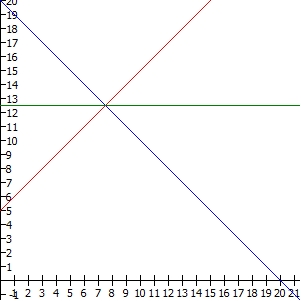
The red line is labor supply, the blue line is labor demand. At the intersection is our glorious efficient market equilibrium, in this case at 7.5 hours of work per day (the x-axis) and $12.50 an hour (the y-axis). The green line is the wage, $12.50 per hour. But let’s stop and think for a moment about what this diagram really means.

What decides that red labor supply line? Do people just arbitrarily decide that they’re going to work 4 hours a day if they get paid $9 an hour, but 8 hours a day if they get paid $13 an hour? No, this line is meant to represent the marginal real cost of working. It’s the monetized value of your work effort and the opportunity cost of what else you could have been doing with your time. It rises because the more hours you work, the more stress it causes you and the more of your life it takes up. Working 4 hours a day, you probably had that time available anyway. Working 8 hours a day, you can fit it in. Working 12 hours a day, now you have no leisure at all. Working 16 hours a day, now you’re having trouble fitting in basic needs like food and sleep. Working 20 hours a day, you eat at work, you don’t get enough sleep, and you’re going to burn yourself out in no time. Why is it a straight line? Because we assume linear relationships to make the math easier. (No, really; that is literally the only reason. We call them “supply and demand curves” but almost always draw and calculate them as straight lines.)

Now let’s consider the blue labor demand line. Is this how much the “job creators” see fit to bestow upon you? No, it’s the marginal value of productivity. The first hour you work each day, you are focused and comfortable, and you can produce a lot of output. The second hour you’re just a little bit fatigued, so you can produce a bit less. By the time you get to hour 8, you’re exhausted, and producing noticeably less output. And if they pushed you past 16 hours, you’d barely produce anything at all. They multiply the amount of products you produce by the price at which they can sell those products, and that’s their demand for your labor. And once again we assume it’s a straight line just to make the math easier.

From this diagram you can calculate what is called employer surplus and worker surplus. Employer surplus is basically the same thing as profit. (It’s not exactly the same for some wonky technical reasons, but for our purposes they may as well be the same.) Worker surplus is a subtler concept; it’s the amount of money you receive minus the monetized value of your cost of working. So if that first hour of work was really easy and you were willing to do it for anything over $5, we take that $5 as your monetized cost of working (your “marginal willingness-to-accept“). Then if you are being paid $12.50 an hour, we infer that you must have gained $7.50 worth of utility from that exchange. (“$7.50 of utility” is a very weird concept, for reasons I’ll get into more in a later post; but it is actually the standard means of estimating utility in neoclassical economics. That’s one of the things I hope to change, actually.)

When you add these up for all the hours worked, the result becomes an integral, which is a formal mathematical way of saying “the area between those two lines”. In this case they are triangles of equal size, so we can just use the old standby A = 1/2*b*h. The area of each triangle is 1/2*7.5*7.5 = $28.13. From each day you work, you make $28.13 in consumer surplus and your employer makes $28.13 in profit.

And that seems fair, doesn’t it? You split it right down the middle. Both of you are better off than you were, and the economic benefits are shared equally. If this were really how labor markets work, that seems like how things ought to be.

But nothing in the laws of economics says that the two areas need to be equal. We tend to draw them that way out of an aesthetic desire for symmetry. But in general they are not, and in some cases they can be vastly unequal.

This happens if we have wildly different elasticities, which is a formal term for the relative rates of change of two things. An elasticity of labor supply of 1 would mean that for a 1% increase in wage you’re willing to work 1% more hours, while an elasticity of 10 would mean that for a 1% increase in wage you’re willing to work 10% more hours. Elasticities can also be negative; a labor demand elasticity of -1 would mean that for a 1% increase in wage your employer is willing to hire you for 1% fewer hours. In the graph above, the elasticity of labor supply is exactly 1. The elasticity of labor demand varies along the curve, but at the equilibrium it is about -1.6. The fact that the profits are shared equally is related to the fact that these two elasticities are close in magnitude but opposite in sign.

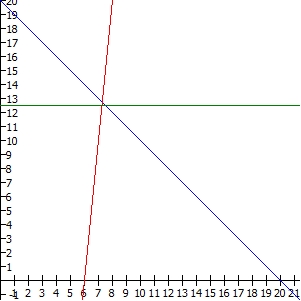
But now consider this equilibrium, in which I’ve raised the labor elasticity to 10. Notice that the wage and number of hours haven’t change; it’s still 7.5 hours at $12.50 per hour. But now the profits are shared quite unequally indeed; while the employer still gets $28.13, the value for the worker is only 1/2*7.5*0.75 = $2.81. In real terms this means we’ve switched from a job that starts off easy but quickly gets harder to a job that is hard to start with but never gets much harder than that.

elastic_supply

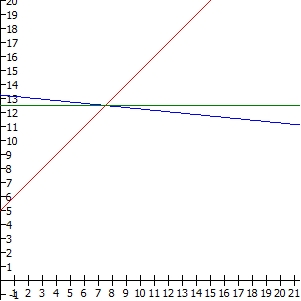
On the other hand what if the supply elasticity is only 0.1? Now the worker surplus isn’t even a triangle; it’s a trapezoid. The area of this trapezoid is 6*12.5+1/2*1.5*12.5 = $84.38. This job starts off easy and fun—so much so that you’d do it for free—but then after 6 hours a day it quickly becomes exhausting and you need to stop.

inelastic_supply

If we had to guess what these jobs are, my suggestion is that maybe the first one is a research assistant, the second one is a garbage collector, and the third one is a video game tester. And thus, even though they are paid about the same (I think that’s true in real life? They all make about $15 an hour or $30k a year), we all agree that the video game tester job is better than the research assistant job which is better than the garbage collector job—which is exactly what the worker surplus figures are saying.

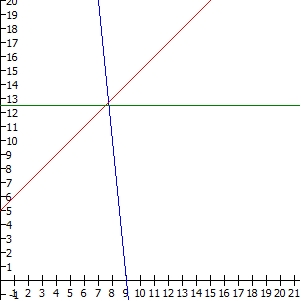
What about the demand side? Here’s where it gets really unfair. Going back to our research assistant with a supply elasticity of 1, suppose they’re not really that good a researcher. Their output isn’t wrong, but it’s also not very interesting. They can do the basic statistics, but they aren’t very creative and they don’t have a deep intuition for the subject. This might produce a demand elasticity 10 times larger. The worker surplus remains the same, but the employer surplus is much lower. The triangle has an area 1/2*7.5*0.75 = $2.81.

elastic_demand

Now suppose that they are the best research assistant ever; let’s say we have a young Einstein. Everything he touches turns to gold, but even Einstein needs his beauty sleep (he actually did sleep about 10 hours a day, which is something I’ve always been delighted to have in common with him), so the total number of work hours still caps out at 7.5. It is entirely possible for the wage equilibrium to be exactly the same as it was for the lousy researcher, making the graph look like this:

inelastic_demand

You can’t even see the top of the triangle on this scale; it’s literally off the chart. The worker had a lower bound at zero, but there’s no comparable upper bound. (I suppose you could argue the lower bound shouldn’t be there either, since there are kinds of work you’d be willing to do even if you had to pay to do them—like, well, testing video games.) The top of the triangle is actually at about $90, as it turns out, so the area of employer surplus is 1/2*(90-12.5)*7.5 = $290.63. For every day he works, the company gets almost $300, but Einstein himself only gets $28.13 after you include what it costs him to work. (His gross pay is just wage*hours of course, so that’s $93.75.) The total surplus produced is $318.76. Einstein himself only gets a measly 8.9% of that.

So here we have three research assistants, who have very different levels of productivity, getting the same pay. But isn’t pay supposed to reflect productivity? Sort of; it’s supposed to reflect marginal productivity. Because Einstein gets worn out and produces at the same level as the mediocre researcher after 7.5 hours of work, since that’s where the equilibrium is that’s what they both get paid.

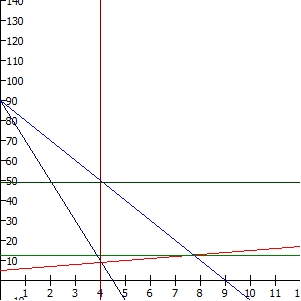
Now maybe Einstein should hold back; he could exercise some monopolistic power over his amazing brain. By only offering to work 4 hours a day, he can force the company to pay him at his marginal productivity for 4 hours a day, which turns out to be $49 an hour. Now he makes a gross pay of $196, with a worker surplus of $171.

monopoly_power

This diagram is a bit harder to read, so let me walk you through it. The light red and blue lines are the same as before. The darker blue line is the marginal revenue per hour for Einstein, once he factors in the fact that working more hours will mean accepting a lower wage. The optimum for him is when that marginal revenue curve crosses his marginal cost curve, which is the red supply curve. That decides how many hours he will work, namely 4. But that’s not the wage he gets; to find that, we move up vertically along the dark red line until we get the company’s demand curve. That tells us what wage the company is willing to pay for the level of marginal productivity Einstein has at 4 hours per day of work—which is the $49 wage he ends up making shown by the dark green line. The lighter lines show what happens if we have a competitive labor market, while the darker lines show what happens if Einstein exercises monopoly power.

The company still does pretty well on this deal; they now make an employer surplus of $82. Now, of the total $253 of economic surplus being made, Einstein takes 69%. It’s his brain, so him taking most of the benefit seems fair.

But you should notice something: This result is inefficient! There’s a whole triangle between 4 and 7.5 hours that nobody is getting; it’s called the deadweight loss. In this case it is $65.76, the difference between the total surplus in the efficient equilibrium and the inefficient equilibrium. In real terms, this means that research doesn’t get done because Einstein held back in order to demand a higher wage. That’s research that should be done—its benefit exceeds its cost—but nobody is doing it. Well now, maybe that doesn’t seem so fair after all. It seems selfish of him to not do research that needs done just so he can get paid more for what he does.

If Einstein has monopoly power, he gets a fair share but the market is inefficient. Removing Einstein’s monopoly power by some sort of regulation would bring us back to efficiency, but it would give most of his share to the company instead. Neither way seems right.

How do we solve this problem? I’m honestly not sure. First of all, we rarely know the actual supply and demand elasticities, and when we do it’s generally after painstaking statistical work to determine the aggregate elasticities, which aren’t even what we’re talking about here. These are individual workers.

Notice that the problem isn’t due to imperfect information; the company knows full well that Einstein is a golden goose, but they aren’t going to pay him any more than they have to.

We could just accept it, I suppose. As long as the productive work gets done, we could shrug our shoulders and not worry about the fact that corporations are capturing most of the value from the hard work of our engineers and scientists. That seems to be the default response, perhaps because it’s the easiest. But it sure doesn’t seem fair to me.

One solution might be for the company to voluntarily pay Einstein more, or offer him some sort of performance bonus. I wouldn’t rule out this possibility entirely, but this would require the company to be unusually magnanimous. This won’t happen at most corporations. It might happen for researchers at a university, where the administrators are fellow academics. Or it might happen to a corporate executive because other corporate executives feel solidarity for their fellow corporate executives.

That sort of solidarity is most likely why competition hasn’t driven down executive salaries. Theoretically shareholders would have an incentive to choose boards of directors who are willing to work for $20 an hour and elect CEOs who are willing to work for $30 an hour; but in practice old rich White guys feel solidarity with other old rich White guys, and even if there isn’t any direct quid pro quo there is still a general sense that because we are “the same kind of people” we should all look out for each other—and that’s how you get $50 million salaries. And then of course there’s the fact that even publicly-traded companies often have a handful of shareholders who control enough of the shares to win any vote.

In some industries, we don’t need to worry about this too much because productivity probably doesn’t really vary that much; just how good can a fry cook truly be? But this is definitely an issue for a lot of scientists and engineers, particularly at entry-level positions. Some scientists are an awful lot better than other scientists, but they still get paid the same.

Much more common however is the case where the costs of working vary. Some people may have few alternatives, so their opportunity cost is low, driving their wage down; but that doesn’t mean they actually deserve a lower wage. Or they may be disabled, making it harder to work long hours; but even though they work so much harder their pay is the same, so their net benefit is much smaller. Even though they aren’t any more productive, it still seems like they should be paid more to compensate them for that extra cost of working. At the other end are people who start in a position of wealth and power; they have a high opportunity cost because they have so many other options, so it may take very high pay to attract them; but why do they deserve to be paid more just because they have more to start with?

Another option would be some sort of redistribution plan, where we tax the people who are getting a larger share and give it to those who are getting a smaller share. The problem here arises in how exactly you arrange the tax. A theoretical “lump sum tax” where we just figure out the right amount of money and say “Person A: Give $217 to person B! No, we won’t tell you why!” would be optimally efficient because there’s no way it can distort markets if nobody sees it coming; but this is not something we can actually do in the real world. (It also seems a bit draconian; the government doesn’t even tax activities, they just demand arbitrary sums of money?) We’d have to tax profits, or sales, or income; and all of these could potentially introduce distortions and make the market less efficient.

We could offer some sort of publicly-funded performance bonus, and for scientists actually we do; it’s called the Nobel Prize. If you are truly the best of the best of the best as Einstein was, you may have a chance at winning the Nobel and getting $1.5 million. But of course that has to be funded somehow, and it only works for the very very top; it doesn’t make much difference to Jane Engineer who is 20% more productive than her colleagues.

I don’t find any of these solutions satisfying. This time I really can’t offer a good solution. But I think it’s important to keep the problem in mind. It’s important to always remember that “efficient” does not mean “fair”, and being paid at marginal productivity isn’t the same as being paid for overall productivity.

Pareto Efficiency: Why we need it—and why it’s not enough

JDN 2456914 PDT 11:45.

I already briefly mentioned the concept in an earlier post, but Pareto-efficiency is so fundamental to both ethics and economics I decided I would spent some more time on explaining exactly what it’s about.

This is the core idea: A system is Pareto-efficient if you can’t make anyone better off without also making someone else worse off. It is Pareto-inefficient if the opposite is true, and you could improve someone’s situation without hurting anyone else.

Improving someone’s situation without harming anyone else is called a Pareto-improvement. A system is Pareto-efficient if and only if there are no possible Pareto-improvements.

Zero-sum games are always Pareto-efficient. If the game is about how we distribute the same $10 between two people, any dollar I get is a dollar you don’t get, so no matter what we do, we can’t make either of us better off without harming the other. You may have ideas about what the fair or right solution is—and I’ll get back to that shortly—but all possible distributions are Pareto-efficient.

Where Pareto-efficiency gets interesting is in nonzero-sum games. The most famous and most important such game is the so-called Prisoner’s Dilemma; I don’t like the standard story to set up the game, so I’m going to give you my own. Two corporations, Alphacomp and Betatech, make PCs. The computers they make are of basically the same quality and neither is a big brand name, so very few customers are going to choose on anything except price. Combining labor, materials, equipment and so on, each PC costs each company $300 to manufacture a new PC, and most customers are willing to buy a PC as long as it’s no more than $1000. Suppose there are 1000 customers buying. Now the question is, what price do they set? They would both make the most profit if they set the price at $1000, because customers would still buy and they’d make $700 on each unit, each making $350,000. But now suppose Alphacomp sets a price at $1000; Betatech could undercut them by making the price $999 and sell twice as many PCs, making $699,000. And then Alphacomp could respond by setting the price at $998, and so on. The only stable end result if they are both selfish profit-maximizers—the Nash equilibrium—is when the price they both set is $301, meaning each company only profits $1 per PC, making $1000. Indeed, this result is what we call in economics perfect competition. This is great for consumers, but not so great for the companies.

If you focus on the most important choice, $1000 versus $999—to collude or to compete—we can set up a table of how much each company would profit by making that choice (a payoff matrix or normal form game in game theory jargon).

A: $999 A: $1000
B: $999 A:$349k

B:$349k

A:$0

B:$699k

B: $1000 A:$699k

B:$0

A:$350k

B:$350k

Obviously the choice that makes both companies best-off is for both companies to make the price $1000; that is Pareto-efficient. But it’s also Pareto-efficient for Alphacomp to choose $999 and the other one to choose $1000, because then they sell twice as many computers. We have made someone worse off—Betatech—but it’s still Pareto-efficient because we couldn’t give Betatech back what they lost without taking some of what Alphacomp gained.

There’s only one option that’s not Pareto-efficient: If both companies charge $999, they could both have made more money if they’d charged $1000 instead. The problem is, that’s not the Nash equilibrium; the stable state is the one where they set the price lower.

This means that only case that isn’t Pareto-efficient is the one that the system will naturally trend toward if both compal selfish profit-maximizers. (And while most human beings are nothing like that, most corporations actually get pretty close. They aren’t infinite, but they’re huge; they aren’t identical, but they’re very similar; and they basically are psychopaths.)

In jargon, we say the Nash equilibrium of a Prisoner’s Dilemma is Pareto-inefficient. That one sentence is basically why John Nash was such a big deal; up until that point, everyone had assumed that if everyone acted in their own self-interest, the end result would have to be Pareto-efficient; Nash proved that this isn’t true at all. Everyone acting in their own self-interest can doom us all.

It’s not hard to see why Pareto-efficiency would be a good thing: if we can make someone better off without hurting anyone else, why wouldn’t we? What’s harder for most people—and even most economists—to understand is that just because an outcome is Pareto-efficient, that doesn’t mean it’s good.

I think this is easiest to see in zero-sum games, so let’s go back to my little game of distributing the same $10. Let’s say it’s all within my power to choose—this is called the ultimatum game. If I take $9 for myself and only give you $1, is that Pareto-efficient? It sure is; for me to give you any more, I’d have to lose some for myself. But is it fair? Obviously not! The fair option is for me to go fifty-fifty, $5 and $5; and maybe you’d forgive me if I went sixty-forty, $6 and $4. But if I take $9 and only offer you $1, you know you’re getting a raw deal.

Actually as the game is often played, you have the choice the say, “Forget it; if that’s your offer, we both get nothing.” In that case the game is nonzero-sum, and the choice you’ve just taken is not Pareto-efficient! Neoclassicists are typically baffled at the fact that you would turn down that free $1, paltry as it may be; but I’m not baffled at all, and I’d probably do the same thing in your place. You’re willing to pay that $1 to punish me for being so stingy. And indeed, if you allow this punishment option, guess what? People aren’t as stingy! If you play the game without the rejection option, people typically take about $7 and give about $3 (still fairer than the $9/$1, you may notice; most people aren’t psychopaths), but if you allow it, people typically take about $6 and give about $4. Now, these are pretty small sums of money, so it’s a fair question what people might do if $100,000 were on the table and they were offered $10,000. But that doesn’t mean people aren’t willing to stand up for fairness; it just means that they’re only willing to go so far. They’ll take a $1 hit to punish someone for being unfair, but that $10,000 hit is just too much. I suppose this means most of us do what Guess Who told us: “You can sell your soul, but don’t you sell it too cheap!”

Now, let’s move on to the more complicated—and more realistic—scenario of a nonzero-sum game. In fact, let’s make the “game” a real-world situation. Suppose Congress is debating a bill that would introduce a 70% marginal income tax on the top 1% to fund a basic income. (Please, can we debate that, instead of proposing a balanced-budget amendment that would cripple US fiscal policy indefinitely and lead to a permanent depression?)

This tax would raise about 14% of GDP in revenue, or about $2.4 trillion a year (yes, really). It would then provide, for every man, woman and child in America, a $7000 per year income, no questions asked. For a family of four, that would be $28,000, which is bound to make their lives better.

But of course it would also take a lot of money from the top 1%; Mitt Romney would only make $6 million a year instead of $20 million, and Bill Gates would have to settle for $2.4 billion a year instead of $8 billion. Since it’s the whole top 1%, it would also hurt a lot of people with more moderate high incomes, like your average neurosurgeon or Paul Krugman, who each make about $500,000 year. About $100,000 of that is above the cutoff for the top 1%, so they’d each have to pay about $70,000 more than they currently do in taxes; so if they were paying $175,000 they’re now paying $245,000. Once taking home $325,000, now only $255,000. (Probably not as big a difference as you thought, right? Most people do not seem to understand how marginal tax rates work, as evinced by “Joe the Plumber” who thought that if he made $250,001 he would be taxed at the top rate on the whole amount—no, just that last $1.)

You can even suppose that it would hurt the economy as a whole, though in fact there’s no evidence of that—we had tax rates like this in the 1960s and our economy did just fine. The basic income itself would inject so much spending into the economy that we might actually see more growth. But okay, for the sake of argument let’s suppose it also drops our per-capita GDP by 5%, from $53,000 to $50,300; that really doesn’t sound so bad, and any bigger drop than that is a totally unreasonable estimate based on prejudice rather than data. For the same tax rate might have to drop the basic income a bit too, say $6600 instead of $7000.

So, this is not a Pareto-improvement; we’re making some people better off, but others worse off. In fact, the way economists usually estimate Pareto-efficiency based on so-called “economic welfare”, they really just count up the total number of dollars and divide by the number of people and call it a day; so if we lose 5% in GDP they would register this as a Pareto-loss. (Yes, that’s a ridiculous way to do it for obvious reasons—$1 to Mitt Romney isn’t worth as much as it is to you and me—but it’s still how it’s usually done.)

But does that mean that it’s a bad idea? Not at all. In fact, if you assume that the real value—the utility—of a dollar decreases exponentially with each dollar you have, this policy could almost double the total happiness in US society. If you use a logarithm instead, it’s not quite as impressive; it’s only about a 20% improvement in total happiness—in other words, “only” making as much difference to the happiness of Americans from 2014 to 2015 as the entire period of economic growth from 1900 to 2000.

If right now you’re thinking, “Wow! Why aren’t we doing that?” that’s good, because I’ve been thinking the same thing for years. And maybe if we keep talking about it enough we can get people to start voting on it and actually make it happen.

But in order to make things like that happen, we must first get past the idea that Pareto-efficiency is the only thing that matters in moral decisions. And once again, that means overcoming the standard modes of thinking in neoclassical economics.

Something strange happened to economics in about 1950. Before that, economists from Marx to Smith to Keynes were always talking about differences in utility, marginal utility of wealth, how to maximize utility. But then economists stopped being comfortable talking about happiness, deciding (for reasons I still do not quite grasp) that it was “unscientific”, so they eschewed all discussion of the subject. Since we still needed to know why people choose what they do, a new framework was created revolving around “preferences”, which are a simple binary relation—you either prefer it or you don’t, you can’t like it “a lot more” or “a little more”—that is supposedly more measurable and therefore more “scientific”. But under this framework, there’s no way to say that giving a dollar to a homeless person makes a bigger difference to them than giving the same dollar to Mitt Romney, because a “bigger difference” is something you’ve defined out of existence. All you can say is that each would prefer to receive the dollar, and that both Mitt Romney and the homeless person would, given the choice, prefer to be Mitt Romney. While both of these things are true, it does seem to be kind of missing the point, doesn’t it?

There are stirrings of returning to actual talk about measuring actual (“cardinal”) utility, but still preferences (so-called “ordinal utility”) are the dominant framework. And in this framework, there’s really only one way to evaluate a situation as good or bad, and that’s Pareto-efficiency.

Actually, that’s not quite right; John Rawls cleverly came up with a way around this problem, by using the idea of “maximin”—maximize the minimum. Since each would prefer to be Romney, given the chance, we can say that the homeless person is worse off than Mitt Romney, and therefore say that it’s better to make the homeless person better off. We can’t say how much better, but at least we can say that it’s better, because we’re raising the floor instead of the ceiling. This is certainly a dramatic improvement, and on these grounds alone you can argue for the basic income—your floor is now explicitly set at the $6600 per year of the basic income.

But is that really all we can say? Think about how you make your own decisions; do you only speak in terms of strict preferences? I like Coke more than Pepsi; I like massages better than being stabbed. If preference theory is right, then there is no greater distance in the latter case than the former, because this whole notion of “distance” is unscientific. I guess we could expand the preference over groups of goods (baskets as they are generally called), and say that I prefer the set “drink Pepsi and get a massage” to the set “drink Coke and get stabbed”, which is certainly true. But do we really want to have to define that for every single possible combination of things that might happen to me? Suppose there are 1000 things that could happen to me at any given time, which is surely conservative. In that case there are 2^1000 = 10^300 possible combinations. If I were really just reading off a table of unrelated preference relations, there wouldn’t be room in my brain—or my planet—to store it, nor enough time in the history of the universe to read it. Even imposing rational constraints like transitivity doesn’t shrink the set anywhere near small enough—at best maybe now it’s 10^20, well done; now I theoretically could make one decision every billion years or so. At some point doesn’t it become a lot more parsimonious—dare I say, more scientific—to think that I am using some more organized measure than that? It certainly feels like I am; even if couldn’t exactly quantify it, I can definitely say that some differences in my happiness are large and others are small. The mild annoyance of drinking Pepsi instead of Coke will melt away in the massage, but no amount of Coke deliciousness is going to overcome the agony of being stabbed.

And indeed if you give people surveys and ask them how much they like things or how strongly they feel about things, they have no problem giving you answers out of 5 stars or on a scale from 1 to 10. Very few survey participants ever write in the comments box: “I was unable to take this survey because cardinal utility does not exist and I can only express binary preferences.” A few do write 1s and 10s on everything, but even those are fairly rare. This “cardinal utility” that supposedly doesn’t exist is the entire basis of the scoring system on Netflix and Amazon. In fact, if you use cardinal utility in voting, it is mathematically provable that you have the best possible voting system, which may have something to do with why Netflix and Amazon like it. (That’s another big “Why aren’t we doing this already?”)

If you can actually measure utility in this way, then there’s really not much reason to worry about Pareto-efficiency. If you just maximize utility, you’ll automatically get a Pareto-efficient result; but the converse is not true because there are plenty of Pareto-efficient scenarios that don’t maximize utility. Thinking back to our ultimatum game, all options are Pareto-efficient, but you can actually prove that the $5/$5 choice is the utility-maximizing one, if the two players have the same amount of wealth to start with. (Admittedly for those small amounts there isn’t much difference; but that’s also not too surprising, since $5 isn’t going to change anybody’s life.) And if they don’t—suppose I’m rich and you’re poor and we play the game—well, maybe I should give you more, precisely because we both know you need it more.

Perhaps even more significant, you can move from a Pareto-inefficient scenario to a Pareto-efficient one and make things worse in terms of utility. The scenario in which the top 1% are as wealthy as they can possibly be and the rest of us live on scraps may in fact be Pareto-efficient; but that doesn’t mean any of us should be interested in moving toward it (though sadly, we kind of are). If you’re only measuring in terms of Pareto-efficiency, your attempts at improvement can actually make things worse. It’s not that the concept is totally wrong; Pareto-efficiency is, other things equal, good; but other things are never equal.

So that’s Pareto-efficiency—and why you really shouldn’t care about it that much.

Schools of Thought

If you’re at all familiar with the schools of thought in economics, you may wonder where I stand. Am I a Keynesian? Or perhaps a post-Keynesian? A New Keynesian? A neo-Keynesian (not to be confused)? A neo-paleo-Keynesian? Or am I a Monetarist? Or a Modern Monetary Theorist? Or perhaps something more heterodox, like an Austrian or a Sraffian or a Marxist?

No, I am none of those things. I guess if you insist on labeling, you could call me a “cognitivist”; and in terms of policy I tend to agree with the Keynesians, but I also like the Modern Monetary Theorists.

But really I think this sort of labeling of ‘schools of thought’ is exactly the problem. There shouldn’t be schools of thought; the universe only works one way. When you don’t know the answer, you should have the courage to admit you don’t know. And once we actually have enough evidence to know something, people need to stop disagreeing about it. If you continue to disagree with what the evidence has shown, you’re not a ‘school of thought’; you’re just wrong.

The whole notion of ‘schools of thought’ smacks of cultural relativism; asking what the ‘Keynesian’ answer to a question is (and if you take enough economics classes I guarantee you will be asked exactly that) is rather like asking what religious beliefs prevail in a particular part of the world. It might be worth asking for some historical reason, but it’s not a question about economics; it’s a question about economic beliefs. This is the difference between asking how people believe the universe was created, and actually being a cosmologist. True, schools of thought aren’t as geographically localized as religions; but they do say the words ‘saltwater’ and ‘freshwater’ for a reason. I’m not all that interested in the Shinto myths versus the Hindu myths; I want to be a cosmologist.

At best, schools of thought are a sign of a field that hasn’t fully matured. Perhaps there were Newtonians and Einsteinians in 1910; but by 1930 there were just Einsteinians and bad physicists. Are there ‘schools of thought’ in physics today? Well, there are string theorists. But string theory hasn’t been a glorious success of physics advancement; on the contrary, it’s been a dead end from which the field has somehow failed to extricate itself for almost 50 years.

So where does that put us in economics? Well, some of the schools of thought are clearly dead ends, every bit as unfounded as string theory but far worse because they have direct influences on policy. String theory hasn’t ever killed anyone; bad economics definitely has. (How, you ask? Exposure to hazardous chemicals that were deregulated; poverty and starvation due to cuts to social welfare programs; and of course the Second Depression. I could go on.)

The worst offender is surely Austrian economics and its crazy cousin Randian libertarianism. Ayn Rand literally ruled a cult; Friedrich Hayek never took it quite that far, but there is certainly something cultish about Austrian economists. They insist that economics must be derived a priori, without recourse to empirical evidence (or at least that’s what they say when you point out that all the empirical evidence is against them). They are fond of ridiculous hyperbole about an inevitable slippery slope between raising taxes on capital gains and turning into Stalin’s Soviet Union, as well as rhetorical questions I find myself answering opposite to how they want (like “For are taxes not simply another form of robbery?” and “Once we allow the government to regulate what man can do, will they not continue until they control all aspects of our lives?”). They even co-opt and distort cognitivist concepts like herd instinct and asymmetric information; somehow Austrians think that asymmetric information is an argument for why markets are more efficient than government, even though Akerlof’s point was that asymmetric information is why we need regulations.

Marxists are on the opposite end of the political spectrum, but their ideas are equally nonsensical. (Marx himself was a bit more reasonable, but even he recognized they were going too far: “All I know is that I am not a Marxist.”) They have this whole “labor theory of value” thing where the value of something is the amount of work you have to put into it. This would mean that labor-saving innovations are pointless, because they devalue everything; it would also mean that putting an awful lot of work into something useless would nevertheless somehow make it enormously valuable. Really, it would never be worth doing much of anything, because the value you get out of something is exactly equal to the work you put in. Marxists also tend to think that what the world needs is a violent revolution to overthrow the bondage of capitalism; this is an absolutely terrible idea. During the transition it would be one of the bloodiest conflicts in history; afterward you’d probably get something like the Soviet Union or modern-day Venezuela. Even if you did somehow establish your glorious Communist utopia, you’d have destroyed so much productive capacity in the process that you’d make everyone poor. Socialist reforms make sense—and have worked well in Europe, particularly Scandinavia. But socialist revolution is a a good way to get millions of innocent people killed.

Sraffians are also quite silly; they have this bizarre notion that capital must be valued as “dated labor”, basically a formalized Marxism. I’ll admit, it’s weird how neoclassicists try to value labor as “human capital”; frankly it’s a bit disturbing how it echoes slavery. (And if you think slavery is dead, think again; it’s dead in the First World, but very much alive elsewhere.) But the solution to that problem is not to pretend that capital is a form of labor; it’s to recognize that capital and labor are different. Capital can be owned, sold, and redistributed; labor cannot. Labor is done by human beings, who have intrinsic value and rights; capital is made of inanimate matter, which does not. (This is what makes Citizens United so outrageous; “corporations are people” and “money is speech” are such fundamental distortions of democratic principles that they are literally Orwellian. We’re not that far from “freedom is slavery” and “war is peace”.)

Neoclassical economists do better, at least. They do respond to empirical data, albeit slowly. Their models are mathematically consistent. They rarely take account of human irrationality or asymmetric information, but when they do they rightfully recognize them as obstacles to efficient markets. But they still model people as infinite identical psychopaths, and they still divide themselves into schools of thought. Keynesians and Monetarists are particularly prominent, and Modern Monetary Theorists seem to be the next rising star. Each of these schools gets some things right and other things wrong, and that’s exactly why we shouldn’t make ourselves beholden to a particular tribe.

Monetarists follow Friedman, who said, “inflation is always and everywhere a monetary phenomenon.” This is wrong. You can definitely cause inflation without expanding your money supply; just ramp up government spending as in World War 2 or suffer a supply shock like we did when OPEC cut the oil supply. (In both cases, the US money supply was still tied to gold by the Bretton Woods system.) But they are right about one thing: To really have hyperinflation ala Weimar or Zimbabwe, you probably have to be printing money. If that were all there is to Monetarism, I can invert another Friedmanism: We’re all Monetarists now.

Keynesians are basically right about most things; in particular, they are the only branch of neoclassicists who understand recessions and know how to deal with them. The world’s most famous Keynesian is probably Krugman, who has the best track record of economic predictions in the popular media today. Keynesians much better appreciate the fact that humans are irrational; in fact, cognitivism can be partly traced to Keynes, who spoke often of the “animal spirits” that drive human behavior (Akerlof’s most recent book is called Animal Spirits). But even Keynesians have their sacred cows, like the Phillips Curve, the alleged inverse correlation between inflation and unemployment. This is fairly empirically accurate if you look just at First World economies after World War 2 and exclude major recessions. But Keynes himself said, “Economists set themselves too easy, too useless a task if in tempestuous seasons they can only tell us that when the storm is long past the ocean is flat again.” The Phillips Curve “shifts” sometimes, and it’s not always clear why—and empirically it’s not easy to tell the difference between a curve that shifts a lot and a relationship that just isn’t there. There is very little evidence for a “natural rate of unemployment”. Worst of all, it’s pretty clear that the original policy implications of the Phillips Curve are all wrong; you can’t get rid of unemployment just by ramping up inflation, and that way really does lie Zimbabwe.

Finally, Modern Monetary Theorists understand money better than everyone else. They recognize that a sovereign government doesn’t have to get its money “from somewhere”; it can create however much money it needs. The whole narrative that the US is “out of money” isn’t just wrong, it’s incoherent; if there is one entity in the world that can never be out of money, it’s the US government, who print the world’s reserve currency. The panicked fears of quantitative easing causing hyperinflation aren’t quite as crazy; if the economy were at full capacity, printing $4 trillion over 5 years (yes, we did that) would absolutely cause some inflation. Since that’s only about 6% of US GDP, we might be back to 8% or even 10% inflation like the 1970s, but we certainly would not be in Zimbabwe. Moreover, we aren’t at full capacity; we needed to expand the money supply that much just to maintain prices where they are. The Second Depression is the Red Queen: It took all the running we could do to stay in one place. Modern Monetary Theorists also have some very good ideas about taxation; they point out that since the government only takes out the same thing it puts in—its own currency—it doesn’t make sense to say they are “taking” something (let alone “confiscating” it as Austrians would have you believe). Instead, it’s more like they are pumping it, taking money in and forcing it back out continuously. And just as pumping doesn’t take away water but rather makes it flow, taxation and spending doesn’t remove money from the economy but rather maintains its circulation. Now that I’ve said what they get right, what do they get wrong? Basically they focus too much on money, ignoring the real economy. They like to use double-entry accounting models, perfectly sensible for money, but absolutely nonsensical for real value. The whole point of an economy is that you can get more value out than you put in. From the Homo erectus who pulls apples from the trees to the software developer who buys a mansion, the reason they do it is that the value they get out (the gatherer gets to eat, the programmer gets to live in a mansion) is higher than the value they put in (the effort to climb the tree, the skill to write the code). If, as Modern Monetary Theorists are wont to do, you calculated a value for the human capital of the gatherer and the programmer equal to the value of the goods they purchase, you’d be missing the entire point.

Who are you? What is this new blog? Why “Infinite Identical Psychopaths”?

My name is Patrick Julius. I am about halfway through a master’s degree in economics, specializing in the new subfield of cognitive economics (closely related to the also quite new fields of cognitive science and behavioral economics). This makes me in one sense heterodox; I disagree adamantly with most things that typical neoclassical economists say. But in another sense, I am actually quite orthodox. All I’m doing is bringing the insights of psychology, sociology, history, and political science—not to mention ethics—to the study of economics. The problem is simply that economists have divorced themselves so far from the rest of social science.

Another way I differ from most critics of mainstream economics (I’m looking at you, Peter Schiff) is that, for lack of a better phrase, I’m good at math. (As Bill Clinton said, “It’s arithmetic!”) I understand things like partial differential equations and subgame perfect equilibria, and therefore I am equipped to criticize them on their own terms. In this blog I will do my best to explain the esoteric mathematical concepts in terms most readers can understand, but it’s not always easy. The important thing to keep in mind is that fancy math can’t make a lie true; no matter how sophisticated its equations, a model that doesn’t fit the real world can’t be correct.

This blog, which I plan to update every Saturday, is about the current state of economics, both as it is and how economists imagine it to be. One of my central points is that these two are quite far apart, which has exacerbated if not caused the majority of economic problems in the world today. (Economists didn’t invent world hunger, but for over a decade now we’ve had the power to end it and haven’t done so. You’d be amazed how cheap it would be; we’re talking about 1% of First World GDP at most.)

The reason I call it “infinite identical psychopaths” is that this is what neoclassical economists appear to believe human beings are, at least if we judge by the models they use. These are the typical assumptions of a neoclassical economic model:

      1. Perfect information: All individuals know everything they need to know about the state of the world and the actions of other individuals.
      2. Rational expectations: Predictions about the future can only be wrong within a normal distribution, and in the long run are on average correct.
      3. Representative agents: All individuals are identical and interchangeable; a single type represents them all.
      4. Perfect competition: There are infinitely many agents in the market, and none of them ever collude with one another.
      5. “Economic rationality”: Individuals act according to a monotonic increasing utility function that is only dependent upon their own present and future consumption of goods.

I put the last one in scare quotes because it is the worst of the bunch. What economists call “rationality” has only a distant relation to actual rationality, either as understood by common usage or by formal philosophical terminology.

Don’t be scared by the terminology; a “utility function” is just a formal model of the things you care about when you make decisions. Things you want have positive utility; things you don’t want have negative utility. Larger numbers reflect stronger feelings: a bar of chocolate has much less positive utility than a decade of happy marriage; a pinched finger has much less negative utility than a year of continual torture. Utility maximization just means that you try to get the things you want and avoid the things you don’t. By talking about expected utility, we make some allowance for an uncertain future—but not much, because we have so-called “rational expectations”.

Since any action taken by an “economically rational” agent maximizes expected utility, it is impossible for such an agent to ever make a mistake in the usual sense. Whatever they do is always the best idea at the time. This is already an extremely strong assumption that doesn’t make a whole lot of sense applied to human beings; who among us can honestly say they’ve never done anything they later regretted?

The worst part, however, is the assumption that an individual’s utility function depends only upon their own consumption. What this means is that the only thing anyone cares about is how much stuff they have; considerations like family, loyalty, justice, honesty, and fairness cannot factor into their decisions. The “monotonic increasing” part means that more stuff is always better; if they already have twelve private jets, they’d still want a thirteenth; and even if children had to starve for it, they’d be just fine with that. They are, in other words, psychopaths. So that’s one word of my title.

I think “identical” is rather self-explanatory; by using representative agent models, neoclassicists effectively assume that there is no variation between human beings whatsoever. They all have the same desires, the same goals, the same capabilities, the same resources. Implicit in this assumption is the notion that there is no such thing as poverty or wealth inequality, not to mention diversity, disability, or even differences in taste. (One wonders why you’d even bother with economics if that were the case.)

As for “infinite”, that comes from the assumptions of perfect information and perfect competition. In order to really have perfect information, one would need a brain with enough storage capacity to contain the state of every particle in the visible universe. Maybe not quite infinite, but pretty darn close. Likewise, in order to have true perfect competition, there must be infinitely many individuals in the economy, all of whom are poised to instantly take any opportunity offered that allows them to make even the tiniest profit.

Now, you might be thinking this is a strawman; surely neoclassicists don’t actually believe that people are infinite identical psychopaths. They just model that way to simplify the mathematics, which is of course necessary because the world is far too vast and interconnected to analyze in its full complexity.

This is certainly true: Suppose it took you one microsecond to consider each possible position on a Go board; how long would it take you to go through them all? More time than we have left before the universe fades into heat death. A Go board has two colors (plus empty) and 361 spaces. Now imagine trying to understand a global economy of 7 billion people by brute-force analysis. Simplifying heuristics are unavoidable.

And some neoclassical economists—for example Paul Krugman and Joseph Stiglitz—generally use these heuristics correctly; they understand the limitations of their models and don’t apply them in cases where they don’t belong. In that sort of case, there’s nothing particularly bad about these simplifying assumptions; they are like when a physicist models the trajectory of a spacecraft by assuming frictionless vacuum. Since outer space actually is close to a frictionless vacuum, this works pretty well; and if you need to make minor corrections (like the Pioneer Anomaly) you can.

However, this explanation already seems weird for the “economically rational” assumption (the psychopath part), because that doesn’t really make things much simpler. Why would we exclude the fact that people care about each other, they like to cooperate, they have feelings of loyalty and trust? And don’t tell me it’s because that’s impossible to quantify; behavioral geneticists already have a simple equation (C < r B) designed precisely to quantify altruism. (C is cost, B is benefit, r is relatedness.) I’d make only one slight modification; instead of r for relatedness, use p for psychological closeness, or as I like to call it, solidarity. For humans, solidarity is usually much higher than relatedness, though the two are correlated. C < p B.

Worse, there are other neoclassical economists—those of the most fanatically “free-market” bent—who really don’t seem to do this. I don’t know if they honestly believe that people are infinite identical psychopaths, but they make policy as if they did.

We have people like Stephen Moore saying that unemployment is “like a paid vacation” because obviously anyone who truly wants a job can immediately find one, or people like N. Gregory Mankiw arguing—in a published paper no less!—that the reason Steve Jobs was a billionaire was that he was actually a million times as productive as the rest of us, and therefore it would be inefficient (and, he implies but does not say outright, immoral) to take the fruits of those labors from him. (Honestly, I think I could concede the point and still argue for redistribution, on the grounds that people do not deserve to starve to death simply because they aren’t productive; but that’s the sort of thing never even considered by most neoclassicists, and anyway it’s a topic for another time.)

These kinds of statements would only make sense if markets were really as efficient and competitive as neoclassical models—that is, if people were infinite identical psychopaths. Allow even a single monopoly or just a few bits of imperfect information, and that whole edifice collapses.

And indeed if you’ve ever been unemployed or known someone who was, you know that our labor markets just ain’t that efficient. If you want to cut unemployment payments, you need a better argument than that. Similarly, it’s obvious to anyone who isn’t wearing the blinders of economic ideology that many large corporations exert monopoly power to increase their profits at our expense (How can you not see that Apple is a monopoly!?).

This sort of reasoning is more like plotting the trajectory of an aircraft on the assumption of frictionless vacuum; you’d be baffled as to where the oxidizer comes from, or how the craft manages to lift itself off the ground when the exhaust vents are pointed sideways instead of downward. And then you’d be telling the aerospace engineers to cut off the wings because they’re useless mass.

Worst of all, if we continue this analogy, the engineers would listen to you—they’d actually be convinced by your differential equations and cut off the wings just as you requested. Then the plane would never fly, and they’d ask if they could put the wings back on—but you’d adamantly insist that it was just coincidence, you just happened to be hit by a random problem at the very same moment as you cut off the wings, and putting them back on will do nothing and only make things worse.

No, seriously; so-called “Real Business Cycle” theory, while thoroughly obfuscated in esoteric mathematics, ultimately boils down to the assertion that financial crises have nothing to do with recessions, which are actually caused by random shocks to the real economy—the actual production of goods and services. The fact that a financial crisis always seems to happen just beforehand is, apparently, sheer coincidence, or at best some kind of forward-thinking response investors make as they see the storm coming. I want to you think for a minute about the idea that the kind of people who make computer programs that accidentally collapse the Dow, who made Bitcoin the first example in history of hyperdeflation, and who bought up Tweeter thinking it was Twitter are forward-thinking predictors of future events in real production.

And yet, it is on this sort of basis that our policy is made.

Can otherwise intelligent people really believe that these insane models are true? I’m not sure.
Sadly I think they may really believe that all people are psychopaths—because they themselves may be psychopaths. Economics students score higher on various psychopathic traits than other students. Part of this is self-selection—psychopaths are more likely to study economics—but the terrifying part is that part of it isn’t—studying economics may actually make you more like a sociopath. As I study for my master’s degree, I actually am somewhat afraid of being corrupted by this; I make sure to periodically disengage from their ideology and interact with normal people with normal human beliefs to recalibrate my moral compass.

Of course, it’s still pretty hard to imagine that anyone could honestly believe that the world economy is in a state of perfect information. But if they can’t really believe this insane assumption, why do they keep using models based on it?

The more charitable possibility is that they don’t appreciate just how sensitive the models are to the assumptions. They may think, for instance, that the General Welfare Theorems still basically apply if you relax the assumption of perfect information; maybe it’s not always Pareto-efficient, but it’s probably most of the time, right? Or at least close? Actually, no. The Myerson-Satterthwaithe Theorem says that once you give up perfect information, the whole theorem collapses; even a small amount of asymmetric information is enough to make it so that a Pareto-efficient outcome is impossible. And as you might expect, the more asymmetric the information is, the further the result deviates from Pareto-efficiency. And since we always have some asymmetric information, it looks like the General Welfare Theorems really aren’t doing much for us. They apply only in a magical fantasy world. (In case you didn’t know, Pareto-efficiency is a state in which it’s impossible to make any person better off without making someone else worse off. The real world is in a not Pareto-efficient state, which means that by smarter policy we could improve some people’s lives without hurting anyone else.)

The more sinister possibility is that they know full well that the models are wrong, they just don’t care. The models are really just excuses for an underlying ideology, the unshakeable belief that rich people are inherently better than poor people and private corporations are inherently better than governments. Hence, it must be bad for the economy to raise the minimum wage and good to cut income taxes, even though the empirical evidence runs exactly the opposite way; it must be good to subsidize big oil companies and bad to subsidize solar power research, even though that makes absolutely no sense.

One should normally be hesitant to attribute to malice what can be explained by stupidity, but the “I trust the models” explanation just doesn’t work for some of the really extreme privatizations that the US has undergone since Reagan.

No neoclassical model says that you should privatize prisons; prisons are a classic example of a public good, which would be underfunded in a competitive market and basically has to be operated or funded by the government.

No neoclassical model would support the idea that the EPA is a terrorist organization (yes, a member of the US Congress said this). In fact, the economic case for environmental regulations is unassailable. (What else are we supposed to do, privatize the air?) The question is not whether to regulate and tax pollution, but how and how much.

No neoclassical model says that you should deregulate finance; in fact, most neoclassical models don’t even include a financial sector (as bizarre and terrifying as that is), and those that do generally assume it is in a state of perfect equilibrium with zero arbitrage. If the financial sector were actually in a state of zero arbitrage, no banks would make a profit at all.

In case you weren’t aware, arbitrage is the practice of making money off of money without actually making any goods or doing any services. Unlike manufacturing (which, oddly enough, almost all neoclassical models are based on—despite the fact that it is now a minority sector in First World GDP), there’s no value added. Under zero arbitrage, the interest rate a bank charges should be almost exactly the same as the interest rate it receives, with just enough gap between to barely cover their operating expenses—which should in turn be minimal, especially in a modern electronic system. If financial markets were at zero arbitrage equilibrium, it would be sensible to speak of a single “real interest rate” in the economy, the one that everyone pays and everyone receives. Of course, those of us who live in the real world know that not only do different people pay radically different rates, most people have multiple outstanding lines of credit, each with a different rate. My savings account is 0.5%, my car loan is 5.5%, and my biggest credit card is 19%. These basically span the entire range of sensible interest rates (frankly 19% may even exceed that; that’s a doubling time of 3.6 years), and I know I’m not the exception but the rule.

So that’s the mess we’re in. Stay tuned; in future weeks I’ll talk about what we can do about it.