The Fringe: An overwhelming embarrassment of riches

Aug 20 JDN 2460177

As I write this, Edinburgh is currently in the middle of The Fringe: It’s often described as an “arts and culture festival”, but mainly it consists of a huge number of theatre and comedy performances that go on across the city in hundreds of venues all month long. It’s an “open access festival”, which basically means that it’s half a dozen different festivals that all run independently and are loosely coordinated with one another.

There is truly an embarrassment of riches in the sheer number and variety of performances going on. There’s no way I could ever go to all of them, or even half of them, even though most of them are going on every single day, all month long

It would be tremendously helpful to get good information about which performances are likely to suit my tastes, so I’d know which ones to attend. For once, advertising actually has a genuinely useful function to serve!

And yet, the ads for performances plastered across the city are almost completely useless. They tell you virtually nothing about the content or even style of the various shows. You are bombarded with hundreds of posters for hundreds of performances as you walk through the city, and almost none of them tell you anything useful that would help you decide which shows you want to attend.

Here’s what they look like; imagine this plastered on every bus shelter and spare bit of wall in the city, as well as plenty of specially-built structures explicitly for the purpose:

What I want to ask today is: Why are these posters so uninformative?

I think there are two forces at work here which may explain this phenomenon.

The first is about comedy: Most of these shows are comedy shows, and it’s very hard to explain to someone what is funny about a joke. In fact, most jokes aren’t even funny once they have been explained. Comedy seems to be closely tied to surprise: If you know exactly what they are going to say, it isn’t funny anymore. So it is inherently difficult to explain what’s good about a comedy show without making it actually less funny for those attending.

Yet this is not a complete explanation. For there are some things you could explain about comedy shows without ruining them. You could give it a general genre: political satire, slapstick, alternative, dark comedy, blue comedy, burlesque, cringe, insult, sitcom, parody, surreal, and so on. That would at least tell you something—I tend to like satire and parody, dark and blue are hit-or-miss, surreal leaves me cold, and I can’t stand cringe. And some of the posters do this—yet a remarkable number do not. I often find myself staring at a particular poster, poring over its details, trying to get some inkling of what kind of comedy I could expect from this performer.

To fully explain this, we need something more: And that, I believe, is provided by economic theory.

Consider for a moment that comedy is varied and largely subjective: What one person finds hilarious, another finds boring, and yet another finds outrageously offensive. And whether or not you find a particular routine funny can be hard to predict—even for you.

But consider that money is quite the opposite: Everyone wants it, everyone always wants more of it, and people pretty much want it for the same reasons.

So when you offer to pay money for comedy, you are offering something fundamentally fungible and objective in exchange for something almost totally individual and subjective. You are giving what everyone wants in exchange for something that only some people want and you yourself may or may not want—and may have no way of knowing whether you want until you have it.

I believe it is in the interests of the performers to keep you in the dark in this way. They don’t want to resolve your ignorance too thoroughly. Their goal is not to find the market niche of people who would most enjoy their comedy. Their goal is to get as many people as possible to show up to their shows. Even if someone absolutely hates their show, if they bought tickets, that’s a win. And even any negative reviews or word-of-mouth they might try to give the comedian is probably still a win—comedians are one profession for which there really may be no such thing as bad publicity.

In other words, even these relatively helpful advertisements aren’t actually designed to inform you. They are, as all advertisements are, designed to get you to buy something. And the way to get you to do that is twofold:

First, get your attention. That’s vital. And it’s quite difficult in such a saturated environment. As a result, all of the posters are quite eye-catching and often bizarre. They use loud colors and striking images, and the whole city is filled with them. It actually becomes exhausting to look at them all; but this is the Nash equilibrium, because there is an arms race between different performers to look more interesting and exciting than all the rest.

Second, convince you to go. But let’s be clear about this: It is not necessary to make you absolutely certain that this show is one you’ll enjoy. It is merely to tip the balance of probability, make you reasonably confident that it is likely to be one you’ll enjoy. Given the subjectivity and unpredictability of comedy, any attendee knows that they are likely to end up with a few duds. That risk effectively gets priced in: You accept that one £10 ticket may be wasted, in exchange for buying another £10 ticket that you’d have gladly paid £20 for.

If the posters tried to give more details about what the shows were about, there would be two costs to this: One, it might make the posters less eye-catching and interesting in the first place. And two, it might (perhaps correctly!) convince some customers that this flavor of comedy really wasn’t for them, making them decide not to buy a ticket. The task when designing such a poster, then, is to make one that conveys enough that people are willing to take the chance on it—but not too much so that you might scare some potential audience members away.

I think that this has implications which go beyond comedy. In fact, I think that something quite similar is going on with political speeches. But I’ll save that one for another post.

The unsung success of Bidenomics

Aug 13 JDN 2460170

I’m glad to see that the Biden administration is finally talking about “Bidenomics”. We tend to give too much credit or blame for economic performance to the President—particularly relative to Congress—but there are many important ways in which a Presidential administration can shift the priorities of public policy in particular directions, and Biden has clearly done that.

The economic benefits for people of color seem to have been particularly large. The unemployment gap between White and Black workers in the US is now only 2.7 percentage points, while just a few years ago it was over 4pp and at the worst of the Great Recession it surpassed 7pp. During lockdown, unemployment for Black people hit nearly 17%; it is now less than 6%.

The (misnamed, but we’re stuck with it) Inflation Reduction Act in particular has been an utter triumph.

In the past year, real private investment in manufacturing structures (essentially, new factories) has risen from $56 billion to $87 billion—an over 50% increase, which puts it the highest it has been since the turn of the century. The Inflation Reduction Act appears to be largely responsible for this change.

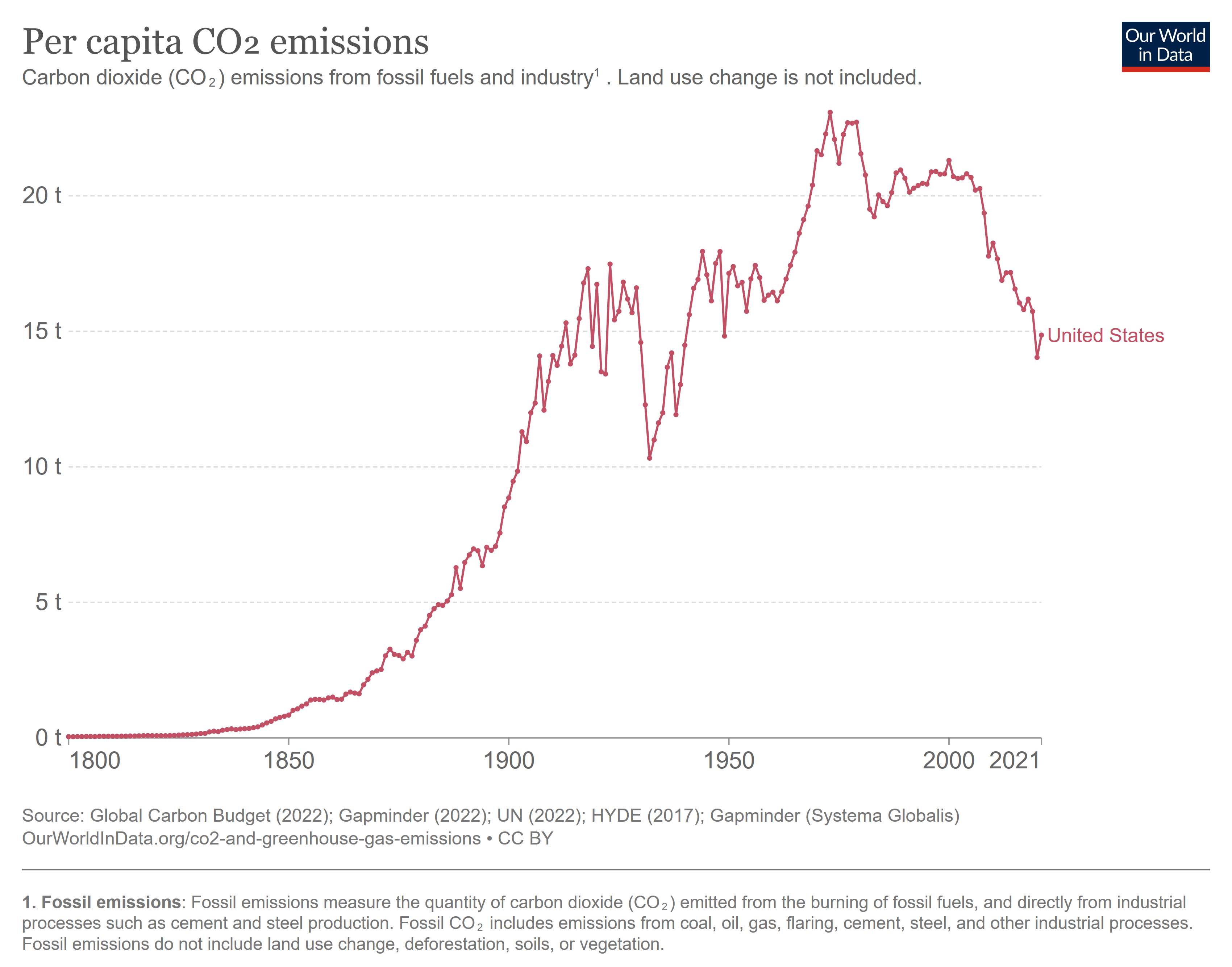
Not many people seem to know this, but the US has also been on the right track with regard to carbon emissions: Per-capita carbon emissions in the US have been trending downward since about 2000, and are now lower than they were in the 1950s. The Inflation Reduction act now looks poised to double down on that progress, as it has been forecasted to reduce our emissions all the way down to 40% below their early-2000s peak.

Somehow, this success doesn’t seem to be getting across. The majority of Americans incorrectly believe that we are in a downturn. Biden’s approval rating is still only 40%, barely higher than Trump’s was. When it comes to political beliefs, most American voters appear to be utterly impervious to facts.

Most Americans do correctly believe that inflation is still a bit high (though many seem to think it’s higher than it is); this is weird, seeing as inflation is normally high when the economy is growing rapidly, and gets too low when we are in a recession. This seems to be Halo Effect, rather than any genuine understanding of macroeconomics: downturns are bad and inflation is bad, so they must go together—when in fact, quite the opposite is the case.

People generally feel better about their own prospects than they do about the economy as a whole:

Sixty-four percent of Americans say the economy is worse off compared to 2020, while seventy-three percent of Americans say the economy is worse off compared to five years ago. About two in five of Americans say they feel worse off from five years ago generally (38%) and a similar number say they feel worse off compared to 2020 (37%).

(Did you really have to write out ‘seventy-three percent’? I hate that convention. 73% is so much clearer and quicker to read.)

I don’t know what the Biden administration should do about this. Trying to sell themselves harder might backfire. (And I’m pretty much the last person in the world you should ask for advice about selling yourself.) But they’ve been doing really great work for the US economy… and people haven’t noticed. Thousands of factories are being built, millions of people are getting jobs, and the collective response has been… “meh”.

How to make political conversation possible

Jun 25 JDN 2460121

Every man has the right to an opinion, but no man has a right to be wrong in his facts.

~Bernard Baruch

We shouldn’t expect political conversation to be easy. Politics inherently involves confllict. There are various competing interests and different ethical views involved in any political decision. Budgets are inherently limited, and spending must be prioritized. Raising taxes supports public goods but hurts taxpayers. A policy that reduces inflation may increase unemployment. A policy that promotes growth may also increase inequality. Freedom must sometimes be weighed against security. Compromises must be made that won’t make everyone happy—often they aren’t anyone’s first choice.

But in order to have useful political conversations, we need to have common ground. It’s one thing to disagree about what should be done—it’s quite another to ‘disagree’ about the basic facts of the world. Reasonable people can disagree about what constitutes the best policy choice. But when you start insisting upon factual claims that are empirically false, you become inherently unreasonable.

What terrifies me about our current state of political discourse is that we do not seem to have this common ground. We can’t even agree about basic facts of the world. Unless we can fix this, political conversation will be impossible.

I am tempted to say “anymore”—it at least feels to me like politics used to be different. But maybe it’s always been this way, and the Internet simply made the unreasonable voices louder. Overall rates of belief in most conspiracy theories haven’t changed substantially over time. Many other times have declared themselves ‘the golden age of conspiracy theory’. Maybe this has always been a problem. Maybe the greatest reason humanity has never been able to achieve peace is that large swaths of humanity can’t even agree on the basic facts.

Donald Trump exemplified this fact-less approach to politics, and QAnon remains a disturbingly significant force in our politics today. It’s impossible to have a sensible conversation with people who are convinced that you’re supporting a secret cabal of Satanic child molesters—and all the more impossible because they were willing to become convinced of that on literally zero evidence. But Trump was not the first conspiracist candidate, and will not be the last.

Robert F. Kennedy Jr. now seems to be challenging Trump for the title of ‘most unreasonable Presidential candidate’, as he has now advocated for an astonishing variety of bizarre unfounded claims: that vaccines are deadly, that antidepressants are responsible for mass shootings, that COVID was a Chinese bioweapon. He even claims things that can be quickly refuted simply by looking up the figures: He says that Switzerland’s gun ownership rate is comparable to the US, when in fact it’s only about one-fourth as high. No other country even comes close to the extraordinarily high rate of gun ownership in the US; we are the only country in the world with more privately-owned guns than private citizens to own them—more guns than people. (We also have by far the most military weapons as well, but that’s a somewhat different issue.)

What should we be doing about this? I think at this point it’s clear that simply sitting back and hoping it goes away on its own is not working. There is a widespread fear that engaging with bizarre theories simply grants them attention, but I think we have no serious alternative. They aren’t going to disappear if we simply ignore them.

That still leaves the question of how to engage. Simply arguing with their claims directly and presenting mainstream scientific evidence appears to be remarkably ineffective. They will simply dismiss the credibility of the scientific evidence, often by exaggerating genuine flaws in scientific institutions. The journal system is broken? Big Pharma has far too much influence? Established ideas take too long to become unseated? All true. But that doesn’t mean that magic beans cure cancer.

A more effective—not easy, and certainly not infallible, but more effective—strategy seems to be to look deeper into why people say the things they do. I emphasize the word ‘say’ here, because it often seems to be the case that people don’t really believe in conspiracy theories the way they believe in ordinary facts. It’s more the mythology mindset.

Rather than address the claims directly, you need to address the person making the claims. Before getting into any substantive content, you must first build rapport and show empathy—a process some call pre-suasion. Then, rather than seeking out the evidence that support their claims—as there will be virtually none—try to find out what emotional need the conspiracy theory satisfies for them: How does it help them make sense of the terrifying chaos of the world? How does professing belief in something that initially seems absurd and horrific actually make the world seem more orderly and secure in their mind?


For instance, consider the claim that 9/11 was an inside job. At face value, this is horrifying: The US government is so evil it was prepared to launch an attack on our own soil, against our own citizens, in order to justify starting a war in another country? Against such a government, I think violent insurrection is the only viable response. But if you consider it from another perspective, it makes the world less terrifying: At least, there is someone in control. An attack like 9/11 means that the world is governed by chaos: Even we in the seemingly-impregnable fortress of American national security are in fact vulnerable to random attacks by small groups of dedicated fanatics. In the conspiracist vision of the world, the US government becomes a terrible villain; but at least the world is governed by powerful, orderly forces—not random chaos.

Or consider one of the most widespread (and, to be fair, one of the least implausible) conspiracy theories: That JFK was assassinated not by a single fanatic, but by an organized agency—the KGB, or the CIA, or the Vice President. In the real world, the President of the United States—the most powerful man on the entire planet—can occasionally be felled by a single individual who is dedicated enough and lucky enough. In the conspiracist world, such a powerful man can only be killed by someone similarly powerful. The world may be governed by an evil elite—but at least it is governed. The rules may be evil, but at least there are rules.

Understanding this can give you some sympathy for people who profess conspiracies: They are struggling to cope with the pain of living in a chaotic, unpredictable, disorderly world. They cannot deny that terrible events happen, but by attributing them to unseen, organized forces, they can at least believe that those terrible events are part of some kind of orderly plan.


At the same time, you must constantly guard against seeming arrogant or condescending. (This is where I usually fail; it’s so hard for me to take these ideas seriously.) You must present yourself as open-minded and interested in speaking in good faith. If they sense that you aren’t taking them seriously, people will simply shut down and refuse to talk any further.

It’s also important to recognize that most people with bizarre beliefs aren’t simply gullible. It isn’t that they believe whatever anyone tells them. On the contrary, they seem to suffer from misplaced skepticism: They doubt the credible sources and believe the unreliable ones. They are hyper-aware of the genuine problems with mainstream sources, and yet somehow totally oblivious to the far more glaring failures of the sources they themselves trust.

Moreover, you should never expect to change someone’s worldview in a single conversation. That simply isn’t how human beings work. The only times I have ever seen anyone completely change their opinion on something in a single sitting involved mathematical proofs—showing a proper proof really can flip someone’s opinion all by itself. Yet even scientists working in their own fields of expertise generally require multiple sources of evidence, combined over some period of time, before they will truly change their minds.

Your goal, then, should not be to convince someone that their bizarre belief is wrong. Rather, convince them that some of the sources they trust are just as unreliable as the ones they doubt. Or point out some gaps in the story they hadn’t considered. Or offer an alternative account of events that explains the outcome without requiring the existence of a secret evil cabal. Don’t try to tear down the entire wall all at once; chip away at it, one little piece at a time—and one day, it will crumble.

Hopefully if we do this enough, we can make useful political conversation possible.

The idiocy of the debt ceiling

Apr 23 JDN 2460058

I thought we had put this behind us. I guess I didn’t think the Republicans would stop using the tactic once they saw it worked, but I had hoped that the Democrats would come up with a better permanent solution so that it couldn’t be used again. But they did not, and here we are again: Republicans are refusing to raise the debt ceiling, we have now hit that ceiling, and we are running out of time before we have to start shutting down services or defaulting on debt. There are talks ongoing that may yet get the ceiling raised in time, but we’re now cutting it very close. Already the risk that we might default or do something crazy is causing turmoil in financial markets.

Because US Treasury bonds are widely regarded as one of the world’s most secure assets, and the US dollar is the most important global reserve currency, the entire world’s financial markets get disrupted every time there is an issue with the US national debt, and the debt ceiling creates such disruptions on the regular for no good reason.

I will try to offer some of my own suggestions for what to do here, but first, I want to make something very clear: The debt ceiling should not exist. I don’t think most people understand just how truly idiotic the entire concept of a debt ceiling is. It seems practically designed to make our government dysfunctional.

This is not like a credit card limit, where your bank imposes a limit on how much you can borrow based on how much they think you are likely to be able to repay. A lot of people have been making that analogy, and I can see why it’s tempting; but as usual, it’s important to remember that government debt is not like personal debt.

As I said some years ago, US government debt is about as close as the world is ever likely to come to a perfect credit market: with no effort at all, borrow as much as you want at low, steady interest rates, and everyone will always be sure that you will pay it back on time. The debt ceiling is a limit imposed by the government itself—it is not imposed by our creditors, who would be more than happy to lend us more.

Also, I’d like to remind you that some of the US national debt is owned by the US government itself (is that really even “debt”?) and most of what’s left is owned by US individuals or corporations—only about a third is owed to foreign powers. Here is a detailed breakdown of who owns US national debt.

There is no reason to put an arbitrary cap on the amount the US government can borrow. The only reason anyone is at all worried about a default on the US national debt is because of this stupid arbitrary cap. If it didn’t exist, they would simply roll over more Treasury bonds to make the payments and everything would run smoothly. And this is normally what happens, when the Republicans aren’t playing ridiculous brinkmanship games.

As it is, they could simply print money to pay it—and at this point, maybe that’s what needs to happen. Mint the Coin already: Mint a $1 trillion platinum coin and deposit it in the Federal Reserve, and there you go, you’ve paid off a chunk of the debt. Sometimes stupid problems require stupid solutions.

Aren’t there reasons to be worried about the government borrowing too much? Yes, a little. The amount of concern most people have about this is wildly disproportionate to the actual problem, but yes, there are legitimate concerns about high national debt resulting in high interest rates and eventually forcing us to raise taxes or cut services. This is a slow-burn, long-term problem that by its very nature would never require a sudden, immediate solution; but it is a genuine concern we should be aware of.

But here’s the thing: That’s a conversation we should be having when we vote on the budget. Whenever we pass a government budget, it already includes detailed projections of tax revenue and spending that yield precise, accurate forecasts of the deficit and the debt. If Republicans are genuinely concerned that we are overspending on certain programs, they should propose budget cuts to those programs and get those cuts passed as part of the budget.

Once a budget is already passed, we have committed to spend that money. It has literally been signed into law that $X will be spend on program Y. At that point, you can’t simply cut the spending. If you think we’re spending too much, you needed to say that before we signed it into law. It’s too late now.

I’m always dubious of analogies between household spending and government spending, but if you really want one, think of it this way: Say your credit card company is offering to raise your credit limit, and you just signed a contract for some home improvements that would force you to run up your credit card past your current limit. Do you call the credit card company and accept the higher limit, or not? If you don’t, why don’t you? And what’s your plan for paying those home contractors? Even if you later decide that the home improvements were a bad idea, you already signed the contract! You can’t just back out!

This is why the debt ceiling is so absurd: It is a self-imposed limit on what you’re allowed to spend after you have already committed to spending it. The only sensible thing to do is to raise the debt ceiling high enough to account for the spending you’ve already committed to—or better yet, eliminate the ceiling entirely.

I think that when they last had a majority in both houses, the Democrats should have voted to make the debt ceiling ludicrously high—say $100 trillion. Then, at least for the foreseeable future, we wouldn’t have to worry about raising it, and could just pass budgets normally like a sane government. But they didn’t do that; they only raised it as much as was strictly necessary, thus giving the Republicans an opening now to refuse to raise it again.

And that is what the debt ceiling actually seems to accomplish: It gives whichever political party is least concerned about the public welfare a lever they can pull to disrupt the entire system whenever they don’t get things the way they want. If you absolutely do not care about the public good—and it’s quite clear at this point that most of the Republican leadership does not—then whenever you don’t get your way, you can throw a tantrum that threatens to destabilize the entire global financial system.

We need to stop playing their game. Do what you have to do to keep things running for now—but then get rid of the damn debt ceiling before they can use it to do even more damage.

Will hydrogen make air travel sustainable?

Apr 9 JDN 2460042

Air travel is currently one of the most carbon-intensive activities anyone can engage in. Per passenger kilometer, airplanes emit about 8 times as much carbon as ships, 4 times as much as trains, and 1.5 times as much as cars. Living in a relatively eco-friendly city without a car and eating a vegetarian diet, I produce much less carbon than most First World citizens—except when I fly across the Atlantic a couple of times a year.

Until quite recently, most climate scientists believed that this was basically unavoidable, that simply sustaining the kind of power output required to keep an airliner in the air would always require carbon-intensive jet fuel. But in just the past few years, major breakthroughs have been made in using hydrogen propulsion.

The beautiful thing about hydrogen is that burning it simply produces water—no harmful pollution at all. It’s basically the cleanest possible fuel.


The simplest approach, which is actually quite old, but until recently didn’t seem viable, is the use of liquid hydrogen as airplane fuel.

We’ve been using liquid hydrogen as a rocket fuel for decades; so we knew it had enough energy density. (Actually its energy density is higher than conventional jet fuel.)

The problem with liquid hydrogen is that it must be kept extremely cold—it boils at 20 Kelvin. And once liquid hydrogen boils into gas, it builds up pressure very fast and easily permeates through most materials, so it’s extremely hard to contain. This makes it very difficult and expensive to handle.

But this isn’t the only way to use hydrogen, and may turn out to not be the best one.

There are now prototype aircraft that have flown using hydrogen fuel cells. These fuel cells can be fed with hydrogen gas—so no need to cool below 20 Kelvin. But then they can’t directly run the turbines; instead, these planes use electric turbines which are powered by the fuel cell.

Basically these are really electric aircraft. But whereas a lithium battery would be far too heavy, a hydrogen fuel cell is light enough for aviation use. In fact, hydrogen gas up to a certain pressure is lighter than air (it was often used for zeppelins, though, uh, occasionally catastrophically), so potentially the planes could use their own fuel tanks for buoyancy, landing “heavier” than they took off. (On the other hand it might make more sense to pressurize the hydrogen beyond that point, so that it will still be heavier than air—but perhaps still lighter than jet fuel!)

Of course, the technology is currently too untested and too expensive to be used on a wide scale. But this is how all technologies begin. It’s of course possible that we won’t be able to solve the engineering problems that currently make hydrogen-powered aircraft unaffordable; but several aircraft manufacturers are now investing in hydrogen research—suggesting that they at least believe there is a good chance we will.

There’s also the issue of where we get all the hydrogen. Hydrogen is extremely abundant—literally the most abundant baryonic matter in the universe—but most of what’s on Earth is locked up in water or hydrocarbons. Most of the hydrogen we currently make is produced by processing hydrocarbons (particularly methane), but that produces carbon emissions, so it wouldn’t solve the problem.

A better option is electrolysis: Using electricity to separate water into hydrogen and oxyen. But this requires a lot of energy—and necessarily, more energy than you can get out of burning the hydrogen later, since burning it basically is just putting the hydrogen and oxygen back together to make water.

Yet all is not lost, for while energy density is absolutely vital for an aircraft fuel, it’s not so important for a ground-based power plant. As an ultimate fuel source, hydrogen is a non-starter. But as an energy storage medium, it could be ideal.

The idea is this: We take the excess energy from wind and solar power plants, and use that energy to electrolyze water into hydrogen and oxygen. We then store that hydrogen and use it for fuel cells to run aircraft (and potentially other things as well). This ensures that the extra energy that renewable sources can generate in peak times doesn’t go to waste, and also provides us with what we need to produce clean-burning hydrogen fuel.

The basic technology for doing all this already exists. The current problem is cost. Under current conditions, it’s far more expensive to make hydrogen fuel than to make conventional jet fuel. Since fuel is one of the largest costs for airlines, even small increases in fuel prices matter a lot for the price of air travel; and these are not even small differences. Currently hydrogen costs over 10 times as much per kilogram, and its higher energy density isn’t enough to make up for that. For hydrogen aviation to be viable, that ratio needs to drop to more like 2 or 3—maybe even all the way to 1, since hydrogen is also more expensive to store than jet fuel (the gas needs high-pressure tanks, the liquid needs cryogenic cooling systems).

This means that, for the time being, it’s still environmentally responsible to reduce your air travel. Fly less often, always fly economy (more people on the plane means less carbon per passenger), and buy carbon offsets (they’re cheaper than you may think).

But in the long run, we may be able to have our cake and eat it too: If hydrogen aviation does become viable, we may not need to give up the benefits of routine air travel in order to reduce our carbon emissions.

What happens when a bank fails

Mar 19 JDN 2460023

As of March 9, Silicon Valley Bank (SVB) has failed and officially been put into receivership under the FDIC. A bank that held $209 billion in assets has suddenly become insolvent.

This is the second-largest bank failure in US history, after Washington Mutual (WaMu) in 2008. In fact it will probably have more serious consequences than WaMu, for two reasons:

1. WaMu collapsed as part of the Great Recession, so there was already a lot of other things going on and a lot of policy responses already in place.

2. WaMu was mostly a conventional commercial bank that held deposits and loans for consumers, so its assets were largely protected by the FDIC, and thus its bankruptcy didn’t cause contagion the spread out to the rest of the system. (Other banks—shadow banks—did during the crash, but not so much WaMu.) SVB mostly served tech startups, so a whopping 89% of its deposits were not protected by FDIC insurance.

You’ve likely heard of many of the companies that had accounts at SVB: Roku, Roblox, Vimeo, even Vox. Stocks of the US financial industry lost $100 billion in value in two days.

The good news is that this will not be catastrophic. It probably won’t even trigger a recession (though the high interest rates we’ve been having lately potentially could drive us over that edge). Because this is commercial banking, it’s done out in the open, with transparency and reasonably good regulation. The FDIC knows what they are doing, and even though they aren’t covering all those deposits directly, they intend to find a buyer for the bank who will, and odds are good that they’ll be able to cover at least 80% of the lost funds.

In fact, while this one is exceptionally large, bank failures are not really all that uncommon. There have been nearly 100 failures of banks with assets over $1 billion in the US alone just since the 1970s. The FDIC exists to handle bank failures, and generally does the job well.

Then again, it’s worth asking whether we should really have a banking system in which failures are so routine.

The reason banks fail is kind of a dark open secret: They don’t actually have enough money to cover their deposits.

Banks loan away most of their cash, and rely upon the fact that most of their depositors will not want to withdraw their money at the same time. They are required to keep a certain ratio in reserves, but it’s usually fairly small, like 10%. This is called fractional-reserve banking.

As long as less than 10% of deposits get withdrawn at any given time, this works. But if a bunch of depositors suddenly decide to take out their money, the bank may not have enough to cover it all, and suddenly become insolvent.

In fact, the fear that a bank might become insolvent can actually cause it to become insolvent, in a self-fulfilling prophecy. Once depositors get word that the bank is about to fail, they rush to be the first to get their money out before it disappears. This is a bank run, and it’s basically what happened to SVB.

The FDIC was originally created to prevent or mitigate bank runs. Not only did they provide insurance that reduced the damage in the event of a bank failure; by assuring depositors that their money would be recovered even if the bank failed, they also reduced the chances of a bank run becoming a self-fulfilling prophecy.


Indeed, SVB is the exception that proves the rule, as they failed largely because their assets were mainly not FDIC insured.

Fractional-reserve banking effectively allows banks to create money, in the form of credit that they offer to borrowers. That credit gets deposited in other banks, which then go on to loan it out to still others; the result is that there is more money in the system than was ever actually printed by the central bank.

In most economies this commercial bank money is a far larger quantity than the central bank money actually printed by the central bank—often nearly 10 to 1. This ratio is called the money multiplier.

Indeed, it’s not a coincidence that the reserve ratio is 10% and the multiplier is 10; the theoretical maximum multiplier is always the inverse of the reserve ratio, so if you require reserves of 10%, the highest multiplier you can get is 10. Had we required 20% reserves, the multiplier would drop to 5.

Most countries have fractional-reserve banking, and have for centuries; but it’s actually a pretty weird system if you think about it.

Back when we were on the gold standard, fractional-reserve banking was a way of cheating, getting our money supply to be larger than the supply of gold would actually allow.

But now that we are on a pure fiat money system, it’s worth asking what fractional-reserve banking actually accomplishes. If we need more money, the central bank could just print more. Why do we delegate that task to commercial banks?

David Friedman of the Cato Institute had some especially harsh words on this, but honestly I find them hard to disagree with:

Before leaving the subject of fractional reserve systems, I should mention one particularly bizarre variant — a fractional reserve system based on fiat money. I call it bizarre because the essential function of a fractional reserve system is to reduce the resource cost of producing money, by allowing an ounce of reserves to replace, say, five ounces of currency. The resource cost of producing fiat money is zero; more precisely, it costs no more to print a five-dollar bill than a one-dollar bill, so the cost of having a larger number of dollars in circulation is zero. The cost of having more bills in circulation is not zero but small. A fractional reserve system based on fiat money thus economizes on the cost of producing something that costs nothing to produce; it adds the disadvantages of a fractional reserve system to the disadvantages of a fiat system without adding any corresponding advantages. It makes sense only as a discreet way of transferring some of the income that the government receives from producing money to the banking system, and is worth mentioning at all only because it is the system presently in use in this country.

Our banking system evolved gradually over time, and seems to have held onto many features that made more sense in an earlier era. Back when we had arbitrarily tied our central bank money supply to gold, creating a new money supply that was larger may have been a reasonable solution. But today, it just seems to be handing the reins over to private corporations, giving them more profits while forcing the rest of society to bear more risk.

The obvious alternative is full-reserve banking, where banks are simply required to hold 100% of their deposits in reserve and the multiplier drops to 1. This idea has been supported by a number of quite prominent economists, including Milton Friedman.

It’s not just a right-wing idea: The left-wing organization Positive Money is dedicated to advocating for a full-reserve banking system in the UK and EU. (The ECB VP’s criticism of the proposal is utterly baffling to me: it “would not create enough funding for investment and growth.” Um, you do know you can print more money, right? Hm, come to think of it, maybe the ECB doesn’t know that, because they think inflation is literally Hitler. There are legitimate criticisms to be had of Positive Money’s proposal, but “There won’t be enough money under this fiat money system” is a really weird take.)

There’s a relatively simple way to gradually transition from our current system to a full-reserve sytem: Simply increase the reserve ratio over time, and print more central bank money to keep the total money supply constant. If we find that it seems to be causing more problems than it solves, we could stop or reverse the trend.

Krugman has pointed out that this wouldn’t really fix the problems in the banking system, which actually seem to be much worse in the shadow banking sector than in conventional commercial banking. This is clearly right, but it isn’t really an argument against trying to improve conventional banking. I guess if stricter regulations on conventional banking push more money into the shadow banking system, that’s bad; but really that just means we should be imposing stricter regulations on the shadow banking system first (or simultaneously).

We don’t need to accept bank runs as a routine part of the financial system. There are other ways of doing things.

The role of police in society

Feb12 JDN 2459988

What do the police do? Not in theory, in practice. Not what are they supposed to do—what do they actually do?

Ask someone right-wing and they’ll say something like “uphold the law”. Ask someone left-wing and they’ll say something like “protect the interests of the rich”. Both of these are clearly inaccurate. They don’t fit the pattern of how the police actually behave.

What is that pattern? Well, let’s consider some examples.

If you rob a bank, the police will definitely arrest you. That would be consistent with either upholding the law or protecting the interests of the rich, so it’s not a very useful example.

If you run a business with unsafe, illegal working conditions, and someone tells the police about it, the police will basically ignore it and do nothing. At best they might forward it to some regulatory agency who might at some point get around to issuing a fine.

If you strike against your unsafe working conditions and someone calls the police to break up your picket line, they’ll immediately come in force and break up your picket line.

So that definitively refutes the “uphold the law” theory; by ignoring OSHA violations and breaking up legal strikes, the police are actively making it harder to enforce the law. It seems to fit the “protect the interests of the rich” theory. Let’s try some other examples.

If you run a fraudulent business that cons people out of millions of dollars, the police might arrest you, eventually, if they ever actually bother to get around to investigating the fraud. That certainly doesn’t look like upholding the law—but you can get very rich and they’ll still arrest you, as Bernie Madoff discovered. So being rich doesn’t grant absolute immunity from the police.

If your negligence in managing the safety systems of your factory or oil rig kills a dozen people, the police will do absolutely nothing. Some regulatory agency may eventually get around to issuing you a fine. That also looks like protecting the interests of the rich. So far the left-wing theory is holding up.

If you are homeless and camping out on city property, the police will often come to remove you. Sometimes there’s a law against such camping, but there isn’t always; and even when there is, the level of force used often seems wildly disproportionate to the infraction. This also seems to support the left-wing account.

But now suppose you go out and murder several homeless people. That is, if anything, advancing the interests of the rich; it’s certainly not harming them. Yet the police would in fact investigate. It might be low on their priorities, especially if they have a lot of other homicides; but they would, in fact, investigate it and ultimately arrest you. That doesn’t look like advancing the interests of the rich. It looks a lot more like upholding the law, in fact.

Or suppose you are the CEO of a fraudulent company that is about to be revealed and thus collapse, and instead of accepting the outcome or absconding to the Carribbean (as any sane rich psychopath would), you decide to take some SEC officials hostage and demand that they certify your business as legitimate. Are the police going to take that lying down? No. They’re going to consider you a terrorist, and go in guns blazing. So they don’t just protect the interests of the rich after all; that also looks a lot like they’re upholding the law.

I didn’t even express this as the left-wing view earlier, because I’m trying to use the woodman argument; but there are also those on the left who would say that the primary function of the police is to uphold White supremacy. I’d be a fool to deny that there are a lot of White supremacist cops; but notice that in the above scenarios I didn’t even specify the race of the people involved, and didn’t have to. The cops are no more likely to arrest a fraudulent banker because he’s Black, and no more likely to let a hostage-taker go free because he’s White. (They might be less likely to shoot the White hostage-taker—maybe, the data on that actually isn’t as clear-cut as people think—but they’d definitely still arrest him.) While racism is a widespread problem in the police, it doesn’t dictate their behavior all the time—and it certainly isn’t their core function.

What does categorically explain how the police react in all these scenarios?

The police uphold order.

Not law. Order. They don’t actually much seem to care whether what you’re doing is illegal or harmful or even deadly. They care whether it violates civil order.

This is how we can explain the fact that police would investigate murders, but ignore oil rig disasters—even if the latter causes more deaths. The former is a violation of civil order, the latter is not.

It also explains why they would be so willing to tear apart homeless camps and break up protests and strikes. Those are actually often legal, or at worst involve minor infractions; but they’re also disruptive and disorderly.

The police seem to see their core mission as keeping the peace. It could be an unequal, unjust peace full of illegal policies that cause grievous harm and death—but what matters to them is that it’s peace. They will stomp out any violence they see with even greater violence of their own. They have a monopoly on the use of force, and they intend to defend it.

I think that realizing this can help us take a nuanced view of the police. They aren’t monsters or tools of oppression. But they also aren’t brave heroes who uphold the law and keep us safe. They are instruments of civil order.

We do need civil order; there are a lot of very important things in society that simply can’t function if civil order collapses. In places where civil order does fall apart, life becomes entirely about survival; the security that civil order provides is necessary not only for economic activity, but also for much of what gives our lives value.

But nor is civil order all that matters. And sometimes injustice truly does become so grave that it’s worth sacrificing some order in order to redress it. Strikes and protests genuinely are disruptive; society couldn’t function if they were happening everywhere all the time. But sometimes we need to disrupt the way things are going in order to get people to clearly see the injustice around them and do something about it.

I hope that this more realistic, nuanced assessment of the role police play in society may help to pull people away from both harmful political extremes.We can’t simply abolish the police; we need some system for maintaining civil order, and whatever system we have is probably going to end up looking a lot like police. (#ScandinaviaIsBetter, truly, but there are still cops in Norway.) But we also can’t afford to lionize the police or ignore their failures and excesses. When they fight to maintain civil order at the expense of social justice, they become part of the problem.

I’m old enough to be President now.

Jan 22 JDN 2459967

When this post goes live, I will have passed my 35th birthday. This is old enough to be President of the United States, at least by law. (In practice, no POTUS has been less than 42.)

Not that I will ever be President. I have neither the wealth nor the charisma to run any kind of national political campaign. I might be able to get elected to some kind of local office at some point, like a school board or a city water authority. But I’ve been eligible to run for such offices for quite awhile now, and haven’t done so; nor do I feel particularly inclined at the moment.

No, the reason this birthday feels so significant is the milestone it represents. By this age, most people have spouses, children, careers. I have a spouse. I don’t have kids. I sort of have a career.

I have a job, certainly. I work for relatively decent pay. Not excellent, not what I was hoping for with a PhD in economics, but enough to live on (anywhere but an overpriced coastal metropolis). But I can’t really call that job a career, because I find large portions of it unbearable and I have absolutely no job security. In fact, I have the exact opposite: My job came with an explicit termination date from the start. (Do the people who come up with these short-term postdoc positions understand how that feels? It doesn’t seem like they do.)

I missed the window to apply for academic jobs that start next year. If I were happy here, this would be fine; I still have another year left on my contract. But I’m not happy here, and that is a grievous understatement. Working here is clearly the most important situational factor contributing to my ongoing depression. So I really ought to be applying to every alternative opportunity I can find—but I can’t find the will to try it, or the self-confidence to believe that my attempts could succeed if I did.

Then again, I’m not sure I should be applying to academic positions at all. If I did apply to academic positions, they’d probably be teaching-focused ones, since that’s the one part of my job I’m actually any good at. I’ve more or less written off applying to major research institutions; I don’t think I would get hired anyway, and even if I did, the pressure to publish is so unbearable that I think I’d be just as miserable there as I am here.

On the other hand, I can’t be sure that I would be so miserable even at another research institution; maybe with better mentoring and better administration I could be happy and successful in academic research after all.

The truth is, I really don’t know how much of my misery is due to academia in general, versus the British academic system, versus Edinburgh as an institution, versus starting work during the pandemic, versus the experience of being untenured faculty, versus simply my own particular situation. I don’t know if working at another school would be dramatically better, a little better, or just the same. (If it were somehow worse—which frankly seems hard to arrange—I would literally just quit immediately.)

I guess if the University of Michigan offered me an assistant professor job right now, I would take it. But I’m confident enough that they wouldn’t offer it to me that I can’t see the point in applying. (Besides, I missed the application windows this year.) And I’m not even sure that I would be happy there, despite the fact that just a few years ago I would have called it a dream job.

That’s really what I feel most acutely about turning 35: The shattering of dreams.

I thought I had some idea of how my life would go. I thought I knew what I wanted. I thought I knew what would make me happy.

The weirdest part it that it isn’t even that different from how I’d imagined it. If you’d asked me 10 or even 20 years ago what my career would be like at 35, I probably would have correctly predicted that I would have a PhD and be working at a major research university. 10 years ago I would have correctly expected it to be a PhD in economics; 20, I probably would have guessed physics. In both cases I probably would have thought I’d be tenured by now, or at least on the tenure track. But a postdoc or adjunct position (this is sort of both?) wouldn’t have been utterly shocking, just vaguely disappointing.

The biggest error by my past self was thinking that I’d be happy and successful in this career, instead of barely, desperately hanging on. I thought I’d have published multiple successful papers by now, and be excited to work on a new one. I imagined I’d also have published a book or two. (The fact that I self-published a nonfiction book at 16 but haven’t published any nonfiction ever since would be particularly baffling to my 15-year-old self, and is particularly depressing to me now.) I imagined myself becoming gradually recognized as an authority in my field, not languishing in obscurity; I imagined myself feeling successful and satisfied, not hopeless and depressed.

It’s like the dark Mirror Universe version of my dream job. It’s so close to what I thought I wanted, but it’s also all wrong. I finally get to touch my dreams, and they shatter in my hands.

When you are young, birthdays are a sincere cause for celebration; you look forward to the new opportunities the future will bring you. I seem to be now at the age where it no longer feels that way.

Charity shouldn’t end at home

It so happens that this week’s post will go live on Christmas Day. I always try to do some kind of holiday-themed post around this time of year, because not only Christmas, but a dozen other holidays from various religions all fall around this time of year. The winter solstice seems to be a very popular time for holidays, and has been since antiquity: The Romans were celebrating Saturnalia 2000 years ago. Most of our ‘Christmas’ traditions are actually derived from Yuletide.

These holidays certainly mean many different things to different people, but charity and generosity are themes that are very common across a lot of them. Gift-giving has been part of the season since at least Saturnalia and remains as vital as ever today. Most of those gifts are given to our friends and loved ones, but a substantial fraction of people also give to strangers in the form of charitable donations: November and December have the highest rates of donation to charity in the US and the UK, with about 35-40% of people donating during this season. (Of course this is complicated by the fact that December 31 is often the day with the most donations, probably from people trying to finish out their tax year with a larger deduction.)

My goal today is to make you one of those donors. There is a common saying, often attributed to the Bible but not actually present in it: “Charity begins at home”.

Perhaps this is so. There’s certainly something questionable about the Effective Altruism strategy of “earning to give” if it involves abusing and exploiting the people around you in order to make more money that you then donate to worthy causes. Certainly we should be kind and compassionate to those around us, and it makes sense for us to prioritize those close to us over strangers we have never met. But while charity may begin at home, it must not end at home.

There are so many global problems that could benefit from additional donations. While global poverty has been rapidly declining in the early 21st century, this is largely because of the efforts of donors and nonprofit organizations. Official Development Assitance has been roughly constant since the 1970s at 0.3% of GNI among First World countries—well below international targets set decades ago. Total development aid is around $160 billion per year, while private donations from the United States alone are over $480 billion. Moreover, 9% of the world’s population still lives in extreme poverty, and this rate has actually slightly increased the last few years due to COVID.

There are plenty of other worthy causes you could give to aside from poverty eradication, from issues that have been with us since the dawn of human civilization (the Humane Society International for domestic animal welfare, the World Wildlife Federation for wildlife conservation) to exotic fat-tail sci-fi risks that are only emerging in our own lifetimes (the Machine Intelligence Research Institute for AI safety, the International Federation of Biosafety Associations for biosecurity, the Union of Concerned Scientists for climate change and nuclear safety). You could fight poverty directly through organizations like UNICEF or GiveDirectly, fight neglected diseases through the Schistomoniasis Control Initiative or the Against Malaria Foundation, or entrust an organization like GiveWell to optimize your donations for you, sending them where they think they are needed most. You could give to political causes supporting civil liberties (the American Civil Liberties Union) or protecting the rights of people of color (the North American Association of Colored People) or LGBT people (the Human Rights Campaign).

I could spent a lot of time and effort trying to figure out the optimal way to divide up your donations and give them to causes such as this—and then convincing you that it’s really the right one. (And there is even a time and place for that, because seemingly-small differences can matter a lot in this.) But instead I think I’m just going to ask you to pick something. Give something to an international charity with a good track record.

I think we worry far too much about what is the best way to give—especially people in the Effective Altruism community, of which I’m sort of a marginal member—when the biggest thing the world really needs right now is just more people giving more. It’s true, there are lots of worthless or even counter-productive charities out there: Please, please do not give to the Salvation Army. (And think twice before donating to your own church; if you want to support your own community, okay, go ahead. But if you want to make the world better, there are much better places to put your money.)

But above all, give something. Or if you already give, give more. Most people don’t give at all, and most people who give don’t give enough.

Is the cure for inflation worse than the disease?

Nov 13 JDN 2459897

A lot of people seem really upset about inflation. I’ve previously discussed why this is a bit weird; inflation really just isn’t that bad. In fact, I am increasingly concerned that the usual methods for fixing inflation are considerably worse than inflation itself.

To be clear, I’m not talking about hyperinflationif you are getting triple-digit inflation or more, you are clearly printing too much money and you need to stop. And there are places in the world where this happens.

But what about just regular, ordinary inflation, even when it’s fairly high? Prices rising at 8% or 9% or even 11% per year? What catastrophe befalls our society when this happens?

Okay, sure, if we could snap our fingers and make prices all stable without cost, that would be worth doing. But we can’t. All of our mechanisms for reducing inflation come with costs—and often very high costs.

The chief mechanism by which inflation is currently controlled is open-market operations by central banks such as the Federal Reserve, the Bank of England, and the European Central Bank. These central banks try to reduce inflation by selling bonds, which lowers the price of bonds and reduces capital available to banks, and thereby increases interest rates. This also effectively removes money from the economy, as banks are using that money to buy bonds instead of lending it out. (It is chiefly in this odd indirect sense that the central bank manages the “money supply”.)

But how does this actually reduce inflation? It’s remarkably indirect. It’s actually the higher interest rates which prevent people from buying houses and prevent companies from hiring workers which result in reduced economic growth—or even economic recession—which then is supposed to bring down prices. There’s actually a lot we still don’t know about how this works or how long it should be expected to take. What we do know is that the pain hits quickly and the benefits arise only months or even years later.

As Krugman has rightfully pointed out, the worst pain of the 1970s was not the double-digit inflation; it was the recessions that Paul Volcker’s economic policy triggered in response to that inflation. The inflation wasn’t exactly a good thing; but for most people, the cure was much worse than the disease.

Most laypeople seem to think that prices somehow go up without wages going up, but that simply isn’t how it works. Prices and wages rise at close to the same rate in most countries most of the time. In fact, inflation is often driven chiefly by rising wages rather than the other way around. There are often lags between when the inflation hits and when people see their wages rise; but these lags can actually be in either direction—inflation first or wages first—and for moderate amounts of inflation they are clearly less harmful than the high rates of unemployment that we would get if we fought inflation more aggressively with monetary policy.

Economists are also notoriously vague about exactly how they expect the central bank to reduce inflation. They use complex jargon or broad euphemisms. But when they do actually come out and say they want to reduce wages, it tends to outrage people. Well, that’s one of three main ways that interest rates actually reduce inflation: They reduce wages, they cause unemployment, or they stop people from buying houses. That’s pretty much all that central banks can do.

There may be other ways to reduce inflation, like windfall profits taxes, antitrust action, or even price controls. The first two are basically no-brainers; we should always be taxing windfall profits (if they really are due to a windfall outside a corporation’s control, there’s no incentive to distort), and we should absolutely be increasing antitrust action (why did we reduce it in the first place?). Price controls are riskier—they really do create shortages—but then again, is that really worse than lower wages or unemployment? Because the usual strategy involves lower wages and unemployment.

It’s a little ironic: The people who are usually all about laissez-faire are the ones who panic about inflation and want the government to take drastic action; meanwhile, I’m usually in favor of government intervention, but when it comes to moderate inflation, I think maybe we should just let it be.