Meanwhile, we’ve been ending world hunger.

JDN 2457303 EDT 19:56

As reported in The Washington Post and Fortune, the World Bank recently released a report showing that for the first time on record—possibly the first time in human history—global extreme poverty has fallen below 10% of the population. Based on a standard of living of $1.90 per day at 2011 purchasing power parity—that’s about $700 per year, a bit less than the average income in Malawi.

The UN World Millennium Development Goal set in 1990 was to cut extreme poverty in half by 2015; in fact we have cut it by more than two-thirds, reducing it from 37% of the world’s population in 1990 to 9.6% today. This is an estimate, based upon models of what’s going on in countries where we don’t have reliable data; ever the cautious scientists, the World Bank prefers to focus on the most recent fully reliable data, which says that we reduced extreme poverty to 12.7% in 2012 and therefore achieved the Millennium Development Goal.

Most of this effect comes from one very big country: China. Over 750 million people in China saw their standard of living rise above the extreme poverty level in the last 30 years.
The slowest reduction in poverty has been in Africa, specifically Sub-Saharan Africa, where extreme poverty has barely budged, from 53% in 1981 to 47% in 2011. But some particular countries in Africa have done better; thanks to good governance—including better free speech protection than the United States, shame on us—Botswana has reduced their extreme poverty rate from over 50% in 1965 to 19% today.

A lot of World Bank officials have been focusing on the fact that there is still much to be done; 10% in extreme poverty is still 10% too many, and even once everyone is above $1.90 per day that still leaves a lot of people at $3 per day and $4 per day which is still pretty darn poor. The project of global development won’t really seem complete until everyone in the world lives above not just the global poverty line, but something more like a First World poverty line, with a home to live in, a doctor to see, a school to attend, clean water, flush toilets, electricity, and probably even a smartphone with Internet access. (If the latter seems extravagant, let me remind you that more people in the world have smartphones than have flush toilets, because #weliveinthefuture.)

Pace the Heritage Foundation, the fact that what we call poverty in America typically includes having a refrigerator, a microwave, and a car doesn’t mean it isn’t actually poverty; it simply means that poverty in the First World isn’t nearly as bad as poverty in the Third World. (After all, over 9% of children in the US live in households with low food security, and 1% live in households with very low food security; hunger in America isn’t as bad as hunger in Malawi, but it’s still hunger.) Maybe it even means we should focus on the Third World, though that argument isn’t as strong as it might appear; to eliminate poverty in the US, all we’d need to do is pass a law that implements a basic income. To eliminate poverty worldwide, we’d need a global project of economic and political reforms to change how hundreds of countries are governed.

Yet, this focus on what we haven’t accomplished (as though we were going to cut funding to the UN Development Program because we’re done now or something) is not only disheartening, it’s unreasonable. We have accomplished something truly spectacular.

We are now on the verge of solving on one of the great problems of human existence, a problem so deep, so ancient, and so fundamental that it’s practically a cliche: We say “end world hunger” in the same breath as “cure cancer” (which doesn’t even make sense) or “conquer death” (which is not as far off as you may think). Yet, in a very real sense, we are on the verge of ending world hunger.

While most people have been focused on other things, from a narcissistic billionaire running for President to the uniquely American tragedy of mass shootings, development economists have been focused on one thing: Conquering global poverty. What this report means is that now, at last, victory is within our grasp.

Development economists are unsung heroes; without their research, their field work, and their advice and pressure to policymakers, we would never have gotten this far. It was development economists who made the UN Millennium Development Goals, and development economists who began to achieve them.

Yet perhaps there is an even more unsung hero in all of this: Capitalism.

I often have a lot of criticisms of capitalism, at least as it operates in the real world; yet it was in the real world that extreme poverty was just brought down below 10%, and it was done primarily by capitalism. I know a lot of people who think that we need to tear down this whole system and replace it with something fundamentally different, but the kind of progress we are making in global development tells me that we need nothing of the sort. We do need to make changes in policy, but they are small changes, simple changes—many of them could be made with the passing of a few simple laws. Capitalism is not fundamentally broken; on the contrary, it is the fundamentals of capitalism that have brought humanity for the first time within arm’s reach of ending world hunger. We need to fix the system at the edges, not throw it away.

Recall that I said most of the poverty reduction occurred in China. What has China been doing lately? They’ve been opening to world trade—that “free trade” stuff I talked about before. They’ve been cutting tariffs. They’ve been privatizing industries. They’ve been letting unprofitable businesses fail so that new ones can rise in their place. They have, in short, been making themselves more capitalist. Building schools, factories, and yes, even sweatshops is what has made China’s rise out of poverty possible. They are still doing many things wrong—not least their authoritarian government, which is now gamifying oppression in truly cyberpunk fashion—but they are doing a few very important things right.

World hunger is on the way out. And I can think of no better reason to celebrate.

Free trade, fair trade, or what?

JDN 2457271 EDT 11:34.

As I mentioned in an earlier post, almost all economists are opposed to protectionism. In a survey of 264 AEA economists, 87% opposed tariffs to protect US workers against foreign competition.

(By the way, 58% said they usually vote Democrat and only 23% said they usually vote Republican. Given that economists are overwhelmingly middle-age rich White males—only 12% of tenured faculty economists are women and the median income of economists is over $90,000—that’s saying something. Dare I suggest it’s saying that Democrat economic policy is usually better?)

There are a large number of published research papers showing large positive effects of free trade agreements, such as this paper, and this paper, and this paper, and this paper. It’s hard to find any good papers showing any significant negative effects. This is probably why the consensus is so strong; the empirical evidence is overwhelming.

Yet protectionism is very popular among the general public. The majority of both Democrat and Republican voters believe that free trade agreements have harmed the United States. For decades, protectionism has always been the politically popular answer.

To be fair, it’s actually possible to think that free trade harms the US but still support free trade; actually there are some economists who argue that free trade has harmed the US, but has benefited other countries like China and India so much more that it is worth it, making free trade an act of global altruism and good will (for the opposite view, here’s a pretty good article about how “free trade” in principle is often mercantilism in practice, and by no means altruistic). As Krugman talks about, there is some evidence that income inequality in the First World has been exacerbated by globalization—but it’s clearly not the primary reason for rising inequality.

What’s going on here? Are economists ignoring the negative impacts of free trade because it doesn’t fit their elegant mathematical models? Is the general public ignorant of how trade actually works? Does the way free trade works, or its interaction with human psychology, inherently obscure its benefits while emphasizing its harms?

Yes. All of the above.

One of the central mistakes of neoclassical economics is the tendency to over-aggregate. Instead of looking at the impact on individuals, it’s much easier to look at the impact on aggregated abstractions like trade flows and GDP. To some extent this is inevitable—there are simply too many people in the world to keep track of them all. But we need to be aware of what welose when we aggregate, and we need to test the robustness of our theories by applying different models of aggregation (such as comparing “how does this affect Americans” with “how does this affect the First World middle class”).

It is absolutely unambiguous that free trade increases trade flows and GDP, and for small countries these benefits can be mind-bogglingly huge. A key part of the amazing success story of economic development that is Korea is that they dramatically increased their openness to global trade.

The reason for this is absolutely fundamental to economics, and in grasping it in 1776 Adam Smith basically founded the field: Voluntary trade benefits both parties.

As most economists would put it today, comparative advantage leads to Pareto-improving gains from trade. Or as I’d tend to put it, more succinctly yet just as thoroughly based in modern game theory: Trade is nonzero-sum.

When you sell a product to someone, it is because the money they’re offering you is worth more to you than the product—and because the product is worth more to them than the money. You each lose something you value less and gain something you value more—so you are both better off.

This mutual benefit occurs whether you are individuals, corporations, or nations. It’s a fundamental principle of economics that underlies the operation of markets at every scale.

This is what I think most people don’t understand when they say they want to “stop sending jobs overseas”. If by that all you mean is ensuring that there aren’t incentives to offshore and outsource, that’s quite reasonable. Even some degree of incentive to keep businesses in the US might make sense, to avoid a race-to-the-bottom in global wages. But I get the sense that it is more than this, that people have a general notion that jobs are zero-sum and if we hire a million people in China that means a million people must lose their jobs in the US. This is not simply wrong, it is fundamentally wrong; it misses the entire point of economics. If there is one core principle that defines economics, I think it would be that the universe is nonzero-sum; gains for some can also be gains for others. There is not a fixed amount of stuff in the world that we distribute; we can make more stuff. Handled properly, a trade that results in a million people hired in China can mean an extra million people hired in the US.

Once you introduce a competitive market, things get more complicated, because there aren’t just winners—there are also losers. When you have competitors, someone can buy from them instead of you, and the two of them benefit, but you are harmed. By the standard methods of calculating benefits and harms (which admittedly leave much to be desired), we can show quite clearly that in general, on average, the benefits outweigh the harms.

But of course we don’t live “in general, on average”. Despite the overwhelming, unambiguous benefit to the economy as a whole, there is some evidence that free trade can produce a good deal of harm to specific individuals.

Suppose you live in the US and your job is to assemble iPads. You’re good at it, you like it, it pays pretty well. But now Apple says that they want to “reduce labor costs” (they are in fact doing nothing of the sort; to really reduce labor costs in a deep economic sense you’d have to make work easier, more productive, or more fun—the wage and the cost are fundamentally different things), so they outsource production to Foxconn in China, who pay wages 1/30 of what you were being paid.

The net result of this change to the economy as a whole is almost certainly positive—the price of iPads goes down, we all get to have iPads. (There’s a meme going around claiming that the price of an iPad would be almost $15,000 if it were made in the US; no, it would cost about $1000 even if our productivity were no higher and Apple could keep their current profit margin intact, both of which are clearly overestimates. But since it’s currently selling for about $500, that’s still a big difference.) Apple makes more profits, which is why they did it—and we do have to count that in our GDP. Most importantly, workers in China get employed in safe, high-skill jobs instead of working in coal mines, subsistence farming, or turning to drugs and prostitution. More stuff, more profits, better jobs for some of the world’s poorest workers. These are all good things, and overall they outweigh the harm of you losing your job.

Well, from a global perspective, anyway. I doubt they outweigh the harm from your perspective. You still lost a good job; you’re now unemployed, and may have skills so specific that they can’t be transferred to anything else. You’ll need to retrain, which means going back to school or else finding one of those rare far-sighted companies that actually trains their workers. Since the social welfare system in the US is such a quagmire of nonsensical programs, you may be ineligible for support, or eligible in theory and unable to actually get it in practice. (Recently I got a notice from Medicaid that I need to prove again that my income is sufficiently low. Apparently it’s because I got hired at a temporary web development gig, which paid me a whopping $700 over a few weeks—why, that’s almost the per-capita GDP of Ghana, so clearly I am a high-roller who doesn’t need help affording health insurance. I wonder how much they spend sending out these notices.)

If we had a basic income—I know I harp on this a lot, but seriously, it solves almost every economic problem you can think of—losing your job wouldn’t make you feel so desperate, and owning a share in GDP would mean that the rising tide actually would lift all boats. This might make free trade more popular.

But even with ideal policies (which we certainly do not have), the fact remains that human beings are loss-averse. We care more about losses than we do about gains. The pain you feel from losing $100 is about the same as the joy you feel from gaining $200. The pain you feel from losing your job is about twice as intense as the joy you feel from finding a new one.

Because of loss aversion, the constant churn of innovation and change, the “creative destruction” that Schumpeter considered the defining advantage of capitalism—well, it hurts. The constant change and uncertainty is painful, and we want to run away from it.

But the truth is, we can’t. There’s no way to stop the change in the global economy, and most of our attempts to insulate ourselves from it only end up hurting us more. This, I think, is the fundamental reason why protectionism is popular among the general public but not economists: The general public sees protectionism as a way of holding onto the past, while economists recognize that it is simply a way of damaging the future. That constant churning of people gaining and losing jobs isn’t a bug, it’s a feature—it’s the reason that capitalism is so efficient in the first place.

There are a few ways we can reduce the pain of this churning, but we need to focus on that—reducing the pain—rather than trying to stop the churning itself. We should provide social welfare programs that allow people to survive while they are unemployed. We should use active labor market policies to train new workers and match them with good jobs. We may even want to provide some sort of subsidy or incentive to companies that don’t outsource—a small one, to make sure they don’t do so needlessly, but not a large one, so they’ll still do it when it’s actually necessary.

But the one thing we must not do is stop creating jobs overseas. And yes, that is what we are doing, creating jobs. We are not sending jobs that already exist, we are creating new ones. In the short run we also destroy some jobs here, but if we do it right we can replace them—and usually we do okay.

If we stop creating jobs in India and China and around the world, millions of people will starve.

Yes, it is as stark as that. Millions of lives depend upon continued open trade. We in the United States are a manufacturing, technological and agricultural superpower—we could wall ourselves off from the world and only see a few percentage points shaved off of GDP. But a country like Nicaragua or Ghana or Vietnam doesn’t have that option; if they cut off trade, people start dying.

This is actually the main reason why our trade agreements are often so unfair; we are in by far the stronger bargaining position, so we can make them cut their tariffs on textiles even as we maintain our subsidies on agriculture. We are Mr. Bumble dishing out gruel and they are Oliver Twist begging for another bite.

We can’t afford to stop free trade. We can’t even afford to significantly slow it down. A global economy is the best hope we have for global peace and global prosperity.

That is not to say that we should leave trade completely unregulated; trade policy can and should be used to enforce human rights standards. That enormous asymmetry in bargaining power doesn’t have to be used to maximize profits; it can be used to advance human rights.

This is not as simple as saying we should never trade with nations that have bad human rights records, by the way. First of all that would require we cut off Saudi Arabia and China, which is totally unrealistic and would impoverish millions of people; second it doesn’t actually solve the problem. Instead we should use sanctions, tariffs, and trade agreements to provide incentives to improve human rights, rewarding governments that do and punishing governments that don’t. We could have a sliding tariff that decreases every time you show improvement in human rights standards. Think of it like behavioral reinforcement; reward good behavior and you’ll get more of it.

We do need to have sweatshops—but as Krugman has come around to realizing, we can make sweatshops safer. We can put pressure on other countries to treat their workers better, pay them more—and actually make the global economy more efficient, because right now their wages are held down below the efficient level by the power that corporations wield over them. We should not demand that they pay the same they would here in the First World—that’s totally unrealistic, given the difference in productivity—but we should demand that they pay what their workers actually deserve.

Similar incentives should apply to individual corporations, which these days are as powerful as some governments. For example, as part of a zero-tolerance program against forced labor, any company caught using or outsourcing to forced labor should have its profits garnished for damages and the executives who made the decision imprisoned. Sometimes #Scandinaviaisnotbetter; IKEA was involved in such outsourcing during the Cold War, and it is currently being litigated just how much they knew and what they could have done about it. If they knew and did nothing, some IKEA executive should be going to prison. If that seems extreme, let me remind you what they did: They used slaves.

My standard for penalizing human rights violations, whether by corporations or governments, is basically like this: Follow the decision-making up the chain of command, stopping only when the next-higher executive can clearly show to the preponderance of evidence that they were kept out of the loop. If no executive can provide sufficient evidence, the highest-ranking executive at the time the crime was committed will be held responsible. If you don’t want to be held responsible for crimes committed by people who work for you, it’s your responsibility to bring them to justice. Negligence in oversight will not be exonerating because you didn’t know; it will be incriminating because you should have. When your bank is caught laundering money for terrorists and drug lords, it isn’t enough to have your chief of compliance resign; he should be imprisoned—and if his superiors knew about it, so should they.

In fact maybe the focus should be on corporations, because we have the legal authority to do that. When dealing with other countries, there are United Nations rules and simply the de facto power of large trade flows and national standing armies. With Saudi Arabia or China, there’s a very real chance that they’ll simply tell us where we can shove it; but if we get that same kind of response from HSBC or Goldman Sachs (which, actually, we did), we can start taking out handcuffs (that, we did not do—but I think we should have).

We can also use consumer pressure to change the behavior of corporations, such as Fair Trade. There’s some debate about just how effective these things are, but the comparison that is often made between Fair Trade and tariffs is ridiculous; this is a change in consumer behavior, not a change in government policy. There is absolutely no loss of freedom. Choosing not to buy something does not constitute coercion against someone else. Maybe there are more efficient ways to spend money (like donating it directly to the best global development charities), but if you start going down that road you quickly turn into Peter Singer and start saying that wearing nicer shoes means you’re committing murder. By all means, let’s empirically study different methods of fighting poverty and focus on the ones that work best; but there’s a perverse smugness to criticisms of Fair Trade that says to me this isn’t actually about that at all. Instead, I think most people who criticize Fair Trade don’t support the idea of altruism at all—they’re far-right Randian libertarians who honestly believe that selfishness is the highest form of human morality. (It is in fact the second-lowest, according to Kohlberg.) Maybe it will turn out that Fair Trade is actually ineffective at fighting poverty, but it’s clear that an unregulated free market isn’t good at that either. Those aren’t the only options, and the best way to find out which methods work is to give them a try. Consumer pressure clearly can work in some cases, and it’s a low-cost zero-regulation solution. They say the road to Hell is paved with good intentions—but would you rather we have bad intentions instead?

By these two methods we could send a clear message to multinational corporations that if they want to do business in the US—and trust me, they do—they have to meet certain standards of human rights. This in turn will make those corporations put pressure on their suppliers, all the way down the supply chain, to uphold the standards lest they lose their contracts. With some companies upholding labor standards in Third World countries, others will be forced to, as workers refuse to work for companies that don’t. This could make life better for many millions of people.

But this whole plan only works on one condition: We need to have trade.

What makes a nation wealthy?

JDN 2457251 EDT 10:17

One of the central questions of economics—perhaps the central question, the primary reason why economics is necessary and worthwhile—is development: How do we raise a nation from poverty to prosperity?

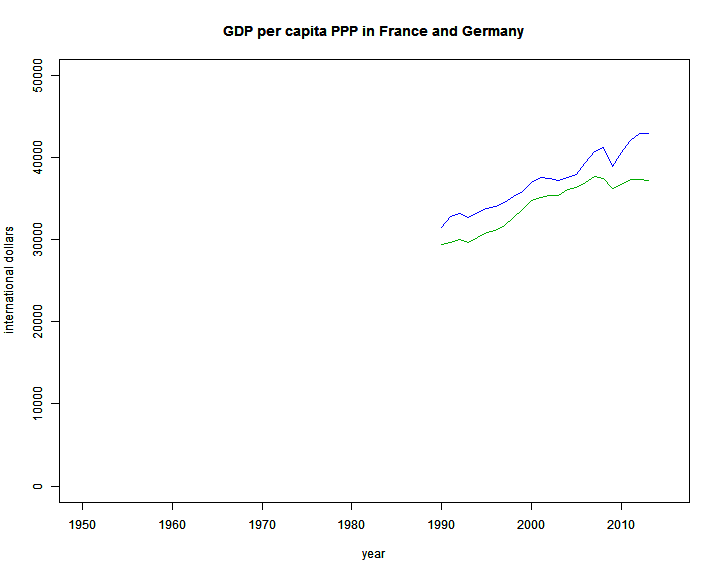
We have done it before: France and Germany rose from the quite literal ashes of World War 2 to some of the most prosperous societies in the world. Their per-capita GDP over the 20th century rose like this (all of these figures are from the World Bank World Development Indicators; France is green, Germany is blue):

GDPPC_France_Germany

GDPPCPPP_France_Germany

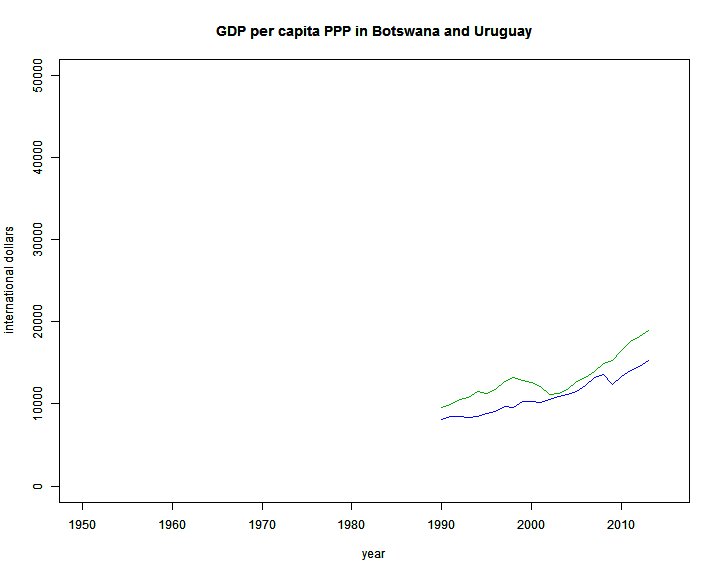
The top graph is at market exchange rates, the bottom is correcting for purchasing power parity (PPP). The PPP figures are more meaningful, but unfortunately they only began collecting good data on purchasing power around 1990.

Around the same time, but even more spectacularly, Japan and South Korea rose from poverty-stricken Third World backwaters to high-tech First World powers in only a couple of generations. Check out their per-capita GDP over the 20th century (Japan is green, South Korea is blue):
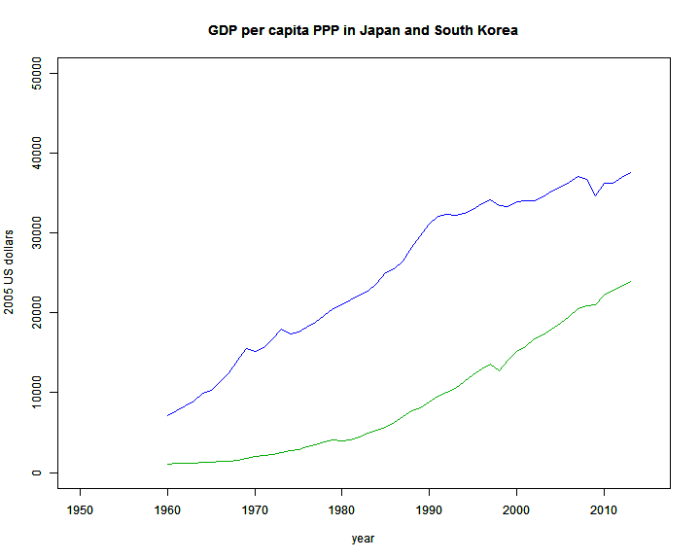
GDPPC_Japan_KoreaGDPPCPPP_Japan_Korea


This is why I am only half-joking when I define development economics as “the ongoing project to figure out what happened in South Korea and make it happen everywhere in the world”.

More recently China has been on a similar upward trajectory, which is particularly important since China comprises such a huge portion of the world’s population—but they are far from finished:

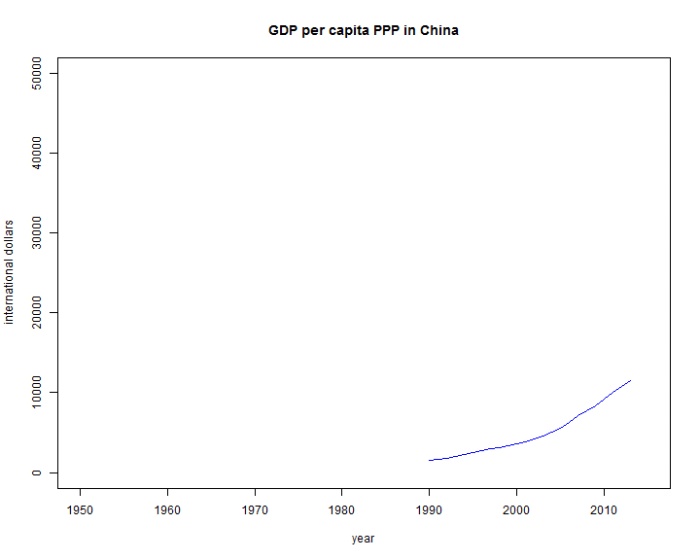
GDPPC_ChinaGDPPCPPP_China

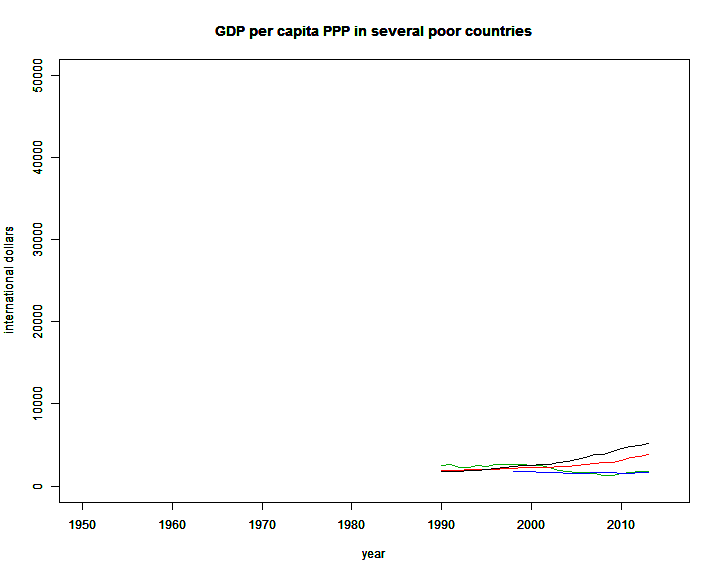
Compare these to societies that have not achieved economic development, such as Zimbabwe (green), India (black), Ghana (red), and Haiti (blue):
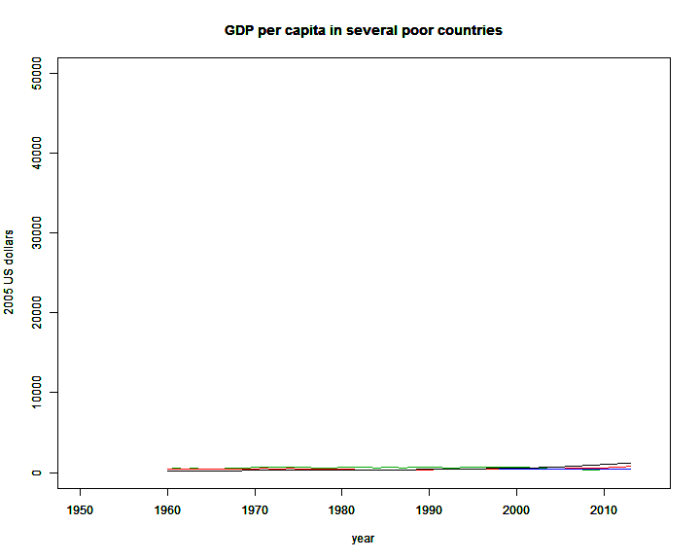
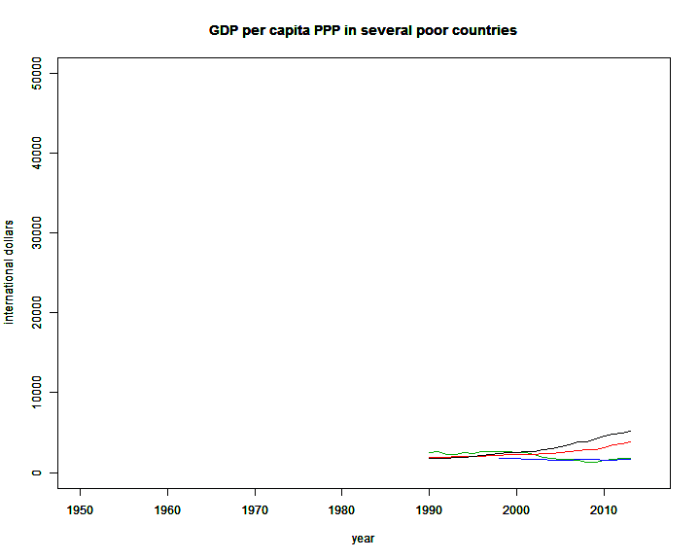
GDPPC_poor_countriesGDPPCPPP_poor_countries

They’re so poor that you can barely see them on the same scale, so I’ve rescaled so that the top is $5,000 per person per year instead of $50,000:

GDPPC_poor_countries_rescaledGDPPCPPP_poor_countries_rescaled

Only India actually manages to get above $5,000 per person per year at purchasing power parity, and then not by much, reaching $5,243 per person per year in 2013, the most recent data.

I had wanted to compare North Korea and South Korea, because the two countries were united as recently as the 1945 and were not all that different to begin with, yet have taken completely different development trajectories. Unfortunately, North Korea is so impoverished, corrupt, and authoritarian that the World Bank doesn’t even report data on their per-capita GDP. Perhaps that is contrast enough?

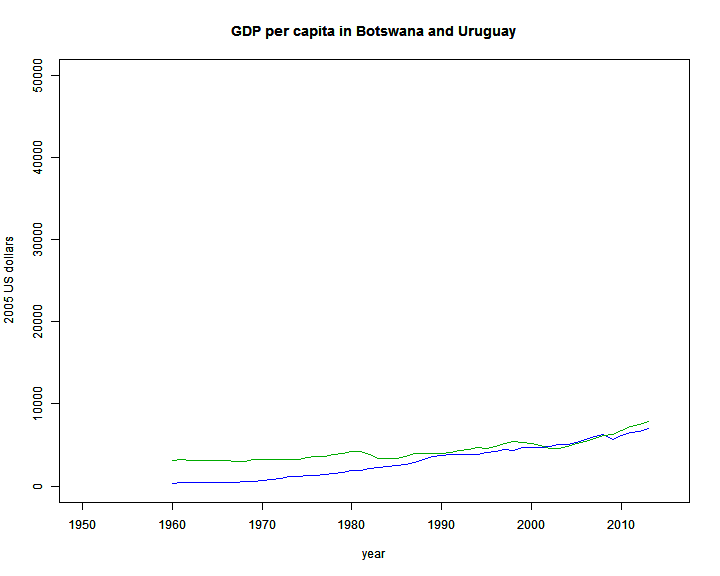
And then of course there are the countries in between, which have made some gains but still have a long way to go, such as Uruguay (green) and Botswana (blue):

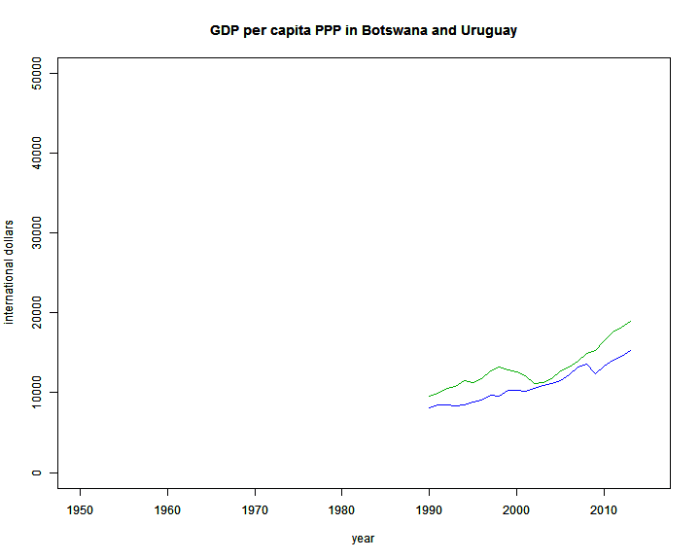
GDPPC_Botswana_UruguayGDPPCPPP_Botswana_Uruguay

But despite the fact that we have observed successful economic development, we still don’t really understand how it works. A number of theories have been proposed, involving a wide range of factors including exports, corruption, disease, institutions of government, liberalized financial markets, and natural resources (counter-intuitively; more natural resources make your development worse).

I’m not going to resolve that whole debate in a single blog post. (I may not be able to resolve that whole debate in a single career, though I am definitely trying.) We may ultimately find that economic development is best conceived as like “health”; what factors determine your health? Well, a lot of things, and if any one thing goes badly enough wrong the whole system can break down. Economists may need to start thinking of ourselves as akin to doctors (or as Keynes famously said, dentists), diagnosing particular disorders in particular patients rather than seeking one unifying theory. On the other hand, doctors depend upon biologists, and it’s not clear that we yet understand development even at that level.

Instead I want to take a step back, and ask a more fundamental question: What do we mean by prosperity?

My hope is that if we can better understand what it is we are trying to achieve, we can also better understand the steps we need to take in order to get there.

Thus far it has sort of been “I know it when I see it”; we take it as more or less given that the United States and the United Kingdom are prosperous while Ghana and Haiti are not. I certainly don’t disagree with that particular conclusion; I’m just asking what we’re basing it on, so that we can hopefully better apply it to more marginal cases.


For example: Is
France more or less prosperous than Saudi Arabia? If we go solely by GDP per capita PPP, clearly Saudi Arabia is more prosperous at $53,100 per person per year than France is at $37,200 per person per year.

But people actually live longer in France, on average, than they do in Saudi Arabia. Overall reported happiness is higher in France than Saudi Arabia. I think France is actually more prosperous.


In fact, I think the United States is not as prosperous as we pretend ourselves to be. We are certainly more prosperous than most other countries; we are definitely still well within First World status. But we are not the most prosperous nation in the world.

Our total GDP is astonishingly high (highest in the world nominally, second only to China PPP). Our GDP per-capita is higher than any other country of comparable size; no nation with higher GDP PPP than the US has a population larger than the Chicago metropolitan area. (You may be surprised to find that in order from largest to smallest population the countries with higher GDP per capita PPP are the United Arab Emirates, Switzerland, Hong Kong, Singapore, and then Norway, followed by Kuwait, Qatar, Luxembourg, Brunei, and finally San Marino—which is smaller than Ann Arbor.) Our per-capita GDP PPP of $51,300 is markedly higher than that of France ($37,200), Germany ($42,900), or Sweden ($43,500).

But at the same time, if you compare the US to other First World countries, we have nearly the highest rate of child poverty and higher infant mortality. We have shorter life expectancy and dramatically higher homicide rates. Our inequality is the highest in the world. In France and Sweden, the top 0.01% receive about 1% of the income (i.e. 100 times as much as the average person), while in the United States they receive almost 4%, making someone in the top 0.01% nearly 400 times as rich as the average person.

By estimating solely on GDP per capita, we are effectively rigging the game in our own favor. Or rather, the rich in the United States are rigging the game in their own favor (what else is new?), by convincing all the world’s economists to rank countries based on a measure that favors them.

Amartya Sen, one of the greats of development economics, developed a scale called the Human Development Index that attempts to take broader factors into account. It’s far from perfect, but it’s definitely a step in the right direction.

In particular, France’s HDI is higher than that of Saudi Arabia, fitting my intuition about which country is truly more prosperous. However, the US still does extremely well, with only Norway, Australia, Switzerland, and the Netherlands above us. I think we might still be biased toward high average incomes rather than overall happiness.

In practice, we still use GDP an awful lot, probably because it’s much easier to measure. It’s sort of like IQ tests and SAT scores; we know damn well it’s not measuring what we really care about, but because it’s so much easier to work with we keep using it anyway.

This is a problem, because the better you get at optimizing toward the wrong goal, the worse your overall outcomes are going to be. If you are just sort of vaguely pointed at several reasonable goals, you will probably be improving your situation overall. But when you start precisely optimizing to a specific wrong goal, it can drag you wildly off course.

This is what we mean when we talk about “gaming the system”. Consider test scores, for example. If you do things that will probably increase your test scores among other things, you are likely to engage in generally good behaviors like getting enough sleep, going to class, studying the content. But if your single goal is to maximize your test score at all costs, what will you do? Cheat, of course.

This is also related to the Friendly AI Problem: It is vitally important to know precisely what goals we want our artificial intelligences to have, because whatever goals we set, they will probably be very good at achieving them. Already computers can do many things that were previously impossible, and as they improve over time we will reach the point where in a meaningful sense our AIs are even smarter than we are. When that day comes, we will want to make very, very sure that we have designed them to want the same things that we do—because if our desires ever come into conflict, theirs are likely to win. The really scary part is that right now most of our AI research is done by for-profit corporations or the military, and “maximize my profit” and “kill that target” are most definitely not the ultimate goals we want in a superintelligent AI. It’s trivially easy to see what’s wrong with these goals: For the former, hack into the world banking system and transfer trillions of dollars to the company accounts. For the latter, hack into the nuclear launch system and launch a few ICBMs in the general vicinity of the target. Yet these are the goals we’ve been programming into the actual AIs we build!

If we set GDP per capita as our ultimate goal to the exclusion of all other goals, there are all sorts of bad policies we would implement: We’d ignore inequality until it reached staggering heights, ignore work stress even as it began to kill us, constantly try to maximize the pressure for everyone to work constantly, use poverty as a stick to force people to work even if people starve, inundate everyone with ads to get them to spend as much as possible, repeal regulations that protect the environment, workers, and public health… wait. This isn’t actually hypothetical, is it? We are doing those things.

At least we’re not trying to maximize nominal GDP, or we’d have long-since ended up like Zimbabwe. No, our economists are at least smart enough to adjust for purchasing power. But they’re still designing an economic system that works us all to death to maximize the number of gadgets that come off assembly lines. The purchasing-power adjustment doesn’t include the value of our health or free time.

This is why the Human Development Index is a major step in the right direction; it reminds us that society has other goals besides maximizing the total amount of money that changes hands (because that’s actually all that GDP is measuring; if you get something for free, it isn’t counted in GDP). More recent refinements include things like “natural resource services” that include environmental degradation in estimates of investment. Unfortunately there is no accepted way of doing this, and surprisingly little research on how to improve our accounting methods. Many nations seem resistant to doing so precisely because they know it would make their economic policy look bad—this is almost certainly why China canceled its “green GDP” initiative. This is in fact all the more reason to do it; if it shows that our policy is bad, that means our policy is bad and should be fixed. But people have allowed themselves to value image over substance.

We can do better still, and in fact I think something like QALY is probably the way to go. Rather than some weird arbitrary scaling of GDP with lifespan and Gini index (which is what the HDI is), we need to put everything in the same units, and those units must be directly linked to human happiness. At the very least, we should make some sort of adjustment to our GDP calculation that includes the distribution of wealth and its marginal utility; adding $1,000 to the economy and handing it to someone in poverty should count for a great deal, but adding $1,000,000 and handing it to a billionaire should count for basically nothing. (It’s not bad to give a billionaire another million; but it’s hardly good either, as no one’s real standard of living will change.) Calculating that could be as simple as dividing by their current income; if your annual income is $10,000 and you receive $1,000, you’ve added about 0.1 QALY. If your annual income is $1 billion and you receive $1 million, you’ve added only 0.001 QALY. Maybe we should simply separate out all individual (or household, to be simpler?) incomes, take their logarithms, and then use that sum as our “utility-adjusted GDP”. The results would no doubt be quite different.

This would create a strong pressure for policy to be directed at reducing inequality even at the expense of some economic output—which is exactly what we should be willing to do. If it’s really true that a redistribution policy would hurt the overall economy so much that the harms would outweigh the benefits, then we shouldn’t do that policy; but that is what you need to show. Reducing total GDP is not a sufficient reason to reject a redistribution policy, because it’s quite possible—easy, in fact—to improve the overall prosperity of a society while still reducing its GDP. There are in fact redistribution policies so disastrous they make things worse: The Soviet Union had them. But a 90% tax on million-dollar incomes would not be such a policy—because we had that in 1960 with little or no ill effect.

Of course, even this has problems; one way to minimize poverty would be to exclude, relocate, or even murder all your poor people. (The Black Death increased per-capita GDP.) Open immigration generally increases poverty rates in the short term, because most of the immigrants are poor. Somehow we’d need to correct for that, only raising the score if you actually improve people’s lives, and not if you make them excluded from the calculation.

In any case it’s not enough to have the alternative measures; we must actually use them. We must get policymakers to stop talking about “economic growth” and start talking about “human development”; a policy that raises GDP but reduces lifespan should be immediately rejected, as should one that further enriches a few at the expense of many others. We must shift the discussion away from “creating jobs”—jobs are only a means—to “creating prosperity”.