The Expanse gets the science right—including the economics

JDN 2457502

Despite constantly working on half a dozen projects at once (literally—preparing to start my PhD, writing this blog, working at my day job, editing a novel, preparing to submit a nonfiction book, writing another nonfiction book with three of my friends as co-authors, and creating a card game—that’s seven actually), I do occasionally find time to do things for fun. One I’ve been doing lately is catching up on The Expanse on DVR (I’m about halfway through the first season so far).

If you’re not familiar with The Expanse, it has been fairly aptly described as Battlestar Galactica meets Game of Thrones, though I think that particular comparison misrepresents the tone and attitudes of the series, because both BG and GoT are so dark and cynical (“It’s a nice day… for a… red wedding!”). I think “Star Trek meets Game of Thrones” might be better actually—the extreme idealism of Star Trek would cancel out the extreme cynicism of Game of Thrones, with the result being a complex mix of idealism and cynicism that more accurately reflects the real world (a world where Mahatma Gandhi and Adolf Hitler lived at the same time). That complex, nuanced world (or should I say worlds?) is where The Expanse takes place. ST is also more geopolitical than BG and The Expanse is nothing if not geopolitical.

But The Expanse is not just psychologically realistic—it is also scientifically and economically realistic. It may in fact be the hardest science fiction I have ever encountered, and is definitely the hardest science fiction I’ve seen in a television show. (There are a few books that might be slightly harder, as well as some movies based on them.)

The only major scientific inaccuracy I’ve been able to find so far is the use of sound effects in space, and actually even these can be interpreted as reflecting an omniscient narrator perspective that would hear any sounds that anyone would hear, regardless of what planet or ship they might be on. The sounds the audience hears all seem to be sounds that someone would hear—there’s simply no particular person who would hear all of them. When people are actually thrown into hard vacuum, we don’t hear them make any noise.

Like Firefly (and for once I think The Expanse might actually be good enough to deserve that comparison), there is no FTL, no aliens, no superhuman AI. Human beings are bound within our own solar system, and travel between planets takes weeks or months depending on your energy budget. They actually show holograms projecting the trajectory of various spacecraft and the trajectories actually make good sense in terms of orbital mechanics. Finally screenwriters had the courage to give us the terrifying suspense and inevitability of an incoming nuclear missile rounding a nearby asteroid and intercepting your trajectory, where you have minutes to think about it but not nearly enough delta-v to get out of its blast radius. That is what space combat will be like, if we ever have space combat (as awesome as it is to watch, I strongly hope that we will not ever actually do it). Unlike what Star Trek would have you believe, space is not a 19th century ocean.

They do have stealth in space—but it requires technology that even to them is highly advanced. Moreover it appears to only work for relatively short periods and seems most effective against civilian vessels that would likely lack state-of-the-art sensors, both of which make it a lot more plausible.

Computers are more advanced in the 2200s then they were in the 2000s, but not radically so, at most a million times faster, about what we gained since the 1980s. I’m guessing a smartphone in The Expanse runs at a few petaflops. Essentially they’re banking on Moore’s Law finally dying sometime in the mid 21st century, but then, so am I. Perhaps a bit harder to swallow is that no one has figured out good enough heuristics to match human cognition; but then, human cognition is very tightly optimized.

Spacecraft don’t have artificial gravity except for the thrust of their engines, and people float around as they should when ships are freefalling. They actually deal with the fact that Mars and Ceres have lower gravity than Earth, and the kinds of health problems that result from this. (One thing I do wish they’d done is had the Martian cruiser set a cruising acceleration of Mars-g—about 38% Earth-g—that would feel awkward and dizzying to their Earther captives. Instead they basically seem to assume that Martians still like to use Earth-g for space transit, but that does make some sense in terms of both human health and simply transit time.) It doesn’t seem like people move around quite awkwardly enough in the very low gravity of Ceres—which should be only about 3% Earth-g—but they do establish that electromagnetic boots are ubiquitous and that could account for most of this.

They fight primarily with nuclear missiles and kinetic weapons, and the damage done by nuclear missiles is appropriately reduced by the fact that vacuum doesn’t transmit shockwaves. (Nuclear missiles would still be quite damaging in space by releasing large amounts of wide-spectrum radiation; but they wouldn’t cause the total devastation they do within atmosphere.) Oddly they decided not to go with laser weapons as far as I can tell, which actually seems to me like they’ve underestimated advancement; laser weapons have a number of advantages that would be particularly useful in space, once we can actually make them affordable and reliable enough for widespread deployment. There could also be a three-tier system, where missiles are used at long range, railguns at medium range, and lasers at short range. (Yes, short range—the increased speed of lasers would be only slight compared to a good railgun, and would be more than offset by the effect of diffraction. At orbital distances, a laser is a shotgun.) Then again, it could well work out that railguns are just better—depending on how vessels are structured, puncturing their hulls with kinetic rounds could well be more useful than burning them up with infrared lasers.

But I think what really struck me about the realism of The Expanse is how it even makes the society realistic (in a way that, say, Firefly really doesn’t—we wanted a Western and we got a Western!).

The only major offworld colonies are Mars and Ceres, both of which seem to be fairly well-established, probably originally colonized as much as a century ago. Different societies have formed on each world; Earth has largely united under the United Nations (one of the lead characters is an undersecretary for the UN), but meanwhile Mars has split off into its own independent nation (“Martian” is now an ethnicity like “German” rather than meaning “extraterrestrial”), and the asteroid belt colonists, while formally still under Earth’s government, think of themselves as a different culture (“Belters”) and are seeking independence. There are some fairly obvious—but deftly managed rather than heavy-handed—parallels between the Belter independence movement and real-world independence movements, particularly Palestine (it’s hard not to think of the PLO when they talk about the OPA). Both Mars and the Belt have their own languages, while Earth’s languages have largely coalesced around English as the language of politics and commerce. (If the latter seems implausible, I remind you that the majority of the Internet and all international air traffic control are in English.) English is the world’s lingua franca (which is a really bizarre turn of phrase because it’s the Latin for French).

There is some of the conniving and murdering of Game of Thrones, but it is at a much more subdued level, and all of the major factions display both merits and flaws. There is no clear hero and no clear villain, just conflict and misunderstanding between a variety of human beings each with their own good and bad qualities. There does seem to be a sense that the most idealistic characters suffer for their idealism much as the Starks often do, but unlike the Starks they usually survive and learn from the experience. Indeed, some of the most cynical also seem to suffer for their cynicism—in the episode I just finished, the grizzled UN Colonel assumed the worst of his adversary and ended up branded “the butcher of Anderson Station”.

Cost of living on Ceres is extraordinarily high because of the limited living space (the apartments look a lot like the tiny studios of New York or San Francisco), and above all the need to constantly import air and water from Earth. A central plot point in the first episode is that a ship carrying comet ice—i.e., water—to Ceres is lost in a surprise attack by unknown adversaries with advanced technology, and the result is a deepening of an already dire water shortage, exacerbating the Belter’s craving for rebellion.

Air and water are recyclable, so it wouldn’t be that literally every drink and every breath needs to be supplied from outside—indeed that would clearly be cost-prohibitive. But recycling is never perfect, and Ceres also appears to have a growing population, both of which would require a constant input of new resources to sustain. It makes perfect sense that the most powerful people on Ceres are billionaire tycoons who own water and air transport corporations.

The police on Ceres (of which another lead character is a detective) are well-intentioned but understaffed, underfunded and moderately corrupt, similar to what we seem to find in large inner-city police departments like the NYPD and LAPD. It felt completely right when they responded to an attempt to kill a police officer with absolutely overwhelming force and little regard for due process and procedure—for this is what real-world police departments almost always do.

But why colonize the asteroid belt at all? Mars is a whole planet, there is plenty there—and in The Expanse they are undergoing terraforming at a very plausible rate (there’s a moving scene where a Martian says to an Earther, “We’re trying to finish building our garden before you finish paving over yours.”). Mars has as much land as Earth, and it has water, abundant metals, and CO2 you could use to make air.Even just the frontier ambition could be enough to bring us to Mars.

But why go to Ceres? The explanation The Expanse offers is a very sensible one: Mining, particularly so-called “rare earth metals”. Gold and platinum might have been profitable to mine at first, but once they became plentiful the market would probably collapse or at least drop off to a level where they aren’t particularly expensive or interesting—because they aren’t useful for very much. But neodymium, scandium, and prometheum are all going to be in extremely high demand in a high-tech future based on nuclear-powered spacecraft, and given that we’re already running out of easily accessible deposits on Earth, by the 2200s there will probably be basically none left. The asteroid belt, however, will have plenty for centuries to come.

As a result Ceres is organized like a mining town, or perhaps an extractive petrostate (metallostate?); but due to lightspeed interplanetary communication—very important in the series—and some modicum of free speech it doesn’t appear to have attained more than a moderate level of corruption. This also seems realistic; the “end-of-history” thesis is often overstated, but the basic idea that some form of democracy and welfare-state capitalism is fast becoming the only viable model of governance does seem to be true, and that is almost certainly the model of governance we would export to other planets. In such a system corruption can only get so bad before it is shown on the mass media and people won’t take it anymore.

The show doesn’t deal much with absolute dollar (or whatever currency) numbers, which is probably wise; but nominal incomes on Ceres are likely extremely high even though the standard of living is quite poor, because the tiny living space and need to import air and water would make prices (literally?) astronomical. Most people on Ceres seem to have grown up there, but the initial attraction could have been something like the California Gold Rush, where rumors of spectacularly high incomes clashed with similarly spectacular expenses incurred upon arrival. “Become a millionaire!” “Oh, by the way, your utility bill this month is $112,000.”

Indeed, even the poor on Ceres don’t seem that poor, which is a very nice turn toward realism that a lot of other science fiction shows seem unprepared to make. In Firefly, the poor are poor—they can barely afford food and clothing, and have no modern conveniences whatsoever. (“Jaynestown”, perhaps my favorite episode, depicts this vividly.) But even the poor in the US today are rarely that poor; our minimalistic and half-hearted welfare state has a number of cracks one can fall through, but as long as you get the benefits you’re supposed to get you should be able to avoid starvation and homelessness. Similarly I find it hard to believe that any society with high enough productivity to routinely build interstellar spacecraft the way we build container ships would not have at least the kind of welfare state that provides for the most basic needs. Chronic dehydration is probably still a problem for Belters, because water would be too expensive to subsidize in this way; but they all seem to have fairly nice clothes, home appliances, and smartphones, and that seems right to me. At one point a character loses his arm, and the “cheap” solution is a cybernetic prosthetic—the “expensive” one would be to grow him a new arm. As today but perhaps even more so, poverty in The Expanse is really about inequality—the enormous power granted to those who have millions of times as much as others. (Another show that does this quite well, though is considerably softer as far as the physics, is Continuum. If I recall correctly, Alec Sadler in 2079 is literally a trillionaire.)

Mars also appears to be a democracy, and actually quite a thriving one. In many ways Mars appears to be surpassing Earth economically and technologically. This suggests that Mars was colonized with our best and brightest, but not necessarily; Australians have done quite well for themselves despite being founded as a penal colony. Mars colonization would also have a way of justifying their frontier idealism that no previous frontiers have granted: No indigenous people to displace, no local ecology to despoil, and no gifts from the surrounding environment. You really are working entirely out of your own hard work and know-how (and technology and funding from Earth of course) to establish a truly new world on the open and unspoiled frontier. You’re not naive or a hypocrite, it’s the real truth. That kind of realistic idealism could make the Martian Dream a success in ways even the American Dream never quite was.

In all it is a very compelling series, and should appeal to people like me who crave geopolitical nuance in fiction. But it also has its moments of huge space battles with exploding star cruisers, so there’s that.

What is the processing power of the human brain?

JDN 2457485

Futurists have been predicting that AI will “surpass humans” any day now for something like 50 years. Eventually they’ll be right, but it will be more or less purely by chance, since they’ve been making the same prediction longer than I’ve been alive. (Similarity, whenever someone projects the date at which immortality will be invented, it always seems to coincide with just slightly before the end of the author’s projected life expectancy.) Any technology that is “20 years away” will be so indefinitely.

There are a lot of reasons why this prediction keeps failing so miserably. One is an apparent failure to grasp the limitations of exponential growth. I actually think the most important is that a lot of AI fans don’t seem to understand how human cognition actually works—that it is primarily social cognition, where most of the processing has already been done and given to us as cached results, some of them derived centuries before we were born. We are smart enough to run a civilization with airplanes and the Internet not because any individual human is so much smarter than any other animal, but because all humans together are—and other animals haven’t quite figured out how to unite their cognition in the same way. We’re about 3 times smarter than any other animal as individuals—and several billion times smarter when we put our heads together.

A third reason is that even if you have sufficient computing power, that is surprisingly unimportant; what you really need are good heuristics to make use of your computing power efficiently. Any nontrivial problem is too complex to brute-force by any conceivable computer, so simply increasing computing power without improving your heuristics will get you nowhere. Conversely, if you have really good heuristics like the human brain does, you don’t even need all that much computing power. A chess grandmaster was once asked how many moves ahead he can see on the board, and he replied: “I only see one move ahead. The right one.” In cognitive science terms, people asked him how much computing power he was using, expecting him to say something far beyond normal human capacity, and he replied that he was using hardly any—it was all baked into the heuristics he had learned from years of training and practice.

Making an AI capable of human thought—a true artificial person—will require a level of computing power we can already reach (as long as we use huge supercomputers), but that is like having the right material. To really create the being we will need to embed the proper heuristics. We are trying to make David, and we have finally mined enough marble—now all we need is Michelangelo.

But another reason why so many futurists have failed in their projections is that they have wildly underestimated the computing power of the human brain. Reading 1980s cyberpunk is hilarious in hindsight; Neuromancer actually quite accurately projected the number of megabytes that would flow through the Internet at any given moment, but somehow thought that a few hundred megaflops would be enough to copy human consciousness. The processing power of the human brain is actually on the order of a few petaflops. So, you know, Gibson was only off by a factor of a few million.

We can now match petaflops—the world’s fastest supercomputer is actually about 30 petaflops. Of course, it cost half a month of China’s GDP to build, and requires 24 megawatts to run and cool, which is about the output of a mid-sized solar power station. The human brain consumes only about 400 kcal per day, which is about 20 watts—roughly the consumption of a typical CFL lightbulb. Even if you count the rest of the human body as necessary to run the human brain (which I guess is sort of true), we’re still clocking in at about 100 watts—so even though supercomputers can now process at the same speed, our brains are almost a million times as energy-efficient.

How do I know it’s a few petaflops?

Earlier this year a study was published showing that a conservative lower bound for the total capacity of human memory is about 4 bits per synapse, where previously some scientists thought that each synapse might carry only 1 bit (I’ve always suspected it was more like 10 myself).

So then we need to figure out how many synapses we have… which turns out to be really difficult actually. They are in a constant state of flux, growing, shrinking, and moving all the time; and when we die they fade away almost immediately (reason #3 I’m skeptical of cryonics). We know that we have about 100 billion neurons, and each one can have anywhere between 100 and 15,000 synapses with other neurons. The average seems to be something like 5,000 (but highly skewed in a power-law distribution), so that’s about 500 trillion synapses. If each one is carrying 4 bits to be as conservative as possible, that’s a total storage capacity of about 2 quadrillion bits, which is about 0.2 petabytes.

Of course, that’s assuming that our brains store information the same way as a computer—every bit flipped independently, each bit stored forever. Not even close. Human memory is constantly compressing and decompressing data, using a compression scheme that’s lossy enough that we not only forget things, we can systematically misremember and even be implanted with false memories. That may seem like a bad thing, and in a sense it is; but if the compression scheme is that lossy, it must be because it’s also that efficient—that our brains are compressing away the vast majority of the data to make room for more. Our best lossy compression algorithms for video are about 100:1; but the human brain is clearly much better than that. Our core data format for long-term memory appears to be narrative; more or less we store everything not as audio or video (that’s short-term memory, and quite literally so), but as stories.

How much compression can you get by storing things as narrative? Think about The Lord of the Rings. The extended edition of the films runs to 6 discs of movie (9 discs of other stuff), where a Blu-Ray disc can store about 50 GB. So that’s 300 GB. Compressed into narrative form, we have the books (which, if you’ve read them, are clearly not optimally compressed—no, we do not need five paragraphs about the trees, and I’m gonna say it, Tom Bombadil is totally superfluous and Peter Jackson was right to remove him), which run about 500,000 words altogether. If the average word is 10 letters (normally it’s less than that, but this is Tolkien we’re talking about), each word will take up about 10 bytes (because in ASCII or Unicode a letter is a byte). So altogether the total content of the entire trilogy, compressed into narrative, can be stored in about 5 million bytes, that is, 5 MB. So the compression from HD video to narrative takes us all the way from 300 GB to 5 MB, which is a factor of 60,000. Sixty thousand. I believe that this is the proper order of magnitude for the compression capability of the human brain.

Even more interesting is the fact that the human brain is almost certainly in some sense holographic storage; damage to a small part of your brain does not produce highly selective memory loss as if you had some bad sectors of your hard drive, but rather an overall degradation of your total memory processing as if you in some sense stored everything everywhere—that is, holographically. How exactly this is accomplished by the brain is still very much an open question; it’s probably not literally a hologram in the quantum sense, but it definitely seems to function like a hologram. (Although… if the human brain is a quantum computer that would explain an awful lot—it especially helps with the binding problem. The problem is explaining how a biological system at 37 C can possibly maintain the necessary quantum coherences.) The data storage capacity of holograms is substantially larger than what can be achieved by conventional means—and furthermore has similar properties to human memory in that you can more or less always add more, but then what you had before gradually gets degraded. Since neural nets are much closer to the actual mechanics of the brain as we know them, understanding human memory will probably involve finding ways to simulate holographic storage with neural nets.

With these facts in mind, the amount of information we can usefully take in and store is probably not 0.2 petabytes—it’s probably more like 10 exabytes. The human brain can probably hold just about as much as the NSA’s National Cybersecurity Initiative Data Center in Utah, which is itself more or less designed to contain the Internet. (The NSA is at once awesome and terrifying.)

But okay, maybe that’s not fair if we’re comparing human brains to computers; even if you can compress all your data by a factor of 100,000, that isn’t the same thing as having 100,000 times as much storage.

So let’s use that smaller figure, 0.2 petabytes. That’s how much we can store; how much can we process?

The next thing to understand is that our processing architecture is fundamentally difference from that of computers.

Computers generally have far more storage than they have processing power, because they are bottlenecked through a CPU that can only process 1 thing at once (okay, like 8 things at once with a hyperthreaded quad-core; as you’ll see in a moment this is a trivial difference). So it’s typical for a new computer these days to have processing power in gigaflops (It’s usually reported in gigahertz, but that’s kind of silly; hertz just tells you clock cycles, while what you really wanted to know is calculations—and that you get from flops. They’re generally pretty comparable numbers though.), while they have storage in terabytes—meaning that it would take about 1000 seconds (about 17 minutes) for the computer to process everything in its entire storage once. In fact it would take a good deal longer than that, because there are further bottlenecks in terms of memory access, especially from hard-disk drives (RAM and solid-state drives are faster, but would still slow it down to a couple of hours).

The human brain, by contrast, integrates processing and memory into the same system. There is no clear distinction between “memory synapses” and “processing synapses”, and no single CPU bottleneck that everything has to go through. There is however something like a “clock cycle” as it turns out; synaptic firings are synchronized across several different “rhythms”, the fastest of which is about 30 Hz. No, not 30 GHz, not 30 MHz, not even 30 kHz; 30 hertz. Compared to the blazing speed of billions of cycles per second that goes on in our computers, the 30 cycles per second our brains are capable of may seem bafflingly slow. (Even more bafflingly slow is the speed of nerve conduction, which is not limited by the speed of light as you might expect, but is actually less than the speed of sound. When you trigger the knee-jerk reflex doctors often test, it takes about a tenth of a second for the reflex to happen—not because your body is waiting for anything, but because it simply takes that long for the signal to travel to your spinal cord and back.)

The reason we can function at all is because of our much more efficient architecture; instead of passing everything through a single bottleneck, we do all of our processing in parallel. All of those 100 billion neurons with 500 trillion synapses storing 2 quadrillion bits work simultaneously. So whereas a computer does 8 things at a time, 3 billion times per second, a human brain does 2 quadrillion things at a time, 30 times per second. Provided that the tasks can be fully parallelized (vision, yes; arithmetic, no), a human brain can therefore process 60 quadrillion bits per second—which turns out to be just over 6 petaflops, somewhere around 6,000,000,000,000,000 calculations per second.

So, like I said, a few petaflops.

The Parable of the Dishwasher

JDN 2456478

Much like free trade, technological unemployment is an issue where the consensus opinion among economists diverges quite sharply from that of the general population.

Enough people think that “robots taking our jobs” is something bad that I’ve seen a fair number of memes like this:

EVERY TIME you use the Self Checkout you are ELIMINATING JOBS!

But like almost all economists, I think that self-checkouts, robots, and automation in general are a pretty good thing. They do have a few downsides, chiefly in terms of forcing us to make transitions that are costly and painful; but in general I want more robots, not fewer.

To help turn you toward this view, I offer a parable.

Suppose we have a family, the (stereo)typical American family with a father, a mother, and two kids, a boy named Joe and a girl named Sue.

The kids do chores for their allowance, and split them as follows: Joe always does the dishes, and Sue always vacuums the carpet. They both spend about 1 hour per week and they both get paid $10 a week.

But one day, Dad decides to buy a dishwasher. This dramatically cuts down the time it takes Joe to do the dishes; where he used to spend 1 hour washing dishes, now he can load the dishwasher and get it done in 5 minutes.

  1. Mom suggests they just sell back the dishwasher to get rid of the problem.
  2. Dad says that Joe should now only be paid for the 5 minutes he works each week, so he would now be paid $0.83 per week. (He’s not buying a lot of video games on that allowance.)
  3. Joe protests that he gets the same amount of work done, so he should be paid the same $10 for doing it.
  4. Sue says it would be unfair for her to have to work so much more than Joe, and has a different solution: They’ll trade off the two sets of chores each week, and they should of course get paid the same amount of money for getting the same amount of work done—$10 per kid per week, for an average of 32.5 minutes of work each.

Which of those solutions sounds the most sensible to you?

Mom’s solution is clearly the worst, right? It’s the Luddite solution, the one that throws away technological progress and makes everything less efficient. Yet that is the solution being offered by people who say “Don’t use the self-checkout machine!” Indeed, anyone who speaks of the virtues of “hard work” is really speaking Mom’s language here; they should be talking about the virtues of getting things done. The purpose of washing dishes is to have clean dishes, not to “work hard”. And likewise, when we construct bridges or make cars or write books or solve equations, our goal should be to get that thing done—not to fulfill some sense of moral obligation to prove our worthiness through hard work.

Joe’s solution is what neoclassical economics says should happen—higher productivity should yield higher wages, so the same amount of production should yield the same pay. This seems like it could work, but empirically it rarely happens. There’s also something vaguely unfair about it; if productivity increases in your industry but not in someone else’s, you get to cut your work hours dramatically while they are stuck working just as hard as before.

Dad’s “solution” is clearly terrible, and makes no sense at all. Yet this is what we actually tend to observe—capital owners appropriate all (or nearly all) the benefits of the new technology, and workers get displaced or get ever-smaller wages. (I talked about that in a recent post.)

It’s Sue’s solution that really seems to make the most sense, isn’t it? When one type of work becomes more efficient, people should shift into different types of labor so that people can work fewer hours—and wages should rise enough that incomes remain the same. “Baumol’s disease” is not a disease—it is the primary means by which capitalism raises human welfare. (That’s why I prefer to use the term “Baumol Effect” instead.)

One problem with this in practice is that sometimes people can’t switch into other industries. That’s a little hard to imagine in this case, but let’s stipulate that for some reason Joe can’t do the vacuuming. Maybe he has some sort of injury that makes it painful to use the vacuum cleaner, but doesn’t impair his ability to wash dishes. Or maybe he has a severe dust allergy, so bad that the dust thrown up by the vacuum cleaner sends him into fits of coughing.

In that case I think we’re back to Joe’s solution; he should get paid the same for getting the same amount of work done. I’m actually tempted to say that Sue should get paid more, to compensate her for the unfairness; but in the real world there is a pretty harsh budget constraint there, so we need to essentially pretend that Dad only has $20 per week to give out in allowances. A possible compromise would be to raise Sue up to $12 and cut Joe down to $8; Joe will probably still be better off than he was, because he has that extra 55 minutes of free time each week for which he only had to “pay” $2. This also makes the incentives work out better—Joe doesn’t have a reason to malinger and exaggerate his dust allergy just to get out of doing the vacuuming, since he would actually get paid more if he were willing to do the vacuuming; but if his allergy really is that bad, he can still do okay otherwise. (There’s a lesson here for the proper structure of Social Security Disability, methinks.)

But you know what really seems like the best solution? Buy a Roomba.

Buy a Roomba, make it Sue’s job to spend 5 minutes a week keeping the Roomba working at vacuuming the carpet, and continue paying both kids $10 per week. Give them both 55 minutes more per week to hang out with their friends or play video games. Whether you think of this $10 as a “higher wage” for higher productivity or simply an allowance they get anyway—a basic income—ultimately doesn’t matter all that much. The point is that everyone gets enough money and nobody has to work very much, because the robots do everything.

And now, hopefully you see why I think we need more robots, not fewer.

Of course, like any simple analogy, this isn’t perfect; it may be difficult to reduce the hours in some jobs or move more people into them. There are a lot of additional frictions and complications that go into the real-world problem of achieving equitable labor markets. But I hope I’ve gotten across the basic idea that robots are not the problem, and could in fact be the solution–not just to our current labor market woes, but to the very problem of wage labor itself.

My ultimate goal is a world where “work” itself is fundamentally redefined—so that it always means the creative sense “This painting is some of my best work.” and not the menial sense “Sweeping this floor is so much work!”; so that human beings do things because we want to do them, because they are worth doing, and not because some employer is holding our food and housing hostage if we don’t.

But that will require our whole society to rethink a lot of our core assumptions about work, jobs, and economics in general. We’re so invested in this idea that “hard work” is inherently virtuous that we forgot the purpose of an economy was to get things done. Work is not a benefit; work is a cost. Costs are to be reduced. Puritanical sexual norms have been extremely damaging to American society, but time will tell if Puritanical work ethic actually does more damage to our long-term future.

The real Existential Risk we should be concerned about

JDN 2457458

There is a rather large subgroup within the rationalist community (loosely defined because organizing freethinkers is like herding cats) that focuses on existential risks, also called global catastrophic risks. Prominent examples include Nick Bostrom and Eliezer Yudkowsky.

Their stated goal in life is to save humanity from destruction. And when you put it that way, it sounds pretty darn important. How can you disagree with wanting to save humanity from destruction?

Well, there are actually people who do (the Voluntary Human Extinction movement), but they are profoundly silly. It should be obvious to anyone with even a basic moral compass that saving humanity from destruction is a good thing.

It’s not the goal of fighting existential risk that bothers me. It’s the approach. Specifically, they almost all seem to focus on exotic existential risks, vivid and compelling existential risks that are the stuff of great science fiction stories. In particular, they have a rather odd obsession with AI.

Maybe it’s the overlap with Singularitarians, and their inability to understand that exponentials are not arbitrarily fast; if you just keep projecting the growth in computing power as growing forever, surely eventually we’ll have a computer powerful enough to solve all the world’s problems, right? Well, yeah, I guess… if we can actually maintain the progress that long, which we almost certainly can’t, and if the problems turn out to be computationally tractable at all (the fastest possible computer that could fit inside the observable universe could not brute-force solve the game of Go, though a heuristic AI did just beat one of the world’s best players), and/or if we find really good heuristic methods of narrowing down the solution space… but that’s an awful lot of “if”s.

But AI isn’t what we need to worry about in terms of saving humanity from destruction. Nor is it asteroid impacts; NASA has been doing a good job watching for asteroids lately, and estimates the current risk of a serious impact (by which I mean something like a city-destroyer or global climate shock, not even a global killer) at around 1/10,000 per year. Alien invasion is right out; we can’t even find clear evidence of bacteria on Mars, and the skies are so empty of voices it has been called a paradox. Gamma ray bursts could kill us, and we aren’t sure about the probability of that (we think it’s small?), but much like brain aneurysms, there really isn’t a whole lot we can do to prevent them.

There is one thing that we really need to worry about destroying humanity, and one other thing that could potentially get close over a much longer timescale. The long-range threat is ecological collapse; as global climate change gets worse and the oceans become more acidic and the aquifers are drained, we could eventually reach the point where humanity cannot survive on Earth, or at least where our population collapses so severely that civilization as we know it is destroyed. This might not seem like such a threat, since we would see this coming decades or centuries in advance—but we are seeing it coming decades or centuries in advance, and yet we can’t seem to get the world’s policymakers to wake up and do something about it. So that’s clearly the second-most important existential risk.

But the most important existential risk, by far, no question, is nuclear weapons.

Nuclear weapons are the only foreseeable, preventable means by which humanity could be destroyed in the next twenty minutes.

Yes, that is approximately the time it takes an ICBM to hit its target after launch. There are almost 4,000 ICBMs currently deployed, mostly by the US and Russia. Once we include submarine-launched missiles and bombers, the total number of global nuclear weapons is over 15,000. I apologize for terrifying you by saying that these weapons could be deployed in a moment’s notice to wipe out most of human civilization within half an hour, followed by a global ecological collapse and fallout that would endanger the future of the entire human race—but it’s the truth. If you’re not terrified, you’re not paying attention.

I’ve intentionally linked the Union of Concerned Scientists as one of those sources. Now they are people who understand existential risk. They don’t talk about AI and asteroids and aliens (how alliterative). They talk about climate change and nuclear weapons.

We must stop this. We must get rid of these weapons. Next to that, literally nothing else matters.

“What if we’re conquered by tyrants?” It won’t matter. “What if there is a genocide?” It won’t matter. “What if there is a global economic collapse?” None of these things will matter, if the human race wipes itself out with nuclear weapons.

To speak like an economist for a moment, the utility of a global nuclear war must be set at negative infinity. Any detectable reduction in the probability of that event must be considered worth paying any cost to achieve. I don’t care if it costs $20 trillion and results in us being taken over by genocidal fascists—we are talking about the destruction of humanity. We can spend $20 trillion (actually the US as a whole does every 14 months!). We can survive genocidal fascists. We cannot survive nuclear war.

The good news is, we shouldn’t actually have to pay that sort of cost. All we have to do is dismantle our nuclear arsenal, and get other countries—particularly Russia—to dismantle theirs. In the long run, we will increase our wealth as our efforts are no longer wasted maintaining doomsday machines.

The main challenge is actually a matter of game theory. The surprisingly-sophisticated 1990s cartoon show the Animaniacs basically got it right when they sang: “We’d beat our swords into liverwurst / Down by the East Riverside / But no one wants to be the first!”

The thinking, anyway, is that this is basically a Prisoner’s Dilemma. If the US disarms and Russia doesn’t, Russia can destroy the US. Conversely, if Russia disarms and the US doesn’t, the US can destroy Russia. If neither disarms, we’re left where we are. Whether or not the other country disarms, you’re always better off not disarming. So neither country disarms.

But I contend that it is not, in fact, a Prisoner’s Dilemma. It could be a Stag Hunt; if that’s the case, then only multilateral disarmament makes sense, because the best outcome is if we both disarm, but the worst outcome is if we disarm and they don’t. Once we expect them to disarm, we have no temptation to renege on the deal ourselves; but if we think there’s a good chance they won’t, we might not want to either. Stag Hunts have two stable Nash equilibria; one is where both arm, the other where both disarm.

But in fact, I think it may be simply the trivial game.

There aren’t actually that many possible symmetric two-player nonzero-sum games (basically it’s a question of ordering 4 possibilities, and it’s symmetric, so 12 possible games), and one that we never talk about (because it’s sort of boring) is the trivial game: If I do the right thing and you do the right thing, we’re both better off. If you do the wrong thing and I do the right thing, I’m better off. If we both do the wrong thing, we’re both worse off. So, obviously, we both do the right thing, because we’d be idiots not to. Formally, we say that cooperation is a strictly dominant strategy. There’s no dilemma, no paradox; the self-interested strategy is the optimal strategy. (I find it kind of amusing that laissez-faire economics basically amounts to assuming that all real-world games are the trivial game.)

That is, I don’t think the US would actually benefit from nuking Russia, even if we could do so without retaliation. Likewise, I don’t think Russia would actually benefit from nuking the US. One of the things we’ve discovered—the hardest way possible—through human history is that working together is often better for everyone than fighting. Russia could nuke NATO, and thereby destroy all of their largest trading partners, or they could continue trading with us. Even if they are despicable psychopaths who think nothing of committing mass murder (Putin might be, but surely there are people under his command who aren’t?), it’s simply not in Russia’s best interest to nuke the US and Europe. Likewise, it is not in our best interest to nuke them.

Nuclear war is a strange game: The only winning move is not to play.

So I say, let’s stop playing. Yes, let’s unilaterally disarm, the thing that so many policy analysts are terrified of because they’re so convinced we’re in a Prisoner’s Dilemma or a Stag Hunt. “What’s to stop them from destroying us, if we make it impossible for us to destroy them!?” I dunno, maybe basic human decency, or failing that, rationality?

Several other countries have already done this—South Africa unilaterally disarmed, and nobody nuked them. Japan refused to build nuclear weapons in the first place—and I think it says something that they’re the only people to ever have them used against them.

Our conventional military is plenty large enough to defend us against all realistic threats, and could even be repurposed to defend against nuclear threats as well, by a method I call credible targeted conventional response. Instead of building ever-larger nuclear arsenals to threaten devastation in the world’s most terrifying penis-measuring contest, you deploy covert operatives (perhaps Navy SEALS in submarines, or double agents, or these days even stealth drones) around the world, with the standing order that if they have reason to believe a country initiated a nuclear attack, they will stop at nothing to hunt down and kill the specific people responsible for that attack. Not the country they came from; not the city they live in; those specific people. If a leader is enough of a psychopath to be willing to kill 300 million people in another country, he’s probably enough of a psychopath to be willing to lose 150 million people in his own country. He likely has a secret underground bunker that would allow him to survive, at least if humanity as a whole does. So you should be threatening the one thing he does care about—himself. You make sure he knows that if he pushes that button, you’ll find that bunker, drop in from helicopters, and shoot him in the face.

The “targeted conventional response” should be clear by now—you use non-nuclear means to respond, and you target the particular leaders responsible—but let me say a bit more about the “credible” part. The threat of mutually-assured destruction is actually not a credible one. It’s not what we call in game theory a subgame perfect Nash equilibrium. If you know that Russia has launched 1500 ICBMs to destroy every city in America, you actually have no reason at all to retaliate with your own 1500 ICBMs, and the most important reason imaginable not to. Your people are dead either way; you can’t save them. You lose. The only question now is whether you risk taking the rest of humanity down with you. If you have even the most basic human decency, you will not push that button. You will not “retaliate” in useless vengeance that could wipe out human civilization. Thus, your threat is a bluff—it is not credible.

But if your response is targeted and conventional, it suddenly becomes credible. It’s exactly reversed; you now have every reason to retaliate, and no reason not to. Your covert operation teams aren’t being asked to destroy humanity; they’re being tasked with finding and executing the greatest mass murderer in history. They don’t have some horrific moral dilemma to resolve; they have the opportunity to become the world’s greatest heroes. Indeed, they’d very likely have the whole world (or what’s left of it) on their side; even the population of the attacking country would rise up in revolt and the double agents could use the revolt as cover. Now you have no reason to even hesitate; your threat is completely credible. The only question is whether you can actually pull it off, and if we committed the full resources of the United States military to preparing for this possibility, I see no reason to doubt that we could. If a US President can be assassinated by a lone maniac (and yes, that is actually what happened), then the world’s finest covert operations teams can assassinate whatever leader pushed that button.

This is a policy that works both unilaterally and multilaterally. We could even assemble an international coalition—perhaps make the UN “peacekeepers” put their money where their mouth is and train the finest special operatives in the history of the world tasked with actually keeping the peace.

Let’s not wait for someone else to save humanity from destruction. Let’s be the first.

Will robots take our jobs?

JDN 2457451
I briefly discussed this topic before, but I thought it deserved a little more depth. Also, the SF author in me really likes writing this sort of post where I get to speculate about futures that are utopian, dystopian, or (most likely) somewhere in between.

The fear is quite widespread, but how realistic is it? Will robots in fact take all our jobs?

Most economists do not think so. Robert Solow famously quipped, “You can see the computer age everywhere but in the productivity statistics.” (It never quite seemed to occur to him that this might be a flaw in the way we measure productivity statistics.)

By the usual measure of labor productivity, robots do not appear to have had a large impact. Indeed, their impact appears to have been smaller than almost any other major technological innovation.

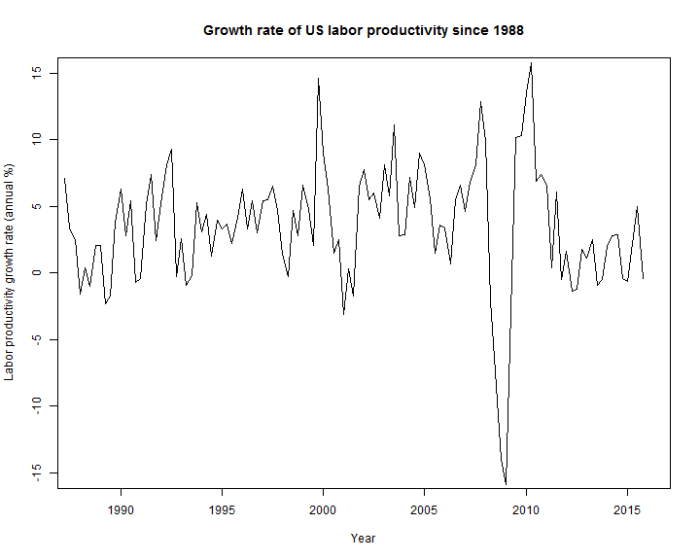
Using BLS data (which was formatted badly and thus a pain to clean, by the way—albeit not as bad as the World Bank data I used on my master’s thesis, which was awful), I made this graph of the growth rate of labor productivity as usually measured:

Productivity_growth

The fluctuations are really jagged due to measurement errors, so I also made an annually smoothed version:

Productivity_growth_smooth

Based on this standard measure, productivity has grown more or less steadily during my lifetime, fluctuating with the business cycle around a value of about 3.5% per year (3.4 log points). If anything, the growth rate seems to be slowing down; in recent years it’s been around 1.5% (1.5 lp).

This was clearly the time during which robots became ubiquitous—autonomous robots did not emerge until the 1970s and 1980s, and robots became widespread in factories in the 1980s. Then there’s the fact that computing power has been doubling every 1.5 years during this period, which is an annual growth rate of 59% (46 lp). So why hasn’t productivity grown at anywhere near that rate?

I think the main problem is that we’re measuring productivity all wrong. We measure it in terms of money instead of in terms of services. Yes, we try to correct for inflation; but we fail to account for the fact that computers have allowed us to perform literally billions of services every day that could not have been performed without them. You can’t adjust that away by plugging into the CPI or the GDP deflator.

Think about it: Your computer provides you the services of all the following:

  1. A decent typesetter and layout artist
  2. A truly spectacular computer (remember, that used to be a profession!)
  3. A highly skilled statistician (who takes no initiative—you must tell her what calculations to do)
  4. A painting studio
  5. A photographer
  6. A video camera operator
  7. A professional orchestra of the highest quality
  8. A decent audio recording studio
  9. Thousands of books, articles, and textbooks
  10. Ideal seats at every sports stadium in the world

And that’s not even counting things like social media and video games that can’t even be readily compared to services that were provided before computers.

If you added up the value of all of those jobs, the amount you would have had to pay in order to hire all those people to do all those things for you before computers existed, your computer easily provides you with at least $1 million in professional services every year. Put another way, your computer has taken jobs that would have provided $1 million in wages. You do the work of a hundred people with the help of your computer.

This isn’t counted in our productivity statistics precisely because it’s so efficient. If we still had to pay that much for all these services, it would be included in our GDP and then our GDP per worker would properly reflect all this work that is getting done. But then… whom would we be paying? And how would we have enough to pay that? Capitalism isn’t actually set up to handle this sort of dramatic increase in productivity—no system is, really—and thus the market price for work has almost no real relation to the productive capacity of the technology that makes that work possible.

Instead it has to do with scarcity of work—if you are the only one in the world who can do something (e.g. write Harry Potter books), you can make an awful lot of money doing that thing, while something that is far more important but can be done by almost anyone (e.g. feed babies) will pay nothing or next to nothing. At best we could say it has to do with marginal productivity, but marginal in the sense of your additional contribution over and above what everyone else could already do—not in the sense of the value actually provided by the work that you are doing. Anyone who thinks that markets automatically reward hard work or “pay you what you’re worth” clearly does not understand how markets function in the real world.

So, let’s ask again: Will robots take our jobs?

Well, they’ve already taken many jobs already. There isn’t even a clear high-skill/low-skill dichotomy here; robots are just as likely to make pharmacists obsolete as they are truck drivers, just as likely to replace surgeons as they are cashiers.

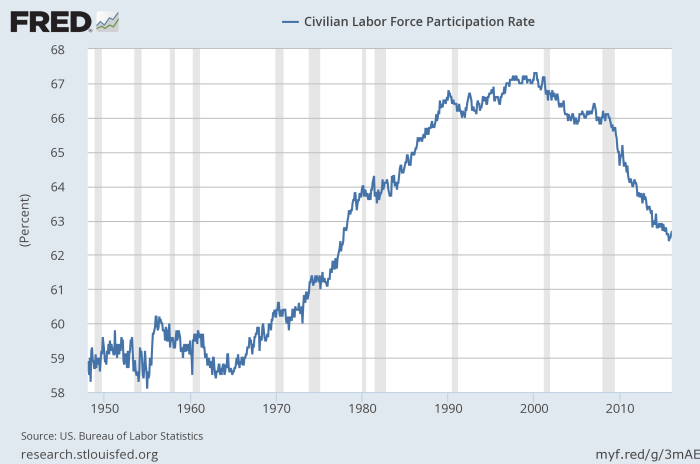
Labor force participation is declining, though slowly:

Labor_force_participation

Yet I think this also underestimates the effect of technology. As David Graeber points out, most of the new jobs we’ve been creating seem to be for lack of a better term bullshit jobs—jobs that really don’t seem like they need to be done, other than to provide people with something to do so that we can justify paying them salaries.

As he puts it:

Again, an objective measure is hard to find, but one easy way to get a sense is to ask: what would happen were this entire class of people to simply disappear? Say what you like about nurses, garbage collectors, or mechanics, it’s obvious that were they to vanish in a puff of smoke, the results would be immediate and catastrophic. A world without teachers or dock-workers would soon be in trouble, and even one without science fiction writers or ska musicians would clearly be a lesser place. It’s not entirely clear how humanity would suffer were all private equity CEOs, lobbyists, PR researchers, actuaries, telemarketers, bailiffs or legal consultants to similarly vanish. (Many suspect it might markedly improve.)

The paragon of all bullshit jobs is sales. Sales is a job that simply should not exist. If something is worth buying, you should be able to present it to the market and people should choose to buy it. If there are many choices for a given product, maybe we could have some sort of independent product rating agencies that decide which ones are the best. But sales means trying to convince people to buy your product—you have an absolutely overwhelming conflict of interest that makes your statements to customers so utterly unreliable that they are literally not even information anymore. The vast majority of advertising, marketing, and sales is thus, in a fundamental sense, literally noise. Sales contributes absolutely nothing to our economy, and because we spend so much effort on it and advertising occupies so much of our time and attention, takes a great deal away. But sales is one of our most steadily growing labor sectors; once we figure out how to make things without people, we employ the people in trying to convince customers to buy the new things we’ve made. Sales is also absolutely miserable for many of the people who do it, as I know from personal experience in two different sales jobs that I had to quit before the end of the first week.

Fortunately we have not yet reached the point where sales is the fastest growing labor sector. Currently the fastest-growing jobs fall into three categories: Medicine, green energy, and of course computers—but actually mostly medicine. Yet even this is unlikely to last; one of the easiest ways to reduce medical costs would be to replace more and more medical staff with automated systems. A nursing robot may not be quite as pleasant as a real professional nurse—but if by switching to robots the hospital can save several million dollars a year, they’re quite likely to do so.

Certain tasks are harder to automate than others—particularly anything requiring creativity and originality is very hard to replace, which is why I believe that in the 2050s or so there will be a Revenge of the Humanities Majors as all the supposedly so stable and forward-thinking STEM jobs disappear and the only jobs that are left are for artists, authors, musicians, game designers and graphic designers. (Also, by that point, very likely holographic designers, VR game designers, and perhaps even neurostim artists.) Being good at math won’t mean anything anymore—frankly it probably shouldn’t right now. No human being, not even great mathematical savants, is anywhere near as good at arithmetic as a pocket calculator. There will still be a place for scientists and mathematicians, but it will be the creative aspects of science and math that persist—design of experiments, development of new theories, mathematical intuition to develop new concepts. The grunt work of cleaning data and churning through statistical models will be fully automated.

Most economists appear to believe that we will continue to find tasks for human beings to perform, and this improved productivity will simply raise our overall standard of living. As any ECON 101 textbook will tell you, “scarcity is a fundamental fact of the universe, because human needs are unlimited and resources are finite.”

In fact, neither of those claims are true. Human needs are not unlimited; indeed, on Maslow’s hierarchy of needs First World countries have essentially reached the point where we could provide the entire population with the whole pyramid, guaranteed, all the time—if we were willing and able to fundamentally reform our economic system.

Resources are not even finite; what constitutes a “resource” depends on technology, as does how accessible or available any given source of resources will be. When we were hunter-gatherers, our only resources were the plants and animals around us. Agriculture turned seeds and arable land into a vital resource. Whale oil used to be a major scarce resource, until we found ways to use petroleum. Petroleum in turn is becoming increasingly irrelevant (and cheap) as solar and wind power mature. Soon the waters of the oceans themselves will be our power source as we refine the deuterium for fusion. Eventually we’ll find we need something for interstellar travel that we used to throw away as garbage (perhaps it will in fact be dilithium!) I suppose that if the universe is finite or if FTL is impossible, we will be bound by what is available in the cosmic horizon… but even that is not finite, as the universe continues to expand! If the universe is open (as it probably is) and one day we can harness the dark energy that seethes through the ever-expanding vacuum, our total energy consumption can grow without bound just as the universe does. Perhaps we could even stave off the heat death of the universe this way—we after all have billions of years to figure out how.

If scarcity were indeed this fundamental law that we could rely on, then more jobs would always continue to emerge, producing whatever is next on the list of needs ordered by marginal utility. Life would always get better, but there would always be more work to be done. But in fact, we are basically already at the point where our needs are satiated; we continue to try to make more not because there isn’t enough stuff, but because nobody will let us have it unless we do enough work to convince them that we deserve it.

We could continue on this route, making more and more bullshit jobs, pretending that this is work that needs done so that we don’t have to adjust our moral framework which requires that people be constantly working for money in order to deserve to live. It’s quite likely in fact that we will, at least for the foreseeable future. In this future, robots will not take our jobs, because we’ll make up excuses to create more.

But that future is more on the dystopian end, in my opinion; there is another way, a better way, the world could be. As technology makes it ever easier to produce as much wealth as we need, we could learn to share that wealth. As robots take our jobs, we could get rid of the idea of jobs as something people must have in order to live. We could build a new economic system: One where we don’t ask ourselves whether children deserve to eat before we feed them, where we don’t expect adults to spend most of their waking hours pushing papers around in order to justify letting them have homes, where we don’t require students to take out loans they’ll need decades to repay before we teach them history and calculus.

This second vision is admittedly utopian, and perhaps in the worst way—perhaps there’s simply no way to make human beings actually live like this. Perhaps our brains, evolved for the all-too-real scarcity of the ancient savannah, simply are not plastic enough to live without that scarcity, and so create imaginary scarcity by whatever means they can. It is indeed hard to believe that we can make so fundamental a shift. But for a Homo erectus in 500,000 BP, the idea that our descendants would one day turn rocks into thinking machines that travel to other worlds would be pretty hard to believe too.

Will robots take our jobs? Let’s hope so.

What would an interplanetary economy look like?

JDN 2457397

Today’s post is the second Reader’s Choice topic, chosen by a vote of my Patreons.

Remember, you too can vote on future topics if you pledge at least $10 per month.

Actually, there was a tie between two topics; since I was in an SF mood today, I decided to do this one as the official Reader’s Choice post. The second, “The challenges and possibilities of a global basic income”, I’ll do as a later post. (If I don’t get around to that before the next vote, you can of course always vote for it again.)

Will we ever colonize outer space? Many people thought we’d be there by now.

In Blade Runner, released in 1982, Roy was built and deployed to the outer colonies in 2015, which you may remember as the year that just ended.

Predictions of the future are often wrong, but predictions from the 20th century of the 21st century seem to be consistently overoptimistic about technology. In a past Idiot Free Zone post, I hypothesize that this is due to the confusion between exponential and logistic growth.

Paul Krugman is also a big fan of SF (it is actually about as likely that I’d run into Krugman at Worldcon as at an economics conference), and he wrote a paper on the possibility of interstellar trade way back in 1978. I think he’s kind of satirizing economic theorists actually; he uses sophisticated mathematics to address a problem that doesn’t exist in the real world—just like they do.

I think we will eventually at least reach the point of interplanetary colonization, if not actually interstellar. To begin, let me emphasize that vital distinction. Mars is currently about 60 million kilometers away at its closest approach. The core of the Alpha Centauri system is 4.24 light-years away, which is about 40 trillion kilometers. The distance from Ann Arbor to Toledo is about 84 kilometers. Thus, the difficulty of going to Alpha Centauri is about as much higher than that of going to Mars as the difficulty of going to Mars is compared to going from Ann Arbor to Toledo—each a factor of 700,000 times the distance.

With current technology, we can send robots to Mars (how cool is that? We did get some of the future we were promised). A typical trip takes about half a year. It costs us about $2.5 billion to do that, though India somehow managed to at least make Mars orbit for $75 million. Even if we use the $2.5 billion figure, that still means our current economic output the US and Europe alone could support hundreds of missions per year if we were willing to pay for it. (Devote the entire US military budget to NASA and we could land a new robot on Mars every day.) Interplanetary travel is most definitely feasible.

Interstellar travel on the other hand, is still far out of reach. In principle we are limited by the speed of light; in fact, it’s a good deal worse than that. The fastest we have ever gotten a spacecraft leaving the Solar System is about 60,000 km/h; at that speed it would take almost one billion hours to get to Alpha Centauri, which is over 100,000 years. We will need substantial breakthroughs in spacecraft propulsion before we can even consider sending anything to even the nearest stars. (I wouldn’t give up hope completely, however; in 1901 someone could just as well have criticized H.G. Wells’ The First Men in the Moon on the grounds that no one will ever invent a propulsion system powerful enough to reach the moon.)

By the time we manage interstellar travel, our technology will be so much more advanced it’s hard to even imagine what things will be like. But interplanetary travel we could probably do right now.

So let’s suppose we do in fact establish colonies on other planets—most likely Mars and Mercury, as well as several moons of Jupiter and Saturn. What would our economy look like once we did?

For a decidedly Game of Thrones take on this situation, see The Expanse. Their scientific accuracy is quite good (although they still have sound in space!); so far, their economic accuracy seems pretty good as well, but so far I haven’t seen enough yet to be sure.
One thing I think The Expanse does get right is that asteroid mining is a vital part of the interplanetary trade network. The thing that’s currently keeping us from colonizing other planets is a lack of economic incentives to bear the enormous cost of space travel. Asteroid mining is one thing that might actually provide those incentives, if we can leap just a few more technological hurdles in terms of mining robots and spacecraft propulsion.

Many asteroids contain metals such as silver, gold and platinum at concentrations 20 times as great as anything found on the surface of the Earth. The amount of iron and nickel they contain is even larger; we could supply the entire iron production of the Earth (3.2 billion tonnes) with a single asteroid, 16 Psyche, for the next million years. That one asteroid over 2e19 kg of nearly pure iron-nickel, which is 200 quadrillion tonnes. Many asteroids also contain large concentrations of other useful and rare metals, such as lithium and neodymium.

It is unlikely we would actually try to colonize asteroids (they do in The Expanse, but I’m not sure I buy it). None are large enough to support an atmosphere (kind of by definition), so we’d have to build space stations large enough for permanent habitation. With such ludicrous amounts of iron all around us, that might be possible; but would it be cost-effective? I think it’s more likely that we would have temporary habitats, able to support people for several months or maybe a few years, and people would basically do “tours of duty” working in the asteroids, and then return home. This is similar to how we use space stations right now; you can live there for a long time—the standing record is over a year—but nobody lives their whole life there. It might be a sort of “seasonal” work, where the seasons are decided by large-scale orbital mechanics rather than local planetary axial tilt. (We might have to start doing “seasonal adjustments” to statistics based on this!) Provided that the workers are paid a substantial portion of the spoils—by no means a certainty, as we all know from sweatshops around the world—this work could easily be lucrative enough that you become a millionaire after a tour or two and then retire.

But they might well return home to Mars, since the orbital transfer from the asteroid belt to Mars is considerably easier (it has what we call a lower “delta-v”) than the same transfer all the way back to Earth, and the launch and landing are even easier still. Mars does support an atmosphere—currently very thin and not breathable, but that could change with terraforming. It is also large enough to spread out with room for many homes, greenhouses, power plants, etc., and has enough gravity to at least keep human bodies as a basic level of functioning without too much additional support. (Mars’ gravity is about 40% that of Earth’s.)

Of course, most of the products we make are going to be used on Earth—most of everything is going to be used on Earth, probably for centuries to come. It’s possible that we’ll end up like the British Empire did where the colonies are more populous than the source, but it will take a long time for that to happen. (Moreover, the primary reason—cheap, fertile agricultural land—will not apply unless we happen upon a habitable planet or get very good at terraforming.) This means we will need to ship something from Mars to Earth. But since the delta-v is exceptionally high, we’ll want to ship as little as possible. I think this means that we will do most of the refinement and even manufacturing on Mars, and then ship prefabricated components to Earth. Any process that removes mass will be done on Mars, to minimize the amount of mass that needs to make the trip to Earth.

And what will Earth provide in return? As we import this huge quantity of metal (or metal components), what will we export in return?
Well, one possibility is that we won’t—at first, we (by which I mean “our corporations”) will simply retain ownership of the entire supply chain and do all the accounting as though production were being done entirely on Earth. We won’t think of it as “trade”, just as corporations engaging in a series of prospecting and mining ventures. At least at first.

Yet this will become increasingly unwieldy, just as it became unwieldy for the British Empire to retain control of all its colonies and collect their taxes for the Crown. Communication between Mars, Earth, and the asteroid belt will be relatively fast—a few hours delay at worst—but travel will be very slow and very expensive. Local institutions will form and assert themselves, and may eventually topple the corporate managers, expropriate their assets, and create new governments. The corporations could see the rebellion coming a year in advance from the transmissions, and still be powerless to stop it because the ships will take too long to arrive.

Once new local governments form, we will start thinking of it as “trade”. So what will we be trading? To some extent people on Mars might simply accept Earth currency (perhaps US Dollars, or Euros, or as I like to imagine some unified currency, perhaps the Atlantic Union Dollar); but only if they can then use that Earth currency to buy things they actually need. What will they actually need?

Food, for one. Some amount of food production will be done on Mars by necessity—you can’t survive if you depend entirely on imported food to survive. But it will be expensive, and most likely nutrient-dense but tasteless and monotonous genetically-engineered vegetable products. People will get tired of eating bricks of processed Aresoy(TM) for the 17,000th time and will crave real food; Earth will respond by selling them frozen steaks at $12,000 per kilogram. Probably only luxury foods will be imported, actually; why spend $11,900 for a hamburger when you can spend $12,000 for filet mignon? Nominal income on Mars will be huge—millionaires will be ubiquitous. At purchasing power parity, it may not be so impressive, once you account for the ridiculous cost of food and housing. It’ll be like living in Silicon Valley—on steroids.

Water, perhaps. This one is not as obvious as it may seem. While Earth does have the largest concentration of liquid water (except for a couple of moons of the gas giants), there is plenty of ice in them thar asteroids. It will most likely be cheaper (albeit not cheap) to obtain water by capturing and melting down asteroid ice than to ship it all the way from Earth.

But I think the most important Earth export will beculture. The main products that Martians will want to buy from us will be books, movies, songs, video games, hologram simulations. They will be blueprints, patents, 3D printer schematics. Those who travel to Mars will be bold, adventurous, many of them loners and misfits—but deep down they will still sometimes long for the comforts of the books they read as children, the songs they listened to as teenagers. The beautiful thing about selling culture is that it can be transported almost for free—just add it to the radio transmissions you were already sending. Mars will also produce its own culture, of course, but the much smaller population and constant struggle for survival will mean that most of the cultural flow will be outward from Earth to the colonies rather than the reverse. The Internet won’t work normally between Earth and Mars due to the time delay, but there will be something like it, a local MarsNet that caches material from the Internet on a delay of a few hours and then shares it with the colony. You won’t download webpages in real time, you’ll request them a day in advance. You won’t send instant messages, but sending email will be hardly any different. (Instead of Nigerian princes we’ll start getting scam spam about Martian mining entrepreneurs.) Whoever owns this communication monopoly will become fantastically rich, perhaps even more so than the mining companies themselves—because the mining companies have overhead.

Overall, the increased availability of previously-scarce metals like gold, lithium, and neodymium will make new technologies possible and also widely available, including battery technologies that might finally allow Earth to wean itself off of carbon emissions. (Unfortunately, our current means of spacecraft launch are all very carbon-intensive. We will need to invent nuclear engines that don’t leave fallout so that we can launch with them from the ground.) Like all trade, the mutual imports and exports between Earth and Mars will benefit both societies.

But unless we change course dramatically as a society, interplanetary trade will make one problem even worse, and that is inequality. I am having trouble foreseeing an interplanetary trade system that doesn’t involve making the middlemen who own the shipping and networking companies rich even beyond the wildest dreams of today’s plutocrats. We will witness the birth of humanity’s first trillionaires, individual men (and let’s face it, probably men, unless we figure out gender equality too) who own as much as not just entire countries, but as entire large First World countries. The GDP of France today is $2.8 trillion per year; the CEO of Aresoy or MarsNet could well make more than that on dividends. Of course, that provides him a great incentive to start the project now—but what will it mean for our societies when one person can buy a spaceship as casually as we would buy a cup of coffee?