Trump has proposed an even worse budget

May 11 JDN 2460807

I didn’t really intend for my blog this year to be taken over by talk about Trump. But all the damage that Trump is doing to America and the world is clearly the most important thing going on in economics right now, and it’s honestly just hard for me to think about anything else.

Trump has proposed a budget. (Read at your own risk; what’s on the White House website is more screed than budget proposal. And it’s pretty clearly written by Trump himself, perhaps with some editing.)

It will come as no surprise to all of you that it is a terrible budget, even worse than what the Republicans recently passed.

First of all, Trump is cutting discretionary spending by $163 billion. This is a huge cut—it removes almost one-fourth of all non-military discretionary spending. Trump naturally claims that he’s just reducing waste, shutting down DEI programs (for the right wing this is considered a good thing), what Trump calls “Green New Scam funding” (read: anything remotely related to environmental sustainability or climate change), and what Trump claims are “large swaths of the Federal Government weaponized against the American people” (read: any other departments Trump doesn’t like, whether or not he actually understands what they are for).

And lest you think that these draconian cuts are being done for fiscal responsibility in the face of an utterly massive federal deficit, Trump also proposes to increase military spending by 13%; multiplying that by our current $850 billion budget means he’s adding $110 billion to the military; and he also says he wants to add a further $119 billion in the mandatory budget. This means he’s cutting $163 billion from non-military spending and adding $239 billion in military spending—which will actually increase the deficit.

Trump is ending programs like the Cybersecurity and Infrastructure Security Agency (sure, let’s just let Chinese hackers in! Why not? It’s not like there’s anything important on those Pentagon servers!) and Fair Housing (amid a historic housing crisis), as well as slashing the EPA (because who needs clean air and water anyway?).

Unsurprisingly, he’s also ending anything that resembles DEI, which includes both some really good necessary programs, and also some stuff that is genuinely ineffective or even counterproductive. Most people who work at firms that have DEI programs think that the programs do more good than harm, but there are big partisan differences, so cutting DEI will play well with the Republican base. But I for one do not want to play the word game where we say out loud every time “diversity, equity, and inclusion”, because there is a big difference between the fundamentally laudable goals of diversity, equity and inclusion, and the actual quite mixed results from DEI programs as they have been implemented. It’s awful that Trump is cutting DEI with a chainsaw, but we really should have been cutting it with a scalpel for awhile now.

Trump is also throwing money at the border, increasing the budgets of CBP (whatever) and ICE (very, very bad!). This is probably the worst thing about the budget, though it also isn’t a big surprise. Part of the increased ICE spending is “50,000 detention beds”, which since ICE lately has been arresting and detaining people without warrants or trials and courts have specifically ruled that they are violating due process, I believe we can fairly say constitutes a concentration camp. If and when they start actually giving everyone—everyone, dammitdue process, then you can call it a detention center.

Trump is eliminating USAID and folding what’s left of it into DFC; but these institutions had quite different goals. USAID had two goals: Advance America’s interests, and make the world a better place. And while it did have significant flaws, overall it did quite a good job of achieving both of those goals—and indeed, publicly making the world a better place can advance America’s interests. DFC’s goal is to promote economic development by financing investments that otherwise could not be financed. That can also promote America’s interests and make the world a better place, but it excludes many of the vital roles that USAID has played in providing humanitarian aid and disaster relief as well as promoting democracy and advancing environmental sustainability. (And when I say “promoting democracy”, I don’t mean the way the CIA does it, by orchestrating coups; I mean things like helping Ukraine remove its dependency on Russia.) There is more to life than money—but I don’t think Trump really understands that.

Trump is canceling a bunch of subsidies to renewable energy, but honestly I’m not too worried about that; the technology has matured so much that renewable energy is actually the cheapest form of energy for most purposes. (And it kinda makes sense: The sun and wind are already there.) Removing the subsidies will make it harder to compete with oil (because oil is still heavily subsidized); but I still think renewables can win. Basically the past subsidies have done their job, and it’s probably okay to remove them.

There’s a really weird proposal involving food, which I think I will just quote in its entirety:

The Budget also supports the creation of MAHA food boxes, that would be filled with commodities sourced from domestic farmers and given directly to American households.

This sounds… kinda… Maoist? Definitely some kind of communist. Why are we circumventing the highly-functional capitalist market for food with massive in-kind transfers? (Despite scaremongering, groceries in the US are still pretty affordable by world standards.) And how are we going to do that, logistically? (Produce does need to be kept fresh, after all.) Does Trump think that markets have trouble providing food in this country? Does he not understand that SNAP exists, and already prioritizes healthier food?(Or does he plan to get rid of it?) Does he think that the reason most Americans don’t eat a very good diet (which is objectively true) is that they aren’t able to get fresh produce? (And not, say, subsidies for factory-farmed meat and high-fructose corn syrup, or mass marketing campaigns by corporations that make junk food?) I’m not so much against this program as I am really baffled by it. It seems like it’s trying to solve the wrong problem by the wrong means. (I’m guessing RFK Jr. had a hand in this, and I recently learned that he doesn’t believe in germ theory. He is a god-tier crank. Like, his views on vaccines and autism were bad enough, but this? Seriously, you put this guy in charge of public health!?)

There are some things in the budget that aren’t terrible, but they’re mostly pretty small.

One actually good thing about Trump’s new budget is the expansion of VA services. I don’t really have any objection to that. It’s a fairly small portion of the budget, and veterans deserve better than they’ve been getting.

Trump says he won’t be cutting Social Security (so perhaps we dodged a bullet on that one). Of course, if he actually cared in the least about the budget deficit, that’s probably what he would cut, because it’s such a huge proportion of our spending—about one-fifth of all federal spending.

I’m not sure what to think about the changes Trump is making to education funding. He’s shutting down the Department of Education, but it seems like most of what it does (including offering grants and handling student loans) is just going to be folded into other agencies. It doesn’t actually seem like there have been substantial cuts in their services, just… a weird and unnecessary reorganization. My guess is that after Trump had already publicly committed to “end the Department of Education”, some staffer quietly explained to him what the Department of Education actually does and why it is necessary; since he’d already committed to shutting it down, he didn’t want to pivot on that, so instead he shut it down in name only while preserving most of what it actually does in other agencies.

Trump is also investing heavily in charter schools, which… meh. Some charter schools are really good, some are really bad. There isn’t a clear pattern of them being better or worse than public schools. Overall, the preponderance of evidence suggests that the average charter school is worse than the average public school, but there’s a lot of variation in both, so the odds that any particular charter school is better than any particular public school are still quite high. (I recently learned about this measure of effect size, probability of superiority, and it’s now my new favorite measure of effect size. Eat your heart out, Cohen’s d!)

Trump is also diverting funding to apprenticeships; he’s introducing a new “Make America Skilled Again” (ugh) grant that States would be required to spend at least 10% on apprenticeship. I’m pretty okay with this in general. 10% is not a lot, and we totally could use more apprenticeship programs in fields like welding and pipefitting.

Another good thing Trump is doing is increasing funding for NASA; he’s clearly doing it out of a sense of national pride and hatred of China, but hey, at least he’s doing it. We might actually be able to pull off a human Mars mission (several years from now, mind you!) if this higher funding continues.

Trump is also redirecting DEA spending to Mexico, Central America, South America, and China; since most fentanyl in the US is made in Latin America from Chinese ingredients, this actually makes sense. I still don’t think that criminalization is the best solution to drug abuse, but fentanyl is genuinely very dangerous stuff, so we should definitely be doing something to reduce its usage.

Finally, and somewhat anticlimactically, Trump is creating some kind of new federal fire service that’s supposedly going to improve our response to wildfires. Given that we already have FEMA, a significant improvement seems unlikely. But hey, it’s worth a try!

These small good things should not distract us from the massive damage that this budget would cause if implemented.

It was not necessary to shift $160 billion from non-military to military spending in order to increase funding for NASA and the VA. It was not necessary to cut hundreds of programs and eliminate USAID—the agency which did what may literally be the very best things our government has ever done. DEI programs had their flaws, but it was wrong to eliminate all of them, instead of finding out which ones are effective and which ones are not.

And while it’s a tiny portion of the budget, the cuts to the EPA will kill people. Most likely thousands of Americans will die from the increased air and water pollution. It will be hard to pinpoint exactly who: Would that kid with asthma have died anyway if the air were cleaner? Was that fatal infection from polluted water, or something else? But the statistics will tell us that there were thousands of unnecessary deaths. (Unless of course Trump falsifies the statistics—which he very well might, since he routinely calls our world-class economic data “fake” when it makes him look bad.)

The large federal budget deficit will be in no way reduced by this budget; in fact it will be slightly increased. If we were in a recession, I’d be okay with this kind of deficit; it was actually a good thing that we ran a huge deficit in 2020. But we aren’t yet—and when one does inevitably hit (given the tariffs, I think sooner rather than later), we won’t have the slack in our budget to do the necessary Keynesian stimulus.

I don’t see any mention of what’s going to happen to Medicare and Medicaid; given that these two programs together constitute roughly one fourth of the federal budget—and nearly twice the military budget—this is a very conspicuous absence. It’s possible that Trump’s leaving them alone because he knows how popular they are, but this once again reveals the emptiness of Republican deficit hawkishness: If you really wanted to reduce the deficit by cutting spending, you’d do it by cutting the military, Social Security, Medicare, and Medicaid. Those four things together comprise the majority of the federal budget. Yet it seems that Trump’s budget cuts none of them.

Mind you, I don’t actually want to cut Social Security, Medicare, or Medicaid; so I’m relieved that Trump isn’t doing that. I’m pretty okay with cutting the military, but I’ll admit I’m less enthused about that since the start of the Ukraine War (I think some moderate cuts are still in order, but we should still have a very big military budget to protect ourselves and our allies). But these are the only budget cuts that could realistically reduce the deficit.

What I actually want to happen is higher taxes on rich people. That’s how I want the budget to be balanced. And Trump very obviously will not do that. Indeed he’s almost certainly going to cut them, making our deficit even larger.

So we’re building a concentration camp, the Chinese are going to hack the Pentagon, we’re going to buy more tanks we don’t need, we won’t be able to properly respond to the next recession, and thousands of people will die from air and water pollution. But at least we got more NASA funding!

The Republicans passed a terrible budget

May 4 JDN 2460800

On April 10, the US House of Representatives passed a truly terrible budget bill. It passed on an almost entirely partisan vote—214 Democrats against, 216 Republicans for, 2 Republicans against. So I think it’s quite fair to say that the Republicans passed this budget—not a single Democrat voted for it, and only 2 Republicans voted against it.

So what’s so bad about it?

Well, first of all, in order to avoid showing just how much it will balloon the national debt, the new budget operates on different accounting rules than normal, using what’s called “current policy baseline” instead of the standard method of assuming that policies will end after 10 years.

In addition to retaining $3.8 trillion in tax cuts that were supposed to expire, this budget will cut taxes by $1.5 trillion over 10 years, with the vast majority of those cuts going to the top 1%—thus the real increase in the deficit is a staggering $5.3 trillion over 10 years. This is absolutely not what we need, given that unemployment is actually pretty good right now and we still have a deficit of $1.8 trillion per year. (Yes, really.) That kind of deficit is good in response to a severe recession—I was all in favor of it during COVID, and it worked. But when the economy is good, you’re supposed to balance the budget, and they haven’t.

The richest 1% stand to gain about 4% more income from these tax cuts (which adds up to about $240 billion per year), while the combination of tax cuts and spending cuts would most likely reduce the income of 40% of the population.

They aren’t even cutting spending to offset these tax cuts. This budget only includes a paltry $4 billion in spending cuts—less than 0.1% of the budget. (I mean, sure, $4 billion is a lot of money for a person; but for a whole country as rich and large as ours? It’s a rounding error.) And then it includes $521 billion in spending increases, over 100 times as much.

They are talking about making more cuts, but they’ve been cagey as to where, probably because the only plausible ways to save this much money are the military, Medicaid, Medicare, or Social Security. Obviously Republicans will never cut the military, but the other three programs are also enormously popular, even in deep-red states. It would be not only very harmful to millions of people to cut these programs—it would also be harmful to the Republicans’ re-election chances. They could also get some savings by cutting income security programs like SNAP and TANF, which would probably be less unpopular—but it would also cause enormous suffering.

This new budget is estimated to add some $6.9 trillion to the national debt over 10 years—and even more after that, if the policies actually continue.

I am not exactly a “deficit hawk”; I don’t think the budget should always be balanced. But this is not the time to be increasing the deficit. When times are good, we should balance the budget, so that when we have to go into debt during bad times, we can afford to do so.

And bad times are probably on the horizon, since Trump’s tariff policy is already such a disaster. So are we going to borrow even more then? While bond yields are rising? We’re going to end up spending most of our budget on debt payments! And all this injection of money into the system won’t be good for inflation either (and on top of the tariffs!).

The only sensible thing to do right now is raise taxes on the rich. We need that revenue. We can’t just keep going deeper into debt. And the rich are the ones who would be least harmed by raising taxes—indeed, if you focused the hikes on billionaires, they would barely feel anything at all.

But the Republicans don’t care about what’s in the interest of ordinary Americans. They only care about the interests of the rich. And that’s why they passed this budget.

I can’t not talk about tariffs right now

Apr 13 JDN 2460779

On the one hand, I’m sure every economics blog on the Internet is already talking about this, including Paul Krugman who knows the subject way better than I ever will (and literally won a Nobel Prize for his work on it). And I have other things I’d rather be writing about, like the Index of Necessary Expenditure. But on the other hand, when something this big happens in economics, it just feels like there’s really no alternative: I have to talk about tariffs right now.

What is a tariff, anyway?

This feels like a really basic question, but it also seems like a lot of people don’t really understand tariffs, or didn’t when they voted for Trump.

A tariff, quite simply, is an import tax. It’s a tax that you impose on imported goods (either a particular kind, or from a particular country, or just across the board). On paper, it is generally paid by the company importing the goods, but as I wrote about in my sequence on tax incidence, that doesn’t matter. What matters is how prices change in response to the tax, and this means that in real terms, prices will go up.

In fact, in some sense that’s the goal of a protectionist tariff, because you’re trying to fix the fact that local producers can’t compete on the global market. So you compensate by making international firms pay higher taxes, so that the local producers can charge higher prices and still compete. So anyone who is saying that tariffs won’t raise prices is either ignorant or lying: Raising prices is what tariffs do.

Why are people so surprised?

The thing that surprises me about all this, (a bit ironically) is how surprised people seem to be. Trump ran his whole campaign promising two things: Deport all the immigrants, and massive tariffs on all trade. Most of his messaging was bizarre and incoherent, but on those two topics he was very consistent. So why in the world are people—including stock traders, who are supposedly savvy on these things—so utterly shocked that he has actually done precisely what he promised he would do?

What did people think Trump meant when he said these things? Did they assume he was bluffing? Did they think cooler heads in his administration would prevail (if so, whose?)?

But I will admit that even I am surprised at just how big the tariffs are. I knew they would be big, but I did not expect them to be this big.

How big?

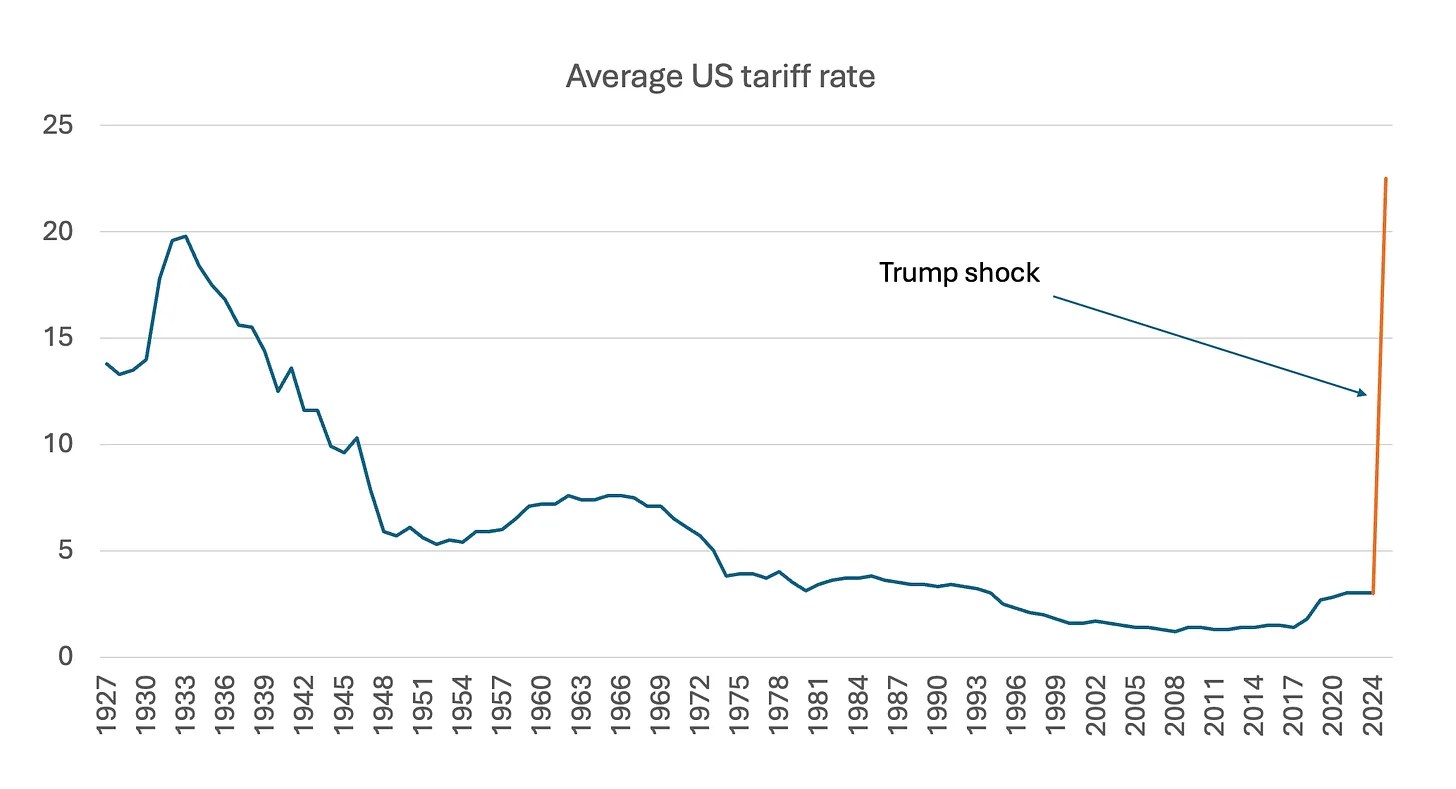
Well, take a look at this graph:

The average tariff rate on US imports will now be higher than it was at the peak in 1930 with the Smoot-Hawley Act. Moreover, Smoot-Hawley was passed during a time when protectionist tariffs were already in place, while Trump’s tariffs come at a time when tariffs had previously been near zero—so the change is dramatically more sudden.

This is worse than Smoot-Hawley.

For the uninitiated, Smoot-Hawley was a disaster. Several countries retaliated with their own tariffs, and the resulting trade war clearly exacerbated the Great Depression, not only in the US but around the world. World trade dropped by an astonishing 66% over the next few years. It’s still debated as to how much of the depression was caused by the tariffs; most economists believe that the gold standard was the bigger culprit. But it definitely made it worse.

Politically, the aftermath cost the Republicans (including Smoot and Hawley themselves) several seats in Congress. (I guess maybe the silver lining here is we can hope this will do the same?)

And I would now like to remind you that these tariffs are bigger than Smoot-Hawley’s and were implemented more suddenly.

Unlike in 1930, we are not currently in a depression—though nor is our economy as hunky-dory as a lot of pundits seem to think, once we consider things like the Index of Necessary Expenditure. But stock markets do seem to be crashing, and if trade drops as much as it did in the 1930s—and why wouldn’t it?—we may very well end up in another depression.

And it’s not as if we didn’t warn you all. Economists across the political spectrum have been speaking out against Trump’s tariffs from the beginning, and nobody listened to us.

So basically the mood of all economists right now is:

The Index of Necessary Expenditure

Mar 16 JDN 2460751

I’m still reeling from the fact that Donald Trump was re-elected President. He seemed obviously horrible at the time, and he still seems horrible now, for many of the same reasons as before (we all knew the tariffs were coming, and I think deep down we knew he would sell out Ukraine because he loves Putin), as well as some brand new ones (I did not predict DOGE would gain access to all the government payment systems, nor that Trump would want to start a “crypto fund”). Kamala Harris was not an ideal candidate, but she was a good candidate, and the comparison between the two could not have been starker.

Now that the dust has cleared and we have good data on voting patterns, I am now less convinced than I was that racism and sexism were decisive against Harris. I think they probably hurt her some, but given that she actually lost the most ground among men of color, racism seems like it really couldn’t have been a big factor. Sexism seems more likely to be a significant factor, but the fact that Harris greatly underperformed Hillary Clinton among Latina women at least complicates that view.

A lot of voters insisted that they voted on “inflation” or “the economy”. Setting aside for a moment how absurd it was—even at the time—to think that Trump (he of the tariffs and mass deportations!) was going to do anything beneficial for the economy, I would like to better understand how people could be so insistent that the economy was bad even though standard statistical measures said it was doing fine.

Krugman believes it was a “vibecession”, where people thought the economy was bad even though it wasn’t. I think there may be some truth to this.


But today I’d like to evaluate another possibility, that what people were really reacting against was not inflation per se but necessitization.

I first wrote about necessitization in 2020; as far as I know, the term is my own coinage. The basic notion is that while prices overall may not have risen all that much, prices of necessities have risen much faster, and the result is that people feel squeezed by the economy even as CPI growth remains low.

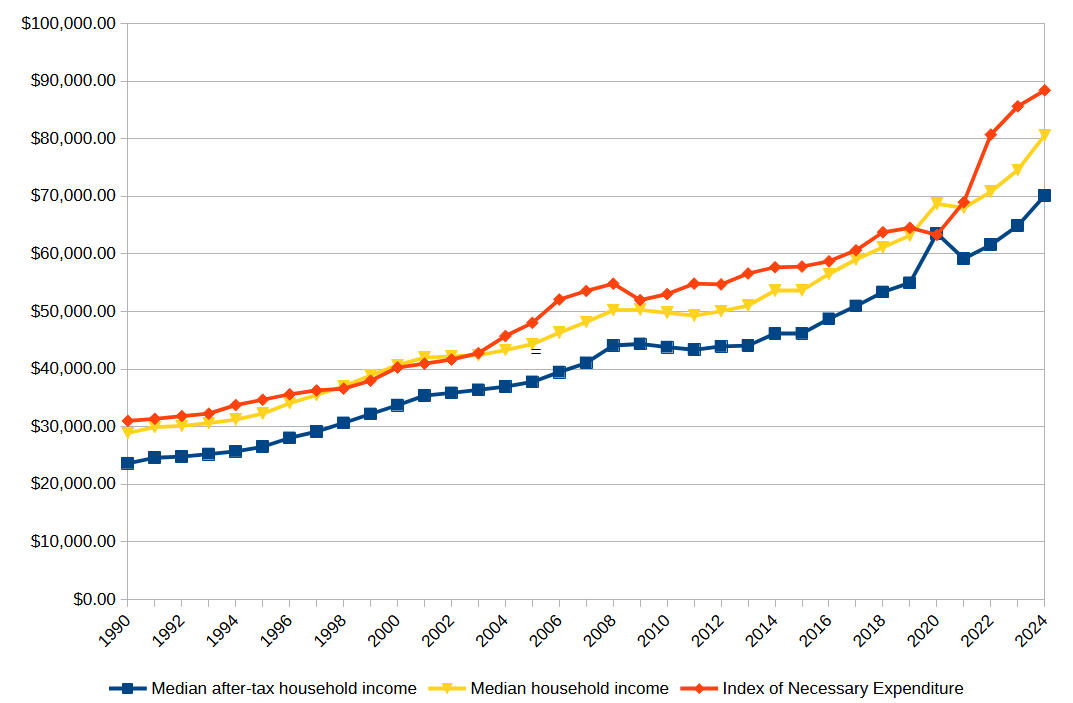
In this post I’d like to more directly evaluate that notion, by constructing an index of necessary expenditure (INE).

The core idea here is this:

What would you continue to buy, in roughly the same amounts, even if it doubled in price, because you simply can’t do without it?

For example, this is clearly true of housing: You can rent or you can own, but can’t not have a house. And nor are most families going to buy multiple houses—and they can’t buy partial houses.

It’s also true of healthcare: You need whatever healthcare you need. Yes, depending on your conditions, you maybe could go without, but not without suffering, potentially greatly. Nor are you going to go out and buy a bunch of extra healthcare just because it’s cheap. You need what you need.

I think it’s largely true of education as well: You want your kids to go to college. If college gets more expensive, you might—of necessity—send them to a worse school or not allow them to complete their degree, but this would feel like a great hardship for your family. And in today’s economy you can’t not send your kids to college.

But this is not true of technology: While there is a case to be made that in today’s society you need a laptop in the house, the fact is that people didn’t used to have those not that long ago, and if they suddenly got a lot cheaper you very well might buy another one.

Well, it just so happens that housing, healthcare, and education have all gotten radically more expensive over time, while technology has gotten radically cheaper. So prima facie, this is looking pretty plausible.

But I wanted to get more precise about it. So here is the index I have constructed. I consider a family of four, two adults, two kids, making the median household income.

To get the median income, I’ll use this FRED series for median household income, then use this table of median federal tax burden to get an after-tax wage. (State taxes vary too much for me to usefully include them.) Since the tax table ends in 2020 which was anomalous, I’m going to extrapolate that 2021-2024 should be about the same as 2019.

I assume the kids go to public school, but the parents are saving up for college; to make the math simple, I’ll assume the family is saving enough for each kid to graduate from with a four-year degree from a public university, and that saving is spread over 16 years of the child’s life. 2*4/16 = 0.5; this means that each year the family needs to come up with 0.5 years of cost of attendance. (I had to get the last few years from here, but the numbers are comparable.)

I assume the family owns two cars—both working full time, they kinda have to—which I amortize over 10 year lifetimes; 2*1/10 = 0.2, so each year the family pays 0.2 times the value of an average midsize car. (The current average new car price is $33226; I then use the CPI for cars to figure out what it was in previous years.)

I assume they pay a 30-year mortgage on the median home; they would pay interest on this mortgage, so I need to factor that in. I’ll assume they pay the average mortgage rate in that year, but I don’t want to have to do a full mortgage calculation (including PMI, points, down payment etc.) for each year, so I’ll say that they amount they pay is (1/30 + 0.5 (interest rate))*(home value) per year, which seems to be a reasonable approximation over the relevant range.

I assume that both adults have a 15-mile commute (this seems roughly commensurate with the current mean commute time of 26 minutes), both adults work 5 days per week, 50 weeks per year, and their cars get the median level of gas mileage. This means that they consume 2*15*2*5*50/(median MPG) = 15000/(median MPG) gallons of gasoline per year. I’ll use this BTS data for gas mileage. I’m intentionally not using median gasoline consumption, because when gas is cheap, people might take more road trips, which is consumption that could be avoided without great hardship when gas gets expensive. I will also assume that the kids take the bus to school, so that doesn’t contribute to the gasoline cost.

That I will multiply by the average price of gasoline in June of that year, which I have from the EIA since 1993. (I’ll extrapolate 1990-1992 as the same as 1993, which is conservative.)

I will assume that the family owns 2 cell phones, 1 computer, and 1 television. This is tricky, because the quality of these tech items has dramatically increased over time.

If you try to measure with equivalent buying power (e.g. a 1 MHz computer, a 20-inch CRT TV), then you’ll find that these items have gotten radically cheaper; $1000 in 1950 would only buy as much TV as $7 today, and a $50 Raspberry Pi‘s 2.4 GHz processor is 150 times faster than the 16 MHz offered by an Apple Powerbook in 1991—despite the latter selling for $2500 nominally. So in dollars per gigahertz, the price of computers has fallen by an astonishing 7,500 times just since 1990.

But I think that’s an unrealistic comparison. The standards for what was considered necessary have also increased over time. I actually think it’s quite fair to assume that people have spent a roughly constant nominal amount on these items: about $500 for a TV, $1000 for a computer, and $500 for a cell phone. I’ll also assume that the TV and phones are good for 5 years while the computer is good for 2 years, which makes the total annual expenditure for 2 phones, a TV, and a computer equal to 2/5*500 + 1/5*500 + 1/2*1000 = 800. This is about what a family must spend every year to feel like they have an adequate amount of digital technology.

I will also assume that the family buys clothes with this equivalent purchasing power, with an index that goes from 166 in 1990 to 177 in 2024—also nearly constant in nominal terms. I’ll multiply that index by $10 because the average annual household spending on clothes is about $1700 today.

I will assume that the family buys the equivalent of five months of infant care per year; they surely spend more than this (in either time or money) when they have actual infants, but less as the kids grow. This amounts to about $5000 today, but was only $1600 in 1990—a 214% increase, or 3.42% per year.

For food expenditure, I’m going to use the USDA’s thrifty plan for June of that year. I’ll use the figures assuming that one child is 6 and the other is 9. I don’t have data before 1994, so I’ll extrapolate that with the average growth rate of 3.2%.

Food expenditures have been at a fairly consistent 11% of disposable income since 1990; so I’m going to include them as 2*11%*40*50*(after-tax median wage) = 440*(after-tax median wage).

The figures I had the hardest time getting were for utilities. It’s also difficult to know what to include: Is Internet access a necessity? Probably, nowadays—but not in 1990. Should I separate electric and natural gas, even though they are partial substitutes? But using these figures I estimate that utility costs rise at about 0.8% per year in CPI-adjusted terms, so what I’ll do is benchmark to $3800 in 2016 and assume that utility costs have risen by (0.8% + inflation rate) per year each year.

Healthcare is also a tough one; pardon the heteronormativity, but for simplicity I’m going to use the mean personal healthcare expenditures for one man and woman (aged 19-44) and one boy and one girl (aged 0-18). Unfortunately I was only able to find that for two-year intervals in the range from 2002 to 2020, so I interpolated and extrapolated both directions assuming the same average growth rate of 3.5%.

So let’s summarize what all is included here:

  • Estimated payment on a mortgage
  • 0.5 years of college tuition
  • amortized cost of 2 cars
  • 7500/(median MPG) gallons of gasoline
  • amortized cost of 2 phones, 1 computer, and 1 television
  • average spending on clothes
  • 11% of income on food
  • Estimated utilities spending
  • Estimated childcare equivalent to five months of infant care
  • Healthcare for one man, one woman, one boy, one girl

There are obviously many criticisms you could make of these choices. If I were writing a proper paper, I would search harder for better data and run robustness checks over the various estimation and extrapolation assumptions. But for these purposes I really just want a ballpark figure, something that will give me a sense of what rising cost of living feels like to most people.

What I found absolutely floored me. Over the range from 1990 to 2024:

  1. The Index of Necessary Expenditure rose by an average of 3.45% per year, almost a full percentage point higher than the average CPI inflation of 2.62% per year.
  2. Over the same period, after-tax income rose at a rate of 3.31%, faster than CPI inflation, but slightly slower than the growth rate of INE.
  3. The Index of Necessary Expenditure was over 100% of median after-tax household income every year except 2020.
  4. Since 2021, the Index of Necessary Expenditure has risen at an average rate of 5.74%, compared to CPI inflation of only 2.66%. In that same time, after-tax income has only grown at a rate of 4.94%.

Point 3 is the one that really stunned me. The only time in the last 34 years that a family of four has been able to actually pay for all necessities—just necessities—on a typical household income was during the COVID pandemic, and that in turn was only because the federal tax burden had been radically reduced in response to the crisis. This means that every single year, a typical American family has been either going further and further into debt, or scrimping on something really important—like healthcare or education.

No wonder people feel like the economy is failing them! It is!

In fact, I can even make sense now of how Trump could convince people with “Are you better off than you were four years ago?” in 2024 looking back at 2020—while the pandemic was horrific and the disruption to the economy was massive, thanks to the US government finally actually being generous to its citizens for once, people could just about actually make ends meet. That one year. In my entire life.

This is why people felt betrayed by Biden’s economy. For the first time most of us could remember, we actually had this brief moment when we could pay for everything we needed and still have money left over. And then, when things went back to “normal”, it was taken away from us. We were back to no longer making ends meet.

When I went into this, I expected to see that the INE had risen faster than both inflation and income, which was indeed the case. But I expected to find that INE was a large but manageable proportion of household income—maybe 70% or 80%—and slowly growing. Instead, I found that INE was greater than 100% of income in every year but one.

And the truth is, I’m not sure I’ve adequately covered all necessary spending! My figures for childcare and utilities are the most uncertain; those could easily go up or down by quite a bit. But even if I exclude them completely, the reduced INE is still greater than income in most years.

Suddenly the way people feel about the economy makes a lot more sense to me.

Trump Won. Now what?

Nov 10 JDN 2460625

How did Trump win?

After the election results were announced, one of the first things I saw on social media, aside from the shock and panic among most of my friends and acquaintances, was various people trying to explain what happened this election by some flaw in Kamala Harris or her campaign.

They said it was the economy—even though the economy was actually very good, with the lowest unemployment we’ve had in decades and inflation coming back to normal. Real wages have been rising quickly, especially at the bottom! Most economists agree that inflation will be worse under Trump than it would have been under Harris.

They said it was too much identity politics, or else that Black and Latino men felt their interests were being ignored—somehow it was both of those things.

They said it was her support of Israel in its war crimes in Gaza—even though Trump supports them even more.

They said she was too radical on trans issues—even though most Americans favor anti-discrimination laws protecting trans people.

They said Harris didn’t campaign well—even though her campaign was obviously better organized than Trump’s (or Hillary Clinton’s).

They said it was too much talk about abortion, alienating pro-lifers—even though the majority of Americans want abortion to be legal in all or most cases.

They said that Biden stepped down too late, and she didn’t have enough time—even though he stepped down as soon as he showed signs of cognitive decline, and her poll numbers were actually better early on in the campaign.

They said that Harris was wrong to court endorsements by Republicans—even though endorsements form the other side are exactly the sort of thing that usually convinces undecided voters.

None of these explanations actually hold much water.

BUT EVEN IF THEY DID, IT WOULDN’T MATTER.

I could stipulate that Harris and her campaign had all of these failures and more. I could agree that she’s the worst candidate the Democrats have fielded in decades. (She wasn’t.)

THE ALTERNATIVE WAS DONALD TRUMP.

Trump is so terrible that he utterly eclipses any failings that could reasonably be attributed to Harris. He is racist, fascist, authoritarian, bigoted, incompetent, narcissistic, egomaniacal, corrupt, a liar, a cheat, an insurrectionist, a sexual predator, and a convicted criminal. He shows just as much cognitive decline as Biden did, but no one on his side asked him to step down because of it. His proposed tariffs would cause massive economic harm for virtually no benefit, and his planned mass deportations are a human rights violation (and also likely an economic disaster). He will most likely implement some variant of Project 2025, which is absolutely full of terrible, dangerous policies. Historians agree he was one of the worst Presidents we’ve ever had.

Indeed, Trump is so terrible that there really can’t be any good reasons to re-elect him. We are left only with bad reasons.

I know of two, and both of them are horrifying.


The first is that Kamala Harris is a woman of color, and a lot of Americans just weren’t willing to put a woman of color in charge. Indeed, sexism seems to be a stronger effect here than racism, because Barack Obama made it but Hillary Clinton didn’t.

The second is that Trump and other Republicans successfully created a whole propaganda system that allows them to indoctrinate millions of people with disinformation. Part of their strategy involves systematically discrediting all mainstream sources, from journalists to scientists, so that they can replace the truth with whatever lies they want.

It was this disinformation that convinced millions of Americans that the economy was in shambles when it was doing remarkably well, convinced them that crime is rising when it is actually falling, convinced them that illegal immigrants were eating people’s pets. Once Republicans had successfully made people doubt all mainstream sources, they could simply substitute whatever beliefs were most convenient for their goals.

Democrats and Republicans are no longer operating with the same set of facts. I’m not claiming that Democrats are completely without bias, but there is a very clear difference: When scientists and journalists report that a widely-held belief by Democrats is false, most Democrats change their beliefs. When the same happens to Republicans, they just become further convinced that scientists and journalists are liars.

What happens now?

In the worst-case scenario, Trump will successfully surround himself with enough sycophants to undermine the checks and balances in our government and actually become an authoritarian dictator. I still believe that this is unlikely, but I can’t rule it out. I am certain that he would want to do this if he thought he could pull it off. (His own chief of staff has said so!)

Even if that worst-case doesn’t come to pass, things will still be very bad for millions of people. Immigrants will be forcibly removed from their homes. Trans people will face even more discrimination. Abortion may be banned nationwide. We may withdraw our support from Ukraine, and that may allow Russia to win the war. Environmental regulations will be repealed. Much or all of our recent progress at fighting climate change could be reversed. Voter suppression efforts will intensify. Yet more far-right judges will be appointed, and they will make far-right rulings. And tax cuts on the rich will make our already staggering, unsustainable inequality even worse.

Indeed, it’s not clear that this will be good even for the people who voted for Trump. (Of course it will be good for Trump himself and his closest lackeys.) The people who voted based on a conviction that the economy was bad won’t see the economy improve. The people who felt ignored by the Democrats will continue to be even more ignored by the Republicans. The people who were tired of identity politics aren’t going to make us care any less about racism and sexism by electing a racist misogynist. The working-class people who were voting against “liberal elites” will see their taxes raised and their groceries more expensive and their wages reduced.

I guess if people really hate immigrants and want them gone, they may get their wish when millions of immigrants are taken from their homes. And the rich will be largely insulated from the harms, while getting those tax cuts they love so much. So that’s some kind of benefit at least.

But mostly, this was an awful outcome, and the next four years will be progressively more and more awful, until hopefully—hopefully—Trump leaves office and we get another chance at something better. That is, if he hasn’t taken over and become a dictator by then.

What can we do to make things less bad?

I’m seeing a lot of people talking about grassroots organizing and mutual aid. I think these are good things, but honestly I fear they just aren’t going to be enough. The United States government is the most powerful institution in the world, and we have just handed control of it over to a madman.

Maybe we will need to organize mass protests. Maybe we will need to take some kind of radical direct action. I don’t know what to do. This all just feels so overwhelming.

I don’t want to give in to despair. I want to believe that we can still make things better. But right now, things feel awfully bleak.

Please, don’t let Trump win this

Oct 20 JDN 2460604

It’s almost time for the Presidential election in the United States. Right now, the race is too close to call; as of writing this post, FiveThirtyEight gives Harris a 53% chance of winning, and Trump a 46% chance.

It should not be this close. It should never have been this close. We have already seen what Trump is like in office, and it should have made absolutely no one happy. He is authoritarian, corrupt, incompetent, and narcissistic, and lately he’s starting to show signs of cognitive decline. He is a convicted felon and was involved in an attempted insurrection. His heavy-handed trade tariffs would surely cause severe economic damage both here and abroad, and above all, he wants to roll back rights for millions of Americans.

Almost anyone would be better than Trump. Harris would be obviously, dramatically better in almost every way. Yet somehow Trump is still doing well in the polls, and could absolutely still win this.

Please, do everything you can to stop that from happening.

Donate. Volunteer. Get out the vote. And above all, vote.

Part of the problem is our two-party system, which comes ultimately from our plurality voting system. As RangeVoting.org has remarked, our current system is basically the worst possible system that can still be considered democratic. Range voting would be clearly the best system, but failing that, at least we could have approval voting, or some kind of ranked-choice system. Only voting for a single candidate causes huge, fundamental flaws in representation, especially when it comes to candidate cloning: Multiple similar candidates that people like can lose to a single candidate that people dislike, because the vote gets split between them.

In fact, that’s almost certainly what happened with Trump: The only reason he won the primary the first time was that he had a small group of ardent supporters, while all the other candidates were similar and so got the mainstream Republican vote split between them. (Though it looks like the second time around he’d still win even if all the other similar candidates were consolidated—which frankly horrifies me.)

But it isn’t just our voting system. The really terrifying thing about Trump is how popular he is among Republicans. Democrats hate him, but Republicans love him. I have tried talking with Republican family members about what they like about Trump, and they struggle to give me a sensible answer. It’s not his personality or his competence (how could it be?). For the most part, it wasn’t even particular policies he supports. It was just this weird free-floating belief that he was a good President and would be again.

There was one major exception to that: Single-issue voters who want to ban abortion. For these people, the only thing that matters is that Trump appointed the Supreme Court justices who overturned Roe v. Wade. I don’t know what to say to such people, since it seems so obvious to me that (1) a total abortion ban is too extreme, even if you want to reduce the abortion rate, (2) there are so many other issues that matter aside from abortion; you can’t simply ignore them all, (3) several other Republican candidates are equally committed to banning abortion but not nearly as corrupt or incompetent, and (4) the Supreme Court has already been appointed; there’s nothing more for Trump to do in that department that he hasn’t already done. But I guess there is at least something resembling a coherent policy preference here, if a baffling one.

Others also talked about his ideas on trade and immigration, but they didn’t seem to have a coherent idea of what a sensible trade or immigration policy looks like. They imagined that it was a reasonable thing to simply tariff all imports massively or expel all immigrants, despite the former being economically absurd and the latter being a human rights violation (and also an economic disaster). I guess that also counts as a policy preference, but it’s not simply baffling; it’s horrifying. I don’t know what to say to these people either.

But maybe that’s a terror I need to come to terms with: Some people don’t like Trump in spite of his terrible policy ideas; they like him because of them. They want a world where rights are rolled back for minorities and LGBT people and (above all) immigrants. They want a world where global trade is shut down and replaced by autarky. They imagine that these changes will somehow benefit them, even when all the evidence suggests that it would do nothing of the sort.

I have never feared Trump himself nearly so much as I fear the people of a country that could elect him. And should we re-elect him, I will fear the people of this country even more.

Please, don’t let that happen.

Why is America so bad at public transit?

Sep 8 JDN 2460562

In most of Europe, 20-30% of the population commutes daily by public transit. In the US, only 13% do.

Even countries much poorer than the US have more widespread use of public transit; Kenya, Russia, and Venezuela all have very high rates of public transit use.

Cities around the world are rapidly expanding and improving their subway systems; but we are not here in the US.

Germany, France, Spain, Italy, and Japan are all building huge high-speed rail networks. We have essentially none.

Even Canada has better public transit than we do, and their population is just as spread out as ours.

Why are we so bad at this?

Surprisingly, it isn’t really that we are lacking in rail network. We actually have more kilometers of rail than China or the EU—though shockingly little of it is electrified, and we had nearly twice as many kilometers of rail a century ago. But we use this rail network almost entirely for freight, not passengers.

Is it that we aren’t spending enough government funds? Sort of. But it’s worth noting that we cover a higher proportion of public transit costs with government funds than most other countries. How can this be? It’s because transit systems get more efficient as they get larger, and attract more passengers as they provide better service. So when you provide really bad service, you end up spending more per passenger, and you need more government subsidies to stay afloat.

Cost is definitely part of it: It costs between two and seven times as much to build the same amount of light rail network in the US as it does in most EU countries. But that just raises another question: Why is it so much more expensive here?

This isn’t comparing with China—of course China is cheaper; they have a dictatorship, they abuse their workers, they pay peanuts. None of that is true of France or Germany, democracies where wages are just as high and worker protections are actually a good deal stronger than here. Yet it still costs two to seven times as much to build the same amount of rail in the US as it does in France or Germany.

Another part of the problem seems to be that public transit in the US is viewed as a social welfare program, rather than an infrastructure program: Rather than seeing it as a vital function of government that supports a strong economy, we see it as a last resort for people too poor to buy cars. And then it becomes politicized, because the right wing in the US hates social welfare programs and will do anything to make sure that they are cut down as much as possible.

It wasn’t always this way.

As recently as 1970, most US major cities had strong public transit systems. But now it’s really only the coastal cities that have them; cities throughout the South and Midwest have massively divested from their public transit. This goes along with a pattern of deindustrialization and suburbanization: These cities are stagnating economically and their citizens are moving out to the suburbs, so there’s no money for public transit and there’s more need for roads.

But the decline of US public transit goes back even further than that. Average transit trips per person in the US fell from 115 per year in 1950 to 36 per year in 1970.

This long, slow decline has only gotten worse as a result of the COVID pandemic; with more and more people working remotely, there’s just less need for commuting in general. (Then again, that also means fewer car miles, so it’s probably a good thing from an environmental perspective.)

Once public transit starts failing, it becomes a vicious cycle: They lose revenue, so they cut back on service, so they become more inconvenient, so they lose more revenue. Really successful public transit systems require very heavy investment in order to maintain fast, convenient service across an entire city. Any less than that, and people will just turn to cars instead.

Currently, the public transit systems in most US cities are suffering severe financial problems, largely as a result of the pandemic; they are facing massive shortfalls in their budgets. The federal government often helps with the capital costs of buying vehicles and laying down new lines, but not with the operating costs of actually running the system.

There seems to be some kind of systemic failure in the US in particular; something about our politics, or our economy, or our culture just makes us uniquely bad at building and maintaining public transit.

What should we do about this?

One option would be to do nothing—laissez faire. Maybe cars are just a more efficient mode of transportation, or better for what Americans want, and we should accept that.

But when you look at the externalities involved, it becomes clear that this is not the right approach. While cars produce enormous amounts of pollution and carbon emissions, public transit is much, much cleaner. (Electric cars are better than diesel buses, but still worse than trams and light rail—and besides, the vast majority of cars use gasoline.) Just for clean air and climate change alone, we have strong reasons to want fewer cars and more public transit.

And there are positive externalities of public transit too; it’s been estimated that for every $1 spent on public transit, a city gains $5 in economic activity. We’re leaving a lot of money on the table by failing to invest in something so productive.

We need a fundamental shift in how Americans think about public transit. Not as a last resort for the poor, but as a default option for everyone. Not as a left-wing social welfare program, but as a vital component of our nation’s infrastructure.

Whenever people get stuck in traffic, instead of resenting other drivers (who are in exactly the same boat!), they should resent that the government hasn’t supported more robust public transit systems—and then they should go out and vote for candidates and policies that will change that.

Of course, with everything else that’s wrong with our economy and our political system, I can understand why this might not be a priority right now. But sooner or later we are going to need to fix this, or it’s just going to keep getting worse and worse.

Why are groceries so expensive?

Aug 18 JDN 2460541

There has been unusually high inflation the past few years, mostly attributable to the COVID pandemic and its aftermath. But groceries in particular seem to have gotten especially more expensive. We’ve all felt it: Eggs, milk, and toilet paper especially soared to extreme prices and then, even when they came back down, never came down all the way.

Why would this be?

Did it involve supply chain disruptions? Sure. Was it related to the war in Ukraine? Probably.

But it clearly wasn’t just those things—because, as the FTC recently found, grocery stores have been colluding and price-gouging. Large grocery chains like Walmart and Kroger have a lot of market power, and they used that power to raise prices considerably faster than was necessary to keep up with their increased costs; as a result, they made record profits. Their costs did genuinely increase, but they increased their prices even more, and ended up being better off.

The big chains were also better able to protect their own supply chains than smaller companies, and so the effects of the pandemic further entrenched the market power of a handful of corporations. Some of them also imposed strict delivery requirements on their suppliers, pressuring them to prioritize the big companies over the small ones.

This kind of thing is what happens when we let oligopolies take control. When only a few companies control the market, prices go up, quality goes down, and inequality gets worse.

For far too long, institutions like the FTC have failed to challenge the ever tighter concentration of our markets in the hands of a small number of huge corporations.

And it’s not just grocery stores.

Our media is dominated by five corporations: Disney, WarnerMedia, NBCUniversal, Sony, and Paramount.

Our cell phone service is 99% controlled by three corporations: T-Mobile, Verizon, and AT&T.

Our music industry is dominated by three corporations: Sony, Universal, and Warner.

Two-thirds of US airline traffic are in four airlines: American, Delta, Southwest, and United.

Nearly 40% of US commercial banking assets are controlled by just three banks: JPMorgan Chase, Bank of America, and Citigroup.

Do I even need to mention the incredible market share Google has in search—over 90%—or Facebook has in social media—over 50%?

And most of these lists used to be longer. Disney recently acquired 21st Century Fox. Viacom recently merged with CBS and then became Paramount. Universal recently acquired EMI. Our markets aren’t simply alarmingly concentrated; they have also been getting more concentrated over time.

Institutions like the FTC are supposed to be protecting us from oligopolies, by ensuring that corporations can’t merge and acquire each other once they reach a certain market share. But decades of underfunding and laissez-faire ideology have weakened these institutions. So many mergers that obviously shouldn’t have been allowed were allowed, because no regulatory agency had the will and the strength to stop them.

The good news is that this is finally beginning to change: The FTC has recently (finally!) sued Google for maintaining a monopoly on Internet search. And among grocery stores in particular, the FTC is challenging Kroger’s acquisition of Albertson’s—though it remains unclear whether that challenge will succeed.

Hopefully this is a sign that the FTC has found its teeth again, and will continue to prosecute anti-trust cases against oligopolies. A lot of that may depend on who ends up in the White House this November.

Can Kamala Harris win this?

Aug 4 JDN 2460527

This election is historic in several ways.

First of all, there’s Trump, who is now on record saying “after this one, you won’t have to vote anymore”. (His own side is trying to downplay this, but does that not sound incredibly authoritarian? Is he not suggesting that there will be no future elections, or that all future elections will be shams? How else are we supposed to interpret this?)

Second, we have had a major candidate for President suddenly step down in the middle of the campaign, leaving his Vice President to take on the nomination. No previous candidate has ever stepped down this late in the race.

But third and perhaps most importantly, we have a woman of color running as a major party candidate for President of the United States. Even if she loses, it will be historic. And if she wins, it will be even more so.

I do think that Biden was right to step down. The narrative had swung too hard against him: People saw him as old, weak, even senile. Whether or not this was really an accurate assessment of his abilities, I honestly don’t know. But I do know that enough people believed it that it was clearly hurting his chances of winning the election—and when the alternative is Trump, that’s just not something we could afford.

But now the big question arises:

Can Kamala Harris succeed where Joe Biden could not?

It definitely seems like voters are more passionate about Harris than they were about Biden; maybe America wasn’t ready for yet another rich White straight male Anglo-Saxon Protestant President. (Or at least maybe Democrats weren’t; Republicans don’t seem to mind Trump.)

But will that passion really translate to electoral success where we need it most?

A more objective answer comes from looking at poll numbers: Are hers better than his? Yes, they are, by several percentage points—but it still looks like a tossup with Trump. Depending on which poll you read on which day, Harris may be up by several points—or Trump may be ahead by a few points instead. Basically, we are within margin of error here.

This is scary particularly because of the idiocy of the Electoral College; right now it looks like the most likely scenario is that Harris wins the popular vote, but Trump still becomes President—just like what happened with Hillary Clinton the first time Trump won.

The Electoral College was supposed to prevent “tyranny of the majority” by stopping authoritarian populist demagogues from taking office. Since it literally caused exactly the outcome it was designed to prevent, it has clearly failed, and needs to be destroyed. Seriously, we need to enact the National Popular Vote Interstate Compact ASAP. It would only take a few more states—or one big state—to put us over the threshold and render the Electoral College irrelevant.

Unfortunately, that doesn’t seem very likely to happen in time for November. Which means that in order to win this election, we have to not only get the most votes; we also need to win enough swing states. It’s incredibly stupid and undemocratic that this is the case, but it is the case. (Frankly, it’s stupid and undemocratic that we have a single first-past-the-post vote instead of ranked-choice or range voting; but that’s also something we seem to be stuck with for the time being.)

A lot of this is going to come down to who Harris chooses as her running mate. Fortunately, Trump seems to have chosen a pretty bad choice in J. D. Vance; that’s good news for Democrats, and ultimately good news for America. Harris is a lot more competent than Trump, and will almost certainly choose a better running mate.

And perhaps that, in the end, is the greatest reason to have hope:

Competence and reasonableness have advantages.

What’s the deal with Trump supporters?

Jul 28 JDN 2460520


I have never understood how this Presidential election is a close one. On the one hand, we have a decent President with many redeeming qualities who has done a great job, but is getting old; on the other hand, we have a narcissistic, authoritarian con man (who is almost as old). It should be obvious who the right choice is here.

And yet, half the country disagrees. I really don’t get it. Other Republican candidates actually have had redeeming qualities, and I could understand why someone might support them; but Trump has basically none.

I have even asked some of my relatives who support Trump why they do, what they see in him, and I could never get a straight answer.

I now think I know why: They don’t want to admit the true answer.

Political scientists have been studying this, and they’ve come to some very unsettling conclusions. The two strongest predictors of support for Trump are authoritarianism and hatred of minorities.

In other words, people support Trump not in spite of what makes him awful, but because of it. They are happy to finally have a political publicly supporting their hateful, bigoted views. And since they believe in authoritarian hierarchy, his desire to become a dictator doesn’t worry them; they may even welcome it, believing that he’ll use that power to hurt the right people. They like him because he promises retribution against social change. He also uses a lot of fear-mongering.

This isn’t the conclusion I was hoping for. I wanted there to be something sympathetic, some alternative view of the world that could be reasoned with. But when bigotry and authoritarianism are the main predictors of a candidate’s support, it seems that reasonableness has pretty much failed.

I wanted there to be something I had missed, something I wasn’t seeing about Trump—or about Biden—that would explain how good, reasonable people could support the former over the latter. But the data just doesn’t seem to show anything. There is an urban/rural divide; there is a generational divide; and there is an educational divide. Maybe there’s something there; certainly I can sympathize with old people in rural areas with low education. But by far the best way to tell whether someone supports Trump is to find out whether they are racist, sexist, xenophobic, and authoritarian. How am I supposed to sympathize with that? Where can we find common ground here?

There seems to be something deep and primal that motivates Trump supporters: Fear of change, tribal identity, or simply anger. It doesn’t seem to be rational. Ask them what policies Trump has done or plans to do that they like, and they often can’t name any. But they are certain in their hearts that he will “Make America Great Again”.

What do we do about this? We can win this election—maybe—but that’s only the beginning. Somehow we need to root out the bigotry that drives support for Trump and his ilk, and I really don’t know how to do that.

I don’t know what else to say here. This all feels so bleak. This election has become a battle for the soul of America: Are we a pluralistic democracy that celebrates diversity, or are we a nation of racist, sexist, xenophobic authoritarians?

Did we push too hard, too fast for social change? Did we leave too many people behind, people who felt coerced into compliance rather than persuaded of our moral correctness? Is this a temporary backlash that we can bear as the arc of the moral universe bends toward justice? Or is this the beginning of a slow and agonizing march toward neo-fascism?

I have never feared Trump himself nearly so much as I fear a nation that could elect him—especially one that could re-elect him.