How do we stop overspending on healthcare?

Dec 10 JDN 2460290

I don’t think most Americans realize just how much more the US spends on healthcare than other countries. This is true not simply in absolute terms—of course it is, the US is rich and huge—but in relative terms: As a portion of GDP, our healthcare spending is a major outlier.

Here’s a really nice graph from Healthsystemtracker.org that illustrates it quite nicely: Almost all other First World countries share a simple linear relationship between their per-capita GDP and their per-capita healthcare spending. But one of these things is not like the other ones….

The outlier in the other direction is Ireland, but that’s because their GDP is wildly inflated by Leprechaun Economics. (Notice that it looks like Ireland is by far the richest country in the sample! This is clearly not the case in reality.) With a corrected estimate of their true economic output, they are also quite close to the line.

Since US GDP per capita ($70,181) is in between that of Denmark ($64,898) and Norway ($80,496) both of which have very good healthcare systems (#ScandinaviaIsBetter), we would expect that US spending on healthcare would similarly be in between. But while Denmark spends $6,384 per person per year on healthcare and Norway spends $7,065 per person per year, the US spends $12,914.

That is, the US spends nearly twice as much as it should on healthcare.

The absolute difference between what we should spend and what we actually spend is nearly $6,000 per person per year. Multiply that out by the 330 million people in the US, and…

The US overspends on healthcare by nearly $2 trillion per year.

This might be worth it, if health in the US were dramatically better than health in other countries. (In that case I’d be saying that other countries spend too little.) But plainly it is not.

Probably the simplest and most comparable measure of health across countries is life expectancy. US life expectancy is 76 years, and has increased over time. But if you look at the list of countries by life expectancy, the US is not even in the top 50. Our life expectancy looks more like middle-income countries such as Algeria, Brazil, and China than it does like Norway or Sweden, who should be our economic peers.

There are of course many things that factor into life expectancy aside from healthcare: poverty and homicide are both much worse in the US than in Scandinavia. But then again, poverty is much worse in Algeria, and homicide is much worse in Brazil, and yet they somehow manage to nearly match the US in life expectancy (actually exceeding it in some recent years).

The US somehow manages to spend more on healthcare than everyone else, while getting outcomes that are worse than any country of comparable wealth—and even some that are far poorer.

This is largely why there is a so-called “entitlements crisis” (as many a libertarian think tank is fond of calling it). Since libertarians want to cut Social Security most of all, they like to lump it in with Medicare and Medicaid as an “entitlement” in “crisis”; but in fact we only need a few minor adjustments to the tax code to make sure that Social Security remains solvent for decades to come. It’s healthcare spending that’s out of control.

Here, take a look.

This is the ratio of Social Security spending to GDP from 1966 to the present. Notice how it has been mostly flat since the 1980s, other than a slight increase in the Great Recession.

This is the ratio of Medicare spending to GDP over the same period. Even ignoring the first few years while it was ramping up, it rose from about 0.6% in the 1970s to almost 4% in 2020, and only started to decline in the last few years (and it’s probably too early to say whether that will continue).

Medicaid has a similar pattern: It rose steadily from 0.2% in 1966 to over 3% today—and actually doesn’t even show any signs of leveling off.

If you look at Medicare and Medicaid together, they surged from just over 1% of GDP in 1970 to nearly 7% today:

Put another way: in 1982, Social Security was 4.8% of GDP while Medicare and Medicaid combined were 2.4% of GDP. Today, Social Security is 4.9% of GDP while Medicare and Medicaid are 6.8% of GDP.

Social Security spending barely changed at all; healthcare spending more than doubled. If we reduced our Medicare and Medicaid spending as a portion of GDP back to what it was in 1982, we would save 4.4% of GDP—that is, 4.4% of over $25 trillion per year, so $1.1 trillion per year.

Of course, we can’t simply do that; if we cut benefits that much, millions of people would suddenly lose access to healthcare they need.

The problem is not that we are spending frivolously, wasting the money on treatments no one needs. On the contrary, both Medicare and Medicaid carefully vet what medical services they are willing to cover, and if anything probably deny services more often than they should.

No, the problem runs deeper than this.

Healthcare is too expensive in the United States.

We simply pay more for just about everything, and especially for specialist doctors and hospitals.

In most other countries, doctors are paid like any other white-collar profession. They are well off, comfortable, certainly, but few of them are truly rich. But in the US, we think of doctors as an upper-class profession, and expect them to be rich.

Median doctor salaries are $98,000 in France and $138,000 in the UK—but a whopping $316,000 in the US. Germany and Canada are somewhere in between, at $183,000 and $195,000 respectively.

Nurses, on the other hand, are paid only a little more in the US than in Western Europe. This means that the pay difference between doctors and nurses is much higher in the US than most other countries.

US prices on brand-name medication are frankly absurd. Our generic medications are typically cheaper than other countries, but our brand name pills often cost twice as much. I noticed this immediately on moving to the UK: I had always been getting generics before, because the brand name pills cost ten times as much, but when I moved here, suddenly I started getting all brand-name medications (at no cost to me), because the NHS was willing to buy the actual brand name products, and didn’t have to pay through the nose to do so.

But the really staggering differences are in hospitals.

Let’s compare the prices of a few inpatient procedures between the US and Switzerland. Switzerland, you should note, is a very rich country that spends a lot on healthcare and has nearly the world’s highest life expectancy. So it’s not like they are skimping on care. (Nor is it that prices in general are lower in Switzerland; on the contrary, they are generally higher.)

A coronary bypass in Switzerland costs about $33,000. In the US, it costs $76,000.

A spinal fusion in Switzerland costs about $21,000. In the US? $52,000.

Angioplasty in Switzerland: $9.000. In the US? $32,000.

Hip replacement: Switzerland? $16,000. The US? $28,000.

Knee replacement: Switzerland? $19,000. The US? $27,000.

Cholecystectomy: Switzerland? $8,000. The US? $16,000.

Appendectomy: Switzerland? $7,000. The US? $13,000.

Caesarian section: Switzerland? $8,000. The US? $11,000.

Hospital prices are even lower in Germany and Spain, whose life expectancies are not as high as Switzerland—but still higher than the US.

These prices are so much lower that in fact if you were considering getting surgery for a chronic condition in the US, don’t. Buy plane tickets to Europe and get the procedure done there. Spend an extra few thousand dollars on a nice European vacation and you’d still end up saving money. (Obviously if you need it urgently you have no choice but to use your nearest hospital.) I know that if I ever need a knee replacement (which, frankly, is likely, given my height), I’m gonna go to Spain and thereby save $22,000 relative to what it would cost in the US. That’s a difference of a car.

Combine this with the fact that the US is the only First World country without universal healthcare, and maybe you can see why we’re also the only country in the world where people are afraid to call an ambulance because they don’t think they can afford it. We are also the only country in the world with a medical debt crisis.

Where is all this extra money going?

Well, a lot of it goes to those doctors who are paid three times as much as in France. That, at least, seems defensible: If we want the best doctors in the world maybe we need to pay for them. (Then again, do we have the best doctors in the world? If so, why is our life expectancy so mediocre?)

But a significant portion is going to shareholders.

You probably already knew that there are pharmaceutical companies that rake in huge profits on those overpriced brand-name medications. The top five US pharma companies took in net earnings of nearly $82 billion last year. Pharmaceutical companies typically take in much higher profit margins than other companies: a typical corporation makes about 8% of its revenue in profit, while pharmaceutical companies average nearly 14%.

But you may not have realized that a surprisingly large proportion of hospitals are for-profit businesseseven though they make most of their revenue from Medicare and Medicaid.

I was surprised to find that the US is not unusual in that; in fact, for-profit hospitals exist in dozens of countries, and the fraction of US hospital capacity that is for-profit isn’t even particularly high by world standards.

What is especially large is the profits of US hospitals. 7 healthcare corporations in the US all posted net incomes over $1 billion in 2021.

Even nonprofit US hospitals are tremendously profitable—as oxymoronic as that may sound. In fact, mean operating profit is higher among nonprofit hospitals in the US than for-profit hospitals. So even the hospitals that aren’t supposed to be run for profit… pretty much still are. They get tax deductions as if they were charities—but they really don’t act like charities.

They are basically nonprofit in name only.

So fixing this will not be as simple as making all hospitals nonprofit. We must also restructure the institutions so that nonprofit hospitals are genuinely nonprofit, and no longer nonprofit in name only. It’s normal for a nonprofit to have a little bit of profit or loss—nobody can make everything always balance perfectly—but these hospitals have been raking in huge profits and keeping it all in cash instead of using it to reduce prices or improve services. In the study I linked above, those 2,219 “nonprofit” hospitals took in operating profits averaging $43 million each—for a total of $95 billion.

Between pharmaceutical companies and hospitals, that’s a total of over $170 billion per year just in profit. (That’s more than we spend on food stamps, even after surge due to COVID.) This is pure grift. It must be stopped.

But that still doesn’t explain why we’re spending $2 trillion more than we should! So after all, I must leave you with a question:

What is America doing wrong? Why is our healthcare so expensive?

Israel, Palestine, and the World Bank’s disappointing priorities

Nov 12 JDN 2460261

Israel and Palestine are once again at war. (There are a disturbing number of different years in which one could have written that sentence.) The BBC has a really nice section of their website dedicated to reporting on various facets of the war. The New York Times also has a section on it, but it seems a little tilted in favor of Israel.

This time, it started with a brutal attack by Hamas, and now Israel has—as usual—overreacted and retaliated with a level of force that is sure to feed the ongoing cycle of extremism. All across social media I see people wanting me to take one side or the other, often even making good points: “Hamas slaughters innocents” and “Israel is a de facto apartheid state” are indeed both important points I agree with. But if you really want to know my ultimate opinion, it’s that this whole thing is fundamentally evil and stupid because human beings are suffering and dying over nothing but lies. All religions are false, most of them are evil, and we need to stop killing each other over them.

Anti-Semitism and Islamophobia are both morally wrong insofar as they involve harming, abusing or discriminating against actual human beings. Let people dress however they want, celebrate whatever holidays they want, read whatever books they want. Even if their beliefs are obviously wrong, don’t hurt them if they aren’t hurting anyone else. But both Judaism and Islam—and Christianity, and more besides—are fundamentally false, wrong, evil, stupid, and detrimental to the advancement of humanity.

That’s the thing that so much of the public conversation is too embarrassed to say; we’re supposed to pretend that they aren’t fighting over beliefs that obviously false. We’re supposed to respect each particular flavor of murderous nonsense, and always find some other cause to explain the conflict. It’s over culture (what culture?); it’s over territory (whose territory?); it’s a retaliation for past conflict (over what?). We’re not supposed to say out loud that all of this violence ultimately hinges upon people believing in nonsense. Even if the conflict wouldn’t disappear overnight if everyone suddenly stopped believing in God—and are we sure it wouldn’t? Let’s try it—it clearly could never have begun, if everyone had started with rational beliefs in the first place.

But I don’t really want to talk about that right now. I’ve said enough. Instead I want to talk about something a little more specific, something less ideological and more symptomatic of systemic structural failures. Something you might have missed amidst the chaos.

The World Bank recently released a report on the situation focused heavily on the looming threat of… higher oil prices. (And of course there has been breathless reporting from various outlets regarding a headline figure of $150 per barrel which is explicitly stated in the report as an unlikely “worst-case scenario”.)

There are two very big reasons why I found this dismaying.


The first, of course, is that there are obviously far more important concerns here than commodity prices. Yes, I know that this report is part of an ongoing series of Commodity Markets Outlook reports, but the fact that this is the sort of thing that the World Bank has ongoing reports about is also saying something important about the World Bank’s priorities. They release monthly commodity forecasts and full Commodity Markets Outlook reports that come out twice a year, unlike the World Development Reports that only come out once a year. The World Bank doesn’t release a twice-annual Conflict Report or a twice-annual Food Security Report. (Even the FAO, which publishes an annual State of Food Security and Nutrition in the World report, also publishes a State of Agricultural Marketsreport just as often.)

The second is that, when reading the report, one can clearly tell that whoever wrote it thinks that rising oil and gas prices are inherently bad. They keep talking about all of these negative consequences that higher oil prices could have, and seem utterly unaware of the really enormous upside here: We may finally get a chance to do something about climate change.

You see, one of the most basic reasons why we haven’t been able to fix climate change is that oil is too damn cheap. Its market price has consistently failed to reflect its actual costs. Part of that is due to oil subsidies around the world, which have held the price lower than it would be even in a free market; but most of it is due to the simple fact that pollution and carbon emissions don’t cost money for the people who produce them, even though they do cost the world.

Fortunately, wind and solar power are also getting very cheap, and are now at the point where they can outcompete oil and gas for electrical power generation. But that’s not enough. We need to remove oil and gas from everything: heating, manufacturing, agriculture, transportation. And that is far easier to do if oil and gas suddenly become more expensive and so people are forced to stop using them.

Now, granted, many of the downsides in that report are genuine: Because oil and gas are such vital inputs to so many economic processes, it really is true that making them more expensive will make lots of other things more expensive, and in particular could increase food insecurity by making farming more expensive. But if that’s what we’re concerned about, we should be focusing on that: What policies can we use to make sure that food remains available to all? And one of the best things we could be doing toward that goal is finding ways to make agriculture less dependent on oil.

By focusing on oil prices instead, the World Bank is encouraging the world to double down on the very oil subsidies that are holding climate policy back. Even food subsides—which certainly have their own problems—would be an obviously better solution, and yet they are barely mentioned.

In fact, if you actually read the report, it shows that fears of food insecurity seem unfounded: Food prices are actually declining right now. Grain prices in particular seem to be falling back down remarkably quickly after their initial surge when Russia invaded Ukraine. Of course that could change, but it’s a really weird attitude toward the world to see something good and respond with, “Yes, but it might change!” This is how people with anxiety disorders (and I would know) think—which makes it seem as though much of the economic policy community suffers from some kind of collective equivalent of an anxiety disorder.

There also seems to be a collective sense that higher prices are always bad. This is hardly just a World Bank phenomenon; on the contrary, it seems to pervade all of economic thought, including the most esteemed economists, the most powerful policymakers, and even most of the general population of citizens. (The one major exception seems to be housing, where the sense is that higher prices are always good—even when the world is in a chronic global housing shortage that leaves millions homeless.) But prices can be too low or too high. And oil prices are clearly, definitely too low. Prices should reflect the real cost of production—all the real costs of production. It should cost money to pollute other people’s air.

In fact I think the whole report is largely a nothingburger: Oil prices haven’t even risen all that much so far—we’re still at $80 per barrel last I checked—and the one thing that is true about the so-called Efficient Market Hypothesis is that forecasting future prices is a fool’s errand. But it’s still deeply unsettling to see such intelligent, learned experts so clearly panicking over the mere possibility that there could be a price change which would so obviously be good for the long-term future of humanity.

There is plenty more worth saying about the Israel-Palestine conflict, and in particular what sort of constructive policy solutions we might be able to find that would actually result in any kind of long-term peace. I’m no expert on peace negotiations, and frankly I admit it would probably be a liability that if I were ever personally involved in such a negotiation, I’d be tempted to tell both sides that they are idiots and fanatics. (The headline the next morning: “Israeli and Palestinian Delegates Agree on One Thing: They Hate the US Ambassador”.)

The World Bank could have plenty to offer here, yet so far they’ve been too focused on commodity prices. Their thinking is a little too much ‘bank’ and not enough ‘world’.

It is a bit ironic, though also vaguely encouraging, that there are those within the World Bank itself who recognize this problem: Just a few weeks ago Ajay Banga gave a speech to the World Bank about “a world free of poverty on a livable planet”.

Yes. Those sound like the right priorities. Now maybe you could figure out how to turn that lip service into actual policy.

What most Americans think about government spending

Oct 22 JDN 2460240

American public opinion on government spending is a bit of a paradox. People say the government spends too much, but when you ask them what to cut, they don’t want to cut anything in particular.

This is how various demographics answer when you ask if, overall, the government spends “too much”, “too little”, or “about right”:

Democrats have a relatively balanced view, with about a third in each category. Republicans overwhelmingly agree that the government spends too much.

Let’s focus on the general population figures: 60% of Americans believe the government spends too much, 22% think it is about right, and only 16% think it spends too little. (2% must not have answered.)

This question is vague about how much people would like to see the budget change. So it’s possible people only want a moderate decrease. But they must at least want enough to justify not being in the “about right” category, which presumably allows for at least a few percent of wiggle room in each direction.

I think a reasonable proxy of how much people want the budget to change is the net difference in opinion between “too much” and “too little”: So for Democrats this is 34 – 27 = 7%. For the general population it is 60 – 16 = 44%; and for Republicans it is 88 – 6 = 82%.

To make this a useful proxy, I need to scale it appropriately. Republicans in Congress say they want to cut federal spending by $1 trillion per year, so that would be a reduction of 23%. So, for a reasonable proxy, I think ([too little] – [too much])/4 is about the desired amount of change.

Of course, it’s totally possible for 88% of people to agree that the budget should be cut 10%, and none of them to actually want the budget to be cut 22%. But without actually having survey data showing how much people want to cut the budget, the proportion who want it to be cut is the best proxy I have. And it definitely seems like most people want the budget to be cut.

But cut where? What spending do people want to actually reduce?

Not much, it turns out:

Overwhelming majorities want to increase spending on education, healthcare, social security, infrastructure, Medicare, and assistance to the poor. The plurality want to increase spending on border security, assistance for childcare, drug rehabilitation, the environment, and law enforcement. Overall opinion on military spending and scientific research seems to be that it’s about right, with some saying too high and others too low. That’s… almost the entire budget.

This AP NORC poll found only three areas with strong support for cuts: assistance to big cities, space exploration, and assistance to other countries.

The survey just asked about “the government”, so people may be including opinions on state and local spending as well as federal spending. But let’s just focus for now on federal spending.

Here is what the current budget looks like, divided as closely as I could get it into the same categories that the poll asked about:

The federal government accounts for only a tiny portion of overall government spending on education, so for this purpose I’m just going to ignore that category; anything else would be far too misleading. I had to separately look up border security, foreign aid, space exploration, and scientific research, as they are normally folded into other categories. I decided to keep the medical research under “health” and military R&D under “military”, so the “scientific research” includes all other sciences—and as you’ll note, it’s quite small.

“Regional Development” includes but is by no means limited to aid to big cities; in fact, most of it goes to rural areas. With regard to federal spending, “Transportation” is basically synonymous with “Infrastructure”, so I’ll treat those as equivalent. Federal spending directly on environmental protection is so tiny that I couldn’t even make a useful category for it; for this purpose, I guess I’ll just assume it’s most of “Other” (though it surely isn’t).

As you can see, the lion’s share of the federal budget goes to three things: healthcare (including Medicare), Social Security, and the military. (As Krugman is fond of putting it: “The US government is an insurance company with an army.”)

Assistance to the poor is also a major category, and as well it should be. Debt interest is also pretty substantial, especially now that interest rates have increased, but that’s not really optional; the global financial system would basically collapse if we ever stopped paying that. The only realistic way to bring that down is to balance the budget so that we don’t keep racking up more debt.

After that… it’s all pretty small, relatively speaking. I mean, these are still tens of billions of dollars. But the US government is huge. When you spend $1.24 trillion (that’s $1,240 billion) on Social Security, that $24 billion for space exploration really doesn’t seem that big.

So, that’s what the budget actually looks like. What do people want it to look like? Well on the one hand, they seem to want to cut it. My admittedly very rough estimate suggests they want to cut it about 11%, which would reduce the total from $4.3 trillion to $3.8 trillion. That’s what they say if you ask about the budget as a whole.

But what if we listen to what they say about particular budget categories? Using my same rough estimate, people want to increase spending on healthcare by 12%, spending on Social Security by 14%, and so on.

The resulting new budget looks like this:

Please note two things:

  1. The overall distribution of budget priorities has not substantially changed.
  2. The total amount of spending is in fact moderately higher.

This new budget would be disastrous for Ukraine, painful for NASA, and pleasant for anyone receiving Social Security benefits; but our basic budget outlook would be unchanged. Total spending would rise to $4.6 trillion, about $300 billion more than what we are currently spending.

The things people say they want to cut wouldn’t make a difference: We could stop all space missions immediately and throw Ukraine completely under the bus, and it wouldn’t make a dent in our deficit.

This leaves us with something of a paradox: If you ask them in general what they want to do with the federal budget, the majority of Americans say they want to cut it, often drastically. But if you ask them about any particular budget category, they mostly agree that things are okay, or even want them to be increased. Moreover, it is some of the largest categories of spending—particularly healthcare and Social Security—that often see the most people asking for increases.

I think this tells us some good news and some bad news.

The bad news is that most Americans are quite ignorant about how government money is actually spent. They seem to imagine that huge amounts are frittered away frivolously on earmarks; they think space exploration is far more expensive than it is; they wildly overestimate how much we give in foreign aid; they clearly don’t understand the enormous benefits of funding basic scientific research. Most people seem to think that there is some enormous category of totally wasted money that could easily be saved through more efficient spending—and that just doesn’t seem to be the case. Maybe government spending could be made more efficient, but if so, we need an actual plan for doing that. We can’t just cut budgets and hope for a miracle.

The good news is that our political system, for all of its faults, actually seems to have resulted in a government budget that broadly reflects the actual priorities of our citizenry. On budget categories people like, such as Social Security and Medicare, we are already spending a huge amount. On budget categories people dislike, such as earmarks and space exploration, we are already spending very little. We basically already have the budget most Americans say they want to have.

What does this mean for balancing the budget and keeping the national debt under control?

It means we have to raise taxes. There just isn’t anything left to cut that wouldn’t be wildly unpopular.

This shouldn’t really be shocking. The US government already spends less as a proportion of GDP than most other First World countries [note: I’m using 2019 figures because recent years were distorted by COVID]. Ireland’s figures are untrustworthy due to their inflated leprechaun GDP; so the only unambiguously First World country that clearly has lower government spending than the US is Switzerland. We spend about 38%, which is still high by global standards—but as well it should be, we’re incredibly rich. And this is quite a bit lower than the 41% they spend in the UK or the 45% they spend in Germany, let alone the 49% they spend in Sweden or the whopping 55% they spend in France.

Of course, Americans really don’t like paying taxes either. But at some point, we’re just going to have to decide: Do we want fewer services, more debt, or more taxes? Because those are really our only options. I for one think we can handle more taxes.

Why are political speeches so vacuous?

Aug 27 JDN 2460184

In last week’s post I talked about how posters for shows at the Fringe seem to be attention-grabbing but almost utterly devoid of useful information.

This brings to mind another sort of content that also fits that description: political speeches.

While there are some exceptions—including in fact some of the greatest political speeches ever made, such as Martin Luther King’s “I have a dream” or Dwight Eisenhower’s “Cross of Iron”—on the whole, most political speeches seem to be incredibly vacuous.

Each country probably has its own unique flavor of vacuousness, but in the US they talk about motherhood, and apple pie, and American exceptionalism. “I love my great country, we are an amazing country, I’m so proud to live here” is basically the extent of the information conveyed within what could well be a full hour-long oration.

This raises a question: Why? Why don’t political speeches typically contain useful information?

It’s not that there’s no useful information to be conveyed: There are all sorts of things that people would like to know about a political candidate, including how honest they are, how competent they are, and the whole range of policies they intend to support or oppose on a variety of issues.

But most of what you’d like to know about a candidate actually comes in one of two varieties: Cheap talk, or controversy.

Cheap talk is the part related to being honest and competent. Basically every voter wants candidates who are honest and competent, and we know all too well that not all candidates qualify. The problem is, how do they show that they are honest and competent? They could simply assert it, but that’s basically meaningless—anybody could assert it. In fact, Donald Trump is the candidate who leaps to mind as the most eager to frequently assert his own honesty and competence, and also the most successful candidate in at least my lifetime who seems to utterly and totally lack anything resembling these qualities.

So unless you are clever enough to find ways to demonstrate your honesty and competence, you’re really not accomplishing anything by asserting it. Most people simply won’t believe you, and they’re right not to. So it doesn’t make much sense to spend a lot of effort trying to make such assertions.

Alternatively, you could try to talk about policy, say what you would like to do regarding climate change, the budget, or the military, or the healthcare system, or any of dozens of other political questions. That would absolutely be useful information for voters, and it isn’t just cheap talk, because different candidates and voters do intend different things and voters would like to know which ones are which.

The problem, then, is that it’s controversial. Not everyone is going to agree with your particular take on any given political issue—even within your own party there is bound to be substantial disagreement.

If enough voters were sufficiently rational about this, and could coolly evaluate a candidate’s policies, accepting the pros and cons, then it would still make sense to deliver this information. I for one would rather vote for someone I know agrees with me 90% of the time than someone who won’t even tell me what they intend to do while in office.

But in fact most voters are not sufficiently rational about this. Voters react much more strongly to negative information than positive information: A candidate you agree with 9 times out of 10 can still make you utterly outraged by their stance on issue number 10. This is a specific form of the more general phenomenon of negativity bias: Psychologically, people just react a lot more strongly to bad things than to good things. Negativity bias has strong effects on how people vote, especially young people.

Rather than a cool-headed, rational assessment of pros and cons, most voters base their decision on deal-breakers: “I could never vote for a Republican” or “I could never vote for someone who wants to cut the military”. Only after they’ve excluded a large portion of candidates based on these heuristics do they even try to look closer at the detailed differences between candidates.

This means that, if you are a candidate, your best option is to avoid offering any deal-breakers. You want to say things that almost nobody will strongly disagree with—because any strong disagreement could be someone’s deal-breaker and thereby hurt your poll numbers.

And what’s the best way to not say anything that will offend or annoy anyone? Not say anything at all. Campaign managers basically need to Mirandize their candidates: You have the right to remain silent. Anything you say can and will be used against you in the court of public opinion.

But in fact you can’t literally remain silent—when running for office, you are expected to make a lot of speeches. So you do the next best thing: You say a lot of words, but convey very little meaning. You say things like “America is great” and “I love apple pie” and “Moms are heroes” that, while utterly vapid, are very unlikely to make anyone particularly angry at you or be any voter’s deal-breaker.

And then we get into a Nash equilibrium where everyone is talking like this, nobody is saying anything, and political speeches become entirely devoid of useful content.

What can we as voters do about this? Individually, perhaps nothing. Collectively, literally everything.

If we could somehow shift the equilibrium so that candidates who are brave enough to make substantive, controversial claims get rewarded for it—even when we don’t entirely agree with them—while those who continue to recite insipid nonsense are punished, then candidates will absolutely change how they speak.

But this would require a lot of people to change, more or less all at once. A sufficiently large critical mass of voters would need to be willing to support candidates specifically because they made detailed policy proposals, even if we didn’t particularly like those policy proposals.

Obviously, if their policy proposals were terrible, we’d have good reason to reject them; but for this to work, we need to be willing to support a lot of things that are just… kind of okay. Because it’s vanishingly unlikely that the first candidates who are brave enough to say what they intend will also be ones whose intentions we entirely agree with. We need to set some kind of threshold of minimum agreement, and reward anyone who exceeds it. We need to ask ourselves if our deal-breakers really need to be deal-breakers.

The unsung success of Bidenomics

Aug 13 JDN 2460170

I’m glad to see that the Biden administration is finally talking about “Bidenomics”. We tend to give too much credit or blame for economic performance to the President—particularly relative to Congress—but there are many important ways in which a Presidential administration can shift the priorities of public policy in particular directions, and Biden has clearly done that.

The economic benefits for people of color seem to have been particularly large. The unemployment gap between White and Black workers in the US is now only 2.7 percentage points, while just a few years ago it was over 4pp and at the worst of the Great Recession it surpassed 7pp. During lockdown, unemployment for Black people hit nearly 17%; it is now less than 6%.

The (misnamed, but we’re stuck with it) Inflation Reduction Act in particular has been an utter triumph.

In the past year, real private investment in manufacturing structures (essentially, new factories) has risen from $56 billion to $87 billion—an over 50% increase, which puts it the highest it has been since the turn of the century. The Inflation Reduction Act appears to be largely responsible for this change.

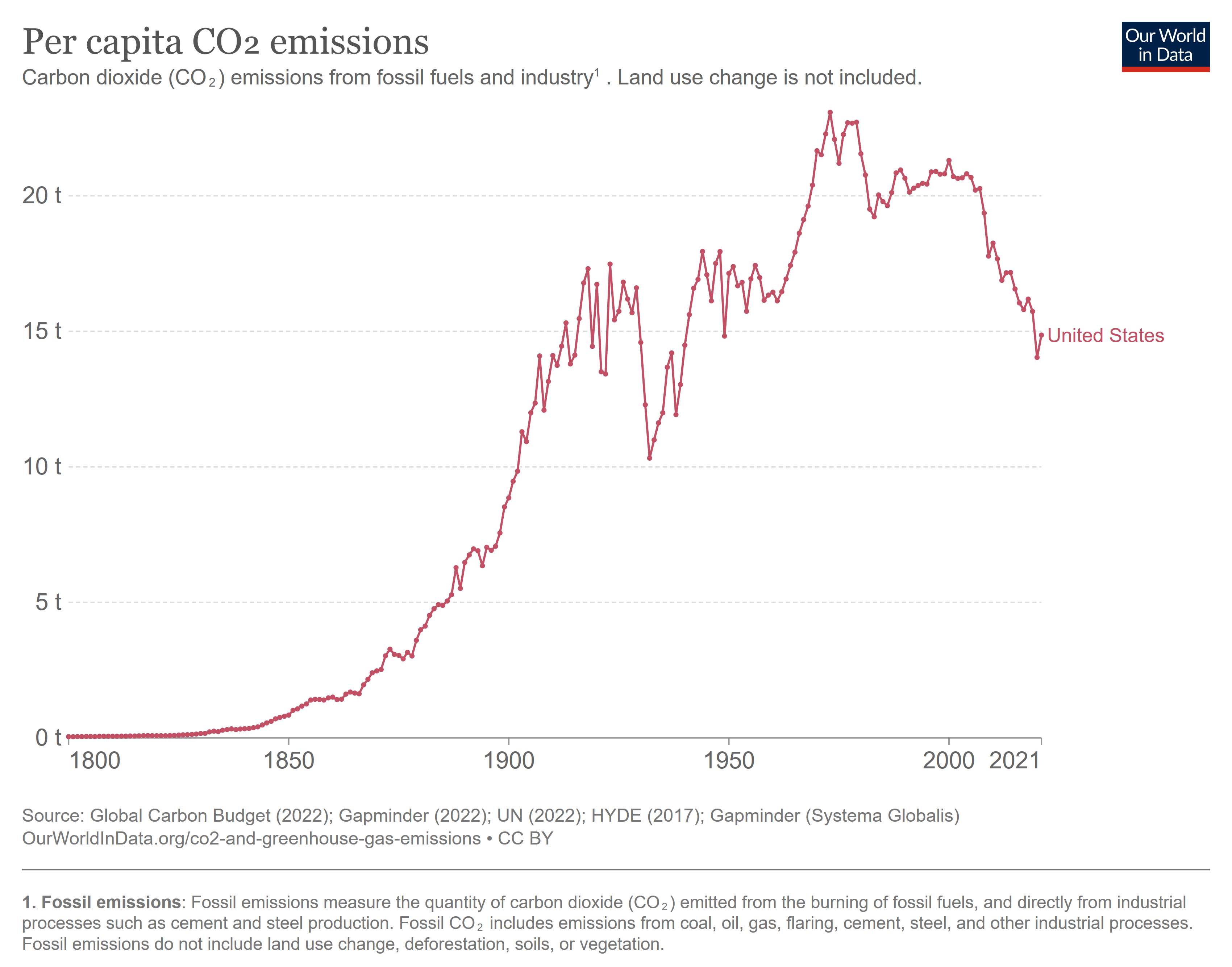
Not many people seem to know this, but the US has also been on the right track with regard to carbon emissions: Per-capita carbon emissions in the US have been trending downward since about 2000, and are now lower than they were in the 1950s. The Inflation Reduction act now looks poised to double down on that progress, as it has been forecasted to reduce our emissions all the way down to 40% below their early-2000s peak.

Somehow, this success doesn’t seem to be getting across. The majority of Americans incorrectly believe that we are in a downturn. Biden’s approval rating is still only 40%, barely higher than Trump’s was. When it comes to political beliefs, most American voters appear to be utterly impervious to facts.

Most Americans do correctly believe that inflation is still a bit high (though many seem to think it’s higher than it is); this is weird, seeing as inflation is normally high when the economy is growing rapidly, and gets too low when we are in a recession. This seems to be Halo Effect, rather than any genuine understanding of macroeconomics: downturns are bad and inflation is bad, so they must go together—when in fact, quite the opposite is the case.

People generally feel better about their own prospects than they do about the economy as a whole:

Sixty-four percent of Americans say the economy is worse off compared to 2020, while seventy-three percent of Americans say the economy is worse off compared to five years ago. About two in five of Americans say they feel worse off from five years ago generally (38%) and a similar number say they feel worse off compared to 2020 (37%).

(Did you really have to write out ‘seventy-three percent’? I hate that convention. 73% is so much clearer and quicker to read.)

I don’t know what the Biden administration should do about this. Trying to sell themselves harder might backfire. (And I’m pretty much the last person in the world you should ask for advice about selling yourself.) But they’ve been doing really great work for the US economy… and people haven’t noticed. Thousands of factories are being built, millions of people are getting jobs, and the collective response has been… “meh”.

Why we need critical thinking

Jul 9 JDN 2460135

I can’t find it at the moment, but awhile ago I read a surprisingly compelling post on social media (I think it was Facebook, but it could also have been Reddit) questioning the common notion that we should be teaching more critical thinking in school.

I strongly believe that we should in fact be teaching more critical thinking in school—actually I think we should replace large chunks of the current math curriculum with a combination of statistics, economics and critical thinking—but it made me realize that we haven’t done enough to defend why that is something worth doing. It’s just become a sort of automatic talking point, like, “obviously you would want more critical thinking, why are you even asking?”

So here’s a brief attempt to explain why critical thinking is something that every citizen ought to be good at, and hence why it’s worthwhile to teach it in primary and secondary school.

Critical thinking, above all, allows you to detect lies. It teaches you to look past the surface of what other people are saying and determine whether what they are saying is actually true.

And our world is absolutely full of lies.

We are constantly lied to by advertising. We are constantly lied to by spam emails and scam calls. Day in and day out, people with big smiles promise us the world, if only we will send them five easy payments of $19.99.

We are constantly lied to by politicians. We are constantly lied to by religious leaders (it’s pretty much their whole job actually).

We are often lied to by newspapers—sometimes directly and explicitly, as in fake news, but more often in subtler ways. Most news articles in the mainstream press are true in the explicit facts they state, but are missing important context; and nearly all of them focus on the wrong things—exciting, sensational, rare events rather than what’s actually important and likely to affect your life. If newspapers were an accurate reflection of genuine risk, they’d have more articles on suicide than homicide, and something like one million articles on climate change for every one on some freak accident (like that submarine full of billionaires).

We are even lied to by press releases on science, which likewise focus on new, exciting, sensational findings rather than supported, established, documented knowledge. And don’t tell me everyone already knows it; just stating basic facts about almost any scientific field will shock and impress most of the audience, because they clearly didn’t learn this stuff in school (or, what amounts to the same thing, don’t remember it). This isn’t just true of quantum physics; it’s even true of economics—which directly affects people’s lives.

Critical thinking is how you can tell when a politician has distorted the views of his opponent and you need to spend more time listening to that opponent speak. Critical thinking could probably have saved us from electing Donald Trump President.

Critical thinking is how you tell that a supplement which “has not been evaluated by the FDA” (which is to say, nearly all of them) probably contains something mostly harmless that maybe would benefit you if you were deficient in it, but for most people really won’t matter—and definitely isn’t something you can substitute for medical treatment.

Critical thinking is how you recognize that much of the history you were taught as a child was a sanitized, simplified, nationalist version of what actually happened. But it’s also how you recognize that simply inverting it all and becoming the sort of anti-nationalist who hates your own country is at least as ridiculous. Thomas Jefferson was both a pioneer of democracy and a slaveholder. He was both a hero and a villain. The world is complicated and messy—and nothing will let you see that faster than critical thinking.


Critical thinking tells you that whenever a new “financial innovation” appears—like mortgage-backed securities or cryptocurrency—it will probably make obscene amounts of money for a handful of insiders, but will otherwise be worthless if not disastrous to everyone else. (And maybe if enough people had good critical thinking skills, we could stop the next “innovation” from getting so far!)

More widespread critical thinking could even improve our job market, as interviewers would no longer be taken in by the candidates who are best at overselling themselves, and would instead pay more attention to the more-qualified candidates who are quiet and honest.

In short, critical thinking constitutes a large portion of what is ordinarily called common sense or wisdom; some of that simply comes from life experience, but a great deal of it is actually a learnable skill set.

Of course, even if it can be learned, that still raises the question of how it can be taught. I don’t think we have a sound curriculum for teaching critical thinking, and in my more cynical moments I wonder if many of the powers that be like it that way. Knowing that many—not all, but many—politicians make their careers primarily from deceiving the public, it’s not so hard to see why those same politicians wouldn’t want to support teaching critical thinking in public schools. And it’s almost funny to me watching evangelical Christians try to justify why critical thinking is dangerous—they come so close to admitting that their entire worldview is totally unfounded in logic or evidence.

But at least I hope I’ve convinced you that it is something worthwhile to know, and that the world would be better off if we could teach it to more people.

How to make political conversation possible

Jun 25 JDN 2460121

Every man has the right to an opinion, but no man has a right to be wrong in his facts.

~Bernard Baruch

We shouldn’t expect political conversation to be easy. Politics inherently involves confllict. There are various competing interests and different ethical views involved in any political decision. Budgets are inherently limited, and spending must be prioritized. Raising taxes supports public goods but hurts taxpayers. A policy that reduces inflation may increase unemployment. A policy that promotes growth may also increase inequality. Freedom must sometimes be weighed against security. Compromises must be made that won’t make everyone happy—often they aren’t anyone’s first choice.

But in order to have useful political conversations, we need to have common ground. It’s one thing to disagree about what should be done—it’s quite another to ‘disagree’ about the basic facts of the world. Reasonable people can disagree about what constitutes the best policy choice. But when you start insisting upon factual claims that are empirically false, you become inherently unreasonable.

What terrifies me about our current state of political discourse is that we do not seem to have this common ground. We can’t even agree about basic facts of the world. Unless we can fix this, political conversation will be impossible.

I am tempted to say “anymore”—it at least feels to me like politics used to be different. But maybe it’s always been this way, and the Internet simply made the unreasonable voices louder. Overall rates of belief in most conspiracy theories haven’t changed substantially over time. Many other times have declared themselves ‘the golden age of conspiracy theory’. Maybe this has always been a problem. Maybe the greatest reason humanity has never been able to achieve peace is that large swaths of humanity can’t even agree on the basic facts.

Donald Trump exemplified this fact-less approach to politics, and QAnon remains a disturbingly significant force in our politics today. It’s impossible to have a sensible conversation with people who are convinced that you’re supporting a secret cabal of Satanic child molesters—and all the more impossible because they were willing to become convinced of that on literally zero evidence. But Trump was not the first conspiracist candidate, and will not be the last.

Robert F. Kennedy Jr. now seems to be challenging Trump for the title of ‘most unreasonable Presidential candidate’, as he has now advocated for an astonishing variety of bizarre unfounded claims: that vaccines are deadly, that antidepressants are responsible for mass shootings, that COVID was a Chinese bioweapon. He even claims things that can be quickly refuted simply by looking up the figures: He says that Switzerland’s gun ownership rate is comparable to the US, when in fact it’s only about one-fourth as high. No other country even comes close to the extraordinarily high rate of gun ownership in the US; we are the only country in the world with more privately-owned guns than private citizens to own them—more guns than people. (We also have by far the most military weapons as well, but that’s a somewhat different issue.)

What should we be doing about this? I think at this point it’s clear that simply sitting back and hoping it goes away on its own is not working. There is a widespread fear that engaging with bizarre theories simply grants them attention, but I think we have no serious alternative. They aren’t going to disappear if we simply ignore them.

That still leaves the question of how to engage. Simply arguing with their claims directly and presenting mainstream scientific evidence appears to be remarkably ineffective. They will simply dismiss the credibility of the scientific evidence, often by exaggerating genuine flaws in scientific institutions. The journal system is broken? Big Pharma has far too much influence? Established ideas take too long to become unseated? All true. But that doesn’t mean that magic beans cure cancer.

A more effective—not easy, and certainly not infallible, but more effective—strategy seems to be to look deeper into why people say the things they do. I emphasize the word ‘say’ here, because it often seems to be the case that people don’t really believe in conspiracy theories the way they believe in ordinary facts. It’s more the mythology mindset.

Rather than address the claims directly, you need to address the person making the claims. Before getting into any substantive content, you must first build rapport and show empathy—a process some call pre-suasion. Then, rather than seeking out the evidence that support their claims—as there will be virtually none—try to find out what emotional need the conspiracy theory satisfies for them: How does it help them make sense of the terrifying chaos of the world? How does professing belief in something that initially seems absurd and horrific actually make the world seem more orderly and secure in their mind?


For instance, consider the claim that 9/11 was an inside job. At face value, this is horrifying: The US government is so evil it was prepared to launch an attack on our own soil, against our own citizens, in order to justify starting a war in another country? Against such a government, I think violent insurrection is the only viable response. But if you consider it from another perspective, it makes the world less terrifying: At least, there is someone in control. An attack like 9/11 means that the world is governed by chaos: Even we in the seemingly-impregnable fortress of American national security are in fact vulnerable to random attacks by small groups of dedicated fanatics. In the conspiracist vision of the world, the US government becomes a terrible villain; but at least the world is governed by powerful, orderly forces—not random chaos.

Or consider one of the most widespread (and, to be fair, one of the least implausible) conspiracy theories: That JFK was assassinated not by a single fanatic, but by an organized agency—the KGB, or the CIA, or the Vice President. In the real world, the President of the United States—the most powerful man on the entire planet—can occasionally be felled by a single individual who is dedicated enough and lucky enough. In the conspiracist world, such a powerful man can only be killed by someone similarly powerful. The world may be governed by an evil elite—but at least it is governed. The rules may be evil, but at least there are rules.

Understanding this can give you some sympathy for people who profess conspiracies: They are struggling to cope with the pain of living in a chaotic, unpredictable, disorderly world. They cannot deny that terrible events happen, but by attributing them to unseen, organized forces, they can at least believe that those terrible events are part of some kind of orderly plan.


At the same time, you must constantly guard against seeming arrogant or condescending. (This is where I usually fail; it’s so hard for me to take these ideas seriously.) You must present yourself as open-minded and interested in speaking in good faith. If they sense that you aren’t taking them seriously, people will simply shut down and refuse to talk any further.

It’s also important to recognize that most people with bizarre beliefs aren’t simply gullible. It isn’t that they believe whatever anyone tells them. On the contrary, they seem to suffer from misplaced skepticism: They doubt the credible sources and believe the unreliable ones. They are hyper-aware of the genuine problems with mainstream sources, and yet somehow totally oblivious to the far more glaring failures of the sources they themselves trust.

Moreover, you should never expect to change someone’s worldview in a single conversation. That simply isn’t how human beings work. The only times I have ever seen anyone completely change their opinion on something in a single sitting involved mathematical proofs—showing a proper proof really can flip someone’s opinion all by itself. Yet even scientists working in their own fields of expertise generally require multiple sources of evidence, combined over some period of time, before they will truly change their minds.

Your goal, then, should not be to convince someone that their bizarre belief is wrong. Rather, convince them that some of the sources they trust are just as unreliable as the ones they doubt. Or point out some gaps in the story they hadn’t considered. Or offer an alternative account of events that explains the outcome without requiring the existence of a secret evil cabal. Don’t try to tear down the entire wall all at once; chip away at it, one little piece at a time—and one day, it will crumble.

Hopefully if we do this enough, we can make useful political conversation possible.

Voting Your Dollars

May 28 JDN 2460093

It’s no secret that Americans don’t like to pay taxes. It’s almost a founding principle of our country, really, going all the way back to the Boston Tea Party. This is likely part of why the US has one of the lowest tax-to-GDP ratios in the First World; our taxes are barely half what they pay in Scandinavia. And this in turn surely contributes to our ongoing budget issues and our stingy social welfare spending. (Speaking of budget issues: As of this writing, the debt ceiling debacle is still unresolved.)

Why don’t Americans like to pay taxes? Why does no one really like to pay taxes (though some seem more willing than others)?

It surely has something to do with the fact that taxes are so coercive: You have to pay them, you get no choice. And you also have very little choice as to how that money is used; yes, you can vote for politicians who will in theory at some point enact budgets that might possibly reflect the priorities they expressed in their campaigns—but the actual budget invariably ends up quite far removed from the campaign promises you could vote based on.

What if we could give you more choice? We can’t let people choose how much to pay—then most people would choose to pay less and we’d be in even more trouble. (If you want to pay more than you’re required to, the IRS will actually let you right now. You can just refuse your refund.) But perhaps we could let people choose where the money goes?

I call this program Vote Your Dollars. I would initially limit it to a small fraction of the budget, tied to a tax increase: Say, raise taxes enough to increase revenue by 5% and use that 5% for the program.

Under Vote Your Dollars, on your tax return, you are given a survey, asking you how you want to divide up your additional money toward various categories. I think they should be fairly broad categories, such as ‘healthcare’, ‘social security’, ‘anti-poverty programs’, ‘defense’, ‘foreign aid’. If we make them too specific, it would be more work for the voters and also more likely to lead to foolish allocations. We want them to basically reflect a voter’s priorities, rather than ask them to make detailed economic management decisions. Most voters are not qualified to properly allocate a budget; the goal here is to get people to weight how much they care about different programs.

As only a small portion of the budget, Vote Your Dollars would initially have very little real fiscal impact. Money is fungible, so any funds that were expected to go somewhere else than where voters put them could easily be reallocated as needed. But I suspect that most voters would fail to appreciate this effect, and thus actually feel like they have more control than they really do. (If voters understood fungibility and inframarginal transfers, they’d never have supported food stamps over just giving poor people cash.)

Moreover, it would still provide useful information, namely: What happens when voters are given this power? Do they make decisions that seem to make sense and reflect their interests and beliefs? Does the resulting budget actually seem like one that could be viable? Could it even be better than what we currently have in some ways?

I suspect that the result would be better than most economists and political scientists imagine. There seems to be a general sense that voters are too foolish or apathetic to usefully participate in politics, which of course would raise the very big question: Why does democracy work?

I don’t think that most voters would choose a perfect budget; indeed, I already said I wouldn’t trust them with the fine details of how to allocate the funds. But I do think most people have at least some reasonable idea of how important they think healthcare is relative to defense, and it would be good to at least gather that information in a more direct way.

If it goes well and Vote Your Dollars seems to result in reasonable budgets even for that extra 5%, we could start expanding it to a larger portion of the overall budget. Try 10% for the next election, then 15% for the next. There should always be some part that remains outside direct voter control, because voters would almost certainly underspend on certain categories (such as administration and national debt payments) and likely overspend on others.

This would allow us to increase taxes—which we clearly must do, because we need to improve government services, but we don’t want to go further into debt—while giving voters more choice, and thus making taxes feel less coercive. Being forced to pay a certain amount each year might not sting as much if you get to say where a significant portion of that money goes.

To give voters even more control over their money, I think I would also include a provision whereby you can deduct the full amount of your charitable contributions to certain high-impact charities (we would need to come up with a good list, but clear examples include UNICEF, Oxfam, and GiveWell) from your tax payment. Currently, you deduct charitable contributions from your income, which means you don’t pay taxes on those donations; but you still end up with less money after donating than you did before. If we let you deduct the full amount, then you would have the same amount after donating, and effectively the government would pay the full cost of your donation. Presumably this would lead to people donating a great deal; this might hurt tax revenues, but its overall positive impact on the world would be so large that it is obviously worth it. By the time we have given enough to UNICEF to meaningfully impact the US federal budget, we have ended world hunger.

Of course, it’s very unlikely that anything like Vote Your Dollars would ever be implemented. There are already ways we could make paying taxes less painful that we haven’t done—such as sending you a bill, as they do in Denmark, rather than making you file a tax form. And we could already increase revenue with very little real cost by simply expanding the IRS and auditing rich people more. These simple, obvious reforms have been repeatedly obstructed by powerful lobbies, who personally benefit from the current system even though it’s obviously a bad system. I guess I can’t think of anyone in particular who would want to lobby against Vote Your Dollars, but I feel like Republicans might just because they want taxes to hurt as much as possible so that they have an excuse to cut spending.

But still, I thought I’d put the idea out there.

Why does democracy work?

May 14 JDN 2460079

A review of Democracy for Realists

I don’t think it can be seriously doubted that democracy does, in fact, work. Not perfectly, by any means; but the evidence is absolutely overwhelming that more democratic societies are better than more authoritarian societies by just about any measure you could care to use.

When I first started reading Democracy for Realists and saw their scathing, at times frothing criticism of mainstream ideas of democracy, I thought they were going to try to disagree with that; but in the end they don’t. Achen and Bartels do agree that democracy works; they simply think that why and how it works is radically different from what most people think.

For it is a very long-winded book, and in dire need of better editing. Most of the middle section of the book is taken up by a deluge of empirical analysis, most of which amounts to over-interpreting the highly ambiguous results of underpowered linear regressions on extremely noisy data. The sheer quantity of them seems intended to overwhelm any realization that no particular one is especially compelling. But a hundred weak arguments don’t add up to a single strong one.

To their credit, the authors often include the actual scatter plots; but when you look at those scatter plots, you find yourself wondering how anyone could be so convinced these effects are real and important. Many of them seem more prone to new constellations.

Their econometric techniques are a bit dubious, as well; at one point they said they “removed outliers” but then the examples they gave as “outliers” were the observations most distant from their regression line rather than the rest of the data. Removing the things furthest from your regression line will always—always—make your regression seem stronger. But that’s not what outliers are. Other times, they add weird controls or exclude parts of the sample for dubious reasons, and I get the impression that these are the cherry-picked results of a much larger exploration. (Why in the world would you exclude Catholics from a study of abortion attitudes? And this study on shark attacks seems awfully specific….) And of course if you try 20 regressions at random, you can expect that at least 1 of them will probably show up with p < 0.05. I think they are mainly just following the norms of their discipline—but those norms are quite questionable.

They don’t ever get into much detail as to what sort of practical institutional changes they would recommend, so it’s hard to know whether I would agree with those. Some of their suggestions, such as more stringent rules on campaign spending, I largely agree with. Others, such as their opposition to popular referenda and recommendation for longer term limits, I have more mixed feelings about. But none seem totally ridiculous or even particularly radical, and they really don’t offer much detail about any of them. I thought they were going to tell me that appointment of judges is better than election (which many experts widely agree), or that the Electoral College is a good system (which far fewer experts would assent to, at least since George W. Bush and Donald Trump). In fact they didn’t do that; they remain eerily silent on substantive questions like this.

Honestly, what little they have to say about institutional policy feels a bit tacked on at the end, as if they suddenly realized that they ought to say something useful rather than just spend the whole time tearing down another theory.

In fact, I came to wonder if they really were tearing down anyone’s actual theory, or if this whole book was really just battering a strawman. Does anyone really think that voters are completely rational? At one point they speak of an image of the ‘sovereign omnicompetent voter’; is that something anyone really believes in?

It does seem like many people believe in making government more responsive to the people, whereas Achen and Bartels seem to have the rather distinct goal of making government make better decisions. They were able to find at least a few examples—though I know not how far and wide they had to search—where it seemed like more popular control resulted in worse outcomes, such as water fluoridation and funding for fire departments. So maybe the real substantive disagreement here is over whether more or less direct democracy is a good idea. And that is indeed a reasonable question. But one need not believe that voters are superhuman geniuses to think that referenda are better than legislation. Simply showing that voters are limited in their capacity and bound to group identity is not enough to answer that question.


In fact, I think that Achen and Bartels seriously overestimate the irrationality of voters, because they don’t seem to appreciate that group identity is often a good proxy for policy—in fact, they don’t even really seem to see social policy as policy at all. Consider this section (p. 238):

“In this pre-Hitlerian age it must have seemed to most Jews that there were no crucial issues dividing the major parties” (Fuchs 1956, 63). Yet by 1923, a very substantial majority of Jews had abandoned their Republican loyalties and begun voting for the Democrats. What had changed was not foreign policy, but rather the social status of Jews within one of America’s major political parties. In a very visible way, the Democrats had become fully accepting and incorporating of religious minorities, both Catholics and Jews. The result was a durable Jewish partisan realignment grounded in “ethnic solidarity”, in Gamm’s characterization.

Gee, I wonder why Jews would suddenly care a great deal which party was more respectful toward people like them? Okay, the Holocaust hadn’t happened yet, but anti-Semitism is very old indeed, and it was visibly creeping upward during that era. And just in general, if one party is clearly more anti-Semitic than the other, why wouldn’t Jews prefer the one that is less hateful toward them? How utterly blinded by privilege do you need to be to not see that this is an important policy difference?

Perhaps because they are both upper-middle-class straight White cisgender men (I would also venture a guess nominally but not devoutly Protestant), Achens and Bartel seem to have no concept that social policy directly affects people of minority identity, that knowing that one party accepts people like you and the other doesn’t is a damn good reason to prefer one over the other. This is not a game where we are rooting for our home team. This directly affects our lives.

I know quite a few transgender people, and not a single one is a Republican. It’s not because all trans people hate low taxes. It’s because the Republican Party has declared war on trans people.

This may also lead to trans people being more left-wing generally, as once you’re in a group you tend to absorb some views from others in that group (and, I’ll admit, Marxists and anarcho-communists seem overrepresented among LGBT people). But I absolutely know some LGBT people who would like to vote conservative for economic policy reasons, but realize they can’t, because it means voting for bigots who hate them and want to actively discriminate against them. There is nothing irrational or even particularly surprising about this choice. It would take a very powerful overriding reason for anyone to want to vote for someone who publicly announces hatred toward them.

Indeed, for me the really baffling thing is that there are political parties that publicly announce hatred toward particular groups. It seems like a really weird strategy for winning elections. That is the thing that needs to be explained here; why isn’t inclusiveness—at least a smarmy lip-service toward inclusiveness, like ‘Diversity, Equity, and Inclusion’ offices at universities—the default behavior of all successful politicians? Why don’t they all hug a Latina trans woman after kissing a baby and taking a selfie with the giant butter cow? Why is not being an obvious bigot considered a left-wing position?

Since it obviously is the case that many voters don’t want this hatred (at the very least, its targets!), in order for it not to damage electoral changes, it must be that some other voters do want this hatred. Perhaps they themselves define their own identity in opposition to other people’s identities. They certainly talk that way a lot: We hear White people fearing ‘replacement‘ by shifting racial demographics, when no sane forecaster thinks that European haplotypes are in any danger of disappearing any time soon. The central argument against gay marriage was always that it would somehow destroy straight marriage, by some mechanism never explained.

Indeed, perhaps it is this very blindness toward social policy that makes Achen and Bartels unable to see the benefits of more direct democracy. When you are laser-focused on economic policy, as they are, then it seems to you as though policy questions are mainly technical matters of fact, and thus what we need are qualified experts. (Though even then, it is not purely a matter of fact whether we should care more about inequality than growth, or more about unemployment than inflation.)

But once you include social policy, you see that politics often involves very real, direct struggles between conflicting interests and differing moral views, and that by the time you’ve decided which view is the correct one, you already have your answer for what must be done. There is no technical question of gay marriage; there is only a moral one. We don’t need expertise on such questions; we need representation. (Then again, it’s worth noting that courts have sometimes advanced rights more effectively than direct democratic votes; so having your interests represented isn’t as simple as getting an equal vote.)

Achen and Bartels even include a model in the appendix where politicians are modeled as either varying in competence or controlled by incentives; never once does it consider that they might differ in whose interests they represent. Yet I don’t vote for a particular politician just because I think they are more intelligent, or as part of some kind of deterrence mechanism to keep them from misbehaving (I certainly hope the courts do a better job of that!); I vote for them because I think they represent the goals and interests I care about. We aren’t asking who is smarter, we are asking who is on our side.

The central question that I think the book raises is one that the authors don’t seem to have much to offer on: If voters are so irrational, why does democracy work? I do think there is strong evidence that voters are irrational, though maybe not as irrational as Achen and Bartels seem to think. Honestly, I don’t see how anyone can watch Donald Trump get elected President of the United States and not think that voters are irrational. (The book was written before that; apparently there’s a new edition with a preface about Trump, but my copy doesn’t have that.) But it isn’t at all obvious to me what to do with that information, because even if so-called elites are in fact more competent than average citizens—which may or may not be true—the fact remains that their interests are never completely aligned. Thus far, representative democracy of one stripe or another seems to be the best mechanism we have for finding people who have sufficient competence while also keeping them on a short enough leash.

And perhaps that’s why democracy works as well as it does; it gives our leaders enough autonomy to let them generally advance their goals, but also places limits on how badly misaligned our leaders’ goals can be from our own.

The idiocy of the debt ceiling

Apr 23 JDN 2460058

I thought we had put this behind us. I guess I didn’t think the Republicans would stop using the tactic once they saw it worked, but I had hoped that the Democrats would come up with a better permanent solution so that it couldn’t be used again. But they did not, and here we are again: Republicans are refusing to raise the debt ceiling, we have now hit that ceiling, and we are running out of time before we have to start shutting down services or defaulting on debt. There are talks ongoing that may yet get the ceiling raised in time, but we’re now cutting it very close. Already the risk that we might default or do something crazy is causing turmoil in financial markets.

Because US Treasury bonds are widely regarded as one of the world’s most secure assets, and the US dollar is the most important global reserve currency, the entire world’s financial markets get disrupted every time there is an issue with the US national debt, and the debt ceiling creates such disruptions on the regular for no good reason.

I will try to offer some of my own suggestions for what to do here, but first, I want to make something very clear: The debt ceiling should not exist. I don’t think most people understand just how truly idiotic the entire concept of a debt ceiling is. It seems practically designed to make our government dysfunctional.

This is not like a credit card limit, where your bank imposes a limit on how much you can borrow based on how much they think you are likely to be able to repay. A lot of people have been making that analogy, and I can see why it’s tempting; but as usual, it’s important to remember that government debt is not like personal debt.

As I said some years ago, US government debt is about as close as the world is ever likely to come to a perfect credit market: with no effort at all, borrow as much as you want at low, steady interest rates, and everyone will always be sure that you will pay it back on time. The debt ceiling is a limit imposed by the government itself—it is not imposed by our creditors, who would be more than happy to lend us more.

Also, I’d like to remind you that some of the US national debt is owned by the US government itself (is that really even “debt”?) and most of what’s left is owned by US individuals or corporations—only about a third is owed to foreign powers. Here is a detailed breakdown of who owns US national debt.

There is no reason to put an arbitrary cap on the amount the US government can borrow. The only reason anyone is at all worried about a default on the US national debt is because of this stupid arbitrary cap. If it didn’t exist, they would simply roll over more Treasury bonds to make the payments and everything would run smoothly. And this is normally what happens, when the Republicans aren’t playing ridiculous brinkmanship games.

As it is, they could simply print money to pay it—and at this point, maybe that’s what needs to happen. Mint the Coin already: Mint a $1 trillion platinum coin and deposit it in the Federal Reserve, and there you go, you’ve paid off a chunk of the debt. Sometimes stupid problems require stupid solutions.

Aren’t there reasons to be worried about the government borrowing too much? Yes, a little. The amount of concern most people have about this is wildly disproportionate to the actual problem, but yes, there are legitimate concerns about high national debt resulting in high interest rates and eventually forcing us to raise taxes or cut services. This is a slow-burn, long-term problem that by its very nature would never require a sudden, immediate solution; but it is a genuine concern we should be aware of.

But here’s the thing: That’s a conversation we should be having when we vote on the budget. Whenever we pass a government budget, it already includes detailed projections of tax revenue and spending that yield precise, accurate forecasts of the deficit and the debt. If Republicans are genuinely concerned that we are overspending on certain programs, they should propose budget cuts to those programs and get those cuts passed as part of the budget.

Once a budget is already passed, we have committed to spend that money. It has literally been signed into law that $X will be spend on program Y. At that point, you can’t simply cut the spending. If you think we’re spending too much, you needed to say that before we signed it into law. It’s too late now.

I’m always dubious of analogies between household spending and government spending, but if you really want one, think of it this way: Say your credit card company is offering to raise your credit limit, and you just signed a contract for some home improvements that would force you to run up your credit card past your current limit. Do you call the credit card company and accept the higher limit, or not? If you don’t, why don’t you? And what’s your plan for paying those home contractors? Even if you later decide that the home improvements were a bad idea, you already signed the contract! You can’t just back out!

This is why the debt ceiling is so absurd: It is a self-imposed limit on what you’re allowed to spend after you have already committed to spending it. The only sensible thing to do is to raise the debt ceiling high enough to account for the spending you’ve already committed to—or better yet, eliminate the ceiling entirely.

I think that when they last had a majority in both houses, the Democrats should have voted to make the debt ceiling ludicrously high—say $100 trillion. Then, at least for the foreseeable future, we wouldn’t have to worry about raising it, and could just pass budgets normally like a sane government. But they didn’t do that; they only raised it as much as was strictly necessary, thus giving the Republicans an opening now to refuse to raise it again.

And that is what the debt ceiling actually seems to accomplish: It gives whichever political party is least concerned about the public welfare a lever they can pull to disrupt the entire system whenever they don’t get things the way they want. If you absolutely do not care about the public good—and it’s quite clear at this point that most of the Republican leadership does not—then whenever you don’t get your way, you can throw a tantrum that threatens to destabilize the entire global financial system.

We need to stop playing their game. Do what you have to do to keep things running for now—but then get rid of the damn debt ceiling before they can use it to do even more damage.