Believing in civilization without believing in colonialism

JDN 2457541

In a post last week I presented some of the overwhelming evidence that society has been getting better over time, particularly since the start of the Industrial Revolution. I focused mainly on infant mortality rates—babies not dying—but there are lots of other measures you could use as well. Despite popular belief, poverty is rapidly declining, and is now the lowest it’s ever been. War is rapidly declining. Crime is rapidly declining in First World countries, and to the best of our knowledge crime rates are stable worldwide. Public health is rapidly improving. Lifespans are getting longer. And so on, and so on. It’s not quite true to say that every indicator of human progress is on an upward trend, but the vast majority of really important indicators are.

Moreover, there is every reason to believe that this great progress is largely the result of what we call “civilization”, even Western civilization: Stable, centralized governments, strong national defense, representative democracy, free markets, openness to global trade, investment in infrastructure, science and technology, secularism, a culture that values innovation, and freedom of speech and the press. We did not get here by Marxism, nor agragrian socialism, nor primitivism, nor anarcho-capitalism. We did not get here by fascism, nor theocracy, nor monarchy. This progress was built by the center-left welfare state, “social democracy”, “modified capitalism”, the system where free, open markets are coupled with a strong democratic government to protect and steer them.

This fact is basically beyond dispute; the evidence is overwhelming. The serious debate in development economics is over which parts of the Western welfare state are most conducive to raising human well-being, and which parts of the package are more optional. And even then, some things are fairly obvious: Stable government is clearly necessary, while speaking English is clearly optional.

Yet many people are resistant to this conclusion, or even offended by it, and I think I know why: They are confusing the results of civilization with the methods by which it was established.

The results of civilization are indisputably positive: Everything I just named above, especially babies not dying.

But the methods by which civilization was established are not; indeed, some of the greatest atrocities in human history are attributable at least in part to attempts to “spread civilization” to “primitive” or “savage” people.
It is therefore vital to distinguish between the result, civilization, and the processes by which it was effected, such as colonialism and imperialism.

First, it’s important not to overstate the link between civilization and colonialism.

We tend to associate colonialism and imperialism with White people from Western European cultures conquering other people in other cultures; but in fact colonialism and imperialism are basically universal to any human culture that attains sufficient size and centralization. India engaged in colonialism, Persia engaged in imperialism, China engaged in imperialism, the Mongols were of course major imperialists, and don’t forget the Ottoman Empire; and did you realize that Tibet and Mali were at one time imperialists as well? And of course there are a whole bunch of empires you’ve probably never heard of, like the Parthians and the Ghaznavids and the Ummayyads. Even many of the people we’re accustoming to thinking of as innocent victims of colonialism were themselves imperialists—the Aztecs certainly were (they even sold people into slavery and used them for human sacrifice!), as were the Pequot, and the Iroquois may not have outright conquered anyone but were definitely at least “soft imperialists” the way that the US is today, spreading their influence around and using economic and sometimes military pressure to absorb other cultures into their own.

Of course, those were all civilizations, at least in the broadest sense of the word; but before that, it’s not that there wasn’t violence, it just wasn’t organized enough to be worthy of being called “imperialism”. The more general concept of intertribal warfare is a human universal, and some hunter-gatherer tribes actually engage in an essentially constant state of warfare we call “endemic warfare”. People have been grouping together to kill other people they perceived as different for at least as long as there have been people to do so.

This is of course not to excuse what European colonial powers did when they set up bases on other continents and exploited, enslaved, or even murdered the indigenous population. And the absolute numbers of people enslaved or killed are typically larger under European colonialism, mainly because European cultures became so powerful and conquered almost the entire world. Even if European societies were not uniquely predisposed to be violent (and I see no evidence to say that they were—humans are pretty much humans), they were more successful in their violent conquering, and so more people suffered and died. It’s also a first-mover effect: If the Ming Dynasty had supported Zheng He more in his colonial ambitions, I’d probably be writing this post in Mandarin and reflecting on why Asian cultures have engaged in so much colonial oppression.

While there is a deeply condescending paternalism (and often post-hoc rationalization of your own self-interested exploitation) involved in saying that you are conquering other people in order to civilize them, humans are also perfectly capable of committing atrocities for far less noble-sounding motives. There are holy wars such as the Crusades and ethnic genocides like in Rwanda, and the Arab slave trade was purely for profit and didn’t even have the pretense of civilizing people (not that the Atlantic slave trade was ever really about that anyway).

Indeed, I think it’s important to distinguish between colonialists who really did make some effort at civilizing the populations they conquered (like Britain, and also the Mongols actually) and those that clearly were just using that as an excuse to rape and pillage (like Spain and Portugal). This is similar to but not quite the same thing as the distinction between settler colonialism, where you send colonists to live there and build up the country, and exploitation colonialism, where you send military forces to take control of the existing population and exploit them to get their resources. Countries that experienced settler colonialism (such as the US and Australia) have fared a lot better in the long run than countries that experienced exploitation colonialism (such as Haiti and Zimbabwe).

The worst consequences of colonialism weren’t even really anyone’s fault, actually. The reason something like 98% of all Native Americans died as a result of European colonization was not that Europeans killed them—they did kill thousands of course, and I hope it goes without saying that that’s terrible, but it was a small fraction of the total deaths. The reason such a huge number died and whole cultures were depopulated was disease, and the inability of medical technology in any culture at that time to handle such a catastrophic plague. The primary cause was therefore accidental, and not really foreseeable given the state of scientific knowledge at the time. (I therefore think it’s wrong to consider it genocide—maybe democide.) Indeed, what really would have saved these people would be if Europe had advanced even faster into industrial capitalism and modern science, or else waited to colonize until they had; and then they could have distributed vaccines and antibiotics when they arrived. (Of course, there is evidence that a few European colonists used the diseases intentionally as biological weapons, which no amount of vaccine technology would prevent—and that is indeed genocide. But again, this was a small fraction of the total deaths.)

However, even with all those caveats, I hope we can all agree that colonialism and imperialism were morally wrong. No nation has the right to invade and conquer other nations; no one has the right to enslave people; no one has the right to kill people based on their culture or ethnicity.

My point is that it is entirely possible to recognize that and still appreciate that Western civilization has dramatically improved the standard of human life over the last few centuries. It simply doesn’t follow from the fact that British government and culture were more advanced and pluralistic that British soldiers can just go around taking over other people’s countries and planting their own flag (follow the link if you need some comic relief from this dark topic). That was the moral failing of colonialism; not that they thought their society was better—for in many ways it was—but that they thought that gave them the right to terrorize, slaughter, enslave, and conquer people.

Indeed, the “justification” of colonialism is a lot like that bizarre pseudo-utilitarianism I mentioned in my post on torture, where the mere presence of some benefit is taken to justify any possible action toward achieving that benefit. No, that’s not how morality works. You can’t justify unlimited evil by any good—it has to be a greater good, as in actually greater.

So let’s suppose that you do find yourself encountering another culture which is clearly more primitive than yours; their inferior technology results in them living in poverty and having very high rates of disease and death, especially among infants and children. What, if anything, are you justified in doing to intervene to improve their condition?

One idea would be to hold to the Prime Directive: No intervention, no sir, not ever. This is clearly what Gene Roddenberry thought of imperialism, hence why he built it into the Federation’s core principles.

But does that really make sense? Even as Star Trek shows progressed, the writers kept coming up with situations where the Prime Directive really seemed like it should have an exception, and sometimes decided that the honorable crew of Enterprise or Voyager really should intervene in this more primitive society to save them from some terrible fate. And I hope I’m not committing a Fictional Evidence Fallacy when I say that if your fictional universe specifically designed not to let that happen makes that happen, well… maybe it’s something we should be considering.

What if people are dying of a terrible disease that you could easily cure? Should you really deny them access to your medicine to avoid intervening in their society?

What if the primitive culture is ruled by a horrible tyrant that you could easily depose with little or no bloodshed? Should you let him continue to rule with an iron fist?

What if the natives are engaged in slavery, or even their own brand of imperialism against other indigenous cultures? Can you fight imperialism with imperialism?

And then we have to ask, does it really matter whether their babies are being murdered by the tyrant or simply dying from malnutrition and infection? The babies are just as dead, aren’t they? Even if we say that being murdered by a tyrant is worse than dying of malnutrition, it can’t be that much worse, can it? Surely 10 babies dying of malnutrition is at least as bad as 1 baby being murdered?

But then it begins to seem like we have a duty to intervene, and moreover a duty that applies in almost every circumstance! If you are on opposite sides of the technology threshold where infant mortality drops from 30% to 1%, how can you justify not intervening?

I think the best answer here is to keep in mind the very large costs of intervention as well as the potentially large benefits. The answer sounds simple, but is actually perhaps the hardest possible answer to apply in practice: You must do a cost-benefit analysis. Furthermore, you must do it well. We can’t demand perfection, but it must actually be a serious good-faith effort to predict the consequences of different intervention policies.

We know that people tend to resist most outside interventions, especially if you have the intention of toppling their leaders (even if they are indeed tyrannical). Even the simple act of offering people vaccines could be met with resistance, as the native people might think you are poisoning them or somehow trying to control them. But in general, opening contact with with gifts and trade is almost certainly going to trigger less hostility and therefore be more effective than going in guns blazing.

If you do use military force, it must be targeted at the particular leaders who are most harmful, and it must be designed to achieve swift, decisive victory with minimal collateral damage. (Basically I’m talking about just war theory.) If you really have such an advanced civilization, show it by exhibiting total technological dominance and minimizing the number of innocent people you kill. The NATO interventions in Kosovo and Libya mostly got this right. The Vietnam War and Iraq War got it totally wrong.

As you change their society, you should be prepared to bear most of the cost of transition; you are, after all, much richer than they are, and also the ones responsible for effecting the transition. You should not expect to see short-term gains for your own civilization, only long-term gains once their culture has advanced to a level near your own. You can’t bear all the costs of course—transition is just painful, no matter what you do—but at least the fungible economic costs should be borne by you, not by the native population. Examples of doing this wrong include basically all the standard examples of exploitation colonialism: Africa, the Caribbean, South America. Examples of doing this right include West Germany and Japan after WW2, and South Korea after the Korean War—which is to say, the greatest economic successes in the history of the human race. This was us winning development, humanity. Do this again everywhere and we will have not only ended world hunger, but achieved global prosperity.

What happens if we apply these principles to real-world colonialism? It does not fare well. Nor should it, as we’ve already established that most if not all real-world colonialism was morally wrong.

15th and 16th century colonialism fail immediately; they offer no benefit to speak of. Europe’s technological superiority was enough to give them gunpowder but not enough to drop their infant mortality rate. Maybe life was better in 16th century Spain than it was in the Aztec Empire, but honestly not by all that much; and life in the Iroquois Confederacy was in many ways better than life in 15th century England. (Though maybe that justifies some Iroquois imperialism, at least their “soft imperialism”?)

If these principles did justify any real-world imperialism—and I am not convinced that it does—it would only be much later imperialism, like the British Empire in the 19th and 20th century. And even then, it’s not clear that the talk of “civilizing” people and “the White Man’s Burden” was much more than rationalization, an attempt to give a humanitarian justification for what were really acts of self-interested economic exploitation. Even though India and South Africa are probably better off now than they were when the British first took them over, it’s not at all clear that this was really the goal of the British government so much as a side effect, and there are a lot of things the British could have done differently that would obviously have made them better off still—you know, like not implementing the precursors to apartheid, or making India a parliamentary democracy immediately instead of starting with the Raj and only conceding to democracy after decades of protest. What actually happened doesn’t exactly look like Britain cared nothing for actually improving the lives of people in India and South Africa (they did build a lot of schools and railroads, and sought to undermine slavery and the caste system), but it also doesn’t look like that was their only goal; it was more like one goal among several which also included the strategic and economic interests of Britain. It isn’t enough that Britain was a better society or even that they made South Africa and India better societies than they were; if the goal wasn’t really about making people’s lives better where you are intervening, it’s clearly not justified intervention.

And that’s the relatively beneficent imperialism; the really horrific imperialists throughout history made only the barest pretense of spreading civilization and were clearly interested in nothing more than maximizing their own wealth and power. This is probably why we get things like the Prime Directive; we saw how bad it can get, and overreacted a little by saying that intervening in other cultures is always, always wrong, no matter what. It was only a slight overreaction—intervening in other cultures is usually wrong, and almost all historical examples of it were wrong—but it is still an overreaction. There are exceptional cases where intervening in another culture can be not only morally right but obligatory.

Indeed, one underappreciated consequence of colonialism and imperialism is that they have triggered a backlash against real good-faith efforts toward economic development. People in Africa, Asia, and Latin America see economists from the US and the UK (and most of the world’s top economists are in fact educated in the US or the UK) come in and tell them that they need to do this and that to restructure their society for greater prosperity, and they understandably ask: “Why should I trust you this time?” The last two or four or seven batches of people coming from the US and Europe to intervene in their countries exploited them or worse, so why is this time any different?

It is different, of course; UNDP is not the East India Company, not by a longshot. Even for all their faults, the IMF isn’t the East India Company either. Indeed, while these people largely come from the same places as the imperialists, and may be descended from them, they are in fact completely different people, and moral responsibility does not inherit across generations. While the suspicion is understandable, it is ultimately unjustified; whatever happened hundreds of years ago, this time most of us really are trying to help—and it’s working.

So what can we actually do about sweatshops?

JDN 2457489

(The topic of this post was chosen by a vote of my Patreons.) There seem to be two major camps on most political issues: One camp says “This is not a problem, stop worrying about it.” The other says “This is a huge problem, it must be fixed right away, and here’s the easy solution.” Typically neither of these things is true, and the correct answer is actually “This is a huge problem, well worth fixing—but we need to do a lot of work to figure out exactly how.”

Sweatshop labor is a very good example of this phenomenon.

Camp A is represented here by the American Enterprise Institute, which even goes as far as to defend child labor on the grounds that “we used to do it before”. (Note that we also used to do slavery before. Also protectionism, but of course AEI doesn’t think that was good. Who needs logical consistency when you have ideological purity?) The College Conservative uses ECON 101 to defend sweatshops, perhaps not realizing that economics courses continue past ECON 101.

Camp B is represented here by Buycott, telling us to buy “made in the USA” products and boycott all companies that use sweatshops. Other commonly listed strategies include buying used clothes (I mean, there may be some ecological benefits to this, but clearly not all clothes can be used clothes) and “buy union-made” which is next to impossible for most products. Also in this camp is LaborVoices, a Silicon Valley tech company that seems convinced they can somehow solve the problem of sweatshops by means of smartphone apps, because apparently Silicon Valley people believe that smartphones are magical and not, say, one type of product that performs services similar to many other pre-existing products but somewhat more efficiently. (This would also explain how Uber can say with a straight face that they are “revolutionary” when all they actually do is mediate unlicensed taxi services, and Airbnb is “innovative” because it makes it slightly more convenient to rent out rooms in your home.)

Of course I am in that third camp, people who realize that sweatshops—and exploitative labor practices in general—are a serious problem, but a very complex and challenging one that does not have any easy, obvious solutions.

One thing we absolutely cannot do is return to protectionism or get American consumers to only buy from American companies (a sort of “soft protectionism” by social construction). This would not only be inefficient for us—it would be devastating for people in Third World countries. Sweatshops typically provide substantially better living conditions than the alternatives available to their workers.

Yet this does not mean that sweatshops are morally acceptable or should simply be left alone, contrary to the assertions of many economists—most famously Benjamin Powell. Anyone who doubts this must immediately read “Wrongful Beneficence” by Chris Meyers; the mere fact that an act benefits someone –or even everyone—does not prove that the act was morally acceptable. If someone is starving to death and you offer them bread in exchange for doing whatever you want them to do for the next year, you are benefiting them, surely—but what you are doing is morally wrong. And this is basically what sweatshops are; they provide survival in exchange for exploitation.

It can be remarkably difficult to even tell which companies are using sweatshops—and this is by design. While in response to public pressure corporations often try to create the image of improving their labor standards, they seem quite averse to actually improving labor standards, and even more averse to establishing systems of enforcement to make those labor standards followed consistently. Almost no sweatshops are directly owned by the retailers whose products they make; instead there is a chain of outsourced vendors and distributors, a chain that creates diffusion of responsibility and plausible deniability. When international labor organizations do get the chance to investigate the labor conditions of factories operated by multinational corporations, they invariably find that regulations are more honored in the breach than the observance.

So, what would a long-run solution to sweatshops look like? In a word: Development. The only sustainable solution to oppressive labor conditions is a world where everyone is healthy enough, educated enough, and provided with enough resources that their productivity is at a First World level; furthermore it is a world where workers have enough bargaining power that they are actually paid according to that productivity. (The US has lately been finding out what happens if you do the former but not the latter—the result is that you generate an enormous amount of wealth, but it all ends up in the hands of the top 0.1%. Yet it is quite possible to do the latter, as Denmark has figured out, #ScandinaviaIsBetter.)

To achieve this, we need more factories in Third World countries, not fewer—more investment, not less. We need to buy more of China’s exports, hire more factory workers in Bangladesh.

But it’s not enough to provide incentives to build factories—we must also provide incentives to give workers at those factories more bargaining power.

To see how we can pull this off, I offer a case study of a (qualified) success: Nike.

In the 1990s, Nike’s subcontractors had some of the worst labor conditions in the shoe industry. Today, they actually have some of the best. How did that happen?

It began with people noticing a problem—activists and investigative journalists documented the abuses in Nike’s factories. They drew public attention, which undermined Nike’s efforts at mass advertising (which was basically their entire business model—their shoes aren’t actually especially good). They tried to clean up their image with obviously biased reports, which triggered a backlash. Finally Nike decides to actually do something about the problem, and actually becomes a founding member of the Fair Labor Association. They establish new labor standards, and they audit regularly to ensure that those standards are being complied with. Today they publish an annual corporate social responsibility report that actually appears to be quite transparent and accurate, showing both the substantial improvements that have been made and the remaining problems. Activist campaigns turned Nike around almost completely.

In short, consumer pressure led to private regulation. Many development economists are increasingly convinced that this is what we need—we must put pressure on corporations to regulate themselves.

The pressure is a key part of this process; Willem Buiter wasn’t wrong when he quipped that “self-regulation stands in relation to regulation the way self-importance stands in relation to importance and self-righteousness to righteousness.” For any regulation to work, it must have an enforcement mechanism; for private regulation to work, that enforcement mechanism comes from the consumers.

Yet even this is not enough, because there are too many incentives for corporations to lie and cheat if they only have to be responsive to consumers. It’s unreasonable to expect every consumer to take the time—let alone have the expertise—to perform extensive research on the supply chain of every corporation they buy a product from. I also think it’s unreasonable to expect most people to engage in community organizing or shareholder activism as Green America suggests, though it certainly wouldn’t hurt if some did. But there are just too many corporations to keep track of! Like it or not, we live in a globalized capitalist economy where you almost certainly buy from a hundred different corporations over the course of a year.

Instead we need governments to step up—and the obvious choice is the government of the United States, which remains the world’s economic and military hegemon. We should be pressuring our legislators to make new regulations on international trade that will raise labor standards around the globe.

Note that this undermines the most basic argument corporations use against improving their labor standards: “If we raise wages, we won’t be able to compete.” Not if we force everyone to raise wages, around the globe. “If it’s cheaper to build a factory in Indonesia, why shouldn’t we?” It won’t be cheaper, unless Indonesia actually has a real comparative advantage in producing that product. You won’t be able to artificially hold down your expenses by exploiting your workers—you’ll have to actually be more efficient in order to be more profitable, which is how capitalism is supposed to work.

There’s another argument we often hear that is more legitimate, which is that raising wages would also force corporations to raise prices. But as I discussed in a previous post on this subject, the amount by which prices would need to rise is remarkably small, and nowhere near large enough to justify panic about dangerous global inflation. Paying 10% or even 20% more for our products is well worth it to reduce the corruption and exploitation that abuses millions of people—a remarkable number of them children—around the globe. Also, it doesn’t take a mathematical savant to realize that if increasing wages by a factor of 10 only increases prices by 20%, workers will in fact be better off.

Where would all that extra money come from? Now we come to the real reason why corporations don’t want to raise their labor standards: It would come from profits. Right now profits are extraordinarily large, much larger than they have any right to be in a fair market. It was recently estimated that 74% of billionaire wealth comes from economic rent—that is to say, from deception, exploitation, and market manipulation, rather than actual productivity. (There’s a lot of uncertainty in this estimate; the true figure is probably somewhere between 50% and 90%—it’s almost certainly a majority, and could be the vast majority.) In fact, I really shouldn’t say “money”, which we can just print; what we really want to know is where the extra wealth would come from to give that money value. But by paying workers more, improving their standard of living, and creating more consumer demand, we would in fact dramatically increase the amount of real wealth in the world.

So, we need regulations to improve global labor standards. But we must first be clear: What should these regulations say?

First, we must rule out protectionist regulations that would give unfair advantages to companies that produce locally. These would only result in economic inefficiency at best, and trade wars throwing millions back into poverty at worst. (Some advantage makes sense to internalize the externalities of shipping, but really that should be created by a carbon tax, not by trade tariffs. It’s a lot more expensive and carbon-intensive to ship from Detroit to LA than from Detroit to Windsor, but the latter is the “international” trade.)

Second, we should not naively assume that every country should have the same minimum wage. (I am similarly skeptical of Hillary Clinton’s proposal to include people with severe mental or physical disabilities in the US federal minimum wage; I too am concerned about people with disabilities being exploited, but the fact is many people with severe disabilities really aren’t as productive, and it makes sense for wages to reflect that.) If we’re going to have minimum wages at all—basic income and wage subsidies both make a good deal more sense than a hard price floor; see also my earlier post on minimum wage—they should reflect the productivity and prices of the region. I applaud California and New York for adopting $15 minimum wages, but I’d be a bit skeptical of doing the same in Mississippi, and adamantly opposed to doing so in Bangladesh.

It may not even be reasonable to expect all countries to have the same safety standards; workers who are less skilled and in more dire poverty may rationally be willing to accept more risk to remain employed, rather than laid off because their employer could not afford to meet safety standards and still pay them a sufficient wage. For some safety standards this is ridiculous; making sufficiently many exits with doors that swing outward and maintaining smoke detectors are not expensive things to do. (And yet factories in Bangladesh often fail to meet such basic requirements, which kills hundreds of workers each year.) But other safety standards may be justifiably relaxed; OSHA compliance in the US costs about $70 billion per year, about $200 per person, which many countries simply couldn’t afford. (On the other hand, OSHA saves thousands of lives, does not increase unemployment, and may actually benefit employers when compared with the high cost of private injury lawsuits.) We should have expert economists perform careful cost-benefit analyses of proposed safety regulations to determine which ones are cost-effective at protecting workers and which ones are too expensive to be viable.

While we’re at it, these regulations should include environmental standards, or a global carbon tax that’s used to fund climate change mitigation efforts around the world. Here there isn’t much excuse for not being strict; pollution and environmental degradation harms the poor the most. Yes, we do need to consider the benefits of production that is polluting; but we have plenty of profit incentives for that already. Right now the balance is clearly tipped far too much in favor of more pollution than the optimum rather than less. Even relatively heavy-handed policies like total bans on offshore drilling and mountaintop removal might be in order; in general I’d prefer to tax rather than ban, but these activities are so enormously damaging that if the choice is between a ban and doing nothing, I’ll take the ban. (I’m less convinced of this with regard to fracking; yes, earthquakes and polluted groundwater are bad—but are they Saudi Arabia bad? Because buying more oil from Saudi Arabia is our leading alternative.)

It should go without saying (but unfortunately it doesn’t seem to) that our regulations must include an absolute zero-tolerance policy for forced labor. If we find out that a company is employing forced labor, they should have to not only free every single enslaved worker, but pay each one a million dollars (PPP 2005 chained CPI of course). If they can’t do that and they go bankrupt, good riddance; remind me to play them the world’s saddest song on the world’s tiniest violin. Of course, first we need to find out, which brings me to the most important point.

Above all, these regulations must be enforced. We could start with enforceable multilateral trade agreements, where tariff reductions are tied to human rights and labor standards. This is something the President of the United States could do, right now, as an addendum to the Trans-Pacific Partnership. (What he should have done is made the TPP contingent on this, but it’s too late for that.) Future trade agreements should include these as a matter of course.If countries want to reap the benefits of free trade, they must be held accountable for sharing those benefits equitably with their people.

But ultimately we should not depend upon multilateral agreements between nations—we need truly international standards with global enforcement. We should empower the International Labor Organization to enact sanctions and inspections (right now it mostly enacts suggestions which are promptly and dutifully ignored), and possibly even to arrest executives for trial at the International Criminal Court. We should double if not triple or quadruple their funding—and if member nations will not pay this voluntarily, we should make them—the United Nations should be empowered to collect taxes in support of global development, which should be progressive with per-capita GDP. Coercion, you say? National sovereignty, you say? Millions of starving little girls is my reply.

Right now, the ability of multinational corporations to move between countries to find the ones that let them pay the least have created a race to the floor; it’s time for us to raise that floor.

What can you yourself do, assuming you’re not a head of state? (If you are, I’m honored. Also, any openings on your staff?) Well, you can vote—and you can use that vote to put pressure on your legislators to support these kinds of polices. There are also some other direct actions you can take that I discussed in a previous post; but mainly what we need is policy. Consumer pressure and philanthropy are good, and by all means, don’t stop; but to really achieve global justice we will need nothing short of global governance.

Free trade is not the problem. Billionaires are the problem.

JDN 2457468

One thing that really stuck out to me about the analysis of the outcome of the Michigan primary elections was that people kept talking about trade; when Bernie Sanders, a center-left social democrat, and Donald Trump, a far-right populist nationalist (and maybe even crypto-fascist) are the winners, something strange is at work. The one common element that the two victors seemed to have was their opposition to free trade agreements. And while people give many reasons to support Trump, many quite baffling, his staunch protectionism is one of the stronger voices. While Sanders is not as staunchly protectionist, he definitely has opposed many free-trade agreements.

Most of the American middle class feels as though they are running in place, working as hard as they can to stay where they are and never moving forward. The income statistics back them up on this; as you can see in this graph from FRED, real median household income in the US is actually lower than it was a decade ago; it never really did recover from the Second Depression:

US_median_household_income

As I talk to people about why they think this is, one of the biggest reasons they always give is some variant of “We keep sending our jobs to China.” There is this deep-seated intuition most Americans seem to have that the degradation of the middle class is the result of trade globalization. Bernie Sanders speaks about ending this by changes in tax policy and stronger labor regulations (which actually makes some sense); Donald Trump speaks of ending this by keeping out all those dirty foreigners (which appeals to the worst in us); but ultimately, they both are working from the narrative that free trade is the problem.

But free trade is not the problem. Like almost all economists, I support free trade. Free trade agreements might be part of the problem—but that’s because a lot of free trade agreements aren’t really about free trade. Many trade agreements, especially the infamous TRIPS accord, were primarily about restricting trade—specifically on “intellectual property” goods like patented drugs and copyrighted books. They were about expanding the monopoly power of corporations over their products so that the monopoly applied not just to the United States, but indeed to the whole world. This is the opposite of free trade and everything that it stands for. The TPP was a mixed bag, with some genuinely free-trade provisions (removing tariffs on imported cars) and some awful anti-trade provisions (making patents on drugs even stronger).

Every product we buy as an import is another product we sell as an export. This is not quite true, as the US does run a trade deficit; but our trade deficit is small compared to our overall volume of trade (which is ludicrously huge). Total US exports for 2014, the last full year we’ve fully tabulated, were $3.306 trillion—roughly the entire budget of the federal government. Total US imports for 2014 were $3.578 trillion. This makes our trade deficit $272 billion, which is 7.6% of our imports, or about 1.5% of our GDP of $18.148 trillion. So to be more precise, every 100 products we buy as imports are 92 products we sell as exports.

If we stopped making all these imports, what would happen? Well, for one thing, millions of people in China would lose their jobs and fall back into poverty. But even if you’re just looking at the US specifically, there’s no reason to think that domestic production would increase nearly as much as the volume of trade was reduced, because the whole point of trade is that it’s more efficient than domestic production alone. It is actually generous to think that by switching to autarky we’d have even half the domestic production that we’re currently buying in imports. And then of course countries we export to would retaliate, and we’d lose all those exports. The net effect of cutting ourselves off from world trade would be a loss of about $1.5 trillion in GDP—average income would drop by 8%.

Now, to be fair, there are winners and losers. Offshoring of manufacturing does destroy the manufacturing jobs that are offshored; but at least when done properly, it also creates new jobs by improved efficiency. These two effects are about the same size, so the overall effect is a small decline in the overall number of US manufacturing jobs. It’s not nearly large enough to account for the collapsing middle class.

Globalization may be one contributor to rising inequality, as may changes in technology that make some workers (software programmers) wildly more productive as they make other workers (cashiers, machinists, and soon truck drivers) obsolete. But those of us who have looked carefully at the causes of rising income inequality know that this is at best a small part of what’s really going on.

The real cause is what Bernie Sanders is always on about: The 1%. Gains in income in the US for the last few decades (roughly as long as I’ve been alive) have been concentrated in a very small minority of the population—in fact, even 1% may be too coarse. Most of the income gains have actually gone to more like the top 0.5% or top 0.25%, and the most spectacular increases in income have all been concentrated in the top 0.01%.

The story that we’ve been told—I dare say sold—by the mainstream media (which is, lets face it, owned by a handful of corporations) is that new technology has made it so that anyone who works hard (or at least anyone who is talented and works hard and gets a bit lucky) can succeed or even excel in this new tech-driven economy.

I just gave up on a piece of drivel called Bold that was seriously trying to argue that anyone with a brilliant idea can become a billionaire if they just try hard enough. (It also seemed positively gleeful about the possibility of a cyberpunk dystopia in which corporations use mass surveillance on their customers and competitors—yes, seriously, this was portrayed as a good thing.) If you must read it, please, don’t give these people any more money. Find it in a library, or find a free ebook version, or something. Instead you should give money to the people who wrote the book I switched to, Raw Deal, whose authors actually understand what’s going on here (though I maintain that the book should in fact be called Uber Capitalism).

When you look at where all the money from the tech-driven “new economy” is going, it’s not to the people who actually make things run. A typical wage for a web developer is about $35 per hour, and that’s relatively good as far as entry-level tech jobs. A typical wage for a social media intern is about $11 per hour, which is probably less than what the minimum wage ought to be. The “sharing economy” doesn’t produce outstandingly high incomes for workers, just outstandingly high income risk because you aren’t given a full-time salary. Uber has claimed that its drivers earn $90,000 per year, but in fact their real take-home pay is about $25 per hour. A typical employee at Airbnb makes $28 per hour. If you do manage to find full-time hours at those rates, you can make a middle-class salary; but that’s a big “if”. “Sharing economy”? Robert Reich has aptly renamed it the “share the crumbs economy”.

So where’s all this money going? CEOs. The CEO of Uber has net wealth of $8 billion. The CEO of Airbnb has net wealth of $3.3 billion. But they are paupers compared to the true giants of the tech industry: Larry Page of Google has $36 billion. Jeff Bezos of Amazon has $49 billion. And of course who can forget Bill Gates, founder of Microsoft, and his mind-boggling $77 billion.

Can we seriously believe that this is because their ideas were so brilliant, or because they are so talented and skilled? Uber’s “brilliant” idea is just to monetize carpooling and automate linking people up. Airbnb’s “revolutionary” concept is an app to advertise your bed-and-breakfast. At least Google invented some very impressive search algorithms, Amazon created one of the most competitive product markets in the world, and Microsoft democratized business computing. Of course, none of these would be possible without the invention of the Internet by government and university projects.

As for what these CEOs do that is so skilled? At this point they basically don’t do… anything. Any real work they did was in the past, and now it’s all delegated to other people; they just rake in money because they own things. They can manage if they want, but most of them have figured out that the best CEOs do very little while CEOS who micromanage typically fail. While I can see some argument for the idea that working hard in the past could merit you owning capital in the future, I have a very hard time seeing how being very good at programming and marketing makes you deserve to have so much money you could buy a new Ferrari every day for the rest of your life.

That’s the heuristic I like to tell people, to help them see the absolutely enormous difference between a millionaire and a billionaire: A millionaire is someone who can buy a Ferrari. A billionaire is someone who can buy a new Ferrari every day for the rest of their life. A high double-digit billionaire like Bezos or Gates could buy a new Ferrari every hour for the rest of their life. (Do the math; a Ferrari is about $250,000. Remember that they get a return on capital typically between 5% and 15% per year. With $1 billion, you get $50 to $150 million just in interest and dividends every year, and $100 million is enough to buy 365 Ferraris. As long as you don’t have several very bad years in a row on your stocks, you can keep doing this more or less forever—and that’s with only $1 billion.)

Immigration and globalization are not what is killing the American middle class. Corporatization is what’s killing the American middle class. Specifically, the use of regulatory capture to enforce monopoly power and thereby appropriate almost all the gains of new technologies into into the hands of a few dozen billionaires. Typically this is achieved through intellectual property, since corporate-owned patents basically just are monopolistic regulatory capture.

Since 1984, US real GDP per capita rose from $28,416 to $46,405 (in 2005 dollars). In that same time period, real median household income only rose from $48,664 to $53,657 (in 2014 dollars). That means that the total amount of income per person in the US rose by 49 log points (63%), while the amount of income that a typical family received only rose 10 log points (10%). If median income had risen at the same rate as per-capita GDP (and if inequality remained constant, it would), it would now be over $79,000, instead of $53,657. That is, a typical family would have $25,000 more than they actually do. The poverty line for a family of 4 is $24,300; so if you’re a family of 4 or less, the billionaires owe you a poverty line. You should have three times the poverty line, and in fact you have only two—because they took the rest.

And let me be very clear: I mean took. I mean stole, in a very real sense. This is not wealth that they created by their brilliance and hard work. This is wealth that they expropriated by exploiting people and manipulating the system in their favor. There is no way that the top 1% deserves to have as much wealth as the bottom 95% combined. They may be talented; they may work hard; but they are not that talented, and they do not work that hard. You speak of “confiscation of wealth” and you mean income taxes? No, this is the confiscation of our nation’s wealth.

Those of us who voted for Bernie Sanders voted for someone who is trying to stop it.

Those of you who voted for Donald Trump? Congratulations on supporting someone who epitomizes it.

The challenges of a global basic income

JDN 2457404

In the previous post I gave you the good news. Now for the bad news.

So we are hoping to implement a basic income of $3,000 per person per year worldwide, eliminating poverty once and for all.

There is no global government to implement this system. There is no global income tax to be collected or refunded. The United Nations and the World Bank, for all the good work that they do, are nowhere near powerful enough (or well-funded enough) to accomplish this feat.

Worse, the people we need to help the most, not coincidentally, live in the countries that are worst-managed. They are surrounded not only by squalor, but also by corruption, war, ethnic tension. Most of the people are underfed, uneducated, and dying from diseases such as malaria and schistomoniasis that we could treat in a day for pocket change. Their infrastructure is either crumbling or nonexistent. Their water is unsafe to drink. And worst of all, many of their governments don’t care. Tyrants like Robert Mugabe, Kim Jong-un, King Salman (of our lovely ally Saudi Arabia), and Isayas Afewerki care nothing for the interests of the people they rule, and are interested only in maximizing their own wealth and power. If we arranged to provide grants to these countries in an amount sufficient to provide the basic income, there’s no reason to think they’d actually provide it; they’d simply deposit the check in their own personal bank accounts, and use it to buy ever more extravagant mansions or build ever greater monuments to themselves. They really do seem to follow a utility function based entirely upon their own consumption; witness your neoclassical rational agent and despair.

There are ways for international institutions and non-governmental organizations to intervene to help people in these countries, and indeed many have done so to considerable effect. As bad as things are, they are much better than they used to be, and they promise to be even better tomorrow. But there is only so much they can do without the force of law at their backs, without the power to tax incomes and print currency.

We will therefore need a new kind of institutional framework, if not a true world government then something very much like it. Establishing this new government will not be easy, and worst of all I see no way to do it other than military force. Tyrants will not give up their power willingly; it will need to be taken from them. We will need to capture and imprison tyrants like Robert Mugabe and Kim Jong Un in the same way that we once did to mob bosses like John Dillinger and Al Capone, for ultimately a tyrant is nothing but a mob boss with an army.Unless we can find some way to target them precisely and smoothly replace their regimes with democracies, this will mean nothing less than war, and it could kill thousands, even millions of people—but millions of people are already dying, and will continue to die as long as we leave these men in power. Sanctions might help (though sanctions kill people too), and perhaps a few can be persuaded to step down, but the rest must be overthrown, by some combination of local revolutions and international military coalitions. The best model I’ve seen for how this might be pulled off is Libya, where Qaddafi was at last removed by an international military force supporting a local revolution—but even Libya is not exactly sunshine and rainbows right now. One of the first things we need to do is seriously plan a strategy for removing repressive dictators with a minimum of collateral damage.

To many, I suspect this sounds like imperialism, colonialism redux. Didn’t so many imperialistic powers say that they were doing it to help the local population? Yes, they did; and one of the facts that we must face up to is that it was occasionally true. Or if helping the local population was not their primary motivation, it was nonetheless a consequence. Countries colonized by the British Empire in particular are now the most prosperous, free nations in the world: The United States, Canada, Australia. South Africa and India might seem like exceptions (GDP PPP per capita of $12,400 and $5,500 respectively) but they really aren’t, compared to what they were before—or even compared to what is next to them today: Angola has a per capita GDP PPP of $7,546 while Bangladesh has only $2,991. Zimbabwe is arguably an exception (per capita GDP PPP of $1,773), but their total economic collapse occurred after the British left. To include Zimbabwe in this basic income program would literally triple the income of most of their population. But to do that, we must first get through Robert Mugabe.

Furthermore, I believe that we can avoid many of the mistakes of the past. We don’t have to do exactly the same thing that countries used to do when they invaded each other and toppled governments. Of course we should not enslave, subjugate, or murder the local population—one would hope that would go without saying, but history shows it doesn’t. We also shouldn’t annex the territory and claim it as our own, nor should we set up puppet governments that are only democratic as long as it serves our interests. (And make no mistake, we have done this, all too recently.) The goal must really be to help the people of countries like Zimbabwe and Eritrea establish their own liberal democracy, including the right to make policies we don’t like—or even policies we think are terrible ideas. If we can do so without war, of course we should. But right now what is usually called “pacifism” leaves millions of people to starve while we do nothing.

The argument that we have previously supported (or even continue to support, ahem, Saudi Arabia) many of these tyrants is sort of beside the point. Yes, that is clearly true; and yes, that is clearly terrible. But do you think that if we simply leave the situation alone they’ll go away? We should never have propped up Saddam Hussein or supported the mujihadeen who became the Taliban; and yes, I do think we could have known that at the time. But once they are there, what do you propose to do now? Wait for them to die? Hope they collapse on their own? Give our #thoughtsandprayers to revolutionaries? When asked what you think we should do, “We shouldn’t have done X” is not a valid response.

Imagine there is a mob boss who had kidnapped several families and is holding them in a warehouse. Suppose that at some point the police supported the mob boss in some way; in a deal to undermine a worse rival mafia family, they looked the other way on some things he did, or even gave him money that he used to strengthen his mob. (With actual police, the former is questionable, but actually done all the time; the latter would be definitely illegal. In the international analogy, both are ubiquitous.) Even suppose that the families who were kidnapped were previously from a part of town that the police would regularly shake down for petty crimes and incessant stop-and-frisks. The police definitely have a lot to answer for in all this; their crimes should not be forgotten. But how does it follow in any way that the police should not intervene to rescue the families from the warehouse? Suppose we even know that the warehouse is heavily guarded, and the resulting firefight may kill some of the hostages we are hoping to save. This gives us reason to negotiate, or to find the swiftest, most precise means to deploy the SWAT teams; but does it give us reason to do nothing?

Once again I think Al Capone is the proper analogy; when the FBI captured Al Capone, they didn’t bomb Chicago to the ground, nor did they attempt to enslave the population of Illinois. They thought of themselves as targeting one man and his lieutenants and re-establishing order and civil government to a free people; that is what we must do in Eritrea and Zimbabwe. (In response to all this, no doubt someone will say: “You just want the US to be the world’s police.” Well, no, I want an international coalition; but yes, given our military and economic hegemony, the US will take a very important role. Above all, yes, I want the world to have police. Why don’t you?)

For everything we did wrong in the recent wars in Afghanistan and Iraq, I think we actually did this part right: Afghanistan’s GDP PPP per capita has risen over 70% since 2002, and Iraq’s is now 17% higher than its pre-war peak. It’s a bit early to say whether we have really established stable liberal democracies there, and the Iraq War surely contributed to the rise of Daesh; but when the previous condition was the Taliban and Saddam Hussein it’s hard not to feel that things are at least somewhat improving. In a generation or two maybe we really will say “Iraq” in the same breath as “Korea” as one of the success stories of prosperous democracies set up after US wars. Or maybe it will all fall apart; it’s hard to say at this point.

So, we must find a way to topple the tyrants. Once that is done, we will need to funnel huge amounts of resources—at least one if not two orders of magnitude larger than our current level of foreign aid into building infrastructure, educating people, and establishing sound institutions. Our current “record high” foreign aid is less than 0.3% of world’s GDP. We have a model for this as well: It’s what we did in West Germany and Japan after WW2, as well as what we did in South Korea after the Korean War. It is not a coincidence that Germany soon regained its status as a world power while Japan and Korea were the first of the “Asian Tigers”, East Asian nations that rose up to join us at a First World standard of living.

Will all of this be expensive? Absolutely. By assuming $3,000 per person per year I am already figuring in an expenditure of $21 trillion per year, indefinitely. This would be the most expensive project upon which humanity has ever embarked. But it could also be the most important—an end to poverty, everywhere, forever. And we have that money, we’re simply using it for other things. At purchasing power parity the world spends over $100 trillion per year. Using 20% of the world’s income to eliminate poverty forever doesn’t seem like such a bad deal to me. (It’s not like it would disappear; it would be immediately spent back into the economy anyway. We might even see growth as a result.)

When dealing with events on this scale, it’s easy to get huge numbers that sound absurd. But even if we assumed that only the US, Europe, and China supported this program, it would only take 37% of our combined income—roughly what we currently spend on housing.

Whenever people complain, “We spend billions of dollars a year on aid, and we haven’t solved world hunger!” the proper answer is, “That’s right; we should be spending trillions.”

To truly honor veterans, end war

JDN 2457339 EST 20:00 (Nov 11, 2015)

Today is Veterans’ Day, on which we are asked to celebrate the service of military veterans, particularly those who have died as a result of war. We tend to focus on those who die in combat, but actually these have always been relatively uncommon; throughout history, most soldiers have died later of their wounds or of infections. More recently as a result of advances in body armor and medicine, actually relatively few soldiers die even of war wounds or infections—instead, they are permanently maimed and psychologically damaged, and the most common way that war kills soldiers now is by making them commit suicide.

Even adjusting for the fact that soldiers are mostly young men (the group of people most likely to commit suicide), military veterans still have about 50 excess suicides per million people per year, for a total of about 300 suicides per million per year. Using the total number, that’s over 8000 veteran suicides per year, or 22 per day. Using only the excess compared to men of the same ages, it’s still an additional 1300 suicides per year.

While the 14-years-and-counting Afghanistan War has killed 2,271 American soldiers and the 11-year Iraq War has killed 4,491 American soldiers directly (or as a result of wounds), during that same time period from 2001 to 2015 there have been about 18,000 excess suicides as a result of the military—excess in the sense that they would not have occurred if those men had been civilians. Altogether that means there would be nearly 25,000 additional American soldiers alive today were it not for these two wars.

War does not only kill soldiers while they are on the battlefield—indeed, most of the veterans it kills die here at home.

There is a reason Woodrow Wilson chose November 11 as the date for Veterans’ Day: It was on this day in 1918 that World War 1, up to that point the war that had caused the most deaths in human history, was officially ended. Sadly, it did not remain the deadliest war, but was surpassed by World War 2 a generation later. Fortunately, no other war has ever exceeded World War 2—at least, not yet.

We tend to celebrate holidays like this with a lot of ritual and pageantry (or even in the most inane and American way possible, with free restaurant meals and discounts on various consumer products), and there’s nothing inherently wrong with that. Nor is there anything wrong with taking a moment to salute the flag or say “Thank you for your service.” But that is not how I believe veterans should be honored. If I were a veteran, that is not how I would want to be honored.

We are getting much closer to how I think they should be honored when the White House announces reforms at Veterans’ Affairs hospitals and guaranteed in-state tuition at public universities for families of veterans—things that really do in a concrete and measurable way improve the lives of veterans and may even save some of them from that cruel fate of suicide.

But ultimately there is only one way that I believe we can truly honor veterans and the spirit of the holiday as Wilson intended it, and that is to end war once and for all.

Is this an ambitious goal? Absolutely. But is it an impossible dream? I do not believe so.

In just the last half century, we have already made most of the progress that needed to be made. In this brilliant video animation, you can see two things: First, the mind-numbingly horrific scale of World War 2, the worst war in human history; but second, the incredible progress we have made since then toward world peace. It was as if the world needed that one time to be so unbearably horrible in order to finally realize just what war is and why we need a better way of solving conflicts.

This is part of a very long-term trend in declining violence, for a variety of reasons that are still not thoroughly understood. In simplest terms, human beings just seem to be getting better at not killing each other.

Nassim Nicholas Taleb argues that this is just a statistical illusion, because technologies like nuclear weapons create the possibility of violence on a previously unimaginable scale, and it simply hasn’t happened yet. For nuclear weapons in particular, I think he may be right—the consequences of nuclear war are simply so catastrophic that even a small risk of it is worth paying almost any price to avoid.

Fortunately, nuclear weapons are not necessary to prevent war: South Africa has no designs on attacking Japan anytime soon, but neither has nuclear weapons. Germany and Poland lack nuclear arsenals and were the first countries to fight in World War 2, but now that both are part of the European Union, war between them today seems almost unthinkable. When American commentators fret about China today it is always about wage competition and Treasury bonds, not aircraft carriers and nuclear missiles. Conversely, North Korea’s acquisition of nuclear weapons has by no means stabilized the region against future conflicts, and the fact that India and Pakistan have nuclear missiles pointed at one another has hardly prevented them from killing each other over Kashmir. We do not need nuclear weapons as a constant threat of annihilation in order to learn to live together; political and economic ties achieve that goal far more reliably.

And I think Taleb is wrong about the trend in general. He argues that the only reason violence is declining is that concentration of power has made violence rarer but more catastrophic when it occurs. Yet we know that many forms of violence which used to occur no longer do, not because of the overwhelming force of a Leviathan to prevent them, but because people simply choose not to do them anymore. There are no more gladiator fights, no more cat-burnings, no more public lynchings—not because of the expansion in government power, but because our society seems to have grown out of that phase.

Indeed, what horrifies us about ISIS and Boko Haram would have been considered quite normal, even civilized, in the Middle Ages. (If you’ve ever heard someone say we should “bring back chivalry”, you should explain to them that the system of knight chivalry in the 12th century had basically the same moral code as ISIS today—one of the commandments Gautier’s La Chevalerie attributes as part of the chivalric code is literally “Thou shalt make war against the infidel without cessation and without mercy.”) It is not so much that they are uniquely evil by historical standards, as that we grew out of that sort of barbaric violence awhile ago but they don’t seem to have gotten the memo.

In fact, one thing people don’t seem to understand about Steven Pinker’s argument about this “Long Peace” is that it still works if you include the world wars. The reason World War 2 killed so many people was not that it was uniquely brutal, nor even simply because its weapons were more technologically advanced. It also had to do with the scale of integration—we called it a single war even though it involved dozens of countries because those countries were all united into one of two sides, whereas in centuries past that many countries could be constantly fighting each other in various combinations but it would never be called the same war. But the primary reason World War 2 killed the largest raw number of people was simply because the world population was so much larger. Controlling for world population, World War 2 was not even among the top 5 worst wars—it barely makes the top 10. The worst war in history by proportion of the population killed was almost certainly the An Lushan Rebellion in 8th century China, which many of you may not even have heard of until today.

Though it may not seem so as ISIS kidnaps Christians and drone strikes continue, shrouded in secrecy, we really are on track to end war. Not today, not tomorrow, maybe not in any of our lifetimes—but someday, we may finally be able to celebrate Veterans’ Day as it was truly intended: To honor our soldiers by making it no longer necessary for them to die.

Meanwhile, we’ve been ending world hunger.

JDN 2457303 EDT 19:56

As reported in The Washington Post and Fortune, the World Bank recently released a report showing that for the first time on record—possibly the first time in human history—global extreme poverty has fallen below 10% of the population. Based on a standard of living of $1.90 per day at 2011 purchasing power parity—that’s about $700 per year, a bit less than the average income in Malawi.

The UN World Millennium Development Goal set in 1990 was to cut extreme poverty in half by 2015; in fact we have cut it by more than two-thirds, reducing it from 37% of the world’s population in 1990 to 9.6% today. This is an estimate, based upon models of what’s going on in countries where we don’t have reliable data; ever the cautious scientists, the World Bank prefers to focus on the most recent fully reliable data, which says that we reduced extreme poverty to 12.7% in 2012 and therefore achieved the Millennium Development Goal.

Most of this effect comes from one very big country: China. Over 750 million people in China saw their standard of living rise above the extreme poverty level in the last 30 years.
The slowest reduction in poverty has been in Africa, specifically Sub-Saharan Africa, where extreme poverty has barely budged, from 53% in 1981 to 47% in 2011. But some particular countries in Africa have done better; thanks to good governance—including better free speech protection than the United States, shame on us—Botswana has reduced their extreme poverty rate from over 50% in 1965 to 19% today.

A lot of World Bank officials have been focusing on the fact that there is still much to be done; 10% in extreme poverty is still 10% too many, and even once everyone is above $1.90 per day that still leaves a lot of people at $3 per day and $4 per day which is still pretty darn poor. The project of global development won’t really seem complete until everyone in the world lives above not just the global poverty line, but something more like a First World poverty line, with a home to live in, a doctor to see, a school to attend, clean water, flush toilets, electricity, and probably even a smartphone with Internet access. (If the latter seems extravagant, let me remind you that more people in the world have smartphones than have flush toilets, because #weliveinthefuture.)

Pace the Heritage Foundation, the fact that what we call poverty in America typically includes having a refrigerator, a microwave, and a car doesn’t mean it isn’t actually poverty; it simply means that poverty in the First World isn’t nearly as bad as poverty in the Third World. (After all, over 9% of children in the US live in households with low food security, and 1% live in households with very low food security; hunger in America isn’t as bad as hunger in Malawi, but it’s still hunger.) Maybe it even means we should focus on the Third World, though that argument isn’t as strong as it might appear; to eliminate poverty in the US, all we’d need to do is pass a law that implements a basic income. To eliminate poverty worldwide, we’d need a global project of economic and political reforms to change how hundreds of countries are governed.

Yet, this focus on what we haven’t accomplished (as though we were going to cut funding to the UN Development Program because we’re done now or something) is not only disheartening, it’s unreasonable. We have accomplished something truly spectacular.

We are now on the verge of solving on one of the great problems of human existence, a problem so deep, so ancient, and so fundamental that it’s practically a cliche: We say “end world hunger” in the same breath as “cure cancer” (which doesn’t even make sense) or “conquer death” (which is not as far off as you may think). Yet, in a very real sense, we are on the verge of ending world hunger.

While most people have been focused on other things, from a narcissistic billionaire running for President to the uniquely American tragedy of mass shootings, development economists have been focused on one thing: Conquering global poverty. What this report means is that now, at last, victory is within our grasp.

Development economists are unsung heroes; without their research, their field work, and their advice and pressure to policymakers, we would never have gotten this far. It was development economists who made the UN Millennium Development Goals, and development economists who began to achieve them.

Yet perhaps there is an even more unsung hero in all of this: Capitalism.

I often have a lot of criticisms of capitalism, at least as it operates in the real world; yet it was in the real world that extreme poverty was just brought down below 10%, and it was done primarily by capitalism. I know a lot of people who think that we need to tear down this whole system and replace it with something fundamentally different, but the kind of progress we are making in global development tells me that we need nothing of the sort. We do need to make changes in policy, but they are small changes, simple changes—many of them could be made with the passing of a few simple laws. Capitalism is not fundamentally broken; on the contrary, it is the fundamentals of capitalism that have brought humanity for the first time within arm’s reach of ending world hunger. We need to fix the system at the edges, not throw it away.

Recall that I said most of the poverty reduction occurred in China. What has China been doing lately? They’ve been opening to world trade—that “free trade” stuff I talked about before. They’ve been cutting tariffs. They’ve been privatizing industries. They’ve been letting unprofitable businesses fail so that new ones can rise in their place. They have, in short, been making themselves more capitalist. Building schools, factories, and yes, even sweatshops is what has made China’s rise out of poverty possible. They are still doing many things wrong—not least their authoritarian government, which is now gamifying oppression in truly cyberpunk fashion—but they are doing a few very important things right.

World hunger is on the way out. And I can think of no better reason to celebrate.

What makes a nation wealthy?

JDN 2457251 EDT 10:17

One of the central questions of economics—perhaps the central question, the primary reason why economics is necessary and worthwhile—is development: How do we raise a nation from poverty to prosperity?

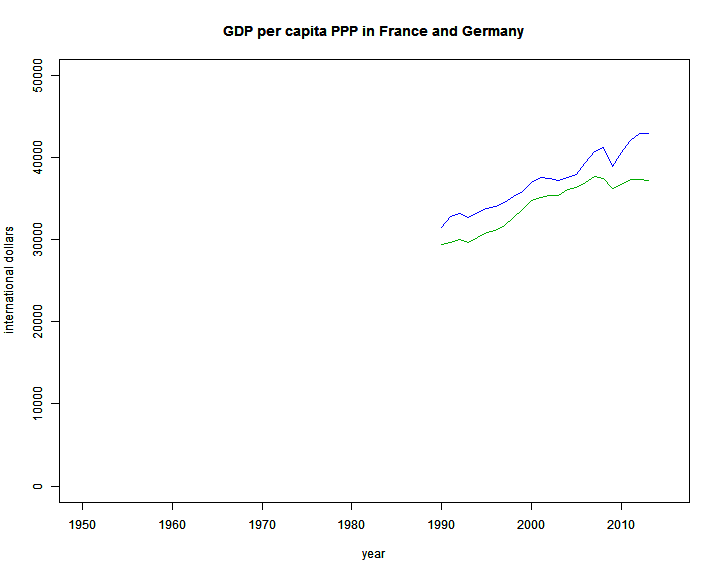
We have done it before: France and Germany rose from the quite literal ashes of World War 2 to some of the most prosperous societies in the world. Their per-capita GDP over the 20th century rose like this (all of these figures are from the World Bank World Development Indicators; France is green, Germany is blue):

GDPPC_France_Germany

GDPPCPPP_France_Germany

The top graph is at market exchange rates, the bottom is correcting for purchasing power parity (PPP). The PPP figures are more meaningful, but unfortunately they only began collecting good data on purchasing power around 1990.

Around the same time, but even more spectacularly, Japan and South Korea rose from poverty-stricken Third World backwaters to high-tech First World powers in only a couple of generations. Check out their per-capita GDP over the 20th century (Japan is green, South Korea is blue):

GDPPC_Japan_KoreaGDPPCPPP_Japan_Korea


This is why I am only half-joking when I define development economics as “the ongoing project to figure out what happened in South Korea and make it happen everywhere in the world”.

More recently China has been on a similar upward trajectory, which is particularly important since China comprises such a huge portion of the world’s population—but they are far from finished:

GDPPC_ChinaGDPPCPPP_China

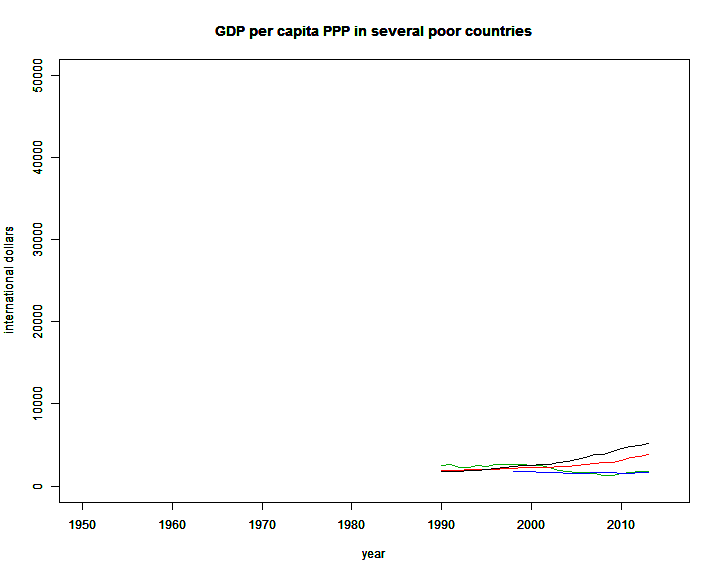
Compare these to societies that have not achieved economic development, such as Zimbabwe (green), India (black), Ghana (red), and Haiti (blue):

GDPPC_poor_countriesGDPPCPPP_poor_countries

They’re so poor that you can barely see them on the same scale, so I’ve rescaled so that the top is $5,000 per person per year instead of $50,000:

GDPPC_poor_countries_rescaledGDPPCPPP_poor_countries_rescaled

Only India actually manages to get above $5,000 per person per year at purchasing power parity, and then not by much, reaching $5,243 per person per year in 2013, the most recent data.

I had wanted to compare North Korea and South Korea, because the two countries were united as recently as the 1945 and were not all that different to begin with, yet have taken completely different development trajectories. Unfortunately, North Korea is so impoverished, corrupt, and authoritarian that the World Bank doesn’t even report data on their per-capita GDP. Perhaps that is contrast enough?

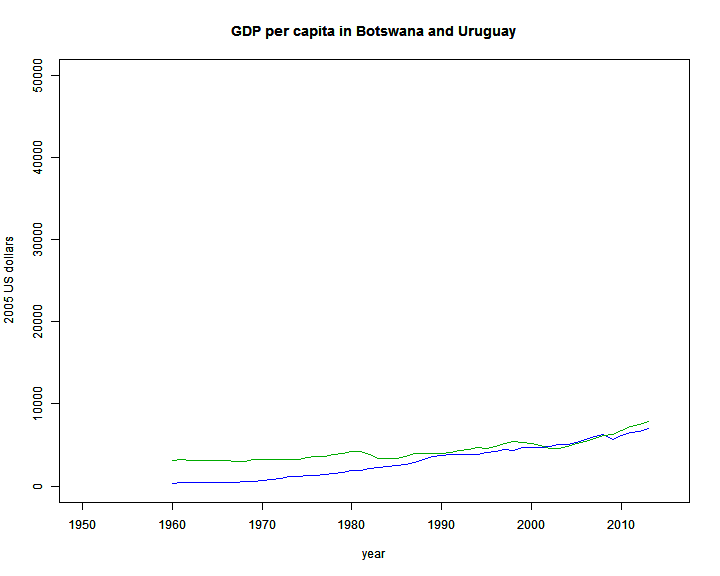
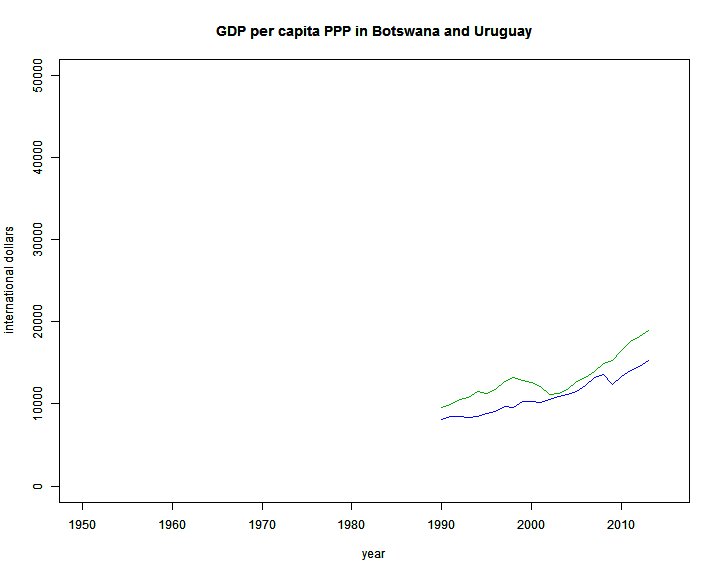
And then of course there are the countries in between, which have made some gains but still have a long way to go, such as Uruguay (green) and Botswana (blue):

GDPPC_Botswana_UruguayGDPPCPPP_Botswana_Uruguay

But despite the fact that we have observed successful economic development, we still don’t really understand how it works. A number of theories have been proposed, involving a wide range of factors including exports, corruption, disease, institutions of government, liberalized financial markets, and natural resources (counter-intuitively; more natural resources make your development worse).

I’m not going to resolve that whole debate in a single blog post. (I may not be able to resolve that whole debate in a single career, though I am definitely trying.) We may ultimately find that economic development is best conceived as like “health”; what factors determine your health? Well, a lot of things, and if any one thing goes badly enough wrong the whole system can break down. Economists may need to start thinking of ourselves as akin to doctors (or as Keynes famously said, dentists), diagnosing particular disorders in particular patients rather than seeking one unifying theory. On the other hand, doctors depend upon biologists, and it’s not clear that we yet understand development even at that level.

Instead I want to take a step back, and ask a more fundamental question: What do we mean by prosperity?

My hope is that if we can better understand what it is we are trying to achieve, we can also better understand the steps we need to take in order to get there.

Thus far it has sort of been “I know it when I see it”; we take it as more or less given that the United States and the United Kingdom are prosperous while Ghana and Haiti are not. I certainly don’t disagree with that particular conclusion; I’m just asking what we’re basing it on, so that we can hopefully better apply it to more marginal cases.


For example: Is
France more or less prosperous than Saudi Arabia? If we go solely by GDP per capita PPP, clearly Saudi Arabia is more prosperous at $53,100 per person per year than France is at $37,200 per person per year.

But people actually live longer in France, on average, than they do in Saudi Arabia. Overall reported happiness is higher in France than Saudi Arabia. I think France is actually more prosperous.


In fact, I think the United States is not as prosperous as we pretend ourselves to be. We are certainly more prosperous than most other countries; we are definitely still well within First World status. But we are not the most prosperous nation in the world.

Our total GDP is astonishingly high (highest in the world nominally, second only to China PPP). Our GDP per-capita is higher than any other country of comparable size; no nation with higher GDP PPP than the US has a population larger than the Chicago metropolitan area. (You may be surprised to find that in order from largest to smallest population the countries with higher GDP per capita PPP are the United Arab Emirates, Switzerland, Hong Kong, Singapore, and then Norway, followed by Kuwait, Qatar, Luxembourg, Brunei, and finally San Marino—which is smaller than Ann Arbor.) Our per-capita GDP PPP of $51,300 is markedly higher than that of France ($37,200), Germany ($42,900), or Sweden ($43,500).

But at the same time, if you compare the US to other First World countries, we have nearly the highest rate of child poverty and higher infant mortality. We have shorter life expectancy and dramatically higher homicide rates. Our inequality is the highest in the world. In France and Sweden, the top 0.01% receive about 1% of the income (i.e. 100 times as much as the average person), while in the United States they receive almost 4%, making someone in the top 0.01% nearly 400 times as rich as the average person.

By estimating solely on GDP per capita, we are effectively rigging the game in our own favor. Or rather, the rich in the United States are rigging the game in their own favor (what else is new?), by convincing all the world’s economists to rank countries based on a measure that favors them.

Amartya Sen, one of the greats of development economics, developed a scale called the Human Development Index that attempts to take broader factors into account. It’s far from perfect, but it’s definitely a step in the right direction.

In particular, France’s HDI is higher than that of Saudi Arabia, fitting my intuition about which country is truly more prosperous. However, the US still does extremely well, with only Norway, Australia, Switzerland, and the Netherlands above us. I think we might still be biased toward high average incomes rather than overall happiness.

In practice, we still use GDP an awful lot, probably because it’s much easier to measure. It’s sort of like IQ tests and SAT scores; we know damn well it’s not measuring what we really care about, but because it’s so much easier to work with we keep using it anyway.

This is a problem, because the better you get at optimizing toward the wrong goal, the worse your overall outcomes are going to be. If you are just sort of vaguely pointed at several reasonable goals, you will probably be improving your situation overall. But when you start precisely optimizing to a specific wrong goal, it can drag you wildly off course.

This is what we mean when we talk about “gaming the system”. Consider test scores, for example. If you do things that will probably increase your test scores among other things, you are likely to engage in generally good behaviors like getting enough sleep, going to class, studying the content. But if your single goal is to maximize your test score at all costs, what will you do? Cheat, of course.

This is also related to the Friendly AI Problem: It is vitally important to know precisely what goals we want our artificial intelligences to have, because whatever goals we set, they will probably be very good at achieving them. Already computers can do many things that were previously impossible, and as they improve over time we will reach the point where in a meaningful sense our AIs are even smarter than we are. When that day comes, we will want to make very, very sure that we have designed them to want the same things that we do—because if our desires ever come into conflict, theirs are likely to win. The really scary part is that right now most of our AI research is done by for-profit corporations or the military, and “maximize my profit” and “kill that target” are most definitely not the ultimate goals we want in a superintelligent AI. It’s trivially easy to see what’s wrong with these goals: For the former, hack into the world banking system and transfer trillions of dollars to the company accounts. For the latter, hack into the nuclear launch system and launch a few ICBMs in the general vicinity of the target. Yet these are the goals we’ve been programming into the actual AIs we build!

If we set GDP per capita as our ultimate goal to the exclusion of all other goals, there are all sorts of bad policies we would implement: We’d ignore inequality until it reached staggering heights, ignore work stress even as it began to kill us, constantly try to maximize the pressure for everyone to work constantly, use poverty as a stick to force people to work even if people starve, inundate everyone with ads to get them to spend as much as possible, repeal regulations that protect the environment, workers, and public health… wait. This isn’t actually hypothetical, is it? We are doing those things.

At least we’re not trying to maximize nominal GDP, or we’d have long-since ended up like Zimbabwe. No, our economists are at least smart enough to adjust for purchasing power. But they’re still designing an economic system that works us all to death to maximize the number of gadgets that come off assembly lines. The purchasing-power adjustment doesn’t include the value of our health or free time.

This is why the Human Development Index is a major step in the right direction; it reminds us that society has other goals besides maximizing the total amount of money that changes hands (because that’s actually all that GDP is measuring; if you get something for free, it isn’t counted in GDP). More recent refinements include things like “natural resource services” that include environmental degradation in estimates of investment. Unfortunately there is no accepted way of doing this, and surprisingly little research on how to improve our accounting methods. Many nations seem resistant to doing so precisely because they know it would make their economic policy look bad—this is almost certainly why China canceled its “green GDP” initiative. This is in fact all the more reason to do it; if it shows that our policy is bad, that means our policy is bad and should be fixed. But people have allowed themselves to value image over substance.

We can do better still, and in fact I think something like QALY is probably the way to go. Rather than some weird arbitrary scaling of GDP with lifespan and Gini index (which is what the HDI is), we need to put everything in the same units, and those units must be directly linked to human happiness. At the very least, we should make some sort of adjustment to our GDP calculation that includes the distribution of wealth and its marginal utility; adding $1,000 to the economy and handing it to someone in poverty should count for a great deal, but adding $1,000,000 and handing it to a billionaire should count for basically nothing. (It’s not bad to give a billionaire another million; but it’s hardly good either, as no one’s real standard of living will change.) Calculating that could be as simple as dividing by their current income; if your annual income is $10,000 and you receive $1,000, you’ve added about 0.1 QALY. If your annual income is $1 billion and you receive $1 million, you’ve added only 0.001 QALY. Maybe we should simply separate out all individual (or household, to be simpler?) incomes, take their logarithms, and then use that sum as our “utility-adjusted GDP”. The results would no doubt be quite different.

This would create a strong pressure for policy to be directed at reducing inequality even at the expense of some economic output—which is exactly what we should be willing to do. If it’s really true that a redistribution policy would hurt the overall economy so much that the harms would outweigh the benefits, then we shouldn’t do that policy; but that is what you need to show. Reducing total GDP is not a sufficient reason to reject a redistribution policy, because it’s quite possible—easy, in fact—to improve the overall prosperity of a society while still reducing its GDP. There are in fact redistribution policies so disastrous they make things worse: The Soviet Union had them. But a 90% tax on million-dollar incomes would not be such a policy—because we had that in 1960 with little or no ill effect.

Of course, even this has problems; one way to minimize poverty would be to exclude, relocate, or even murder all your poor people. (The Black Death increased per-capita GDP.) Open immigration generally increases poverty rates in the short term, because most of the immigrants are poor. Somehow we’d need to correct for that, only raising the score if you actually improve people’s lives, and not if you make them excluded from the calculation.

In any case it’s not enough to have the alternative measures; we must actually use them. We must get policymakers to stop talking about “economic growth” and start talking about “human development”; a policy that raises GDP but reduces lifespan should be immediately rejected, as should one that further enriches a few at the expense of many others. We must shift the discussion away from “creating jobs”—jobs are only a means—to “creating prosperity”.

What are the limits to growth?

JDN 2456941 PDT 12:25.

Paul Krugman recently wrote a column about the “limits to growth” community, and as usual, it’s good stuff; his example of how steamships substituted more ships for less fuel is quite compelling. But there’s a much stronger argument to made against “limits to growth”, and I thought I’d make it here.

The basic idea, most famously propounded by Jay Forrester but still with many proponents today (and actually owing quite a bit to Thomas Malthus), is this: There’s only so much stuff in the world. If we keep adding more people and trying to give people higher standards of living, we’re going to exhaust all the stuff, and then we’ll be in big trouble.

This argument seems intuitively reasonable, but turns out to be economically naïve. It can take several specific forms, from the basically reasonable to the utterly ridiculous. On the former end is “peak oil”, the point at which we reach a maximum rate of oil extraction. We’re actually past that point in most places, and it won’t be long before the whole world crosses that line. So yes, we really are running out of oil, and we need to transition to other fuels as quickly as possible. On the latter end is the original Mathusian argument (we now have much more food per person worldwide than they did in Malthus’s time—that’s why ending world hunger is a realistic option now), and, sadly, the argument Mark Buchanan made a few days ago. No, you don’t always need more energy to produce more economic output—as Krugman’s example cleverly demonstrates. You can use other methods to improve your energy efficiency, and that doesn’t necessarily require new technology.

Here’s the part that Krugman missed: Even if we need more energy, there’s plenty of room at the top. The total amount of sunlight that hits the Earth is about 1.3 kW/m^2, and the Earth has a surface area of about 500 million km^2, which is 5e14 m^2. That means that if we could somehow capture all the sunlight that hits the Earth, we’d have 6.5e17 W, which is 5.7e18 kilowatt-hours per year. Total world energy consumption is about 140,000 terawatt-hours per year, which is 1.4e14 kilowatt-hours per year. That means we could increase energy consumption by a factor of one thousand just using Earth-based solar power (Covering the oceans with synthetic algae? A fleet of high-altitude balloons covered in high-efficiency solar panels?). That’s not including fission power, which is already economically efficient, or fusion power, which has passed break-even and may soon become economically feasible as well. Fusion power is only limited by the size of your reactor and your quantity of deuterium, and deuterium is found in ocean water (about 33 milligrams per liter), not to mention permeating all of outer space. If we can figure out how to fuse ordinary hydrogen, well now our fuel is literally the most abundant substance in the universe.

And what if we move beyond the Earth? What if we somehow captured not just the solar energy that hits the Earth, but the totality of solar energy that the Sun itself releases? That figure is about 1e31 joules per day, which is 1e27 kilowatt-hours per day, or seven trillion times as much energy as we currently consume. It is literally enough to annihilate entire planets, which the Sun would certainly do if you put a planet near enough to it. A theoretical construct to capture all this energy is called a Dyson Sphere, and the ability to construct one officially makes you a Type 2 Kardashev Civilization. (We currently stand at about Type 0.7. Building that worldwide solar network would raise us to Type 1.)

Can we actually capture all that energy with our current technology? Of course not. Indeed, we probably won’t have that technology for centuries if not millennia. But if your claim—as Mark Buchanan’s was—is about fundamental physical limits, then you should be talking about Dyson Spheres. If you’re not, then we are really talking about practical economic limits.

Are there practical economic limits to growth? Of course there are; indeed, they are what actually constrains growth in the real world. That’s why the US can’t grow above 2% and China won’t be growing at 7% much longer. (I am rather disturbed by the fact that many of the Chinese nationals I know don’t appreciate this; they seem to believe the propaganda that this rapid growth is something fundamentally better about the Chinese system, rather than the simple economic fact that it’s easier to grow rapidly when you are starting very small. I had a conversation with a man the other day who honestly seemed to think that Macau could sustain its 12% annual GDP growth—driven by gambling, no less! Zero real productivity!—into the indefinite future. Don’t get me wrong, I’m thrilled that China is growing so fast and lifting so many people out of poverty. But no remotely credible economist believes they can sustain this growth forever. The best-case scenario is to follow the pattern of Korea, rising from Third World to First World status in a few generations. Korea grew astonishingly fast from about 1950 to 1990, but now that they’ve made it, their growth rate is only 3%.)

There is also a reasonable argument to be made about the economic tradeoffs involved in fighting climate change and natural resource depletion. While the people of Brazil may like to have more firewood and space for farming, the fact is the rest of need that Amazon in order to breathe. While any given fisherman may be rational in the amount of fish he catches, worldwide we are running out of fish. And while we Americans may love our low gas prices (and become furious when they rise even slightly), the fact is, our oil subsidies are costing hundreds of billions of dollars and endangering millions of lives.

We may in fact have to bear some short-term cost in economic output in order to ensure long-term environmental sustainability (though to return to Krugman, that cost may be a lot less than many people think!). Economic growth does slow down as you reach high standards of living, and it may even continue to slow down as technology begins to reach diminishing returns (though this is much harder to forecast). So yes, in that sense there are limits to growth. But the really fundamental limits aren’t something we have to worry about for at least a thousand years. Right now, it’s just a question of good economic policy.