You call this a hobby?

Nov 9 JDN 2460989

A review of Politics is for Power by Eitan Hersch

This week, there was an election. It’s a minor midterm election—since it’s an odd-numbered year, many places don’t even have any candidates on the ballot—and as a result, turnout will surely be low. Eitan Hersch has written a book about why that’s a bad thing, and how it is symptomatic of greater problems in our civic culture as a whole.

Buried somewhere in this book, possible to find through committed, concerted effort, there is a book that could have had a large positive effect on our political system, our civic discourse, and our society as a whole. Sadly, Dr. Hersch buried it so well that most people will never find it.

In particular, he starts the booknot even on the first page, but on the cover—by actively alienating his core audience with what seems to be the very utmost effort he can muster.


Yes, even the subtitle is condescending and alienating:

How to Move Beyond Political Hobbyism, Take Action, and Make Real Change

And of course it’s not just there; on page after page he drives the dagger deeper and twists it as hard as he can, repeating the accusation over and over:

This is just a hobby for you. It doesn’t really mean anything.

Today’s hobbyists possess the negative qualities of the amateurs—hyperemotional engagement, obsession with national politics, an insatiable appetite for debate—and none of the amateur’s positive qualities—the neighborhood meetings, the concrete goals, the leadership.

– p.9

You hear that? You’re worse than an amateur. This is on page 9. Page 9.

[…] Much of the time we spend on politics is best described as an inward-focused leisure activity for people who like politics.

We may not easily concede that we are doing politics for fun.[…]

-p. 14

See? You may say it’s not really just for fun, but you’re lying. You’re failing to concede the truth.

To the political hobbyist, news is a form of entertainment and needs to be fun.

-p.19

You hear me? This is fun for you. You’re enjoying this. You’re doing it for yourself.

The real explanation for the dynamics of voter turnout is that we treat politics like a game and follow the spectacle. Turnout is high in presidential elections compared to other US elections in the same way that football viewership is high when the Super Bowl is on. Many people who do not like football or even know the rules of the game end up at a Super Bowl party. They’re there for the commercials, the guacamole, and to be part of a cultural moment. That’s why turnout is high in presidential elections. Without the spectacle, even people who say they care about voting don’t show up.

-p. 48

This is all a game. It’s not real. You don’t really care.

I could go on; he keeps repeating this message—this insult, this accusation—throughout the book. He tells you, over and over, that if you are not already participating in politics in the very particular way he wants you to (and he may even be right that it would be better!), you are a selfish liar, and you are treating what should be vitally important as just meaningless entertainment.

This made it honestly quite painful to get through the book. Several times, I was tempted to just give up and put it back on the shelf. But I’m glad I didn’t, because there are valuable insights about effective grassroots political activism buried within this barrage of personal accusations.

I guess Hersch must not see this as a personal accusation; at one point, he acknowledges that people might find it insulting, but (1) doesn’t seem to care and (2) makes no effort to inquire as to why we might feel that way; in fact, he manages to twist the knife just a little deeper in that very same passage:

For the non-self-identifying junkies, the term political hobbyist can be insulting. Given how important politics is, it doesn’t feel good to call one’s political activity a hobby. The term is also insulting, I have learned, to real hobbyists, who see hobbies as activities with much more depth than the online bickering or addictive news consumption I’m calling a hobby.

-p. 88

You think calling it a “hobby” is insulting? Yeah, well, it’s worse than that, so ha!

But let me tell you something about my own experience of politics. (Actually, one of Hersch’s central messages is that sharing personal experiences is one of the most powerful political tools I know.)

How do most people I know feel about politics, since, oh, say… November 2016?

ABSOLUTE HORROR AND DESPAIR.

For every queer person I know, every trans person, every immigrant, every woman, every person of color, and for plenty of White cishet liberal guys too, the election of President Donald Trump was traumatic. It felt like a physical injury. People who had recovered from depression were thrust back into it. People felt physically nauseated. And especially for immigrants and trans people, people literally feared for their lives and were right to do so.

WHATEVER THIS IS, IT IS NOT A HOBBY.

I’ve had to talk people down from psychotic episodes and suicidal ideation because of this, and you have the fucking audacity to tell me that we’re doing this for fun!?

If someone feared for their life because their team lost the Super Bowl, we would rightfully recognize that as an utterly pathological response. But I know a whole bunch of folks on student visas that are constantly afraid of being kidnapped and taken away by masked men with guns, because that is a thing that has actually happened to other people who were in this country on student visas. I know a whole bunch of trans folks who are afraid of assaulted or even killed for using the wrong bathroom, because that is a thing that actually happens to trans people in this country.

I wish I could tell these people—many of them dear friends of mine—that they are wrong to fear, that they are safe, that everything will be all right. But as long as Donald Trump is in power and the Republicans in Congress and the right-wing Supreme Court continue to enable him, I can’t tell them that, because I would be lying; the danger is real. All I can do is tell them that it is probably not as great a danger as they fear, and that if there is any way I can help them, I am willing to do so.

Indeed, politics for me and those closest to me is so obviously so much not a hobby that repeatedly insisting that I admit that it is starts to feel like gaslighting. I feel like I’m in a struggle session or something: “Admit you are a hobbyist! Repent!”

I don’t know; maybe there are people for whom politics is just a hobby. Maybe the privileged cishet White kids at Tufts that Dr. Hersch lectures to are genuinely so removed from the consequences of public policy that they can engage with politics at their leisure and for their own entertainment. (A lot of the studies he cites are specifically about undergrads; I know this is a thing in pretty much all social science… but maybe undergrads are in fact not a very representative sample of political behavior?) But even so, some of the international students in those lecture halls (11% of Tufts undergrads and 17% of Tufts grads) probably feel pretty differently, I have to imagine.

In fact, maybe genuine political hobbyism is a widespread phenomenon, and its existence explains a lot of otherwise really baffling things about the behavior of our electorate (like how the same districts could vote for both Donald Trump and Alexandria Ocasio-Cortez). I don’t find that especially plausible given my own experience, but I’m an economist, not a political scientist, so I do feel like I should offer some deference to the experts on this matter. (And I’m well aware that my own social network is nothing like a representative sample of the American electorate.)

But I can say this for sure:

The target audience of this book is not doing this as a hobby.

Someone who picks up a book by a political scientist hoping for guidance as to how to make their own political engagement more effective is not someone who thinks this is all a game. They are not someone who is engaging with politics as a fun leisure activity. They are someone who cares. They are someone who thinks this stuff matters.

By construction, the person who reads this book to learn about how to make change wants to make change.

So maybe you should acknowledge that at some point in your 200 pages of text? Maybe after spending all these words talking about how having empathy is such an important trait in political activism, you should have some empathy for your audience?

Hersch does have some useful advice to give, buried in all this.

His core message is basically that we need more grassroots activism: Small groups of committed people, acting in their communities. Not regular canvassing, which he acknowledges as terrible (and as well he should; I’ve done it, and it is), but deep canvassing, which also involves going door to door but is really a fundamentally different process.

Actually, he seems to love grassroots organizing so much that he’s weirdly nostalgic for the old days of party bosses. Several times, he acknowledges that these party bosses were corrupt, racist, and utterly unaccountable, but after every such acknowledgment he always follows it up with some variation on “but at least they got things done”.

He’s honestly weirdly dismissive of other forms of engagement, though. Like, I expected him to be dismissive of “slacktivism” (though I am not), if for no other reason than the usual generational curmudgeonry. But he’s also weirdly dismissive of donations and even… honestly… voting? He doesn’t even seem interested in encouraging people to vote more. He doesn’t seem to think that get-out-the-vote campaigns are valuable.

I guess as a political scientist, he’s probably very familiar with the phenomenon of “low information voters”, who frequently swing elections despite being either clueless or actively misled. And okay, maybe turning out those people isn’t all that useful, at least if it’s not coupled with also educating them and correcting their misconceptions. But surely it’s not hobbyism to vote? Surely doing the one most important thing in a democratic system isn’t treating this like a game?

In his section on donations, he takes two tacks against them:

The first is to say that rich donors who pay $10,000 a plate for fancy dinners really just want access to politicians for photo ops. I don’t think that’s right, but the truth is admittedly not much better: I think they want access to politicians to buy influence. This is “political engagement” in some sense—you’re acting to exert power—but it’s corrupt, and it’s the source of an enormous amount of damage to our society—indeed to our planet itself. But I think Hersch has to deny that the goal is influence, because that would in fact be “politics for power”, and in order to remain fiercely non-partisan throughout (which, honestly, probably is a good strategic move), he carefully avoids ever saying that anyone exerting political power is bad.

Actually the closest he gets to admitting his own political beliefs (surprise, the Massachusetts social science professor is a center-left liberal!) comes in a passage where he bemoans the fact that… uh… Democrats… aren’t… corrupt enough? If you don’t believe me, read it for yourself:

The hobbyist motivation among wealthy donors is also problematic for a reason that doesn’t have a parallel in the nonprofit world: Partisan asymmetry. Unlike Democratic donors, Republican donors typically support politicians whose policy priorities align with a wealthy person’s financial interests. The donors can view donations as an investment. When Schaffner and I asked max-out donors why they made their contribution, many more Republicans than Democrats said that a very or extremely important reason for their gift was that the politician could affect the donor’s own industry (37 percent of Republicans versus 22 percent of Democrats).

This asymmetry puts Democrats at a disadvantage. Not motivated by their own bottom line, Democratic donors instead have to be motivated by ideology, issues, or even by the entertainment value that a donation provides.

-p.80

Yes, God forbid they be motivated by issues or ideology. That would involve caring about other people. Clearly only naked self-interest and the profit motive could ever be a good reason for political engagement! (Quick question: You haven’t been, uh, reading a lot of… neoclassical economists lately, have you? Why? Oh, no reason.) Oh why can’t Democrats just be more like Republicans, and use their appallingly vast hoards of money to make sure that we cut social services and deregulate everything until the polluted oceans flood the world!?

The second is to say that the much broader population who makes small donations of $25 or $50 is “ideologically extreme” compared to the rest of the population, which is true, but seems to me utterly unsurprising. The further the world is from how you’d like to see it, the greater the value is to you of changing the world, and therefore the more you should be willing to invest into making that change—or even into a small probability of possibly making that change. If you think things are basically okay, why would you pay money to try to make them different? (I guess maybe you’d try to pay money to keep them the same? But even so-called “conservatives” never actually seem to campaign on that.)

I also don’t really see “ideologically extreme” as inherently a bad thing.

Sure, some extremists are very bad: Nazis are extreme and bad (weird that this seems controversial these days), Islamists are extreme and bad, Christian nationalists are extreme and bad, tankie leftists are extreme and bad.

But vegetarians—especially vegans—are also “ideologically extreme”, but quite frankly we are objectively correct, and maybe don’t even go far enough (I only hope that future generations will forgive me for my cheese). Everyone knows that animals can suffer, and everyone who is at all informed knows that factory farms make them suffer severely. The “moderate” view that all this horrible suffering is justifiable in the name of cheap ground beef and chicken nuggets is a fundamentally immoral one. (Maybe I could countenance a view that free-range humane meat farming is acceptable, but even that is far removed from our current political center.)

Trans activism is in some sense “ideologically extreme”—and frequently characterized as such—but it basically amounts to saying that the human rights of free expression, bodily autonomy, and even just personal safety outweigh other people’s narrow, blinkered beliefs about sex and gender. Okay, maybe we can make some sort of compromise on trans kids in sports (because why should I care about sports?), and I’m okay with gender-neutral bathrooms instead of letting trans women in women’s rooms (because gender-neutral bathrooms give more privacy and safety anyway!), and the evidence on the effects of puberty blockers and hormones is complicated (which is why it should be decided by doctors and scientists, not by legislators!), but in our current state, trans people die to murder and suicide at incredibly alarming rates. The only “moderate” position here is to demand, at minimum, enforced laws against discrimination and hate crimes. (Also, calling someone by the name and pronouns they ask you to costs you basically nothing. Failing to do that is not a brave ideological stand; it’s just you being rude and obnoxious. Indeed, since it can trigger dysphoria, it’s basically like finding out someone’s an arachnophobe and immediately putting a spider in their hair.)

Open borders is regarded as so “ideologically extreme” that even the progressive Democrats won’t touch it, despite the fact that I literally am not aware of a single ethical philosopher in the 21st century who believes that our current system of immigration control is morally justifiable. Even the ones who favor “closed borders” in principle are almost unanimous that our current system is cruel and racist. The Lifeboat Theory is ridiculous; allowing immigrants in wouldn’t kill us, it would just maybe—maybe—make us a little worse off. Their lives may be at stake, but ours are not. We are not keeping people out of a lifeboat so it doesn’t sink; we are keeping them out of a luxury cruise liner so it doesn’t get dirty and crowded.

Indeed, even so-called “eco-terrorists”, who are not just ideologically extreme but behaviorally extreme as well, don’t even really seem that bad. They are really mostly eco-vandals; they destroy property, they don’t kill people. There is some risk to life and limb involved in tree spiking or blowing up a pipeline, but the goal is clearly not to terrorize people; it’s to get them to stop doing a particular thing—a particular thing that they in fact probably should stop doing. I guess I understand why this behavior has to be illegal and punished as such; but morally, I’m not even sure it’s wrong. We may not be able to name or even precisely count the children saved who would have died if that pipeline had been allowed to continue pumping oil and thus spewing carbon emissions, but that doesn’t make them any less real.

So really, if anything, the problem is not “extremism” in some abstract sense, but particular beliefs and ideologies, some of which are not even regarded as extreme. A stronger vegan lobby would not be harmful to America, however “extreme” they might be, and a strong Republican lobby, however “mainstream” it is perceived to be, is rapidly destroying our nation on a number of different levels.

Indeed, in parts of the book, it almost seems like Hersch is advocating in some Nietzschean sense for power for its own sake. I don’t think that’s really his intention; I think he means to empower the currently disempowered, for the betterment of society as a whole. But his unwillingness to condemn rich Republicans who donate the maximum allowed in order to get their own industry deregulated is at least… problematic, as both political activists and social scientists are wont to say.

I’m honestly not even sure that empowering the disempowered is what we need right now. I think a lot of the disempowered are also terribly misinformed, and empowering them might actually make things worse. In fact, I think the problem with the political effect of social media isn’t that it has failed to represent the choices of the electorate, but that it has represented them all too well and most people are really, really bad—just, absolutely, shockingly, appallingly bad—at making good political choices. They have wildly wrong beliefs about really basic policy questions, and often think that politicians’ platforms are completely different from what they actually are. I don’t go quite as far as this article by Dan Williams in Conspicuous Cognition, but it makes some really good points I can’t ignore. Democracy is currently failing to represent the interests of a great many Americans, but a disturbingly large proportion of this failure must be blamed on a certain—all too large—segment of the American populace itself.

I wish this book had been better.

More grassroots organizing does seem like a good thing! And there is some advice in this book about how to do it better—though in my opinion, not nearly enough. A lot of what Hersch wants to see happen would require tremendous coordination between huge numbers of people, which almost seems like saying “politics would be better if enough people were better about politics”. What I wanted to hear more about was what I can do; if voting and donating and protesting and blogging isn’t enough, what should I be doing? How do I make it actually work? It feels like Hersch spent so long trying to berate me for being a “hobbyist” that he forgot to tell me what he actually thinks I should be doing.

I am fully prepared to believe that online petitions and social media posts don’t accomplish much politically. (Indeed, I am fully prepared to believe that blogging doesn’t accomplish much politically.) I am open to hearing what other options are available, and eager for guidance about how to have the most effective impact.

But could you please, please not spend half the conversation repeatedly accusing me of not caring!?

For my mother, on her 79th birthday

Sep 21 JDN 2460940

When this post goes live, it will be mother’s 79th birthday. I think birthdays are not a very happy time for her anymore.

I suppose nobody really likes getting older; children are excited to grow up, but once you hit about 25 or 26 (the age at which you can rent a car at the normal rate and the age at which you have to get your own health insurance, respectively) and it becomes “getting older” instead of “growing up”, the excitement rapidly wears off. Even by 30, I don’t think most people are very enthusiastic about their birthdays. Indeed, for some people, I think it might be downhill past 21—you wanted to become an adult, but you had no interest in aging beyond that point.

But I think it gets worse as you get older. As you get into your seventies and eighties, you begin to wonder which birthday will finally be your last; actually I think my mother has been wondering about this even earlier than that, because her brothers died in their fifties, her sister died in her sixties, and my father died at 63. At this point she has outlived a lot of people she loved. I think there is a survivor’s guilt that sets in: “Why do I get to keep going, when they didn’t?”

These are also very hard times in general; Trump and the people who enable him have done tremendous damage to our government, our society, and the world at large in a shockingly short amount of time. It feels like all the safeguards we were supposed to have suddenly collapsed and we gave free rein to a madman.

But while there are many loved ones we have lost, there are many we still have; and nor need our set of loved ones be fixed, only to dwindle with each new funeral. We can meet new people, and they can become part of our lives. New children can be born into our family, and they can make our family grow. It is my sincere hope that my mother still has grandchildren yet to meet; in my case they would probably need to be adopted, as the usual biological route is pretty much out of the question, and surrogacy seems beyond our budget for the foreseeable future. But we would still love them, and she could still love them, and it is worth sticking around in this world in order to be a part of their lives.

I also believe that this is not the end for American liberal democracy. This is a terrible time, no doubt. Much that we thought would never happen already has, and more still will. It must be so unsettling, so uncanny, for someone who grew up in the triumphant years after America helped defeat fascism in Europe, to grow older and then see homegrown American fascism rise ascendant here. Even those of us who knew history all too well still seem doomed to repeat it.

At this point it is clear that victory over corruption, racism, and authoritarianism will not be easy, will not be swift, may never be permanent—and is not even guaranteed. But it is still possible. There is still enough hope left that we can and must keep fighting for an America worth saving. I do not know when we will win; I do not even know for certain that we will, in fact, win. But I believe we will.

I believe that while it seems powerful—and does everything it can to both promote that image and abuse what power it does have—fascism is a fundamentally weak system, a fundamentally fragile system, which simply cannot sustain itself once a handful of critical leaders are dead, deposed, or discredited. Liberal democracy is kinder, gentler—and also slower, at times even clumsier—than authoritarianism, and so it may seem weak to those whose view of strength is that of the savanna ape or the playground bully; but this is an illusion. Liberal democracy is fundamentally strong, fundamentally resilient. There is power in kindness, inclusion, and cooperation that the greedy and cruel cannot see. Fascism in Germany arrived and disappeared within a generation; democracy in America has stood for nearly 250 years.

We don’t know how much more time we have, Mom; none of us do. I have heard it said that you should live your life as though you will live both a short life and a long one; but honestly, you should probably live your life as though you will live a randomly-decided amount of time that is statistically predicted by actuarial tables—because you will. Yes, the older you get, the less time you have left (almost tautologically); but especially in this age of rapid technological change, none of us really know whether we’ll die tomorrow or live another hundred years.

I think right now, you feel like there isn’t much left to look forward to. But I promise you there is. Maybe it’s hard to see right now; indeed, maybe you—or I, or anyone—won’t even ever get to see it. But a brighter future is possible, and it’s worth it to keep going, especially if there’s any way that we might be able to make that brighter future happen sooner.

What’s the deal with Trump supporters?

Jul 28 JDN 2460520


I have never understood how this Presidential election is a close one. On the one hand, we have a decent President with many redeeming qualities who has done a great job, but is getting old; on the other hand, we have a narcissistic, authoritarian con man (who is almost as old). It should be obvious who the right choice is here.

And yet, half the country disagrees. I really don’t get it. Other Republican candidates actually have had redeeming qualities, and I could understand why someone might support them; but Trump has basically none.

I have even asked some of my relatives who support Trump why they do, what they see in him, and I could never get a straight answer.

I now think I know why: They don’t want to admit the true answer.

Political scientists have been studying this, and they’ve come to some very unsettling conclusions. The two strongest predictors of support for Trump are authoritarianism and hatred of minorities.

In other words, people support Trump not in spite of what makes him awful, but because of it. They are happy to finally have a political publicly supporting their hateful, bigoted views. And since they believe in authoritarian hierarchy, his desire to become a dictator doesn’t worry them; they may even welcome it, believing that he’ll use that power to hurt the right people. They like him because he promises retribution against social change. He also uses a lot of fear-mongering.

This isn’t the conclusion I was hoping for. I wanted there to be something sympathetic, some alternative view of the world that could be reasoned with. But when bigotry and authoritarianism are the main predictors of a candidate’s support, it seems that reasonableness has pretty much failed.

I wanted there to be something I had missed, something I wasn’t seeing about Trump—or about Biden—that would explain how good, reasonable people could support the former over the latter. But the data just doesn’t seem to show anything. There is an urban/rural divide; there is a generational divide; and there is an educational divide. Maybe there’s something there; certainly I can sympathize with old people in rural areas with low education. But by far the best way to tell whether someone supports Trump is to find out whether they are racist, sexist, xenophobic, and authoritarian. How am I supposed to sympathize with that? Where can we find common ground here?

There seems to be something deep and primal that motivates Trump supporters: Fear of change, tribal identity, or simply anger. It doesn’t seem to be rational. Ask them what policies Trump has done or plans to do that they like, and they often can’t name any. But they are certain in their hearts that he will “Make America Great Again”.

What do we do about this? We can win this election—maybe—but that’s only the beginning. Somehow we need to root out the bigotry that drives support for Trump and his ilk, and I really don’t know how to do that.

I don’t know what else to say here. This all feels so bleak. This election has become a battle for the soul of America: Are we a pluralistic democracy that celebrates diversity, or are we a nation of racist, sexist, xenophobic authoritarians?

Did we push too hard, too fast for social change? Did we leave too many people behind, people who felt coerced into compliance rather than persuaded of our moral correctness? Is this a temporary backlash that we can bear as the arc of the moral universe bends toward justice? Or is this the beginning of a slow and agonizing march toward neo-fascism?

I have never feared Trump himself nearly so much as I fear a nation that could elect him—especially one that could re-elect him.

The worst is not inevitable

Jul 14 JDN 2460506

As I write this, the left has just won two historic landslide victories: In France, where a coalition of left-wing parties set aside their differences and prevailed; and in the UK, where the Labour Party just curb-stomped all competition.

Many commentators had been worried that the discredited center-right parties in these countries had left a power vacuum that would be filled by far-right parties like France’s National Rally, but this isn’t what happened. Voters showed up to the polls, and they voted out the center-right all right; but what they put in its place was the center-left, not the far-right.

The New York Times is constitutionally incapable of celebrating anything, so they immediately turned to worries that “turnout was low” and this indicates “an unhappy Britain”. Honestly this seems to be a general failing of journalists: They can’t ever say anything is good. Their entire view of the world is based around “if it bleeds, it leads”. I’m assuming this has something to do with incentives created by the market of news consumers, but it also seems to be an entrenched social norm among journalists themselves. The world must be getting worse, in every way, or if it’s obviously not, we don’t talk about those things—because good things just aren’t news. (Look no further than the fact we now have the lowest global homicide rates in the history of the human race. What, you didn’t realize we had that right now? Could that perhaps be because literally no news source even mentioned it, ever?)

Now, to be fair, turnout was low, and far-right parties did win some representation, and any kind of sudden political shift indicates some kind of public dissatisfaction… but for goodness’ sake, can we take the win for once?

These elections are proof that the free world’s slide into far-right authoritarianism doesn’t have to be inevitable. We can fight it, we are fighting it—and sometimes, we actually win.

So let’s not give up hope in the United States, either. Yes, polls of the Biden/Trump election don’t look great right now; Trump seems to have a slight lead, and it’s way too close for comfort. But we don’t need to roll over and die. The left can win, when we band together well enough; and if France and Britain can pull it off, I don’t see why we can’t too.

And don’t tell me they had way better candidates. The new UK Prime Minister is not a particularly appealing or charismatic candidate. I frankly don’t even like him. He either is a TERF, or is at least willing to capitulate to them. (He also underestimates the number of trans women by about an order of magnitude.) But he won, because the Labour Party won, and he happened to be the Labour Party leader at the time.

Biden is old. Sure. So is Trump. And if it turns out that Biden is really unhealthy, guess what? That means he’ll die or resign and we get a woman of color as President instead. I don’t see eye-to-eye with Kamala Harris on everything, but I don’t see her taking office as a horrible outcome. It’s certainly a hundred times better than what happens if we let Trump win.

Are there better candidates out there? Theoretically, sure. But unless one of them manages to win nomination by one of the two leading parties, that doesn’t matter. Because in a first-past-the-post voting system, you either vote for one of the top two, or you waste your vote. I’m sorry. It sucks. I want a new voting system too. I know exactly which one we could use that would be a hundred times better. But we’re not going to get it by refusing to vote altogether.

We might get a better voting system by voting strategically for candidates who are open to the idea—which at this juncture clearly means Democrats, not Republicans. (At this point in history, Republicans don’t seem entirely convinced that we should decide things democratically in the first place.)There are also other forms of activism we can use, independent of voting. But not voting isn’t a form of activism, and we should stop acting like it is. Not voting is the lazy, selfish, default option. It’s what you’d do if you were a neoclassical rational agent who cares not in the least for his fellow human beings. You should never be proud of not voting. You’re not sending a message; you’re shirking your civic responsibility.

Voting isn’t writing a love letter. It isn’t signing a form endorsing everything a candidate has ever done or ever will do. If you think of it that way, you’re going to never want to vote—and thus you’re going to give up the most important power you have as a citizen of a democracy.

Voting is a decision. It’s choosing one alternative over another. Like any decision in the real world, there will almost never be a perfect option. There will only be better or worse options. Sometimes, even, you’ll feel that there are only bad options, and you are choosing the least-bad option. But you still have to choose the least-bad option, because literally everything else is worse—including doing nothing.

So get out there and try to help Biden win. Not because you love Biden, but because it’s your civic duty. And if enough people do it, we can still win this.

The rise and plateau of China’s economy

Sep 3 JDN 2460191

It looks like China’s era of extremely rapid economic growth may be coming to an end. Consumer confidence in China cratered this year (and, in typical authoritarian fashion, the agency responsible just quietly stopped publishing the data after that). Current forecasts have China’s economy growing only about 4-5% this year, which would be very impressive for a First World country—but far below the 6%, 7%, even 8% annual growth rates China had in recent years.

Some slowdown was quite frankly inevitable. A surprising number of people—particularly those in or from China—seem to think that China’s ultra-rapid growth was something special about China that could be expected to continue indefinitely.

China’s growth does look really impressive, in isolation:

But in fact this is a pattern we’ve seen several times now (admittedly mostly in Asia): A desperately poor Third World country finally figures out how to get its act together, and suddenly has extremely rapid growth for awhile until it manages to catch up and become a First World country.

It happened in South Korea:

It happened in Japan:

It happened in Taiwan:

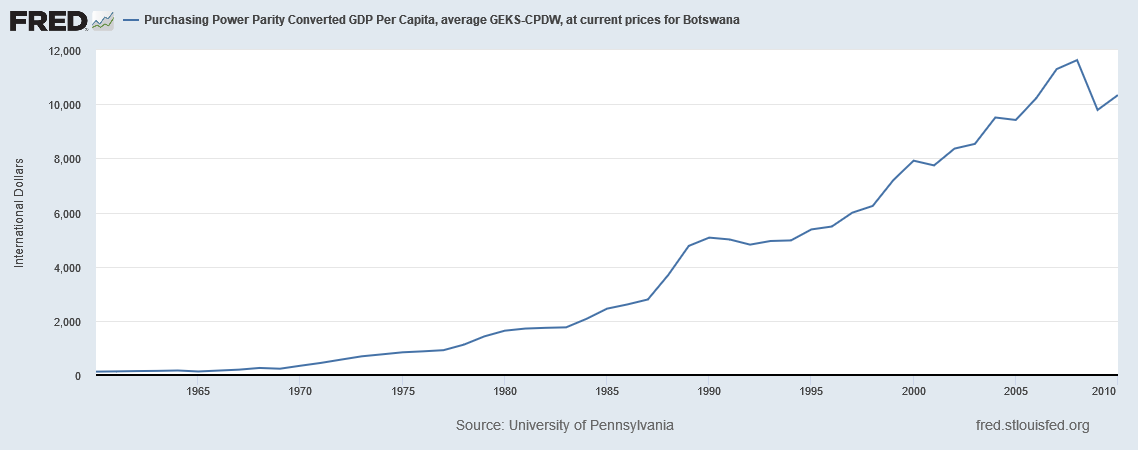
It even seems to be happening in Botswana:

And this is a good thing! These are the great success stories of economic development. If we could somehow figure out how to do this all over the world, it might literally be the best thing that ever happened. (It would solve so many problems!)

Here’s a more direct comparison across all these countries (as well as the US), on a log scale:

From this you can pretty clearly see two things.

First, as countries get richer, their growth tends to slow down gradually. By the time Japan, Korea, and Taiwan reached the level that the US had been at back in 1950, their growth slowed to a crawl. But that was okay, because they had already become quite rich.

And second, China is nothing special: Yes, their growth rate is faster than the US, because the US is already so rich. But they are following the same pattern as several other countries. In fact they’ve actually fallen behind Botswana—they used to be much richer than Botswana, and are now slightly poorer.

So while there are many news articles discussing why China’s economy is slowing down, and some of them may even have some merit (they really seem to have screwed up their COVID response, for instance, and their terrible housing price bubble just burst); but the ultimate reason is really that 7% annual economic growth is just not sustainable. It will slow down. When and how remains in question—but it will happen.

Thus, I am not particularly worried about the fact that China’s growth has slowed down. Or at least, I wouldn’t be, if China were governed well and had prepared for this obvious eventuality the way that Korea and Japan did. But what does worry me is that they seem unprepared for this. Their authoritarian government seems to have depended upon sky-high economic growth to sustain support for their regime. The cracks are now forming in that dam, and something terrible could happen when it bursts.

Things may even be worse than they look, because we know that the Chinese government often distorts or omits statistics when they become inconvenient. That can only work for so long: Eventually the reality on the ground will override whatever lies the government is telling.

There are basically two ways this could go: They could reform their government to something closer to a liberal democracy, accept that growth will slow down and work toward more shared prosperity, and then take their place as a First World country like Japan did. Or they could try to cling to their existing regime, gripping ever tighter until it all slips out of their fingers in a potentially catastrophic collapse. Unfortunately, they seem to be opting for the latter.

I hope I’m wrong. I hope that China will find its way toward a future of freedom and prosperity.

But at this point, it doesn’t look terribly likely.

Voting Your Dollars

May 28 JDN 2460093

It’s no secret that Americans don’t like to pay taxes. It’s almost a founding principle of our country, really, going all the way back to the Boston Tea Party. This is likely part of why the US has one of the lowest tax-to-GDP ratios in the First World; our taxes are barely half what they pay in Scandinavia. And this in turn surely contributes to our ongoing budget issues and our stingy social welfare spending. (Speaking of budget issues: As of this writing, the debt ceiling debacle is still unresolved.)

Why don’t Americans like to pay taxes? Why does no one really like to pay taxes (though some seem more willing than others)?

It surely has something to do with the fact that taxes are so coercive: You have to pay them, you get no choice. And you also have very little choice as to how that money is used; yes, you can vote for politicians who will in theory at some point enact budgets that might possibly reflect the priorities they expressed in their campaigns—but the actual budget invariably ends up quite far removed from the campaign promises you could vote based on.

What if we could give you more choice? We can’t let people choose how much to pay—then most people would choose to pay less and we’d be in even more trouble. (If you want to pay more than you’re required to, the IRS will actually let you right now. You can just refuse your refund.) But perhaps we could let people choose where the money goes?

I call this program Vote Your Dollars. I would initially limit it to a small fraction of the budget, tied to a tax increase: Say, raise taxes enough to increase revenue by 5% and use that 5% for the program.

Under Vote Your Dollars, on your tax return, you are given a survey, asking you how you want to divide up your additional money toward various categories. I think they should be fairly broad categories, such as ‘healthcare’, ‘social security’, ‘anti-poverty programs’, ‘defense’, ‘foreign aid’. If we make them too specific, it would be more work for the voters and also more likely to lead to foolish allocations. We want them to basically reflect a voter’s priorities, rather than ask them to make detailed economic management decisions. Most voters are not qualified to properly allocate a budget; the goal here is to get people to weight how much they care about different programs.

As only a small portion of the budget, Vote Your Dollars would initially have very little real fiscal impact. Money is fungible, so any funds that were expected to go somewhere else than where voters put them could easily be reallocated as needed. But I suspect that most voters would fail to appreciate this effect, and thus actually feel like they have more control than they really do. (If voters understood fungibility and inframarginal transfers, they’d never have supported food stamps over just giving poor people cash.)

Moreover, it would still provide useful information, namely: What happens when voters are given this power? Do they make decisions that seem to make sense and reflect their interests and beliefs? Does the resulting budget actually seem like one that could be viable? Could it even be better than what we currently have in some ways?

I suspect that the result would be better than most economists and political scientists imagine. There seems to be a general sense that voters are too foolish or apathetic to usefully participate in politics, which of course would raise the very big question: Why does democracy work?

I don’t think that most voters would choose a perfect budget; indeed, I already said I wouldn’t trust them with the fine details of how to allocate the funds. But I do think most people have at least some reasonable idea of how important they think healthcare is relative to defense, and it would be good to at least gather that information in a more direct way.

If it goes well and Vote Your Dollars seems to result in reasonable budgets even for that extra 5%, we could start expanding it to a larger portion of the overall budget. Try 10% for the next election, then 15% for the next. There should always be some part that remains outside direct voter control, because voters would almost certainly underspend on certain categories (such as administration and national debt payments) and likely overspend on others.

This would allow us to increase taxes—which we clearly must do, because we need to improve government services, but we don’t want to go further into debt—while giving voters more choice, and thus making taxes feel less coercive. Being forced to pay a certain amount each year might not sting as much if you get to say where a significant portion of that money goes.

To give voters even more control over their money, I think I would also include a provision whereby you can deduct the full amount of your charitable contributions to certain high-impact charities (we would need to come up with a good list, but clear examples include UNICEF, Oxfam, and GiveWell) from your tax payment. Currently, you deduct charitable contributions from your income, which means you don’t pay taxes on those donations; but you still end up with less money after donating than you did before. If we let you deduct the full amount, then you would have the same amount after donating, and effectively the government would pay the full cost of your donation. Presumably this would lead to people donating a great deal; this might hurt tax revenues, but its overall positive impact on the world would be so large that it is obviously worth it. By the time we have given enough to UNICEF to meaningfully impact the US federal budget, we have ended world hunger.

Of course, it’s very unlikely that anything like Vote Your Dollars would ever be implemented. There are already ways we could make paying taxes less painful that we haven’t done—such as sending you a bill, as they do in Denmark, rather than making you file a tax form. And we could already increase revenue with very little real cost by simply expanding the IRS and auditing rich people more. These simple, obvious reforms have been repeatedly obstructed by powerful lobbies, who personally benefit from the current system even though it’s obviously a bad system. I guess I can’t think of anyone in particular who would want to lobby against Vote Your Dollars, but I feel like Republicans might just because they want taxes to hurt as much as possible so that they have an excuse to cut spending.

But still, I thought I’d put the idea out there.

Why does democracy work?

May 14 JDN 2460079

A review of Democracy for Realists

I don’t think it can be seriously doubted that democracy does, in fact, work. Not perfectly, by any means; but the evidence is absolutely overwhelming that more democratic societies are better than more authoritarian societies by just about any measure you could care to use.

When I first started reading Democracy for Realists and saw their scathing, at times frothing criticism of mainstream ideas of democracy, I thought they were going to try to disagree with that; but in the end they don’t. Achen and Bartels do agree that democracy works; they simply think that why and how it works is radically different from what most people think.

For it is a very long-winded book, and in dire need of better editing. Most of the middle section of the book is taken up by a deluge of empirical analysis, most of which amounts to over-interpreting the highly ambiguous results of underpowered linear regressions on extremely noisy data. The sheer quantity of them seems intended to overwhelm any realization that no particular one is especially compelling. But a hundred weak arguments don’t add up to a single strong one.

To their credit, the authors often include the actual scatter plots; but when you look at those scatter plots, you find yourself wondering how anyone could be so convinced these effects are real and important. Many of them seem more prone to new constellations.

Their econometric techniques are a bit dubious, as well; at one point they said they “removed outliers” but then the examples they gave as “outliers” were the observations most distant from their regression line rather than the rest of the data. Removing the things furthest from your regression line will always—always—make your regression seem stronger. But that’s not what outliers are. Other times, they add weird controls or exclude parts of the sample for dubious reasons, and I get the impression that these are the cherry-picked results of a much larger exploration. (Why in the world would you exclude Catholics from a study of abortion attitudes? And this study on shark attacks seems awfully specific….) And of course if you try 20 regressions at random, you can expect that at least 1 of them will probably show up with p < 0.05. I think they are mainly just following the norms of their discipline—but those norms are quite questionable.

They don’t ever get into much detail as to what sort of practical institutional changes they would recommend, so it’s hard to know whether I would agree with those. Some of their suggestions, such as more stringent rules on campaign spending, I largely agree with. Others, such as their opposition to popular referenda and recommendation for longer term limits, I have more mixed feelings about. But none seem totally ridiculous or even particularly radical, and they really don’t offer much detail about any of them. I thought they were going to tell me that appointment of judges is better than election (which many experts widely agree), or that the Electoral College is a good system (which far fewer experts would assent to, at least since George W. Bush and Donald Trump). In fact they didn’t do that; they remain eerily silent on substantive questions like this.

Honestly, what little they have to say about institutional policy feels a bit tacked on at the end, as if they suddenly realized that they ought to say something useful rather than just spend the whole time tearing down another theory.

In fact, I came to wonder if they really were tearing down anyone’s actual theory, or if this whole book was really just battering a strawman. Does anyone really think that voters are completely rational? At one point they speak of an image of the ‘sovereign omnicompetent voter’; is that something anyone really believes in?

It does seem like many people believe in making government more responsive to the people, whereas Achen and Bartels seem to have the rather distinct goal of making government make better decisions. They were able to find at least a few examples—though I know not how far and wide they had to search—where it seemed like more popular control resulted in worse outcomes, such as water fluoridation and funding for fire departments. So maybe the real substantive disagreement here is over whether more or less direct democracy is a good idea. And that is indeed a reasonable question. But one need not believe that voters are superhuman geniuses to think that referenda are better than legislation. Simply showing that voters are limited in their capacity and bound to group identity is not enough to answer that question.


In fact, I think that Achen and Bartels seriously overestimate the irrationality of voters, because they don’t seem to appreciate that group identity is often a good proxy for policy—in fact, they don’t even really seem to see social policy as policy at all. Consider this section (p. 238):

“In this pre-Hitlerian age it must have seemed to most Jews that there were no crucial issues dividing the major parties” (Fuchs 1956, 63). Yet by 1923, a very substantial majority of Jews had abandoned their Republican loyalties and begun voting for the Democrats. What had changed was not foreign policy, but rather the social status of Jews within one of America’s major political parties. In a very visible way, the Democrats had become fully accepting and incorporating of religious minorities, both Catholics and Jews. The result was a durable Jewish partisan realignment grounded in “ethnic solidarity”, in Gamm’s characterization.

Gee, I wonder why Jews would suddenly care a great deal which party was more respectful toward people like them? Okay, the Holocaust hadn’t happened yet, but anti-Semitism is very old indeed, and it was visibly creeping upward during that era. And just in general, if one party is clearly more anti-Semitic than the other, why wouldn’t Jews prefer the one that is less hateful toward them? How utterly blinded by privilege do you need to be to not see that this is an important policy difference?

Perhaps because they are both upper-middle-class straight White cisgender men (I would also venture a guess nominally but not devoutly Protestant), Achens and Bartel seem to have no concept that social policy directly affects people of minority identity, that knowing that one party accepts people like you and the other doesn’t is a damn good reason to prefer one over the other. This is not a game where we are rooting for our home team. This directly affects our lives.

I know quite a few transgender people, and not a single one is a Republican. It’s not because all trans people hate low taxes. It’s because the Republican Party has declared war on trans people.

This may also lead to trans people being more left-wing generally, as once you’re in a group you tend to absorb some views from others in that group (and, I’ll admit, Marxists and anarcho-communists seem overrepresented among LGBT people). But I absolutely know some LGBT people who would like to vote conservative for economic policy reasons, but realize they can’t, because it means voting for bigots who hate them and want to actively discriminate against them. There is nothing irrational or even particularly surprising about this choice. It would take a very powerful overriding reason for anyone to want to vote for someone who publicly announces hatred toward them.

Indeed, for me the really baffling thing is that there are political parties that publicly announce hatred toward particular groups. It seems like a really weird strategy for winning elections. That is the thing that needs to be explained here; why isn’t inclusiveness—at least a smarmy lip-service toward inclusiveness, like ‘Diversity, Equity, and Inclusion’ offices at universities—the default behavior of all successful politicians? Why don’t they all hug a Latina trans woman after kissing a baby and taking a selfie with the giant butter cow? Why is not being an obvious bigot considered a left-wing position?

Since it obviously is the case that many voters don’t want this hatred (at the very least, its targets!), in order for it not to damage electoral changes, it must be that some other voters do want this hatred. Perhaps they themselves define their own identity in opposition to other people’s identities. They certainly talk that way a lot: We hear White people fearing ‘replacement‘ by shifting racial demographics, when no sane forecaster thinks that European haplotypes are in any danger of disappearing any time soon. The central argument against gay marriage was always that it would somehow destroy straight marriage, by some mechanism never explained.

Indeed, perhaps it is this very blindness toward social policy that makes Achen and Bartels unable to see the benefits of more direct democracy. When you are laser-focused on economic policy, as they are, then it seems to you as though policy questions are mainly technical matters of fact, and thus what we need are qualified experts. (Though even then, it is not purely a matter of fact whether we should care more about inequality than growth, or more about unemployment than inflation.)

But once you include social policy, you see that politics often involves very real, direct struggles between conflicting interests and differing moral views, and that by the time you’ve decided which view is the correct one, you already have your answer for what must be done. There is no technical question of gay marriage; there is only a moral one. We don’t need expertise on such questions; we need representation. (Then again, it’s worth noting that courts have sometimes advanced rights more effectively than direct democratic votes; so having your interests represented isn’t as simple as getting an equal vote.)

Achen and Bartels even include a model in the appendix where politicians are modeled as either varying in competence or controlled by incentives; never once does it consider that they might differ in whose interests they represent. Yet I don’t vote for a particular politician just because I think they are more intelligent, or as part of some kind of deterrence mechanism to keep them from misbehaving (I certainly hope the courts do a better job of that!); I vote for them because I think they represent the goals and interests I care about. We aren’t asking who is smarter, we are asking who is on our side.

The central question that I think the book raises is one that the authors don’t seem to have much to offer on: If voters are so irrational, why does democracy work? I do think there is strong evidence that voters are irrational, though maybe not as irrational as Achen and Bartels seem to think. Honestly, I don’t see how anyone can watch Donald Trump get elected President of the United States and not think that voters are irrational. (The book was written before that; apparently there’s a new edition with a preface about Trump, but my copy doesn’t have that.) But it isn’t at all obvious to me what to do with that information, because even if so-called elites are in fact more competent than average citizens—which may or may not be true—the fact remains that their interests are never completely aligned. Thus far, representative democracy of one stripe or another seems to be the best mechanism we have for finding people who have sufficient competence while also keeping them on a short enough leash.

And perhaps that’s why democracy works as well as it does; it gives our leaders enough autonomy to let them generally advance their goals, but also places limits on how badly misaligned our leaders’ goals can be from our own.

Centrism is dying in America.

Apr 24 JDN 2459694

Four years ago—back when (shudder) Trump was President—I wrote a post about the true meaning of centrism, the kind of centrism worth defending.

I think it’s worth repeating now: Centrism isn’t saying “both sides are the same” when they aren’t. It’s recognizing that the norms of democracy themselves are worth defending—and more worth defending than almost any specific policy goal.

I wanted to say any specific policy goal, but I do think you can construct extreme counterexamples, like “establish a 100% tax on all income” (causing an immediate, total economic collapse), or “start a war with France” (our staunchest ally for the past 250 years who also has nuclear weapons). But barring anything that extreme, just about any policy is less important than defending democracy itself.

Or at least I think so. It seems that most Americans disagree. On both the left and the right—but especially on the right—a large majority of American voters are still willing to vote for a candidate who flouts basic democratic norms as long as they promise the right policies.

I guess on the right this fact should have been obvious: Trump. But things aren’t much better on the left, and should some actual radical authoritarian communist run for office (as opposed to, you know, literally every left-wing politician who is accused of being a radical authoritarian communist), this suggests that a lot of leftist voters might actually vote for them, which is nearly as terrifying.

My hope today is that I might tip the balance a little bit the other direction, remind people why democracy is worth defending, even at the cost of our preferred healthcare systems and marginal tax rates.

This is, above all, that democracy is self-correcting. If a bad policy gets put in place while democratic norms are still strong, then that policy can be removed and replaced with something better later on. Authoritarianism lacks this self-correction mechanism; get someone terrible in power and they stay in power, doing basically whatever they want, unless they are violently overthrown.

For the right wing, that’s basically it. You need to stop making excuses for authoritarianism. Basically none of your policies are so important that they would justify even moderate violations of democratic norms—much less than Trump already committed, let alone what he might do if re-elected and unleashed. I don’t care how economically efficient lower taxes or privatized healthcare might be (and I know that there are in fact many economists who would agree with you on that, though I don’t), it isn’t worth undermining democracy. And while I do understand why you consider abortion to be such a vital issue, you really need to ask yourself whether banning abortion is worth living under a fascist government, because that’s the direction you’re headed. Let me note that banning abortion doesn’t even seem to reduce it very much, so there’s that. While the claim that abortion bans do nothing is false, even a total overturn of Roe v. Wade would most likely reduce US abortions by about 15%—much less than the 25% decrease between 2008 and 2014, which was also part of a long-term trend of decreasing abortion rates which are now roughly half what they were in 1980. We don’t need to ban abortion in order to reduce it—and indeed many of the things that work are things like free healthcare and easy access to contraception that right-wing governments typically resist. So even if you consider abortion to be a human rights violation, which I know many of you do, is that relatively small reduction in abortion rates worth risking the slide into fascism?

But for the left wing, things are actually a bit more complicated. Some right-wing policies—particularly social policies—are inherently anti-democratic and violations of human rights. I gave abortion the benefit of the doubt above; I can at least see why someone would think it’s a human rights violation (though I do not). Here I’m thinking particularly of immigration policies that lock up children at the border and laws that actively discriminate against LGBT people. I can understand why people would be unwilling to “hold their nose” and vote for someone who wants to enact that kind of policy—though if it’s really the only way to avoid authoritarianism, I think we might still have to do it. Democracy is too high a price to pay; give it up now and there is nothing to stop that new authoritarian leftist government from turning into a terrible nightmare (that may not even remain leftist, by the way!). If we vote in someone who is pro-democratic but otherwise willing to commit these sorts of human rights violations, hopefully we can change things by civic engagement or vote them out of office later on (and over the long run, we do, in fact, have a track record of doing that). But if we vote in someone who will tear apart democracy even when they seem to have the high ground on human rights, then once democracy is undermined, the new authoritarian government can oppress us in all sorts of ways (even ways they specifically promised not to!), and we will have very little recourse.

Above all, even if they promise to give us everything we want, once you put an authoritarian in power, they can do whatever they want. They have no reason to keep their promises (whereas, contrary to popular belief, democratic politicians actually typically do), for we have no recourse if they don’t. Our only option to remove them from power is violent revolution—which usually fails, and even if it succeeds, would have an enormous cost in human lives.

Why is this a minority view? Why don’t more Americans agree with this?

I can think of a few possible reasons.

One is that they may not believe that these violations of democratic norms are really all that severe or worrisome. Overriding a judge with an executive order isn’t such a big deal, is it? Gerrymandering has been going on for decades, why should we worry about it now?

If that is indeed your view, let me remind you that in January 2021, armed insurrectionists stormed the Capitol building. That is not something we can just take lying down. This is a direct attack upon the foundations of democracy, and while it failed (miserably, and to be honest, hilariously), it wasn’t punished nearly severely enough—most of the people involved were not arrested on any charges, and several are now running for office. This lack of punishment means that it could very well happen again, and this time be better organized and more successful.

A second possibility is that people do not know that democracy is being undermined; they are somehow unaware that this is happening. If that’s the case, all I can tell you is that you really need to go to the Associated Press or New York Times website and read some news. You would have to be catastrophically ignorant of our political situation, and you frankly don’t deserve to be voting if that is the case.

But I suspect that for most people, a third reason applies: They see that democracy is being undermined, but they blame the other side. We aren’t the ones doing it—it’s them.

Such a view is tempting, at least from the left side of the aisle. No Democratic Party politician can hold a candle to Trump as far as authoritarianism (or narcissism). But we should still be cognizant of ways that our actions may also undermine democratic norms: Maybe we shouldn’t be considering packing the Supreme Court, unless we can figure out a way to ensure that it will genuinely lead to a more democratic and fair court long into the future. (For the latter sort of reform, suppose each federal district elected its own justice? Or we set up a mandatory retirement cycle such that every President would always appoint at least one justice?)

But for those of you on the right… How can you possibly think this? Where do you get your information from? How can you look at Donald Trump and think, “This man will defend our democracy from those left-wing radicals”? Right now you may be thinking, “oh, look, he suggested the New York Times; see his liberal bias”; that is a newspaper of record in the United States. While their editors are a bit left of center, they are held to the highest standards of factual accuracy. But okay, if you prefer the Wall Street Journal (also a newspaper of record, but whose editors are a bit more right of center), be my guest; their factual claims won’t disagree, because truth is truth. I also suggested the Associated Press, widely regarded worldwide as one of the most credible news sources. (I considered adding Al Jazeera, which has a similar reputation, but figured you wouldn’t go for that.)

If you think that the attack on the Capitol was even remotely acceptable, you must think that their claims of a stolen election were valid, or at least plausible. But every credible major news source, the US Justice Department, and dozens of law courts agree that they were not. Any large election is going to have a few cases of fraud, but there were literally only hundreds of fradulent votes—in an election in which over 150 million votes were cast, Biden won the popular vote by over 7 million votes, and no state was won by less than 10,000 votes. This means that 99.999% of votes were valid, and even if every single fradulent vote had been for Biden and in Georgia (obviously not the case), it wouldn’t have been enough to tip even that state.

I’m not going to say that left-wing politicians never try to undermine democratic norms—there’s certainly plenty of gerrymandering, and I just said, court-packing is at least problematic. Nor would I say that the right wing is always worse about this. But it should be pretty obvious to anyone with access to basic factual information—read: everyone with Internet access—that right now, the problem is much worse on the right. You on the right need to face up to that fact, and start voting out Republicans who refuse to uphold democracy, even if it means you have to wait a bit longer for lower taxes or more (let me remind you, not very effective) abortion bans.

In the long run, I would of course like to see changes in the whole political system, so that we are no longer dominated by two parties and have a wider variety of realistic options. (The best way to do that would of couse be range voting.) But for now, let’s start by ensuring that democracy continues to exist in America.

Russia has invaded Ukraine.

Mar 6 JDN 2459645

Russia has invaded Ukraine. No doubt you have heard it by now, as it’s all over the news now in dozens of outlets, from CNN to NBC to The Guardian to Al-Jazeera. And as well it should be, as this is the first time in history that a nuclear power has annexed another country. Yes, nuclear powers have fought wars before—the US just got out of one in Afghanistan as you may recall. They have even started wars and led invasions—the US did that in Iraq. And certainly, countries have been annexing and conquering other countries for millennia. But never before—never before, in human historyhas a nuclear-armed state invaded another country simply to claim it as part of itself. (Trump said he thought the US should have done something like that, and the world was rightly horrified.)

Ukraine is not a nuclear power—not anymore. The Soviet Union built up a great deal of its nuclear production in Ukraine, and in 1991 when Ukraine became independent it still had a sizable nuclear arsenal. But starting in 1994 Ukraine began disarming that arsenal, and now it is gone. Now that Russia has invaded them, the government of Ukraine has begun publicly reconsidering their agreements to disarm their nuclear arsenal.

Russia’s invasion of Ukraine has just disproved the most optimistic models of international relations, which basically said that major power wars for territory were over at the end of WW2. Some thought it was nuclear weapons, others the United Nations, still others a general improvement in trade integration and living standards around the world. But they’ve all turned out to be wrong; maybe such wars are rarer, but they can clearly still happen, because one just did.

I would say that only two major theories of the Long Peace are still left standing in light of this invasion, and that is nuclear deterrence and the democratic peace. Ukraine gave up its nuclear arsenal and later got attacked—that’s consistent with nuclear deterrence. Russia under Putin is nearly as authoritarian as the Soviet Union, and Ukraine is a “hybrid regime” (let’s call it a solid D), so there’s no reason the democratic peace would stop this invasion. But any model which posits that trade or the UN prevent war is pretty much off the table now, as Ukraine had very extensive trade with both Russia and the EU and the UN has been utterly toothless so far. (Maybe we could say the UN prevents wars except those led by permanent Security Council members.)

Well, then, what if the nuclear deterrence theory is right? What would have happened if Ukraine had kept its nuclear weapons? Would that have made this situation better, or worse? It could have made it better, if it acted as a deterrent against Russian aggression. But it could also have made it much, much worse, if it resulted in a nuclear exchange between Russia and Ukraine.

This is the problem with nukes. They are not a guarantee of safety. They are a guarantee of fat tails. To explain what I mean by that, let’s take a brief detour into statistics.

A fat-tailed distribution is one for which very extreme events have non-negligible probability. For some distributions, like a uniform distribution, events are clearly contained within a certain interval and nothing outside is even possible. For others, like a normal distribution or lognormal distribution, extreme events are theoretically possible, but so vanishingly improbable they aren’t worth worrying about. But for fat-tailed distributions like a Cauchy distribution or a Pareto distribution, extreme events are not so improbable. They may be unlikely, but they are not so unlikely they can simply be ignored. Indeed, they can actually dominate the average—most of what happens, happens in a handful of extreme events.

Deaths in war seem to be fat-tailed, even in conventional warfare. They seem to follow a Pareto distribution. There are lots of tiny skirmishes, relatively frequent regional conflicts, occasional major wars, and a handful of super-deadly global wars. This kind of pattern tends to emerge when a phenomenon is self-reinforcing by positive feedback—hence why we also see it in distributions of income and wildfire intensity.

Fat-tailed distributions typically (though not always—it’s easy to construct counterexamples, like the Cauchy distribution with low values truncated off) have another property as well, which is that minor events are common. More common, in fact, than they would be under a normal distribution. What seems to happen is that the probability mass moves away from the moderate outcomes and shifts to both the extreme outcomes and the minor ones.

Nuclear weapons fit this pattern perfectly. They may in fact reduce the probability of moderate, regional conflicts, in favor of increasing the probability of tiny skirmishes or peaceful negotiations. But they also increase the probability of utterly catastrophic outcomes—a full-scale nuclear war could kill billions of people. It probably wouldn’t wipe out all of humanity, and more recent analyses suggest that a catastrophic “nuclear winter” is unlikely. But even 2 billion people dead would be literally the worst thing that has ever happened, and nukes could make it happen in hours when such a death toll by conventional weapons would take years.

If we could somehow guarantee that such an outcome would never occur, then the lower rate of moderate conflicts nuclear weapons provide would justify their existence. But we can’t. It hasn’t happened yet, but it doesn’t have to happen often to be terrible. Really, just once would be bad enough.

Let us hope, then, that the democratic peace turns out to be the theory that’s right. Because a more democratic world would clearly be better—while a more nuclearized world could be better, but could also be much, much worse.

Capitalism isn’t bad for the environment

Sep 27 JDN 2459120

There are certainly many legitimate criticisms to be made against capitalism, particularly unregulated, unfettered capitalism. But many of the criticisms the left likes to offer against capitalism really don’t hold water, and one of them is the assertion that capitalism is bad for the environment.

The world’s most polluted cities are largely in India and China. In fact, as China has opened up to world markets and become more capitalist, it has become more ecologically efficient, in the sense of producing far less greenhouse emission per dollar of GDP.

Indeed, the entire world has been getting more efficient on this metric: We now produce about twice as much GDP per ton of CO2 emitted than we did in 1990.

Pollution in the Soviet Union was horrific; even today, many of the world’s most polluted places are in the former Soviet Union. Much of the ecological damage was hidden while the USSR was still in place, but once it collapsed, the damage that Soviet policy had done to the environment became obvious.

If you sort countries by their per-capita greenhouse emissions, the worst offenders are Kuwait, Brunei, Qatar, Oman, and Bahrain—small, oil-producing countries in the Middle East. The US and Canada also do pretty badly, and are certainly quite capitalist; but so do Libya, Kazakhstan, and Turkmenistan, not exactly known for their devotion to free markets.

I think this in fact too generous to socialist countries. We really should adjust for GDP per capita. It’s easy to produce zero pollution: Just let everyone starve to death. And if that sounds extreme, consider that millions of people literally did starve to death under Stalin and Mao. It’s a fair question whether we really need the high standard of living we have become accustomed to in the First World; perhaps we could afford to cut back. But clearly some kind of adjustment is necessary: A country is obviously doing better if they can produce more GDP for the same carbon emissions.

Therefore, let’s see what happens when we rank countries by kilograms of CO2 emissions per dollar of GDP. The highest polluters are then the Central African Republic, Belize, Libya, Gambia, Eritrea, Niger, Grenada, Palau… not a First World country among them. CAR produces a horrifying 126 tons of CO2 per $10,000 of GDP. The US is near the world average at about 3.0 tons of CO2 per $10,000 of GDP, and as usual Scandinavia Is Better with about 1 ton of CO2 per $10,000 of GDP. China does worse than the US, at about 4.0 tons of CO2 per $10,000 of GDP. Russia and most of the former Soviet Union does substantially worse, generally around 5.0 tons of CO2 per $10,000 of GDP.

Then again, these figures use production-based accounting; perhaps we should be using consumption-based accounting, so that First World countries can’t simply offshore their emissions. The data is less complete and probably less reliable, but it’s still pretty clear that the highest per-capita emissions are in small oil-exporting countries in the Middle East, like Qatar and Brunei.

Moreover, on consumption-based accounting, the highest emissions per dollar of GDP are in Mongolia, Namibia, Ukraine, South Africa, and Kazakhstan. The US actually does better at 2.6 tons of CO2 per $10,000 of GDP, while Scandinavia is still at about 1 ton of CO2 per $10,000 of GDP. China closes the gap, but still does worse than the US, at about 3.0 tons of CO2 per $10,000 of GDP.

No matter how you slice it, the US just isn’t the world’s worst polluter, and we only look like we are in the top 10 because we are so fabulously rich. If it were generally true that higher wealth always comes with proportionally higher pollution, then perhaps capitalism could be blamed for producing all this pollution—though then we’d have a difficult tradeoff to make between reducing pollution and increasing wealth. But in fact there is wide variation in the ecological efficiency of an economy; nuclearize your energy grid like France did and you can cut your emissions in half. Do whatever Scandanavia does and you can do even better.

Now I suppose it would be fair to say that France and Scandinavia are less capitalist than the United States; they certainly have much stronger social welfare states (including universal healthcare) and more redistribution of wealth. But they’re still quite capitalist. They have robust free-market economies, thousands of for-profit corporations, and plenty of billionaires. France has 41 billionaires among 65 million people, just a slightly lower rate of billionaires-per-capita than the US. Sweden has 31 billionaires among 10 million people, a substantially higher rate of billionaires-per-capita than the US. It may be that the optimal level of capitalism for environmental sustainability is not 100%; but it doesn’t seem to be anywhere near 0% either. National Review overstates the case a little (I mean, they are National Review), but I don’t think they are wrong when they say that socialism is bad for the environment.

Indeed, it seems quite important that France and Scandinavia are democratic (by some measures the most democratic places in the world), while China and Russia are authoritarian. It’s not hard to see why democracy would be good for the environment: It solves the Tragedy of the Commons by including the interests of everyone who is impacted by pollution. Policies that produce really catastrophic pollution tend to get leaders voted out.

The rather surprising result is that empirically there doesn’t appear to be a strong effect of democracy on environmental sustainability either. There’s some evidence that it helps, but it seems to depend upon a lot of factors, and on some measures democracy may actually make matters worse. I honestly don’t have a good explanation for this; I would have expected a really strong benefit, since the theoretical argument is quite strong: Voters have strong reasons to want clean air and water, while dictators don’t (especially water, which they can easily pay to import).


Perhaps capitalism is bad for the environment, but democracy is good, and the two sort of cancel out? But there isn’t even much reason theoretically to think that capitalism would be worse for the environment. Private ownership yields private stewardship, and poisoning your employees and customers is not good business. Yes, some forms of pollution spread out far enough that they become a Tragedy of the Commons; but it’s actually hard to find clear examples where pollution spreads far enough to be a Tragedy of the Commons for a corporation but doesn’t spread far enough to be a Tragedy of the Commons for a whole country. Some multinational corporations are large enough that they probably have more reason to care about the environment than many small countries—Walmart’s total revenue is nearly 15 times higher than Brunei’s total GDP. Indeed, one of the few upsides of concentrated oligopolies is that they are less likely to pollute!

I can understand why it’s tempting to blame capitalism for the degradation of the environment. Indeed, if the argument could stick, it would be a really compelling reason to dismantle capitalism—we simply cannot continue to degrade the environment at the rate we have been for much longer. But empirically it just doesn’t work; whatever determines a country’s ecological sustainability or lack thereof, it’s something subtler than capitalism versus socialism—or even democracy versus authoritarianism.