Is America uniquely… mean?

JDN 2457454

I read this article yesterday which I found both very resonant and very disturbing: At least among First World countries, the United States really does seem uniquely, for lack of a better word, mean.

The formal psychological terminology is social dominance orientation; the political science term is authoritarianism. In economics, we notice the difference due to its effect on income inequality. But all of these concepts are capturing part of a deeper underlying reality that in the age of Trump I am finding increasingly hard to deny. The best predictor of support for Trump is authoritarianism.

Of course I’ve already talked about our enormous military budget; but then Tennessee had to make their official state rifle a 50-caliber weapon capable of destroying light tanks. There is something especially dominant, aggressive, and violent about American culture.

We are certainly not unique in the world as a whole—actually I think the amount of social dominance orientation, authoritarianism, and inequality in the US is fairly similar to the world average. We are unique in our gun ownership, but our military spending proportional to GDP is not particularly high by world standards—we’re just an extremely rich country. But in all these respects we are a unique outlier among First World countries; in many ways we resemble a rich authoritarian petrostate like Qatar rather than a European social democracy like France or the UK. (At least we’re not Saudi Arabia?)

More than other First World cultures, Americans believe in hierarchy; they believe that someone should be on top and other people should be on the bottom. More than that, they believe that people “like us” should be on top and people “not like us” should be on the bottom, however that is defined—often in terms of race or religion, but not necessarily.

Indeed, one of the things I find most baffling about this is that it is often more important to people that others be held down than that they themselves be lifted up. This is the only way I can make sense of the fact that people who have watched their wages be drained into the pockets of billionaires for a generation can think that the most important things to do right now are block out illegal immigrants and deport Muslims.

It seems to be that people become convinced that their own status, whatever it may be, is deserved: If they are rich, it is obviously because they are so brilliant and hard-working (something Trump clearly believes about himself, being a textbook example of Narcissistic Personality Disorder); if they are poor, it is obviously because they are so incompetent and lazy. Thus, being lifted up doesn’t make sense; why would you give me things I don’t deserve?

But then when they see people who are different from them, they know automatically that those people must be by definition inferior, as all who are Not of Our Tribe are by definition inferior. And therefore, any of them who are rich gained their position through corruption or injustice, and all of them who are poor deserve their fate for being so inferior. Thus, it is most vital to ensure that these Not of Our Tribe are held down from reaching high positions they so obviously do not deserve.

I’m fairly sure that most of this happens at a very deep unconscious level; it calls upon ancient evolutionary instincts to love our own tribe, to serve the alpha male, to fear and hate those of other tribes. These instincts may well have served us 200,000 years ago (then again, they may just have been the best our brains could manage at the time); but they are becoming a dangerous liability today.

As E.O. Wilson put it: “The real problem of humanity is the following: we have paleolithic emotions; medieval institutions; and god-like technology.”

Yet this cannot be a complete explanation, for there is variation in these attitudes. A purely instinctual theory should say that all human cultures have this to an essentially equal degree; but I started this post by pointing out that the United States appears to have a particularly large amount relative to Europe.

So, there must be something in the cultures or institutions of different nations that makes them either enhance or suppress this instinctual tribalism. There must be something that Europe is doing right, the US is doing wrong, and Saudi Arabia is doing very, very wrong.
Well, the obvious one that sticks out at me is religion. It seems fairly obvious to me that Sweden is less religious than the US, which is less religious than Saudi Arabia.

Data does back me up on this. Religiosity isn’t easy to measure, but we have methods of doing so. If we ask people in various countries if religion is very important in their lives, the percentage of people who say yes gives us an indication of how religious that country is.

In Saudi Arabia, 93% say yes. In the United States, 65% say yes. In Sweden, only 17% say yes.

Religiosity tends to be highest in the poorest countries, but the US is an outlier, far too rich for our religion (or too religious for our wealth).

Religiosity also tends to be highest in countries with high inequality—this time, the US fits right in.

The link between religion and inequality is quite clear. It’s harder to say which way the causation runs. Perhaps high inequality makes people cling more to religion as a comfort, and getting rid of religion would only mean taking that comfort away. Or, perhaps religion actually makes people believe more in social dominance, and thus is part of what keeps that high inequality in place. It could also be a feedback loop, in which higher inequality leads to higher religiosity which leads to higher inequality.

That said, I think we actually have some evidence that causality runs from religion to inequality, rather than the other way around. The secularization of France took place around the same time as the French Revolution that overthrew the existing economic system and replaced it with one that had substantially less inequality. Iran’s government became substantially more based on religion in the latter half of the 20th century, and their inequality soared thereafter.

Above all, Donald Trump dominates the evangelical vote, which makes absolutely no sense if religion is a comfort against inequality—but perfect sense if religion solidifies the tendency of people to think in terms of hierarchy and authoritarianism.

This also makes sense in terms of the content of religion, especially Abrahamaic religion; read the Bible and the Qur’an, and you will see that their primary goal seems to be to convince you that some people, namely people who believe in this book, are just better than other people, and we should be in charge because God says so. (And you wouldn’t try to argue with God, would you?) They really make no particular effort to convince you that God actually exists; they spend all their argumentative effort on what God wants you to do and who God wants you to put in charge—and for some strange reason it always seems to be the same guys who are writing down “God’s words” in the book! What a coincidence!

If religion is indeed the problem, or a large part of the problem, what can we do about it? That’s the most difficult part. We’ve been making absolutely conclusive rational arguments against religion since literally 300 years before Jesus was even born (there has never been a time in human history in which it was rational for an educated person to believe in Christianity or Islam, for the religions did not come into existence until well after the arguments to refute them were well-known!), and the empirical evidence against theism has only gotten stronger ever since; so that clearly isn’t enough.

I think what we really need to do at this point is confront the moral monopoly that religion has asserted for itself. The “Moral Majority” was neither, but its name still sort of makes sense to us because we so strongly associate being moral with being religious. We use terms like “Christian” and “generous” almost interchangeably. And whenever you get into a debate about religion, shortly after you have thoroughly demolished any shred of empirical credibility religion still had left, you can basically guarantee that the response will be: “But without God, how can you know right from wrong?”

What is perhaps most baffling about this concept of morality so commonplace in our culture is that not only is the command of a higher authority that rewards and punishes you not the highest level of moral development—it is literally the lowest. Of the six stages of moral thinking Kohlberg documented in children, the reward and punishment orientation exemplified by the Bible and the Qur’an is the very first. I think many of these people really truly haven’t gotten past level 1, which is why when you start trying to explain how you base your moral judgments on universal principles of justice and consequences (level 6) they don’t seem to have any idea what you’re talking about.

Perhaps this is a task for our education system (philosophy classes in middle school?), perhaps we need something more drastic than that, or perhaps it is enough that we keep speaking about it in public. But somehow we need to break up the monopoly that religion has on moral concepts, so that people no longer feel ashamed to say that something is morally wrong without being able to cite a particular passage from a particular book from the Iron Age. Perhaps once we can finally make people realize that morality does not depend on religion, we can finally free them from the grip of religion—and therefore from the grip of authoritarianism and social dominance.

If this is right, then the reason America is so mean is that we are so Christian—and people need to realize that this is not a paradoxical statement.

“Polarization” is not symmetric

I titled the previous post using the word “polarization”, because that’s the simplest word we have for this phenomenon; but its connotations really aren’t right. “Polarization” suggests that both sides have gotten more extreme, and as a result they are now more fiercely in conflict. In fact what has happened is that Democrats have more or less stayed where they were, while Republicans have veered off into insane far-right crypto-fascist crazyland.

If you don’t believe my graph from ThinkProgress, take it from The Washington Post.

Even when pollsters try to spin it so that maybe the Democrats have also polarized, the dimensions upon which Democrats have gotten “more extreme” are not being bigoted toward women, racial minorities, immigrants, and gay people. So while the Republicans have in fact gotten more extreme, Democrats have simply gotten less bigoted.

Yes, I suppose you can technically say that this means we’ve gotten “more extremely liberal on social issues”; but we live in a world in which “liberal on social issues” means “you don’t hate and oppress people based on who they are”. Democrats did not take on some crazy far-left social view like, I don’t know, legalizing marriage between humans and dogs. They just stopped being quite so racist, sexist, and homophobic.

It’s on issues where there is no obvious moral imperative that it makes sense to talk about whether someone has become more extreme to the left or the right.

Many economic issues are of this character; one could certainly go too far left economically if one were to talk about nationalizing the auto industry (because it worked so well in East Germany!) or repossessing and redistributing all farmland (what could possibly go wrong?). But Bernie Sanders’ “radical socialism” sounds a lot like FDR’s New Deal—which worked quite well, and is largely responsible for the rise of the American middle class.

Meanwhile, Donald Trump’s economic policy proposals (if you can even call them that) are so radical and so ad hoc that they would turn back the clock on decades of economic development and international trade. He wants to wage a trade war with China that would throw the US into recession and send millions of people in China back into poverty. And that’s not even including the human rights violations required to implement the 11 million deportations of immigrants that Trump has been clamoring for since day one.

Or how about national defense? There is room for reasonable disagreement here, and there definitely is a vein of naive leftist pacifism that tells us to simply stay out of it when other countries are invaded by terrorists or commit genocide.

FDR’s view on national defense can be found in his “Day of Infamy” speech after Pearl Harbor

The attack yesterday on the Hawaiian Islands has caused severe damage to American naval and military forces. I regret to tell you that very many American lives have been lost. In addition, American ships have been reported torpedoed on the high seas between San Francisco and Honolulu.

Yesterday the Japanese Government also launched an attack against Malaya.
Last night Japanese forces attacked Hong Kong.
Last night Japanese forces attacked Guam.
Last night Japanese forces attacked the Philippine Islands.
Last night the Japanese attacked Wake Island.
And this morning the Japanese attacked Midway Island.

Japan has therefore undertaken a surprise offensive extending throughout the Pacific area. The facts of yesterday and today speak for themselves. The people of the United States have already formed their opinions and well understand the implications to the very life and safety of our nation.

As Commander-in-Chief of the Army and Navy I have directed that all measures be taken for our defense, that always will our whole nation remember the character of the onslaught against us.

No matter how long it may take us to overcome this premeditated invasion, the American people, in their righteous might, will win through to absolute victory.

When Hillary Clinton lived through a similar event—9/11—this was her response:

We will also stand united behind our President as he and his advisors plan the necessary actions to demonstrate America’s resolve and commitment. Not only to seek out an exact punishment on the perpetrators, but to make very clear that not only those who harbor terrorists, but those who in any way aid or comfort them whatsoever will now face the wrath of our country. And I hope that that message has gotten through to everywhere it needs to be heard. You are either with America in our time of need or you are not.

We also stand united behind our resolve — as this resolution so clearly states — to recover and rebuild in the aftermath of these tragic acts. You know, New York was not an accidental choice for these madmen, these terrorists, and these instruments of evil. They deliberately chose to strike at a city, which is a global city — it is the city of the Twenty First century, it epitomizes who we are as Americans. And so this in a very real sense was an attack on America, on our values, on our power, and on who we are as a people. And I know — because I know America — that America will stand behind New York. That America will offer whatever resources, aid, comfort, support that New Yorkers and New York require. Because the greatest rebuke we can offer to those who attack our way of life is to demonstrate clearly that we are not cowed in any way whatsoever.

Sounds pretty similar to me.

Now, compare Eisenhower’s statements on the military to Ted Cruz’s.

First Eisenhower, his famous “Cross of Iron” speech

The best would be this: a life of perpetual fear and tension; a burden of arms draining the wealth and the labor of all peoples; a wasting of strength that defies the American system or the Soviet system or any system to achieve true abundance and happiness for the peoples of this earth.

Every gun that is made, every warship launched, every rocket fired signifies, in the final sense, a theft from those who hunger and are not fed, those who are cold and are not clothed.

This world in arms in not spending money alone.

It is spending the sweat of its laborers, the genius of its scientists, the hopes of its children.

The cost of one modern heavy bomber is this: a modern brick school in more than 30 cities.

It is two electric power plants, each serving a town of 60,000 population.

It is two fine, fully equipped hospitals.

It is some 50 miles of concrete highway.

We pay for a single fighter with a half million bushels of wheat.

We pay for a single destroyer with new homes that could have housed more than 8,000 people.

This, I repeat, is the best way of life to be found on the road the world has been taking.

This is not a way of life at all, in any true sense. Under the cloud of threatening war, it is humanity hanging from a cross of iron.

That is the most brilliant exposition of the opportunity cost of military spending I’ve ever heard. Let me remind you that Eisenhower was a Republican and a five-star general (we don’t even have those anymore; we stop at four stars except in major wars). He was not a naive pacifist, but a soldier who understood the real cost of war.

Now, Ted Cruz, in his political campaign videos:

Instead we will have a President who will make clear we will utterly destroy ISIS.We will carpet bomb them into oblivion. I don’t know if sand can glow in the dark, but we’re gonna find out. And we’re gonna make abundantly clear to any militant on the face of the planet, that if you go and join ISIS, if you wage jihad and declare war on America, you are signing your death warrant.


Under President Obama and Secretary Clinton the world is more dangerous, and America is less safe. If I’m elected to serve as commander-in-chief, we won’t cower in the face of evil. America will lead. We will rebuild our military, we will kill the terrorists, and every Islamic militant will know, if you wage jihad against us, you’re signing your death warrant.
And under no circumstances will I ever apologize for America.

In later debates Cruz tried to soften this a bit, but it ended up making him sound like he doesn’t understand what words mean. He tried to redefine “carpet bombing” to mean “precision missile strikes” (but of course, precision missile strikes are what we’re already doing). He tried to walk back the “sand can glow in the dark” line, but it’s pretty clear that the only way that line makes sense is if you intend to deploy nuclear weapons. (I’m pretty sure he didn’t mean bioluminescent phytoplankton.) He gave a speech declaring his desire to commit mass murder, and is now trying to Humpty Dumpty his way out of the outrage it provoked.

This is how far the Republican Party has fallen.

Medicaid expansion and the human cost of political polarization

JDN 2457422

As of this writing, there are still 22 of our 50 US states that have refused to expand Medicaid under the Affordable Care Act. Several other states (including Michigan) expanded Medicaid, but on an intentionally slowed timetable. The way the law was written, these people are not eligible for subsidized private insurance (because it was assumed they’d be on Medicaid!), so there are almost 3 million people without health insurance because of the refused expansions.

Why? Would expanding Medicaid on the original timetable be too arduous to accomplish? If so, explain why 13 states managed to do it on time.

Would expanding Medicaid be expensive, and put a strain on state budgets? No, the federal government will pay 90% of the cost until 2020. Some states claim that even the 10% is unbearable, but when you figure in the reduced strain on emergency rooms and public health, expanding Medicaid would most likely save state money, especially with the 90% federal funding.

To really understand why so many states are digging in their heels, I’ve made you a little table. It includes three pieces of information about each state: The first column is whether it accepted Medicaid immediately (“Yes”), accepted it with delays or conditions, or hasn’t officially accepted it yet but is negotiating to do so (“Maybe”), or refused it completely (“No”). The second column is the political party of the state governor. The third column is the majority political party of the state legislatures (“D” for Democrat, “R” for Republican, “I” for Independent, or “M” for mixed if one house has one majority and the other house has the other).

State Medicaid? Governor Legislature
Alabama No R R
Alaska Maybe I R
Arizona Yes R R
Arkansas Maybe R R
California Yes D D
Colorado Yes D M
Connecticut Yes D D
Delaware Yes D D
Florida No R R
Georgia No R R
Hawaii Yes D D
Idaho No R R
Illinois Yes R D
Indiana Maybe R R
Iowa Maybe R M
Kansas No R R
Kentucky Yes R M
Lousiana Maybe D R
Maine No R M
Maryland Yes R D
Massachusetts Yes R D
Michigan Maybe R R
Minnesota No D M
Mississippi No R R
Missouri No D M
Montana Maybe D M
Nebraska No R R
Nevada Yes R R
New Hampshire Maybe D R
New Jersey Yes R D
New Mexico Yes R M
New York Yes D D
North Carolina No R R
North Dakota Yes R R
Ohio Yes R R
Oklahoma No R R
Oregon Yes D D
Pennsylvania Maybe D R
Rhode Island Yes D D
South Carolina No R R
South Dakota Maybe R R
Tennessee No R R
Texas No R R
Utah No R R
Vermont Yes D D
Virginia Maybe D R
Washington Yes D D
West Virginia Yes D R
Wisconsin No R R
Wyoming Maybe R R

I have taken the liberty of some color-coding.

The states highlighted in red are states that refused the Medicaid expansion which have Republican governors and Republican majorities in both legislatures; that’s Alabama, Florida, Georgia, Idaho, Kansas, Mississippi, Nebraska, North Carolina, Oklahoma, South Carolina, Tennessee, Texas, Utah, and Wisconsin.

The states highlighted in purple are states that refused the Medicaid expansion which have mixed party representation between Democrats and Republicans; that’s Maine, Minnesota, and Missouri.

And I would have highlighted in blue the states that refused the Medicaid expansion which have Democrat governors and Democrat majorities in both legislatures—but there aren’t any.

There were Republican-led states which said “Yes” (Arizona, Nevada, North Dakota, and Ohio). There were Republican-led states which said “Maybe” (Arkansas, Indiana, Michigan, South Dakota, and Wyoming).

Mixed states were across the board, some saying “Yes” (Colorado, Illinois, Kentucky, Maryland, Massachusetts, New Jersey, New Mexico, and West Virginia), some saying “Maybe” (Alaska, Iowa, Lousiana, Montana, New Hampshire, Pennsylvania, and Virginia), and a few saying “No” (Maine, Minnesota, and Missouri).

But every single Democrat-led state said “Yes”. California, Connecticut, Delaware, Hawaii, New York, Oregon, Rhode Island, Vermont, and Washington. There aren’t even any Democrat-led states that said “Maybe”.

Perhaps it is simplest to summarize this in another table. Each row is a party configuration (“Democrat, Republican”, or “mixed”); the column is a Medicaid decision (“Yes”, “Maybe”, or “No”); in each cell is the count of how many states that fit that description:

Yes Maybe No
Democrat 9 0 0
Republican 4 5 14
Mixed 8 7 3

Shall I do a chi-square test? Sure, why not? A chi-square test of independence produces a p-value of 0.00001. This is not a coincidence. Being a Republican-led state is strongly correlated with rejecting the Medicaid expansion.

Indeed, because the elected officials were there first, I can say that there is Granger causality from being a Republican-led state to rejecting the Medicaid expansion. Based on the fact that mixed states were much less likely to reject Medicaid than Republican states, I could even estimate a dose-response curve on how having more Republicans makes you more likely to reject Medicaid.

Republicans did this, is basically what I’m getting at here.

Obamacare itself was legitimately controversial (though the Republicans never quite seemed to grasp that they needed a counterproposal for their argument to make sense), but once it was passed, accepting the Medicaid expansion should have been a no-brainer. The federal government is giving you money in order to give healthcare to poor people. It will not be expensive for your state budget; in fact it will probably save you money in the long run. It will help thousands or millions of your constituents. Its impact on the federal budget is negligible.

But no, 14 Republican-led states couldn’t let themselves get caught implementing a Democrat’s policy, especially if it would actually work. If it failed catastrophically, they could say “See? We told you so.” But if it succeeded, they’d have to admit that their opponents sometimes have good ideas. (You know, just like the Democrats did, when they copied most of Mitt Romney’s healthcare system.)

As a result of their stubbornness, almost 3 million Americans don’t have healthcare. Some of those people will die as a result—economists estimate about 7,000 people, to be precise. Hundreds of thousands more will suffer. All needlessly.

When 3,000 people are killed in a terrorist attack, Republicans clamor to kill millions in response with carpet bombing and nuclear weapons.

But when 7,000 people will die without healthcare, Republicans say we can’t afford it.

What is socialism?

JDN 2457265 EDT 10:47

Last night I was having a political discussion with some friends (as I am wont to do), and it became a little heated, though never uncongenial. A key point of contention was the fact that Bernie Sanders is a socialist, and what exactly that entails.

One of my friends was arguing that this makes him far-left, and thus it is fair when the news media often likes to make a comparison between Sanders on the left and Trump on the right. Donald Trump is actually oddly liberal on some issues, but his attitudes on racial purity, nativism, military unilateralism, and virtually unlimited executive power are literally fascist. Even his “liberal” views are more like the kind of populism that fascists have often used to win support in the past: Don’t you hate being disenfranchised? Give me absolute power and I’ll fix everything for you! Don’t like how our democracy has become corrupt? Don’t worry, I’ll get rid of it! (The democracy, that is.) While he certainly doesn’t align well with the Republican Party platform, I think it’s quite fair to say that Donald Trump is a far-right candidate.

Bernie Sanders, however, is not a far-left candidate. He is a center-left candidate. His views are basically consonant with the Labour Party of the UK and the Social Democratic Party of Germany. He has spoken often about the Scandinavian model (because, well, #Scandinaviaisbetter—Denmark, Sweden, and Norway are some of the happiest places on Earth). When we talk about Bernie Sanders we aren’t talking about following Cuba and the Soviet Union; we’re talking about following Norway and Sweden. As Jon Stewart put it, he isn’t a “crazy-pants cuckoo bird” as some would have you think.

But he’s a socialist, right? Well… sort of—we have to be very clear what that means.

The word “socialism” has been used to mean many things; it has been a cover for genocidal fascism (“National Socialism”) and tyrannical Communism (“Union of Soviet Socialist Republics”). It has become a pejorative thrown at Social Security, Medicare, banking regulations—basically any policy left of Milton Friedman. So apparently it means something between Medicare and the Holocaust.

Social democracy is often classified as a form of socialism—but one can actually make a pretty compelling case that social democracy is not socialism, but in fact a form of capitalism.

If we want a simple, consistent definition of “socialism”, I think I would put it thus: Socialism is a system in which the majority of economic activity is directly controlled by the government. Most, if not all, industries are nationalized; production and distribution are handled by centrally-planned quotas instead of market supply and demand. Under this definition, the USSR, Venezuela, Cuba, and (at least until recently) China are socialist—and under this definition, socialism is a very bad idea. The best-case scenario is inefficiency; the worst-case scenario is mass murder.

Social democracy, the position that Bernie Sanders espouses (and I basically agree wit), is as follows: Social democracy is a system in which markets are taxed and regulated by a democratically-elected government to ensure that they promote general welfare, public goods are provided by the government, and transfer programs are used to reduce poverty and inequality.

Let’s also try to define “capitalism”: Capitalism is a system in which the majority of economic activity is handled by private sector markets.

Under the Scandinavian model, the majority of economic activity is handled by private sector markets, which are in turn regulated and taxed to promote the general welfare—that is, at least on these definitions, Scandinavia is both capitalist and social democratic.

In fact, so is the United States; while our taxes are lower and our regulations weaker, we still have substantial taxes and regulations. We do have transfer programs like WIC, SNAP, and Social Security that attempt to redistribute wealth and reduce poverty.

We could define “socialism” more broadly to mean any government intervention in the economy, in which case Bernie Sander is a socialist and so is… almost everyone else, including most economists.

The majority of the most eminent American economists are in favor of social democracy. I don’t intend this as an argument from authority, but rather to give a sense of the scientific consensus. The consensus in economics is by no means as strong as that in biology or physics (or climatology, ahem), but there is still broad agreement on many issues.

In a survey of 264 members of the American Economics Association [pdf link], 77% opposed government ownership of enterprise (14% mixed feelings, 8% favor) but 71% favored redistribution of wealth in some form (7% mixed feelings, 20% opposed). That’s social democracy is a nutshell. 67% favored public schools (14% mixed feelings, 17% opposed); 75% favored Keynesian monetary policy (12% mixed feelings, 12% opposed); 51% favored Keynesian fiscal policy (19% mixed feelings, 30% opposed). 58% opposed tighter immigration restrictions (16% mixed feelings, 25% opposed). 79% support anti-discrimination laws. 68% favor gun control.

The major departure from left-wing views that the majority of economists make is a near-universal opposition to protectionism, with 86.8% opposed, 7.6% with mixed feelings, and only 5.3% in favor. It seems I am not the only economist to cringe when politicians say they want to “stop sending jobs overseas”, which they do left and right. This view is quite popular; but the evidence says that it is wrong. Protectionism is not the answer; you make your trading partners poorer, they retaliate with their own protections, and you both end up worse off. We need open trade. I’ll save the details on why open trade is so important for a later post.

One issue that economists are very divided on right now is minimum wage; 47.3% favor minimum wage, 38.3% oppose it, and 14.4% have mixed feelings. This division likely reflects the ambiguity of empirical results on the employment effect of minimum wage, which have a wide margin of error but effect sizes that cluster around zero. Economists are also somewhat divided on military aid, with 36.8% in favor, 33% opposed, and 29.9% with mixed feelings. This I attribute more to the fact that military aid, like most military action, can be justified in principle but is typically unjustified in practice. And indeed perhaps “mixed feelings” is the most reasonable view to have on war and its instruments.

Since Bernie Sanders strongly supports raising minimum wage and some of his statements verge on protectionism, I do have to place him to the left of the economic consensus. A lot of economists would probably disagree on the particulars of his tax plans and such. But his core policies are entirely in line with that consensus, and being a social democrat is absolutely part of that. Compare this to the Republicans, who keep trying to out-crazy each other (apparently Scott Walker thinks we should not only build a wall against Mexico, but also against Canada?) and want policies that were abandoned decades ago by mainstream economists (like the gold standard, or a balanced-budget amendment), or simply would never be taken seriously by mainstream economists at all (the aforementioned border wall, eliminating all environmental regulation, or ending all transfer payments and social welfare programs). Even the things they supposedly agree on I’m not sure they do; when economists say they want “deregulation” Republicans seem to think that means “no rules at all” when in fact it’s supposed to mean “simple, transparent rules that can be tightly and fairly enforced”. (I think we need a new term for it, though there is a slogan I like: “Deregulate with a scalpel, not a chainsaw.”) Obama has done a very good job of deregulating in the sense that economists intend, and I think in general most economists view him positively as a leader who made the best of a bad situation.

In any case, the broad consensus of American economists (and I think most economists around the world) is that some form of capitalist social democracy is the best system we have so far. There is dispute about particular policies—how much should the tax rates be, should we tax income, consumption, real estate, capital, etc.; how large should the transfers be; what regulations should be added or removed—but the basic concept of a market economy with a government that taxes, transfers, and regulates is not in serious dispute.

Indeed, social democracy is the economic system of the free world.

Even using the conservative Heritage Foundation’s data, the correlation between tax burden and economic freedom—that’s economic freedom—is small but positive. (I’m excluding missing data, as well as Timor-Leste because it has a “tax burden” larger than its GDP due to weird accounting of its tourism-based economy, and North Korea because they lie to us and they theoretically have “zero taxes” but that’s clearly not true; the Heritage Foundation reports them as 100% taxes, but that’s also clearly not true either.) See for yourself:

Graph: Heritage Foundation Economic Freedom Index and tax burden

Why is this? Do taxes automatically make you more free? No, they make you less free, because you have to pay for things you didn’t choose to buy (which I admit and the Heritage Foundation includes in their index). But taxes are how you manage a free economy. You need to control monetary policy somehow, which means adding and removing money. The way that social democracies do this is by spending on public goods and transfers to add money, and taxing income, consumption, or assets to remove money. Even if you tie your money to the gold standard, you still need to pay for public goods like military and police; and with a fixed money supply that means spending must be matched by taxes.

There are other ways to do this. You could be like Zimbabwe and print as much money as you feel like. You could be like Venezuela, and have government-owned industries form the majority of your economy. Or, actually, you could not do it; you could fail to manage your country’s economy and leave it wallowing in poverty, like Ghana. All of the countries I just listed have lower tax burdens than the United States.

Within the framework of social democracy, there are higher taxes so that spending and transfers can be higher, which means that more public goods are provided and poverty is lower, which means that real equality of opportunity and thus, real economic freedom, are higher. It’s not that raising taxes automatically makes people more free; rather, the kind of policies that make people more free tend to be the kind of social-democratic policies that involve relatively high taxes.

Worldwide, US is 12th in terms of economic freedom and 62nd in terms of tax burden. We currently stand at 24%. That’s quite low for a First World country, but still relatively high by world standards. The highest tax burden is in Eritrea at 50%; the lowest is in Kuwait at an astonishing 0.7% (I don’t even know how that’s possible). Neither is a really wonderful place to live (though Kuwait is better).

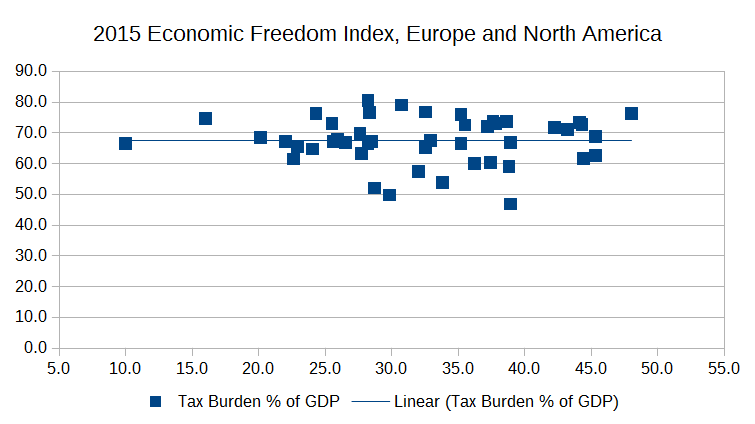
Indeed, if you restrict the sample to North America and Europe, the correlation basically disappears; all the countries are fairly free, all the taxes are fairly high, and within that the two aren’t very much related. (It’s been a long time since I’ve seen a trendline that flat, actually!)

Graph: Heritage Foundation Economic Freedom Index and tax burden, Europe and North America

Switzerland, Canada, and Denmark all have higher economic freedom scores than the United States, as well as higher tax burdens; but on the other hand, Greece, Spain, and Austria have higher tax burdens but lower freedom scores. All of them are variations on social democracy.

Is that socialism? I’m really not sure. Why does it matter, really?