Why Millennials feel “entitled”

JDN 2457064

I’m sure you’ve already heard this plenty of times before, but just in case here are a few particularly notable examples: “Millennials are entitled.” “Millennials are narcissistic.” “Millennials expect instant gratification.

Fortunately there are some more nuanced takes as well: One survey shows that we are perceived as “entitled” and “self-centered” but also “hardworking” and “tolerant”. This article convincingly argues that Baby Boomers show at least as much ‘entitlement’ as we do. Another article points out that young people have been called these sorts of names for decades—though actually the proper figure is centuries.

Though some of the ‘defenses’ leave a lot to be desired: “OK, admittedly, people do live at home. But that’s only because we really like our parents. And why shouldn’t we?” Uh, no, that’s not it. Nor is it that we’re holding off on getting married. The reason we live with our parents is that we have no money and can’t pay for our own housing. And why aren’t we getting married? Because we can’t afford to pay for a wedding, much less buy a home and start raising kids. (Since the time I drafted this for Patreon and it went live, yet another article hand-wringing over why we’re not getting married was publishedin Scientific American, of all places.)

Are we not buying cars because we don’t like cars? No, we’re not buying cars because we can’t afford to pay for them.

The defining attributes of the Millennial generation are that we are young (by definition) and broke (with very few exceptions). We’re not uniquely narcissistic or even tolerant; younger generations always have these qualities.

But there may be some kernel of truth here, which is that we were promised a lot more than we got.

Educational attainment in the United States is the highest it has ever been. Take a look at this graph from the US Department of Education:

Percentage of 25- to 29-year-olds who completed a bachelor’s or higher degree, by race/ethnicity: Selected years, 1990–2014

education_attainment_race

More young people of every demographic except American Indians now have college degrees (and those figures fluctuate a lot because of small samples—whether my high school had an achievement gap for American Indians depended upon how I self-identified on the form, because there were only two others and I was tied for the highest GPA).

Even the IQ of Millennials is higher than that of our parents’ generation, which is higher than their parents’ generation; (measured) intelligence rises over time in what is called the Flynn Effect. IQ tests have to be adjusted to be harder by about 3 points every 10 years because otherwise the average score would stop being 100.

As your level of education increases, your income tends to go up and your unemployment tends to go down. In 2014, while people with doctorates or professional degrees had about 2% unemployment and made a median income of $1590 per week, people without even high school diplomas had about 9% unemployment and made a median income of only $490 per week. The Bureau of Labor Statistics has a nice little bar chart of these differences:

education_employment_earnings

Now the difference is not quite as stark. With the most recent data, the unemployment rate is 6.7% for people without a high school diploma and 2.5% for people with a bachelor’s degree or higher.

But that’s for the population as a whole. What about the population of people 18 to 35, those of us commonly known as Millennials?

Well, first of all, our unemployment rate overall is much higher. With the most recent data, unemployment among people ages 20-24 is a whopping 9.4%. For ages 25 to 34 it gets better, 5.3%; but it’s still much worse than unemployment at ages 35-44 (4.0%), 45-54 (3.6%), or 55+ (3.2%). Overall, unemployment among Millennials is about 6.7% while unemployment among Baby Boomers is about 3.2%, half as much. (Gen X is in between, but a lot closer to the Boomers at around 3.8%.)

It was hard to find data specifically breaking it down by both age and education at the same time, but the hunt was worth it.

Among people age 20-24 not in school:

Without a high school diploma, 328,000 are unemployed, out of 1,501,000 in the labor force. That’s an unemployment rate of 21.9%. Not a typo, that’s 21.9%.

With only a high school diploma, 752,000 are unemployed, out of 5,498,000 in the labor force. That’s an unemployment rate of 13.7%.

With some college but no bachelor’s degree, 281,000 are unemployed, out of 3,620,000 in the labor force. That’s an unemployment rate of 7.7%.

With a bachelor’s degree, 90,000 are unemployed, out of 2,313,000 in the labor force. That’s an unemployment rate of 3.9%.

What this means is that someone 24 or under needs to have a bachelor’s degree in order to have the same overall unemployment rate that people from Gen X have in general, and even with a bachelor’s degree, people under 24 still have a higher unemployment rate than what Baby Boomers simply have by default. If someone under 24 doesn’t even have a high school diploma, forget it; their unemployment rate is comparable to the population unemployment rate at the trough of the Great Depression.

In other words, we need to have college degrees just to match the general population older than us, of whom only 20% have a college degree; and there is absolutely nothing a Millennial can do in terms of education to ever have the tiny unemployment rate (about 1.5%) of Baby Boomers with professional degrees. (Be born White, be in perfect health, have a professional degree, have rich parents, and live in a city with very high employment, and you just might be able to pull it off.)

So, why do Millennials feel like a college degree should “entitle” us to a job?

Because it does for everyone else.

Why do we feel “entitled” to a higher standard of living than the one we have?
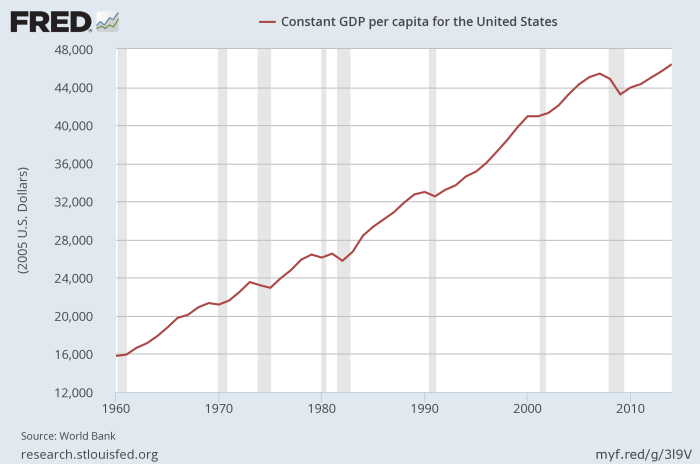
Take a look at this graph of GDP per capita in the US:

US_GDP_per_capita

You may notice a rather sudden dip in 2009, around the time most Millennials graduated from college and entered the labor force. On the next graph, I’ve added a curve approximating what it would look like if the previous trend had continued:

US_GDP_per_capita_trend

(There’s a lot on this graph for wonks like me. You can see how the unit-root hypothesis seemed to fail in the previous four recessions, where economic output rose back up to potential; but it clearly held in this recession, and there was a permanent loss of output. It also failed in the recession before that. So what’s the deal? Why do we recover from some recessions and take a permanent blow from others?)

If the Great Recession hadn’t happened, instead of per-capita GDP being about $46,000 in 2005 dollars, it would instead be closer to $51,000 in 2005 dollars. In today’s money, that means our current $56,000 would be instead closer to $62,000. If we had simply stayed on the growth trajectory we were promised, we’d be almost 10 log points richer (11% for the uninitiated).

So, why do Millennials feel “entitled” to things we don’t have? In a word, macroeconomics.

People anchored their expectations of what the world would be like on forecasts. The forecasts said that the skies were clear and economic growth would continue apace; so naturally we assumed that this was true. When the floor fell out from under our economy, only a few brilliant and/or lucky economists saw it coming; even people who were paying quite close attention were blindsided. We were raised in a world where economic growth promised rising standard of living and steady employment for the rest of our lives. And then the storm hit, and we were thrown into a world of poverty and unemployment—and especially poverty and unemployment for us.

We are angry about how we had been promised more than we were given, angry about how the distribution of what wealth we do have gets ever more unequal. We are angry that our parents’ generation promised what they could not deliver, and angry that it was their own blind worship of the corrupt banking system that allowed the crash to happen.

And because we are angry and demand a fairer share, they have the audacity to call us “narcissistic”.

Why does nobody want to become a teacher?

JDN 2457366

The United States is currently suffering a large and growing shortage of qualified teachers, particularly in grades K-12. In some particular areas, this shortage is extremely acute; high schools are not able to teach some courses because there is simply no one qualified to teach them. Science and math teachers are in particularly high demand, because these programs are being expanded even as the people qualified to teach them are shifting over to working at the college level or in the private sector.

Other countries are also suffering severe teacher shortages, including the UK and several other countries in the EU.
The problem is projected to get worse: Enrollments in teacher training are rapidly declining. Meanwhile, because somewhere along the way people got convinced that the problem with education is that our teachers aren’t smart enough (this is completely, totally wrong by the way), standards for becoming a teacher are becoming ever more stringent, narrowing the pool even more.

This is a very serious problem, because education—often called “human capital investment” in economic jargon—is one of the most important investments any society can make. Indeed, it may be the most important, the one factor of production that is absolutely indispensable. If you run out of one raw material, you can make products out of something else. Manual labor can be replaced by machines. If you don’t have enough machines, you can build more. But if you find yourself without anyone who knows how to read and do arithmetic, how are you going to replace that? If we imagine a scenario like being trapped on a desert island or colonizing Mars where we have to start from scratch and we are only allowed to have one factor of production, education is the one we would want to have. (I guess if it’s Mars you do need a certain bare minimum of physical capital, like a spacesuit.)

The teacher shortage is most acute in high-poverty areas, where educational outcomes are terrible. Indeed, the most important cause of the failings of the US education system has always been poverty.

Why are teachers in poor schools so underqualified? Because their working conditions are terrible. Turnover is extremely high because teachers are underpaid, the schools are undersupplied, and their administrators do not support them.

Why are there so many teachers not qualified to teach their subjects? Because people who are qualified can find better jobs in other places. Jobs just as rewarding, that make just as large a contribution to society, which are more pleasant, offer more autonomy, and pay a lot better.

If you are an expert in physics, you could become a physicist and make a median income of $106,000.

If you are an expert in economics, you could become an economist and make a median income of $92,000.

If you are an expert in biology, you could become a biochemist and make a median income of $81,000.

Or, instead of all those things, you could become a high school teacher and make a median income of $55,000. Gee, I wonder which one you’re going to do?

Keep that in mind if it sounds ridiculous to you to pay teachers $100,000 salaries.

Even in wealthy schools, teachers are miserable; I have this on direct testimony from my father, who has taught high school in Ann Arbor for almost 20 years now. There are a lot of teachers who believe in making a difference through education, but quickly become burnt out and leave for better working conditions.

I know in my own case that I’m not planning on teaching high school, even though I know I’d be very good at it and I’ve always found teaching very rewarding. I’d actually be qualified to teach several subjects, from mathematics to social studies and even including physics and Latin. Any public school would be thrilled to have me—but probably not thrilled enough to pay me as much as I’d get from a university, international institution, or policy think-tank. So it’s hard for me to justify the career decision of going into public education.

The absolute highest-paid teacher in the Ann Arbor Public Schools is paid $109,000 gross—and Ann Arbor is one of the highest-paying school systems in the nation, and not coincidentally also one of the best. Most of the professors at the University of Michigan are paid over $100,000 gross and some are paid over $300,000. (As a public school, the University of Michigan releases all its salaries.)

So, you’re living in Ann Arbor… you have a graduate degree… you want to work in education; you could either start at $40,000 and maybe work your way up to $100,000 by teaching high school, or you could start at $100,000 and maybe work your way up to $300,000 by teaching college. (Admittedly, to teach in college you generally also need to do research work and probably get a PhD; so it’s not quite an equal comparison. But the most-qualified educators would be good at either job.)

Economics, along with most science and math fields, pays particularly well outside education. This senior economist position at the World Bank pays at grade GG, which is a minimum starting net salary of $102,000.
How can we solve our teacher shortage? It’s really quite simple: Offer higher salaries for teachers. If you want the best-qualified people in your classrooms, you must pay salaries that attract the best-qualified people. If you pay substandard salaries, you’re going to attract substandard talent. “Those who can, do; those who can’t, teach” isn’t a law of nature; it’s a result of public policy decisions to keep teachers systematically underpaid.

Most of the time when people say “It’s just ECON 101”, they don’t actually understand economics very well and likely have not actually taken ECON 101. But this really basically is a question of ECON 101: Supply and demand. If you have a shortage of something, not enough people willing to produce it compared to the number of people who want to buy it, you must raise the price.

Would that be expensive? Yes it would. Doubling the salary of every teacher would raise total spending on education by about 75%, because teacher compensation is about three-quarters of education spending. This would raise US K-12 education spending from about $600 billion per year to more like $1.05 trillion per year, an additional $450 billion per year in public spending, or a little less than $1,500 per American per year. That is not a small amount of money; indeed, it’s about three times what we’d need to end world hunger. And this is actually an underestimate, since we also hope to hire more teachers and should also improve facilities while we’re at it. So a truly comprehensive educational reform project could very well double our total spending on K-12 education to $1.2 trillion.

And if you want to go up there on a podium and actually tell people, “It would be nice to improve our educational system, but we simply can’t afford to do it without raising taxes unreasonably high!” then that is absolutely a reasonable argument to make. There are always tradeoffs in life. At some point, maybe it really isn’t worth spending an extra million dollars to educate one more child. (Is it worth an extra million dollars to educate two more children? Based on net present value of earnings, yes. And frankly I don’t think net present value of earnings even gets close to assessing the true value of an education; it’s a very weak lower bound.)

But I am sick and tired of people saying “Education is our highest priority!” and then refusing to actually spend the money it would take to improve our educational system. This is not a question of “finding solutions”; we know what to do. Raise teacher salaries. Improve schools. Buy new textbooks. People just aren’t willing to actually pony up the cash to do it. They want an easy way out, some simple way of making education better that somehow won’t cost anything. But we’ve been searching for that for awhile now—don’t you think we’d have found it by now?

How (not) to talk about the defense budget

JDN 2457927 EDT 20:20.

This week on Facebook I ran into a couple of memes about the defense budget that I thought were worth addressing. While the core message that the United States spends too much on the military is sound, these particular memes are so massively misleading that I think it would be irresponsible to let them go unanswered.

Tax_dollars_meme

First of all, this graph is outdated; it appears to be from about five years ago. If you use nominal figures for just direct military spending, the budget has been cut from just under $700 billion (what this figure looks like) in 2010 to only about $600 billion today. If you include verterans’ benefits, again nominally, we haven’t been below $700 billion since 2007; today we are now above $800 billion. I think the most meaningful measure is actually military spending as percent of GDP, on which we’ve cut military spending from its peak of 4.7% of GDP in 2010 to 3.5% of GDP today.

It’s also a terrible way to draw a graph; using images instead of bars may be visually appealing, but it undermines the most important aspect of a bar graph, which is that you can easily visually compare relative magnitudes.

But the most important reason why this graph is misleading is that it uses only the so-called “discretionary budget”, which includes almost all military spending but only a small fraction of spending on healthcare and social services. This creates a wildly inflated sense of how much we spend on the military relatively to other priorities.

In particular, we’re excluding Medicare and Social Security, which are on the “mandatory budget”; each of these alone is comparable to total military spending. Here’s a very nice table of all US government spending broken down by category.

Let’s just look at federal spending for now. Including veterans’ benefits, we currently spend $814 billion per year on defense. On Social Security, we spend $959 billion. On healthcare, we spend $1,018 billion per year, of which $536 billion is Medicare.

We also spend $376 billion on social welfare programs and unemployment, along with $149 billion on education, $229 billion servicing the national debt, and $214 billion on everything else (such as police, transportation, and administration).

I’ve made you a graph that accurately reflects these relative quantities:

US_federal_spending

As you can see, the military is one of our major budget items, but the largest categories are actually pensions (i.e. Social Security) and healthcare (i.e. Medicare and Medicaid).

Given the right year and properly adjusted bars on the graph, the meme may strictly be accurate about the discretionary budget, but it gives an extremely distorted sense of our overall government spending.

The next meme is even worse:

Lee_Camp_meme

Again the figures aren’t strictly wrong if you use the right year, but we’re only looking at the federal discretionary budget. Since basically all military spending is federal and discretionary, but most education spending is mandatory and done at the state and local level, this is an even more misleading picture.

Total annual US military spending (including veteran benefits) is about $815 billion.
Total US education spending (at all levels) is about $922 billion.

Here’s an accurate graph of total US government spending at all levels:

US_total_spending

That is, we spend more on education than we do on the military, and dramatically more on healthcare.

However, the United States clearly does spend far too much on the military and probably too little on education; the proper comparison to make is to other countries.

Most other First World Countries spend dramatically more on education than they do on the military.

France, for example, spends about $160 billion per year on education, but only about $53 billion per year on the military—and France is actually a relatively militaristic country, with the 6th-highest total military spending in the world.

Germany spends about $172 billion per year on education, but only about about $44 billion on the military.

In absolute figures, the United States overwhelms all other countries in the world—we spend as much as at least the next 10 combined.

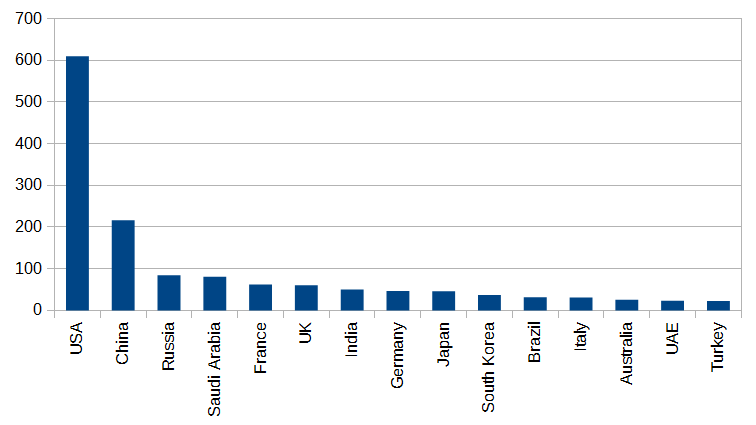
Using figures from the Stockholm International Peace Research Institute (SIPRI), the US spends $610 billion of the world’s total $1,776 billion, meaning that over a third of the world’s military spending is by the United States.

This is a graph of the top 15 largest military budgets in the world.

world_military_spending

One of these things is not like the other ones…

It probably makes the most sense to compare military spending as a portion of GDP, which makes the US no longer an outlier worldwide, but still very high by First World standards:

world_military_spending_GDP

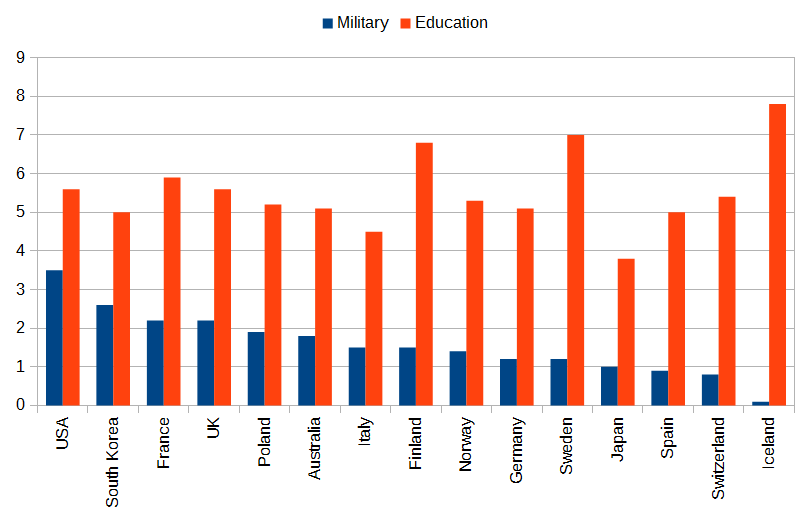
If we do want to compare military spending to other forms of spending, I think we should do that in international perspective as well. Here is a graph of education spending versus military spending as a portion of GDP, in several First World countries (military from SIPRI and the CIA, and education from the UNDP):

world_military_education

Our education spending is about average (though somehow we do it so inefficiently that we don’t provide college for free, unlike Germany, France, Finland, Sweden, or Norway), but our military spending is by far the highest.

How about a meme about that?

How is the economy doing?

JDN 2457033 EST 12:22.

Whenever you introduce yourself to someone as an economist, you will typically be asked a single question: “How is the economy doing?” I’ve already experienced this myself, and I don’t have very many dinner parties under my belt.

It’s an odd question, for a couple of reasons: First, I didn’t say I was a macroeconomic forecaster. That’s a very small branch of economics—even a small branch of macroeconomics. Second, it is widely recognized among economists that our forecasters just aren’t very good at what they do. But it is the sort of thing that pops into people’s minds when they hear the word “economist”, so we get asked it a lot.

Why are our forecasts so bad? Some argue that the task is just inherently too difficult due to the chaotic system involved; but they used to say that about weather forecasts, and yet with satellites and computer models our forecasts are now far more accurate than they were 20 years ago. Others have argued that “politics always dominates over economics”, as though politics were somehow a fundamentally separate thing, forever exogenous, a parameter in our models that cannot be predicted. I have a number of economic aphorisms I’m trying to popularize; the one for this occasion is: “Nothing is exogenous.” (Maybe fundamental constants of physics? But actually many physicists think that those constants can be derived from even more fundamental laws.) My most common is “It’s the externalities, stupid.”; next is “It’s not the incentives, it’s the opportunities.”; and the last is “Human beings are 90% rational. But woe betide that other 10%.” In fact, it’s not quite true that all our macroeconomic forecasters are bad; a few, such as Krugman, are actually quite good. The Klein Award is given each year to the best macroeconomic forecasters, and the same names pop up too often for it to be completely random. (Sadly, one of the most common is Citigroup, meaning that our banksters know perfectly well what they’re doing when they destroy our economy—they just don’t care.) So in fact I think our failures of forecasting are not inevitable or permanent.

And of course that’s not what I do at all. I am a cognitive economist; I study how economic systems behave when they are run by actual human beings, rather than by infinite identical psychopaths. I’m particularly interested in what I call the tribal paradigm, the way that people identify with groups and act in the interests of those groups, how much solidarity people feel for each other and why, and what role ideology plays in that identification. I’m hoping to one day formally model solidarity and make directly testable predictions about things like charitable donations, immigration policies and disaster responses.

I do have a more macroeconomic bent than most other cognitive economists; I’m not just interested in how human irrationality affects individuals or corporations, I’m also interested in how it affects society as a whole. But unlike most macroeconomists I care more about inequality than unemployment, and hardly at all about inflation. Unless you start getting 40% inflation per year, inflation really isn’t that harmful—and can you imagine what 40% unemployment would be like? (Also, while 100% inflation is awful, 100% unemployment would be no economy at all.) If we’re going to have a “misery index“, it should weight unemployment at least 10 times as much as inflation—and it should also include terms for poverty and inequality. Frankly maybe we should just use poverty, since I’d be prepared to accept just about any level of inflation, unemployment, or even inequality if it meant eliminating poverty. This is of course is yet another reason why a basic income is so great! An anti-poverty measure can really only be called a failure if it doesn’t actually reduce poverty; the only way that could happen with a basic income is if it somehow completely destabilized the economy, which is extremely unlikely as long as the basic income isn’t something ridiculous like $100,000 per year.

I could probably talk about my master’s thesis; the econometric models are relatively arcane, but the basic idea of correlating the income concentration of the top 1% of 1% and the level of corruption is something most people can grasp easily enough.

Of course, that wouldn’t be much of an answer to “How is the economy doing?”; usually my answer is to repeat what I’ve last read from mainstream macroeconomic forecasts, which is usually rather banal—but maybe that’s the idea? Most small talk is pretty banal I suppose (I never was very good at that sort of thing). It sounds a bit like this: No, we’re not on the verge of horrible inflation—actually inflation is currently too low. (At this point someone will probably bring up the gold standard, and I’ll have to explain that the gold standard is an unequivocally terrible idea on so, so many levels. The gold standard caused the Great Depression.) Unemployment is gradually improving, and actually job growth is looking pretty good right now; but wages are still stagnant, which is probably what’s holding down inflation. We could have prevented the Second Depression entirely, but we didn’t because Republicans are terrible at managing the economy—all of the 10 most recent recessions and almost 80% of the recessions in the last century were under Republican presidents. Instead the Democrats did their best to implement basic principles of Keynesian macroeconomics despite Republican intransigence, and we muddled through. In another year or two we will actually be back at an unemployment rate of 5%, which the Federal Reserve considers “full employment”. That’s already problematic—what about that other 5%?—but there’s another problem as well: Much of our reduction in unemployment has come not from more people being employed but instead by more people dropping out of the labor force. Our labor force participation rate is the lowest it’s been since 1978, and is still trending downward. Most of these people aren’t getting jobs; they’re giving up. At best we may hope that they are people like me, who gave up on finding work in order to invest in their own education, and will return to the labor force more knowledgeable and productive one day—and indeed, college participation rates are also rising rapidly. And no, that doesn’t mean we’re becoming “overeducated”; investment in education, so-called “human capital”, is literally the single most important factor in long-term economic output, by far. Education is why we’re not still in the Stone Age. Physical capital can be replaced, and educated people will do so efficiently. But all the physical capital in the world will do you no good if nobody knows how to use it. When everyone in the world is a millionaire with two PhDs and all our work is done by robots, maybe then you can say we’re “overeducated”—and maybe then you’d still be wrong. Being “too educated” is like being “too rich” or “too happy”.

That’s usually enough to placate my interlocutor. I should probably count my blessings, for I imagine that the first confrontation you get at a dinner party if you say you are a biologist involves a Creationist demanding that you “prove evolution”. I like to think that some mathematical biologists—yes, that’s a thing—take their request literally and set out to mathematically prove that if allele distributions in a population change according to a stochastic trend then the alleles with highest expected fitness have, on average, the highest fitness—which is what we really mean by “survival of the fittest”. The more formal, the better; the goal is to glaze some Creationist eyes. Of course that’s a tautology—but so is literally anything that you can actually prove. Cosmologists probably get similar demands to “prove the Big Bang”, which sounds about as annoying. I may have to deal with gold bugs, but I’ll take them over Creationists any day.

What do other scientists get? When I tell people I am a cognitive scientist (as a cognitive economist I am sort of both an economist and a cognitive scientist after all), they usually just respond with something like “Wow, you must be really smart.”; which I suppose is true enough, but always strikes me as an odd response. I think they just didn’t know enough about the field to even generate a reasonable-sounding question, whereas with economists they always have “How is the economy doing?” handy. Political scientists probably get “Who is going to win the election?” for the same reason. People have opinions about economics, but they don’t have opinions about cognitive science—or rather, they don’t think they do. Actually most people have an opinion about cognitive science that is totally and utterly ridiculous, more on a par with Creationists than gold bugs: That is, most people believe in a soul that survives after death. This is rather like believing that after your computer has been smashed to pieces and ground back into the sand from whence it came, all the files you had on it are still out there somewhere, waiting to be retrieved. No, they’re long gone—and likewise your memories and your personality will be long gone once your brain has rotted away. Yes, we have a soul, but it’s made of lots of tiny robots; when the tiny robots stop working the soul is no more. Everything you are is a result of the functioning of your brain. This does not mean that your feelings are not real or do not matter; they are just as real and important as you thought they were. What it means is that when a person’s brain is destroyed, that person is destroyed, permanently and irrevocably. This is terrifying and difficult to accept; but it is also most definitely true. It is as solid a fact as any in modern science. Many people see a conflict between evolution and religion; but the Pope has long since rendered that one inert. No, the real conflict, the basic fact that undermines everything religion is based upon, is not in biology but in cognitive science. It is indeed the Basic Fact of Cognitive Science: We are our brains, no more and no less. (But I suppose it wouldn’t be polite to bring that up at dinner parties.)

The “You must be really smart.” response is probably what happens to physicists and mathematicians. Quantum mechanics confuses basically everyone, so few dare go near it. The truly bold might try to bring up Schrodinger’s Cat, but are unlikely to understand the explanation of why it doesn’t work. General relativity requires thinking in tensors and four-dimensional spaces—perhaps they’ll be asked the question “What’s inside a black hole?”, which of course no physicist can really answer; the best answer may actually be, “What do you mean, inside?” And if a mathematician tries to explain their work in lay terms, it usually comes off as either incomprehensible or ridiculous: Stokes’ Theorem would be either “the integral of a differential form over the boundary of some orientable manifold is equal to the integral of its exterior derivative over the whole manifold” or else something like “The swirliness added up inside an object is equal to the swirliness added up around the edges.”

Economists, however, always seem to get this one: “How is the economy doing?”

Right now, the answer is this: “It’s still pretty bad, but it’s getting a lot better. Hopefully the new Congress won’t screw that up.”