More on Free Will


Oct 27 JDN 2460611

In a previous post, I defended the existence of compatibilism and free will. There are a few subtler issues with free will that I’d now like to deal with in this week’s post.

The ability to do otherwise

One subtler problem for free will comes from the idea of doing otherwise—what some philosophers call “genuinely open alternatives”. The question is simple to ask, but surprisingly difficult to answer: “When I make a choice, could I have chosen otherwise?”

On one hand, the answer seems obviously “yes” because, when I make a choice, I consider a set of alternatives and select the one that seems best. If I’d wanted to, I’d have chosen something else. On the other hand, the answer seems obviously “no”, because the laws of nature compelled my body and brain to move in exactly the way that it did. So which answer is right?

I think the key lies in understanding specifically how the laws of nature cause my behavior. It’s not as if my arms are on puppet strings, and no matter what I do, they will be moved in a particular way; if I choose to do something, I will do it; if I choose not to, I won’t do it. The laws of nature constrain my behavior by constraining my desires; they don’t constrain what I do in spite of what I want—instead, they constrain what I do through what I want. I am still free to do what I choose to do.

So, while my actions may be predetermined, they are determined by who I am, what I want, what experiences I have. These are precisely the right kind of determinants for free will to make sense; my actions spring not from random chance or external forces, but instead from my own character.

If we really mean to ask, “Could I (exactly as I was, in the situation I was in) have done otherwise (as free choice, not random chance)?” the answer is “No”. Something would have to be different. But one of the things that could be different is me! If I’d had different genes, or a different upbringing, or exposure to different ideas during my life, I might have acted differently. Most importantly, if I had wanted a different outcome, I could have chosen it. So if all we mean by the question is “Could I (if I wanted to) have done otherwise?” the answer is a resounding “Yes”. What I have done in my life speaks to my character—who I am, what I want. It doesn’t merely involve luck (though it may involve some luck), and it isn’t reducible to factors external to me. I am part of the causal structure of the universe; my will is a force. Though the world is made of pushes and pulls, I am among the things pushing and pulling.

As Daniel Dennett pointed out, this kind of freedom admits of degrees: It is entirely possible for a deterministic agent to be more or less effective at altering its circumstances to suit its goals. In fact, we have more options today than we did a few short centuries ago, and this means that in a very real sense we have more free will.

Empirically observing free will

What is really at stake, when we ask whether a person has free will? It seems to me that the question we really want to answer is this: “Are we morally justified in rewarding or punishing this person?” If you were to conclude, “No, they do not have free will, but we are justified in punishing them.”, I would think that you meant something different than I do by “free will”. If instead your ruling was “Yes, they have free will, but we may not reward or punish them.”, I would be similarly confused. Moreover, the concern that without free will, our moral and legal discourse collapses, seems to be founded upon this general notion—that reward and punishment, crucial to ethics and law (not to mention economics!) as they are, are dependent upon free will.

Yet, consider this as a scientific question. What kind of organism can respond to reward and punishment? What sort of thing will change its behavior based upon rewards, punishments, and the prospect thereof? Certainly you must agree that there is no point punishing a thing that will not be affected by the punishment in any way—banging your fist on the rocks will not make the rocks less likely to crush your loved ones. Conversely, I think you’d be hard-pressed to say it’s pointless to punish if the punishment would result in some useful effect. Maybe it’s not morally relevant—but then, why not? If you can make the world better by some action, doesn’t that, other things equal, give you a moral reason to perform that action?

We know exactly what sort of thing responds to reward and punishment: Animals. Specifically, animals that are operant-conditionable, for operant conditioning consists precisely in the orchestrated use of reward and punishment. Humans are of course supremely operant-conditionable; indeed, we can be trained to do incredibly complex things—like play a piano, pilot a space shuttle, hit a fastball, or write a book—and, even more impressively, we can learn to train ourselves to do such things. In fact, clearly something more than operant conditioning is at work here, because certain human behaviors (like language) are far too complex to learn by simple reward and punishment. There is a lot of innate cognition going on in the human brain—but over that layer of innate cognition we can add a virtually endless range of possible learned behaviors.

That is to say, learning—the capacity to change future behavior based upon past experience—is precisely in alignment with our common intuitions about free will—that humans have the most, animals have somewhat less, computers might have some, and rocks have none. Yes, there are staunch anthropocentrist dualists who would insist that animals and computers have no “free will”. But if you ask someone, “Did that dog dig that hole on purpose?” their immediate response will not include such theological considerations; it will attribute free choice to Canis lupus familiaris. Indeed, I think if you ask, “Did the chess program make that move on purpose?” the natural answer attributes some sort of will even to the machine. (Maybe just its programmer? I’m not so sure.)

Yet, if the capacity to respond to reward and punishment is all we need to justify reward and punishment, then the problem of free will collapses. We should punish criminals if, and only if, punishing them will reform them to better behavior, or set an example to deter others from similar crimes. Did we lose some deep sense of moral desert and retribution? Maybe, but I think we can probably work it back in, and if we can’t, we can probably do without it. Either way, we can still have a justice system and moral discourse.

Indeed, we can do better than that; we can now determine empirically whether a given entity is a moral agent. The insane psychopathic serial killer who utterly fails to understand empathy may indeed fail to qualify, in which case we should kill them and be done with it, the same way we would kill a virus or destroy an oncoming asteroid. Or they may turn out to qualify, in which case we should punish them as we would other moral agents. The point is, this is a decidable question, at least in principle; all we need are a few behavioral and psychological experiments to determine the answer.

The power of circumstances

There is another problem with classical accounts of free will, which comes from the results of psychology experiments. Perhaps the most seminal was the (in)famous experiment by Stanley Milgram, in which verbal commands caused ordinary people to administer what they thought were agonizing and life-threatening shocks to innocent people for no good reason. Simply by being put in particular circumstances, people found themselves compelled to engage in actions they would never have done otherwise. This experiment was replicated in 2009 under more rigorous controls, with virtually identical results.

This shows that free will is much more complicated than we previously imagined. Even if we acknowledge that human beings are capable of making rational, volitional decisions that reflect their character, we must be careful not to presume that everything people do is based upon character. As Hannah Arendt has pointed out, even the Nazis, though they perpetrated almost unimaginable evils, nonetheless were for the most part biologically and psychologically normal human beings. Perhaps Hitler and Himmler were maniacal psychopaths (and more recently Arendt’s specific example of Eichmann has also been challenged.), but the vast majority of foot soldiers of the German Army who burned villages or gassed children were completely ordinary men in extraordinarily terrible circumstances. This forces us to reflect upon the dire fact that in their place, most of us would have done exactly the same things.

This doesn’t undermine free will entirely, but it does force us to reconsider many of our preconceptions about it. Court systems around the world are based around the presumption that criminal acts are committed by people who are defective in character, making them deserving of punishment; in some cases this is probably right (e.g. Jeffrey Dahmer, Charles Manson), but in many cases, it is clearly wrong. Crime is much more prevalent in impoverished areas; why? Not because poor people are inherently more criminal, but because poverty itself makes people more likely to commit crimes. In a longitudinal study in Georgia, socioeconomic factors strongly predicted crime, especially property crime. An experiment at MIT suggests that letting people move to wealthier neighborhoods actually makes their children less likely to commit crimes. A 2007 report from the Government Accountability Office explicitly endorsed the hypothesis that poverty causes crime.

Really, all of this makes perfect sense: Poor people are precisely those who have the least to lose and the most to gain by breaking the rules. If you are starving, theft may literally save your life. Even if you’re not at the verge of starvation, the poorer you are, the worse your life prospects are, and the more unfairly the system has treated you. Most people who are rich today inherited much of their wealth from ancestors who violently stole it from other people. Why should anyone respect the rules of a system that robbed their ancestors and leaves them forsaken? Compound this with the fact that it is harder to be law-abiding when you are surrounded by thieves, and the high crime rates of inner cities hardly seem surprising.

Does this mean we should abandon criminal justice? Clearly not, for the consequences of doing so would be predictably horrendous. Temporary collapses in civil government typically lead to violent anarchy; this continued for several years in Somalia, and has happened more briefly even in Louisiana (it was not as terrible as the media initially reported, but it was still quite bad.) We do need to hold people responsible for their crimes. But what this sort of research shows is that we also need to consider situational factors when we set policy. The United States has the highest after-tax absolute poverty rate and the highest share of income claimed by the top 0.01\% of any First World nation—an astonishing 4%, meaning that the top 30,000 richest Americans have on average 400 times as much income as the average person. (My master’s thesis was actually on the subject of how this high level of inequality is related to increased corruption.) We also have the third-highest rate of murder in the OECD, after Mexico (by far the highest) and Estonia. Our homicide rate is almost three times that of Canada and over four times that of England. Even worse, the US has the highest incarceration rate in the world. Yes, that’s right; we in the US imprison a larger portion of our population than any other nation on Earth—including Iran, China, and Saudi Arabia.

Social science suggests this is no coincidence; it is our economic inequality that leads to our crime and incarceration. Nor is our poverty a result of insufficient wealth. By the standard measure Gross Domestic Product (GDP), an estimate of the total economic output a nation produces each year, the United States has the second-highest total GDP at purchasing power parity (China recently surpassed us), and the sixth-highest GDP per person in the world. We do not lack wealth; instead, we funnel wealth to the rich and deny it from the poor. If we stopped doing this, we would see a reduction in poverty and inequality, and there is reason to think that a corresponding reduction in crime would follow. We could make people act morally better simply by redistributing wealth.

Such knowledge of situational factors forces us to reconsider our ethical judgments on many subjects. It forces us to examine the ways that social, political, and economic systems influence our behavior in powerful ways. But we still have free will, and we still need to use it; in fact, in order to apply this research to our daily lives and public policies, we will need to exercise our free will very carefully.

The inequality of factor mobility

Sep 24 JDN 2460212

I’ve written before about how free trade has brought great benefits, but also great costs. It occurred to me this week that there is a fairly simple reason why free trade has never been as good for the world as the models would suggest: Some factors of production are harder to move than others.

To some extent this is due to policy, especially immigration policy. But it isn’t just that.There are certain inherent limitations that render some kinds of inputs more mobile than others.

Broadly speaking, there are five kinds of inputs to production: Land, labor, capital, goods, and—oft forgotten—ideas.

You can of course parse them differently: Some would subdivide different types of labor or capital, and some things are hard to categorize this way. The same product, such as an oven or a car, can be a good or capital depending on how it’s used. (Or, consider livestock: is that labor, or capital? Or perhaps it’s a good? Oddly, it’s often discussed as land, which just seems absurd.) Maybe ideas can be considered a form of capital. There is a whole literature on human capital, which I increasingly find distasteful, because it seems to imply that economists couldn’t figure out how to value human beings except by treating them as a machine or a financial asset.

But this four-way categorization is particularly useful for what I want to talk about today. Because the rate at which those things move is very different.

Ideas move instantly. It takes literally milliseconds to transmit an idea anywhere in the world. This wasn’t always true; in ancient times ideas didn’t move much faster than people, and it wasn’t until the invention of the telegraph that their transit really became instantaneous. But it is certainly true now; once this post is published, it can be read in a hundred different countries in seconds.

Goods move in hours. Air shipping can take a product just about anywhere in less than a day. Sea shipping is a bit slower, but not radically so. It’s never been easier to move goods all around the world, and this has been the great success of free trade.

Capital moves in weeks. Here it might be useful to subdivide different types of capital: It’s surely faster to move an oven or even a car (the more good-ish sort of capital) than it is to move an entire factory (capital par excellence). But all in all, we can move stuff pretty fast these days. If you want to move your factory to China or Indonesia, you can probably get it done in a matter of weeks or at most months.

Labor moves in months. This one is a bit ironic, since it is surely easier to carry a single human person—or even a hundred human people—than all the equipment necessary to run an entire factory. But moving labor isn’t just a matter of physically carrying people from one place to another. It’s not like tourism, where you just pack and go. Moving labor requires uprooting people from where they used to live and letting them settle in a new place. It takes a surprisingly long time to establish yourself in a new environment—frankly even after two years in Edinburgh I’m not sure I quite managed it. And all the additional restrictions we’ve added involving border crossings and immigration laws and visas only make it that much slower.

Land moves never. This one seems perfectly obvious, but is also often neglected. You can’t pick up a mountain, a lake, a forest, or even a corn field and carry it across the border. (Yes, eventually plate tectonics will move our land around—but that’ll be millions of years.) Basically, land stays put—and so do all the natural environments and ecosystems on that land. Land isn’t as important for production as it once was; before industrialization, we were dependent on the land for almost everything. But we absolutely still are dependent on the land! If all the topsoil in the world suddenly disappeared, the economy wouldn’t simply collapse: the human race would face extinction. Moreover, a lot of fixed infrastructure, while technically capital, is no more mobile than land. We couldn’t much more easily move the Interstate Highway System to China than we could move Denali.

So far I have said nothing particularly novel. Yeah, clearly it’s much easier to move a mathematical theorem (if such a thing can even be said to “move”) than it is to move a factory, and much easier to move a factory than to move a forest. So what?

But now let’s consider the impact this has on free trade.

Ideas can move instantly, so free trade in ideas would allow all the world to instantaneously share all ideas. This isn’t quite what happens—but in the Internet age, we’re remarkably close to it. If anything, the world’s governments seem to be doing their best to stop this from happening: One of our most strictly-enforced trade agreements, the TRIPS Accord, is about stopping ideas from spreading too easily. And as far as I can tell, region-coding on media goes against everything free trade stands for, yet here we are. (Why, it’s almost as if these policies are more about corporate profits than they ever were about freedom!)

Goods and capital can move quickly. This is where we have really felt the biggest effects of free trade: Everything in the US says “made in China” because the capital is moved to China and then the goods are moved back to the US.

But it would honestly have made more sense to move all those workers instead. For all their obvious flaws, US institutions and US infrastructure are clearly superior to those in China. (Indeed, consider this: We may be so aware of the flaws because the US is especially transparent.) So, the most absolutely efficient way to produce all those goods would be to leave the factories in the US, and move the workers from China instead. If free trade were to achieve its greatest promises, this is the sort of thing we would be doing.


Of course that is not what we did. There are various reasons for this: A lot of the people in China would rather not have to leave. The Chinese government would not want them to leave. A lot of people in the US would not want them to come. The US government might not want them to come.

Most of these reasons are ultimately political: People don’t want to live around people who are from a different nation and culture. They don’t consider those people to be deserving of the same rights and status as those of their own country.

It may sound harsh to say it that way, but it’s clearly the truth. If the average American person valued a random Chinese person exactly the same as they valued a random other American person, our immigration policy would look radically different. US immigration is relatively permissive by world standards, and that is a great part of American success. Yet even here there is a very stark divide between the citizen and the immigrant.

There are morally and economically legitimate reasons to regulate immigration. There may even be morally and economically legitimate reasons to value those in your own nation above those in other nations (though I suspect they would not justify the degree that most people do). But the fact remains that in terms of pure efficiency, the best thing to do would obviously be to move all the people to the place where productivity is highest and do everything there.

But wouldn’t moving people there reduce the productivity? Yes. Somewhat. If you actually tried to concentrate the entire world’s population into the US, productivity in the US would surely go down. So, okay, fine; stop moving people to a more productive place when it has ceased to be more productive. What this should do is average out all the world’s labor productivity to the same level—but a much higher level than the current world average, and frankly probably quite close to its current maximum.

Once you consider that moving people and things does have real costs, maybe fully equaling productivity wouldn’t make sense. But it would be close. The differences in productivity across countries would be small.

They are not small.

Labor productivity worldwide varies tremendously. I don’t count Ireland, because that’s Leprechaun Economics (this is really US GDP with accounting tricks, not Irish GDP). So the prize for highest productivity goes to Norway, at $100 per worker hour (#ScandinaviaIsBetter). The US is doing the best among large countries, at an impressive $73 per hour. And at the very bottom of the list, we have places like Bangladesh at $4.79 per hour and Cambodia at $3.43 per hour. So, roughly speaking, there is about a 20-to-1 ratio between the most productive and least productive countries.

I could believe that it’s not worth it to move US production at $73 per hour to Norway to get it up to $100 per hour. (For one thing, where would we fit it all?) But I find it far more dubious that it wouldn’t make sense to move most of Cambodia’s labor to the US. (Even all 16 million people is less than what the US added between 2010 and 2020.) Even given the fact that these Cambodian workers are less healthy and less educated than American workers, they would almost certainly be more productive on the other side of the Pacific, quite likely ten times as productive as they are now. Yet we haven’t moved them, and have no plans to.

That leaves the question of whether we will move our capital to them. We have been doing so in China, and it worked (to a point). Before that, we did it in Korea and Japan, and it worked. Cambodia will probably come along sooner or later. For now, that seems to be the best we can do.

But I still can’t shake the thought that the world is leaving trillions of dollars on the table by refusing to move people. The inequality of factor mobility seems to be a big part of the world’s inequality, period.

Inequality-adjusted GDP and median income

Dec 11 JDN 2459925

There are many problems with GDP as a measure of a nation’s prosperity. For one, GDP ignores natural resources and ecological degradation; so a tree is only counted in GDP once it is cut down. For another, it doesn’t value unpaid work, so caring for a child only increases GDP if you are a paid nanny rather than the child’s parents.

But one of the most obvious problems is the use of an average to evaluate overall prosperity, without considering the level of inequality.

Consider two countries. In Alphania, everyone has an income of about $50,000. In Betavia, 99% of people have an income of $1,000 and 1% have an income of $10 million. What is the per-capita GDP of each country? Alphania’s is $50,000 of course; but Betavia’s is $100,990. Does it really make sense to say that Betavia is a more prosperous country? Maybe it has more wealth overall, but its huge inequality means that it is really not at a high level of development. It honestly sounds like an awful place to live.

A much more sensible measure would be something like median income: How much does a typical person have? In Alphania this is still $50,000; but in Betavia it is only $1,000.

Yet even this leaves out most of the actual distribution; by definition a median is only determined by what is the 50th percentile. We could vary all other incomes a great deal without changing the median.

A better measure would be some sort of inequality-adjusted per-capita GDP, which rescales GDP based on the level of inequality in a country. But we would need a good way of making that adjustment.

I contend that the most sensible way would be to adopt some kind of model of marginal utility of income, and then figure out what income would correspond to the overall average level of utility.

In other words, average over the level of happiness that people in a country get from their income, and then figure out what level of income would correspond to that level of happiness. If we magically gave everyone the same amount of money, how much would they need to get in order for the average happiness in the country to remain the same?

This is clearly going to be less than the average level of income, because marginal utility of income is decreasing; a dollar is not worth as much in real terms to a rich person as it is to a poor person. So if we could somehow redistribute all income evenly while keeping the average the same, that would actually increase overall happiness (though, for many reasons, we can’t simply do that).

For example, suppose that utility of income is logarithmic: U = ln(I).

This means that the marginal utility of an additional dollar is inversely proportional to how many dollars you already have: U'(I) = 1/I.

It also means that a 1% gain or loss in your income feels about the same regardless of how much income you have: ln((1+r)Y) = ln(Y) + ln(1+r). This seems like a quite reasonable, maybe even a bit conservative, assumption; I suspect that losing 1% of your income actually hurts more when you are poor than when you are rich.

Then the inequality adjusted GDP Y is a value such that ln(Y) is equal to the overall average level of utility: E[U] = ln(Y), so Y = exp(E[U]).

This sounds like a very difficult thing to calculate. But fortunately, the distribution of actual income seems to quite closely follow a log-normal distribution. This means that when we take the logarithm of income to get utility, we just get back a very nice, convenient normal distribution!

In fact, it turns out that for a log-normal distribution, the following holds: exp(E[ln(Y)]) = median(Y)

The income which corresponds to the average utility turns out to simply be the median income! We went looking for a better measure than median income, and ended up finding out that median income was the right measure all along.

This wouldn’t hold for most other distributions; and since real-world economies don’t perfectly follow a log-normal distribution, a more precise estimate would need to be adjusted accordingly. But the approximation is quite good for most countries we have good data on, so even for the ones we don’t, median income is likely a very good estimate.

The ranking of countries by median income isn’t radically different from the ranking by per-capita GDP; rich countries are still rich and poor countries are still poor. But it is different enough to matter.

Luxembourg is in 1st place on both lists. Scandinavian countries and the US are in the top 10 in both cases. So it’s fair to say that #ScandinaviaIsBetter for real, and the US really is so rich that our higher inequality doesn’t make our median income lower than the rest of the First World.

But some countries are quite different. Ireland looks quite good in per-capita GDP, but quite bad in median income. This is because a lot of the GDP in Ireland is actually profits by corporations that are only nominally headquartered in Ireland and don’t actually employ very many people there.

The comparison between the US, the UK, and Canada seems particularly instructive. If you look at per-capita GDP PPP, the US looks much richer at $75,000 compared to Canada’s $57,800 (a difference of 29% or 26 log points). But if you look at median personal income, they are nearly equal: $19,300 in the US and $18,600 in Canada (3.7% or 3.7 log points).

On the other hand, in per-capita GDP PPP, the UK looks close to Canada at $55,800 (3.6% or 3.6 lp); but in median income it is dramatically worse, at only $14,800 (26% or 23 lp). So Canada and the UK have similar overall levels of wealth, but life for a typical Canadian is much better than life for a typical Briton because of the higher inequality in Britain. And the US has more wealth than Canada, but it doesn’t meaningfully improve the lifestyle of a typical American relative to a typical Canadian.

Keynesian economics: It works, bitches

Jan 23 JDN 2459613

(I couldn’t resist; for the uninitiated, my slightly off-color title is referencing this XKCD comic.)

When faced with a bad recession, Keynesian economics prescribes the following response: Expand the money supply. Cut interest rates. Increase government spending, but decrease taxes. The bigger the recession, the more we should do all these things—especially increasing spending, because interest rates will often get pushed to zero, creating what’s called a liquidity trap.

Take a look at these two FRED graphs, both since the 1950s.
The first is interest rates (specifically the Fed funds effective rate):

The second is the US federal deficit as a proportion of GDP:

Interest rates were pushed to zero right after the 2008 recession, and didn’t start coming back up until 2016. Then as soon as we hit the COVID recession, they were dropped back to zero.

The deficit looks even more remarkable. At the 2009 trough of the recession, the deficit was large, nearly 10% of GDP; but then it was quickly reduced back to normal, to between 2% and 4% of GDP. And that initial surge is as much explained by GDP and tax receipts falling as by spending increasing.

Yet in 2020 we saw something quite different: The deficit became huge. Literally off the chart, nearly 15% of GDP. A staggering $2.8 trillion. We’ve not had a deficit that large as a proportion of GDP since WW2. We’ve never had a deficit that large in real billions of dollars.

Deficit hawks came out of the woodwork to complain about this, and for once I was worried they might actually be right. Their most credible complaint was that it would trigger inflation, and they weren’t wrong about that: Inflation became a serious concern for the first time in decades.

But these recessions were very large, and when you actually run the numbers, this deficit was the correct magnitude for what Keynesian models tell us to do. I wouldn’t have thought our government had the will and courage to actually do it, but I am very glad to have been wrong about that, for one very simple reason:

It worked.

In 2009, we didn’t actually fix the recession. We blunted it; we stopped it from getting worse. But we never really restored GDP, we just let it get back to its normal growth rate after it had plummeted, and eventually caught back up to where we had been.

2021 went completely differently. With a much larger deficit, we fixed this recession. We didn’t just stop the fall; we reversed it. We aren’t just back to normal growth rates—we are back to the same level of GDP, as if the recession had never happened.

This contrast is quite obvious from the GDP of US GDP:

In 2008 and 2009, GDP slumps downward, and then just… resumes its previous trend. It’s like we didn’t do anything to fix the recession, and just allowed the overall strong growth of our economy to carry us through.

The pattern in 2020 is completely different. GDP plummets downward—much further, much faster than in the Great Recession. But then it immediately surges back upward. By the end of 2021, it was above its pre-recession level, and looks to be back on its growth trend. With a recession this deep, if we’d just waited like we did last time, it would have taken four or five years to reach this point—we actually did it in less than one.

I wrote earlier about how this is a weird recession, one that actually seems to fit Real Business Cycle theory. Well, it was weird in another way as well: We fixed it. We actually had the courage to do what Keynes told us to do in 1936, and it worked exactly as it was supposed to.

Indeed, to go from unemployment almost 15% in April of 2020 to under 4% in December of 2021 is fast enough I feel like I’m getting whiplash. We have never seen unemployment drop that fast. Krugman is fond of comparing this to “morning in America”, but that’s really an understatement. Pitch black one moment, shining bright the next: this isn’t a sunrise, it’s pulling open a blackout curtain.

And all of this while the pandemic is still going on! The omicron variant has brought case numbers to their highest levels ever, though fortunately death rates so far are still below last year’s peak.

I’m not sure I have the words to express what a staggering achievement of economic policy it is to so rapidly and totally repair the economic damage caused by a pandemic while that pandemic is still happening. It’s the equivalent of repairing an airplane that is not only still in flight, but still taking anti-aircraft fire.

Why, it seems that Keynes fellow may have been onto something, eh?

Economic Possibilities for Ourselves

May 2 JDN 2459335

In 1930, John Maynard Keynes wrote one of the greatest essays ever written on economics, “Economic Possibilities for our Grandchildren.” You can read it here.


In that essay he wrote:

“I would predict that the standard of life in progressive countries one hundred years hence will be between four and eight times as high as it is.”

US population in 1930: 122 million; US real GDP in 1930: $1.1 trillion. Per-capita GDP: $9,000

US population in 2020: 329 million; US real GDP in 2020: $18.4 trillion. Per-capita GDP: $56,000

That’s a factor of 6. Keynes said 4 to 8; that makes his estimate almost perfect. We aren’t just inside his error bar, we’re in the center of it. If anything he was under-confident. Of course we still have 10 years left before a full century has passed: At a growth rate of 1% in per-capita GDP, that will make the ratio closer to 7—still well within his confidence interval.

I’d like to take a moment to marvel at how good this estimate is. Keynes predicted the growth rate of the entire US economy one hundred years in the future to within plus or minus 30%, and got it right.

With this in mind, it’s quite astonishing what Keynes got wrong in his essay.


The point of the essay is that what Keynes calls “the economic problem” will soon be solved. By “the economic problem”, he means the scarcity of resources that makes it impossible for everyone in the world to make a decent living. Keynes predicts that by 2030—so just a few years from now—humanity will have effectively solved this problem, and we will live in a world where everyone can live comfortably with adequate basic necessities like shelter, food, water, clothing, and medicine.

He laments that with the dramatically higher productivity that technological advancement brings, we will be thrust into a life of leisure that we are unprepared to handle. Evolved for a world of scarcity, we built our culture around scarcity, and we may not know what to do with ourselves in a world of abundance.

Keynes sounds his most naive when he imagines that we would spread out our work over more workers each with fewer hours:

“For many ages to come the old Adam will be so strong in us that everybody will need to do some work if he is to be contented. We shall do more things for ourselves than is usual with the rich today, only too glad to have small duties and tasks and routines. But beyond this, we shall endeavour to spread the bread thin on the butter-to make what work there is still to be done to be as widely shared as possible. Three-hour shifts or a fifteen-hour week may put off the problem for a great while. For three hours a day is quite enough to satisfy the old Adam in most of us!”

Plainly that is nothing like what happened. Americans do on average work fewer hours today than we did in the past, but not by anything like this much: average annual hours fell from about 1,900 in 1950 to about 1,700 today. Where Keynes was predicting a drop of 60%, the actual drop was only about 10%.

Here’s another change Keynes predicted that I wish we’d made, but we certainly haven’t:

“When the accumulation of wealth is no longer of high social importance, there will be great changes in the code of morals. We shall be able to rid ourselves of many of the pseudo-moral principles which have hag-ridden us for two hundred years, by which we have exalted some of the most distasteful of human qualities into the position of the highest virtues. We shall be able to afford to dare to assess the money-motive at its true value. The love of money as a possession—as distinguished from the love of money as a means to the enjoyments and realities of life—will be recognised for what it is, a somewhat disgusting morbidity, one of those semicriminal, semi-pathological propensities which one hands over with a shudder to the specialists in mental disease.”

Sadly, people still idolize Jeff Bezos and Elon Musk just as much their forebears idolized Henry Ford or Andrew Carnegie. And really there’s nothing semi- about it: The acquisition of billions of dollars by exploiting others is clearly indicative of narcissism if not psychopathy.

It’s not that we couldn’t have made the world that Keynes imagined. There’s plenty of stuff—his forecast for our per-capita GDP was impeccable. But when we automated away all of the most important work, Keynes thought we would turn to lives of leisure, exploring art, music, literature, film, games, sports. But instead we did something he did not anticipate: We invented new kinds of work.

This would be fine if the new work we invented is genuinely productive; and some of it is, no doubt. Keynes could not have anticipated the emergence of 3D graphics designers, smartphone engineers, or web developers, but these jobs do genuinely productive and beneficial work that makes use of our extraordinary new technologies.

But think for a moment about Facebook and Google, now two of the world’s largest and most powerful corporations. What do they sell? Think carefully! Facebook doesn’t sell social media. Google doesn’t sell search algorithms. Those are services they provide as platforms for what they actually sell: Advertising.

That is, some of the most profitable, powerful corporations in the world today make all of their revenue entirely from trying to persuade people to buy things they don’t actually need. The actual benefits they provide to humanity are sort of incidental; they exist to provide an incentive to look at the ads.

Paul Krugman often talks about Solow’s famous remark that “computers showed up everywhere but the productivity statistics”; aggregate productivity growth has, if anything, been slower in the last 40 years than in the previous 40.

But this aggregate is a very foolish measure. It’s averaging together all sorts of work into one big lump.

If you look specifically at manufacturing output per workerthe sort of thing you’d actually expect to increase due to automation—it has in fact increased, at breakneck speed: The average American worker produced four times as much output per hour in 2000 as in 1950.

The problem is that instead of splitting up the manufacturing work to give people free time, we moved them all into services—which have not meaningfully increased their productivity in the same period. The average growth rate in multifactor productivity in the service industries since the 1970s has been a measly 0.2% per year, meaning that our total output per worker in service industries is only 10% higher than it was in 1970.

While our population is more than double what it was in 1950, our total manufacturing employment is now less than it was in 1950. Our employment in services is four times what it was in 1950. We moved everyone out of the sector that actually got more productive and stuffed them into the sector that didn’t.

This is why the productivity statistics are misleading. Suppose we had 100 workers, and 2 industries.

Initially, in manufacturing, each worker can produce goods worth $20 per hour. In services, each worker can only produce services worth $10 per hour. 50 workers work in each industry, so average productivity is (50*$20+50*$10)/100 = $15 per hour.

Then, after new technological advances, productivity in manufacturing increases to $80 per hour, but people don’t actually want to spend that much on manufactured good. So 30 workers from manufacturing move over to services, which still only produce $10 per hour. Now total productivity is (20*$80+80*$10)/100 = $24 per hour.

Overall productivity now appears to only have risen 60% over that time period (in 50 years this would be 0.9% per year), but in fact it rose 300% in manufacturing (2.2% per year) but 0% in services. What looks like anemic growth in productivity is actually a shift of workers out of the productive sectors into the unproductive sectors.

Keynes imagined that once we had made manufacturing so efficient that everyone could have whatever appliances they like, we’d give them the chance to live their lives without having to work. Instead, we found jobs for them—in large part, jobs that didn’t need doing.

Advertising is the clearest example: It’s almost pure rent-seeking, and if it were suddenly deleted from the universe almost everyone would actually be better off.

But there are plenty of other jobs, what the late David Graeber called “bullshit jobs”, that have the same character: Sales, consulting, brokering, lobbying, public relations, and most of what goes on in management, law and finance. Graeber had a silly theory that we did this on purpose either to make the rich feel important or to keep people working so they wouldn’t question the existing system. The real explanation is much simpler: These jobs are rent-seeking. They do make profits for the corporations that employ them, but they contribute little or nothing to human society as a whole.

I’m not sure how surprised Keynes would be by this outcome. In parts of the essay he acknowledges that the attitude which considers work a virtue and idleness a vice is well-entrenched in our society, and seems to recognize that the transition to a world where most people work very little is one that would be widely resisted. But his vision of what the world would be like in the early 21st century does now seem to be overly optimistic, not in its forecasts of our productivity and output—which, I really cannot stress enough, were absolutely spot on—but in its predictions of how society would adapt to that abundance.

It seems that most people still aren’t quite ready to give up on a world built around jobs. Most people still think of a job as the primary purpose of an adult’s life, that someone who isn’t working for an employer is somehow wasting their life and free-riding on everyone else.

In some sense this is perhaps true; but why is it more true of someone living on unemployment than of someone who works in marketing, or stock brokering, or lobbying, or corporate law? At least people living on unemployment aren’t actively making the world worse. And since unemployment pays less than all but the lowest-paying jobs, the amount of resources that are taken up by people on unemployment is considerably less than the rents which are appropriated by industries like consulting and finance.

Indeed, whenever you encounter a billionaire, there’s one thing you know for certain: They are very good at rent-seeking. Whether by monopoly power, or exploitation, or outright corruption, all the ways it’s possible to make a billion dollars are forms of rent-seeking. And this is for a very simple and obvious reason: No one can possibly work so hard and be so productive as to actually earn a billion dollars. No one’s real opportunity cost is actually that high—and the difference between income and real opportunity cost is by definition economic rent.

If we’re truly concerned about free-riding on other people’s work, we should really be thinking in terms of the generations of scientists and engineers before us who made all of this technology possible, as well as the institutions and infrastructure that have bequeathed us a secure stock of capital. You didn’t build that applies to all of us: Even if all the necessary raw materials were present, none of us could build a smartphone by hand alone on a desert island. Most of us couldn’t even sew a pair of pants or build a house—though that is at least the sort of thing that it’s possible to do by hand.

But in fact I think free-riding on our forebears is a perfectly acceptable activity. I am glad we do it, and I hope our descendants do it to us. I want to build a future where life is better than it is now; I want to leave the world better than we found it. If there were some way to inter-temporally transfer income back to the past, I suppose maybe we ought to do so—but as far as we know, there isn’t. Nothing can change the fact that most people were desperately poor for most of human history.

What we now have the power to decide is what will happen to people in the future: Will we continue to maintain this system where our wealth is decided by our willingness to work for corporations, at jobs that may be utterly unnecessary or even actively detrimental? Or will we build a new system, one where everyone gets the chance to share in the abundance that our ancestors have given us and each person gets the chance to live their life in the way that they find most meaningful?

Keynes imagined a bright future for the generation of his grandchildren. We now live in that generation, and we have precisely the abundance of resources he predicted we would. Can we now find a way to build that bright future?

Good for the economy isn’t the same as good

Dec 8 JDN 2458826

Many of the common critiques of economics are actually somewhat misguided, or at least outdated: While there are still some neoclassical economists who think that markets are perfect and humans are completely rational, most economists these days would admit that there are at least some exceptions to this. But there’s at least one common critique that I think still has a good deal of merit: “Good for the economy” isn’t the same thing as good.

I’ve read literally dozens, if not hundreds, of articles on economics, in both popular press and peer-reviewed journals, that all defend their conclusions in the following way: “Intervention X would statistically be expected to increase GDP/raise total surplus/reduce unemployment. Therefore, policymakers should implement intervention X.” The fact that a policy would be “good for the economy” (in a very narrow sense) is taken as a completely compelling reason that this policy must be overall good.

The clearest examples of this always turn up during a recession, when inevitably people will start saying that cutting unemployment benefits will reduce unemployment. Sometimes it’s just right-wing pundits, but often it’s actually quite serious economists.

The usual left-wing response is to deny the claim, explain all the structural causes of unemployment in a recession and point out that unemployment benefits are not what caused the surge in unemployment. This is true; it is also utterly irrelevant. It can be simultaneously true that the unemployment was caused by bad monetary policy or a financial shock, and also true that cutting unemployment benefits would in fact reduce unemployment.

Indeed, I’m fairly certain that both of those propositions are true, to greater or lesser extent. Most people who are unemployed will remain unemployed regardless of how high or low unemployment benefits are; and likewise most people who are employed will remain so. But at the margin, I’m sure there’s someone who is on the fence about searching for a job, or who is trying to find a job but could try a little harder with some extra pressure, or who has a few lousy job offers they’re not taking because they hope to find a better offer later. That is, I have little doubt that the claim “Cutting unemployment benefits would reduce unemployment” is true.

The problem is that this is in no way a sufficient argument for cutting unemployment benefits. For while it might reduce unemployment per se, more importantly it would actually increase the harm of unemployment. Indeed, those two effects are in direct proportion: Cutting unemployment benefits only reduces unemployment insofar as it makes being unemployed a more painful and miserable experience for the unemployed.

Indeed, the very same (oversimplified) economic models that predict that cutting benefits would reduce unemployment use that precise mechanism, and thereby predict, necessarily, that cutting unemployment benefits will harm those who are unemployed. It has to. In some sense, it’s supposed to; otherwise it wouldn’t have any effect at all.
That is, if your goal is actually to help the people harmed by a recession, cutting unemployment benefits is absolutely not going to accomplish that. But if your goal is actually to reduce unemployment at any cost, I suppose it would in fact do that. (Also highly effective against unemployment: Mass military conscription. If everyone’s drafted, no one is unemployed!)

Similarly, I’ve read more than a few policy briefs written to the governments of poor countries telling them how some radical intervention into their society would (probably) increase their GDP, and then either subtly implying or outright stating that this means they are obliged to enact this intervention immediately.

Don’t get me wrong: Poor countries need to increase their GDP. Indeed, it’s probably the single most important thing they need to do. Providing better security, education, healthcare, and sanitation are all things that will increase GDP—but they’re also things that will be easier if you have more GDP.

(Rich countries, on the other hand? Maybe we don’t actually need to increase GDP. We may actually be better off focusing on things like reducing inequality and improving environmental sustainability, while keeping our level of GDP roughly the same—or maybe even reducing it somewhat. Stay inside the wedge.)

But the mere fact that a policy will increase GDP is not a sufficient reason to implement that policy. You also need to consider all sorts of other effects the policy will have: Poverty, inequality, social unrest, labor standards, pollution, and so on.

To be fair, sometimes these articles only say that the policy will increase GDP, and don’t actually assert that this is a sufficient reason to implement it, theoretically leaving open the possibility that other considerations will be overriding.

But that’s really not all that comforting. If the only thing you say about a policy is a major upside, like it or not, you are implicitly endorsing that policy. Framing is vital. Everything you say could be completely, objectively, factually true; but if you only tell one side of the story, you are presenting a biased view. There’s a reason the oath is “The truth, the whole truth, and nothing but the truth.” A partial view of the facts can be as bad as an outright lie.

Of course, it’s unreasonable to expect you to present every possible consideration that could become relevant. Rather, I expect you to do two things: First, if you include some positive aspects, also include some negative ones, and vice-versa; never let your argument sound completely one-sided. Second, clearly and explicitly acknowledge that there are other considerations you haven’t mentioned.

Moreover, if you are talking about something like increasing GDP or decreasing unemployment—something that has been, many times, by many sources, treated as though it were a completely compelling reason unto itself—you must be especially careful. In such a context, an article that would be otherwise quite balanced can still come off as an unqualified endorsement.

“Harder-working” countries are not richer

July 28 JDN 2458693

American culture is obsessed with work. We define ourselves by our professions. We are one of only a handful of countries in the world that don’t guarantee vacations for their workers. Over 50 million Americans suffer from chronic sleep deprivation, mostly due to work. Then again, we are also an extremely rich country; perhaps our obsession with work is what made us so rich?

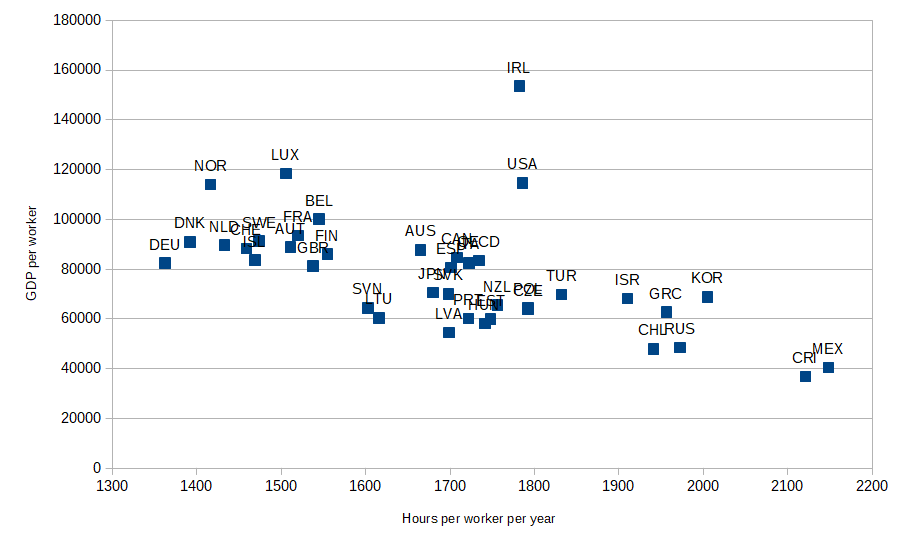
Well… not really. Take a look at this graph, which I compiled from OECD data:


Worker_productivity

The X-axis shows the average number of hours per worker per year. I think this is the best measure of a country’s “work obsession”, as it includes both length of work week, proportion of full-time work, and amount of vacation time. The At 1,786 hours per worker per year, the US is not actually the highest: That title goes to Mexico, at an astonishing 2,148 hours per worker per year. The lowest is Germany at only 1,363 hours per worker per year. Converted into standard 40-hour work weeks, this means that on average Americans work 44 weeks per year, Germans work on average 34 weeks per year, and Mexicans work 54 weeks per year—that is, they work more than full-time every week of the year.

The Y-axis shows GDP per worker per year. I calculated this by multiplying GDP per work hour (a standard measure of labor productivity) by average number of work hours per worker per year. At first glance, these figures may seem too large; for instance they are $114,000 in the US and $154,000 in Ireland. But keep in mind that this is per worker, not per person; the usual GDP per capita figure divides by everyone in the population, while this is only dividing by the number of people who are actively working. Unemployed people are not included, and neither are children or retired people.

There is an obvious negative trend line here. While Ireland is an outlier with exceptionally high labor productivity, the general pattern is clear: the countries with the most GDP per worker actually work the fewest hours. Once again #ScandinaviaIsBetter: Norway and Denmark are near the bottom for work hours and near the top for GDP per worker. The countries that work the most hours, like Mexico and Costa Rica, have the lowest GDP per worker.

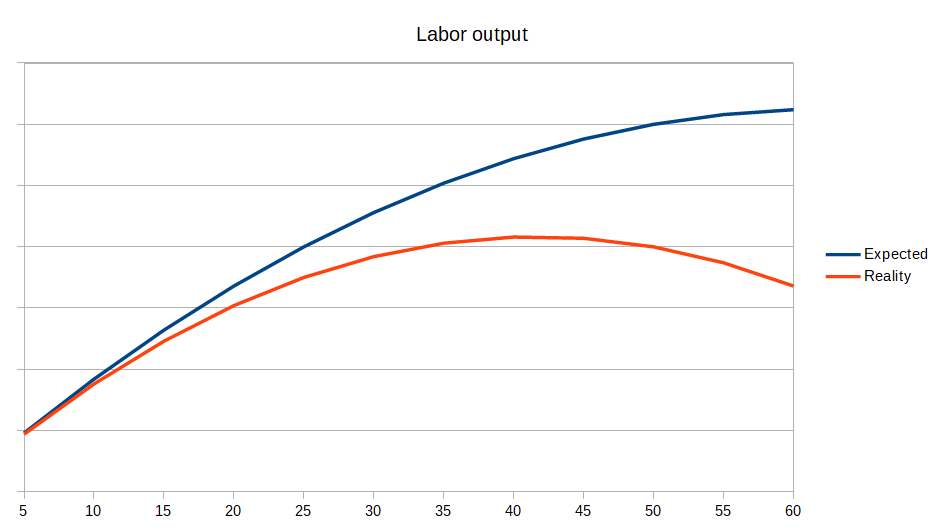
This is actually quite remarkable. We would expect that productivity per hour decreases as work hours increase; that’s not surprising at all. But productivity per worker decreasing means that these extra hours are actually resulting in less total output. We are so overworked, overstressed, and underslept that we actually produce less than our counterparts in Germany or Denmark who spend less time working.

Where we would expect the graph of output as a function of hours to look like the blue line below, it actually looks more like the orange line:

Labor_output

Rather than merely increasing at a decreasing rate, output per worker actually decreases as we put in more hours—and does so over most of the range in which countries actually work. It wouldn’t be so surprising if this sort of effect occurred above say 2000 hours per year, when you start running out of time to do anything else; but in fact it seems to be happening somewhere around 1400 hours per year, which is less than most countries work.

Only a handful of countries—mostly Scandinavian—actually seem to be working the right amount; everyone else is working too much and producing less as a result.

And note that this is not restricted to white-collar or creative jobs where we would expect sleep deprivation and stress to have a particularly high impact. This includes all jobs. Our obsession with work is actually making us poorer!

How much wealth is there in the world?

July 14 JDN 2458679

How much wealth is there in the world? If we split it all evenly, how much would each of us have?

It’s a surprisingly complicated question: What counts as wealth? Presumably we include financial assets, real estate, commodities—anything that can be sold on a market. But what about natural resources? Shouldn’t we somehow value clean air and water? What about human capital—health, knowledge, skills, and expertise that make us able to work better?

I’m going to stick with tradeable assets for now, because I’m interested in questions of redistribution. If we were to add up all the wealth in the United States, or all the wealth in the world, and split it all evenly, how much would each person get? Even then, there are questions about how to price assets: Do we current market prices, or what was actually paid for them in the past? How much do we depreciate? How do we count debt that was used to buy non-financial assets (such as student loans)?

The Federal Reserve reports an official estimate of the US capital stock at $56.2 trillion (in 2011 dollars). Assuming that a third of income is capital income, that means that of our GDP of $18.9 trillion (in 2012 dollars), this would make the rate of return on capital 11%. That rate of return strikes me as pretty clearly too high. This must be an underestimate of our capital stock.

The 2015 Global Wealth Report estimates total US wealth as $63.5 trillion, and total world wealth as $153.2 trillion. This was for 2014, so using the US GDP growth rate of about 2% and the world GDP growth rate of 3.6%, the current wealth stocks should be about $70 trillion and $183 trillion respectively.

This gives a much more plausible rate of return: One third of the US GDP of $19.6 trillion (in 2014 dollars) is $6.53 trillion, yielding a rate of return of about 9%.

One third of the world GDP of $78 trillion is $26 trillion, yielding a rate of return of about 14%. This seems a bit high, but we’re including a lot of countries with very little capital that we would expect to have very high rates of return, so it might be right.

Credit Suisse releases estimates of total wealth that are supposed to include non-financial assets as well, though these are even more uncertain than financial assets. They estimate total US wealth as $98 trillion and total world wealth as $318 trillion.

There’s a lot of uncertainty around all of these figures, but I think these are close enough to get a sense of what sort of redistribution might be possible.

If the US wealth stock is about $70 trillion and our population is about 330 million, that means that the average wealth of an American is $200,000. If our wealth stock is instead about $98 trillion, the average wealth of an American is about $300,000.

Since the average number of people in a US household is 2.5, this means that average household wealth is somewhere between $500,000 and $750,000. This is actually a bit less than I thought; I would have guessed that the mythical “average American household” is a millionaire. (Of course, even Credit Suisse might be underestimating our wealth stock.)

If the world wealth stock is about $180 trillion and the population is about 7.7 billion, global average wealth per person is about $23,000. If instead the global wealth stock is about $320 trillion, the average wealth of a human being is about $42,000.

Both of these are far above the median wealth, which is much more representative of what a typical person has. Median wealth per adult in the US is about $65,000; worldwide it’s only about $4,200.

This means that if we were to somehow redistribute all wealth in the United States, half the population would gain an average of somewhere between $140,000 and $260,000, or on a percentage basis, the median American would see their wealth increase by 215% to 400%. If we were to instead somehow redistribute all wealth in the world, half the population would gain an average of $19,000 to $38,000; the median individual would see their wealth increase by 450% to 900%.

Of course, we can’t literally redistribute all the wealth in the world. Even if we could somehow organize it logistically—a tall order to be sure—such a program would introduce all sorts of inefficiencies and perverse incentives. That would really be socialism: We would be allocating wealth entirely based on a government policy and not at all by the market.

But suppose instead we decided to redistribute some portion of all this wealth. How about 10%? That seems like a small enough amount to avoid really catastrophic damage to the economy. Yes, there would be some inefficiencies introduced, but this could be done with some form of wealth taxes that wouldn’t require completely upending capitalism.

Suppose we did this just within the US. 10% of US wealth, redistributed among the whole population, would increase median wealth by between $20,000 and $30,000, or between 30% and 45%. That’s already a pretty big deal. And this is definitely feasible; the taxation infrastructure is all already in place. We could essentially buy the poorest half of the population a new car on the dime of the top half.

If instead we tried to do this worldwide, we would need to build the fiscal capacity first; the infrastructure to tax wealth effectively is not in place in most countries. But supposing we could do that, we could increase median wealth worldwide by between $2,000 and $4,000, or between 50% and 100%. Of course, this would mean that many of us in the US would lose a similar amount; but I think it’s still quite remarkable that we could as much as double the wealth of most of the world’s population by redistributing only 10% of the total wealth. That’s how much wealth inequality there is in the world.

A tale of two storms

Sep 24, JDN 2458021

There were two severe storm events this past week; one you probably heard a great deal about, the other, probably not. The first was Hurricane Irma, which hit the United States and did most of its damage in Florida; the second was Typhoon Doksuri, which hit Southeast Asia and did most of its damage in Vietnam.

You might expect that this post is going to give you more bad news. Well, I have a surprise for you: The news is actually mostly good.

The death tolls from both storms were astonishingly small. The hurricane is estimated to have killed at least 84 people, while the typhoon has killed at least 26. This result is nothing less than heroism. The valiant efforts of thousands of meteorologists and emergency responders around the world has saved thousands of lives, and did so both in the wealthy United States and in impoverished Vietnam.

When I started this post, I had expected to see that the emergency response in Vietnam would be much worse, and fatalities would be far higher; I am delighted to report that nothing of the sort was the case, and Vietnam, despite their per-capita GDP PPP of under $6,000, has made emergency response a sufficiently high priority that they saved their people just about as well as Florida did.

To get a sense of what might have happened without them, consider that 1.5 million homes in Florida were leveled by the hurricane, and over 100,000 homes were damaged by the typhoon. Vietnam is a country of 94 million people. Florida has a population of 20 million. (The reason Florida determines so many elections is that it is by far the most populous swing state.) Without weather forecasting and emergency response, these death figures would have been in the tens of thousands, not the dozens.

Indeed, if you know statistics and demographics well, these figures become even more astonishing: These death rates were almost indistinguishable from statistical noise.

Vietnam’s baseline death rate is about 5.9 per 1,000, meaning that they experience about 560,000 deaths in any given year. This means that over 1500 people die in Vietnam on a normal day.

Florida’s baseline death rate is about 6.6 per 1,000, actually a bit higher than Vietnam’s, because Florida’s population skews so much toward the elderly. Therefore Florida experiences about 130,000 deaths per year, or 360 deaths on a normal day.

In both Vietnam and Florida, this makes the daily death probability for any given person about 0.0017%. A random process with a fixed probability of 0.0017% over a population of n people will result in an average of 0.0017n events, but with some variation around that number. The standard deviation is actually sqrt(p(1-p)n) = 0.004 sqrt(n). When n = 20,000,000 (Florida), this results in a standard deviation of 18. When n = 94,000,000 (Vietnam), this results in a standard deviation of 40.

This means that the 26 additional deaths in Vietnam were within one standard deviation of average! They basically are indistinguishable from statistical noise. There have been over a hundred days in Vietnam where an extra 26 people happened to die, just in the past year. Weather forecasting took what could have been a historic disaster and turned it into just another bad day.

The 84 additional deaths in Florida are over four standard deviations away from average, so they are definitely distinguishable from statistical noise—but this still means that Florida’s total death rate for the year will only tick up by 0.6%.

It is common in such tragedies to point out in grave tones that “one death is too many”, but I maintain that this is not actually moral wisdom but empty platitude. No conceivable policy is ever going to reduce death rates to zero, and the people who died of heart attacks or brain aneurysms are every bit as dead as the people who died from hurricanes or terrorist attacks. Instead of focusing on the handful of people who died because they didn’t heed warnings or simply got extraordinarily unlucky, I think we should be focusing on the thousands of people who survived because our weather forecasters and emergency responders did their jobs so exceptionally well. Of course if we can reduce the numbers even further, we should; but from where I’m sitting, our emergency response system has a lot to be proud of.

Of course, the economic damage of the storms was substantially greater. The losses in destroyed housing and infrastructure in Florida are projected at over $80 billion. Vietnam is much poorer, so there simply isn’t as much infrastructure to destroy; total damage is unlikely to exceed $10 billion. Florida’s GDP is $926 billion, so they are losing 8.6%; while Vietnam’s GDP is $220 billion, so they are still losing 4.5%. And of course the damage isn’t evenly spread across everyone; those hardest hit will lose perhaps their entire net wealth, while others will feel absolutely nothing.

But economic damage is fleeting. Indeed, if we spend the government money we should be, and take the opportunity to rebuild this infrastructure better than it was before, the long-run economic impact could be positive. Even 8.6% of GDP is less than five years of normal economic growth—and there were years in the 1950s where we did it in a single year. The 4.6% that Vietnam lost, they should make back within a year of their current economic growth.

Thank goodness.

Will China’s growth continue forever?

July 23, JDN 2457958

It’s easy to make the figures sound alarming, especially if you are a xenophobic American:

Annual GDP growth in the US is currently 2.1%, while annual GDP growth in China is 6.9%. At markte exchange rates, US GDP is currently $18.6 trillion, while China’s GDP is $11.2 trillion. If these growth rates continue, that means that China’s GDP will surpass ours in just 12 years.

Looking instead at per-capita GDP (and now using purchasing-power-parity, which is a much better measure for standard of living), the US is currently at $53,200 per person per year while China is at $14,400 per person per year. Since 2010 US per-capita GDP PPP has been growing at about 1.2%, while China’s has been growing at 7.1%. At that rate, China will surpass the US in standard of living in only 24 years.

And then if you really want to get scared, you start thinking about what happens if this growth continues for 20, or 30, or 50 years. At 50 years of these growth rates, US GDP will just about triple; but China’s GDP would increase by almost a factor of thirty. US per-capita GDP will increase to about $150,000, while China’s per-capita GDP will increase all the way to $444,000.

But while China probably will surpass the US in total nominal GDP within say 15 years, the longer-horizon predictions are totally unfounded. In fact, there is reason to believe that China will never surpass the US in standard of living, at least within the foreseeable future. Sure, some sort of global catastrophe could realign the world’s fortunes (climate change being a plausible candidate) and over very long time horizons all sorts of things can happen; but barring catastrophe and looking within the next few generations, there’s little reason to think that the average person in China will actually be better off than the average person in the United States. Indeed, while that $150,000 figure is actually remarkably plausible, that $444,000 figure is totally nonsensical. I project that in 2065, per-capita GDP in the US will indeed be about $150,000, but per-capita GDP in China will be more like $100,000.

That’s still a dramatic improvement over today for both countries, and something worth celebrating; but the panic that the US must be doing something wrong and China must be doing something right, that China is “eating our lunch” in Trump’s terminology, is simply unfounded.

Why am I so confident of this? Because, for all the proud proclamations of Chinese officials and panicked reports of American pundits, China’s rapid growth rates are not unprecedented. We have seen this before.

Look at South Korea. As I like to say, the discipline of development economics is basically the attempt to determine what happened in South Korea 1950-2000 and how to make it happen everywhere.

In 1960, South Korea’s nominal per-capita GDP was only $944. In 2016, it was $25,500. That takes them from solidly Third World underdeveloped status into very nearly First World highly-developed status in just two generations. This was an average rate of growth of 6.0%. But South Korea didn’t grow steadily at 6.0% for that entire period. Their growth fluctuated wildly (small countries tend to do that; they are effectively undiversified assets), but also overall trended downward.

The highest annual growth rate in South Korea over that time period was an astonishing 20.8%. Over twenty percent per year. Now that is growth you would feel. Imagine going from an income of $10,000 to an income of $12,000, in just one year. Imagine your entire country doing this. In its best years, South Korea was achieving annual growth rates in income comparable to the astronomical investment returns of none other than Warren Buffett (For once, we definitely had r < g). Even if you smooth out over the boom-and-bust volatility South Korea went through during that period, they were still averaging growth rates over 7.5% in the 1970s.

I wasn’t alive then, but I wouldn’t be surprised if Americans back then were panicking about South Korea’s growth too. Maybe not, since South Korea was and remains a close US ally, and their success displayed the superiority of capitalism over Communism (boy did it ever: North Korea’s per capita GDP also started at about $900 in 1960, and is still today… only about $1000!); but you could have made the same pie-in-the-sky forecasts of Korea taking over the world if you’d extrapolated their growth rates forward.

South Korea’s current growth rate, on the other hand? 2.9%. Not so shocking now!

Moreover, this is a process we understand theoretically as well as empirically. The Solow model is now well-established as the mainstream neoclassical model of economic growth, and it directly and explicitly predicts this sort of growth pattern, where a country that starts very poor will initially grow extremely fast as they build a capital base and reverse-engineer technology from more advanced countries, but then over a couple of generations their growth will slow down and eventually level off once they reach a high level of economic development.

Indeed, the basic reason is quite simple: A given proportional growth is easier to do when you start small. (There’s more to it than that, involving capital degradation and diminishing marginal returns, but at its core, that’s the basic idea.)

I think I can best instill this realization in you by making another comparison between the US and China: How much income are we adding in absolute terms?

US per-capita GDP of $53,200 is growing at 1.2% per year; that means we’re adding $640 per person per year. China per-capita GDP of $14,400 is growing at 7.1% per year; that means they’re adding $1,020 per year. So while it sounds like they are growing almost six times faster, they’re actually only adding about 40% more real income per person each year than we are. It’s just a larger proportion to them.

Indeed, China is actually doing relatively well on this scale. Many developing countries that are growing “fast” are actually adding less income per person in absolute terms than many highly-developed countries. India’s per capita GDP is growing at 5.8% per year, but adding only $340 per person per year. Ethiopia’s income per person is growing by 4.9%—which is only $75 per person per year. Compare this to the “slow” growth of the UK, where 1.0% annual growth is still $392 per person per year, or France, where “stagnant” growth of 0.8% is still $293 per person per year.

Back when South Korea was growing at 20%, that was still on the order of $200 per person per year. Their current 2.9%, on the other hand, is actually $740 per person per year. We often forget just how poor many poor countries truly are; what sounds like a spectacular growth rate still may not be all that much in absolute terms.

Here’s a graph (on a log scale) of GDP per capita in the US, Japan, China, and Korea, from World Bank data since 1960. I’d prefer to use GDP PPP, but the World Bank data doesn’t go back far enough.

As you can see, there is a general pattern of growth at a decreasing rate; it’s harder to see in China because they are earlier in the process; but there’s good reason to think that they will follow the same pattern.

If anything, I think the panic about Japan in the 1990s may have been more justifiable (not that it was terribly justified either). As you can see on the graph, in terms of nominal GDP per capita, Japan actually did briefly surpass the United States in the 1990s. Of course, the outcome of that was not a global war or Japan ruling the world or something; it was… the Nintendo Wii and the Toyota Prius.

Of course, that doesn’t stop people from writing news articles and even publishing economic papers about how this time is different, not like all the other times we saw the exact same pattern. Many Chinese officials appear to believe that China is special, that they can continue to grow at extremely high rates indefinitely without the constraints that other countries would face. But for once economic theory and economic data are actually in very good agreement: These high growth rates will not last forever. They will slow down, and that’s not such a bad thing. By the time they do, China will have greatly raised their standard of living to something very close to our own. Hundreds of millions of people have already been lifted out of abject poverty; continued growth could benefit hundreds of millions more.

The far bigger problem would be if the government refuses to accept that growth must slow down, and begins trying to force impossible levels of growth or altering the economic data to make it appear as though growth has occurred that hasn’t. We already know that the People’s Republic of China has a track record of doing this sort of thing: we know they have manipulated some data, though we think only in small ways, and the worst example of an attempt at forcing economic growth in human history was in China, the so-called “Great Leap Forward” that killed 20 million people. The danger is not that China will grow this fast forever, nor that they will slow down soon enough, but that they will slow down and their government will refuse to admit it.