Taylor Swift and the means of production

Oct 5 JDN 2460954

This post is one I’ve been meaning to write for awhile, but current events keep taking precedence.

In 2023, Taylor Swift did something very interesting from an economic perspective, which turns out to have profound implications for our economic future.

She re-recorded an entire album and released it through a different record company.

The album was called 1989 (Taylor’s Version), and she created it because for the last four years she had been fighting with Big Machine Records over the rights to her previous work, including the original album 1989.

A Marxist might well say she seized the means of production! (How rich does she have to get before she becomes bourgeoisie, I wonder? Is she already there, even though she’s one of a handful of billionaires who can truly say they were self-made?)

But really she did something even more interesting than that. It was more like she said:

Seize the means of production? I am the means of production.”

Singing and songwriting are what is known as a human-capital-intensive industry. That is, the most important factor of production is not land, or natural resources, or physical capital (yes, you need musical instruments, amplifiers, recording equipment and the like—but these are a small fraction of what it costs to get Talor Swift for a concert), or even labor in the ordinary sense. It’s one where so-called (honestly poorly named) “human capital” is the most important factor of production.

A labor-intensive industry is one where you just need a lot of work to be done, but you can get essentially anyone to do it: Cleaning floors is labor-intensive. A lot of construction work is labor-intensive (though excavators and the like also make it capital-intensive).

No, for a human-capital-intensive industry, what you need is expertise or talent. You don’t need a lot of people doing back-breaking work; you need a few people who are very good at doing the specific thing you need to get done.

Taylor Swift was able to re-record and re-release her songs because the one factor of production that couldn’t be easily substituted was herself. Big Machine Records overplayed their hand; they thought they could control her because they owned the rights to her recordings. But she didn’t need her recordings; she could just sing the songs again.

But now I’m sure you’re wondering: So what?

Well, Taylor Swift’s story is, in large part, the story of us all.

For most of the 18th, 19th, and 20th centuries, human beings in developed countries saw a rapid increase in their standard of living.

Yes, a lot of countries got left behind until quite recently.

Yes, this process seems to have stalled in the 21st century, with “real GDP” continuing to rise but inequality and cost of living rising fast enough that most people don’t feel any richer (and I’ll get to why that may be the case in a moment).

But for millions of people, the gains were real, and substantial. What was it that brought about this change?

The story we are usually told is that it was capital; that as industries transitioned from labor-intensive to capital-intensive, worker productivity greatly increased, and this allowed us to increase our standard of living.

That’s part of the story. But it can’t be the whole thing.

Why not, you ask?

Because very few people actually own the capital.

When capital ownership is so heavily concentrated, any increases in productivity due to capital-intensive production can simply be captured by the rich people who own the capital. Competition was supposed to fix this, compelling them to raise wages to match productivity, but we often haven’t actually had competitive markets; we’ve had oligopolies that consolidate market power in a handful of corporations. We had Standard Oil before, and we have Microsoft now. (Did you know that Microsoft not only owns more than half the consumer operating system industry, but after acquiring Activision Blizzard, is now the largest video game company in the world?) In the presence of an oligopoly, the owners of the capital will reap the gains from capital-intensive productivity.

But standards of living did rise. So what happened?

The answer is that production didn’t just become capital-intensive. It became human-capital-intensive.

More and more jobs required skills that an average person didn’t have. This created incentives for expanding public education, making workers not just more productive, but also more aware of how things work and in a stronger bargaining position.

Today, it’s very clear that the jobs which are most human-capital-intensive—like doctors, lawyers, researchers, and software developers—are the ones with the highest pay and the greatest social esteem. (I’m still not 100% sure why stock traders are so well-paid; it really isn’t that hard to be a stock trader. I could write you an algorithm in 50 lines of Python that would beat the average trader (mostly by buying ETFs). But they pretend to be human-capital-intensive by hiring Harvard grads, and they certainly pay as if they are.)

The most capital-intensive industries—like factory work—are reasonably well-paid, but not that well-paid, and actually seem to be rapidly disappearing as the capital simply replaces the workers. Factory worker productivity is now staggeringly high thanks to all this automation, but the workers themselves have gained only a small fraction of this increase in higher wages; by far the bigger effect has been increased profits for the capital owners and reduced employment in manufacturing.

And of course the real money is all in capital ownership. Elon Musk doesn’t have $400 billion because he’s a great engineer who works very hard. He has $400 billion because he owns a corporation that is extremely highly valued (indeed, clearly overvalued) in the stock market. Maybe being a great engineer or working very hard helped him get there, but it was neither necessary nor sufficient (and I’m sure that his dad’s emerald mine also helped).

Indeed, this is why I’m so worried about artificial intelligence.

Most forms of automation replace labor, in the conventional labor-intensive sense: Because you have factory robots, you need fewer factory workers; because you have mountaintop removal, you need fewer coal miners. It takes fewer people to do the same amount of work. But you still need people to plan and direct the process, and in fact those people need to be skilled experts in order to be effective—so there’s a complementarity between automation and human capital.

But AI doesn’t work like that. AI substitutes for human capital. It doesn’t just replace labor; it replaces expertise.

So far, AI is currently too unreliable to replace any but entry-level workers in human-capital-intensive industries (though there is some evidence it’s already doing that). But it will most likely get more reliable over time, if not via the current LLM paradigm, than through the next one that comes after. At some point, AI will come to replace experienced software developers, and then veteran doctors—and I don’t think we’ll be ready.

The long-term pattern here seems to be transitioning away from human-capital-intensive production to purely capital-intensive production. And if we don’t change the fact that capital ownership is heavily concentrated and so many of our markets are oligopolies—which we absolutely do not seem poised to do anything about; Democrats do next to nothing and Republicans actively and purposefully make it worse—then this transition will be a recipe for even more staggering inequality than before, where the rich will get even more spectacularly mind-bogglingly rich while the rest of us stagnate or even see our real standard of living fall.

The tech bros promise us that AI will bring about a utopian future, but that would only work if capital ownership were equally shared. If they continue to own all the AIs, they may get a utopia—but we sure won’t.

We can’t all be Taylor Swift. (And if AI music catches on, she may not be able to much longer either.)

Solving the student debt problem

Aug 24 JDN 2460912

A lot of people speak about student debt as a “crisis”, which makes it sound like the problem is urgent and will have severe consequences if we don’t soon intervene. I don’t think that’s right. While it’s miserable to be unable to pay your student loans, student loans don’t seem to be driving people to bankruptcy or homelessness the way that medical bills do.

Instead I think what we have here is a long-term problem, something that’s been building for a long time and will slowly but surely continue getting worse if we don’t change course. (I guess you can still call it a “crisis” if you want; climate change is also like this, and arguably a crisis.)

But there is a problem here: Student loan balances are rising much faster than other kinds of debt, and the burden falls the worst on Black women and students who went to for-profit schools. A big part of the problem seems to be predatory schools that charge high prices and make big promises but offer poor results.

Making all this worse is the fact that some of the most important income-based repayment plans were overturned by a federal court, forcing everyone who was on them into forebearance. Income-based repayment was a big reason why student loans actually weren’t as bad a burden as their high loan balances might suggest; unlike a personal loan or a mortgage, if you didn’t have enough income to repay your student loans at the full amount, you could get on a plan that would let you make smaller payments, and if you paid on that plan for long enough—even if it didn’t add up to the full balance—your loans would be forgiven.

Now the forebearance is ending for a lot of borrowers, and so they are going into default; and most of that loan forgiveness has been ruled illegal. (Supposedly this is because Congress didn’t approve it. I’ll believe that was the reason when the courts overrule Trump’s tariffs, which clearly have just as thin a legal justification and will cause far more harm to us and the rest of the world.)

In theory, student loans don’t really seem like a bad idea.

College is expensive, because it requires highly-trained professors, who demand high salaries. (The tuition money also goes other places, of course….)

College is valuable, because it provides you with knowledge and skills that can improve your life and also increase your long-term earnings. It’s a big difference: Median salary for someone with a college degree is about $60k, while median salary for someone with only a high school diploma is about $34k.

Most people don’t have enough liquidity to pay for college.

So, we provide loans, so that people can pay for college, and then when they make more money after graduating, they can pay the loans back.

That’s the theory, anyway.

The problem is that average or even median salaries obscure a lot of variation. Some college graduates become doctors, lawyers, or stockbrokers and make huge salaries. Others can’t find jobs at all. In the absence of income-based repayment plans, all students have to pay back their loans in full, regardless of their actual income after graduation.

There is inherent risk in trying to build a career. Our loan system—especially with the recent changes—puts most of this risk on the student. We treat it as their fault they can’t get a good job, and then punish them with loans they can’t afford to repay.

In fact, right now the job market is pretty badfor recent graduates—while usually unemployment for recent college grads is lower than that of the general population, since about 2018 it has actually been higher. (It’s no longer sky-high like it was during COVID; 4.8% is not bad in the scheme of things.)

Actually the job market may even be worse than it looks, because new hires are actually the lowest rate they’ve been since 2020. Our relatively low unemployment currently seems to reflect a lack of layoffs, not a healthy churn of people entering and leaving jobs. People seem to be locked into their jobs, and if they do leave them, finding another is quite difficult.

What I think we need is a system that makes the government take on more of the risk, instead of the students.

There are lots of ways to do this. Actually, the income-based repayment systems we used to have weren’t too bad.

But there is actually a way to do it without student loans at all. College could be free, paid for by taxes.


Now, I know what you’re thinking: Isn’t this unfair to people who didn’t go to college? Why should they have to pay?

Who said they were paying?

There could simply be a portion of the income tax that you only pay if you have a bachelor’s degree. Then you would only pay this tax if you both graduated from college and make a lot of money.

I don’t think this would create a strong incentive not to get a bachelor’s degree; the benefits of doing so remain quite large, even if your taxes were a bit higher as a result.

It might create incentives to major in subjects that aren’t as closely linked to higher earnings—liberal arts instead of engineering, medicine, law, or business. But this I see as fundamentally a public good: The world needs people with liberal arts education. If the market fails to provide for them, the government should step in.

This plan is not as progressive as Elizabeth Warren’s proposal to use wealth taxes to fund free college; but it might be more politically feasible. The argument that people who didn’t go to college shouldn’t have to pay for people who did actually seems reasonable to me; but this system would ensure that in fact they don’t.

The transfer of wealth here would be from people who went to college and make a lot of money to people who went to college and don’t make a lot of money. It would be the government bearing some of the financial risk of taking on a career in an uncertain world.

Reflections on the Index of Necessary Expenditure

Mar 16 JDN 2460751

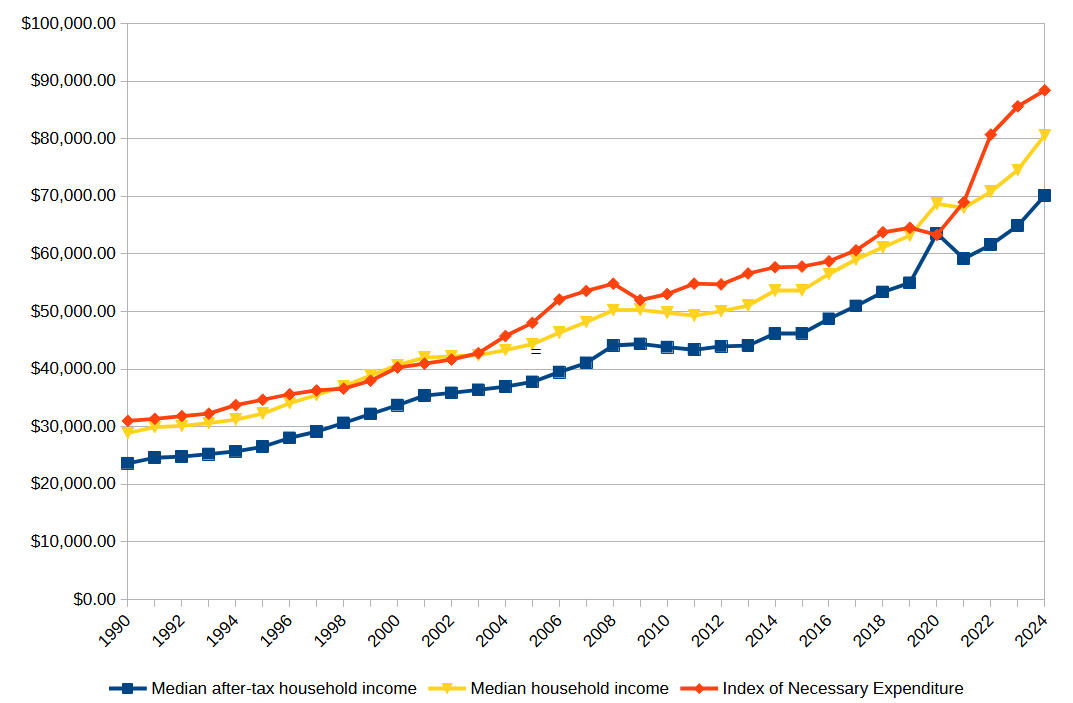
In last week’s post I constructed an Index of National Expenditure (INE), attempting to estimate the total cost of all of the things a family needs and can’t do without, like housing, food, clothing, cars, healthcare, and education. What I found shocked me: The median family cannot afford all necessary expenditures.

I have a couple more thoughts about that.

I still don’t understand why people care so much about gas prices.

Gasoline was a relatively small contribution to INE. It was more than clothing but less than utilities, and absolutely dwarfed by housing, food, or college. I thought maybe since I only counted a 15-mile commute, maybe I didn’t actually include enoughgasoline usage, but based on this estimate of about $2000 per driver, I was in about the right range; my estimate for the same year was $3350 for a 2-car family.

I think I still have to go with my salience hypothesis: Gasoline is the only price that we plaster in real-time on signs on the side of the road. So people are constantly aware of it, even though it isn’t actually that important.

The price surge that should be upsetting people is housing.

If the price of homes had only risen with the rate of CPI inflation instead of what it actually did, the median home price in 2024 would be only $234,000 instead of the $396,000 it actually is; and by my estimation that would save a typical family $11,000 per year—a whopping 15% of their income, and nearly enough to make the INE affordable by itself.

Now, I’ll consider some possible objections to my findings.

Objection 1: A typical family doesn’t actually spend this much on these things.

You’re right, they don’t! Because they couldn’t possibly. Even with substantial debt, you just can’t sustainably spend 125% of your after-tax household income.

My goal here was not to estimate how much families actually spend; it was to estimate how much they need to spend in order to live a good life and not feel deprived.


What I have found is that most American families feel deprived. They are forced to sacrifice something really important—like healthcare, or education, or owning a home—because they simply can’t afford it.

What I’m trying to do here is find the price of the American Dream; and what I’ve found is that the American Dream has a price that most Americans cannot afford.

Objection 2: You should use median healthcare spending, not mean.

I did in fact use mean figures instead of median for healthcare expenditures, mainly because only the mean was readily available. Mean income is higher than median income, so you might say that I’ve overestimated healthcare expenditure—and in a sense that’s definitely true. The median family spends less than this on healthcare.

But the reason that the median family spends less than this on healthcare is not that they want to, but that they have to. Healthcare isn’t a luxury that people buy more of because they are richer. People buy either as much as they need or as much as they can afford—whichever is lower, which is typically the latter. Using the mean instead of the median is a crude way to account for that, but I think it’s a defensible one.

But okay, let’s go ahead and cut the estimate of healthcare spending in half; even if you do that, the INE is still larger than after-tax median household income in most years.

Objection 3: A typical family isn’t a family of four, it’s a family of three.

Yes, the mean number of people in a family household in the US is 3.22 (the median is 3).

This is a very bad thing.

Part of what I seem to be finding here is that a family of four is unaffordable—literally impossible to afford—on a typical family income.

But a healthy society is one in which typical families have two or three children. That is what we need in order to achieve population replacement. When families get smaller than that, we aren’t having enough children, and our population will decline—which means that we’ll have too many old people relative to young people. This puts enormous pressure on healthcare and pension systems, which rely upon the fact that young people produce more, in order to pay for the fact that old people cost more.

The ideal average number of births per woman is about 2.1; this is what would give us a steady population. No US state has fertility above this level. The only reason the US population is growing rather than shrinking is that we are taking in immigrants.

This is bad. This is not sustainable. If the reason families aren’t having enough kids is that they can’t afford them—and this fits with other research on the subject—then this economic failure damages our entire society, and it needs to be fixed.

Objection 4: Many families buy their cars used.

Perhaps 1/10 of a new car every year isn’t an ideal estimate of how much people spend on their cars, but if anything I think it’s conservative, because if you only buy a car every 10 years, and it was already used when you bought it, you’re going to need to spend a lot on maintaining it—quite possibly more than it would cost to get a new one. Motley Fool actually estimates the ownership cost of just one car at substantially more than I estimated for two cars. So if anything your complaint should be that I’ve underestimated the cost by not adequately including maintenance and insurance.

Objection 5: Not everyone gets a four-year college degree.

Fair enough; a substantial proportion get associate’s degrees, and most people get no college degree at all. But some also get graduate degrees, which is even more expensive (ask me how I know).

Moreover, in today’s labor market, having a college degree makes a huge difference in your future earnings; a bachelor’s degree increases your lifetime earnings by a whopping 84%. In theory it’s okay to have a society where most people don’t go to college; in practice, in our society, not going to college puts you at a tremendous disadvantage for the rest of your life. So we either need to find a way to bring wages up for those who don’t go to college, or find a way to bring the cost of college down.

This is probably one of the things that families actually choose to scrimp on, only sending one kid to college or none at all. But because college is such a huge determinant of earnings, this perpetuates intergenerational inequality: Only rich families can afford to send their kids to college, and only kids who went to college grow up to have rich families.

Objection 6: You don’t actually need to save for college; you can use student loans.

Yes, you can, and in practice, most people who to college do. But while this solves the liquidity problem (having enough money right now), it does not solve the solvency problem (having enough money in the long run). Failing to save for college and relying on student loans just means pushing the cost of college onto your children—and since we’ve been doing that for over a generation, feel free to replace the category “college savings” with “repaying student loans”; it won’t meaningfully change the results.

The Index of Necessary Expenditure

Mar 16 JDN 2460751

I’m still reeling from the fact that Donald Trump was re-elected President. He seemed obviously horrible at the time, and he still seems horrible now, for many of the same reasons as before (we all knew the tariffs were coming, and I think deep down we knew he would sell out Ukraine because he loves Putin), as well as some brand new ones (I did not predict DOGE would gain access to all the government payment systems, nor that Trump would want to start a “crypto fund”). Kamala Harris was not an ideal candidate, but she was a good candidate, and the comparison between the two could not have been starker.

Now that the dust has cleared and we have good data on voting patterns, I am now less convinced than I was that racism and sexism were decisive against Harris. I think they probably hurt her some, but given that she actually lost the most ground among men of color, racism seems like it really couldn’t have been a big factor. Sexism seems more likely to be a significant factor, but the fact that Harris greatly underperformed Hillary Clinton among Latina women at least complicates that view.

A lot of voters insisted that they voted on “inflation” or “the economy”. Setting aside for a moment how absurd it was—even at the time—to think that Trump (he of the tariffs and mass deportations!) was going to do anything beneficial for the economy, I would like to better understand how people could be so insistent that the economy was bad even though standard statistical measures said it was doing fine.

Krugman believes it was a “vibecession”, where people thought the economy was bad even though it wasn’t. I think there may be some truth to this.


But today I’d like to evaluate another possibility, that what people were really reacting against was not inflation per se but necessitization.

I first wrote about necessitization in 2020; as far as I know, the term is my own coinage. The basic notion is that while prices overall may not have risen all that much, prices of necessities have risen much faster, and the result is that people feel squeezed by the economy even as CPI growth remains low.

In this post I’d like to more directly evaluate that notion, by constructing an index of necessary expenditure (INE).

The core idea here is this:

What would you continue to buy, in roughly the same amounts, even if it doubled in price, because you simply can’t do without it?

For example, this is clearly true of housing: You can rent or you can own, but can’t not have a house. And nor are most families going to buy multiple houses—and they can’t buy partial houses.

It’s also true of healthcare: You need whatever healthcare you need. Yes, depending on your conditions, you maybe could go without, but not without suffering, potentially greatly. Nor are you going to go out and buy a bunch of extra healthcare just because it’s cheap. You need what you need.

I think it’s largely true of education as well: You want your kids to go to college. If college gets more expensive, you might—of necessity—send them to a worse school or not allow them to complete their degree, but this would feel like a great hardship for your family. And in today’s economy you can’t not send your kids to college.

But this is not true of technology: While there is a case to be made that in today’s society you need a laptop in the house, the fact is that people didn’t used to have those not that long ago, and if they suddenly got a lot cheaper you very well might buy another one.

Well, it just so happens that housing, healthcare, and education have all gotten radically more expensive over time, while technology has gotten radically cheaper. So prima facie, this is looking pretty plausible.

But I wanted to get more precise about it. So here is the index I have constructed. I consider a family of four, two adults, two kids, making the median household income.

To get the median income, I’ll use this FRED series for median household income, then use this table of median federal tax burden to get an after-tax wage. (State taxes vary too much for me to usefully include them.) Since the tax table ends in 2020 which was anomalous, I’m going to extrapolate that 2021-2024 should be about the same as 2019.

I assume the kids go to public school, but the parents are saving up for college; to make the math simple, I’ll assume the family is saving enough for each kid to graduate from with a four-year degree from a public university, and that saving is spread over 16 years of the child’s life. 2*4/16 = 0.5; this means that each year the family needs to come up with 0.5 years of cost of attendance. (I had to get the last few years from here, but the numbers are comparable.)

I assume the family owns two cars—both working full time, they kinda have to—which I amortize over 10 year lifetimes; 2*1/10 = 0.2, so each year the family pays 0.2 times the value of an average midsize car. (The current average new car price is $33226; I then use the CPI for cars to figure out what it was in previous years.)

I assume they pay a 30-year mortgage on the median home; they would pay interest on this mortgage, so I need to factor that in. I’ll assume they pay the average mortgage rate in that year, but I don’t want to have to do a full mortgage calculation (including PMI, points, down payment etc.) for each year, so I’ll say that they amount they pay is (1/30 + 0.5 (interest rate))*(home value) per year, which seems to be a reasonable approximation over the relevant range.

I assume that both adults have a 15-mile commute (this seems roughly commensurate with the current mean commute time of 26 minutes), both adults work 5 days per week, 50 weeks per year, and their cars get the median level of gas mileage. This means that they consume 2*15*2*5*50/(median MPG) = 15000/(median MPG) gallons of gasoline per year. I’ll use this BTS data for gas mileage. I’m intentionally not using median gasoline consumption, because when gas is cheap, people might take more road trips, which is consumption that could be avoided without great hardship when gas gets expensive. I will also assume that the kids take the bus to school, so that doesn’t contribute to the gasoline cost.

That I will multiply by the average price of gasoline in June of that year, which I have from the EIA since 1993. (I’ll extrapolate 1990-1992 as the same as 1993, which is conservative.)

I will assume that the family owns 2 cell phones, 1 computer, and 1 television. This is tricky, because the quality of these tech items has dramatically increased over time.

If you try to measure with equivalent buying power (e.g. a 1 MHz computer, a 20-inch CRT TV), then you’ll find that these items have gotten radically cheaper; $1000 in 1950 would only buy as much TV as $7 today, and a $50 Raspberry Pi‘s 2.4 GHz processor is 150 times faster than the 16 MHz offered by an Apple Powerbook in 1991—despite the latter selling for $2500 nominally. So in dollars per gigahertz, the price of computers has fallen by an astonishing 7,500 times just since 1990.

But I think that’s an unrealistic comparison. The standards for what was considered necessary have also increased over time. I actually think it’s quite fair to assume that people have spent a roughly constant nominal amount on these items: about $500 for a TV, $1000 for a computer, and $500 for a cell phone. I’ll also assume that the TV and phones are good for 5 years while the computer is good for 2 years, which makes the total annual expenditure for 2 phones, a TV, and a computer equal to 2/5*500 + 1/5*500 + 1/2*1000 = 800. This is about what a family must spend every year to feel like they have an adequate amount of digital technology.

I will also assume that the family buys clothes with this equivalent purchasing power, with an index that goes from 166 in 1990 to 177 in 2024—also nearly constant in nominal terms. I’ll multiply that index by $10 because the average annual household spending on clothes is about $1700 today.

I will assume that the family buys the equivalent of five months of infant care per year; they surely spend more than this (in either time or money) when they have actual infants, but less as the kids grow. This amounts to about $5000 today, but was only $1600 in 1990—a 214% increase, or 3.42% per year.

For food expenditure, I’m going to use the USDA’s thrifty plan for June of that year. I’ll use the figures assuming that one child is 6 and the other is 9. I don’t have data before 1994, so I’ll extrapolate that with the average growth rate of 3.2%.

Food expenditures have been at a fairly consistent 11% of disposable income since 1990; so I’m going to include them as 2*11%*40*50*(after-tax median wage) = 440*(after-tax median wage).

The figures I had the hardest time getting were for utilities. It’s also difficult to know what to include: Is Internet access a necessity? Probably, nowadays—but not in 1990. Should I separate electric and natural gas, even though they are partial substitutes? But using these figures I estimate that utility costs rise at about 0.8% per year in CPI-adjusted terms, so what I’ll do is benchmark to $3800 in 2016 and assume that utility costs have risen by (0.8% + inflation rate) per year each year.

Healthcare is also a tough one; pardon the heteronormativity, but for simplicity I’m going to use the mean personal healthcare expenditures for one man and woman (aged 19-44) and one boy and one girl (aged 0-18). Unfortunately I was only able to find that for two-year intervals in the range from 2002 to 2020, so I interpolated and extrapolated both directions assuming the same average growth rate of 3.5%.

So let’s summarize what all is included here:

  • Estimated payment on a mortgage
  • 0.5 years of college tuition
  • amortized cost of 2 cars
  • 7500/(median MPG) gallons of gasoline
  • amortized cost of 2 phones, 1 computer, and 1 television
  • average spending on clothes
  • 11% of income on food
  • Estimated utilities spending
  • Estimated childcare equivalent to five months of infant care
  • Healthcare for one man, one woman, one boy, one girl

There are obviously many criticisms you could make of these choices. If I were writing a proper paper, I would search harder for better data and run robustness checks over the various estimation and extrapolation assumptions. But for these purposes I really just want a ballpark figure, something that will give me a sense of what rising cost of living feels like to most people.

What I found absolutely floored me. Over the range from 1990 to 2024:

  1. The Index of Necessary Expenditure rose by an average of 3.45% per year, almost a full percentage point higher than the average CPI inflation of 2.62% per year.
  2. Over the same period, after-tax income rose at a rate of 3.31%, faster than CPI inflation, but slightly slower than the growth rate of INE.
  3. The Index of Necessary Expenditure was over 100% of median after-tax household income every year except 2020.
  4. Since 2021, the Index of Necessary Expenditure has risen at an average rate of 5.74%, compared to CPI inflation of only 2.66%. In that same time, after-tax income has only grown at a rate of 4.94%.

Point 3 is the one that really stunned me. The only time in the last 34 years that a family of four has been able to actually pay for all necessities—just necessities—on a typical household income was during the COVID pandemic, and that in turn was only because the federal tax burden had been radically reduced in response to the crisis. This means that every single year, a typical American family has been either going further and further into debt, or scrimping on something really important—like healthcare or education.

No wonder people feel like the economy is failing them! It is!

In fact, I can even make sense now of how Trump could convince people with “Are you better off than you were four years ago?” in 2024 looking back at 2020—while the pandemic was horrific and the disruption to the economy was massive, thanks to the US government finally actually being generous to its citizens for once, people could just about actually make ends meet. That one year. In my entire life.

This is why people felt betrayed by Biden’s economy. For the first time most of us could remember, we actually had this brief moment when we could pay for everything we needed and still have money left over. And then, when things went back to “normal”, it was taken away from us. We were back to no longer making ends meet.

When I went into this, I expected to see that the INE had risen faster than both inflation and income, which was indeed the case. But I expected to find that INE was a large but manageable proportion of household income—maybe 70% or 80%—and slowly growing. Instead, I found that INE was greater than 100% of income in every year but one.

And the truth is, I’m not sure I’ve adequately covered all necessary spending! My figures for childcare and utilities are the most uncertain; those could easily go up or down by quite a bit. But even if I exclude them completely, the reduced INE is still greater than income in most years.

Suddenly the way people feel about the economy makes a lot more sense to me.

The role of police in society

Feb12 JDN 2459988

What do the police do? Not in theory, in practice. Not what are they supposed to do—what do they actually do?

Ask someone right-wing and they’ll say something like “uphold the law”. Ask someone left-wing and they’ll say something like “protect the interests of the rich”. Both of these are clearly inaccurate. They don’t fit the pattern of how the police actually behave.

What is that pattern? Well, let’s consider some examples.

If you rob a bank, the police will definitely arrest you. That would be consistent with either upholding the law or protecting the interests of the rich, so it’s not a very useful example.

If you run a business with unsafe, illegal working conditions, and someone tells the police about it, the police will basically ignore it and do nothing. At best they might forward it to some regulatory agency who might at some point get around to issuing a fine.

If you strike against your unsafe working conditions and someone calls the police to break up your picket line, they’ll immediately come in force and break up your picket line.

So that definitively refutes the “uphold the law” theory; by ignoring OSHA violations and breaking up legal strikes, the police are actively making it harder to enforce the law. It seems to fit the “protect the interests of the rich” theory. Let’s try some other examples.

If you run a fraudulent business that cons people out of millions of dollars, the police might arrest you, eventually, if they ever actually bother to get around to investigating the fraud. That certainly doesn’t look like upholding the law—but you can get very rich and they’ll still arrest you, as Bernie Madoff discovered. So being rich doesn’t grant absolute immunity from the police.

If your negligence in managing the safety systems of your factory or oil rig kills a dozen people, the police will do absolutely nothing. Some regulatory agency may eventually get around to issuing you a fine. That also looks like protecting the interests of the rich. So far the left-wing theory is holding up.

If you are homeless and camping out on city property, the police will often come to remove you. Sometimes there’s a law against such camping, but there isn’t always; and even when there is, the level of force used often seems wildly disproportionate to the infraction. This also seems to support the left-wing account.

But now suppose you go out and murder several homeless people. That is, if anything, advancing the interests of the rich; it’s certainly not harming them. Yet the police would in fact investigate. It might be low on their priorities, especially if they have a lot of other homicides; but they would, in fact, investigate it and ultimately arrest you. That doesn’t look like advancing the interests of the rich. It looks a lot more like upholding the law, in fact.

Or suppose you are the CEO of a fraudulent company that is about to be revealed and thus collapse, and instead of accepting the outcome or absconding to the Carribbean (as any sane rich psychopath would), you decide to take some SEC officials hostage and demand that they certify your business as legitimate. Are the police going to take that lying down? No. They’re going to consider you a terrorist, and go in guns blazing. So they don’t just protect the interests of the rich after all; that also looks a lot like they’re upholding the law.

I didn’t even express this as the left-wing view earlier, because I’m trying to use the woodman argument; but there are also those on the left who would say that the primary function of the police is to uphold White supremacy. I’d be a fool to deny that there are a lot of White supremacist cops; but notice that in the above scenarios I didn’t even specify the race of the people involved, and didn’t have to. The cops are no more likely to arrest a fraudulent banker because he’s Black, and no more likely to let a hostage-taker go free because he’s White. (They might be less likely to shoot the White hostage-taker—maybe, the data on that actually isn’t as clear-cut as people think—but they’d definitely still arrest him.) While racism is a widespread problem in the police, it doesn’t dictate their behavior all the time—and it certainly isn’t their core function.

What does categorically explain how the police react in all these scenarios?

The police uphold order.

Not law. Order. They don’t actually much seem to care whether what you’re doing is illegal or harmful or even deadly. They care whether it violates civil order.

This is how we can explain the fact that police would investigate murders, but ignore oil rig disasters—even if the latter causes more deaths. The former is a violation of civil order, the latter is not.

It also explains why they would be so willing to tear apart homeless camps and break up protests and strikes. Those are actually often legal, or at worst involve minor infractions; but they’re also disruptive and disorderly.

The police seem to see their core mission as keeping the peace. It could be an unequal, unjust peace full of illegal policies that cause grievous harm and death—but what matters to them is that it’s peace. They will stomp out any violence they see with even greater violence of their own. They have a monopoly on the use of force, and they intend to defend it.

I think that realizing this can help us take a nuanced view of the police. They aren’t monsters or tools of oppression. But they also aren’t brave heroes who uphold the law and keep us safe. They are instruments of civil order.

We do need civil order; there are a lot of very important things in society that simply can’t function if civil order collapses. In places where civil order does fall apart, life becomes entirely about survival; the security that civil order provides is necessary not only for economic activity, but also for much of what gives our lives value.

But nor is civil order all that matters. And sometimes injustice truly does become so grave that it’s worth sacrificing some order in order to redress it. Strikes and protests genuinely are disruptive; society couldn’t function if they were happening everywhere all the time. But sometimes we need to disrupt the way things are going in order to get people to clearly see the injustice around them and do something about it.

I hope that this more realistic, nuanced assessment of the role police play in society may help to pull people away from both harmful political extremes.We can’t simply abolish the police; we need some system for maintaining civil order, and whatever system we have is probably going to end up looking a lot like police. (#ScandinaviaIsBetter, truly, but there are still cops in Norway.) But we also can’t afford to lionize the police or ignore their failures and excesses. When they fight to maintain civil order at the expense of social justice, they become part of the problem.

If I had a trillion dollars…

May 29 JDN 2459729

(To the tune of “If I had a million dollars” by Barenaked Ladies; by the way, he does now)

[Inspired by the book How to Spend a Trillion Dollars]

If I had a trillion dollars… if I had a trillion dollars!

I’d buy everyone a house—and yes, I mean, every homeless American.

[500,000 homeless households * $300,000 median home price = $150 billion]

If I had a trillion dollars… if I had a trillion dollars!

I’d give to the extreme poor—and then there would be no extreme poor!

[Global poverty gap: $160 billion]

If I had a trillion dollars… if I had a trillion dollars!

I’d send people to Mars—hey, maybe we’d find some alien life!

[Estimated cost of manned Mars mission: $100 billion]

If I had a trillion dollars… if I had a trillion dollars!

I’d build us a Moon base—haven’t you always wanted a Moon base?

[Estimated cost of a permanent Lunar base: $35 billion. NASA is bad at forecasting cost, so let’s allow cost overruns to take us to $100 billion.]

If I had a trillion dollars… if I had a trillion dollars!

I’d build a new particle accelerator—let’s finally figure out dark matter!

[Cost of planned new accelerator at CERN: $24 billion. Let’s do 4 times bigger and make it $100 billion.]

If I had a trillion dollars… if I had a trillion dollars!

I’d save the Amazon—pay all the ranchers to do something else!

[Brazil, where 90% of Amazon cattle ranching is, produces about 10 million tons of beef per year, which at an average price of $5000 per ton is $50 billion. So I could pay all the farmers two years of revenue to protect the Amazon instead of destroying it for $100 billion.]

If I had a trillion dollars…

We wouldn’t have to drive anymore!

If I had a trillion dollars…

We’d build high-speed rail—it won’t cost more!

[Cost of proposed high-speed rail system: $240 billion]

If I had a trillion dollars… if I had trillion dollars!

Hey wait, I could get it from a carbon tax!

[Even a moderate carbon tax could raise $1 trillion in 10 years.]

If I had a trillion dollars… I’d save the world….

All of the above really could be done for under $1 trillion. (Some of them would need to be repeated, so we could call it $1 trillion per year.)

I, of course, do not, and will almost certainly never have, anything approaching $1 trillion.

But here’s the thing: There are people who do.

Elon Musk and Jeff Bezos together have a staggering $350 billion. That’s two people with enough money to end world hunger. And don’t give me that old excuse that it’s not in cash: UNICEF gladly accepts donations in stock. They could, right now, give their stocks to UNICEF and thereby end world hunger. They are choosing not to do that. In fact, the goodwill generated by giving, say, half their stocks to UNICEF might actually result in enough people buying into their companies that their stock prices would rise enough to make up the difference—thus costing them literally nothing.

The total net wealth of all the world’s billionaires is a mind-boggling $12.7 trillion. That’s more than half a year of US GDP. Held by just over 2600 people—a small town.

The US government spends $4 trillion in a normal year—and $5 trillion the last couple of years due to the pandemic. Nearly $1 trillion of that is military spending, which could be cut in half and still be the highest in the world. After seeing how pathetic Russia’s army actually is in battle (they paint Zs on their tanks because apparently their IFF system is useless!), are we really still scared of them? Do we really need eleven carrier battle groups?

Yes, the total cost of mitigating climate change is probably in the tens of trillions—but the cost of not mitigating climate change could be over $100 trillion. And it’s not as if the world can’t come up with tens of trillions; we already do. World GDP is now over $100 trillion per year; just 2% of that for 10 years is $20 trillion.

Do these sound like good ideas to you? Would you want to do them? I think most people would want most of them. So now the question becomes: Why aren’t we doing them?

Scalability and inequality

May 15 JDN 2459715

Why are some molecules (e.g. DNA) billions of times larger than others (e.g. H2O), but all atoms are within a much narrower range of sizes (only a few hundred)?

Why are some animals (e.g. elephants) millions of times as heavy as other (e.g. mice), but their cells are basically the same size?

Why does capital income vary so much more (factors of thousands or millions) than wages (factors of tens or hundreds)?

These three questions turn out to have much the same answer: Scalability.

Atoms are not very scalable: Adding another proton to a nucleus causes interactions with all the other protons, which makes the whole atom unstable after a hundred protons or so. But molecules, particularly organic polymers such as DNA, are tremendously scalable: You can add another piece to one end without affecting anything else in the molecule, and keep on doing that more or less forever.

Cells are not very scalable: Even with the aid of active transport mechanisms and complex cellular machinery, a cell’s functionality is still very much limited by its surface area. But animals are tremendously scalable: The same exponential growth that got you from a zygote to a mouse only needs to continue a couple years longer and it’ll get you all the way to an elephant. (A baby elephant, anyway; an adult will require a dozen or so years—remarkably comparable to humans, in fact.)

Labor income is not very scalable: There are only so many hours in a day, and the more hours you work the less productive you’ll be in each additional hour. But capital income is perfectly scalable: We can add another digit to that brokerage account with nothing more than a few milliseconds of electronic pulses, and keep doing that basically forever (due to the way integer storage works, above 2^63 it would require special coding, but it can be done; and seeing as that’s over 9 quintillion, it’s not likely to be a problem any time soon—though I am vaguely tempted to write a short story about an interplanetary corporation that gets thrown into turmoil by an integer overflow error).

This isn’t just an effect of our accounting either. Capital is scalable in a way that labor is not. When your contribution to production is owning a factory, there’s really nothing to stop you from owning another factory, and then another, and another. But when your contribution is working at a factory, you can only work so hard for so many hours.

When a phenomenon is highly scalable, it can take on a wide range of outcomes—as we see in molecules, animals, and capital income. When it’s not, it will only take on a narrow range of outcomes—as we see in atoms, cells, and labor income.

Exponential growth is also part of the story here: Animals certainly grow exponentially, and so can capital when invested; even some polymers function that way (e.g. under polymerase chain reaction). But I think the scalability is actually more important: Growing rapidly isn’t so useful if you’re going to immediately be blocked by a scalability constraint. (This actually relates to the difference between r- and K- evolutionary strategies, and offers further insight into the differences between mice and elephants.) Conversely, even if you grow slowly, given enough time, you’ll reach whatever constraint you’re up against.

Indeed, we can even say something about the probability distribution we are likely to get from random processes that are scalable or non-scalable.

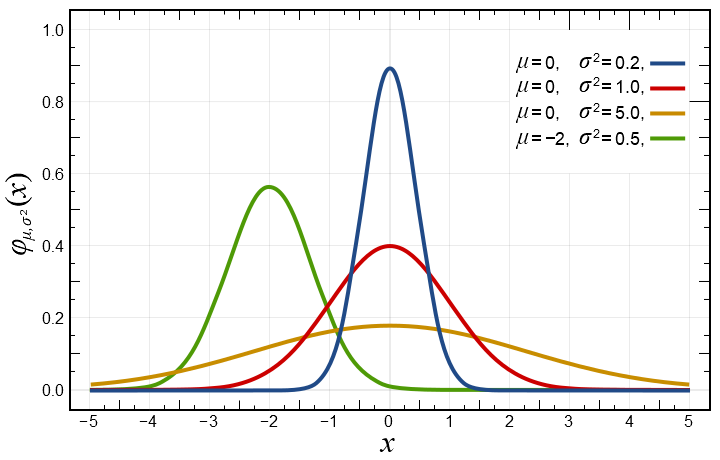
A non-scalable random process will generally converge toward the familiar normal distribution, a “bell curve”:

[Image from Wikipedia: By Inductiveload – self-made, Mathematica, Inkscape, Public Domain, https://commons.wikimedia.org/w/index.php?curid=3817954]

The normal distribution has most of its weight near the middle; most of the population ends up near there. This is clearly the case for labor income: Most people are middle class, while some are poor and a few are rich.

But a scalable random process will typically converge toward quite a different distribution, a Pareto distribution:

[Image from Wikipedia: By Danvildanvil – Own work, CC BY-SA 3.0, https://commons.wikimedia.org/w/index.php?curid=31096324]

A Pareto distribution has most of its weight near zero, but covers an extremely wide range. Indeed it is what we call fat tailed, meaning that really extreme events occur often enough to have a meaningful effect on the average. A Pareto distribution has most of the people at the bottom, but the ones at the top are really on top.

And indeed, that’s exactly how capital income works: Most people have little or no capital income (indeed only about half of Americans and only a third(!) of Brits own any stocks at all), while a handful of hectobillionaires make utterly ludicrous amounts of money literally in their sleep.

Indeed, it turns out that income in general is pretty close to distributed normally (or maybe lognormally) for most of the income range, and then becomes very much Pareto at the top—where nearly all the income is capital income.

This fundamental difference in scalability between capital and labor underlies much of what makes income inequality so difficult to fight. Capital is scalable, and begets more capital. Labor is non-scalable, and we only have to much to give.

It would require a radically different system of capital ownership to really eliminate this gap—and, well, that’s been tried, and so far, it hasn’t worked out so well. Our best option is probably to let people continue to own whatever amounts of capital, and then tax the proceeds in order to redistribute the resulting income. That certainly has its own downsides, but they seem to be a lot more manageable than either unfettered anarcho-capitalism or totalitarian communism.

Maybe we should forgive student debt after all.

May 8 JDN 2459708

President Biden has been promising some form of student debt relief since the start of his campaign, though so far all he has actually implemented is a series of no-interest deferments and some improvements to the existing forgiveness programs. (This is still significant—it has definitely helped a lot of people with cashflow during the pandemic.) Actual forgiveness for a large segment of the population remains elusive, and if it does happen, it’s unclear how extensive it will be in either intensity (amount forgiven) or scope (who is eligible).

I personally had been fine with this; while I have a substantial loan balance myself, I also have a PhD in economics, which—theoretically—should at some point entitle me to sufficient income to repay those loans.

Moreover, until recently I had been one of the few left-wing people I know to not be terribly enthusiastic about loan forgiveness. It struck me as a poor use of those government funds, because $1.75 trillion is an awful lot of money, and college graduates are a relatively privileged population. (And yes, it is valid to consider this a question of “spending”, because the US government is the least liquidity-constrained entity on Earth. In lieu of forgiving $1.75 trillion in debt, they could borrow $1.75 trillion in debt and use it to pay for whatever they want, and their ultimate budget balance would be basically the same in each case.)

But I say all this in the past tense because Krugman’s recent column has caused me to reconsider. He gives two strong reasons why debt forgiveness may actually be a good idea.

The first is that Congress is useless. Thanks to gerrymandering and the 40% or so of our population who keeps electing Republicans no matter how crazy they get, it’s all but impossible to pass useful legislation. The pandemic relief programs were the exception that proves the rule: Somehow those managed to get through, even though in any other context it’s clear that Congress would never have approved any kind of (non-military) program that spent that much money or helped that many poor people.

Student loans are the purview of the Department of Education, which is entirely under control of the Executive Branch, and therefore, ultimately, the President of the United States. So Biden could forgive student loans by executive order and there’s very little Congress could do to stop him. Even if that $1.75 trillion could be better spent, if it wasn’t going to be anyway, we may as well use it for this.

The second is that “college graduates” is too broad a category. Usually I’m on guard for this sort of thing, but in this case I faltered, and did not notice the fallacy of composition so many labor economists were making by lumping all college grads into the same economic category. Yes, some of us are doing well, but many are not. Within-group inequality matters.

A key insight here comes from carefully analyzing the college wage premium, which is the median income of college graduates, divided by the median income of high school graduates. This is an estimate of the overall value of a college education. It’s pretty large, as a matter of fact: It amounts to something like a doubling of your income, or about $1 million over one’s whole lifespan.

From about 1980-2000, wage inequality grew about as fast as today, and the college wage premium grew even faster. So it was plausible—if not necessarily correct—to believe that the wage inequality reflected the higher income and higher productivity of college grads. But since 2000, wage inequality has continued to grow, while the college wage premium has been utterly stagnant. Thus, higher inequality can no longer (if it ever could) be explained by the effects of college education.

Now some college graduates are definitely making a lot more money—such as those who went into finance. But it turns out that most are not. As Krugman points out, the 95th percentile of male college grads has seen a 25% increase in real (inflation-adjusted) income in the last 20 years, while the median male college grad has actually seen a slight decrease. (I’m not sure why Krugman restricted to males, so I’m curious how it looks if you include women. But probably not radically different?)

I still don’t think student loan forgiveness would be the best use of that (enormous sum of) money. But if it’s what’s politically feasible, it definitely could help a lot of people. And it would be easy enough to make it more progressive, by phasing out forgiveness for graduates with higher incomes.

And hey, it would certainly help me, so maybe I shouldn’t argue too strongly against it?

Could the Star Trek economy really work?

Jun 13 JDN 2459379

“The economics of the future are somewhat different”, Jean-Luc Picard explains to Lily Sloane in Star Trek: First Contact.

Captain Picard’s explanation is not very thorough, and all we have about the economic system of the Federation comes from similar short glimpes across the various Star Trek films and TV series. The best glimpses of what the Earth’s economy is like largely come from the Picard series in particular.

But I think we can safely conclude that all of the following are true:

1. Energy is extraordinarily abundant, with a single individual having access to an energy scale that would rival the energy production of entire nations at present. By E=mc2, simply being able to teleport a human being or materialize a hamburger from raw energy, as seems to be routine in Starfleet, would require something on the order of 10^17 joules, or about 28 billion kilowatt-hours. The total energy supply of the world economy today is about 6*10^20 joules, or 100 trillion kilowatt-hours.

2. There is broad-based prosperity, but not absolute equality. At the very least different people live differently, though it is unclear whether anyone actually has a better standard of living than anyone else. The Picard family still seems to own their family vineyard that has been passed down for generations, and since the population of Earth is given as about 9 billion (a plausible but perhaps slightly low figure for our long-run stable population equilibrium), its acreage is large enough that clearly not everyone on Earth can own that much land.

3. Most resources that we currently think of as scarce are not scarce any longer. Replicator technology allows for the instantaneous production of food, clothing, raw materials, even sophisticated electronics. There is no longer a “manufacturing sector” as such; there are just replicators and people who use or program them. Most likely, even new replicators are made by replicating parts in other replicators and then assembling them. There are a few resources which remain scarce, such as dilithium (somehow involved in generating these massive quantities of energy) and latinum (a bizarre substance that is prized by many other cultures yet for unexplained reasons cannot be viably produced in replicators). Essentially everything else that is scarce is inherently so, such as front-row seats at concerts, original paintings, officer commissions in Starfleet, or land in San Francisco.

4. Interplanetary and even interstellar trade is routine. Starships with warp capability are available to both civilian and government institutions, and imports and exports can be made to planets dozens or even hundreds of light-years away as quickly as we can currently traverse the oceans with a container ship.

5. Money as we know it does not exist. People are not paid wages or salaries for their work. There is still some ownership of personal property, and particular families (including the Picards) seem to own land; but there does not appear to be any private ownership of capital. For that matter there doesn’t even appear to be be much in the way of capital; we never see any factories. There is obviously housing, there is infrastructure such as roads, public transit, and presumably power plants (very, very powerful power plants, see 1!), but that may be all. Nearly all manufacturing seems to be done by replicators, and what can’t be done by replicators (e.g. building new starships) seems to be all orchestrated by state-owned enterprises such as Starfleet.

Could such an economy actually work? Let’s stipulate that we really do manage to achieve such an extraordinary energy scale, millions of times more than what we can currently produce. Even very cheap, widespread nuclear energy would not be enough to make this plausible; we would need at least abundant antimatter, and quite likely something even more exotic than this, like zero point energy. Along this comes some horrifying risks—imagine an accident at a zero-point power plant that tears a hole in the fabric of space next to a major city, or a fanatical terrorist with a handheld 20-megaton antimatter bomb. But let’s assume we’ve found ways to manage those risks as well.

Furthermore, let’s stipulate that it’s possible to build replicators and warp drives and teleporters and all the similarly advanced technology that the Federation has, much of which is so radically advanced we can’t even be sure that such a thing is possible.

What I really want to ask is whether it’s possible to sustain a functional economy at this scale without money. George Roddenberry clearly seemed to think so. I am less convinced.

First of all, I want to acknowledge that there have been human societies which did not use money, or even any clear notion of a barter system. In fact, most human cultures for most of our history as a species allocated resources based on collective tribal ownership and personal favors. Some of the best parts of Debt: The First 5000 Years are about these different ways of allocating resources, which actually came much more naturally to us than money.

But there seem to have been rather harsh constraints on what sort of standard of living could be maintained in such societies. There was essentially zero technological advancement for thousands of years in most hunter-gatherer cultures, and even the wealthiest people in most of those societies overall had worse health, shorter lifespans, and far, far less access to goods and services than people we would consider in poverty today.

Then again, perhaps money is only needed to catalyze technological advancement; perhaps once you’ve already got all the technology you need, you can take money away and return to a better way of life without greed or inequality. That seems to be what Star Trek is claiming: That once we can make a sandwich or a jacket or a phone or even a car at the push of a button, we won’t need to worry about paying people because everyone can just have whatever they need.

Yet whatever they need is quite different from whatever they want, and therein lies the problem. Yes, I believe that with even moderate technological advancement—the sort of thing I expect to see in the next 50 years, not the next 300—we will have sufficient productivity that we could provide for the basic needs of every human being on Earth. A roof over your head, food on your table, clothes to wear, a doctor and a dentist to see twice a year, emergency services, running water, electricity, even Internet access and public transit—these are things we could feasibly provide to literally everyone with only about two or three times our current level of GDP, which means only about 2% annual economic growth for the next 50 years. Indeed, we could already provide them for every person in First World countries, and it is quite frankly appalling that we fail to do so.

However, most of us in the First World already live a good deal better than that. We don’t have the most basic housing possible, we have nice houses we want to live in. We don’t take buses everywhere, we own our own cars. We don’t eat the cheapest food that would provide adequate nutrition, we eat a wide variety of foods; we order pizza and Chinese takeout, and even eat at fancy restaurants on occasion. It’s less clear that we could provide this standard of living to everyone on Earth—but if economic growth continues long enough, maybe we can.

Worse, most of us would like to live even better than we do. My car is several years old right now, and it runs on gasoline; I’d very much like to upgrade to a brand-new electric car. My apartment is nice enough, but it’s quite small; I’d like to move to a larger place that would give me more space not only for daily living, but also for storage and for entertaining guests. I work comfortable hours for decent pay at a white-collar job that can be done entirely remotely on mostly my own schedule, but I’d prefer to take some time off and live independently while I focus more on my own writing. I sometimes enjoy cooking, but often it can be a chore, and sometimes I wish I could just go eat out at a nice restaurant for dinner every night. I don’t make all these changes because I can’t afford to—that is, because I don’t have the money.

Perhaps most of us would feel no need to have a billion dollars. I don’t really know what $100 billion actually gets you, as far as financial security, independence, or even consumption, that $50 million wouldn’t already. You can have total financial freedom and security with a middle-class American lifestyle with net wealth of about $2 million. If you want to also live in a mansion, drink Dom Perignon with every meal and drive a Lamborghini (which, quite frankly, I have no particular desire to do), you’ll need several million more—but even then you clearly don’t need $1 billion, let alone $100 billion. So there is indeed something pathological about wanting a billion dollars for yourself, and perhaps in the Federation they have mental health treatments for “wealth addiction” that prevent people from experiencing such pathological levels of greed.

Yet in fact, with the world as it stands, I would want a billion dollars. Not to own it. Not to let it sit and grow in some brokerage account. Not to simply be rich and be on the Forbes list. I couldn’t care less about those things. But with a billion dollars, I could donate enormous amounts to charities, saving thousands or even millions of lives. I could found my own institutions—research institutes, charitable foundations—and make my mark on the world. With $100 billion, I could make a serious stab at colonizing Mars—as Elon Musk seems to be doing, but most other billionaires have no particular interest in.

And it begins to strain credulity to imagine a world of such spectacular abundance that everyone could have enough to do that.

This is why I always struggle to answer when people ask me things like “If money were not object, how would you live your life?”; if money were no object, I’d end world hunger, cure cancer, and colonize the Solar System. Money is always an object. What I think you meant to ask was something much less ambitious, like “What would you do if you had a million dollars?” But I might actually have a million dollars someday—most likely by saving and investing the proceeds of a six-figure job as an economist over many years. (Save $2,000 per month for 20 years, growing it at 7% per year, and you’ll be over $1 million. You can do your own calculations here.) I doubt I’ll ever have $10 million, and I’m pretty sure I’ll never have $1 billion.

To be fair, it seems that many of the grand ambitions I would want to achieve with billions of dollars already are achieved by 23rd century; world hunger has definitely been ended, cancer seems to have been largely cured, and we have absolutely colonized the Solar System (and well beyond). But that doesn’t mean that new grand ambitions wouldn’t arise, and indeed I think they would. What if I wanted to command my own fleet of starships? What if I wanted a whole habitable planet to conduct experiments on, perhaps creating my own artificial ecosystem? The human imagination is capable of quite grand ambitions, and it’s unlikely that we could ever satisfy all of them for everyone.

Some things are just inherently scarce. I already mentioned some earlier: Original paintings, front-row seats, officer commissions, and above all, land. There’s only so much land that people want to live on, especially because people generally want to live near other people (Internet access could conceivably reduce the pressure for this, but, uh, so far it really hasn’t, so why would we think it will in 300 years?). Even if it’s true that people can have essentially arbitrary amounts of food, clothing, or electronics, the fact remains that there’s only so much real estate in San Francisco.

It would certainly help to build taller buildings, and presumably they would, though most of the depictions don’t really seem to show that; where are the 10-kilometer-tall skyscrapers made of some exotic alloy or held up by structural integrity fields? (Are the forces of NIMBY still too powerful?) But can everyone really have a 1000-square-meter apartment in the center of downtown? Maybe if you build tall enough? But you do still need to decide who gets the penthouse.

It’s possible that all inherently-scarce resources could be allocated by some mechanism other than money. Some even should be: Starfleet officer commissions are presumably allocated by merit. (Indeed, Starfleet seems implausibly good at selecting supremely competent officers.) Others could be: Concert tickets could be offered by lottery, and maybe people wouldn’t care so much about being in the real front row when you can always simulate the front row at home in your holodeck. Original paintings could all be placed in museums available for public access—and the tickets, too, could be allocated by lottery or simply first-come, first-served. (Picard mentions the Smithsonian, so public-access museums clearly still exist.)

Then there’s the question of how you get everyone to work, if you’re not paying them. Some jobs people will do for fun, or satisfaction, or duty, or prestige; it’s plausible that people would join Starfleet for free (I’m pretty sure I would). But can we really expect all jobs to work that way? Has automation reached such an advanced level that there are no menial jobs? Sanitation? Plumbing? Gardening? Paramedics? Police? People still seem to pick grapes by hand in the Picard vineyards; do they all do it for the satisfaction of a job well done? What happens if one day everyone decides they don’t feel like picking grapes today?

I certainly agree that most menial jobs are underpaid—most people do them because they can’t get better jobs. But surely we don’t want to preserve that? Surely we don’t want some sort of caste system that allocates people to work as plumbers or garbage collectors based on their birth? I guess we could use merit-based aptitude testing; it’s clear that the vast majority of people really aren’t cut out for Starfleet (indeed, perhaps I’m not!), and maybe some people really would be happiest working as janitors. But it’s really not at all clear what such a labor allocation system would be like. I guess if automation has reached such an advanced level that all the really necessary work is done by machines and human beings can just choose to work as they please, maybe that could work; it definitely seems like a very difficult system to manage.

So I guess it’s not completely out of the question that we could find some appropriate mechanism to allocate all goods and services without ever using money. But then my question becomes: Why? What do you have against money?

I understand hating inequality—indeed I share that feeling. I, too, am outraged by the existence of hectobillionaires in a world where people still die of malaria and malnutrition. But having a money system, or even a broadly free-market capitalist economy, doesn’t inherently have to mean allowing this absurd and appalling level of inequality. We could simply impose high, progressive taxes, redistribute wealth, and provide a generous basic income. If per-capita GDP is something like 100 times its current level (as it appears to be in Star Trek), then the basic income could be $1 million per year and still be entirely affordable.

That is, rather than trying to figure out how to design fair and efficient lotteries for tickets to concerts and museums, we could still charge for tickets, and just make sure that everyone has a million dollars a year in basic income. Instead of trying to find a way to convince people to clean bathrooms for free, we could just pay them to do it.

The taxes could even be so high at the upper brackets that they effectively impose a maximum income; say we have a 99% marginal rate above $20 million per year. Then the income inequality would collapse to quite a low level: No one below $1 million, essentially no one above $20 million. We could tax wealth as well, ensuring that even if people save or get lucky on the stock market (if we even still have a stock market—maybe that is unnecessary after all), they still can’t become hectobillionaires. But by still letting people use money and allowing some inequality, we’d still get all the efficiency gains of having a market economy (minus whatever deadweight loss such a tax system imposed—which I in fact suspect would not be nearly as large as most economists fear).

In all, I guess I am prepared to say that, given the assumption of such great feats of technological advancement, it is probably possible to sustain such a prosperous economy without the use of money. But why bother, when it’s so much easier to just have progressive taxes and a basic income?

Because ought implies can, can may imply ought

Mar21JDN 2459295

Is Internet access a fundamental human right?

At first glance, such a notion might seem preposterous: Internet access has only existed for less than 50 years, how could it be a fundamental human right like life and liberty, or food and water?

Let’s try another question then: Is healthcare a fundamental human right?

Surely if there is a vaccine for a terrible disease, and we could easily give it to you but refuse to do so, and you thereby contract the disease and suffer horribly, we have done something morally wrong. We have either violated your rights or violated our own obligations—perhaps both.

Yet that vaccine had to be invented, just as the Internet did; go back far enough into history and there were no vaccines, no antibiotics, even no anethestetics or antiseptics.

One strong, commonly shared intuition is that denying people such basic services is a violation of their fundamental rights. Another strong, commonly shared intuition is that fundamental rights should be universal, not contingent upon technological or economic development. Is there a way to reconcile these two conflicting intuitions? Or is one simply wrong?

One of the deepest principles in deontic logic is “ought implies can“: One cannot be morally obligated to do what one is incapable of doing.

Yet technology, by its nature, makes us capable of doing more. By technological advancement, our space of “can” has greatly expanded over time. And this means that our space of “ought” has similarly expanded.

For if the only thing holding us back from an obligation to do something (like save someone from a disease, or connect them instantaneously with all of human knowledge) was that we were incapable and ought implies can, well, then now that we can, we ought.

Advancements in technology do not merely give us the opportunity to help more people: They also give us the obligation to do so. As our capabilities expand, our duties also expand—perhaps not at the same rate, but they do expand all the same.

It may be that on some deeper level we could articulate the fundamental rights so that they would not change over time: Not a right to Internet access, but a right to equal access to knowledge; not a right to vaccination, but a right to a fair minimum standard of medicine. But the fact remains: How this right becomes expressed in action and policy will and must change over time. What was considered an adequate standard of healthcare in the Middle Ages would rightfully be considered barbaric and cruel today. And I am hopeful that what we now consider an adequate standard of healthcare will one day seem nearly as barbaric. (“Dialysis? What is this, the Dark Ages?”)

We live in a very special time in human history.

Our technological and economic growth for the past few generations has been breathtakingly fast, and we are the first generation in history to seriously be in a position to end world hunger. We have in fact been rapidly reducing global poverty, but we could do far more. And because we can, we should.

After decades of dashed hope, we are now truly on the verge of space colonization: Robots on Mars are now almost routine, fully-reusable spacecraft have now flown successful missions, and a low-Earth-orbit hotel is scheduled to be constructed by the end of the decade. Yet if current trends continue, the benefits of space colonization are likely to be highly concentrated among a handful of centibillionaires—like Elon Musk, who gained a staggering $160 billion in wealth over the past year. We can do much better to share the rewards of space with the rest of the population—and therefore we must.

Artificial intelligence is also finally coming into its own, with GPT-3 now passing the weakest form of the Turing Test (though not the strongest form—you can still trip it up and see that it’s not really human if you are clever and careful). Many jobs have already been replaced by automation, but as AI improves, many more will be—not as soon as starry-eyed techno-optimists imagined, but sooner than most people realize. Thus far the benefits of automation have likewise been highly concentrated among the rich—we can fix that, and therefore we should.

Is there a fundamental human right to share in the benefits of space colonization and artificial intelligence? Two centuries ago the question wouldn’t have even made sense. Today, it may seem preposterous. Two centuries from now, it may seem preposterous to deny.

I’m sure almost everyone would agree that we are obliged to give our children food and water. Yet if we were in a desert, starving and dying of thirst, we would be unable to do so—and we cannot be obliged to do what we cannot do. Yet as soon as we find an oasis and we can give them water, we must.

Humanity has been starving in the desert for two hundred millennia. Now, at last, we have reached the oasis. It is our duty to share its waters fairly.