Trump has proposed an even worse budget

May 11 JDN 2460807

I didn’t really intend for my blog this year to be taken over by talk about Trump. But all the damage that Trump is doing to America and the world is clearly the most important thing going on in economics right now, and it’s honestly just hard for me to think about anything else.

Trump has proposed a budget. (Read at your own risk; what’s on the White House website is more screed than budget proposal. And it’s pretty clearly written by Trump himself, perhaps with some editing.)

It will come as no surprise to all of you that it is a terrible budget, even worse than what the Republicans recently passed.

First of all, Trump is cutting discretionary spending by $163 billion. This is a huge cut—it removes almost one-fourth of all non-military discretionary spending. Trump naturally claims that he’s just reducing waste, shutting down DEI programs (for the right wing this is considered a good thing), what Trump calls “Green New Scam funding” (read: anything remotely related to environmental sustainability or climate change), and what Trump claims are “large swaths of the Federal Government weaponized against the American people” (read: any other departments Trump doesn’t like, whether or not he actually understands what they are for).

And lest you think that these draconian cuts are being done for fiscal responsibility in the face of an utterly massive federal deficit, Trump also proposes to increase military spending by 13%; multiplying that by our current $850 billion budget means he’s adding $110 billion to the military; and he also says he wants to add a further $119 billion in the mandatory budget. This means he’s cutting $163 billion from non-military spending and adding $239 billion in military spending—which will actually increase the deficit.

Trump is ending programs like the Cybersecurity and Infrastructure Security Agency (sure, let’s just let Chinese hackers in! Why not? It’s not like there’s anything important on those Pentagon servers!) and Fair Housing (amid a historic housing crisis), as well as slashing the EPA (because who needs clean air and water anyway?).

Unsurprisingly, he’s also ending anything that resembles DEI, which includes both some really good necessary programs, and also some stuff that is genuinely ineffective or even counterproductive. Most people who work at firms that have DEI programs think that the programs do more good than harm, but there are big partisan differences, so cutting DEI will play well with the Republican base. But I for one do not want to play the word game where we say out loud every time “diversity, equity, and inclusion”, because there is a big difference between the fundamentally laudable goals of diversity, equity and inclusion, and the actual quite mixed results from DEI programs as they have been implemented. It’s awful that Trump is cutting DEI with a chainsaw, but we really should have been cutting it with a scalpel for awhile now.

Trump is also throwing money at the border, increasing the budgets of CBP (whatever) and ICE (very, very bad!). This is probably the worst thing about the budget, though it also isn’t a big surprise. Part of the increased ICE spending is “50,000 detention beds”, which since ICE lately has been arresting and detaining people without warrants or trials and courts have specifically ruled that they are violating due process, I believe we can fairly say constitutes a concentration camp. If and when they start actually giving everyone—everyone, dammitdue process, then you can call it a detention center.

Trump is eliminating USAID and folding what’s left of it into DFC; but these institutions had quite different goals. USAID had two goals: Advance America’s interests, and make the world a better place. And while it did have significant flaws, overall it did quite a good job of achieving both of those goals—and indeed, publicly making the world a better place can advance America’s interests. DFC’s goal is to promote economic development by financing investments that otherwise could not be financed. That can also promote America’s interests and make the world a better place, but it excludes many of the vital roles that USAID has played in providing humanitarian aid and disaster relief as well as promoting democracy and advancing environmental sustainability. (And when I say “promoting democracy”, I don’t mean the way the CIA does it, by orchestrating coups; I mean things like helping Ukraine remove its dependency on Russia.) There is more to life than money—but I don’t think Trump really understands that.

Trump is canceling a bunch of subsidies to renewable energy, but honestly I’m not too worried about that; the technology has matured so much that renewable energy is actually the cheapest form of energy for most purposes. (And it kinda makes sense: The sun and wind are already there.) Removing the subsidies will make it harder to compete with oil (because oil is still heavily subsidized); but I still think renewables can win. Basically the past subsidies have done their job, and it’s probably okay to remove them.

There’s a really weird proposal involving food, which I think I will just quote in its entirety:

The Budget also supports the creation of MAHA food boxes, that would be filled with commodities sourced from domestic farmers and given directly to American households.

This sounds… kinda… Maoist? Definitely some kind of communist. Why are we circumventing the highly-functional capitalist market for food with massive in-kind transfers? (Despite scaremongering, groceries in the US are still pretty affordable by world standards.) And how are we going to do that, logistically? (Produce does need to be kept fresh, after all.) Does Trump think that markets have trouble providing food in this country? Does he not understand that SNAP exists, and already prioritizes healthier food?(Or does he plan to get rid of it?) Does he think that the reason most Americans don’t eat a very good diet (which is objectively true) is that they aren’t able to get fresh produce? (And not, say, subsidies for factory-farmed meat and high-fructose corn syrup, or mass marketing campaigns by corporations that make junk food?) I’m not so much against this program as I am really baffled by it. It seems like it’s trying to solve the wrong problem by the wrong means. (I’m guessing RFK Jr. had a hand in this, and I recently learned that he doesn’t believe in germ theory. He is a god-tier crank. Like, his views on vaccines and autism were bad enough, but this? Seriously, you put this guy in charge of public health!?)

There are some things in the budget that aren’t terrible, but they’re mostly pretty small.

One actually good thing about Trump’s new budget is the expansion of VA services. I don’t really have any objection to that. It’s a fairly small portion of the budget, and veterans deserve better than they’ve been getting.

Trump says he won’t be cutting Social Security (so perhaps we dodged a bullet on that one). Of course, if he actually cared in the least about the budget deficit, that’s probably what he would cut, because it’s such a huge proportion of our spending—about one-fifth of all federal spending.

I’m not sure what to think about the changes Trump is making to education funding. He’s shutting down the Department of Education, but it seems like most of what it does (including offering grants and handling student loans) is just going to be folded into other agencies. It doesn’t actually seem like there have been substantial cuts in their services, just… a weird and unnecessary reorganization. My guess is that after Trump had already publicly committed to “end the Department of Education”, some staffer quietly explained to him what the Department of Education actually does and why it is necessary; since he’d already committed to shutting it down, he didn’t want to pivot on that, so instead he shut it down in name only while preserving most of what it actually does in other agencies.

Trump is also investing heavily in charter schools, which… meh. Some charter schools are really good, some are really bad. There isn’t a clear pattern of them being better or worse than public schools. Overall, the preponderance of evidence suggests that the average charter school is worse than the average public school, but there’s a lot of variation in both, so the odds that any particular charter school is better than any particular public school are still quite high. (I recently learned about this measure of effect size, probability of superiority, and it’s now my new favorite measure of effect size. Eat your heart out, Cohen’s d!)

Trump is also diverting funding to apprenticeships; he’s introducing a new “Make America Skilled Again” (ugh) grant that States would be required to spend at least 10% on apprenticeship. I’m pretty okay with this in general. 10% is not a lot, and we totally could use more apprenticeship programs in fields like welding and pipefitting.

Another good thing Trump is doing is increasing funding for NASA; he’s clearly doing it out of a sense of national pride and hatred of China, but hey, at least he’s doing it. We might actually be able to pull off a human Mars mission (several years from now, mind you!) if this higher funding continues.

Trump is also redirecting DEA spending to Mexico, Central America, South America, and China; since most fentanyl in the US is made in Latin America from Chinese ingredients, this actually makes sense. I still don’t think that criminalization is the best solution to drug abuse, but fentanyl is genuinely very dangerous stuff, so we should definitely be doing something to reduce its usage.

Finally, and somewhat anticlimactically, Trump is creating some kind of new federal fire service that’s supposedly going to improve our response to wildfires. Given that we already have FEMA, a significant improvement seems unlikely. But hey, it’s worth a try!

These small good things should not distract us from the massive damage that this budget would cause if implemented.

It was not necessary to shift $160 billion from non-military to military spending in order to increase funding for NASA and the VA. It was not necessary to cut hundreds of programs and eliminate USAID—the agency which did what may literally be the very best things our government has ever done. DEI programs had their flaws, but it was wrong to eliminate all of them, instead of finding out which ones are effective and which ones are not.

And while it’s a tiny portion of the budget, the cuts to the EPA will kill people. Most likely thousands of Americans will die from the increased air and water pollution. It will be hard to pinpoint exactly who: Would that kid with asthma have died anyway if the air were cleaner? Was that fatal infection from polluted water, or something else? But the statistics will tell us that there were thousands of unnecessary deaths. (Unless of course Trump falsifies the statistics—which he very well might, since he routinely calls our world-class economic data “fake” when it makes him look bad.)

The large federal budget deficit will be in no way reduced by this budget; in fact it will be slightly increased. If we were in a recession, I’d be okay with this kind of deficit; it was actually a good thing that we ran a huge deficit in 2020. But we aren’t yet—and when one does inevitably hit (given the tariffs, I think sooner rather than later), we won’t have the slack in our budget to do the necessary Keynesian stimulus.

I don’t see any mention of what’s going to happen to Medicare and Medicaid; given that these two programs together constitute roughly one fourth of the federal budget—and nearly twice the military budget—this is a very conspicuous absence. It’s possible that Trump’s leaving them alone because he knows how popular they are, but this once again reveals the emptiness of Republican deficit hawkishness: If you really wanted to reduce the deficit by cutting spending, you’d do it by cutting the military, Social Security, Medicare, and Medicaid. Those four things together comprise the majority of the federal budget. Yet it seems that Trump’s budget cuts none of them.

Mind you, I don’t actually want to cut Social Security, Medicare, or Medicaid; so I’m relieved that Trump isn’t doing that. I’m pretty okay with cutting the military, but I’ll admit I’m less enthused about that since the start of the Ukraine War (I think some moderate cuts are still in order, but we should still have a very big military budget to protect ourselves and our allies). But these are the only budget cuts that could realistically reduce the deficit.

What I actually want to happen is higher taxes on rich people. That’s how I want the budget to be balanced. And Trump very obviously will not do that. Indeed he’s almost certainly going to cut them, making our deficit even larger.

So we’re building a concentration camp, the Chinese are going to hack the Pentagon, we’re going to buy more tanks we don’t need, we won’t be able to properly respond to the next recession, and thousands of people will die from air and water pollution. But at least we got more NASA funding!

The Republicans passed a terrible budget

May 4 JDN 2460800

On April 10, the US House of Representatives passed a truly terrible budget bill. It passed on an almost entirely partisan vote—214 Democrats against, 216 Republicans for, 2 Republicans against. So I think it’s quite fair to say that the Republicans passed this budget—not a single Democrat voted for it, and only 2 Republicans voted against it.

So what’s so bad about it?

Well, first of all, in order to avoid showing just how much it will balloon the national debt, the new budget operates on different accounting rules than normal, using what’s called “current policy baseline” instead of the standard method of assuming that policies will end after 10 years.

In addition to retaining $3.8 trillion in tax cuts that were supposed to expire, this budget will cut taxes by $1.5 trillion over 10 years, with the vast majority of those cuts going to the top 1%—thus the real increase in the deficit is a staggering $5.3 trillion over 10 years. This is absolutely not what we need, given that unemployment is actually pretty good right now and we still have a deficit of $1.8 trillion per year. (Yes, really.) That kind of deficit is good in response to a severe recession—I was all in favor of it during COVID, and it worked. But when the economy is good, you’re supposed to balance the budget, and they haven’t.

The richest 1% stand to gain about 4% more income from these tax cuts (which adds up to about $240 billion per year), while the combination of tax cuts and spending cuts would most likely reduce the income of 40% of the population.

They aren’t even cutting spending to offset these tax cuts. This budget only includes a paltry $4 billion in spending cuts—less than 0.1% of the budget. (I mean, sure, $4 billion is a lot of money for a person; but for a whole country as rich and large as ours? It’s a rounding error.) And then it includes $521 billion in spending increases, over 100 times as much.

They are talking about making more cuts, but they’ve been cagey as to where, probably because the only plausible ways to save this much money are the military, Medicaid, Medicare, or Social Security. Obviously Republicans will never cut the military, but the other three programs are also enormously popular, even in deep-red states. It would be not only very harmful to millions of people to cut these programs—it would also be harmful to the Republicans’ re-election chances. They could also get some savings by cutting income security programs like SNAP and TANF, which would probably be less unpopular—but it would also cause enormous suffering.

This new budget is estimated to add some $6.9 trillion to the national debt over 10 years—and even more after that, if the policies actually continue.

I am not exactly a “deficit hawk”; I don’t think the budget should always be balanced. But this is not the time to be increasing the deficit. When times are good, we should balance the budget, so that when we have to go into debt during bad times, we can afford to do so.

And bad times are probably on the horizon, since Trump’s tariff policy is already such a disaster. So are we going to borrow even more then? While bond yields are rising? We’re going to end up spending most of our budget on debt payments! And all this injection of money into the system won’t be good for inflation either (and on top of the tariffs!).

The only sensible thing to do right now is raise taxes on the rich. We need that revenue. We can’t just keep going deeper into debt. And the rich are the ones who would be least harmed by raising taxes—indeed, if you focused the hikes on billionaires, they would barely feel anything at all.

But the Republicans don’t care about what’s in the interest of ordinary Americans. They only care about the interests of the rich. And that’s why they passed this budget.

I can’t not talk about tariffs right now

Apr 13 JDN 2460779

On the one hand, I’m sure every economics blog on the Internet is already talking about this, including Paul Krugman who knows the subject way better than I ever will (and literally won a Nobel Prize for his work on it). And I have other things I’d rather be writing about, like the Index of Necessary Expenditure. But on the other hand, when something this big happens in economics, it just feels like there’s really no alternative: I have to talk about tariffs right now.

What is a tariff, anyway?

This feels like a really basic question, but it also seems like a lot of people don’t really understand tariffs, or didn’t when they voted for Trump.

A tariff, quite simply, is an import tax. It’s a tax that you impose on imported goods (either a particular kind, or from a particular country, or just across the board). On paper, it is generally paid by the company importing the goods, but as I wrote about in my sequence on tax incidence, that doesn’t matter. What matters is how prices change in response to the tax, and this means that in real terms, prices will go up.

In fact, in some sense that’s the goal of a protectionist tariff, because you’re trying to fix the fact that local producers can’t compete on the global market. So you compensate by making international firms pay higher taxes, so that the local producers can charge higher prices and still compete. So anyone who is saying that tariffs won’t raise prices is either ignorant or lying: Raising prices is what tariffs do.

Why are people so surprised?

The thing that surprises me about all this, (a bit ironically) is how surprised people seem to be. Trump ran his whole campaign promising two things: Deport all the immigrants, and massive tariffs on all trade. Most of his messaging was bizarre and incoherent, but on those two topics he was very consistent. So why in the world are people—including stock traders, who are supposedly savvy on these things—so utterly shocked that he has actually done precisely what he promised he would do?

What did people think Trump meant when he said these things? Did they assume he was bluffing? Did they think cooler heads in his administration would prevail (if so, whose?)?

But I will admit that even I am surprised at just how big the tariffs are. I knew they would be big, but I did not expect them to be this big.

How big?

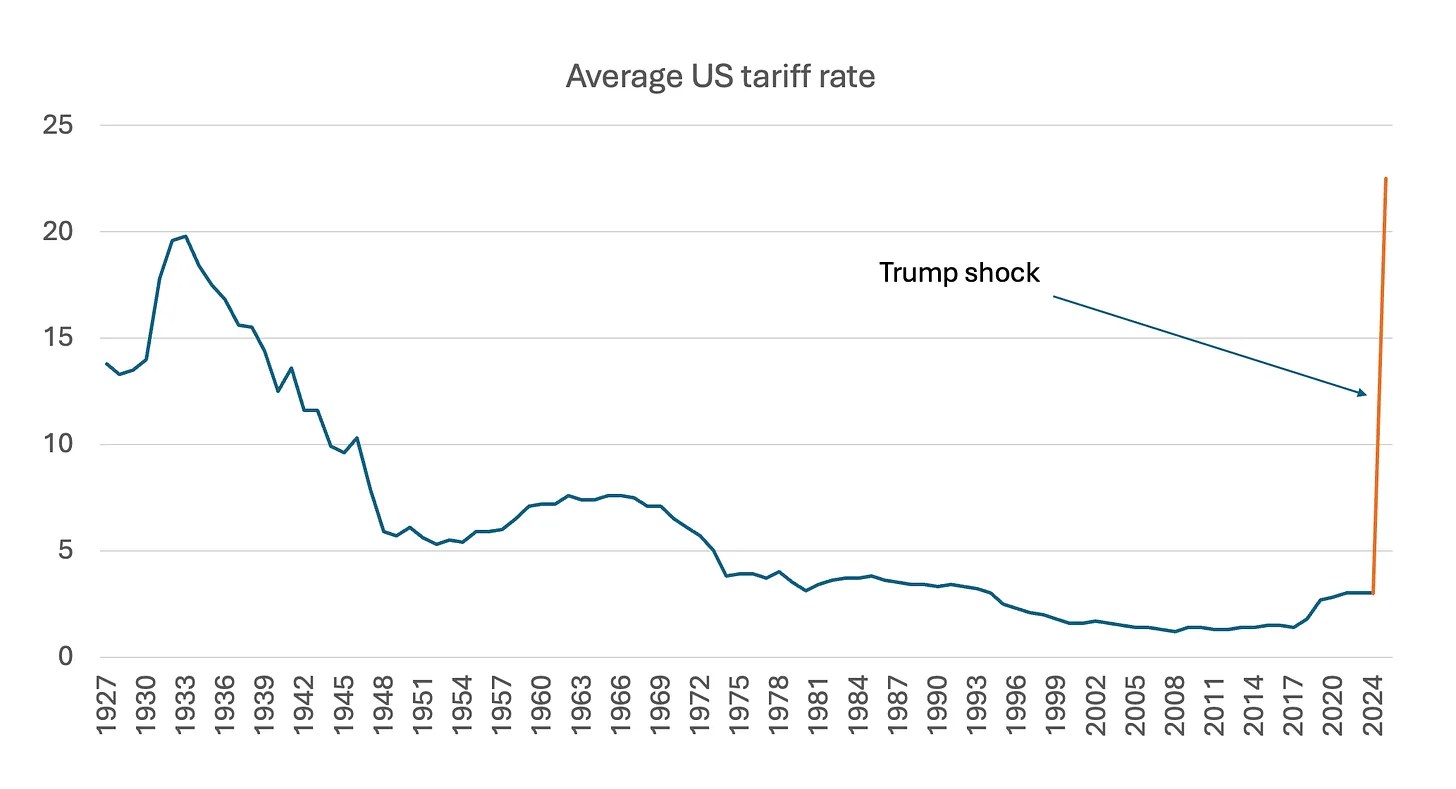
Well, take a look at this graph:

The average tariff rate on US imports will now be higher than it was at the peak in 1930 with the Smoot-Hawley Act. Moreover, Smoot-Hawley was passed during a time when protectionist tariffs were already in place, while Trump’s tariffs come at a time when tariffs had previously been near zero—so the change is dramatically more sudden.

This is worse than Smoot-Hawley.

For the uninitiated, Smoot-Hawley was a disaster. Several countries retaliated with their own tariffs, and the resulting trade war clearly exacerbated the Great Depression, not only in the US but around the world. World trade dropped by an astonishing 66% over the next few years. It’s still debated as to how much of the depression was caused by the tariffs; most economists believe that the gold standard was the bigger culprit. But it definitely made it worse.

Politically, the aftermath cost the Republicans (including Smoot and Hawley themselves) several seats in Congress. (I guess maybe the silver lining here is we can hope this will do the same?)

And I would now like to remind you that these tariffs are bigger than Smoot-Hawley’s and were implemented more suddenly.

Unlike in 1930, we are not currently in a depression—though nor is our economy as hunky-dory as a lot of pundits seem to think, once we consider things like the Index of Necessary Expenditure. But stock markets do seem to be crashing, and if trade drops as much as it did in the 1930s—and why wouldn’t it?—we may very well end up in another depression.

And it’s not as if we didn’t warn you all. Economists across the political spectrum have been speaking out against Trump’s tariffs from the beginning, and nobody listened to us.

So basically the mood of all economists right now is:

Extrapolating the INE

Apr 6 JDN 2460772

I was only able to find sufficient data to calculate the Index of Necessary Expenditure back to 1990. But I found a fairly consistent pattern that the INE grew at a rate about 20% faster than the CPI over that period, so I decided to take a look at what longer-term income growth looks like if we extrapolate that pattern back further in time.

The result is this graph:

Using the CPI, real per-capita GDP in the US (in 2024 dollars) has grown from $25,760 in 1950 to $85,779 today—increasing by a factor of 3.33. Even accounting for increased inequality and the fact that more families have two income earners, that’s still a substantial increase.

But using the extrapolated INE, real per-capita GDP has only grown from $43,622 in 1950 to $85,779 today—increasing by only a factor of 1.97. This is a much smaller increase, especially when we adjusted for increased inequality and increased employment for women.

Even without the extrapolation, it’s still clear that real INE-adjusted incomes have were basically stagnant in the 2000s, increased rather slowly in the 2020s, and then actually dropped in 2022 after a bunch of government assistance ended. What looked, under the CPI, like steadily increasing real income was actually more like treading water.

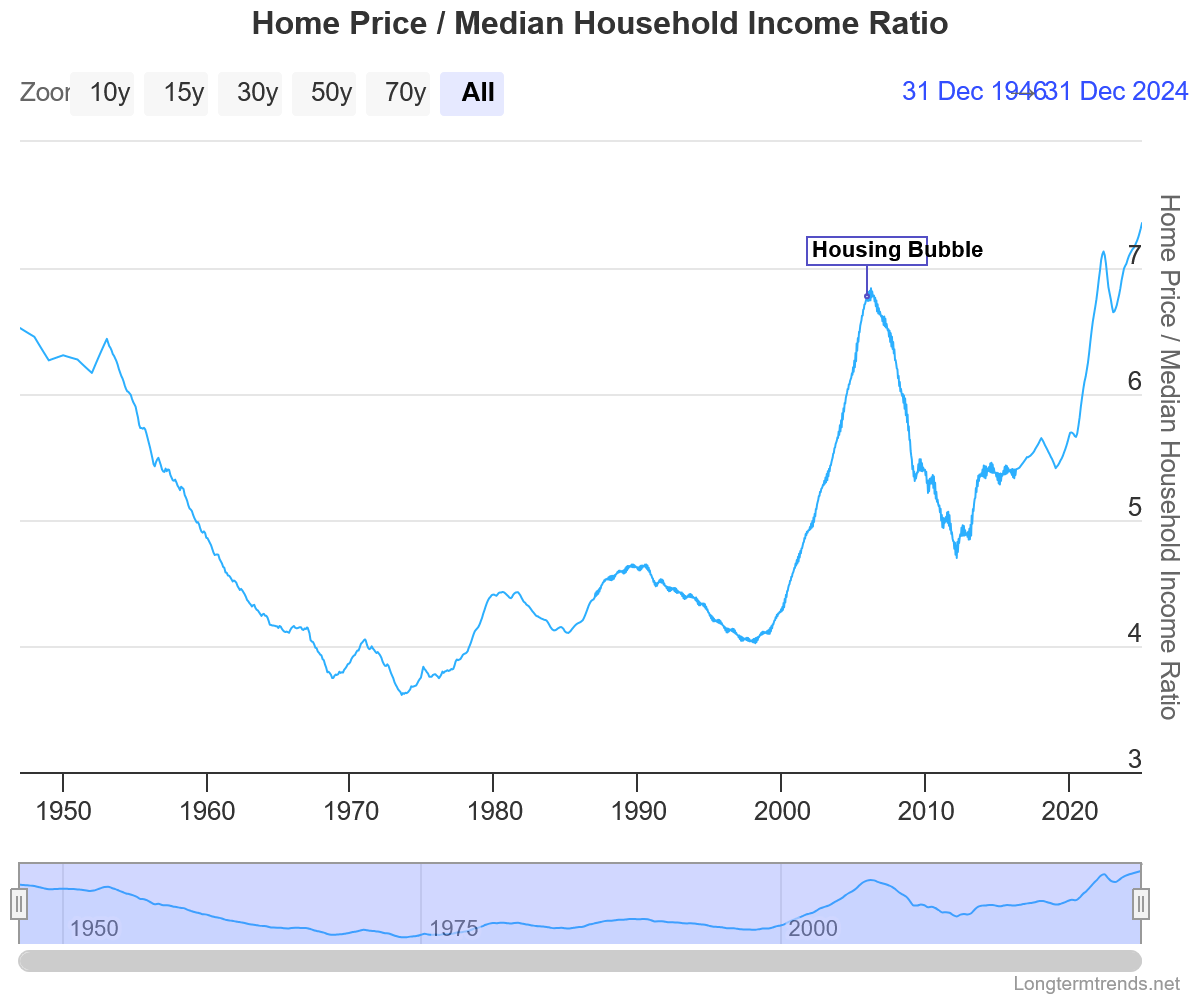
Should we trust this extrapolation? It’s a pretty simplistic approach, I admit. But I think it is plausible when we consider this graph of the ratio between median income and median housing price:

This ratio was around 6 in the 1950s, then began to fall until in the 1970s it stabilized around 4. It began to slowly creep back up, but then absolutely skyrocketed in the 2000s before the 2008 crash. Now it has been rising again, and is now above 7, the highest it has been since the Second World War. (Does this mean we’re due for another crash? I’d bet as much.)

What does this mean? It means that a typical family used to be able to afford a typical house with only four years of their total income—and now would require seven. In that sense, homes are now 75% more expensive today than they were in the 1970s.

Similar arguments can be made for the rising costs of education and healthcare; while many prices have not grown much (gasoline) or even fallen (jewelry and technology), these necessities have continued to grow more and more expensive, not simply in nominal terms, but even compared to the median income.

This is further evidence that our standard measures of “inflation” and “real income” are fundamentally inadequate. They simply aren’t accurately reflecting the real cost of living for most American families. Even in many times when it seemed “inflation” was low and “real income” was growing, in fact it was growing harder and harder to afford vital necessities such as housing, education, and healthcare.

This economic malaise may have been what contributed to the widespread low opinion of Biden’s economy. While the official figures looked good, people’s lives weren’t actually getting better.

Yet this is still no excuse for those who voted for Trump; even the policies he proudly announced he would do—like tariffs and deportations—have clearly made these problems worse, and this was not only foreseeable but actually foreseen by the vast majority of the world’s economists. Then there are all the things he didn’t even say he would do but is now doing, like cozying up to Putin, alienating our closest allies, and discussing “methods” for achieving an unconstitutional third term.

Indeed, it honestly feels quite futile to even reflect upon what was wrong with our economy even when things seemed to be running smoothly, because now things are rapidly getting worse, and showing no sign of getting better in any way any time soon.

On this, my 37th birthday

Jan 19 JDN 2460695

This post will go live on my 37th birthday. I’m now at an age where birthdays don’t really feel like a good thing.

This past year has been one of my worst ever.

It started with returning home from the UK, burnt out, depressed, suffering from frequent debilitating migraines. I had no job prospects, and I was too depressed to search for any. I moved in with my mother, who lately has been suffering health problems of her own.

Gradually, far too gradually, some aspects of my situation improved; my migraines are now better controlled, my depression has been reduced. I am now able to search for jobs at least—but I still haven’t found one. I would say that my mother’s health is better than it was—but several of her conditions are chronic, and much of this struggle will continue indefinitely.

I look back on this year feeling shame, despair, failure and defeat. I haven’t published anything—either fiction, nonfiction, or scientific—in years, and after months of searching I still haven’t found a job that would let me and my husband move to a home of our own. My six figures of student debt are now in forbearance, because the SAVE plan was struck down in court. (At least they’re not accruing interest….) I can’t think of anything I’ve done this year that I would count as a meaningful accomplishment. I feel like I’m just treading water, trying not to drown.

I see others my age finding careers, buying homes, starting families. Honestly they’re a little old to be doing these things now—we Millennials have drawn the short straw on homeownership for sure. (The median age of first-time homebuyers is now 38 years old—the highest ever recorded. In 1981, it was only 29.) I don’t see that happening for me any time soon, and I feel a deep grief over that.

I have not had a year go this badly since high school, when I was struggling even more with migraines and depression. Back then I had debilitating migraines multiple times per week, and my depression sometimes kept me from getting out of bed. I even had suicidal thoughts for a time, though I never made any plans or attempts.

Somehow, despite all that, I still managed to maintain straight As in high school and became a kind of de facto valedictorian. (My school technically didn’t have a valedictorian, but I had the best grades, and I successfully petitioned for special dispensation to deliver a much longer graduation speech than any other student.) Some would say this was because I was so brilliant, but I say it was because high school was too easy—and that this set me up for unrealistic expectations later in life. I am a poster child for Gifted Kid Syndrome and Impostor Syndrome. Honestly, maybe I would have gotten better help for my conditions sooner if my grades had slipped.

Will the coming year be better?

In some ways, probably. Now that my migraines and depression are better controlled—but by no means gone—I have been able to actively search for jobs, and I should be able to find one that fits me eventually (or so I keep trying to convince myself, when it all feels hopeless and pointless). And once I do have a job, whenever that happens, I might be able to start saving up for a home and finally move forward into feeling like a proper adult in this society.

But I look to the coming year feeling fear and dread, as Trump will soon take office and already looks primed to be far worse the second time around. In all likelihood I personally won’t suffer very much from Trump’s incompetence and malfeasance—but millions of other people will, and I don’t know how I can help them, especially when I seem so ineffectual at helping myself.

What’s the deal with Trump supporters?

Jul 28 JDN 2460520


I have never understood how this Presidential election is a close one. On the one hand, we have a decent President with many redeeming qualities who has done a great job, but is getting old; on the other hand, we have a narcissistic, authoritarian con man (who is almost as old). It should be obvious who the right choice is here.

And yet, half the country disagrees. I really don’t get it. Other Republican candidates actually have had redeeming qualities, and I could understand why someone might support them; but Trump has basically none.

I have even asked some of my relatives who support Trump why they do, what they see in him, and I could never get a straight answer.

I now think I know why: They don’t want to admit the true answer.

Political scientists have been studying this, and they’ve come to some very unsettling conclusions. The two strongest predictors of support for Trump are authoritarianism and hatred of minorities.

In other words, people support Trump not in spite of what makes him awful, but because of it. They are happy to finally have a political publicly supporting their hateful, bigoted views. And since they believe in authoritarian hierarchy, his desire to become a dictator doesn’t worry them; they may even welcome it, believing that he’ll use that power to hurt the right people. They like him because he promises retribution against social change. He also uses a lot of fear-mongering.

This isn’t the conclusion I was hoping for. I wanted there to be something sympathetic, some alternative view of the world that could be reasoned with. But when bigotry and authoritarianism are the main predictors of a candidate’s support, it seems that reasonableness has pretty much failed.

I wanted there to be something I had missed, something I wasn’t seeing about Trump—or about Biden—that would explain how good, reasonable people could support the former over the latter. But the data just doesn’t seem to show anything. There is an urban/rural divide; there is a generational divide; and there is an educational divide. Maybe there’s something there; certainly I can sympathize with old people in rural areas with low education. But by far the best way to tell whether someone supports Trump is to find out whether they are racist, sexist, xenophobic, and authoritarian. How am I supposed to sympathize with that? Where can we find common ground here?

There seems to be something deep and primal that motivates Trump supporters: Fear of change, tribal identity, or simply anger. It doesn’t seem to be rational. Ask them what policies Trump has done or plans to do that they like, and they often can’t name any. But they are certain in their hearts that he will “Make America Great Again”.

What do we do about this? We can win this election—maybe—but that’s only the beginning. Somehow we need to root out the bigotry that drives support for Trump and his ilk, and I really don’t know how to do that.

I don’t know what else to say here. This all feels so bleak. This election has become a battle for the soul of America: Are we a pluralistic democracy that celebrates diversity, or are we a nation of racist, sexist, xenophobic authoritarians?

Did we push too hard, too fast for social change? Did we leave too many people behind, people who felt coerced into compliance rather than persuaded of our moral correctness? Is this a temporary backlash that we can bear as the arc of the moral universe bends toward justice? Or is this the beginning of a slow and agonizing march toward neo-fascism?

I have never feared Trump himself nearly so much as I fear a nation that could elect him—especially one that could re-elect him.

The worst is not inevitable

Jul 14 JDN 2460506

As I write this, the left has just won two historic landslide victories: In France, where a coalition of left-wing parties set aside their differences and prevailed; and in the UK, where the Labour Party just curb-stomped all competition.

Many commentators had been worried that the discredited center-right parties in these countries had left a power vacuum that would be filled by far-right parties like France’s National Rally, but this isn’t what happened. Voters showed up to the polls, and they voted out the center-right all right; but what they put in its place was the center-left, not the far-right.

The New York Times is constitutionally incapable of celebrating anything, so they immediately turned to worries that “turnout was low” and this indicates “an unhappy Britain”. Honestly this seems to be a general failing of journalists: They can’t ever say anything is good. Their entire view of the world is based around “if it bleeds, it leads”. I’m assuming this has something to do with incentives created by the market of news consumers, but it also seems to be an entrenched social norm among journalists themselves. The world must be getting worse, in every way, or if it’s obviously not, we don’t talk about those things—because good things just aren’t news. (Look no further than the fact we now have the lowest global homicide rates in the history of the human race. What, you didn’t realize we had that right now? Could that perhaps be because literally no news source even mentioned it, ever?)

Now, to be fair, turnout was low, and far-right parties did win some representation, and any kind of sudden political shift indicates some kind of public dissatisfaction… but for goodness’ sake, can we take the win for once?

These elections are proof that the free world’s slide into far-right authoritarianism doesn’t have to be inevitable. We can fight it, we are fighting it—and sometimes, we actually win.

So let’s not give up hope in the United States, either. Yes, polls of the Biden/Trump election don’t look great right now; Trump seems to have a slight lead, and it’s way too close for comfort. But we don’t need to roll over and die. The left can win, when we band together well enough; and if France and Britain can pull it off, I don’t see why we can’t too.

And don’t tell me they had way better candidates. The new UK Prime Minister is not a particularly appealing or charismatic candidate. I frankly don’t even like him. He either is a TERF, or is at least willing to capitulate to them. (He also underestimates the number of trans women by about an order of magnitude.) But he won, because the Labour Party won, and he happened to be the Labour Party leader at the time.

Biden is old. Sure. So is Trump. And if it turns out that Biden is really unhealthy, guess what? That means he’ll die or resign and we get a woman of color as President instead. I don’t see eye-to-eye with Kamala Harris on everything, but I don’t see her taking office as a horrible outcome. It’s certainly a hundred times better than what happens if we let Trump win.

Are there better candidates out there? Theoretically, sure. But unless one of them manages to win nomination by one of the two leading parties, that doesn’t matter. Because in a first-past-the-post voting system, you either vote for one of the top two, or you waste your vote. I’m sorry. It sucks. I want a new voting system too. I know exactly which one we could use that would be a hundred times better. But we’re not going to get it by refusing to vote altogether.

We might get a better voting system by voting strategically for candidates who are open to the idea—which at this juncture clearly means Democrats, not Republicans. (At this point in history, Republicans don’t seem entirely convinced that we should decide things democratically in the first place.)There are also other forms of activism we can use, independent of voting. But not voting isn’t a form of activism, and we should stop acting like it is. Not voting is the lazy, selfish, default option. It’s what you’d do if you were a neoclassical rational agent who cares not in the least for his fellow human beings. You should never be proud of not voting. You’re not sending a message; you’re shirking your civic responsibility.

Voting isn’t writing a love letter. It isn’t signing a form endorsing everything a candidate has ever done or ever will do. If you think of it that way, you’re going to never want to vote—and thus you’re going to give up the most important power you have as a citizen of a democracy.

Voting is a decision. It’s choosing one alternative over another. Like any decision in the real world, there will almost never be a perfect option. There will only be better or worse options. Sometimes, even, you’ll feel that there are only bad options, and you are choosing the least-bad option. But you still have to choose the least-bad option, because literally everything else is worse—including doing nothing.

So get out there and try to help Biden win. Not because you love Biden, but because it’s your civic duty. And if enough people do it, we can still win this.

Reckoning costs in money distorts them

May 7 JDN 2460072

Consider for a moment what it means when an economic news article reports “rising labor costs”. What are they actually saying?

They’re saying that wages are rising—perhaps in some industry, perhaps in the economy as a whole. But this is not a cost. It’s a price. As I’ve written about before, the two are fundamentally distinct.

The cost of labor is measured in effort, toil, and time. It’s the pain of having to work instead of whatever else you’d like to do with your time.

The price of labor is a monetary amount, which is delivered in a transaction.

This may seem perfectly obvious, but it has important and oft-neglected implications. A cost, one paid, is gone. That value has been destroyed. We hope that it was worth it for some benefit we gained. A price, when paid, is simply transferred: One person had that money before, now someone else has it. Nothing was gained or lost.

So in fact when reports say that “labor costs have risen”, what they are really saying is that income is being transferred from owners to workers without any change in real value taking place. They are framing as a loss what is fundamentally a zero-sum redistribution.

In fact, it is disturbingly common to see a fundamentally good redistribution of income framed in the press as a bad outcome because of its expression as “costs”; the “cost” of chocolate is feared to go up if we insist upon enforcing bans on forced labor—when in fact it is only the price that goes up, and the cost actually goes down: chocolate would no longer include complicity in an atrocity. The real suffering of making chocolate would be thereby reduced, not increased. Even when they aren’t literally enslaved, those workers are astonishingly poor, and giving them even a few more cents per hour would make a real difference in their lives. But God forbid we pay a few cents more for a candy bar!

If labor costs were to rise, that would mean that work had suddenly gotten harder, or more painful; or else, that some outside circumstance had made it more difficult to work. Having a child increases your labor costs—you now have the opportunity cost of not caring for the child. COVID increased the cost of labor, by making it suddenly dangerous just to go outside in public. That could also increase prices—you may demand a higher wage, and people do seem to have demanded higher wages after COVID. But these are two separate effects, and you can have one without the other. In fact, women typically see wage stagnation or even reduction after having kids (but men largely don’t), despite their real opportunity cost of labor having obviously greatly increased.

On an individual level, it’s not such a big mistake to equate price and cost. If you are buying something, its cost to you basically just is its price, plus a little bit of transaction cost for actually finding and buying it. But on a societal level, it makes an enormous difference. It distorts our policy priorities and can even lead to actively trying to suppress things that are beneficial—such as rising wages.

This false equivalence between price and costs seems to be at least as common among economists as it is among laypeople. Economists will often justify it on the grounds that in an ideal perfect competitive market the two would be in some sense equated. But of course we don’t live in that ideal perfect market, and even if we did, they would only beproportional at the margin, not fundamentally equal across the board. It would still be obviously wrong to characterize the total value or cost of work by the price paid for it; only the last unit of effort would be priced so that marginal value equals price equals marginal cost. The first 39 hours of your work would cost you less than what you were paid, and produce more than you were paid; only that 40th hour would set the three equal.

Once you account for all the various market distortions in the world, there’s no particular relationship between what something costs—in terms of real effort and suffering—and its price—in monetary terms. Things can be expensive and easy, or cheap and awful. In fact, they often seem to be; for some reason, there seems to be a pattern where the most terrible, miserable jobs (e.g. coal mining) actually pay the leastand the easiest, most pleasant jobs (e.g. stock trading) pay the most. Some jobs that benefit society pay well (e.g. doctors) and others pay terribly or not at all (e.g. climate activists). Some actions that harm the world get punished (e.g. armed robbery) and others get rewarded with riches (e.g. oil drilling). In the real world, whether a job is good or bad and whether it is paid well or poorly seem to be almost unrelated.

In fact, sometimes they seem even negatively related, where we often feel tempted to “sell out” and do something destructive in order to get higher pay. This is likely due to Berkson’s paradox: If people are willing to do jobs if they are either high-paying or beneficial to humanity, then we should expect that, on average, most of the high-paying jobs people do won’t be beneficial to humanity. Even if there were inherently no correlation or a small positive one, people’s refusal to do harmful low-paying work removes those jobs from our sample and results in a negative correlation in what remains.

I think that the best solution, ultimately, is to stop reckoning costs in money entirely. We should reckon them in happiness.

This is of course much more difficult than simply using prices; it’s not easy to say exactly how many QALY are sacrificed in the extraction of cocoa beans or the drilling of offshore oil wells. But if we actually did find a way to count them, I strongly suspect we’d find that it was far more than we ought to be willing to pay.

A very rough approximation, surely flawed but at least a start, would be to simply convert all payments into proportions of their recipient’s income: For full-time wages, this would result in basically everyone being counted the same, as 1 hour of work if you work 40 hours per week, 50 weeks per year is precisely 0.05% of your annual income. So we could say that whatever is equivalent to your hourly wage constitutes 50 microQALY.

This automatically implies that every time a rich person pays a poor person, QALY increase, while every time a poor person pays a rich person, QALY decrease. This is not an error in the calculation. It is a fact of the universe. We ignore it only at out own peril. All wealth redistributed downward is a benefit, while all wealth redistributed upward is a harm. That benefit may cause some other harm, or that harm may be compensated by some other benefit; but they are still there.

This would also put some things in perspective. When HSBC was fined £70 million for its crimes, that can be compared against its £1.5 billion in net income; if it were an individual, it would have been hurt about 50 milliQALY, which is about what I would feel if I lost $2000. Of course, it’s not a person, and it’s not clear exactly how this loss was passed through to employees or shareholders; but that should give us at least some sense of how small that loss was for them. They probably felt it… a little.

When Trump was ordered to pay a $1.3 million settlement, based on his $2.5 billion net wealth (corresponding to roughly $125 million in annual investment income), that cost him about 10 milliQALY; for me that would be about $500.

At the other extreme, if someone goes from making $1 per day to making $1.50 per day, that’s a 50% increase in their income—500 milliQALY per year.

For those who have no income at all, this becomes even trickier; for them I think we should probably use their annual consumption, since everyone needs to eat and that costs something, though likely not very much. Or we could try to measure their happiness directly, trying to determine how much it hurts to not eat enough and work all day in sweltering heat.

Properly shifting this whole cultural norm will take a long time. For now, I leave you with this: Any time you see a monetary figure, ask yourself: How much is that worth to them?” The world will seem quite different once you get in the habit of that.

Rethinking progressive taxation

Apr 17 JDN 2459687

There is an extremely common and quite bizarre result in the standard theory of taxation, which is that the optimal marginal tax rate for the highest incomes should be zero. Ever since that result came out, economists have basically divided into two camps.

The more left-leaning have said, “This is obviously wrong; so why is it wrong? What are we missing?”; the more right-leaning have said, “The model says so, so it must be right! Cut taxes on the rich!”

I probably don’t need to tell you that I’m very much in the first camp. But more recently I’ve come to realize that even the answers left-leaning economists have been giving for why this result is wrong are also missing something vital.

There have been papers explaining that “the zero top rate only applies at extreme incomes” (uh, $50 billion sounds pretty extreme to me!) or “the optimal tax system can be U-shaped” (I don’t want U-shaped—we’re not supposed to be taxing the poor!)


And many economists still seem to find it reasonable to say that marginal tax rates should decline over some significant part of the distribution.

In my view, there are really two reasons why taxes should be progressive, and they are sufficiently general reasons that they should almost always override other considerations.

The first is diminishing marginal utility of wealth. The real value of a dollar is much less to someone who already has $1 million than to someone who has only $100. Thus, if we want to raise the most revenue while causing the least pain, we typically want to tax people who have a lot of money rather than people who have very little.

But the right-wing economists have an answer to this one, based on these fancy models: Yes, taking a given amount from the rich would be better (a lump-sum tax), but you can’t do that; you can only tax their income at a certain rate. (So far, that seems right. Lump-sum taxes are silly and economists talk about them too much.) But the rich are rich because they are more productive! If you tax them more, they will work less, and that will harm society as a whole due to their lost productivity.

This is the fundamental intuition behind the “top rate should be zero” result: The rich are so fantastically productive that it isn’t worth it to tax them. We simply can’t risk them working less.

But are the rich actually so fantastically productive? Are they really that smart? Do they really work that hard?

If Tony Stark were real, okay, don’t tax him. He is a one-man Singularity: He invented the perfect power source on his own, “in a cave, with a box of scraps!”; he created a true AI basically by himself; he single-handedly discovered a new stable island element and used it to make his already perfect power source even better.

But despite what his fanboys may tell you, Elon Musk is not Tony Stark. Tesla and SpaceX have done a lot of very good things, but in order to do they really didn’t need Elon Musk for much. Mainly, they needed his money. Give me $270 billion and I could make companies that build electric cars and launch rockets into space too. (Indeed, I probably would—though I’d also set up some charitable foundations as well, more like what Bill Gates did with his similarly mind-boggling wealth.)

Don’t get me wrong; Elon Musk is a very intelligent man, and he works, if anything, obsessively. (He makes his employees work excessively too—and that’s a problem.) But if he were to suddenly die, as long as a reasonably competent CEO replaced him, Tesla and SpaceX would go on working more or less as they already do. The spectacular productivity of these companies is not due to Musk alone, but thousands of highly-skilled employees. These people would be productive if Musk had not existed, and they will continue to be productive once Musk is gone.

And they aren’t particularly rich. They aren’t poor either, mind you—a typical engineer at Tesla or SpaceX is quite well-paid, and rightly so. (Median salary at SpaceX is over $115,000.) These people are brilliant, tremendously hard-working, and highly productive; and they get quite well-paid. But very few of these people are in the top 1%, and basically none of them will ever be billionaires—let alone the truly staggering wealth of a hectobillionaire like Musk himself.

How, then, does one become a billionaire? Not by being brilliant, hard-working, or productive—at least that is not sufficient, and the existence of, say, Donald Trump suggests that it is not necessary either. No, the really quintessential feature every billionaire has is remarkably simple and consistent across the board: They own a monopoly.

You can pretty much go down the list, finding what monopoly each billionaire owned: Bill Gates owned software patents on (what is still) the most widely-used OS and office suite in the world. J.K. Rowling owns copyrights on the most successful novels in history. Elon Musk owns technology patents on various innovations in energy storage and spaceflight technology—very few of which he himself invented, I might add. Andrew Carnegie owned the steel industry. John D. Rockefeller owned the oil industry. And so on.

I honestly can’t find any real exceptions: Basically every billionaire either owned a monopoly or inherited from ancestors who did. The closest things to exceptions are billionaire who did something even worse, like defrauding thousands of people, enslaving an indigenous population or running a nation with an iron fist. (And even then, Leopold II and Vladimir Putin both exerted a lot of monopoly power as part of their murderous tyranny.)

In other words, billionaire wealth is almost entirely rent. You don’t earn a billion dollars. You don’t get it by working. You get it by owning—and by using that ownership to exert monopoly power.

This means that taxing billionaire wealth wouldn’t incentivize them to work less; they already don’t work for their money. It would just incentivize them to fight less hard at extracting wealth from everyone else using their monopoly power—which hardly seems like a downside.

Since virtually all of the wealth at the top is simply rent, we have no reason not to tax it away. It isn’t genuine productivity at all; it’s just extracting wealth that other people produced.

Thus, my second, and ultimately most decisive reason for wanting strongly progressive taxes: rent-seeking. The very rich don’t actually deserve the vast majority of what they have, and we should take it back so that we can give it to people who really need and deserve it.

Now, there is a somewhat more charitable version of the view that high taxes even on the top 0.01% would hurt productivity, and it is worth addressing. That is based on the idea that entrepreneurship is valuable, and part of the incentive for becoming and entrepreneur is the chance at one day striking it fabulously rich, so taxing the fabulously rich might result in a world of fewer entrepreneurs.

This isn’t nearly as ridiculous as the idea that Elon Musk somehow works a million times as hard as the rest of us, but it’s still pretty easy to find flaws in it.

Suppose you were considering starting a business. Indeed, perhaps you already have considered it. What are your main deciding factors in whether or not you will?

Surely they do not include the difference between a 0.0001% chance of making $200 billion and a 0.0001% chance of making $50 billion. Indeed, that probably doesn’t factor in at all; you know you’ll almost certainly never get there, and even if you did, there’s basically no real difference in your way of life between $50 billion and $200 billion.

No, more likely they include things like this: (1) How likely are you to turn a profit at all? Even a profit of $50,000 per year would probably be enough to be worth it, but how sure are you that you can manage that? (2) How much funding can you get to start it in the first place? Depending on what sort of business you’re hoping to found, it could be as little as thousands or as much as millions of dollars to get it set up, well before it starts taking in any revenue. And even a few thousand is a lot for most middle-class people to come up with in one chunk and be willing to risk losing.

This means that there is a very simple policy we could implement which would dramatically increase entrepreneurship while taxing only billionaires more, and it goes like this: Add an extra 1% marginal tax to capital gains for billionaires, and plow it into a fund that gives grants of $10,000 to $100,000 to promising new startups.

That 1% tax could raise several billion dollars a year—yes, really; US billionaires gained some $2 trillion in capital gains last year, so we’d raise $20 billion—and thereby fund many, many startups. Say the average grant is $20,000 and the total revenue is $20 billion; that’s one million new startups funded every single year. Every single year! Currently, about 4 million new businesses are founded each year in the US (leading the world by a wide margin); this could raise that to 5 million.

So don’t tell me this is about incentivizing entrepreneurship. We could do that far better than we currently do, with some very simple policy changes.

Meanwhile, the economics literature on optimal taxation seems to be completely missing the point. Most of it is still mired in the assumption that the rich are rich because they are productive, and thus terribly concerned about the “trade-off” between efficiency and equity involved in higher taxes. But when you realize that the vast, vast majority—easily 99.9%—of billionaire wealth is unearned rents, then it becomes obvious that this trade-off is an illusion. We can improve efficiency and equity simultaneously, by taking some of this ludicrous hoard of unearned wealth and putting it back into productive activities, or giving it to the people who need it most. The only people who will be harmed by this are billionaires themselves, and by diminishing marginal utility of wealth, they won’t be harmed very much.

Fortunately, the tide is turning, and more economists are starting to see the light. One of the best examples comes from Piketty, Saez, and Stantcheva in their paper on how CEO “pay for luck” (e.g. stock options) respond to top tax rates. There are a few other papers that touch on similar issues, such as Lockwood, Nathanson, and Weyl and Rothschild and Scheuer. But there’s clearly a lot of space left for new work to be done. The old results that told us not to raise taxes were wrong on a deep, fundamental level, and we need to replace them with something better.

In search of reasonable conservatism

Feb 21JDN 2459267

This is a very tumultuous time for American politics. Donald Trump, not once, but twice was impeached—giving him the dubious title of having been impeached as many times as the previous 45 US Presidents combined. He was not convicted either time, not because the evidence for his crimes was lacking—it was in fact utterly overwhelming—but because of obvious partisan bias: Republican Senators didn’t want to vote against a Republican President. All 50 of the Democratic Senators, but only 7 of the 50 Republican Senators, voted to convict Trump. The required number of votes to convict was 67.

Some degree of partisan bias is to be expected. Indeed, the votes looked an awful lot like Bill Clinton’s impeachment, in which all Democrats and only a handful of Republicans voted to acquit. But Bill Clinton’s impeachment trial was nowhere near as open-and-shut as Donald Trump’s. He was being tried for perjury and obstruction of justice, over lies he told about acts that were unethical, but not illegal or un-Constitutional. I’m a little disappointed that no Democrats voted against him, but I think acquittal was probably the right verdict. There’s something very odd about being tried for perjury because you lied about something that wasn’t even a crime. Ironically, had it been illegal, he could have invoked the Fifth Amendment instead of lying and they wouldn’t have been able to touch him. So the only way the perjury charge could actually stick was because it wasn’t illegal. But that isn’t what perjury is supposed to be about: It’s supposed to be used for things like false accusations and planted evidence. Refusing to admit that you had an affair that’s honestly no one’s business but your family’s really shouldn’t be a crime, regardless of your station.

So let us not imagine an equivalency here: Bill Clinton was being tried for crimes that were only crimes because he lied about something that wasn’t a crime. Donald Trump was being tried for manipulating other countries to interfere in our elections, obstructing investigations by Congress, and above all attempting to incite a coup. Partisan bias was evident in all three trials, but only Trump’s trials were about sedition against the United States.

That is to say, I expect to see partisan bias; it would be unrealistic not to. But I expect that bias to be limited. I expect there to be lines beyond which partisans will refuse to go. The Republican Party in the United States today has shown us that they have no such lines. (Or if there are, they are drawn far too high. What would he have to do, bomb an American city? He incited an invasion of the Capitol Building, for goodness’ sake! And that was after so terribly mishandling a pandemic that he caused roughly 200,000 excess American deaths!)

Temperamentally, I like to compromise. I want as many people to be happy as possible, even if that means not always getting exactly what I would personally prefer. I wanted to believe that there were reasonable conservatives in our government, professional statespersons with principles who simply had honest disagreements about various matters of policy. I can now confirm that there are at most 7 such persons in the US Senate, and at most 10 such persons in the US House of Representatives. So of the 261 Republicans in Congress, no more than 17 are actually reasonable statespersons who do not let partisan bias override their most basic principles of justice and democracy.

And even these 17 are by no means certain: There were good strategic reasons to vote against Trump, even if the actual justice meant nothing to you. Trump’s net disapproval rating was nearly the highest of any US President ever. Carter and Bush I had periods where they fared worse, but overall fared better. Johnson, Ford, Reagan, Obama, Clinton, Bush II, and even Nixon were consistently more approved than Trump. Kennedy and Eisenhower completely blew him out of the water—at their worst, Kennedy and Eisenhower were nearly 30 percentage points above Trump at his best. With Trump this unpopular, cutting ties with him would make sense for the same reason rats desert a sinking ship. And yet somehow partisan loyalty won out for 94% of Republicans in Congress.

Politics is the mind-killer, and I fear that this sort of extreme depravity on the part of Republicans in Congress will make it all too easy to dismiss conservatism as a philosophy in general. I actually worry about that; not all conservative ideas are wrong! Low corporate taxes actually make a lot of sense. Minimum wage isn’t that harmful, but it’s also not that beneficial. Climate change is a very serious threat, but it’s simply not realistic to jump directly to fully renewable energy—we need something for the transition, probably nuclear energy. Capitalism is overall the best economic system, and isn’t particularly bad for the environment. Industrial capitalism has brought us a golden age. Rent control is a really bad idea. Fighting racism is important, but there are ways in which woke culture has clearly gone too far. Indeed, perhaps the worst thing about woke culture is the way it denies past successes for civil rights and numbs us with hopelessness.

Above all, groupthink is incredibly dangerous. Once we become convinced that any deviation from the views of the group constitutes immorality or even treason, we become incapable of accepting new information and improving our own beliefs. We may start with ideas that are basically true and good, but we are not omniscient, and even the best ideas can be improved upon. Also, the world changes, and ideas that were good a generation ago may no longer be applicable to the current circumstances. The only way—the only way—to solve that problem is to always remain open to new ideas and new evidence.

Therefore my lament is not just for conservatives, who now find themselves represented by craven ideologues; it is also for liberals, who no longer have an opposition party worth listening to. Indeed, it’s a little hard to feel bad for the conservatives, because they voted for these maniacs. Maybe they didn’t know what they were getting? But they’ve had chances to remove most of them, and didn’t do so. At best I’d say I pity them for being so deluded by propaganda that they can’t see the harm their votes have done.

But I’m actually quite worried that the ideologues on the left will now feel vindicated; their caricatured view of Republicans as moustache-twirling cartoon villains turned out to be remarkably accurate, at least for Trump himself. Indeed, it was hard not to think of the ridiculous “destroying the environment for its own sake” of Captain Planet villains when Trump insisted on subsidizing coal power—which by the way didn’t even work.

The key, I think, is to recognize that reasonable conservatives do exist—there just aren’t very many of them in Congress right now. A significant number of Americans want low taxes, deregulation, and free markets but are horrified by Trump and what the Republican Party has become—indeed, at least a few write for the National Review.

The mere fact that an idea comes from Republicans is not a sufficient reason to dismiss that idea. Indeed, I’m going to say something even stronger: The mere fact that an idea comes from a racist or a bigot is not a sufficient reason to dismiss that idea. If the idea itself is racist or bigoted, yes, that’s a reason to think it is wrong. But even bad people sometimes have good ideas.

The reasonable conservatives seem to be in hiding at the moment; I’ve searched for them, and had difficulty finding more than a handful. Yet we must not give up the search. Politics should not appear one-sided.