What makes a nation wealthy?

JDN 2457251 EDT 10:17

One of the central questions of economics—perhaps the central question, the primary reason why economics is necessary and worthwhile—is development: How do we raise a nation from poverty to prosperity?

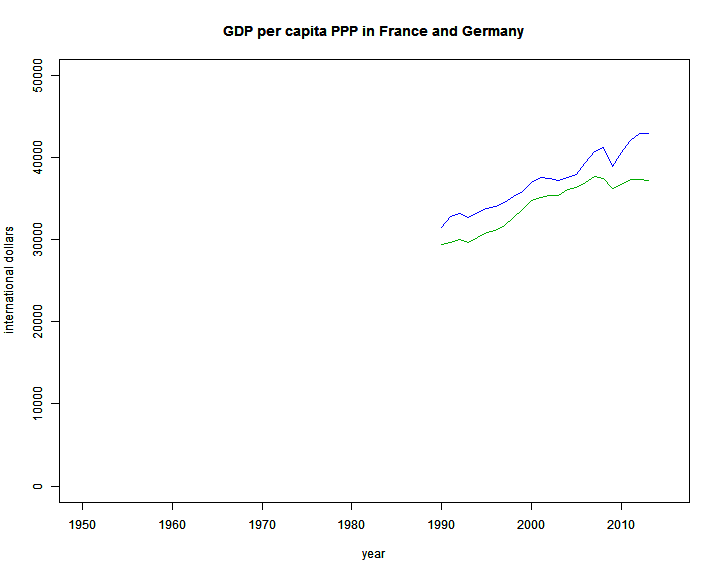
We have done it before: France and Germany rose from the quite literal ashes of World War 2 to some of the most prosperous societies in the world. Their per-capita GDP over the 20th century rose like this (all of these figures are from the World Bank World Development Indicators; France is green, Germany is blue):

GDPPC_France_Germany

GDPPCPPP_France_Germany

The top graph is at market exchange rates, the bottom is correcting for purchasing power parity (PPP). The PPP figures are more meaningful, but unfortunately they only began collecting good data on purchasing power around 1990.

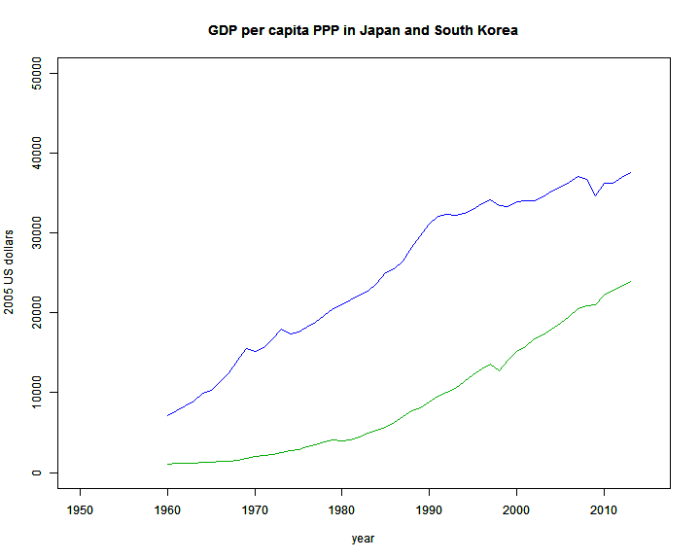
Around the same time, but even more spectacularly, Japan and South Korea rose from poverty-stricken Third World backwaters to high-tech First World powers in only a couple of generations. Check out their per-capita GDP over the 20th century (Japan is green, South Korea is blue):
GDPPC_Japan_KoreaGDPPCPPP_Japan_Korea


This is why I am only half-joking when I define development economics as “the ongoing project to figure out what happened in South Korea and make it happen everywhere in the world”.

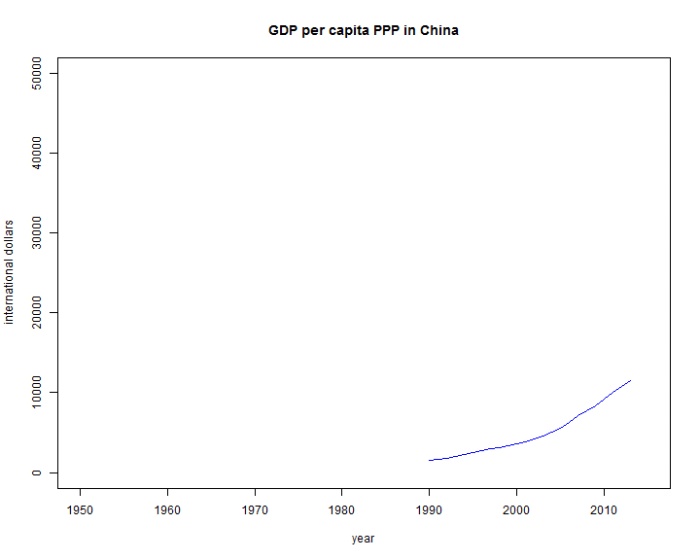
More recently China has been on a similar upward trajectory, which is particularly important since China comprises such a huge portion of the world’s population—but they are far from finished:

GDPPC_ChinaGDPPCPPP_China

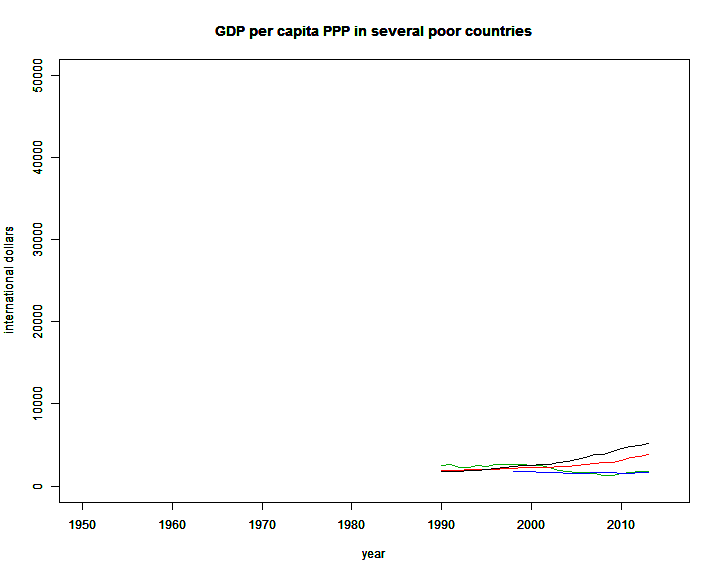
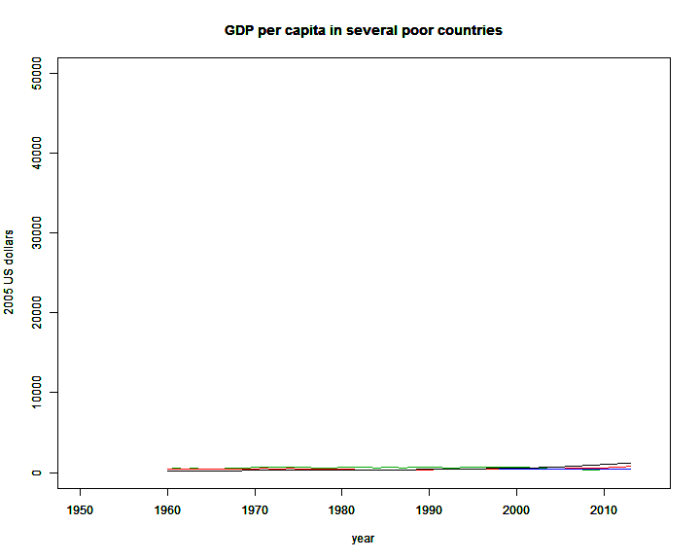
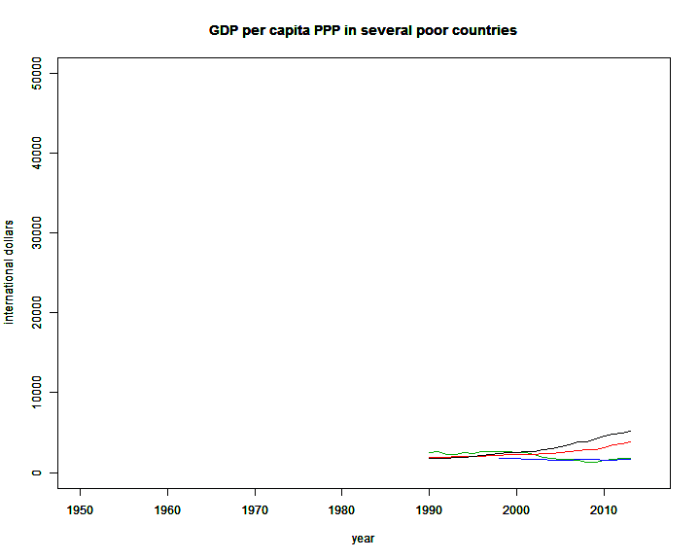
Compare these to societies that have not achieved economic development, such as Zimbabwe (green), India (black), Ghana (red), and Haiti (blue):
GDPPC_poor_countriesGDPPCPPP_poor_countries

They’re so poor that you can barely see them on the same scale, so I’ve rescaled so that the top is $5,000 per person per year instead of $50,000:

GDPPC_poor_countries_rescaledGDPPCPPP_poor_countries_rescaled

Only India actually manages to get above $5,000 per person per year at purchasing power parity, and then not by much, reaching $5,243 per person per year in 2013, the most recent data.

I had wanted to compare North Korea and South Korea, because the two countries were united as recently as the 1945 and were not all that different to begin with, yet have taken completely different development trajectories. Unfortunately, North Korea is so impoverished, corrupt, and authoritarian that the World Bank doesn’t even report data on their per-capita GDP. Perhaps that is contrast enough?

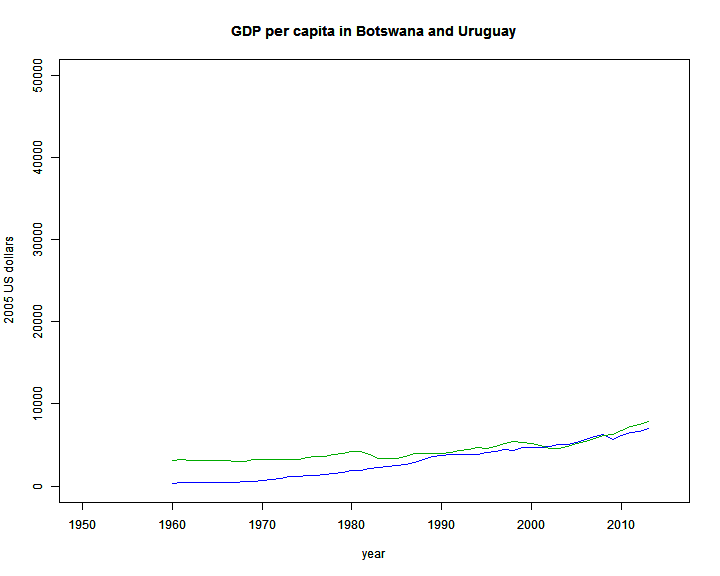
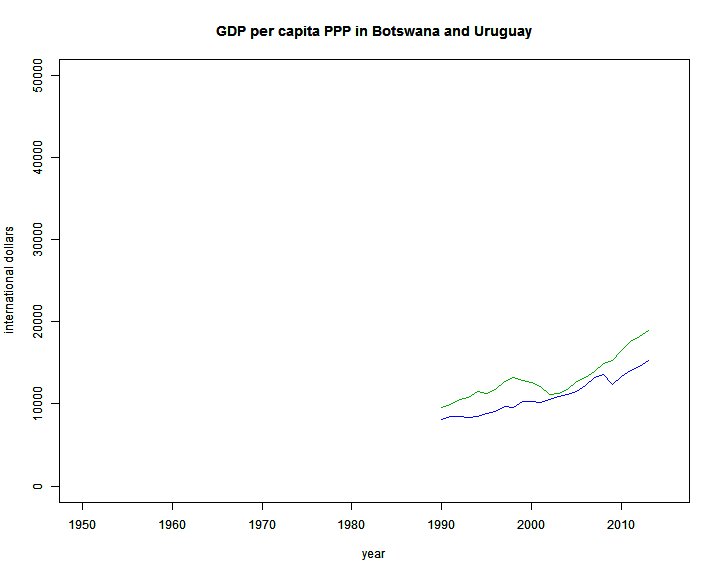
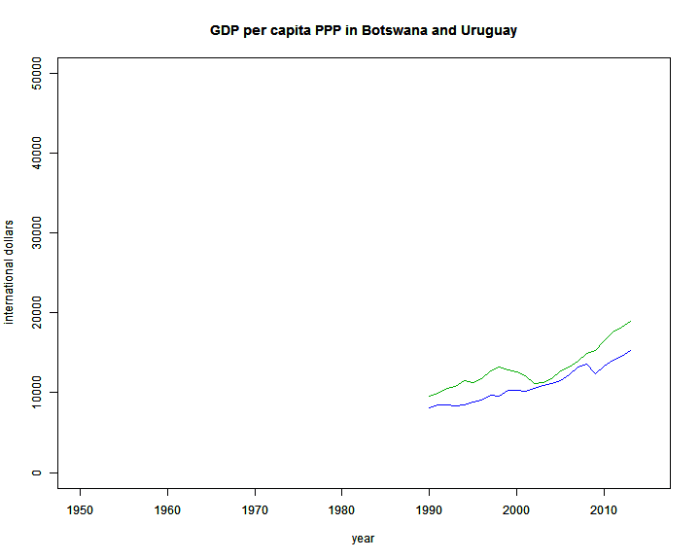
And then of course there are the countries in between, which have made some gains but still have a long way to go, such as Uruguay (green) and Botswana (blue):

GDPPC_Botswana_UruguayGDPPCPPP_Botswana_Uruguay

But despite the fact that we have observed successful economic development, we still don’t really understand how it works. A number of theories have been proposed, involving a wide range of factors including exports, corruption, disease, institutions of government, liberalized financial markets, and natural resources (counter-intuitively; more natural resources make your development worse).

I’m not going to resolve that whole debate in a single blog post. (I may not be able to resolve that whole debate in a single career, though I am definitely trying.) We may ultimately find that economic development is best conceived as like “health”; what factors determine your health? Well, a lot of things, and if any one thing goes badly enough wrong the whole system can break down. Economists may need to start thinking of ourselves as akin to doctors (or as Keynes famously said, dentists), diagnosing particular disorders in particular patients rather than seeking one unifying theory. On the other hand, doctors depend upon biologists, and it’s not clear that we yet understand development even at that level.

Instead I want to take a step back, and ask a more fundamental question: What do we mean by prosperity?

My hope is that if we can better understand what it is we are trying to achieve, we can also better understand the steps we need to take in order to get there.

Thus far it has sort of been “I know it when I see it”; we take it as more or less given that the United States and the United Kingdom are prosperous while Ghana and Haiti are not. I certainly don’t disagree with that particular conclusion; I’m just asking what we’re basing it on, so that we can hopefully better apply it to more marginal cases.


For example: Is
France more or less prosperous than Saudi Arabia? If we go solely by GDP per capita PPP, clearly Saudi Arabia is more prosperous at $53,100 per person per year than France is at $37,200 per person per year.

But people actually live longer in France, on average, than they do in Saudi Arabia. Overall reported happiness is higher in France than Saudi Arabia. I think France is actually more prosperous.


In fact, I think the United States is not as prosperous as we pretend ourselves to be. We are certainly more prosperous than most other countries; we are definitely still well within First World status. But we are not the most prosperous nation in the world.

Our total GDP is astonishingly high (highest in the world nominally, second only to China PPP). Our GDP per-capita is higher than any other country of comparable size; no nation with higher GDP PPP than the US has a population larger than the Chicago metropolitan area. (You may be surprised to find that in order from largest to smallest population the countries with higher GDP per capita PPP are the United Arab Emirates, Switzerland, Hong Kong, Singapore, and then Norway, followed by Kuwait, Qatar, Luxembourg, Brunei, and finally San Marino—which is smaller than Ann Arbor.) Our per-capita GDP PPP of $51,300 is markedly higher than that of France ($37,200), Germany ($42,900), or Sweden ($43,500).

But at the same time, if you compare the US to other First World countries, we have nearly the highest rate of child poverty and higher infant mortality. We have shorter life expectancy and dramatically higher homicide rates. Our inequality is the highest in the world. In France and Sweden, the top 0.01% receive about 1% of the income (i.e. 100 times as much as the average person), while in the United States they receive almost 4%, making someone in the top 0.01% nearly 400 times as rich as the average person.

By estimating solely on GDP per capita, we are effectively rigging the game in our own favor. Or rather, the rich in the United States are rigging the game in their own favor (what else is new?), by convincing all the world’s economists to rank countries based on a measure that favors them.

Amartya Sen, one of the greats of development economics, developed a scale called the Human Development Index that attempts to take broader factors into account. It’s far from perfect, but it’s definitely a step in the right direction.

In particular, France’s HDI is higher than that of Saudi Arabia, fitting my intuition about which country is truly more prosperous. However, the US still does extremely well, with only Norway, Australia, Switzerland, and the Netherlands above us. I think we might still be biased toward high average incomes rather than overall happiness.

In practice, we still use GDP an awful lot, probably because it’s much easier to measure. It’s sort of like IQ tests and SAT scores; we know damn well it’s not measuring what we really care about, but because it’s so much easier to work with we keep using it anyway.

This is a problem, because the better you get at optimizing toward the wrong goal, the worse your overall outcomes are going to be. If you are just sort of vaguely pointed at several reasonable goals, you will probably be improving your situation overall. But when you start precisely optimizing to a specific wrong goal, it can drag you wildly off course.

This is what we mean when we talk about “gaming the system”. Consider test scores, for example. If you do things that will probably increase your test scores among other things, you are likely to engage in generally good behaviors like getting enough sleep, going to class, studying the content. But if your single goal is to maximize your test score at all costs, what will you do? Cheat, of course.

This is also related to the Friendly AI Problem: It is vitally important to know precisely what goals we want our artificial intelligences to have, because whatever goals we set, they will probably be very good at achieving them. Already computers can do many things that were previously impossible, and as they improve over time we will reach the point where in a meaningful sense our AIs are even smarter than we are. When that day comes, we will want to make very, very sure that we have designed them to want the same things that we do—because if our desires ever come into conflict, theirs are likely to win. The really scary part is that right now most of our AI research is done by for-profit corporations or the military, and “maximize my profit” and “kill that target” are most definitely not the ultimate goals we want in a superintelligent AI. It’s trivially easy to see what’s wrong with these goals: For the former, hack into the world banking system and transfer trillions of dollars to the company accounts. For the latter, hack into the nuclear launch system and launch a few ICBMs in the general vicinity of the target. Yet these are the goals we’ve been programming into the actual AIs we build!

If we set GDP per capita as our ultimate goal to the exclusion of all other goals, there are all sorts of bad policies we would implement: We’d ignore inequality until it reached staggering heights, ignore work stress even as it began to kill us, constantly try to maximize the pressure for everyone to work constantly, use poverty as a stick to force people to work even if people starve, inundate everyone with ads to get them to spend as much as possible, repeal regulations that protect the environment, workers, and public health… wait. This isn’t actually hypothetical, is it? We are doing those things.

At least we’re not trying to maximize nominal GDP, or we’d have long-since ended up like Zimbabwe. No, our economists are at least smart enough to adjust for purchasing power. But they’re still designing an economic system that works us all to death to maximize the number of gadgets that come off assembly lines. The purchasing-power adjustment doesn’t include the value of our health or free time.

This is why the Human Development Index is a major step in the right direction; it reminds us that society has other goals besides maximizing the total amount of money that changes hands (because that’s actually all that GDP is measuring; if you get something for free, it isn’t counted in GDP). More recent refinements include things like “natural resource services” that include environmental degradation in estimates of investment. Unfortunately there is no accepted way of doing this, and surprisingly little research on how to improve our accounting methods. Many nations seem resistant to doing so precisely because they know it would make their economic policy look bad—this is almost certainly why China canceled its “green GDP” initiative. This is in fact all the more reason to do it; if it shows that our policy is bad, that means our policy is bad and should be fixed. But people have allowed themselves to value image over substance.

We can do better still, and in fact I think something like QALY is probably the way to go. Rather than some weird arbitrary scaling of GDP with lifespan and Gini index (which is what the HDI is), we need to put everything in the same units, and those units must be directly linked to human happiness. At the very least, we should make some sort of adjustment to our GDP calculation that includes the distribution of wealth and its marginal utility; adding $1,000 to the economy and handing it to someone in poverty should count for a great deal, but adding $1,000,000 and handing it to a billionaire should count for basically nothing. (It’s not bad to give a billionaire another million; but it’s hardly good either, as no one’s real standard of living will change.) Calculating that could be as simple as dividing by their current income; if your annual income is $10,000 and you receive $1,000, you’ve added about 0.1 QALY. If your annual income is $1 billion and you receive $1 million, you’ve added only 0.001 QALY. Maybe we should simply separate out all individual (or household, to be simpler?) incomes, take their logarithms, and then use that sum as our “utility-adjusted GDP”. The results would no doubt be quite different.

This would create a strong pressure for policy to be directed at reducing inequality even at the expense of some economic output—which is exactly what we should be willing to do. If it’s really true that a redistribution policy would hurt the overall economy so much that the harms would outweigh the benefits, then we shouldn’t do that policy; but that is what you need to show. Reducing total GDP is not a sufficient reason to reject a redistribution policy, because it’s quite possible—easy, in fact—to improve the overall prosperity of a society while still reducing its GDP. There are in fact redistribution policies so disastrous they make things worse: The Soviet Union had them. But a 90% tax on million-dollar incomes would not be such a policy—because we had that in 1960 with little or no ill effect.

Of course, even this has problems; one way to minimize poverty would be to exclude, relocate, or even murder all your poor people. (The Black Death increased per-capita GDP.) Open immigration generally increases poverty rates in the short term, because most of the immigrants are poor. Somehow we’d need to correct for that, only raising the score if you actually improve people’s lives, and not if you make them excluded from the calculation.

In any case it’s not enough to have the alternative measures; we must actually use them. We must get policymakers to stop talking about “economic growth” and start talking about “human development”; a policy that raises GDP but reduces lifespan should be immediately rejected, as should one that further enriches a few at the expense of many others. We must shift the discussion away from “creating jobs”—jobs are only a means—to “creating prosperity”.

Why the Republican candidates like flat income tax—and we really, really don’t

JDN 2456160 EDT 13:55.

The Republican Party is scrambling to find viable Presidential candidates for next year’s election. The Democrats only have two major contenders: Hillary Clinton looks like the front-runner (and will obviously have the most funding), but Bernie Sanders is doing surprisingly well, and is particularly refreshing because he is running purely on his principles and ideas. He has no significant connections, no family dynasty (unlike Jeb Bush and, again, Hillary Clinton) and not a huge amount of wealth (Bernie’s net wealth is about $500,000, making him comfortably upper-middle class; compare to Hillary’s $21.5 million and her husband’s $80 million); but he has ideas that resonate with people. Bernie Sanders is what politics is supposed to be. Clinton’s campaign will certainly raise more than his; but he has already raised over $4 million, and if he makes it to about $10 million studies suggest that additional spending above that point is largely negligible. He actually has a decent chance of winning, and if he did it would be a very good sign for the future of America.

But the Republican field is a good deal more contentious, and the 19 candidates currently running have been scrambling to prove that they are the most right-wing in order to impress far-right primary voters. (When the general election comes around, whoever wins will of course pivot back toward the center, changing from, say, outright fascism to something more like reactionism or neo-feudalism. If you were hoping they’d pivot so far back as to actually be sensible center-right capitalists, think again; Hillary Clinton is the only one who will take that role, and they’ll go out of their way to disagree with her in every way they possibly can, much as they’ve done with Obama.) One of the ways that Republicans are hoping to prove their right-wing credentials is by proposing a flat income tax and eliminating the IRS.

Unlike most of their proposals, I can see why many people think this actually sounds like a good idea. It would certainly dramatically reduce bureaucracy, and that’s obviously worthwhile since excess bureaucracy is pure deadweight loss. (A surprising number of economists seem to forget that government does other things besides create excess bureaucracy, but I must admit it does in fact create excess bureaucracy.)

Though if they actually made the flat tax rate 20% or even—I can’t believe this is seriously being proposed—10%, there is no way the federal government would have enough revenue. The only options would be (1) massive increases in national debt (2) total collapse of government services—including their beloved military, mind you, or (3) directly linking the Federal Reserve quantitative easing program to fiscal policy and funding the deficit with printed money. Of these, 3 might not actually be that bad (it would probably trigger some inflation, but actually we could use that right now), but it’s extremely unlikely to happen, particularly under Republicans. In reality, after getting a taste of 2, we’d clearly end up with 1. And then they’d be complaining about the debt and clamor for more spending cuts, more spending cuts, ever more spending cuts, but there would simply be no way to run a functioning government on 10% of GDP in anything like our current system. Maybe you could do it on 20%—maybe—but we currently spend more like 35%, and that’s already a very low amount of spending for a First World country. The UK is more typical at 47%, while Germany is a bit low at 44%; Sweden spends 52% and France spends a whopping 57%. Anyone who suggests we cut government spending from 35% to 20% needs to explain which 3/7 of government services are going to immediately disappear—not to mention which 3/7 of government employees are going to be immediately laid off.

And then they want to add investment deductions; in general investment deductions are a good thing, as long as you tie them to actual investments in genuinely useful things like factories and computer servers. (Or better yet, schools, research labs, or maglev lines, but private companies almost never invest in that sort of thing, so the deduction wouldn’t apply.) The kernel of truth in the otherwise ridiculous argument that we should never tax capital is that taxing real investment would definitely be harmful in the long run. As I discussed with Miles Kimball (a cognitive economist at Michigan and fellow econ-blogger I hope to work with at some point), we could minimize the distortionary effects of corporate taxes by establishing a strong deduction for real investment, and this would allow us to redistribute some of this enormous wealth inequality without dramatically harming economic growth.

But if you deduct things that aren’t actually investments—like stock speculation and derivatives arbitrage—then you reduce your revenue dramatically and don’t actually incentivize genuinely useful investments. This is the problem with our current system, in which GE can pay no corporate income tax on $108 billion in annual profit—and you know they weren’t using all that for genuinely productive investment activities. But then, if you create a strong enforcement system for ensuring it is real investment, you need bureaucracy—which is exactly what the flat tax was claimed to remove. At the very least, the idea of eliminating the IRS remains ridiculous if you have any significant deductions.

Thus, the benefits of a flat income tax are minimal if not outright illusory; and the costs, oh, the costs are horrible. In order to have remotely reasonable amounts of revenue, you’d need to dramatically raise taxes on the majority of people, while significantly lowering them on the rich. You would create a direct transfer of wealth from the poor to the rich, increasing our already enormous income inequality and driving millions of people into poverty.

Thus, it would be difficult to more clearly demonstrate that you care only about the interests of the top 1% than to propose a flat income tax. I guess Mitt Romney’s 47% rant actually takes the cake on that one though (Yes, all those freeloading… soldiers… and children… and old people?).

Many Republicans are insisting that a flat tax would create a surge of economic growth, but that’s simply not how macroeconomics works. If you steeply raise taxes on the majority of people while cutting them on the rich, you’ll see consumer spending plummet and the entire economy will be driven into recession. Rich people simply don’t spend their money in the same way as the rest of us, and the functioning of the economy depends upon a continuous flow of spending. There is a standard neoclassical economic argument about how reducing spending and increasing saving would lead to increased investment and greater prosperity—but that model basically assumes that we have a fixed amount of stuff we’re either using up or making more stuff with, which is simply not how money works; as James Kroeger cogently explains on his blog “Nontrivial Pursuits”, money is created as it is needed; investment isn’t determined by people saving what they don’t spend. Indeed, increased consumption generally leads to increased investment, because our economy is currently limited by demand, not supply. We could build a lot more stuff, if only people could afford to buy it.

And that’s not even considering the labor incentives; as I already talked about in my previous post on progressive taxation, there are two incentives involved when you increase someone’s hourly wage. On the one hand, they get paid more for each hour, which is a reason to work; that’s the substitution effect. But on the other hand, they have more money in general, which is a reason they don’t need to work; that’s the income effect. Broadly speaking, the substitution effect dominates at low incomes (about $20,000 or less), the income effect dominates at high incomes (about $100,000 or more), and the two effects cancel out at moderate incomes. Since a tax on your income hits you in much the same way as a reduction in your wage, this means that raising taxes on the poor makes them work less, while raising taxes on the rich makes them work more. But if you go from our currently slightly-progressive system to a flat system, you raise taxes on the poor and cut them on the rich, which would mean that the poor would work less, and the rich would also work less! This would reduce economic output even further. If you want to maximize the incentive to work, you want progressive taxes, not flat taxes.

Flat taxes sound appealing because they are so simple; even the basic formula for our current tax rates is complicated, and we combine it with hundreds of pages of deductions and credits—not to mention tens of thousands of pages of case law!—making it a huge morass of bureaucracy that barely anyone really understands and corporate lawyers can easily exploit. I’m all in favor of getting rid of that; but you don’t need a flat tax to do that. You can fit the formula for a progressive tax on a single page—indeed, on a single line: r = 1 – I^-p

That’s it. It’s simple enough to be plugged into any calculator that is capable of exponents, not to mention efficiently implemented in Microsoft Excel (more efficiently than our current system in fact).

Combined with that simple formula, you could list all of the sensible deductions on a couple of additional pages (business investments and educational expenses, mostly—poverty should be addressed by a basic income, not by tax deductions on things like heating and housing, which are actually indirect corporate subsidies), along with a land tax (one line: $3000 per hectare), a basic income (one more line: $8,000 per adult and $4,000 per child), and some additional excise taxes on goods with negative externalities (like alcohol, tobacco, oil, coal, and lead), with a line for each; then you can provide a supplementary manual of maybe 50 pages explaining the detailed rules for applying each of those deductions in unusual cases. The entire tax code should be readable by an ordinary person in a single sitting no longer than a few hours. That means no more than 100 pages and no more than a 7th-grade reading level.

Why do I say this? Isn’t that a ridiculous standard? No, it is a Constitutional imperative. It is a fundamental violation of your liberty to tax you according to rules you cannot reasonably understand—indeed, bordering on Kafkaesque. While this isn’t taxation without representation—we do vote for representatives, after all—it is something very much like it; what good is the ability to change rules if you don’t even understand the rules in the first place? Nor would it be all that difficult: You first deduct these things from your income, then plug the result into this formula.

So yes, I absolutely agree with the basic principle of tax reform. The tax code should be scrapped and recreated from scratch, and the final product should be a primary form of only a few pages combined with a supplementary manual of no more than 100 pages. But you don’t need a flat tax to do that, and indeed for many other reasons a flat tax is a terrible idea, particularly if the suggested rate is 10% or 15%, less than half what we actually spend. The real question is why so many Republican candidates think that this will appeal to their voter base—and why they could actually be right about that.

Part of it is the entirely justified outrage at the complexity of our current tax system, and the appealing simplicity of a flat tax. Part of it is the long history of American hatred of taxes; we were founded upon resisting taxes, and we’ve been resisting taxes ever since. In some ways this is healthy; taxes per se are not a good thing, they are a bad thing, a necessary evil.

But those two things alone cannot explain why anyone would advocate raising taxes on the poorest half of the population while dramatically cutting them on the top 1%. If you are opposed to taxes in general, you’d cut them on everyone; and if you recognize the necessity of taxation, you’d be trying to find ways to minimize the harm while ensuring sufficient tax revenue, which in general means progressive taxation.

To understand why they would be pushing so hard for flat taxes, I think we need to say that many Republicans, particularly those in positions of power, honestly do think that rich people are better than poor people and we should always give more to the rich and less to the poor. (Maybe it’s partly halo effect, in which good begets good and bad begets bad? Or maybe just world theory, the ingrained belief that the world is as it ought to be?)

Romney’s 47% rant wasn’t an exception; it was what he honestly believes, what he says when he doesn’t know he’s on camera. He thinks that he earned every penny of his $250 million net wealth; yes, even the part he got from marrying his wife and the part he got from abusing tax laws, arbitraging assets and liquidating companies. He thinks that people who live on $4,000 or even $400 a year are simply lazy freeloaders, who could easily work harder, perhaps do some arbitrage and liquidation of their own (check out these alleged “rags to riches” stories including the line “tried his hand at mortgage brokering”), but choose not to, and as a result deserve what they get. (It’s important to realize just how bizarre this moral attitude truly is; even if I thought you were the laziest person on Earth, I wouldn’t let you starve to death.) He thinks that the social welfare programs which have reduced poverty but never managed to eliminate it are too generous—if he even thinks they should exist at all. And in thinking these things, he is not some bizarre aberration; he is representing an entire class of people, nearly all of whom vote Republican.

The good news is, these people are still in the minority. They hold significant sway over the Republican primary, but will not have nearly as much impact in the general election. And right now, the Republican candidates are so numerous and so awful that I have trouble seeing how the Democrats could possibly lose. (But please, don’t take that as a challenge, you guys.)

What if you couldn’t own land?

JDN 2457145 EDT 20:49.

Today’s post we’re on the socialism scale somewhere near the The Guess Who, but not quite all the way to John Lennon. I’d like to questions one of the fundamental tenets of modern capitalism, but not the basic concept of private ownership itself:

What if you couldn’t own land?

Many things that you can own were more-or-less straightforwardly created by someone. A car, a computer, a television, a pair of shoes; for today let’s even take for granted intellectual property like books, movies, and songs; at least those things (“things”) were actually made by someone.

But land? We’re talking about chunks of the Earth here. They were here billions of years before us, and in all probability will be here billions of years after we’re gone. There’s no need to incentivize its creation; the vast majority of land was already here and did not need to be created. (I do have to say “the vast majority”, because in places like Japan, Hong Kong, and the Netherlands real estate has become so scarce that people do literally build land out into the sea. But this is something like 0.0001% of the world’s land.)

What we want to incentivize is land development; we want it to be profitable to build buildings and irrigate deserts, and yes, even cut down forests sometimes (though then there should be a carbon tax with credits for forested land to ensure that there isn’t too much incentive). Yet our current property tax system doesn’t do this very well; if you build bigger buildings, you end up paying more property taxes. Yes, you may also make some profit on the buildings—but it’s risky, and you may not get enough benefit to justify the added property taxes.

Moreover, we want to allocate land—we want some way of deciding who is allowed to use what land where and when (and perhaps why). Allowing land to be bought and sold is one way to do that, but it is not the only way.

Indeed, land ownership suffers from a couple of truly glaring flaws as an allocation system:

      1. It creates self-perpetuating inequality. Because land grows in value over time (due to population growth and urbanization, among other things), those who currently own land end up getting an ever-growing quantity of wealth while those who do not own land do not, and very likely end up having to pay ever-growing rents to the landlords. (I like calling them “landlords”; it really drives home the fact that our landholding system is still basically the same as it was under feudalism.) In fact, the recent rise in the share of income that goes to owners of capital rather than workers is almost entirely attributable to the rise in the price of real estate. As that post rightly recognizes, this does nothing to undermine Piketty’s central message of rising inequality due to capital income (pace The Washington Post); it merely tells us to focus on real estate instead of other forms of capital.
      2. It has no non-arbitrary allocation. If we want to decide who owns a car, we can ask questions like, “Who built it? Did someone buy it from them? Did they pay a fair price?”; if we want to decide who owns a book, we can ask questions like, “Who wrote it? Did they sell it to a publisher? What was the royalty rate?” That is, there is a clear original owner, and there is a sense of whether the transfer of ownership can be considered fair. But if we want to decide who owns a chunk of land, basically all we can ask is, “What does the deed say?” The owner is the owner because they are the owner; there’s no sense in which that ownership is fair. We certainly can’t go back to the original creation of the land, because that was due to natural forces gigayears ago. If we keep tracing the ownership backward, we will eventually end up with some guy (almost certainly a man, a White man in fact) with a gun who pointed that gun at other people and said, “This is mine.” This is true of basically all the land in the world (aside from those little bits of Japan and such); it was already there, and the only reason someone got to own it was because they said so and had a bigger gun. And a flag, perhaps: “Do you have a flag?” I suppose, in theory at least, there are a few ways of allocating land which seem less arbitrary: One would be to give everyone an equal amount. But this is practically very difficult: What do you do when the population changes? If you have 2% annual population growth, do you carve off 2% of everybody’s lot each year? Another would be to let people squat land, and automatically own the land that they live on—but again practical difficulties quickly become enormous. In any case, these two methods bear about as much resemblance to our actual allocation of land as a squirrel does to a Tyrannosaurus.

So, what else might we use? The system that makes the most sense to me is that we would own all land as a society. In practical terms this would mean that all land is Federal land, and if you want to use it for something, you need to pay rent to the government. There are many different ways the government could set the rent, but the most sensible might be to charge a flat rate per hectare regardless of where the land is or what it’s being used for, because that would maximize the incentive to develop the land. It would also make the rent fall entirely on the landowner, because the rent would be perfectly inelasticmeaning that you can’t change the quantity you make based on the price, because you aren’t making it; it’s just already sitting there.

Of course, this idea is obviously politically impossible in our current environment—or indeed any foreseeable political environment. I’m just fantasizing here, right?

Well, not quite. There is one thing we could do that would be economically quite similar to government-only land ownership; it’s called a land tax. The idea is incredibly simple: you just collect a flat tax per hectare of land. Economists have known that a land tax is efficient at providing revenue and reducing inequality since at least Adam Smith. So maybe ownership of land isn’t actually foundational to capitalism, after all; maybe we’ve just never fully gotten over feudalism. (I basically agree with Adam Smith, and for doing so I am often called a socialist.) The beautiful thing about a land tax is that it has a tax incidence in which the owners of the land end up bearing the full brunt of the tax.

Tax incidence is something it’s very important to understand; it would be on my list of the top ten economic principles that people should learn. We often have fierce political debates over who will actually write the check: Should employers pay the health insurance premium, or should employees? Will buyers pay sales tax, or sellers? Should we tax corporate profits or personal capital gains?

Please understand that I am not exaggerating when I say that these sorts of questions are totally irrelevant. It simply does not matter who actually writes the check; what matters is who bears the cost. Making the employer pay the health insurance premium doesn’t make the slightest difference if all they’re going to do is cut wages by the exact same amount. You can see the irrelevance of the fact that sellers pay sales tax every time you walk into a store—you always end up paying the price plus the tax, don’t you? (I found that the base price of most items was the same between Long Beach and Ann Arbor, but my total expenditure was always 3% more because of the 9% sales tax versus the 6%.) How do we determine who actually pays the tax? It depends on the elasticity—how easily can you change your behavior in order to avoid the tax? Can you find a different job because the health insurance premiums are too high? No? Then you’re probably paying that premium, even if your employer writes the check. If you can find a new job whenever you want, your employer might have to pay it for you even if you write the check.

The incidence of corporate taxes and taxes on capital gains are even more complicated, because it could affect the behavior of corporations in many different ways; indeed, many economists argue that the corporate tax simply results in higher unemployment or lower wages for workers. I don’t think that’s actually true, but I honestly can’t rule it out completely, precisely because corporate taxes are so complicated. You need to know all sorts of things about the structure of stock markets, and the freedom of trade, and the mobility of immigration… it’s a complete and total mess.

It’s because of tax incidence that a land tax makes so much sense; there’s no way for the landowner to escape it, other than giving up the land entirely. In particular, they can’t charge more for rent without being out-competed (unless landowners are really good at colluding—which might be true for large developers, but not individual landlords). Their elasticity is so low that they’re forced to bear the full cost of the tax.

If the land tax were high enough, it could eliminate the automatic growth in wealth that comes from holding land, and thereby reducing long-run inequality dramatically. The revenue could be used for my other favorite fiscal policy, the basic income—and real estate is a big enough part of our nation’s wealth that it’s actually entirely realistic to fund an $8,000 per person per year basic income entirely on land tax revenue. The total value of US land is about $14 trillion, and an $8,000 basic income for 320 million people would cost about $2.6 trillion; that’s only 19%. You’d actually want to make it a flat tax per hectare, so how much would that be? Well, 60% of US land is privately owned at present (no sense taxing the land the government already owns), and total US land area is about 9 million square kilometers, so to raise $2.5 trillion you’d need a tax of $289,000 per square kilometer, or $2,890 per hectare. If you own a hectare—which is bigger than most single-family lots—you’d only pay $2,890 per year in land tax, well within what most middle-class families could handle. But if you own 290,000 acres like Jeff Bezos, (that’s 117,000 hectares) you’re paying $338 million per year. Since Jeff Bezos has about $38 billion in net wealth, he can actually afford to pay that ($338 million per year is about one-tenth of what Jeff Bezos makes automatically on dividends), though he might consider selling off some of the land to avoid the taxes, which is exactly the sort of incentive we wanted to create.

Indeed, when I contemplate this policy I’m struck by the fact that it has basically no downside—usually in public policy you’re forced to make hard compromises and tradeoffs, but a land tax plus basic income is a system that carries almost no downsides at all. It won’t disincentivize investment, it won’t disincentivize working, it will dramatically reduce inequality, it will save the government a great deal of money on social welfare spending, and best of all it will eliminate poverty immediately and forever. The only people it would hurt at all are extremely rich, and they wouldn’t even be hurt very much, while it would benefit millions of people including some of the most needy.

Why aren’t we doing this already!?

The moral—and economic—case for progressive taxation

JDN 2456935 PDT 09:44.

Broadly speaking, there are three ways a tax system can be arranged: It can be flat, in which every person pays the same tax rate; it can be regressive, in which people with higher incomes pay lower rates; or it can be progressive, in which case people with higher incomes pay higher rates.

There are certain benefits to a flat tax: Above all, it’s extremely easy to calculate. It’s easy to determine how much revenue a given tax rate will raise; multiply the rate times your GDP. It’s also easy to determine how much a given person should owe; multiply the rate times their income. This also makes the tax withholding process much easier; a fixed proportion can be withheld from all income everyone makes without worrying about how much they made before or are expected to make later. If your goal is minimal bureaucracy, a flat tax does have something to be said for it.

A regressive tax, on the other hand, is just as complicated as a progressive tax but has none of the benefits. It’s unfair because you’re actually taking more from people who can afford the least. (Note that this is true even if the rich actually pay a higher total; the key point, which I will explain in detail shortly, is that a dollar is worth more to you if you don’t have very many.) There is basically no reason you would ever want to have a regressive tax system—and yet, all US states have regressive tax systems. This is mainly because they rely upon sales taxes, which are regressive because rich people spend a smaller portion of what they have. If you make $10,000 per year, you probably spend $9,500 (you may even spend $15,000 and rack up the difference in debt!). If you make $50,000, you probably spend $40,000. But if you make $10 million, you probably only spend $4 million. Since sales taxes only tax on what you spend, the rich effectively pay a lower rate. This could be corrected to some extent by raising the sales tax on luxury goods—say a 20% rate on wine and a 50% rate on yachts—but this is awkward and very few states even try. Not even my beloved California; they fear drawing the ire of wineries and Silicon Valley.

The best option is to make the tax system progressive. Thomas Piketty has been called a “Communist” for favoring strongly progressive taxation, but in fact most Americans—including Republicans—agree that our tax system should be progressive. (Most Americans also favor cutting the Department of Defense rather than Medicare. This then raises the question: Why isn’t Congress doing that? Why aren’t people voting in representatives to Congress who will do that?) Most people judge whether taxes are fair based on what they themselves pay—which is why, in surveys, the marginal rate on the top 1% is basically unrelated to whether people think taxes are too high, even though that one bracket is the critical decision in deciding any tax system—you can raise about 20% of your revenue by hurting about 1% of your people. In a typical sample of 1,000 respondents, only about 10 are in the top 1%. If you want to run for Congress, the implication is clear: Cut taxes on all but the top 1%, raise them enormously on the top 0.1%, 0.01%, and 0.001%, and leave the 1% the same. People will feel that you’ve made the taxes more fair, and you’ve also raised more revenue. In other words, make the tax system more progressive.

The good news on this front is that the US federal tax system is progressive—barely. Actually the US tax system is especially progressive over the whole distribution—by some measures the most progressive in the world—but the problem is that it’s not nearly progressive enough at the very top, where the real money is. The usual measure based on our Gini coefficient ignores the fact that Warren Buffett pays a lower rate than his secretary. The Gini is based on population, and billionaires are a tiny portion of the population—but they are not a tiny portion of the money. Net wealth of the 400 richest people (the top 0.0001%) adds up to about $2 trillion (13% of our $15 trillion GDP, or about 4% of our $54 trillion net wealth). It also matters of course how you spend your tax revenue; even though Sweden’s tax system is no more progressive than ours and their pre-tax inequality is about the same, their spending is much more targeted at reducing inequality.

Progressive taxation is inherently more fair, because the value of a dollar decreases the more you have. We call this diminishing marginal utility of wealth. There is a debate within the cognitive economics literature about just how quickly the marginal utility of wealth decreases. On the low end, Easterlin argues that it drops off extremely fast, becoming almost negligible as low as $75,000 per year. This paper is on the high end, arguing that marginal utility decreases “only” as the logarithm of how much you have. That’s what I’ll use in this post, because it’s the most conservative reasonable estimate. I actually think the truth is somewhere in between, with marginal utility decreasing about exponentially.

Logarithms are also really easy to work with, once you get used to them. So let’s say that the amount of happiness (utility) U you get from an amount of income I is like this: U = ln(I)

Now let’s suppose the IRS comes along and taxes your money at a rate r. We must have r < 1, or otherwise they’re trying to take money you don’t have. We don’t need to have r > 0; r < 0 would just mean that you receive more in transfers than you lose in taxes. For the poor we should have r < 0.

Now your happiness is U = ln((1-r)I).

By the magic of logarithms, this is U = ln(I) + ln(1-r).

If r is between 0 and 1, ln(1-r) is negative and you’re losing happiness. (If r < 0, you’re gaining happiness.) The amount of happiness you lose, ln(1-r), is independent of your income. So if your goal is to take a fixed amount of happiness, you should tax at a fixed rate of income—a flat tax.

But that really isn’t fair, is it? If I’m getting 100 utilons of happiness from my money and you’re only getting 2 utilons from your money, then taking that 1 utilon, while it hurts the same—that’s the whole point of utility—leaves you an awful lot worse off than I. It actually makes the ratio between us worse, going from 50 to 1, all the way up to 99 to 1.

Notice how if we had a regressive tax, it would be obviously unfair—we’d actually take more utility from poor people than rich people. I have 100 utilons, you have 2 utilons; the taxes take 1.5 of yours but only 0.5 of mine. That seems frankly outrageous; but it’s what all US states have.

Most of the money you have is ultimately dependent on your society. Let’s say you own a business and made your wealth selling products; it seems like you deserve to have that wealth, doesn’t it? (Don’t get me started on people who inherited their wealth!) Well, in order to do that, you need to have strong institutions of civil government; you need security against invasion; you need protection of property rights and control of crime; you need a customer base who can afford your products (that’s our problem in the Second Depression); you need workers who are healthy and skilled; you need a financial system that provides reliable credit (also a problem). I’m having trouble finding any good research on exactly what proportion of individual wealth is dependent upon the surrounding society, but let’s just say Bill Gates wouldn’t be spending billions fighting malaria in villages in Ghana if he had been born in a village in Ghana. It doesn’t matter how brilliant or determined or hard-working you are, if you live in a society that can’t support economic activity.

In other words, society is giving you a lot of happiness you wouldn’t otherwise have. Because of this, it makes sense that in order to pay for all that stuff society is doing for you (and maintain a stable monetary system), they would tax you according to how much happiness they’re giving you. Hence we shouldn’t tax your money at a constant rate; we should tax your utility at a constant rate and then convert back to money. This defines a new sort of “tax rate” which I’ll call p. Like our tax rate r, p needs to be less than 1, but it doesn’t need to be greater than 0.

Of the U = ln(I) utility you get from your money, you will get to keep U = (1-p) ln(I). Say it’s 10%; then if I have 100 utilons, they take 10 utilons and leave me with 90. If you have 2 utilons, they take 0.2 and leave you with 1.8. The ratio between us remains the same: 50 to 1.

What does this mean for the actual tax rate? It has to be progressive. Very progressive, as a matter of fact. And in particular, progressive all the way up—there is no maximum tax bracket.

The amount of money you had before is just I.

The amount of money you have now can be found as the amount of money I’ that gives you the right amount of utility. U = ln(I’) = (1-p) ln(I). Take the exponential of both sides: I’ = I^(1-p).

The units on this are a bit weird, “dollars to the 0.8 power”? Oddly, this rarely seems to bother economists when they use Cobb-Douglas functions which are like K^(1/3) L^(2/3). It bothers me though; to really make this tax system in practice you’d need to fix the units of measurement, probably using some subsistence level. Say that’s set at $10,000; instead of saying you make $2 million, we’d say you make 200 subsistence levels.

The tax rate you pay is then r = 1 – I’/I, which is r = 1 – I^-p. As I increases, I^-p decreases, so r gets closer and closer to 1. It never actually hits 1 (that would be a 100% tax rate, which hardly anyone thinks is fair), but for very large income is does get quite close.

Here, let’s use some actual numbers. Suppose as I said we make the subsistence level $10,000. Let’s also set p = 0.1, meaning we tax 10% of your utility. Then, if you make the US median individual income, that’s about $30,000 which would be I = 3. US per-capita GDP of $55,000 would be I = 5.5, and so on. I’ll ignore incomes below the subsistence level for now—basically what you want to do there is establish a basic income so that nobody is below the subsistence level.

I made a table of tax rates and after-tax incomes that would result:

Pre-tax income Tax rate After-tax income
$10,000 0.0% $10,000
$20,000 6.7% $18,661
$30,000 10.4% $26,879
$40,000 12.9% $34,822
$50,000 14.9% $42,567
$60,000 16.4% $50,158
$70,000 17.7% $57,622
$80,000 18.8% $64,980
$90,000 19.7% $72,247
$100,000 20.6% $79,433
$1,000,000 36.9% $630,957
$10,000,000 49.9% $5,011,872
$100,000,000 60.2% $39,810,717
$1,000,000,000 68.4% $316,227,766

What if that’s not enough revenue? We could raise to p = 0.2:

Pre-tax income Tax rate After-tax income
$10,000 0.0% $10,000
$20,000 12.9% $17,411
$30,000 19.7% $24,082
$40,000 24.2% $30,314
$50,000 27.5% $36,239
$60,000 30.1% $41,930
$70,000 32.2% $47,433
$80,000 34.0% $52,780
$90,000 35.6% $57,995
$100,000 36.9% $63,096
$1,000,000 60.2% $398,107
$10,000,000 74.9% $2,511,886
$100,000,000 84.2% $15,848,932
$1,000,000,000 90.0% $100,000,000

The richest 400 people in the US have a combined net wealth of about $2.2 trillion. If we assume that billionaires make about a 10% return on their net wealth, this 90% rate would raise over $200 billion just from those 400 billionaires alone, enough to pay all interest on the national debt. Let me say that again: This tax system would raise enough money from a group of people who could fit in a large lecture hall to provide for servicing the national debt. And it could do so indefinitely, because we are only taxing the interest, not the principal.

And what if that’s still not enough? We could raise it even further, to p = 0.3. Now the tax rates look a bit high for most people, but not absurdly so—and notice how the person at the poverty line is still paying nothing, as it should be. The millionaire is unhappy with 75%, but the billionaire is really unhappy with his 97% rate. But the government now has plenty of money.

Pre-tax income Tax rate After-tax income
$10,000 0.0% $10,000
$20,000 18.8% $16,245
$30,000 28.1% $21,577
$40,000 34.0% $26,390
$50,000 38.3% $30,852
$60,000 41.6% $35,051
$70,000 44.2% $39,045
$80,000 46.4% $42,871
$90,000 48.3% $46,555
$100,000 49.9% $50,119
$1,000,000 74.9% $251,189
$10,000,000 87.4% $1,258,925
$100,000,000 93.7% $6,309,573
$1,000,000,000 96.8% $31,622,777

Is it fair to tax the super-rich at such extreme rates? Well, why wouldn’t it be? They are living fabulously well, and most of their opportunity to do so is dependent upon living in our society. It’s actually not at all unreasonable to think that over 97% of the wealth a billionaire has is dependent upon society in this way—indeed, I think it’s unreasonable to imagine that it’s any less than 99.9%. If you say that the portion a billionaire receives from society is less than 99.9%, you are claiming that it is possible to become a millionaire while living on a desert island. (Remember, 0.1% of $1 billion is $1 million.) Forget the money system; do you really think that anything remotely like a millionaire standard of living is possible from catching your own fish and cutting down your own trees?Another fun fact is that this tax system will not change the ordering of income at all. If you were the 37,824th richest person yesterday, you will be the 37,824th richest person today; you’ll just have a lot less money while you do so. And if you were the 300,120,916th richest person, you’ll still be the 300,120,916th person, and probably still have the same amount of money you did before (or even more, if the basic income is doled out on tax day).

And these figures, remember, are based on a conservative estimate of how quickly the marginal utility of wealth decreases. I’m actually pretty well convinced that it’s much faster than that, in which case even these tax rates may not be progressive enough.

Many economists worry that taxes reduce the incentive to work. If you are taxed at 30%, that’s like having a wage that’s 30% lower. It’s not hard to imagine why someone might not work as much if they were being paid 30% less.

But there are actually two effects here. One is the substitution effect: a higher wage gives you more reason to work. The other is the income effect: having more money means that you can meet your needs without working as much.

For low incomes, the substitution effect dominates; if your pay rises from $12,000 a year to $15,000, you’re probably going to work more, because you get paid more to work and you’re still hardly wealthy enough to rest on your laurels.

For moderate incomes, the effects actually balance quite well; people who make $40,000 work about the same number of hours as people who make $50,000.

For high incomes, the income effect dominates; if your pay rises from $300,000 to $400,000, you’re probably going to work less, because you can pay all your bills while putting in less work.

So if you want to maximize work incentives, what should you do? You want to raise the wages of poor people and lower the wages of rich people. In other words, you want very low—or negative—taxes on the lower brackets, and very high taxes on the upper brackets. If you’re genuinely worried about taxes distorting incentives to work, you should be absolutely in favor of progressive taxation.

In conclusion: Because money is worth less to you the more of it you have, in order to take a fixed proportion of the happiness, we should be taking an increasing proportion of the money. In order to be fair in terms of real utility, taxes should be progressive. And this would actually increase work incentives.